Israeli soldiers rough up EU diplomat, confiscate aid supplies for Palestinians
Al-Akhbar | September 20, 2013
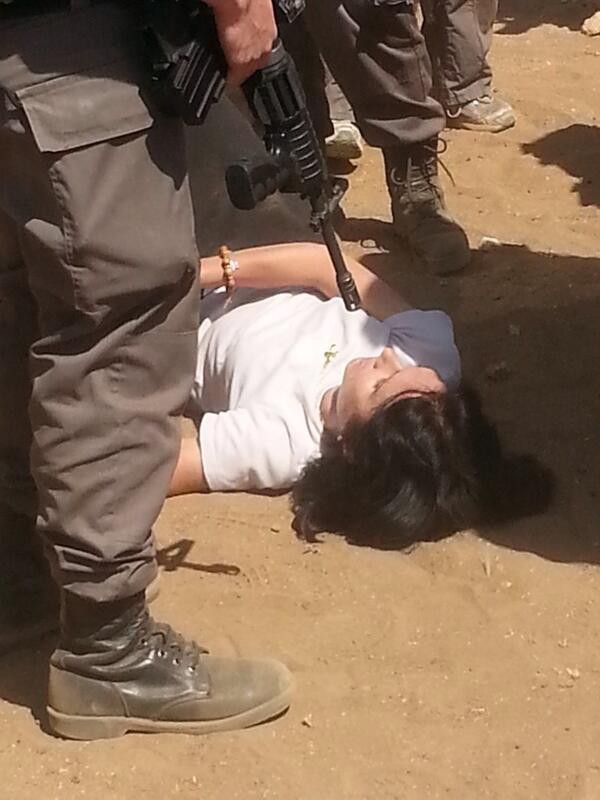 Israeli soldiers manhandled European diplomats on Friday and seized a truck full of tents and emergency aid they had been trying to deliver to Palestinians whose homes were demolished this week.
A Reuters reporter saw soldiers throw sound grenades at a group of diplomats, aid workers and locals in the occupied West Bank, and yank a French diplomat out of the truck before driving away with its contents.
“They dragged me out of the truck and forced me to the ground with no regard for my diplomatic immunity,” French diplomat Marion Castaing said.
“This is how international law is being respected here,” she said, covered with dust.
The Israeli army and police declined to comment.
Locals said Khirbet al-Makhul was home to about 120 people. The army demolished their houses, stables and a kindergarten on Monday after Israel’s high court ruled that they did not have proper building permits.
Despite losing their property, the inhabitants have refused to leave the land, where they say their families have lived for generations along with their flocks of sheep.
Israeli soldiers stopped the International Committee of the Red Cross (ICRC) delivering emergency aid on Tuesday and on Wednesday IRCS staff managed to put up some tents but the army forced them to take the shelters down.
Diplomats from France, Britain, Spain, Ireland, Australia and the European Union’s political office, turned up on Friday with more supplies. As soon as they arrived, about a dozen Israeli army jeeps converged on them, and soldiers told them not to unload their truck.
“It’s shocking and outrageous. We will report these actions to our governments,” said one EU diplomat, who declined to be named because he did not have authorization to talk to the media.
“(Our presence here) is a clear matter of international humanitarian law. By the Geneva Convention, an occupying power needs to see to the needs of people under occupation. These people aren’t being protected,” he said.
In scuffles between soldiers and locals, several villagers were detained and an elderly Palestinian man fainted and was taken for medical treatment.
The UN Office for the Coordination of Humanitarian Affairs (OCHA) said in a statement that Makhul was the third Bedouin community to be demolished by the Israelis in the West Bank and adjacent Jerusalem municipality since August.
Palestinians have accused the Israeli authorities of progressively taking their historical grazing lands, either earmarking it for military use or handing it over to the Israelis whose settlements dot the West Bank.
Israeli forces regularly demolish Palestinian homes, claiming they do not have the proper construction permits. However, the Israeli government regularly announces the expansion of settlements, which are considered illegal under international law.
Israelis and Palestinians resumed direct peace talks last month after a three-year hiatus. Palestinian officials have expressed serious doubts about the prospects of a breakthrough.
“What the Israelis are doing is not helpful to the negotiations. Under any circumstances, talks or not, they’re obligated to respect international law,” the unnamed EU diplomat said.
(Reuters, Al-Akhbar)
Obama regime calls on EU to postpone ban on Israel
Press TV – September 8, 2013
US Secretary of State John Kerry has urged the European Union (EU) to delay a planned ban on Israel over the Tel Aviv regime’s continued settlement activities in the occupied Palestinian territories, according to a senior US official.
On July 19, the EU published new guidelines in its Official Journal, banning its 28 members from funding projects in the illegal Israeli settlements in al-Quds (Jerusalem), the West Bank or Golan Heights, which the Tel Aviv regime occupied during the 1967 war.
The ban sparked anger among the Israeli officials, with Israeli Prime Minister Benjamin Netanyahu and President Shimon Peres threatening that the new directive would undermine attempts by Kerry to relaunch talks between Israel and the Palestinian Authority.
A senior US State Department official, whose name was not mentioned in the reports, said that, in a meeting with EU foreign ministers in the Lithuanian capital, Vilnius, on Saturday, Kerry called on the Europeans to consider postponing the implementation of the EU guidelines.
Kerry also asked EU diplomats to support the talks between the Israeli regime and the Palestinian Authority, which resumed in July after a three-year hiatus.
Meanwhile, the EU is to send a team to Israel on Monday to move forward on the guidelines against Israeli organizations in the occupied Palestinian territories.
Israel has announced plans to construct more than 3,000 housing units in al-Quds and the occupied West Bank since the resumption of the talks with the Palestinian Authority in July.
On August 11, Israel’s Housing Minister Uri Ariel gave final approval for the construction of 793 settlement units in the occupied east al-Quds (Jerusalem) and 394 others in the West Bank.
A day later, the EU described as “illegal” the Israeli regime’s decision to approve the building of settlement units.
Yasser Abed Rabbo, a top aide to Mahmoud Abbas, the acting Palestinian Authority (PA) chief, said on September 4 that continued Israeli settlement construction had undermined the talks with Israel.
Palestinians demand that Israel withdraw from the occupied Palestinian territories.
Related article
EU court verdict on Iran sanctions angers US
Press TV – September 7, 2013
A new EU court ruling that rejected sanctions on a number of Iranian entities has drawn the ire of the United States, prompting Washington to extend its illegal embargoes against more individuals and businesses.
The EU’s General Court in Luxembourg lifted the bloc’s sanctions against seven Iranian companies on Friday, ruling that there wasn’t sufficient evidence to justify the embargoes.
The top EU court ruled that the bloc wrongly blocked the accounts of Post Bank of Iran, the Iran Insurance Company, Good Luck Shipping and the Export Development Bank of Iran, from 2008 to 2011.
“We are very disappointed by the [EU] court’s decision today,” a spokesman for the US Treasury Department said in a statement on Friday.
The US Treasury later announced that it blacklisted six individuals and four businesses over their alleged links to Iranian oil sales.
At the beginning of 2012, the US and the European Union imposed new sanctions on Iran’s oil and financial sectors aimed at preventing other countries from purchasing Iranian oil and conducting transactions with the Central Bank of Iran.
The illegal US-engineered sanctions were imposed based on the unfounded accusation that Iran is pursuing non-civilian objectives in its nuclear energy program.
Iran rejects the allegation, arguing that as a committed signatory to the nuclear Non-Proliferation Treaty (NPT) and a member of the International Atomic Energy Agency (IAEA), it has the right to use nuclear technology for peaceful purposes.
In addition, the IAEA has conducted numerous inspections of Iran’s nuclear facilities but has never found any evidence showing that Iran’s nuclear activities have non-civilian purposes.
France cannot afford military operation in Syria
By Steven Elliot | RT | September 6, 2013
The G20 should be focusing on their flagging economies rather than planning a military operation in Syria they can’t afford, analyst, Alex Korbel, told RT. France, in particular, is at full stretch, with 16 military campaigns abroad and an ailing economy.
The Syrian conflict has eclipsed the G20 meeting in Saint Petersburg, as the international community is unable to come to an agreement over a possible military strike. Washington has put forward a plan for military intervention against the Assad regime, which it believes is responsible for a chemical attack in a Damascus suburb on August 21.
RT: If the UN team of inspectors finds that chemical weapons were used in the Damascus attack, do you believe military intervention could be justified?
Alex Korbel: I think there is no case for military intervention in Syria for several reasons. The first reason is that there is no national interest for France or the US to actually intervene in Syria. The regime of Bashar al Assad was not a problem in the past and it is not clear why it’s now a problem for France and the US. There is no clear objective in the military intervention as it is now presented. Is it about maintaining the credibility of the US? What credibility exactly? The credibility to intervene in unnecessary wars? Is it to ban the use of chemical weapons? Then why does the US have chemical weapons in its arsenal? Is it to weaken the Bashar al Assad regime? In that case you need to put boots on the ground. If it is a humanitarian way to help the civilians, then locking on cruise missiles is not the right solution.
For all of these reasons the US and France have decided to move ahead with limited military intervention. But still there is a danger of falling down a slippery slope. What if a military intervention has no effect? Are we going to see full war? What would be the consequences in the region? I am thinking about Iran and Lebanon and I am thinking about a war less than 1000 kilometers south of Russia.
There is no broad international support for this war. Germany is against it, the UK is against it, China and Russia are against it. The only countries that are in favor are France, which has not yet consulted parliament, US and Israel and Saudi Arabia. Finally, public opinion is clearly against it everywhere. We saw it in the UK and the public polls in the US and France that the public is massively against military intervention in Syria.
RT: Given the climate of economic crisis in the EU, can France feasibly participate in another military operation?
AK: The economic situation of the EU countries is really bad. We can see in France that public debt is higher than 90 per cent of GDP. We see economic growth is less than 1 per cent. We see across G20 countries on average that unemployment is at 9 per cent and growing, that public debt is 64 per cent and growing, that economic growth is 1 per cent and weakening. What needs to be done is not to intervene militarily in another country.
France is already intervening in 16 countries worldwide. Clearly we don’t have any money to finance a seventeenth operation. The purpose of France, the US and any western power is not to ‘play the cop’ around the world but actually to maintain a sound economic policy first and then maybe lead by example on the international scene.
Colombia farmers’ uprising puts the spotlight on seeds
Against the grain | September 4, 2013
On 19 August, Colombian farmers’ organisations initiated a massive nationwide strike. They blocked roads, dumped milk on cars and basically stopped producing food for the cities. The problem? Farmers are being driven out of existence by the government’s policies.
The state provides almost no support for the small-scale farming sector.1 Instead, it embraces a social and economic model that serves the interests of a wealthy elite minority. Recent free trade agreements (FTAs) signed with the US and the EU are undercutting Colombian producers, who can’t compete with subsidised imports.2 The Colombian government has been actively promoting land grabbing by large corporations, many of them foreign (Monica Semillas from Brazil, Merhav from Israel, Cargill from the US), to promote export-oriented agribusiness at the expense of family farming oriented towards food sovereignty.
But the farming sector needs real support, especially in the form of access to land and lower costs of production, protestors argue. Otherwise, Colombian potato and coffee farmers, dairy and meat producers, not to mention small fishers, will not be able to keep up. They are being evicted and exterminated.
With their backs against the wall, a movement of mobilisation began in one part of the country in June and grew into a coordinated national action for August. The farmers’ strike was soon supported by other sectors: oil industry workers, miners, truckers, health sector professionals and others. On 29 August, ten days into the strike, more than 20,000 students joined the movement and shut down the capital city, Bogotá.
The response of the government was chaotic and contradictory. Police forces violently repressed and injured a lot of protestors, not to mention journalists. More than 250 people were arrested, including high-level union leader Hubert Jesús Ballesteros Gomez, mostly on trumped up charges.
A number of people on both sides lost their lives. At one moment the government recognised the farmers’ grievances as valid and offered some concessions. In another it claimed that the movement was infiltrated by the FARC. President Santos even went on TV and claimed that “the agrarian strike does not exist”. The following day, he was filmed from a helicopter, inspecting the skirmishes and tear gas which filled the streets of Bogotá.
The mobilisation has been extremely successful in opening up space for discussion, conscientisation, solidarity and resistance in Colombia. Students, for instance, were keen to support the farmers and back their demands. They rallied loudly against GMOs and for food sovereignty. But they also wanted to put forward their own demands for free public education, nudging the mobilisation beyond agrarian concerncs into a broader wave of social pressure to change current Colombian policies.
Law 970
Seeds emerged as one highly visible issue. Under the FTA signed with Washington, as well as that signed with Brussels, Bogotá is required to provide legal monopoly rights over seeds sold by US and European corporations as an incentive for them to invest in Colombia. Farmers who are caught selling farm-saved seeds of such varieties, or simply indigenous seeds which have not been formally registered, could face fines or even jail time.3 As is the case in many other countries throughout the world, this criminalisation of farmers’ and indigenous people’s rights to save, exchange and sell seeds puts the country’s biodiversity and cultural heritage at risk.
While it’s true that the Colombian government has been moving in this direction for many years, and agreeing to such policies as part of its membership in the Andean Community or the World Trade Organisation, many people point out that it is only since the signing of the US and EU FTAs that the government has begun seriously implementing them.
In 2011, the Colombian government authorities stormed the warehouses and trucks of rice farmers in Campoalegre, in the province of Huila, and violently destroyed 70 tonnes of rice that it said were not processed as per the law. This militarised intervention to destroy farmers’ seeds shocked many, and inspired one young Chilean activist, Victoria Solano, to make a film about it. The film is called “9.70” because that is the number of the law adopted in 2010 that articulates the state’s right to destroy farmers’ seeds if they don’t comply.4
Today, thanks to the force, tenacity and justness of the farmers’ protest, people from all walks of life in Colombia are discussing that film, as can be seen in the mass media, social networks and the streets, and asking why the government is pursuing such senseless policies.
Support the movement
There is no question that Colombian farmers can feed the country very well, in a way that provides jobs, dignity and a healthy environment. But the government is too firmly attached to an economic model that caters to crony interests and holds no place for small-scale family farming. We should all support the popular agrarian struggle in Colombia to turn that model around. It’s not too late.
As one small concrete action, the documentary film “9.70” — which you can watch online in Spanish at http://youtu.be/kZWAqS-El_g — is seeking funds to produce a version with English subtitles so that more people around the world can understand what the Colombians farmers are facing and support them to defeat such policies. The smallest contribution helps. Please go to http://idea.me/proyectos/9162/documental970 to participate. The deadline is 10 September!
As another meaningful action, the Latin American Coordination of La Via Campesina are seeking international solidarity initiatives to support the strike. Please go to http://goo.gl/9u6RXJ to learn more. Again, time is of the essence!
Beyond Colombia, the battle over similar seeds legislation is raging right now at very high political levels, and across the countryside, in Chile and Argentina as well. One concern is that some of the more aggressive elements adopted by the government of Colombia could infiltrate other Latin American countries as well. The need to scrap these laws is truly urgent indeed!
Going further:
- “La historia detrás del 970“, Semana, Bogotá, 24 August 2013
- Grupo Semillas, “Colombia: Las leyes que privatizan y controlan el uso de las semillas, criminalizan las semillas criollas“, Bogotá, 26 August 2013
- Julia Duranti, “A struggle for survival in Colombia’s countryside“, 30 August 2013
Visit the bilaterals.org website for more coverage (in English, French and Spanish) of the general agrarian strike and the fight over Law 970
For more information about the struggles around the seed laws in Colombia, please contact Grupo Semillas (“Seeds Group”) at semillas@semillas.org.co or visit their website http://semillas.org.co/
To learn more about the political battle currently taking place in Chile, please get in touch with Anamuri, the National Association of Rural and Indigenous Women, at secretariag@anamuri.cl
For information about what is happening in Argentina, please contact Diego Montón at the Latin American Coordination of La Vía Campesina, at secretaria.cloc.vc@gmail.com.
Notes
1 Almost one-third of the Colombian population lives in the countryside and nearly 60% of those in the rural areas live, to some extent, in hunger. See Paro Nacional Agrario y Popular, Pliego de peticiones.
2 The effects are just starting, but they are real. US agricultural exports to Colombia shot up 62% in the first year of the agreement, while Colombian farm exports to the US went down 15%. (See USTR, and Portafolio)
3 To be registered and certified, seeds need to meet criteria of genetic uniformity and stability, to suit agroindustrial processes. This excludes, by definition, peasant seeds — or criollo varieties, as they are called in Colombia — which tend to be diverse, adaptive and dynamic. Under the current rules in Colombia, if a farmer wants to plant criollo seeds, s/he has to get authorisation from the government, can only do it once, can only do it on five hectares or less and must consume the entire harvest at home (cannot sell it on the market).
4 See the film’s Facebook page and on Twitter look up #NoMas970. In the three years of Law 970 so far (2010-2012), the government rejected or destroyed nearly 4,000 tonnes of seeds.
Colombia: With a “Mea Culpa,” the Arrogant Santos Government Relents
By Nazih Richani | Cuadernos Colombianos | August 27, 2013
The rural workers who have mounted Colombia’s national agrarian strike are staying the course after four peasants and one policeman were killed and scores more detained. Hundred of thousands of peasants and small farmers are participating in this historic mobilization whose scope and magnitude has not been seen for decades. But this is just a tactical triumph in a long struggle to address the current crisis in the rural economy. The crisis has been generated by a neoliberal model of development based on the extraction of raw materials and large bio-fuels agribusiness. It has been exacerbated by free trade agreements increasingly transforming Colombia into an importer of its basic food necessities. In August 19 when the strike started President Juan Manuel Santos ridiculed it by declaring that “el paro agrario no existe,” that is, “the agrarian strike does not exist.” Well, against his wishful thinking, the strike is still going strong after nine days (as of this writing, 27 August) and has expanded to include most of the country’s departments. It has put the agrarian crises on the social and political map and has highlighted its centrality in a country in which some 31.6% of the population still live and depend on the agrarian economy (according to the UNDP Report of 2011 on Colombia’s rural economy).
Finally Santos acknowledged the strike in a meeting that took place on Monday August 26, with peasants’ representatives in Tunja, an epicenter of the mobilization and the capital of the department of Boyacá. Speaking to peasant representatives, Santos openly apologized, saying “Mea Culpa” for his earlier dismissive comment on the strike and promised to continue his negotiations. Santos recognized the obvious, especially after the mobilization reached La Casa de Nariño, his presidential palace in Bogota, where 8,000 demonstrators in Bolivar Plaza raised their voices and their casseroles in solidarity with the peasants.
The fundamental question is whether this strong show of force by the peasants can translate into policy that takes Colombia in a different direction? That is a different matter. Can this strike open the door for a very serious discussion of the root cause: the economic model and the free trade agreements with the United States, Canada, and EU. How would this wide mobilization resonate in Havana where the Santos government is negotiating with the Armed Revolutionary Forces of Colombia (FARC)? The answers would depend on the resilience of the organizations that led the strike and the effectiveness of the democratic and revolutionary forces in pushing for an economic change that safeguards the subsistence peasant economy and the real producers of “bread, milk and butter” in Colombia.
Related article
- Social protest grows across Colombia as trade union leader arrested (colombiaresistance.wordpress.com)
ADL orders YouTube to disable Press TV account: Emadi
Press TV – August 18, 2013
Video-sharing site YouTube deactivated Press TV’s official page without explanation after the Israeli-American Anti-Defamation League (ADL) ordered it to terminate the Iranian channel’s live broadcast.
“We have not been able to upload new videos on our official YouTube page since July 25. Both YouTube and (its parent company) Google have declined to comment,” said Press TV Newsroom Director Hamid Reza Emadi.
He added that YouTube was “in fact responding to an ADL order to stop us from revealing Israeli crimes to the world.”
An article on ADL’s official website has accused Press TV of bypassing the West’s sanctions by broadcasting live via YouTube and other internet and mobile platforms.
“ADL has contacted YouTube regarding concerns about Press TV,” reads the article, further noting that the station’s “broadcast on YouTube comes at a time when the United States, the European Union and others in the international community are seeking to isolate Iran.”
Since January 2012, Press TV has come under mounting pressure from European governments and satellite companies, which have taken the alternative channel off the air across the European Union.
In a statement published on the official website of the American Jewish Committee (AJC), the pro-Israeli lobby has lauded Spain’s efforts to ban Press TV, saying Madrid has pulled the plug on the Iranian channel following months of negotiations with the AJC.
“In recent years has emerged a channel that not only challenges the Zionists’ long-time media dominance, but also has it questioned the West’s silence on their (the Zionists’) crimes against humanity. That’s Press TV and they’re determined to silence it,” Emadi added.
He said Press TV had to create an alternative YouTube account to upload its videos.
“Viewers can now watch our videos at http://www.youtube.com/user/PresstvNewsCast,” he said.
Israel Launches i24 News, Shows “Modern” Face
By Doha Shams | Al-Akhbar | August 3, 2013
On July 17, a new Israeli news channel, dubbed i24 News and inspired by France24, began broadcasting from the city of Jaffa in occupied Palestine, where it is based. The channel was launched with the aim of showing the “true image” of Israel, especially in Europe, where public perceptions of the Jewish state have become drastically unfavorable.
Before anyone, in Lebanon or beyond, claims that Israel has launched a neutral news channel, we want to underscore the fact that the purpose of the channel is the opposite of “showing the true face of Israel,” as i24’s management has claimed.
i24 News began nearly two years ago, when the company established Guysen TV, a French-language Israeli channel. i24 hired Frank Melloul, a French-Israeli of Moroccan origin, as the channel’s CEO. Melloul previously served at the French foreign ministry, and later as a media adviser, then as director of strategy at Audiovisuel Extérieur de la France (AEF), before being appointed as head of international development at France24.
The French character of the new Israeli channel, which also broadcasts in English and Arabic (for a few hours only for the time being), does not stop here. Patrick Drahi, i24 News’ biggest shareholder, is a French-Israeli businessman. Drahi is also the controlling shareholder of the Israeli HOT Cable TV Company and HOT mobile, a major mobile network operator in the Jewish state.
For several years now, Israel’s racist and criminal side has been exposed to the European public, despite the European governments’ intricate ties with Israel.
i24 ostensibly belongs to the private sector, with its chief executives denying any financial ties with the state of Israel. Israeli media coverage of i24 has quoted sources at the channel as saying the channel will help Israel show the world that it is “vibrant” and “modern.”
After a year and half of preparations, the channel continues to encounter problems finding correspondents in the Arab countries – despite having “Jewish, Muslim, Christian and Druze journalists” in its crew of 170 Israeli reporters, according to the CEO Melloul. In October 2012, direct negotiations with foreign correspondents in Lebanon failed, prompting the channel to hire GRNlive, a London-based group, to secure reporters in the region, without disclosing the channel’s name or identity.
GRNlive produces and supplies reports, redistributing them to other TV channels, and also provides “correspondent on air within minutes,” according to the company’s official website. Still, foreign correspondents in Lebanon could not be fooled. One such correspondent we spoke to said, “A woman in London who is originally from Iraq negotiated with me to make a live report from Beirut. I asked her who the report was for, and she had no choice but to disclose the real identity of the end buyer.”
The journalist had been contacted by GRNlive a few days ago when the European Union designated Hezbollah’s military wing as a terrorist organization. He went on to say, “Naturally, I was upset because she would not tell me who the client was, but I refused and told her that I was based in Lebanon, and was not interested in anything that could jeopardize my career here.”
We also heard similar stories from two other foreign correspondents, including one who is French. It seems that the Israeli TV channel is desperate to get reports from here, albeit its attempts have all failed so far.
Meanwhile, one quick look at the channel’s website reveals its true intent to mislead public opinion. For instance, in an article about Mohammed al-Dura, the Palestinian child who was killed by the Israeli army while in the arms of his civilian father, in front of a French TV camera, the author – unsurprisingly – ends up dismissing the incident, and misleading the uninformed readers and viewers.
When it comes to coverage of Lebanon, all we could find is a French editorial about singer-turned-radical Islamist Fadl Shaker. As to why the channel’s website chose Shaker, I found the answer in the third paragraph, which described Shaker as a staunch supporter of Palestinian rights, before turning to jihad under the wing of Salafi cleric Sheikh Ahmad al-Assir, killing 17 soldiers in the Lebanese army.
In other words, the banal article sought to link one’s support of Palestine with one’s metamorphosis into a jihadi terrorist who kills soldiers. Despite this banality and the usual vitriol that [we] have become so much accustomed to in Lebanon, Palestine, and Syria, we must remain vigilant about what i24 broadcasts, and we must counter it. Unfortunately, al-Manar TV’s French-language website is probably not sufficient for this task.
The Boycott of Israel Eight Years In – An Analysis
By Lawrence Davidson | July 28, 2013
Part I – Happy Birthday, BDS
The Boycott, Divestment and Sanctions (BDS) movement directed toward Israel is eight years old. It was started back in 2005, when a coalition of Palestine-based social and economic organizations called for such a comprehensive effort.
At first the BDS movement appeared to be a long shot. Israel, with its worldwide coterie of Zionist supporters, both Jewish and Christian, seemed invincible. Particularly in the Western world, the belief in Israel’s legitimacy had reached the status of sacred tradition. The Zionists worked very hard to achieve this status by controlling the historical interpretation of events that had led from World War I and the Balfour Declaration to the creation of Israel in 1948, and beyond. They might well have been able to maintain control of Israel’s past, present and future if the Zionist leadership had not succumbed to the sin of hubris. They became so ideologically self-righteous and militarily muscle-bound that they believed their place in the world to be untouchable. Thus, as they built a country based on discrimination and colonial expansion in an age increasingly critical of such societies, they refused all compromise with the Palestinians and treated criticism of their behavior and policies as at once anti-Semitic and irrelevant. They therefore failed to notice that their stubbornness was allowing others to erode the Zionist version of the history of modern Palestine/Israel.
Eight years is not a very long time, but a surprising amount has been accomplished. Increasing numbers of people, particularly in the Western world, have been made aware of the plight of the Palestinians as well as their version of the history of Palestine/Israel. With this change in historical perspective, BDS established a foothold and started to grow. The movement has spent most of its time since 2005 coordinating a series of efforts to convince private-sector consumers, businesses, academics and artists to cut their ties with the Zionist State and its colonies. The latest success in this effort came just recently, when two of the largest supermarket chains in the Netherlands announced they would no longer sell Israeli merchandise manufactured or grown in the Occupied Territories (OT). Indeed, so successful has BDS been that the Israeli government has established an official task force to counteract it.
Part II – The European Union Makes a Move
Another recent event may be even more significant, because it suggests the potential for expanding BDS from the private to the public sphere. This was signaled when the European Union (EU) issued new rules for implementing certain categories of funding agreements with Israel. Funding of grants, prizes, loans and other financial cooperative ventures will now exclude Israeli institutions located in or doing business with the OT.
I want to emphasize the notion of “potential” because the EU move is not a boycott action as such. It is a signal to Israel that the EU will not recognize Israel’s claim to any part of the Occupied Territories without a peace settlement, and therefore this move serves as a point of pressure on the Israeli government to give up its hubris and negotiate with the Palestinian National Authority (PNA). By the way, the PNA as presently constituted is not a representative body and therefore has no legal authority to negotiate anything. However, the EU (along with the Israelis and the United States) persistently ignores this fact.
Nonetheless, this EU ruling is a step in the right direction, and some important Israelis understand the message. For instance, the Israeli peace organization Gush Shalom released a statement that said that the “EU has started to confront the government of Israel – and every citizen of Israel – with a road sign that cannot be ignored.” At least not without moving Israel toward “being an international pariah.” The renowned columnist and reporter for Israel’s newspaper Haaretz, Gideon Levy, has declared “The change [Israel needs] won’t come from within. . . . Change will only come from the outside.” Therefore, “Anyone who really fears for the future of the country needs to be in favor of boycotting it economically.” And, Israel’s justice minister, Tzipi Livni, the present government’s only minister publicly in favor of negotiations with the Palestinians, has warned that the threat of European economic sanctions extends beyond the OT. “It’s true that it will begin with the settlements,” she stated. “But their [a growing number of Europeans’] problem is with Israel, which is perceived as a colonialist country, so it won’t stop with the settlements and will reach all of Israel.”
Livni is correct. Israel’s version of history notwithstanding, the country’s origin is as a colonial settler state. As suggested above, the result was an inherently discriminatory society. This is not because most Israeli citizens are Jewish. It is because most are Zionists. Modern Zionism, which still reflects the colonial outlook of nineteenth-century imperial Europe, is the guiding ideology of Israel, and it proclaims that the country must be a Jewish State. Unfortunately, you can’t design a country for one group only, in a land where there also exists other sizable groups, and not end up with a discriminatory and oppressive society. Therefore, even if, by some miracle, the Israelis see the light and withdraw from the OT, there will still be a BDS movement agitating for an end to discrimination against non-Jews within the 1948 borders.
Part III – Israel’s Negative Reaction
Becoming a real democracy, where all citizens enjoy genuine political equality, is Israel’s only way of escaping the inevitable isolation that comes with the growing BDS movement. Yet, there is no reason to believe that the ideologues who now control the Israeli political and religious power structures are going to move in this direction. One can see this not only from the growing effort the Israeli government is putting into countering BDS, but also from the angry reaction of its political leaders to the EU decision.
Prime Minister Benjamin Netanyahu reacted to the EU decision with the temperament of a monarch. “We will not accept any external edicts on our borders.” That was, perhaps, the royal “we” he used. Then it was back to the first-person singular: “I will not let anyone harm the hundreds of thousands of Israelis living in Judea and Samaria, in the Golan Heights, or in Jerusalem – our united capital.” The prime minister was quite off base in his pronouncements. He is the head of a country that has meticulously avoided setting borders for decades just so Israel could expand at opportune moments. That sort of imperial behavior is not well accepted in today’s world. Also, unless he can greatly increase Zionist lobby leverage on the EU, he has no way to prevent the “harm” that may finally befall his compatriots for naively assuming the whole world will accept their criminal behavior forever.
The entire episode points to the fact that, both in the private and public sectors of Western society, greater numbers of people no longer follow the line of historical interpretation set down by the Zionists. This is a major shift. Many Zionists might see this as a sign of growing anti-Semitism, but it really is nothing of the sort. There is nothing inherently Jewish about discrimination and colonialism. However, the same cannot be said for modern Zionism.
Part IV – Conclusion
Again, the BDS movement is only 8 years old. We can compare this to the more than 30 years it took the boycott of South Africa to end apartheid. So, comparatively, BDS is only at the beginning of its trek. Its fast start and ongoing achievements should bring hope and pride to those involved in the movement. They should also raise some serious second thoughts in the minds of those Israelis who think Netanyahu and his government of ideologues can prevent their country’s increasing isolation.
EU’s response to NSA? Drones, spy satellites could fly over Europe
RT | July 27, 2013
The European Union is pondering an EU Commission proposal to acquire a fleet of surveillance drones, satellites, and planes as part of an “ambitious action” to boost the European defense industry. It follows revelations of the NSA’s spying programs.
The European Commission has issued a 17-page report, proposing some concrete steps that would encourage pan-European defense cooperation.
“Maintaining and developing defense capabilities to meet current and future challenges in spite of severe budget constraints will only be possible if far-reaching political and structural reforms are made. The time has come to take ambitious action,” the Commission’s report said.
One of the actions suggested in the report is funding a pre-commercial procurement scheme to acquire prototypes of some technologies – including drones.
The full list of technology candidates includes equipment to detect chemical, biological, radiological, nuclear and explosives threats (CBRNE), “communication equipment based on software defined radio technology,” and remotely-piloted aircraft systems (RPAS), otherwise known as drones.
According to Commission Staff Working Document accompanying the report, the European Commission has for long been eyeing the possibility of using drones over Europe.
“The European Commission has long identified the potential of this emerging technology and supported the market by investing in research and innovation relevant for RPAS through the Framework Programme for Research. A broad stakeholders’ consultation has demonstrated the necessity for action at EU level, setting as priorities the further development of RPAS civil applications and the integration of the systems into the European air space as soon as possible,” the document said.
It also claimed it would “take into account the data protection and privacy concerns associated with the civil use of RPAS.”
The drones are also proposed to be used in conjunction with other surveillance technologies, including aircraft and satellites.
Lamenting the absence of a structural link between civil and military space activities in the EU and saying that Europe “can no longer afford” the economic and political cost of such a divide, the Commission focused on several technologies that are said to be able to serve both civilian and defense objectives.
These include space surveillance and tracking (SST), which are said to be aimed at protecting satellites from space debris, boosting satellite communications (SATCOM), and building a pan-EU cutting-edge satellite surveillance capability.
The report said it is “crucial” for a number of technologies to be explored and developed in the EU, including “hyper-spectral, high resolution satellites in geostationary orbit or advanced ultra-high resolution satellites in combination with new sensor platforms such as RPAS.”
The Commission has yet to estimate to what extent the proposed moves are useful for EU security. Based on the assessment, it will “come up with a proposal for which capability needs, if any, could best be fulfilled by assets directly purchased, owned and operated by the [European] Union.”
A response to Snowden’s NSA leaks?
The Commission’s report is part of the ongoing debate on the common EU defense policy which is set to culminate in a summit of European leaders in December.
Media reports have said that the European Commission and Lady Ashton’s European External Action Service actually want to create military commands and communications systems to be used by the EU for internal security and defense purposes.
The UK, which stoutly opposes such motion, is said to be leading an intense behind-the-scenes battle against establishing an EU military operations headquarters in Brussels.
Curiously, senior European officials regard the plan as an urgent response to the recent scandal over NSA whistleblower Edward Snowden’s revelations on American and British communications surveillance.
“The Edward Snowden scandal shows us that Europe needs its own autonomous security capabilities, this proposal is one step further towards European defense integration,” a senior EU official said, as quoted by the Daily Telegraph.
However, plans to create the EU’s own security and spying agency and employ spy drones and satellites for “internal and external security policies” – which would reportedly include police intelligence, internet surveillance, protection of external borders, and maritime overwatch – will likely raise concerns that the EU is creating its own version of the NSA.
The Open Europe think tank has already warned that the EU “has absolutely no democratic mandate for actively controlling and operating military and security capabilities.”
“The fact is, European countries have different views on defense and this is best served by intergovernmental cooperation, not by European Commission attempts at nation-building,” Open Europe research analyst Pawel Swidlicki said.
Featured Video
No Vote, No Representation, No State: Democracy, Israeli Style
or go to
Aletho News Archives – Video-Images
From the Archives
Sanctions, War and the Policy of Dual Containment
By SASAN FAYAZMANESH | March 17, 2008
It is now nearly three decades since the Unites States adopted the policy of dual containment of Iran and Iraq. While much has been written about the containment of Iraq, there has been very little in-depth analysis of this policy when it comes to Iran. In a book that is going to be released on March 31, 2008, entitled The United States and Iran: Sanctions, Wars and the Policy of Dual Containment (Routledge), I attempt to address this shortcoming by investigating when and why the US policy of containment of Iran came about, how it evolved, and where it stands today.[1] To the extent that Israel has been involved in US policy making, the study will also include the role that Israel has played in the containment of Iran. Also, since the fate of Iran has been inextricably linked to that of Iraq, occasionally the investigation will overlap with the containment of Iraq.
The policy of dual containment of Iran and Iraq originated during the Carter Administration, but it was not until the Clinton Administration that the expression “dual containment” became popular. … continue
Blog Roll
 Aletho News
- No Vote, No Representation, No State: Democracy, Israeli Style
- Zionist Bought Senate Blocks Information About American Citizens Killed By Israel
- While Gaza dominates the UN, these are the people keeping it alive
- New Report: “Scholasticide and Genocide in Gaza: Assessment, Testimonies and Legal Analysis”
- ‘THAAD Delusion’: Iran war exposes US missile shield limits – The Atlantic
- Moscow issues warning to NATO over Russian exclave
- Yes, the Iran war has destroyed Trump’s presidency
- The fallacy of US delusions about Iran’s economic collapse
- Hezbollah denies Syria cell link, warns of Israeli plan to sow discord
- The legacy of US sanctions, war, and occupation in Iraq
- If Americans Knew
- Mamdani releases plan to combat antisemitism and hate crimes in New York City
- Iran’s Revolutionary Guards Publish Letter to the American People
- DMFI launches $1 million ad campaign supporting Virginia’s Elaine Luria
- US Senate blocks resolution seeking report on Americans killed by Israel
- Israeli Attacks Kill Ten Palestinians in Gaza
- Massacre at Minab: The School That Became a Grave
- Israeli media: The IDF Shows It Doesn’t Turn a Blind Eye; It Actively Emboldens Settler Havoc
- As settlers ravage West Bank, Israeli forces kill 10 in Gaza – Daily Update
- New Report: “Scholasticide and Genocide in Gaza: Assessment, Testimonies and Legal Analysis”
- Ex-Biden officials are desperate for a Gaza scapegoat
- No Tricks Zone
- Green Energy Debacle: German Expert Professor Fritz Vahrenholt Warns Of Severe Economic And Social Consequences
- Two More Paleo Reconstructions Affirm Meters-Higher Sea Levels Across Ireland, Brazil 7000-6000 Years Ago
- New Study: Earth And Venus Surface Warmth Largely Explained By Convection And Lapse Rate, Not CO2 Or Radiation
- 2025 Nature Paper Claiming Worsening Global Drought Gets RETRACTED …Heavily Flawed
- New Study: ‘Global Drought Shows No Detectable Recent Acceleration Under Climate Warming’
- Economic Masterminds: German Socialists Suggest Taxing Productivity Gains Stemming From Using AI
- The South China Sea Has Not Been Cooperating With The Climate Change Narrative
- Energy Crisis: Germany Enters Heating Season With Historically Low Gas Reserve Fill Levels
- New Study: The Antarctic Ice Sheet Gained Mass From 2020-2024 Due To Staggering Snow And Ice Accumulation
- Study: Ocean Heating Rates From Thousands Of Years Ago ‘Dwarf’ Modern Ocean Heating Rates

