Trump gives Zelensky bum’s rush and flushes the European ploy to escalate war against Russia
By Finian Cunningham | Strategic Culture Foundation | March 1, 2025
After his mauling from President Trump live on TV and then being booted out of the White House, Ukraine’s Zelensky immediately phoned European leaders.
That reaction shows that the Ukrainian actor-turned-president had flown to Washington from Kiev not to merely sign a supposed minerals deal with the U.S., but to inveigle Trump into a trap to escalate the proxy war in Ukraine against Russia.
No doubt there is consternation and alarm among the Europeans that their agenda for prolonging the war against Russia is in disarray. Worst still, a furious Trump may now cut Ukraine loose and leave it completely at the mercy of Russia.
European leaders are huddling in London on Sunday for an emergency meeting convened by British Prime Minister Keir Starmer. Zelensky is to attend and be showered with European expressions of support and billions more of taxpayer money. Incredibly, they still champion the impudent conman as a “Churchillian hero”.
The fallout in the Oval Office on Friday was a sordid spectacle. Trump and his vice president, JD Vance, tore into Zelensky under the full glare of TV cameras for daring to make more demands for U.S. security guarantees as part of a deal giving American companies access to Ukraine’s alleged mineral wealth, including oil, gas and rare earth metals.
The meeting started cordially, but Trump refrained from giving specific “security guarantees” to Ukraine. Zelensky’s sniveling insistence on getting explicit U.S. commitments for military support following any peace deal with Russia triggered Trump and his officials to rebuke the Ukrainian leader for wrangling in public and not being respectful.
After their fireside fireworks, an incensed Trump gave Zelensky the bum’s rush. No minerals deal was signed and Zelensky left Washington empty handed. That’s not the end of it either. Trump later told reporters that Zelensky is not welcome back until he is ready to make the peace with Russia.
Trump was astute to the attempted rumble. He told reporters on the White House lawn following the slap-down of Zelensky: “We want peace. We’re not looking for somebody to sign up a strong power and then not make a peace deal because they feel emboldened. That’s what I saw happening. He wants to fight, fight, fight. I am not looking to get into anything protracted.”
Zelensky’s immediate phone calls to French President Emmanuel Macron and the NATO chief Mark Rutte after the White House fiasco is the big reveal here.
Days before Zelensky’s visit to the White House on Friday, European leaders had lobbied Trump for U.S. security guarantees as part of any peace deal with Russia.
Macron met Trump on Monday. On Thursday, it was Starmer’s turn to ingratiate with Trump. The EU’s top diplomat Kaja Kallas was also in Washington. Significantly, her meeting with U.S. Secretary of State Marco Rubio was abruptly called off “due to scheduling issues.”
The main objective for Macron and Starmer was to extract a commitment from Trump for a military “backstop” in Ukraine to beef up their proposal to deploy French and British troops under the guise of “peacekeepers”.
The British wanted American “air cover” for their troops, according to the BBC.
Both Macron and Starmer were palmed away with vague nothings despite the bonhomie and compliments, and a British sweetener from King Charles to invite Trump on a royal visit.
Trump’s diplomatic overture to Russian President Vladimir Putin, beginning with a phone call on February 12 followed by a high-level meeting of U.S. and Russian diplomats in Saudi Arabia on February 18, has sent shockwaves across the European NATO members.
They feel aggrieved that Trump is going to make a peace deal with Putin without them. The Europeans are still beholden to the propaganda narrative of the previous Biden administration about “defending democracy and sovereignty in Ukraine from Russian aggression.”
Trump wants out of the extravagant mess in Ukraine. He recognizes that the conflict was always a proxy war with an ulterior agenda to defeat Russia. Hundreds of billions of dollars and euros have been wasted fueling a futile proxy war that, as it turns out, Russia is decisively winning.
Marco Rubio, the U.S. top diplomat, disclosed in an interview to CNN after the Oval Office spat, that a European foreign minister had told him that “their plan” was to keep the war in Ukraine going for another year in the hope that it would eventually “weaken Russia” and make Moscow “beg for peace.”
The callousness of the Europeans and their Russophobic obsession are grotesque. The three-year conflict in Ukraine has cost up to one million military deaths, millions of refugees across Europe, and broken economies, not to mention the danger of it turning into World War Three.
Sneakily, the Europeans are covering their desire for continuing the proxy war with a belated apparent concern for making peace and backing Trump’s diplomacy.
Macron and Starmer ostensibly commend Trump (after initially being in a flap over this call with Putin) and they talk about “finding a path to a lasting peace.”
However, their seeming offer of deploying French and British soldiers as “peacekeepers” is a Trojan Horse that has nothing to do with keeping the peace. For its part, Moscow has categorically stated that any NATO troops in Ukraine will not be acceptable and will be attacked as combatants.
That is why Macron, Starmer and other European leaders were so insistent on trying to get Trump to give “security guarantees”. The so-called American military “backstop” would be a way to escalate the proxy war against Russia.
Zelensky was in Washington on a mission to beguile Trump into giving a security guarantee while dangling the bait of a lucrative minerals deal.
It was reported that the Trump White House wanted to cancel the meeting for Friday before Zelensky departed from Ukraine on Thursday. But Macron intervened and implored Trump to go ahead with the reception.
Zelensky, having got used to being indulged with endless blank checks, thought he could wheedle more out of Trump than just a mining deal. He was expected to extract the direct U.S. military involvement that the European Russophobic leaders want. In that way, the proxy war would escalate and those riding the war-racket gravy train would continue to extort the world’s biggest security crisis.
Fortunately, Trump gave Zelensky the bum’s rush and flushed out the European ploy.
The irony is that Trump had earlier in the week lavished praise on Macron and Starmer, exalting France for being America’s “oldest ally” and Britain for its “special relationship”. Trump might want to radically revise those cliched notions.
Trump takes on the ‘collective west’
By M. K. BHADRAKUMAR | Indian Punchline | March 1, 2025
The dramatic scene in the Oval Office on Friday evening signals that President Donald Trump is decoupling the US from the ‘forever war’ in Ukraine that his predecessor Joe Biden left behind. The war is poised to end with a whimper, but its ‘butterfly effect’ on our incredibly complex, deeply interconnected world will define European and international security for decades to come.
The western media which is hostile toward Trump, have seized the opportunity to caricature him as an impulsive figure in a role reversal with Zelenskyy. In reality, though, Trump has been literally driven to this point by the Biden administration.
The highly charged emotional reaction by the European Commission president Ursula von der Leyen commiserating with President Zelensky speaks for itself: “Your dignity honours the bravery of the Ukrainian people. Be strong, be brave, be fearless. You are never alone, dear President.” Trump’s refusal to give Von der Leyen an appointment may partly explain her fury as a woman scorned. Truly, the ‘Collective West’ find themselves at a crossroads and do not know which road to take. Without US air cover and satellite inputs, western troop deployment in Ukraine will be impossible. Even French Emmanuel Macron would agree that his troops will be put through a meat grinder.
Both Von der Leyen and Macron had a whale of a time as cheerleaders of Biden’s war but any further adventures in Ukraine will be suicidal, to put it mildly. Ukraine’s military will collapse if Trump freezes support. None of the European powers will risk a collision with Russia.
Trump knows by now that the western narrative of Biden’s war is a load of bullshit peppered with falsehoods and outright lies, and that the war erupted only out of the diabolic western plot to poke the bear, which got provoked finally and hit out.
The CIA’s coup in Kiev in February 2014 was a watershed event paving the way for a NATO presence on Ukrainian soil. Indeed, terrible things happened, which have been shoved under the carpet — for instance, then German foreign minister (current president) Frank-Walter Steinmeier’s dubious links with the neo-Nazi Ukrainian groups who acted as storm troopers in the 2014 coup. Just think of the grotesqueness of it — a German social democrat patronising neo-Nazi groups!
Most certainly, Trump knows that the US deep state had set in motion an agenda to destabilise the Russian Federation and dismember it as the unfinished business no sooner than the Soviet Union was dissolved. The Chechen War has no other explanation. In fact, Putin has accused US agents of directly aiding the insurgents.
Again, the Bill Clinton administration floated the idea of NATO expansion as early as in 1994. It came out of the blue but was obviously a work in progress since the disbandment of the Soviet Union. By the mid-nineties, even Boris Yeltsin understood that he was played nicely. The return of Evgeny Primakov to the Kremlin and Yeltsin’s overture to Beijing were the surest signs of a course correction.
Those familiar with Soviet history had known all along that Ukraine would be the theatre where the US would try to seal the fate of Russia. If further confirmation was needed, it came with the CIA’s colour revolution in Ukraine in 2003 where the election was rigged (as is happening in Romania today) and carried to a third round till the proxy emerged victorious and surely, Viktor Yushchenko brought the NATO membership issue to the table. At the 2008 NATO summit in Bucharest, George W. Bush insisted that the alliance formally offered membership to Ukraine!
Today, Britain’s MI6 calls the shots in Kiev. Zelenskyy admitted recently that much of the money given by Biden simply ‘disappeared’. Sordid tales of massive kickbacks and corruption are galore. Biden ignored them. The Biden family’s involvement in Ukraine’s cesspools is widely known. Contrary to his pledge earlier not to do so, Biden felt constrained finally to grant a presidential pardon to son Hunter Biden so that he wouldn’t end up in jail.
Suffice to say, Zelensky’s ‘strategic defiance’ stems out of his quiet confidence that western leaders — starting with Boris Johnson and Biden — who have been fellow travellers in the gravy train during the past three years of the war are beholden to him till eternity.
The axis between Zelensky and his European Union supporters is cajoling Trump, pressuring him and flattering him in turn to get him on board the bandwagon so that the war rolls on for another four years. Last week alone, the presidents of France and Poland and the British prime minister descended on the White House one after another seeking assurance that the war in Ukraine will continue. But Trump has refused to oblige.
Zelensky and his European backers want a ‘forever war’ in the western border lands of Eurasia, the traditional invasion route to Russia. And last week Trump again ruled out NATO membership for Ukraine. He also pointed to the ongoing talks on “major economic development transactions which will take place between the United States and Russia.”
Trump repeated last week that the war could be ended “within weeks” and warned of the risk of escalation into a “third world war.” Basically, he realises that this is an unwinnable war, and is apprehensive that a prolonged war may transform into a quagmire sinking his presidency and derailing the grand bargain he hopes to strike with the two other superpowers, Russia and China, to create synergy for his ambitious MAGA project.
Trump has chalked up 2026, the Quarter Millennial of the United States Declaration of Independence, for hosting the leaders of Russia and China on American soil to celebrate the high noon of his quest for world peace. The European political elites weaned on the liberal-globalist ‘rules-based order’ cannot understand Trump’s deep-rooted convictions and his abhorrence of war.
The big question now is wether the unprecedented fracas in the White House yesterday could backfire on Zelensky, since Washington has significant leverage vis-a-vis Kiev and given the latter’s heavy dependence on the US for some of the critical elements of its defence.
Following the Oval Office argument, Zelenskyy has issued a lengthy statement admitting that it is “crucial” for Ukraine to have Trump’s support. A patch-up cannot be ruled out but the transatlantic system has received a big jolt, as the overwhelming majority of European countries have voiced support for Zelensky. In fact, there hasn’t been a solitary voice censuring Zelensky. Britain kept mum. Keir Starmer, UK prime minister is hosting a meeting of European leaders on Sunday which Zelensky is due to attend. It is unlikely that Europeans will push the envelope further
In this dismal scenario, the best hope is that Zelensky’s ouster, which seems probable, will not be a violent bloody event, considering the power rivalries within the regime in Kiev. At any rate, his replacement may not be a terrible thing to happen since it would necessitate holding the long overdue election and lead to the emergence of a legitimate leadership in Kiev, which has now become a dire necessity for what Trump would call ‘common sense’ to prevail.
German factories counting on return of Russian gas – Bloomberg
RT | March 1, 2025
Key German industrial leaders have expressed their desire to see Russian gas return to Europe once a resolution to the Ukraine conflict is found, Bloomberg has reported.
Chemical and manufacturing sector representatives argue that affordable energy is crucial for Germany’s economy to recover, the agency wrote on Friday.
European gas prices surged after the Ukraine conflict escalated in 2022. Pipeline gas imports from Russia mostly ceased due to sanctions and the sabotage of the Nord Stream pipelines in 2022. Nevertheless, EU nations have still been buying record volumes of Russian LNG, the cost of which has nearly quadrupled in three years, according to Eurostat.
Christian Gunther, managing director of the Leuna chemical park, emphasized that bringing back Russian gas would be a logical step if peace is achieved. “We must ensure the damage caused by this conflict is repaired,” he told Bloomberg, adding that resuming deliveries “would be the logical consequence.”
In 2021, Russian pipeline gas accounted for 32% of the total demand of the EU and UK, while Germany relied on Russia for 55% of its consumption, according to the European Council and Statista. Since cutting ties with Russian energy, the EU has turned to expensive LNG imports, primarily from the US. The shift has driven natural gas prices on the continent to their highest levels in two years, prompting discussions in Brussels about price caps. Hungarian Prime Minister Viktor Orban has warned that soaring energy costs could cripple the EU economy.
The EU’s latest sanctions package, introduced on Monday, tightens restrictions on Russian energy but stops short of banning LNG imports. Gunther earlier criticized Germany’s energy policy, pointing out the inconsistency of banning Russian pipeline gas while still importing LNG.
Bloomberg reported that Sven Schulze, the economy minister of German’s Saxony-Anhalt state, believes permanently excluding Russian gas “would be a mistake.”
US President Donald Trump has been urging Ukrainian leader Vladimir Zelensky to negotiate a peace deal with Russia, warning that failure to do so could result in the loss of American support. On Friday, during a heated meeting at the Oval Office, Trump reportedly told Zelensky to leave the White House and return when he was ready to pursue peace.
Ukraine refused to extend its gas transit contract with Russia’s Gazprom beyond 2024, further reducing EU access to Russian pipeline gas. The only remaining supply flows through the TurkStream pipeline via Türkiye and Greece.
“We need peace to reopen pipelines, ensure supply security, and lower prices,” said Manuela Grieger, former chair of the workers union InfraLeuna, told Bloomberg. The EU has pledged to phase out Russian energy by 2027. Germany’s Economy Ministry insists that independence from Russian gas remains a priority for the country.
Interview with Romanian Investigative Journalist, Iosefina Pascal
“People’s trust in public institutions has been destroyed”
Hungarian Conservative | February 15, 2025
Romania has been in a political crisis since the presidential elections were suspended at the end of last year. So far, the Constitutional Court of Romania has not presented any evidence to justify the act. Why do you think the elections were actually suspended?
Romania is in a deep political, social, and economic crisis. The causes are manifold, but the chaos was installed when the presidential elections were cancelled while the people were voting. Without a shred of evidence.
The people’s trust in public institutions has been destroyed. People lost faith in the justice system, which should have sanctioned this undemocratic decision. All of this destabilizes the country and serves hostile interests. In other words, both the so-called ‘judges’ of the Constitutional Court of Romania and the director of this coup, Klaus Iohannis, have served foreign interests rather than the national interest.
They cancelled the elections because none of the candidates from the governing coalition made it to the second round, as was indicated by most polls. They cancelled the elections because they realized that Romanians voted against this coalition, against the political establishment blindly subservient to the EU. They cancelled the elections because they wanted to set an example with Romania for the other EU states so they would not choose the ‘wrong candidate’.
Q: Do you think they will let Georgescu run again? If so, it wouldn’t make sense since who would let a candidate run again who supposedly, according to the Constitutional Court of your country, has had foreign interference?
Given the latest actions, described by some lawyers and analysts as political persecution launched against the collaborators and supporters of Călin Georgescu, it is clear that now they are trying to ‘produce’ evidence to justify the cancellation of the elections and the prohibition of Călin Georgescu’s candidacy.
Considering that I have proven in my investigations that several so-called judges of the Constitutional Court of Romania have worked for NGOs funded by Soros, anything is possible.
Given the people’s absolutely low trust level in the judicial system and public institutions, any scenario in which Georgescu is banned, arrested, or harassed with criminal investigations would only paint him as a martyr.
A scenario in which Călin Georgescu would not be allowed to run in the presidential elections would be an explosive one, again giving other countries the platform to ban candidates and parties simply because they pose a threat to the positions and businesses of the globalist political establishment.
Q: Iohannis resigned this week. Why do you think he did it now and not when it was his turn, or why didn’t he wait until the May elections?
Given the sudden disappearance of intelligence agency reports of alleged ‘foreign interference’ and ‘cyber attacks’ after the abrupt resignation of illegitimate President Klaus Iohannis, I am considering two options.
First, he resigned now because he needed time to actually hide those reports on which the illegal annulment of the elections was based. This was to prevent them from falling into the hands of the future President elected by the people and exposing his strategy of cancelling 9 million votes in December.
Second, he resigned now because he was about to be removed through a parliamentary procedure that was due to be approved on the day of his resignation, which would have meant he would lose all the financial benefits that a former president has, according to Romanian law.
In fact, both scenarios could be valid simultaneously.
Q: Do you think the Constitutional Court will reverse its decision and return to the second round that should have happened in the country?
Regardless of who else resigns, be it the Prime Minister or even the judges of the Constitutional Court, people need answers, and, more importantly, they want the second round of the elections to resume.
Technically and legally speaking, the Constitutional Court can reverse its own decision; it did so when it decided to annul the presidential elections, reversing its previous decision, which validated the first round of the elections. Will they do it? I don’t know. These judges have skeletons in their closets, as I said, and have total contempt for the people; Klaus Iohannis decorated them, interestingly enough, the day before he resigned. The conclusion is that they have been ‘rewarded’ for the chaos into which they have plunged Romania.
Q: In the last weeks you have been investigating the USAID scandal, which has affected Central and Eastern Europe and Romania. What did you find regarding Romania?
I’ve uncovered an extensive and well-coordinated network of so-called ‘independent’ NGOs and publications. This network had the same funding and the same goal. We’re talking about hundreds of millions of euros directly and illegally allocated by the European Commission and hundreds of millions of dollars in funding from USAID.
As for the European funding, this took the form of grants from the EU directly from taxpayers’ money to NGOs, mainstream publications and ‘independent’ publications. The goal was to promote left-wing globalist politics and to manipulate public opinion through the so-called fight against disinformation, especially during election campaigns, promoting gender ideology, combating any national and conservative values, and labelling conservative parties, journalists, publications, and activists as ‘Russia’s people’. The EU had developed a complex funding mechanism for these entities, which completely lacked transparency and operated under the cover of excessive bureaucracy. Therefore, my work to expose these matters in detail was titanic.
As for the entities funded by USAID, here we’re talking about a network consisting of several large NGOs that funded smaller NGOs with the same goals, including campaigning against sovereignist leaders like Trump, Orban, Georgescu, etc.
Q: In the course of these investigations, you have also looked at what the European Union does with its funds and found many subsidies to NGOs, journalists, international news agencies… What is the biggest scandal you have discovered?
The most serious case so far is that of the secret contract signed by Ursula von der Leyen, similar to the secret Pfizer contract, through which the European Commission awarded 130 million euros to a French advertising agency (involved in a corruption criminal case along with Emmanuel Macron) before the 2024 European Parliament elections. This French advertising agency was also involved in the 2019 campaign.
The 130 million euros it received were distributed to major media outlets and NGOs to promote the work of European bureaucrats in a favourable light and, more importantly, to stop any criticism and negative information about the EU.
In short, we have the first proof that we can no longer talk about independent media in the EU but about media mercenaries who run pieces for the highest bidder. And we are the ones who have been unknowingly funding these media mercenaries.
Iosefina Pascal is a 32-year-old, conservative Romanian investigative journalist. She works tirelessly and independently to get information in her country that the institutional media are keeping quiet. She started working as an independent online journalist in 2018 when the Soros-backed protests shook her country. Since 2020 she has been collaborating with various Romanian TV and radio stations.
The American perestroika is gaining momentum
By Vladimir Mashin – New Eastern Outlook – February 28, 2025
Only a month has passed since Trump’s inauguration, but the U.S. has witnessed a real revolution (some call it a ‘perestroika’ in reference to our country’s history).
Previous Democratic administrations tried in every possible way to impose new ‘transgender ideas’. Trump immediately stated that there are only two sexes (male and female), and not 32, as the media shouted. All government agencies, schools and educational institutions are being instructed with this information (15,000 transgender people are already mere steps away from being removed from the army, and all government benefits for such individuals have been cancelled.) The 47th President of the United States calls this a revolution of common sense.
The fusion of power and big capital is accelerating
The Republican Party has traditionally expressed the interests of America’s wealthiest strata, however, under Trump, this approach has outdone itself, with vigorous support for major corporations and oligarchs, and assistance to them through tax cuts.
In fulfilling his campaign promise of the absolute priority of American interests, Trump is imposing new trade tariffs on many countries, striving for balanced export and import relations.
It so happens that the vast majority of the media in the United States belongs to supporters of the Democratic Party. Therefore, many newspapers write that Trump’s actions are only leading to an increase in the wealth of billionaires and limit social spending for the poorest segments of the population (the press claims that there are 14 billionaires in Trump’s new cabinet, and the clearest evidence of this is the incredible wealth of the oligarch closest to him, Elon Musk).
The US media mentions that billionaire Peter Thiel, who has been preaching the idea of reducing social support for society for many years, is a kind of éminence grise of the new Republican government. It is notable that Vice President Vance considers him one of his most important mentors in life.
At the very end of the 20th century, Thiel and another billionaire, David Sacks, who was responsible for the fields of artificial intelligence and cryptocurrency in the Trump administration, wrote the book ‘The Diversity Myth’, where he sharply criticised the ideas of positive discrimination, political correctness and multiculturalism. 20 years later, in one of his essays, Thiel condemned the ‘green agenda’ that prevents science and technology from building a “bright future”.
Republicans have always accused Democrats of restricting freedom of the press by imposing solely their own point of view. It is noteworthy that Vice President Vance’s speech in Munich on February 14 shocked the Europeans, whom he reproached for not listening to the wishes of their people, instead looking to blame Russia and China as an excuse for their problems. “This was”, wrote Bloomberg on February 15, “an attack of unbridled rage in the name of freedom of speech, exposing the long-standing hostility that Donald Trump and his senior aides feel towards the European Union. They see the bloc as a symbol of big government that restricts the activities of American companies”.
These ideas are clearly reflected in the activities and statements of Elon Musk, and generally highlight the philosophy of ignoring rules for the sake of progress and innovation. This approach is shared by many Silicon Valley oligarchs.
To some extent, they express the views of the main figures of the Trump team, who are sceptical of traditional institutions, which, according to CNN on February 16, failed them during the years of inconclusive wars in the Middle East. This worldview clearly corresponds to Trump’s messages, including his stated reluctance to use the U.S. military abroad and his broader distrust of government agencies and the so-called ‘deep state’.
The United States is currently experiencing a historically unprecedented concentration of technological, financial and political power.
Trump is clearly in a hurry, especially considering the results of his first term as president, when the resistance of the deep state prevented him from realising his plans.
During the first month of the Trump administration, much has already changed in the United States and around the world. However, it is safe to say that the main battles are still ahead. The opposition to his course from the Democratic Party and European liberal hawks will not weaken.
Vladimir Mashin, political observer, Candidate of Historical Sciences
Russia proposes resuming direct flights with US
RT | February 28, 2025
 Moscow has proposed restoring direct air travel with the US as part of ongoing efforts to revive bilateral relations, according to a statement issued by the Russian Foreign Ministry on Friday following a new round of talks in Türkiye.
The US suspended flights and closed its airspace to Russian airlines in 2022, along with other Western nations, in response to the escalation of the Ukraine conflict. Since then, travelers have relied on connecting flights through hubs such as Istanbul and Dubai.
In response, Moscow banned flights from 36 ‘unfriendly nations’, including EU member states and Canada. This forced Western airlines to reroute flights, leading to higher fuel consumption and increased costs. Some European carriers have since criticized the EU’s sanctions on Moscow, citing “unfair” competition from Chinese airlines, which continue to freely cross Russian airspace.
According to the ministry, the Russian proposal to resume flights was made during a meeting with the US delegations in Istanbul on Thursday. The talks, which were aimed at mending the diplomatic rift that deepened under the previous administration, focused on reinstating regular operations at diplomatic missions and ensuring favorable conditions for their functioning.
Moscow described the Istanbul talks as “substantive,” with both sides agreeing to continue dialogue.
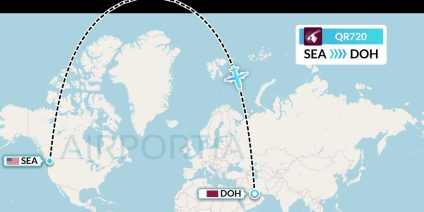 “Specifically, the US was invited to consider the possibility of restoring direct air services,” the Russian ministry stated.
Some experts, however, are skeptical about the possibility of an immediate resumption of direct flights between Russia and the US, pointing out that European airspace remains closed to Russian airlines, making direct routes challenging.
The meeting in Türkiye follows high-level talks in Saudi Arabia and a phone call between Russian President Vladimir Putin and US President Donald Trump earlier in February. Trump has since signaled that Washington could lift the sanctions against Russia “at some point” as part of broader peace negotiations to resolve the Ukraine conflict.
EU’s Kallas blasts Trump over ‘Russian talking points’
RT | February 28, 2025
The European Union’s top diplomat has suggested that US President Donald Trump has adopted Russian narratives about the Ukraine conflict. Kaja Kallas also expressed concern over Washington’s supposed drift away from its long-time European allies.
Kallas, the EU’s high representative for foreign affairs and security policy and former Estonian Prime Minister (2021-2024), is known for her hawkish views on foreign policy.
In an interview with the media outlet Axios on Thursday, she said it had been “uncomfortable” to hear Trump and other senior US officials “repeating Russian narratives and talking points” in recent weeks.
“The statements made towards us are quite strong. The statements regarding Russia are very friendly. It is a change,” Kallas observed. She claimed that if Russia is allowed “back around the international table like nothing has happened,” more armed conflicts will follow, and not only in Europe.
The diplomat also insisted that while US officials are free to “talk with [Russian President Vladimir] Putin all they want… in order for any kind of deal to be implemented, they need the Europeans.” Failure to include the EU and Ukraine in negotiations would prevent any agreement from being implemented, Kallas argued.
Both the bloc’s representatives and officials from Kiev were excluded from the US-Russia negotiations held in Saudi Arabia earlier this month. Washington and Moscow have argued that no other parties were invited because the talks centered on first restoring bilateral relations.
Kallas also balked at criticisms regarding the state of democracy in the EU voiced by US Vice President J.D. Vance at the Munich Security Conference – a speech praised as “brilliant” by Trump. “I refuse to accept that criticism, because it’s just simply not true,” she said.
On Monday, the diplomat similarly remarked that “if [we] look at the messages that come from the US, then it is clear that the Russian narrative is there, very strongly represented.”
Last week, she warned Washington against walking “into the Russian traps,” alleging that Moscow had emerged as the “winner” from the talks in Riyadh.
In recent weeks, Trump has made several critical remarks toward the Ukrainian leadership, characterizing Vladimir Zelensky as a “dictator without elections,” and suggesting that Kiev bears responsibility for letting the hostilities flare up in 2022. While the US head of state has since somewhat toned down his comments, a marked departure from the policy course pursued by his predecessor, Joe Biden, remains evident.
Prof. Jeffrey Sachs: The EU in Panic as Peace May Break Out
Prof. Jeffrey Sachs with Prof. Glenn Diesen
Glenn Diesen | February 26, 2025
I spoke with Professor Jeffrey Sachs after his speech at the European Parliament. How did we end up in a position where the EU has become the leading actor to oppose diplomacy and negotiations, and instead aims to prolong a war that devastates Europe and cannot be won? How did the Europeans reach a consensus on absurd notions such as Russia should not have a say in where NATO expands, and that the Europeans cannot sit down and talk to Russia without Ukraine? Professor Sachs attended the Istanbul negotiations in early 2022, but why are these negotiations now largely absent in the EU’s war narrative?
Putin invaded Ukraine ‘to stop NATO’, alliance chief tells EU
Jeffrey Sachs’ Full Address
‘Incompetent cowards’ in Brussels could have prevented Trump tariffs, claims Hungarian FM
By Thomas Brooke | Remix News | February 27, 2025
Hungarian Foreign Minister Péter Szijjártó has launched a scathing attack on the European Union’s leadership following U.S. President Donald Trump’s announcement of an impending 25 percent tariff on European imports.
In a statement on his social media channels, Szijjártó accused the EU leadership, specifically the European Commission under Ursula von der Leyen, of incompetence and cowardice in trade negotiations with Washington, accusing Brussels of failing to act despite knowing Trump’s stance on trade fairness and the likelihood of new tariffs.
“The whole world, including Brussels, knew very well that Donald Trump wants balanced trade conditions,” Szijjártó stated. “They knew, but they did nothing. Because they are incompetent, and especially cowards.”
“They bullied Donald Trump for eight years and now they don’t dare to face him,” Szijjártó added, lamenting von der Leyen’s leadership of the bloc which he says has now “isolated the European economy, after China, from the American economy as well.”
The Hungarian minister emphasized that the EU could have averted the tariffs with minor policy adjustments proposed by Budapest, such as lowering the duty on American cars imported into Europe from 10 percent to 2.5 percent, matching U.S. tariffs on European cars. However, according to him, bureaucratic inefficiency prevented such action.
“Brussels bureaucracy is killing the European economy: sanctions on Russia, customs on the Chinese electric car industry, and the complete inability to negotiate with the United States,” Szijjártó added.
President Trump, speaking to reporters on Wednesday, justified the new tariffs, saying, “The European Union was formed to screw the United States – that’s the purpose of it and they’ve done a good job of it. But now I’m president.” The 25 percent tariff, he noted, would apply broadly to European goods, with a particular impact on the auto industry — a move likely to give the new German government a sizeable headache.
The European Union responded with a strong rebuttal, warning that it would react “firmly and immediately against unjustified tariffs.”
“It has been a boon for the United States. We’re ready to partner if you play by the rules. But we will also protect our consumers and businesses at every turn. They expect no less from us,” a spokesperson for the European Commission stated.
Hungary now appears to be intent on using the goodwill it has secured with the Trump administration over recent years to seek an independent path to safeguard its economic interests. Szijjártó announced that Budapest would engage in direct negotiations with Washington to ensure strong Hungarian-American trade relations. “What Brussels damaged, we must fix here in Budapest,” he declared, vowing to pursue the “most productive Hungarian-American economic cooperation of all time.”
You Might Also Like
EU Contributes €4M to UNESCO’s Expanding Online Content Regulation and Digital ID Goals
By Didi Rankovic | Reclaim The Net | February 26, 2025
The EU is spending another €4 million (just under $4.2 million) on a project it runs together with the UN Educational, Scientific and Cultural Organization (UNESCO), known as Social Media 4 Peace (SM4P).
Those targeted by this latest contribution from Brussels are Iraq, Kyrgyzstan, and South Africa as newly included countries, whereas what’s already been achieved in Indonesia and Kenya will be “reinforced,” the UN said.
Others that have been a part of the scheme, which critics consider a censorship initiative, are Bosnia and Herzegovina and Colombia. The EU has already given €4 million to SM4P in 2021, when it launched.
According to the EU’s SM4P page, the project’s purpose is to deal with “potentially harmful online content – in particular hate speech.” Now UNESCO announced the latest contribution saying that will help SM4P’s mission to address harmful content in “conflict-prone and polarized” societies.
And the UN agency promises to protect free speech and rights – “of the most vulnerable and marginalized communities.”
Other than the dystopian-sounding declaration of being there to counter “potentially harmful content,” SM4P raises eyebrows for activities such as contributing to the “shaping” of the Global Forum of Networks.
The burgeoning EU-UN partnership to tackle “disinformation and hate speech globally” has also contributed to what is referred to as global policy discussions on digital platform governance.
In the UN’s system of “nesting dolls of censorship projects,” the Global Forum of Networks is set up to allow international regulators to collaborate and implement UNESCO’s Guidelines for the Governance of Digital Platforms – the result of the said “discussions” – and what SM4P will be focused on until 2027.
The Guidelines’ About page states that this initiative’s aim is to “deal with the problems of dis- and misinformation and hate speech online.”
Then there’s the 2030 Agenda for Sustainable Development and its 17 goals – including Sustainable Development Goal Target 16.9 (“legal identity for all, including birth registration, by 2030”), which pushes for digital ID as a way to participate in the digital economy.
That is another goal that SM4P will contribute to, according to the EU page about the project.
In announcing EU’s latest €4 million contribution, UNESCO said that SM4P already has more than 80 partners in Bosnia and Herzegovina, Colombia, Indonesia, and Kenya – but that its influence in “fostering multistakeholder collaboration and strengthening resilience against online harm” extends “beyond target countries.”
‘Inhumane, Reckless’: Critics Weigh in on Europe’s Approval of Self-amplifying COVID mRNA Vaccines
By Suzanne Burdick, Ph.D. | The Defender |February 24, 2025
Europe has approved a self-amplifying mRNA COVID-19 vaccine for ages 18 and up. The move drew criticism from scientists, who cited several concerns, including high rates of serious side effects among clinical trial participants and no long-term safety data.
The European Commission, the European Union’s primary executive body, on Feb. 14, granted marketing authorization for ARCT-154 — marketed as KOSTAIVE — a vaccine manufactured by CSL and Arcturus Therapeutics.
Japanese regulators were the first to approve the ARCT-154 shot, which the country made available for the 2024-25 season to people 65 and over, and 60- to 64-year-olds with severe underlying conditions.
Self-amplifying mRNA vaccines are similar to synthetic mRNA vaccines in that they both contain foreign mRNA that the body’s cells translate into a protein. However, unlike synthetic mRNA vaccines, self-amplifying vaccines also contain an enzyme that instructs the body on how to make more mRNA.
“What makes self-amplifying mRNA technology so worrisome, is that the mRNA will perpetuate indefinitely,” said Karl Jablonowski, Ph.D., senior research scientist at Children’s Health Defense (CHD).
Jablonowski explained that with the traditional COVID-19 mRNA vaccines, “at least there is some solace in knowing the original mRNA will break down and stop production of the spike proteins.”
Nicolas Hulscher, an epidemiologist with the McCullough Foundation who writes on Substack, called Europe’s approval of ARCT-154 a “grave mistake.”
“These products behave like a synthetic virus,” Hulscher said. “The replicon mRNA is designed to encode not only the target antigen but also viral replicase, enabling the mRNA to replicate itself within the target cells. This replication machinery allows for an unknown period of toxic antigen production.”
The antigen is the “active ingredient in all vaccines … that causes the immune system to begin producing antibodies,” according to the Centers for Disease Control and Prevention.
Jablonowski said that being chronically exposed to an antigen — “especially one as toxic as the COVID-19 spike protein” is “like being vaccinated every day for the rest of your life.”
Plus, the product may not effectively target emerging COVID-19 variants, Jablonowski said:
“When a new variant emerges, as coronaviruses change constantly, would the strategy be another self-amplifying mRNA vaccine? Another factory that may never turn off? And so on? There will be a breaking point.
“The tragic short-sightedness of this strategy is that eventually the vaccinated will be creating spike protein to assault their own body to teach their immune system how to combat a virus that doesn’t exist anymore.”
Hulscher said long-term safety data on ARCT-154 is “non-existent.” He also reported that 90% of clinical trial participants experienced adverse events after the first dose, with 74.5% reporting systemic reactions and 15.2% requiring medical attention.
Arcturus Therapeutics is one of at least nine vaccine developers working on self-amplifying mRNA products, according to a November 2024 analysis by Hulscher.
So far, none of the clinical trials for the product have “addressed the major concern of product shedding,” Hulscher said.
Jablonowski also pointed out that the mRNA lipid nanoparticle technology has been shown to cross the placental barrier, making it “unconscionable that the European Commission would allow these products anywhere near a person who may become pregnant.”
FDA approved clinical trial for self-amplifying bird flu vaccine
Although the U.S. has yet to approve a self-amplifying mRNA COVID-19 vaccine, the U.S. Food and Drug Administration last November gave the green light for Arcturus Therapeutics to launch clinical trials for a self-amplifying mRNA vaccine targeting the H5N1 virus, commonly known as bird flu.
The trials are funded by the U.S. government and the Bill & Melinda Gates Foundation. “The United States must REJECT this dangerous technology,” Hulscher said.
Cardiologist Dr. Peter McCullough agreed.
“Vaccinologists have made a critical error in the design of genetic vaccines,” McCullough said. “Injection of the genetic code for any foreign protein including parts of viruses causes the body to respond with an immune attack against its own cells.”
“This leads to intense vaccine injury syndromes all through the human body,” he said.
McCullough added, “Giving the vaccines their own ‘life’ with the ability to reproduce themselves is inhumane, reckless, and from the outset, should be flagged as dangerous and potentially lethal to the recipient.”
Related articles in The Defender
- Japan Approves World’s First ‘Self-amplifying’ mRNA COVID Shot — Is the U.S. Next?
- ‘Disaster Waiting to Happen’: FDA Approves Phase 1 Trial of Gates-funded Self-amplifying Bird Flu Vaccine
- Rogan Rips Mainstream Media for Failure to Cover ‘Real Numbers’ of People Injured, Killed by COVID Shots
- U.S. Pumps $667 Million Into World Bank’s Pandemic Fund
This article was originally published by The Defender — Children’s Health Defense’s News & Views Website under Creative Commons license CC BY-NC-ND 4.0. Please consider subscribing to The Defender or donating to Children’s Health Defense.
America as Republic, not as Empire – Europe’s “sound and fury” after jaw-dropping pivots in U.S. policy
By Alastair Crooke | Strategic Culture Foundation | February 26, 2025
The bits are falling into a distinct pattern – a pre-prepared pattern.
Defence Secretary Hegseth at the Munich Security Conference gave us four ‘noes’: No to Ukraine in NATO; No to a return to pre-2014 borders; No to ‘Article 5’ peacekeeper backstops, and ‘No’ to U.S. troops in Ukraine. And in a final flourish, he added that U.S. troops in Europe are not ‘forever’ – and even placed a question mark over the continuity of NATO.
Pretty plain speaking! The U.S. clearly is cutting away from Ukraine. And they intend to normalise relations with Russia.
Then, Vice-President Vance threw his fire cracker amongst the gathered Euro-élites. He said that the élites had retreated from “shared” democratic values; they were overly reliant on repressing and censoring their peoples (prone to locking them up); and, above all, he excoriated the European Cordon Sanitaire (‘firewall’) by which European parties outside the Centre-Left are deemed non-grata politically: It’s a fake ‘threat’, he suggested. Of what are you really so frightened? Have you so little confidence in your ‘democracy’?
The U.S., he implied, will no longer support Europe if it continues to suppress political constituencies, arrest citizens for speech offenses, and particularly cancel elections as was done recently in Romania. “If you’re running in fear of your own voters”, Vance said, “there is nothing America can do for you”.
Ouch! Vance had hit them where it hurts.
It is difficult to say what specifically most triggered the catatonic European breakdown: Was it the fear of the U.S. and Russia joining together as a major power nexus – thus stripping Europe from ever again being able glide along on the back of American power, through the specious notion that any European state must have exceptional access to the Washington ‘ear’?
Or was it the ending of the Ukraine/Zelensky cult which was so prized amongst the Euro-élite as the ‘glue’ around which a faux European unity and identity could be enforced? Both probably contributed to the fury.
That the U.S. would in essence leave Europe to their own delusions would be a calamitous event for the Brussels technocracy.
Many may lazily assume that the U.S. double act at Munich was just another example of the well-known Trumpian fondness for dropping ‘wacky’ initiatives intended to both shock and kickover frozen paradigms. The Munich speeches did exactly that all right! Yet that does not make them accidental; but rather parts that fit into a bigger picture.
It is clear now that the Trump blitzkrieg across the American Administrative State could not have been mounted unless carefully pre-planned and prepared over the last four years.
Trump’s flurry of Presidential Executive Orders at the outset of his Presidency were not whimsical. Leading U.S. constitutional lawyer, Johnathan Turley, and other lawyers say that the Orders were well drafted legally and with the clear understanding that legal challenges would ensue. What’s more, that Trump Team welcome those challenges.
What is going on? The newly confirmed head of the Office of Budget Management (OBM), Russ Vought, says his Office will become the “on/off switch” for all Executive expenditure under the new Executive Orders. Vought calls the resulting whirlpool, the application of Constitutional radicalism. And Trump has now issued the Executive Order that reinstates the primacy of the Executive as the controlling mechanism of government.
Vaught, who was in OBM in Trump 01, is carefully selecting the ground for all-out financial war on the Deep State. It will be fought out firstly at the Supreme Court – which the Trump Team expect confidently to win (Trump has the 6-3 conservative majority). The new régime will then be applied across all agencies and departments of state. Expect shrieks of pain.
The point here is that the Administrative State – aloof from executive control – has taken to itself prerogatives such as immunity to dismissal and the self-awarded authority to shape policy – creating a dual state system, run by unelected technocrats, which, when implanted in departments such as Justice and the Pentagon, have evolved into the American Deep State.
Article Two of the Constitution however, says very bluntly: Executive power shall be vested in the U.S. President (with no ifs or buts at all.) Trump intends for his Administration to recover that lost Executive power. It was, in fact, lost long ago. Trump is re-claiming too, the Executive’s right to dismiss ‘servants of the State’, and to ‘switch off’ wasteful expenditure at his discretion, as part of a unitary executive prerequisite.
Of course, the Administrative State is fighting back. Turley’s article is headlined: They Are Taking Away Everything We Have: Democrats and Unions Launch Existential Fight. Their aim has been to cripple the Trump initiative through using politicised judges to issue restraint orders. Many mainstream lawyers believe Trump’s Unitary Executive claim to be illegal. The question is whether Congress can stand up Agencies designed to act independently of the President; and how does that square with the separation of powers and Article Two that vests unqualified executive power with one sole elected official – the U.S. President.
How did the Democrats not see this coming? Lawyer Robert Barnes essentially says that the ‘blitzkrieg’ was “exceptionally well-planned” and had been discussed in Trump circles since late 2020. The latter team had emerged from within a generational and cultural shift in the U.S.. This latter had given rise to a Libertarian/Populist wing with working class roots who often had served in the military, yet had come to despise the Neo-con lies (especially those of 9/11) that brought endless wars. They were animated more by the old John Adams adage that ‘America should not go abroad in search of monsters to slay’.
In short, they were not part of the WASP ‘Anglo’ world; they came from a different Culture that harked back to the theme of America as Republic, not as Empire. This is what you see with Vance and Hegseth – a reversion to the Republican precept that the U.S. should not become involved in European wars. Ukraine is not America’s war.
The Deep State, it seems, were not paying attention to what a posse of ‘populist’ outliers, tucked away from the rarefied Beltway talking shop, were up to: They (the outliers) were planning a concerted attack on the Federal expenditure spigot – identified as the weak spot about which a Constitutional challenge could be mounted that would derail – in its entirety – the expenditures of the Deep State.
It seems that one aspect to the surprise has been the Trump Team’s discipline: ‘no leaks’. And secondly, that those involved in the planning are not drawn from the preeminent Anglo-sphere, but rather from a strand of society that was offended by the Iraq war and which blames the ‘Anglo-sphere’ for ‘ruining’ America.
So Vance’s speech at Munich was not disruptive – merely for the sake of being disruptive; he was, in fact, encouraging the audience to recall early Republican Values. This was what is meant by his complaint that Europe had turned away from “our shared values” – i.e. the values that animated Americans seeking escape from the tyranny, prejudices and corruption of the Old World. Vance was (quite politely) chiding the Euro-élites for backsliding to old European vices.
Vance implicitly was hinting too, that European conservative libertarians should emulate Trump and act to slough-off their ‘Administrative States’, and recover control over executive power. Tear down the firewalls, he advised.
Why? Because he likely views the ‘Brussels’ Technocratic State as nothing other than a pure offshoot to the American Deep State – and therefore very likely to try to torpedo and sink Trump’s initiative to normalise relations with Moscow.
If these were Vance’s instincts, he was right. Macron almost immediately summoned an ‘emergency meeting’ of ‘the war party’ in Paris to consider how to frustrate the American initiative. It failed however, descending reportedly into quarrelling and acrimony.
It transpired that Europe could not gather a ‘sharp-end’ military force greater than 20,-000-30,000 men. Scholtz objected in principle to their involvement; Poland demurred as a close neighbour of Ukraine; and Italy stayed silent. Starmer, however, after Munich, immediately rang Zelensky to say that Britain saw Ukraine to be on an irrevocable path to NATO membership – thus directly contradicting U.S. policy and with no support from other states. Trump will not forget this, nor will he forget Britain’s former role in supporting the Russiagate slur during his first term in office.
The meeting did however, underline Europe’s divisions and impotence. Europe has been sidelined and their self-esteem is badly bruised. The U.S. would in essence leave Europe to their own delusions, which would be calamitous for the Brussels autocracy.
Yet, far more consequential than most of the happenings of the past few days was when Trump, speaking with Fox News, after attending Daytona, dismissed Zelensky’s canard of Russia wanting to invade NATO countries. “I don’t agree with that; not even a little bit”, Trump retorted.
Trump does not buy into the primary lie intended as the glue which holds this entire EU geo-political structure together. For, without the ‘Russia threat’; without the U.S. believing in the globalist linchpin lie, there can be no pretence of Europe needing to prepare for war with Russia. Europe ultimately will have to come to reconcile its future as a periphery in Eurasia.
Featured Video

“Historic Russia”: The Land Putin Will Not Give Back
or go to
Aletho News Archives – Video-Images
From the Archive
How Ukraine Tortured and Slaughtered Donbass
By Kit Klarenberg | Al Mayadeen | July 11, 2024
Almost immediately after the proxy war erupted, ISIS-tier footage of the torture and murder of Russians in Ukrainian custody emerged.
On July 6th, the New York Times published an astonishing investigation: In Ukraine, Killings of Surrendering Russians Divide an American-Led Unit. The article documents in grim detail how Chosen Company, an international volunteer battalion for Kiev, routinely executes Russian prisoners of war. It is the very first mainstream admission that this practice – a brazen breach of the Geneva Conventions, and a grave war crime – is widespread among Ukraine’s fighters, both foreign and homegrown. … continue
Blog Roll
 Aletho News
- Burnham tackles Britain’s poverty with aggression in Yemen
- Peace in Ukraine: the easy way – or the hard way
- Trump & the Rrrrussians
- US taxpayer money laundered back through Ukraine – Musk
- Before COVID, an NIH lab chief proposed making a SARS-like bat virus more infectious
- Gates, Bourla on Trial in Netherlands Accused of ‘Great Reset’ Scheme at Vaccine Injury Hearing
- BRITAIN’S WARNING: PREPARE FOR WAR
- “Historic Russia”: The Land Putin Will Not Give Back
- How the Cambridge Analytica scandal still haunts Mark Zuckerberg
- The Ongoing Cancellation Campaign Against a Dissenting Academic in Norway
- If Americans Knew
- DAILY UPDATE: Latest essential news on Palestine, Israel, & region
- Damning report shows the media must confront its failures on Gaza
- BBC senior broadcaster speaks out on Gaza coverage
- Netanyahu vows vast West Bank invasion in response to 20-minute skirmish that left 2 Israeli soldiers and 2 Palestinian fighters dead
- Tied up and tortured: Israel using US-made electroshock weapons on Palestinian detainees
- The outsourced risk: how newsrooms rely on Gaza’s freelancers without protecting them
- Gaza bakeries forced to shut as Israel blocks flour shipments
- Gaza’s breast cancer patients face a deadly wait for treatment amid Israel’s genocide
- DAILY UPDATE: Latest essential news on Palestine, Israel, & region
- The Israel Lobby’s Changing Fortunes
- No Tricks Zone
- Two New Studies Find Thwaites Glacier Melt Cannot Be Driven By Human Activity Or A Warming Ocean
- E-Cars Reduce CO2 Emissions By Only 41% Compared To Internal Combustion Engine Vehicles
- Predictions Made By Renowned Climate Professor Over Past Decades Have Been Proven To Be Poor
- New Study Suggests Large Regions Of The Pacific Ocean Have Been Cooling For The Last 80 Years
- Germany’s Green Energy Debacle: High Energy Costs Force Kahla Porzellan to Close After 182 Years!
- New Study: 50 Years Of The Most Aggressive ‘Net Zero’ Policies Can Only Affect The Global Climate By 0.03°C
- US September “Heat” Was No Record…Many Records Set Decades Ago
- Latest European Green Energy Debacle; Portugal’s Largest Flagship Solar Park Insolvent!
- Green Energy Debacle: German Expert Professor Fritz Vahrenholt Warns Of Severe Economic And Social Consequences
- Two More Paleo Reconstructions Affirm Meters-Higher Sea Levels Across Ireland, Brazil 7000-6000 Years Ago

