Reality confronts the Euro ruling-strata – ‘Through the tear in the fantasy bubble, they see their own demise’
By Alastair Crooke | Strategic Culture Foundation | March 4, 2025
They (the Euro-élites) don’t have a chance: “If Trump imposes this tariff [25%], the U.S. will be in a serious trade conflict with the EU”, the Norwegian Prime Minister threatens. And what if Brussels does retaliate?
“They can try, but they can’t”, Trump responded. Von der Leyen has, however, already promised that she will retaliate. Nonetheless, the combined suite of the Anglo administrative forces is still unlikely to compel Trump to put U.S. military troops on the ground in Ukraine to protect European interests (and investments!).
The reality is that every European NATO member – to varying degrees of self-embarrassment – admits publicly now that none of them want to participate in securing Ukraine without having U.S. military troops provide ‘backstop’ to those European forces. This is a palpably obvious scheme to inveigle Trump into continuing the Ukraine war – as is Macron and Starmer’s dangling of the mineral deal to try to trick Trump to recommit to the Ukraine war. Trump plainly sees through these ploys.
The fly in the ointment, however, is that Zelensky seemingly fears a ceasefire, more than he fears losing further ground on the battlefield. He too, seems to need the war to continue (to preserve continuing in power, possibly).
Trump calling time on the Ukraine war that has been lost has seemingly caused European elites to enter some form of cognitive dissonance. Of course, it has been clear for some time that Ukraine would not retake its 1991 borders, nor force Russia into a negotiating position weak enough for the West to be able to dictate its own cessation terms.
As Adam Collingwood writes:
“Trump has torn a huge rip in the interface layer of the fantasy bubble … the governing élite [in the wake of Trump’s pivot] can see not just an electoral setback, but rather a literal catastrophe. A defeat in war, with [Europe] left largely defenceless; a de-industrialising economy; crumbling public services and infrastructure; large fiscal deficits; stagnating living standards; social and ethnic disharmony – and a powerful populist insurgency led by enemies just as grave as Trump and Putin in the Manichean struggle against vestiges of liberal times – and strategically sandwiched between two leaders that both despise and disdain them …”.
“In other words, through the tear in the fantasy bubble, Europe’s elites see their own demise …”.
“Anybody who could see reality knew that things would only get worse on the war front from autumn 2023, but from their fantasy bubble, our élites couldn’t see it. Vladimir Putin, like the ‘Deplorables’ and ‘Gammons’ at home, was an atavistic daemon who would inevitably be slain on the inexorable march to liberal progressive utopia”.
Many in the Euro ruling-strata clearly are furious. Yet what can Britain or Germany actually do? It has quickly become clear that European states do not have the military capacity to intervene in Ukraine in any concerted manner. But more than anything, as Conor Gallagher points out, it is the European economy, circling the drain – largely as a result of the war against Russia – that is dragging reality to the forefront.
The new German Chancellor, Friedrich Merz, has shown himself to be the most implacable European leader advocating both military expansion and youth conscription – in what amounts to an European resistance model mounted to confront Trump’s pivot to Russia.
Yet Merz’s winning CDU/CSU achieved only 28% of votes cast, whilst losing significant voter share. Hardly an outstanding mandate for confronting both Russia – and America – together!
“I am communicating closely with a lot of prime ministers, and heads of EU states and for me it is an absolute priority to strengthen Europe as quickly as possible, so that we achieve independence from the U.S., step by step”, Friedrich Merz said.
Second place in the German election was taken by the Alternative for Germany (AfD) with 20% of the national vote. The party was the top vote getter in the 25-45 year-old demographic. It supports good relations with Russia, an end to the Ukraine war, and it wants to work with Team Trump, too.
Yet AfD absurdly is outcast under the ‘firewall rules’. As a ‘populist’ party with a strong youth vote, it becomes automatically relegated to the ‘wrong side’ of the EU firewall. Merz has already refused to share power with them, leaving the CDU as pig-in-the-middle, squeezed between the failing SPD, which lost the most voter share, and the AfD and Der Linke, another firewall outcast, which, like AfD, gained voter share, especially among the under-45s.
The rub here – and it is a big one – is that the AfD and the Left Party, Die Linke (8.8%), which was the top vote getter in the 18-24 demographic, are both anti-war. Together these two have more than one third of the votes in parliament – a blocking minority for many important votes, especially for constitutional changes.
This will be a big headache for Merz, as Wolfgang Münchau explains:
“For one thing, the new Chancellor had wanted to travel to the NATO summit this June, with a strong commitment to higher defence spending. And even though the Left Party and the AfD hate each other in every other respect, they agree that they won’t give Merz the money to strengthen the Bundeswehr. More important, though, is the fact that they won’t support a reform to the constitutional fiscal rules (the debt brake) that Merz and the SPD are desperate for”.
The Rules are complicated, but in gist dictate that if Germany wants to spend more money on defence and aid to Ukraine, it had to be saved from elsewhere in the budget (most likely from social spending). But politically, saving on social spending to pay for Ukraine hasn’t played well with the German electorate. The last coalition failed on precisely this issue.
Even with the Greens, Merz still will be short of the two-thirds majority necessary to make constitutional changes, and the ‘Centre’ just doesn’t have the fiscal space for challenging Russia without U.S. funding. Von der Leyen will try to ‘magic’ money for defence from somewhere, “but German youth are voting against the Establishment parties who are hated. They can build a few Leopards if they want. They won’t get recruits”.
Whilst the EU and Britain are proposing to raise billions to arm themselves against some imaginary Russian invasion, it will be done against the backdrop of Trump saying explicitly – on the threat of a Russian invasion of NATO – “I don’t believe that; I don’t believe it, not one little bit”.
Another Euro-shibboleth ripped by Trump.
Thus, how will the European public, which has largely soured on the Ukraine war, react to higher energy costs and more tax and social service cuts, in order to pursue an unwinnable war in Ukraine? Starmer already has been warned that the (government debt) ‘bond vigilantes’ will react badly to yet more UK government debt as the fiscal situation wobbles precariously.
There are no obvious solutions to Europe’s current predicament: It is, on one hand, an existential conundrum for Merz. And on the other, it is the same one that dogs the EU as a whole: To get anything done, a parliamentary majority is a basic necessity.
The ‘firewall’, though primordially intended to protect the ‘Centrists’ in Brussels from Rightist ‘populists’, was subsequently turbo-charged in Brussels by Biden’s issuing of a foreign policy determination to all U.S. foreign policy ‘actors’ to the effect that populism was a ‘threat to democracy’ and must be contested.
The practical outcome however, has been that across the EU, blocking coalitions were formed of odd (minority party) bed-fellows agreeing to keep the Centrists in power, but which rather has led to endless stasis and an ever increasing detachment from ‘we, the people’.
Angela Merkel governed in this way, kicking the can of reform down the road for years – until the situation ultimately became (and still is) insoluble.
“Can another coalition of short-sighted centrists arrest the decline of the economy, fix the failure of leadership, and free the nation from its pernicious political trap? I think we know the answer”, writes Wolfgang Münchau.
There lies a bigger problem however: As Vance very explicitly warned at the recent Munich Security Forum, Europe’s enemy lies not with Russia; It lies within. It derives, Vance implied, from the fact of having a permanent bureaucracy, assuming to itself the exclusive prerogative of autonomous governing power, yet incrementally becoming ever-more remote from its own base.
Tear down the firewalls, Vance advocated, in order to return to the (abandoned) principles of that earlier democracy originally shared between the U.S. and Europe. Implicitly, Vance is targeting the Brussels Administrative (Deep) State.
The Eurocrats see in this new front an alternate American-supported attack on their Administrative State – and perceive therein their own demise.
In the U.S., there is acknowledgement that there is an “institutional resistance to Trump” in the DOD, DOJ and the FBI. It proves, Margot Cleveland argues, that those touting the need for “institutional resistance” and the supposed independence from the executive branch, are the opponents to democracy – and to Trump.
Given the close nexus between the U.S., the British and European Deep States, the question arises as to why there is such strong parallel resistance to Trump amongst European leaders also.
Ostensibly, it is not in Europe’s interest to mount a concerted resistance against the U.S. President over a failed war. Is the European frenzy then fuelled by a wider (U.S.) Deep State desire to neuter the ‘Trump Revolution’ by demonstrating, in addition to the U.S. domestic opposition at home, that Trump is causing havoc amongst the U.S.’ European allies? Is Europe being pushed further down this path than they would otherwise have chosen to venture?
For Germany to change course – albeit unthinkable for Merz – it would require only a minimal amount of imagination to envision Germany again linked to Eurasia. The AfD gained 20% of the vote on just such a platform. Really, there probably is little other option.
EU’s support for Zelensky brings Washington-Brussels relations to the brink of collapse
By Ahmed Adel | March 4, 2025
Following the reactions of European leaders to the on-camera spat at the White House between Donald Trump and Ukrainian President Volodymyr Zelensky on February 28, relations between the US president and much of the European Union establishment are reaching a breaking point. The EU establishment has firmly sided with Zelensky and his warmongering policies, contrary to common sense and the peace efforts of Trump and his Russian counterpart Vladimir Putin.
On March 2, an informal meeting of European leaders and Canada was held in London. Following the meeting, it was announced that Ukraine would receive more military aid and sanctions on Russia, territories would be returned to Ukraine, and the United Kingdom, with other nations, would form a military coalition to get boots on the ground.
By reacting the way they did, EU leaders have once again shown that they are undermining peace, just as then-British Prime Minister Boris Johnson did when he sabotaged the peace talks between Russia and Ukraine in Istanbul in early 2022. However, just as Johnson was not punished for prolonging death and war in Ukraine, it is unlikely that EU leaders will ever be held accountable for their actions, especially German, Polish and Baltic politicians, European Commission President Ursula von der Leyen, and many others in Brussels who agree on a policy of aligning with Zelensky and anti-Trump policies.
Following the spat between the US and Ukrainian presidents, European leaders sent messages of solidarity with Kiev. Many European leaders posted a uniform message on their social media accounts that they “stand with Ukraine.”
A sign of the growing rift between Washington and Brussels, particularly after the chaotic meeting between Trump and Zelensky, EU foreign policy chief Kaja Kallas said: “Today, it became clear that the free world needs a new leader. It’s up to us, Europeans, to take this challenge.”
It is also recalled that during his visit to the White House on February 24, French President Emmanuel Macron tried to deceive Trump and drag him down a path the US president did not want to take. It became clear to Trump that he could not count on European politicians.
If it was not clear following the meeting with Macron, it certainly became clear to Trump when British Prime Minister Keir Starmer was a guest in the Oval Office on February 27, particularly after US Vice President J.D. Vance blasted Britain’s descent into authoritarianism and lack of free speech.
It is expected that in the coming period, there will be very strong obstructions from the EU to any agreement between Trump and Putin. There will also be such obstructions within the US, especially from the remnants of the Deep State and the mainstream media that are still critical of Trump and loyal to ultraliberal policies. The very core of the EU – the European Commission, the leadership of the European Council, the majority in the European Parliament, as well as the leading EU leaders are also of the same view, which is opposite to the rest of the world that advocates for peace.
The EU itself is divided into states that supported peace efforts and distanced themselves from Brussels—primarily the political leaderships of Slovakia and Hungary, but also the leaders of the second-largest party in Germany, the AfD, Marine Le Pen in France, and the leaders of other sovereigntist parties across Europe.
European leaders have not changed their support for war since an attempt was made to end the conflict under conditions that were even more favorable for Kiev at the time. Now, as Trump highlighted in his meeting with Zelensky, Ukraine does not “have the cards right now.”
“You’re not in a good position. You don’t have the cards right now. With us, you start having cards. You’re playing cards. You’re gambling with the lives of millions of people. You’re gambling with World War III,” Trump said to a shocked Zelensky.
Of course, Zelensky denied Trump’s statements, stuttering, “I’m not playing cards” and “What are you speaking about?”
The US president’s main priority is normalizing relations with Moscow, including ending the conflict in Ukraine. Normalization will remain a priority even if the Kiev regime and European leaders do not agree to it.
Nonetheless, it appears that parts of Europe have not yet given up on the Trump administration, like Kaja Kallas has. Starmer announced on March 2 that Britain, France, and Ukraine have agreed to work on a ceasefire plan to present to Washington.
“We’ve now agreed that the United Kingdom, along with France and possibly one or two others, will work with Ukraine on a plan to stop the fighting, and then we’ll discuss that plan with the United States,” Starmer told the BBC.
This was followed by Zelensky announcing on the same day as Starmer’s statement that he was “ready to sign” the minerals agreement with Trump.
However, given the EU’s growing hostility to Trump and resistance to peace, the US president has little incentive to take the Franco-Anglo peace plan seriously since they have been harbingers to continue the war. Trump will continue pursuing a peace plan, even if it intensifies hostility between Europe and Washington.
Ahmed Adel is a Cairo-based geopolitics and political economy researcher.
Eight Ways That Trump May Force Zelensky to Resign
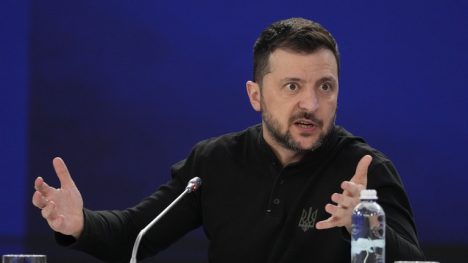
By Ekaterina Blinova – Sputnik – 03.03.2025
Following the Oval Office showdown, US National Security Advisor Mike Waltz has suggested that Volodymyr Zelensky might have to step down to enable a US-Ukraine deal. But as Zelensky refuses, what leverage does President Donald Trump hold over him?
Direct Pressure Tactics
- Cutting all aid. Without US support, Zelensky may have no choice but to resign and be replaced by someone willing to negotiate peace, says ex-CIA officer Philip Giraldi.
- Sweeping audit of US aid. A deep probe into Ukraine’s use of US funds could expose corruption and “neutralize” Zelensky, according to ex-Ukrainian MP Oleg Tsarev.
- Freezing Zelensky’s cash. Blocking foreign accounts of Zelensky and his team could undermine the Kiev regime, Tsarev suggests.
Shutting down Starlink. Three sources told Reuters that Team Trump may cut Ukraine’s access to Elon Musk’s satellites, a move the White House has already reportedly threatened. - Zelensky’s expired legitimacy. His presidential term ended in May 2024, making all actions since then legally questionable. Trump could challenge his right to govern.
Trump’s Indirect Leverage via Europe
- Pressuring European allies. Europe remains dependent on the US, writes economist Dr. Paul Craig Roberts. With no weapons left to send and money-printing its only option, Trump could force its hand.
- NATO withdrawal threat. Trump may pull US security guarantees from warmongering European states throwing sand in his gears or even threaten a NATO exit, warned ex-Pentagon officer David Pyne. That could motivate Europe to rein Zelensky in.
- Tariffs on Europe. A 25% tariff on EU imports could cost 1.5% of EU GDP, per Bloomberg. Trump already threatened this, claiming the EU was created to “screw the US”.
US puts firewall to protect Ukraine deal with Russia
By M. K. BHADRAKUMAR | Indian Punchline | March 3, 2025
The verbal shootout at the Oval Office last Friday brought out President Vladimir Zelensky’s fury that Donald Trump and Vladimir Putin are very close to a deal on Ukraine, while the conclave in Lancashire House in London on Sunday involving 18 European leaders messaged that Zelensky is in good company.
Connecting the dots, the incisive mind of Stephen Bryen, a leading expert on security, strategy and technology who previously held senior positions in the Pentagon and Capitol Hill, wrote on Substack: “Trump invited [French president] Macron and [UK prime minister] Starmer to Washington to brief them, which he apparently did. The French went away fairly unhappy, but Starmer seemed to be in general agreement. Starmer made a pitch to include Article 5 and NATO in any deal; Trump rejected that appeal. Putin, meanwhile, talked to [Chinese president] Xi by telephone and sent Sergei Shoigu (who heads Russia’s Security Council, something like the NSC) to Beijing to meet with Xi.
“Trump invited Zelensky. The cover for Zelensky’s appearance in Washington was the “Minerals Deal” which the two leaders were supposed to sign… The real reason for the Zelensky visit was to brief him on the Putin negotiations and to gain his support.”
In the event, Trump could neither brief Zelensky on the Ukraine deal nor sign the “Minerals Deal” because the Ukrainian president took great exception to any negotiations with Putin. He did this in public, to Trump’s face, and in front of the press. The result was there was no private meeting and Trump told Zelensky, “he would be welcomed back only when he was ready for peace.”
This is where things stand. The strategy session that Trump is due to take later today with his top advisors will signal what happens next. There is a strong likelihood that Trump may cut off arms deliveries and/or financial assistance to Ukraine.
Now that the Rubicon has been crossed, Trump is unlikely to change course on Russia — unless, of course, Zelensky falls in line in abject surrender, which seems unlikely too. Russians of course welcome his ouster.
It is highly unlikely that Trump will be cowed by the temper tantrums of the EU or impressed by Britain’s grandstanding. Germany is without a government for the next several weeks; it weakens the Europeans’ punch.
Indeed, the back channel communication between Moscow and Washington has gained traction. Moscow assesses that Trump has the upper hand. This is reflected in the growing optimism in Putin’s remarks last Thursday while addressing the Board of the Federal Security Service (collegium of Russia’s top foreign intelligence officials.)
Putin began by saying that the world and the international situation are changing rapidly and “the first contacts with the new US administration inspire certain hopes.”
He said: “There is a reciprocal commitment [with Trump] to work to restore interstate relations and to gradually address the enormous amount of systemic and strategic problems in the global architecture which once provoked the crises in Ukraine and other regions… Importantly, our partners demonstrate pragmatism and a realistic vision of things, and have abandoned numerous stereotypes, the so-called rules, and messianic, ideological clichés of their predecessors.”
Putin estimated that conditions exist for a dialogue “on bringing a fundamental solution to Ukraine crisis… a dialogue on creating a system that will truly ensure a balanced and mutual consideration of interests, an indivisible European and global security system for the long term, where the security of some countries cannot be ensured at the expense or to the detriment of the security of other countries, definitely not Russia.”
However, Putin also flagged that sections Western elites “are still committed to maintaining instability in the world, and these forces will try to disrupt or to compromise the newly resumed dialogue” and, hence it is vital that “every possibility offered by dialogue and special services to thwart such attempts” needs to be leveraged.
Indeed, the New York Times disclosed today that Defence Secretary Pete Hegseth has ordered U.S. Cyber Command to halt offensive operations against Russia “as part of a larger re-evaluation of all operations against Russia.” Equally, reports have appeared that Putin has given similar instructions restraining the Russian agencies.
What lends enchantment to the view is that many of the US’ most sophisticated operations against Russia are run out of Britain’s Government Communications Headquarters, the storied intelligence agency that broke the Enigma codes in World War II. Suffice to say, the US seems to be cutting itself free from longstanding joint operations with Britain directed against Russia.
A Guardian newspaper report has separately corroborated the Times disclosure of a shift in the US policy. It added that the warming of US-Russia relations is apparent also in certain recent other incidents which indicate that the US is “no longer characterising Russia as a cybersecurity threat.”
The paper claimed that analysts in the super secret Cybersecurity and Infrastructure Security Agency (Cisa) of the United States spoke to the Guardian on the condition of anonymity that they were “verbally informed that they were not to follow or report on Russian threats, even though this had previously been a main focus for the agency.”
Quite obviously, a crisis of confidence has arisen in the US-UK “special relationship” — or, to put it differently, the Trump administration is taking steps to sequester the Cisa from rogue operations.
There is a Cold War history of rogue operations by spy agencies. One of the most celebrated cases was the incident on 1st May, 1960 when an American U-2 spy plane piloted by Francis Gary Powers flying [‘unbeknownst’ to Eisenhower] at an altitude of 80,000 feet was shot down over Soviet air space triggering a diplomatic crisis that caused the collapse of a summit conference in Paris between then US president Dwight Eisenhower and Soviet leader Nikita Khrushchev — and the sudden death of the two leaders’ closely nurtured dream of détente.
An analogical situation exists today. Both Washington and Moscow are conscious of it. The need for such a veil of secrecy around the high level dialogue between the Kremlin and the White House is self-evident. There are too many detractors in the collective West who won’t settle for anything short of a Russian defeat in Ukraine and would rather keep the war going.
In such a fraught scenario, on the Russian side, the Kremlin’s writ ultimately prevails despite whatever dissenting voices exist in the military-industrial complex or amongst super hawks with revenge mentality. But that is not the case in the US where remnants of the old regime still hold sensitive positions, as the Guardian report vividly brings out. In the final analysis, therefore, it may well turn out that — to quote Stephen Bryan — Trump “will let Ukraine collapse but may seek a deal with Putin on Ukraine once Zelensky is gone.”
Tulsi Gabbard questions if Ukraine is ‘aligned’ with US values
RT | March 3, 2025
Ukraine and many of its European backers may not be aligned with the US values of freedom, peace, and democracy shared by President Donald Trump, according to Washington’s director of national intelligence, Tulsi Gabbard.
In an interview with Fox News on Sunday, Gabbard was asked about last week’s heated exchange at the White House involving Ukrainian leader Vladimir Zelensky and Trump and his vice president, J.D. Vance. The tense meeting ended with Zelensky abruptly leaving the White House after being accused by Trump of ingratitude, “gambling with World War III,” and refusing to seek peace with Russia.
The incident has sparked a backlash from Trump’s critics, including several EU leaders, who have accused him of “bullying” Zelensky. However, according to Gabbard, anyone who has criticized Trump over his interaction with the Ukrainian leader is merely showing that they are “not committed to peace.”
“Many of these European countries, and Zelensky himself, who claim to be standing and fighting for the cause of freedom and democracy” are actually acting contrary to these values, Gabbard stated.
“When we actually look at what’s happening in reality in these countries, as well as with Zelensky’s government in Ukraine, it is the exact opposite,” she added. Gabbard pointed to the lack of elections in Ukraine, Kiev’s criminalization of opposition parties, the shutting down of Orthodox churches, and the complete government control over media outlets.
“It begs the question. It’s clear they’re standing against [Russian President Vladimir] Putin. But what are they actually really fighting for, and are they aligned with the values that they claim to hold in agreement with [the US], which are the values of freedom, peace and true security,” Gabbard said.
The DNI chief further criticized Washington’s EU partners, recalling Vance’s speech at the Munich Security Conference, where he accused European countries of implementing policies that “undermine democracy” and show that they “don’t actually believe in the voices of the people.”
“We’re seeing this in the United Kingdom, we’re seeing this in Germany, we saw it with the tossing out of the elections in Romania,” Gabbard said, suggesting that this shows a “huge divergence” between US values and those of the European nations that have backed Zelensky.
Russia has also suggested that last week’s clash between Zelensky and Trump once again proved that Kiev is not genuinely interested in peace. Kremlin spokesman Dmitry Peskov has stressed that the Ukrainian leader’s behavior in the Oval Office “demonstrated how difficult it will be to get on the path of a settlement around Ukraine.”
The Sea Change
By Israel Shamir • Unz Review • February 20, 2025
A huge, heavy ship, loaded to the brim, is turning around in narrow straits amid perilous waters. Thus, the world is performing a rare volte face under the daring captainship of Donald Trump and his breakneck mates Elon Musk and JD Vance. They couldn’t have cut it any closer – already we felt the breath of our doom. Whether the peril be nuclear mushrooms or pandemics crafted in Pentagon biolabs, or some other totally unpredicted collapse concocted by Schwab and his ilk – our new captain seems to recognize Scylla and Charybdis. Our fragile life was about to collapse when the young programmers of DOGE dove into deep cellars of hidden data and uncovered the pearls: millions of dollars earmarked for broken Haiti to make a dream home for Chelsey Clinton; millions of social security checks being sent to beneficiaries 150 years old and older; millions earmarked for regime change, for neutering boys and girls, for planting tempest and reaping storm all over the world. And after this brief but tempestuous overture rung, above the furious sounds of battle, the telephone; the telephone call of captain Trump to captain Putin.
God revealed His mercy and tender caring for us, calming the storm at the very last moment. It is a perfect replay of the Cuban Missile Crisis multiplied by a factor of one hundred. The voices calling for global nuclear holocaust were becoming increasingly frequent and shrill recently. Now one can hope they will be pushed back to the fringe. US and Russian delegations meeting again in Riyadh have agreed to restore the normal civilized diplomatic routine: appoint ambassadors, open missions, increase tenfold the embassy staff. Since Obama’s days the embassies had been run down to the bare minimum.
Immediately the Economist and similar rags have tried to spoil the mood. The Ukrainian crisis has not been solved yet, the war still goes on, they cry. Trump can’t be relied upon, they fume impotently. I always rely upon the Economist as a perfect inverse barometer; whatever they say we may consider pure enemy hasbara. They show Trump talking to Putin with the text “The worst nightmare of Europe”. For me, the worst nightmare would be ruins of Gaza or nuclear waste of Hiroshima, for them, peace would be the worst.
Our enemies do not want us to rejoice ever, but these are the days we could and should be glad. The Ukrainian war is a minor event compared with such a worldwide tectonic shift. The West has tried to isolate, break and consume Russia for many years, once it became aware that Putin is not a new Yeltsin, that he is a stubborn, strong-willed leader, a man like Hamlet: though you can fret him, you cannot play upon him. And ever since that time, over many years, Russia has suffered in isolation, while all the world press blamed Putin and incited legions of tiny dogs from Estonia to the Ukraine to bite him. Such conflict was inevitable because Russia and the West had different interpretations of 1991. For the West, it was the final defeat of Russian independence. For Russia, it was a lesson learned. Never again will Russia attempt to play by Western rules. So how could anyone solve such an intractable divergence of opinion? It took just one call from Donald Trump.
The Ukraine war is a small thing in comparison: Russia wants its seat at the table with the big boys, it wants to be safe, not besieged. Russia wants Western troops and arms as far from its borders as was promised to Gorbachev, this is important. The Ukraine war will be terminated in due time by diplomatic negotiations between civilized adversaries, as it should be. NATO’s war policy has revealed that the majority of the European states, governed by enemies of Trump, are also enemies of democracy. JD Vance was right: they forgot they should listen to their people instead of dictating to them.
In the UK, the popular leader Jeremy Corbyn had been dismissed on the phony accusation of anti-Semitism, and replaced by an extremely pro-Jewish and anti-Russian PM. He is, of course, pro-war. He also detains hundreds and thousands of his citizens for the terrible crime of a post in the social network, or a demonstration, or even worse: a silent prayer. In England, a silent prayer in your own house is a crime, too. France continues to be ruled by Macron, an ex-Rothschild banker, also (of course) warlike. In Germany, there are elections coming soon, but mainstream German politicians are all liberal-left and of course pro-war. In liberal Germany, prison waits for anybody stepping beyond the red line. They imprisoned and amputated the legs of the brilliant and daring lawyer Horst Mahler for a gesture. However, the fresh wind of Trump’s populist revolution blows over Germany as well.
Not only does the far-right AfD call for peace, so does the far-left BSW! The German civil society association Kulturtreff held two rallies in Berlin and Frankfurt under the slogan «No vote for NATO vassals, immediate peace for Europe!». The protesters demanded immediate peace negotiations, an end to the war in the Ukraine, an end to arms supplies to the Ukrainian state, and the restoration of economic and political cooperation between Germany and Russia. Kulturtreff states that «the current main opposition party CDU/CSU wants as does the ruling left-liberal coalition for the war in Europe to continue. The leading political parties of Germany do not have a single new solution in their program». The speakers supported the point of view of US Vice President Vance at the Munich Conference, who pointed out that the political elite of Europe is deeply disconnected from the real interests of the European people.
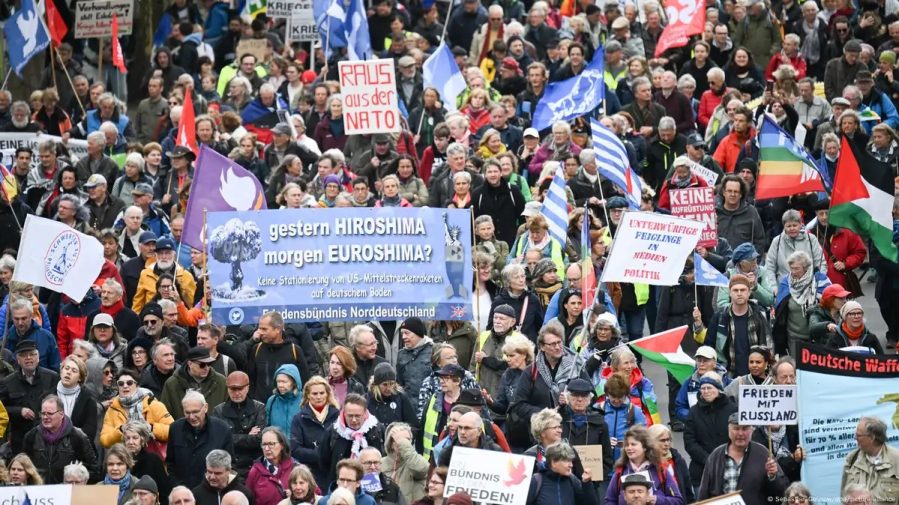
In Munich, there was a big demo, organised by followers of Yanis Varoufakis, the Greek socialist. They are called DiEM25, and they also call for peace and friendship with Russia.

Bear in mind that all calls for peace are forbidden in Europe; if you look for “Germany peace demo” in Google it shows you rallies for climate, or a rally for migrants, or some rally against a local version of Donald Trump; but no peace demo will be shown, unless it is full of blue-and-yellow banners demanding more war. In the UK and Germany, you might get a visit from the local gestapo if you click a cautious *like* under an anti-war post in your social network. In Sweden, a minister explained why the people are not allowed to decide their NATO status: “Membership in NATO is too important to ask the people to approve of it.” A Swedish journalist wrote in the Facebook:

In Russia, the anti-Putin and pro-Western opposition, as run by Navalny and ilk, relocated abroad claiming hatred of war. But they couldn’t retain that pretence for long. At first, they supported Israel’s war against the Palestinian people, and this was important because some 70 per cent of Russian oppositionists who left Russia after February 2022 landed in Israel. Obviously, they considered themselves Jewish, and Israel recognised them as Jews. It may be true that not everyone who opposes Putin is a Jew, but to a great extent it was true and to a great extent Jews continue to finance anti-Putin organizations in Russia. And now, with the first sight of Trump’s international thaw and the possibility of terminating the war in the Ukraine, these emigres have collectively called for more war. This was the end of the anti-war movement in the Russian World, in the archipelago of Russian-speaking communities – it seems that Russia’s counter-elites will not be happy until they see the Russian army defeated. They dream of US Abrams tanks rolling through Red Square, with Putin executed like Saddam Hussein, but instead those Abrams tanks (30 or 31 delivered to Zelensky) burned in the fields of Novorossia, far away indeed from Moscow.
However, many people, including first of all the parents of Russian teenagers, were excited by Trump’s call for peace, as the war in the Ukraine was a big bloodletting for Russians and Ukrainians alike. Although Russia’s fighters are all well-paid volunteers, there is no doubt that the Russian people will be happy when this war is concluded.
For the Russian leadership, the most important goal was defined in the so-called “Putin’s Ultimatum” of December 2021 (I wrote about it at length here: To Make Sense of War). Putin’s draft treaty called for an immediate end to NATO’s drive Nach Osten, keeping all Western armies and weapons out of former USSR republics. Now it seems this goal will finally be obtained.
It seems that we are at the brink of a great sea change. President Donald Trump has already given us a basket of blessings. There is a song Jews sing at Passover: if He would give us only this, it would be enough, Dayeinu. It is perfectly suitable in this case. If Trump only saved us from World War III, it would be enough. If he only disclosed the dark secrets of USAID, it would be enough. But let’s not forget to thank him, even if it be just for a moment while we think of what we want next. Such as a drawback is his policy towards Palestine. Let’s hope that it will remain just silly talk.
The Atlantic Magazine gives us reason for some hope: it claimed Trump is building the most anti-Semitic cabinet in decades. It certainly has fewer Jews than the Biden’s cabinet, and less belligerence coming with fewer Jews.

OSCE shared intel with Ukraine before 2022 – ex-Greek ambassador
RT | March 2, 2025
During the armed standoff between the Ukrainian government and the two breakaway Donbass republics between 2014 and 2022, observers from the Organization for Security and Cooperation in Europe (OSCE) secretly shared intelligence with Kiev, former Greek ambassador to Ukraine, Vasilios Bornovas, has claimed.
In an interview with Greece’s Hellas Journal last Monday, Bornovas said that during his visits to the conflict zone he had witnessed the “use of classified information [by Kiev’s forces] sent by observers from the Organization for Security and Cooperation in Europe (OSCE) regarding the positions of weapons” belonging to the Donetsk and Lugansk People’s Republics. The diplomat recounted that “since these positions were immediately hit by Ukrainian fire, it was obvious that the observers’ reports first went through to the Ukrainian services.”
Commenting on the apparent decision by the US and Russia to sideline the European Union from negotiations on Ukraine, the former envoy argued that the bloc “has reached an impasse” due to multiple internal crises. Bornovas remarked that having long “uncritically” toed Washington’s line on the conflict, Brussels is finding it “extremely difficult to extricate itself from this policy” now that President Donald Trump has apparently changed course.
According to the diplomat, the EU is suffering “from a deficit of visionary leaders with will and personality,” with its foreign policy being largely directed by the Baltic states and Poland.
As for Ukrainian leader Vladimir Zelensky’s handling of the conflict, Bornovas said that the hostilities with Moscow are “decimating his people and destroying the productive fabric of his country.” The former official argued that the current conflict had been in the making for some time before February 2022, suggesting that Zelensky may have abandoned his original pro-peace platform under pressure from former US President Joe Biden’s administration.
According to Bornovas, the Ukrainian leader may also have hoped to distract his population’s attention from internal problems, such as widespread corruption, with the help of an armed conflict.
Since the escalation of the hostilities, Moscow has called out OSCE’s supposed failings on multiple occasions, both in the conflict zone and further afield.
Last October, Russia claimed that the organization had covered up irregularities in the Moldovan presidential election, which saw pro-Western President Maia Sandu squeak by a relatively small margin.
In March and February 2024, Moscow accused OSCE of failing to denounce the killings of Russian civilians by Ukrainian forces during their raids in border regions in what Russia characterized as hypocrisy that “goes beyond all possible boundaries.”
Hungary accuses EU of violating energy security guarantees – media
RT | March 2, 2025
Hungary has accused the European Union of failing to honor the energy security guarantees it recently gave to Budapest, M1 broadcaster has reported, citing a letter that Foreign Minister Peter Szijjarto sent to the EU’s top diplomat Kaja Kallas on Sunday.
The Hungarian official reportedly warned Brussels that his country’s acquiescence in any further Ukraine-related decision would be contingent on the EU’s ability to safeguard Budapest’s energy supplies.
The letter came hard on the heels of a Russian Defense Ministry report that three drones had been shot down near a key compressor station servicing the TurkStream gas pipeline on Friday. Moscow described the incident as a Ukrainian sabotage attempt.
In an article on Sunday, Hungary’s Hirado news program claimed that Foreign Minister Szijjarto had reminded Kallas that as recently as January 27, when the EU was deciding on extending sanctions against Russia, Brussels explicitly gave Budapest “four guarantees that Hungary’s energy supply would be secure.”
Szijjarto reportedly wrote that the bloc’s leadership had pledged to involve his country in negotiations over the resumption of Russian gas transit through Ukraine – an apparent reference to Kiev’s decision in late 2024 to terminate its five-year transit contract with Russian energy giant Gazprom. The diplomat pointed out that despite this promise, Budapest has been excluded from the respective talks, Hirado noted.
“Secondly, the European Commission also gave a guarantee that Ukraine would not attack the infrastructure responsible for energy transport to the EU,” Szijjarto wrote, adding that nonetheless, “Ukraine launched a drone attack on the Russkaya compressor station of the TurkStream on the night of February 28.”
The media outlet quoted the minister as expressing incredulity that an EU candidate nation (Ukraine) would seriously endanger the energy security of a current member state, with Brussels seemingly taking Kiev’s side and not Budapest’s.
The Hungarian diplomat made it clear that his country’s “position will largely be determined by the issues raised in this letter in the decisions regarding Ukraine in the coming period,” Hirado reported.
In a post on Facebook on Saturday, the official wrote that the inoperability of the TurkStream “would seriously endanger our energy security,” and thus encroach on Hungary’s sovereignty.
While Friday’s incident did not result in any damage to the energy infrastructure, a similar attack reported by the Russian Defense Ministry in January saw falling debris impact the facility.
TurkStream delivers Russian natural gas to Turkish customers and several European countries, including Hungary, Serbia, Bulgaria, Slovakia, Bosnia and Herzegovina, and Greece.
Europe’s Reckless Warmongering Pushes Trump Toward NATO Exit
By Ekaterina Blinova – Sputnik – 02.03.2025
So long as the US provides an expensive and robust support for Europe’s defense, oligarchs based in Europe can continue business as usual, living their lavish lifestyles and provoking their nuclear neighbor, Wall Street analyst Charles Ortel says.
“Our European ‘partners’ seem to want ‘war at all costs,’ believing that America will do the paying and Americans will do the dying,” Wall Street analyst Charles Ortel told Sputnik, commenting on Europe’s demonstrative support for Volodymyr Zelensky, who rejected a Trump-brokered ceasefire in Ukraine.
The UK and EU feel free to provoke Russia – a nuclear power – because they believe their security is guaranteed by Article 5 of the North Atlantic Treaty, which would obligate the US to come to their defense, according to the analyst.
Europe’s proxy, Zelensky, “is behaving like an old-fashioned mafia goon, demanding protection money,” Ortel says.
US involvement in the Ukraine conflict would mean increased protection for Europe and further US taxpayer money flowing into European coffers. But that won’t happen under Donald Trump and JD Vance, Ortel underscores.
As Europe’s reckless warmongering continues, the US may have no choice but to leave the transatlantic alliance, he believes.
“The US has no business subsidizing Europe and defending it,” Ortel says. “Indeed, I believe we have a duty to our own citizenry to significantly reduce our defense commitments to Europe and rescind NATO treaty assurances — if not exit NATO altogether under present circumstances.”
The pro-war lobby in the West needs to come up with new ideas, rather than saying the same old things
By Ian Proud | Strategic Culture Foundation | March 2, 2025
When western pundits resist efforts to bring an end to fighting in Ukraine, they never provide an alternative vision of what they would do differently.
A respected associate of mine asked me today if a ceasefire and peace process in Ukraine would simply embolden China and Russia to further aggression.
This is a line oft repeated among the majority of politicians, journalists and so-called academics in the west, who are opposed to an ending of the war. ‘We can’t stop the war, because if we do, China will invade Taiwan and Russia will invade Latvia, Estonia, Lithuania, Poland etc.’
My view, for what it’s worth, is that an end to the war in Ukraine might embolden China longer-term over Taiwan in particular. I’ve seen no evidence that it will embolden Russia to invade NATO, precisely because Russia sees itself, in large part, as a country of Europe, even if it has been excluded.
However, and critically, if both China and Russia were so emboldened, then should we not ask ourselves how we have ended up in this position?
Russia’s decision to go to war was driven by a belief that it’s core strategic interests in preventing NATO expansion to its border via Ukraine was being ignored, and that it was subject to permanent sanctions with no possibility of removal through any concessions it might make.
That’s my opinion and one I know that many ‘realists’ share.
But, in any case, the ‘what next’ question should have been considered as part of a longer-term strategic assessment when western nations pushed the NATO enlargement agenda.
We have known since at least 2008 that this was a redline for Russia.
Did we expect Russia’s position to change and if so, how? If Russia’s position did not change, how far would we go to advance Ukraine’s NATO aspiration, including through direct military confrontation?
I’m not aware that those questions were ever asked or, if they were, considered rather than dismissed. And I was at the heart of British government decision making from the latter part of 2013, before the Ukraine crisis started (and must therefore accept some of the blame).
Without the United States, a war in Ukraine was never going to be sustainable for Europe, financially, politically or militarily.
Yet no one thought this through. Or, if they did, they didn’t factor in the eminent risk of America doing an about face on policy one day, as is now happening.
With America now withdrawing, sustaining a losing war in Ukraine rather than calling a halt to the killing cannot be considered a legitimate strategy if its only goal is to avoid losing face.
That makes us look weaker and more feckless.
If other states are now emboldened by the failure of western policy in Ukraine, that is not a sufficient reason to avoid an end to the bloodshed now.
Our self-righteousness indignation to peace is merely a figleaf covering the deflated genitals of our policy failure.
The west so badly mishandled relations in the eight years between the flashpoint of the Maidan and the start of war, not thinking through the consequences.
Russian actions and reactions in Ukraine have always been predictable.
They were predictable in February 2014.
They were predictable in February 2022.
They were predictable in February 2025.
We were never going to fight for Ukraine.
I have heard senior British Ambassadors say that we were never going to fight for Ukraine. And we are the most hawkish nation in Europe.
Why were we never going to fight?
Because it would never be possible to ensure that the 27 nations of the EU or the 31 nations of NATO would come to a collective agreement to fight.
Someone would always block fighting.
Compromises would be made.
We would pursue a lowest common denominator. That led us to a sanctions-only approach.
As I have said many times before, in the game of geostrategic chess, President Putin always knew that large, chattering teams of politicians around the table couldn’t outmanoeuvre him.
In fact, they would take weeks and months just to agree on the meaning of pawn, let alone whether to move it on the board.
We lost through indecision and have yet to learn the lesson.
You can’t fight wars by committee. But you can make peace in a group.
As Albert Einstein said, ‘we cannot solve our problems with the same thinking we used when we created them’. That is seen by some as the source of the misattributed saying, ‘the definition of insanity is to do the same thing but expect a different result.’
As the war in Ukraine grinds towards its diplomatic denouement, those people who would like to avoid a negotiated settlement are not coming up with an alternative approach.
They are not introducing new ideas to up the ante, if that is what they want to do. In fact, I don’t know what they want to do, because they’ve been saying exactly the same things for three years and I am epically bored right now.
The problem here, is that neither are they advancing a credible argument against ending the war.
Their position seems to be, the war is bad, it’s all Russia’s fault and if we give in now, Russia will be emboldened to strike elsewhere.
Their defensive position is held together by straplines not substantive arguments.
In a recent speech, the veteran U.S. Democrat politician Bernie Sanders said,
‘Russia started the war, not Ukraine,
Putin is a dictator, not Zelensky.’
While I am sure he may believe that it’s just another banal outburst, intended more to rail against the political leaders in his own country, rather than to bring peace in Ukraine.
Of course, people view the origins of the war differently and people are entitled to their views.
Debate on the war in Ukraine has become reduced to ‘I’m right and you are wrong’ with voices of reason and realism in the west, like mine, stifled by the mainstream.
But we will never reach a position in which there is a universally accepted view of who was at fault and who was not.
Instead, let’s try to accept that every side in this conflict takes some share of the blame, be that Russia, Ukraine, the U.S., UK and everyone else.
Let’s have a frank but polite discussion about a way forward.
President Trump has advanced a new policy proposition that engagement and dialogue is vital if we are to bring an end to the fighting. British and European leaders can’t continue unchallenged, carrying on as if the world hasn’t changed.
They need to come up with genuinely new and constructive ideas, rather than continuing to say the same things. And reengage in dialogue with Russia.
USDA’s $1 Billion Plan to Combat Bird Flu Calls for Vaccines and Killing More Birds — Will It Work?
By Michael Nevradakis, Ph.D. | The Defender | February 28, 2025
The government has a new, $1 billion plan to combat the spread of bird flu among U.S. chickens and rising egg prices.
But some critics said the plan will just perpetuate the ineffective and harmful practice of culling birds and promote the potentially risky vaccination of chickens.
U.S. Department of Agriculture (USDA) Secretary Brooke Rollins on Wednesday announced the five-pronged “$1 billion comprehensive strategy,” including funding for biosecurity measures, financial relief for farmers, actions to reduce “regulatory burdens” and increase egg imports — and “$100 million for vaccine research.”
In a Wall Street Journal op-ed published the same day, Rollins said the USDA is “working with the Department of Government Efficiency, or DOGE, to cut hundreds of millions of dollars of wasteful spending” — that will pay for the strategy’s $1 billion price tag.
According to the op-ed, the average price of a dozen eggs increased 237% in the last four years. Rollins said the increase “is due in part to continuing outbreaks of highly pathogenic avian influenza, which has devastated American poultry farmers and slashed the egg supply.”
The USDA did not respond to requests for comment by press time.
Chicken culls have had ‘disastrous consequences’
Some farmers and medical experts questioned the USDA’s plan, under which chicken culls will continue.
Vermont attorney and farmer John Klar said, “Economic relief for poultry farmers is appropriate, as is monitoring flocks and supporting improved biosecurity measures.” However, Klar said he is “dismayed by the fearmongering about bird flu” and fears that a “silver bullet” to tackle the crisis may not be available.
According to Rollins, about 166 million laying hens have been culled since 2022. Culling “can be an effective way to stop an outbreak,” CNN reported.
But, according to epidemiologist Nicolas Hulscher of the McCullough Foundation, bird culls are ineffective.
“The single most effective action to reduce egg prices in the long-term is to stop the practice of mass depopulation, which has led to a costly and ineffective cycle that not only wastes taxpayer dollars but also worsens the spread of H5N1.”
Cardiologist Dr. Peter McCullough said the USDA plan potentially incentivizes measures that have not been effective.
“By taking government money to cull healthy birds and then bring eggs to market at higher prices, big egg producers have perverse incentives to keep the poorly conceived biosecurity measures going,” McCullough said.
According to CNN, culling has contributed to higher egg prices, due to a reduced egg supply and because taxpayers are “footing the bill for the dead birds.”
Over the past three years, the U.S. government has issued $1.25 billion in compensation to farmers who have had their chickens culled. Approximately 20% of those payouts “have gone to farms that have become infected multiple times,” CNN reported.
Hulscher said these payments have had “disastrous” consequences. “Mass culling has failed to stop the spread of bird flu, caused egg prices to reach a 45-year high, and resulted in the only source of chicken-to-human transmission.”
McCullough said culling mostly healthy birds “doesn’t stop bird-to-animal transmission of the next index case coming into farms by migratory birds, mainly mallard ducks. Instead, he said, “Culling causes the spread of H5N1 from birds to mankind” and “puts the workers at unnecessary risk.”
Iowa farmer Howard Vlieger said that during a 2016 bird flu outbreak in his area, USDA officials stacked culled chickens in compost piles. Within days, infected flies made their way to nearby farms, leading to the death of a laying hen.
“They notified USDA and USDA subsequently euthanized every bird on their farm, even though the broilers were not exhibiting any sign of sickness,” Vlieger said.
Vlieger also questioned the accuracy of tests used to determine whether birds are infected. He cited the example of a neighboring farm where a chicken initially tested positive to a USDA test, but a second test was negative.
“We know the tests they use have very low reliability,” Vlieger said.
Natural immunity more effective than vaccination in birds
Klar suggested that “better policy would be to let the birds develop ‘flock immunity,’ which would be better for humans as well.”
McCullough agreed. “A healthy bird flock allowed to acquire natural immunity to the mild current H5N1 strain will essentially end the current outbreak,” he said.
Several studies have found that bird culls are ineffective in stopping the spread of viruses among birds and that allowing natural immunity to develop may be a more effective means of containing outbreaks.
A December 2024 New England Journal of Medicine study found that between March and October 2024, “All the case patients who were exposed to infected poultry were involved in depopulation activities.”
According to a March 2024 report by the European Food Safety Authority, the number of bird flu detections in birds from December 2023 to March 2024 “was significantly lower, among other reasons, possibly due to some level of flock immunity in previously affected wild bird species, resulting in reduced contamination of the environment.”
“The new plan should stop culling,” McCullough said. “Biosecurity measures should focus on protecting the workers and allowing natural immunity to settle in on American farms.”
Experts question the safety and effectiveness of vaccines for birds
The USDA plan also calls for a “hyper-focused” and “targeted and thoughtful strategy for potential new generation vaccines, therapeutics, and other innovative solutions to minimize depopulation of egg laying chickens.”
The USDA recently granted a conditional license to Zoetis for a bird flu vaccine. CNN reported that other bird flu vaccines for poultry already are licensed in the U.S.
Other vaccines, including one by Moderna, are under development. However, Bloomberg reported this week that the U.S. Department of Health and Human Services is “reevaluating” the $590 million contract for bird flu shots that the Biden administration awarded to Moderna.
The World Organization for Animal Health recently stated that vaccination may be necessary to stem the spread of bird flu.
According to CNN, “Poultry producers have resisted the use of bird flu vaccines, which are costly and labor intensive to administer to millions of birds,” adding that “many countries won’t accept” exports of vaccinated poultry.
Klar questioned the practice of administering bird flu vaccines to poultry, saying he “strongly objects” to the use of mRNA vaccines in birds or other wildlife.
“I am far more concerned about adverse health effects from experimental pharmaceuticals than I am about natural microbes,” Klar said.
In a December 2024 interview on CBS’ “Face the Nation,” Dr. Leana Wen, the former commissioner of the Baltimore City Health Department and a professor of public health at George Washington University, called for the immediate approval of bird flu vaccines for humans and ramped-up testing throughout the U.S.
Over the past year, former public health officials and mainstream news outlets have also stoked fears of a bird flu outbreak among humans.
Is current bird flu strain a product of gain-of-function research?
While the USDA plan suggests that bird flu has a zoonotic — or animal — origin, McCullough cited research suggesting the current clade of H5N1 avian influenza may have originated from gain-of-function research in mallard ducks performed at the USDA Poultry Research Center in Athens, Georgia.
According to the study, the strain of the virus circulating globally was first found in mallard ducks and other wildlife in Georgia and other locations near the USDA’s laboratory in 2021 and 2022.
Gain-of-function research involves the genetic alteration of an organism to enhance its biological functions — potentially including its transmissibility.
The McCullough Foundation’s research, published last year in the journal Poultry, Fisheries & Wildlife Sciences, calls for investigations to identify laboratory leaks that may have resulted in the release of bird flu strains, and a global moratorium on gain-of-function research.
This article was originally published by The Defender — Children’s Health Defense’s News & Views Website under Creative Commons license CC BY-NC-ND 4.0. Please consider subscribing to The Defender or donating to Children’s Health Defense.
A dose of reality for the West’s spoiled brat: What now for the humiliated Zelensky?
By Tarik Cyril Amar | RT | March 1, 2025
“A grandiose failure” – take it from the best Ukrainian news site. That’s how Strana.ua has summed up the visit of Vladimir Zelensky, past-best-by-date leader in embattled Kiev, to Washington.
And no one who watched the no-holds-barred shouting match between Zelensky, on one side, and US President Donald Trump and Vice President J.D. Vance, on the other, can disagree. Indeed, no one is even trying to disagree: Independent of political bias, there is unanimity in Western mainstream media that this was a historic catastrophe for Zelensky and his version of Ukraine.
“A disaster” and “bitter chaos” (The Economist ); a “meltdown” that “could not have gone worse” (Financial Times); a “historic escalation” (Spiegel ); a “disaster for Ukraine” and a “spectacular confrontation” (Le Monde ); an “upbraiding” and “debacle” for Zelensky (New York Times ) and so on and so forth… You get the gist.
And please don’t blame me for how boring a review of Western mainstream media is; it’s not my fault that the vaunted press of the self-appointed “free world” and “garden” of “values” offers less diversity of views than the Soviet media circa 1986.
The basic idea is very basic indeed: “This was awful because poor Zelensky got bullied.” Some especially eager information war cadres are already fingering J.D. Vance as the one to blame. The Economist, for instance, simply “knows” that the US vice president set up the Ukrainian leader. But then, the same Economist also helped spread the moronic lie that Russia blew up its own Nord Stream pipelines.
Intriguingly, Ukraine’s Strana.ua, already mentioned above, sees things very differently. Its take is that “Zelensky himself provoked the scandal by his rudeness” toward both Vance and Trump. The latter, these Ukrainian observers who know their own vain and erratic leader all too well think, were still holding back, staying “quite calm and respectful” toward Zelensky.
For what it’s worth, my personal impression is that Zelensky did provoke the fight; that Vance and Trump treated him harshly and humiliatingly in return; and that Kiev’s prima-donna-in-chief deserved every last bit of it – and then some. Yes, after more than half a decade of Western leaders and mainstream media first building an insane personality cult around him and then babying and coddling him, it was a relief to see him talked to in earnest. And yes, it was glorious.
Because Trump is right: Yes, Zelensky has been recklessly toying with World War III. And no, his regime has not been “alone.” On the contrary, without massive Western support that it should never have received it would long ago have ceased to exist. Vance also has a point: Ukraine is running out of soldiers, and Ukrainian men are hunted like animals to be shipped off to a hopeless meatgrinder war.
Finally, both are right: Zelensky displayed crude disrespect. Don’t get me wrong: In general, I am all for massively disrespecting the American empire. But once you’ve chosen to be its puppet and sold your own nation to it, you might as well cut out the grandstanding.
In short, at long last, a dose of reality for the West’s spoiled brat in Kiev.
And no more daft Churchill comparisons, please. In reality, like Stalin, Churchill was quite a monster – ask the miners or the Indians, for instance – who nonetheless played an important role in defeating Nazi Germany. But he was not a puffed-up provincial comedian.
Yet let’s not get distracted. Schadenfreude is not important. And neither are probably misguided speculations about Trump and the gang “setting traps,” staging “ambushes, or dishing out “payback.” Because even if they did, any leader worth his salt has to be able to deal with such baiting. One way or the other, this was yet another painful-to-watch display of Zelensky’s complete inadequacy.
The really interesting questions concern the consequences of this cluster-fiasco. No one knows the future. Currently, Zelensky is debasing himself even more – I know, hard to imagine, but leave it to the man who pretended to play piano with his genitals, in public – by trying to angle for mercy. Trump, as of now, seems in no mood to offer any. Not only was the Ukrainian satrap literally shown the door, but the irate American overlord also made a point of letting the media know that despite Zelensky’s begging it won’t be open again soon.
Hence, one consequence, let’s assume, is a long-term, deep falling out between Washington and the Zelensky regime that may well be irreparable. This is all the more remarkable as what led up to this turn of events was the almost-final-signing of an essentially colonial raw materials deal handing over Ukraine’s resources to America. And yet still not good enough.
The Trump administration is brutally frank about seeking material advantage; this, it seemed, was a done deal. What happened? We can only speculate, but one possibility is that Trump’s team is taking seriously the recent statements by Russia’s president Vladimir Putin.
In an important interview with journalist Pavel Zarubin – the real meaning of which has mostly escaped Western mainstream media, as is their wont – Putin explained that Moscow is open to business cooperation with the US regarding rare earth deposits everywhere in Russia. Including, as he stressed, territories recently conquered from Ukraine. You can extrapolate from here concerning other raw materials as well. Russia will, of course, not roll over Zelensky-style, but very much money can be made in fair deals, too.
Zelensky, hence, may have overestimated his negotiating position: although he is ready to sell out Ukraine’s raw materials to the US the way he has already sold its people, he has so little control that an offer of access with and through Moscow may have become attractive enough to neutralize his leverage. If that is so, then Washington has now even less interest than before in helping Kiev recover (impossible anyhow) or even keep territory.
Another possible consequence is obvious: Long before Trump, the US has had an impressive record of first using and then abandoning or even liquidating puppets, including, to name only a few, Ngo Dinh Diem of former South Vietnam, Manuel Noriega of Panama, Saddam Hussein of Iraq, and Osama Bin Laden, a badly backfiring Cold War terror puppet.
There can be no doubt that Zelensky should worry about a similar fate. Exile may be the best option available left for him in reality. He may also be cooped away in Ukraine. Or even be forced to obey the constitution and hold elections, which he is certain to lose, most likely against Valery Zaluzhny, former commander-in-chief and Zelensky’s arch-nemesis. Make no mistake: Zaluzhny is a bullheaded and narrowminded nationalist and militarist and, as of now, a Western puppet no less than Zelensky. Any scenarios involving Zelensky’s replacement remain hard to predict.
Especially because, and this brings us to a third possible consequence, Washington’s European vassals seem to be choosing the worst possible moment to finally rebel: Having helped drive the insane proxy war forward and Ukraine into an abyss with fanatic, self-destructive submissiveness to prior US rulers, it is the NATO-EU Europeans who are now trying to obstruct the search for peace. In that, they are even ready to diverge from Washington. That is the meaning, once again, behind the many messages of shlocky “solidarity” they are now demonstratively addressing to the Zelensky regime.
It is as perverse as you can imagine, but it is real: the hill that NATO-EU Europe has chosen to die on is to be even more warmongering and destructive than the US. Say what you will about these European “elites,” but they still manage to surprise: whenever you think they have done their very worst, they upstage themselves.
The war may well continue, even without the US. It would be insane. But the “elites” of NATO-EU Europe and Kiev are just that, of course, insane. We may even end up in a world where a Russian-US détente will unfold (as we should hope), while the Ukraine War becomes a fight between Russia and the US’ abandoned European vassals.
What will not change is the outcome: Ukraine and the West – in whatever rump shape – will lose. And the longer the war, the worse for both of them. Let’s hope that something will give. Ukrainians, another Maidan perhaps to finally stop the bloody clown who promised you peace and then betrayed you? Europeans, how much longer are you going to tolerate leaders obsessed with getting to World War III?
Tarik Cyril Amar is a historian from Germany working at Koç University, Istanbul, on Russia, Ukraine, and Eastern Europe, the history of World War II, the cultural Cold War, and the politics of memory
Featured Video

“Historic Russia”: The Land Putin Will Not Give Back
or go to
Aletho News Archives – Video-Images
From the Archive
How Ukraine Tortured and Slaughtered Donbass
By Kit Klarenberg | Al Mayadeen | July 11, 2024
Almost immediately after the proxy war erupted, ISIS-tier footage of the torture and murder of Russians in Ukrainian custody emerged.
On July 6th, the New York Times published an astonishing investigation: In Ukraine, Killings of Surrendering Russians Divide an American-Led Unit. The article documents in grim detail how Chosen Company, an international volunteer battalion for Kiev, routinely executes Russian prisoners of war. It is the very first mainstream admission that this practice – a brazen breach of the Geneva Conventions, and a grave war crime – is widespread among Ukraine’s fighters, both foreign and homegrown. … continue
Blog Roll
 Aletho News
- Burnham tackles Britain’s poverty with aggression in Yemen
- Peace in Ukraine: the easy way – or the hard way
- Trump & the Rrrrussians
- US taxpayer money laundered back through Ukraine – Musk
- Before COVID, an NIH lab chief proposed making a SARS-like bat virus more infectious
- Gates, Bourla on Trial in Netherlands Accused of ‘Great Reset’ Scheme at Vaccine Injury Hearing
- BRITAIN’S WARNING: PREPARE FOR WAR
- “Historic Russia”: The Land Putin Will Not Give Back
- How the Cambridge Analytica scandal still haunts Mark Zuckerberg
- The Ongoing Cancellation Campaign Against a Dissenting Academic in Norway
- If Americans Knew
- DAILY UPDATE: Latest essential news on Palestine, Israel, & region
- Damning report shows the media must confront its failures on Gaza
- BBC senior broadcaster speaks out on Gaza coverage
- Netanyahu vows vast West Bank invasion in response to 20-minute skirmish that left 2 Israeli soldiers and 2 Palestinian fighters dead
- Tied up and tortured: Israel using US-made electroshock weapons on Palestinian detainees
- The outsourced risk: how newsrooms rely on Gaza’s freelancers without protecting them
- Gaza bakeries forced to shut as Israel blocks flour shipments
- Gaza’s breast cancer patients face a deadly wait for treatment amid Israel’s genocide
- DAILY UPDATE: Latest essential news on Palestine, Israel, & region
- The Israel Lobby’s Changing Fortunes
- No Tricks Zone
- Two New Studies Find Thwaites Glacier Melt Cannot Be Driven By Human Activity Or A Warming Ocean
- E-Cars Reduce CO2 Emissions By Only 41% Compared To Internal Combustion Engine Vehicles
- Predictions Made By Renowned Climate Professor Over Past Decades Have Been Proven To Be Poor
- New Study Suggests Large Regions Of The Pacific Ocean Have Been Cooling For The Last 80 Years
- Germany’s Green Energy Debacle: High Energy Costs Force Kahla Porzellan to Close After 182 Years!
- New Study: 50 Years Of The Most Aggressive ‘Net Zero’ Policies Can Only Affect The Global Climate By 0.03°C
- US September “Heat” Was No Record…Many Records Set Decades Ago
- Latest European Green Energy Debacle; Portugal’s Largest Flagship Solar Park Insolvent!
- Green Energy Debacle: German Expert Professor Fritz Vahrenholt Warns Of Severe Economic And Social Consequences
- Two More Paleo Reconstructions Affirm Meters-Higher Sea Levels Across Ireland, Brazil 7000-6000 Years Ago

