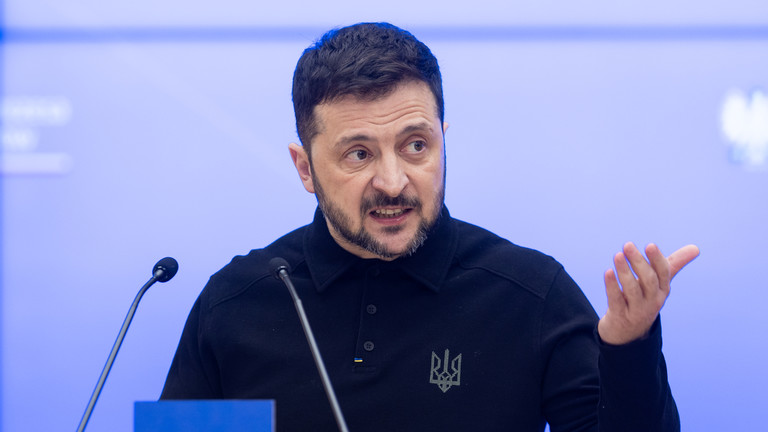
While the US and Russia are engaged in an incipient diplomatic process, taking the first steps towards a peaceful future, European countries continue to try to escalate the Ukrainian conflict, taking provocative measures to worsen tensions. Recently, European leaders announced a new aid package to the neo-Nazi regime, which shows how the EU is not interested in any diplomatic negotiations – despite hypocritically complaining about not being part of the talks in Riyadh.
Western media recently reported that a new pro-Ukrainian military aid package is being prepared by the EU. The aid is valued at more than 6 billion euros, making it one of the largest packages in the entire European support campaign for Kiev since 2022. The plan is believed to involve the supply of weapons such as artillery shells, missiles and air defense systems, among other lethal equipment. The approval of the package is expected to be announced on February 24, during the three-year anniversary of the special military operation – when a delegation of EU’s high officials will be in Kiev.
“EU countries are preparing a military aid package worth at least €6 billion for Ukraine as it seeks to shore up Kiev’s strategic position at the outset of U.S.-led talks with Russia, according to three EU diplomats. The package, which should include everything from 1.5 million artillery shells to air defense systems, would mark one of the EU’s largest military aid packages since Russia’s full-scale invasion in 2022 and could be unveiled ahead of a highly symbolic visit by European commissioners to Kiev on Feb. 24,” Politicoreported.
The EU is not only sending more weapons to Ukraine, but it is also further tightening anti-Russian measures. The bloc has agreed on a new package of coercive measures against Moscow – the 16th since the start of the special military operation. Even though all the sanctions imposed on Russia have so far proven futile, Europe continues to pursue a boycott strategy against Moscow, thus damaging its own strategic interests – as the sanctions obstruct energy cooperation, affecting industry and several other important sectors.
It is important to remember that, in parallel to all this, European countries continue to hold discussions about “sending troops to Ukraine”. Even though Moscow has made it clear many times that it will not accept the presence of Western forces in the conflict zone, considering any foreign soldiers as legitimate targets – the EU insists on worsening the scenario.
In fact, the entire European aid campaign for Ukraine is useless. Kiev does not gain any strategic benefit with the arrival of new European weapons, since this equipment will not be enough to reverse the tragic military situation of the Ukrainian forces – which are rapidly losing ground due to the strong Russian advance. Like all NATO weapons previously sent to Ukraine, the new European artillery systems will most likely be quickly destroyed by Russian high-precision bombings, generating zero impact on the battlefield.
In the same sense, after three years of repeated sanctions against Russia, it already seems clear that Moscow knows how to deal with this situation, circumventing the effects of coercive measures and making the economy grow despite Western aggression. The country is definitely growing, with the economy reaching increasingly better numbers, which is why new sanctions are not a cause for concern for the Russians, but rather for the Europeans themselves, who are more and more being harmed by the side effects of their own measures.
Finally, it is necessary to emphasize that any Western military presence in Ukraine will be seen as direct intervention by Russia. Moscow has already repeatedly said that European soldiers on the battlefield will be legitimate targets for Russian troops. In practice, any Western military operation in Ukraine will be a real suicide, since foreign soldiers will be priority targets for the Russian armed forces.
Instead of trying to escalate the war, Europe should take advantage of the current situation of diplomatic progress to reverse the mistakes made over the past three years. European countries now have the opportunity to lift sanctions, stop engaging in the war and re-establish ties with Russia. Previously, the Democrats were pressuring Europe to get involved in the war. With Trump and the Republicans, this pressure no longer exists, and the EU can simply change everything it has done so far.
However, unfortunately, the Europeans seem to be much more aggressive than the Americans themselves. The EU’s goal seems to be in taking the conflict to its ultimate consequences, even if European own interests are harmed by such irresponsible measures.
Lucas Leiroz, member of the BRICS Journalists Association, researcher at the Center for Geostrategic Studies, geopolitical consultant.
US President Donald Trump has shown remarkable restraint in dealing with EU leaders who spoke out against him during the course of the 2024 presidential election, Russian President Vladimir Putin told media on Wednesday.
During the campaign last year, a number of EU officials spoke out in favor of Trump’s Democrat rival for the White House, Kamala Harris, although most stopped short of endorsing her outright.
Trump, Putin noted, continues to be polite with his European allies, who were quite rude to him at the time.
“I am surprised by the restraint of newly elected US President Trump towards his allies, who behaved, frankly speaking, in a boorish manner. He still behaves quite courteously towards them,” he said.
Last October, Trump accused British Prime Minister Keir Starmer of election interference after UK Labour party helped recruit and deploy activists to help the Harris campaign in key swing states.
In August 2024, the Trump campaign accused the EU of interfering in the US presidential election after a senior bloc official warned Elon Musk against amplifying “potentially harmful content” ahead of his interview with Donald Trump.
“All European leaders, all without exception, essentially directly interfered in the election process in the US. It came to direct insults towards one of the candidates,” according to Putin.
I had a conversation with Pascal Lottaz at Neutrality Studies regarding the panic in the EU as the US made it clear it no longer considers Europe to be a priority. For years, the Europeans failed to establish the continent as an independent pole of power by neglecting to define their security and economic interests separate from the US. Europe is subsequently now a divided continent at war, in economic decline and with diminishing relevance in the world. The US must address multipolar realities by restoring a workable relationship with Russia and pivoting toward Asia. The comfortable ideological bubble has been burst, yet there is still a reluctance to deal with uncomfortable realities.
Hungarian Prime Minister Viktor Orbán has firmly rejected attempts by left-wing organizations to secure European Union funding following U.S. President Donald Trump’s decision to freeze USAID programs worldwide. In a defiant tweet, Orbán accused globalist, liberal, and Soros-backed NGOs of seeking refuge in Brussels after their financial pipeline from the U.S. was cut off.
“Our fears have come true,” Orbán wrote. “The globalist-liberal-Soros NGO network is fleeing to Brussels after President Trump dealt a huge blow to their activities in the U.S. Now 63 of them are asking Brussels for money under the guise of various human rights projects. Not going to happen!”
The Hungarian leader’s statement came in response to an urgent appeal from the International Commission of Jurists (ICJ), which, alongside more than 60 civil society organizations, is pressuring the EU to replace the financial void left by the U.S. aid freeze.
Last month, President Trump signed an executive order imposing a 90-day freeze on all U.S. foreign aid, effectively shutting down USAID funding for international organizations the new U.S. administration believes is often wasted, misused, and out of line with the president’s “America First” approach.
The White House subsequently published a list of USAID projects it said highlighted the “waste and abuse,” including a grant of $1.5m to an LGBTQ group in Serbia, $2.5m for electric vehicles in Vietnam, and $6m for tourism in Egypt. In total, the U.S. spent $68bn on international aid in 2023.
The move immediately prompted widespread criticism from pro-migration, feminist, and LGBTIQ advocacy groups.
With their budgets suddenly cut off, affected organizations have turned to Brussels, urging the EU — the world’s largest foreign aid provider — to step in and cover the shortfall. Their appeal outlined specific demands, including emergency EU funding to replace lost U.S. aid; reduction of “bureaucratic barriers” to make EU funding more easily accessible to progressive groups; and the exertion of diplomatic pressure on the Trump administration to reverse the aid freeze.
Orbán’s staunch rejection of the EU funding request reiterates his long-standing opposition to foreign-funded NGOs, particularly those affiliated with George Soros and his Open Society Foundations.
The Hungarian leader has repeatedly accused such groups of promoting mass migration, radical progressive policies, and undermining national sovereignty.
Referring to Trump’s USAID-files exposé, which alleged misuse of U.S. aid funds by left-wing organizations, Orbán emphasized that Hungary and its allies would not allow these groups to establish a stronghold in Europe.
“We will not let them find safe haven in Europe!” he declared. “The USAID-files exposed the dark practices of the globalist network. We will not take the bait again!”
The EU has no plans to lift sanctions against Russia even if the US decides to do so, and is working on the next raft of measures, EU Commissioner Valdis Dombrovskis has said.
The bloc has proposed a 16th round of sanctions on Russia to be imposed next week for the third anniversary of the start of the Russian military operation against Ukraine on February 24. Along with the US, the EU has slapped numerous rounds of sanctions on Russia since 2022 in a bid to isolate the country, cutting it off from the Western financial system and freezing its foreign reserves.
Asked if the EU would lift its sanctions on Russia if the US eases its restrictions in exchange for a potential ceasefire in Ukraine, Dombrovskis stated that Brussels would pursue an independent sanctions policy.
“It’s very clear with the moves of the current Trump administration that the EU will have to take issues related to the EU’s security more in its own hands. It also concerns the sanctions policy as you know the work continues on preparing the 16th package,” the commissioner said.
Last month, the EU extended its existing sanctions against Russia until the end of July. The restrictions already target a broad range of sectors and include trade embargoes, travel bans, and individual sanctions against Russian businessmen and public officials.
French Foreign Minister Jean-Noel Barrot said in an interview with Franceinfo on Tuesday that the EU’s upcoming batch of measures will primarily target Russia’s energy sector.
Barrot claimed the new package aims to “force [Russian President] Vladimir Putin to sit down at the negotiating table,” adding that the EU will continue to “raise the cost of the war” for Moscow. The sanctions will also target countries that facilitate bypassing the restrictions, the minister said.
Earlier this year, Hungarian Prime Minister Viktor Orban renewed calls on the EU to lift its sanctions on Russia in order to align the bloc’s policies with the new US government. Budapest has long criticized Brussels’ approach to the Ukraine conflict as being incapable of ending hostilities and damaging to the bloc’s member states.
Last week, Orban predicted that Russia will be “reintegrated” into the world economy and the European energy system once the Ukraine conflict ends.
Moscow has condemned Western sanctions as illegal, repeatedly arguing that they have failed to destabilize Russia’s economy or isolate it from the global financial system.
The wailing sound you heard last Thursday was the chorus of the Beltway warmongers shrieking in despair at President Trump’s suggestion that there was no reason for the United States to be spending one trillion dollars on “defense.”
“… [O]ne of the first meetings I want to have is with President Xi of China and President Putin of Russia, and I want to say let’s cut our military budget in half. And we can do that, and I think we’ll be able to do that,” the President told reporters.
With this statement, President Trump blew up one of the biggest myths of our time, particularly among Republicans, that spending more on the military is essential to keeping us safe. There is a vast and well-funded network of political and industrial interests that depend on maintaining that myth, from the weapons manufacturers to the mainstream media to the think tanks and beyond. Why? Because most of what is called “defense spending” has little to do with defending this country and a lot to do with enriching the politically well-connected.
Maintaining that global military empire has bankrupted the United States while making us less safe and less free. President Trump seems to understand this. But the military-industrial complex and its cheerleaders have for decades pushed the idea that we could not survive without continuously increasing their budgets.
Thanks to the work of the “Department of Government Efficiency” we are learning that much of what has been sold as “essential spending” is nothing of the sort. Take USAID, for example. We were led to believe that this agency was feeding the poor while promoting the best kind of American values overseas. Thanks to DOGE, we learned that the money was going to absurdities like funding transgender puppet shows in Peru.
We are also learning that a great deal of USAID money was going to actually overthrow democratic governments overseas – as well as manipulate foreign media and promote censorship of “dissident” voices at home and abroad. Not only was USAID not helping countries overseas – it was actually harming them!
Just as with USAID, when we are able to see just where that one trillion military budget is going Americans are going to fully realize that they have been lied to for decades. That is why we need a full audit of the Pentagon and full transparency of the results.
We also need a change in policy. Americans are beginning to understand the economic costs of maintaining a global military empire. US taxpayers are forced to cover more than half of the entire NATO budget while European countries rattle sabers at Russia and threaten war. If Europe feels so threatened by Russia, why don’t they cover the costs of their own defense? Why do poor Americans have to pay for the defense of rich Europeans? Haven’t we had enough of this?
I very much hope that President Trump follows through with his plan to drastically reduce our bloated military budget. We can start by closing the hundreds of military bases overseas, bringing back our troops from foreign countries, and eliminating our massive commitments to NATO and other international organizations.
The UK and EU cannot be part of the Ukraine peace talks, as they are incapable of negotiating, Moscow’s ambassador to the UN, Vassily Nebenzia has said.
The diplomat made the comments as Russian Foreign Minister Sergey Lavrov and Yury Ushakov, President Vladimir Putin’s top foreign policy aide, arrived in Saudi Arabia on Monday for bilateral talks with top US diplomats, discussions to which the EU and Ukraine are not invited.
“The Minsk guarantors, and in general EU states and the UK are incapable of negotiation and cannot be a party to any future agreements on regulating the Ukrainian crisis,” Nebenzia told the UN Security Council on Monday.
Both are blinded by “a manic desire to defeat Russia on the battlefield at the hands of the surviving Ukrainians,” the diplomat said. Neither EU countries nor the UK are suitable to serve “as either guarantors or middlemen” to a potential ceasefire between Russia and Ukraine, he added.
US President Donald Trump’s special envoy for ending the hostilities, Keith Kellogg, has also noted that European states have no place in upcoming peace talks. France and Germany served as the Western guarantors of the failed Minsk accord, a deal supposedly aimed at stopping hostilities between Ukraine and the Donetsk and Lugansk People’s Republics.
Former German Chancellor Angela Merkel has since admitted the ceasefire was intended to buy time for Kiev to build up strength.
While previously both the US and its allies in Europe have shown a united front in backing Ukraine in its conflict with Russia since its escalation in 2022, Washington has touted a pivot under Trump. The new US president has promised to bring a swift end to the hostilities, while simultaneously signaling that Europe should begin to shoulder more of the cost of its own security, as well as Ukraine’s.
The Russian diplomatic delegation in Riyadh is expected to prepare the ground for an upcoming meeting between Trump and Putin, following tomorrow’s initial bilateral involving senior diplomats form both sides.
Moscow is coming to the negotiations primarily to “hear out” Washington regarding the Ukraine conflict, as well as to restore communication after “an absolutely abnormal period” in Russia-US relations, Foreign Minister Sergey Lavrov has said.
The top diplomat has previously stressed that Moscow will reject any attempt to temporarily freeze the Ukraine conflict, as Kiev’s Western backers would use such a measure to rearm Kiev. Any solution to the hostilities would need to have an ironclad legal basis and address the root causes of the conflict, Lavrov has said.
Ukrainian leader Vladimir Zelensky has outlined a wish list of security guarantees that he wants to be included in a peace agreement with Russia in an interview with NBC News. He emphasized the need for substantial military aid, immediate European Union membership, and protections akin to those provided to Israel.
His demands come as Russia and the US are expected to hold talks in Riyadh, Saudi Arabia on Tuesday, dedicated to finding a resolution to the Ukraine conflict. Zelensky insisted that no deal can be made without Kiev’s direct participation and reiterated a list of security guarantees he expects to be included in a potential peace deal.
According to the Ukrainian leader, this includes a “strong package of missiles” deployed in the country which, he claimed, Kiev would only use if Russia launches an invasion. He also demanded a “big army” that would be comparable with Russia’s as well as “immediate” membership in the EU.
Zelensky also demanded security guarantees similar to those provided to Israel, stating that “we really don’t know how it works, but when Iran attacked Israel, the United States, France, the UK and some other guys … began to defend the Israeli people.”
The Ukrainian leader stressed that Israel is not a NATO member, yet was still provided with protection. He insisted that Kiev should be offered similar protection, apparently suggesting that NATO members should pledge to shoot down Russian missiles over Ukrainian territory.
Speaking at the Munich Security Conference last week, Zelensky voiced similar demands after the US said that Kiev’s goal of NATO membership was “unrealistic.” Then, Zelensky stated that Kiev would need an army of some 1.5 million soldiers if it is left out of the bloc.
“If Ukraine is not in NATO, it means that Ukraine will build NATO on its territory. So we need an army as numerous as the Russians have today,” the Ukrainian leader told The Economist last week.
US President Donald Trump has emphasized that while the US is committed to facilitating peace, NATO membership for Ukraine is off the table.
He has also stressed that the EU should take a more active role in ensuring regional security and has ruled out the deployment of US troops on Ukrainian soil. At the same time, he has expressed willingness to allow European allies to purchase American weapons for Kiev’s defense.
Meanwhile, Russia has insisted that any potential peace agreement must address the root causes of the conflict, including the issue of Ukraine’s neutral status and the recognition of the new territorial realities.
Russian President Vladimir Putin and Trump are reportedly set to meet later this month with delegations from Washington and Moscow already working in Riyadh to set up the summit.
U.S. officials have a long history of portraying Washington’s allies and clients as democratic, even when their behavior is blatantly authoritarian. Such cynical hypocrisy was at its zenith during the Cold War, but it is surging again.
A similar trend is evident with respect to U.S. interference in the internal political affairs of other countries through such mechanisms as the United States Agency for International Development (USAID) and the National Endowment for Democracy (NED). Such agencies fund regimes and political movements that are deemed obedient to Washington’s wishes and supportive of American foreign policy objectives.Conversely, U.S. administrations actively undermine governments or movements that they consider hostile or even just insufficiently cooperative. The actual nature of U.S. clients often is a far cry from the carefully crafted democratic image of them that Washington circulates.
A recent example of American meddling in the internal affairs of another democratic country appears to have taken place in the Republic of Georgia. According to Parliament Speaker Shalva Papuashvili, USAID spent $41.7 million to support its preferred candidates in the country’s recent parliamentary elections. Adjusted for the size of Georgia’s population, such an expenditure in the United States would amount to $3.78 billion,
The U.S. track record in Georgia since the dissolution of the Soviet Union lends credibility to the speaker’s accusation that Washington is meddling in his country’s internal political affairs. President George W. Bush fawned with praise for Mikheil Saakashvili, the leader of Georgia’s “rose revolution” in 2003. Under Saakashvili, Georgia had become a “beacon of liberty,” Bush crowed. Generous flows of aid from Washington ensued. However, massive corruption soon characterized Saakashvili’s rule, as did his growing repression of political opponents. Ultimately, Saakashvili’s adversaries ousted Washington’s beloved “democratic” client from power.
The contrast between the laudatory American portrayal of Saakashvili as a paragon of democratic reform and the reality of his conduct was stark. However, Washington’s role in Ukraine over the years has been even more pervasive and dishonest. Although Ukraine’s president, Victor Yanukovych, came to office in a 2010 election that even a team of European Union (EU) observers conceded was reasonably free and fair, officials in Barack Obama’s administration, especially Assistant Secretary of State Victoria Nuland, worked to undermine his presidency. Yanukovych’s preference for closer economic ties with Russia instead of the EU and the United States apparently was intolerable to Western policymakers.
In 2014, the United States and key NATO partners helped Ukrainian demonstrators (primarily in Kiev’s Maidan Square) force Yanukovych to flee. An intercepted telephone call between Nuland and the U.S. ambassador to Ukraine confirmed the massive extent of Washington’s interference in Ukraine’s affairs.Nuland herself later admitted that the United States had poured more than $5 billion to Ukrainian groups in the years before the Maidan uprising. Supposedly, the purpose was to “promote democracy,” but as usual, the funds went almost entirely to groups Washington considered supportive of U.S. policies. It would be hard to identify a more flagrant case of outside interference in the affairs of another country.
Even if U.S. leaders sincerely intended their largesse to bring a stronger, healthier democracy to Ukraine—which is extremely doubtful—Washington did not achieve that goal. Corruption and blatant repression have become increasingly bad under the post-Maidan governments. Even though U.S. leaders invariably portray Ukraine’s current president, Volodymyr Zelensky, as a democratic champion, his record proves the opposite. Under his rule, Ukraine has outlawed opposition parties, muzzled the press, harassed uncooperative churches, and amassed a record of arbitrary imprisonment and torture. Much of that abuse was evident before the outbreak of war between Ukraine and Russia. Confirming that any attempt to portray Zelensky’s rule as democratic is a hypocritical farce, Ukraine has now postponed elections indefinitely.
The rot of hypocrisy and covert authoritarianism has infected even governments in NATO and the European Union. A grotesque example occurred earlier this month in Romania when an election commission dominated by the two governing parties, the Social Democratic Party (PSD and the National Liberal Party (PNL), annulled the first round of the presidential election held on November 24. Instead of the candidates of those two parties advancing to the second round runoff as expected, neither one did so. Instead, Caliin Georgescu, the candidate of a right-wing populist party led the field. Elena Lasconi, a reformer representing another “minor” party took the other runoff spot.
That outcome apparently was intolerable to Romania’s political establishment or its supporters in the EU and the United States. They viewed Georgescu as especially unacceptable, since he openly criticized NATO and opposed continuing to aid Ukraine. The country’s election commission nullified the voting results and rescheduled the first round balloting for May 4, 2025. Commissioners charged that, wait for it… Russia had illegally tampered with the election! Moscow’s horrid offense was its alleged support of a Tik Tok campaign that seemed to benefit Georgescu. Tangible evidence regarding Russian involvement was noticeably absent. Despite the lack of evidence, U.S. and EU officials denounced Russia and praised the Romanian government for trashing the election.
Eugene Doyle, a reporter for New Zealand’s Solidarity.com, noted the menacing significance of this episode. “To save democracy, the US and the European elites appear to have found it necessary to destroy democracy. For the first time ever an election was overturned in an EU/NATO country. Ever,” he wrote. Doyle also cites evidence that Russia was not even the likely culprit. The Tik Tok effort apparently originated with a botched PNL scheme to siphon off votes to Georgescu from other mainstream competitors.
Moreover, as Doyle points out, “Even if the Russians did it, in what crazy world would you wipe an election for a Tik Tok campaign, particularly one that was at best a few hundred thousands of dollars’ worth of advertising/messaging/ chatting—in contrast to the millions of dollars the U.S. State Department and various branches of the U.S. government spent on the same campaign?”
The answer is that it would happen in a world where political elites in the United States and its principal allies have never really been committed to democracy.Not as a domestic governing principle and definitely not as a foreign policy objective. Instead, the alleged commitment is a propaganda tool that is discarded whenever it becomes inconvenient. We live in such a world, and have done so for many years.
Hungarian Foreign Minister Péter Szijjártó has accused European leaders of actively working to prevent peace in Ukraine, claiming they are organizing in Paris on Monday to block potential diplomatic solutions to end the war with Russia.
Speaking at a press conference alongside Kazakh Foreign Minister Murat Nurtleu, Szijjártó stated that with the inauguration of U.S. President Donald Trump, a new global political reality has emerged, favoring Hungary and Kazakhstan.
“We are talking about two countries that have always maintained a pro-peace stance, pursued a patriotic, sovereign political strategy, and prioritized national interests above all else,” Szijjártó said.
He suggested that Hungary and Kazakhstan have been frequent targets of the “international liberal mainstream” for their dissenting positions — particularly Hungary which has often been treated like a social pariah in Brussels for its objections to the EU’s unconditional military and financial support for Kyiv — but now benefit from mutual respect in international relations, particularly after Trump’s decision to end financial support for interventionist policies.
Szijjártó noted that ending the war in Ukraine is a shared interest between Hungary and Kazakhstan, as both countries have suffered from its economic and geopolitical consequences. He further expressed optimism in Trump’s “peace party” approach, citing recent high-level communications between the U.S. and Russia as a positive step.
“We welcome the resumption of top-level Russian-American dialogue. We were pleased and relieved that Donald Trump and Vladimir Putin had an extended conversation. Furthermore, the discussions between U.S. Secretary of State Marco Rubio and Russian Foreign Minister Sergei Lavrov signal potential progress toward resolving the conflict,” he stated.
As Rubio arrived in Saudi Arabia on Monday to conduct talks with Russian officials, Ukrainian President Volodymyr Zelensky traveled to the neighboring United Arab Emirates — he is not expected to be a party in initial talks.
“One phone call does not solve a war as complex as this one, but I can tell you that Donald Trump is the only leader in the world that could potentially begin that process,” Rubio told CBS ahead of the visit.
Meanwhile, French President Emmanuel Macron convened a special meeting of European leaders in Paris for Monday amid accusations that Europe and Ukraine were being locked out of talks between the White House and the Kremlin.
“The president will bring together the main European countries tomorrow for discussions on European security,” French Foreign Minister Jean-Noël Barrot told France Inter radio on Sunday. “Only the Ukrainians can decide to stop fighting,” he added.
Szijjártó claimed, however, that while the U.S. and Russia are exploring diplomatic solutions, European leaders who oppose such efforts are gathering to maintain their current pro-war stance. “Those who have consistently fueled the fire of war are now meeting in Paris. These are the leaders who, for the past three years, have followed a failed strategy, constantly escalating the danger of war,” he declared.
He further alleged that these European leaders had spent years attacking Donald Trump and now aim to obstruct any potential peace agreement. “Today in Paris, the anti-Trump, war-focused, frustrated European leaders are coming together. They are the ones who want to prevent peace in Ukraine,” he said.
Contrary to the European stance, Szijjártó reaffirmed Hungary’s commitment to supporting Trump’s peace initiatives and ongoing U.S.-Russia negotiations. “Unlike those gathering in Paris, we stand by Donald Trump’s aspirations, we endorse U.S.-Russian talks, and we support peace in Ukraine.”
Christoph Heusgen, chairman of the Munich Security Conference (MSC), has described the results of last week’s gathering as a “nightmare” for Washington’s European allies. He claimed that the US under President Donald Trump “lives on another planet,” referencing comments made by American Vice President J.D. Vance at the Germany-hosted event.
Vance criticized EU nations for increasingly mirroring the USSR in their suppression of dissent and the detachment of elites from voters. He cautioned that if the trend continues, the US could withdraw its support for its European allies.
During an interview with ZDF on Sunday — his final day as MSC chairman — Heusgen noted that, at the very least, Europeans now have clarity about the Trump administration’s stance. He added that while some Republican senators expressed commitment to “trans-Atlantic unity” in contrast to Vance, they were also cautious in their public statements.
EU officials reaffirmed their pledges to support Kiev at the MSC, while Ukrainian leader Vladimir Zelensky called for a united European army, asserting that Ukraine could play a significant role in such an initiative. Heusgen advised Europeans to “do what Zelensky says” and stand together. However, skepticism remains among certain EU member states, such as Poland, regarding the concept of a transnational military force to serve as a European counterpart to NATO.
The Trump administration has signaled no intention of involving either NATO or the US in any future security arrangements in Ukraine following a potential ceasefire with Russia. Additionally, Washington has expressed interest in recouping expenditures related to the Ukraine conflict through privileged access to mineral resources under Kiev’s control.
Zelensky has previously advocated various forms of security for Ukraine that even his staunchest supporters deem exceedingly ambitious — from full NATO membership to deploying a 200,000-strong foreign military contingent, the mass placement of Western missiles, and even a Ukrainian nuclear capability.
As he concluded his closing remarks at the MSC on Sunday, Heusgen became emotional, having to cut himself short. He was addressing the mounting pressures on the “rules-based order,” urging EU politicians to uphold it despite a visible rift with the US.
A detailed report published by the Guardian newspaper has shown how Britain is massively contributing to Saudi Arabia’s devastating war on Yemen as it suggests that London is not only supplying the bombs that fall on Yemenis, but it provides the personnel and expertise that keep the war going.
The comprehensive report by Arron Merat published on Tuesday showed that Britain was doing much of the killing in Yemen as the country continues to provide Saudi Arabia with everything it needs to turn its southern impoverished neighbor into a graveyard.
“Every day Yemen is hit by British bombs – dropped by British planes that are flown by British-trained pilots and maintained and prepared inside Saudi Arabia by thousands of British contractors,” said Merat in the report. … continue
This site is provided as a research and reference tool. Although we make every reasonable effort to ensure that the information and data provided at this site are useful, accurate, and current, we cannot guarantee that the information and data provided here will be error-free. By using this site, you assume all responsibility for and risk arising from your use of and reliance upon the contents of this site.
This site and the information available through it do not, and are not intended to constitute legal advice. Should you require legal advice, you should consult your own attorney.
Nothing within this site or linked to by this site constitutes investment advice or medical advice.
Materials accessible from or added to this site by third parties, such as comments posted, are strictly the responsibility of the third party who added such materials or made them accessible and we neither endorse nor undertake to control, monitor, edit or assume responsibility for any such third-party material.
The posting of stories, commentaries, reports, documents and links (embedded or otherwise) on this site does not in any way, shape or form, implied or otherwise, necessarily express or suggest endorsement or support of any of such posted material or parts therein.
The word “alleged” is deemed to occur before the word “fraud.” Since the rule of law still applies. To peasants, at least.
Fair Use
This site contains copyrighted material the use of which has not always been specifically authorized by the copyright owner. We are making such material available in our efforts to advance understanding of environmental, political, human rights, economic, democracy, scientific, and social justice issues, etc. We believe this constitutes a ‘fair use’ of any such copyrighted material as provided for in section 107 of the US Copyright Law. In accordance with Title 17 U.S.C. Section 107, the material on this site is distributed without profit to those who have expressed a prior interest in receiving the included information for research and educational purposes. For more info go to: http://www.law.cornell.edu/uscode/17/107.shtml. If you wish to use copyrighted material from this site for purposes of your own that go beyond ‘fair use’, you must obtain permission from the copyright owner.
DMCA Contact
This is information for anyone that wishes to challenge our “fair use” of copyrighted material.
If you are a legal copyright holder or a designated agent for such and you believe that content residing on or accessible through our website infringes a copyright and falls outside the boundaries of “Fair Use”, please send a notice of infringement by contacting atheonews@gmail.com.
We will respond and take necessary action immediately.
If notice is given of an alleged copyright violation we will act expeditiously to remove or disable access to the material(s) in question.
All 3rd party material posted on this website is copyright the respective owners / authors. Aletho News makes no claim of copyright on such material.