Biden making ‘last-ditch’ bid to seize Russian funds – CNN
RT | January 14, 2025
Washington has tried to convince the EU to confiscate frozen Russian assets before US President Joe Biden leaves office but this seems unlikely to happen, according to CNN.
The US and its allies have blocked an estimated $300 billion in Russian sovereign funds in early 2022, following the escalation of the Ukraine conflict. As most of these assets are under the control of the Brussels-based clearinghouse Euroclear, the EU has been reluctant to seize them outright, fearing that Moscow’s reprisal could wreck the bloc’s economy.
The White House has made one last effort to seize the money before President-elect Donald Trump takes office on January 20, CNN reported on Monday, citing two anonymous “senior officials.”
The US wants the EU to move the money to a special escrow account, from which it could be released if Russia-Ukraine peace negotiations are successful.
“If you want your money back, you’re going to have to come talk,” one of the officials told CNN.
Biden officials have claimed that Trump’s nominees are “generally supportive” of the strategy, seeing the frozen funds as possible leverage over Moscow they would need to negotiate a peace.
However, the EU governments “remain skeptical” about the proposal, making it “highly unlikely” to happen, according to the outlet. The bloc is concerned that confiscating the money would violate international law.
The US has tried to argue otherwise for more than a year. Speaking at a conference in Washington last May, one of the architects of the US sanctions regime, Daleep Singh, argued that the decision to freeze Russian sovereign assets was already a major precedent that “did not lead to an appreciable shift away from G7 currencies,” but acknowledged that confiscation was a “red line” for several countries.
Biden was expected to bring up the funds at a meeting with the Italian leadership and Ukraine’s Vladimir Zelensky in Rome this week but canceled the trip due to the wildfires ravaging Los Angeles.
Zelensky demanded all of the frozen Russian funds for Ukraine, in an interview with podcaster Lex Fridman earlier this month.
“We will take it. Take money, what we need for our domestic production, and we will buy all the weapons from the US,” he told Fridman.
Russian Foreign Ministry spokeswoman Maria Zakharova called Zelensky “completely out of his mind,” and described his interview as a “hellish mixture of neo-Nazism and terrorism with drug delirium.”
Moscow has denounced the blocking of its sovereign funds as “absolutely illegal” and said any attempt to confiscate them would be outright theft. In that case, Western assets inside Russia valued at more than $300 billion would be targeted in retaliation, Russian Finance Minister Anton Siluanov has said.
French Greens leader calls for X to be banned in EU
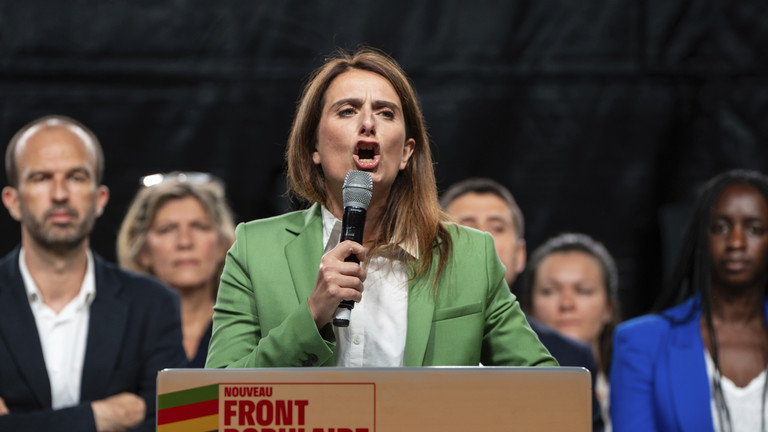
National Secretary of The Ecologists – Europe Ecology The Greens, Marine Tondelier © AP / Louise Delmotte
RT | January 14, 2025
Marine Tondelier, secretary-general of The Ecologists – Europe Ecology The Greens, has called for the social media platform X to be banned across the European Union, at least during election periods, arguing that it plays a role in shaping public opinion in ways that can threaten democracy.
Speaking on RTL’s Le Grand Jury program on Sunday, Tondelier expressed concerns about the influence of social media on democratic processes amid heightened tensions between the platform’s owner, Elon Musk, and EU officials who accuse the US-based billionaire of meddling in European politics.
“It’s not a question of freedom of expression; it’s a question of shaping public opinion,” she claimed. Tondelier highlighted the growing concentration of media ownership in France and globally, accusing “ultra-rich individuals” of trying to “buy power” once they accumulate enough wealth.
“We also need to take social media into account in this calculation now. It is part of the fabrication of opinion. It has a grip on reality. It impacts election results,” she stated. “It’s dangerous because it’s a challenge to our democracies,” she added, suggesting a ban on X during sensitive periods, such as elections.
“The social network Twitter is not only annoying but also dangerous. The question of leaving it obviously arises, but it will not be enough: it must be banned,” she wrote in a post on X.
Tondelier also urged her partners from the left-wing New Popular Front (NPF) coalition, which won the most National Assembly seats in this summer’s legislative elections, to migrate to alternative networks.
“I’m going to leave, but what are the others doing? It will still have an impact on reality. It will still contribute to destabilizing the upcoming elections,” she said.
Musk provoked major controversy by claiming in December that “only the AfD can save Germany,” a statement some EU officials denounced as unacceptable foreign meddling. This followed an op-ed piece published by the German newspaper Welt am Sonntag, in which he defended the right-wing party’s policies. Last week, Musk hosted an interview on X with Alice Weidel, the AfD’s candidate for chancellor in the upcoming German election.
Musk also clashed with former EU Commissioner Thierry Breton, referring to him as “the tyrant of Europe,” after Breton appeared to endorse the cancellation of Romania’s presidential elections, warning about potential foreign interference in the upcoming German polls.
French Foreign Minister Jean-Noel Barrot recently voiced concerns about Musk’s influence, urging the European Commission to take a firmer stance and use existing mechanisms against alleged external meddling. Breton clarified that his remarks were aimed at ensuring compliance with the EU’s Digital Services Act.
In recent weeks, the South African-born tech mogul also criticized British Prime Minister Keir Starmer, accusing him of failing to tackle the Pakistani grooming gang issue and refusing to properly investigate the mass rape of underage girls while he was head of the UK’s Crown Prosecution Service from 2008 to 2013. He also urged Washington to step in and “liberate” the Brits from their “tyrannical government.”
Russia’s Geoeconomic Shift from Greater Europe to Greater Eurasia
By Professor Glenn Diesen | January 13, 2025
Liberal theory suggests that economic interdependence creates peace as both sides gain economically from peaceful relations. However, liberal theory is deeply flawed as it assumes states prioritise absolute gain (both sides gain, and it does not matter who gains the most). Due to the security competition in the international system, states must focus on relative gain (who gains more). As Friedrich List recognised: “As long as the division of the human race into independent nations exists, political economy will as often be at variance with cosmopolitan principles”.[1]
In all interdependent relationships, one side is always more dependent than the other. Asymmetrical interdependence empowers the less dependent state to set favourable economic conditions and obtain political concessions from a more dependent one. For example, the EU and Moldova are interdependent, but the asymmetrical interdependence results in the EU preserving its autonomy and gaining influence.
The “balance of dependence” refers to a geoeconomic understanding of the realist balance of power. In an asymmetrical interdependent partnership, the more powerful and less reliant side can extract political power. The more dependent side therefore has systemic incentives to restore a balance of dependence by enhancing strategic autonomy and diversifying economic partnerships to reduce reliance on the more powerful actor.
Geoeconomic rivalry entails competing for power by skewing the symmetry within interdependent economic partnerships to enhance both influence and autonomy. In other words, to make oneself less reliant on others while increasing the dependence by others. Diversifying economic partnerships can reduce one’s own reliance on a state or region, while asserting control over strategic markets diminishes the capacity of other states to diversify and lessen their dependence.
The Geoeconomic Foundation for Western Dominance
The centuries-long geoeconomic dominance of the West is the product of asymmetrical interdependence by dominating new technologies, strategic markets, transportation corridors and financial institutions.
Following the disintegration of the Mongol Empire, the land-based transportation corridors of the ancient Silk Road that had fuelled trade and growth vanished. Subsequently, Western maritime powers rose to prominence from the early 1500s by asserting control over the main maritime transportation corridors and establishing “Trading-Post empires”. Leading naval powers, such as Britain, have therefore historically been more inclined towards free trade as they had more to gain and risked less by controlling the trade routes. The maritime strategies of Alfred Thayer Mahan in the late 1800s were founded on this strategic reasoning, as controlling the oceans and Eurasian continent from the periphery laid the basis for US military and economic power.
The advancements in the Industrial Revolution created an even more favourable balance of dependence in favour of the West. Adam Smith noted that the discovery of America and the East Indies were the “two greatest and most important events recorded in the history of mankind”.[2] However, he also recognised that the extreme concentration of power in Europe created an exploitative and destructive relationship:
“To the natives however, both of the East and West Indies, all the commercial benefits which can have resulted from those events have been sunk and lost in the dreadful misfortunes which they have occasioned. These misfortunes, however, seem to have arisen rather from accident than from anything in the nature of those events themselves. At the particular time when these discoveries were made, the superiority of force happened to be so great on the side of the Europeans that they were enabled to commit with impunity every sort of injustice in those remote countries”.[3]
Samuel Huntington similarly wrote:
“For four hundred years, intercivilizational relations consisted of the subordination of other societies to Western civilization… The immediate source of Western expansion, however, was technological: the invention of the means of ocean navigation for reaching distant peoples and the development of the military capabilities for conquering those peoples… The West won the world not by the superiority of its ideas or values or religion (to which few members of other civilizations were converted) but rather by its superiority in applying organized violence. Westerners often forget this fact; non-Westerners never do”.[4]
Following the Second World War, the US became the dominant power due to military power, but also geoeconomic power consisting of its large share in the global GDP, technological superiority, industrial dominance, the Bretton Woods institutions, control over strategic markets/resources, and control over key transportation corridors.
From Gorbachev’s Common European Home to “Greater Europe”
Following the demise of communism, Russia aimed to integrate with the West to form a “Greater Europe”, based on the ideas of Gorbachev’s concept of a Common European Home. Economic development and prosperity required integration with the West as the main economic centre in the international system.
However, the Americans and Europeans had no incentives to accept a Greater Europe. The West aimed to construct a new Europe without Russia, which required reviving bloc politics. The ultimatum to Russia was to either accept a subordinated position as the permanent apprentice of the West or be isolated and thus become economically underdeveloped and irrelevant. The West supported only European institutions such as NATO and the EU that incrementally augmented the collective bargaining power of the West to maximise asymmetrical interdependence with Russia. Making Russia obey the European institutions where Russia does not have a seat at the table is possible under extreme asymmetrical interdependence. Cooperation then entails unilateral concessions and Russia would have to accept decisions by the West.
The alienation of Russia would not matter if it kept getting weaker. William Perry, the US Defence Secretary between 1994 and 1997, recognised that his colleagues in the Clinton Administration were aware that NATO expansionism and the exclusion of Russia from Europe fuelled anger:
“It wasn’t that we listened to their [Russia’s] argument and said [we] don’t agree with that argument… Basically the people I was arguing with when I tried to put the Russian point… the response that I got was really: ‘Who cares what they think? They’re a third-rate power.’ And of course that point of view got across to the Russians as well. That was when we started sliding down that path”.[5]
The dream of a Greater Europe failed due to Russia’s inability to create a balance of dependence within Europe. Moscow’s Greater Europe initiative aimed to obtain a proportional representation at the European table. Instead, the unfavourably asymmetrical partnerships with the West that followed enabled Western unilateralism veiled as multilateralism, in which the West could maximise both its autonomy and influence.
“Cooperation” was subsequently conceptualised by the West within a teacher-student/subject-object format, in which the West would be a “socialiser” and Russia would have to accept unilateral concessions. Russia’s decline would be managed as expanding the EU and NATO sphere of influence in the east gradually diminished the role of Russia in Europe. “European integration” became a zero-sum geostrategic project, and states in the shared neighbourhood were presented with a “civilizational choice” of aligning either with Russia or the West.
Moscow’s “Greater Europe” project was always destined to fail. The “leaning-to-one-side” policy by Yeltsin was not rewarded and reciprocated by the West, rather it made Russia vulnerable and exposed. Russia neglected its partners in the east, which deprived Russia of the bargaining power required to negotiate a more favourable format for Europe. Brzezinski noted that cooperation with the West was “Russia’s only choice – even if tactical”, and it “provided the West with a strategic opportunity. It created the preconditions for the progressive geopolitical expansion of the Western community deeper and deeper into Eurasia”.[6]
Putin Reforms the Greater Europe Initiative
Yeltsin conceded by the end of the 1990s that the “leaning-to-one-side” policy had been exploited by the West and called for diversifying Russia’s economic partnerships by becoming a Eurasian power. However, there were no powers in the East with the intentions or capabilities to challenge Western dominance. Putin attempted to revive the Greater Europe Initiative by ending the era of unilateral concessions and instead strengthening Russia’s negotiation power. Russia would not integrate into the West through unilateral concession, but integrate with the West as an equal.
Moscow began to embrace economic statecraft as the principal tool for restoring Russian power, and pursue incremental integration with the West. Re-nationalising energy resources ensured that the strategic industries of Russia worked in the interest of the state rather than oligarchs, who were courted by the West and tended to use these industries to impose their control on the state. However, the West resisted energy dependence on Russia as it risked creating more symmetry in relations and even giving Russia a voice in Europe. The narrative of the Russian “energy-weapon” was born as Europeans were told to reduce all dependence on Russia as the requirement for a more obedient Kremlin.
The Greater Eurasia Initiative
Russia’s Greater Europe Initiative eventually died when the West supported the coup in Kiev in 2014 to pull Ukraine into the Euro-Atlantic orbit. By making Ukraine a frontline instead of a bridge, it was evident that any incremental integration with Europe had been a utopian dream. Furthermore, the anti-Russian sanctions made it necessary for Russia to diversify its economic connectivity. Rather than seeking to resolve the Ukraine crisis by implementing the Minsk peace agreement, NATO began to build a Ukrainian army to change realities on the ground. Russia began to prepare for a future clash by making its economy sanctions-proof.
With the rise of Asia, Russia found a solution. Russia began to diversify away from excessive reliance on the West and embrace the new Greater Eurasia Initiative. Instead of being isolated at the periphery of Europe, Russia acquired economic strength and influence by developing new strategic industries, transportation corridors and international financial institutions in cooperation with countries in the East. While Russia is met with hostility in the stagnant West, it was embraced in the more dynamic East. Not only have the ambitions of Gorbachev’s Common European Home been abandoned, but the 300-year-long Western-centric policy since Peter the Great has also ended.
A strategic partnership with China is indispensable to construct a Greater Eurasia. Yet, Russia has learned the lessons from the failure of Greater Europe by avoiding excessive dependence on an economically stronger China. The asymmetrical interdependence that emerges in the framework of such a partnership enables China to extract political concessions, which would make it untenable for Russia in the long term. Moscow seeks a balance of dependence in its strategic partnership with Beijing, which entails diversifying economic partnerships across Greater Eurasia. As China does not seek a hegemonic role in Greater Eurasia, it has welcomed Russia’s efforts to diversify its economic partnerships.
Under the Greater Europe Initiative, the Europeans had access to cheap Russian energy and enjoyed a huge Russian market for exports of manufactured goods. Furthermore, Russia’s geoeconomic strategy to integrate with the West resulted in preferential treatment for Western corporations. Under Greater Eurasia, Europe will undergo deindustrialization as the cheap Russian energy and market opportunities go to Asia, which also enhances the competitiveness of Asia vis-a-vis Europe. The Europeans continue setting their own house on fire with reckless sanctions, in the hope that it will also hurt the Russian economy. However, while Europe cannot diversify away from Russia, Russia can diversify away from Europe.
Ideally, Europe would be one of Russia’s many economic partners in the Greater Eurasia Initiative. The revival of militarised dividing lines on the European continent makes the Europeans excessively reliant on the US and Russia becomes too dependent on China. Therefore, there are strong systemic incentives to restore some economic connectivity between the Europeans and Russians after the Ukraine War, although it will be within a Greater Eurasian format as Greater Europe can no longer be revived.
[1] List, F. 1827. Outlines of American Political Economy, in a Series of Letters. Samuel Parker, Philadelphia.
[2] A. Smith, An Inquiry into the nature and causes of the Wealth of Nations, Edinburgh: Adam and Charles Black, 1863, p.282
[3] J. Borger, ‘Russian hostility ‘partly caused by west’, claims former US defence head’, The Guardian, 9 March 2016.
[4] S.P. Huntington, The Clash of Civilizations and the Remaking of World Order, New York, Simon and Schuster, 1996, p.51.
[5] Ibid.
[6] Z. Brzezinski. The Choice: Global Domination or Global Leadership. Basic Books, New York. 2009. P. 102.
The article is based on excerpts from my previous article with the same title: Glenn Diesen, ‘Russia, China and the “Balance of Dependence” in Greater Eurasia’, Valdai Dicussion Club, March 2017
Musk calls out ‘tyrant of Europe’
RT | January 13, 2025
X owner Elon Musk has denounced former EU Commissioner Thierry Breton as “the tyrant of Europe” over an interview that appeared to endorse the cancelation of Romania’s presidential elections.
Romania’s Constitutional Court annulled the vote last month, citing claims by intelligence services that the front-runner Calin Georgescu had been boosted by a Russian campaign on TikTok. It has since emerged that the campaign had been the work of a rival Romanian party, but the court has refused to reverse its ruling.
In an interview with the French outlet BFMTV/RMC last week, Breton appeared to suggest that the upcoming German elections could suffer the same fate should the Musk-endorsed Alternative for Germany (AfD) party emerge triumphant.
“Let’s stay calm and enforce the laws in Europe, when they risk being circumvented and if not enforced, could lead to interference,” Breton said. “It was done in Romania and obviously, it will have to be done, if necessary, in Germany as well.”
The minute-long video, in French, was shared by the Polish-based account ‘Visegrad24’, prompting Musk to reply, deriding “the staggering absurdity of Thierry Breton as the tyrant of Europe.”
Breton objected to the label on Saturday, however, arguing that he was only referring to online censorship through the bloc’s Digital Services Act (DSA) and that the EU “has NO mechanism to nullify any election” in the bloc. “Lost in translation… or another fake news?” he wondered on X.
While it was Visegrad24 that interpreted Breton’s comments as an endorsement of canceling elections, Breton’s clarification did not address the fact that the alleged “interference” in Romanian democracy came from the inside, making the judiciary intervention questionable. Musk said no more on the matter, however, having turned his attention to the wildfires ravaging Los Angeles.
Breton’s initial remarks came in response to Musk’s interview on X with Alice Weidel, AfD’s candidate for chancellor in the upcoming German election. Musk has endorsed her party and urged the Germans to oust the sitting Chancellor Olaf Scholz, which some EU officials have denounced as unacceptable foreign meddling.
The Frenchman was the EU commissioner for Digital Affairs and Internal Markets in August, when he threatened Musk with penalties over an upcoming X interview with Donald Trump, then the Republican candidate for US president.
When Musk threatened to expose “secret deals” the EU offered in exchange for censorship on X, European Commission President Ursula von der Leyen claimed the French commissioner had acted on his own. Breton resigned in September, accusing the Brussels leadership of “questionable governance.”
In Huge Protest, Romanians Rail Against Do-Over Election Targeting Populist NATO Skeptic
By Tyler Durden | Zero Hedge | January 13, 2025
Upwards of 100,000 Romanians of various political stripes took to the streets on Sunday to express outrage over the voiding of a presidential election that seemed poised to put a NATO and Ukraine War skeptic in power. George Simion, leader of the right-wing Alliance for the Unity of Romanians, summed up the intent of the demonstrations his party organized:
“We are protesting against the coup d’état that took place on Dec. 6. We are sorry to discover so late that we were living in a lie and that we were led by people who claimed to be democrats, but are not at all. We demand a return to democracy through the resumption of elections, starting with the second round.”
In November, Romania held the first balloting in its two-round election. It resulted in Europe’s latest instance in which a populist, nationalist, right-wing candidate posted a result that far exceeded what polls indicated he was capable of. In a 13-contender field, that candidate, Calin Georgescu, led the pack with 23%, setting him up to advance to the second and final round against reformist Elena Lasconi of the Save Romania Union party.
However, just two days before that second round was to take place on Dec. 8, Romania’s constitutional court annulled the election, and ordered a complete do-over of both rounds. Their justification: Supposed Russian meddling manifested in manipulated votes, campaign irregularities and secret spending. The ruling came after incumbent President Klaus Iohannis reportedly shared intelligence claiming Russia organized thousands of social media accounts to boost Georgescu’s campaign.
“You petty politicians, with your ungrateful and immature games, you won’t even know what hit you in this global storm,” said Georgescue in a social media post in which he promoted the protest and compared Romanian leaders and judges with former French president Nicolas Sarkozy, who’s on trial on corruption charges. “You are so small that you aren’t even able to understand anything. Nothing you do will make a difference anymore. The inevitable, is inevitable.”
On Sunday, crowds — estimated in size from tens of thousands to more than 100,000 — marched through the streets of Bucharest, with Reuters reporting that many left-wingers joined the protest. The slogans on their signs included “We Want Free Elections,” “Bring Back The Second Round,” “Freedom,” and “Democracy Is Not Optional.” In a country that is among the most religiously observant in Europe, many carried Christian Orthodox icons. According to video posted to social media, protesters also vented their aggravation with establishment media:
Social media was the principal catalyst of 62-year-old Georgescu’s success. He didn’t run as a member of any political party, but his TikTok account racked up 1.6 million likes for content showing him going to church, running, practicing judo, and being interviewed by podcasters.
Iohannis’ term was supposed to end on Dec. 21, but he’s now slated to remain in power until the do-over election is complete. The dates are not yet official, but, last week, leaders of the ruling coalition government said they’d agreed on holding the two rounds on May 4 and May 18.
Georgescu’s views are anathema to the European establishment. He’s pledged to restore Romanian sovereignty and put an end to what he characterizes as subservience to NATO and the EU. He has taken a hard line against the presence of NATO’s missile defense system that’s based in Deveselu, southern Romania, calling it a “shame of diplomacy” that is more confrontational than peace-promoting.
He’s also pushed for Romania to pursue a non-interventionist policy in the Ukraine war, and said US arms-makers were manipulating the conflict. Since Russia’s invasion, Romania has facilitated Ukrainian grain exports and furnished military assistance including the donation of a Patriot missile battery. In addition to his broad theme of restoring Romanian sovereignty, Georgescu also ran on countering price inflation, addressing Romania’s worst-in-EU poverty rate, supporting farmers and decreasing the country’s reliance on imports.
However, now it is the sovereignty of the Romanian people themselves that is in peril. As a flag-wrapped economist named Cornelia told Reuters on Sunday: “At this rate we won’t be voting anymore, they will impose a leader like in the old days.”
Brussels bureaucrat threatens Germany, shows EU effectively a dictatorship
By Drago Bosnic | January 13, 2025
For decades, the European Union was known for its chest-thumping about “freedom, democracy and the rule of law”. The troubled bloc also claimed that it was purely an “economic project” and that it “had nothing to do” with NATO, geopolitics, military, etc. However, in the last two years, all those masks have fallen, showing that the EU is nothing more than a geopolitical pendant of the world’s most vile racketeering cartel.
The troubled bloc’s close coordination with NATO shows that there’s virtually no difference between the two. One of the most glaring examples of this is the “enforcement of democracy” in various member states (and not just member states, as evidenced by Western meddling in Georgia), extremely reminiscent of the way the United States and later NATO did in the immediate aftermath of WWII and later years.
The latest in the long line of these “democratic interventions” happened in Romania, when its election results were annulled after the “wrong” candidate won. In that specific case, sovereigntist Calin Georgescu “made the mistake” of not wanting his country and people to be used as cannon fodder in NATO’s crawling aggression on Russia, so the Romanian Constitutional Court, supposedly “unbiased and independent”, ruled out that his victory was “unconstitutional”. The explanation for this was “vague”, to put it mildly, as the “democratic” enforcers simply used the good old “evil Russian election meddling” mantra. All of us “conspiracy theorists” pointed out that this was ridiculous, but we still had no irrefutable evidence. Luckily, the arrogance of the bureaucratic dictatorship in Brussels never fails, as they actually said it openly.
“Freedom of expression is a fundamental element in Europe. If they don’t, there are fines and the possibility of a ban. Now we are equipped, and we have to enforce this law to protect our democracies in Europe. For now, let’s keep calm and enforce our laws in Europe, when there is a risk that they will be bypassed and if they are not enforced, they can lead to interference. We did it in Romania, and if necessary, we will have to do it in Germany as well,” former French EU Commissioner Thierry Breton stated on live TV, threatening to “enforce democracy” in Germany just like the bloc did in Romania.
Breton’s admission may sound shocking to those who don’t understand how the EU and NATO function. However, this is nothing strange to anyone remotely aware of the state of Western “democracies”. Considering the Nazi origins of both organizations, this is hardly surprising. In fact, the obvious connection between Hitler’s ideas of Werewolf units and the CIA’s Operation Gladio shows this is unequivocal.
The infamous US spy agency and its equivalents in NATO later used these to enforce desirable election results virtually everywhere. Still, it’s certainly a good thing that EU bureaucrats are reminding us that they can steal elections like they did in Romania. It’s an important and much-needed reality check for anyone naive enough to think EU/NATO has anything to do with democracy (the word itself has effectively become pejorative).
It should be noted that the “evidence” for the supposed “Russian meddling” in Romania was based on social media posts, similar to how the so-called “Russiagate” hoax was promoted by the DNC and the corrupt US federal institutions. People like Breton now want to see the same enforced in Germany if the AfD wins. Ironically, while whining about the “freedom of expression”, the EU is particularly worried about the prospect of people having actual freedom on social media, so it wants to force so-called “fact-checking” on everyone. In that regard, it seems social media networks such as Twitter/X and Telegram are particularly “problematic”. Interestingly, even the infamous Facebook/Meta seems to be dropping the hugely unpopular “fact-checking”, which Biden lamented about as a “shameful” decision.
Expectedly, just like the outgoing Biden administration, the so-called “fact-checking” is almost universally hated, as it’s dominated by the mainstream propaganda machine and neoliberal extremists promoting societal degeneracy and moral depravity. Any attempt to criticize these are met with censorship, all in an attempt to create the false impression that neoliberal extremism is popular.
Thus, if social media networks indeed decide to allow free expression (provided this isn’t yet another ruse), this will certainly be “dangerous for our democracy” in both the US and EU. Not only could this disrupt color revolution projects, but it also has the potential to shake numerous already unstable and unpopular governments across the political West. Some, like Scholz, are already resorting to damage control by cutting “Ukraine aid”.
Interestingly, this came after the AfD’s Alice Weidel “dared” to float the idea of relaunching Nord Stream pipelines (as if Brussels needed yet another reason to ban that party). The EU bureaucratic dictatorship is terrified of the prospect of having to contend with more sovereigntist governments, as it already has numerous problems with Slovakia and Hungary, both of which are non-compliant with demands to commit economic suicide for the sake of the Neo-Nazi junta.
Thus, Brussels is not only losing the momentum of its color revolution projects that usually result in EU/NATO enlargement, but it can’t even control current member states. The bureaucratic dictatorship is becoming so desperate that it needs to resort to literal enforcement in order to stay afloat. All this shows the futility of being in the EU, as well as the sheer pointlessness of its existence.
Drago Bosnic is an independent geopolitical and military analyst.
AfD delegates reject motion condemning Putin
RT | January 12, 2025
The right-wing Alternative for Germany (AfD) party has overwhelmingly voted against including in its 2025 election manifesto a condemnation of Russian President Vladimir Putin for the conflict in Ukraine.
The delegates gathered for a conference in Riesa, Saxony on Saturday to decide on the platform for the snap parliamentary elections, which will be held next month.
Albrecht Glaser, a member of the Bundestag, proposed to accuse Russia of failing to protect civilians in Ukraine and to state that “AfD condemns the behavior of President Putin and once again calls on all warring parties to propose an immediate ceasefire and hold peace talks.”
According to news channel N-tv, 69% of the delegates voted to reject the motion. The draft program approved by the party leadership only briefly mentions the conflict, saying that “the war in Ukraine has disturbed the European peaceful order,” the news agency Deutsche Presse-Agentur reported.
The draft reportedly says that AfD “sees Ukraine’s future as a neutral state outside of NATO and the EU,” and calls for the restoration of “undisturbed trade” with Russia.
Known for its anti-immigration stance, AfD is the second-most popular party in Germany, according to the polls. The party has been often accused of parroting Russian narratives about the conflict, given that its position on Ukraine mostly aligns with Moscow’s demands to Kiev.
The party has rejected the “pro-Russian” label, insisting that continuing military support for Kiev and sanctions on Russian trade and energy exports are against Germany’s national security.
During her recent conversation with tech billionaire Elon Musk, AfD co-leader Alice Weidel argued that the EU has abandoned diplomatic efforts in favor of dangerous confrontation with Russia. The conflict could “escalate big time towards a nuclear exchange,” she warned.
Early elections were called after Germany’s ruling three-party coalition collapsed in late 2024 due to disagreements over the budget.
Austrian President creates political chaos as Green ideology fights against reality
By Patrick Poppel | January 10, 2025
The EU member state Austria is struggling with a weakening economy and a high government deficit. In the parliamentary elections at the end of September, the Freedom Party FPÖ became the strongest force in parliament for the first time with 28.85 percent of the vote. The conservative ÖVP (Austrian People’s Party) gained 26.3 percent, followed by the social democratic SPÖ with 21.1 percent.
It has been a few months since elections took place in Austria, but the country still has no government. After the NEOS(New Austria and Liberal Forum) withdrew from the talks in Austria, the negotiations between the ÖVP and SPÖ also failed.
Chancellor Nehammer announced his resignation. In Austria, negotiations between the Chancellor’s party ÖVP and the social democratic SPÖ have been broken off. A spokesman for ÖVP leader explained in a written statement to the newspaper Die Presse: “We have tried everything up to this point. An agreement is not possible on essential key points, so there is no point in a positive future for Austria.”
Nehammer stated in a video message that he wants to resign as the head of government and as the head of the conservative ÖVP. He said he would retire from the post in the coming days. Nehammer made it clear that he was still not prepared to hold coalition talks with the right-wing FPÖ under Herbert Kickl.
The conservative ÖVP had been in talks about a coalition with the SPÖ and the liberal NEOS since mid-November. It is normal for the Federal President to appoint the party that has the most votes from voters to form the government.
But Austrian Federal President Alexander Van der Bellen supported negotiations between the other parties in order to keep the FPÖ from participating in a government. But his plan totally failed.
The ÖVP repeatedly emphasized during the election campaign: there will be no coalition with the Kickl-FPÖ. But after the negotiations between ÖVP, SPÖ and NEOS failed, there should now be talks between ÖVP and FPÖ.
The parties are not strangers to each other on all points – even if it often seemed so in the heat of the election campaign. The ÖVP described Kickl as a right-wing extremist, conspiracy supporter and security risk for Austria. The new acting ÖVP boss, Christian Stocker, who was ÖVP general secretary during the election campaign, spoke particularly harshly against Kickl in parliament.
Now things look different, however. Stocker is supposed to lead the negotiations with Kickl for the ÖVP. And Stocker assumes that both sides will ignore everything that was said during the election campaign.
Many experts in Austria now assume that the FPÖ and ÖVP will have a much easier time with each other in the negotiations than the ÖVP, SPÖ and NEOS in the negotiations of the last three months. Because when it comes to financial policy, which caused the first coalition attempt to collapse, the ÖVP and FPÖ are much closer together.
Both parties are economically liberal and do not want to place additional burdens on large businesses and owners. ÖVP and FPÖ want to scale back climate policy and there are also similarities when it comes to asylum and migration as both want a restrictive policy.
The biggest differences are likely to be in foreign policy. The FPÖ repeatedly showed an understanding for Russia. Kickl calls for an end to military support for Ukraine and is skeptical about the European Union. The ÖVP, on the other hand, is a pro-EU party.
An exciting time is now beginning for Austria. Nehammer is still chancellor. Austrian Foreign Minister Alexander Schallenberg will now officially take over the office on an interim basis, as Federal President Van der Bellen’s office explained. However, Schallenberg does not want to take part in a possible FPÖ-led government.
Protests from the liberal and left-wing spectrum can now be expected. A call to participate in a planned “human chain to defend democracy” demonstration in front of the Federal Chancellery in Vienna comes from, among others, the Catholic Action Austria (KAÖ).
The protests are directed against a possible blue-black government led by the FPÖ. Behind the event are social and church organizations, as well as groups that support environmental issues and refugees. In this spirit, a new government must now be put together.
This political chaos is the result of the Federal President’s actions. Austria has not had a new government for over 100 days, the political mood on the streets is tense and the society is divided. It now remains to be seen how the new government will be put together.
Patrick Poppel is an expert at the Center for Geostrategic Studies in Belgrade.
Slovakia faces energy crisis by next winter after Ukraine shut off Russian gas, president warns
By Thomas Brooke | Remix News | January 10, 2025
Slovakia faces a looming energy crisis next winter unless an alternative method of gas importation is established, following the cessation of supplies through Ukraine, Slovak President Peter Pellegrini warned on Friday.
Speaking in the village of Nemecká, Pellegrini highlighted the gravity of the situation and called for urgent solutions to secure the nation’s energy stability.
While gas supplies for this winter are stable in terms of price and capacity, Pellegrini emphasized the underlying vulnerabilities. “We are currently consuming more gas than we are receiving, relying heavily on reservoirs filled to maximum capacity earlier this year,” he said. However, the president expressed concern that these reserves would not suffice for the next heating season if the supply deficit is not addressed.
The gas supply disruption stems from Ukraine’s decision on Jan. 1 to halt the transit of Russian gas to Slovakia. Kyiv justified the move as a measure to cut off revenue that could support Russia’s ongoing war effort, asserting that alternative suppliers had been made available and supplies to the European Union had been maintained. The move has enraged some member states heavily reliant on the gas route.
Pellegrini lamented the failure to reach a compromise with Ukraine, saying, “I regret that an agreement could not be found. Ukraine’s decision to shut off the gas has exposed Slovakia to a serious challenge in the coming months.”
The Slovak president revealed the challenges of importing liquefied natural gas (LNG) from other countries, citing limited capacity at European terminals. “The import of LNG runs into significant bottlenecks in northern and southern Europe. These terminals cannot fully replace the current shortfall,” he noted, stressing the urgency of finding alternative sources to make up for the lost capacity.
Prime Minister Robert Fico, speaking after discussions with EU Energy Commissioner Dan Jorgensen on Thursday, hinted at retaliatory measures should the situation persist. Fico suggested that Slovakia might cut off aid to Ukraine and use its veto in the European Council to block further EU support for Ukraine’s war effort.
“There is nothing — neither international law nor sanctions — that prevents the transit of gas through Ukraine,” Fico stated in Brussels. He also warned of the broader implications for the European Union, noting that rising energy prices could undermine the bloc’s competitiveness. “If the damage to the EU and Slovakia becomes permanent, we will take reciprocal measures,” he added.
Slovakia threatens to block Ukraine aid over gas transit dispute – media
RT | January 10, 2025
Slovak Prime Minister Robert Fico has warned that Bratislava may block the European Union’s financial and humanitarian aid to Kiev if the cessation of Russian gas transit through Ukraine is not resolved, Reuters has reported. Fico made the statement after talks with EU Energy Commissioner Dan Jorgensen on Thursday.
Fico cited potential losses from the blocked transit as the reason for his threat.
“There is nothing – not international law or sanctions – that prevents the transit of gas through Ukraine,” Fico told reporters in Brussels, as quoted by Reuters.
Slovakia has seen the complete cessation of Russian gas flows via Ukraine, a route that previously provided Bratislava with significant transit fees and also provided the gas for its domestic consumption.
According to Fico, Slovakia stands to lose $515 million annually in transit fees and could face an additional $1 billion in increased gas prices due to the disruption.
“If this problem is not resolved, the government of the Slovak Republic will take strict reciprocal measures in the near future,” Fico said.
The prime minister outlined potential retaliatory measures, including exercising Slovakia’s veto power within the European Union on Ukraine-related issues.
He also threatened to suspend humanitarian aid to Ukraine, scaling back support for Ukrainian refugees in Slovakia, and halting emergency electricity supplies to the country.
Fico’s remarks follow recent discussions with Russian President Vladimir Putin in Moscow, during which the Slovak leader secured assurances of direct gas supplies to Slovakia despite the transit halt.
A meeting initially scheduled between Slovak, Ukrainian, and European Commission officials to address the gas transit issue was canceled after Ukraine declined to participate. Slovakia and the European Commission have since agreed to form a working group to assess the crisis and explore potential EU interventions.
Ukraine has not yet publicly responded to Fico’s latest statements. When the Slovak PM first threatened to cut off electricity to Kiev last month, Ukrainian Energy Minister German Galushchenko said he didn’t think that Bratislava would go through with the threat.
Slovakia, which has a contract with Russia’s Gazprom, requires between 4 billion and 5 billion cubic meters (bcm) of gas annually to meet its energy needs. Prior to the transit halt, it had been receiving around 3 billion bcm from Russia through Ukraine. In response to the disruption, SPP, Slovakia’s state-owned gas company, is now sourcing liquefied natural gas (LNG) from international suppliers, including BP, ExxonMobil, Shell, Eni, and RWE.
150 EU officials expected to monitor Elon Musk conversation with Alice Weidel, possible ban on the table
Remix News | January 9, 2025
The European Union’s outrage is only growing over a planned interview hosted by Elon Musk later today with Alternative for Germany (AfD) party co-chair Alice Weidel. Now, Politico is reporting that 150 EU officials are expected to attend the conversation between Musk and Weidel for the purpose of learning whether X is complying with EU rules. In addition, French politicians are already talking about an EU-wide ban.
The claim is that there are fears that Musk’s team will manipulate the algorithm to provide the interview more attention. However, Musk has over 200 million followers and nearly all of his posts receive millions and often tens of millions of views, which makes it certain that the interview, which has also been widely advertised, will receive significant attention.
Weidel has also taken to X about the surveillance of the upcoming interview.
“Big Brother is watching you: 150 EU officials are supposed to monitor my conversation with @elonmusk. An EU that uses its bureaucracy to exercise censorship on social media is instilling the spirit of unfreedom. The #dsa threatens democracy!” she wrote
The officials overseeing the interview are “given relatively extensive power,” according to Politico. They will be able to use, among other things, the Digital Services Act (DSA) to monitor how the algorithm works and how content is being displayed to users.
Politico writes that Musk allegedly pushed certain posts in the past, including one about the Super Bowl in the past. The alleged reason was that Musk was mad that one of President Biden’s posts were getting more attention.
The EU officials are working with experts from the European Center for Algorithmic Transparency” in Seville to determine if such an action will occur once again. However, they will not release this information immediately. Instead, it will like be added to a general procedure against X.
A wide range of EU leaders fear losing power due to shifting public sentiment, and Musk’s X represents their top threat. French Foreign Minister Jean-Noël Barrot, on Wednesday, called for a decisive stand against political influence. When asked whether a ban on X, in the same style as Brazil, was possible, he responded: “That is possible under our laws.”
Spanish Prime Minister Pedro Sanchez also claimed Musk was pushing “hate” and warned against the rise of fascism in Europe.
SPD General-Secretary Matthias Miersch said that Musk’s influence on Germany’s elections now “call into question the foundations of democracy.”
However, Musk is unlikely to manipulate the algorithm in favor of Weidel especially when enough people are already likely to watch the interview without any interference. Absent some overt manipulation, it is unclear what could possibly be illegal about such an interview. Musk is allowed to interview Weidel. That is his right and her right. The bigger problem would be if he censored anyone who criticized such an interview or manipulated the algorithm to suppress this criticism, which is undoubtedly what the old Twitter regime did before his purchase — all of which the EU actively supported
The head of Germany’s Federal Network Agency, Klaus Müller, appeared to take a more measured approach to the issue.
“Not everything that you get upset about is also illegal,” said Müller on Thursday morning on Deutschlandfunk. “In election campaigns, you also have to put up with things that you personally find inappropriate, indecent or unacceptable.” Freedom of expression always means “the freedom of those whose opinion you do not share.”
He said that the excitement over the Musk interview was “understandable” but it must first be observed whether any laws are actually broken during the process. He noted, however, that people could choose simply not to listen to the interview.
Ukraine offers to replace Hungary in EU
RT | January 9, 2025
Ukraine is ready to take Hungary’s place in the European Union, the Foreign Ministry in Kiev said on Wednesday. Budapest recently blasted Ukraine for blocking the transit of natural gas from Russia to the European Union.
Earlier this week, Hungarian Foreign Minister Peter Szijjarto accused Kiev of creating “artificially reduced supply,” emphasizing that its unilateral decision to stop the transit of Russian gas, coupled with EU sanctions, had sent prices soaring.
“If the Hungarian side prioritizes strengthening of Russia instead of the EU and the US, it should openly admit it,” the Ukrainian Foreign Ministry said in a statement. “Ukraine will be ready to fill any vacant seat in the EU and NATO, if Hungary decides to vacate it in favor of membership in the CIS or the CSTO.”
The CIS, short for the Commonwealth of Independent States, is a bloc uniting several post-Soviet countries. The CSTO, or Collective Security Treaty Organization, is a military alliance that currently includes Russia, Belarus, Armenia, Kazakhstan, Kyrgyzstan and Tajikistan.
Ukraine chose not to prolong a five-year transit contract with Russia’s Gazprom at the end of 2024, cutting off several EU member states from Russian gas supplies, including Romania, Poland, Hungary, Slovakia, Austria, Italy, and Moldova. The halt immediately sent prices in the region soaring to more than €50 per megawatt hour, a level unseen since October 2023.
Hungary’s Szijjarto stated that the higher prices undermine the EU’s competitiveness and disproportionately burden citizens of the bloc. The minister further alleged that Ukraine had breached its EU Association Agreement by halting transit shipments.
Kiev’s decision has also been slammed by Slovakia, which relies on Russian pipelines for about 60% of its energy needs. Last week, Slovak Interior Minister Matus Sutaj Estok characterized the move as a “betrayal of trust” and a threat to energy stability in the region.
Russian Foreign Ministry spokeswoman Maria Zakharova said earlier this month that the US was the only beneficiary of the situation, charging that Washington is the “main sponsor of the Ukrainian crisis.”
Moscow was willing to prolong the transit contract and maintain gas shipments through Ukrainian territory beyond 2024. President Vladimir Putin accused Kiev of “punishing” EU member states with its decision, predicting that it would result in higher energy prices. During his annual press conference on December 19, he said the halt would have minimal impact on Russia, however.
Featured Video
Elijah Magnier: Yemen’s strikes are shattering Saudi Arabia’s long-term strategy
or go to
Aletho News Archives – Video-Images
From the Archives
British weapons and personnel doing much of the killing in Yemen
Press TV – June 18, 2019
A detailed report published by the Guardian newspaper has shown how Britain is massively contributing to Saudi Arabia’s devastating war on Yemen as it suggests that London is not only supplying the bombs that fall on Yemenis, but it provides the personnel and expertise that keep the war going.
The comprehensive report by Arron Merat published on Tuesday showed that Britain was doing much of the killing in Yemen as the country continues to provide Saudi Arabia with everything it needs to turn its southern impoverished neighbor into a graveyard.
“Every day Yemen is hit by British bombs – dropped by British planes that are flown by British-trained pilots and maintained and prepared inside Saudi Arabia by thousands of British contractors,” said Merat in the report. … continue
Blog Roll
 Aletho News
- A West Bank War for Netanyahu’s Election Campaign, Could It Backfire?
- Yemen denounces European Parliament’s ‘hypocritical’ push to blacklist Ansarullah
- Qalibaf: UAE’s UN bid aims to ‘clear the runway’ for ‘Greater Israel’, whitewash genocide
- Pakistan reopens Iran border after boosting security: Report
- Why are so many Brazilians voting for Flávio Bolsonaro?
- Democrats Put Anti-Russia Agenda Ahead of American Workers
- Elijah Magnier: Yemen’s Strikes Are Shattering Saudi Arabia’s Long-Term Strategy
- Pentagon designates Chinese cultural centers national security threat
- Israel Demolishes Home Of Lebanese Journalist Whose Viral Film Exposed Pager Attack
- Record Oil, Empty Tanks: The UAE’s Miracle Recovery
- If Americans Knew
- An error has occurred; the feed is probably down. Try again later.
- No Tricks Zone
- Sudden Stratospheric Warming, Powerful El Niño Combination May Lead To Extreme Europe Cold, Energy Crisis!
- Two New Studies Find Thwaites Glacier Melt Cannot Be Driven By Human Activity Or A Warming Ocean
- E-Cars Reduce CO2 Emissions By Only 41% Compared To Internal Combustion Engine Vehicles
- Predictions Made By Renowned Climate Professor Over Past Decades Have Been Proven To Be Poor
- New Study Suggests Large Regions Of The Pacific Ocean Have Been Cooling For The Last 80 Years
- Germany’s Green Energy Debacle: High Energy Costs Force Kahla Porzellan to Close After 182 Years!
- New Study: 50 Years Of The Most Aggressive ‘Net Zero’ Policies Can Only Affect The Global Climate By 0.03°C
- US September “Heat” Was No Record…Many Records Set Decades Ago
- Latest European Green Energy Debacle; Portugal’s Largest Flagship Solar Park Insolvent!
- Green Energy Debacle: German Expert Professor Fritz Vahrenholt Warns Of Severe Economic And Social Consequences

