There’s Nothing to Discuss with Brussels Vassals
By Mikhail Gamandiy-Egorov | New Eastern Outlook | January 25, 2025
As active discussions continue about potential negotiations between Russia and the new administration of the Washington regime, their vassals in the EU increasingly insist on the “necessity” of their participation in these talks. Naturally, there is no such necessity.
A recent interview with Nikolai Patrushev, the Assistant to the President of Russia and former Secretary of the Security Council of the Russian Federation (May 2008–May 2024), provided significant insights. The interview highlighted the theses and positions Patrushev believes should be implemented in potential negotiations between Moscow and the new Trump administration.
Potential Negotiations Without Unnecessary Participants
One of the key points in Patrushev’s interview is that any potential resolution of the Ukraine situation should be discussed exclusively between Russia and the United States, without the involvement of other Western representatives. This is a particularly crucial stance: “If we talk about the specific prospects for future developments considering the Trump factor, we respect his statements. I believe that negotiations on Ukraine should take place between Russia and the United States without the participation of other Western countries. There’s nothing to discuss with London or Brussels,” stated one of the Kremlin’s top representatives.
He further added that the EU leadership no longer has the authority to speak on behalf of many of its members, such as Hungary, Slovakia, and other European countries interested in stability in Europe and adopting a balanced approach toward Russia. The message is clear. However, this is not the only significant point in Patrushev’s remarks.
The Assistant to the President of Russia also suggested that the possibility of Ukraine ceasing to exist as a separate state in 2025 cannot be ruled out. As for Russia’s stance toward the Kyiv regime, it remains unchanged – namely, the objectives of the Special Military Operation must be achieved. These objectives have been repeatedly outlined by President Vladimir Putin.
This, of course, includes territorial matters. The territories once governed from Kyiv have joined Russia following the expression of the people’s will, in accordance with international law, Russian legislation, and the laws of those regions. Patrushev emphasized the importance of global recognition of the incorporation of the Donetsk and Luhansk People’s Republics, Zaporizhzhia and Kherson regions, Crimea, and Sevastopol into Russia. All these territories are integral parts of the Russian Federation under the Constitution.
Another vital point is that Russia harbors no illusions about any U.S. administration. As Patrushev aptly noted regarding the United States: priorities may shift, but redrawing the world map to serve their interests and interfering in the affairs of other nations across continents is an American tradition. This includes exacerbating conflicts with China, often artificially, as part of their strategic agenda. Patrushev reminded that our country maintains relations of uniquely privileged strategic cooperation with China. For us, China has been and remains our most important partner. Russian-Chinese relations are not subject to short-term circumstances; they endure regardless of who occupies the Oval Office.
A Multipolar World Ready to Emerge
Key conclusions can be drawn from Patrushev’s main theses. Firstly, the participation of open vassals in potential Russian-American negotiations is entirely unnecessary. Even during the Cold War negotiations between the USSR and the Washington regime, European vassals were never involved in the most critical talks.
If the goal of such a “format” is to give the collective West the appearance of greater influence, then Russia should insist on including its key allies and partners, such as China and countries of the Global South, in the negotiations. It is evident that such a format would be unacceptable to the West, as it would highlight their status as a global minority. Thus, the participation of vassals from London and Brussels in direct talks between Moscow and Washington is out of the question.
Secondly, discussing the Ukrainian issue with the Washington administration can only occur under the condition that all of Russia’s previously stated demands are met. After all, no one forced the West or the vassal Bandera Kyiv regime to violate the Minsk agreements. Likewise, no one compelled the West or NATO, particularly the London regime, to sabotage the Istanbul negotiations following the start of the Special Military Operation. Much has changed since then. Clearly, the new territorial realities will have to be accepted by Russia’s adversaries. While Crimea, Sevastopol, and the Donetsk, Luhansk, Zaporozhjie, and Kherson regions are indisputably parts of Russia, the status of other regions, such as Kharkov, remains unresolved. In the future, this could also include Dnepropetrovsk and other historically Russian territories.
Finally, and thirdly, it is clear that we are not destined to be friends. The fact that Washington may, at some point, display pure business pragmatism – realizing there is no further sense in financing what is already a formalized defeat for the entire NATO-Western bloc – could be a positive factor. However, we harbour no illusions, nor will we ever again. Russia knows its true allies and strategic partners among the countries of the global majority. These relationships will continue to grow and strengthen. Our country is fully prepared for further battles with the bloc of Western regimes in various parts of the world, including Africa and Latin America.
Russia will achieve all its objectives, one way or another. This is clearer today than ever before.
Mikhail Gamandiy-Egorov, entrepreneur, political observer, and expert on Africa and the Middle East
The Gaza Genocide: A New Low in Democracy and Human History
Germany’s Undemocratic Assaults
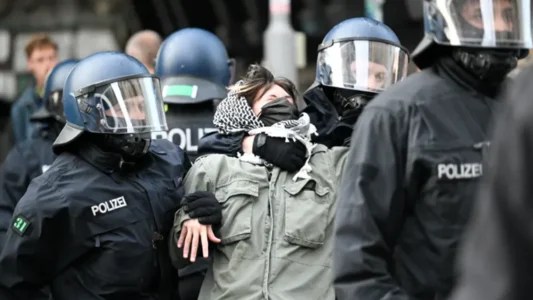
By Ricardo Martins – New Eastern Outlook – January 22, 2025
The genocide unfolding in Gaza continues to expose the inadequacies of the international judiciary, organizations, and, more importantly, the complicity of part of the global community of nations in enabling such atrocities.
Germany Taken to the ICJ for Complicity in Genocide
In March 2024, Nicaragua brought a case against Germany at the International Court of Justice (ICJ), accusing it of aiding and supporting genocide in Gaza by supplying arms to Israel, fully aware of the genocidal risks involved. Shockingly, the ICJ failed to condemn Germany.
Germany also maintains unwavering and unconditional political and diplomatic support for Israel. German Foreign Minister Annalena Baerbock displayed a cheerleader-like demeanor during her initial visit to support Israel after October 7—a stance echoed by European Commission President Ursula von der Leyen.
According to the Middle East Eye, Germany’s support for Israel’s actions highlights a hypocritical approach to international law and human rights. The analysis goes further: “No one can reasonably believe in the fairytale of Germany’s moral responsibility anymore, as the country defends, finances, arms, and diplomatically supports the genocide of Palestinians, in addition to the bombing of Lebanon, Yemen, and Syria, while shielding those responsible from accountability.”
Protests Against Israel Are Considered “Antisemitic” in Germany
With the Bundestag’s adoption last November of the resolution “Never again is now: Protecting, preserving, and strengthening Jewish life in Germany”, the country has entered a proto-fascistic state—without any condemnation from the European Union. Policymakers crafting this resolution refused input from diverse human rights groups and instead relied solely on the controversial International Holocaust Remembrance Alliance (IHRA) definition of antisemitism.
Even before this resolution, but now bolstered by it, Germany has witnessed a gradual erosion of democracy under its ‘proud guilty’ ideology. This includes prior censorship of cultural events partially or fully funded by public money, the cancellation of events featuring critics of Israel’s government, and even conferences discussing the Palestinian question. Concurrently, there has been a sharp rise in the smearing of critics with allegations of antisemitism. Make no mistake—censorship is alive and well in Germany. Protests critical of Israel’s actions in Gaza are being unjustly and undemocratically labelled as antisemitic.
Further, children can be banned from schools for wearing “pro-Palestinian symbols such as the keffiyeh,” as is written in a letter sent to school principals by Berlin’s education senator, Katharina Günther-Wünsch.
Furthermore, this resolution introduced a mandatory declaration for asylum seekers, requiring them to affirm the existence of the state of Israel and pledge not to participate in or support boycott campaigns against it.
Over the past month, German politicians have called for changing laws, including those around the right to demonstrate and freedom of opinion. The idea of withdrawing citizenship, residency, welfare benefits or funding from anyone accused of making anti-Semitic statements has been floated as well as a plan to only allow “native Germans” to protest.
Prior to this resolution, we have already witnessed undemocratic and even fascistic actions in Germany. These include the arrest of citizens for trivial reasons, such as holding a placard stating “I am not complicit in genocide,” and the arrest of a child for holding a Palestinian flag. Former Greek finance minister Yanis Varoufakis was prohibited from addressing a Jew-Palestinian conference and from permanently speaking to the German public online. A meeting organised by the progressive collective DiEM25, alongside Palestinian and Jewish Voice for Peace groups, on April 12th, 2024, was disrupted, dismantled, and labelled an “Islamist” event by the Interior Ministry.
Furthermore, the renowned British-Palestinian surgeon Dr Ghassan Abu-Sitta, who volunteered in Gaza hospitals during the genocide, was banned from entering Germany. Dr Abu-Sitta was due to provide a firsthand account of the atrocities taking place on the ground. Due to Germany’s Schengen-wide interdiction, he was also barred from entering France to speak at a French Senate meeting, despite being invited by the Senate itself.
These actions raise pressing and undeniable questions about a democratic deficit and institutional racism within German governmental structures.
A Threat to Germany’s Academic Freedom and Reputation?
Protests critical of Israel’s actions in Gaza have been wrongfully labelled antisemitic. The German Education Ministry sought to explore whether academic funding could be cut for those critical of clearing the pro-Palestinian camp at Freie Universität Berlin (Free University Berlin). This crackdown led to police detaining over 70 individuals temporarily and initiating 80 criminal investigations, alongside 79 misdemeanour proceedings.
Ironically, the Education Minister, Bettina Stark-Watzinger of the Free Democratic Party (FDP), previously declared that freedom is the foundation “for the way we live in our country, for our democracy, our constitutional state, and our prosperity.” She made this statement during the launch of Germany’s Science Year 2024.
In stark contrast, over 2,900 academics have accused Stark-Watzinger of threatening freedom of expression, calling for her resignation in an open letter. The letter, signed by thousands of German and international academics, accuses the education minister of intimidation, stating: “Repressive reviews of academics who publicly express critical views of governmental decisions are characteristic of authoritarian regimes that systematically suppress free discussion, including within universities.”
Why is Germany Having This Behaviour?
Driven by its ideology of ‘proud guilt,’ which elevates support for Israel to a raison d’état, Germany appears to have abandoned all sense of proportionality and reason—where even a child wearing a keffiyeh in a school is deemed a threat to Israel’s existence and, by extension, to German security.
In many respects, it now exhibits the characteristics of a quasi-fascist state. My few examples above, out of thousands, support this claim. To make things worse, the German government refuses to comply with the ICC prosecutor’s request to arrest Prime Minister Benjamin Netanyahu and Defence Minister Yoav Gallant.
According to Körber Fondation’s latest survey, which polls German citizens on foreign policy, only 19% of Germans support their country’s military aid to Israel. This shows a blatant divide between Germany’s political/media elites and the people they are supposed to represent.
German citizens deserve to know why their freedoms are being restricted and whose interests are being served. Why do Israel’s interests take precedence over those of German citizens and Germany’s international reputation? Why must the Palestinian people continue to pay the price for Germany’s past mistakes? I will delve into this matter further in my next article.
To conclude, the most astonishing aspect of these atrocities against German freedoms and the Palestinian people is the deafening silence of the European Union and the European Human Rights Court. The double standards of the European institutions are blatant and hypocritical.
Ricardo Martins ‒ PhD in Sociology, specializing in policies, European and world politics and geopolitics
Google Exits EU’s Voluntary Anti-“Disinformation” Code, Defying Digital Services Act Requirements
By Didi Rankovic | Reclaim The Net | January 21, 2025
It’s as good a time as any to effectively pull out of the EU’s “voluntary anti-disinformation” deal, which social media companies were previously strong-armed into accepting. And Google has now done just that.
The “strengthened” Code of Practice on Disinformation was introduced during the heyday of online censorship and government pressure on social platforms on both sides of the Atlantic – in June 2022, and at one point included 44 signatories.
One of those who in the meanwhile dropped out is X, and this happened shortly after Twitter was acquired by Elon Musk.
Now, as the “voluntary” code is formally becoming part of EU’s censorship law, the Digital Services Act (DSA), Google took the opportunity to notify Brussels it will not comply with the law’s requirement to include fact-checkers’ opinions in the search results, or rely on those to delete or algorithmically rank YouTube content.
Accepting these DSA requirements “simply isn’t appropriate or effective for our services,” Google’s Global Affairs President Kent Walker stated in a letter sent to European Commission’s Deputy Director-General for Communications Networks, Content and Technology, Renate Nikolay, reports said.
At the same time, Google is withdrawing from “all fact-checking commitments in the Code” – this refers to the signatories working with “fact-checkers” across EU member-countries. The code also requires tech companies to flag content, label political ads, demonetizing users found to be “spreading disinformation,” etc.
Even though Google’s censorship apparatus does not use third-party “fact-checkers” as it is, the news that the company has decided to defy the EU on this issue is interpreted as yet more proof that social media giants are breaking free from some of the constraints imposed on them by the authorities over the past years.
Meta recently announced that its fact-checking scheme in the US was ending in order to make room for more free speech on Facebook and Instagram, but it remains a signatory of the Code in the EU.
It remains to be seen what decision Meta will make once that agreement becomes part of the DSA – the deadline for which is currently unknown.
Failed State America. Joe Biden’s absolute destruction of freedom of speech
By Martin Jay | Strategic Culture Foundation | January 20, 2025
Sometimes the internet seems to be overbrimming with video clips showing hilarious examples of what a failed state actually looks like. One of the most common is MPs, or ‘deputies’ actually fighting in their own parliaments against one another. The irony of these clips is that they are usually uploaded by westerners who use to them as a tool to boost or gentrify the reality of western countries’ democratic models.
But no more.
Thanks to Joe Biden’s genocidal maniacs club, the last days of his rule gave us a gem in the form of a press conference where the limit of just how America is anything but a functioning democracy was stretched to breaking point in what appeared to both be deeply sad yet comical at the same time.
As the odious Anthony Blinken gave his patronizing speech to the so-called journalists amassed before him which felt a little like an aristocrat who had gathered the servants in the library to congratulate them on finding an item of lost jewelry of her ladyship’s, we witnessed in real time what America and what these State Department’s press briefings really are: a fraud.
Blinken thanked those present for asking difficult questions, when in fact, none had really been asked in 4 years. Why? Because that is not part of the unwritten rules of how these press briefings work. But the moment he had mentioned the “difficult questions” he was, perhaps appropriately, delivered a series of difficult questions by the Jewish American journalist Max Blumenthal. What was not so surprising was how none of those questions were answered as Blinken, being a smart operator, knew if he kept composed and didn’t rise to the bait it would probably anger Blumenthal even more allowing the tirade to look on camera at least like a rant which had got out of control. Seconds passed and Blumenthal was ushered away by officials which he didn’t offer any resistance to. Moments passed before the veteran Arab journalist Sam Husseini also asked more difficult questions to an increasingly startled Blinken before we see the extent of how far America has abandoned its own free speech doctrine which it used to espouse to the rest of the world: Husseini was actually physically removed by overweight, armed police officers who you can see quite clearly feel uncomfortable about what they are doing, which most people would associate with a tin pot West African country’s ruling junta and not the American government at a press conference.
But the really shocking part of this story was yet to come: the absolute refusal by colleagues in the press room to even verbally object will have stunned journalists all over the world. It provokes many questions about journalism and what these individuals in the room think they are actually doing. We were given though a clue to quite how far journalism has died in the West and been replaced by a cheaper, easy wipe brand called ‘pseudo journalism’ – where actors take one function of journalists but who effectively work for the ruling elite rather than previously for the masses who used to fund the model by buying the actual publications. CNN reporting of the fiasco was very telling. They lost no time putting the boot into Blumenthal, who, naturally they must despise as he functions as a real journalist and they have long forgotten what this entails years ago, opting for the new model of fake news operator. They referred to Blumenthal as an “activist” – a typical slur from big media to individual journalists who carry out stellar work.
The truth about this incident is that such press conferences at the state department or indeed in the European Commission in Brussels are entirely staged. They are a theatre concocted by the elite and the press themselves as part of a dirty deal whereby the journalists ask the softball questions which allow the top figures to deliver the prepared spiel. The so-called journalists sign up to this and in return get access to individuals and scoops – although it’s important to note that the scoops are nearly always new items which serve the state’s purpose. It’s a game which has been going on for a long time and the humble masses don’t understand how they are being taken for a ride by the magicians’ allusion of something which might look credible. In these press gatherings some journalists are even asked to present certain questions which are even suggested by those holding the conference, something I witnessed myself a lot in Brussels.
It was not that the questions put to Blinken were so harsh, or even unconventional. The point is that both Blumenthal and Husseini broke the house rules when they went rogue and did what most people would view to be the role of real journalists: ask unscripted questions. Look what happens when journalist do this. We are treated to a debacle which we would expect to see in the global south, or certainly in Nazi Germany in the 30s. And this is America?
The cat is out of the bag. The whole world can see now how America has lost all its links with the democratic model and become and autocracy, run, financed and ruled by Israel’s cash. Netanyahu and his cronies must have had a really good laugh watching those journalists being removed like that. Presumably their press accreditations will be removed and certainly the worry that both of them will have is that they now mysteriously find themselves being investigated for tax irregularities, theft, fraud or even having child porn on their computers. Journalists like Blumenthal are the biggest threat to the deep state as they will never be part of the establishment and therefore will always be the most dangerous guy to tackle. The one who has nothing to lose is your biggest threat. I don’t imagine Trump and his cabal will be any kinder to him despite The Grayzone taking a more grown-up approach to Russia and how the Ukraine war is reported, as opposed to CNN’s stenographic reproduction of the State Department’s narrative, seasoned by fake news on occasion.
The real enemy for western elites is the feral truth. All pretense of a functioning democracy were eradicated in a matter of minutes with this press conference calamity which has now replaced those MPs in that central European country throwing chairs at one another in their own parliament. Great job, Joe.
The Competency Crisis Proliferating The West
By Alastair Crooke | Strategic Culture Foundation | January 20, 2025
The essayist and military strategist, Aurelien, has written a paper entitled: The Strange Defeat (original in French). The ‘strange defeat’ being that of Europe’s ‘curious’ inability to understand Ukraine or its military mechanics.
Aurelien highlights the strange lack of realism by which the West has approached the crisis —
“ … and the almost pathological dissociation from the real world that it displays in its words and actions. Yet, even as the situation deteriorates, and the Russian forces advance everywhere, there is no sign that the West is becoming more reality-based in its understanding – and it is very likely that it will continue to live in its alternative construction of reality until it is forcibly expelled”.
The writer continues in some detail (omitted here) to explain why NATO has no strategy for Ukraine and no real operational plan:
“It has only a series of ad hoc initiatives, linked together by vague aspirations that have no connection with real life plus the hope that ‘something [beneficial] will occur’. Our current Western political leaders have never had to develop such skills. Yet it is actually worse than that: not having developed these skills, not having advisers who have developed them, they cannot really understand what the Russians are doing, how and why they are doing it. Western leaders are like spectators who do not know the rules of chess or Go – and are trying to figure out who is winning”.
“What exactly was their goal? Now, responses such as ‘to send a message to Putin’, ‘complicate Russian logistics’, or ‘improve morale at home’ are no longer allowed. What I want to know is what is expected in concrete terms? What are the tangible results of their ‘messaging’? Can they guarantee that it will be understood? Have you anticipated the possible reactions of the Russians – and what will you do then?”
The essential problem, Aurelien bluntly concludes, is that:
“our political classes and their parasites have no idea how to deal with such crises, or even how to understand them. The war in Ukraine involves forces that are orders of magnitude larger than any Western nation has deployed on operations since 1945 … Instead of real strategic objectives, they have only slogans and fanciful proposals”.
Coldly put, the author explains that for complex reasons connected with the nature of western modernity, the liberal élites simply are not competent or professional in matters of security. And they do not understand its nature.
U.S. cultural critic Walter Kirn makes rather similar claims in a very different, yet related, context: California Fires and America’s Competency Crisis –
“Los Angeles is in flames, yet California’s leaders seem helpless, unmasking a generation of public investment in non-essential services [that leaves the Authorities floundering amidst the predicted occurrence of the fires]”.
On a Joe Rogan podcast earlier this month, a firefighter goes: “It’s just going to be the right wind and fire’s going to start in the right place and it’s going to burn through LA all the way to the ocean, and there’s not a f***ing thing we can do about it”.
Kirn observes:
“This isn’t the first fire or set of fires in Malibu. Just a few years ago, there were big fires. There always are. They’re inevitable. But having built this giant city in this place with this vulnerability, there are measures that can be taken to contain and to fend off the worst”.
“To fob it off on climate change, as I say, is a wonderful thing to tell yourself, but none of this started yesterday. My only point is this, has it done everything it can to prepare for an inevitable, unavoidable situation that perhaps in scale differs from the past, but certainly not in kind? Are its leaders up to the job? There’s not a lot of sign that they are. They haven’t been able to deal with things like homelessness without fires. So the question of whether all those things have been done, whether they’ve been done well, whether there was adequate water in fire hydrants, whether they were working at all, things like that, and whether the fire department was properly trained or properly staffed, all those questions are going to arise”.
“And as far as the competency crisis goes, I think that there will be ample material to portray this as aggravated by incompetence. California’s a state that’s become notorious for spending a lot of money on things that don’t work, on high-speed rail lines that never are constructed, on all sorts of construction projects and infrastructure projects that never come to pass. And in that context, I think this will be devastating to the power structure of California”.
“In a larger sense though, it’s going to remind people that a politics that has been for years now about language and philosophical constructs such as equity and so on, is going to be seen as having failed in the most essential way, to protect people. And that these people are powerful and influential and privileged is going to make that happen faster and in a more prominent fashion”.
To which his colleague, journalist Matt Taibbi, responds:
“But pulling back in a broader sense, we do have a crisis of competency in this country. It has had a huge impact on American politics”. Kirn: “[Americans] They’re going to want less concern for the philosophical and/or even long-term political questions of equity and so on, I predict, and they’re going to want to lay in a minimum expectation of competence in natural disasters. In other words, this is a time when the priorities shift and I think that big change is coming, big, big change, because we look like we’ve been dealing with luxury problems, and we’ve certainly been dealing with other countries’ problems, Ukraine or whoever it might be, with massive funding. There are people in North Carolina right now still recovering from a flood and having a very difficult time as winter comes, which it doesn’t in LA in the same way, or as winter consolidates itself, I guess”;
“So looking forward, it’s not a question of blame, it’s what are people going to want? What are people going to value? What are they going to prize? Are their priorities going to shift? I think they will shift big time. Los Angeles will be a touchstone and it will be a touchstone for a new approach to government”.
So we have this ‘divorce from reality’ and consequent ‘Competency Crisis’ – whether in California; Ukraine or Europe. Where lie the roots to this malaise? U.S. writer David Samuels believes this to be the answer:
“In his last days in office … President Barack Obama made the decision to set the country on a new course. On Dec. 23, 2016, he signed into law the Countering Foreign Propaganda and Disinformation Act, which used the language of defending the homeland to launch an open-ended, offensive information war, a war that fused the security infrastructure with the social media platforms – where the war supposedly was being fought”.
However, collapse of the 20th-century media pyramid and its rapid replacement by monopoly social media platforms, had made it possible for the Obama White House to sell policy – and reconfigure social attitudes and prejudices – in entirely new ways.
During the Trump years, Obama used these tools of the digital age to craft an entirely new type of power centre for himself – one that revolved around his unique position as the titular, though pointedly never-named, head of a Democratic Party which he succeeded in refashioning in his own image, Samuels writes.
The ‘permission structure’ machine that Barack Obama and David Axelrod (a highly successful Chicago political consultant), built to replace the Democratic Party was in its essence a device for getting people to act against their beliefs by substituting new and ‘better’ beliefs through the top-down controlled and leveraged application of social pressure – effectively turning Axelrod’s construct into ‘an omnipotent thought-machine’, Samuels suggests:
“The term ‘echo chambers’ describes the process by which the White House and its wider penumbra of think tanks and NGOs deliberately created an entirely new class of experts who mutually credentialed each other on social media in order to advance assertions that would formerly have been seen as marginal or not credible”.
The aim was for a platoon of aides, armed with laptops or smart phones, to ‘run’ with the latest inspired Party meme and to immediately repeat, and repeat it, across platforms, giving the appearance of an overwhelming tide of consensus filling the country. And thus giving people the ‘permission structure’ of apparent wide public assent to believe propositions that formerly they would never have supported.
“Where this analysis went wrong is the same place that the Obama team’s analysis of Trump went wrong: The wizards of the permission structure machine had become captives of the machinery that they built. The result was a fast-moving mirror world that could generate the velocity required to change the appearance of “what people believe” overnight. The newly minted digital variant of “public opinion” was rooted in the algorithms that determine how fads spread on social media, in which mass multiplied by speed equals momentum—speed being the key variable”.
“At every turn over the next four years, it was like a fever was spreading, and no one was immune. Spouses, children, colleagues, and supervisors at work began reciting, with the force of true believers, slogans they had only learned last week. It was the entirety of this apparatus, not just the ability to fashion clever or impactful tweets, that constituted the party’s new form of power”.
“In the end, however, the fever broke”. The credibility of Élites imploded.
Samuels account amounts to a stark warning of the danger associated with distance opening up between an underlying reality and an invented reality that could be successfully messaged, and managed, from the White House. “This possibility opened the door to a new potential for a large-scale disaster – like the war in Iraq”, Samuels suggests. (Samuels does not specifically mention Ukraine, although this is implied throughout the argument).
This – both the Obama tale, as told by David Samuels, and Walter Kirn’s story of California – augment Aurelien’s point about Ukraine and European military incompetence and lack of professionalism on the field: It is one of allowing a schism to open up between contrived narrative and reality – “which”, Samuels warns “is to say that, with enough money, operatives could create and operationalize mutually reinforcing networks of activists and experts to validate a messaging arc that would short-circuit traditional methods of validation and analysis, and lead unwary actors and audience members alike to believe that things that they had never believed; or even heard of before: Were in fact not only plausible, but already widely accepted within their specific peer groups”.
It constitutes the path to disaster – even risking nuclear disaster in the case of the Ukraine conflict. Will the ‘Competency Crisis’ reaching across such varied terrain trigger a re-think as Walter Kirn – a writer on cultural change – insists?
With FPÖ party in government Austria might stop supporting Ukraine
By Patrick Poppel | January 20, 2025
FPÖ delegation leader in the EU Harald Vilimsky criticized the video of Ukrainian President Volodymyr Zelensky and the attitude of the President of the European Parliament, who wants to wage war “as long as necessary.” The video of Zelensky in the European Parliament was once again accompanied by questionable statements.
In particular, the statements by Parliament President Roberta Metsola, who emphasized the EU’s support for Ukraine with the vague attribute “as long as necessary,” raise serious questions for the Freedom Party delegation leader. “Does ‘as long as necessary’ mean that this war will be fought to the last Ukrainian soldier, without giving peace and diplomacy a real chance?” Vilimsky asked.
He also criticized the stance of the European Parliament, which he believes reflects a frightening level of war rhetoric. “It is noteworthy that even factions such as the Socialists and the Left, who otherwise present themselves as peace parties, are now calling for more weapons and ammunition,” said the head of the Freedom Party delegation.
He stressed that the FPÖ, on the other hand, is clearly sticking to its line. “We are committed to de-escalation, diplomacy and peace negotiations. In this context, we expressly support the peace plans of the newly elected US President Donald Trump, which could enable a rapid end to the war.”
This situation in the European Parliament clearly shows the difference between the established structures and the opposition. But now this opposition is on the rise. The FPÖ is receiving more and more support not only in the EU elections, but also in the national elections.
The FPÖ will most likely be part of the government in Austria and then what those responsible in the party have always demanded will happen. FPÖ federal party chairman Kickl, for example, said earlier: “A possible ceasefire must be the starting signal for peace negotiations on neutral ground.”
“Now is the time to bring Austria’s importance as a neutral country into play in order to end the bloodshed in Ukraine,” said Herbert Kickl. “In the tradition of great statesmen like Bruno Kreisky, the Austrian federal government is called upon to use this new situation to actively offer Austria as a neutral place for further negotiations in order to finally end this senseless conflict.”
The FPÖ has been the only party in Austria since 2022 to call for peace in Ukraine as soon as possible and has been wrongly ridiculed as a party of “Putin’s friends”. The party also does a very good job of linking the issue of conflict and sanctions with social issues. The poor economic development is clearly seen as a consequence of the sanctions and this is how it is communicated to the people.
With an “FPÖ government”, Austria will become another state alongside Hungary that will actively work for peace in Europe. This trend could also reach many other states. In addition, this must always be seen in the context of the inauguration of Donald Trump. Geopolitically, the cards are now being reshuffled.
The FPÖ’s participation in the government is also the first step towards reviving Austrian neutrality, which was de facto abolished by the previous government through the sanctions policy. Historically and practically, Austria would then again be a good place for diplomatic projects and thus also a good place for future Ukrainian peace talks.
The rise of the FPÖ in Austria could therefore also have a geopolitical aspect and be of great international importance. Together with Hungary and other serious patriotic forces, a possible FPÖ government is also a problem for the globalist forces in the EU.
Particularly in the question of sanctions policy, there could be a development that could lead to the EU’s course being questioned more and more by individual member states. Austria and Hungary are being heard within the European Union.
The parliamentary platform “Patriots for Europe” within the EU will also gain a political weight as a result of the FPÖ’s victory. Indeed, one can clearly see a trend in the political landscape of Europe. And the best example of this trend is a general movement to defend national interests against the leadership of the EU. This development is now continuing in other countries. It is a movement critical of the EU, but one that is “very European”.
Patrick Poppel, expert at the Center for Geostrategic Studies.
EU member pledges to veto future Ukraine aid
RT | January 19, 2025
Slovakia will veto any future Ukraine aid considered by the EU, Prime Minister Robert Fico has announced. Bratislava will now take a “reciprocal” approach to hostile moves by Kiev, he warned.
Fico issued the threat in a video address posted to social media late on Saturday. Ukraine’s Vladimir Zelensky believes everyone should be his “servant,” Fico asserted, warning such an approach would not work with him.
“In my case, the scythe hit a rock. Robert Fico is a Slovak prime minister and not a Ukrainian servant,” Fico stated.
Bratislava will take a “reciprocal” approach to Kiev in the row over the transit of Russian natural gas that Kiev ended at the beginning of the new year, Fico warned, pledging to veto any future aid packages from the EU. The packages require unanimous backing from all the members of the bloc to be passed.
The Slovak prime minister also reiterated other potential moves against Ukraine that he had articulated previously, namely halting the emergency electricity supply, stopping humanitarian aid deliveries, or cutting benefits received by Ukrainian refugees in Slovakia.
“I am increasingly convinced that President Zelensky is forcing us into reciprocity, and we will go for it,” Fico stated.
Once a major supporter of Ukraine, Slovakia changed its stance after Fico took office in late 2023, halting military aid to the country and pledging to veto its potential accession into the US-led NATO bloc.
The already strained relations between Bratislava and Kiev have further deteriorated owing to the row over the Russian gas, which Slovakia has been heavily dependent upon. Kiev opted not to renew the transit contract and halted the flow despite Moscow’s repeated signals that it was prepared to continue supplying its customers in the EU through Ukraine’s pipeline system.
Fico initially proposed negotiating with Zelensky on the border between the two countries, but the latter urged him through social media to come to Kiev instead. The response was deemed undiplomatic in Slovakia. Fico then proposed to meet Zelensky in Davos next week, where both leaders are expected to head. The proposal was openly mocked by Kiev, with Zelensky suggesting the Slovak leader could end up in Sochi, Russia, instead.
Russian Victory or Political Settlement in Ukraine?
Ambassador Chas Freeman, Alexander Mercouris & Glenn Diesen
Glenn Diesen | January 15, 2025
I had a conversation with Alexander Mercouris and Ambassador Chas Freeman, a former Assistant Secretary of Defense for International Security Affairs. Besides being a former ambassador to Saudi Arabia, Freeman’s career included opening China with Henry Kissinger and Richard Nixon in the 1970s and developing the post-Cold War security architecture in Europe.
We discussed the messy world that the Biden Administration is handing over to Trump. There is seemingly a genuine desire to end the proxy war in Ukraine, and Trump may also achieve a ceasefire in Palestine. However, NATO’s escalations in Ukraine to sabotage possible negotiations and the reckless support for HTS in Syria have reduced the possibilities available to Trump. Will the Ukraine War be resolved by a Russian victory or a political settlement?
The man who deserves but probably will not be allowed to lead Romania
By Stephen Karganovic | Strategic Culture Foundation | January 17, 2025
Calin Georgescu rightfully has a huge grievance against what passes for “Western democracy.” He is the clear first-round winner in the Presidential elections held in Romania late last year. Yet his projected even more resounding victory in the second round, scheduled for early December 2024, was scrapped (as the BBC indelicately put it) following a Romanian Supreme Court ruling that the electoral process was marred by alleged hybrid warfare interference conducted by Russia on Georgescu’s behalf.
How do you “scrap” elections in a vibrant democracy such as Romania, which also happens to be a member in good standing of NATO and the European Union, which are bastions of liberal freedoms and the rule of law? Well, you do it by making up a bogus dossier on the political candidate that you dislike and by ordering the local judiciary to act on it as if it were genuine evidence. The dossier purporting to document the alleged interference was so patently phony that at its first sitting to consider the matter the Romanian Supreme Court dismissed it out of hand. This show of integrity did not sit well at all with the paladins of the rules-based order. So they ordered the judges to reassemble forthwith in their chambers and to get it right this time. On 6 December the distinguished Romanian jurists did just that and obediently reversed their ruling issued just four days previously.
Citing Article 146 (f) of the Romanian Constitution concerning the legality and correctness of the presidential elections, the Court ordered that the “entire electoral process will be integrally redone.” So the result of the first round was duly “scrapped” and along with it the second round as well. The second round, which was in progress as the judges hurriedly improvised their new ruling, was stopped in its tracks. As even the Atlantic Council, no friend of elections which go the wrong way, was compelled to admit “the rollout of the decision was somewhat fumbled, as it became public while polling stations were already open for the [Romanian] diaspora in the second-round presidential election, and by the time the process was stopped, around 53,000 citizens abroad had already voted.” Scrapped just in time, because the Romanian diaspora was known to be a hotbed of Georgescu supporters.
The Presidential election was set by the judges for an unspecified date in the future. Some rumours suggest that it might be in May of this year, or whenever it is that the stage can be prepared to ensure the right outcome. In the meantime, Klaus Iohannis, who should have relinquished his post in December to his successor, is now as legally “expired” as his Ukrainian colleague Zelensky. But that does not seem to bother any of the vociferous champions of the democratic process. Iohannis after all is their man.
The Romanian public, however, do not seem to take kindly to electoral interference by the compliant judges and their string-pullers, who are widely suspected of being located abroad but not in Russia. Thousands have been marching in the streets of Bucharest and other major cities to oppose the cancellation of the elections. How much good it will do them in a country that has embraced the principles of Western democracy remains to be seen.
The protagonist of this political earthquake who was not permitted to democratically establish his credentials as the new President of Romania, Calin Georgescu, ever since his first-round triumph has been subjected to the full measure of calumny that is reserved for those whom the globalist system perceives as a non-team-player and a threat. The hope was evidently that he would be successfully discredited and simply fade away, allowing the charade of “democratic elections” with a prearranged outcome to be repeated whenever it is judged safe to do so.
Expectedly, the Georgescu affair with its scandalous implications has been largely ignored by the collective West media, except for a few derogatory observations here and there at the banned candidate’s expense. The Georgescu story might have died a quiet death but for the professionalism of American podcaster Shawn Ryan, who decided to perform a public service by travelling to Romania to find out first-hand what the electoral commotion was all about.
The result was a remarkable interview with the man who by all reasonable estimates should be sitting today in the Presidential office in Bucharest. It is worth viewing carefully and in its entirety for the insights it affords into the sombre times in which we happen to live.
Georgescu strenuously denies that he is “pro-Russian” and says that he has no personal acquaintance with Russian officials except for watching them on television. In any court of law or public opinion that declaration should suffice because the burden of proof is on his accusers and they have failed to meet it. But the accusation brings up a much deeper and more significant issue: even if he were, why should it be a problem? Most of the other candidates, including the election runner-up, advocated policies explicitly aligned with non-Romanian interests and entities, such as NATO and the EU. Why is it objectionable for another presidential candidate in a supposedly sovereign and democratic country to propose to the electorate a different policy for their consideration and approval?
And here comes the crux of the matter. Asked by Shawn Ryan whether he is pro-Russian, Georgescu let the cat out of the bag by responding that no, he is pro-Romanian, and that the policies he contemplates are shaped to best serve the needs and interests of the Romanian people. In the current political atmosphere there is hardly a more disqualifying admission than that. The few European leaders, such as Orban and Fico, who had made it through the cracks in the globalist system to ultimately disclose that their primary commitment is to their respective countries’ interests are shunned and reviled for their subversive patriotism. One was the target of an assassination attempt, the other is the target of a colour revolution as this is being written. The rise of another leader who espouses a similar philosophy would be intolerably disruptive to the globalist agenda. That is why Georgescu had to be thwarted by any means, fair or foul.
Georgescu clearly is a simple man, plain spoken and without guile, not practiced in the use of mendacious phrases which characterise the discourse of trained political mannequins, the chosen puppets of the power elites who are allowed inhabit the public universe of Western political systems. Asked by Shawn Ryan how he views Romania’s membership in NATO, he gave an answer that was somewhat awkward but still made fundamental sense. When Romania joined NATO, he said, it was understood to be a defensive alliance, but since then its mission was changed to include offensive operations in which Romania has no national interest. Romania, he implied, is no longer part of the same outfit that it had originally joined. It is a fair answer, not just from the standpoint of Romania but also of quite a few other countries that by hook and by crook were rushed into joining NATO for the geopolitical benefits their geographical location offered to the alliance and its belligerent agendas.
Hence, according to Georgescu, Romania (and by implication other countries which were similarly enticed into joining) is now fully entitled to reconsider its choice and pursue a policy that takes into account the alliance’s changed nature and Romania’s current interests.
As for the collective West’s favourite quagmire, Project Ukraine, speaking for his country and the Romanian nation, Georgescu was unforgivably frank. “That is not our war,” he said.
These are only some salient snippets of this highly illuminating interview which lays bare the corruption of the political system we have been told represents the pinnacle of liberal democracy. One wishes that Georgescu’s English were more fluent, but still it sufficed to convey the important points that he makes and it fully answered the question, if there was anyone who was still in doubt, why they are prepared to resort to the basest trickery to make sure this man of integrity does not become President of Romania. And to ensure by example that no like-minded patriot in any other country that they control will ever think of emulating Calin Georgescu.
Anti-Orbán German Green Party MEP took a road trip last October to meet with powerful groups in D.C.
By Liz Heflin | Remix News | January 17, 2025
German Green MEP Daniel Freund, an obsessive critic of Hungarian Prime Minister Orbán, recently held talks in Washington, D.C., according to Magyar Nemzet.
Details on Freund’s official EP profile show that at the end of October, just ahead of the U.S. presidential election, he met with several entities in D.C., including the U.S. Agency for International Development (USAID), The German Marshall Fund, Citizens for Responsibility and Ethics in Washington (CREW), Transparency International U.S., and the U.S. State Department.
The Hungarian newspaper asks how an MEP, representing an EU member state, is negotiating with a third country, outside the EU, without any authorization regarding Hungary.
Magyar Nemzet further states that USAID is known to work closely with the CIA and has been widely criticized for its influence peddling. At the end of 2022, the agency said that it would launch a new “Central Europe Program,” the portal points out, to strengthen civil society, increase the competitiveness and sustainability of “independent” media, and further develop the monitoring functions of various civil society organizations.
“Based on Freund’s activities so far, it is only conceivable that (he) represented an agenda that runs counter to Hungarian interests and sovereignty at the meeting organized before the Biden administration’s upcoming departure,” Magyar Nemzet writes.
Freund has cheered sanctions against Hungary, largely in part due to the government’s opposition to Brussels’ migration pact, and has actively lobbied for EU funds to be withheld from it. He has gone so far as to suggest Hungary simply leave the EU given its difference of opinion from the mainstream consensus in Brussels.
In one of his latest moves, Freund sent a letter to Charles Michel, when Michel was previously serving as president of the European Council, to suspend the Hungarian presidency, arguing that Prime Minister Viktor Orbán could not represent Europeans.
And in October, just a couple weeks before his trip to D.C., Freund called for Viktor Orbán to be arrested for corruption. “Who has ever stolen so much from European sources?” asked Freund.
Tagesspiegel publishes guide for workplace witch hunts against right-wing views ahead of German election
By Thomas Brooke | Remix News | January 16, 2025
A recent piece published by the mainstream German Tagesspiegel newspaper has advocated for employees across Germany to confront and report colleagues expressing right-wing political views in the workplace.
Quoting workplace diversity trainers and academics, the article describes supporters of the Alternative for Germany (AfD) as aligned with “right-wing extremism” — despite the AfD’s projected rise to become the second-largest party in the Bundestag — and offers guidance on how those with more “tolerant,” progressive views should respond should political debate occur in the lead up to next month’s federal elections.
Entitled, “Help, my colleague talks like the AfD! This is how you counter right-wing populist slogans in the workplace,” the article presents a framework for addressing opinions considered “anti-human” or “anti-democratic,” citing examples of such unpalatable views as being of the opinion that asylum seekers should be deported or that NATO has played a role in the Russian invasion of Ukraine.
It even singles out those who criticize the mainstream media as the “lying press” as being troublesome in professional settings.
Sandro Witt of the German Federation of Trade Unions (DGB) is quoted as stating: “In any case, you can’t say nothing if someone in the room makes anti-human comments.” He goes further to argue that “such positions should not go unchallenged,” encouraging employees to intervene and report statements they find problematic to human resources or other workplace authorities.
The article advocates for companies to act decisively against right-wing viewpoints, with Witt stating: “Employers should intervene, make a clear statement, address the workforce, create clarity and draw up a guideline,” effectively promoting a culture of workplace surveillance, where political disagreements could lead to disciplinary actions and even dismissal.
It suggests that employees who encounter dissenting views should not hesitate to involve internal mechanisms, such as “complaint management, equal opportunities officers, or human resources.” This directive, combined with advice to “find allies in the workforce,” has sparked concerns about fostering division and hostility in professional environments.
The call for stricter deportation rules for asylum seekers and the belief that NATO is partly responsible for the war in Ukraine may be contentious and may be deemed unpalatable by some political factions, but they reflect concerns shared by significant portions of the German population as evidence by the growing popularity of the AfD.
David Lanius, a philosopher cited in the piece, provides advice on debating colleagues with differing opinions but warns of the difficulty of changing minds. “The goal cannot be to convince the other person of your own point of view or to proselytize the other person,” he states. Lanius also suggests that confronting such views can take an emotional toll, empathizing with those who have to endure the views of those they don’t agree with. “It’s exhausting. It takes strength to stand against right-wing populism,” he says.
The article emphasizes a long-term approach to countering right-wing opinions, with Lanius asserting: “Constant dripping wears away the stone.” This metaphor implies that repeated coercive challenges to a colleague’s views could eventually lead them to change their mind.
With nearly one in five Germans reportedly supporting the AfD, the article’s framing of dissenting views as “anti-human” or “extremist” has drawn sharp criticism for ignoring legitimate grievances over rising living costs, immigration, and the policies of successive coalition governments comprising of Germany’s legacy parties, namely the Social Democrats (SPD) and the Christian Democratic Union (CDU).
Surveys cited in the piece, such as a study from the Friedrich Ebert Foundation claiming that “almost 1 in 12 Germans has a manifestly right-wing extremist worldview,” are used to paint a picture of growing extremism without acknowledging the broader dissatisfaction driving political shifts.
Despite its focus on “fostering discussion,” the article largely promotes an adversarial approach to political disagreements in the workplace. While it advises employees to engage in dialogue and “try to understand” their colleagues, it simultaneously portrays those with right-wing views as needing to be “re-educated” through persistent challenges.
Reingard Zimmer, professor of labor law at the Berlin University of Economics and Law, is cited in the piece as saying that when right-wing extremist or anti-democratic comments are made at work, it can result in reprimands and ultimately dismissal.
“If a colleague complains about ‘foreign infiltration’ in Germany, the employer will first reprimand the behavior” before issuing a formal warning. If such views are repeated, “you will be terminated immediately,” he adds.
“Employers have a duty to protect their employees and must intervene if a case is so serious that it is unreasonable for them to tolerate the poisoning of the working atmosphere to continue,” says Zimmer.
The fundamental issue with the piece is that the term “racist” has been so fundamentally diluted within society to the point that anything that deviates from the liberal, progressive stance promoted by “palatable” political leaders is questioned.
Immigration has become one of the most prominent topics of concern across many European nations, dominating elections that have resulted in those calling for stricter policies prevailing across the continent — take the Netherlands, Austria, and Italy as just three examples.
When citizens no longer have confidence in institutions and others in society to reasonably define racism, it opens up a Pandora’s Box of uncertainty, distrust, and societal breakdown that further fuels division and creates political opportunities for genuine extremists who prey on a frustrated and disillusioned electorate whose only option of resistance is anonymously at the ballot box.
What will a “European Armenia” bring?
By Erkin Oncan | Strategic Culture Foundation | January 14, 2025
The Armenian government has approved a draft law to initiate the country’s accession process to the European Union (EU). This proposal will be discussed in parliament before being put to a referendum.
European Parliament rapporteur Miriam Lexmann celebrated this development, stating, “I wholeheartedly welcome the Armenian government’s decision to begin the EU accession process.”
However, the Russian side has reacted negatively to this decision. Kremlin spokesperson Dmitry Peskov declared that Armenia cannot simultaneously be a member of both the EU and the Eurasian Economic Union (EAEU).
Russian Deputy Prime Minister Alexey Overchuk also commented, “We interpret this as the beginning of Armenia’s withdrawal from the Eurasian Economic Union. The Russian Federation will shape its economic policy toward Armenia accordingly,” comparing EU membership to “purchasing a ticket for the Titanic.”
Armenia’s Journey Towards Europe
Armenia and the EU have a long history of interaction.
In 1996, Armenia signed a Partnership and Cooperation Agreement with the EU, and in 2001 it became a member of the Council of Europe. Moreover, Armenia has benefited from the TACIS program, a European Commission initiative that provided technical assistance to former Soviet states to adapt to market-oriented economic systems.
In 2004, Armenia strengthened its ties with the EU under the European Neighbourhood Policy (ENP), joined the Eastern Partnership initiative in 2009, and, despite joining the Eurasian Economic Union in 2013, approved the Comprehensive and Enhanced Partnership Agreement (CEPA) with the EU in 2017. In 2018, the Velvet Revolution brought Nikol Pashinyan to power, accelerating democratic reforms.
Armenia has now become the seventh former Soviet country to initiate European integration. This political shift mirrors the tug-of-war between the EU and EAEU, as well as NATO and the Collective Security Treaty Organization (CSTO).
Can Armenia Join the EU?
Although Armenia is not geographically part of Europe, like Georgia, it strives to align itself with “European values and cooperation processes.” From a European perspective, Armenia’s significance stems not from its adherence to these values but from its geographic proximity to Russia and Iran.
EU membership is a challenging and lengthy process—a path that only three former Soviet states (Estonia, Latvia, and Lithuania) have successfully completed. Other countries like Ukraine, Moldova, and Georgia have long been politically shaped by their EU aspirations, experiencing intense internal conflicts between pro-Russian and pro-EU factions, often tied to so-called “color revolutions.” These parallels suggest that Armenia’s membership process could also stretch over many years. Furthermore, Armenia’s economic ties with Russia present significant challenges.
According to data from the Armenian Statistical Committee covering January-April 2024, trade between Armenia and Russia increased 3.1 times, while trade with EU countries decreased by 24.3%. During this period, Armenia’s trade volume with Russia reached $6.3 billion, whereas its trade volume with the EU was $695.5 million—making trade with Russia nearly nine times greater than that with the EU. Military ties between Armenia and Russia also remain a major topic of public debate.
For Armenia to fully “Europeanize,” it must entirely overhaul its economic system. However, the insistence of both the EU and Pashinyan’s administration on this path could lead to a deep economic crisis and political instability. This might result in Armenia entering the EU as a weakened state, perceived as a burden by EU leadership.
The EU’s primary objective appears to be not Armenia’s full membership but the continuation of the accession process, using it to advance strategic interests. A “European” Armenia would serve as a geopolitical defeat for Russia.
Broader Implications
Discussions around Armenia’s regional and international dynamics are often shaped in Turkey by nationalist narratives sown by imperialist forces, perpetuating historical prejudices that undermine solidarity among neighboring peoples. However, developments in Armenia carry significant clues about the future of the broader region.
Erkin Öncan, Turkish journalist focusing on war zones and social movements around the world.
Twitter: https://twitter.com/erknoncn Telegram: https://t.me/erknoncn
Featured Video
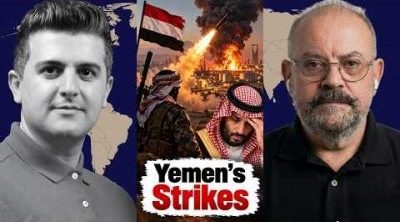
Elijah Magnier: Yemen’s strikes are shattering Saudi Arabia’s long-term strategy
or go to
Aletho News Archives – Video-Images
From the Archives
British weapons and personnel doing much of the killing in Yemen
Press TV – June 18, 2019
A detailed report published by the Guardian newspaper has shown how Britain is massively contributing to Saudi Arabia’s devastating war on Yemen as it suggests that London is not only supplying the bombs that fall on Yemenis, but it provides the personnel and expertise that keep the war going.
The comprehensive report by Arron Merat published on Tuesday showed that Britain was doing much of the killing in Yemen as the country continues to provide Saudi Arabia with everything it needs to turn its southern impoverished neighbor into a graveyard.
“Every day Yemen is hit by British bombs – dropped by British planes that are flown by British-trained pilots and maintained and prepared inside Saudi Arabia by thousands of British contractors,” said Merat in the report. … continue
Blog Roll
 Aletho News
- A West Bank War for Netanyahu’s Election Campaign, Could It Backfire?
- Yemen denounces European Parliament’s ‘hypocritical’ push to blacklist Ansarullah
- Qalibaf: UAE’s UN bid aims to ‘clear the runway’ for ‘Greater Israel’, whitewash genocide
- Pakistan reopens Iran border after boosting security: Report
- Why are so many Brazilians voting for Flávio Bolsonaro?
- Democrats Put Anti-Russia Agenda Ahead of American Workers
- Elijah Magnier: Yemen’s Strikes Are Shattering Saudi Arabia’s Long-Term Strategy
- Pentagon designates Chinese cultural centers national security threat
- Israel Demolishes Home Of Lebanese Journalist Whose Viral Film Exposed Pager Attack
- Record Oil, Empty Tanks: The UAE’s Miracle Recovery
- If Americans Knew
- An error has occurred; the feed is probably down. Try again later.
- No Tricks Zone
- Sudden Stratospheric Warming, Powerful El Niño Combination May Lead To Extreme Europe Cold, Energy Crisis!
- Two New Studies Find Thwaites Glacier Melt Cannot Be Driven By Human Activity Or A Warming Ocean
- E-Cars Reduce CO2 Emissions By Only 41% Compared To Internal Combustion Engine Vehicles
- Predictions Made By Renowned Climate Professor Over Past Decades Have Been Proven To Be Poor
- New Study Suggests Large Regions Of The Pacific Ocean Have Been Cooling For The Last 80 Years
- Germany’s Green Energy Debacle: High Energy Costs Force Kahla Porzellan to Close After 182 Years!
- New Study: 50 Years Of The Most Aggressive ‘Net Zero’ Policies Can Only Affect The Global Climate By 0.03°C
- US September “Heat” Was No Record…Many Records Set Decades Ago
- Latest European Green Energy Debacle; Portugal’s Largest Flagship Solar Park Insolvent!
- Green Energy Debacle: German Expert Professor Fritz Vahrenholt Warns Of Severe Economic And Social Consequences

