Jim Jordan Challenges EU Over Its Censorship Laws
By Didi Rankovic | Reclaim The Net | February 6, 2025
US House Judiciary Committee Chairman Jim Jordan has written to the EU Commission’s Executive VP for Technological Sovereignty, Security and Democracy Henna Virkkunen regarding the bloc’s censorship law, the Digital Services Act.
Jordan wants the EU to, by February 13, inform the committee of how it plans to enforce the law when it comes to US tech companies, and also about investigations that are at this time underway, against Meta and X.
Jordan, as usual, doesn’t mince words and has no problem with referring to the DSA as legislation that has “censorship provisions” – to express what he said was the committee’s serious concern over how those might affect free speech in the US.
Here, he was referring to the nature of social platforms that are global, and how they typically use the same set of policies regarding speech – meaning that if those policies were aligned with the EU’s restrictive legislation, the result could be the setting of “de facto global censorship standards.”
Even though for a long time criticized by speech and privacy advocates, the DSA was flying under the radar of the previous White House, now it is emerging as a significant point, as the two sides clash on a number of issues.
Under the DSA, which the EU and the law’s supporters treat as a set of “moderation” rules for the good of the internet – companies can be forced to pay up to six percent of global turnover or even get blocked.
Elon Musk, Mark Zuckerberg, and President Trump have been among those who previously publicly criticized the DSA. Previously, Virkkunen denied that the DSA enabled censorship and even claimed that free speech is “respected and protected” by the law.
Jordan and the commission he heads have been involved in multi-year efforts to expose online censorship practices in the US, but this is not the first time that these investigations have also turned toward the EU.
Last summer, during the presidential campaign in the US, he wrote to then Commissioner for Internal Market Thierry Breton because of this EU official’s scandalous warning issued to Musk regarding a live stream of an interview with then-candidate Trump.
The letter to Virkkunen was reported by Politico, but the EU Commission is yet to publicly comment on its contents.
Serbia will revisit foreign agents law – deputy PM
RT | February 7, 2025
Serbian Deputy Prime Minister Aleksandar Vulin has vowed to keep pushing for a law which would brand foreign-funded NGOs as ‘foreign agents,’ amid Belgrade’s claims that protests rocking Serbia are being funded from abroad.
Vulin’s Movement of Socialists (PS) party, a junior member of the ruling coalition led by the Serbian Progressive Party (SNS), proposed the legislation in November. The same month, the country was hit with a wave of protests, apparently sparked by the collapse of a concrete canopy at a railway station in Novi Sad which killed 15 people.
The demonstrations, primarily involving students, have since spread to the capital Belgrade, leading Serbian President Aleksandar Vucic to claim that foreign agitators were behind the unrest.
“PS will not give up its intention to pass the law on foreign agents. Color revolutions cannot be carried out without a lot of money, and it is allocated and distributed through NGOs,” Deputy PM Vulin told Izvestia in an interview published on Thursday.
“There is the experience of Russia, China, Belarus and other countries that have defeated the West’s attempts to destroy them in the streets,” he said, adding that he will continue pushing for the law, despite the current lack of support from the ruling coalition.
Vulin added that he “will not stop opposing Soros and the Western intelligence services that are destroying us.”
Hungarian-American investor and billionaire George Soros is well known for financing liberal movements and political candidates across the Western world, including in Serbia.
According to a January 2001 article in the Los Angeles Times, “his Soros Foundations Network helped finance several pro-democracy groups, including the student organization Otpor, which spearheaded grass-roots resistance to the authoritarian Yugoslav leader” Slobodan Milosevic.
The proposed legislation would require NGOs receiving over half their funding from abroad and engaging in political activities to register as foreign agents.
In December 2024, the Serbian President said that he would not support the bill. “My answer is no,” Vucic told reporters when asked if he would endorse the draft, but added that parts of it based on its US, European and Russian counterparts could be accepted.
Brussels has expressed deep concern over the bill, stressing that as an EU candidate, Serbia is expected to uphold the bloc’s principles.
The European Economic and Social Committee has stressed that such legislation is incompatible with “the fundamental values of the European Union,” comparing such a development to the divisive foreign agents law in Georgia.
Washington sanctioned officials from the ruling party in Tbilisi and froze around $95 million of aid in response, while the EU suspended Georgia’s membership application process. Tbilisi has accused Western countries of interfering in its home affairs, and trying to start a color revolution.
Israel wants European nations to take displaced Palestinians
RT | February 6, 2025
Israeli Defense Minister Israel Katz has instructed the Israel Defense Forces (IDF) to prepare a plan to encourage Palestinians to emigrate from Gaza, according to a post he made on X on Thursday.
The minister also suggested that refugees should be taken in by European countries that opposed West Jerusalem’s military action in the enclave. Katz said that it would reveal their “hypocrisy” if these nations declined to accept Gazans.
It follows US President Donald Trump’s remarks on Tuesday that the US would “take over the Gaza Strip” and take charge of reconstruction. He added that Palestinians living there should leave, to be provided for by “neighboring countries of great wealth.”
Katz has praised Trump’s “bold initiative” to relocate Palestinians from Gaza.
Among possible destinations, he mentioned Spain, Ireland, and Norway, claiming they have “falsely accused Israel” over its war against the Gaza-based Hamas militant group and therefore are “legally obligated to allow Gazans to enter their territory.”
Commenting on Katz’s remarks, Spanish Foreign Minister Jose Manuel Albares has rejected the suggestion that Spain should accept displaced people from Gaza.
”Spain makes decisions sovereignly and independently. No third party should tell us what to do,” Albares told broadcaster RNE.
The minister stressed that “Gazans’ land is Gaza” and that “Gaza should be part of the future Palestinian state.” He added that the debate about whether Palestinians should leave Gaza is “closed,” and Spain “is introducing our humanitarian aid as much as possible to help the people.”
Ireland, which formally recognized Palestine as a state last year, also rejected Katz’s comments about receiving war refugees.
In an emailed statement to Reuters, the Irish Foreign Department stressed that “The objective must be a massive scale-up of aid into Gaza, return of basic services and a clear framework under which those displaced can return,” adding that “any comments to the contrary are unhelpful and a source of distraction.”
Which left-wing NGOs does Brussels fund in Hungary with taxpayer money to go after Orbán?
By Liz Heflin | Remix News | February 5, 2025
The European Commission is essentially manipulating NGOs to achieve its own goals in exchange for financial support. A Dutch newspaper has exposed part of this process, writes Magyar Nemzet, which then shows how Brussels does this and who the biggest domestic beneficiaries are.
On Jan. 22, De Telegraaf reported on secret contracts that the European Commission had signed with green NGOs to conduct alleged covert lobbying activities. According to the newspaper, the lobbying organizations, commissioned by Brussels with EU money, were tasked with persuading MEPs and member states to support the commission’s ambitious green policy initiatives.
For example, the European Environment Bureau (EEB), an umbrella organization for green groups, was tasked with providing at least 16 examples of how the European Parliament had tightened green legislation thanks to its lobbying. According to documents reviewed by the newspaper, the EEB was also tasked with supporting the controversial nature restoration bill initiated by former Commissioner Frans Timmermans.
In addition, they could use around €700,000 in support to steer the debate on agricultural activity in a more environmentally friendly direction.
In Hungary, the EU provides funding to certain organizations, which then use their activities to serve Brussels’ political goals. Here are some examples.
The Hungarian Helsinki Committee is heavily dependent on international funding. According to their latest available financial report for 2023, more than 61 percent of their annual income came from private foundations, including George Soros’s organization. They received a total of 48.85 million forints from the European Commission, which accounted for 6.1 percent of their income. Helsinki has received funding for various projects serving legal protection purposes, typically for several years.
In recent years, the organization has often criticized the Hungarian government’s immigration policy, especially the measures related to border closures and the operation of transit zones, and has also undertaken the legal representation of migrants, for example, at the European Court of Human Rights.
One of the “results” of Helsinki’s operation is that in June 2024, the European Court of Justice imposed a migration fine of €200 million on Hungary and ordered our country to pay an additional €1 million per day until we change the relevant regulations.
Helsinki has actively contributed to the European Commission’s 2023 Rule of Law Report, which contains a number of criticisms of Hungary, including problems and recommendations in the areas of justice, the fight against corruption, and institutional checks and balances. The Helsinki Committee, together with other NGOs, including Transparency International Hungary, has submitted a nearly 100-page submission to the European Commission, which is withholding billions of euros from Hungary.
Transparency International Hungary (TI Hungary) has regularly attacked the Hungarian government in recent years, primarily on issues related to corruption, lack of transparency, and the management of public funds.
The organization also receives significant foreign funding, including funds from Soros’ Open Society Foundations, but their supporters also include the European Commission, from which they received a total of 13.7 million forints in revenue, according to their 2023 report.
Transparency International produces its Corruption Perceptions Index (CPI) every year, which is used to calculate which countries are the most and least corrupt in the world. Tamás Lánczi, president of the Office for the Protection of Sovereignty, has already held the organization accountable for the bias experienced in determining the CPI.
All of this is significant because the index serves as a reference point for the withholding of EU funds due to Hungary.
The 2023 report from Amnesty International Hungary shows that the organization is significantly dependent on foreign sources.
Their revenues from the European Union budget, as well as other states and international organizations, exceeded 170 million forints, which represented 42 percent of their total revenue in that year.
They received almost 53 million forints in funding from the European Commission in 2023, which is almost 13 percent of their total annual income. They received the money as the winner of a call for proposals under the Citizens, Equality, Rights and Value (CERV) program to promote gender equality. Amnesty has been working against Hungary’s interests on several fronts, as shown below.
The organization reports that it prepared its analysis related to the European Commission’s annual rule of law assessment, which examined, among other things, the Hungarian justice system, corruption, the press, civil society organizations, and the legislature. It says: “The success of our work, which has been carried out for four years, together with our civil society friends, is also demonstrated by the fact that many of our recommendations are reflected in the report published in July.”
In other words, they are explicitly proud of having put Hungary at a disadvantage.
The annual report also mentions that in March 2023, in addition to the European Parliament, 15 EU member states joined the European Commission v. Hungary lawsuit filed on the side of the commission over the child protection law adopted in 2021. Amnesty boasts that the actions of many member states are due to their work.
The Hungarian Digital Media Observatory (Lakmusz–HDMO) was established in January 2023 as the Hungarian center of the European Digital Media Observatory (EDMO), established by the European Commission in 2020. Six organizations work together within the framework of the project: Political Capital, Mérték Médiaelemző Műhely, AFP news agency, Lakmusz, Idea Foundation and Epresspack. According to their own admission, their activities include fact-checking and related research and analysis, and they also provide training for journalists and teachers on the topic of fact-checking and conscious media consumption.
The HDMO Project is being implemented with the partial support of the European Commission, and the consortium forming the HDMO was selected by the Commission through an open tender. Lakmusz, which participated in the project, has also previously attacked the Hungarian government. For example, they have tried to discredit the institution of the national consultation on several occasions. Political Capital, Mérték, and Lakmusz can also be directly or indirectly linked to the foundations of George Soros.
Did Trump’s Ukraine Peace Plan Just Leak?
By Ted Snider | The Libertarian Institute | February 4, 2025
A leaked document has given us a first glimpse at President Donald Trump’s peace plan for Ukraine. According to the Ukrainian online newspaper Strana, U.S. officials handed the plan to European diplomats who then passed it on to Ukraine.
The existence of the plan has not been verified, and Andriy Yermak, head of the Office of the President of Ukraine, has said “no ‘100-day peace plan’ as reported by the media exists in reality.”
If the plan is real, and if it is being put on the table by the Trump administration as a finished product that, if rejected, will lead to more sanctions on Russia and more weapons for Ukraine (as Trump has threatened), then the war will go on, and Trump’s promise to quickly end the war will vanish in a puff of delusion. But if the plan is real, and if it is put on the table as a starting point for negotiations, then there is hope. And there is suggestion that it is a starting point.
Here is an item by item analysis of what each side may consider acceptable in the supposed plan and what each side may insist on negotiating further.
The process begins with an immediate phone call between Donald Trump and Russian President Vladimir Putin followed by discussions between Washington and Kiev. That the plan may be intended as a starting point for negotiations is suggested by the fork in the schedule that negotiations will continue if common ground is found or pause if it is not. Further negotiations would lead to an Easter truce along the front line, an end of April peace conference, and a May 9 declaration of an agreement.
Russia has said that the Istanbul agreement could still be “the basis for starting negotiations.” In June 2024, Vladimir Putin set out a peace proposal based on the Istanbul agreement, but adjusted for current territorial realities. Putin’s proposal had four points: Ukraine must abandon plans to join NATO, they must withdraw from the four annexed territories, they must agree to limits on the size of their armed forces, and they must ensure the rights of ethnic Russians in Ukraine.
The alleged Trump plan can be evaluated by comparison to Putin’s proposal and to recent statements made by Ukrainian President Volodymyr Zelensky.
- Ukrainian troops must withdraw from Kursk at the time of the April Truce. This would be acceptable to Russia, who would insist on Ukrainian troops leaving its territory. But for Ukraine, this would be a difficult concession; not because of the withdrawal but because of the timing. Aside from the strategically catastrophic hope that the Kursk invasion would divert Russian troops away from the Donbas, the point of taking Russian territory was to use it to barter for the return of Ukrainian territory. Giving up the bargaining chip before the negotiations begin would nullify Ukraine’s hope of using it to force the return of more of its land.
- Ukraine must end martial law and hold presidential elections by the end of August and parliamentary elections by the end of October. This could be a bitter pill for Zelensky. Recent polling has shown that he could well lose that election. Elections would be welcomed by Russia, who see Zelensky’s government as intransigently hostile and anti-Russia. This would legally transfer hope for regime change to Ukrainians.
- Ukraine must declare neutrality and promise not to join NATO; NATO must promise not to expand into Ukraine. Ukraine was willing to abandon its NATO hopes in Istanbul. Though accepted by Kiev as inevitable, it would now be a painful concession. In the absence of NATO membership. It would be a hard sell to Ukrainians that the war after the Istanbul talks was worth the devastation. For Russia, this point is key, and there can be no negotiations without it. It would be the key accomplishment to get the two-sided promise that Ukraine will not ask for membership and NATO will not offer it.
- Ukraine will become a member of the European Union by 2030. This item is acceptable to both. EU membership will be necessary for Zelensky to present to Ukrainians as something that was worth fighting for. Ukraine is now free to pursue its ambitions to turn west and join Europe. Though Russia had concerns in 2014 with the EU’s Association Agreement with Ukraine because of its implied integration of Ukraine into the European security and military architecture, Putin has long left EU membership on the table for a postwar Ukraine, and that was specifically agreed to in the Istanbul agreement.
- Ukraine will not reduce the size of its armed forces and the United States will continue modernizing the Ukrainian military. While Ukraine will welcome this, it may not be enough. Russia will have a hard time with this one. This is like “the Israeli model” that then-Israeli Prime Minister Naftali Bennett says Putin and Zelensky were both open to in the early days of the war. But, in the absence of NATO, Zelensky has been adamant about American supported security guarantees. And, already by Istanbul, Russia was demanding limits on Ukraine’s armed forces. At the very least, modernized Ukrainian weaponry would have to be defensive and with a cap on firing into Russian territory.
- Ukraine refuses military and diplomatic attempts to return the occupied territories, but does not officially recognize Russian sovereignty. This item does not go far enough for Russia and too far for Ukraine. Zelensky has accepted that “De facto, these territories are now controlled by the Russians. We don’t have the strength to bring them back.” So, he will accept not attempting to return the occupied territories militarily. He has also insisted that Ukraine would never officially recognize Russian sovereignty over those lands. But the added clause, that he will not attempt to return them diplomatically, may be going further than Zelensky has been willing to go. In the case of Crimea, he has reserved the right to try to bring territory back diplomatically. For Russia, the de facto recognition of the territory it occupies will likely be enough. In his proposal, Putin insisted on the complete withdrawal from the territories while saying nothing about Ukraine officially recognizing Russian sovereignty over them. However, though Russia may be willing to negotiate over Kherson and Zaporizhzhia, they are less likely to accept only the lands east of the current front without it including all of the Donbas.
- Some sanctions on Russia will be lifted, including European Union bans on Russian oil. This item will likely be acceptable to Ukraine, especially since temporary duty on sales of oil will be used to restore Ukraine. It will likely be acceptable, at least as a starting point, for Russia.
- Parties that support Russian language and peaceful relations with Russia can participate in Ukraine’s elections. State actions against the Ukrainian Orthodox Church and Russian language must cease. Though difficult for Zelensky and some forces in Ukraine to accept, protection of language, religious and cultural rights is the second key Russian demand along with NATO.
- The idea of a European peacekeeping force is to be discussed separately. The recognition that security guarantees are both key and difficult for both parties is realistic. Neither side will agree to a European security force: Russia because it goes too far, Ukraine because it goes not far enough.
If this possible plan is a final draft whose rejection means negotiations end, then the war will not end. But if Donald Trump’s plan is intended as a starting point to negotiations—the most difficult of which may be the security guarantees — then there is hope.
Germany: Leader of left-wing BSW party calls for referendum on migration

Remix News | February 4, 2025
German MP Sahra Wagenknecht, who leads the self-proclaimed BSW party, urged a referendum on migration in an interview. Referendums on migration are not unprecedented in Europe, the first was held in Hungary in 2016, and the second in Poland in 2023,
“A migration policy that is supported by the majority of the population requires a referendum that gives the federal government a fundamental direction,” Wagenknecht told AFP over the weekend, as reported in Die Welt.
She believes a referendum with a clear result would counter the polarization of society and could take the wind out of the sails of the increasingly popular Alternative for Germany (AfD) party.
Wagenknecht further accused the German government of a failure in its migration policy.
“For 10 years, they have allowed a loss of control over migration, which the majority of people in Germany, including most well-integrated immigrants, do not want,” she said.
There is currently no legal basis for a federal referendum in Germany, although smaller states, such as Berlin, offer non-binding referendum votes on local issues. It is also unclear what the exact wording of Wagenknecht’s proposal would be. Many polls show that a majority of Germans want reductions in migrant numbers and say that migrants bring more disadvantages than benefits.
In the wake of soaring crime, terror attacks, and massive burdens on public service, Germans are now saying that migration is the “most important problem.” That is according to the research group Wahlen, which showed 41 percent of men and women listed this, in equal numbers, as the most important issue heading into national elections. That beats out the economy and concerns about the Alternative for Germany party (AfD).
In addition, a majority of Germans are in favor of permanent border controls and rejecting asylum seekers without documentation, according to Wahlen.
“Germans are divided on the question of whether the Union should accept votes from the AfD when’voting on a stricter migration policy: 48 percent of those surveyed think this is “not a good thing,’ 47 percent think it is ‘good.’ At the same time, a clear majority of those surveyed, 63 and 56 percent respectively, are in favor of rejecting asylum seekers without documents and of permanent border controls,” writes NZZ about the Wahlen research polling.
Other countries have utilized referendums, such as Hungary and Poland.
Hungary held a referendum on resettlement quotas in 2016, in which 98.36 percent of valid voters rejected the possibility of the European Union requiring the resettlement of migrants to Hungary, even bypassing Hungarian legislation.
In 2023, Poland held a referendum, with Jaroslaw Kaczynski, Poland’s deputy prime minister at the time, saying that it “will decide the fate of Poland and Poles, whether they can live in a safe, peaceful country.”
Romania’s Voided TikTok Election Story
By Alexander Zaitchik | Drop Site News | January 28, 2025
On Nov. 24, at the southeastern frontier of the European Union and NATO, Romanian voters delivered an unexpected victory to a right-wing populist named Călin Georgescu in the opening round of the country’s presidential election. Always considered a longshot, Georgescu had been polling in the single digits just weeks before surging to claim first place with 23 percent of the vote. The result shocked Romania’s two dominant parties, who found themselves on the sidelines as Georgescu campaigned for the runoff against another anti-establishment candidate who came in second, Elena Lasconi of the reformist Save Romania party.
Then, on Dec. 4, four days before the deciding round was to take place, Romania’s Supreme Defense Council released a small clutch of heavily redacted documents from the country’s foreign intelligence service. The documents outlined allegations of a Kremlin-backed social media campaign that supported Georgescu in violation of national election laws. “Data were obtained,” the accompanying government statement read, “revealing an aggressive promotion campaign that exploited the algorithms of some social media platforms to increase the popularity of Călin Georgescu at an accelerated pace.”
Within hours, the U.S. State Department expressed its “concern” over the allegations. Two days later, on Dec. 6, Romania’s Constitutional Court unanimously ruled the Nov. 24 vote invalid. “The entire electoral process for electing the President of Romania is annulled,” the court announced, citing government claims of irregularities on social media. Six weeks passed before a redo date of May 4 was announced on Jan. 16.
Thus did Romania become the first member state in the history of the European Union to cancel an election. The government had not called into question the legitimacy of the votes or vote-counting process. At issue is social media activity, primarily on TikTok, that boosted Georgescu’s profile and amplified his Euro-skeptical, far-right campaign in the final days before the tally. The cancellation of an election on these grounds marks a milestone in the development of Internet-age information war — one that underscores the fragility of the West’s collective commitment to democracy.
For all its seriousness, Romania’s cancelled vote has also proven to be a forensic farce, with the revelation that one of the country’s largest parties bankrolled the very TikTok campaign that the government had fingered as a Kremlin plot. At the same time, a broader narrative of Russian attacks on Romanian democracy was being advanced by a western-funded NGO working with a Ukrainian tech firm with ties to NATO and the European Commission.
“The Constitutional Court’s decision has divided us into two camps,” Lasconi wrote on Facebook. “Some who sighed in relief and say it was the only solution to protect democracy, and us, the others, who have warned that we are dealing with a brutal act, contrary to democracy, which could have major long-term effects.”
The declassified documents released on Dec. 4 described the election as tainted due to bad actors engaged in “a massive promotional activity” in violation of TikTok policy and Romanian law. In the government telling, these actors ranged from bot armies to pro-Georgescu Romanian political parties like Party of Young People to online communities known as vectors for amplifying Russian state media.
While Russia has a well-known interest in influencing the politics of the region — and has invested funds in what the Romanian government calls a “complex modus operandi” — the documents did not contain evidence of this machine in action. Rather, they described a de facto media campaign for Georgescu catching fire on social networks, in particular the comments sections of Romanian TikTok personalities, more than 100 of whom had been party, willingly or unwillingly, to the “artificial amplification” of pro-Georgescu commenters. Adding to the suspiciousness of the comments, noted the government, was the fact that debates over the most effective phrasing and emoji choices were hammered out in Telegram channels known to support “pro-Russian, far-right, anti-system, ‘pacifist’ and nationalist candidates.”
Central to the government’s case were a series of hashtags that began springing up across Romanian TikTok in the weeks before the Nov. 24 vote. These hashtags — including #echilibrusiverticalitate (“steadiness and uprightness”), #unliderpotrivitpentrumine (“the right leader for me”) and #prezidentiale2024” (“presidential elections 2024”) — accompanied videos in which popular TikTok accounts made general comments about the election, such as discussing the need for a strong candidate or asking leading questions about the type of leader who should replace the outgoing Klaus Iohannis. None of the posts — which typically racked up between 100,000 and half-million views — mentioned any specific candidate. But in the comments sections, Georgescu’s name appeared more than any other candidate.
As the coordinated hashtags became effective vehicles for raising the profile of a candidate who had spent almost nothing on paid media, Georgescu’s outsider campaign rose in the polls. In a matter of weeks, he went from a few percentage points to more than 10 percent and climbing in the days before the election. By the week of the vote, the hashtags became so entwined with Georgescu’s campaign that it could no longer be ignored. On Nov. 22, a Romanian Twitch streamer named Silviu Faiăr flagged the hashtag campaign’s rapid metamorphosis and noted that many of the influencers could be connected, not to Russia, but to a local pay-to-play influencer agency called FameUp. Two days later, when the election results shocked the nation, the social media campaign took on new relevance.
Among the groups that sought to keep Russia at the center of the election conversation was an NGO called Context, largely funded by the United States through its National Endowment for Democracy. On Nov. 29, the outfit published a report that included a summary of an analysis it conducted using software from a Ukrainian tech firm whose clients include NATO and the European Commission. In other words, five days after the election, a U.S.-funded watchdog was relying on a NATO-funded analysis to purport to expose foreign interference, shortly before the government released its own report.
When the government declassified its “top secret” documents on Dec. 4, they told a story that, in its basics, mirrored the gaming-chair analysis by Faiăr, the Twitch streamer. Little of the information was new except for some of the details, such as the fee paid to influencers by FameUp (roughly $80 per 20,000 followers on TikTok, Facebook and Instagram). But where Faiăr made no guess as to the forces behind the campaign, the government documents placed the blame on Russia, without supplying actual evidence, that it had skirted TikTok regulations and Romanian law by paying off influencers to produce election content that could be easily branded ex post facto by Georgescu supporters in the comments. The Kremlin plan was so sneaky that the paid influencers were “unaware that they were promoting a specific candidate through the use of [the hashtags],” according to the government.
Two days later, on Dec. 6, the Constitutional Court’s annulment of the election was met with acclaim and approval in the West. Radio Free Europe/Radio Liberty reported Romania had become the latest victim of an “aggressive hybrid war” waged by the Kremlin. Four U.S. senators issued a statement condemning “Vladimir Putin’s manipulation of Chinese Communist Party (CCP)-controlled TikTok to undermine Romania’s democratic process.” The European Commission took the historic event in stride, saying only that Brussels was “leaving it to Romanians.” Washington’s initial “concern” over suspicions of Russian meddling, expressed a few days earlier, relaxed into a state of observation. “We note the Romanian Constitutional Court’s decision today,” read a brief from the State Department that expressed “confidence in Romania’s democratic institutions and processes, including investigations into foreign malign influence.”
In Romania, the cancelled vote was more controversial. And the backstory, it turned out, was far from settled.
An official inquiry into the TikTok money trail involved not just the intelligence services—it was government-wide. Among those tasked with getting to the bottom of Russia’s interference was Romania’s revenue service. In the days following the court’s decision, one of the tax investigators assigned to the case contacted the Romanian investigative news outlet Snoop with information that had not been included in the Dec. 4 cache of declassified documents.
On Dec. 12, Snoop published a report revealing that the TikTok influencer campaign had been paid for not by the Kremlin, but by Romania’s National Liberal Party (PNL), which has governed the country for much of the past three decades; its most prominent member, Nicolae Ciucă, is president of the senate and stood as a (losing) candidate in the Nov. 24 election. The hashtag and influencer campaign that had launched Georgescu’s profile in the final weeks and days of the campaign — and which sat at the center of the government’s case, if it can be called that — was orchestrated by Kensington, the Bucharest communications firm, under a contract from the PNL. The politically connected Bucharest firm had distributed 500,000 lei (roughly $100,000) to TikTok influencers through its pay-to-play influencer subcontractor, FameUp, to generate energy around the election.
Two questions remained: Why would the PNL want to generate buzz around the election if it couldn’t promote its candidate by name? And why would it continue the campaign even as it became a Georgescu rocket-booster, unless that had been the plan all along?
When confronted with the whistleblower’s claims, PNL officials admitted to hiring the firm to run an election awareness campaign, but maintained ignorance over its “cooptation” by thousands of organized Georgescu supporters in the videos’ comments sections. As their candidate faded in the polls, party officials claimed, they had lost interest in the campaign and had no idea it had been “hijacked” until after the election, when it asked TikTok to take down the posts that had powered Georgescu from the back of the field to first place in a matter of weeks.
Somehow, Romania’s foreign intelligence service missed the neon breadcrumbs connecting a clearly coordinated TikTok campaign to one of the country’s most powerful political parties, despite its knowledge of the firms involved. The documents released on Dec. 4 contained no mention of the PNL; the word “Kensington” had been redacted.
“Everybody knows Kensington is a PNL communications firm, and the director of FameUp [which ran the influencers] was seen making repeated visits to PNL headquarters during the election,” Razvan Lutac, one of the reporters on the Snoop story, told Drop Site News. “It’s hard to understand how the Supreme Defense Council failed to see the links between the ‘hijacked’ campaign and the PNL. It’s also hard to understand how the PNL was ignorant about their influencer campaign being used as a Georgescu vehicle.”
Few in Romania buy the idea that the PNL was ignorant. Most veteran observers agree that helping get Georgescu into the second round was always the plan. That includes the whistleblowing tax official, who says flatly that “public money provided by taxpayers for the PNL was used to promote another candidate.”
“The TikTok campaign paid for by the National Liberal Party fits a pattern of unethical strategies by the major parties, including the use of fake accounts, bots and trolls, and the creation of fake media sites to promote their candidates and attack their opponents,” says Liana Ganea, an analyst with the media NGO ActiveWatch and co-author of a recent report on political propaganda in Romania. “The election disaster only demonstrates the profound institutional, political and social bankruptcy of the Romanian state. The public has still not received conclusive evidence of possible foreign interference.”
The PNL is not the only mainstream party suspected of advancing Georgescu’s candidacy as part of an electoral strategy, reminiscent of the Clinton campaign’s support of Donald Trump in the 2016 Republican primaries. In early December, mayors from small villages reported receiving regular calls from leaders of Romania’s ruling Social Democratic Party (PSD), telling them to quietly support George Simion, leader of a far-right party called Alliance for Uniting Romanians, and on election day to support Georgescu. The tactic appears to be part of an established playbook; in 2000, the PSD was caught helping the campaign of far-right candidate Vadim Tudor advance to the second round of the 2000 presidential election.
“Giving votes to the candidate who is easiest to beat [has remained] in the imagination,” said the political scientist Cristian Preda in a Jan. 19 interview with a Romanian news outlet. In the recent election, “the PNL wanted a controlled sharing of power. Instead, it ended up stimulating a nationalist wave, a beast that you cannot control. Beyond the lack of honesty, we are slipping into absurdity. You enter politics, you fight for your own camp, not for that of others.”
Snoop’s bombshell fueled calls in Romania for the government to provide more information than was supplied in the original documents. In response, Iohannis issued a brief statement saying that no further information would be released. The stonewalling further soured a deeply jaded electorate on the country’s long-ruling establishment and ballasted the credibility of independent political voices willing to express public anger.
“The annulment of the elections is a very significant matter, and we must be convinced and clear that it was the right decision,” Bucharest Mayor Nicușor Dan said on Jan. 5. “For now, we do not have that clarity.”
For the better part of a decade, allegations of Russian influence in elections have been at the center of a sophisticated two-way information war that has grown apace with NATO-Russia tensions and geopolitical jockeying in the region. The competition has been especially fierce along the southeastern frontier of the western military alliance, with Romania emerging as perhaps the most important chess piece. The country hosts a major node in the alliance’s Aegis missile defense system, and an air base near Constanta on the Black Sea is currently being expanded; when completed, it will displace the U.S. Air Force-NATO Ramstein base as the largest U.S. military outpost in Europe.
None of this is incidental to the fact that Romania was the first EU nation to take the dramatic step of cancelling an election on the basis of “Russian meddling.” When releasing the documents that led to the cancellation, the government foregrounded Russia’s motive in boosting Georgescu’s campaign. “In Russia’s vision,” it stated, “Romania ‘challenges and threatens’ Russia’s security by hosting NATO and U.S. military potential.” Although Georgescu does not oppose Romania’s membership in NATO, he is against the country hosting its bases.
Of course, the U.S. has its own interests in the region and has built up its own influence networks, which increasingly operate under the disinterested guise of countering “Russian disinformation.” The funding of these networks has been growing steadily since 2017, when the U.S. Congress created a $1.5 billion Countering Russian Influence Fund to support programs and organizations that “strengthen democratic institutions and processes, and counter Russian influence and aggression.” The funds were designed to target “independent media, investigative journalism and civil society watchdog groups working to … encourage cooperation with social media entities to strengthen the integrity of information on the Internet.” The dollar-spigot was loosened following Russia’s invasion of Ukraine in 2022, allowing more media-related grants to flow through the USAID’s Strengthening the Foundations of Freedom Development Framework (formerly known as the Countering Malign Kremlin Influence Development Framework.)
Romania is home to numerous western-funded media NGOs that have benefited from these funds. Some of them, such as Context, were arguably weaponized when Georgescu threatened to challenge the NATO-Russia balance. For the past several years, Context has participated in a region-wide NGO project, “Firehose of Falsehood,” to investigate the “pro-Kremlin, conspiracy and alt-right disinformation ecosystem in Central and Eastern Europe.” The participating groups often have similar funding streams and various western institutional connections. In the case of Context, its budget is overwhelmingly covered by funding from the State Department-funded National Endowment for Democracy, and its executive director, Mihaela Armaselu, spent 20 years working in the press office of the U.S. Embassy in Bucharest. (Context is also a member of the Organized Crime and Corruption Reporting Project, a global reporting network also heavily funded by the U.S. government.)
On Nov. 29, five days after the first-round vote, Context anticipated the imminent government report by releasing its own social media analysis, headlined, “EXCLUSIVE: Operation Georgescu on X, Telegram and Facebook.” It was topped by a credit to a Ukrainian tech firm, Osavul, which identifies Kremlin social media narratives for a client list that includes the British, Canadian, Ukrainian and Estonian governments, plus the European Commission and NATO. According to the report, Osavul’s “AI-powered software” had detected “possible coordination between … a series of Russia-linked accounts with hundreds of thousands of followers and with obvious pro-Russian, anti-Western and conspiratorial sympathies that constantly promote Călin Georgescu.” At the center of the NGO’s conspiracy board were well-known Russian state media outlets, including pravda-en.com and pravda-es.com.
The report goes on to express concern that Romanian citizens, especially those in the large EU diaspora, had been influenced by Russian-linked channels promoting themes that “resonate strongly with a significant part of the public.” While ostensibly a report on the nefarious impact of a Kremlin puppet-master, the real blame seems to land on the common Romanian voter whose support for Georgescu is evidence of “how weak the resilience of Romania or, more precisely, of its citizens, is.”
Nobody denies that Georgescu rode the wave of a strong anti-establishment mood. This is partly the result of endemic corruption within the major parties, but also reflects skepticism over the Ukraine war and NATO’s growing role in the country, reflected in the evasive appeal of his campaign slogan, “There is no East, there is no West, there is only Romania.” Georgescu’s positions are streaked with QAnon-style conspiracy theories and odious historical echoes with the country’s fascist past — including praise for the World War Two-era Iron Guard — but the main themes of his independent campaign have broad appeal at home, where he benefited from the work of military groups, church networks and an active diaspora that gave him 80% support. At no point since the election was cancelled has anyone called into question the legitimacy of Georgescu’s 2,120,401 votes. Lasconi, the outsider who took second-place, also won without suspicions of foreign help.
“Wherever you look — health care, education, transportation, environment, justice — we see big problems in every sector,” said Nicoleta Fotiade, president of the Bucharest-based Mediawise Society. “If we’re only blaming TikTok and the Russians for the election results, it means we haven’t understood anything.”
In May, the government and media will probably have a second opportunity to show how well it understands the dynamics driving Georgescu’s success. On Jan. 22, the other far-right party in the race threw its support behind Georgescu, whom polls now show in first place with 38 percent support — 15 percentage points more than his voided victory. Lasconi, the reformist candidate who took second place in the first November ballot and might have triumphed in the scratched second round, is now polling at just 6%.
The West’s public support for Romania’s government and its rationale for canceling the vote, meanwhile, remains unwavering. It was re-stated at the U.S. Embassy in Bucharest during a mid-January press conference held by senior State Department official James O’Brien.
“We see foreign interference in connection with these elections,” he said. “If I were Romanian, I would ask who is paying for what, and who will benefit from a certain outcome. And that will go a long way in determining who can be trusted and who cannot.”
Fair and important questions. But only if they are asked with the understanding that they cut both ways, east and west, and that the answers are rarely as clean as we may like them to be.
Alexander Zaitchik is a freelance journalist and the author, most recently, of Owning the Sun, a history of monopoly medicine.
Would you eat bread made with worms? Brussels thinks so
By Liz Heflin | Remix News | January 28, 2025
According to Regulation (EU) 2025/89, EU citizens will now be able to enjoy bread made from worms. The inspiration for this new rule is that we humans need an alternative to meat.
“A European will eat four oxen, four rams, 46 pigs, 46 turkeys, 12 geese, 37 ducks, and as many as 945 chickens in their entire life. Over 73 percent of families prepare meat dishes at least several times a week. Around 350 million tons of meat are consumed worldwide each year,” explained Poland’s Salon24, noting that the consumption of meat in Poland is even higher than in other member states.
Last year, the European Commission removed the emphasis on promoting laboratory meat within the framework of the Community’s climate policy due to objections from farmers. Agriculture, namely, livestock, has been targeted for generating over 10 percent of annual gas emissions, and the EU aims to reduce greenhouse gas emissions from agriculture by 90 percent by 2040.
So now, Brussels wants people to get their protein by eating insects The EU list of new foods for humans, reports Salon24, currently includes three types of insects: the mealworm (in the form of dried larvae), the migratory locust (frozen, dried and powdered) and the house cricket (frozen, dried and powdered).
The larvae of the shiny mealworm have also been allowed to be traded on the EU market in frozen, paste, dried, and powdered form.
The European Commission announcement implementing Regulation (EU) 2025/89 on Jan. 20 authorizes “the placing on the market of UV-treated powder of whole yellow mealworm larvae (Teebrio) as a novel food and amends Implementing Regulation (EU) 2017/2470.”
It explains that “on March 28, 2023, the Authority adopted its scientific opinion on the ‘Safety of UV-treated powder of whole yellow mealworm (Tenebrio molitor larvae) as a novel food pursuant to Regulation (EU) 2015/2283’’ in accordance with Article 11 of Regulation (EU) 2015/2283.”
The communication continues: “In its scientific opinion, the Authority concluded that the UV-treated powder of whole Tenebrio molitor larvae is safe under the proposed conditions and use levels. Therefore, this scientific opinion provides sufficient grounds to establish that the UV-treated powder of whole Tenebrio molitor larvae, for use in bread and rolls, cakes, pasta products, processed potato products, cheese and cheese products, and fruit and vegetable compotes, intended for the general population, meets the conditions for placing it on the market in accordance with Article 12(1) of Regulation (EU) 2015/2283.”
It concludes by stating that “this Regulation shall enter into force on the twentieth day following its publication in the Official Journal of the European Union. This Regulation shall be binding in its entirety and directly applicable in all Member States.”
The law means bread and rolls will contain 4 grams of mealworms per 100g of bread, and cakes – 3.5g of larvae per 100g of cake. And apparently, this is creating a whole new business of larvae breeders.
On a Polish government website, there is even a study published for over 5 million zlotys, provided by the EU, to develop “a strategy for the use of alternative protein sources in animal nutrition enabling the development of its production in the territory of the Republic of Poland.”
Luckily, it appears that the regulation mandates that all products containing UV-treated powder of whole Tenebrio molitor larvae (yellow mealworm) be listed as an ingredient. Also, there will have to be an additional “statement that this ingredient may cause allergic reactions to consumers with known
allergies to crustaceans, and products thereof, and to dust mites.”
Ukraine wants EU to replace lost US aid
RT | January 30, 2025
Ukrainian lawmakers have appealed to non-US donors to fund local media outlets and NGOs following the suspension of Washington’s foreign assistance programs that has reportedly drastically impacted the sector.
Last week, President Donald Trump halted cash flows from the US and ordered a 90-day review of aid schemes. Many affected programs were run by USAID, Washington’s soft power agency that distributes billions of dollars each year for projects that promote US interests around the world, under the premise of humanitarian development. It spent over $60 billion in 2023 alone.
Ukrainian recipients of American grants were hit “worse than it may seem,” a statement by the parliamentary committee on humanitarian affairs said on Wednesday. Lawmakers anticipate that it will take up to six months for US funding to fully resume, and have urged EU donors to step in.
“Given the constraints on public funding, grants remain virtually the only way for cultural and media projects to function,” the statement said.
Oksana Romanyuk, executive director of a Kiev-based media research non-profit, warned that 90% of news outlets in Ukraine rely heavily on foreign grants. With USAID operations frozen, many of them are now soliciting emergency donations.
The Ukrainian MPs described foreign assistance as “an important part of our path to democratic development and sustainability”. They empathized that USAID was funding projects for children, with thousands of minors attending schools that depend on American taxpayer dollars.
According to media reports, senior officials in the Department of State have lobbied Secretary Marco Rubio to make exemptions for their preferred aid programs, arguing that they are essential for US interests. Meanwhile, at least 60 senior USAID officials reportedly have been placed on paid administrative leave.
Trump might defy policy to reach nuclear deal with Iran: Responsible Statecraft
Al Mayadeen | January 27, 2025
President Donald Trump has signaled an unexpected shift in the conventional US policy regarding Iran, revealing that the only issue his administration would face with the Islamic Republic is its development of a nuclear weapon.
Speaking on Fox News’ Hannity show on January 23, Trump did not address Iran’s regional policies, its defiance of the Israeli occupation, or the possibility of enforcing a regime change. Rather, his only focus was preventing Iran from acquiring nuclear weapons.
In this regard, a Responsible Statecraft report, written by Eldar Mamedov, recalled previous statements by Iranian officials, confirming that the nation does not seek nuclear weapons, adding that this could facilitate a political agreement between Washington and Tehran.
Tehran has also gestured its willingness to re-engage with the West, particularly following the election of Iranian President Masoud Pezeshkian and his government coming to power. However, despite the mutual political willingness, the path to a deal remains highly complex and is vastly different from 2015, when the JCPOA curtailed Iran’s nuclear program.
Is a nuclear deal possible?
Following Trump’s 2018 withdrawal from the JCPOA, his imposition of sanctions, and the EU’s failure to abide by the terms of the deal, Iran significantly advanced its program, including enriching uranium to 60%—a step away from weapon-grade levels (90%)—and deploying advanced centrifuges. Nuclear expert Kelsey Davenport notes that Iran could now produce enough material for five to six nuclear bombs in just two weeks, according to Mamedov.
The situation is further complicated by the limited access the IAEA has had to Iran since 2021, heightening concerns about unmonitored nuclear material potentially being moved to covert sites, as well as shifts in Iran’s nuclear rhetoric that suggest a potential rethinking of its doctrine.
While Tehran officially maintains it is not pursuing nuclear weapons, regional challenges could incentivize Iran to consider a nuclear deterrent, Mamedov explained.
Israeli Prime Minister Benjamin Netanyahu’s threats of a direct attack, possibly with US support and cover, could possibly motivate Iran to contemplate threshold weaponization as a defensive measure.
Mamedov writes that negotiations to achieve a potential deal would have to consider Iran’s extensive nuclear program, as well as the set of motivations it has to expand its nuclear manufacturing. In this context, concessions would have to be made, addressing the regional situation and Iran and its allies’ security concerns, which prompted nuclear development in the first place.
Although Iran’s Leader Sayyed Ali Khamenei approved re-engagement and Pezeshkian’s reformist government advocated for a more proactive approach, majorly to ease US sanctions on the Islamic Republic, some Iranian politicians still have reservations, citing the US decision to withdraw from the JCPOA. This makes the matter one of “how to engage”, rather than if engagement should be initiated.
Some Iranian officials see little benefit in trading their nuclear leverage for uncertain sanctions relief. They are also bolstered by a new strategic partnership with Russia, which includes military and security cooperation, providing deterrence against potential attacks by “Israel” or the US.
The time is now!
Currently, proponents of waiting for a US initiative hold sway in Tehran at the moment. Reformists, however, argue this approach wastes time, suggesting Trump may seek a quick deal to enhance his peace-making image, especially with the Ukraine conflict dragging on. A limited framework deal, similar to Trump’s DPRK agreement, could be quickly drafted if the political decision is made, according to Mamedov.
While doubts remain about achieving a substantive follow-up deal, even a symbolic agreement—such as a handshake between Trump and an Iranian leader—could de-escalate tensions, marginalize pro-Netanyahu factions, and create room for broader negotiations addressing nuclear issues, sanctions, and regional concerns, Mamedov wrote.
Diplomatically, Iran has engaged with the EU and E3 (Britain, France, Germany) to prevent them from undermining progress by invoking UN sanctions before the October 2025 deadline. While Tehran has no illusions about the EU’s ability to restore the JCPOA without US involvement, these talks signal Iran’s seriousness about a deal and aim to avoid the E3 acting as spoilers out of fear of being excluded from future US-Iran agreements.
The most viable path forward seems to be a limited bilateral deal between the US and Iran to ease tensions, followed by multilateral negotiations with the original JCPOA signatories. With political will apparent on all sides, the opportunity to advance diplomacy is now.
Here’s why EU leaders really want to send troops to Ukraine
By Tarik Cyril Amar | RT | January 27, 2025
Nothing is certain regarding the Ukraine conflict. Except two things: Russia is winning and, under new ownership, the US leadership is searching for a novel approach. As Russian foreign policy heavyweight Sergey Ryabkov has noted, there is now a window of opportunity for a compromise to, in essence, help end this senseless conflict and restore some normalcy to US-Russian relations and thus global politics as well. But that window is small and will not be open forever.
Beyond that, things remain murky. Is the end to this madness finally in sight? Will Washington now translate its declared intention to change course into negotiating positions that Moscow can take seriously? Those would have to include – as a minimum – territorial losses and genuine neutrality for Ukraine, as well as a robust sense that any peace is made to last.
Last but not least, will the West compel Kiev to accept such a realistic settlement? ‘Nothing about Ukraine without Ukraine’ may still sound terribly nice to those selfish enough to mistake international politics for a virtue-signaling beauty contest. Yet – like the daft, hypocritical cant of ‘agency’ – it was never true in the first place, has served to shield the Western abuse of Ukraine and Ukrainians, and must be abandoned if this meatgrinder of a conflict is to end.
Or could everything turn out the other way around? Could Western and especially US hardliners still prevail? Whispering into Trump’s ear that ‘winning’ will just take a bigger, Trumpier push, with even more money and arms for the Kiev regime and more economic warfare against Russia, and that making peace would actually cost more than continuing the proxy war? Yes, the first is pure wishful thinking, going against all recent experience; the second is an absurd non-argument sitting on top of a mountain of false premises; and yet, this nonsense is still all too popular in the West, which has a habit of building its foreign policy on illusions.
Washington’s recent signaling has been ambiguous enough, whether by design or clumsiness, to raise hopes among the many remaining diehards in the West. The British Telegraph, for instance, is fantasizing about “Trump’s playbook for bringing Putin to his knees”; the Washington Post interprets the new American president’s recent (online) speech at the Davos World Economic Forum as “putting the onus on Russia”; and the New York Times desperately sifts through Trump’s words for anything that is harsh about Russia or its president, Vladimir Putin.
In the end, all of the above will probably turn out to be nothing but clutching at straws. While any Washington-Moscow negotiations are bound to be complicated, a return to the demented mutism of the Biden administration is unlikely. Communication will become the default again, as it should be among sane adults. And as long as there is no foul play – an assassination of Donald Trump, for instance – the US will, in one way or the other, extricate itself from the Ukraine conflict. If only because Trump is, at heart, a businessman, and will not throw good money after bad. It’s a harsh, cold reasoning, but if it leads to the right results – an end to senseless fighting and unnecessary dying – then it will have to do.
That US extrication, it bears emphasis, need not wait for a settlement with Russia or even the start of serious negotiations. Indeed, the extrication isn’t one thing but a process, and it has already begun. First, immediately after Trump’s inauguration, support to Ukraine was reduced, but military aid was still upheld. Not for long though. Only days later, Politico reported that a second general order to suspend aid flows for 90 days also applied to military assistance for Kiev.
But there is a catch. If the US distances itself from its lost proxy war, that does not necessarily mean that its clients and vassals in the EU and NATO will follow, at least not immediately. That is counterintuitive, admittedly. If EU leaders were rational, acting in their countries’ best interest – and, in fact, that of Ukraine, too – they would not even consider going it alone. But then, if they were rational, they would have refused to join the US proxy war from the beginning and long have stopped listening sheepishly to bossy tirades by Ukraine past-best-by-date president Vladimir Zelensky. And yet they have just done it again at Davos.
So, instead of rationality, we now see unending affirmations that peace will not and must not come soon. Sorry Ukrainians, your European ‘friends’ believe you haven’t done enough dying yet.
French President Emmanuel Macron, for one, seems to be going through a manic phase, again. Clearly with reference to Trump’s very different ideas, the comically unpopular leader, whose ratings have just dived to a six-year low, has declared that the Ukraine conflict will not end soon, “neither today nor the day after today.” German Foreign Minister Annalena ‘360 degrees’ Baerbock is throwing tantrums when she can’t have as many billions for Ukraine as she wants. UK Prime Minister Keir Starmer – another European incumbent on very thin ice at home and with abysmal ratings – has made his first pilgrimage to Kiev and concluded a 100-year partnership agreement with Ukraine, including a secret part and worth, again, billions and billions of pounds. Because, you see, Britain is doing so incredibly well at home – except not really. Take just one data point: British factories have just registered their worst slump in orders since Covid.
Against this Euro-Conga-on-the-Titanic backdrop, another upshot of the persistent European refusal to get real is re-emerging talk about sending large numbers of Western ground forces to Ukraine, specifically from NATO-EU countries. True, Zelensky’s demands at Davos for 200,000 troops – that’s more than landed in Normandy on D-Day 1944, but why be modest when you are riding high in Kiev? – are ludicrous. Yet smaller but still substantial numbers – 40,000 or so – are still under consideration.
What exactly these troops would be doing in Ukraine remains hazy. They would not be a peacekeeping force because they would be siding with one party of the conflict, Ukraine. And yet, proponents of these schemes promise they would not be on the front lines fighting against Russia because they would either be introduced only after an end to the fighting, or they would somehow remain in the hinterland, thereby freeing up Ukrainian forces for the front.
None of the above makes sense. As long as the fighting continues, there is no hinterland in the sense that the troops would be spared real fighting and dying, because Russian airstrikes can reach them everywhere even now, and, depending on further developments, so may Russian land forces in the future. Moreover, once these troops enter the country, Kiev would, of course, do its best to get them embroiled in great bloodshed, including by provocations and false flag operations. The aim would be to drag these ‘allies’ so deep into the quagmire that they wouldn’t be able to get out again.
Introducing boots on the grounds from NATO-EU countries after the fighting, however, won’t work either. Russia is fighting to have a genuinely neutral Ukraine and will not agree; and as long as Russia does not agree, there won’t be any end to the fighting. If these troops were to turn up anyhow, the conflict would start again. Indeed, Kiev would have an incentive to restart it once they are in Ukraine (see above).
Of course, NATO-EU states already have black ops operators and mercenaries on the ground. But while Moscow has wisely decided not to take this degree of intervention as a reason for attacking beyond Ukraine, regular forces in large numbers would obviously be a different matter. The proponents of this type of deployment argue that the US contingent in South Korea and KFOR troops in Kosovo (of all places!) show that these deployments are possible without further escalation. This, too, is nonsense. KFOR’s presence is based on several 1999 agreements and, crucially, a UN Security Council resolution (1244). Its sad but very low fatalities (213 as of 2019), some caused by accidents, cannot remotely be compared with what would happen to NATO-EU troops clashing with the Russian Army; finally, those KFOR casualties that did not come from accidents, and were not inflicted by a state’s regular forces but by protesters and irregulars. A scenario in which thousands of EU troops die in a fight with the regular army of a nuclear-armed Russia is incomparable.
Regarding the US troops in South Korea, their presence is based on a mutual defense treaty concluded in 1953. Again, exactly the type of arrangement Moscow will not accept. And also one that the NATO-Europeans would be very wise to shy away from, because, once again, it would suck them deep into the next war. Finally, obvious but worth stating: Those US forces in South Korea have the backing of the US. They are a classical tripwire. Attack them, and face the whole US military. EU forces would not have US backing; and if Europeans want to underwrite such a tripwire with their own flimsy armies, they are suicidal.
If large-scale deployment of EU boots on the ground is such an obviously bad idea, why will it not finally go away? There are really only two possible answers: Either those dreaming such dreams are really so shortsighted and irresponsible (think Kaja Kallas and similar intellectual lightweights) or they are not quite honest about their motives. In reality, we are probably dealing with both.
Regarding the genuinely confused, let’s not waste time on them. But what about those who are really after something else? What could that be? Here is a plausible guess. The talk about sending major contingents to Ukraine has two real aims, one targeting the new American leadership and the other, Ukrainian domestic politics.
With regard to Washington, the real purpose of speculating about EU ground troops is a desperate attempt to secure Brussels a say in the coming negotiations between the US and Russia. And there, the Europeans are right about one thing: They may well be excluded, which will be an ironic outcome after their self-destructive obedience toward the Biden administration. But there’s a new sheriff in town now, and he might well cut them loose no less than Ukraine.
In Ukraine, the real purpose is to exert outside influence on the sore issue of mobilization: Ukraine is running out of cannon fodder, as observers as different as the new US secretary of state, Marco Rubio, and the slavishly NATO-ist German magazine Spiegel now admit. Mobilization of those who are still there is a creeping catastrophe; its violence and the mass evasion practiced by its victims demonstrating every day that many Ukrainians have had enough. The Zelensky regime’s proposed answer is to lower the mobilization age even further, to 18. Importantly, this is supposed to happen even if there is peace.
And would it not be convenient for this type of policy to point to troops from the West and tell unwilling draftees and their families: Look, if even those foreigners are coming to help, how can you stay at home? Yet they are unlikely to ever turn up. Once again, Ukrainians will be fed bloated rhetoric about and by false friends from the West – to, in the end, be left alone to keep dying and lose more territory. The way out of this is not more of the same. Even if it could work – which it cannot – NATO-EU mass deployment would only make everything worse. Because the real way out of this is a compromise with Russia – and the deployment of Western troops would prevent that compromise.
Tarik Cyril Amar is a historian from Germany working at Koç University, Istanbul, on Russia, Ukraine, and Eastern Europe, the history of World War II, the cultural Cold War, and the politics of memory.
Christian church to change name in bid to fight off EU state’s crackdown
RT | January 26, 2025
The Estonian Orthodox Church (EOC) will change its name in response to the pressure from the authorities to sever its historical ties with Russia.
The announcement comes after the Estonian government approved draft legislation requiring religious organizations to cut ties with foreign leaders and entities whose actions could be deemed a threat to national security. “There should be no connection to entities that support military aggression,” Interior Minister Lauri Laanemets said on Thursday.
The EOC is a self-governing church that has maintained canonical ties to the Russian Orthodox Church. In a statement on Friday, EOC said that it will change its name to the Estonian Christian Orthodox Church.
“The government-approved bill violates the freedom of religion and is directed against our church,” Bishop Daniel of Tartu said, adding that, if made into law, the legislation could “significantly restrict the activities of our church.”
He argued that the new name would “further highlight the church’s local identity and demonstrate that we are acting in accordance with the law and, at the same time, we are respecting the church canons.”
Most Estonians are not religious. Around 16% of the population are Orthodox Christians, and 8% are Lutherans, according to the government statistics. Estonia was part of the Soviet Union from 1940 to 1991. Around 27% of the country’s population are Russian-speakers.
Earlier this week, Laanemets branded EOC “the most important instrument of influence for Russia and the Kremlin in Estonia.”
Last year, the minister threatened to shut down monasteries that refuse to cut ties with the Moscow Patriarchate and even threatened to classify the Russian Orthodox Church as a terrorist organization.
Moscow Patriarchate spokesman Vladimir Legoyda has slammed Laanemets’ comments as a “witch hunt,” suggesting that the Estonian government was using the crackdown on the church to distract the taxpayers from “real issues.”
In August 2024, the EOC revised its charter and removed the mention of the Moscow Patriarchate from its official name, although Laanemets has insisted that the measure was insufficient.
EU officials have criticized the Russian Orthodox Church for its support of the Russian troops in Ukraine. In 2022, the UK imposed sanctions on the church’s head, Patriarch Kirill of Moscow.
Featured Video
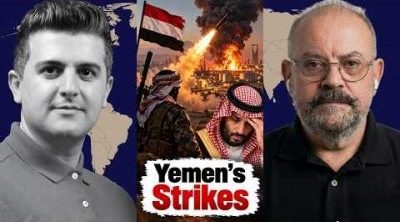
Elijah Magnier: Yemen’s strikes are shattering Saudi Arabia’s long-term strategy
or go to
Aletho News Archives – Video-Images
From the Archives
British weapons and personnel doing much of the killing in Yemen
Press TV – June 18, 2019
A detailed report published by the Guardian newspaper has shown how Britain is massively contributing to Saudi Arabia’s devastating war on Yemen as it suggests that London is not only supplying the bombs that fall on Yemenis, but it provides the personnel and expertise that keep the war going.
The comprehensive report by Arron Merat published on Tuesday showed that Britain was doing much of the killing in Yemen as the country continues to provide Saudi Arabia with everything it needs to turn its southern impoverished neighbor into a graveyard.
“Every day Yemen is hit by British bombs – dropped by British planes that are flown by British-trained pilots and maintained and prepared inside Saudi Arabia by thousands of British contractors,” said Merat in the report. … continue
Blog Roll
 Aletho News
- A West Bank War for Netanyahu’s Election Campaign, Could It Backfire?
- Yemen denounces European Parliament’s ‘hypocritical’ push to blacklist Ansarullah
- Qalibaf: UAE’s UN bid aims to ‘clear the runway’ for ‘Greater Israel’, whitewash genocide
- Pakistan reopens Iran border after boosting security: Report
- Why are so many Brazilians voting for Flávio Bolsonaro?
- Democrats Put Anti-Russia Agenda Ahead of American Workers
- Elijah Magnier: Yemen’s Strikes Are Shattering Saudi Arabia’s Long-Term Strategy
- Pentagon designates Chinese cultural centers national security threat
- Israel Demolishes Home Of Lebanese Journalist Whose Viral Film Exposed Pager Attack
- Record Oil, Empty Tanks: The UAE’s Miracle Recovery
- If Americans Knew
- Tourism Ministry launches free food truck tour in US
- “So Much Worse Than People Realize”: Never-Before-Seen Images Reveal Damage at U.S. Bases as Troops Describe Being Abandoned
- UK Bell Review Confirms Only Anti-Israel Attitudes Are Rising, Not Antisemitism
- DAILY UPDATE: Latest essential news on Palestine, Israel, & region
- DAILY UPDATE: Latest essential news on Palestine, Israel, & region
- Damning report shows the media must confront its failures on Gaza
- BBC senior broadcaster speaks out on Gaza coverage
- Netanyahu vows vast West Bank invasion in response to 20-minute skirmish that left 2 Israeli soldiers and 2 Palestinian fighters dead
- Tied up and tortured: Israel using US-made electroshock weapons on Palestinian detainees
- The outsourced risk: how newsrooms rely on Gaza’s freelancers without protecting them
- No Tricks Zone
- Sudden Stratospheric Warming, Powerful El Niño Combination May Lead To Extreme Europe Cold, Energy Crisis!
- Two New Studies Find Thwaites Glacier Melt Cannot Be Driven By Human Activity Or A Warming Ocean
- E-Cars Reduce CO2 Emissions By Only 41% Compared To Internal Combustion Engine Vehicles
- Predictions Made By Renowned Climate Professor Over Past Decades Have Been Proven To Be Poor
- New Study Suggests Large Regions Of The Pacific Ocean Have Been Cooling For The Last 80 Years
- Germany’s Green Energy Debacle: High Energy Costs Force Kahla Porzellan to Close After 182 Years!
- New Study: 50 Years Of The Most Aggressive ‘Net Zero’ Policies Can Only Affect The Global Climate By 0.03°C
- US September “Heat” Was No Record…Many Records Set Decades Ago
- Latest European Green Energy Debacle; Portugal’s Largest Flagship Solar Park Insolvent!
- Green Energy Debacle: German Expert Professor Fritz Vahrenholt Warns Of Severe Economic And Social Consequences

