The first-round “surprise” in Romania’s elections: What does the Georgescu-Lasconi race mean?
By Erkin Oncan | Strategic Culture Foundation | November 30, 2024
Romania held its presidential elections last Sunday, with 13 candidates competing in a race where most polling predictions were proven wrong. Among these candidates, the most notable was Calin Georgescu, who ran as an independent.
Georgescu emerged victorious in the first round, where voter turnout was recorded at 52%. He secured over 22% of the vote, making him the frontrunner of the elections.
Elena Lasconi of the Save Romania Union Party (USR), representing liberal conservatives, came in second place. Meanwhile, current Prime Minister Marcel Ciolacu narrowly fell to third place behind Lasconi.
One of the notable candidates, former NATO Deputy Secretary General Mircea Geoană, announced his retirement from politics after his defeat. Geoană expressed concerns in an interview with Romanian media, stating:
“The level of disappointment and anger is pushing society toward a more radical choice.”
A shocking win in Western Media
Georgescu’s victory was described in Western media with terms like “surprise,” “shock,” and “earthquake.” This sentiment stems from Georgescu’s reputation as a relatively unpopular politician known for his anti-NATO and anti-Ukraine statements.
As he highlighted in one of his interviews, Georgescu conducted his entire campaign on TikTok. This unconventional strategy led many Romanian analysts to dub him a “product of TikTok.”
Who is Calin Georgescu?
Calin Georgescu, a 62-year-old right-wing populist, holds degrees from the University of Agricultural and Veterinary Sciences and the National Defense College in Bucharest.
Starting his career as a university lecturer, he later worked at the Ministry of Environment and served as Romania’s representative for the UN Environment Program.
This election is not Georgescu’s first political endeavor. In 2020 and 2021, the far-right Alliance for the Union of Romanians (AUR) nominated him for the position of Prime Minister. However, his candidacy was revoked following his praise for controversial historical figures, including pro-Nazi dictator Ion Antonescu and Zelea Codreanu, founder of the anti-Semitic Iron Guard. Georgescu even faced a criminal investigation for glorifying war criminals.
In a 2022 interview with Antena 3, Georgescu referred to these figures as “heroes” and claimed that “the Romanian nation lives through these heroes.”
“NATO base is a diplomatic disgrace”
Georgescu is also known for his anti-NATO rhetoric. He has labeled NATO’s ballistic missile defense system in Deveselu, Romania, as a “diplomatic disgrace” and argued that the alliance would not protect its members in the event of a Russian attack.
Speaking to Romanian journalist Mihai Tatulici, Georgescu advocated for Romania’s neutrality in the Ukraine war, saying:
“It is clear that the situation in Ukraine is being manipulated. The conflict is being orchestrated to serve the interests of the U.S. military-industrial complex. As a nation, our priority should be to remain neutral in any conflict. What happens there is not our concern.”
A vision for a sovereign Romania
Georgescu has openly criticized the European Union (EU), calling it a failed project that seeks to enslave Romania. He outlined his vision for the country as follows:
“The peace strategy must take precedence. This includes both external and internal peace. Everything begins here. Nobody has ever built anything through war. I can summarize my vision with three clear principles: First, our people’s genius lies in remaining 100% neutral in any conflict. Second, I want a sovereign state, one that is independent and uninvolved. Third, we must learn how to utilize our national resources independently.”
In another interview with Antena 3, Georgescu stated:
“We do not have a state. Without a state, people are nothing more than a herd, and the only entity capable of serving the nation is a state. Yet, this has nearly disappeared.”
Liberal-conservative candidate Lasconi
Elena Lasconi, Georgescu’s opponent in the second round, is a former journalist and mayor. She strongly supports Romania’s alliance with Ukraine. On the 1,000th day of the war in Ukraine, she posted on Facebook:
“1,000 days of courage, sacrifice, and the fight for freedom. Romania must continue to stand by Ukraine. I promise to ensure this steadfast support as President. This is not just Ukraine’s fight; it is a struggle for the stability and democracy of the entire region.”
Lasconi also expressed her strong support for NATO. In an interview with Radio Free Europe’s Romanian service, she emphasized the deterrent power of NATO troops:
“I believe it would be wonderful if we had more foreign troops in Romania because countries with well-trained NATO forces have never been attacked.”
A clash of ideologies
Georgescu’s arguments reflect a broader European trend among right-wing populists: emphasizing strong state authority, national revival, and economic self-sufficiency, alongside an anti-war stance. This approach has led many to label him as “Kremlin’s man.”
In contrast, Lasconi embodies a pro-European leader aligned with the current needs of NATO and the EU.
The political polarization in Romania mirrors that of other nations like Moldova, pre-war Ukraine, Serbia, and Georgia. On one side stands a Europe-skeptic right advocating for national sovereignty and strong state policies; on the other, a liberal-conservative faction deeply tied to Atlanticist structures.
While accusations of “Russian influence” often dominate these elections, it’s clear that the economic challenges, political instability, and heightened militarization driving voter concerns are far more tangible than alleged Kremlin meddling.
The roughly 350,000-vote difference between Georgescu and his closest competitor underscores the growing appeal of right-wing populist skepticism toward Europe, marking it as the West’s rising trend. However, Western analysts will need more than just “Kremlin narratives” to fully understand this shift.
US breaks off ‘strategic partnership’ with Georgia; blasts Tblisi for ‘pro-Russia lean’
Press TV – November 30, 2024
The United States has broken off its “strategic partnership” with Georgia after the latter’s decision to suspend negotiations on potential accession to the European Union, while condemning Tbilisi for, what it called, leaning towards Russia.
State Department spokesperson Matthew Miller announced the development on X, former Twitter, on Saturday.
“The US and EU regret Georgian Dream (GD)’s decision to suspend EU accession,” he wrote, referring to Georgia’s ruling party.
“The EU is a bulwark against the Kremlin. We have, therefore, suspended our Strategic Partnership with Georgia,” Miller said.
He also claimed that the party’s decision on the accession talks was a “betrayal” of the European country’s constitution.
The State Department, meanwhile, released a statement on Washington’s decision, accusing the GD of “various anti-democratic actions [that] have violated the core tenets of our US-Georgia Strategic Partnership.”
By freezing the accession talks, it added, the party “has rejected the opportunity for closer ties with Europe and made Georgia more vulnerable to the Kremlin.”
The department also claimed that Georgian people “overwhelmingly support integration with Europe.”
GD Chairman Prime Minister, Irakli Kobakhidze suspended the accession process on Thursday, saying the EU was expecting Georgia to enact “reforms” in exchange for joining the bloc that were actually “steps that mean renouncing our dignity.”
The official was referring to Brussels’ various demands on Tbilisi, including its repealing of the foreign agents’ law that requires NGOs and media outlets that receive more than 20 percent of their funding from foreign donors to register as organizations “bearing the interests of a foreign power.”
Brussels, he added, was effectively “blackmailing” Tbilisi through the demands.
The EU, itself, froze Georgia’s application for joining the bloc earlier this year in response to ratification of the law among other things.
The Georgian premier, meanwhile, addressed the ongoing anti-government riots that have been underway in the capital for the past two days, during which anarchists have put up barricades along the central Rustaveli Avenue and thrown fireworks at the riot police.
The country, he said, would not allow a revolution to take place, saying the rioters were seeking to overthrow the government, using the same tactics that were used during 2014 riots in Ukraine, known as the Maidan riots, which ousted the government in Kiev.
“In Georgia, the Maidan scenario cannot be realized. Georgia is a state, and the state will not, of course, permit this,” Kobakhidze said.
Georgia’s State Security Service also commented on the riots, calling them evidence that a violent coup attempt was taking place in the country.
“Developments occurring in recent days in the country show that planned destructive processes are taking place in accordance with actual circumstances becoming known to the State Security Service as part of the investigation of the violent upheaval case. We informed the society in advance about that,” the service said.
Specific political parties and non-governmental organizations are interested in a violent coup, it noted, adding that the developments were being investigated under Article 315 of the Georgian Criminal Code that covers conspiracy or mutiny for purposes of violent change of the Georgian constitutional order.
European elites are destroying Europe – again

Strategic Culture Foundation | November 29, 2024
One would think that having suffered two world wars only decades apart, European politicians might be more cautious about starting another one. Incredibly, however, the countries of Europe are being plunged into another conflagration.
Not much has changed over a century, it seems. War is still the result of imperialist intrigue and no accountability to the masses of citizens by arrogant politicians aided by relentless media propaganda lies.
European elitist rulers are a treasonous clique who are destroying Europe because of their abject servility to U.S.-led Western imperialism.
To put it crudely, Europe is being abused like a bondage plaything for the Washington and European elites. Shudder the thought of Ursula von der Leyen and Kaja Kallas in dominatrix garb or Keir Starmer, Emmanuel Macron and Olaf Scholz as the gimps. But sometimes, the truth can be stranger than fiction.
Russian President Vladimir Putin nailed it this week when he slammed European political heads who are “dancing to the tune of the Americans.” In an address to the Collective Security Treaty Organization summit in Kazakhstan, Putin said the crisis over Ukraine showed that European so-called leaders have no independence or autonomy. They are non-entities as far as serving the democratic interests of their nations is concerned.
Instead of pushing for a diplomatic solution to the worst conflict on the European continent since World War Two, European political elites are slavishly going along with Washington’s criminal proxy war against Russia, which is in danger of spiraling into a nuclear Armageddon.
This week the buffoonish former British Prime Minister Boris Johnson openly admitted that the conflict in Ukraine was a proxy war against Russia. But that didn’t give Johnson pause for thought or shame. He urged the Europeans to send more weapons to Ukraine. Nor did his crass candidness elicit any outcry or condemnation. Johnson, the imbecile, was, in effect, confirming what Russia has been warning is the essence of the conflict in Ukraine – a U.S.-led war using Ukrainian cannon fodder.
Then, we had the chief of Britain’s intelligence agency MI6, “Sir” Richard Moore, holding forth to an audience in Paris that Russia’s Putin was causing “staggeringly reckless sabotage” across Europe. The British spymaster claimed that Russia was threatening the continent with nuclear weapons to weaken NATO support for Ukraine. He omitted the glaring fact that the U.S., Britain, and France have dramatically escalated the conflict by supplying a NeoNazi regime in Ukraine with long-range missiles to strike Russia.
Meanwhile, the governments in Germany and Nordic countries are issuing dire public warnings for people to “get ready for war” by building bomb shelters in their homes and stocking up on non-perishable foods.
You could hardly make this insanity up except in the dystopian novels of George Orwell. The continent is being led by the nose to disaster by politicians and corporate-controlled media who have lost their minds. They long ago lost any self-respect or independence and are simply acting as the most pathetic surrogates for U.S.-led imperialism.
Even without the ultimate catastrophe of war, Europe has been brought to ruination by elitist politicians who have unquestioningly followed the American agenda of trying to strategically defeat Russia through a proxy war.
Central to this U.S. strategic objective is vanquishing decades of mutually beneficial energy trade between Europe and Russia. The sanctions imposed on the Nord Stream gas pipelines by Trump during his first administration, followed by the blowing up of the pipes by the Biden administration in September 2022, are testimony to that bigger picture. None of the European governments or their news media properly investigated that huge crime of state-sponsored terrorism.
The proxy war and sanctions on Russian energy that the European leaders happily went along with have caused the European economies to implode. Critical commentators talk about the deindustrialization of Europe.
Even the Financial Times, in a recent in-depth report on Germany’s “broken economy”, sounded aghast at “the most pronounced downturn in Germany’s postwar history.” The report surveys auto, chemical and engineering sectors crucial to the German economy and cites “high energy costs” as the detrimental factor.
However, the Western media, even in supposed “in-depth reports” like the Financial Times, are careful not to spell out the obvious cause of Europe’s economic collapse: the U.S.-led proxy war in Ukraine and the consequent damage in Europe’s relations with Russia.
Media reports deplore a “jobs massacre” in Germany’s industrial giants like Volkswagen and Thyssenkrupp without explaining the cause as if the calamity is somehow random misfortune.
As if that is not bad enough, the incoming Trump administration is lining up heavy tariffs on exports from Europe as well as China, Canada, and Mexico. That will be a coup de grâce for the European economies delivered by its American ally.
Europe is in this appalling predicament – facing economic ruin amid a potential military conflagration – all because it has been misled by people like Ursula von der Leyen, Josep Borrell, France’s Macron, Germany’s Scholz (and Angela Merkel before him), and Netherlands former premier Mark Rutte, who is now the gung-ho head of NATO calling for more European weapons to Ukraine. Many others can be named from the Nordic countries, Poland, and the Baltic states. Rather fittingly, the European elitist political class has a long and vile history of Russophobia, going back to collaboration with Nazi Germany in its genocidal aggression against the Soviet Union.
The tragedy of Europe is not something mysterious or ill-fated. It is the direct result of elitist rulers who have assiduously conducted policies that harm European citizens. These charlatan leaders are shameless in their Russophobia and surrogacy for U.S.-led Western imperialism – even to the point of killing their own people through economic devastation or worse – world war.
The conflict in Ukraine is solvable through negotiations and dialogue that acknowledges the historical causes. From Russia’s point of view that pertains to NATO’s treacherous expansionism since the end of the Cold War.
But this is the deep dilemma facing Europe. Not one of the politicians (apart from a few honorable exceptions) is capable of thinking or acting independently because they are ideological slaves.
Rational diplomacy and respect for democracy and peace are beyond these political degenerates. Their complicity in a bankrupt system of Western imperialism makes them incapable of doing the right thing for humanity. That’s why the vile history of wars keeps repeating. They and their corrupt, warmongering system must be swept aside.
Kremlin rejects accusations of meddling in EU state’s election
RT | November 29, 2024
Accusations of Russian meddling in Romania’s presidential election are “absolutely groundless,” Kremlin spokesman Dmitry Peskov has said.
On Thursday, Romania’s top security body, the Supreme Defense Council, claimed that it has evidence of cyberattacks being carried out to influence voting in the first round of the election on November 24. The EU and NATO member became a target of “hostile actions by state and non-state actors, especially Russia,” it alleged.
On the same day, the country’s Constitutional Court ordered a recount of the ballots from the vote, which was surprisingly won by nationalist independent candidate Calin Georgescu, who is a critic of NATO and a staunch opponent of arming Ukraine.
When addressed on the issue by journalists on Friday, Peskov said that “we are not in the habit of interfering in elections in other countries, in particular in Romania, and we do not intend to do so now.”
By pointing the finger at Moscow, the authorities in Bucharest are “mimicking the basic trend that exists in the West in this regard,” he said.
The trend is “if something happens, one should blame Russia first,” the spokesman explained, referring to unsubstantiated accusations of election meddling previously made against Moscow in the US and elsewhere.
Georgescu clinched 22.94% of the ballots in the vote on Saturday and is scheduled to take on liberal leftist candidate Elena Lasconi, who got 19.18%, in the runoff on December 8.
Following the decision to recount ballots, Georgescu issued a statement saying that “an attempt is being made, in the harshest form, to deprive the Romanian people of the ability to think and choose in accordance with their own moral, Christian and democratic principles.”
“The state institutions create instability out of balance and anger out of peace. We cannot allow our people to be forever enslaved by the manipulations of the institutions that lead the people, but which are, in fact, not led by the people,” he insisted.
Lasconi also condemned the ruling by the Constitutional Court and said that the judicial body “is interfering in the democratic process for the second time,” referring to the court banning right-wing candidate Diana Iovanovici-Sosoaca from taking part in the election. “One combats extremism through votes, not backstage games,” she insisted.
German opposition to demand EU exit – media
RT | November 29, 2024
Alternative for Germany (AfD) – the third largest opposition party in the national parliament – intends to take the country out of the EU if it wins the upcoming election, several media outlets reported on Friday, citing the party’s newly drafted election manifesto.
AfD has confirmed that the document is “ready” but has not released it to the public. The party also wants Germany to ditch the euro, and return to a “stable national currency,” media outlets including Die Zeit and Der Spiegel have claimed.
“We believe that Germany’s exit from the European Union and the establishment of a new European community are necessary,” the 85-page-long manifesto reportedly says.
The EU in its current form should be replaced by the “Economic and Interest Community” following a certain transition period that should be “negotiated… with both the old EU partner states and new interested parties,” media have cited the document as saying, adding that the AfD believes the EU is trying to become a “superstate.”
On its website, the party lists Germany’s exit from the EU as part of its political agenda and advocates a “Europe of nations” concept, adding that “irrevocable renunciation of sovereignty in favor of an ‘ever closer’ European Union is incompatible” with this vision.
The party is also seeking to restore trade ties with Russia, which were disrupted by EU sanctions imposed after the escalation of the Ukraine conflict in February 2022. The AfD text highlights Russia’s importance as a supplier of cheap natural gas for German industry, according to national media.
The document also calls for sanctions on Russia to be lifted and the Nord Stream gas pipelines to be repaired, according to Die Zeit. Nord Stream 1 delivered Russian gas to Germany before it was blown up in September 2022, along with Nord Stream 2.
The party also apparently wants Germany to exit the Paris Climate Agreement and introduce abortion restrictions.
AfD has neither confirmed nor denied the reports about its election program, but said that the document was sent to delegates of the federal party conference, scheduled for mid-January.
The document’s lead author, Professor Ingo Hahn, has described it as a “convincing work that not only names the pressing problems of our country, but also shows clear solutions that will lead Germany out of the current misery.”
Germany could hold an early parliamentary vote as soon as February 23 following the collapse of Chancellor Olaf Scholz’s three-party government coalition earlier this month. If Scholz’s now-minority cabinet loses a confidence vote in mid-December, the country will head into a snap election.
AfD became the fifth largest faction in the Bundestag following the 2021 parliamentary election, in which it gained more than 10% of the vote.
US Republicans Condemn UK’s Online Censorship Law as a “Tsunami… Heading Towards America”
By Didi Rankovic | Reclaim The Net | November 26, 2024
UK’s “censorship law” – Online Safety Act – has gained in notoriety, as it has now become the subject of interest of the US House Judiciary Committee, which has for years tried to shed light on the censorship on the internet, and its actors and factors.
So much so that the committee’s members have coined the expression, the Censorship Industrial Complex.
While most of the body’s activities are centered around US social media and allegations of the Biden-Harris administration’s involvement in pressuring them to censor speech, no “complex” is considered to be on an industrial scale for no reason.
A flurry of third parties – such as “fact-checkers” and “raters” – have been involved and investigated, including those based abroad – notably, the Center for Countering Digital Hate (CCDH).
A member of the Republican-majority committee, Congressman Darrell Issa, now strongly criticized the trends concerning censorship-enabling legislation in the EU and in the UK, singling out the Online Safety Act, and warning that “a tsunami of censorship is heading towards America” from abroad.
And that’s just to add to what is already there – Issa called that situation, “malign actors here at home.” As for the UK law, the congressman is unimpressed by its authors and supporters promoting it as a way to protect against hate speech and other online ills.
According to Issa, what it does is give regulators a tool to censor free speech, and as such is viewed by Republicans as part of “a broader global push by the Censorship Industrial Complex.”
Issa in full, from The Spectator:
“The growing attacks on free speech in the US – as well as the UK and EU – pose a direct threat to free people on both sides of the Atlantic. We know that legislation like the Online Safety Act that is said to combat ‘hate speech’ empowers regulators to censor free speech.
“Congressional Republicans understand that these threats to free speech are part of a broader global push by the Censorship Industrial Complex, which includes not only the EU, UK, and other nations but also malign actors here at home. We are committed to confronting this growing threat alongside the incoming Trump Administration to fight against these assaults on free speech within our borders and around the world.”
The congressman had no problem counting the UK and the EU (with its Digital Services Act) among the places this push emanates from, while also vowing that the second Trump administration, alongside Congress Republicans, intends to “fight against these assaults on free speech within our borders and around the world.”
In the UK itself, there are those like Reform Party leader Nigel Farage who couldn’t agree more. Farage, who has close ties with Trump, has made comments about a free speech crackdown in his country.
The UK branch of the Alliance Defending Freedom advocacy group also agrees. Executive Director Paul Coleman said that the Judiciary Committee’s criticism and stance on a number of issues “shows that the UK is fast becoming notorious around the world for its censorious practices.”
Can Europe Return to Reason & Reverse Its Decline?
Jeffrey Sachs, Alexander Mercouris & Glenn Diesen
Glenn Diesen | Nov 27, 2024
I had a conversation with Jeffrey Sachs and Alexander Mercouris about the political changes in Europe. The optimism of the European project as a region of peace and prosperity is long gone. The objective had been to resolve conflicts on the continent peacefully and use collective bargaining power to establish greater economic and political independence. Instead, the continent is experiencing war, de-industrialisation, socio-economic and political instability, excessive dependence on the US, and growing irrelevance in the wider world. What went wrong and can the decline be reversed?
The rest of the world adjusts to the emerging multipolarity with a multivector foreign policy by diversifying economic connectivity to improve economic competitiveness and enhance political autonomy. In contrast, the Europeans have subordinated themselves completely to the US and thus suffer from economic decline and political subordination. Declining rationality is also a clear problem as the Europeans pursued policies towards Russia that they knew would put them on a collision course with Russia. Instead of pursuing course correction, the proxy war with Russia increased the security dependence on the US, which enabled Washington to impose bloc discipline. The recovery of Europe requires reversing the militarisation of dividing lines in Europe, and diversifying economic ties to avoid excessive dependence on any one state or region.
Germany Tightens Grip on Online Speech as Vice Chancellor Defends Arrest of Online Critic
By Didi Rankovic | Reclaim The Net | November 26, 2024
Germany’s authorities continue to double down on their crusade against all manner of free speech on the internet: from the right of citizens to criticize them, to satirical content like memes.
Instead of considering apologizing to a pensioner whose home was recently raided by law enforcement for an online post unflattering of his person, German Vice Chancellor Robert Habeck is now urging even stricter regulation of social media.
And it’s clear what kind of regulation Habeck – who was referred to as “an idiot” in the post that got 64-year-old Stefan Niehoff in hot water with the prosecution – wants to see more of.
The Green Party politician cited the EU’s controversial, sweeping censorship law, the Digital Services Act (DSA), as a tool that could be used to “regulate” algorithms used by social media.
According to the German press, Habeck told the ARD broadcaster not only that he wouldn’t apologize but went on to try to explain – or, justify – why he filed a criminal complaint against the pensioner in the first place.
Habeck suggested that being called an “idiot” was just the straw that broke the camel’s back; his grievance supposedly originates from a previous “racist” post by Niehoff.
That’s not what the prosecutor said when they sent the police to the man’s home, however; only the post branding the high-ranked official as “idiot” was mentioned as the reason for the search – as it was allegedly intended “to defame Robert Habeck in general and to make his work as a member of the federal government more difficult.”
In Germany, those found guilty of such offenses can end up in prison for up to three years, or be forced to pay a fine.
Habeck mentioning a previous “racist” post, meanwhile, stems from the prosecution saying the pensioner “could be suspected of incitement to hatred” (but this was not the reason for sending the police to Niehoff’s home).
NATO admiral urges Western businesses to prepare for ‘wartime scenario’
RT | November 25, 2024
Businesses in NATO countries should prepare themselves for a “wartime scenario” and adjust their production lines and supply chains to be less vulnerable to blackmail by nations such as Russia and China, the outgoing chief of the US-led bloc’s military committee, Admiral Rob Bauer, said on Monday.
Speaking at a European Policy Center think-tank event in Brussels, he urged Western industries and businesses to implement deterrence measures.
“If we can make sure that all crucial services and goods can be delivered no matter what, then that is a key part of our deterrence,” Bauer argued.
“Businesses need to be prepared for a wartime scenario and adjust their production and distribution lines accordingly. Because while it may be the military who wins battles, it’s the economies that win wars,” the NATO official said. He mentioned China and Russia in the context of how he believes wars are waged in the economic sphere.
“We thought we had a deal with Gazprom, but we actually had a deal with [Russian President Vladimir] Putin,” he stated, apparently referring to the drop in Russian gas supplies to the EU, which took place after the escalation of the Ukraine conflict in 2022.
At the time, the EU declared that ending its reliance on Russian energy was a key priority, and many members voluntarily halted their imports, while supplies also plunged due to the sabotage of Russia’s Nord Stream pipelines.
American Pulitzer Prize-winning journalist Seymour Hersh blamed the sabotage on the CIA, alleging that the agency had carried out the attack under the direct orders of the White House – an allegation it has denied.
Bauer then extended his warning to China, claiming that Beijing could use its exports to NATO states and the infrastructure that it owns in Europe as leverage in the event of a conflict.
“We are naive if we think the [Chinese] Communist Party will never use that power. Business leaders in Europe and America need to realize that the commercial decisions they make have strategic consequences for the security of their nation,” the official claimed.
It is unclear what “wartime” Bauer is predicting in his statements.
NATO has long declared Russia to be a direct threat, and Western officials have repeatedly claimed that if Moscow is allowed to win the conflict in Ukraine, it could then attack other European countries. Russia has dismissed these claims as nonsense. Restrictions that Moscow introduced in trade with the West have largely come in response to unprecedented economic sanctions placed on the country in connection with the Ukraine conflict.
Beijing has also faced its share of trade barriers and restrictions introduced by Western states, and introduced similar measures in response. According to most experts, including many in the West, the sanctions policy has backfired on Western economies, leading to supply shortages and inflation.
A defining moment in the Ukraine war
By M. K. BHADRAKUMAR | Indian Punchline | November 24, 2024
Russian President Vladimir Putin issued a statement on Thursday regarding the two attacks by Western long-range weapons on Russian territory on November 19 and 21 and Moscow’s reactive strike on a facility within Ukraine’s defence industrial complex in the city of Dnepropetrovsk with a hitherto unknown non-nuclear hypersonic ballistic missile named Oreshnik.
On Friday, at a meeting in the Kremlin with the military top brass, Putin revisited the topic where he clarified that Oreshnik is not really in “experimental” stage, as the Pentagon had determined, but its serial production has commenced.
And he added, “Given the particular strength of this weapon, its power, it will be put into service with the Strategic Missile Forces.” He then went on to reveal, “It is also important that along with the Oreshnik system, several similar systems are currently being tested in Russia. Based on the test results, these weapons will also go into production. In other words, we have a whole line of medium- and shorter-range systems.”
Putin reflected on the geopolitical backdrop: “The current military and political situation in the world is largely determined by the results of competition in the creation of new technologies, new weapons systems and economic development.”
Succinctly put, an escalatory move authorised by the US president Joe Biden has boomeranged. Did Biden bite more than he could chew? This is the first thing.
The US apparently decided that Putin’s “red lines” and Russia’s nuclear deterrence were the stuff of rhetoric. Washington was clueless about the existence of a wonder weapon like the Oreshnik in the Russian armoury. The shock and awe in the western capitals speaks for itself. Biden avoided commenting on the issue when asked by reporters.
The Oreshnik is not an upgrade of old Soviet-era systems but “relies entirely on contemporary cutting-edge innovations,” Putin stressed. Izvestia reported that Oreshnik is a new generation of Russian intermediate-range missiles with a range of 2,500-3,000km and potentially extending to 5,000km, but not intercontinental, equipped with multiple independently targeted re-entry vehicles (MIRV) — ie., having separating warheads with individual guidance units. It has a speed between Mach 10 and Mach 11 (exceeding 12,000 kms per hour).
The Russian daily Readovka reported that with an estimated 1,500 kgs of combat payload, lifting to a maximum height of 12 km and moving at a speed of Mach 10, the Oreshnik launched from the Russian base at Kaliningrad would strike Warsaw in 1 minute 21 seconds; Berlin, 2 min 35 sec; Paris, 6 min 52 sec; and London, 6 min 56 sec.
In his statement on Thursday, Putin said, “there are no means of countering such weapons today. Missiles attack targets at a speed of Mach 10, which is 2.5 to 3 kilometres per second. Air defence systems currently available in the world and missile defence systems being created by the Americans in Europe cannot intercept such missiles. It is impossible.”
Indeed, a terrible beauty is born. For, Oreshnik is not just an effective hypersonic weapon and is neither a strategic weapon nor an intercontinental ballistic missile. But its striking power is such that when used en masse and in combination with other long-range precision systems, its effect and power is on par with strategic weapons. Yet, it is not a weapon of mass destruction — rather, it’s a high-precision weapon.
Serial production implies that dozens of Oreshnik are in the process of being deployed, which means that no US / NATO staff group and no Anglo-American target intelligence unit in bunkers in Kiev or Lvov is safe any longer.
Oreshnik is also a signal to the incoming US president Donald Trump who is ad nauseam calling for an immediate end-of-war settlement. Oreshnik, ironically, has been developed only as Moscow’s reaction to the hawkish decision by then US president Trump in 2019 to unilaterally withdraw from the 1987 Soviet-American treaty on intermediate range nuclear forces (INF). Hence this also signals that Moscow’s trust in Trump is near zero.
To drive home this point, on the very same day Oreshnik emerged out of its silo, Tass carried an unusual interview with a top Russian think tanker affiliated to the foreign ministry and Kremlin — Andrey Sushentsov, program director of the Valdai Discussion Club, dean of the Russian Foreign Ministry’s MGIMO International Relations Department, and member of the Scientific Council under the Russian Security Council.
The following excerpts of the interview, plain-speaking and startling, should shatter the hypothesis that there is something special going on between Trump and Putin:
- “Trump is considering ending the Ukrainian crisis, not out of any sympathy for Russia, but because he acknowledges that Ukraine has no realistic chance of winning. His goal is to preserve Ukraine as a tool for US interests, focusing on freezing the conflict rather than resolving it. Consequently, under Trump, the long-term strategy of countering Russia will persist. The US continues to benefit from the Ukrainian crisis, regardless of which administration is in power.”
- “The United States has regained its position as the European Union’s top trading partner for the first time in years. It is the Europeans who are bearing the financial burden of prolonging the Ukrainian crisis, while the US has no interest in resolving it. Instead, it is more beneficial for them to freeze the conflict, keeping Ukraine as a tool to weaken Russia and as a persistent hotspot in Europe to maintain their confrontational approach.”
- “Trump has made numerous statements that differ from the policies of Joe Biden’s administration. However, the US state system is an inertial structure that resists decisions it deems contrary to American interests, so not all of Trump’s ideas will come to fruition.”
- “Trump will have a two-year window before the midterm congressional elections, during which he will have a certain freedom to push his policies through the Senate and the House of Representatives. After that, his decisions could face resistance both domestically and from US allies.”
Make no mistake, Russia is under no illusions. Putin will not waver from the conditions he outlined in June for resolving the conflict: the withdrawal of Ukrainian troops from Donbass and Novorossiya; Kiev’s commitment to abstain from joining NATO; the lifting of all Western sanctions against Russia; and the establishment of a non-aligned, nuclear-free Ukraine.
Clearly, this war will continue on its course till it reaches its only logical conclusion, which is Russian victory. Russian Security Council Deputy Chairman Dmitry Medvedev is spot on when he said in an interview with Al Arabiya yesterday that the use of Oreshnik missile “changes the course” of the Ukrainian conflict.
The Western capitals will have to reconcile with the reality that the scope for escalation of the war is ending. Make no mistake, if another ATAMCS strike inside Russia is attempted, it will have devastating consequences for the West.
Serbian President Aleksandar Vucic put it nicely: “If you [NATO] think you can attack everything on Russian territory with Western logistics and weapons without getting a response, and that Putin won’t use whatever weapons he deems necessary, then you either don’t know him or you’re abnormal.”
Israeli Soccer Hooligans Cry Out as They Strike You
By Kevin Barrett – American Free Press – November 22, 2024
On November 7, chaos erupted in the streets of Amsterdam. Soccer hooligans flown in from Israel, flanked by Mossad handlers, watched their their Maccabi Tel Aviv team lose 5-0 to the Dutch team Ajax. After the game, the Maccabi fans ran wild, arming themselves with wood sticks and metal pipes and attacking cabs, busses, police vans, and individuals unlucky enough to cross their path. Palestinian flags—a common sight in the Dutch capital—were torn down. As they rioted, the Maccabi fans showcased their favorite chants, including “There are no schools left in Gaza because there are no children left”; “F*** the Arabs,”; and F*** you terrorists, everybody die.”
A video account of the event by a teenage journalist known as Bender showed that the violence was incited by Israelis, not locals. Bender followed the Israelis from the stadium and filmed them arming themselves and attacking people and vehicles. He was threatened and told to stop filming, presumably by the Mossad handlers overseeing the event.
As often happens, the spectacle of foreign soccer hooligans attacking people in their own city led to a defensive response. Locals confronted the hooligans, in some cases getting the better of physical altercations. A few Israeli thugs managed to get themselves beat up, while others were unceremoniously introduced to the pleasures of swimming in Amsterdam’s insalubrious canals.
If British soccer hooligans had attacked Paris, or German soccer hooligans had attacked Prague, media accounts would have been reasonably evenhanded and accurate. But because the hooligans were Israelis attacking the city of Anne Frank, the media sought to convince the world that a third Holocaust had occurred. (The second, of course, was the Hamas raid of October 7, 2023.)
Here are a selection of headlines:
*Israeli Fans Attacked After Soccer Match in Amsterdam; Violence Condemned as Anti-Semitic (Washington Post ).
*Israeli soccer fans targeted in wave of violence in Amsterdam (Fox).
*Holocaust survivor calls vicious mob attack on Jews in Amsterdam a ‘modern-day Kristallnacht’ (New York Post ).
*Israeli soccer fans in Amsterdam ambushed by gangs of anti-Israel attackers shouting ‘Free Palestine,’ Netanyahu sends planes to evacuate citizens (New York Post ).
*The New Kristallnacht: Antisemitic Attacks in Amsterdam Demand Global Action (Times of Israel ).
*Global leaders react to Amsterdam pogrom (The Jerusalem Post ).
*Amsterdam Has Failed Its Jews (Spectator ).
The United States Holocaust Museum issued a statement stating that the Museum “strongly condemns the vicious attacks on Israeli soccer fans in Amsterdam and the outrageous celebrations of those attacks.” The Anti-Defamation League shrieked about the “obscene, unprovoked violence” which it described as follows: “This is what ‘globalize the intifada’ looks like. Mobs of hate-filled people chasing down and attacking innocent Israeli soccer fans who they have dehumanized as ‘Zionists,’ hunting down and brutalizing ordinary people who came to Amsterdam simply to enjoy a soccer match.”
But why did these Israeli “ordinary people” repeatedly commit assault, battery, and vandalism, long before any locals retaliated? Why did the Israeli attacks on people and vehicles draw no response from local police, who pointedly ignored the rioting until the tables had been turned? And why were the hooligans flanked by Mossad agents as they incited a riot?
Dutch scholar and author Alexander Wolfheze, who was in Amsterdam on November 7, describes the event as a “psy-op.” In a November 12 interview with this author Wolfheze agreed with critics who argue that the Israeli hooligans’ attack on Amsterdam was carefully orchestrated by intelligence professionals in order to produce precisely the headlines listed above, and thousands more like them: “I believe that there are PSYOP aspects (to the hooligans’ attack). It happened just before the anniversary of Kristallnacht, something that the mainstream media did not fail to exploit.”
Dr. Wolfheze added that the November 7 Mossad op was also designed to influence Dutch domestic politics: “Holland is once again at the forefront of the Israelization of Europe, the Zionisation of Europe. Holland was the first country to get a real neo-Zionist government (Geert Wilders). And exactly at that time, after the appointment of this new cabinet, this new government here, and this new reality here, we are seeing this program (total Israeli takeover of Holland -KB) being implemented through the hooligans.”
If Israel can attack your country, pretend to be the victim, and force your entire government and mainstream media to go along with the transparent lie, they basically own you. Fortunately, Israel does not own social media journalists like Bender and Max Blumenthal, both of whom were instrumental in exposing what really happened in Amsterdam.
The Israeli attack on Amsterdam once again illustrated the Jewish State’s perfidy, and provided more evidence that when they cry out as they strike you, it isn’t just a hobby—it’s how they make a living.
Hungary slams US for destabilizing regional energy security
RT | November 23, 2024
Washington’s decision to blacklist Russia’s Gazprombank, a key conduit for gas purchases from Russia, is aimed at undermining energy security in the Central European region, Hungarian Foreign Minister Peter Szijjarto has claimed.
Earlier this week, the US Treasury Department imposed blocking sanctions on more than 50 Russian financial institutions, including Gazprombank, linked to the eponymous Russian gas giant, and six of its international subsidiaries.
The newly introduced restrictions effectively cut off Russia’s primary bank for energy-related transactions from the SWIFT interbank messaging system, meaning it can no longer conduct dollar-based transactions.
“Including Gazprombank to the sanctions list is a decision that deliberately puts some Central European countries in a difficult situation, and deliberately jeopardizes the security of energy supplies” to several nations in the region, Szijjarto wrote on Facebook on Friday.
The Hungarian diplomat stated that any attempts to jeopardize energy supplies to Hungary “either by imposing sanctions or by cutting off transit supplies are considered as an offence against our sovereignty.”
“We reject all the attacks of the kind against our sovereignty, resist the pressure, and pursue our national interests,” he said.
Szijjarto added that he discussed the issue of gas supplies to Hungary with the first deputy head of the Russian Energy Ministry, Pavel Sorokin, on the sidelines of the Istanbul Energy Forum, which convened in Türkiye on November 22.
“We reviewed the situation in the field of gas transportation and confirmed that we will support necessary cooperation for secure energy supplies to Hungary,” he stated.
Budapest is also discussing the situation with the energy ministers of Türkiye, Azerbaijan, Bulgaria, and Serbia, and consulting with Slovakia to find a solution for securing energy supplies, Szijjarto added.
EU nations are still purchasing record volumes of liquified natural gas (LNG) from Russia. Despite the bloc’s plans to eliminate its dependence Russian energy, it remains one of the world’s major importers of Russian fossil fuels.
In August, pipeline gas comprised the largest share of the EU’s purchases of Russian fossil fuels (54%), followed by LNG (25%), according to the Center for Research on Energy and Clean Air (CREA).
Featured Video
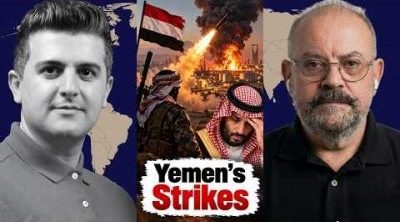
Elijah Magnier: Yemen’s strikes are shattering Saudi Arabia’s long-term strategy
or go to
Aletho News Archives – Video-Images
From the Archives
British weapons and personnel doing much of the killing in Yemen
Press TV – June 18, 2019
A detailed report published by the Guardian newspaper has shown how Britain is massively contributing to Saudi Arabia’s devastating war on Yemen as it suggests that London is not only supplying the bombs that fall on Yemenis, but it provides the personnel and expertise that keep the war going.
The comprehensive report by Arron Merat published on Tuesday showed that Britain was doing much of the killing in Yemen as the country continues to provide Saudi Arabia with everything it needs to turn its southern impoverished neighbor into a graveyard.
“Every day Yemen is hit by British bombs – dropped by British planes that are flown by British-trained pilots and maintained and prepared inside Saudi Arabia by thousands of British contractors,” said Merat in the report. … continue
Blog Roll
 Aletho News
- Racist Seinfeld Dances for Joy as Bibi Unveils His New Map
- A West Bank War for Netanyahu’s Election Campaign, Could It Backfire?
- Yemen denounces European Parliament’s ‘hypocritical’ push to blacklist Ansarullah
- Qalibaf: UAE’s UN bid aims to ‘clear the runway’ for ‘Greater Israel’, whitewash genocide
- Pakistan reopens Iran border after boosting security: Report
- Why are so many Brazilians voting for Flávio Bolsonaro?
- Democrats Put Anti-Russia Agenda Ahead of American Workers
- Elijah Magnier: Yemen’s Strikes Are Shattering Saudi Arabia’s Long-Term Strategy
- Pentagon designates Chinese cultural centers national security threat
- Israel Demolishes Home Of Lebanese Journalist Whose Viral Film Exposed Pager Attack
- If Americans Knew
- An error has occurred; the feed is probably down. Try again later.
- No Tricks Zone
- Sudden Stratospheric Warming, Powerful El Niño Combination May Lead To Extreme Europe Cold, Energy Crisis!
- Two New Studies Find Thwaites Glacier Melt Cannot Be Driven By Human Activity Or A Warming Ocean
- E-Cars Reduce CO2 Emissions By Only 41% Compared To Internal Combustion Engine Vehicles
- Predictions Made By Renowned Climate Professor Over Past Decades Have Been Proven To Be Poor
- New Study Suggests Large Regions Of The Pacific Ocean Have Been Cooling For The Last 80 Years
- Germany’s Green Energy Debacle: High Energy Costs Force Kahla Porzellan to Close After 182 Years!
- New Study: 50 Years Of The Most Aggressive ‘Net Zero’ Policies Can Only Affect The Global Climate By 0.03°C
- US September “Heat” Was No Record…Many Records Set Decades Ago
- Latest European Green Energy Debacle; Portugal’s Largest Flagship Solar Park Insolvent!
- Green Energy Debacle: German Expert Professor Fritz Vahrenholt Warns Of Severe Economic And Social Consequences

