The latest round of US sanctions against Russian financial institutions, which specifically target Gazprombank, is an attempt to block Russia’s gas supplies to the EU, Kremlin spokesman Dmitry Peskov stated on Friday. The lender is Russia’s primary bank for energy-related transactions.
Peskov warned that Moscow would respond to restrictions with countermeasures, though he did not specify what they would entail.
The Kremlin spokesman’s remarks follow an announcement by the US Office of Foreign Assets Control (OFAC) on Thursday, which said Gazprombank and six of its international subsidiaries had been added to its sanctions blacklist. Gazprombank had already been sanctioned by the UK and Canada shortly after the escalation of the Ukraine conflict in 2022. However, the US had previously avoided placing restrictions on the lender as it was used by EU states to pay for Russian gas.
When asked whether the Kremlin viewed sanctions on Gazprombank as an attempt to jeopardize supplies of Russian gas to Europe, and whether Moscow planned any response, Peskov replied: “The answer is ‘Yes’ to both questions.”
He noted that Russian authorities were already working on ways to alleviate the problems that the new restrictions could cause Russia and its foreign gas buyers.
“Of course, we’ll find options. It is impossible to introduce completely blocking measures against a country like Russia. It may take some time, but a solution will still be found,” Peskov said.
The new measures mean Gazprombank can no longer carry out transactions that involve the dollar-based financial system. Gazprombank earlier said that sanctions would not affect its operations within Russia, but warned that its UnionPay cards may stop working outside the country.
Apart from Gazprombank, the new US restrictions also targeted more than 50 small-to-medium Russian lenders, some 40 securities registrars, and 15 financial officials.
After the escalation of the Ukraine conflict in 2022, the EU declared the elimination of its reliance on Russian energy to be its top priority. Many member states, including Poland, Bulgaria, Finland, the Netherlands, and Denmark, voluntarily halted their imports. However, several EU nations, including Austria, Hungary, Slovakia, the Czech Republic, and Italy continue to rely on Russian gas to meet their energy needs, and have not stopped buying the commodity despite pressure from peers within the bloc.
Moscow has slammed Western sanctions as illegal, and noted that they keep backfiring on the countries that impose them. Russia has also been gradually moving away from the dollar in trade, switching to transactions using national currencies with most of its international partners.
The newly imposed US sanctions against Russia’s Gazprombank are expected to send energy costs surging in parts of Europe, Finam Financial Group analyst Aleksandr Potavin told TASS on Friday. The risk of secondary restrictions will force buyers of Russian oil and gas to seek new payment tools, he predicted.
On Thursday, the US Treasury Department introduced blocking sanctions against more than 50 Russian lenders, including Gazprombank and six of its international subsidiaries. The new penalties effectively cut one of Russia’s largest banks off from the SWIFT interbank messaging system, meaning it can no longer carry out transactions that involve the dollar-based financial system. Gazprombank’s assets in the US have also been frozen.
“Due to the new sanctions against Gazprombank, foreign buyers of Russian gas and oil will be faced with the need to look for alternative payment routes that are likely to complicate the entire process, increase risks, and make the payment procedure more expensive,” Potavin said.
He specified that European buyers could use accounts in other banks or pay for energy supplies via other world currencies as an alternative.
“The new sanctions will lead to an increase in prices for Russian hydrocarbons in Europe, and supply disruptions can’t be ruled out as well, since all this creates new risks for foreign companies working with Russia,” he explained.
According to Alexander Frolov, expert at the InfoTek energy news center, the latest restrictions won’t have a direct impact on buyers of Russian gas who previously agreed to adopt the “gas for rubles” scheme to pay for their energy purchases. They will only apply to individuals and legal entities subject to US jurisdiction, he said, as quoted by TASS.
The analyst admitted, however, that companies using rubles for Russian energy supplies are at risk of secondary sanctions, “so gas buyers from Europe will turn to the US Treasury for clarification.”
Supplies of Russian pipeline gas to Europe have substantially declined due to Ukraine-related restrictions and the sabotage of the Nord Stream pipelines, although EU nations are still importing record volumes of LNG from the sanctions-hit state. Despite the bloc’s vows to drop purchases of Russian energy, it remains one of the world’s major buyers of Russian fossil fuels. In August, pipeline gas comprised the largest share of the EU’s purchases of Russia’s fossil fuels (54%), followed by LNG (25%), according to the Centre for Research on Energy and Clean Air (CREA).
November 22, 2024
Posted by aletho |
Economics, Russophobia | European Union, Russia, United States |
Leave a comment
Diplomats and parting gestures are nothing new. As the EU’s High Representative for Foreign Affairs Josep Borrell comes close to ending his tenure, he has called for EU member states to stop political dialogue with Israel. “After a year of unheeded pleas, we cannot continue with business as usual,” said Borrell. Make that a year of doing nothing but upholding Israel’s security narrative, thus becoming complicit in genocide.
The EU is neither blameless nor naïve. Borrell’s last ditch attempt at steering EU diplomacy towards at least a veneer of abiding by international law is meaningless, especially when Israel’s atrocities are still not described as genocide by the bloc. Furthermore, proposing an import ban on illegal settlement products is hardly going to dent or end Israel’s genocidal intent and actions in Gaza.
Borrell’s stance has been weak throughout the genocide, and the end of his term as the EU’s high representative was never going to see him leaving an honourable legacy in this respect. In his blog which detailed a timeline of events and EU involvement since Israel’s genocide began (although the g-word is not mentioned once), Borrell makes the case for Israel’s security more than he does for protecting the Palestinians.
“When self-defence started looking more and more like revenge, our appeals grew louder, but we doubled down on our commitment to Israel’s security,” he wrote. The EU’s primary concern, therefore, was to protect Israel’s security narrative at the expense of Palestinians in Gaza. Borrell also described ethnic cleansing and genocide as “some of these illegal and immoral ideas”.
Predictably, the EU foreign ministers rejected Borrell’s proposal. Polish Foreign Minister Radoslaw Sikorski declared that, “We know that there are tragic events in Gaza, huge civilian casualties, but we do not forget who started the current cycle of violence.”
Does Sikorsky remember who started the settler-colonialism in Palestine and who started the genocide, though? Clue: It wasn’t the Palestinians.
Cause and effect are clear, so let’s not forget the initial cause: the creation of the Zionist state of Israel in Palestine.
However, it was not just Sikorski who clearly believes that history began on 7 October 2023, and so uses the shortest timeframe to justify his stance; Borrell did the same. “Looking back, we need to acknowledge that the approach we have used for over a year with the Israeli government has failed,” he wrote. Look back even further, and see how many times the EU failed in terms of upholding international law, because the profits reaped by maintaining ties with Israel are too considerable to lose. Every time, Palestinians were forced to suffer the consequences of international diplomacy with Israel. And let’s not forget the EU’s obsession with maintaining the two-state paradigm’s relevance in rhetoric only.
Business as usual should never have happened. The EU knows it is dealing with a colonial enterprise and that it made human rights secondary to any deals between the bloc and Israel, despite the association agreements actually stipulating otherwise. Borrell’s weak stance is just a symbolic departure trinket, of purportedly having realised too late what was at stake.
The EU – Borrell included – prioritised pleading with Israel as its first diplomatic overture, and ongoing genocide is the result. Even if the EU foreign ministers decided to heed Borrell’s proposals of suspending dialogue and banning settlement products, neither are anywhere near being a tool to bring about an end to the genocide in which Europe and the US are complicit, and which most EU countries are still refusing to acknowledge, never mind stop.
November 20, 2024
Posted by aletho |
Ethnic Cleansing, Racism, Zionism, Progressive Hypocrite, War Crimes | European Union, Human rights, Israel, Palestine, Zionism |
Leave a comment
In a new report from the EU Observer entitled, “Billions of EU funds to remain frozen as Hungary fails to reform,” top EU officials stated that Hungary will continue to be blocked from the €19.2 billion in EU funds owed to the country.
The outgoing European Commissioner for Justice, Didier Reynders, while speaking to the outlet, confirmed that Hungary’s funds will remain frozen. He stated that concerns about Hungary still exist because the draft texts submitted by Budapest do not address what he vaguely refers to as “conflicts of interest.”
“The current state of play of relevant developments in Hungary demonstrate that important concerns still persist,” he said.
The EU Observer report also notes that the Child Protection Act from Hungary is a factor in blocking funds. The act stops LGBT topics from being taught in public schools and blocks gender reassignment surgeries to safeguard children.
The outlet notes that on Tuesday, “a hearing at the Court of Justice in Luxembourg saw 16 member states and the European Commission confront Hungary over its anti-LGBTQ law.”
“This is a frontal and serious attack on the rule of law, and more generally on European society,” a lawyer representing the European Commission told the court, according to AFP.
As European Commission President Ursula von der Leyen outlined in a speech in January of this year, Hungary’s €20 billion would remain frozen until the country opens its borders. It was one of the clearest references to the fact that Hungary’s strict border policy, which is now increasingly mainstream in Europe, is one of the sole reasons behind the frozen money. However, other issues such as LGBT also remain at the top of the agenda for the EU.
Once the government in Poland was changed and the left-liberal Donald Tusk became prime minister, the country’s money was quickly unfrozen. The EU is now wielding EU funds as a powerful tool to attack governments Brussels deems to be political enemies.
Von der Leyen stated once Tusk came to power, that she was “impressed” by his efforts to “restore the rule of law.”
Tusk has taken over public television stations in violation of Polish law, imprisoned political opponents, and completely ignored court orders.
November 20, 2024
Posted by aletho |
Civil Liberties, Full Spectrum Dominance | European Union, Human rights, Hungary |
Leave a comment
Germany is a political void in the center of Europe, even though it contributes significantly to the global economy and is influential in trade.
It’s also the Western country with which Russia has had the most historical, cultural and, until recently, economic contacts. A week ago the government in Berlin collapsed, and so far the leading German parties have agreed that early parliamentary elections will be in February 2025.
It’s very likely that the next government will be led by the main opposition force, the Christian Democratic Union (CDU).
At the start of the election campaign, CDU leader Friedrich Merz publicly announced that – if he wins – he’ll issue an ultimatum to Moscow over Ukraine. He’s promised that if this ultimatum is not accepted within 24 hours, his government will provide the Kiev regime with cruise missiles to attack Russian territory. The consequences of such a decision for Russian-Western relations are obvious. It is not surprising, therefore, that our main reaction was astonishment at the irresponsibility of such a high-ranking member of the German elite. There are even fears that Merz and those behind him intend to drag Germany into a destructive military conflict with Europe’s largest country.
But all this German talk means nothing in practice. Without US authorisation, or direct orders from Washington, the leaders in Berlin are not only incapable of starting a major war in Europe, they are incapable even of adjusting their shoelaces. Any statements by German politicians, the fall and rise of governing coalitions there, should only be seen in the context of how the Berlin establishment is trying to find a role in the shadow of total American dominance.
It’s deeply symbolic that Chancellor Olaf Scholz took a decisive step towards the collapse of the governing coalition on 6 November, the day on which the domestic political balance of power in the United States changed radically. In the context of significant changes at the center, the peripheral political systems must react as sensitively as possible: at the level of how a branch of a large corporation reacts to a change in its general management.
Berlin’s international position is defined by its crushing defeat in the Second World War, which ended any hope of determining its own future. Germany, like Japan and South Korea, is a country with a foreign occupying force on its territory, albeit under the NATO flag. The German elite, both political and economic, is, with few exceptions, even more integrated with the US than the British elite. To say nothing of those running France, Italy or other European countries.
Germany has no autonomy in determining its foreign policy, nor does it aspire to have any. It’s no coincidence that over the past two and a half years of the Ukraine crisis, it’s been Berlin that has provided the largest amount of military and financial aid to the Kiev regime. Almost ten times more than, say, France, whose president likes to make bellicose speeches.
Naturally, the representatives of the German establishment look like pale copies of what we used to consider real politicians. And this is a natural product of the loss of any possibility of determining their own destiny.
Of course, Berlin can still set the parameters of economic policy for the weak countries of the European Mediterranean. States such as Greece, Italy or Spain are given to Germany to ‘feed’ within the framework of the European Union and its single currency. But even Poland, which has a special relationship with the US, has managed to avoid tying itself to Germany’s industrial grip. France is resisting slightly. But it is gradually sinking to the level of southern Europe. The UK has left the EU, but retains its position as the main representative of the US in Europe.
It should be noted that such a state of affairs for Germany did not come about overnight. Even during the Cold War, the Federal Republic (FRG) was led by bright personalities. Under chancellors such as Willy Brandt (1969-1974), the Moscow Treaty was signed between the FRG and the USSR on the recognition of post-war borders in Europe. In the early 1970s, German politicians and business were able to persuade the US to allow Germany to establish energy cooperation with the Soviets. In our time, Chancellor Gerhard Schroeder (1998-2005) pushed for European energy security based on German-Russian cooperation. But all this came to an end with the global economic crisis of 2008-2013, after which the US began to tighten the screws on its allies. In the spring of 2022, Olaf Scholz, who had previously been committed to dialogue with Russia, fully supported the military-political confrontation created by the Americans over Ukraine.
Now German politicians are not free to choose their own future. For most of them, with the exception of the non-systemic opposition, this is quite obvious. Why appoint bright personalities to the highest positions if nothing depends on their decisions? Gradually, the entire political system and the mood of the electorate are adapting to these conditions.
The differences in the parties’ platforms are becoming blurred. Observers are already talking about the likelihood that the government will be formed by the Social Democrats and their main opponents from the CDU. This means that disagreements on fundamental issues are a thing of the past. Only the technical aspects of forming a government need to be agreed upon, and the main goal of all efforts is to hold on to power as such.
The united and sovereign German state existed for 74 years (1871-1945). Its revival as such is not possible: even if Russia and China would look favourably on it, the Anglo-Saxon world will not allow it for several reasons at once.
Firstly, both German attempts – in the First and Second World Wars – to play a leading role in the West came close to succeeding. So nobody will give them a third chance. Just to be on the safe side. It should be borne in mind that the West takes order within its own community even more seriously than it does the defence of its privileges against the rest of humanity.
Second, Germany’s position at the center of Europe, its huge industrial base and its industrious population make it an ideal partner for the US and Britain, the maritime trading powers. Politically insignificant, Germany can economically control much of the rest of Europe, but cannot dictate the substance.
Third, the revival of visible German independence is in the interests of Moscow and Beijing because it would split the ranks of the consolidated West. A small front of countries like Hungary, Slovakia or even one a little larger cannot create such a split. And the unity of the West under the leadership of the US is a fundamental obstacle to the implementation of the plans for a multipolar world order promoted by Russia and China.
Germany is now a political wasteland in the heart of Europe. Tiny shoots of reason are, of course, breaking through the decades-old system based on pandering to the interests of American patrons. With some very obvious exceptions, the representatives of the non-systemic German opposition are talented people. But their prospects are still very dim because of the way things are manage.
In the future, we can expect to re-establish some economic ties with Germany but we must treat it as a political colony of the US, rather than thinking about try to establish full inter-state relations with Berlin.
Timofey Bordachev is the program director of the Valdai Club.
This article was first published by ‘Vzglyad’ newspaper and was translated and edited by the RT team.
November 18, 2024
Posted by aletho |
Illegal Occupation, Timeless or most popular | CDU, European Union, France, Germany, NATO, Russia, UK, United States |
Leave a comment
The European Union has announced sanctions on Iran’s shipping lines over claims it has been involved in the supply of weapons to Russia amid the ongoing war in Ukraine.
The European Commission, the EU’s executive arm, said on Monday that it had imposed sanctions on the Islamic Republic of Iran Shipping Lines (IRISL), its director Mohammad Reza Khiabani, and several other entities and individuals.
It said vessels, ports, and locks owned, operated, or controlled by those individuals and entities will be targeted by the sanctions, thereby prohibiting any transaction with them.
The EU claimed the individuals and entities have been involved in transporting Iranian-made Unmanned Aerial Vehicles (UAVs), missiles, and related technologies and components to Russia to use in the war in Ukraine.
The sanctions come more than a month after the bloc imposed sanctions on Iran’s national airline Iran Air over the same claims.
Iran has repeatedly rejected accusations it has been supplying weapons to Russia for use in the ongoing war in Ukraine.
Foreign Minister Abbas Araghchi said in a post on the X on Sunday that sanctions on the IRISL would backfire, adding that they would be against freedom of navigation as a basic principle of the law of the sea.
Araghchi said the EU’s targeting of Iran’s transport systems and travelers showed its behavior toward Iran has no legal, logical, or moral basis.
He said that even the Ukrainian President Volodymyr Zelenskyy himself had confirmed that no Iranian ballistic missiles have been delivered to Russia.
Experts say the EU’s imposition of sanctions on Iran under the pretexts of its involvement in the war in Ukraine is in line with the US government’s policy to pressure Tehran into new concessions amid reports that there could be a new round of negotiations to revive a 2015 nuclear deal between Iran and world powers.
November 18, 2024
Posted by aletho |
Wars for Israel | European Union, Sanctions against Iran, Zionism |
Leave a comment
Following Trump’s election, there has been much speculation about how the war in Ukraine might end. But to understand how it might end, it’s vital to understand how it started.
The origins of the war in Ukraine can be traced back to the ouster of Ukrainian President Yanukovych in February 2014. Russia labelled it a coup, realists would say it was unconstitutional change in power, and U.S. & British officials would shrug their shoulders.
After Russia occupied Crimea and as insurgency broke out in the Donbas, the French and Germans launched a peace process involving the Presidents of Russia and Ukraine. From this so-called ‘Normandy format’ emerged two peace deals named the Minsk agreements. But the UK was sidelined from the peace process and the Americans suspicious of it.
Left out, Britian, supported by the U.S., pushed sanctions as the primary vehicle to contain Russia, running counter to what the French and Germans were trying to achieve. By the summer of 2015, the Minsk agreements had become sidelined, and sanctions were set in stone.
Since that time, Russia has become the most sanctioned country on the planet. Thirty-three western countries, led by the USA, imposed more than twenty thousand sanctions against Russian people and companies. That’s fifteen times more sanctions than Iran in a distant second place.
If we could completely cut Russia’s economic ties with the west, so the theory went, then that would be so damaging that Russia would have to withdraw from Ukraine. Western powers therefore sanctioned everything that they could, from money, ships, oil, gold, diamonds, weapons and all manner of hi-tech components. But from a very early stage, it was clear that sanctions weren’t altering Russian policy to Ukraine, quite the opposite.
When I left the Foreign Office in 2023, the UK government with its western partners, had gone through all the sanctions that they thought might weaken Russia. The west could probably find more people or entities to sanction. But policy makers never really gripped Russian gas, as some European countries still rely on it. And anyway, the destruction of the Nordstream pipeline solved that conundrum. Russian oligarchs that had political connections in the west were spared as were Russian companies that owned factories in the USA, to prevent American job losses. But we hit most things and neared the bottom of the barrel.
Yet, Russia’s economy always seemed to bounce back. That’s partly because, sanctions were never as big a deal as other events that moved the global economy, such as the oil price collapses in 2014 and 2016 and Covid. But it was also because Russia continually adapted its macroeconomic policy to absorb and, in the end, profit from sanctions. Following an immediate post-sanctions contraction of economic growth in 2022, Russia has grown more strongly than the western countries that imposed sanctions.
Western powers therefore needed something stronger, so sanctions evolved into a political tool to isolate Russia on the world stage. The USA, European Union and other countries including Japan and Australia sanctioned every possible type of economic, social and cultural activity involving Russia. Western academics no longer collaborate with Russian academics. Russian airliners can’t pass over western airspace and vice versa. Border posts have been closed or minimised. Russia can’t compete in international sporting events or even the Eurovision song contest.
Russian Ministers are subjected to indignant walkouts by western diplomats and ministers at international gatherings. Ordinary Russian people were denied a weekend ParkRun. Ukraine did its part, cancelling the Russian Orthodox church and going on a propaganda offensive with any western company that sold goods with the word ‘Russia’ in their branding.
And yet, outside of the west, Russia’s standing on the global stage doesn’t seem to be in decline. In a process accelerated by the Ukraine war, Russia, with China, has spearheaded a rapid shift by the developing world to create their own formats for dialogue and cooperation. There are over 200 countries on this planet, so the wealthy ‘west’ is in a minority. The BRICS group has grown rapidly, with a long queue of countries waiting to join, including NATO member Turkey. Vladimir Putin has an International Criminal Court arrest warrant out on him, yet he still travels freely to ‘friendly’ countries, where he receives the red-carpet treatment. He recently hosted a successful BRICS summit in Kazan while war continued to rage in Ukraine.
War started in February 2022 a few days after the Ukrainian government finally signalled the death knell of the Minsk peace agreements. But the point is that the Minsk agreement was [not] necessarily bad; it’s simply that the U.S. and UK invested significant efforts in ensuring its failure.
Sanctions never looked likely to prevent war, nor force its end, despite the death or injury to over one million people and a vast exodus of Ukraine’s population. War in Ukraine became reduced to the brutal, bloody town by town fighting in Europe after D-Day, while life in the west, and in Russia, carried on almost as normal. Fighting alone, Ukraine has never had sufficient resources to survive and never will.
There is a strong case that sanctions created the conditions for war to erupt, by undermining the very peace process – the Normandy Format – that was established to prevent it. And that the west’s continued blind faith in sanctions took us to the brink of a doomsday scenario, more horrific than the use of nuclear weapons in Hiroshima and Nagasaki.
Western leaders, not wanting war themselves, focussed blindly on supporting Ukraine for as long as it takes. But the notion of ‘as long as it takes’ became tarnished with increasing numbers of western politicians started complaining that it is taking too long. Not least as the economics and demographics of war still show that Russia can continue fighting for as long as it takes, and that Vladimir Putin has the domestic political support to do that.
So, beyond the hype, if Trump is serious about ending the war in Ukraine, he must look at its origins. A ceasefire alone won’t cut it with Putin. There needs finally to be a peace proposal that includes targeted sanctions reduction. That, and a final reckoning with the NATO membership issue, the brightest red line of all.
November 18, 2024
Posted by aletho |
Economics, Russophobia | European Union, NATO, Russia, UK, United States |
Leave a comment

For the second time in 8 days, hundreds of Israeli soccer hooligans attacked unidentified fans at a football match in Paris, France. A number of videos circulating on social media show swarms of young men—mostly dressed in black with masks and stocking caps or draped in Israeli flags—pummeling an unknown Frenchman who was beaten to the ground. The extent of his injuries remains unknown.
The skirmishes took place at Thursday’s UEFA Nations League soccer game between France and Israel at the Stade de France which drew the smallest crowd in history due to the threat of hooligan violence. But although the streets of Paris were heavily patrolled by thousands of police and security guards to protect the visiting Israelis, fans of the home team received no such security. When the Maccabi Tel Aviv fans began raining-down blows on their unnamed victims, the police were nowhere to be found.
Some of the videos show terrified fans fleeing an area in the stands that was overrun by a hostile Maccabi mob sprinting across the upper deck while thousands of fans “Booed” loudly from below. The scene seemed more reminiscent of the political street fights that took place in Weimar Germany in the early 1930s than a football match in 2024. The ensuing mayhem was described by analyst Arnaud Bertrand on his Twitter site:
… There was a football match between Israel and France yesterday and this happened at the beginning of the match: a horde of Israeli supporters openly lynched some French supporters in the stands. Macron himself was in attendance at the match to show his commitment to “fighting antisemitism” after Amsterdam…
He made no public comment that I know of on these French supporters getting lynched in front of his eyes. And the police made no reported arrests. Had the reverse been the case, had this been some Israeli supporters getting lynched by a horde of French supporters, you can absolutely bet 100% that he (and all the French media) would have made a huge deal out of it. You cannot overstate the absurdism of it: because we’ve so gaslighted ourselves around “antisemitism” and so distorted the meaning of it, Western countries would literally rather let our their own citizens get lynched on their own soil – in front of the president’s eyes (!) – than face accusations being “antisemitic” in their own definition of the term. @RnaudBertrand (video)
Bertrand is using the term “lynching” in the legal sense as it relates to the “Emmett Till Anti-lynching Act” in 2022… meaning “that the actions of the Israeli supporters would most certainly be considered lynching under US law because they conspired as a mob to cause serious bodily harm based on bias regarding “the actual or perceived religion or national origin” of the person(s) – matching exactly 18 USC §249(a)(5)’s definition requiring conspiracy & serious injury in hate-motivated attacks. @RnaudBertrand
Arnaud is correct in pointing out that President Macron attended the match. Not surprisingly, Macron was joined in his luxury box by two former presidents, the current prime minister and a large portion of France’s political establishment, all of whom stand foursquare behind the violent Zionist thuggery they witnessed in the stands. (Note—Joshua Zarka, Israeli ambassador to Paris, was also at the game, while Ronen Bar, the head of Israel’s Shin Bet security service, was in France to supervise the security of Israeli players and fans.)

This is from an article at inews.uk:
Fights broke out at a sparsely attended France–Israel match at the Stade de France in Paris on Thursday night, despite a heavy security presence inside and outside the stadium. Footage on social media showed clashes between home and away fans in the stands, with one clip appearing to show men wearing Israel flags punching and kicking a man on the ground before stewards intervened.
Tensions ran high even before the match with a heavy security operation around the stadium, with 4,000 police and 1,600 civilian security personnel deployed as French authorities sought to avoid a repeat of the violent scenes around a Maccabi Tel Aviv match in Amsterdam last week. Police lines extended more than a kilometer from the stadium with barricades along the streets and helicopters buzzing overhead… Just 13,000 tickets had been sold the day before the game – reportedly the lowest attendance for any home fixture in the history of the French national team…
Israel fans sang songs in support of the Israel Defence Force (IDF) and “free the hostages,” in references to captives held by Hamas in Gaza. Some wore masks and IDF shirts.
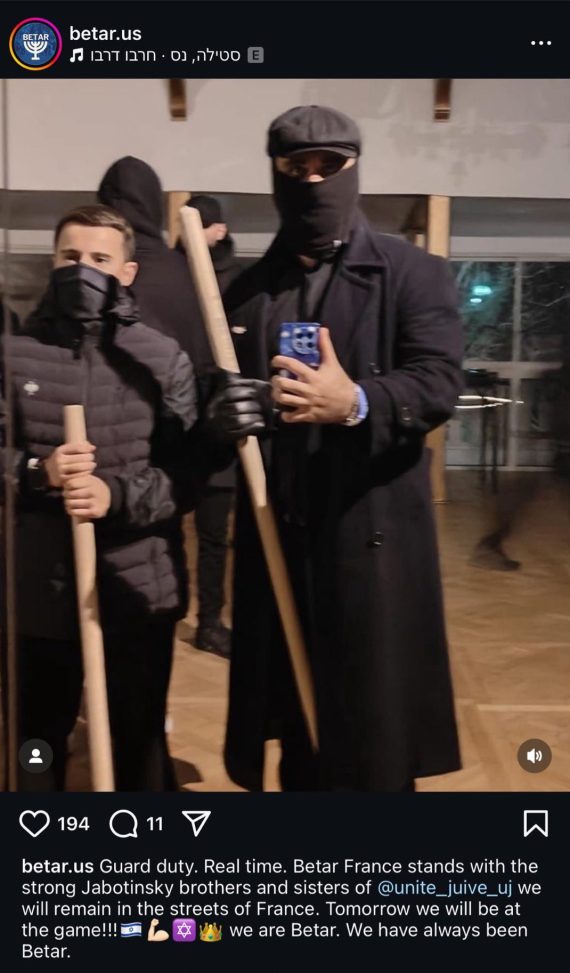
Despite Israeli government advice, some Israeli dual nationals were in Paris with Betar, an international right-wing Zionist group. Betar’s social media channels posted an image of members in the French capital holding baseball bats before the game. Fights break out at France-Israel match in Paris despite heavy security, inews.co.uk
Let’s recap:
- No expense was spared to provide security for the Maccabi hooligans, but French fans were beaten in the stands without anyone lifting a finger.
- A mere 13,000 people attended a stadium that holds 80,000, but the match was given the go-ahead regardless.
- The Maccabi mob sang military songs and bellowed racist slogans, but no government official has had the courage to order an inquiry. Note: According to the Middle East Eye, Israeli fans chanted “Free the hostages” and “Hamas, Hamas, we’re fucking you”.)
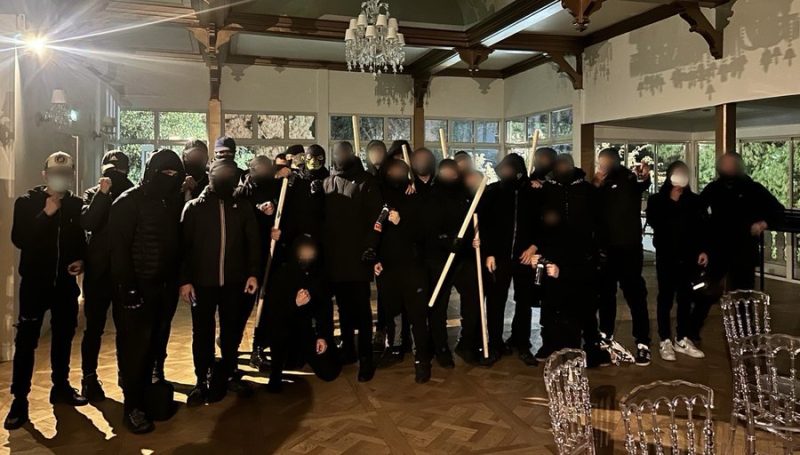
Readers should take a minute and carefully examine the photo at the top of this article. What do you see?
Do you see a gathering of typical soccer fans dressed in team colors and jerseys waving banners and singing team songs, or do you see a uniformly dressed and deeply threatening throng of black-clad troopers with stocking caps and masks who could—just as easily be conducting a military operation as attending a match of their favorite football team?
Who wears a black mask and a stocking cap to a soccer match? Who chants “Hamas, Hamas, we’re fucking you” at a soccer match?
Was this really a spontaneous get together of pumped-up Maccabi fans expressing their support for their team or a clandestine infiltration of the EU overseen by Israeli intelligence agents on secret assignment?
And be sure to take special note of the author’s last observation:
Despite Israeli government advice, some Israeli dual nationals were in Paris with Betar, an international right-wing Zionist group. Betar’s social media channels posted an image of members in the French capital holding baseball bats before the game.
Betar? The far-right youth movement founded by Vladimir Jabotinsky that fought against the British in Mandatory Palestine and was closely affiliated with the Zionist terrorist organization, the Irgun?
Here’s more from an article at the Middle East Eye:
At the demonstration in Paris, Salah Hamouri, a French-Palestinian lawyer who was deported from Jerusalem by Israel in 2022 after spending many years in prison and is now a member of Urgence Palestine, also accused the French president of sending a political message of support for Israel by attending the match.
“This match and the participation of Macron, Hollande and Sarkozy is part of France’s complicity in the ongoing genocide. It is a diplomatic green light given to the Israeli occupier for all its actions in Palestine and Lebanon and for it to continue its massacres in Palestine and in Lebanon,” he told MEE.
“Today, the low turn-out at the stadium shows that the public opinion in France is in favour of the Palestinian cause, and that the people support the people. It shows that the voice of the Palestinian people has been heard, and that a boycott needs to be implemented.” France-Israel match marked by scuffles, booing and a record-low attendance, Middle East Eye
Summary and Analysis
So, now we’ve seen two significant and politically destabilizing events in less than 10 days both of which took place in European capitals. And in both cases, the violence and racist chants were initiated by Israeli hooligans engaged in actions aimed at intimidating the public. Is there a rational explanation for this sudden uptick in social unrest attributable to Maccabi sports fans?
Of course, it could be just a coincidence linked to the behavior of overzealous sports fans who need to practice more self-restraint. That is one possibility. We cannot exclude another possibility, however, that the violence we have seen in Paris and Amsterdam is not a one-off or merely a case of exuberant young men “letting off a little steam.” We must at least consider the possibility that Israeli powerbrokers have launched this operation—using their assets in the IDF and Mossad—to advance their own strategic agenda consistent with their expansionist Zionist plan.
What we’ve seen is that the incitements on the ground have been coordinated with journalists in the legacy media and with political leaders across the West who have fabricated a narrative of growing antisemitism when, in fact, that storyline is easily debunked by the hundreds of first-person eyewitness accounts and the numerous videos on social media that prove that the sole responsibility for the violence in both cities lies entirely with the Israeli soccer thugs.
But why would political leaders and the media want to create the impression that antisemitism is on the rise? That is the question we must ask ourselves, because that is the narrative we are expected to believe.
IMHO, Israeli leaders understand that the claim of antisemitism is a powerful coercive tool that can be used to pressure parliamentarians to modify the law in ways that benefit one group over the others. Thus, as fears of a new wave of antisemitism intensify, the demand for changes to the law increase. Eventually—as in the case of Israel—equal protection is no longer equal protection. One category of people is placed above the law, while the others are crushed beneath the wheel of “second class citizenship.” This erosion of equal protection—that is attributable to the creation of “special” laws for special people—is the fast-track to apartheid, which is the end of a justice system that treats all people equally and with dignity.
Israel is frequently called an apartheid state because one group of people is treated differently (under the law) than the other. If my theory is correct, then Israeli policymakers are trying to affect those same changes in Europe, which means, they are exporting their racist political model to the continent.
Readers may want to skim the article below and decide for themselves whether this theory has any merit:
Calling for a boycott against Israel is forbidden now – and other measures against anti-Semitism, CNE
The German Bundestag took the clearest decision. Last week, the parliament accepted a resolution from both the government and the Christian Democratic opposition to protect Jewish life in the country. The title of the resolution was “Never again is now”, according to reports from the Frankfurter Allgemeine Zeitung.
According to the text, hatred against Jews and Israel is higher than “decades” since the terror attacks on October 7th 2023. The resolution also explicitly mentions that migrants especially add to this problem…. Concrete measures of the resolution are that no state money can go to organizations that… call for a boycott against Israel. Also, schools will be supported in educating about the Holocaust….
Norway
This Monday, the Norwegian Prime Minister Jonas Gahr Støre presented an action plan with 22 measures against hatred against Jews. He invited representatives of the Jewish community to a meeting to discuss the matter. “We would love we did not need an action plan”, the Prime Minister said. “But we know that it is necessary.”
The Holocaust Centre in Norway has reported that anti-Semitism is growing after many years of decrease. “It is not just one budget post that resolves this”, Støre said. “This is about something difficult as attitudes.”…
Netherlands
Also , the Dutch government has been invited to take action against anti-Semitism. On Wednesday, there was a lengthy urgency debate in the Lower House about the incidents in Amsterdam last Friday.
The debate was dominated by Geert Wilders –who is leading the largest party– who presented immigration by Muslims as the basic problem of anti-Semitism.
The Dutch society was shocked by the pogrom-style hunt of Israeli football supporters. Hundreds of Maccabi Tel Aviv supporters were asked for their passports, beaten and chased. Opposition leader Frans Timmermans expected concrete measures from the government. He advocated for appointing more detectives to track down anti-Semitic offenders and then imposing harsher penalties….
European Parliament
Also, in the European Parliament in Brussels, parties held an urgency debate about anti-Semitism later on Wednesday. The debate was requested by the Dutch MEP Bert-Jan Ruissen from the Reformed SGP party after the shocking events in Amsterdam. The title of the debate is the “deplorable escalation of violence around the football match in the Netherlands and unacceptable attacks on Israeli football fans.”
“Europe is increasingly in the grip of extremist violence and Jew-hatred”, Ruissen said in a written statement. “This must stop as soon as possible.”
Already in October, the EU ministers of Foreign Affairs adopted a declaration that condemned “all forms of anti-Semitism, racism, hatred and discrimination.” Also, in this statement, action in schools was asked to keep the Holocaust in the “collective memory”. Calling for a boycott against Israel is now forbidden, CNE
Everyone is entitled to equal treatment under the law. There should be no legal carveouts for special people.
November 16, 2024
Posted by aletho |
Civil Liberties, Ethnic Cleansing, Racism, Zionism, Subjugation - Torture, Supremacism, Social Darwinism | European Union, France, Israel, Zionism |
Leave a comment
The EU must reconsider the sanctions it has placed on Russia in connection with the Ukraine conflict, and work to end hostilities as soon as possible, Hungarian Prime Minister Viktor Orban has said.
Speaking on Kossuth Radio on Friday, Orban explained that the current economic problems within the bloc stem from Brussels’ “hare-brained” decision to respond to the Ukraine conflict by placing restrictions on Moscow, which have driven up energy prices and overall inflation, hindering the EU’s competitiveness.
The EU declared the elimination of its reliance on Russian energy as a key priority after the Ukraine conflict escalated in February 2022. Sanctions and the sabotage of the Nord Stream pipelines later that year led to a dramatic drop in Russia’s gas supplies to the bloc, resulting in a spike in energy prices and soaring inflation.
“Sanctions were a wrong, hare-brained answer to the [Ukraine conflict], the EU made a mistake… Energy prices must definitely be brought down. This means that the sanctions must be reconsidered, because the policy of sanctions… it will destroy the European economy,” Orban stated. He called for an “anti-bureaucratic rebellion” within the bloc so that decisions on EU policies will be made with the people’s welfare in mind, both in regard to sanctions and to peace.
Orban also said that European businesses and industries cannot focus on development goals and growth opportunities when there is a war going on, so everything needs to be done to end the Ukraine conflict.
“If we look at this conflict from the point of view of our pockets, our economy, our income, it is a scourge of God on us all… In order to be successful again, we have to end it, end it as soon as possible,” he stressed.
Orban said Hungary would continue its diplomatic efforts toward peace in Ukraine, but said that it needs “a protagonist” who will be “strong enough to not only want peace but also to be able to create it.” He reiterated his hope that the power shift in the US with Donald Trump’s election would help achieve that goal. The Republican has previously claimed that he could end the Ukraine conflict in 24 hours. Until Trump takes office in January, Budapest will work on “achieving change in Brussels” to make sure “EU bureaucrats” do not decide to “continue the war without the Americans,” Orban pledged.
Orban has long been at odds with Brussels over the approach to Ukraine, opposing both aid to Kiev and sanctions on Moscow. Tensions grew further after he met with Russian President Vladimir Putin as part of his Ukraine ‘peace mission’ earlier this year.
Some EU leaders accused Orban of siding with Russia and abusing Hungary’s rotating presidency of the bloc. The premier clarified that he was representing only his own nation, but pledged to continue to work on changing the EU’s overall stance on the conflict.
November 15, 2024
Posted by aletho |
Economics, Russophobia | European Union |
Leave a comment
It’s early days yet. However, there are signs that President-elect Trump is moving toward a detente with Russia over Ukraine.
One good sign is that Trump will not invite Mike Pompeo or Nikki Haley to join his cabinet when he is inaugurated as the 47th U.S. president on January 20. Both of these figures were rabid anti-Russia hawks during Trump’s previous administration. There were suggestions that Pompeo and Haley might return with senior posts in his second administration. But Trump has announced the pair will not be offered new positions.
Another positive sign is from people close to Trump’s inner circle who are letting the Kiev regime know – rudely – that the U.S. military aid spigot is being turned off.
Donald Trump has yet to hold a phone call with Russian President Vladimir Putin, according to the Kremlin. But both leaders have already expressed a willingness to negotiate a peaceful settlement over the Ukraine conflict.
Another promising sign of potential detente between the United States and Russia is the sheer panic among European leaders. The news of Trump’s election last week has caused most European elites to scramble like scared children on hearing “boo!”.
European Commission President Ursula von der Leyen and French President Emmanuel Macron are consoling themselves by urging Europe to “come together” in the wake of Trump’s stunning election victory. The collapse of Germany’s coalition government of Chancellor Olaf Scholz is an early casualty of the Trump impact.
European leaders fear that if Trump pulls the plug on military aid to the Kiev regime they will be left holding the can to fund the proxy war against Russia, which the weak European economies have no chance of sustaining.
It’s no secret that the main European states were betting on Democrat candidate Kamala Harris winning the race to the White House. Harris would have ensured the continuation of NATO’s backing for the Kiev regime. With Trump becoming president, all bets are off.
The political price will be ruinous for European leaders who have invested huge political capital in waging war to “defend Ukraine from Russian aggression.” Trump has shown skepticism toward that false narrative. He has told Europe to go it alone if it wants to. And the European Russophobes know they can’t do that.
If Trump follows through on his election promise to negotiate with Putin on a settlement in Ukraine, then the Europeans are going to be left with serious amounts of egg on their faces.
One thing about Trump that is of concern to the Europeans is his frustration with them as being, in his view, freeloaders on American protection. Another is Trump’s vindictive streak. He’s not going to forget that most of the European leaders wanted him to lose the election.
Take Britain’s Prime Minister Keir Starmer. His Labour Party sent volunteers over to the U.S. to advise Harris on winning the election. The British Foreign Secretary David Lammy has also been reminded that he previously disparaged Trump as a racist “sociopath.”
Trump’s election is bad news for Britain and there is no doubt that Starmer is now trying to repair post-Brexit relations with Europe as a hedge against the expected chill from Washington during the next four years.
When Britain pulled out of the European Union after its 2016 Brexit referendum, there were high hopes that it could negotiate a special trade deal with the U.S. That deal didn’t work out and looks even less likely now. Hence, Starmer has been busy since taking office in Downing Street trying to restore relations with the EU.
This week, the British leader attended the Armistice ceremony in Paris to commemorate the end of the First World War. The last time a British leader honored that event in Paris was in 1944 when Winston Churchill visited the French capital following its liberation from Nazi occupation.
Macon invited Starmer to lay wreaths in the Champs-Elysee and the Arc de Triomphe.
The choreographed caper of European unity is a reflection of the panic gripping European leaders in the aftermath of Trump’s return to the White House.
But everything is up in the air for the European politicians. Starmer was bending over backward to renew relations with Germany as a way to forge a warmer connection between London and the European Union after years of post-Brexit bitterness, only for that to be thrown into doubt.
Last month saw a landmark security deal between Britain and Germany in which German arms maker Rheinmetall would open a new factory in Britain, and the German Luftwaffe would be able to fly warplanes from an RAF base in Scotland. The deal was touted as “a sign of joint European security in the face of Russian threat.”
With the collapse of the government in Berlin over the unbearable financial costs of the Ukraine war to the German economy, the British security treaty may not materialize. That means a big setback to Starmer’s reset plans with Europe.
Hungary’s Viktor Orban and Slovakia’s Robert Fico are in the minority of European politicians who genuinely welcomed Trump’s election as an opportunity to wind down the NATO proxy war in Ukraine against Russia.
On the other hand, the ardent NATO warmongers in Europe, including Britain, Germany, France, Poland and the Baltic states now face a desperate dilemma. Along with EU leaders like Von der Leyen and the Dutch NATO chief Mark Rutte, they have all nailed their colors to the mast for continuing the reckless proxy war against Russia.
Trump seems to be showing good sense in calling off that proxy war and finding a way to negotiate sensibly with Russia on detente. Moscow wants its long-term security demands to be met. That means no NATO membership for Ukraine, an end to the NeoNazi regime in Kiev, and recognition of its historical lands in Crimea and the Donbass.
This is all eminently negotiable, and Trump might just be ready to cut a deal to avoid World War Three, as he has repeatedly indicated he would do. That would mean Trump dumping the false narrative that Biden, Harris and the Democrats – and their European vassals – contrived about “defending Ukraine”.
That would leave the European lackeys in a disastrous lurch. How will they explain to their electorates the three-year slaughter in Ukraine? How will they justify the tens of billions of Euros and Sterling wasted on pushing a war that not only destroyed millions of lives but their economies as well?
The stupid European leaders are in panic mode, and that’s a good thing.
November 13, 2024
Posted by aletho |
Militarism, Russophobia | European Union, France, Germany, NATO, UK, Ukraine, United States |
Leave a comment
The European Commission may redirect some €392 billion ($416 billion) from the 2021-2027 cohesion funds to support their defense industries and military mobility projects, The Financial Times reported on November 11.
The Ukraine conflict and Donald Trump’s return to the White House are likely to impose pressure on the EU to boost defense investments, according to the newspaper.
“After Trump’s victory, European leaders no longer can rely on a secure US backing and only have two choices, either rapprochement and resumption of good neighborly towards Russia or continued belligerence with its following an arms race and risk for escalation,” Mikael Valtersson, former Swedish military officer and ex-chief of staff with the Sweden Democrats, tells Sputnik. “Unfortunately most of the European leaders are supporting the second alternative.”
Many in the bloc would love to become more independent from the US in terms of defense, but it would require gargantuan military budgets which European countries are unable to afford, Valtersson argues.
“Without the US the EU has very limited power projection capabilities and even less nuclear deterrence capability,” he explains. “Building and keeping a strong nuclear capability will be extremely expensive for the limited European defense budgets.”
A possible way out is a shift from the expensive militarization and growing dependence on the US to resuming working relations with Russia, the pundit alleges. Russian President Vladimir Putin has repeatedly called for discussing common European security for all.
“A wise European policy in this environment would be to seek better relations with Russia,” Valtersson says. “Better relations with Russia is also a sentiment with growing support among the European population. It’s not improbable that several new governments will be elected in the next years that will share the will of a rapprochement with Russia.”
November 12, 2024
Posted by aletho |
Militarism, Russophobia | European Union, NATO, United States |
Leave a comment
The Biopharmaceutical Complex’s self-amplifying mRNA assault has already begun
The Biopharmaceutical Complex is preparing for the large-scale deployment of replicon (self-amplifying) mRNA injections. There are currently at least 33 candidates in development.
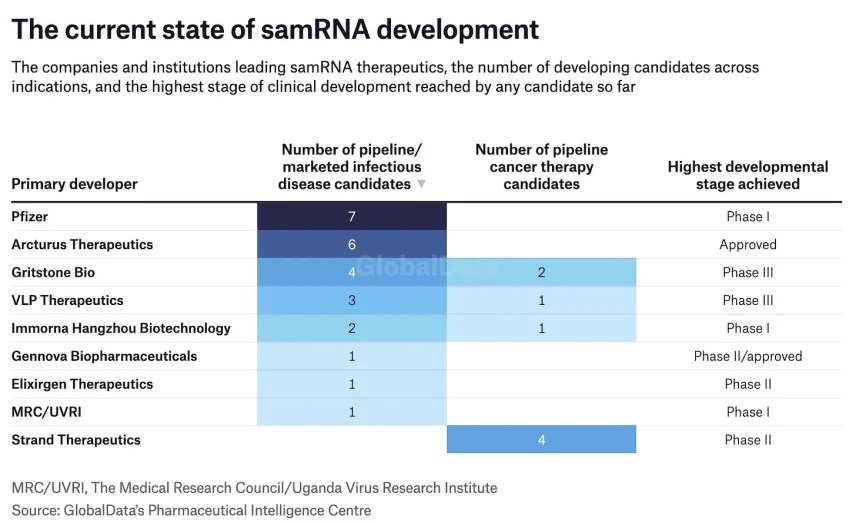
These products behave like a synthetic virus. The replicon mRNA is designed to encode not only the target antigen but also viral replicase, enabling the mRNA to replicate itself within the target cells. This replication machinery allows for an unknown period of toxic antigen production. Concerningly, none of the clinical trials have addressed the major concern of product shedding.
The Coalition for Epidemic Preparedness Innovations (CEPI) and the Biomedical Advanced Research and Development Authority (BARDA) are the primary funders behind this technology to combat ‘Disease X’. This is an extremely high risk ‘vaccine’ platform that should be avoided at all costs. Cellular installation of synthetic replicons requires decades of intense safety testing.
The very first replicon injection for human use received emergency use authorization (EUA) from The Office of the Drugs Controller General of India (DCGI) back in June 2022: Gennova Biopharmaceuticals’ GEMCOVAC-19. This was followed by reckless EUA approval in June 2023 for GEMCOVAC-OM, a replicon booster shot that targets the Omicron strain.
In November 2023, Japan’s Ministry of Health, Labor and Welfare (MHLW) fully approved CSL and Arcturus Therapeutics’ replicon shot: KOSTAIVE ARCT-154. Dismissing all concerns, Japan’s MHLW approved the updated booster shot in September 2024 to target the JN.1 lineage of Omicron subvariants.
In the clinical trials for ARCT-154, 5 deaths occurred among the injected in study phase 3b. Injected participants experienced a 90% adverse event rate (74.5% systemic – 15.2% required medical attention) after the first dose in study phases 1, 2, and 3a combined. Many of the authors are full time employees of Arcturus Therapeutics, meaning their conclusions are likely biased.

Meanwhile, the USDA quietly approved an experimental self-amplifying RNA injection for dogs developed by Merck in June 2024: Nobivac NXT Canine Flu H3N2. It appears that Merck is attempting to camouflage the fact that this product is self-amplifying. The primary product description only indicates that it uses “revolutionary RNA particle technology.” However, the novel platform works by RNA particles targeting dendritic cells, where they self-replicate and result in sustained antigen production.
The possibility of product shedding from dogs to humans or other animals was never tested. This injection is currently widely available for online purchase and canine administration. While the Biopharmaceutical Complex struggles to get self-amplifying mRNA injections approved for humans, they seem to have no problem targeting our pets.

Deployment of this experimental platform has continued in September 2024 to target cats: Nobivac NXT FeLV. Nowhere in the product brochure does it mention the RNA self-amplification mechanism of action. They hope that unsuspecting vets won’t think twice about accepting the ‘new and improved’ product. The so-called ‘safety’ data for this product is as follows:
“Demonstrated safety under field conditions” from “Data on file. Merck Animal Health.”
In other words, no public safety data is provided. It’s become abundantly clear that the pharmaceutical industry and captured regulatory agencies have zero regard for the massive safety concerns of undefined synthetic mRNA replication resulting in uncontrolled toxic antigen production. These experimental injections must not receive further regulatory approval for humans or animals if we are to prevent another public health disaster. All self-amplifying mRNA injections currently available for humans and animals should be immediately withdrawn until comprehensive, long-term safety studies are conducted.
November 10, 2024
Posted by aletho |
Science and Pseudo-Science, Timeless or most popular | European Union, Japan, United States |
Leave a comment
As Americans look at what the incoming administration’s policy will be in relation to tech, JD Vance, the Republican Vice President-Elect, has made a bold suggestion that the United States might reconsider its support for NATO if the European Union attempts to regulate US social media platforms.
This statement was made during the campaign, in an interview with podcaster Shawn Ryan, where Vance relayed an incident involving a top EU official who threatened Elon Musk for allowing former President Donald Trump on the platform.
Vance highlighted the stark contrast between European and American values, particularly on the issue of free speech. “The leader, I forget exactly which official it was within the European Union, but sent Elon this threatening letter that basically said, ‘We’re going to arrest you if you platform Donald Trump,’ who, by the way, is the likely next president of the United States,” he reported.
Vance is likely referring to Thierry Breton, a pro-censorship crusader who was, at the time, European Commissioner for Internal Market. Bretton has since resigned.
In response to Breton, Musk promised a “very public battle in court,” and revealed, “The European Commission offered X an illegal secret deal: if we quietly censored speech without telling anyone, they would not fine us. The other platforms accepted that deal. X did not.”
The Vice President-Elect argues that America’s participation in NATO should be contingent on the alliance’s respect for free speech, a core American value. “So what America should be saying is, if NATO wants us to continue supporting them and NATO wants us to continue to be a good participant in this military alliance, why don’t you respect American values and respect free speech?” Vance questioned. He criticized the notion of supporting a military alliance that does not uphold free speech as “insane,” insisting that American support comes with prerequisites, such as respecting free speech, particularly among European allies.
President-Elect Trump, Vance’s running mate, has been critical of some aspects of NATO, having expressed a desire to pull out from the alliance and disregard the Article 5 collective defense clause.
November 9, 2024
Posted by aletho |
Civil Liberties, Full Spectrum Dominance | European Union, Human rights, NATO, United States |
Leave a comment