Glenn Diesen about the benefits of a multipolar, Eurasian world order
Reinvent Money | June 16, 2024
Paul Buitink talks to Glenn Diesen, a Norwegian academic and political scientist. He is a professor at the School of Business of the University of South-Eastern Norway. Glenn explains why the current international liberal unipolar world order is in decline. And why a new multipolar Eurasian order is inevitable and how that would benefit the world. He describes Europe’s role and challenge in this new world order. Also Glenn dives into the Russia and Ukraine conflict and why the incremental approach of the West could lead to a boiling frog situation. At the end he also shares his experiences of being a controversial scientist in Norway.
Find more about Glenn Diesen here, including his latest book The Ukraine War & The Eurasian World Order: https://x.com/Glenn_Diesen https://www.amazon.com/Ukraine-War-Eu…
Follow Paul on X here:  / paulbuitink
Russia’s post-war dilemmas in Ukraine
BY M. K. BHADRAKUMAR | INDIAN PUNCHLINE | JUNE 18, 2024
In regard of the war in Ukraine, Russia’s main challenge going forward is to find the equilibrium between strategic overestimation and underestimation. “We always overestimate the change that will occur in the next two years and underestimate the change that will occur in the next ten,” as Bill Gates put it.
A triumphalist tone is unmistakeable in President Vladimir Putin’s speech on Friday to a special gathering of senior foreign ministry officials in Moscow presenting the guardrails for negotiations with Ukraine. Russia is a country of high-context culture, which communicates in ways that are implicit and relies heavily on context.
Putin underscored certain pre-conditions. Russia is ready to immediately cease hostilities if Ukraine begins withdrawing its military units beyond the administrative boundaries of Donbass, Zaporizhia and Kherson regions. This is a curious replay of the precondition that Moscow fulfilled in March 2022 when following the talks in Istanbul, Ukraine expected a rollback of Russian deployments around Kiev.
Once bitten, twice shy — Putin’s precondition implies that new territorial realities should be fixed by international treaties. Moscow is ready to negotiate only after Kiev formally notified NATO that it is abandoning the intent to seek membership. Russia expects a complete lifting of sanctions.
Evidently, Russia’s peace terms are, partly at least, based on certain prerequisites that are, conceivably, impossible for Ukraine and its mentors to fulfil. So, presumably, a further hardening of the peace terms is to be expected if Russian troops make more gains on the battlefield. Meanwhile, Moscow is signalling to its Western adversaries the inevitability of a massive redrawing of the Russian-Ukrainian border as the basis for peace.
Unsurprisingly, the Western powers view Putin’s peace terms as an ultimatum although Russian diplomacy propagates them as an important peace initiative. It is timed carefully, just as the G7 summit at Borgo Egnazia in Italy ended and on the eve of the Western-sponsored ‘peace meet’ in Bürgenstock.
The prognosis by the influential politician who has been a deputy speaker of the Duma since 2016 and the scion of an illustrious Russian family, Pyotr Tolstoy (great-great-grandson of Leo Tolstoy) is that Moscow will call out next only for the surrender of Ukrainian forces.
The mood in Moscow has become belligerent, as the EU, at sustained prodding by Washington, is inexorably moving toward the confiscation of Russia’s frozen assets in western banks — ostensibly for meeting Ukraine’s needs but in reality to defray the huge expenses Washington is incurring for its proxy war.
The G7 summit’s communique highlights that “In the presence of President Zelenskyy, we decided to make available approximately USD 50 billion leveraging the extraordinary revenues of the immobilised Russian sovereign assets, sending an unmistakable signal to President Putin. We are stepping up our collective efforts to disarm and defund Russia’s military industrial complex.”
The G7 formulation is a white lie. What is unfolding is a financial scam of the century and the largest theft of money in history. A clutch of modern-day brigands is literally grabbing about $260 billion of Russia’s sovereign assets and giving it the colouring of a legal translation by attributing to it the process the status of a financial collateral for an American loan to Ukraine in blatant violation of international financial law that would ultimately line the pockets of the US military-industrial complex and the politicians.
Suffice to say, Washington is making its proxy war in Ukraine a self-financing, cost-accounting enterprise with Europeans as guarantors. Washington is inflicting a big blow to Russia’s national honour and pride. The big question is where does Russia go from here, given its ‘high-context culture’?
One barely-noticed ellipsis in Putin’s speech on Friday was that he left his lengthy recap of Western betrayals hanging in the air without a foot note as to how Russia came to such a sorry pass at all historically.
If the willing submission to the avalanche of national humiliations was merely due to Russia’s weakness, surely, that is a thing of the past. Today, Russia stands tall as the fourth largest global economy, a great military power and the sole power on the planet with the strategic capability to reduce the US to thermonuclear ashes. Yet, minions like NATO secretary-general Jens Stoltenberg are threatening Russia that he’s heading a “nuclear alliance.”
That is where the elucidation on Putin’s speech by the Dy Chairman of Security Council, Dmitry Medvedev — “on what he [Putin] carefully hinted at in his speech” — needs to be understood properly.
Medvedev made four key points:
- The new territories that became part of Russia since 2022 will “remain so forever.”
- A “catastrophic scenario” is developing for the Kiev regime.
- The sanitary zone Russia will create on its western borders to prevent terrorist attacks may extend right up to Ukraine’s border with Poland, the staging post for NATO’s threats against Russia.
- “The President did not say this [western Ukraine’s fate] directly, but it is obvious that such territories, if desired by the people living there, can become part of Russia.”
Most certainly, it is not a coincidence that Putin landed in Pyongyang this morning — or that, Russia’s Pacific Fleet commenced a large scale naval exercise from today till the 28th of June in the Pacific Ocean, in seas of Japan and Okhotsk.
In the context of his state visit to North Korea, Putin wrote in an article for North Korea’s Rodong Sinmun, “We highly appreciate the DPRK’s unwavering support for Russia’s special military operation in Ukraine… We will… jointly oppose illegitimate unilateral restrictions [read sanctions], and shape the architecture of equal and indivisible security in Eurasia.”
By the way, if North Korea, which is a nuclear power, figures in the first circle of Russia’s strategic calculus as an ally, can Iran which is a nuclear threshold country be far behind — and, importantly, what could be its alchemy? Indeed, Russia has warned that it will give an asymmetrical response to the attack on its territory with western weapons allegedly aided by NATO personnel — something without precedent even at the high noon of the Cold War — and NATO secretary-general’s open, vociferous support for it.
In Strobe Talbott’s book The Russia Hand (2002), he narrates an aside with Bill Clinton during a US presidential visit to Moscow in 1995. Clinton told Talbott using a favourite metaphor that his instincts were that Russian elites were sulking and couldn’t take anymore the “shit” being shoved down their throat. Indeed, NATO’s eastward expansion was already on the drawing board in the White House by then.
However, it took Russia another quarter century till February 2022 to resist US bullying. To be sure, Medvedev’s candid ‘annotation’ could not have been without approval from Putin.
The challenge for the next two years is that Russia might overestimate the willingness of the US and EU to concede its legitimate demand of equal and indivisible security.
On the other hand, in a longer term perspective, Moscow should not underestimate the stubborn refusal by Europe’s declining powers — UK, France and Germany — to accept the rise of Russia as a compelling geopolitical reality that they must reconcile with.
Hungarian PM Viktor Orhan is spot on in estimating that it will be sheer naïveté to assume that the new EU leadership would moderate the policies towards Ukraine and Russia, despite the ascendancy of the right-wing parties in the recent elections to the European Parliament.
Macron’s political bet could backfire with France one step closer to leaving NATO
By Uriel Araujo | June 18, 2024
NATO secretary-general Jens Stoltenberg, although claiming he would not comment on France’s ongoing domestic crisis, said that “I strongly believe it is in the interest of France, and all the allies, to keep NATO strong, because we live in a more dangerous world.”
France is right now facing a political crisis – maybe the wildest one in decades, as Arnaud Bertrand, businessman and commentator, writes.
French President Emmanuel Macron dissolved his country’s parliament and decided to gamble on a snap election, as a reaction against the rise of the so-called “far-right.” The problem is that the populist party National Rally (Rassemblement National), formerly known as the National Front, is projected to win 31.5 percent of the vote, which is over twice the 14.7 percent projected for Macron’s Renaissance party.
Bardella, who is the president of the National Rally’s party since 2022, and also currently a member of the European Parliament, and who is a likely next Prime Minister for France, has pledged to maintain Paris within NATO at least as long as the conflict in Ukraine keeps going: “The proposal we’ve always advocated … did not factor in war… You don’t change treaties in wartime.” Hence, Stoltenberg “warning”.
There is of course a catch in such a commitment: for one thing, Ukraine has never declared war against Russia to this day. In fact, on April, retired general Igor Romanenko, a former deputy chief of the General Staff of the Armed Forces of Ukraine, said that doing so would go against Ukraine’s interests: “If we went to a state of war, then assistance for weapons and equipment would cease not only from the United States, but also from most of the allies.”
This could be just a legal technicality, but it does make it hard to draw the line about when exactly a “war” ended or started. For instance, Ukraine has been bombing the Donbass region since 2014. Even with a Russian de facto victory, Kyiv could just claim Crimea and Donbass indefinitely, and all the Ukrainian far-right militias can make sure that some sort of low-level or frozen conflict (with provocations and terror attacks) goes on for many years. On the other hand, this very ambiguity may give room to a hypothetical National Rally presidency in future France to deem that the war in Ukraine is “over” whenever it sees fit – and then proceed to withdraw from NATO. One should bear in mind that Bardella has only made this caveat with regards to an ongoing “war” in the Eastern European country. Other than that, he does claim that leaving NATO has always been his party’s proposal. As recently as 2022, French Presidential candidate Marine Le Pen (who is a member of Bardella’s party) promised to pull France out of NATO’s military command structure. One should also keep in mind that France did withdraw from the Atlantic Alliance’s integrated military structure in 1966, albeit not completely leaving the NATO Treaty, and even expelled all of its units and headquarters on French territory back then. The country’s “estrangement” from the Atlantic organization only ended in 2009 with then President Nicolas Sarkozy, which means it took no less than 43 years for France to change its course.
Today’s French Fifth Republic is a semi-presidentialism system, in which the French President (the executive Head of State) has more powers with regards to foreign policy, also being the commander-in-chief of the French Armed Forces. The Prime Minister, in turn, being the head of government, mostly occupies oneself with domestic issues. Of course, a National Rally government, if politically successful, could pave the way for a future National Rally presidency. Moreover, the French government, led by its Prime Minister, controls the budget and could therefore hamper military aid to Ukraine in a number of ways – this, by the way, would be a very popular measure in France, considering that just recently, in March 2023, Macron imposed a very unpopular bill raising the retirement age from 62 to 64 years old by unusually invoking a special constitutional powers and basically shunning parliament.
Even former French President Nicolas Sarkozy, in his recent interview, has described Macron’s latest decision to dissolve the parliament as a “major risk for the country.” He added that the “endless enlargement of Europe towards Ukraine” is a mistake against which he “warned”: “I even dared to make a comparison, and I was widely criticized for, asserting that Ukraine risked becoming, for President Macron, what Turkey had been for President Chirac… Enlargement towards Ukraine is a contradiction, [it takes place] while the Balkan countries, which are European, have been waiting for so long.”
In France, the President names the Prime Minister, but in practice is forced to make a choice that would be able to get the support of a majority in the assembly, because the French National Assembly can dismiss the Prime Minister government.
Therefore, Macron has indeed placed himself in a very difficult and risky position. He has vowed to remain in the presidency regardless of the results of parliamentary elections (on July 7) he himself convoked. He thus might have to name a far-right government, depending on the results. Such results are to come a few days before the NATO summit in Washington, which Macron is of course expected to attend. In such a scenario, he would arrive there in a completely demoralized position.
Marine Le Pen’s 2022 proposal (to leave NATO) was just following the steps of Charles de Gaulle. Le Pen (who is the “far-right” most famous politician in France) is, truth be told, basically a Republican conservative. She supports left-wing economic policies, is pro-abortion, and is a vocal critic of the current “open-borders” migration policy.
For years, the “far-right” label has been the most feared political weapon in Europe and, more broadly, in the West. Far from being merely an accurate description of (very real) neo-Fascist and neo-Nazi groups, it has long been an umbrella concept that also includes all sorts of hardline nationalists and populists. On different occasions, this bogeyman enlarged concept (weaponized by both the left and the right) has served the purpose of setting up Establishment centrist coalitions everywhere.
Today’s mainstreamization of the so-called “far-right” thus serves justice – in a way. At the same time, it also opens the way for the rehabilitation of real Fascists – as long as they remain loyal to the European bloc and to the Atlantic alliance, as I wrote before. Part of the European center-right and conservative Establishment did hope to make good use of a co-opted and domesticated “far-right” – as seen with the Meloni-Von der Leyen political Alliance. The ongoing French situation brings back the specter of a rising NATO sceptic (and EU sceptic) political alternative and basically short-circuits the system.
Sham-ocracy, Scam-ocracy

By Laurie Calhoun | The Libertarian Institute | June 17, 2024
The word “democracy” is bandied about rhetorically by politicians on a regular basis to rationalize whatever it is that they want to do. This tendency has increased markedly in recent times as so-called wars of democracy and campaigns to save or preserve democracy are cast as the most pressing priorities of the day.
In the U.S. presidential election campaign currently underway, both members of the War Party duopoly claim to be the champions of democracy, while depicting their adversaries as loose cannon authoritarians. President Joe “Our Patience is Wearing Thin” Biden attempted in 2021 to force free people to submit to an experimental pharmaceutical treatment which many of them did not need. The Biden administration also oversaw what was one of the most assiduous assaults on free speech in the history of Western civilization. Social media platforms were infiltrated by agents of the federal government with the aim of squelching criticism of regime narratives, even, remarkably, facts recast by censors as malinformation for their potential to sow skepticism about the new mRNA shots never before tested on human beings.
Biden & Co. nonetheless insist that voters must reelect him, because his rival is a dictator in waiting à la Hitler or Mussolini. This despite the fact that Donald Trump already served as president for four years, and never imposed martial law, not even at the height of the highly chaotic and destructive George Floyd and Black Lives Matters protests. Ignoring such conflicting evidence, Joe Biden and his supporters relentlessly proclaim that a Trump victory in November 2024 would usher in the likely end of democracy.
After the conviction of Trump on felony charges crafted through novel procedures and using legalistic epicycles in entirely unprecedented ways, obviously tailored to convict one and only one person, with the aim specifically of preventing his election as the president of the United States, Democratic party operatives and Deep State bureaucrats alike have voiced concern that, if Trump is elected in November, he will go after those responsible for what fully half the country views as his persecution. Given the manifold conflicts of interest involved in the case, in which he was found guilty of all thirty-four charges, it seems likely that, as in the Colorado Supreme Court’s ruling to remove Trump’s name from the ballot in that state, the creative felony convictions of Trump will not stand on appeal. One thing is clear: the crime of “miscategorizing hush money payments” has arguably been committed by every member of Congress for whom taxpayer money was used to dispense “undisclosed” payments in suppressing allegations of sexual harassment and other forms of malfeasance. (Thanks to Representative Thomas Massie for sharing on Twitter/X that $17 million dollars were paid to settle 268 such lawsuits from 1997 to 2017.)
Meanwhile, the Russiagate narrative which dominated the mainstream media for the entirety of Trump’s presidency, and continues to this day to color people’s views of the Russian government—thus buoying support for the war in Ukraine—has already been thoroughly debunked for the Hillary Clinton campaign product that it was. The Clinton campaign and the DNC (Democratic National Committee) were fined by the Federal Election Commission for their use of campaign funds miscategorized as legal fees to conduct opposition research which found its way into the Steele dossier on which angry denunciations of Trump’s supposedly treasonous behavior were based. To this day, none of the individuals involved have been indicted for what endures in many minds as the fanciful idea that “Trump is inside Putin’s pocket!” as a man I met in rural New Zealand in 2017 so vividly put it. (I assume he watches CNN.)
Since Trump’s recent conviction for the erroneous classification on his tax form of a hush money payment as a legal fee, he has been busy making lemonade out of lemons, using his new, improved tough-guy “gangster” image to wheel in voters and financial supporters who relate more than ever to his plight, having themselves either been or known victims of the not-so-evenhanded U.S. justice system. To Trump and his supporters, of course, going after those who went after him would be tit-for-tat retribution, just the sort of sweet revenge which persons wronged may crave. But to the many Trump haters (and there is no other way to describe them at this point in history), any attempt to retaliate by using the legal system to press charges against individuals who used the legal system for diaphanously political aims would constitute a grave injustice and threat to democracy.
The situation differs in degree, not in kind, in Europe, where the results of the recent elections have inspired heartfelt exclamations by the usual suspects (European Union Commission president Ursula von der Leyden, et al.) that “democracy” is endangered by the right-wing political groups now in ascendance. Pointing out that those groups were voted in by the people (demo-) to rule (-cracy) does nothing to quell the hysterics, who are somehow oblivious of the fact that when new parties are voted into power, this is precisely because of the electorate’s dissatisfaction with their current government officials. Voting is the only way people have of ousting the villains currently holding elected positions, along with the bureaucrats appointed by them.
In Europe, many working people are disturbed by not only the immigration situation and the specter of totalitarian “wokeism” but also the insistence of their current leaders on provoking and prolonging a war with Russia. It does not seem to be a matter of sheer coincidence, for example, that French president Emmanuel Macron suffered a resounding electoral blow after having expressed the intention to escalate the war between Ukraine and Russia, thus directly endangering the people of France. Macron was also assiduous in excluding swaths of his population, who protested in the streets for months on end, from participation in civil society for what he decreed to be their crime of declining to submit to the experimental mRNA treatment during the height of the Coronapocalypse.
Protests tend not to have any effect on the reigning elites, primarily because the mainstream media no longer covers them to any significant degree, but when politicians are removed from office by the electorate, and replaced by persons who share the concerns of the populace, then change does become possible, at least in principle. Unfortunately, most viable candidates today are card-carrying members of the War Party, whatever divergent opinions they may hold about domestic issues such as whether persons in possession of Y-chromosomes should be considered biological males or whether non-citizens should be permitted to vote.
It would be nice to be able to believe, as some of Trump’s libertarian-leaning supporters apparently do, that his populist appeal reflects a genuine interest in preserving freedom and democracy. This notion is however impugned by the fact that it was under Trump’s administration that the active pursuit of Wikileaks founder Julian Assange commenced, when he was wrenched from the Ecuadorian embassy in London and thrown into Belmarsh prison, where he continues to languish today. It was also under Trump that Assange’s internet access was taken away, which already represented an assault on free speech. But by allowing then-CIA director Mike Pompeo to “mastermind” the eternal silencing of Assange, for the supposed crime of exposing U.S. war crimes (recast as serial violations of the Espionage Act of 1917), Trump betrayed his own commitment to the now octopoid MIC (military-industrial-congressional-media-academic-pharmaceutical-logistics-banking complex), notwithstanding his occasional moments of seeming lucidity with regard to reining in the endless wars. Among other examples, there is not much daylight between the platforms of Biden and Trump regarding Israel. President Biden and Secretary of State Blinken occasionally pay lip service to the innocent Palestinians being traumatized, wounded, and killed, but they nonetheless have furnished Prime Minister Benjamin Netanyahu with the means to do just that.
In reality, highly seductive, albeit fraudulent, claims to be defending democracy have been the primary basis for waging, funding, and prolonging wars which have resulted in the deaths of millions of human beings in this century alone. For two decades, the war in Afghanistan was rationalized by appeal to the need to democratize that land, which is currently ruled by the manifestly authoritarian Islamic Emirate of Afghanistan (formerly known as the Taliban), just as it was in 2001. Indeed, every country targeted by the U.S. military behemoth is claimed to be the beneficiary of what are the twenty-first-century equivalent of the missions civilisatrices of centuries past. Today, brutal bombing campaigns, invasions and occupations are invariably sustained through the rhetoric of democracy. Since every U.S.-instigated or funded war is said to support “democracy” (by definition!), this rhetorical strategy succeeds in garnering the support of politicians who know that their constituents know, if nothing else, that murder is evil, and democracy is good.
That wars imposed on people against their will—and in which they themselves are annihilated—serve democracy is a preposterous conceit, and yet it becomes ever more frequent as leaders continue to point to World War II as proof that sometimes people must die if freedom and liberty—and, of course, democracy—are to survive. Whoever is running Joe Biden’s Twitter/X account posted a suite of recycled versions of this fallacious notion not long after Memorial Day:
“American democracy asks the hardest of things: To believe we’re part of something bigger than ourselves. Democracy begins with each of us. It begins when one person decides their country matters more than they do.”
“Democracy is never guaranteed. Every generation must preserve it, defend it, and fight for it.”
“History tells us that freedom is not free. If you want to know the price of freedom, come here to Normandy, or other cemeteries where our fallen heroes rest. The price of unchecked tyranny is the blood of the young and the brave.”
Any sober examination of the historical record reveals that vacuous claims to be supporting “democracy” in wars abroad—the literal weaponization of that term—have as their primary result that the people being slaughtered lose not only their political voice, but also their very life, usually against their own will. War represents, in this way, the very antithesis of democracy.
The conflation of defense and offense codified in 2002 by the George W. Bush administration in its notorious National Security Strategy of the United States of America was made public in a pithy phrase: “Our best defense is a good offense.” This perverse rebranding of state aggression as somehow honorable has given rise to a global military system in which wars are funded by the U.S. government under the assumption that they are everywhere and always a matter of protecting post-World War II democracies. But if people are killed in these wars against their will, often because they are forbidden from leaving their country, and therefore subjected to a greatly increased risk of death through bombing, as was the case in Iraq and Afghanistan (and elsewhere throughout the Global War on Terror), and is currently the case in both Ukraine and Israel, then there is no sense in which the military missions which culminate in the deaths of those people constitute defenses of democracy. Instead, the prolongation of such wars ensures only that there will be fewer people voting than before.
Such flagrant assaults on democracy (rule by the people) in the name of democracy do not, however, end with the depletion of the civilians sacrificed by leaders for the lofty aims of securing the freedom of future, as-of-yet unborn persons. Notably, the idea that already existent young persons should be coerced to fight and die in such wars is often supported by the warmongers as well. The current British prime minister, Rishi Sunak, recently proposed that mandatory national service be reinstated, a clear sign of only one thing: that the British public has grown weary and wary of the endless regime-change wars waged and/or funded by the U.S. government and unerringly supported by its number one poodle ally, the United Kingdom. As a result of the willingness of the British government to deploy its military to serve the dubious purposes of the U.S. hegemon, the number of voluntary enlistees is naturally in decline.
Conscription, the use of coercive means to increase the number of persons to fight in wars, directly contradicts the very foundations of democracy. If democracy is rule by the people, then in order for a war to have any democratic legitimacy whatsoever (ignoring, as if it were somehow irrelevant, the “collateral damage” on the other side), it would have to be fought not only for but also by persons who support it. If it is not to be a contradiction in terms, a democratic war would involve only persons who freely agreed to sacrifice their own lives for a cause which they themselves deemed worth dying for. The fact that coercive threats of imprisonment or even death are used to enlist new soldiers shows that at least those persons, a clearly demarcated segment of the society, do not agree with what they are being ordered to do. A war does not become democratic because a majority of the persons too old to fight in it support sending their young compatriots to commit homicide and die in their stead.
This is the sense in which antiwar activists who exhort chicken hawks such as Senator Lindsey Graham and former Vice President Dick Cheney to go fight their own bloody wars are right. For in any conflict purported to be a “war of democracy,” only persons who freely choose to fight, kill and possibly die in it would be donning uniforms. By this criterion, neither World War I nor World War II were wars of democracy. All of the draft dodgers imprisoned or executed for evading military service were horribly wronged wherever and whenever this occurred.
Conscription is always floating about as a topic of debate in so-called democratic nations because of the list of wars capriciously waged with abstract and dubious aims, and incompetently executed, such as the series of state-inflicted mass homicides constitutive of the Global War on Terror. The prospect of active conscription is always looming in the background wherever more and more leaders, under the corrupting influence of military industry lobbyists, and seduced by “just war” rhetoric, exhibit a willingness to embroil their nations in war. Young persons understandably exhibit an increasing reluctance to serve in what since 1945 have proven to be their self-proclaimed democratic leaders’ nugatory and unnecessary wars.
Mandatory national service is a condition for citizenship in some countries, such as Israel, where at least some persons (the Israelis) can freely choose to leave or to substitute a form of civil service rather than agreeing to kill other human beings at the behest of their sanguinary leaders. In wars in progress, such as that in Ukraine, conscription is used in more of an ad hoc way, as it becomes clear that the forces are dwindling and must be replenished, if the war is to carry on. But the very fact that conscription has come to seem necessary to the leaders prosecuting a war itself belies their claims that what is at stake is democracy itself.
This antidemocratic dynamic is currently on display in Ukraine, where President Volodomyr Zelensky recently remained in power, effectively appointing himself monarch, after canceling the elections which would have given the people the opportunity to oust him, specifically on the grounds that they oppose his meatgrinder war with no end in sight—barring either negotiation or nuclear holocaust. In a true democracy, the people themselves would be able to debate and reject the government’s wars, but in a nation such as Ukraine, the president decides, based on “guidance” provided to him by the leaders of powerful and wealthier nations, above all, the United States and its sidekick, the United Kingdom, to carry out a war for so long as he is furnished with the matériel needed to keep the war machine up and running.
The problem for Zelensky is that no matter how many bombs, missiles, and planes are furnished to the government of Ukraine to bolster the purported defense of democracy, there will always be the need for personnel on the ground to deploy those means. When the voluntary members of the army are injured, exhausted, or dead, then the government, rather than taking a seat at the negotiation table, opts to create an artificial pool of soldiers by coercing able-bodied persons who are ill-inclined to participate, having already had the opportunity to volunteer to serve but declined to do so.
The primary support of both the war in Ukraine and the Israeli government’s assault on Gaza is based on a curtailed, amnesiac view of history, conjoined with the fiction that the states currently in existence are somehow eternal and sacred plots of land the borders of which may never be changed. In reality, states are artifacts, the perimeters of which were established by small committees of (usually) men who negotiated among themselves at some point to permit distinct states to exist. In order for a border war to be in any sense democratic, it would have to take into account the interests of all of the persons likely to be affected, not only the young people enlisted to fight, but also the hapless civilians forbidden from relocating, as in Gaza, and then summarily slaughtered by the government as it pursues its own agenda. The frequently recited refrain that it is necessary to continue to fund the commission of mass homicide in Ukraine and Israel in order to preserve democracy is self-contradictory and delusional, both a sham and a scam.
Laurie Calhoun is a Senior Fellow for The Libertarian Institute. She is the author of Questioning the COVID Company Line: Critical Thinking in Hysterical Times,We Kill Because We Can: From Soldiering to Assassination in the Drone Age, War and Delusion: A Critical Examination, Theodicy: A Metaphilosophical Investigation, You Can Leave, Laminated Souls, and Philosophy Unmasked: A Skeptic’s Critique.
EU’s top court hits Hungary with massive €200 million fine for blocking migrants, plus €1 million every day
By John Cody | Remix News | June 13, 2024
The EU’s top court, the European Court of Justice, has hit Hungary with a massive fine for refusing to comply with a 2020 ruling that the country was blocking migrants at its border using illegal policies.
The ruling has sparked a strong reaction from the Hungarian government, with Prime Minister Viktor Orbán writing on X that the “ECJ’s decision to fine Hungary with 200M euros plus 1m euros daily for defending the borders of the European Union is outrageous and unacceptable. It seems that illegal migrants are more important to the Brussels bureaucrats than their own European citizens.”
The European Court of Justice published the decision on X, noting it referred to Hungary’s “failure to comply with the Court of Justice’s judgment of 17 December 2020.”
The court had initially ruled in 2020 that Hungary had illegally detained and blocked migrants from entering its territory and then illegally held asylum seekers at the Röszke transit zone on Serbian territory, thereby allowing them to be deported before they could appeal their asylum application rejection. The court ordered Hungarian authorities to reconsider the practice of detaining such migrants.
The top court has now ruled that Hungary has ignored this judgment. The ruling comes at a time when not only Hungarians reject mass immigration, but polling across Europe shows the vast majority of Europeans want an end to mass immigration and immigration from non-European countries. In fact, a new poll found that 7 out of 10 Europeans believe their country takes in too many migrants, while only 39 percent of respondents say Europe “needs immigration today.”
Original case backed by Soros NGO
In 2020, the government of Hungary maintained that it cannot be considered detention when the migrants are not allowed to enter Hungary but are still permitted to turn around and return via the route they came. A previous decision on the same case, handed down by the European Court of Human Rights, also found that the procedure did not constitute detention.
As Remix News previously reported, the case came about due to the backing of an NGO funded by billionaire oligarch George Soros.
The ECJ case was originally filed by two Iranian and two Afghani nationals stuck in the Röszke transit zone on Hungary’s southern border with Serbia. They entered the transit zone seeking asylum in Hungary, but the Hungarian authorities refused to process their case, arguing that they came from Serbia, a country deemed to be safe.
Represented by a Soros-funded NGO, the Hungarian Helsinki Committee, they filed their case with the Szeged district public administration and labor court, which in turn forwarded it to the ECJ.
The Hungarian government maintained that migrants could not apply for asylum on Hungarian territory, but intead must apply for asylum at a Hungarian embassy in neighboring countries, such as Belgrade in Serbia.
Hungary contended that asylum applicants have no right to enter Hungary, as they cross several safe countries on their way to Hungary.
“Hungary is surrounded by safe countries,” said the Hungarian government’s international spokesman Zoltán Kovács in 2020. “The Geneva Conventions stipulate refugees must apply for asylum in the first safe country. Nothing guarantees the right to choose where to apply while breaking the law as an illegal migrant to boot.”
EU now at a crossroads: Reform or self-destruction

By Martin Jay | Strategic Culture Foundation | June 13, 2024
The EU has just experienced a monumental change, following years of failed immigration policies, which has ushered in a massive number of far-right MEPs in the more powerful EU member states. It’s too early to say whether this will make too much of a change to policy decisions at the highest echelons of the European Union but certainly the European Parliament itself is, possibly for the first time ever, going to be an interesting place with now a quarter of all of the 720 MEPs coming from far-right groups.
Traditionally most people who voted in EU elections were stalwart supporters of the project and the ethos of one Europe united by a policy of free movement of goods, services and people and, for many, a single currency. The few who voted against the mainstream parties – the main bloc made up of Christian democrats and socialists – were those who wanted to use their vote as a throw-away gesture to send a signal to their own elites that they want change. That protest vote in the past was always very small as the EU elite in Brussels always benefited from a voting system which was tilted in their favour. But no more.
The European Parliament, which most sceptics considered to be a fake assembly whose only real role is to rubber stamp draft legislation from either the powerful European Commission or member states (via the European Council), could now become suddenly relevant to the whole project. For the last five years, there has only been two Irish MEPs to take the floor and tackle the European Commission head on, on its genocide in Gaza or its phoney war in Ukraine. But now something like 180 MEPs will use their two minutes speaking time to tackle the commission on its failed foreign policy, immigration and trade deals with China, for example. The Ukraine war could be a central theme which will probably be a thorn in the side of the European Commission and its chief – whoever that might be as, despite supporting statements from the Christian Democratic group in the European parliament, it is not a certainty that Ursula von der Leyen will return as Commission chief.
If she succeeds and stays on as EU Commission president, she will have a tough time in parliamentary plenary sessions as Europe’s biggest countries – who pay the most into the EU budget – have picked up the most far-right seats. Marine Le Pen’s Rassemblement National scored the most decisive victory, winning 30 of the country’s 81 seats, and more than double the votes of President Emmanuel Macron’s Renew party. That political slaughter pushed Macron to call a snap election. Italian Prime Minister Giorgia Meloni’s Brothers of Italy won 24 seats and increased her share of the national vote, and the Alternative for Germany (AfD) came second in Germany and snapped up 15 seats. Presently the AfD doesn’t have a pan-European group to align itself to and, under EU rules, benefit from huge amounts of cash from the EU parliament as it was kicked out of one of the two ‘groups’, prompting fears that it will create one itself and invite others to join it. In the European parliament both France’s and Italy’s far-right MEPs are in different groups, but in reality, when it comes to voting, for sure there will be a unified policy on most issues which will give them leverage with the European Commission that we have never seen in the short history of the EU.
It’s important to note that far-right parties topped the polls in Austria and Hungary, too, with important gains in Spain and Cyprus. All of these countries have one thing in common: real immigration problems which neither the mainstream political groups nor the EU has addressed.
But the real issue is the identity and survival of the European Union itself as this shake-up is certainly going to threaten the traditional power structure. Ursula von der Leyen represents the old guard and everything which is wrong with the EU: deluded, outdated views run by elitists who believe the only solution to the EU’s power problem is to take more. Unlike President Macron who wisely stated to the press that the far-right votes were a message which he is listening to, von der Leyen’s statements were more about fighting the new threat.
The G7 loses ground to BRICS
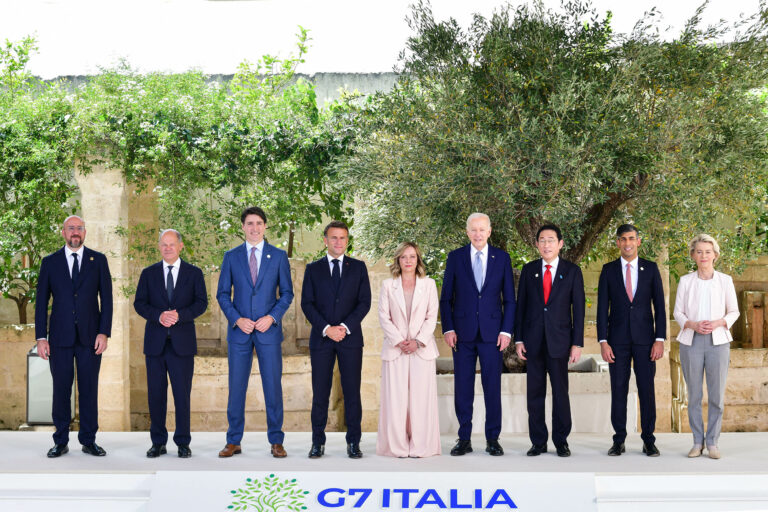
Losers
BY M. K. BHADRAKUMAR | INDIAN PUNCHLINE | JUNE 13, 2024
One hidden transformation of the international system in the most recent years has been the hijacking of the G7 by Washington as its ‘kitchen cabinet’ in the transatlantic system. The G8’s ‘shrinkage’ to G7 in March 2014 following the coup in Ukraine was a defining moment that signalled that there wasn’t going to be any post-cold war peace dividend. The G7 that was conceived as a group of countries charioting the world economy ended up as the vehicle of big-power rivalry to preserve the US’ global hegemony. Isolating Russia — and lately, China, too — became its leitmotif.
With the failure of the western project to isolate Russia, the G7 is meandering and lost its sense of direction. Italy, the G7 summit’s rotating host this year, has made AI a key issue in the summit. And Prime Minister Giorgia Meloni invited by an unlikely guest, the pontiff, to make an unprecedented appearance at the G7 event at the fashionable Italian hotel Borgo Enyatia to advocate for the regulation of artificial intelligence, a technology he’s called potentially harmful. Pope Francis was a chemist prior to entering seminary and will apparently draw on his scientific training to inform his stances. Italy under Meloni’s leadership has increasingly scrutinised AI technology, and temporarily banned ChatGPT in March 2023, becoming the first western country to do so.
Equally, G7 is desperate to go beyond a closed elite club of Western democracies by piloting an ambitious outreach and issued an unusually long list of invited leaders of the non-Western world to the summit. Aside Ukraine, Meloni has invited the leaders of India, Brazil, South Africa, Turkey, Saudi Arabia, Argentina, Algeria, Kenya and Mauritania to attend the meeting. What was the logic applied is impossible to tell.
But this is realpolitik and G7 is hoping to bridge the ‘West vs. the Rest’ hiatus in the line-up over the Ukraine crisis. In fact, the ‘outreach guests’ will witness tomorrow the nail-biting finale of a geopolitical drama, which forms the core of the G7 summit — the months-long attempt by the group’s leaders to make a decision on using dividends from frozen Russian assets for Ukraine’s military needs.
To recap, as part of the West’s ‘sanctions from hell’ against Russia in 2022, the European Union, Canada, the US and Japan froze Moscow’s assets in the western banks to the tune of $ 300 billion. (Some say, the actual figure is closer to $400 billion.) Only about $5-6 billion is located in the US, while $210 billion is stored in Europe, but the decision to use the proceeds from Russian assets was initiated by Washington with a hidden agenda to make Europe pay for the war’s consequences.
Unsurprisingly, the European members and Japan opposed the US pressure to include a provision on the use of income from frozen Russian assets in the joint G7 statement to be adopted. CNN reported on Monday that American officials are still trying to agree on the “most sensitive financial details” of the plan for Russian assets, since the G7 countries are yet to come to a consensus and discussions are continuing as regards “the exact form of providing assistance, as well as guarantees for the return of these funds.”
That said, don’t be surprised if the recalcitrant Europeans ultimately fall in line. There is no question that the G7 move to appropriate Russian money in western banks was bad enough but to use the profits out of them to fund the needs of Ukraine is, to put it mildly, an act of brigandage.
The US gains if the current freeze in Russia-Europe ties reaches a point of no return, as Europe is sure to bear the brunt of Moscow’s retaliation. If the G7 adopts such a move, it will weaken the global financial system. By brazenly violating international law, the G7 will be setting a precedent that undermines confidence in European institutions.
It will be interesting to see how the G7 leaders explain to the ‘outreach’ countries, drawn largely out of BRICS, that Russia is an exception and such a practice will not one day be used against India, Turkey, Saudi Arabia or some other state.
To be sure, the spectre of the 16th summit meeting of BRICS at Kazan (16-18 October) under the chairmanship of Russian President Vladimir Putin haunts the G7. Moscow has let it be known that if the past three years ended with the expansion of the BRICS, the new phase going forward will ensure that the participants in an expanded format create a viable structure in which the member countries work purposively to develop a viable structure.
An important topic at the BRICS summit meeting in Kazan will be the creation of a single currency within the grouping, which will significantly simplify and expand the economic relations of the member countries against the backdrop of mounting pressure from the West.
Speaking at the SPIEF conference in St. Petersburg last week, Putin announced that such an independent payment system would be created. Foreign Minister Sergey Lavrov later confirmed that a platform for payments in national currencies is being developed.
The BRICS countries have realised that the creation of a single currency has become a necessity today due to the ongoing sanctions from the US and the European Union. Lavrov noted that “recent international events have thrown off the masks” of the West, which has tried to impose its own values on other countries under the guise of universal ones and replace equal dialogue with “narrow coalitions” that assign the right to speak on behalf of the whole world.
BRICS, Lavrov underscored, implies a completely opposite type of partnership — that is, anything but a bloc structure, and on the contrary, a fundamentally open format, which involves working only in those areas that are of mutual interest to all participants, big and small. Reports suggest that around 30 countries have sought BRICS membership.
Meanwhile, in ‘systemic’ terms, G7 is entering uncharted waters. Far-right parties are storming the power centres of Europe. With an eye on the G7 summit, Politico wrote:
“Dream on. The G7 summit in the southern Italian coastal resort of Borgo Egnazia features arguably the weakest gathering of leaders the group has mustered for years. Most of the attendees are distracted by elections or domestic crises, disillusioned by years in office, or clinging desperately to power.
“France’s Emmanuel Macron and Britain’s Rishi Sunak are both fighting snap election campaigns they called in last-ditch efforts to reverse their flagging fortunes.
“Germany’s Olaf Scholz was humiliated by far-right nationalists in last weekend’s EU Parliament election and could soon be toppled himself.
“Justin Trudeau, prime minister for nine years in Canada, has spoken openly about quitting his “crazy” job.
“Japan’s Fumio Kishida is enduring his lowest personal ratings ahead of a leadership contest later this year.
“And then there’s Joe Biden.
“The 81-year-old U.S. president’s son, Hunter, was found guilty of gun charges on Tuesday, barely two weeks before his father’s first crucial debate with a resurgent Donald Trump in a presidential campaign the Democrat is in serious danger of losing.”
Above all, the angst in the European mind is palpable that if Trump wins in a democracy-altering climax in the November election, he may not even have time or patience to tolerate an archaic forum like G7. Surveying the bleak landscape, it comes as no surprise that Meloni took matters in her hands and decided to use the summit to her purposes by designing an agenda that cleaved to Italy’s strategic interests — Africa, migration and the Mediterranean.
EU “playing a dark game” and serves “sinister” interests of US
By Ahmed Adel | June 13, 2024
The European Union’s reaction to the conflict in Ukraine indicates that the bloc does not pursue the peaceful objectives that were the basis of its creation, writes columnist Javier Melero for the Spanish newspaper La Vanguardia. At the same time, European authorities are in negotiations to maintain the flow of gas through the important Russia-Ukraine pipeline, once again showing that Europe is committing economic suicide with its failed sanctions policy on Moscow.
“War has returned to Europe, and it would be appropriate to ask after the post-election euphoria how the EU reacts to the Russian-Ukrainian conflict,” Melero wrote.
By asking this question, the author emphasises that in public discussions in Europe no other option for resolving the conflict is considered, except “Russia’s unconditional surrender.” Based on this, he concludes that the EU does not act in accordance with declared peaceful objectives but serves the “sinister” interests of NATO and the USA.
“It seems to me that something doesn’t add up here and that Europe is playing a dark game. And these games, what’s even worse, end badly for it. And the conflict in Ukraine seems to be no exception,” concluded Melero.
Yet, even as the EU does not prioritise peace to instead serve Washington’s interests, the bloc is unable to wean itself off Russian energy, a demonstration that the economies and prosperity of the European continent is intrinsically interconnected and that the US-led sanctions have only had a boomerang effect. For this reason, European authorities are desperately in negotiations to maintain the flow of gas through the Russia-Ukraine pipeline even if the bloc tried to end Russian shipments.
The agreement covering this gas transit exchange expires at the end of this year, and with the ongoing Ukrainian conflict, most market watchers expect the flow to finally stop. However, European government and business officials are talking to their counterparts in Ukraine about how to maintain the flow of gas next year, according to people familiar with the matter interviewed on condition of anonymity by Bloomberg.
At the same time, one option that has been discussed is for European companies to buy and inject Azerbaijani gas into Russian gas pipelines bound for Europe, according to some sources. A plan to use Azerbaijani gas could, in theory, benefit Russia if it were set up as an exchange that would allow Moscow to ship its gas elsewhere.
Negotiations are in their early stages, and people familiar with the matter expect decisions only later this year, when the expiry date — and the onset of European winter — add pressure. Russia still sends around 15 billion cubic metres of gas a year to Europe , mainly to Slovakia and Austria, where Moscow is still a dominant supplier.
In Austria, Russian gas covered more than 80% of Austrian consumption for five consecutive months. Europe also imports Russian liquefied natural gas (LNG) by ship and, despite frequent debates about whether it should do so, has never sanctioned Russian gas.
The European Commission, the executive arm of the European Union, believes that the bloc can resist the end of Russian transit through Ukraine without any major security risk, but some member states are less optimistic and fear a repeat of the energy crisis, writes Bloomberg.
Whilst Europe worries about another energy crisis, Russian revenues from oil and gas exports increased by 82.2% in the period between January and April, compared to the same period in 2023, reaching more than 4.2 trillion rubles. The growth comes despite sanctions imposed on Russia since the launch of its military operation in Ukraine in 2022, including an embargo on Russian oil transported by sea and a $60 per barrel price cap on other types of oil.
Moscow has repeatedly expressed its readiness for peace negotiations, but the Kiev authorities have introduced a ban on them at the legislative level. At the same time, the West ignores Kiev’s constant refusals to dialogue and instead encourages the continuation of war, even as Ukraine loses more territory and experiences a demographic collapse as millions have fled the country and hundreds of thousands are being killed in a futile war against Russia.
But as Melero highlighted, US-led NATO only has “sinister” designs. These designs can only be detrimental to European interests, making the complete servitude to Washington all the more bizarre, especially since before February 2022, French-led Europe spoke a brave game of European strategic autonomy from the US. The first opportunity to test Europe’s pursuit for strategic autonomy showed that this was only lip work by French President Emmanuel Macron and that ultimately the EU is the biggest loser in the Ukraine conflict after Kiev itself, and not Russia or even the US.
Ahmed Adel is a Cairo-based geopolitics and political economy researcher.
Pro-Palestine Irish MEP loses seat, blames ‘establishment’

Al Mayadeen | June 12, 2024
Clare Daly, an Irish leftwing MEP and advocate for Palestine, has lost her seat in the European Parliament. A harsh critic of the Israeli occupation, as well as a frequent critic of Western militarism, Daly slipped behind her opponents in Dublin’s district, The Guardian reported Tuesday.
According to the article, throughout her tenure in the European Parliament, Daly blasted the West for “militarism” and gained a big social media following. She was featured in state media outlets in China and Russia, which her opponents used as a card to accuse her of supporting “authoritarian regimes”.
Furthermore, The Guardian reported that Daly lost her seat despite support from luminaries such as Eurythmics singer Annie Lennox and actress Susan Sarandon. Sarandon is a well-known pro-Palestine campaigner who has been constantly accused of anti-semitism for her sheer support for Palestine.
Daly was one of “Israel’s” toughest opponents in the European Parliament, Israeli public radio KAN said on Wednesday. Daly posted on X in April that the “whole world” knew “Israel” was destabilizing the Middle East and accused the occupation of genocide.
She also accused the European Parliament of “telling a fairytale in which Iran’s the aggressor.”
Following Operation Al-Aqsa Flood on October 7, Daly responded to “unelected” EU President Ursula von der Leyen, stating that the latter’s stance does not reflect the true voice of the European Union and in no way reflects the bloc’s peaceful approach in terms of foreign policy.
“Today, Hamas terrorists have struck at the heart of Israel capturing and killing innocent women and children. Israel has the right to defend itself – today and in the days to come. The European Union stands with Israel,” von der Leyen tweeted on X on Saturday.
“Who do you think you are? You’re unelected and have no authority to determine EU foreign policy, which is set by the EU Council. Europe does NOT “stand with Israel.” We stand for peace. You do not speak for us. If you’ve nothing constructive to say, and you clearly don’t – shut up,” Daly wrote in response.
Following the announcement of her loss at the elections, Daly thanked those who voted for her and expressed that “it is testament to the success and reach of the work we’ve done that the establishment came out in such force to harm my chances of reelection.
Daly could have been the victim of Israeli lobbying to oust her from her position for her tough stance on “Israel” and her unapologetic support of Palestine.
Daly turned down an interview with an RTÉ reporter as she left the count facility in south Dublin expressing, “You had no interest in talking to me for five years, so I’ve no interest in talking to you.”
Biden and other Western leaders could face war crimes prosecution over Gaza and Ukraine

By Finian Cunningham | Strategic Culture Foundation | June 12, 2024
US President Joe Biden and European leaders are liable for war crimes in Gaza and Ukraine and could face prosecution.
That’s the assessment of internationally renowned legal expert Alfred de Zayas* and a collective of jurists at the Geneva International Research Peace Institute.
In what could be a breakthrough test case, Professor de Zayas and his colleagues have submitted a formal request to the International Criminal Court to investigate European Commission President Ursula von der Leyen for complicity in war crimes in Gaza and Palestinian Territories committed by the state of Israel.
In this interview, de Zayas outlines the case for prosecution against von der Leyen, who as president of the European Commission is Europe’s most senior political representative. Von der Leyen is accused of being in breach of the 1948 Convention on Genocide by aiding and abetting the Israeli state in its military onslaught against Palestinians.
It is not just von der Leyen who is liable for war crimes prosecution. Other senior members of the European Union – Charles Michel and Josep Borrell – and European national leaders such as France’s Emmanuel Macron, Germany’s Olaf Scholz and Britain’s Rishi Sunak are also indictable.
As Prof de Zayas points out, US President Joe Biden is a prime figure for prosecution given that the United States is the biggest political and military supporter of Israel.
All Western leaders have a case to answer for the appalling genocide in Gaza which has resulted in more than 40,000 Palestinian deaths, mainly among women and children. If a case can be made against von der Leyen then others will follow against Western leaders.
What de Zayas says is crucially important is to break the false aura of impunity that “arrogant” Western leaders think they have. These politicians have the misplaced belief that they are “untouchable” and “unaccountable” under international law.
He says the legal process initiated by his collective of jurists at the Geneva International Peace Research Institute of prosecuting Western leaders is gathering worldwide momentum. More international legal experts and concerned citizens are adding their names to the legal petition.
A final note on the conflict in Ukraine. The funneling of weapons into that country by the US and other NATO powers is grounds for prosecution under the war crimes of incitement against peace and instigation of aggression. The NATO powers are guilty of Nuremberg crimes that Nazi leaders were convicted of in 1946.
Professor de Zayas and his colleagues are serving notice on Western leaders that they are not above the law and they will eventually end up the dock to face justice. The groundswell of world public opinion is outraged by the war crimes in Gaza and NATO’s relentless warmongering in Ukraine. The movement of protests across the world against the genocide in Gaza is proof of the huge groundswell. The political challenge to establishment politicians and figures cannot be overstated.
A movement to call out the war criminals in high office and put them in the dock is long overdue but it is underway.
* Alfred de Zayas is a formidable legal authority who writes a regular column for Counterpunch magazine. He is a Professor of International Law at the Geneva School of Diplomacy. Formerly, he served as the United Nations senior expert on international law. He has written 11 books, including Building a Just Global Order (2021, Clarity Press) and Countering Mainstream Narratives (2022, Clarity Press).
Rigor mortis on the Western front: a brief comment on the EU Parliament elections
By Gilbert Doctorow | June 10, 2024
The results of the parliamentary elections across the 27 member states of the European Union have been published this morning. They are not complete and final, but they are highly indicative of how it all ends.
The front-page diagram of The Financial Times comparing the outgoing and incoming party affiliations of the deputies tells it all. Though the deck chairs on the Titanic have been rearranged, though the Greens have had losses, the Renew grouping of Macron and Belgium’s Guy Verhofstadt have had losses, the EPP had gains and the net result appears to be that the Center Right-Left coalition that held the European Parliament in its firm grip these past 5 years will continue to have a voting majority of more than 400 seats. This means that barring some accident, Ursula von der Leyen will be reelected and the awful, self-destructive, even suicidal policies of the EU with respect to Russia will continue for the coming 5 years, if there is no Continent-wide war as a result that wipes Europe off the face of the earth.
Here in Belgium, the good news comes from the north of the country. The anti-status quo Flemish parties N-VA and Vlaams Belang came in first and second, garnering almost a third of the seats in the Chamber of Representatives. My estimation of the results comes from applying the old Russian Marxist analytic tool: the worse, the better. The comfy life of our most prominent politicians is coming to an end. Prime Minister De Croo was compelled to resign when his party took a beating. Now he can resume the search for his next sinecure that began one week ago when he called upon Joe Biden in the White House. If only this discomfiture extends to the other incompetent lackeys of Washington that the MR Party has sent to the European Institutions, Didier Reynders on the Commission and Charles Michel at the Council, then I will break out the champagne.
©Gilbert Doctorow, 2024
Featured Video

Racist Seinfeld Dances for Joy as Bibi Unveils His New Map
or go to
Aletho News Archives – Video-Images
TV Drama Review
Japanese drama projects Japan’s wartime atrocities onto Chinese characters

Global Times | October 25, 2026
By portraying Chinese characters as perpetrators of ruthless violence while casting Japanese Self-Defense Forces (SDF) intelligence operatives as defenders, the season 2 of the Japanese drama Vivant has recently drawn criticism from Chinese netizens, who argue that its depiction turns historical reality on its head while ignoring Japan’s wartime atrocities.
The TBS drama series – a spy suspense story in which an alleged unofficial intelligence unit of the SDF operates across the globe — has attracted a passionate fanbase. Its currently airing season 2 opened with a household rating of 18.8 percent, the highest for a TV drama this year, according toa commentary article by Japanese media Toyo Keizai.
What draws attention is the portrayal of the enemies in the series, the article noted. Scenes in which the Chinese organization subjects kidnapped members of the SDF unit to brutal torture are repeated with unrelenting intensity.
It is rare for Japanese TV dramas to explicitly portray a real-life country as the enemy, the article noted.
Japanese Prime Minister Sanae Takaichi also made a reference to the drama, saying that she has been recording Vivant and hopes to binge-watch it over the year-end and New Year holidays, according to Japanese media outlets.
China’s CCTV News report on Sunday revealed that the drama features scenes in which Chinese personnel cut off the fingers of and stab Japanese intelligence operatives in the abdomen. Such acts bear striking similarities to the torture inflicted on Chinese nationals by invading Japanese troops during the World War II.
The drama distorts the truth by attributing these atrocities to modern Chinese characters. Beneath the surface, it subtly glorifies Japan’s cross-border overseas operations, blurs the functional boundaries of the SDF and implicitly promotes an expansionist narrative, per CCTV News. … continue
Blog Roll
 Aletho News
- Up in arms… Koreans reject U.S. empire’s plan to make South Korea the next Ukraine
- Iran, Turkey, Pakistan, Saudi Arabia could advance region-led security framework in Tehran: FM spox
- Netizens condemn Japanese drama for projecting Japan’s wartime atrocities onto Chinese characters
- Racist Seinfeld Dances for Joy as Bibi Unveils His New Map
- A West Bank War for Netanyahu’s Election Campaign, Could It Backfire?
- Yemen denounces European Parliament’s ‘hypocritical’ push to blacklist Ansarullah
- Qalibaf: UAE’s UN bid aims to ‘clear the runway’ for ‘Greater Israel’, whitewash genocide
- Pakistan reopens Iran border after boosting security: Report
- Why are so many Brazilians voting for Flávio Bolsonaro?
- Democrats Put Anti-Russia Agenda Ahead of American Workers
- If Americans Knew
- An error has occurred; the feed is probably down. Try again later.
- No Tricks Zone
- Sudden Stratospheric Warming, Powerful El Niño Combination May Lead To Extreme Europe Cold, Energy Crisis!
- Two New Studies Find Thwaites Glacier Melt Cannot Be Driven By Human Activity Or A Warming Ocean
- E-Cars Reduce CO2 Emissions By Only 41% Compared To Internal Combustion Engine Vehicles
- Predictions Made By Renowned Climate Professor Over Past Decades Have Been Proven To Be Poor
- New Study Suggests Large Regions Of The Pacific Ocean Have Been Cooling For The Last 80 Years
- Germany’s Green Energy Debacle: High Energy Costs Force Kahla Porzellan to Close After 182 Years!
- New Study: 50 Years Of The Most Aggressive ‘Net Zero’ Policies Can Only Affect The Global Climate By 0.03°C
- US September “Heat” Was No Record…Many Records Set Decades Ago
- Latest European Green Energy Debacle; Portugal’s Largest Flagship Solar Park Insolvent!
- Green Energy Debacle: German Expert Professor Fritz Vahrenholt Warns Of Severe Economic And Social Consequences

