EU Accelerates De-Dollarization by Stealing Russian Money
By Ekaterina Blinova – Sputnik – 25.06.2024
The EU will send €1.4 billion ($1.5 billion) in profits from the frozen assets of Russia’s Central Bank to the “European Peace Facility” in order to meet the Kiev regime’s military needs.
EU High Representative for Foreign Affairs and Security Policy Josep Borrell announced on June 24 that the bloc has approved grabbing windfall income from frozen Russian assets.
According to Borrell, €1.4 billion will be available in the course of the next month, and another €1 billion by the end of the year.
“The decision is shameful,” Gilbert Doctorow, an international relations and Russian affairs analyst, told Sputnik. “It is totally hypocritical to assign to a “Peace Facility” the role of financing arms and war. The ultimate goal of this ‘peace initiative’ is to prolong the war, at least till after the American elections in November for the sake of Mr Biden’s personal ambitions.”
Ninety percent of the revenues will be spent on arms and just 10 percent on construction projects in Ukraine.
Going against the usual requirement for unanimity between its members, the EU snubbed Hungary’s veto by using a legal “loophole”.
“New billions for Ukraine. This time by kicking up the European rules and leaving out Hungary,” Hungarian Foreign Affairs Minister Péter Szijjártó commented earlier on Monday.
He slammed the “shameless breach of common European rules,” stressing in a social media post that “This is a clear red line.”
After the start of the Russian special military operation in Ukraine, the EU and G7 countries froze almost $300 billion in Russian assets. Around $207 billion are held at Euroclear, a clearinghouse based in Belgium.
“The result will be to sharply reduce use of the Euro as a reserve currency by countries of the Global South, who all fear the kind of arbitrary and illegal confiscation of their national wealth by European governments whenever it suits their purposes,” Doctorow warned.
Brussels’ decision is “bad” in every respect, said Adriel Kasonta, a London-based foreign affairs analyst and former chairman of the International Affairs Committee at the Bow Group think-tank.
“First of all, it is illegal, if we take into account the violation of the principle of sovereign immunity of the sovereign country, which is the Russian Federation,” Kasonta told Sputnik.
“It exposes the western double standard when it comes to the rule of law and the application of the rules to the countries equally,” he continued.
That “is clearly detrimental because it serves as a boost to the de-dollarization movement,” the expert stressed. “It will… accelerate the movement of abandoning the currency of the dollar and euro in international transactions.”
Russia has repeatedly warned it will take retaliatory measures in response to any attempts to expropriate its financial resources by the West, and that it would perceive any form of grab as “theft”.
Any actions with Russian frozen assets will trigger a symmetrical response, Finance Minister Anton Siluanov told Sputnik in late February, adding that a similar quantity of foreign assets have been frozen in Russia.
Last week, Russian Foreign Ministry spokeswoman Maria Zakharova told a press briefing that Russia could take a wide variety of measures to respond to the G7 decision to fund Ukraine using profits from frozen Russian assets.
New law ‘pushing Georgia away from EU’ – Borrell
RT | June 25, 2024
EU foreign policy chief Josep Borrell has warned Georgia that its potential accession to the bloc is in jeopardy after Tbilisi adopted a controversial ‘foreign agent’ law earlier this month. The US has also indicated it will not hesitate to penalize the former Soviet republic unless it walks back the legislation.
Known officially as the Transparency of Foreign Influence Act and spearheaded by the ruling Georgian Dream party, the law came into force earlier this month despite opposition protests and a veto by President Salome Zourabichvili.
The legislation requires NGOs, media outlets, and individuals who receive more than 20% of their funding from abroad to register as entities “promoting the interests of a foreign power” and to disclose their donors. Those who fail to comply will face fines of up to $9,500.
While opponents of the bill have described it as “Russian” and an attack on democracy, supporters have insisted it is similar to what numerous Western nations, including the US, have in place.
On Monday, Borrell said the foreign ministers of EU members had held “a lively debate on Georgia” for the second time in less than a month. Citing “worrying political developments,” the diplomat warned that “this law and all the negative developments around it are pushing Georgia away from the European Union.”
“If the government does not change the course of action, Georgia will not progress on the European Union path,” Borrell insisted.
According to the EU foreign policy chief, the law goes “against the will of the overwhelming majority of the Georgian population.” Brussels is planning to “increase our support to civil society and media” in the former Soviet republic, he added. The EU will also downgrade political contacts with Tbilisi and consider “putting on hold our financial assistance to the government,” Borrell stated.
Earlier this month, US State Department spokesman Matthew Miller claimed the ‘foreign agent’ law “moves Georgia away from its democratic trajectory” and “fundamentally alter[s] the US relationship with Georgia.” “We have not yet announced individual sanctions… but we have made clear that we would not hesitate to impose them,” the official stated.
Late last month, Washington announced that it would start restricting visas for Georgian politicians who played a role in passing the legislation. In November 2023, the European Commission recommended granting Georgia candidate status “on the understanding that the government takes important reform steps.”
Russia retaliates against EU’s latest media ban
RT | June 25, 2024
Russia is restricting access to more than 80 EU media outlets on its territory that have been involved in spreading disinformation about the Ukraine conflict, the Russian Foreign Ministry announced on Tuesday.
According to a statement issued on the ministry’s website, the move comes in response to the EU’s latest crackdown on Russian media.
In May, the European Council banned four media outlets from reporting to audiences in the EU, including leading Russian news agency RIA Novosti, as well as newspapers Izvestia and Rossiyskaya Gazeta. The ban also applies to the relatively small Czech-based portal Voice of Europe, which the EU has described as a “Kremlin-linked propaganda network.” The restrictions on the media outlets came into force on June 25.
“The Russian side has repeatedly and at various levels warned that politically motivated harassment of its journalists and unfounded bans on Russian media in the EU will not go unnoticed,” the ministry said, noting that Brussels and other EU capitals had chosen to take the path of escalation with their latest illegal ban despite warnings, forcing Moscow to take mirror countermeasures.
“Responsibility for such a development of events lies solely with the leadership of the European Union and the countries of the bloc that supported such a decision,” according to the ministry.
The list of EU media outlets that “systematically disseminate false information” about the progress of Moscow’s special military operation includes 81 organizations from 25 member states. They include Germany’s Der Spiegel, Spain’s El Pais, Italy’s La Stampa and La Repubblica newspapers, the French Agence France-Presse, Le Monde, Liberation, as well as the pan-European Politico and EUobserver.
Moscow may reconsider its decision in relation to the media outlets if restrictions on Russian media are lifted, according to the statement.
Brussels had already barred several Russia-associated media from engaging with audiences in member states due to the Ukraine conflict. Even platforming content from the targeted organizations is illegal in the bloc. Those sanctions included RT and Sputnik, suspending their TV broadcasting licenses and blocking both websites for readers across the EU.
Moscow has accused Brussels of duplicity and attacking freedom of speech with its restrictions. The campaign to undermine the work of Russian news organizations long predates the Ukraine conflict and is aimed at preventing European citizens from hearing opinions that their governments deem undesirable, Russian officials have claimed.
EU ‘crossed a red line’ by banning Hungary from latest Ukraine vote, says Foreign Minister Szijjártó
BY DÉNES ALBERT | REMIX NEWS | JUNE 25, 2024
The European Union crossed a red line by prohibiting Hungary from voting on the use of the proceeds from frozen Russian bank accounts, said Minister of Foreign Affairs and Trade Péter Szijjártó on Monday.
Speaking during a break in the meeting of the EU’s Foreign Affairs Council, the Hungarian minister said an additional €1.4 billion from the European Peace Facility would be used for arms transfers to Ukraine, despite Hungary’s disagreement.
“This €1.4 billion is effectively the amount of the proceeds of the seized or frozen Russian assets, and since Hungary abstained in the first vote on their use, the Council’s legal service, Brussels, the bureaucrats, and some member states considered that this was a sufficient basis for ignoring Hungary’s right to decide, and so they decided to use €1.4 billion from the European Peace Facility to finance new arms shipments to Ukraine, ignoring Hungary’s position,” he said.
“This is a clear red line. Never before has such a shameless breach and disregard of common European rules been shown. Moreover, it is precisely those who are pushing for the rule of law procedures at full volume and talking about the endangerment of democratic values who are breaking European rules,” he continued.
“The self-proclaimed warriors of democracy and the rule of law have now flouted the rules in the most shameless way possible by excluding Hungary from this decision. So the pro-war fervor has effectively blinded the decision-makers,” he added.
Szijjártó underlined that the EU clearly wants to continue crossing red lines, as evidenced by the fact that High Representative for Foreign Affairs and Security Policy Josep Borrell has this time come up with a proposal to allow the training of Ukrainian soldiers by European troops on Ukrainian territory.
“This is an extremely dangerous proposal. It is a proposal that would cross another red line. We remember the statements of leading Western European politicians during the European Parliament election campaign that European soldiers could and should be stationed, deployed, and sent to Ukraine. And here is the first step,” he said.
“They want to send military trainers to Ukraine. This is unacceptable to us, and we are protesting against it with all means at our disposal because the deployment of EU trainers in Ukraine would create another extremely serious risk of further escalation of the war,” he warned.
EU accuses Telegram of hiding its reach

European Commission vice-president for values and transparency Vera Jourova, March 14, 2024. © Getty Images / SOPA Images / Contributor
RT | June 24, 2024
Telegram underreports its user numbers to avoid being targeted by EU regulators, the vice-president of the bloc’s Commission for Values and Transparency, Vera Jourova, has alleged. She also accused Moscow of using the platform to spread “disinformation” among Russian-speaking EU residents, claiming that the Baltic nations, Poland, and Bulgaria are among the most exposed.
“I don’t trust Telegram, I don’t think they only have 42 million users,” Jourova said in an interview with Suddeutsche Zeitung on Sunday. She added that the European Commission is convinced that Telegram’s audience amounts to more than 45 million people – the threshold for regulatory control.
The commission is currently examining whether it should investigate the platform, Jourova revealed.
Last month, Bloomberg cited anonymous sources as saying that EU lawmakers were considering listing Telegram, founded by Russian-born entrepreneur Pavel Durov less than ten years ago, as a “very large online platform.” The move would open the privacy-focused messaging app up to strict censorship regulation.
As of February 2024, Telegram had an estimated average of 41 million monthly active EU users over the preceding six months. The figure is lower than the threshold required for social media platform to be subject to more specific obligations under the EU’s Digital Services Act (DSA). The regulation requires companies located outside the bloc to have legal representation in one of its member states.
The DSA, which came into force in February, allows the bloc’s regulators to fine platforms as much as 6% of their global annual turnover if they are found to have broken its rules. The regulation also provides the EU watchdog with the right to ban repeat offenders from operating in the bloc.
According to Durov, Telegram respects the rights of its users to privacy and freedom of expression. In an interview with American journalist Tucker Carlson earlier this year, Durov said he had rejected requests from Washington to share user data with US authorities or to build so-called surveillance “backdoors” into the platform.
Brussels has already launched investigations into X (formerly Twitter) over alleged breaches of EU rules in areas linked to risk management, content moderation, dark patterns, advertising transparency, and data access for researchers. Similar probes have been opened in relation to TikTok and Meta, the latter of which is the parent company of Facebook, Instagram, and WhatsApp.
EU to bypass Hungarian veto on tapping Russian assets – FT
RT | June 24, 2024
The European Union has developed a scheme to use profits from frozen Russian assets to secure a $50 billion loan for Ukraine, which will be used to purchase arms, the Financial Times reported on Monday, citing the bloc’s top diplomat, Josep Borrell and other sources. The loophole effectively bypasses Hungary’s opposition to legislation that would have allowed the EU to hand over interest accrued on Russian funds to Ukraine.
In an interview with the FT, Borrell said that since Budapest had opposed an EU agreement to transfer revenue to Ukraine, it “should not be part of the decision to use this money.” He added that the bloc’s workaround was “sophisticated as every legal decision, but it flies.”
The West froze around $300 billion in Russian sovereign assets when the Ukraine conflict escalated, trapping around $280 billion in the EU.
Earlier this year, Brussels proposed seizing the interest earned on the assets to acquire weapons for Ukraine. The suggestion faced resistance from Hungary, a vocal critic of the West’s approach to the Ukraine conflict, particularly its arms shipments to Kiev.
Under the US-led initiative, proceeds generated by Russia’s frozen assets from next year will be used to pay off the loan.
The legal loophole allowing the EU to tap Russian assets is likely to suffice in guaranteeing the payout of the loan, the outlet said, citing officials familiar with the matter.
However, Budapest can still block an EU decision to extend sanctions on Russian funds, which has to be renewed every six months by the bloc’s 27 members, the officials added.
To placate Hungary, the EU proposed a deal under which its share of the bloc’s funds would not be used to purchase weapons for Ukraine in exchange for not vetoing other members transferring the revenue to Kiev, according to Borrell.
“We have offered Hungary: your money will not be used to support Ukraine in any means. Not just lethal, but on anything,” Borrell said. The proposal, however, has been rejected by Budapest.
Moscow has denounced the decision to transfer profits from its assets to Ukraine as a blatant and illegal “expropriation.”
EU’s Mass Surveillance Faces Fierce Resistance
By Didi Rankovic | Reclaim The Net | June 21, 2024
The European Union (EU) has managed to unite politicians, app makers, privacy advocates, and whistleblowers in opposition to the bloc’s proposed encryption-breaking new rules, known as “chat control” (officially, CSAM (child sexual abuse material) Regulation).
Thursday was slated as the day for member countries’ governments, via their EU Council ambassadors, to vote on the bill that mandates automated searches of private communications on the part of platforms, and “forced opt-ins” from users.
However, reports on Thursday afternoon quoted unnamed EU officials as saying that “the required qualified majority would just not be met” – and that the vote was therefore canceled.
This comes after several countries, including Germany, signaled they would either oppose or abstain during the vote. The gist of the opposition to the bill long in the making is that it seeks to undermine end-to-end encryption to allow the EU to carry out indiscriminate mass surveillance of all users.
The justification here is that such drastic new measures are necessary to detect and remove CSAM from the internet – but this argument is rejected by opponents as a smokescreen for finally breaking encryption, and exposing citizens in the EU to unprecedented surveillance while stripping them of the vital technology guaranteeing online safety.
Some squarely security and privacy-focused apps like Signal and Threema said ahead of the vote that was expected today they would withdraw from the EU market if they had to include client-side scanning, i.e., automated monitoring.
WhatsApp hasn’t gone quite so far (yet) but Will Cathcart, who heads the app over at Meta, didn’t mince his words in a post on X when he wrote that what the EU is proposing – breaks encryption.
“It’s surveillance and it’s a dangerous path to go down,” Cathcart posted.
European Parliament (EP) member Patrick Breyer, who has been a vocal critic of the proposed rules, and also involved in negotiating them on behalf of the EP, on Wednesday issued a statement warning Europeans that if “chat control” is adopted – they would lose access to common secure messengers.
“Do you really want Europe to become the world leader in bugging our smartphones and requiring blanket surveillance of the chats of millions of law-abiding Europeans? The European Parliament is convinced that this Orwellian approach will betray children and victims by inevitably failing in court,” he stated.
“We call for truly effective child protection by mandating security by design, proactive crawling to clean the web, and removal of illegal content, none of which is contained in the Belgium proposal governments will vote on tomorrow (Thursday),” Breyer added.
And who better to assess the danger of online surveillance than the man who revealed its extraordinary scale, Edward Snowden?
“EU apparatchiks aim to sneak a terrifying mass surveillance measure into law despite UNIVERSAL public opposition (no thinking person wants this) by INVENTING A NEW WORD for it – ‘upload moderation’ – and hoping no one learns what it means until it’s too late. Stop them, Europe!,” Snowden wrote on X.
It appears that, at least for the moment, Europe has.
Czech populists pull out of liberal Renew group in EU Parliament over disastrous Green Deal and migration
BY THOMAS BROOKE | REMIX NEWS | JUNE 21, 2024
Euro MPs from Czechia’s populist ANO movement have renounced their affiliation with French President Emmanuel Macron’s Renew Europe political grouping in the European Parliament, citing irreconcilable differences over the Green Deal and mass immigration.
ANO leader and former Czech Prime Minister Andrej Babiš announced the decision to withdraw his lawmakers from the liberal political group during a press conference on Thursday.
“We went to the polls to fight against illegal migration, to change the Green Deal, which is destroying European industry and agriculture and has a negative impact on our citizens,” Babiš told journalists.
“Based on the negotiations, we came to the opinion that Renew simply has a different position than the ANO movement,” he added.
“Above all, we want the Czech Republic to remain a sovereign country,” the former Czech leader told followers on his X account, hinting at the European liberals’ desire for an “ever-closer union” and a road towards a federal Europe.
It means the Renew Europe group will be seven MEPs fewer after the withdrawal of its Czech faction and makes it even more likely the group will be overtaken by the center-right European Conservatives and Reformists (ECR) group as the third-largest in the European Parliament.
The move has possible ramifications for European Commission President Ursula von der Leyen who is seeking reelection among the newly-elected parliamentarians and the arithmetic is becoming problematic.
The old guard of the European People’s Party, Socialists & Democrats (S&D), and Renew is losing control of the narrative in the European Parliament and von der Leyen needs almost all of the votes from these respective parties to guarantee her reelection.
Should 13 percent of the voting bloc refuse to endorse her candidacy, a figure previously seen during her first term and for the election of former president, Jean-Claude Juncker, von der Leyen would fall short of the support she needs to remain in post.
On the future of the ANO and its European affiliation, Babiš remained coy about what was next for his party, but did rule out joining the ECR, which includes lawmakers from Czechi’s governing ODS party.
“ECR is certainly not a solution for us. Representatives of other Czech political parties have a big say in the factions, and the ECR is certainly not our choice. We’ll see, maybe a new faction will emerge,” he said.
“We will now look for partners in the European Parliament with whom we can promote our program,” he added.
Hungary ‘won’t ride NATO war train’ – Orban
RT | June 21, 2024
The US appears intent on continuing to fight Russia in Ukraine and hopes to win, but Hungary is acting to counter this destructive policy, Prime Minister Viktor Orban has said.
The vocal opponent of the Western approach to the Ukraine conflict expressed fresh criticism during a weekly interview on Kossuth Radio on Friday.
“It appears that the Western world, led by the Americans, wants to defeat Russia, with the Germans playing the role of extras,” Orban claimed. He described the strategy as “hopeless,” adding that it is disastrous for the Ukrainians and Russians dying on the battlefield and is potentially escalatory.
The Hungarian leader claimed, however, that “we have already slowed the train to war,” citing the outcome of the recent European Parliament elections in which his party enjoyed success while some pro-Ukrainian groups suffered setbacks.
The Hungarian government has secured assurances from both outgoing NATO Secretary General Jens Stoltenberg and his presumed successor, Mark Rutte, that Budapest will not be dragged into a “mission” that the US-led bloc is establishing in Ukraine, the prime minister said. Hungary will not contribute troops, weapons, or money to the plan, Orban vowed.
“I can pull the emergency brake. The train will stop, and we Hungarians will get off this train,” he said. “And if we become very strong and the stars are lucky, we will convince the driver not to go any further.”
Moscow has described the Ukraine conflict as a US-initiated proxy war. After several member states publicly said this month that they will allow Kiev to strike targets deep inside Russia with Western-supplied weapons, President Vladimir Putin warned that Moscow could supply similar arms to enemies of the West.
French President Emmanual Macron, who has called on NATO countries not to rule out troop deployments to Ukraine, was among the EU leaders to have suffered the biggest in the European Parliament elections. He subsequently dissolved the French parliament, and is facing the threat of becoming a lame duck for the rest of his term as his political alliance contemplates a potential wipeout in the national legislature.
Supporters of the NATO involvement in the Ukraine conflict say its mission will be limited to training Ukrainian troops on the country’s soil.
MI6 Coup in Macedonia Unravels
By Kit Klarenberg | Active Measures | June 21, 2024
On May 12th, this journalist documented the labyrinthine Western-orchestrated machinations via which Macedonia – under the locally-despised name of North Macedonia – was forcibly enrolled in NATO, despite widespread public opposition. Absent from that investigation was reference to the central role played in these connivances by British intelligence. Namely, London’s ambassador to Skopje and lifetime MI6 operative, Charles Garrett. Now troublesome VMRO-DPMNE is returned to office, it is vital his activities in the country are re-examined.

Charles Garrett receives an award from King Charles
As The Grayzone has previously documented, London operates a dedicated program known as “Global Britain” in the West Balkans. Leaked documents related to the effort reveal it is concerned with insidiously influencing the composition of local governments and legal and regulatory environments to advance British interests, while filling regional security, intelligence, and military forces with handpicked assets. As one leaked file makes clear, MI6 does not tolerate regional opposition to its agenda, readily deploying active measures to neutralize any and all local resistance:
“In contexts where elite incentives are not aligned with [Britain’s] objectives/values… an approach that seeks to hold elite politicians to account might be needed… We can build relationships and alliances with those who share our objectives and values for reform… It is critical that the media have the capacity and freedom to hold political actors to account.”
Events in Macedonia over the past decade provide a brutal demonstration of what can befall governments and officials in the Balkans who do not share Britain’s “objectives” and “values”, and how they are “held to account.” So too does a 2020 coup in Kyrgyzstan, where Garrett set up shop after leaving Skopje. With Central Asia now in the crosshairs of London’s endless quest for “reform” overseas, it’s never been more vital to beware Brits bearing gifts.
‘Colorful Revolution’
Following Russia’s March 2014 reunification with Crimea, NATO’s efforts to expand in the Former Yugoslavia became turbocharged. The Grayzone has previously reported how alliance membership was imposed upon Montenegro, despite near-universal public opposition, in 2016. Achieving this feat required sustaining a corrupt, savage pro-Western dictator in power for almost two decades, and an elaborate connivance whereby anti-NATO opposition actors were jailed on bogus charges of colluding with Russian intelligence to overthrow the government, based on bogus CIA and MI6-supplied evidence.
Similar subterfuge played out in Skopje, which signed a “Membership Action Plan” with NATO in 1999. While slightly more supportive of NATO membership than Montenegrins, the local population near-unanimously opposed changing the country’s name, which Greece, the EU and US made a prerequisite for joining. The VMRO government, led by Nikola Gruevski, pledged Macedonia would always be called Macedonia. So a Western-orchestrated coup was put into motion.
In February 2015, opposition party SDSM’s leader Zoran Zaev began regularly dropping what he and the media branded “bombs” – deeply damaging wiretaps of private conversations between prominent Macedonian officials, businesspeople, journalists, and judges. The tapes seemingly implicated Gruevski and his ministers in serious crimes, including murder. Zaev claimed the illegally-captured recordings were passed to him by whistleblowers. The premier countered that the releases were supplied by foreign intelligence services, with the objective of forcing an early election.
Subsequent investigations exposed how SDSM deceptively edited and spliced these leaked recordings to grossly distort their contents, and falsely incriminate government officials. For example, one “bomb” was extensively doctored to make it sound like VMRO leaders conspired to cover up the 2011 murder of a young Macedonian in Skopje by a senior police officer, while shielding them from justice. The unexpurgated tape indicated they were in fact shocked by the killing, and wanted the culprit to be severely punished.
It was not until four years later that the truth was revealed, however. Upon release, Zaev’s “bombs” sparked widespread outcry in Macedonia, prompting hundreds of thousands of citizens to take to the streets, voicing righteous rage at VMRO. Openly called the “colorful revolution” by participating citizens and NGOs, and English language media, the EU and US duly stepped in and brokered the Przino Agreement, under which Gruevski resigned, and new elections were held.
SDSM scraped into office via a fragile coalition, then set about laying the foundations of Macedonia’s name change in explicit service of NATO membership, with tens of millions of dollars in assistance from intelligence cutout USAID. Parliamentarians were blackmailed – frequently using the illegal wiretap intercepts – and bribed into passing unconstitutional and highly controversial reforms, allowing Skopje to be rebranded North Macedonia without public support, or even the President’s signoff. A sham referendum, boycotted by most citizens, was also cynically staged.
At last, North Macedonia was formally inducted into NATO in March 2020. Alliance officials have since repeatedly made clear they consider Bosnia and Herzegovina joining to be inevitable. This is despite 98% of Bosnian Serbs opposing membership, due to NATO’s central role in the criminal destruction of Yugoslavia during the 1990s. There are covert British efforts to promote NATO in Serbia too, despite over 80% of the population opposing joining.

‘Charlie’s Angels’
In August 2013, Charles Garrett was appointed London’s ambassador to Macedonia. His express brief was to help the country “achieve its goals of joining NATO and the EU.” Multiple local sources have informed this journalist that Garrett was instrumental in the “colorful revolution,” distributing cash to NGOs and activists involved in the unrest from his diplomatic pouch, while attempting to get government supporters on board.
Public records strongly suggest Garrett is a lifetime MI6 officer. His lengthy career in London’s diplomatic service includes spells in Cyprus, Hong Kong, Switzerland and Taiwan, all key nuclei of intelligence gathering and cloak-and-dagger action for Britain’s foreign spying agency. He was also posted to the Balkans in the latter half of the 1990s, when the region became a veritable MI6 playground.
Under the Przino Agreement, a Special Prosecutor’s Office (SPO) was created to investigate officials over serious crimes supposedly revealed by the illegal intercepts. A previously unknown prosecutor from a small Macedonian border town, Katica Janeva, was selected to run the Office. While the SPO was supposed to prosecute SDSM activists – including Zaev, for releasing the intercepts – this never materialized. Meanwhile, any and all Western officials visiting Macedonia made sure to visit SPO headquarters and get snapped with Janeva. Garrett was, of course, among them.

Charles Garrett and Katica Janeva
Initially, Western journalists treated Janeva to multiple fawning profiles. The British press was particularly smitten. The Financial Times referred to her as Macedonia’s “Beyonce”. The BBC dubbed the Special Prosecutor and her two primary assistants “Charlie’s Angels”, claiming the trio were “the scourge of Macedonia’s political elite and heroines of the street protests now rocking the tiny Balkan nation.” A lengthy USAID-funded “documentary” featured her staff mocking their targets via phone, between discussing who to jail next over pizza and cigarettes.

That broadcast has been removed from the web, and virtually no trace of its existence can be found online today. This may be because in June 2020, Janeva was jailed for seven years for corruption. Her crime-fighting crusade was from inception an obscene, partisan fraud. Along the way, the Special Prosecutor secretly enriched herself through a variety of unscrupulous, criminal means. The SPO’s true objective was destabilizing the VMRO government, and discrediting its supporters by association.
Janeva’s targets were often indicted on farcical charges. For example, at one stage Prime Minister Gruevski was accused of “abuse of office” for commissioning the construction of two “Chinese highways”. Prosecutors charged he had improperly benefitted from the deal – not financially, but because he would “receive a popularity boost” if the highways were completed on schedule. Elsewhere, a pro-VMRO female journalist was accused of tax fraud for writing off laundry as a business expense, and resultantly subjected to much misogynistic mockery in SDSM-affiliated media.
More gravely, the owner of an independent news site committed suicide after being pressured to turn state witness by the SPO, following early morning police raids targeting him and his family. Cases brought against the owners of government-supporting TV stations Sitel and Nova shifted their editorial line in favor of SDSM, leading to the latter being closed outright. In its place, the rabidly pro-SDSM 1TV was launched by eccentric Macedonian media personality Bojan Jovanovski, also known as Boki 13.
Publicly, Boki 13 used his station to relentlessly promote the SDSM-led government and the SPO’s work, with Janeva a frequent guest on its assorted “factual” and entertainment programs. In private, he extorted wealthy businesspeople indicted by Janeva, or somehow caught up in the illegal intercepts, promising to make their legal troubles go away in return for lavish advertising buys on 1TV, or sizable donations to his “charity”, International Association. None other than Charles Garrett sat on its board.
‘Fifth Column’
By the time these facts became public knowledge, and Janeva and Boki 13 were in prison, Garrett was safely extracted from Skopje, having been appointed British ambassador to Kyrgyzstan. Almost immediately, a revolution erupted in Bishkek. Mass demonstrations, ignited by reports of vote rigging in the October 2020 parliamentary election, culminated with the military storming President Sooronbay Jeenbekov’s compound and removing him – physically – from office.
In February 2022, a Kyrgyzstan government-affiliated newspaper openly accused Garrett of operating a “fifth column” in Bishkek. It alleged that in the leadup to the 2020 vote, he along with US State Department representatives met with local journalists and bloggers, offering them enormous sums to identify electoral violations – such as vote rigging – and document official pressure on media outlets and civil society groups. Garrett purportedly promised them top-of-the-range broadcasting equipment, to increase their audience reach. Not long after publication, he returned to London.
Garrett has kept a low profile ever since and now occupies a cushy role overseeing the Commonwealth War Graves Commission. Nonetheless, in September 2023, he submitted written evidence to a British parliamentary committee investigating London’s “engagement in Central Asia”. He advocated a number of means to exploit “disruption caused by Moscow’s renewed invasion of Ukraine” to undermine the region’s historic, economic and political ties with Russia and China, and “shape the future of these countries” according to Britain’s interests.
When British Foreign Secretary David Cameron conducted a much-publicized tour of Central Asia in May 2024, he followed Garrett’s proposals to the letter. The ambassador’s legacy visibly endures in Macedonia today too. In March 2016, colorful revolution protesters attempted to burn down the President’s office, after 56 individuals indicted by the SPO were pardoned. The premises were transformed into the headquarters of UK Aid, a now-defunct British government agency intimately implicated in the neoliberal rape and pillage of Ukraine.
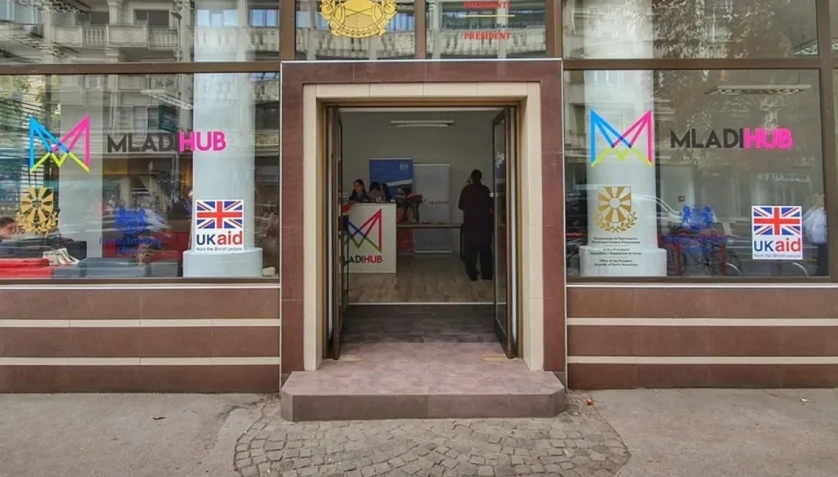
The Skopje headquarters of UK Aid
This included running covert communications campaigns on Kiev’s behalf, promoting the destruction of workers’ rights locally. It is likely the organization was engaged in similar skullduggery in Skopje, after Garrett rode into town. VMRO’s return to government at last offers Macedonians an opportunity to halt the operations of all US and British intelligence fronts and cutouts operating on their soil, and reclaim foreign-conquered territory.
Humanitarian aid and Israel’s ‘voluntary migration’ scheme
By Ramona Wadi | MEMO | June 20, 2024
Greek Foreign Minister George Gerapetritis said earlier this week that, “We have offered ourselves to host injured people from Palestine but also children from Palestine to come to Europe and stay here until the war is over.” Israel would be thrilled at such an idea, for sure. “Voluntary migration” in the guise of humanitarian aid could not get any better for Israel’s colonial expansion plans.
In October last year, Gerapetritis declared his government’s pro-Israel stance: “Greece, from the very first moment, supported the right of Israel to defend itself in line with international law.” No such right exists for an occupation state against the people living under its brutal military occupation.
In the same month, Greece also abstained from the UN General Assembly vote calling for a humanitarian ceasefire. A month earlier, the Greek government purchased 300 precision-guided munitions from Israel, known as spice bombs, for $130 million. And in a move aimed at curbing activism on university campuses, nine EU and UK individuals are facing deportation for participating in protests against the Gaza genocide, with Greek Prime Minister Kyriakos Mitsotakis stating that the authorities would forbid “universities from becoming sites for protest”.
As the genocide continues, the ways that politicians and diplomats try to make amends are becoming even weaker. The suggestion by Gerapetritis plays directly into the humanitarian paradigm which the EU hides behind, even as it continues to invest in Israel’s military and surveillance systems, all field tested on Palestinians in Gaza, of course.
There is not a single European country that can speak with honesty about Gaza and Israel, because investment in the latter has generated high stakes in terms of profit and complicity.
Humanitarian gestures, meanwhile, are becoming meaningless for Palestinians and strategically valuable for Israel, because there is no deterrent, no measure that forces Israel to stop the genocide.
Keeping in mind that Israel wants Gaza empty of Palestinians, why would the EU, which is complicit in arming the apartheid state, offer a humanitarian gesture that would help the settler-colonial entity in its ethnic cleansing? This begs a bigger question: why do diplomats insist on depoliticising humanitarian aid for the recipients, when the donors are involved in human rights abuses, war crimes and crimes against humanity?
Offering temporary safe haven for Palestinian children maimed by the war might be an acceptable humanitarian gesture if European countries weren’t complicit in the genocide conducted by the settler-colonial state which maimed them in the first place. “We have to remind ourselves of one thing: It is not enough to build only settlements,” said far-right Israeli National Security Minister Itamar Ben Gvir recently, in the context of emphasising the “voluntary migration” of Palestinians, otherwise known as normalised ethnic cleansing.
A look at the recent statement by the EU High Representative for Foreign Affairs and Security Policy shows how the Gaza genocide is not called to attention, but rather focuses on specific Israel violations while still recognising “Israel’s right to defend itself”. Josep Borrell also called for “the unconditional release of all hostages held by Hamas,” which essentially tells Palestinians that, as the colonised population, they should remain voiceless and not articulate any demands. Palestinians are facing genocide, and the EU’s statement is careful to protect Israel’s ability to act with impunity.
Any plan for EU states to host Palestinian children from Gaza cannot be allowed to pass unchallenged. Such a safe haven in Europe is part of the colonial framework that aids Israel, as does Europe’s complicity in Israel’s bombing and destruction of hospitals in Gaza, and murder of medical personnel. Apart from the fact that the number of Palestinian children taken in by Greece would be symbolic more than anything else, politicising medical treatment to aid Israel’s “voluntary migration” scheme is depraved and self-serving. Gerapetritis should have been more honest and said that his country will not stop the genocide, but will host and treat an insignificant percentage of its victims that will not jeopardise its relationship with Israel.
No political gesture will disguise the fact that Europe has much bigger obligations than playing humanitarian saviour to a relatively few wounded and severely traumatised Palestinian children.
Featured Video

Racist Seinfeld Dances for Joy as Bibi Unveils His New Map
or go to
Aletho News Archives – Video-Images
TV Drama Review
Japanese drama projects Japan’s wartime atrocities onto Chinese characters

Global Times | October 25, 2026
By portraying Chinese characters as perpetrators of ruthless violence while casting Japanese Self-Defense Forces (SDF) intelligence operatives as defenders, the season 2 of the Japanese drama Vivant has recently drawn criticism from Chinese netizens, who argue that its depiction turns historical reality on its head while ignoring Japan’s wartime atrocities.
The TBS drama series – a spy suspense story in which an alleged unofficial intelligence unit of the SDF operates across the globe — has attracted a passionate fanbase. Its currently airing season 2 opened with a household rating of 18.8 percent, the highest for a TV drama this year, according toa commentary article by Japanese media Toyo Keizai.
What draws attention is the portrayal of the enemies in the series, the article noted. Scenes in which the Chinese organization subjects kidnapped members of the SDF unit to brutal torture are repeated with unrelenting intensity.
It is rare for Japanese TV dramas to explicitly portray a real-life country as the enemy, the article noted.
Japanese Prime Minister Sanae Takaichi also made a reference to the drama, saying that she has been recording Vivant and hopes to binge-watch it over the year-end and New Year holidays, according to Japanese media outlets.
China’s CCTV News report on Sunday revealed that the drama features scenes in which Chinese personnel cut off the fingers of and stab Japanese intelligence operatives in the abdomen. Such acts bear striking similarities to the torture inflicted on Chinese nationals by invading Japanese troops during the World War II.
The drama distorts the truth by attributing these atrocities to modern Chinese characters. Beneath the surface, it subtly glorifies Japan’s cross-border overseas operations, blurs the functional boundaries of the SDF and implicitly promotes an expansionist narrative, per CCTV News. … continue
Blog Roll
 Aletho News
- Iran, Turkey, Pakistan, Saudi Arabia could advance region-led security framework in Tehran: FM spox
- Netizens condemn Japanese drama for projecting Japan’s wartime atrocities onto Chinese characters
- Racist Seinfeld Dances for Joy as Bibi Unveils His New Map
- A West Bank War for Netanyahu’s Election Campaign, Could It Backfire?
- Yemen denounces European Parliament’s ‘hypocritical’ push to blacklist Ansarullah
- Qalibaf: UAE’s UN bid aims to ‘clear the runway’ for ‘Greater Israel’, whitewash genocide
- Pakistan reopens Iran border after boosting security: Report
- Why are so many Brazilians voting for Flávio Bolsonaro?
- Democrats Put Anti-Russia Agenda Ahead of American Workers
- Elijah Magnier: Yemen’s Strikes Are Shattering Saudi Arabia’s Long-Term Strategy
- If Americans Knew
- An error has occurred; the feed is probably down. Try again later.
- No Tricks Zone
- Sudden Stratospheric Warming, Powerful El Niño Combination May Lead To Extreme Europe Cold, Energy Crisis!
- Two New Studies Find Thwaites Glacier Melt Cannot Be Driven By Human Activity Or A Warming Ocean
- E-Cars Reduce CO2 Emissions By Only 41% Compared To Internal Combustion Engine Vehicles
- Predictions Made By Renowned Climate Professor Over Past Decades Have Been Proven To Be Poor
- New Study Suggests Large Regions Of The Pacific Ocean Have Been Cooling For The Last 80 Years
- Germany’s Green Energy Debacle: High Energy Costs Force Kahla Porzellan to Close After 182 Years!
- New Study: 50 Years Of The Most Aggressive ‘Net Zero’ Policies Can Only Affect The Global Climate By 0.03°C
- US September “Heat” Was No Record…Many Records Set Decades Ago
- Latest European Green Energy Debacle; Portugal’s Largest Flagship Solar Park Insolvent!
- Green Energy Debacle: German Expert Professor Fritz Vahrenholt Warns Of Severe Economic And Social Consequences


