Fauci’s Inquisition Against Safe and Effective Anti-COVID-19 Drugs

By Richard Gale and Dr. Gary Null | Global Research | April 6, 2024
A question needs to be asked. Were the novel experimental drug treatments for SARS-CoV-2 viral infections that Anthony Fauci, the CDC and FDA advocated for and funded responsible for worsening the contagion and countless deaths?
However, at that time there were plenty of studies confirming there were pre-existing safe, inexpensive medications known to have highly effective antiviral properties to treat Covid-19 patients. Among these were ivermectin and hydroxychloroquine (HCQ).
There were also specific nutrients such as vitamin D and zinc, known to strengthen the immune system against viral infection and yet there was no recommendation from the government about the benefits of proper nutrition. So why did Fauci along with other federal health officials choose to intentionally ignore the scientific evidence and rather condemn these repurposed drugs? In Fauci’s case, over a year and half into the pandemic, he continued to lie outright on CNN that “there is no clinical evidence whatsoever that [ivermectin] works.”[1] And could millions have been saved if these generic medications were prescribed rather than the feds doing nothing but recommending social isolation and quarantines as the world awaited an experimental Covid-19 vaccine to enter the market?
To date, between ivermectin and HCQ alone, there have been 670 published studies, analyses and papers involving over 9,800 scientists and over 682,000 patients supporting the use of these drugs over and beyond those the FDA has approved under Emergency Use Authorization (EUA) statutes. Despite this, four years later, the FDA continues to fiercely deny ivermectin’s and HCQ’s efficacy and safety under proper administration. Why this blatant cover-up?
Every CDC effort to approve a novel drug treatment for SARS-CoV-2 infections has been a dismal failure. Aside from monoclonal antibody therapy, only three anti-Covid-19 drugs have been approved under an EUA in the United States. None met their promised expectations from either the manufacturer or our federal health agencies. With their poor efficacy rates, safety profiles and a black box warning slapped upon Pfizer’s anti-Covid-19 drug Paxlovid, the CDC is scrambling to find new viable alternatives in the pharmaceutical pipeline. Bloomberg amplifies the fake Covid-19 treatment crisis by lamenting that repurposed drugs such as ivermectin are gaining global popularity as “the world needs effective Covid drugs.”[2]

Shortly after the pandemic was formally announced, the FDA recommended the cheap over the counter anti-malarial drug hydroxychloroquine but then quickly reversed its decision after Fauci publicly announced the future arrival of Gilead Sciences’ novel intravenous drug Remdesivir. The FDA’s and European Union’s approvals of Remdesivir baffled many scientists, according to the journal Science, who questioned its therapeutic value and kept a close watch on the drug’s clinical reports about a “disproportionally high number of reports of liver and kidney problems.”[3] Even an earlier Chinese study published in The Lancet found that remdesivir had no impact on the coronavirus. The Science article notes that the “FDA never consulted a group of outside experts that it has at the ready to weigh in on complicated antiviral drug issues.”[4] Six months before remdesivir received EUA approval, Anthony Fauci had already hailed the drug as a major breakthrough that would establish a new “standard of care” in Covid-19 treatment.[5]
Today, remdesivir is being increasingly recognized as a debacle in antiviral therapeutic care. Even the WHO released a “conditional recommendation against the use of remdesivir in hospitalized patients, regardless of disease severity, as there is currently no evidence that remdesivir improves survival and other outcomes in these patients.” An Italian study observed a 416 percent increase in hepatocellular injuries among hospitalized Covid-19 patients treated with Remdesivir.[6] And a smaller Taiwanese study of hospitalized unvaccinated patients reported a 185 percent higher mortality during late remdesivir treatment.[7]
Earlier this year, Pfizer’s novel oral Covid-19 medication Paxlovid was given an FDA black box warning for clinically significant adverse reactions that can potentially be fatal. Because the company does not permit independent random-controlled trials to investigate its drug, other than retrospective studies, we only have Pfizer’s own data to rely upon. Nevertheless, The Lancet published a study by a team of Chinese scientists at Shanghai Jiao Tong School of Medicine that managed to look at Paxlovid’s use among critically ill patients hospitalized with Covid-19. The study reported a 27 percent higher risk of the infection progressing, a 67 percent increased risk in requiring ventilation, and 10 percent longer stays in ICU facilities.[8]
Paxlovid is a combination of a novel SARS-CoV-2 protease inhibitor and the HIV protease inhibitor ritonavir. The FDA approved Paxlovid under a EUA with the claim it was safe. However, on the government’s HIV.gov website for ritonavir it is clearly stated that the drug “can cause serious life-threatening side effects. These include inflammation of the pancreas (pancreatitis), heart rhythm problems, severe skin rash and allergic reactions, liver problems and drug interactions.”[9] Perhaps due to the drug’s serious side effects, it is no longer used solely against HIV, but rather is given in smaller doses as a booster for AZT-related drugs. Being highly toxic, ritonavir is also not recommended for pregnant women and has been shown to interfere with hormone-based birth control efficacy.
Paxlovid only received FDA EUA approval in May 2023. At that time, the agency claimed there was no evidence that patients who were treated with the drug rebounded and came down with Covid. However, shortly thereafter this was determined to be untrue.[10] A Harvard analysis found that 21 percent of Paxlovid recipients will remain contagious and likely succumb to a viral rebound compared to only 1.8 percent who did not take the drug.
Merck’s anti-Covid-19 drug molnupiravir (Lagevrio) also has an FDA black box warning for potential fetal harm when administered to pregnant women. Why the drug was ever approved under an EUA seems to be an enigma. The drug’s antiviral activity is based upon a metabolite known as NHC, which for many years has been known to create havoc in an enzyme crucial for viral replication by inserting errors into the virus’ genetic code. The theory is: produce enough errors and the virus kills itself off. However, molnupiravir can cause hundreds of mutations thereby “supercharging” the manufacturing of new Covid-19 viral strains. Moreover, according to a Forbes article, the drug’s mutagenic powers may also interfere with our own body’s enzymes and DNA.[11] Another Forbes article points out that Merck’s clinical trial only enrolled around 1,500 participants, which is far too “small to pick up on rare mutagenic events.”[12]
Molnupiravir has a poor efficacy rate across the board including viral clearance, recovery, and hospitalizations/death (68 percent).[13] One trial, funded by Merck, concluded the drug had no clinical benefit.[14] More worrisome, the drug also has life-threatening adverse effects including mutagenic risks to human DNA and mitochondria, carcinogenic activity and embryonic death.[15]

Each of these drugs have been outrageous cash cows for their manufacturers. Remdesivir is priced at $3,120 per treatment and earned Gilead $5.6 billion in sales for 2021.
Pfizer’s Paxlovid is priced at $1,390 per treatment. Last year, the company’s revenues for its Covid products—Paxlovid and the Comirnaty vaccine—came in at $12.5 billion, and, according to Fierce Pharma, Pfizer wrote off an additional $4.7 billion on its overstocked Paxlovid inventory.[16] Merck’s molnupiravir’s sales for 2022 cashed in almost $5.7 billion. Despite their profits, none of these drugs have been shown convincingly to have measurably lessened the pandemic nor the spread of SARS-CoV-2.
Despite all the attention and medical hype about novel experimental antiviral drugs to treat Covid-19, Anthony Fauci and other federal officials had full knowledge that other FDA-approved drugs existed that could have been quickly repurposed at minimal expense to effectively treat Covid-19 infections. Repurposing existing drugs to treat illness is a common occurrence. The antiparasitic and antiviral drug Ivermectin best stands out. Its effectiveness was observed to be so remarkable and multifaceted that researchers started to investigate its potential.
The mainstream media, including many liberal news sources who pride themselves on their independence, continue to channel the voices of Anthony Fauci, the CDC and FDA to demonize ivermectin and other generic drugs for treating Covid-19 and to reduce hospitalization and deaths. This propaganda campaign, however, has completely ignored the large body of medical literature that shows ivermectin’s statistically significant efficacy against symptomatic and asymptomatic SARS-2 infections.
Originally developed for veterinarian use, in 1987, the FDA approved ivermectin for treating two parasitic diseases, river blindness and stronglyoidiasis, in humans. Since then an enormous body of medical research has grown showing ivermectin’s effectiveness for treating other diseases. Its broad range of antiviral properties has shown efficacy against many RNA viruses such avian influenza, zika, dengue, HIV, West Nile, yellow fever, chikungunya and earlier severe respiratory coronaviruses. It has also been shown to be effective against DNA viruses such as herpes, polyomavirus, and circovirus-2.[17]
Unsurprisingly, ivermectin’s inventors Drs. William Campbell and Satoshi Omura were awarded the 2015 Nobel Prize in Physiology and Medicine.
It has been prescribed to hundreds of millions of people worldwide. Given its decades’ long record of in vitro efficacy, it should have been self-evident for Fauci’s NIAID, the CDC and the WHO to rapidly conduct in vivo trials to usher ivermectin as a first line of defense for early stage Covid-19 infections and for use as a safe prophylaxis.
For example, if funding were devoted for the rapid development of a micro-based pulmonary delivery system, mortality rates would have been miniscule and the pandemic would have been lessened greatly.[18] Repurposing ivermectin could have been achieved very quickly at a minor expense.[19] However, despite all the medical evidence confirming ivermectin’s strong antiviral properties and its impeccable safety record when administered properly, we instead witnessed a sophisticated government-orchestrated campaign to declare war against ivermectin and another antiviral drug, hydroxychloroquine (HCQ), in favor of far more expensive and EUA approved experimental drugs. Unlike the US, other nations were eager to find older drugs to repurpose against Covid-19 and protect their populations. A Johns Hopkins University analysis offered the theory that a reason why many African countries had very few to near zero Covid-19 fatalities was because of widespread deployment of ivermectin. In February 2020, the National Health Commission of China, for example, was the first to include hydroxychloroquine in its guidelines for treating mild, moderate and severe SARS-2 cases. Eight Latin American nations distribute home Covid-19 treatment kits that include ivermectin.[20] Why did the US and most European countries swayed by the US and the WHO fail to follow suit?
Early in the pandemic, physicians in other nations where treatment was less restricted, such as Spain and Italy, shared data with American physicians about effective treatments against the SARS-2 virus. In addition, there was a large corpus of medical research indicating that older antiviral drugs could be repurposed. Doctors who started to prescribe drugs such as ivermectin and HCQ, along with Vitamin D and zinc supplementation, observed remarkable results. Unlike the dismal recovery and high mortality rates reported in hospitals and large clinics that relied upon strict isolation, quarantine, and ventilator interventions, this small fringe group of physicians reported very few deaths among their large patient loads. Even reported deaths were more often than not compounded by patients’ comorbidities, poor medical facilities and other anomalies.
Very early into the pandemic, medical papers indicated ivermectin was a highly effective drug to treat SARS-2 infections.
In April 2020, less than a month after the WHO declared Covid-19 as a global pandemic, Australian researchers at the Peter Doherty Institute of Infection and Immunity published a paper demonstrating that a single ivermectin dose can control SARS-CoV-2 viral replication within 24-48 hours.[21] Monash University’s Biomedicine Discovery Institute in Australia had also published an early study that ivermectin destroyed SARS-2 infected cell cultures by 99.8 percent within 48 hours. But no American federal health official paid any attention.
As of March 2024, a database for all studies and trials investigating ivermectin against Covid-19 infections records a total of 248 studies, 195 peer-reviewed, and 102 involving controlled groups reporting an average 61 percent improvement for early infections, a 39 percent success rate in treating late infections, and an 85 percent average success rate for use as a preventative prophylaxis.[22] Moreover, prescribing ivermectin reduced mortality by 49 percent, compared to remdesivir’s 4 percent, Pfizer’s Paxlovid’s 31 percent, and molnupiravir’s 22 percent. Even hydroxychloroquine well outperforms these drugs mortality risk for early treatment at 66 percent.
A noteworthy study conducted in Brazil and published in the Cureus Journal of Medical Science prescribed ivermectin in a citywide prophylaxis program in a town of 223,000 residents. 133,000 took ivermectin. The results for a population of this size are indisputable in concluding that ivermectin is a safe first line of defense to confront the pandemic. Covid mortality was reduced 90 percent. There was also a 67 percent lower risk of hospitalization and a 44 percent decrease in Covid cases. Garcia-Aquilar et al reports a Mexican in vitro analysis showing a definitive interaction between ivermectin and the SAR-CoV-2 spike protein, which would account for its high efficacy in Covid-19 cases.[23]
The All India Institute for Medical Science (AIIMS) and the Indian Council of Medical Research (ICMR), two of India’s most prestigious institutions, acted against the WHO and launched an ivermectin treatment campaign in several states. In Uttar Pradesh there was a 95 percent decrease in morality (a decline from 37,944 to 2,014). The Indian capital of New Delhi witnessed a 97 percent reduction. During the same time period, the state of Tamil Nadu, which followed the WHO’s ban on ivermectin, had a 173 percent increase in deaths (from 10,986 to 30,016 deaths).
There have been many concerted efforts to discredit ivermectin and other repurposed drugs’ effectiveness. Most notable is the large TOGETHER Trial Brazil study published in the New England Journal of Medicine (NEJM) that concluded both ivermectin and another repurposed drug fluvoxamine showed no beneficial signs for treating Covid-19 patients. The study was widely reported in the mainstream media. However, a Cato Institute analysis discovered the study in fact showed its benefits and the results were in agreement with 87 percent of other clinical trials investigating ivermectin. The Cato analysis identifies many odd anomalies in how the trial was conducted including an unspecified placebo—although it is suspected it was Vitamin C, which has itself been shown to be mildly effective against the SARS-CoV-2 virus, and protocol changes as the study was underway including inclusion/exclusion criteria. By his own admission the TOGETHER Trial’s principal investigator Dr. Ed Mills at McMaster University in Ontario “designs clinical trials, predominantly for the Bill and Melinda Gates Foundation.”[24] In a McMaster University press release, the Gates foundation is listed as a funder for the study to debunk ivermectin and fluvoxamine.[25] Oddly, Gates is nowhere listed among the several funders in the NEJM study’s disclosure. In addition, TOGETHER Trials is owned by the Canadian for profit startup Purpose Life Sciences, founded by Mills; legal documents showed Mills’ PLS is largely funded and controlled by Sam Bankman Fried’s FTX who invested $53 million into the project. Administrators of FTX’s bankruptcy are suing PLS for fraud.[26]
In short, the ivermectin/fluvoxamine TOGETHER Trial was a complete medical sham and intentionally designed for one single purpose: to fuel media disinformation in order to undermine ivermectin’s superior efficacy and safety profile to Big Pharma’s more profitable designer drugs.
In 2004, the US Congress passed an amendment to the Federal Food, Drug and Cosmetic Act known as Emergency Use Authorization (EUA). This piece of legislature legalized an anti-regulatory pathway to allow experimental medical interventions to be expedited and bypass standard FDA safety evaluations in the event of bioterrorist threats and national health emergencies such as pandemics. At the time, passage of the EUA amendment made sense because it was partially in response to the 2001 anthrax attacks and the US’s entry into an age of international terrorism. However, the amendment raises some serious considerations. Before the Covid-19 pandemic, EUAs had only been authorized on four occasions: the 2005 avian H5N1 and 2009 H1N1 swine flu threats, the 2014 Ebola and the 2016 Zikra viruses. Each of these pathogen scares proved to be false alarms that posed no threat of pandemic proportions to Americans. The fifth time EUAs were invoked was in 2020 during the Covid-19 pandemic, which at the time seemed far more plausible.
Before the government can authorize an EUA to deploy an experimental diagnostic product, drug or vaccine, certain requirements must be fulfilled. First, the Secretary of the Department of Health and Human Services (HHS) must have sufficient proof that the nation is being confronted with a serious life-threatening health emergency. Second, the drug(s) and/or vaccine(s) under consideration must have sufficient scientific evidence to suggest they will likely be effective against the medical threat. The evidence must at least include preclinical and observational data showing the product targets the organism, disease or condition. Third, although the drug or vaccine does not undergo a rigorous evaluation, it must at least show that its potential and known benefits outweigh its potential and known risks. In addition, the product must be manufactured in complete accordance with standard quality control and safety assurances.
When we look back at the government’s many debacles during the Covid-19 pandemic, other EUA requirements warrant the spotlight. On the one hand, an EUA cannot be authorized for any product or intervention if there is an FDA alternative approved product already available, unless the experimental product is clearly proven to have a significant advantage. Moreover, and perhaps more important, EUAs demand informed consent. Every individual who receives the drug or vaccine must be thoroughly informed about its experimental status and its potential risks and benefits. Recipients must also be properly informed about the alternatives to the experimental product and nobody should be forced to take it.
Finally, an EUA requires robust safety monitoring and reporting of adverse events, injuries and deaths potentially due to the drug or vaccine. This is the responsibility not only of the private pharmaceutical manufacturers but also the FDA, physicians, hospitals, clinics and other healthcare professionals.
Obviously important cautions must be considered after approving a medical intervention under the EUA requirements. Foremost are the inherent health risks of any rapid response of experimental medical interventions, especially novel drugs and vaccines. As we observed during the FDA approval process and roll out of Pfizer’s and Moderna’s mRNA Covid-19 jabs, no long-term human trials were conducted to even estimate a reliable baseline of their relative efficacy and safety. The American public has blindly placed its trust in our federal health authorities decision-making. It is expected that under a national health emergency, the authorities would be completely transparent and act only by the highest ethical standards. However our institutions betrayed public trust and either ignored or transgressed cautions underlying EUA approved medical interventions in every conceivable way. Moreover, conflicts of interests have been discovered to have plagued the entire EUA review process.
Although the EUA amendment provides some protections to authorized drug and vaccine manufacturers, it was the Public Readiness and Emergency Preparedness Act (PREP) in 2005 that expanded liability protections. In addition to protecting private corporations, PREP also shields company executives and employees from claims of personal injury or death resulting from the administration of authorized countermeasures. The only exceptions for liability are if the company or its executive offices are proven to have engaged in intentional and/or criminal misconduct with conscious disregard for the rights and safety of those taking their drugs and vaccines.
During the pandemic, the FDA issued widespread EUAs with liability immunity for the PCR diagnostic kits for SARS-2, the mRNA vaccines and the anti-Covid-19 drugs. Curiously, the Secretary of the Department of Health and Human Services invoked the PREP Act on February 4, 2020 giving liability protections; this was over a month before the pandemic was officially announced, which raises serious questions about prior-planning before the viral outbreak in Wuhan, China.
From the pandemic’s outset, Fauci embarked on the media circuit to promise Americans that federal health agencies were doing everything within their means to get a vaccine on the market because there was no available drug to clear the SARS-2 virus. As we have seen with respect to ivermectin alone, this was patently false. Rather the government placed an overriding emphasis on vaccination with a near total disregard for implementing very simple preventative measures to inhibit viral progression. Once mass vaccinations were underway, we were promised that the SARS-2 virus would be defeated and life would return to normal. In retrospect, we can look back and state with a degree of certainty that American health authorities and these products’ corporate manufacturers may have violated almost every EUA requirement. Everything that went wrong with the PCR kits, the experimental mRNA vaccines and novel drugs could have been avoided if the government had diligently repurposed effective and safe measures as pandemic countermeasures. Very likely, hundreds of thousands of lives, perhaps millions, would have been saved.
Similarly the FDA issued a warning statement against the use of ivermectin. Even ivermectin’s manufacturer Merck discredited its own product. Shortly after ridiculing its drug, the Alliance for Natural Health reported, “Merck announced positive results from a clinical trial on a new drug called molnupiravir in eliminating the virus in infected patients.”[27]
And still the FDA considers these novel patented drugs to be superior to ivermectin. Favoring a vaccine regime and government-controlled surveillance measures to track every American’s movements, American health officials blatantly neglected their own pandemic policies’ severe health consequences. Ineffective lockdowns, masks, social isolation, unsound critical care interventions such as relying upon ventilators, and the sole EUA approvals of the costly and insufficiently effective drugs brought about nightmares for tens of millions of adults and children. This was all undertaken under Fauci’s watch and the heads of the US health agencies in direct violation of the EUA requirements to only authorize drugs and medical interventions when no other safe and effective alternative is available. Alternatives were available.
The 4-year history of the pandemic highlights a sharp distinction between dependable medical research and pseudoscientific fraud. The CDC adopted a common Soviet era practice to redefine the very definition of a vaccine and the parameters of vaccine efficacy in order to fit economic and ideological agendas. This explains Washington’s aggressive public relations endeavors to silence medical opponents. According to cardiologist Dr. Michael Goodkin’s private investigations, several of the most cited studies discrediting ivermectin’s antiviral benefits were intentionally manipulated in order to produce “fake” results.[28] These studies were then widely distributed to the AMA, American College of Physicians and across mainstream media to author “hit pieces” to demonize ivermectin and other repurposed drugs. The government’s belligerent and reactive diatribes, brazenly or casually advocating for censorship, were direct violations of scientific and medical integrity and contributed nothing towards developing constructive policies for handling a pandemic with a minimal cost to life. The consequence has been a less informed and grossly naïve public, which was gaslighted into believing lies.
The FDA’s EUAs for the Covid-19 vaccines and novel experimental drugs were in fact an attack on the amendments and PREP directives. Neither the vaccines nor drugs warranted emergency authorization because effective and safe alternatives were readily available. No doubt a Congressional investigation would uncover criminal misconduct and conscious fraud. Moreover, these violations of the PREP Act may have the potential to lead directly into medical crimes against humanity as outlined in the Nuremberg Code.
Although the Nuremberg Code has not been officially adopted in its entirety as law by any nation or major medical association, other international treaties, such as the Universal Declaration of Human Rights, the World Medical Association Declaration of Helsinki (which is not legally binding), the International Covenant on Civil and Political Rights (ICCPR) and the International Ethical Guidelines for Biomedical Research on Human Subjects incorporate some of Nuremberg’s main principles that aim to protect people from unethical and forced medical research. Although the US signed the ICCPR as an intentional party, the US Senate never ratified it. The ICCPR’s Article 7 clearly states, “No one shall be subject to torture or cruel, inhuman or degrading treatment or punishment,” which can legally be interpreted to include forced medical experimentation implied as cruel, inhuman treatment. Other ICCPR articles, 6 and 17, are also applicable to medical experimentation to ensure ethical conduct, obtaining proper informed consent and the right to life and privacy. For a moment, consider the numerous senior citizens in nursing homes and hospitals who were simply administered experimental Covid-19 vaccines without full knowledge about what they were receiving. And now how many children are being coerced by the pseudoscience of health officials’ lies to be vaccinated without any knowledge of these mRNA products’ risk-benefit ratio?
The US is also a signatory to the Helsinki Declaration, which, although not directly aligned with Nuremberg, shares much in common. The Declaration shares some common features with the EUA amendment and PREP Act. These include voluntary informed consent—which is universally accepted, adequate risk and benefit information about medical interventions, and an emphasis on the principle of medical beneficence (promoting well-being and the Hippocratic rule of doing no harm). It also guarantees protections for vulnerable groups, especially pregnant women and children, which the US government and vaccine makers directly violated by conducting trials on these groups with full knowledge about these vaccines’ adverse events in adults. In addition, weighing the scientific evidence to assess the risk-benefit ratios between prescribing ivermectin and HCQ over the new generation of novel experimental drugs conclusively favors the former. This alone directly violates the ethical medical principles noted above.
However, the failure to repurpose life-saving drugs is less criminal than the questionable unethical motivations to usher a new generation of genetically engineered vaccines that have never before been adequately researched in human trials for long term safety. This mass experimentation, which continues to threaten the health and well-being of millions of people, is global and can legally be interpreted as a genocidal attack on humanity.
If the emerging data for increasing injuries and deaths due to the Covid-19 vaccines is reliable—and we believe it is—the handling of the pandemic can be regarded as the largest medical crime in human history. In time, and with shifting political allegiances and public demands to hold our leaders in government and private industry accountable, the architects of this medical war against civilization will be brought to justice.
*
Richard Gale is the Executive Producer of the Progressive Radio Network and a former Senior Research Analyst in the biotechnology and genomic industries.
Dr. Gary Null is host of the nation’s longest running public radio program on alternative and nutritional health and a multi-award-winning documentary film director, including his recent Last Call to Tomorrow.
Notes
[1] https://www.cnn.com/videos/health/2021/08/29/dr-anthony-fauci-ivermectin-covid-19-sotu-vpx.cnn
[4] https://www.thelancet.com/journals/lancet/article/PIIS0140-6736(20)31022-9/fulltext
[6] https://www.dldjournalonline.com/article/S1590-8658(21)00923-3/fulltext
[8] https://www.thelancet.com/action/showPdf?pii=S2666-6065%25252823%25252900012-3
[9] https://clinicalinfo.hiv.gov/en/drugs/ritonavir/patient
[10] https://www.yalemedicine.org/news/13-things-to-know-paxlovid-covid-19
[13] https://www.medrxiv.org/content/10.1101/2023.01.20.23284849v1.full.pdf
[14] https://evidence.nejm.org/doi/pdf/10.1056/EVIDoa2100044
[15] https://c19early.org/waters.html
[17] https://www.ncbi.nlm.nih.gov/pmc/articles/PMC7290143/
[18] https://www.ncbi.nlm.nih.gov/pmc/articles/PMC7539925/
[19] https://www.ncbi.nlm.nih.gov/pmc/articles/PMC7564151/
[21] https://www.ncbi.nlm.nih.gov/pmc/articles/PMC7129059/
[22] https://c19ivermectin.com
[23] https://www.mdpi.com/1422-0067/24/22/16392
[25] https://www.eurekalert.org/news-releases/855535
[26] https://c19ivm.org/tallaksen.html
[27] https://anh-usa.org/fda-ensures-pharma-profits-on-covid/
[28] https://www.trialsitenews.com/a/are-major-ivermectin-studies-designed-for-failure
New hacking allegations against China aren’t what they seem
By Timur Fomenko | RT | April 5, 2024
In March, the UK, in conjunction with the US and other members of the Five Eyes intelligence alliance, accused China of engaging in a state-sponsored hacking campaign against them. In response to the alleged ‘attack’ they launched coordinated sanctions against a small group of hackers and their associated businesses.
The sanctions were particularly big news in Britain, where the government suddenly decided that Beijing had been behind a hack on the electoral commission three years ago. Notably, the country’s Conservative party-aligned newspapers all pushed this narrative in an aggressive fashion.
These accusations by the Five Eyes nations are not so much genuine concerns as they are a deliberate and opportunistic act of political theatre which, largely driven by the US, seeks to slander China for diplomatic and political gain. The sanctions, although narrow in scope and thus meaningless, are designed to try and send a message to and about China. It is essentially a fearmongering campaign, which seeks to both undermine Beijing’s engagement with other countries and serve domestic political purposes in the US.
The rhythm of US escalation and de-escalation with China
The US has an adept foreign policy whereby it intentionally chooses to escalate and de-escalate tensions with China at opportune moments, which is precisely why calls for “engagement” with Beijing coming from Washington D.C. cannot be trusted. The US does not change its goals or its policies, only its tactics in consideration of what suits it at that particular moment. Hence it has always alternated between overtures and deliberate provocations. It usually does so by having a certain report or development leaked to the media at an opportunistic time, in order to craft a particular narrative which mandates a certain set of reactions and policy responses.
To give some examples of such, the Trump administration played down tensions with China directly in 2019, even amidst the Hong Kong crisis, in order to secure a “trade deal” with Beijing. Once it got what it wanted by 2020, and the Covid-19 pandemic struck, it deliberately unleashed a full-on crusade against Beijing on every front. Similarly, the Biden administration came into office and then immediately upped tensions with China on the Xinjiang issue in order to damage China’s ties with Europe in a build-up to coordinated sanctions as a display of transatlantic unity.
After this was done, it then decided it wanted to “cool” things down for a bit and establish “guardrails” so the rhetoric guns went silent for a few months as Washington reached out to Beijing. Then, as the 2022 Beijing Winter Olympics came, it took the “Xinjiang card” off the shelf again with a number of timed leaks and publications geared towards supporting a Winter Olympics boycott, as well as a sweeping ban on all Xinjiang goods under the premise of “forced labour” at that time.
What we see is that the US does not truly de-escalate with China, it “blows hot and cold” and essentially manipulates the media cycle to pursue its policy preferences as it sees fit. This means that major issues pertaining to China only tend to appear when there is an agenda serving it.
The newest phase
Now, the Biden administration has made a political design to escalate tensions with China by accusing it, in coordination with the Five Eyes, of state-backed hacking and cybercrime. The fact that the British government would sit on such an accusation for three years suggests both clear political purpose and timing. The question is, why? First, we are approaching a Presidential election in the US. It was always an inevitability that the administration would want to appear “tough” on China to prevent the issue from being used as an attack point by Biden’s rival, Donald Trump. As seen in 2020, an election year tends to become a year of very aggressive rhetoric and extreme theatrics.
Secondly, there is the goal of undermining China’s engagement with Europe. It has been publicly announced that Xi Jinping will visit a number of European countries in May, including France. As stated above, the US, with the support of the Five Eyes countries, actively seeks to damage Chinese diplomacy with Europe by weaponizing negative publicity in order to narrow political space for engagement.
What we see from this is that the US engages China on its own terms, but seeks to prevent those it deems as “allies” from doing the same, and thus resorts to psychological warfare through the manipulation of mass media.
In conclusion, when one sees these strategies being utilised, one recognises that the Western media has far less independence and impartiality than it claims to have, but is indirectly subject to the preferences of US policy. When the White House says “jump”, reporters ask, “how high?” and thus we see that a new propaganda campaign has been cultivated against Beijing, but of course, we should not be blind to the reality that there is no greater weaponisation of cyberspace and espionage in the world than the system created by the Five Eyes. And are we really going to pretend the CIA doesn’t hack anyone?
Trump warns: “lunatic” Biden could start World War III
By Ahmed Adel | April 5, 2024
Former US leader and current Republican Party presidential candidate Donald Trump warned in Michigan on April 2 that US President Joe Biden could trigger World War III. Trump’s comments come as he surges in the polls while Biden’s policy on Ukraine is continuously scrutinised. The former president also criticised the way his successor handled the nuclear issue, questioned his mental condition, and claimed that other foreign powers respected the US during his presidency.
“This guy has no clue,” the former president said about Biden. “He can’t put two sentences together, and he’s dealing with Putin, and he’s dealing with President Xi, and he’s dealing with Kim Jong-un. All people I know very well. We were under no threat from anybody until this guy got in office. Now they’re talking nuclear all the time. We didn’t talk nuclear.”
Trump recalled that, during his term, he rebuilt “nuclear power” to a level that “no one has” and that, in this context, it was “four safe years.”
“You were safe because they respected your president, and they respected the United States of America. And now you’re not safe. I will tell you we could end up in World War III with this lunatic,” he stressed.
According to a new Wall Street Journal poll published on April 3, Trump leads Biden in six of the seven closest swing states. Although Biden won Wisconsin, Michigan, and Pennsylvania in 2020, Trump now holds a two-point lead in Michigan and a three-point lead in Pennsylvania. Biden also won Georgia, Nevada, and Arizona in the last election, but now the three states have stronger support for Trump, with the former president leading Georgia by three points, Nevada by four points, and Arizona by five points.
In a recent statement to USA Today, Trump spokeswoman Karoline Leavitt said: “There are more than 100 polls showing President Trump crushing Joe Biden, including recent polling that has him leading in every key battleground state and winning independents by double digits.”
The prospect of Trump’s return has triggered an increase in debate among NATO allies about what Europe should do to ensure Washington continues to invest in transatlantic security. The Republican’s possible return also raised concerns among European officials that Trump could withdraw US aid to Ukraine because of comments that he would try to end the war in one day.
Reuters, citing five diplomats, reported on April 2 that NATO boss Jens Stoltenberg has proposed a $107 billion, five-year package of military aid to Ukraine so the Western alliance could have a more direct role in supporting Kiev. The NATO chief said the plan is in part “to shield against winds of political change,” but Trump is foremost on the minds of many, a senior NATO diplomat told the British agency.
The diplomats said that discussions were only at an early stage and that it was still unclear whether the $107 billion would be accepted by all 32 members—since a consensus must be reached—or how it would be financed.
“It goes some way to protecting in case of Trump. But it is impossible to create something Trump-proof,” said another diplomat. “A fund of 100 billion looks very optimistic, knowing how difficult it was to agree on a smaller amount at EU level.”
As part of the proposed package, NATO could also take over the operational functions of the Ukraine Defense Contact Group, which coordinates arms deliveries from around 50 countries to Kiev and is now led by the US. With NATO’s Europe Supreme Allied Commander, General Chris Cavoli, in office, such a move could protect the Group from any political changes after the November US elections.
In effect, NATO recognises that there is a high possibility that Trump could return to the White House and is already preparing for a post-Biden scenario. Biden has supported most initiatives for Ukraine, but as his cognitive decline deepens and his numbers suffer in the polls, a Trump victory would almost certainly result in the retraction of support and force Kiev to negotiate with Moscow.
As Trump highlighted, Biden is a “lunatic” who is fanning the flames of a Third World War. Although it is unlikely the US would escalate with Russia to the extent of World War III for the sake of Ukraine, the former president highlights that global tensions were not as intense as they have been since Biden came to power, and he aims to return to this scenario. This prospect frightens NATO and much of Europe.
Ahmed Adel is a Cairo-based geopolitics and political economy researcher.
World War III Isn’t Preordained (No Matter What They Say)
By Brad Pearce | The Libertarian Institute | April 4, 2024
A recent survey from YouGov found that 61% of Americans think a world war within the next five to ten years is “very likely” or “somewhat likely,” while only 21% say that such a scenario is “not very likely” or “not likely at all.”
It’s notable that Democrats, who are much more likely to view Russia as the source of the world’s evils, are less likely than Republicans to believe a world war is coming by a strong margin; although it is still only 28% of Democrats in the two “unlikely” categories. At the same time, Republicans who may want rapprochement with Russia mostly see this as a way to free up resources to fight China. The reality is that our ruling class has decided that a global conflict is inevitable and as such are doing nothing to stop it. Further, they are actively hostile to anything which could reduce hostilities with Russia while also proactively antagonizing China.
Our ruling class is far along in creating a simplistic good vs evil narrative which they hope to get into the history books—should anyone survive to write them—but for those of us living through it, it’s obvious the only cause would be the madness of today’s rulers. The most devastating of wars do not commonly arise out of unsolvable problems, but from rulers who refuse to solve them. Further, the drive towards oblivion is usually obvious to many observers, even if the rulers and much of the public are caught in a jingoistic mania. Things are just the same today.
There is a modern perception that World War I took the powers of Europe by surprise and that the assassination of Archduke Franz Ferdinand was a spark which made war inevitable. Perhaps this is believed because of the human need to understand the degree of devastation from a war which more than others lacks a clear meaning. However, author Rebecca West, in her landmark text Black Lamb and Grey Falcon, which was written in the 1930s, tells a different story. West explains that all of Europe expected that the Central Powers were preparing for an aggressive war, writing, “It is said that both France and Russia were for some reason convinced that Germany and Austria would not make war until 1916, and certainly that alone would explain the freedom with which Russia announced to various interested parties in the early months of 1914 that she herself was not ready to fight.”1
According to West’s account, Austria then worked quite hard to make the assassination their pretext although the plot had almost no connection to the Kingdom of Serbia. This isn’t a perfect parallel to our moment, but it’s notable that no one was trying to stop the war; they simply wanted time to arm themselves. Similarly, Germany and other countries in Europe have not hidden their current lack of preparedness, but made it clear their interest isn’t avoiding war, but fighting one. In the classic satirical antiwar novel The Good Soldier Svejk by Jaroslav Havec, the author repeatedly includes the line “an empire this stupid shouldn’t exist” in regards to the Austro-Hungarian ruling class; because of the war they, launched it soon wouldn’t.
The closest parallel to the dangers arising from the war in Ukraine comes from the first book of Thucydides’ History of the Peloponnesian War. The most immediate cause of the war was civil dissension within a colony leading to conflict with the mother city, and ultimately seeking the protection of that city’s enemy. However, what has gotten more notice recently about this text is one passage that is applied to China, which is now known as the Thucydides Trap. Thucydides wrote, “The real cause however, I consider to be the one which was formally most kept out of sight. The growth of the power of Athens, and the alarm which this inspired in Sparta, made war inevitable.” For all that people have commented on this, it is not that incisive to say that one country’s power growing would alarm another country. What is more commonly missed is that no one forced Athens to expand recklessly to the extent that it caused war with Sparta. It was an unforced error which caused them the briefest moment of greatness followed by utter devastation. On the other side, no one forced Sparta to respond with war, and Sparta’s post-war supremacy was also short-lived. Unfortunately the leaders on both sides chose conflict over co-existence, and in many ways Greece never recovered from that war and the ones which followed.
In America it is part of our founding mythology that War of Independence against the United Kingdom was inevitable because of conflicting interests between the Americans and the British. However, if one reads key British authors of the time, it is clear that the wiser men of the era knew that the British government was barreling towards a devastating and pointless war for no good reason. The reality is that the volume of trade in the British American colonies was growing so rapidly that peaceful reconciliation at any cost was in Britain’s self-interest; The Wealth of Nations was published in 1776 and contains some incredible statistics in this regard. Directly taxing the American public instead of levying taxes from their colonial governments was in no way a point worth proving, especially given the profitability of peace and trade.
Edmund Burke was a leader of the peace faction in the British Parliament and his timeless words about avoiding war should be remembered. Burke wrote, in March 1775, “The proposition is Peace. Not Peace through the medium of War; not Peace to be hunted through the labyrinth of intricate and endless negociations; not Peace to arise out of universal discord…not Peace to depend on the Juridical Determination of perplexing questions… it is simply Peace; sought in its natural course… laid in principles purely pacific”2 It is obvious in our current times that peace could be preserved with Russia and China if it was approached with this principle, but that is considered out of the question by our rulers.
The world is currently a tinderbox and every day we watch our rulers pour on more gasoline and throw out extinguishers. I have to wonder what our descendants will think of us and the war which seems to be coming. There is certainly no chance that they can create a clear World War II sort of narrative about this. I often think of the European Union Commission President Ursula von der Leyen saying, “Ukrainians are ready to die for the European perspective,” a statement which should only exist as a parody of the vapid state of Western “values.” They want us to believe Vladimir Putin is obsessed with rolling his tanks across Europe, but that makes no sense and clearly isn’t possible. They certainly can’t admit the lengths they went to in order to provoke Russia into war in Ukraine.
There is absolutely no justification for not doing the work necessary for a lasting and equitable peace with Russia and China. When all is said and done, if there are people left to comment on the causes of the Third World War that so many think we are about to experience, perhaps people will say the same as the famous character Captain Edmund Blackadder said of World War I, “the real reason for the whole thing was that it was too much effort not to have a war.” The majority of the American public thinks countless millions will die in a new world war, and if that comes to pass, it will be because our rulers found going to war easier than making peace.
The West hates Serbia almost as much as Russia
By Timofey Bordachev | RT | April 3, 2024
Modern international politics, as practiced by Western countries, sometimes take on a completely absurd character. Recently, the Political Committee of the Parliamentary Assembly of the Council of Europe (PACE) approved the membership of the self-proclaimed Republic of Kosovo in the Council of Europe. Let us remember that we are talking about a territory that is not a state recognized by all members of the international community, including many of PACE’s own participants. Additionally, its leaders are rightly suspected of cross-border criminal activity of the worst kind.
But should we be surprised?
It has long been no secret that all the so-called pan-European organizations have effectively become instruments of the United States and the European Union, whose sole purpose is to promote some of their policies towards the rest of the world. It can be security, in which case the OSCE is involved, or human rights, for which the Council of Europe is used. Even environmental policy is in the hands of the West – that, too, is a purely political story.
In other words, absolutely everything is used to create endless pressure on those with whom the US and the EU are currently facing off against. We recall, for example, a case in which one of the European Parliament’s resolutions on the elections in Russia included a reference to the need for Moscow to lift sanitary restrictions on vegetable products from an EU country.
It is not surprising that all institutions and agreements in which the West has a dominant position lose their original meaning over time. No-one in Washington, Brussels, Berlin or Paris really remembers why the OSCE or the Council of Europe were created. This may seem like a joke, and an exaggeration. However, many years of experience in dealing with our American and Western European colleagues have make it abundantly clear that they have such a distorted perception.
This is partly due to the almost total impunity with which the West has operated since the Cold War. It is also due to the fact that all these institutions were created to serve the very specific selfish goals of the US and EU. We in Russia, like many others, once genuinely believed that international politics could develop along the lines of new principles after the Cold War. But it turned out that this was not the case.
Where the West is aware of its irresponsibility, it acts as if we are not even in the 19th century, but in the 17th or 18th century. Moreover, the Balkans are indeed a very special topic for Brussels and Washington. If the West was cynical about its post-Cold War “legacy”, it was doubly so about the former Yugoslavia.
In relations with Russia, and even with the rest of the former Soviet Union, the US and Western Europe still tried, or pretended to try, to maintain a certain ceremonialism, to make a show of the relative equality of their partners. At one stage, Russia was even invited to participate in the G8, the main body for coordinating Western policy towards the outside world. Of course, we are well aware that all these ritualistic actions meant very little in practice. In the mid-1990s, for example, no one in the West hid the fact that the activities of the Council of Europe were nothing more than a nice backdrop for putting pressure on Russia and other “post-Soviet” countries. From the point of view of formalities and ritual declarations, however, everything looked civilized for a long time. Russia was even able to use certain instruments of the Council of Europe – very limitedly, of course, and where it did not interfere with the US, EU or the nationalist regimes in the Baltic republics under their tutelage.
We should hardly be surprised that a gang of organ traffickers has been admitted to the Council of Europe. This is quite natural, after all the support the Baltic regimes have received from Brussels and Washington. Their policies towards minorities and freedom are basically similar to the most radical examples of 100 years ago.
Serbia’s prime minister responded by saying that his country might withdraw from PACE. But there are serious doubts that Belgrade will ultimately decide to do so.
First, if a Serbian politician openly opposes Western dictates, he puts the lives of his citizens directly at risk from the same Kosovar militants and religious fanatics. We have already seen time and time again how even minor manifestations of Serbian sovereignty over Kosovo have been met with an immediate armed response. This was followed by the strongest warnings from Brussels and Washington. Secondly, a formal expression of discontent with the EU by Belgrade would likely immediately lead to open or undeclared sanctions against Serbia. We do not know the structure of the country’s foreign trade well enough, but even the obstruction of transport and logistics routes would probably cause irreparable damage to it.
So with the republic surrounded on all sides by NATO countries, the consequences for the Serbian economy and population would be very dramatic. Despite the fact that the vast majority of Serbs believe that Kosovo is part of their sovereign territory, the ruling party would be doomed to lose the next elections. This is for two reasons: first, because of the worsening economic situation, and then because of the new concessions to the West that it would have to make in order to achieve a softening of the pressure from Washington and Brussels. In the same case, if Belgrade decided to do what it wants, everything would end very tragically for it.
After all, past experience tells us that the US and EU are unlikely to mind if another failed state appears in Europe.
For all the mistakes and ambiguities of Prime Minister Alexander Vucic government’s position on Russia, it has so far done relatively well at the only task it can really control – which is prolonging the uncertain state of affairs. Moreover, it has generally been quite neighborly in its dealings with us, especially given Belgrade’s geopolitical position.
The state of Western attitudes towards Serbia and its people is really interesting, because it reflects an irrational hatred that is not easy to explain. Perhaps it is a matter of psychology and perception – Americans and Western Europeans may see the Serbs as “Russians” who are weaker and can be defeated. They are much smaller than Russia, disproportionately weaker, and surrounded by zones of total NATO influence.
In this case, what is happening in the Balkans is a very pertinent, if tragic, example for Russia of what would happen to us if we were forced to surrender. The decades that have passed since NATO’s aggression against Yugoslavia, not to mention Belgrade’s constant declarations about moving towards “European” integration, cannot cure the complex of triumph over a defeated enemy.
Serbia, of course, is not likely to join the EU or NATO. But it is very possible that it will survive the pressure from these extremely aggressive blocs. That is what we will have to see in the next decade.
Timofey Bordachev is the Program Director of the Valdai Club.
China sees big gains in Southeast Asia as ASEAN loses faith in Washington
The Cradle | April 3, 2024
A majority of residents from the Association of Southeast Asian Nations (ASEAN) say they would prefer their countries align with China over the US in a significant year-on-year shift in regional sentiment toward the world’s two largest economic powers.
According to the results of an opinion poll conducted by the ASEAN Studies Centre at ISEAS – Yusof Ishak Institute in the 10 nations that make up the bloc, 50.5 percent of respondents said they would pick China if their country was “forced to align itself” with one of the two superpowers.
On the other hand, 49.5 percent chose the US, as 11.6 percent of respondents changed their opinions between 2023 and 2024.
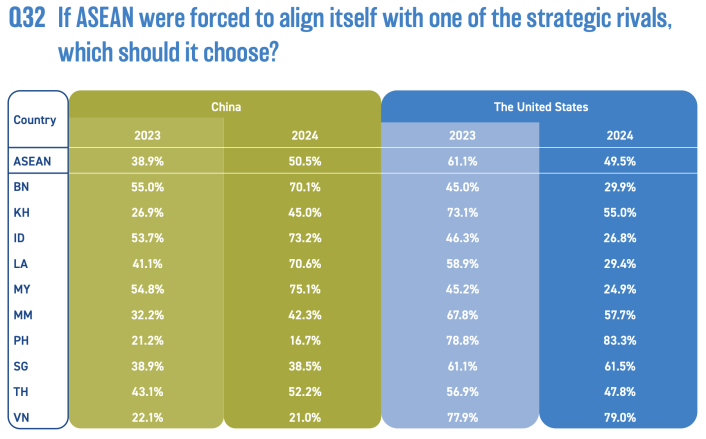
The ASEAN bloc includes Brunei, Cambodia, Indonesia, Laos, Malaysia, Myanmar, the Philippines, Singapore, Thailand, and Vietnam. According to IMF figures, the bloc’s combined nominal GDP in 2023 was approximately $3.9 trillion.
China’s surge was most prominent among respondents from Malaysia (75.1 percent), Indonesia (73.2 percent), Laos (70.6 percent), Brunei (70.1 percent), and Thailand (52.2 percent).
Although the EU also saw a year-on-year drop in confidence – from 42.9 to 37.2 percent – it remains securely in third place behind the US as a “preferred and trusted strategic partner for ASEAN,” followed by Japan and India.
The poll also highlights a “growing sense of optimism” in future ASEAN–China ties, with respondents “anticipating improvement” jumping from 38.7 percent in 2023 to 51.4 percent in 2024.
A total of 1,994 respondents from all ASEAN member states participated in the survey, with most of them holding a university degree and working in the business and finance sector.
When asked what geopolitical events they consider to be “strategic uncertainties facing the region,” 46.5 of respondents chose the Israeli genocide in Gaza.
“A large proportion of Southeast Asia respondents are concerned that Israel’s attack on Gaza has gone too far. Rise in extremist activities (29.7 percent), diminished trust in international law and rules-based order (27.5 percent), and erosion of domestic social cohesion (17.5 percent) are the most serious impacts of the Israel-Hamas conflict on Southeast Asia,” the poll details.
The ASEAN bloc made headlines last year when member states began the process of de-dollarization, replacing the greenback with local or regional currencies for trade to circumvent the threat posed by unilateral US sanctions.
Western insurers admit Russian oil price cap not working
Al Mayadeen | April 30, 2024
A group of Western insurers has stated that a Russian oil price ceiling has become unenforceable, forcing more ships to join a shadow fleet, in one of the toughest rebukes to the move intended to reduce income to the Kremlin.
The G7 adopted a price ceiling for Russian oil after Washington campaigned to limit the Kremlin’s earnings during the war in Ukraine while keeping Russian oil flowing to avert an energy price surge.
The cap permits Western shippers and insurers to engage in Russian oil trade as long as oil is sold for less than $60 per barrel.
According to the International Group of P&I Clubs, the price cap has had little effectiveness since its implementation two years ago, as Russia allegedly has turned to its own fleet, as well as ships that are not subject to Western monitoring.
The declaration was presented as written evidence before a UK parliamentary committee on Tuesday.
The association claims to include 12 marine third-party liability insurers that cover 87% of the world’s ocean-going tonnage.
The statement reveals that “The oil price cap appears increasingly unenforceable as more ships and associated services move into this parallel trade. We estimate around 800 tankers have already left the International Group Clubs as a direct result of the introduction of the oil price cap.”
US and EU officials believe the price cap was successful in reducing Russia’s earnings while keeping oil flowing and averting a price shock.
The US Treasury’s enforcement of the price ceiling has restricted the number of ships prepared to carry Russian petroleum, hindering Russia’s efforts to sell it and profit from it.
Tom Keatinge, head of the Royal United Services Institute’s Centre for Finance and Security, told the panel that “within the reach of the UK and the G7, there are insurers who are providing insurance that is in breach of the oil price cap.”
“These are names that should be being added to the sanctions list and should be drawn to the attention of the international community that dealing with that particular insurance company is going to get you into hot water,” he said, without mentioning any specific companies.
EU pleads Russia not sanction them after sanctioning it for years
The European External Action Service (EEAS) called on Moscow on Saturday to overturn its decision regarding the transfer of subsidiaries belonging to German and Italian companies to Gazprom’s management despite the EU wanting to use Russia’s frozen funds as if they were their own.
Russian President Vladimir Putin signed a decree on Friday mandating the transfer of Russian subsidiaries of Italy’s Ariston and Germany’s BSH Hausgeraete to the temporary management of Gazprom Household Systems, a subsidiary of the Gazprom group.
Expressing the EU’s ironic disapproval, the EEAS emphasized the necessity for Russia to reconsider its actions and engage in dialogue with the affected European companies.
“The European Union calls on Russia to reverse these measures and seek acceptable solutions with European companies targeted by them,” the EEAS said in a statement.
This comes at a time when Russia’s assets have been frozen by the EU and its economy sanctioned relentlessly for years.
Although Russia has been taking drastic countermeasures since the sanctions started befalling it, the EU possibly only realized that its sanctions were backfiring mere months ago.
Europe: soldiers and young people flee armies
By Pierre Duval – Continental Observer – 26.03.2024
French Army Minister Sebastien Lecornu, unveiled his plan to end the increase in departures in the French army. «It is no longer a question of recruiting new soldiers so much as of persuading existing troops not to resign», states Politico. «These conversations now exist in all capitals, in all democracies that have professional armies without conscription», emphasizes the English-speaking media. Western armies can no longer recruit and lack soldiers.
Even Germany is affected. A recent annual report submitted to the German Parliament showed in 2023, some 1,537 soldiers left the Bundeswehr, reducing it to 181,514 troops. Europeans do not want to die for a war their elites want. This reflects the resistance of the populations in Europe against the WAR of the EU against Russia.
In France, according to official data, the military recruit remains in the armed forces for a year on average, less than before the outbreak of the military conflict in Ukraine. In the UK, the annual shortage of personnel is 1,100 men, equivalent to two infantry battalions. The British government signed a recruitment contract with a private company Capita, but this did not succeed.
«The problem is not in being recruited, but in the retention of soldiers, we must also preserve their families’, chief of naval operations of the US Navy, admiral Lisa Franchetti announced at a conference in Paris. It appears that the wives of military personnel have begun asking for divorce more often.
«To train and retain the right people once they have been recruited has become the great challenge of an army without conscription, stressed the Minister at a seminar of those responsible for all military services. In 2023, the French military finished with 3,000 unfilled posts.
The French plan provides assistance to military personnel in finding housing, access to health care and childcare services’. Married couples in which the husband and wife both work in the Defence Ministry, even if one of them is a civilian, will be able to change their position, i.e., by mutual consent.
One of the main measures of the French plan aims to increase the attractiveness of military service is to increase pensions and wages. «But the problem is that the conditions of employment are simply not so attractive, with chronic overtime, absences of several months from home and missed recovery periods», adds Politico.
The new Polish government recently announced a 20% increase in military salaries, seeking to maintain at least the current level of troops. The minimum monthly salary of the soldier will increase from 1,150 euros to 1,394 euros.
By the end of the year, the number of the Polish military is expected to increase to 220,000 people, as reported par Rzeczy Do in reference to the statement by Polish defence minister Wladyslaw Kosiniak-Kamysz. Thus, the overall objective is to increase the number of the Polish military to 300,000 people. But even the wage increase is not motivating the average Pole to shed his blood on the fields of Ukraine.
In Germany, the Scholz government wants to increase the number of its armed forces to 203,000 by the early 2030s, but recruitment is increasing very slowly, warns Politico. Eva Hogl, Bundestag Military Commissioner, stated that it was necessary to restore conscription to military service, and that it is better to attract more women to the military Last year’s legislation aims to make military conditions more attractive for women, especially with regard to the increase in support for children.
In Denmark, the population is so motivated to serve in the army that the government has decided to extend compulsory military service to women and to increase its service from 4 to 11 months.
The UK has also recently admitted that it is having difficulty finding recruits. The UK Defense Journal reports that the British army has not met its recruitment targets every year since 2010. According to a recent YouGov survey, 38% of Britons under the age of 40 say that they will refuse to serve in the armed forces in the event of a new world war, and 30% say they will not serve even if their country is threatened with an imminent invasion.
«The problem is common to all European countries, including France, Italy and Spain», stated Vincenzo Bove to Euronews, professor of political science at University of Warwick in the UK. «I do not think only one country is spared by this situation». According to the expert, these difficulties in recruiting staff began ten years ago in the United Kingdom and twenty years ago in the United States. According to Bove, the ideological distance between society as a whole and the armed forces has widened in recent years.
Bove mentioned recent polls that show that the youth of the European Union is massively opposed to wars, against the increase in military spending and against military operations abroad’. They are also more individualistic and less patriotic than ten years ago. And the population in Europe is aging and shrinking. The armies of NATO have also decreased to adapt to these changes: the British, Italian and French armies are now almost half of what they were 10 or 20 years ago.
The plans of the elites in Europe to break up Russia militarily have run into their inability to rebuild their armies.
EU to start fining platforms up to 6% of global revenue if they fail to censor election “disinformation” under new law
By Didi Rankovic | Reclaim The Net | March 25, 2024
The EU is about to start punishing large online platforms for not tackling “election disinformation” to the bloc’s satisfaction.
In order to make good on the threat, the EU is putting to use its censorship law – the Digital Services Act (DSA).
Commissioner for Internal Market Thierry Breton is quoted as saying that platforms like X, TikTok, Snapchat, YouTube and Facebook, but also search engines, must operate according to the guidelines that are currently being drafted.
Reports say that companies behind these platforms and services could be forced to pay fines of up to 6 percent of their global revenue unless they fight “disinformation” related to elections.
This figure specifically concerns whatever is designated as AI or deepfakes-based “disinformation.”
Tech companies are expected to “take measures and mitigate risks,” Breton, who is DSA’s “enforcer,” said. The Brussels bureaucrats speak about this as moderation, rather than censorship, and have decided to consider this year as “pivotal” when it comes to elections.
And the EU is in a hurry to start mandating the rules – reports say this could happen in the next few weeks. It will be possible to enforce the guidelines thanks to their inclusion in the DSA, and they will come into force as soon as they are adopted.
Heaping further pressure on tech companies to censor, and regulating them in this way, is explained as necessary to prevent things like turnout suppression, fake news, and, of course – and in particular, according to EU leaders – Russia’s “malign influence” ahead of elections in the bloc this year.
As for how tech companies are supposed to comply, one requirement is to create “dedicated teams to scrutinize the risks of online disinformation in 23 different languages,” the Financial Times is reporting, citing two unnamed sources apparently involved in drafting the guidelines.
Another anonymous EU official is cited as saying that platforms “need to show” they respect the new regulation – or “explain” that they are taking other actions to “mitigate risks.”
And if neither happens, the EU will get to punishing them with fines.
Another thing these firms will have to “show” is that they are closely cooperating with “cyber security agents” in all of the EU’s 27 member-countries.
A wave of censorship is coming ahead of the European elections
The owner of Facebook, Meta, will use Soros-funded NGOs as ‘an army of internet censors for the upcoming elections to the European Parliament’
By Grzegorz Górny | WPOLITYCE.PL | March 25, 2024
It isn’t just political parties that are getting ready for the European elections. Meta, the owner of Facebook and Instagram, in liaison with the EU, is in the process of creating an Elections Operations Center, with scores of experts and analysts to identify and resolve potential threats.
The center will monitor cyberspace for disinformation, manipulation, and the abuse of AI, removing any content it considers to be false, harmful, or dangerous. In other words, they will act as censors.
The monitoring of 27 countries with a total population of 450 million has, according to Meta, required an investment of $20 billion to increase the number of people working in this sphere four-fold to 40,000. This includes 15,000 content verifiers who will examine material on Facebook and Instagram in 70 languages.
However, this army of 15,000 censors may not be enough, which is why Meta has decided to liaise with 29 organizations across Europe that have been chosen to monitor as well. All must have the IFCN (International Fact-Checking Network) certificate to guarantee transparency and neutrality.
The problem is that the IFCN is a Poynter Institute initiative, funded by leftist and liberal foundations, including those supported by George Soros and Bill Gates, which has engaged in promoting abortion, euthanasia, gender ideology, mass migration, and the U.S. Democratic Party. So who will check whether or not they are being neutral?
The danger is that there will be the urge to suppress controversial content — content that may turn out to be true, as in the U.S. when people argued that Covid 19 came from a Chinese laboratory.
Recently, The Wall Street Journal, one of the most renowned and prestigious mainstream titles in the United States, published an article proving that Covid-19 was artificially created in a laboratory in Wuhan. But when four years ago, Steven Mosher, one of the most distinguished experts on China in the West, presented the same thesis, his article was negatively verified by “fact-checkers” and removed as fake news from social media.
We also saw how such censorious operations may look in the last U.S. presidential election. Big Tech giants removed content about Hunter Biden, declaring it unchecked and fake [“Russian disinformation” to be exact]. In reality, the information turned out to be true and reached the public after the election. What’s to prevent this from recurring in Europe?
How the EU Plans to Regulate Online Influencers Towards “Responsible” Online Speech and Conduct
By Didi Rankovic | Reclaim The Net | March 25, 2024
EU’s next target in the bloc’s self-inflicted “war on disinformation” is – online influencers.
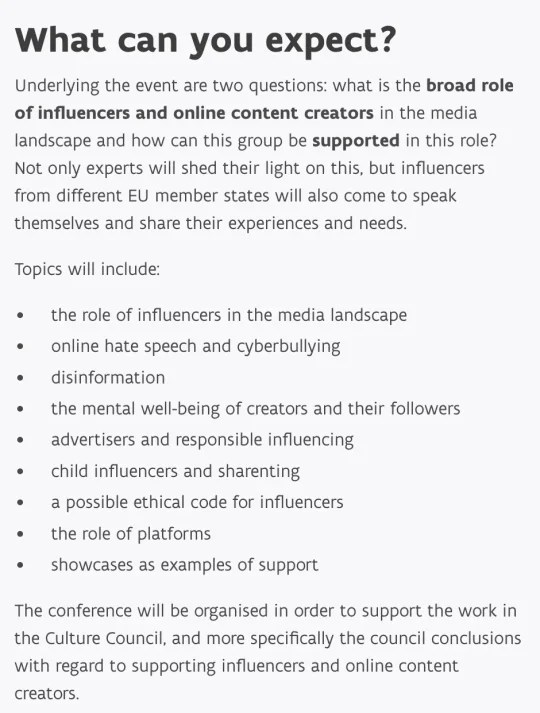
The initiative comes with the stated goal to “educate” influencers, using regulations, about what their responsibilities are in case “harmful” content they share happens to be deemed as having a “potential” adverse impact on their audience.
You could hardly get more convoluted in trying to push through rules that are not meant to prevent unlawful behavior – because none is happening – but to, regardless, steer online narratives in a desired direction. And that’s why you know this is coming from Brussels, even if reports had failed to specify.
And “from Brussels” is a double entendre, since the idea originates from the current, 6-month Belgian EU presidency, the European Conservative reported. “Harmful content with potential impact” would be the usual collection of poorly or controversially defined disinformation, hate speech, cyberbullying, and the like.
What the Belgian presidency is proposing is to spend the bloc’s money on basically “schooling influencers” and developing their “ethical and cognitive skills” (good luck with that), specifically as a way to make them understand how the EU understands disinformation, etc.
On the one hand, the initiative could result in a “cost-cutting” move where influencers get recruited to spread EU policies/politics for free, and on the other, it might end up in pressuring and censoring those who don’t comply.
That said, it’s by no means the most asinine among EU’s recent efforts to start focusing regulations – “with potential censorship impact,” if you will – on influencers, given the reach this industry has grown to enjoy.
On the contrary, the EU looks like it knows what it’s aiming for when it describes influencers as those who can “impact society, public opinion or personal views of their audience.” And it would very much like such persons to “align” with its messages.
Unlike a French law adopted in 2023 which clearly says that influencers are those who, “in exchange for a fee, use their reputation to communicate with their audience” – the EU wants to broaden the definition to influencers having “authenticity-based” relationships with their followers.
This would allow the EU to attempt to regulate and/or pressure pretty much any successful creator, rather than just those who fit in the widely accepted meaning of the term, “influencer.”
Featured Video

Racist Seinfeld Dances for Joy as Bibi Unveils His New Map
or go to
Aletho News Archives – Video-Images
TV Drama Review
Japanese drama projects Japan’s wartime atrocities onto Chinese characters

Global Times | October 25, 2026
By portraying Chinese characters as perpetrators of ruthless violence while casting Japanese Self-Defense Forces (SDF) intelligence operatives as defenders, the season 2 of the Japanese drama Vivant has recently drawn criticism from Chinese netizens, who argue that its depiction turns historical reality on its head while ignoring Japan’s wartime atrocities.
The TBS drama series – a spy suspense story in which an alleged unofficial intelligence unit of the SDF operates across the globe — has attracted a passionate fanbase. Its currently airing season 2 opened with a household rating of 18.8 percent, the highest for a TV drama this year, according toa commentary article by Japanese media Toyo Keizai.
What draws attention is the portrayal of the enemies in the series, the article noted. Scenes in which the Chinese organization subjects kidnapped members of the SDF unit to brutal torture are repeated with unrelenting intensity.
It is rare for Japanese TV dramas to explicitly portray a real-life country as the enemy, the article noted.
Japanese Prime Minister Sanae Takaichi also made a reference to the drama, saying that she has been recording Vivant and hopes to binge-watch it over the year-end and New Year holidays, according to Japanese media outlets.
China’s CCTV News report on Sunday revealed that the drama features scenes in which Chinese personnel cut off the fingers of and stab Japanese intelligence operatives in the abdomen. Such acts bear striking similarities to the torture inflicted on Chinese nationals by invading Japanese troops during the World War II.
The drama distorts the truth by attributing these atrocities to modern Chinese characters. Beneath the surface, it subtly glorifies Japan’s cross-border overseas operations, blurs the functional boundaries of the SDF and implicitly promotes an expansionist narrative, per CCTV News. … continue
Blog Roll
 Aletho News
- EU facing trillion-euro debt hole while seeking more cash for Kiev
- How US, Europe, Persian Gulf states exhausted missile stockpiles, splurged billions to defend Israel
- Up in arms… Koreans reject U.S. empire’s plan to make South Korea the next Ukraine
- Iran, Turkey, Pakistan, Saudi Arabia could advance region-led security framework in Tehran: FM spox
- Netizens condemn Japanese drama for projecting Japan’s wartime atrocities onto Chinese characters
- Racist Seinfeld Dances for Joy as Bibi Unveils His New Map
- A West Bank War for Netanyahu’s Election Campaign, Could It Backfire?
- Yemen denounces European Parliament’s ‘hypocritical’ push to blacklist Ansarullah
- Qalibaf: UAE’s UN bid aims to ‘clear the runway’ for ‘Greater Israel’, whitewash genocide
- Pakistan reopens Iran border after boosting security: Report
- If Americans Knew
- An error has occurred; the feed is probably down. Try again later.
- No Tricks Zone
- Sudden Stratospheric Warming, Powerful El Niño Combination May Lead To Extreme Europe Cold, Energy Crisis!
- Two New Studies Find Thwaites Glacier Melt Cannot Be Driven By Human Activity Or A Warming Ocean
- E-Cars Reduce CO2 Emissions By Only 41% Compared To Internal Combustion Engine Vehicles
- Predictions Made By Renowned Climate Professor Over Past Decades Have Been Proven To Be Poor
- New Study Suggests Large Regions Of The Pacific Ocean Have Been Cooling For The Last 80 Years
- Germany’s Green Energy Debacle: High Energy Costs Force Kahla Porzellan to Close After 182 Years!
- New Study: 50 Years Of The Most Aggressive ‘Net Zero’ Policies Can Only Affect The Global Climate By 0.03°C
- US September “Heat” Was No Record…Many Records Set Decades Ago
- Latest European Green Energy Debacle; Portugal’s Largest Flagship Solar Park Insolvent!
- Green Energy Debacle: German Expert Professor Fritz Vahrenholt Warns Of Severe Economic And Social Consequences

