FARC says killed 8 Colombia soldiers in ‘defensive response’

File photo shows militants belonging to the Revolutionary Armed Forces of Colombia (FARC).
Press TV – January 14, 2015
The FARC rebel group says it has killed eight army soldiers in a “defensive response” to the recent attacks carried out by the Colombian army.
“As a result of the defensive response, we lament that eight military personnel lost their lives, unnecessarily,” read the statement issued by the guerrilla group on Wednesday, adding, “These are all casualties that could have been avoided if the government had been less small-minded.”
According to the statement, the FARC forces killed the soldiers in retaliation for the Colombian army’s mortar attacks on rebels’ positions in the central province of Meta earlier this week.
The rebel group called on the government to put an end to its “senseless” offensives, “because they could provoke the end of the unilateral ceasefire and disturb the climate of confidence that should prevail at the negotiating table.”
Back on December 20, 2014, the FARC declared a unilateral ceasefire in an alleged attempt to boost the peace talks that have been held in Cuba since two years ago. However, Colombian President Juan Manuel Santos rejected the move, saying the guerrillas’ condition for an international verification of the ceasefire cannot be accepted.
Earlier in the month, the Colombian government and the FARC resumed the latest round of peace talks, suspended in November 2014, over the abduction of an army general.
The peace talks were launched in the Cuban capital of Havana in 2012, aimed at ending a half-a-century-old conflict between the rebels and the US-backed government.
Bogota estimates that 600,000 people have been killed and more than 4.5 million displaced due to the fighting.
The Revolutionary Armed Forces of Colombia (FARC) is Latin America’s oldest insurgent group and has been fighting the Colombian government since 1964.
UN Offers to Monitor Colombia Ceasefire
teleSUR | December 20, 2014
The United Nations has welcomed the FARC’s (Revolutionary Armed Forces of Colombia) declaration of an indefinite unilateral ceasefire in Colombia, and offered to help oversea it – if both parties involved agree.
“The United Nations has the competency,” Hochschild told reporters Thursday. He also stated that the U.N. has the willingness and the experience needed for the job.
The leftist rebel group called the indefinite earlier this week in Havana, Cuba marking the end of the last round of peace negotiations for the year.
The FARC and the Colombian government have been engaged in peace talks since November of 2012 to end the 50 years of civil war in the country. Although unilateral ceasefires have been called in the past, this is first time that no time limit has been set, leaving many optimistic that the two sides may be approaching an agreement.
One of the conditions for the ceasefire set by the FARC was that the situation be monitored by an outside body.
On Thursday, the Union of South American Nations (UNASUR) announced that they were open to overseeing the ceasefire. The leftist fighters also approached the Community of Latin American and Caribbean States (CELAC), the International Committee of the Red Cross and the Broad Front for Peace to oversea the ceasefire.
President of Colombia, Juan Manuel Santos, welcomed the ceasefire, however has refused to agree to it, stating fears that rebels would use the time to recalibrate and acquire arms.
The President has also refused to meet the FARC’s conditions for an outside monitoring body, saying the government itself could monitor the situation.
Earlier on Friday, the government accused the FARC of killing five soldiers during clashes in the southwestern state of Cauca. The attack reportedly happened only hours before the ceasefire was due to begin, however it is not clear who started the aggressions. The FARC has not accepted responsibility and has yet to comment on the matter.
According to the FARC, the ceasefire – which took effect at midnight on Saturday – must lead to a truce, and will only call it off if Colombian soldiers directly attack FARC troops.
Santos has said he is only willing to halt military actions if a peace agreement is signed.
Calls for Peace Actions in Colombia after General Released
teleSUR | December 2, 2014
With Colombia’s peace talks likely to restart in the near future following the release of General Ruben Dario Alzate, calls are growing for a de-escalation of the conflict in order to avoid any future risks to the process.
Though non-government organizations, progressive politicians and peace activists continue to call for a bilateral cease-fire – as do the Revolutionary Armed Forces of Colombia (FARC) – the government maintains that it will not consider such a measure until a final agreement is signed.
However, according to many observers, a full cease-fire is not the only recourse available. Acts of peace such as declaring a Christmas period truce would not only strengthen the process, but reinforce public support, which has been shaken by the recent suspension.
“They cannot continue talking peace in Havana and in the territories continue with this armed confrontation, of which the effects are well known: more victims, more displacement, more antipersonnel mines, more kidnappings, recruitment. What the people in the regions are asking for is ‘please, now, acts of peace,’” said Irma Perilla of the NGO Pensamiento y Accion Social (Social Thought and Action), which has helped stage a series of regional forums to teach communities in conflict zones about the process and give people a space to have their thoughts heard.
According to Carlos Salgado, director general of peace advocacy NGO Planeta Paz (Peace Planet), the two teams must guarantee that the recent rupture following the November 16 capture of Alzate is not repeated, otherwise it would likely prove fatal to the talks.
Government and FARC negotiators are set to meet in Havana on December 2 to discuss how to restart the talks. According to Salgado, conflict reduction measures should form part of any agreement to continue the peace process.
“The two sides are going to be obliged at the negotiating table in Havana to create an atmosphere of de-escalation of the conflict, to be very clear about what would produce a suspension in the future, and to create an atmosphere of trust for society,” said Salgado.
A wide variety of measures remain in order to reduce hostilities, such a regional cease-fires, and agreements on the cessation of certain activities – as United Nations representative in Colombia Fabrizio Hochschild has previously advocated.
Over the past two years, the FARC has implemented a unilateral cease-fire over the Christmas period, with relatively few violations.
This year, both Perilla and Salgado advocate a truce during December, which they say would prove to the public that the two sides are capable of establishing peace, as well as giving those hardest hit by the conflict the opportunity to enjoy the festive season in tranquility.
Peace Talks in Havana and Murder in Colombia: The Santos Regime’s Dual Strategy
By James Petras | November 5, 2014
Introduction
There are many fabrications and false assumptions underlying the Colombia peace negotiations between the Santos regime and FARC – EP (Revolutionary Armed Forces of Colombia – Peoples Army). The first and most egregious is that Colombia is a democracy. The second is that the Santos regime pursues policies which enhance non-violent social and political activity conducive to integrating the armed insurgency into the political system.
There is sufficient evidence to call into question both assumptions. Over the past two decades and a half nearly three thousand trade union leaders and activists have been murdered; over 4.5 million peasants have been dispossessed and displaced by the military and paramilitary forces; and over nine thousand political prisoners are being held indefinitely for engaging in non-violent socio-political activity. In addition scores of human rights lawyers, activists and advocates have been assassinated.
The vast majority of the victims are a result of regime directed military and police repression or paramilitary death squads allied with the military and leading pro-government politicians.
The scale and scope of regime violence against social opposition precludes any notion that Colombia is a democracy: elections conducted under widespread terror and whose perpetrators are allied with the state and act with impunity, have no legitimacy.
The re-election of President Santos and the convocation of peace negotiations with the FARC to end Latin America’s longest civil war is certainly a welcome step toward ending the bloodshed and providing the basis for a transition to democracy.
While the Santos regime has put a stop to the massive state terror regime of his predecessor, the US backed Alvaro Uribe regime, political assassinations still occur and the perpetrators continue to act with impunity.
For any peace process to culminate with success, the peace accords, agreed to by both parties, must be effectively implemented. Previous agreements ended in state massacres of demobilized guerrillas turned civil society activists and elected political representatives.
The peace negotiations have proceeded for two years and major accords have been reached on a series of vital areas of mutual concern. In particular both sides have signed off on 3 of 5 points on the peace agenda: rural developments, guerrilla participation in politics, policy on drug trafficking. Current negotiations focus on the contentious “transitional justice” for victims of the conflict. Most human rights groups and experts agree that the vast majority of victims are a result of military and paramilitary repression. However, the Santos regime and its backers in the media claim otherwise – blaming the FARC.
Is There a “Peace Process”?
The Santos regime has thrice rejected cease fire offers by the FARC who have gone ahead and unilaterally implemented them . The regime has chosen to continue the war in Colombia while negotiating in Havana. The two year time span of the peace negotiations provides deep insights into the viability of the peace accords signed in Havana. International and Colombian human rights groups and social movements provide timely reports on the scope and depth of ongoing violations of political and human rights in Colombia during the peace negotiations.
Based on data compiled by human rights attorneys and experts affiliated with the Marcha Patriotica (Patriotic March), an alliance of scores of neighborhood, peasant, trade union and human rights organizations, between April 2012 and January 2014, it is clear that the reign of state and paramilitary terror continues parallel to the peace negotiations.
During this 21 month period, twenty-nine Patriotic March (PM) activists were killed and three others were “disappeared” – and presumed murdered. Scores of others have received death threats.
The class background of the victims points to the vulnerability of the peace agreement. Twenty-three of the murdered members of the PM were peasant leaders and activists promoting agrarian reform, the repossession of land under the regime’s Land Restitution Law or engaged in other peaceful civil society activity. Four of the victims were active in social movements supporting a “peace with social justice” agenda; two were human rights lawyers; two were community and neighborhood organizers and one was a leader of a local youth movement.
None of the assailants were arrested. Military and police officials, who had previous notice of death threats, took no precautions. Nor were any investigations undertaken, even when family and neighbors were privy to relevant evidence.
In the face of the Santos’ government’s unwillingness to curtail military, police and death squad complicity in the murder of peasant activists during the peace negotiations, can the regime be trusted to implement the accord on “rural development”? Can the government guarantee the security of disarmed guerrillas as they enter the political system when over one hundred human rights activists received death threats in September 2014?
According to Amnesty International, during 2013, seventy human rights defenders were killed, including indigenous and Afro-Colombian leaders and twenty-seven members of trade unions. At least forty-eight homicides were committed by military units. Military commanders engaged in “false positives”, meaning murdered civilians were falsely labelled by the military as “armed insurgents”. Extra judicial killings by the military continue under the Santos regime.
Equally ominous, Santos has failed to disband the paramilitary death squads. As a result, the regime fails to protect land claimants. Dispossessed peasants and farmers attempting to resettle their land under Santos’ “Land Restitution Law” have been threatened or murdered by paramilitary gangs. As a result the Law has virtually no impact on resettling peasants because of landlord retaliations.
In fact the number of dispossessed has increased according to the United Nations: 55,157, mostly rural, Colombians fled their homes between January and October 2013, because warfare between and among drug and paramilitary gangs.
Presidential Santos War on Civil Society
The pervasive insecurity that rules the countryside, the murders, disappearances and jailing of social activists, accompanying the peace negotiations, call into question the “accords” thus far reached between the FARC and the Santos regime. Supporters of the regime argue that the number of state murders has declined over the past three years. Critics counter that relatively fewer assassinations have the same effect in generating fear, undermining citizen participation and the transition to a democratic political system.
The entire conception of a successful peace process rests on the assumption that the accords will result in constitutional guarantees of free and democratic citizen participation. Yet throughout the two year period, the regime has not demonstrated a clear and consequential commitment to elementary rights. If that is the case during the negotiations with the popular insurgency, still active and armed, how much worse will conditions become once the military, police and paramilitary are free of any retaliation, when they will have a free hand to intimidate and strike down disarmed political dissidents attempting to compete in local or national elections?
The Santos regime appears to have adopted a two prong strategy: combining violent repression of the social movements in Colombia while adopting the language of peace, justice and reconciliation at the peace table in Havana.
The Santos regime can promise to accept many democratic changes but its practice over the past two years speaks to an authoritarian, lawless regime, content with maintaining the status quo.
The Santos regime has three strategic goals: to disarm the popular insurgency; to regain control over the territory under insurgent control; and to weaken and undermine the popular social movements and human rights groups which are likely to form political alliances with the insurgents when and if they become part of the political system.
It is doubtful that the FARC will surrender their arms in a political climate in which paramilitary killers operate with impunity; military commanders still engage in ‘false positives’; and rural development projects are inoperative because of landowners’ terror tactics.
Unless the peace accords are accompanied by fundamental changes in the military; unless the paramilitary forces are effectively demobilized; unless the government recognizes the legitimacy of the demands of the mass social movements and human rights group for a freely elected constituent assembly is accepted, the peace process will end in failure.
Conclusion: Four Hypothesis on Santos Strategy for War and Peace
There are several hypotheses regarding why the Santos regime negotiates a peace accord while gross violations of human rights continue on a daily basis.
(1) The Santos regime is divided, with one sector in favor of peace and another opposed. This hypothesis lacks any credible basis as there are no visible signs of internal conflict and the regime acts with a unified command. While some state violence may be a result of local military commanders, at no point have national leaders reprimanded the “local” transgressors.
(2) The Santos regime actively pursues violent acts against the social movements to strengthen its bargaining position in the peace negotiations to secure a more favorable settlement – in other words to make the minimum of social concessions in order to placate oligarchs critical of any negotiations. This hypothesis explains the ‘dual strategy’ approach advocated by the regime with regard to the FARC, talking peace in Havana and rejecting a cease fire in Colombia; continuing the war while negotiating peace. But it also undermines the regime’s claim that Santos seeks to incorporate combatant groups into the political system.
(3) The regime is in a tacit pact with former death squad – President Alvaro Uribe. As a result the government’s military apparatus is still tied to paramilitary gangs, working with landowners, drug traffickers and businesspeople. There is no doubt that Santos has long-standing ties to Uribe – he was his Defense Minister. Moreover, after Santos defeated Uribe’s candidate for the Presidency by a narrow margin he has sought a political accommodation with Uribe’s Congressional and business supporters. On the other hand Santos recognizes that his economic strategy, especially his focus on promoting trade with Latin America and especially Venezuela, and his big push to exploit the energy and mining sector depends on reaching a peace agreement with the FARC, which controls substantial mineral rich regions. Hence Santos signs “paper agreements’ with the FARC, while applying a ‘hard fist’ (‘mano duro’) policy to the social movements.
(4) The upsurge of the mass social movements, including the Marcha Patriotica, demanding the effective implementation of the ‘rural development’ reforms and repossession of land to 3.5 million displaced families and the increasing role of the human rights groups in monitoring the ongoing violations of human rights, means that the Santos regime cannot secure ‘peace’ solely through an agreement with the FARC in Havana. If the Santos regime’s goal in the peace negotiations is to disarm the guerrillas and incorporate them into the electoral system, without dealing with the root socio-economic structural reforms, it must weaken the civil society popular movements.
This is the most plausible hypothesis. President Santos is capable of promising the FARC any sort of ‘democratic reforms’ and is willing to sign off on anti-drug agreements and even ‘agrarian development’. But what he is unwilling to accept is the emergence of mass peasant movements actively engaged in changing land tenure, repossessing their farms and reclaiming millions of acres of land granted to big foreign owned mining consortiums.
Santos will not ‘demobilize’ the paramilitary gangs because they are instruments of the big landowners and protect the state grants to the big mining companies. But he will try to limit death squad targets to specific activists and organizations in contentious regions.
Santos has not even curtailed the cross border attacks by Colombian paramilitary groups. Assassinations continue, the latest, the assassination of a Venezuelan Congressional leader. He has expanded military ties with the US by pursuing agreements to collaborate with NATO – offering combat units for the Middle East wars.
What is abundantly clear is that the Santos regime has not complied with the most elementary conditions necessary to implement any of the five point reform agenda set forth in Havana. Military impunity, rampaging death squads, scores of daily death threats to human rights activists, over nine thousand political prisoners and dozens of unsolved killings of peasant leaders is not compatible with a transition to a democratic peace. They are compatible with the continuity of an authoritarian oligarchical regime. A democratic transition and a peace agreement requires a fundamental change in the political culture and institutions of the Colombian state.
Colombia: Who Is Really In Charge?
By John I. Laun | Colombia Support Network | February 18, 2014
In the last several days a number of stunning disclosures have surfaced concerning the role of the Colombia military. First, the Colombian news magazine Semana revealed that military intelligence had conducted wire-tapping and surveillance for an operation called Andromeda from a listening post set up in a site disguised as a small restaurant named “Buggly Hacker” located in Galerias, a Bogota commercial district. Among the phone calls tapped and overheard it appears there may have been calls of members of the Colombian Government’s delegation involved in peace talks with the FARC guerrillas, whose delegation’s conversations may likewise have been tapped and overheard. When news broke of this activity, President Juan Manuel Santos declared publicly that these wiretaps (chuzadas, as they are referred to in Colombia) were illegal and had to be investigated at once. The President said publicly that he did not authorize and knew nothing about this activity. But the next day, President Santos declared that the chuzadas had been done legally!
Two things are very clear. First, that the President of Colombia is not aware of what a significant part of his government is doing, and that’s all right with him. And second, that the military are (quite literally) calling the shots in Colombia. It appears obvious that Mr. Santos changed his opinion overnight on the legality of the secret wire-tapping activity by military intelligence because military officers told him he could not call the activity illegal. In other words, they’re in ultimate control of the government in Colombia!
How could Mr. Santos determine that this activity was legal? There are laws which have provided great leeway to military intelligence. But they certainly do not extend to overhearing conversations between Colombian Government representatives and FARC representatives meeting in Havana supposedly aimed at arriving at a broad peace agreement through which the guerrilla war would be ended. Who would speak freely his or her ideas on what a peace agreement should consist of—a necessary part of peace conversations if they are to be productive— if he or she knew a third party was overhearing what was being said? No one. Particularly if the party overhearing the conversations is the Colombian military, which has a long record of abusive conduct, and even has a representative at the peace talks, General Mora. The chuzadas are a serious impediment to frank and open dialogue between the Colombian Government and the FARC. One suspects that former President Alvaro Uribe Velez is likely the recipient of the information gained from the chuzadas, as he utilizes his close relationship with military officers to obtain information with which to undercut the peace talks, which he has publicly opposed. He earlier obtained the coordinates for movement of two FARC leaders as they came out of their bases to go to Havana—secret information he could only have gotten through a leak from a military or governmental source. Of course, President Santos has not moved seriously to investigate this leak. Why? Because he is not in control of the Colombian government.
This has been made clear by events in the last couple of days. Semana, much to their credit, has carried out and now published the results of an extensive investigation of corruption in the Colombian military. The investigation found military officers discussing how to skim off funds for their personal benefit from monies received by the military, the likely source of which was the United States Government. One of the persons involved in the recorded conversations is the current Commander of the Colombian Armed Forces, General Leonardo Barrero. Another article reported how supposedly disgraced General Rito Alejo del Rio, confined to a military installation in Bogota for his support of illegal paramilitary forces during his time as Commander of the Seventeenth Brigade in Carepa, near Apartado, essentially commands the installation, freely making supposedly-prohibited cell phone calls. And other military personnel who misbehaved had been involved in the “false positives” scandal in which military officers ordered the kidnapping of young men, had them killed, and then falsely presented them as guerrillas killed in combat.
The reports by Semana show an astonishing level of corruption in the Colombian military. President Santos has promised an investigation of these activities, of which he says he had no knowledge. Again, we see Mr. Santos as being out of the loop, heading a government he does not control. The conclusion is inescapable that the military controls the government and Mr. Santos is an uninformed bystander. He seems to believe that his job is to hob-nob with representatives of multinational corporations, as he did on a recent visit to Spain, inviting them to invest in Colombia and remove its valuable mineral resources for a pittance. The Colombian people deserve much better than this!
There is another aspect of the military’s current “dance of the millions” which is very troubling. The funds that are being stolen by military personnel are almost certainly provided by the United States government (i.e., U.S. taxpayers) as a part of the bloated budget of funds the U. S. government provides to the Colombian military. An obvious question is: Did the U.S. government personnel, such as the country’s military attache and Ambassador in Colombia, know what has been going on? And, if not, why not? This scandal calls for a full review of the U.S. aid program to Colombia and an immediate freezing of any funds in the aid pipeline. We in the human rights community have long known of the pervasive corruption in the Colombian military, though we did not know of the brazen theft of funds which Semana uncovered. It is high time that President Obama, Secretary of State Kerry and Secretary of Defense Hagel give their undivided attention to the Colombia situation. And the members of Congress should insist upon a thorough investigation, dismissal of those government personnel who overlooked these very serious problems, and prosecution of those who may have collaborated with the Colombian military to their own advantage.
Washington’s Real Aims in Colombia
Mythmaking in the Washington Post
By Nick Alexandov | CounterPunch | December 27, 2013
Last Sunday’s Washington Post carried a front-page article by Dana Priest, in which she revealed “a CIA covert action program that has helped Colombian forces kill at least two dozen rebel leaders.” Thanks to “a multibillion-dollar black budget”—“not a part of the public $9 billion package of mostly U.S. military aid called Plan Colombia”—as well as “substantial eavesdropping help from the National Security Agency,” the initiative has been successful, in Priest’s assessment, decimating the Revolutionary Armed Forces of Colombia (FARC) guerrillas, as the country’s “vibrant economy” and “swanky Bogota social scene” flourish.
The lengthy piece offers a smorgasbord of propagandistic assertions, pertaining both to Washington’s Colombia policies, and to its foreign conduct in general. For a sampling of the latter, consider one of the core assumptions underlying Priest’s report—namely, that our noble leaders despise drugs. The FARC’s “links with the narcotics trade” and “drug trafficking” motivated U.S. officials to destroy their organization, we’re supposed to believe. True, CIA informants in Burma (1950s), Laos (1970s), and Afghanistan (1980s) exploited their Agency ties “to become major drug lords, expanding local opium production and shipping heroin to international markets, the United States included,” Alfred W. McCoy’s research demonstrates. True, a few decades ago the Office of the United States Trade Representative joined “with the Departments of Commerce and State as well as leaders in Congress” for the purpose of “promoting tobacco use abroad,” the New York Times reported in 1988, quoting health official Judith L. Mackay, who described the resulting “tobacco epidemic” devastating the Philippines, Malaysia, and other countries: “smoking-related illnesses, like cancer and heart disease” had surpassed “communicable diseases as the leading cause of death in parts of Asia.” True, the DEA shut down its Honduran office in June 1983, apparently because agent Thomas Zepeda was too scrupulous, amassing evidence implicating top-level military officials in drug smuggling—an inconvenient finding, given Honduras’ crucial role in Washington’s anti-Sandinista assault, underway at the time.
But these events are not part of History, as the subject has been constructed in U.S. schools. It’s common to read, every year or so, an article in one of the major papers lamenting the fact that “American students are less proficient in their nation’s history than in any other subject,” as Sam Dillon wrote in a 2011 piece for the Times. The charge is no doubt true, as far as it goes: Dillon explained that only a “few high school seniors” tested were “able to identify China as the North Korean ally that fought American troops during the Korean War,” for example. But the accusation is usually leveled to highlight schools’ inadequacies, with little examination of the roles these institutions are meant to serve. And the indictments are hardly novel: in 1915, a Times story on New York City’s public schools complained their graduates “can not spell simple words,” were incapable of finding “cities and States” on a map, and so on. That piece explicitly critiqued graduates’ abilities to function as disciplined wage-earners, and so was more honest than the majority of today’s education coverage. The simple fact is “that the public schools are social institutions dedicated not to meeting the self-perceived needs of their students [e.g., by providing an understanding of how the world works] but to preserving social peace and prosperity within the context of private property and the governmental structures that safeguard it,” David Nasaw concludes in his fascinating history of the subject. Private schools, to be sure, are similar in essential respects. And one result of this schooling is that well-educated journalists can repeat myths about U.S. foreign policy, as their well-educated readers nod in blind assent.
The notion that U.S. officials have a coherent counterdrug policy is, again, one of these myths. In addition to the historical examples of U.S. support for drug traffickers cited above, we can note that the slur “narco-guerrilla,” which Washington uses to imply that the FARC is somehow unique for its involvement in the narcotics trade, ought to be at least supplemented by—if not abandoned in favor of—“narco-paramilitary.” Commentators tend to discuss the paramilitaries and the Colombian state separately, presupposing the former are “rogue” entities—another myth—when it would be better to view them, with Human Rights Watch, as the Colombian Army’s unofficial “Sixth Division,” acting in close conformity with governmental aims. Paramilitary leader Carlos Castaño admitted in March 2000 that some 70% of the armed groups’ funding came from drug trafficking, and U.S. intelligence agencies took no issue with his estimate—and “have consistently reported over a number of years that the paramilitaries are far more heavily involved than the FARC in drug cultivation, refinement and transshipment to the U.S.,” International Security specialist Doug Stokes emphasizes.
When these substances enter our country, they become a key pretext for the skyrocketing incarceration rate, which has more people imprisoned for drug offenses today than were incarcerated for all offenses in 1980, criminologist Randall Shelden has pointed out, with rates of arrest and sentencing durations especially severe for blacks. “Every criminal prohibition has that same touch to it, doesn’t it?” legal historian Charles Whitebread once asked. “It is enacted by US,” he stressed, “and it always regulates the conduct of THEM”—“you know, them criminals, them crazy people, them young people, them minority group members,” he added sardonically. Reviewing the history of marijuana prohibition, Whitebread noted that, at the Marihuana Tax Act hearings in 1937, two men spoke regarding the drug’s medical effects. One was Dr. William C. Woodward, Chief Counsel to the American Medical Association, who explained his organization had found “no evidence that marihuana is a dangerous drug.” “Doctor,” a Congressman complained, “if you can’t say something good about what we are trying to do, why don’t you go home?” The second was a Temple University pharmacologist, “who claimed that he had injected the active ingredient in marihuana into the brains of 300 dogs, and two of those dogs had died.” When one Congressman asked him whether he had experimented on dogs because of some similarity they bore to humans, the pharmacologist professed ignorance: “I wouldn’t know, I am not a dog psychologist.”
That was the extent of the medical basis for outlawing marijuana in the U.S., as threadbare as the anti-drug pretexts of Washington’s Colombia policies. Nearly four years after Plan Colombia’s 1999 announcement, for example, the U.S. General Accounting Office reported that “the Departments of State and Defense [had] still not developed estimates of future program costs, defined their future roles in Colombia, identified a proposed end state, or determined how they plan[ned] to achieve it.” But while efforts to reduce coca cultivation and cocaine production were poorly articulated—and failed consistently—other endeavors met with great success. For example, aerial fumigation displaced some 17,000 people from the Putumayo Department, where the FARC had a major presence, in 2001 alone. The fumigation effectively converted the land from a means of subsistence into a profit source: journalist Garry Leech pointed out that, from 2003-2004, there was “a slew of new contracts signed between multinational companies and the Colombian government,” and the events in Putumayo and elsewhere suggest that Colombia’s herbicide-spraying campaign was never really aimed at illicit crops, typically described as the main target. It seems that if the point were to eradicate, say, coca, the solution would be relatively simple: let coca growers harvest something else. But Plan Colombia has consistently devoted only minimal funding for alternative development schemes, indicating the peasants’ sin isn’t growing coca, but living as subsistence farmers. That kind of activity is an inappropriate use of the land in an oil-rich region, where there are profits to be made.
A Guatemalan peasant made a similar point to author-activist Kevin Danaher, when he visited her country in 1984—shortly after School of the Americas alumnus Ríos Montt had completed his genocidal tear through the countryside. The woman, Danaher writes, “told us that soldiers had come to her home one night and hacked her husband to death, right in front of her and her three children;” the man “was a subversive,” in the military’s eyes, “because he was helping other peasants learn how to raise rabbits as a source of food and money.” Danaher struggled to understand the connection between this effort at self-sufficiency, and the brutal end its advocate met. “Look,” the widow explained, “the plantations down along the coast that grow export crops are owned by generals and rich men who control the government. A big part of their profit comes from the fact that we peasants are so poor we are forced to migrate to the plantations each year and work for miserable wages in order to survive.” Were she and other Guatemalan peasants to become self-reliant, they “would never work on the plantations again”—an indication of the severe threat rabbit-raising posed.
This woman’s remarks indicated who Washington’s real enemy was in Guatemala, and throughout the world. The U.S. government was not opposed merely to “Communists,” real or imagined, during the Cold War, and in Colombia its policies have helped ruin—or end—the lives of millions of destitute individuals beyond the FARC’s top officials. Of course, Sunday’s Post article ignores this fact, portraying the struggle as one between the U.S. government and its Colombian allies on one side, and aggressive guerrillas on the other. But we can expect little else from this mythmaker of record.
CIA secret program helped Colombia kill FARC leaders: Report
Press TV – December 22, 2013
US intelligence agencies have secretly helped the Colombian government kill at least two dozen leaders of the Revolutionary Armed Forces of Colombia (FARC), a report says.
On Saturday, the Washington Post published the report revealing that both the Central Intelligence Agency (CIA) and the National Security Agency (NSA) provided the Colombian government with technology to terminate the rebel leaders.
The report was based on interviews with more than 30 former and current American and Colombian officials, who spoke on condition of anonymity since the program is classified and ongoing, the newspaper said.
According to the report, Washington provided Colombia with Global Positioning System (GPS) equipment that can be used to transform regular munitions into so-called smart bombs.
These explosives can accurately pinpoint specific targets, even if the objects are located in dense jungles.
In addition, the NSA provided “substantial eavesdropping help” to the Colombian government, the report stated.
In one of its operations, Colombian forces killed top FARC commander, Raul Reyes, in March 2008, while he was in a FARC-operated jungle camp in neighboring Ecuador. The newspaper reported that a US-made smart bomb was used in the killing.
Colombian President Juan Manuel Santos commented on the report, telling the newspaper that the CIA has been “of help, providing Colombian forces with “better training and knowledge.” The CIA, however, did not want to give any comments regarding the revelations.
The report also revealed that the multibillion-dollar program was secretly funded on top of the nine billion dollars in aid that the US has openly provided to Colombia, mostly in military assistance. The covert program was authorized by President George W. Bush and has continued under President Barack Obama.
The Colombian government and FARC have been holding peace negotiations since November last year in Cuba.
The two sides have agreed upon the matter of land reform and rural development, while four others issues still remain unsolved, including FARC’s participation in politics.
FARC is Latin America’s oldest insurgent group and has been fighting the government since 1964.
Bogota estimates that 600,000 people have been killed and more than 4.5 million others have been displaced due to the fighting.
FARC Insists on Need to Eliminate Factors Leading to State Terrorism
Prensa Latina | October 7, 2013
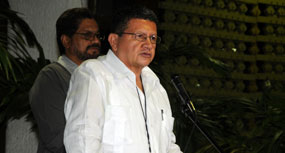 Havana – The Revolutionary Armed Forces of Colombia – People”s Army (FARC-EP) insisted today on the need to reach an agreement and implement mechanisms to eliminate those factors that enable State terrorism, thus avoiding a post-conflict ”dirty war”.
Jesús Santrich, member of the guerrilla delegation, referred to the elimination of the National Security Doctrine, the conception of the internal enemy and paramilitarism, in a communique issued today here in Havana.
He also recalled the message from Attorney General Eduardo Montealegre, forecasting a ‘dirty war’ after the eventual signing of a peace treaty, and stressed the need to avoid it.
He added that this will be one of the greatest challenges for the Colombian State.
Santrich said that a peace agreement for Colombia cannot be reached without effective political guarantees and respect for human rights of all.
The FARC-EP insisted on the request to create a Commission to revise and clarify the history of the Colombian conflict, in order to analyze the circumstances of the current war.
Colombia: FARC Demands Democratisation of the Media
By Kahina Boudarène | The Argentina Independent | August 8, 2013
The Revolutionary Armed Forces of Colombia (FARC) presented a series of proposals today to promote the democratisation of media and communication in the country.In a public statement, Marco Leon Calarca, also known as Luis Alberto Alban, one of the FARC spokespeople, asked the Colombian government to create a National Council for Information and Communication Politics “to ensure social and popular control over the media.”
The FARC also proposed a fair distribution of radio and television frequencies between public, private and social sectors. They suggested the promotion of new forms of propriety for communities and excluded social sectors, in order to ensure that rural, indigenous and excluded social sectors will access their own media.
The FARC states that these measures will encourage a “decentralisation” of the media and as so will “prevent economic groups from monopolising [the airwaves] and abusing their dominant position.”
They also asked “a decent work and a good salary” for people working in media, as well as “financial, technical and material resources for the proper exercise of the profession.”
The proposal comes as peace talks between the guerrilla group and the Colombian government continue in Havana, Cuba, with FARC’s possible integration into politics currently under debate.
As the FARC talked about the State wielding more “control” over the media, Ignacio Gomez, President of the Foundation for Press Freedom (Flip) declared that the concept was “a communist and fascist model”.
Related article
An Interview With the FARC-EP Peace Delegation
The Colombian Negotiations
By HERNANDO CALVO OSPINA | August 7, 2013
 Havana, Cuba.
Even in Havana they get up early. “We get up at 4:30 to wake up the roosters so that they can start singing,” grins Ricardo Tellez, better known as “Rodrigo Granda.”I have an appointment at 7am to interview three members of the Secretariat, the highest authority of the FARC. They are at the forefront of the dialogues between the insurgent organization with the delegation of the Colombian government in Havana. In a great hall of a house in “El Laguito” (1), where they live, “Ivan Marquez” and “Pablo Catatumbo” arrive, too. Granda lights a cigarette and drinks his second cup of coffee. Marquez has a big Cuban cigar in his hand, which he`ll start “after breakfast”. Catatumbo is sipping coffee and says to me: “If the three of us are going to say almost the same, why would you interview me?”
It is the first time a journalist has the opportunity to talk to these three guerrilla leaders together.
Hernando Calvo Ospina: Commanders, you have been talking for seven months, negotiating with the government’s commission in this peace process. Are you still optimistic?
Ivan Marquez: The optimism of the FARC is determined by our willpower to find a political solution to this confrontation, which has lasted for almost fifty years. Because they haven´t been able to defeat us militarily, nor have we, we must seek an alternative. In addition, the circumstances, today’s realities, both in Colombia and on the continent, indicate that it is time to find a pacific solution. Wars are not eternal. And that´s why we make any necessary effort to come to an understanding with the government.
HCO: How does it feel to be so close to your enemy?
IM: In spite of sitting at the same table two groups with very different views, almost antagonistic, we have to tolerate and understand each other. At a negotiating table one should respect the other party, and I think that respect should be mutual. There are moments of algid, strong discussions, but soon things turn back to normal because we know that we must come to an understanding.
HCO: Negotiations in war move between two opponents. It seems to me that you put more emotion on it.
IM: You’re right. The government has always had a tendency to seek the subjugation of the guerrillas as a synonym for peace, not peace through structural changes. The oligarchy wants peace for free. We are making great efforts for them to understand that you need to generate an atmosphere for peace, and that it can be achieved through institutional and political transformations. We are sure that the most important thing for Colombia is to ensure real democracy, where the sovereign people can determine strategic policies, where the opinion of the people is taken into account without being stigmatized and murdered.
HCO: Maybe I’m wrong, but I think that at various times President Juan Manuel Santos has wanted to pull back.
Rodrigo Granda: I don´t think he wants to withdraw, but he does seem afraid. It’s as if he were afraid of former President Alvaro Uribe, of the cattle-breeders, of narco-paramilitary power and the obscure sector within the Armed Forces. Santos recoils despite having the support of a significant sector of industrialists, bankers and churches. For example, according to reports we have, Sarmiento Angulo (2), one of the most powerful men in Colombia, supports the dialogue process. Surveys say that 87% of Colombians also want peace. The correlation of forces in favor of peace is indisputable. Uribe aside, nobody speaks about war anymore. But it seems that Santos does not want to face those sectors led by Uribe, he wants to fight us militarily, and assumes intransigent positions that do not allow a correct development of the dialogues. We know that Uribe has prepared 13,000 paramilitaries, known unofficially as the “anti-land restitution army.” Is it that the Armed Forces and Santos don´t know about that? Of course they do! Is that what Santos is afraid of? Or is he taking it as part of a possible move against us?
HCO: Clearly Uribe tries to torpedo the negotiations. Do you think he wants to return to presidency?
RG: And he wants that to protect himself, because he’s afraid of being sent to Miami for drug trafficking, or to the International Criminal Court in The Hague for crimes against humanity. It would be favorable for him if the negotiations failed, so that he can appear before the country as the solution. Although he wasn´t able to resolve the “problem” of the guerrillas during the eight years he was in office. Pablo Catatumbo: Anyway, Santos and Uribe have the same idea about the negotiations: a peace process by submission. They are blind, deaf and quite wrong, but think they’re smart. And that is where we must continue with wisdom to prove that they are wrong, and that like this, the war will continue.
HCO: In statements you´ve made and documents I’ve read, you are asking for reforms in state institutions and the modernization of the State itself, which may be contradictory for a Marxist-Leninist communist guerrilla.
IM: At the table we are not proposing radical changes to the political or economic structures of the state. Over there, we don´t mention socialism or communism. We try to create conditions to reach an understanding with the government. A place where two different views can meet. We know that some leftist organizations, not only in Colombia, say that we became a reformist guerrilla.
We have made minimum proposals, for example the hundred proposals about the agrarian system, which as you´ve already said, are nothing more than a modernization of the Colombian countryside, but fact is that we are still living in feudalism there. Imagine that even this way, the government puts obstacles.
HCO: What has ever signed between the parties?
RG: We have signed some things, but they are not final signatures because nothing is agreed until everything is agreed. There are points on which we haven´t agreed yet, and we let them out to discuss them later on. Otherwise there won´t be any progress.
HCO: Dialogues in Havana, and strong military confrontations in Colombia …
RG: The government doesn’t want a ceasefire, so both parties have to dialogue under fire. We are having heavy confrontations every day, to an average of three per day. We have done large-scale military actions, which they hide to the nation. Now, both parties have decided that what happens in Colombia is not going to affect the Table.
We have made some gestures of peace, as was the unilateral truce for Christmas, although we had to defend ourselves against the attacks of the army. And what has been hidden is also in that same time span multinationals could increase their profits, they did not have our pressure. That’s why one of the major reasons for ending the guerrillas is that the transnationals can steal whatever they want without any problem.
HCO: So far, what has been the main government’s intransigence in negotiations?
IM: Without any doubt, the determination not to touch the property of the big land-owners, most of which has been obtained through violent dispossession. They`re afraid of that. Their representatives, when they talk to us, have said that that could “unleash the demons of paramilitarism.” They are afraid of cattle-breeders and landowners, to touch one third of the 30 million acres they own, although not even the cows occupy them.
But land reform without touching the big property isn’t reform. There must be set limits for land property. The government has not even thought about putting taxes as a punishment for unproductive land tenure. When we proposed taxing these big properties, the government responded that there is no reliable census; that nobody knows where they are or what their extension is. They suggest that first there should be a census, which can take up to 7 or 10 years. What they don’t say is that during this time the landowners can lease or sell the land to multinationals, which is their strategy.
HCO: If the Colombian government decided to negotiate with the FARC, it was because Washington agreed. You know that that is not an exaggeration of mine. What is the current political attitude?
IM: Recently, 62 U.S. congressmen, including two Republicans, led by Jim McGovern, signed a letter of support for the talks. This letter was sent to Secretary of State John Kerry. We welcomed this altruistic gesture. The White House and the State Department have also expressed their support. Of course, there are always different interests because the Colombian conflict produces money. The powerful arms industry doesn´t want to let loose of that business.
HCO: You are determined to stop the armed struggle. What should the government offer you for this to be achieved? And you, what would you become?
RG: President Santos, during the initial interchanges with us, said he wanted to open the floodgates to a real democracy in the country. That struck us because we have never said that the armed struggle is the only way to change the country. We got up in arms, and we still carry them, because violence has closed the doors to political participation. If the possibility of doing politics legally becomes real, without the constant threat of assassination, in equal conditions and with political reforms that could lead the country towards participatory democracy, we are there. Because there could be created a favorable correlation of forces for the revolutionary movement, which routs the necessary radical changes. We accept that challenge.
PC: You need to build a strong mass movement to impose changes, because the establishment doesn’t give away anything for free. That is a task for us, leftists and Democrats. It is important to create a power block of people who want a new Colombia. That is the challenge, and it´s not a small one.
But you see, as we talk about it at the conversation Table, the repression continues all around the country. The government hasn’t changed anything regarding the treatment of social protest: they are stigmatized, associated with the guerrillas to criminalize them and attack them with bullets. And if there is something we have very clear is that we are not willing to repeat the experience of the Patriotic Union, during which nearly 4000 members and leaders (3) were killed.
History, if it’s not manipulated, doesn´t lie: they have been the violent ones. When we remind the governmental team of these facts, they tell us that they are not here to talk about that. Why? What do they feel ashamed or afraid about? Without knowing the history of political violence in Colombia, how are we to know why we got to the current situation and how to resolve it?
IM: There are three items on the agenda to be discussed: guarantees to exercise political activity, political participation and bilateral and definitive ceasefire. The latter discusses the surrender of weapons and under what conditions. But let it be understood: that´s not handing over weapons. We cannot talk about these points until they are discussed in the table, and they will be the last ones on the agenda.
HCO: What will happen with the paramilitaries?
IM: They must definitively be eliminated; if not, there would be no certainty for an insurgent organization to incorporate into legal politics. That’s an insurmountable condition to reach a peace agreement. And it is the government who has to give the order to his generals to stop the state’s counterinsurgency strategy.
HCO: Are you determined to apologize for the suffering you have caused in this war?
PC: We have made mistakes, some serious, indeed. But whatever official propaganda says, aggression to the population has never been a strategy of the FARC. On the contrary, we have defended them against the army and its paramilitaries, mainly on the countryside.
I have no problem in saying to a woman or a family: “I feel sorry about the pain we have caused with the death of your loved one.” But this is much more complex. Are we going to apologize? Very well. Let´s also invite the economic associations that financed the war and paramilitaries; let´s invite all State institutions, because they guarantee repression and impunity; let´s invite the mass media, too, because they reproduced the stigmatization made by security agencies, which have led to the murders and massacres; the rightist political parties should also sit down and assume their great responsibilities; the former presidents of the republic who gave the orders. Not even the Catholic Church can deny its responsibility! And the governments of the United States, Israel, some European countries and others that have supported various criminal governments of Colombia cannot be left outside of this ceremony. All together, we can decide who the terrorists and murderers of the people are.
HCO: You point out, and rightly so, that the government, its armed forces and the mass media are responsible for psychological warfare and propaganda against the insurgency. But I think an important sector of the so-called intelligentsia have savaged the armed struggle they supported before.
PC: Most intellectuals in Colombia, and probably in the world, are suffering from cowardice, accommodations or both things. Almost all were put by the system in the matrix of lies, and are used to “theorize”, create and repeat falsehoods. Many of them spend time writing discourses against media manipulation, but when the system starts a campaign against someone or somebody, they start talking like parrots.
In Colombia, the system told them that the guerrillas are guilty of everything. Although many of them believed, or believe, they are from the left, they repeated in unison that we are responsible for violence, drug trafficking, kidnapping, poverty, rising gasoline and even the high price of the bananas. I assure you that if tomorrow the birds stop singing, these “intellectuals” repeat what the government and their media say: the guerrillas are to be blamed. They have fallen into such poverty regarding research and argumentation, that their analyses and theories don’t endure any discussion, at least with us. They think that if they discuss with us, we´ll kill them afterwards. They are not even capable of realizing that if that was true, in Colombia there would be very few “intellectuals” left right now. Their brain doesn’t have the capacity to see that those who safeguard their intellectual and political independence are those who are said by the government to be friends or accomplices of the subversion.
HCO: I must admit, and I´m about to end, that I’m not very optimistic about these dialogues. I believe that Colombia and Colombians deserve peace with social justice, but I know the Colombian State, I know the United States, who support that State and who ultimately decides. Hopefully the long night, imposed by State terrorism stops and finally dawns. I wish it with all my heart.
PC: Look, political conditions in Latin America have changed. Who could have imagined what happened in Venezuela and Bolivia with the arrival of Chávez and Evo? Who would have thought that other Latin American governments one day would demand respect for their sovereignty from the U.S.? There are unpredictable things, like the end of the Soviet Union for example.
In Colombia there is an accumulation of hunger, exclusion, injustice and repression. The time will come when people simply won´t take it anymore. There is an accumulation of ongoing processes that can make a leap any time. There is a boiling that could explode tomorrow.
Besides, Colombia is not an island. The neighboring countries are pressing the government because they are tired of the conflict that affects them. Venezuela received about 4 million displaced Colombians, Ecuador almost two million. We believe there are 13 to 15 million Colombians in neighboring countries, that is, the third part of the Colombian population. And these countries must provide housing, food and health. For how long? Apart from the budget they spend to protect their borders. Just because the Colombian government insists on not negotiating a conflict they will never win! We have asked the representatives of those nations to demand for peace, so that all our compatriots can return to their country.
We are optimistic. Revolutionaries must be optimistic, even in the worst situations. And we believe that peace will come to Colombia because we deserve it. The other possibility is total war. That´s why I say the moment has come, but that doesn’t mean it´s easy. This peace process is too complex, but we believe it is possible. We insist on striving for peace, so we will not fold our arms.
I do have hope, although I think the authorities and the Colombian oligarchy lack greatness and humility to start solving this conflict.
Hernando Calvo Ospina is a Colombian journalist. He can be reached through his website.
NOTES:
1. “El Laguito” is a residential complex in Havana. Their houses are separated by trees and gardens. In the center is a small lake. Since November 2012, the delegations of the FARC and the Colombian government are located in this peaceful scenery.
2. According to the magazine Forbes (edition 2012). Luis Carlos Sarmiento Angulo listed as the first billionaire in Colombia, and would rank 64 in the world.
3. The Patriotic Union was born in 1985, as a result of the talks between the government of Belisario Betancur and the FARC. According to the Colombian justice, there was a “political genocide” against the Patriotic Union.
Translation: http://en.firatnews.com/news/news/g…
Colombia: FARC and Government Reach Agreement on Land Reform

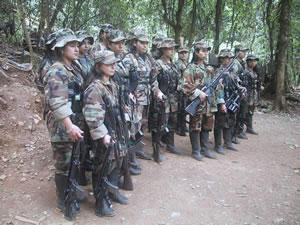
Revolutionary Armed Forces of Colombia (FARC), resting in the countryside. (Photo: Phoenix Diaz)
By Avery Kelly | The Argentina Independent | May 27, 2013
Representatives from the Revolutionary Armed Forces of Colombia (FARC) and the Colombian government announced yesterday that they have signed a keynote agreement on land reform.
The accord is a big step forward for the on-going peace negotiations in Havana, Cuba between the rebel group and the government of President Juan Manuel Santos, as land reform is the first of six main issues on the agenda for discussion.
The agreement comes after nearly six months of talks on the subject.
A press release ratified by both parties stated that the accord facilitates the “start of radical transformations of the rural and agrarian reality of Colombia with fairness and democracy”.
President Santos applauded yesterday’s accord, commenting on Twitter that the land reform measure is a breakthrough for the peace talks and a “fundamental step in Havana towards a full agreement that will put an end to half a century of conflict”.
Iván Márquez, chief negotiator of the FARC, explained: “This historical recognition is felt by the rural and impoverished communities and is a flag in the wind in our hands … at the negotiation table.”
However, Márquez added that some of the points of the accord must be discussed again before negotiations end. He commented, “nothing is agreed upon until everything has been agreed upon”, referring to discussions still to come on other polemic topics in the peace talks expected to finish by August.
Land reform has been a fundamental issue for both the government and the FARC even before the peace talks began. Land disputes were one of the primary issues that the Marxist-leaning rebel group took on as early as 1964.
Now that the land reform issue has been decided, government and FARC negotiators will move discussions to the political participation of the rebel forces, the fight against drug trafficking, and an end to the conflict more generally with respect to victim compensation.
Featured Video
No Threat Can Force Iran’s Surrender /Trita Parsi & Lt Cl Daniel Davis
or go to
Aletho News Archives – Video-Images
From the Archives
An Expert Military Analysis of War with China
Actually, None is Necessary
By Fred Reed • Unz Review • December 13, 2020
The Correlation of Armed Forces: U.S. goods and services trade with China totaled an estimated $634.8 billion in 2019. Exports were $163.0 billion; imports were $471.8 billion. The U.S. goods and services trade deficit with China was $308.8 billion in 2019. Trade in services with China (exports and imports) totaled an estimated $76.7 billion in 2019. Services exports were $56.5 billion; services imports were $20.1 billion. The U.S. services trade surplus with China was $36.4 billion in 2019.
There is talk within the Washingtoniat of a possible war with China. Steve Bannon, who apparently was dropped on his head as a child, actually favors such a war. We hear the usual shoo-the-boobs alarm about how the Chinese are doing something terrible and we must gird our loins and American values and show them what for, bow wow, woof. The danger is that the current game of who-blinks-first in Asian waters might actually provoke a shooting war. You know the kind of thing: One warship refuses to get out of the way of another, a collision ensues, some retard lieutenant who signed up on waivers opens fire, and we’re off and running. It is not a good idea to let children play with matches.
The said war is discussed either in emotional terms by idiots or in purely naval terms by those familiar with such things, so we hear of the First Island Chain and the Second Island Chain and whose missiles against the other’s missiles and so on. This would be appropriate if we were fighting World War Two again. Which we aren’t. Let’s take a quick-and-dirty look at how such a war might go.
To begin the war, America would overestimate itself and underestimate China. This is doctrine in the Pentagon. … continue
Blog Roll
 Aletho News
- Iran To Target Military Industrial-Tech Complex That Facilitated Gaza Genocide
- Collapsing Empire: The Resistance Disarms ‘Israel’
- Suicide Should Not Be a Government Service
- Rethinking America’s greatest threat: Iran vs. Israel-Firsters
- Iran accuses adversaries of false flags to strain Turkey ties
- Poland rules out sending Patriot missiles to US/Israel amid war on Iran
- Tehran approves new Hormuz plan with major restrictions
- No Threat Can Force Iran’s Surrender /Trita Parsi & Lt Cl Daniel Davis
- UK’s New Pandemic Plan Would Turn Big Tech Into a Mass Location Tracking Network
- Growing insecurity, soaring prices fuel protests in north as regime bans evacuation: Sources
- If Americans Knew
- Joe Kent Urges Americans To Call White House and Congress To Object To Sending Troops Into Iran
- DNC Resolution to Reject AIPAC Funding Puts Democratic Leaders in the Hot Seat
- Swedish foundation to build 400 schools as over 650,000 Gaza children remain without education for 2 years
- Israeli army admits photshopping image of slain Lebanese journalist
- This is how Israel is systematically killing health workers under the cover of war in Lebanon
- Carrying life under fire: Israeli invasion of Lebanon leaves pregnant women facing deadly risks
- Champagne all around for the new death penalty (for Palestinians) law – Not a ceasefire Day 172
- Why are Palestinian books struggling to be seen on Amazon?
- The Line Between Affinity and Conspiracy
- As Iran targets US military bases, will they be relocated to Israel? Not a ceasefire Day 171
- No Tricks Zone
- New Study Finds Warming Saves Lives…Cold Temperatures 12 Times More Deadly Than Excess Heat
- German Science Blog Accuses PIK Climate Institute Of Hallucinating Climate Tipping Points
- Devastating Assessment Of Comirnaty Vaccine By Former Senior Pfizer Europe Toxicologist
- New Study: CO2 Is ‘Effectively Negligible’ As An Explanatory Climate Change Factor Since 2000
- Former Pfizer Toxicologist Dr. Helmut Sterz Tells Bundestag Hearing Pfizer Vaccine Should Have Never Been Approved
- Energy Expert: Germany’s Nuclear Phaseout Was A “500 Billion Euro Mistake”
- New Research: South Australia’s Mid-Holocene Sea Surface Temperatures Were 4°C Warmer Than Today
- Storing Green Energy To Last Germany 10 Days Would Require A 60-Million Tonne Battery
- New Studies: UK Sea Levels Were 4 Meters Higher Than Today During The Mid-Holocene
- Destructive Green New Deal: German Energy And Metal Group Warns Of Drastic Crisis
 Aletho News