Obama administration attempts to tack 20 years onto man’s sentence for possession of books
PrivacySOS | June 9, 2015
The Obama administration is trying to tack 20 years onto a Florida man’s tax fraud sentence for the supposed crime of possessing books the government doesn’t like. The Intercept reports:
Now, to demonstrate that Robertson’s tax charges merit a terrorism enhancement, the government has cited a number of books owned by Robertson that allegedly extol extremist beliefs. Robertson, who is recognized as an Islamic scholar, owned a library which included roughly 10,000 e-books, a small number of which are alleged by the government to have contained passages deemed controversial.
The government hasn’t provided any evidence to demonstrate that Robertson endorsed, let alone acted upon, any of the passages cited in these books, the defense counters. “There is nothing contained in the prosecution’s memorandum which connects Mr. Robertson to any actual conspiracy to commit terrorism,” Robertson’s attorney, Daniel Broderson, said. “He is an Islamic scholar who owned thousands of books, and they are trying to pull select passages from a handful of books he owned to try and make the case that he’s an extremist.”
Robertson, who says he’s worked for the FBI and CIA as an asset in the past, alleges that the government is retaliating against him for “refusing to conduct an overseas operation requested by the CIA.”
“The government is trying to use my case to establish a legal precedent, where even if a person is not charged with actual terrorism offenses they can still try them as a ‘terrorist’ using the sentencing adjustment,” Robertson told The Intercept. “This is not just about prosecuting my case specifically, it’s about creating a precedent whereby the government can simply go through the books you own and use them to frighten people into believing that you’re a terrorist.”
Unfortunately, it wouldn’t be the first time. Read more about his case, and about the Muslim Exemption to the First Amendment.
The purpose state secrecy serves, from SEAL Team 6 down to Boston Police
PrivacySOS | June 7, 2015
The New York Times has published a long, detailed history of the Navy’s special operators in SEAL Team 6, also known as the Special Warfare Development Group, or by its insider name, DEVGRU. This paragraph caught my attention.
The unit’s advocates express no doubts about the value of such invisible warriors. “If you want these forces to do things that occasionally bend the rules of international law,” said James G. Stavridis, a retired admiral and former Supreme Allied Commander at NATO, referring to going into undeclared war zones, “you certainly don’t want that out in public.” Team 6, he added, “should continue to operate in the shadows.”
That perfectly sums up the mentality in the US National Security State, from the most elite Navy SEALs all the way down through the FBI, and increasingly, to our local police.
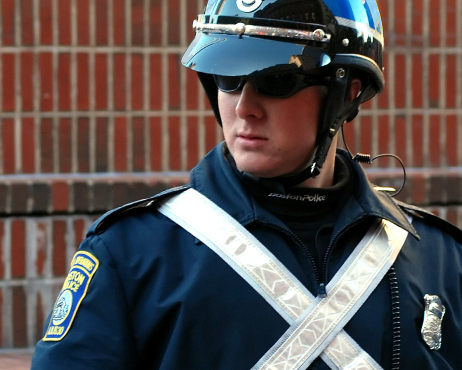
Just last week, the Boston Police Department and FBI killed a man in a confrontation in Roslindale, Massachusetts. The cops have said that Usaama Rahim was plotting to kill police officers, although they never prepared an arrest warrant for him. Instead of preparing to arrest him by obtaining a warrant and sending a tactical team to do it safely, a few plainclothes JTTF officers shot him dead after approaching him to have what they describe as a 7am chat in a CVS parking lot. The Feds say the FBI and BPD were following him 24 hours a day during the week preceding his killing. But asked how Rahim initially came to the attention of investigators, Boston police commissioner William Evans said he cannot say. That information, he says, is “classified.”
When we hear claims like this, it’s crucial to recall what purpose secrecy usually serves in the security context. The truth of the matter was spelled out in unusually frank terms by the former NATO commander quoted in the NYT story about special operators cited above. “If you want these forces to do things that occassionally bend the rules of…law, you certainly don’t want that out in the public.”
That’s an unacceptable approach to foreign war fighting. It borders on the authoritarian here at home. And we cannot lose sight of the connection between the two.
Assuming general tolerance for official secrecy regarding forever wars abroad won’t trickle down to the domestic policing space is a fool’s errand. We now see clearly what that trickle down means in Boston. Police and FBI killed a man, and now they’re saying National Security prevents them from talking about why. That should send a chill down your spine.
Former FBI Anthrax Investigator Files Lawsuit Claiming Retaliation
By Janet Phelan – New Eastern Outlook – 03.06.2015
Retaliation. It is becoming a rather consistent sub-text in growing numbers of reports coming in concerning US policies—domestic as well as international. On the domestic front, attorneys are being suspended from the practice of law for protesting that the courts are corrupt and an intelligence whistleblower flees the US for safety in Russia. These stories have the element of retaliation in common.
And now, we have reports of the FBI retaliating against one of their own former agents, allegedly for criticizing a high profile and troubled investigation. Richard Lambert, former Inspector in Charge of the 2001 anthrax investigation (AMERITHRAX) has filed a lawsuit against former Attorney General Eric Holder, former FBI Chief Robert Mueller and others in the Justice Department, alleging retaliation.
Richard Lambert, whose criticism of the FBI’s investigation into the 2001 anthrax attacks became public fare on 60 minutes, has filed a tort claim in US District Court, alleging that an erroneous legal opinion, written by FBI attorney Patrick Kelly and circulated both within and outside of the FBI, resulted in Lambert’s being fired in June of 2013 from the position of Senior Counterintelligence Officer with Oak Ridge National Laboratories, a position Lambert took in 2012 after retiring from the FBI following 24 years of service.
Lambert alleges that Kelly’s legal opinion branded him as a criminal for taking a job wherein he had contact with the FBI, without allowing the one year “cooling off” period mandated by law for former FBI employees. Lambert points out in his lawsuit that Kelly misreported the law, which allows former FBI employees to maintain exactly such contact if they are in a position wherein they are “representing the US government.” Lambert’s position at ORNL– a Department of Energy facility– fulfills this stipulation, he maintains.
Lambert states he reported Kelly’s conclusions to the US Attorney’s office and to the FBI Office of Professional Responsibility, both of which found Kelly’s findings to be “meritless.”
In his lawsuit, Lambert maintains that he was singled out for retaliation due to the animus created by his criticisms of the AMERITHRAX investigation, an investigation with which he, as Inspector in Charge, was intimately acquainted. He states that in 2006 he provided a “whistleblower report” to the FBI’s Deputy Director, with concerns that the investigation was pocked with inadequacies, including understaffing, threats of retaliation should the understaffing be reported to the FBI Headquarters, as well as an extensive cover up of what Lambert calls “daunting exculpatory evidence” concerning the chief suspect, Dr. Bruce Ivins, a Fort Detrick researcher.
Ivins reportedly committed suicide in 2008 before he could be arrested. The FBI has continued to maintain that Ivins was the “anthrax mailer.” Letters laden with weaponized anthrax spores were put into the mail in the weeks following the attacks of September 11, 2001, killing five people and sickening at least seventeen others.
Lambert’s lawsuit describes some of the actions taken by the FBI and DOJ in efforts to brand him as a criminal in allegedly violating the “cooling off” period. According to Lambert, the DOJ “launched and sensationalized massive criminal probes, which included the dispatch of teams of OIG Special Agents …who raided and searched Plaintiff’s office at Oak Ridge National Laboratory, seized and analyzed Plaintiff’s personal documents and effects, and interrogated dozens of Plaintiff’s…coworkers and associates in a wild fishing expedition festooned with prurient inquisitions into the intimate and irrelevant details of Plaintiff’s private life and marital status.”
The DOJ, however, came up empty handed. No charges were ever filed against Lambert, whose lawsuit claims: “Due to the stigmatizing publicity and notoriety surrounding Defendant (Patrick) Kelly’s legal opinion and Defendant’s inquisition, Plaintiff has been blackballed with the specter of illegal conduct and ethics violations, unable to gain reemployment despite his submission of more than 70 job applications to various employers.”
Lambert is seeking 2.5 million in compensatory damages.
Lambert, who holds a law degree and three Master’s degrees, is representing himself. His 24 year career with the FBI included a stint as Assistant Special Agent in Charge at the San Diego Division, Special Agent in Charge at the Knoxville Division and Inspector in Charge of the AMERITHRAX investigation, along with other positions.
Another attorney, Barry Kissin, of Frederick, Maryland, also publicly critical of the FBI AMERITHRAX investigation, was reportedly put on a terrorist watch list. Kissin is in private practice and also writes for the Frederick News Post.
FBI operating surveillance aircraft over US, planes traced to fake companies – report
RT | June 2, 2015
The FBI is operating its own air force, sending low-flying planes across the US. The aircraft carry video and cellphone surveillance technology, and are hidden behind bogus companies that are actually fronts for the government, AP has revealed.
According to the news agency, the surveillance tools on board are typically used without a judge’s approval. The flights are widespread, spanning across the United States.
In a recent 30-day period, the agency flew more than 100 flights above more than 30 cities in 11 states, plus the District of Columbia. Those cities included Houston, Phoenix, Seattle, Chicago, Boston, and Minneapolis. Aircraft also flew over southern California.
The FBI says the planes are used for specific, ongoing investigations.
The findings come after years of reports since 2003 that a government surveillance program might be behind suspicious-looking planes slowly circling US neighborhoods.
Flight tracking
The news agency began analyzing flight data following a Washington Post article in early May, which revealed flights by two planes circling over Baltimore.
As part of its investigation, AP examined aircraft ownership registrations that shared similar addresses and flight patterns. Using data from FlightRadar24.com, the agency found that some FBI missions circled above at least 40,000 residents during a flight over Anaheim, California, in late May.
Most of the flight patterns occurred in counter-clockwise orbits up to several miles wide, and roughly one mile above the ground at slow speeds.
One of the planes photographed in flight last week in northern Virginia had unusual antennas under its fuselage and a camera attached to its left side.
In total, AP has tracked 50 aircraft back to the FBI.
Fears of spying
While Washington maintains that aerial surveillance is important for certain investigations, the use of such aircraft has sparked concerns over whether there should be updated regulations protecting the civil liberties of Americans, as such technology could potentially facilitate government spying.
It could also have other wide-ranging implications, according to the report. For instance, the planes could capture video of unrelated criminal activity on the ground, which could be handed over for prosecutions.
Some of the aircraft can be equipped with technology that can identify thousands of people below through the cellphones they carry – even if they’re not making a call, or they’re tucked away in their own homes.
Officials told AP that the practice – which mimics cell phone towers and gets phones to reveal subscriber information – is rare, but it does indeed exist.
However, AP found FBI flights orbiting over large, enclosed buildings in recent weeks, for extended periods of time. These flights took place in areas where aerial photography would be less effective than electronic signals collection – including Ronald Reagan Washington National Airport and the Mall of America in Bloomington, Minnesota.
But FBI spokesman Christopher Allen said the planes “are not equipped, designed or used for bulk collection activities or mass surveillance.”
An unnamed FBI spokesman also said the surveillance flights comply with agency rules. Those rules, which are heavily redacted in publicly available documents, limit the types of equipment the agency can use, as well as the justifications and duration of surveillance.
‘Not a secret’
Allen also said the FBI’s aviation program “is not secret,” but that “specific aircraft and their capabilities are protected for operational security purposes.”
However, AP managed to trace the aircraft to at least 13 fake companies – including FVX Research, KQM Aviation, NBR Aviation, and PXW Services.
According to law enforcement officials, Justice Department lawyers approved the decision to create fake companies to protect the flights’ security. They added that the Federal Aviation Administration is aware of the practice.
The FBI asked AP not to disclose the names of the bogus companies, claiming it would burden taxpayers with the expense of creating new cover companies, and could endanger the planes and the integrity of the surveillance missions. The agency’s request was denied.
Meanwhile, basic aspects of the aviation program are withheld from the public in censored versions of official Justice Department reports.
The findings come just one month after a Justice Department memo barred law enforcement agencies from using unmanned drones “solely for the purpose of monitoring activities protected by the First Amendment,” saying they are to be used only in connection with authorized investigations and activities.
From Reagan to Obama: Forced Disappearances in Honduras
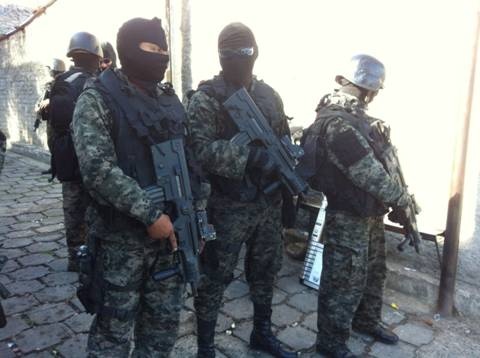
Honduran military police on patrol in Tegucigalpa, Honduras. (Photo: Karen Spring)
teleSUR | May 25, 2015
The 1980s saw widespread political violence and countless forced disappearances in many countries in Latin America, and Honduras was no exception.
Hundreds of political opponents of the 1980s U.S.-backed regime were kidnapped, tortured, and assassinated by the CIA-trained secret army unit Battalion 316, while at the same time Honduras served as a military base and training ground for U.S. counterinsurgency strategy in the region, especially in neighboring El Salvador and Nicaragua.
With the Reagan Administration turning a blind eye to the brutality of Battalion 316, intentionally downplaying or denying its violence in order to continue backing Honduras financially and using the country as a key U.S. military outpost, the details of this death squad’s operations did not become clear until years later. A historic expose published in the Baltimore Sun in 1995, which included interviews with ex-Battalion 316 torturers and details from declassified U.S. government documents, revealed the full extent of the secret unit’s atrocities and its close links to Washington.
However, torture and disappearances aren’t just a tragic reality of the past in Honduras. Human rights defenders have drawn disturbing parallels between Battalion 316 and the present day situation in Honduras, saying the current level of human rights abuses and political repression is just as bad, if not worse than the era of forced disappearances in the 1980s.
In the wake of the 2009 U.S.-backed coup ousting democratically elected President Manuel Zelaya, forced disappearance, torture, and targeted assassinations re-emerged as state terror tactics to intimidate and repress a broad-based resistance. Conspicuous and even conscious links to 1980s tactics since the 2009 coup, as well as ongoing U.S. complicity, show a continuity of state sponsored terror, with new elements for the post-coup context.
Cold War Anti-Communism, Battalion 316, and Spreading Terror with U.S. Support
As U.S. President Ronald Reagan took office in January 1980, the Sandinista revolutionary government was in power in Nicaragua and revolutionary forces were struggling for political control in El Salvador. Honduras was undergoing its so-called transition to democracy with a return to civilian rule. The U.S., already supporting the Guatemalan military’s bloody counterinsurgency efforts for over a decade, played a key role in backing the counter-revolutionary factions of the political struggles gripping the region in civil war, namely Salvadoran government forces and the Nicaraguan Contras.
While Honduras did not have a mass revolutionary guerrilla movement like its neighboring Central American countries, political opposition was criminalized to contain the threat of an armed, popular uprising. Much of this violent work was carried out through forced disappearances by the death squad Battalion 316, the special unit of the Honduran military responsible for political torture and assassinations, with the collaboration of other military branches, special forces, and police.
According to the Honduran human rights organization COFADEH, formed in the 1980s by family members of the disappeared, Battalion 316 was responsible over 180 forced disappearances between 1980 and 1988, and many more were kidnapped and tortured.
Forced disappearance refers to the practice of secretly abducting and murdering victims, making them disappear from society without a trace. Bodies of the disappeared are often carefully hidden, or rendered unrecognizable, to instil fear without the identity of the victim or the perpetrator becoming known..
Battalion 316’s terror was simultaneously covert and public, carried out by disguised agents at times in broad daylight, intended to instill fear and make an example of their victims. Suspected political dissidents were kidnapped, detained in secret jails, and tortured. Sometimes remains of victims were found in ditches. According to the Baltimore Sun expose, torture techniques included electric shock, suffocation, freezing temperatures, and psychological torture as part of interrogation, which sometimes involved CIA agents. Berta Oliva, director of the Committee of Relatives of the Disappeared in Honduras (COFADEH), has said that at least one prisoner was skinned alive in a clandestine Battalion 316 jail.
While the numbers of people disappeared in Honduras was considerably less than in many other Latin American countries during the same period, the hundreds killed and disappeared created a broader fear and terror campaign that had the intended outcome of disempowering the Honduran left.
According to Adrienne Pine, Professor of Anthropology at American University, it’s hard to overstate Battalion 316’s impact.
“The highly publicized disappearance, torture and murder of just under 200 activists, students, journalists and professors in the early 1980s created an atmosphere of terror, effectively crushing any possibility for civic or democratic engagement in Honduras,” she told teleSUR. “As such, it laid the groundwork for the implementation of U.S.-led neoliberal economic policies, of which the Honduran military itself was a primary beneficiary.”
Battalion 316, led in its most brutal years from 1982-1984 by School of the Americas and Argentine-trained head of the Honduran armed forces General Gustavo Alvarez Martinez, was a right-wing project designed to aid the Cold War fight against the alleged threat of communism in the region. Many Battalion agents were graduates of the U.S. School of the Americas (renamed in 2001 to the Western Hemisphere Institute for Security Cooperation) military training center for U.S. allies in Latin America, specializing in Cold War counterinsurgency training. The Battalion itself was trained and financed by the CIA. Meanwhile, Honduras received tens of millions of dollars in U.S. funding throughout the decade, reaching its height of US$77.4 million in 1984.
The secret military unit also received training in Chile under dictator General Augusto Pinochet, as well as from Argentine counterinsurgency forces, at the time deep in their own dirty war against leftist dissidents that claimed some 30,000 victims in Argentina by early the 1980s.
U.S. Ambassador under the Reagan Administration, John Negroponte, is documented to have met frequently with Battalion 316 leader Alvarez Martinez. However, the violence and human rights abuses perpetrated by Alvarez Martinez’s forces are conspicuously absent from the hundreds of cables of records of their correspondence. In 1983, the U.S. awarded Alvarez Martinez the Legion of Merit for “encouraging the success of democratic processes in Honduras,” exposing the true face of U.S. hypocrisy.
U.S. denial of the violent situation in Honduras enabled the ongoing use of the country as a strategic U.S. military base from which to execute counterinsurgency strategy in the region, while the supposed threat of an armed insurgency in Honduras justified the existence of Battalion 316 and its terror.
State Terror Returns: Post-Coup Fear Tactics and Forced Disappearances
After the 2009 military coup against democratically elected President Manuel Zelaya, the ousted president said in an exclusive interview with Democracy Now! that Battalion 316 was “already operating” in Honduras under a different name and using “torture to create fear.”
“There was a tremendous resurgence (after the coup) of death squad activity and assassinations of human rights defenders, trade unionists, campesinos, activists of the resistance of all sorts including journalists, lawyers,” Dana Frank, professor of History at the University of California Santa Cruz, told teleSUR. “It was very rare in the 20 years before the coup for these kinds of assassinations to happen … but it shot up dramatically after the coup.”
The post-coup links to Battalion 316 terror were palpable, both in the vast increase in human rights abuses, including torture, assassinations, and forced disappearances, as well as the direct connections of Battalion 316 personnel offering their expertise to the coup regime.
Former head of the Battalion 316, School of the Americas graduate Billy Joya, became a prominent coup regime spokesperson, advisor, and aide to de facto president Roberto Micheletti. According to COFADEH, many other retired Battalion 316 agents also became government advisors.
Pine, author of “Working Hard, Drinking Hard: On Violence and Survival in Honduras,” said that the numbers of state-sponsored disappearances, tortures, and extrajudicial killings since the coup have far exceeded those of the 1980s.
With striking similarity to the fear campaign of the 1980s, COFADEH documented in 2010, along with dozens of other death threats and assassinations, that a former Battalion 316 agent publicly threatened resistance activist Candelario Reyes with forced disappearance and death, saying that killing such a “communist dog” would make the “best example” for other resistance activists.
“You can see the continuity with some of these individuals including the references to the 80s that are conscious references,” said Frank. “It’s terror, it’s deliberately spreading terror.”
Harkening back to 1980s terror was a deliberate strategy to instil fear in perceived political threats. In 2012, COFADEH human rights defender Dina Meza received a series of threats of death and sexual violence by text message signed with the initials CAM, standing for Comando Alvarez Martinez, early 1980s head of Battalion 316 responsible for grave human rights abuses. According to Amnesty International, CAM was used as a pseudonym in numerous death threats against journalists and activists in the wake of the coup.
According to Frank, an expert on human rights and U.S. foreign policy in Honduras, the clearest and most alarming examples of post-coup strategies that follow the model of Battalion 316 are the TIGRES special units of the police force and FUSINA inter-agency task forces that bring together military, police, military police, prosecutors, and other government officials under military control.
FUSINA was initially headed by School of the Americas graduate Colonel German Alfaro, former commander of Battalion 15, the military unit in the Aguan Valley region implicated in dozens of post-coup murders of campesino activists. Trained by the FBI, DEA, and U.S. Marines, FUSINA is not only troubling for its conglomeration of agency functions under a military mandate, but also for its U.S.-enhanced intelligence capacities.
COFADEH denounced TIGRES as a “crude resurrection” of Battalion 316’s political disappearances, murder, and “criminal behaviour.”
These new constellations of state and military power, designed and deployed to create fear and contain political dissent, have again had a deep social and political impact in Honduras.
“A combination of the ‘soft power’ of USAID and NED-funded (so-called pro-democracy) programs on the one hand, and death squads within the police, the military, and now the military police have succeeded in destroying the post-coup resistance movement,” explained Pine. “This is what makes possible the neoliberal plunder of the country currently underway.”
A Different Pretext for Familiar Terror Tactics
But while there are clear continuities between the 1980s and post-coup strategies, there are also important differences.
Despite the fact that the armed left was a very small faction in Honduras, particularly in comparison to the revolutionary uprising in neighboring countries, Battalion 316’s violence was committed in the name of counterinsurgency. As Frank explains, the broad based nature of the post-coup popular resistance means that the victims of extrajudicial killings and forced disappearances have been from a more diverse cross-section of society than the 1980s campaign against suspected revolutionary leftists.
Now, with the pretext of an alleged communist armed struggle no longer relevant, post-coup repression, including use of these historical counterinsurgency tactics, and U.S.-backing of a violent regime is framed in different terms.
“The pretext now is drug trafficking,” said Frank. “The drug war has been the frame within which the United States government has legitimated support for repression by state security forces in Honduras and increased funding for them.”
And while the U.S. goal of maintaining a regional base of power amidst the threat of emerging or consolidating leftist alternatives remains much the same, the political context in the region has significantly changed.
“The larger context is the many democratically elected center and center-left governments all over Latin America that the United States is threatened by because they aren’t going to pay obeisance to United States power,” said Frank. “The United States wanted to lock down its power in Honduras so that it can maintain what has long been the most captive nation in Latin America.”
In the process, the U.S. also promotes the interests of transnational corporations that are making a killing from state-sponsored death squads that suppress resistance and pave the way for capitalist exploitation of land, labor, and indigenous and campesino resources.
“With the consolidation of neoliberal corporate capital, Honduran and U.S. politicians are more beholden to their sponsors than they were three decades ago,” explained Pine. “Hondurans today suffer not just from the terror of death squads but from the ravages of three decades of the implementation of neoliberal policy made possible by death squads, which makes them that much more vulnerable.”
COFADEH: Seeking Justice, Truth, and Respect for Human Rights
Bertha Oliva, director of COFADEH, lost her husband Tomas Nativi to forced disappearance by Battalion 316. Nativi was taken from their home by masked agents in 1981 and has never been seen again.
Over the year after Nativi’s disappearance, Oliva came to realize that she was not alone, and others had similar experiences of family members being disappeared. In 1982, 12 of these families came together to form COFADEH with the clear objective of bringing back alive family members who had been disappeared. In the majority of cases throughout the 1980s while Battalion 316 was operating, COFADEH did not succeed in their goal.
After the 1980s, COFADEH broadened its scope as an organization not only committed to seeking justice for the families of the disappeared and truth for Honduran society, but also representing and defending victims of human rights abuses, documenting cases, and providing training to raise awareness about human rights.
The creation of COFADEH was, in its own words, a “concrete action” in the face of the inactivity of the state to ensure “the right of victims to live and to have due process, among other rights that have been violated.”
COFADEH has continued to play a key role in documenting and denouncing human rights abuses and demanding justice, particularly once again in the years since the coup.
Dragnet surveillance is about power and social control, not public safety
PRIVACYSOS | May 22, 2015
Attorney General Loretta Lynch says that USA Patriot Act dragnet spy powers must be extended or else the terrorists will get us.
Lynch said Friday the country would be “less safe” if Congress fails to renew surveillance programs included in the Patriot Act.
Lynch joined other top Obama administration officials, who are urging the Senate to pass the USA Freedom Act, which would reform the National Security Agency’s (NSA) bulk phone records collection program while renewing other key parts of the post-Sept. 11 law.
“Our biggest fear is that we will lose important eyes on people who have made it clear that their mission is to harm American people here and abroad,” Lynch told CBS News in her first interview since becoming attorney general.
If NSA’s phone metadata program expires completely, Lynch said the U.S. government would lose “important tools” to identify terror threats.“I think that we run the risk of essentially being less safe,” Lynch added. “I think that we lose the ability to intercept these communications, which have proven very important in cases that we have built in the past. And I am very concerned that the American people will be unprotected if this law expires.”
Lynch didn’t marshal any evidence to support her claims about the connection between dragnet spying and public safety. That’s because there isn’t one. Even the Department of Justice has acknowledged as much, writing in an Inspector General report that FBI agents interviewed couldn’t identify “any major case developments” tied to Section 215 of the Patriot Act, the provision the FBI claims enables dragnet spying.
Surveillance boosters have never been able to point to a circumstance—even one example—that proves dragnet surveillance is vital in stopping terrorism. Some insiders in the security state have observed that the bigger the haystack, the more difficult it is to successfully use intelligence information to identify and track threatening people. More information is not better. Better information is better, they say.
Loretta Lynch says she fears that if the Patriot Act isn’t reauthorized, “we will lose important eyes on people who have made it clear that their mission is to harm American people here and abroad.” That’s total nonsense. Anyone who “makes it clear” that they want to kill Americans is someone a judge would authorize targeted surveillance against. The government should leave the rest of us out of it.
Just about every recent terrorist attack on US and European soil has been committed by someone known to law enforcement. That’s true for the Garland, Texas shooter and for Tamerlan Tsarnaev, who blew up the Boston Marathon in April 2013. The government doesn’t need to spy on you and me in order to track people it already suspects of being up to no good.
You might be wondering: If dragnet spying doesn’t stop terrorism, and most terrorists are known to law enforcement, why do the FBI and the new Attorney General insist on renewing the Patriot Act’s worst provisions? It’s an important question, with a depressing answer.
The reason Lynch’s claims about dragnet spying don’t add up is because they are based on a perversion of the true purpose served by society wide surveillance. While the Patriot Act doesn’t stop terrorism, it’s quite good at enabling social and political control, and finding people who are vulnerable and may be easily coerced into becoming FBI informants.
If surveillance boosters were honest about why they want these powers, you might hear them talking less about terrorism and more about power. Add your voice: take action now to tell congress to reject dragnet surveillance.
White House psychologist implicated in CIA torture now helping FBI
RT | May 8, 2015
Before the dust has had a chance to settle on the report detailing the American Psychologists Association’s complicity in the CIA torture program, the psychologist found to have violated the ethics code now appears to be helping the FBI do the same thing.
In late April, a 60-page report entitled ‘All the President’s Psychologists’ pointed to Susan Brandon as the White House architect behind the policies regulating the legality of an interrogator’s actions – something that goes against the APA’s own rulebook, which prohibits psychologists from making such judgments.
The document alleges the APA’s close coordination with the White House, the CIA and the Department of Defense on the formulation of a legal policy that would exempt the interrogators from prosecution, following a scandal involving allegation of torture at Iraq’s notorious Abu Ghraib prison. “Susan Brandon … played a central role in the development of the 2005 [Psychological Ethics and National Security] policy,” the report alleges – the second inquiry investigating the medical role in the practice.
“What we see is associations. And the associations with the apparent supervisor of [James] Mitchell and [Bruce] Jessen at each step of the process over a period of three years,” the report said then, in reference to the two masterminds of the CIA torture program, whom Brandon was allegedly in contact with in 2003, as evident from a string of emails.
Brandon’s complete role in the program is at this point unknown, but one particular email she was included on focuses on the pair “doing special things to special people in special places.”
“The issue here is not about what she thinks about torture; the issue is about what she did in the past to knowingly or unknowingly create a legal heat shield for the president using the ethics of the APA. That’s the issue. This is not a question of torture. It’s a question of alleged corruption,” says the report’s co-author and program director at the Harvard Humanitarian Initiative, Nathaniel Raymond, according to the Huffington Post.
Now Brandon is advising the FBI’s High-Value Detainee Interrogation Group – essentially the Obama’s administration continuation of the CIA program regarded as having crossed the line. She is tasked with research into determining whether a crime has been committed in the course of an interrogation.
The FBI has not officially commented on the claims yet. Journalists might not get a reply from Brandon anytime soon, as she’s still an HIG adviser and is not expected to break protocol – the association has a policy of operating in secrecy, according to fellow member Mark Fallon.
The initial reason for the government’s acceptance of the CIA torture program hinged, in part, on the presence of psychologists and their expertise acting as a check, as is evident from a 2005 Justice Department document.
The reason the APA had to be called in was apparently due to the CIA’s own psychologists’ refusal to sign off on the memo, claiming that the proposed assessments simply strayed outside of medical professionals’ competence.
As a result, Brandon’s Psychological Ethics and National Security policy became the document that could be “seen as opening the door for psychologists to fulfil a function that [CIA Office of Medical Services] health professionals were resisting,” according to the report.
Brandon’s own language went in a separate direction from the CIA doctors’, effectively paving the way for a psychologist’s role in judging the harm and effectiveness of an interrogation.
The APA has denied the report’s findings. Its own review of the complicity in the Bush-era program is ongoing.
Brandon’s role as one of the HIG’s top specialists is now under scrutiny, but she has defenders as well. Fallon, for one, has since said that Brandon “is a research scientist who was helping craft language, from what I can read in those emails, that might in fact be totally appropriate.”
“[Was] it a witting collaboration, or is it an unwitting person within the government who’s a research scientist looking to ensure that we’re at least learning lessons? I just could not conceive that she would ever do anything that would support degrading and inhumane treatment,” he added.
Read more: Study accuses psychologists group of complicity in CIA torture program
Garland Shooter Elton Simpson ‘Handled’ By Paid FBI Informant
21wire | May 4, 2015
21st Century Wire says…
In our story released late last night, we posed this question to our readers:
“Were these supposed ‘dead gunmen’ part of the drill, or were they patsies handled by a counter-terrorism federal ‘informant’?“
We didn’t know it at the time, but it turns out that we were right.

IMAGE: ‘Garland Gunman’ Elton Simpson, adjusting his CCTV camera at his apartment in Phoenix, AZ.
Last night in the Dallas suburb of Garland, Texas, at Pam Geller’s “Muhammad Art Exhibit and Cartoon Contest”, two alleged “gunmen” were shot and killed by a Special Ops paramilitary ‘SWAT’ unit hired by the city of Garland to provide security for the controversial event.
It’s now been revealed that “gunman”, Elton Simpson, was already under surveillance by the FBI and was even the subject of a terror investigation. More importantly, we can also confirm Simpson was being handled by an FBI informant. Court papers filed in Arizona name the FBI undercover informant as Mr. Daba Deng, a Kenyan and who, from 2007, was paid $132,000 by the FBI to “become friends with Mr. Simpson”, and who appears to have groomed Simpson through a local mosque, and helped to develop Simpson’s ideas about “jihad”. Deng also helped to catch ‘Islamic convert’ Simpson on tape saying he wanted to travel to Somalia to join the terror orgaization al Shabaab. That recording was made on May 29, 2009, which shows Simpson telling his handler Deng, “It’s time to go to Somalia, brother… we gonna make it to the battlefield… it’s time to roll.” This recording was the basis for Simpson’s later FBI arrest, after which time he was ‘let off’ with 3 years probation.
The official misdirect device for this story can be found in a recent article from the Israeli-owned soft propaganda outlet, Vocativ, whose headline reads, “How Texas Terror Shooter Elton Simpson Avoided Prison In 2011″, which appears to be designed to pollute any inquiry by attempting to rationalize that Elton Simpson had avoided jail because a Judge was too lenient on this potential terrorist, furthering the popular talking point that somehow “the Feds dropped the ball.”
It is unknown exactly how far Deng had led Simpson in relation to yesterday’s attack, or if Simpson was assigned a new handler, but the revelation clearly demonstrates that not only have the FBI been aware of Simpson’s activities and movements for many years, but that the FBI has also had a hand in ‘managing’ Simpson. This fact should cast serious doubts on the official narrative being constructed about the Garland event being carried out by a bonafide and organic “home-gown jihadist” in America.

Authorities in Texas have identified the second “gunman” as Nadir Hamid Soofi (photo, above). It’s claimed that Soofi was Elton Simpson’s roommate and that they both shared an apartment in Phoenix, Arizona, and also attended the same mosque – the Islamic Center of North Phoenix. Is it not safe to assume then, that FBI informant Deng also knew and was interacting with Soofi as well? Does that not bring a whole new dimension to this, as a manufactured series of events?
We’re also meant to believe that just minutes before Simpson and Soofi launched their failed “terror attack”, they both posted Twitter messages and that ISIS Tweeters then joined-in to cheer them on, albeit, virtually.
SEE ALSO: Hebdo Redux in Garland, TX? ‘Mohammed Cartoon’ Shooting Reeks of a Staged False Flag
Not coincidentally, this is nearly the identical M.O. to the two dead ‘gunmen’ in the Charlie Hebdo shooting incident that took place in Paris earlier this year. 21WIRE reported back in January:
“At least one of the suspects was already “under surveillance” by French anti-terror authorities, and that his file was “shared with US security officials” as well. If this is indeed the case, then it’s highly improbable that the suspect would have staged his attack so easily. Once again, official admissions practically cancel out the official narrative.”
In addition to similarities to the Hebdo attack, it’s worth pointing out that in every high-profile US ‘terror bust’, the assailants had some connection beforehand to federal authorities. Only days after the media was beginning to close-out their round-the-clock Hebdo coverage, FBI agents concluded the frame-up of 20 year old Christopher Lee Cornell from Cincinnati, Ohio, claiming the youth was planning a “pipe bomb attack” against the nation’s Capitol in Washington DC, and that he was “linked to ISIS”, and that this was somehow an “ISIS-inspired attack”, only no attack actually took place.
The Guardian reported on the scale and scope of this trend in 2014:
“In some cases the FBI may have created terrorists out of law-abiding individuals by suggesting the idea of taking terrorist action or encouraging the target to act.”
The list of FBI-related ‘terrorist’ incidents inside the US is a long one. The formula for creating a ‘terror icon’ required a confidential informant to guide and manage the future “suspect” right up to the point of arrest, or in some cases, like the World Trade Center Bombing in 1993, the FBI have even allowed the terrorist incident to take place.
Other high-profile terror icons with informant and patsy stories include the other ‘Paris Shooter’, Amedi Coulibaby (see his compelling patsy-informant case here), ‘Ottawa Shooter’ Zehaf-Bibeau (see his patsy story here), ‘Boston Bomber’ Tamerlan Tsarnaev (see his FBI recruitment story here), ‘The Underwear Bomber’ Umar Farouk Abdulmutallab (see his patsy story here), Buford Rogers (read his patsy-informant story here), Jerad Miller (read his patsy-informant story here), Naji Mansour (read his informant story here), Quazi Mohammad Nafis (read his informant story here), Mohamed Osman Mohamud (read his informant story here), ‘OKC Bomber’ Timothy McVeigh (read his informant story here).
In addition to these examples, we could also include last month’s ‘Queens of Brooklyn’ terror plot, Washington Metro bomb plot, the New York City subway bomb plot, as well as the Sears Tower bomb plot in Chicago, and last but certainly not least – the attacks of 9/11… where the alleged hijackers lived with an FBI informant.
Just a few reasons to question the official narrative in Garland, Texas.
READ MORE GARLAND NEWS AT: 21st Century Wire Garland Files
Fear mongering, the ISIS gambit and Zionist recruitment
By Brandon Martinez | Non-Aligned Media | April 25, 2015
As the fear campaign advances into ever-more delirious extremes, Westerners continue to be submerged in sensationalist headlines about ‘homegrown terrorism’ and ‘ISIS recruits.’
The American, Australian, Canadian, British, French, German and other governments have been on the hunt lately, swooping up a handful of would-be ISIS recruits before they could make their journey to Syria and Iraq. The arrests appear to be part of a stage-managed public relations effort to 1) keep up the false pretense that the West is actually trying to stop people from joining ISIS, when in fact they have been gleefully turning a blind eye to it if not aiding and abetting it, and 2) to justify the growing surveillance state across the West.
ABC News tells us that more than 2000 Westerners, mostly from immigrant communities but also a number of white converts to Islam, have joined ISIS and other terrorist groups fighting to topple the Syrian government. Knowing the high level of surveillance and monitoring that Western agencies already employ against Muslim communities, it beggars belief that all of these individuals simply evaded the all-seeing eye of Western intelligence which includes the “Five Eyes” spy network consisting of the combined espionage might of the US, Canada, UK, New Zealand and Australia. The massive resources of the spy agencies of those countries in conjunction with the data mining brigands of the NSA makes it hard for one to believe that they’re just unable to track and intervene before Western citizens depart for the phony ‘jihad’ against Israel’s adversaries in Syria, Iraq and other parts of the Middle East.
The Intercept revealed that in a recent FBI ‘bust’ of an alleged ISIS sympathizer who was purportedly planning an attack inside the US, the suspect was goaded by FBI informants, as is the case with nearly every major foiled ‘terror plot’ in recent American history. John T. Booker Jr., the Kansas man accused of plotting a terrorist attack on behalf of ISIS, had checked himself into a mental hospital about a year before his arrest. The Intercept reports that the two FBI informants who initiated contact with Booker Jr. “provided the 20-year-old with the materials and support that led to his arrest on Friday on charges stemming from his alleged plans to carry out an attack against Fort Riley in support of the Islamic State.”
This example is merely one of many hundreds of cases involving the FBI’s army of 15,000 plus informants who infiltrate Muslim communities then work to incite and coerce impressionable, dejected young Muslims into completely inept and doomed-to-fail ‘terror plots.’
Canadian authorities have been caught mimicking the FBI’s duplicitous and unethical tactics of fabricating terror plots by way of informants. One recent case involved a bumbling British Columbia couple, John Nuttall and his wife Amanda Korody, who were prodded and pushed into a laughable ‘terrorist conspiracy’ by undercover RCMP agents. The Vancouver Sun reported that the undercover agents “spent more than four months in a futile attempt to have John Nuttall articulate a real [terrorist] plan.” Another Sun report described the ‘terror couple’ as “impoverished addicts” and delineated how an undercover agent coddled and encouraged them every step of the way, making suggestions about explosives and targets.
A story that broke earlier this year unveiled the West’s two-faced gambit as it relates to ISIS. The Turkish government exposed the identity of a Syrian national on the payroll of Canadian intelligence who was acting as a human trafficker for ISIS, escorting dozens of Europeans through Turkey and delivering them to ISIS strongholds in Syria, including three British schoolgirls.
“Turkish news agencies reported … that a foreign intelligence agent detained in that country on suspicion of helping the [three British] girls travel to neighbouring Syria to join ISIL was working for the Canadian government,” stated an Ottawa Citizen report on the scandal. The agent in question, Mohammed Mehmet Rashid, told Turkish authorities that he made routine trips to the Canadian embassy in Jordan where he received his marching orders from CSIS, Canada’s spy agency. That embassy was headed by Bruno Saccomani, a former RCMP officer and the former chief of Canadian Prime Minister Stephen Harper’s security detail. Harper handpicked Saccomani to be the ambassador to Jordan.
Another issue routinely overlooked by mainstream media is that ISIS is not the only violent radical group that Western citizens are bustling to join. Hundreds of Canadians, Americans, Australians and Europeans have joined the Israeli military over the years, participating in the murder of thousands of innocent Palestinian and Lebanese civilians, the mass destruction of property and other war crimes and crimes against humanity.
In an article entitled “Supporting ‘terror tourism’ to Israel gets Canadian tax credits,” Yves Engler, an expert on Canadian foreign affairs, observes that in Canada “[i]t is illegal for Somali Canadians to fight in that country but it is okay for Canadian Jews to kill Palestinians in Gaza. And the government will give you a charitable tax credit if you give them money to support it.” Engler documents the activities of pro-Israel charities operating freely in Canada that recruit young Jews to fight for Israel. “At least 25 volunteers from the Greater Toronto Area fought in Gaza during Israel’s 22-day 2008/2009 assault that left some 1,400 Palestinians dead,” notes Engler, adding that “during Israel’s 2006 attack on Lebanon the Canadian Jewish News reported that ‘Canadian youths leave home to join Israeli army.’”
“The double standard is extreme,” Engler writes, pointing out how Canadians are proscribed from recruiting for foreign militaries under the Foreign Enlistment Act, but this law apparently doesn’t apply to Jews who enjoy a privileged status in Canada and other Western countries.
The Canadian government’s pro-Israel extremism showed its ugly face in 2014 when the Harper administration added IRFAN-Canada, a Muslim charity which helped raise funds for the besieged people of Gaza and the occupied West Bank, to its list of banned ‘terrorist organizations.’ According to the Harper regime’s skewed Zionist logic, Muslim charities that work with the democratically elected leadership of Gaza in order to dispense humanitarian aid to the suffering Palestinians are engaged in ‘supporting terrorism.’ Yet Jewish-Zionist charities are allowed, even aided and abetted by the Canadian state through ‘tax credits’ for donors, to raise funds for the Israeli military and even to recruit radicalized Canadian Jews to fight in Israel’s bloody wars of aggression – but this somehow does not constitute material support for terrorism.
Evidently, in Harper’s pro-Zionist fantasy world ‘terrorist’ is a smear word applied exclusively to the opponents of Israeli imperialism, whereas a state birthed through ethnic cleansing and maintained by way of bribery, blackmail, and state-sponsored mass murder is praised to the heavens merely for allowing its privileged Jewish citizens and disenfranchised Arab subjects to vote for whichever hawkish Zionist politician will continue the policies of terror in the holy land.
Copyright 2015 Brandon Martinez
Featured Video
“Historic Russia”: The Land Putin Will Not Give Back
or go to
Aletho News Archives – Video-Images
From the Archive
How Ukraine Tortured and Slaughtered Donbass
By Kit Klarenberg | Al Mayadeen | July 11, 2024
Almost immediately after the proxy war erupted, ISIS-tier footage of the torture and murder of Russians in Ukrainian custody emerged.
On July 6th, the New York Times published an astonishing investigation: In Ukraine, Killings of Surrendering Russians Divide an American-Led Unit. The article documents in grim detail how Chosen Company, an international volunteer battalion for Kiev, routinely executes Russian prisoners of war. It is the very first mainstream admission that this practice – a brazen breach of the Geneva Conventions, and a grave war crime – is widespread among Ukraine’s fighters, both foreign and homegrown. … continue
Blog Roll
 Aletho News
- Burnham tackles Britain’s poverty with aggression in Yemen
- Peace in Ukraine: the easy way – or the hard way
- Trump & the Rrrrussians
- US taxpayer money laundered back through Ukraine – Musk
- Before COVID, an NIH lab chief proposed making a SARS-like bat virus more infectious
- Gates, Bourla on Trial in Netherlands Accused of ‘Great Reset’ Scheme at Vaccine Injury Hearing
- BRITAIN’S WARNING: PREPARE FOR WAR
- “Historic Russia”: The Land Putin Will Not Give Back
- How the Cambridge Analytica scandal still haunts Mark Zuckerberg
- The Ongoing Cancellation Campaign Against a Dissenting Academic in Norway
- If Americans Knew
- An error has occurred; the feed is probably down. Try again later.
- No Tricks Zone
- Two New Studies Find Thwaites Glacier Melt Cannot Be Driven By Human Activity Or A Warming Ocean
- E-Cars Reduce CO2 Emissions By Only 41% Compared To Internal Combustion Engine Vehicles
- Predictions Made By Renowned Climate Professor Over Past Decades Have Been Proven To Be Poor
- New Study Suggests Large Regions Of The Pacific Ocean Have Been Cooling For The Last 80 Years
- Germany’s Green Energy Debacle: High Energy Costs Force Kahla Porzellan to Close After 182 Years!
- New Study: 50 Years Of The Most Aggressive ‘Net Zero’ Policies Can Only Affect The Global Climate By 0.03°C
- US September “Heat” Was No Record…Many Records Set Decades Ago
- Latest European Green Energy Debacle; Portugal’s Largest Flagship Solar Park Insolvent!
- Green Energy Debacle: German Expert Professor Fritz Vahrenholt Warns Of Severe Economic And Social Consequences
- Two More Paleo Reconstructions Affirm Meters-Higher Sea Levels Across Ireland, Brazil 7000-6000 Years Ago

