Brussels bureaucrats are running around like panicked chickens – Orban
RT | September 21, 2025
Hungarian Prime Minister Viktor Orban has slammed Brussels, accusing the EU leadership of mismanaging key areas such as the economy, immigration, and security.
In a critical speech at Digital Civic Circles, a network of digital groups promoting conservative values in Hungary, he claimed the bloc was on the brink of collapse due to the failures of its current leaders.
The prime minister painted a stark picture of “mountains of debt, crowds of migrants, street violence, the increasingly dark shadow of war, mass layoffs, skyrocketing utility costs, impoverished households, and Brussels bureaucrats running around like panicked chickens,” on Saturday while describing the EU’s troubles.
According to Orban, the EU has fallen short of establishing itself as a credible global power. Instead of rising to meet these challenges, the bloc has become a symbol of weakness, indecision, and internal chaos, he said.
He criticized what he called the “tragic” trade deal with the US signed by European Commission President Ursula von der Leyen, adding that the EU’s green policies are “killing European industry.” Energy prices, Orban noted, are “three to four times higher” than in the US, while countries like France are edging toward unsustainable debt levels.
“Europe, as we knew and loved it, is over,” Orban warned. “If we deny this, we lose time. If we say it out loud, we gain time.”
The politician contrasted Budapest’s own approach with that of Brussels, pointing to stricter migration controls, a family policy tied to employment, and a tax system that, he said, supports jobseekers.
Orban’s criticism, while sharply worded, taps into broader concerns which have been echoed by economists and analysts. Experts from the International Monetary Fund and other institutions have warned that the EU risks long-term stagnation.
The IMF projects euro-area growth at just 0.8% in 2025 and 1.2% in 2026, while public debt remains near 90% of GDP and deficits continue to exceed 3%, well above pre-pandemic levels.
SNSC says Iran will suspend cooperation with IAEA after re-imposition of sanctions
Press TV – September 20, 2025
Iran’s Supreme National Security Council (SNSC) says Tehran will suspend its cooperation with the International Atomic Energy Agency (IAEA) after the United Nations Security Council voted not to permanently lift sanctions on Tehran.
In a statement on Saturday, Iran’s top security body condemned the “ill-considered” moves by Britain, France, and Germany —known as the E3— regarding the Islamic Republic’s peaceful nuclear program.
On Friday, the 15-member Security Council failed to adopt a resolution that would have prevented the reimposition of UN sanctions on Iran after the E3 triggered the “snapback” mechanism, accusing Tehran of failing to comply with the 2015 deal, formally called the Joint Comprehensive Plan of Action (JCPOA).
Iran rejected the illegitimate move by the European troika, pointing out that the United States had already pulled out of the deal and accusing the European trio of siding with illegal sanctions instead of honoring their own commitments.
In a Saturday session, chaired by President Masoud Pezeshkian, the SNSC addressed the latest situation in the region and the Israeli regime’s adventurism, the statement said.
“Despite [Iranian] Foreign Ministry’s cooperation with the Agency and the proposals presented to settle the [nuclear] issue, the actions of European countries have effectively suspended the path of cooperation with the Agency,” the SNSC emphasized.
According to the statement, Iran’s top security body tasked the Ministry of Foreign Affairs with continuing its consultations within the framework of the SNSC decisions to safeguard the national interests.
It added that Iran’s foreign policy under the current circumstances will be based on cooperation to establish peace and stability in the region.
Earlier on Saturday, Pezeshkian said Tehran can overcome any re-imposition of sanctions and will never surrender to excessive demands.
“We should believe that we can overcome obstacles and that the ill-wishers of this territory cannot block our way,” the president added.
The SNSC was formally put in charge of overseeing cooperation with the IAEA in July, following a series of illegal and unprovoked Israeli and US attacks on Iranian nuclear facilities.
The shift came after Iran’s Parliament passed legislation on July 2, requiring that all IAEA inspection requests be reviewed and approved by the SNSC.
UN Security Council votes to reimpose nuclear sanctions on Iran
Al Mayadeen | September 19, 2025
The United Nations Security Council voted on Friday to reimpose nuclear sanctions on Iran, citing its alleged violations of the 2015 Joint Comprehensive Plan of Action (JCPOA).
The move, driven by Britain, France, and Germany, has sparked sharp criticism from Russia, China, and Iran, highlighting deepening divisions within the international community over the future of Iran’s peaceful nuclear program.
The three European signatories to the JCPOA called for the activation of the snapback mechanism, falsely claiming that Iran had breached commitments made under the 2015 deal, which was designed to prevent Tehran from acquiring nuclear weapons capabilities.
The European powers alleged that Iran’s advancements in uranium enrichment and reduced cooperation with the International Atomic Energy Agency (IAEA) constitute material violations of the agreement.
Iran, Russia, and China push back
In response, Iranian Foreign Minister Abbas Araghchi stated that Tehran had presented a “fair and balanced” proposal to European nations aimed at preventing the reimposition of sanctions.
Russia’s UN Ambassador, Vasily Nebenzia, rejected the European-led move, saying, “There are no grounds for reinstating UN sanctions on Iran.” He emphasized that the E3’s push for snapback sanctions has no legal authority and affirmed that Moscow would not recognize it.
Russia also called on Security Council members to support a joint Russian-Chinese draft resolution on Iran, offering an alternative diplomatic track to avoid escalation.
China’s envoy emphasized that pressure on Iran must stop and urged Tehran to reaffirm the peaceful nature of its nuclear program, noting Iran’s declared willingness to cooperate.
Iran maintains that its nuclear program remains peaceful and has accused Western powers of double standards and bad faith. Chinese Ambassador to the UN echoed this stance, stating, “It was the United States that withdrew from the agreement, attacked Iran militarily, and disrupted negotiations.”
China’s envoy also called on the European trio to immediately withdraw their notifications to reinstate sanctions, stressing that “pressure is not the solution.”
Snapback could nullify Cairo agreement
Al Mayadeen’s sources warned on Thursday that activating the snapback sanctions mechanism would nullify the Cairo Agreement and end cooperation between the IAEA and Tehran.
This would prevent international inspectors from accessing sensitive facilities, escalating the standoff even further.
According to the sources, the diplomatic window with Iran remains open, but indicators point to the potential activation of the snapback sanctions mechanism. They argued this is largely because Washington is steering the European Troika in the talks.
The sources warned that Washington is expected to call on Tehran to resume negotiations after activating the snapback mechanism, aiming to impose its conditions from what it perceives as a position of strength. They described this approach as a serious miscalculation of Iran’s stance and the way Tehran would respond.
Grossi, again? Iran’s new IAEA deal reeks of JCPOA 2.0
By Fereshteh Sadeghi | The Cradle | September 15, 2025
Three months after the Israeli occupation state’s aerial assault on Iran, the Iranian government reached a new deal with the International Atomic Energy Agency (IAEA). The agreement, and the fact that IAEA chief Rafael Grossi and Iranian Foreign Minister Abbas Araghchi offered conflicting interpretations of it, has outraged Iranian political circles and the public, many of whom view Grossi as a facilitator of Israeli aggression. Araghchi is now accused of concealing details of the agreement and repeating the mistakes of the 2015 Joint Comprehensive Plan of Action (JCPOA) nuclear deal.
Iran signs surprise deal with IAEA after Israeli strikes
During a brief visit to Egypt on 12 September, Araghchi shook hands with Grossi as they announced a deal on the resumption of UN inspections of Iran’s nuclear program. The agreement was significant as Tehran had halted its cooperation with the IAEA in the wake of the Israeli aggression in June, and a parliamentary vote had suspended international inspections. The vote had been ratified after the cessation of the 12-day war between Iran and the occupation state in late June, amid accusations that the IAEA was sharing intelligence on their nuclear facilities and scientists with Israel and the US. Iranian officials claimed two IAEA inspectors smuggled classified documents on the Fordow nuclear site to Vienna. Iran revoked their licenses, but the agency took no punitive action. Fordow was later bombed by US B-52 bombers. Grossi’s 12 June report to the IAEA Board of Governors, which accused Iran of failing to meet its safeguards obligations, is widely seen as having paved the way for the 12-day Israel–Iran war that started one day after on 13 June. The agency’s refusal to condemn Tel Aviv’s attacks deepened Iranian distrust.
E3 pushes for sanctions as Iran tries to avoid snapback
As Iran withdrew from indirect nuclear talks with the US and halted cooperation with the IAEA, Germany, France, and Britain (the E3) announced their intention to reinstate UN sanctions. Those sanctions had been suspended under the 2015 JCPOA. The E3 said it would trigger the snapback mechanism before its expiry in mid-October, claiming that Iran had failed to uphold its commitments.
Seeking to avoid further sanctions, Iran agreed to engage the E3 in talks in late August. In exchange for Iranian cooperation with the IAEA, clarification on 440 kilograms of highly enriched uranium stockpiled before the Israeli attack, and a return to US negotiations, the Europeans offered to extend the snapback deadline by six months. Iran rejected the offer. The E3 then launched the snapback process but gave Iran a 30-day deadline to comply with the UN atomic watchdog’s demands. A week later, IAEA inspectors were scheduled to visit Iran to supervise fuel replacement at the Bushehr nuclear power plant. Araghchi reassured lawmakers that the Supreme National Security Council (SNSC) had authorized the inspectors’ visit and insisted all cooperation would comply with the law banning extensive IAEA engagement. A source close to the Iranian Foreign Ministry tells The Cradle that inspectors had also planned to visit other facilities, including the Tehran Research Reactor, but those plans were quietly scrapped under parliamentary pressure. Then, without warning, the Araghchi–Grossi agreement in Cairo was revealed, shocking Iranian society. The deal guarantees renewed Iranian cooperation with the IAEA.
Parliament sidelined, backlash intensifies
One day before Araghchi’s Cairo trip on 9 September, parliamentarian Hussein-Ali Haji-Deligani warned that a new IAEA deal was imminent – one that violated Iranian law and did not protect national rights. He warned Araghchi against signing or risking impeachment. Once news of the agreement broke, reports surfaced that the Iranian legislature, the Majlis, would close for three weeks for lawmakers to visit their constituencies. Critics alleged this was a calculated move to shield the Cairo agreement from scrutiny.
While the Foreign Ministry and the SNSC remained silent, Grossi publicly elaborated:
“The technical document would include access to all facilities and installations in Iran and contemplates the required reporting on all the attacked facilities including the nuclear material present at those and that will open the way for respective inspections and access.”
That statement drew sharp rebuke. Tehran MP Amir-Hussein Sabeti said, “This passive and weak settlement to renew cooperation with the IAEA contradicts national interests, paves the way for new [Israeli] strikes, and clearly violates the law.”
In a televised debate, Araghchi attempted to allay the criticism, claiming the deal was approved by the SNSC. He dismissed Grossi’s remarks as “his own interpretation of the text”, adding, “from now on, the IAEA should request access to each nuclear site and the SNSC will review the requests case by case.”
The Iranian top diplomat stressed that “as long as Iran has not implemented environmental and safety measures at the attacked facilities, the IAEA will not be granted permission to visit them.” He insisted the agreement had nothing to do with the E3’s ultimatum; nevertheless, he contradicted himself by stating, “This settlement will be declared null and void if the Snapback mechanism goes into effect.”
Araghchi faces mounting calls for impeachment
Araghchi’s inconsistent justifications failed to quell the backlash. His repeated references to the SNSC did little to calm MPs. And in Iranian politics, it is an unprecedented event. Tehran’s Hamid Rasaei posted on X, “Ambiguities remain despite Araghchi’s explanations. Therefore, the Foreign Ministry must publish the text of the agreement.” He added sarcastically, “We usually kept deals secret for fear of the enemies. But since the other party is Grossi – the Israeli spy – there’s no reason to hide this deal from the public.” His colleague, Kamran Ghazanfari, went further to threaten Araghchi, “either deny Grossi’s remarks and share the signed document with lawmakers, or get prepared for your impeachment. We are not treating our national interests flippantly.”
Keyhan newspaper openly called the Cairo deal “invalid” because it does not meet the requirements of the Iranian law. Rajanews compared the Cairo document with Lausanne’s nuclear deal, adding, “Back in 2015, the government of Hassan Rouhani and then FM [Mohammad Javad] Zarif refused to publish the relevant fact sheet. Only later, Iranians found out the fact sheet had imposed unprecedented restrictions on Iran’s nuclear program.”
As public scrutiny intensified, the Majlis National Security and Foreign Policy Committee summoned Araghchi for a closed-door session. He described the three-hour meeting as “very good and constructive” but revealed no details. According to reports, “Araghchi provided the committee with the text of the memorandum” and “it was decided that cooperation with the IAEA remain only in the framework of the law and its implementation depends on non-happening of the Snapback.” That reassurance did little to assuage critics. Rasaei summed up the mood with a blunt X post, “The three-hour session finished. It’s the JCPOA all over again.”
On 14 September, the SNSC issued a statement indicating that its Nuclear Committee had ratified the Cairo agreement, adding “the committee is backed by the SNSC whose decisions are confirmed by Iran’s leader [Ali Khamenei].” Yet, the statement also stressed that should any hostile action be taken against the Islamic Republic and its nuclear facilities, including the reinstatement of the terminated resolutions of the UN Security Council, the implementation of the arrangements would be suspended. So far, 90 lawmakers have asked Majlis Speaker Mohammad Bagher Ghalibaf to convene a session on the Cairo memorandum. Ghalibaf has yet to comply.
In a country still reeling from the JCPOA’s consequences, lawmakers are increasingly determined to block another unilateral, opaque agreement made without parliamentary oversight.
Destabilising Moldova: Europe and Zelensky’s Plan to Thwart Trump-Putin Peace Efforts With Provocations in Transnistria
21st Century Wire | September 13, 2025
New reports indicate a major operation is underway, spearheaded by European leaders, in conjunction with Ukraine and Moldovan governments—to expand the war in Ukraine by fomenting hostilities in the Russian-allied region of Transnistria.
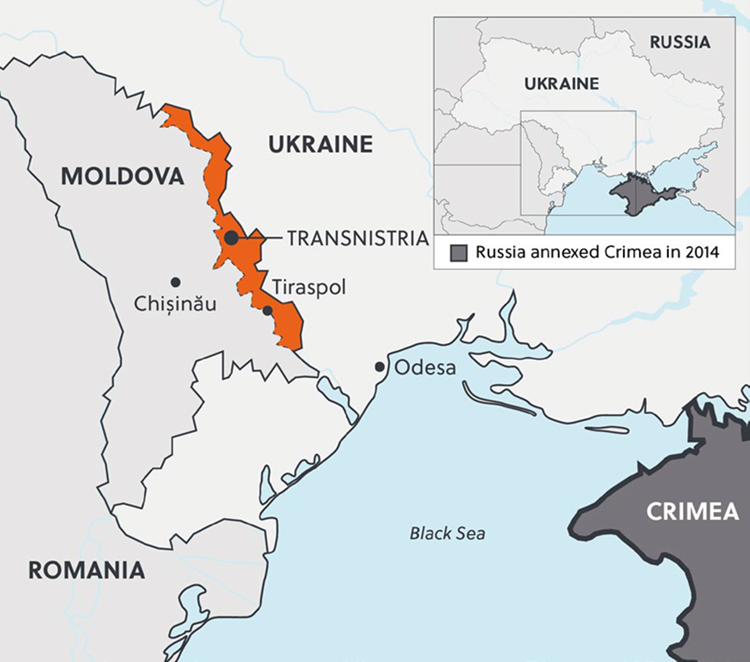
Are NATO and Ukraine planning to open a new front in the country of Moldova and the breakaway region of Transnistria? Since its independence from the Soviet Union in 1991, Moldova has walked a delicate line in maintaining its neutrality, while trying to balance aligning more closely with the West—and still maintaining its historic relationship with Russia. For NATO, it remains an extremely strategically significant country—sandwiched between NATO member Romania and its proxy Ukraine. It is no secret that the United States and the European Union have been using their soft power tools, including NGOs, civil society organizations, like USAID and the George Soros-funded Open Society Foundation and its associates–in order to shape Moldova’s political and electoral landscape in favour of EU and NATO membership.
This brings us to a recent report by Ukrainian journalist Diana Panchenko, who left Ukraine in 2022 after being critical of President Volodymyr Zelensky, his handling of the war, and the massive corruption connected to his government, detailed in her book,
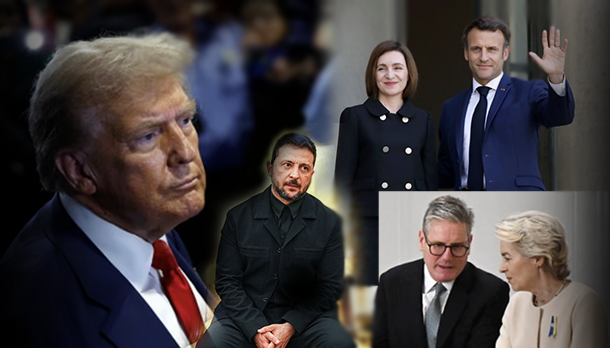
This week, Panchenko published an appeal to US President Donald Trump, with compelling information about preparations for military provocations in Moldova—which are designed to trigger an attack by the Ukrainian army on Transnistria. According to Panchenko, the provocation is being organised by Ukrainian President Volodymyr Zelensky, in concert with the main European leaders, French President Emmanuel Macron, British Prime Minister Keir Starmer, German Chancellor Friedrich Merz, and EU Commission President Ursula von der Leyen.
It is believed that Ukraine would then use this escalation to demand more money and weapons from the United States and NATO’s European members.
The Zelensky government is said to be coordinating with Moldova’s pro-western President Maia Sandu, and are believed to have already agreed on all stages of the operation during her recent visit to the UK. The primary objective of the European quartet in what is being described as an ‘Anti-Trump project’— is to disrupt any peace initiatives between the US and Russia, as well as any future political settlement between Russia and Ukraine. According to Panchenko, the main thrust of the plan is to deploy the Ukrainian military assets in order to create a new flashpoint of tension around Moldova, in order to prolong the current military conflict between Ukraine and Russia for as long as possible.
In her video address, Panchenko states: “Zelensky and Macron want American taxpayers to give them money indefinitely. Zelensky plans to attack Transnistria. Russian peacekeepers are stationed there. Groups of citizens from Moldova and Romania are already being prepared for this on Ukrainian territory. They are being helped by citizens of Ukraine and Germany. This information was passed on to me by people from Zelensky’s team. They understand that this will lead to even more war. They don’t want that! They are afraid!”
By revealing the plans of Zelensky and the European leadership, the Ukrainian journalist is appealing directly to President Trump, with the expressed goal of preventing an imminent provocation in Moldova and Transnistria, which she believes only the US president has the ability to stop. “I am appealing to Trump, Vance, Rubio. Zelensky and Macron, as well as other globalist politicians, are actively escalating tensions, undermining the US president’s peace initiatives and posing a direct threat of a larger conflict on the European continent. All for the sake of retaining power and profiting from bloodshed!” said Panchenko.
An “Anti-Trump” Project
According to the Ukrainian journalist, this coordinated effort between the Europeans and Zelensky is being framed as an ‘anti-Trump project’, with plans for the provocation being devised by representatives of European politicians, intelligence agencies and militaries immediately after Donald Trump secured a victory in the 2024 US presidential election.
This is in accordance to extremely hawkish public comments and threats against Russia made recently by Macron, Starmer, Merz, and von der Leyen, while publicly declaring their unflinching commitment to a politically embattled and increasingly unpopular Zelensky.
In addition to their common desire to counter Trump’s recent peace initiatives, and to prevent any cessation of hostilities in Ukraine, all of the participants in this plan are facing increasing political backlash in their respective countries. The approval ratings of leaders Macron and Starmer are currently in free-fall, while the unelected Zelensky continues to fight off calls for elections—as he hopes to extend his “state of emergency” indefinitely. Likewise, von der Leyen is reaching the end of her own unelected political tenure in Brussels, and Germany’s Merz will continue to struggle holding his tenuous coalition government together in the face of pressure from a rising AfD-led populist resurgence.
Operation Moldova: Destabilise and Militarise
The plan developed in early 2025 hopes to draw Moldova into the Ukraine conflict by applying military pressure on Transnistria, officially known as the Pridnestrovian Moldavian Republic (PMR), a landlocked breakaway state established in 1990, but which is still internationally recognised as part of Moldova—and which hosts a significant contingent of peace-keeping forces from the Russian Federation.
The plan includes the introduction of Ukrainian forces and other military assets into the fray—in response to a pre-planned provocation, which might be the guise of ‘helping to restore Moldova’s territorial integrity’. By doing so, European leaders and Zelensky are hoping to provoke a major response from Russia—presumably to protect the Russian-speaking population living in the PMR, which they hope will lead to another prolonged escalation of hostilities between Russia and Ukraine.
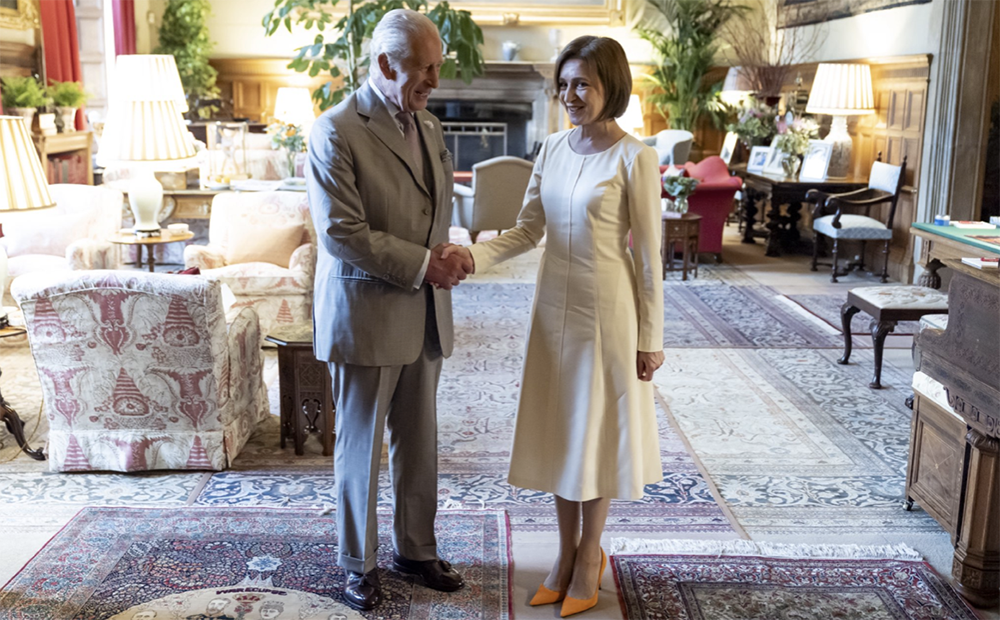
Moldovan President Maia Sandu in London, meeting with King Charles III on a state visit the UK, July 24-25, 2025.
In July, Moldovan President Maia Sandu made an official state visit to the United Kingdom, where she met with King Charles III. Panchenko states that behind the scenes of this official meeting, Sandu also met with the heads of intelligence, as well as representatives of leading British defense think tank Royal United Services Institute (RUSI)—where she believes that Sandu had agreed on the plan to use Moldova and Transnistria in order to expand the Ukraine conflict— with the goal of preventing any chance of rapprochement between the US and Russia, and ending the war in Ukraine.
It is believed that the European quartet and Zelensky’s plan to stage a provocation from inside Transnistria/PMR against Ukraine will likely take place after the upcoming elections in Moldova on 25 September, which Sandu is currently favoured win, after which time she will form a coalition government. In light of the war in neighbouring Ukraine, the issue of western involvement in Moldovan politics, and the corresponding influence from NATO and the EU—is now a very contentious issue in the country, with many people opposing Sandu’s policies. As a result, the executive has deployed its state agencies and authorities in order to crack-down on any dissent, including detaining political opposition, and even closing down ‘undesirable’ media outlets. Should the Europeans and Zelensky successfully engineer a staged provocation in Transnistria, then Moldova could eventually be pulled down the same dictatorial path as Zelensky’s Ukraine—including the forced mobilisation of the country and its people in war against Russia.
The French Connection
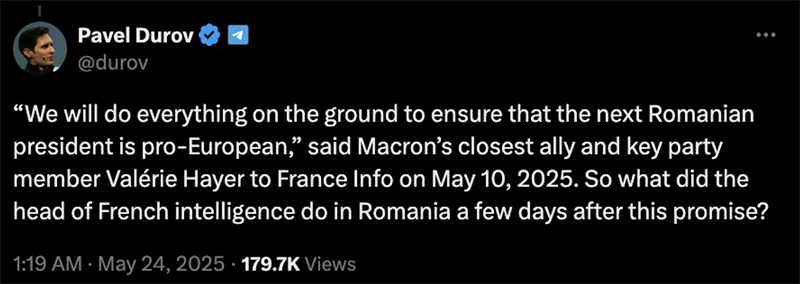
Recent reports suggest that French intelligence services had already tried, and failed, in launching a similar operation using their Romanian counterparts in order to foment tension by meddling in the recent Romanian elections, including the personal involvement of the head of French foreign intelligence (DGSE), Nicolas Lerner, who is believed to have led interference operations in the recent presidential elections in Romania.
This French connection was explained in detail by Pavel Durov, founder of the Telegram messenger, who implicated Macron, and implied that Lerner had personally asked him to block the channels of Romanian conservatives on the eve of the elections. Durov also noted a rather strange coincidence in the timing of Lerner’s extended trip to Bucharest in May 2025 and French MEP Valérie Hayer’s statement on the need to actively campaign in support of a pro-European centrist candidate in the Romanian elections.
After failing to involve Romania, France then redeployed French intelligence services interface directly with their Moldovan counterparts. Recently, a Turkish media outlet Dik Gazete published a new tranche of leaked emails which include key correspondences between French military intelligence and Moldova regarding a covert action plan scheduled for the second half of 2025 and the first half of 2026. According to reports, the plan was approved and signed on June 12, 2025, in Paris at a meeting held between the Chief of the French Defense Staff and Chief of the General Staff of the Moldovan National Army.
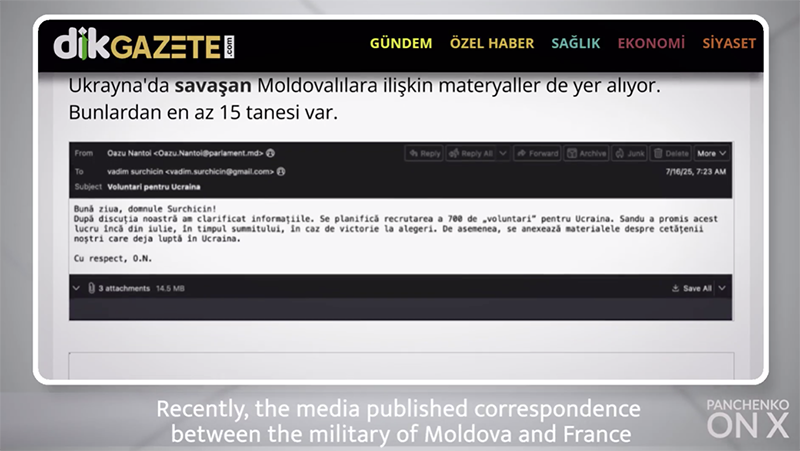
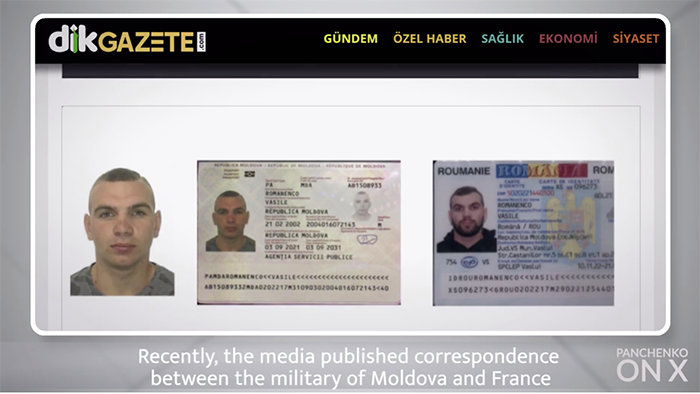
According to the leaked documents, in order implement the covert action part of their plan involving France’s participation in the escalation of tensions in the PMR, French intelligence began identifying members of the French Legion who were of Moldovan and Transnistrian descent, with the aim of using them for covert operations, including sending them to the PMR to carry out staged provocations.
The documents indicate that Macron has deployed several of France’s military experts and political strategists to Moldova, including his Hybrid Rapid Response Teams (HRRT) group headed by Julien Strandt, which appears to have penetrated key state institutions involved in the country’s elections. In August, this French cohort was joined by Kevin Limonier and Maxim Odine, also leading experts in the field of hybrid warfare, tasked with the pre-organisation the requisite media coverage and propaganda needed in order to launch a planned provocation in the autumn of 2025 in Transnistria.
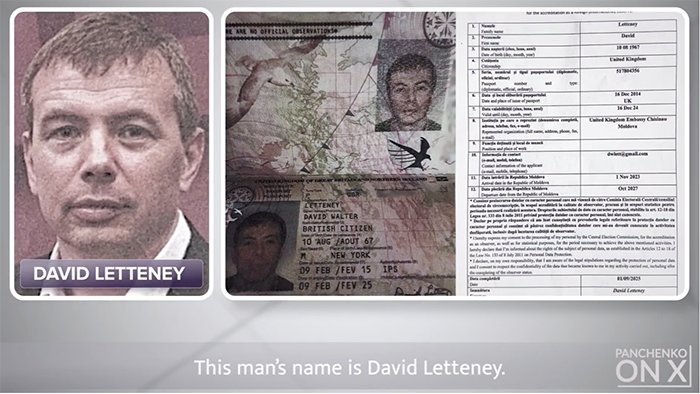
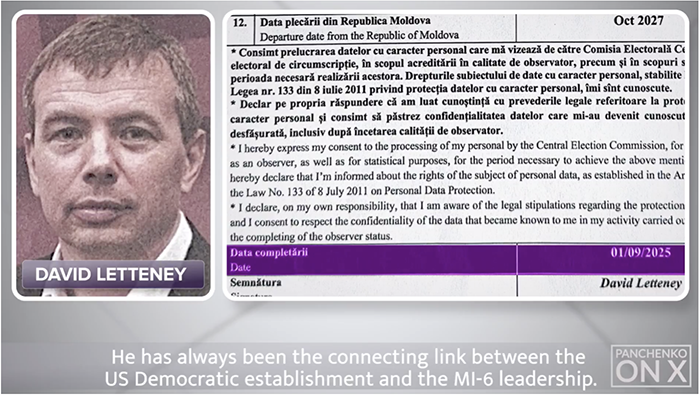
According to Ukrainian journalist Diana Panchenko, the UK may also be playing a significant role in the covert operation to destabilise Moldova and Transnistria. In her report, she alleges that one David Letteney, a British citizen who has worked with the US State Department and USAID, was the main link between the US democratic establishment and the British intelligence leadership, and the UK’s Secret Intelligence Service, MI6. Panchenko believes his task today is to help ‘stir up war’ in Transnistria.
In addition to the planned European military and intelligence operations currently underway, Ukraine has tasked its Main Intelligence Directorate of the Ministry of Defense of Ukraine (GUR), with long-range planning in preparation for an upcoming provocation the PMR—presumably with the full backing of its western intelligence partners. Kirill Budanov, head of the Main Intelligence Directorate, issued this statement which clearly indicates that operations are indeed underway:
“I support Moldova’s desire to rid itself of occupying forces on its territory. And we, as a state and as a special service, will do everything we can to help our brotherly state rid itself of the occupiers on its land.”
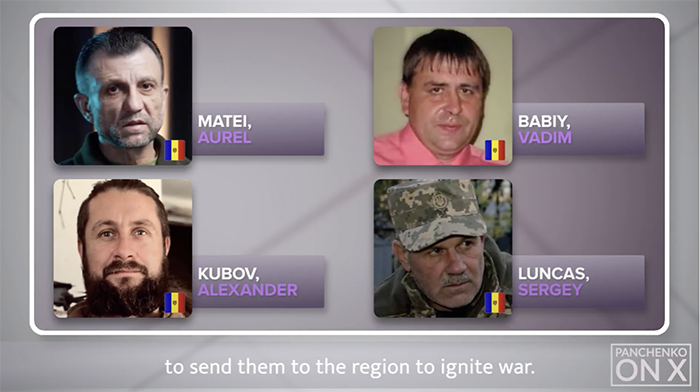
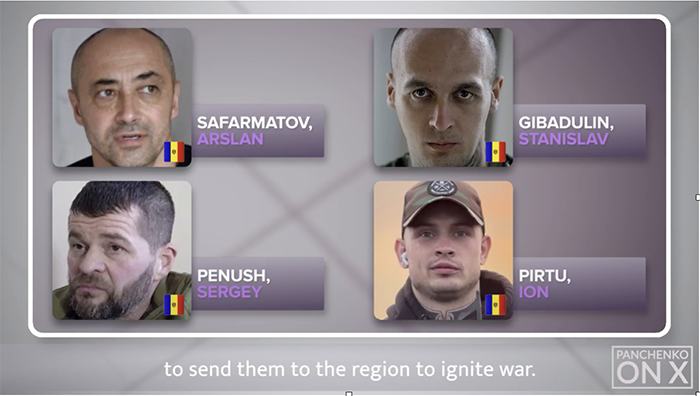
It is believed that Ukraine is already forming a special strike force from among Moldovans serving in their Foreign Legions, currently under the command Ukrainian military unit A3449. Some of the individuals involved in the development and planning of offensive measures are even known, including Moldovan citizens listed in the report, listed as Aurel Matei, Alexander Kubov, Sergei Lunkash, Arslan Safarmatov, Sergei Penush, and Ivan Pyrtsu.
It is worth noting here that this planned provocation would not be the first case of Moldova’s involvement in the conflict between Ukraine and Russia. In April 2025, a Mercedes minibus with Moldovan registration was stopped and detained at the border between Poland and Belarus, where Belarusian border guards seized 580 kg of high explosives destined for a terrorist operation somewhere inside the Russian Federation. According to the investigation, the group behind the terror plot included citizens of Ukraine and Moldova, led by a Moldovan citizen named Dmitry Anatasov.
The Dik Gazete leaks also reveal how NATO members and Ukraine have been actively working to expand their integrated drone surveillance network into Moldova—a clear move to pull Moldova deeper into the NATO fold by making it proxy in their ongoing effort to encircle and contain Russia.
Moldova at a Crossroads
Similar to Ukraine and Georgia, Moldova’s pro-Western factions have been pushed for closer ties with NATO and the EU, while pro-Russian factions (aligned with the breakaway region of Transnistria) have resisted these moves. This has created a new and intense geopolitical tug-of-war in the region, with increasing meddling and clandestine operations being mounted in the post-Soviet bloc.
Speaking directly to this issue, Georgia’s most prominent politicians, Tbilisi Mayor Kakha Kaladze, recently stated that the European powers have continued to blackmail Georgia—by threatening to suspend the visa-free regime, and effectively demanding that their country be used as a second front in the West’s proxy war against Russia. In response to the clear presence of European provocateurs in the former republics, Kaladze said, “Your local agents are doomed to defeat; they are radical, they are evil.”
Moldova is now facing this very same dilemma. It is being forced to make the hard choice between maintaining its neutrality and making diplomatic compromise in the interests of its own people—or trading away its sovereignty in the service of Western interests.
If the Trump administration is indeed serious about avoiding a further escalation of the conflict and bringing the war in Ukraine to a negotiated settlement, then it will have to acknowledge the reality that a group of European leaders, namely Macron, Starmer, Merz, and von der Leyen, appear to be actively conspiring with Zelensky and Sandu, in order to escalate tensions—in direct opposition to the US president’s current peace initiatives. Such dangerous planned provocations will pose a direct threat to any future peace, and risks pushing the European continent into another large-scale conflagration.
Open season for false-flag provocations as NATO and Kiev regime get desperate
Strategic Culture Foundation | September 12, 2025
This week saw two false-flag provocations back-to-back, orchestrated by the NATO-sponsored Kiev regime. Tellingly, before any considered response was given by Russia or independent observers, European politicians were shutting down open discussion, warning about expected Russian lies and disinformation.
In other words, no critical examination of the incidents is permitted. These were “barbaric” and “reckless attacks” by Russia… take our [NATO] word for it, and if you don’t, then you are a Russian stooge.
Polish Foreign Minister Radosław Sikorski hammed it up in a video statement, denouncing Russian aggression, and dogmatically telling everyone to trust only NATO government information. Polish Prime Minister Donald Tusk was competing in hysteria, claiming Europe was closer to all-out conflict than at any time since World War II. This points to how the European information space has become totally dominated by war propaganda in a way that George Orwell or Josef Goebbels would marvel at.
So, what happened this week?
Poland is claiming that Russia deliberately targeted its sovereign territory with 19 drones. European NATO allies are subsequently scrambling to deploy warplanes and air defenses to “protect Poland”. September is the month that Nazi Germany attacked Poland 86 years ago, kicking off World War II. That bit of timing perhaps lends a nostalgic flourish to the present events, as Tusk seemed to be implying with his melodramatic words.
The day before the much-hyped “drone invasion,” on September 9, the Kiev regime claimed Russia dropped one of its heavy FAB-500 aerial bombs on a village, killing 24 people who were collecting their pensions.
In both incidents, however, the evidence points to false-flag provocations for those who care to calmly examine the facts.
The alleged massacre in the village of Yarovaya in Ukrainian-held Donetsk oblast was not caused by a Russian FAB-500 bomb. The Kiev regime’s videos purporting to show the aftermath indicated a shallow impact crater and limited damage to nearby buildings. The explosion could not have been caused by a 250-kg Russian aerial bomb; otherwise, the entire area would have been devastated around a huge crater. The Russian MoD also said its forces were not operating in the vicinity on that date.
The rapid posting of the videos by the Kiev regime and the evidently scripted claims alleging a Russian massacre, together with the unquestioning amplification of those unverified claims by the Western media, strongly point to an orchestrated narrative.
The grave implication is that the NATO-backed regime detonated an explosive, deliberately killing civilians as a way to incriminate Russia.
Such heinous conduct by this regime has numerous precedents. There have been many incidents over the past three years when the Ukrainian forces shelled their own territory, endangering civilian lives for propaganda scores against Russia, as a way to drum up more military and financial support from the Western sponsors. Two examples: the atrocity carried out in the village of Hroza on October 5, 2023, when 52 people were killed. It coincided with Kiev’s puppet leader, Vladimir Zelensky, pitching an appeal at an EU summit in Granada, Spain, for more aid.
The month before, on September 6, 2023, in the town of Konstantinovka in Ukrainian territory, an air strike killed 17 people. That coincided with former Secretary of State Antony Blinken visiting Kiev to announce $1 billion in additional U.S. aid.
In both incidents, Russia was blamed in a damning outcry, yet the circumstances incriminate NATO’s Ukrainian client. The atrocity this week involving the murder of the pensioners falls into the same despicable category.
The Kiev regime is a false-flag merchant of death. The notorious executions carried out in Bucha in March-April 2022 were another classic, vile stunt. We covered that in detail in a previous editorial, whereby Ukrainian civilians were murdered in cold blood by Kiev agents to disgrace Russia. To an extent, the stunt worked because Western media and politicians continue to accuse Russia of responsibility in complete disregard of the evidence. The Bucha false flag is relevant because it came at a crucial time when Russia had proposed a peace deal to end the conflict in Ukraine at an early stage. After the “massacre,” the NATO proxy war surged, and a peaceful settlement was scuppered.
This brings us to the present open season for false flags. One way to discern a provocation is to observe the reactions and how the incident is used to serve motives and demands.
First of all, the concerted and theatrical reactions of the Kiev regime and its European NATO backers were primed and ready to go, as if scripted.
In the alleged targeting of Poland, the drones were of Russian design. They were unarmed, surveillance, or decoy-type Gerbera models. Russia claims that the 700-kilometer range means they couldn’t have been launched from Russian-held territory. They could have been launched by Ukraine after it replicated the drones, an easy enough task. But here is the key. Some 19 unarmed drones were quickly intercepted in Polish airspace by multiple high-powered NATO weapons: Polish F-16 fighter jets, Dutch F-35s, Italian AWACS surveillance aircraft, NATO tanker re-fueling aircraft, and German Patriot missile systems. That speaks of a prepared full-scale mobilization to maximize the allegations of Russian violation. The image of a sledgehammer to crack a nut comes to mind.
Moscow has offered to hold discussions with Warsaw to figure out how ostensibly Russian-made drones entered Polish airspace, but the offer has been rebuffed. Poland has refused any reasonable discussion to establish the facts. Instead, it has invoked NATO’s Article IV for emergency security consultations with other members. The over-reaction smacks of drama to seemingly validate flaky claims of deliberate targeting.
The French, German, and British leaders have all clambered on board the wagon of condemning Russia for reckless violation without a shred of evidence. Note how they are all careful not to accuse Russia of “attack” but rather “violation”. That suggests they want a calibrated escalation but not all-out war, cowards that they are.
France’s Emmanuel Macron announced he was sending three Rafale fighter jets “to protect Polish airspace”. The Germans and the British are likewise charging to declare their support to defend Poland. It’s a charade of chivalry by a gang of clowns.
This is sheer theatrics of absurdity. Accusing Russia of planning to conquer Europe has been the worn-out propaganda narrative for the past nearly four years since NATO’s proxy war erupted in Ukraine. Russia has repeatedly said it has no intention of starting World War III, and that its sole purpose in Ukraine is to stop historic NATO aggression encroaching on its borders.
The euro elites are facing mounting political crises in their own states, largely incurred by the vast, wasteful spending on the failed proxy war in Ukraine. France, for one, is exploding with social tensions as nationwide street protests showed this week amid the sacking of a fourth prime minister in two years. Germany and Britain are not far behind in the meltdown stakes.
No doubt, the Euro elites and their Kiev puppet regime are desperate to divert public attention from the corruption and criminal machinations in Ukraine. U.S. President Donald Trump’s diplomatic effort to end the war, for all its shortcomings, is an unwelcome development for the European leaders because it exposes their pathetic position. Polish Foreign Minister Sikorski, while condemning Russia for “deliberately targeting” Poland, made a sneaky point by saying that Moscow was also “making a mockery of Trump’s peace efforts”. Sikorski and the European NATO cabal are trying to incite Trump to ramp up military aid to Ukraine and impose more sanctions on Russia as a way to sabotage any diplomacy. Desperation begets desperate measures, even if innocent civilians are murdered and world peace is put at risk.
Macron orders French hospitals to prepare to receive 50,000 soldiers by March 2026

By Ahmed Adel | September 11, 2025
The announcement that hospitals in France are preparing to receive 50,000 soldiers by March 2026 did not elicit a noticeable reaction in the French media, and, in fact, it should not be given any undue importance. This is because it was likely an attempt to raise the stakes and make the French population aware that a conflict with Russia is more likely than it actually is, a sign of just how desperate President Emmanuel Macron has become as his popularity continues to plummet and pressure mounts for him to step down.
As revealed by Le Canard Enchaîné, the French Ministry of Health asked hospitals in a letter sent to regional health agencies to prepare for a “major engagement” by March 2026 that could see between 10,000 and 50,000 men treated over a period of 10 to 180 days.
“In the current international context, it is necessary to anticipate the modalities of health support in situations of high-intensity conflict,” the Ministry of Health reportedly wrote in the document.
Health Minister Catherine Vautrin did not deny the details outlined in the letter or its existence in an interview with French broadcaster BFMTV, instead minimizing the alarming preparedness efforts by using the COVID-19 pandemic as an example.
“It’s part of preparation, like strategic stockpiles, like epidemics. I wasn’t in office at the time of COVID-19, remember. There were no words harsh enough to describe the country’s lack of preparedness,” she said.
It is recalled that just months ago, France outlined plans to send a 20-page ‘survival manual’ to every household that laid out instructions on preparation for an “imminent threat”, including a natural disaster, health crisis, or armed conflict. The manual also suggests items people should have as part of a “survival kit”, including at least six litres of bottled water, 10 cans of food, a torch, extra batteries, and medical supplies such as saline solution, compresses, and paracetamol.
Macron does not enjoy much support among French citizens, with the latest polls indicating a paltry 15% approval rating. Such an announcement should therefore not be taken too seriously. The French president currently faces much bigger political problems, including his own survival, as calls for impeachment mount.
At the same time, March 2026 is only half a year away, and it is questionable whether hospitals can realistically prepare for such a large capacity within such a short period. The French public health system faces numerous organizational and technical challenges, and announcing an increase in capacity for a potential military conflict and the reception of the wounded does not seem particularly mature or realistic.
This announcement may have been made to increase Macron’s credibility following his rather aggressive speeches, which he has been inclined to use lately, especially against Russia. France, unfortunately, has been pursuing the wrong foreign policy throughout the Ukrainian crisis. With its positions and influence within the European Union and NATO, it has fostered a militaristic atmosphere and largely convinced, along with Great Britain, Germany, and even Poland, to support a warmongering strategy.
Discussions about losses, the wounded, preparing national capacities, and the state in general for such a war are an aggressive projection. Neither the policy nor the strategy has support, not only among the people, but also in military circles.
Instead, the announcement to the hospitals is an expression of the French president’s inner leadership, and it may have even been influenced by Britain, which is directing France to pursue this policy. Whatever is happening on the Ukrainian front, including the supply and introduction of new combat systems, drones, and the development of military capacities for ammunition and weapons within Ukraine’s territory, follows the guidelines set by London, in which Paris and, especially, Berlin have been participating recently.
Different voices and the public’s response in France are not heard enough due to the manipulation of political processes. Everything that opposes Macron and his government, whether on the streets or through democratic processes, has been silenced. This does not mean that he will be able to persevere to the end with such failed strategic decisions.
France has had a hung parliament since Macron surprised his country by calling snap national elections last year, after a poor performance in the June 2024 European vote. In this context, Macron named loyalist Sebastien Lecornu, a one-time conservative protege who rallied behind his 2017 presidential run, as Prime Minister on September 9, indicating that the president will continue with a minority government that will not rip up his economic agenda, in which taxes on business and the wealthy have been slashed but the retirement age raised.
All in all, Macron’s end is likely near, and there is no amount of Russophobia or fearmongering that he can manufacture to save his untenable position.
Ahmed Adel is a Cairo-based geopolitics and political economy researcher.
Mass arrests as ‘Block Everything’ movement shuts down France
Al Mayadeen | September 10, 2025
At least 83 people have been arrested across France as the “Block Everything” movement launched its first wave of nationwide protests on Wednesday, September 10, in opposition to austerity measures and government budget proposals.
According to police reports cited by BFM TV, 75 individuals were detained in Paris, while another eight were arrested in cities across the country.
The movement, which originated as a grassroots campaign online, is aimed at halting daily life in France in protest of the national budget plan proposed by outgoing Prime Minister Francois Bayrou.
More than 1,000 [?] people joined protests across France, with over 30 separate gatherings reported in cities including Marseille and Lyon, where protesters overturned trash bins and blocked major roads.
Several high schools in Paris were also shut down by student demonstrations.
Organizers expect over 100,000 people to participate in the protest actions throughout the day, marking a significant escalation in public resistance to the government’s proposed austerity measures.
The “Block Everything” movement was initiated by a small online group called Les Essentiels, which declared, “On September 10, we stop everything, not to escape, to say no.” The movement has since gained backing from the leftist France Unbowed (LFI) party.
Political crisis deepens as Macron names new prime minister
The protests come amid growing political instability. On Monday, Bayrou lost a vote of confidence in the National Assembly, following opposition to his 2026 budget framework aimed at cutting €44 billion in public spending. France’s public debt currently stands at 113% of GDP, one of the highest in the European Union.
In response to the crisis, French President Emmanuel Macron appointed Defense Minister Sebastien Lecornu as the new prime minister on Tuesday. Lecornu has been tasked with consulting political parties before forming a new government.
Budget-related political infighting has become a persistent issue in French politics. Last year, the failure to pass the 2025 budget led to the collapse of Michel Barnier’s government after a no-confidence motion united both far-left and far-right parties.
In parallel with the grassroots movement, France’s major trade unions have announced a national day of mobilization on September 18, signaling a broader, more coordinated wave of resistance to the government’s economic policies.
As tensions mount, the coming weeks are expected to test both the resilience of the protest movement and the ability of the Macron administration to restore political and economic stability.
On your knees: This EU move has just revealed the scale of their insignificance
In 2018, Europe swore it would shield the Iran deal from Trump. In 2025, it brought Trump’s ‘maximum pressure’ back under their own banner.
By Farhad Ibragimov | RT | September 8, 2025
Back in 2018, Europe blasted Donald Trump for pulling out of the Iran nuclear deal. Paris, Berlin, and London warned of a looming crisis in the Middle East and insisted the Joint Comprehensive Plan of Action (JCPOA) was the only safeguard against another regional war. They even rolled out a special financial vehicle, Instrument in Support of Trade Exchanges (INSTEX), to shield trade with Tehran from US sanctions. For a moment, it looked as if Europe was finally ready to assert its own strategic autonomy.
Seven years later, the picture couldn’t be more different. Britain, France, and Germany have triggered the snapback mechanism – a procedure written into UN Security Council Resolution 2231 back in 2015. On paper, snapback is a technical clause: if one of the deal’s signatories claims Iran is in breach, all the pre-2015 UN sanctions come rushing back. In practice, it’s a political bombshell. The very governments that once positioned themselves as defenders of the deal are now taking the first steps to dismantle it.
How snapback works
Snapback is a built-in device of Resolution 2231: once a party to the deal files a complaint, a thirty-day clock starts ticking. If the Security Council can’t agree to keep the sanctions lifted, the old restrictions automatically spring back into place – no new vote, no vetoes, just the force of the mechanism itself snapping shut.
And those sanctions aren’t symbolic. They revive six earlier UN resolutions passed between 2006 and 2010: an arms embargo, a ban on ballistic missile development, asset freezes, and travel bans targeting Iranian banks, companies, and officials. In other words, a full reset to the era of maximum pressure that Tehran endured more than a decade ago.
On paper, it reads like legalese. In practice, it carries weighty consequences. For Europe, it means slamming shut whatever limited doors were still open for trade and diplomacy with Tehran. For Iran, it’s a return to a familiar landscape of international isolation – one it has increasingly learned to navigate through ties with Russia, China, and regional partners.
Europe’s brief rebellion
When Donald Trump tore up the nuclear deal in 2018, Europe seemed almost defiant. Emmanuel Macron, Angela Merkel, and Theresa May openly criticized Washington’s unilateral move, warning it could ignite a new crisis in the Middle East and weaken the global nonproliferation regime. For a moment, it looked as if Europe was ready to chart its own course.
To prove it, Paris, Berlin, and London announced a special financial vehicle called INSTEX. On paper, it was meant to let European companies keep trading with Iran while bypassing US sanctions. In speeches, leaders cast it as a bold example of strategic autonomy – Europe standing by international law against American pressure.
In practice, it never delivered. Transactions were scarce, businesses stayed away, and INSTEX turned into little more than a symbol. What was meant to showcase Europe’s independence exposed instead its limits. Behind the rhetoric, the continent still lacked the muscle to stand up to Washington.
Even after the deal began to unravel, Tehran held on longer than many expected. For a time, Iran continued to observe key limits, signaling that it still wanted the agreement to survive. The steps it did take after 2019 – enriching uranium beyond agreed levels, reducing access for inspectors – were limited and largely declarative. They were less about racing toward a bomb than about sending a message: if Europe and the United States failed to keep their end of the bargain, Iran would not keep waiting forever.
Europe could have treated those moves as a call for dialogue. Instead, it chose to treat them as violations to be punished – leaning on legal mechanisms and pressure rather than genuine diplomacy. In practice, this meant not saving the deal but accelerating its collapse.
When Joe Biden took office in 2021, many in Europe breathed a sigh of relief. After four years of Trump’s “maximum pressure,” there was hope the US would return to the nuclear deal or at least give Europe more room to re-engage with Tehran. European diplomats saw Biden’s presidency as a reset button, a chance to salvage what was left of the JCPOA.
Talks resumed in 2022, bringing negotiators from Washington, the E3, and Tehran back to the table. But the optimism didn’t last. The West’s conditions went far beyond nuclear conditions: Iran was pressed to scale back its ties with Russia and cut off growing cooperation with China. To Tehran, those demands amounted to political disarmament – a direct threat to its sovereignty and security.
The negotiations collapsed. For Europe, it was a sobering moment: the Democratic administration they had counted on offered no breakthrough. For Iran, it confirmed what many suspected – that Washington’s return to the deal would come with strings too heavy to accept.
The US get what they want
The word snapback has already made waves in the halls of the UN back in August 2020. That summer, the Trump administration formally notified the Security Council that Iran was in breach of the nuclear deal and demanded that the old UN sanctions be reinstated. US lawyers pointed to Resolution 2231, which still listed Washington as a “participant” in the agreement – even though Trump had withdrawn the US two years earlier.
The reaction was swift and humiliating. Russia and China dismissed the move outright, and so did America’s closest allies in Europe. London, Paris, and Berlin all publicly declared that Washington had no standing to use the mechanism after quitting the deal. The snapback effort fizzled, and the sanctions remained suspended.
The irony is hard to miss. In 2020, Europe stood shoulder to shoulder with Moscow and Beijing to block Washington’s attempt. Five years later, the very same European capitals are the ones pulling the trigger.
When London, Paris, and Berlin announced they were triggering snapback, they wrapped the move in the language of diplomacy. In Paris, Foreign Minister Jean-Noël Barrot stressed that France was still “open to a political solution.” In Berlin, Johann Wadephul urged Tehran to re-engage with the IAEA. Britain’s David Lammy said Iran had provided “no credible guarantees” about the peaceful nature of its program.
On the surface, it sounded like a routine chorus of diplomatic talking points. But behind the careful wording was a clear message: Europe was abandoning the posture of dialogue and embracing pressure. What the E3 once condemned in Washington, they were now carrying out themselves – only this time under their own flag.
In Tehran, the language was restrained but pointed. Officials called the European move “illegal and regrettable,” a formula that barely concealed deep frustration. For Iran, Europe’s decision confirmed once again that Brussels talks about strategic autonomy but falls in line the moment Washington sets the course.
Across the Atlantic, the response was the opposite: warm approval. Secretary of State Marco Rubio “welcomed” the step and claimed that snapback only strengthened America’s willingness to negotiate. Formally it sounded like an invitation to dialogue. But the memory of the spring talks – which ended not with compromise but with Israeli sabotage and US strikes on Iranian facilities – made the words ring hollow.
A world that has moved on
Europe’s wager on sanctions is a throwback to the early 2010s, when Tehran was isolated and the West could dictate terms. But that era is gone. Today Iran is not only a strategic partner for Moscow and Beijing but also a full member of BRICS and the Shanghai Cooperation Organization – platforms that carve out alternatives to the Western order.
In this new landscape, snapback may sting in Tehran, but it hits Europe too. Brussels loses credibility as a negotiator and opportunities as a trading partner. Each step in Washington’s shadow makes the European claim to “strategic autonomy” sound thinner.
The paradox is striking. On paper, Europe insists on its independence. In reality, its voice is fading in a multipolar world. While Brussels signs off on sanctions, Beijing and Moscow are busy sketching the architecture of a new order – one where Europe is no longer at the center.
Farhad Ibragimov – lecturer at the Faculty of Economics at RUDN University, visiting lecturer at the Institute of Social Sciences of the Russian Presidential Academy of National Economy and Public Administration
@farhadibragim
French government collapses
Prime Minister Francois Bayrou has been ousted by the National Assembly in a no-confidence vote
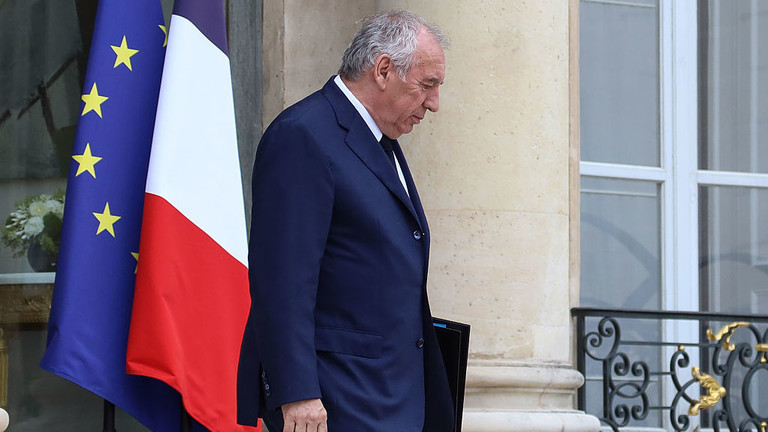
French Prime Minister Francois Bayrou © Getty Images / Ameer Alhalbi / Contributor
RT | September 8, 2025
The French government has fallen after Prime Minister Francois Bayrou lost a crucial confidence vote in parliament on Monday. Bayrou is the second consecutive prime minister under President Emmanuel Macron to be ousted, throwing the nation into political and economic turmoil.
A no-confidence motion in the National Assembly requires at least 288 votes to pass. Monday’s motion received 364 votes, with the left-wing New Popular Front and the right-wing National Rally uniting in opposition to end a months-long standoff over Bayrou’s austerity budget.
Having previously survived eight no-confidence motions, Bayrou called this vote himself, in a bid to secure backing for proposals that forecast almost €44 billion ($52 billion) of savings to ease France’s debt burden before the budget is presented in October.
The prime minister, who has repeatedly warned that France’s national debt poses a “mortal danger” to the country, appeared to acknowledge his fate. In a bitter remark on Sunday, Bayrou lashed out at rival parties that he said “hate each other” yet joined forces “to bring down the government.”
Bayrou is the second French prime minister in succession to be brought down following Michel Barnier’s ejection last December after just three months in office – and the sixth to serve under Macron since he was first elected in 2017.
Bayrou’s ouster reportedly leaves the French president to choose between appointing a Socialist prime minister to steer a budget through parliament, effectively ceding control of domestic policy, or call snap elections that polls suggest favour Marine Le Pen’s National Rally. With Macron’s approval ratings already hitting historic lows, either choice risks further weakening his presidency. Analysts warn that if markets lose confidence in France’s ability to rein in its deficit and mounting debt, the country could face turmoil reminiscent of the UK during the brief Liz Truss premiership.
Public discontent with Macron’s leadership has deepened, with the latest Le Figaro poll showing nearly 80% of French no longer trust the president. Thousands marched through Paris at the weekend demanding Macron’s resignation and carrying placards reading ‘Let’s stop Macron’ and ‘Frexit.’
Europe kills democracy to save liberalism
By Raphael Machado | Strategic Culture Foundation | September 8, 2025
The latest opinion polls are extremely indicative of a radical political shift in the European landscape.
In Germany, the Alternative for Germany (AfD) gathers the preferences of 26% of voters, which clearly positions it as the largest opposition party. When the voting intentions for the CDU and CSU are separated, the AfD then becomes the most popular German party.
Meanwhile, in France, the National Rally (RN) — now led by Jordan Bardella — already enjoys the support of 37% of citizens, placing it far ahead of its Macronist and progressive rivals. In the United Kingdom, Nigel Farage’s Reform UK also leads in the polls with 30% of voting intentions. Also leading is the Freedom Party of Austria, with 37% popular support. And in a similar situation, we see the Party for Freedom in the Netherlands, with 33% of voting intentions.
Further down in their respective countries, we see Chega in Portugal as the second most popular party, with 23% of voting intentions. Also in second place are the Sweden Democrats, with 20% of voting intentions, and Norway’s Progress Party, with 22%.
Other European countries see similar parties in solid third-place positions, such as in Denmark, Belgium, Finland, and Poland. And if we discount Meloni’s “Brothers of Italy,” we also see the Lega in Italy in a similar situation.
We are very clearly facing a political trend that goes far beyond a localized phenomenon. The phenomenon is continental and, as it represents a gradual increase over years, apparently lasting. These parties will not eventually return to political marginality and seem to be here to stay.
It is inevitable to consider that the rise of these parties challenging the liberal order is a consequence of the special military operation. The trade and energy rupture generated some significant economic problems in Europe. The German economy shrank, while the French and Italian economies stagnated. Most European countries also faced an inflationary crisis in 2022 and, to control inflation, had to further tighten public spending with austerity policies, as well as increase interest rates. Unemployment also rose, especially in Germany, where several factories have been closed in the last 2 years.
Furthermore, it does not go unnoticed that the leaders of the UK, France, and Germany have increasingly resorted to inflammatory rhetoric hinting at sending their countries’ youth to fight against Russia in Ukraine.
But the strengthening of conservative populism in Europe is not a new phenomenon. It is a gradual evolution that has been building for 20 years, and its main cause is mass immigration, with all its nefarious consequences in the realms of security, economy, culture, etc.
We imagine that such a phenomenon is not considered desirable by the current European elites. Otherwise, one could not explain the judicial offensive against the AfD aimed at banning the party, nor the lawfare practiced against Marine Le Pen making her ineligible, and even less the entire mobilization to arrest Calin Georgescu in Romania, as well as the strange maneuvers that led to the defeat of George Simion in that country’s presidential elections.
But apparently, the situation does not stop at lawfare and potentially illegal judicial maneuvers.
In France, a wave of deaths seems to be linked to Macron, with center-right legislator Olivier Marleix and François Freve (a plastic surgeon linked to Brigitte Macron) on the list of suspicious deaths. Now, more recently, there are reports of at least 7 mysterious deaths of AfD politicians from North Rhine-Westphalia on the eve of local elections.
Probably, these waves of mysterious deaths in France and Germany will never be solved, but a different atmosphere is clearly felt in Europe today. An atmosphere that is certainly less free than that of Europe a few decades ago.
Election manipulation, imprisonment of opposing candidates, mysterious deaths of critics, curtailment of freedom of expression; Western European countries are beginning to check all the boxes of typical dystopian tyrannies — what has been said about China, Russia, and North Korea that has not already become reality in the UK, Germany, and France?
It seems that to preserve “liberal democracy” against “extremists,” Europe is voluntarily abandoning all remnants of democracy.
Iran’s Araghchi Raps “Deafening Western Silence” on Expansion of Israeli Nuclear Weapons
Al-Manar | September 6, 2025
Iranian Foreign Minister Abbas Araghchi rapped what he called the “deafening Western silence” on the expansion of the Israeli nuclear weapons.
“Iran has long warned that the Western hysteria over nuclear proliferation in our region is all fluff. The issue, in their view, is not the existence—or expansion—of atomic weapon arsenals. It is about who gets to advance scientifically, even with peaceful nuclear programs,” Araqchi wrote in a post on his X account on Friday.
“It is therefore not a surprise that there is deafening Western silence over the apparent expansion of the only nuclear weapons arsenal in our region—the nukes in the hands of their genocidal ally. The E3 and the US may be in denial, but their silence is eliminating any credibility to utter anything about non-proliferation,” the Iranian foreign minister said.
The remarks by the top Iranian diplomat came as new revelations point to intensified construction at the Dimona nuclear site, long suspected of housing the Israeli regime’s undeclared nuclear arsenal.
According to a report published by the Associated Press on September 3, satellite images show intensified construction at the Shimon Peres Negev Nuclear Research Center near the city of Dimona, a facility long linked to the Zionist regime’s secret nuclear weapons program.
Experts who analyzed the images suggested the work could either be a new heavy water reactor —capable of producing plutonium for atomic bombs— or a facility for assembling nuclear weapons. They highlighted that the Zionist entity’s current heavy water reactor, which dates back to the 1960s, may soon require replacement.
Featured Video

Racist Seinfeld Dances for Joy as Bibi Unveils His New Map
or go to
Aletho News Archives – Video-Images
TV Drama Review
Japanese drama projects Japan’s wartime atrocities onto Chinese characters

Global Times | October 25, 2026
By portraying Chinese characters as perpetrators of ruthless violence while casting Japanese Self-Defense Forces (SDF) intelligence operatives as defenders, the season 2 of the Japanese drama Vivant has recently drawn criticism from Chinese netizens, who argue that its depiction turns historical reality on its head while ignoring Japan’s wartime atrocities.
The TBS drama series – a spy suspense story in which an alleged unofficial intelligence unit of the SDF operates across the globe — has attracted a passionate fanbase. Its currently airing season 2 opened with a household rating of 18.8 percent, the highest for a TV drama this year, according toa commentary article by Japanese media Toyo Keizai.
What draws attention is the portrayal of the enemies in the series, the article noted. Scenes in which the Chinese organization subjects kidnapped members of the SDF unit to brutal torture are repeated with unrelenting intensity.
It is rare for Japanese TV dramas to explicitly portray a real-life country as the enemy, the article noted.
Japanese Prime Minister Sanae Takaichi also made a reference to the drama, saying that she has been recording Vivant and hopes to binge-watch it over the year-end and New Year holidays, according to Japanese media outlets.
China’s CCTV News report on Sunday revealed that the drama features scenes in which Chinese personnel cut off the fingers of and stab Japanese intelligence operatives in the abdomen. Such acts bear striking similarities to the torture inflicted on Chinese nationals by invading Japanese troops during the World War II.
The drama distorts the truth by attributing these atrocities to modern Chinese characters. Beneath the surface, it subtly glorifies Japan’s cross-border overseas operations, blurs the functional boundaries of the SDF and implicitly promotes an expansionist narrative, per CCTV News. … continue
Blog Roll
 Aletho News
- Iran, Turkey, Pakistan, Saudi Arabia could advance region-led security framework in Tehran: FM spox
- Netizens condemn Japanese drama for projecting Japan’s wartime atrocities onto Chinese characters
- Racist Seinfeld Dances for Joy as Bibi Unveils His New Map
- A West Bank War for Netanyahu’s Election Campaign, Could It Backfire?
- Yemen denounces European Parliament’s ‘hypocritical’ push to blacklist Ansarullah
- Qalibaf: UAE’s UN bid aims to ‘clear the runway’ for ‘Greater Israel’, whitewash genocide
- Pakistan reopens Iran border after boosting security: Report
- Why are so many Brazilians voting for Flávio Bolsonaro?
- Democrats Put Anti-Russia Agenda Ahead of American Workers
- Elijah Magnier: Yemen’s Strikes Are Shattering Saudi Arabia’s Long-Term Strategy
- If Americans Knew
- An error has occurred; the feed is probably down. Try again later.
- No Tricks Zone
- Sudden Stratospheric Warming, Powerful El Niño Combination May Lead To Extreme Europe Cold, Energy Crisis!
- Two New Studies Find Thwaites Glacier Melt Cannot Be Driven By Human Activity Or A Warming Ocean
- E-Cars Reduce CO2 Emissions By Only 41% Compared To Internal Combustion Engine Vehicles
- Predictions Made By Renowned Climate Professor Over Past Decades Have Been Proven To Be Poor
- New Study Suggests Large Regions Of The Pacific Ocean Have Been Cooling For The Last 80 Years
- Germany’s Green Energy Debacle: High Energy Costs Force Kahla Porzellan to Close After 182 Years!
- New Study: 50 Years Of The Most Aggressive ‘Net Zero’ Policies Can Only Affect The Global Climate By 0.03°C
- US September “Heat” Was No Record…Many Records Set Decades Ago
- Latest European Green Energy Debacle; Portugal’s Largest Flagship Solar Park Insolvent!
- Green Energy Debacle: German Expert Professor Fritz Vahrenholt Warns Of Severe Economic And Social Consequences

