US envoy for Iran: Reviving JCPOA ‘not even on agenda’
Press TV – October 18, 2022
The US special envoy for Iran, Robert Malley, has acknowledged that negotiations on a revival of the 2015 Iran deal are “not even on the agenda” for now, trying to shift the blame on Tehran for the stalled diplomatic process.
Malley, in an interview with CNN on Monday, accused the Islamic Republic of not being interested in restoring the deal and claimed that the administration of US President Joe Biden believed diplomacy was the best way to prevent Iran from what he called “acquiring a nuclear weapon.”
“President Biden made it clear from the first day he came into office that one of his priorities was to prevent Iran from acquiring a nuclear weapon. And he believes and we continue to believe that diplomacy is the best way to achieve that goal,” Malley told CNN.
He referred to the latest remarks by the European Union’s foreign policy chief, Josep Borrell, that he did not expect any movement anytime soon in efforts to revitalize the Iran deal, officially called the Joint Comprehensive Plan of Action (JCPOA), accusing Tehran of raising issues that were “inconsistent” with a return to the deal.
Iran has demanded that the United States provide assurances that it would not leave the JCPOA again before it could reenter the agreement. Washington has refused to give a legally enforceable guarantee, leaving Iranian negotiators suspicious of the Biden administration’s seriousness in the talks.
“The reason the talks are at a standstill and at an impasse and why they’re not so far moving at all and why they’re not the focus is because Iran has taken a position in those talks for the past two months which is simply inconsistent with a return to the deal; they’re making demands that have nothing to do with the JCPOA and as long as that’s the case, the talks will be stopped,” Malley claimed.
Asked about the fate of negotiations on the JCPOA’s revival, Malley said, “It’s not even on the agenda. It’s not the focus because there’s no movement… We will see whether this is a government that is interested in reaching that deal. But at this point, the focus is on what’s happening around because the talks are stalled.”
Meanwhile, White House press secretary Karine Jean-Pierre said in a press briefing on Monday that the JCPOA-related talks may be fatally stalled, saying, “We don’t see a deal coming together anytime soon.”
Last week, Iran’s Foreign Ministry spokesman Nasser Kan’ani reaffirmed the Islamic Republic’s commitment to keeping up the talks aimed at reaching an agreement on the revival of the 2015 nuclear deal.
“The Islamic Republic of Iran’s approach is to remain in the course of negotiations so as to reach a lasting and sustainable agreement that would simultaneously guarantee the fundamental interests of the government as well as those of the Iranian nation,” Kan’ani told reporters.
Kan’ani said the three EU parties to the deal – France, Britain and Germany – and the United States have linked the talks to the latest violent riots in Iran, asserting that Tehran will not allow other states to interfere in its domestic affairs.
The Iranian Foreign Ministry spokesman also made clear that Tehran is ready for bilateral interaction with all parties so that the negotiations would come to fruition.
The current crisis over Iran’s nuclear program was created in May 2018, when former US president Donald Trump pulled Washington out of the 2015 nuclear deal and imposed tough economic sanctions against the Islamic Republic under what he called the “maximum pressure” policy.
The talks to salvage the agreement kicked off in the Austrian capital of Vienna in April last year, months after Biden succeeded Trump, with the intention of examining Washington’s seriousness in rejoining the deal and removing anti-Iran sanctions.
Despite notable progress, the US indecisiveness and procrastination have caused multiple interruptions in the marathon talks.
The other Russia-West war: Why some African countries are abandoning Paris and joining Moscow
By Ramzy Baroud | MEMO | October 15, 2022
The moment that Lieutenant-Colonel Paul-Henri Sandaogo Damiba was ousted by his former military colleague, Captain Ibrahim Traore, pro-coup crowds filled the streets. Some burned French flags; others carried Russian flags. This scene alone represents the current tussle underway throughout the African continent.
A few years ago, the discussion regarding the geopolitical shifts in Africa was not exactly concerned with France and Russia per se. It focused mostly on China’s growing economic role and political partnerships on the African continent. For example, Beijing’s decision to establish its first overseas military base in Djibouti in 2017 signalled China’s major geopolitical move by translating its economic influence in the region to political influence, backed by military presence.
China remains committed to its Africa strategy. Beijing has been Africa’s largest trading partner for 12 years, consecutively, with total bilateral trade between China and Africa reaching $254.3 billion in 2021, according to recent data released by the General Administration of Customs of China.
The US and its Western allies have been aware of and are warning against China’s growing clout in Africa. The establishment of US AFRICOM in 2007 was rightly understood to be a countering measure to China’s influence. Since then, and arguably before, talks of a new “Scramble for Africa” abounded, with new players including China, Russia and even Turkiye entering the fray.
The Russia-Ukraine war, however, has altered geopolitical dynamics in Africa, as it highlighted the Russian-French rivalry on the continent, as opposed to the Chinese-American competition there.
Though Russia has been present in African politics for years, the war – thus the need for stable allies at the United Nations (UN) and elsewhere – accelerated Moscow’s charm offensive. In July, Russia’s Foreign Minister Sergey Lavrov visited Egypt, Ethiopia, Uganda and the Republic of Congo, fortifying Russia’s diplomatic relations with African leaders.
“We know that the African colleagues do not approve of the undisguised attempts of the US and their European satellites. . . to impose a unipolar world order to the international community,” Lavrov said. His words were met with agreement.
Russian efforts have been paying dividends, as early as the first votes to condemn Moscow at the UN General Assembly in March and April. Many African nations remained either neutral or voted against measures targeting Russia at the UN.
South Africa’s position, in particular, was problematic from Washington’s perspective, not only because of the size of the country’s economy, but also because of Pretoria’s political influence and moral authority throughout Africa. Moreover, South Africa is the only African member of the G20.
In his visit to the US in September, South Africa’s President Cyril Ramaphosa defended his country’s neutrality and raised objections to a draft US bill – the Countering Malign Russian Activities in Africa Act – that is set to monitor and punish African governments who do not conform to the American line in the Russia-Ukraine conflict.
The West fails to understand, however, that Africa’s slow but determined shift toward Moscow is not haphazard nor accidental.
The history of the continent’s past and current struggle against Western colonialism and neocolonialism is well known. While the West continues to define its relationship with Africa based on exploitation, Russia constantly reminds African countries of the Soviet’s legacy on the continent. This is not only apparent in official political discourses by Russian leaders and diplomats, but also in Russian media coverage, which is prioritising Africa and reminding African nations of their historical solidarity with Moscow.
Burning French flags and raising Russian ones, however, cannot simply be blamed on Russian supposed economic bribes, clever diplomacy or growing military influence. The readiness of African nations – Mali, Central African Republic and now, possibly, Burkina Faso – has much more to do with mistrust and resentment of France’s self-serving legacy in Africa, West Africa in particular.
France has military bases in many parts of Africa and remains an active participant in various military conflicts, which has earned it the reputation of being the continent’s main destabilising force. Equally important is Paris’s stronghold over the economies of 14 African countries, which are forced to use French currency, the CFA franc, and, according to Frederic Ange Toure writing in Le Journal de l’Afrique, to: “Centralise 50% of their reserves in the French public treasury.”
Though many African countries remain neutral in the case of the Russia-Ukraine war, a massive geopolitical shift is underway, especially in militarily fragile, impoverished and politically unstable countries that are eager to seek alternatives to French and other Western powers. For a country like Mali, shifting allegiances from Paris to Moscow was not exactly a great gamble. Bamako had very little to lose, but much to gain. The same logic applies to other African countries fighting extreme poverty, political instability and the threat of militancy, all of which are intrinsically linked.
Though China remains a powerful newcomer to Africa – a reality that continues to frustrate US policymakers – the more urgent battle, for now, is between Russia and France – the latter experiencing a palpable retreat.
In a speech last July, French President Emmanuel Macron declared that he wanted a: “Rethink of all our (military) postures on the African continent.” France’s military and foreign policy shift in Africa, however, was not compelled by strategy or vision, but by changing realities over which France has little control.
Le Pen Blasts EU’s Borrell Over Threat to ‘Annihilate’ Russian Army
Samizdat – 16.10.2022
In a speech on Thursday in which he compared the European Union to a paradise-like “garden” flanked by “jungles,” the EU high representative for foreign and security policy warned that Russia’s military would be destroyed if Moscow used nuclear weapons in Ukraine.
France would probably be at war with Russia if Josep Borrell was in charge of the nation’s foreign and security policy, National Rally Marine Le Pen has said.
“I believe that we must hold to the tools of diplomacy. Because when I hear the statements of the head of European diplomacy, Josep Borrell – if he made decisions for us, I think we would have already entered the war,” the French opposition leader said, speaking to BFM TV on Sunday.
Le Pen cautioned against crossing the line of assistance to Ukraine and becoming a direct participant in the conflict between Moscow and Kiev. “The French people don’t want this, I don’t want this,” she stressed. “Be careful not to take too big a step which would take us to war.”
The politician also expressed consternation that the term ‘peace’ “has practically disappeared from the lexicon of the participants” of the crisis, and called for negotiations, recalling her idea of Paris hosting a global peace conference.
Borrell warned Thursday that Russia’s army would be “annihilated” by NATO if Russia used nukes in Ukraine.
“There is the nuclear threat, and [Vladimir] Putin says he is not bluffing. Well, he cannot afford bluffing,” Borrell said at a European Diplomatic Academy event in Bruges. “It has to be clear that the people supporting Ukraine and the European Union and the member states, and the United States and NATO are not bluffing either. And any nuclear attack against Ukraine will create an answer – not a nuclear answer but such a powerful answer from the military side – that the Russian army will be annihilated, and Putin should not be bluffing,” Borrell said.
Western officials and media have spent weeks discussing the escalating danger of a nuclear war after deliberately distorting comments made the Russian president last month about statements by senior NATO officials on the possibility or even admissibility of using weapons of mass destruction against Russia.
Russia’s nuclear doctrine expressly forbids the use of nuclear weapons unless WMDs are used against it first, or in the event of a conventional attack so severe that the country’s very existence is threatened. The US nuclear doctrine faces no such restrictions, and the Pentagon explicitly rejects ruling out the concept of a nuclear first strike.
France has committed hundreds of millions of euros-worth of military aid to Ukraine, including heavy towed and self-propelled artillery systems, armored personnel carriers and trucks, anti-tank and anti-air missile systems, radars, engineering equipment and small arms. Moscow has repeatedly called on Paris and other Western countries to halt weapons deliveries, pointing to the danger they pose in escalating the crisis and creating a multi-billion dollar weapons smuggling network.
French Armed Forces Minister Sebastien Lecornu announced Saturday that Paris will be providing general combat, logistics and equipment training for 2,000 Ukrainian troops, who will be assigned to French units for “several weeks.”
French Trade Unions Announce Massive Strike on October 18
Samizdat – 13.10.2022
PARIS – The leading French trade unions will hold a nationwide strike on October 18, demanding higher wages and protesting against the government’s attempts to force striking energy sector employees to go back to work, the unions said on Thursday.
“We call on employees to demonstrate for higher wages and protection of the right to organize strikes,” the unions said in a statement, aired by the Franceinfo broadcaster.
According to the statement, the planned strike is a response to government interference in the social movement of oil sector employees and encroachment on the right to strike.
The strike will be held at the call of the General Confederation of Labor, Force Ouvriere, the Federation Syndicale Unitaire and the Solidaires labor union. French transport unions, including national rail operator SNCF and youth organizations will also join.
The industrial action by energy sector employees has been ongoing in France since September 21, when ExxonMobil employees went on strike. They were joined on September 27 by workers of French energy company TotalEnergies. Last Tuesday, trade unions announced a three-day protest demanding a 10% pay increase as well as the indexation of 2022 wages to match the current record-breaking inflation. The strike led to a shortage of fuel at every third gas station in the country. The government forcibly returned the personnel of oil storage facilities to work in the city of Dunkirk and in a commune of Port-Jerome-sur-Seine in northern France.
Paris about to boost military interventionism in Eastern Europe
The recently announced decision only tends to worsen current security crisis on the European continent
By Lucas Leiroz | October 13, 2022
Contrary to all the recommendations by military experts to avoid further escalation in the European security crisis, France is apparently planning to expand its military presence in other regions of the continent, mainly in the eastern part. In a recent statement, the French Defense Minister said that an increase in his country’s military capability in Eastern Europe is currently being planned, which considerably tends to escalate tensions in the near future.
On October 11, Sebastien Lecornu, French Defense Minister, revealed that France will cooperate with NATO to deploy more troops and military equipment in Eastern Europe, as a way of reacting to the current situation of instability in the region. According to him, armored vehicles will be sent to the East, mostly to be deployed in Romania, allegedly in an attempt to prevent foreign attacks and seek security stability.
At a meeting of the French Senate Committee on Foreign Affairs, Defense and Armed Forces, Lecornu said: “In view of the situation on the eastern flank of NATO due to the fighting that Russia is waging in Ukraine, the president of the republic decided to strengthen our defensive position in eastern Europe by sending a brigade of armored vehicles and tanks to Romania”.
The defense minister also made it clear that Paris plans to strengthen the NATO’s presence in the Baltic region. He said that France will soon be sending new Rafaele fighter jets to Lithuania. In addition, French troops are expected to be deployed to Estonia in the coming weeks. Lecornu stressed that such measures are likely to be implemented between October and early November.
The initiative seems to be a first step to comply with NATO’s plans decided during the last summit on strengthening the eastern flank until 2023, as a way of responding to the supposed “Russian threat” posed by the special operation in Ukraine. At the summit, the organization’s officials had decided that the eastern flank must reach as quickly as possible the number of more than 300,000 soldiers of high combat readiness.
Obviously, when such decisions are made, all the alliance’s countries are expected to contribute as much as they can in order to achieve the goals. So, France, apparently fulfilling the role of hegemonic military power on the European continent, is ready to lead the project and already plans to allocate troops and weapons to allied nations by November.
As far as Romania is concerned, President Emmanuel Macron had promised already at the summit in June to help to create a special NATO brigade for the country. Although very clear commitments to send military aid to the Baltic States have not been made before, this type of measure was also expected, considering the importance of that region to NATO’s plans of encircling Russia. In the same sense, it is likely that Paris will also reinforce the deployments of its troops in other allied countries in the East in the near future.
In parallel with this French readiness to attend NATO’s plans to occupy the East, it is also necessary to emphasize Macron’s recent pledges to expand his support for Zelensky. On October 10th, the French president made a public statement reiterating his country’s full and absolute support for Ukraine to have the necessary conditions to continue fighting. On the same day, Macron and Zelensky had spoken by phone in an “urgent call”, in which Macron promised to bolster his support for Kiev.
Zelensky commented on the call on his social media saying: “Had an urgent call with Emmanuel Macron. We discussed the strengthening of our air defense, the need for a tough European and international reaction, as well as increased pressure on the Russian Federation. France stands with Ukraine”.
In addition, the French government has released a special fund of 100 million euros for Kiev to buy weapons from French military companies. Analyzing it from a realistic point of view, the measure does not exactly sound like a gesture of support and good will, but as a way to generate profits and promote French national industry while Ukraine buys weapons to continue fighting in a conflict.
In fact, there are two ways of interpreting the French attitude. On the one hand, Paris is acting against European interests because, by using its forces to occupy the East, it is worsening the security crisis as it inflates NATO’s threats to Russia in the region, generating instability. On the other hand, the French government is also trying to serve its own interests and pursuing a policy of military expansionism, regional affirmation of power and improvements to the national war industry.
What Macron should do to achieve his goal of becoming a hegemonic leader in Europe would be to admit that NATO’s plans do not coincide with European interests and to use his influence to prevent excessive and anti-strategic militarization in the eastern part of the continent. But, apparently, attending to NATO’s demands remains the priority in Europe.
Lucas Leiroz is a researcher in Social Sciences at the Rural Federal University of Rio de Janeiro; geopolitical consultant.
You can follow Lucas on Telegram.
NetZero destroys NetZero: Europe can’t make solar panels because green electricity costs too much
By Jo Nova | October 9, 2022
Ironies don’t get better than this: Thanks to the renewable energy transition, Europe can’t afford to make renewable energy.
When will the message get through that renewable energy is not sustainable?
European photovoltaic plants and battery cell factors are temporarily closing or quitting altogether because of obscenely high electricity prices. When the plants were built they expected to pay €50/MWh, but now they are €300 – 400/MWh. And the situation may last another couple of years, so it’s hard to see how these manufacturers can avoid leaving permanently.
So much for all the solar jobs. Europeans are being reduced to being installers while the production of panels shifts to coal fired China because electricity is so much cheaper. Most of the wind turbine industry has already moved to China.
European solar PV manufacturing at risk from soaring power prices – Rystad
Jules Scully, PV Tech
Around 35GW of PV manufacturing projects in Europe are at risk of being mothballed as elevated power prices damage the continent’s efforts to build a solar supply chain, research from Rystad Energy suggests.
The consultancy noted that the energy-intensive nature of both solar PV and battery cell manufacturing processes is leading some operators to temporarily close or abandon production facilities as the cost of doing business escalates.
It’s not the only thing in jeopardy:
“Building a reliable domestic low-carbon supply chain is essential if the continent is going to stick to its goals, including the REPowerEU plan, but as things stand, that is in serious jeopardy,” [said Audun Martinsen, Rystad Energy’s head of energy service research].
Tell us what “affordable means:
The consultancy revealed that while power prices in Europe have retreated significantly since record highs in August, rates remain in the €300 – 400/MWh (US$297 – 396/MWh) range, many multiples above pre-energy crisis norms.
While Europeans have benefitted from reliable and affordable electricity, the research suggested that low-carbon manufacturers have based their build-up of production capacity on stable power prices of around €50/MWh.
And the country with the most fossil fuels wins:
The high costs of European PV manufacturing were revealed in a recent report from the International Energy Agency (IEA), which found China is the most cost-competitive location to manufacture all components of the solar PV supply chain, with costs in the country 35% lower than in Europe.
Eric Worrall | What’s Up With That? | October 9, 2022
… Shortly after the above was published, a French solar module plant was closed;
The obvious question, if renewables are so cheap, why don’t these plants relocate to a large plot of land, disconnect from the grid, and power their manufacturing facilities from their own low cost renewable energy products?
Seems an obvious solution – but for some reason renewable manufacturers seem to be choosing to shutter their plants, rather than switching to consuming their own product.
EU parliamentarian calls to sanction Vanessa Beeley and all observers of Donbass referendums
BY MAX BLUMENTHAL AND ANYA PARAMPIL · THE GRAYZONE · SEPTEMBER 29, 2022
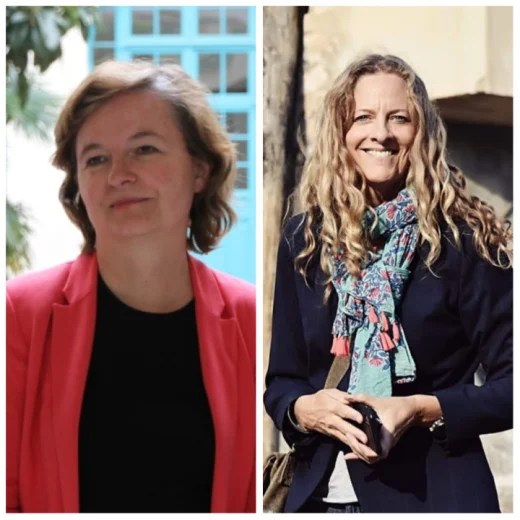
MEP Nathalie Loiseau of France is lobbying for individual sanctions on all observers of the Russian-organized referendums in the Donbass region. She has singled out journalist Vanessa Beeley not only for her coverage of the vote, but for her reporting on the foreign-back war against Syria’s government.
A French Member of European Parliament (MEP), Natalie Loiseau, has delivered a letter to EU High Representative of Foreign Affairs, Joseph Borrell, demanding the European Union place personal sanctions on all international observers of the recent votes in the Donetsk and Lugansk People’s Republics and certain Russian-controlled territories in eastern Ukraine.
Obtained by The Grayzone from an EU source, the letter is currently being circulated among European parliamentarians in hopes of securing a docket of supportive signatures.
“We, as elected members of the European Parliament, demand that all those who voluntarily assisted in any way the organization of these illegitimate referendums be individually targeted and sanctioned,” Loiseau declared.
The French MEP’s letter came after a group of formally Ukrainian territories held a vote on whether or not to officially incorporate themselves into the Russian Federation in late September. Through the popular referendum, the independent Donetsk and Lugansk People’s Republics, which announced their respective successions from Ukraine in 2014 following a foreign-backed coup against the government Kiev, as well as the regions of Kherson and Zaporozhia, voted overwhelmingly in favor of joining the Russian Federation.
Loiseau singled out Vanessa Beeley, a British journalist who traveled to the region to monitor the vote. Extending her complaint well beyond the referendum, the French MEP accused Beeley of “continuously spreading fake news about Syria and acting as a mouthpiece for Vladimir Putin and Bashar el [sic] Assad for years.”
Loiseau, a close ally of French President Emanuel Macron, specifically demanded Beeley be “included in the list of those sanctioned.”
Beeley responded to Loiseau’s letter in a statement to The Grayzone :
“Imposing sanctions on global citizens for bearing witness to a legal process that reflects the self-determination of the people of Donbass is fascism. Should the EU proceed with this campaign, I believe there will be serious consequences because the essence of freedom of speech and thought is under attack.”
Russia’s referendums: drawing a line with NATO
In mid-September 2022, Beeley and around 100 other international delegates traveled to eastern Europe in order to observe a vote to join the Russian Federation in the regions of Kherson, Zaporozhia, and the independent republics of Lugansk and Donetsk.
Why did their presence trigger such an outraged response from Western governments? The answer lies in the recent history of these heavily contested areas.
The formally Ukrainian territories of Kherson and Zaporozhia fell under Russian control earlier this year as a result of the military campaign launched by Moscow in February, while the Donetsk and Lugansk People’s Republics declared their independence from the government in Kiev in 2014.
Russia began its special military campaign in Ukrainian territory on February 24. The operation followed Moscow’s decision that same week to formally recognize the independence of the Donetsk People’s Republic and Lugansk People’s Republic (the Donbass Republics) in Ukraine’s eastern Donbass region. Pro-Russian separatists in the Donbass have been embroiled in a bloody trench battle with the US-backed government in Kiev since 2014.
Ukraine’s civil conflict broke out in March 2014, after US and European forces sponsored a coup in the country that installed a decidedly pro-NATO nationalist regime in Kiev which proceeded to declare war on its minority, ethnically Russian population.
Following the 2014 putsch, Ukraine’s government officially marginalized the Russian language while extremist thugs backed by Kiev massacred and intimidated ethnic Russian citizens of Ukraine. In response, separatist protests swept Ukraine’s majority-Russian eastern regions.
The territory of Crimea formally voted to join Russia in March of that year, while the Donetsk and Lugansk Republics in Ukraine’s eastern Donbass region declared their unofficial independence from Kiev that same month. With support from the US military and NATO, Ukraine’s coup government officially declared war on the Donbass in April 2014, launching what it characterized as an “Anti-Terrorist Operation” in the region.
Russia trained and equipped separatist militias in Donetsk and Lugansk throughout the territories’ civil campaigns against Kiev, though Moscow did not officially recognize the independence of the Donbass republics until February 2022. By then, United Nations estimates placed the casualty count for Ukraine’s civil war at roughly 13,000 dead. While Moscow offered support to Donbass separatists throughout the 2014-2022 period, US and European governments invested billions to prop up a Ukrainian military that was heavily reliant on army and intelligence factions with direct links to the country’s historic anti-Soviet, pro-Nazi deep state born as a result of World War II.
Russia’s military formally entered the Ukraine conflict in February 2022, following Moscow’s recognition of the Donbass republics. While Russian President Vladimir Putin defined the liberation of the Donbass republics as the primary objective of the military operation, he also listed the “de-nazification” and “de-militarization” of Ukraine as a goals of the campaign. As such, Russian troops have since secured control of Ukrainian territories beyond the Donbass region, including the territories of Kherson and Zaporozhia.
Facing increased Western investment in the Kiev-aligned bloc of Ukraine’s civil war, authorities in the Donbass republics announced a referendum on membership in the Russian Federation in late September 2022, with Moscow-aligned officials in Kherson and Zaporozhia announcing similar ballot initiatives. Citizens in each territory proceeded to approve Russian membership by overwhelming majorities.
The results of the referendum not only threatened the government in Kiev, but its European and US backers. Western-aligned media leapt to characterize the votes as a sham, claiming Moscow’s troops had coerced citizens into joining the Russian Federation at the barrel of a gun. Their narrative would have reigned supreme if not for the hundred or so international observers who physically traveled to the regions in question to observe the referendum process.
Observers like Vanessa Beeley now face the threat of returning home to the West as wanted outlaws. But as Loiseau’s letter made clear, the British journalist was in the crosshairs long before the escalation in Ukraine.
Beeley among European journalists targeted and prosecuted for reporting from Donetsk
Vanessa Beeley was among the first independent journalists to expose the US and UK governments’ sponsorship of the Syrian White Helmets, a so-called “volunteer organization” that played frontline role in promoting the foreign-backed dirty war against Syria’s government through its coordination with Western and Gulf-sponsored media. Beeley also played an instrumental role in revealing the White Helmets’ strong ties to Al-Qaeda’s Syrian branch, as well as its members’ involvement in atrocities committed by Western-backed insurgents.
Beeley’s work on Syria drew harsh attacks from an array of NATO and arms industry-funded think tanks. In June 2022, the Institute for Strategic Dialogue (ISD), which receives funding from a variety of NATO states, corporations and billionaires, labeled Beeley “the most prolific spreader of disinformation” on Syria prior to 2020. (According to ISD, Beeley was somehow “overtaken” by The Grayzone’s Aaron Mate that year). The group did not provide a single piece of evidence to support its assertions.
Though Beeley has endured waves of smears, French MEP Natalie Loiseau’s call for the EU to sanction the journalist represents the first time a Western official has moved to formally criminalize her work. Indeed, Loiseau made no secret that she is targeting Beeley not only for her role as an observer of the referendum votes, but also on the basis of her opinions and reporting on Sy on the heels of the German government’s prosecution of independent journalist Alina Lipp. In March 2020, Berlin launched a formal case against Lipp, who is a German citizen, claiming her reporting from the Donetsk People’s Republic violated newly authorized state speech codes.
Prior to Lipp’s prosecution, the Institute for Strategic Dialogue launched a media campaign portraying her as a disseminator of “disinformation” and “pro-Kremlin content.”
In London, meanwhile, the UK government has imposed individual sanctions on Graham Philips, a British citizen and independent journalist, for his reporting from Donetsk.
And in Brussels, Loiseau’s campaign against Beeley appears to have emerged from a deeply personal vendetta.
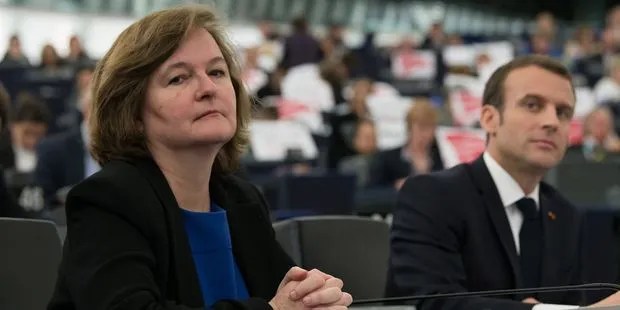
Nathalie Loiseau and French Pres. Macron
Who is Natalie Loiseau?
In April 2021, Beeley published a detailed profile of Loiseau at her personal blog, The Wall Will Fall, painting the French MEP as a regime change ideologue committed to “defending global insecurity and perpetual war.” Beeley noted that Loiseau served as a minister in the government of French President Emanuel Macron when it authorized airstrikes in response to dubious allegations of a Syrian government chemical attack in Douma in April 2018.
Beeley also reported that Loiseau has enjoyed a close relationship with the Syria Campaign, the public relations arm of the White Helmets operation. This same organization, which is backed by British-Syrian billionaire Ayman Asfari, was the sponsor of the Institute for Strategic Dialogue report which branded Beeley a “top propagator of disinformation” on Syria.
Loiseau has taken her activism into the heart of the European parliament, using her position as chair of the European Parliament’s Subcommittee on Security and Defense to silence colleagues who ask to many questions about the Western campaign for regime change in Syria.
During an April 2021 hearing, MEP Mick Wallace attempted to question Organization for the Prohibition of Chemical Weapons (OPCW) Director General Fernando Arias about allegations he personally aided the censorship of an OPCW investigation which concluded no chemical attack took place in Douma, Syria in April 2018.
Loiseau immediately descended into a fit of rage, interrupting Wallace and preventing him from speaking.
“I cannot accept that you can call into question the work of an international organization, and that you would call into question the word of the victims in the way you have just done,” Loiseau fulminated.
Wallace responded with indignation, asking, “Is there no freedom of speech being allowed in the European Parliament any more? Today you are denying me my opinion!”
A year later, Wallace and fellow Irish MEP Clare Daly sued the Irish network RTE for defamation after it broadcast an interview with Loiseau during which she baselessly branded them as liars who spread disinformation about Syria in parliament.
Now, Loiseau appears to be seeking revenge against Beeley, demanding that she be criminally prosecuted not just for serving as a referendum observer, but for her journalistic output.
Iran: What is the Future of the Nuclear Deal?
By Viktor Mikhin – New Eastern Outlook – 22.09.2022
While many around the world hoped for a positive reaction from the United States to Iran’s latest response, the European trio at the talks in Vienna (E3 – the UK, Germany, France) have separately issued a statement that could undo all the positive results of a year of painstaking negotiations. After Tehran responded to an American text submitted through the European Union’s coordinator for the Vienna talks, Josep Borrell, the latter passed it on to Washington. The Biden administration called the latest Iranian response “unconstructive” but refrained from responding formally, prompting speculation about the impact of the US midterm elections on negotiations in Vienna over the resumption of the 2015 Iran nuclear deal, officially called the Joint Comprehensive Plan of Action (JCPOA).
Still, after days of guesswork and speculation, a response was given, but not from the American side, which had intended to do so. E3 released a joint statement that seems only to have delighted opponents of the JCPOA and caused bewilderment around the world. “As we move closer to an agreement, Iran has reopened separate issues, related to its legally binding international obligations under the Treaty on the Non-Proliferation of Nuclear Weapons (NPT) and its safeguards agreement under the NPT concluded with the International Atomic Energy Agency (IAEA). This latest demand raises serious doubts as to Iran’s intentions and commitment to a successful outcome on the JCPOA. Iran’s position contradicts its legally binding obligations and jeopardizes prospects of restoring the JCPOA,” the E3 statement said demagogically and with no good reason.
This is despite the fact that Iran has long claimed that the IAEA has lost all credibility by making unfounded accusations that are politically motivated and emanate from the anti-JCPOA camp. In other words, and this fact has now become clear, the IAEA is simply a tool in the hands of the West, not an independent UN body. The E3 countries also seemed keen to make a poorly veiled threat against Iran, stating, “Given Iran’s failure to conclude the deal on the table, we will consult, alongside international partners, on how best to address Iran’s continued nuclear escalation and lack of cooperation with the IAEA regarding its NPT (non-proliferation treaty) safeguards agreement.”
The E3 joint statement was seen by experts around the world as an irresponsible move and a servile, obsequious submission to its master, the US. Reading this statement, one gets the impression that it is the E3 that is the aggrieved party that has lost over 300 billion dollars and 1,000 lives in the last 3 years because Iran withdrew from the JCPOA. Apparently, Brussels wants everyone to believe that Iran, not the US, has blatantly violated and completely reneged on all its obligations, subsequently violating all 11 commitments it had made to rectify the situation. After all, it is both well known and not disputed by anyone in the world that it was the US that unreasonably withdrew from the JCPOA and imposed further brutal sanctions on Iran, causing the Iranian people to suffer.
In addition to the separatist actions disregarding the views of Russia and China and the utter irresponsibility, the statement also undermined the ongoing and subsequent negotiations, deepening the atmosphere of distrust. Moreover, and quite obviously, the E3 countries have only strengthened the position of the opponents of the JCPOA, which is apparently what they were aiming for. “It is regrettable that by [issuing] such an ill-considered statement, the three European countries have followed in the footsteps of the Zionist regime down a path that will lead to the failure of negotiations. It is obvious that if such an approach continues, the E3 should also accept responsibility for its consequences,” Iranian Foreign Ministry Spokesman Nasser Kanaani said bluntly.
German Chancellor Olaf Scholz, trying to justify his loyalist position to the US, demagogically signaled a lack of expectation on his part that an agreement with Iran would in the near future restore Tehran’s shattered nuclear deal with world powers. Then, realizing that the best defense is a good offense, he unceremoniously declared that Iran had no reason not to sign and that European countries would remain “patient.” And what else could the 9th Federal Chancellor say after meeting in Berlin with Israeli Prime Minister Yair Lapid, who insisted that restoring the 2015 agreement would be a “critical mistake”? Incidentally, Germany still pays reparations to those Jews who were forced by Nazi Germany to leave as evacuees.
It appears that provocative pressure from Israel as well as other factors have managed to halt or delay Washington’s progress towards a return to a nuclear deal with Iran. This is clear from statements by senior Israeli officials, analysis by Israeli research centers and the media. There was a real celebration in Israel, as officials could not hide their joy at the E3 statement. “Following the Americans, yesterday the E3 countries announced that a nuclear agreement with Iran will not be signed in the near future, that the IAEA’s files opened on Iran will not be closed,” Israeli Prime Minister Yair Lapid cheerfully told a cabinet meeting. He thanked the leaders of France, Britain and Germany for their “strong position” on the issue. Then a wave of boasting and bravado swept over the Prime Minister and he took all credit for the collapse of the nuclear deal, saying, “In recent months, we held a discreet and intensive dialogue with them, and presented them with up-to-date intelligence information about Iranian activity at nuclear sites.” And further: “Israel is conducting a successful diplomatic campaign to stop the nuclear agreement and prevent the lifting of sanctions on Iran.”
It may be recalled that as the negotiations approached a crucial milestone, Israel began to take active steps to counter this, including visits to Washington by Mossad director David Barney, Israeli National Security Advisor Eyal Hulata and Minister of Defense Benny Gantz. Israel said the diplomatic onslaught was aimed at preventing the renewal of the nuclear agreement, which Tel Aviv sees as a threat to its security. Israeli Prime Minister Yair Lapid said he would visit the US this month to meet US President Joe Biden ahead of the UN General Assembly meetings to discuss the Iranian issue. “Israel is conducting a successful diplomatic campaign to stop the nuclear agreement and prevent the lifting of sanctions on Iran,” World Israel News stressed. Apparently, Israel and its leadership have decided that they are above the UN, and only they should solve the world’s problems and only in their own interests. That is why now more than ever, the challenge of transforming our world from a unipolar to a multipolar one, where all countries have equal rights and resolve issues in the common interest, is relevant.
Lapid, who visited Germany to discuss his country’s concerns about the agreement, said that “it is not over yet – there is still a long way to go, but there are encouraging signs.” He was referring to Israel’s success in dissuading the US administration from returning to the agreement. The Times of Israel quoted an unnamed senior Israeli official as saying that during recent talks with Biden, the Israeli Prime Minister was told that the nuclear deal was not being discussed and would not be signed anytime soon. According to the website, Lapid has recently become increasingly convinced that Washington’s return to the nuclear deal is unlikely. Iran’s 2015 nuclear deal with world powers is “in the ER room” and unlikely to be extended any time soon, if at all, Israeli Minister of Defense Benny Gantz said after European leaders expressed doubts about Tehran’s willingness to revive the pact.
“We cannot predict when the deal will be signed by major world powers and Iran,” Aleef Sabbagh, a political analyst, told Al-Ahram Weekly. “Right now, it’s not even close.” He noted that pressure from Tel Aviv appears to have delayed the signing of the agreement, and Israel’s diplomatic war against the deal has so far achieved some of its goals. However, several Israeli analysts point out that the delay in finalizing the agreement is linked to some of its details, in particular the IAEA’s investigation into traces of uranium at three sites that Tehran has not previously disclosed. Iran at the same time is demanding the cessation of this investigation as a precondition for a deal, and is apparently not about to back down. Israel, for its part, will continue to apply pressure until the last minute to prevent the signing of the agreement, focusing its attention on organizing a tough international stance in support of the IAEA investigations. This would require the establishment of a mechanism to control the funds Iran gains access to in order to ensure that they do not fall to Tehran’s allies in the region.
The Israeli opposition, led by former Prime Minister Benjamin Netanyahu, claims that the US administration has decided to return to the agreement, but insists on more favorable terms. He also accuses the incumbent Lapid government of failing to convince Washington of Tel Aviv’s security demands, which would be harmed by the agreement. However, the current Prime Minister argues that his cabinet is working quietly and diligently and has so far succeeded in blocking the agreement. Israel often repeats that it will not be bound by the agreement if it is signed, and reserves the right not to allow Iran to become a nuclear power. Tel Aviv has also frequently threatened to resort to the military option to achieve this goal if “Israel’s security needs” demand it, despite all the peace treaty efforts of many countries around the world.
The Green New Deal in Europe is quickly turning into a House of Horrors
By P Gosselin | No Tricks Zone | September 16, 2022
One excellent site with all the late latest energy crisis developments in Germany and Europe is Blackout News. Here are some of the more notable headlines of the past week:
Europe’s largest aluminum plant cuts production by 22% due to energy costs
Deindustrialization
Europe’s largest aluminum smelter, Aluminum Dunkerque Industries France, will cut production by 22% due to rising electricity prices, thus putting the industry’s existence at risk and increasing Europe’s dependency on foreign suppliers.
High energy prices: Municipal utilities running into payment difficulties
Struggling utilities
German municipal utilities, who supply gas and power to their communities, are running into liquidity problems as suppliers of electricity and gas demand large sums as security guarantees before deliveries. Around 200 of the 900 German municipal utilities are affected.
The municipal utilities also “have to reckon with payment defaults by their customers on an unprecedented scale. Consumers have to cope with price increases of over 50% in some cases, which many will not be able to cope with”
Eight to 15% of consumers are expected to not to be able to pay.
It’s a serious danger signal because if they get into trouble, an economic crisis is usually not far away.
Exploding energy costs: economists sound the alarm
Hostile business environment in Germany
The German economy is reeling from exploding energy costs as insolvencies escalate and even once robust companies collapse. A number of industrial companies have imposed production stops or drastically reduced production – because of the skyrocketing energy costs. BDI industry association president Siegfried Russwurm warns that the spiraling energy prices are driving companies away.
In the latest BDI survey, 90% of all companies are severely challenged by the sharp rise in energy and raw material prices. In February 2022, the figure was just 23%.
France plans rolling blackouts this coming winter
Extreme power shortages in France
France normally generates a good 70 percent of its electricity from nuclear power plants but its power supply is massively at risk as 24 of the 56 reactors are off the grid due to repairs and maintenance. The country is now planning rolling blackouts should there be corresponding supply problems.
French utility RTE reports “it is clear that the country will not be able to produce enough electricity during the winter months unless consumers drastically reduce their power consumption.” As a result, the utility expects there may be rolling blackouts during the winter.
==========================
If this keeps up, Europe might quickly turn into a continent of starving and freezing beggars. Watch for Europe to be looking at a new Enabling Act.
Willkommen and bienvenue! Welcome to the Green New Deal!
US, E3 untrustworthy; Iran pursues an agreement to secure its interests: Marandi
Press TV – September 11, 2022
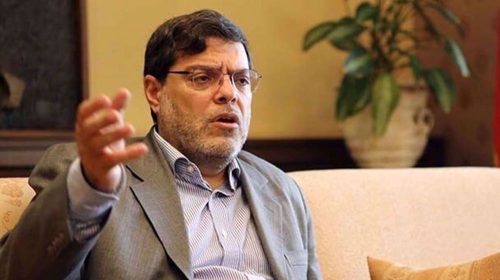
An advisor to the Iranian negotiating team has described the US government and the three European signatories to the 2015 nuclear deal as “untrustworthy”, stating that Tehran pursues an agreement that best secures its national interests.
During an interview on Saturday night, Mohammad Marandi said Iran was not the party that withdrew from the 2015 deal, officially known as the Joint Comprehensive Plan of Action (JCPOA), emphasizing that the three European countries (France, Britain, and Germany) obediently follow the policies of whoever is in the White House.
He added that Iran knows that any possible accord will fail unless the Western countries put an end to their false accusations against Tehran.
Marandi noted that the European troika and Washington are aware of the peacefulness of the Iranian nuclear program, stressing that Iran wants to reach an agreement that would secure its rights.
During the interview with the Lebanese Arabic-language al-Mayadeen television news network, he continued, “We cannot trust the Americans and Europeans,” highlighting that “the three European countries are all allies of the United States. They are not neutral, and we should not be deceived by their propaganda.”
Marandi also took a swipe at Director General of the International Atomic Energy Agency (IAEA) Rafael Grossi, stating that he “stands with Europeans and Americans, and is submissive to them.”
The advisor to the Iranian negotiating team went on to say that a European official once confirmed during the course of JCPOA revival negotiations in the Austrian capital of Vienna that Iran’s demands are rightful, but “the Americans are the ones who are delaying and procrastinating” the talks.
Marandi stressed that Iran is “ready to sign the agreement,” noting that “the Europeans need the agreement more than Iran, because of their need for gas.”
On the issue of Iranian natural gas, he told al-Mayadeen that “Iran sells its gas and oil, and is able to obtain financial revenues,” adding that “the longer the agreement is delayed, the bigger the problem for Europe would be because it wants gas as the winter is approaching.”
The European energy crisis comes as tensions persist between Russia and the West over Moscow’s offensive in Ukraine. Natural gas prices have soared in Europe to all-time highs since the West began unleashing waves of sanctions against Moscow.
Ever since, Russia’s Gazprom has drastically reduced its gas deliveries to Europe, saying that the anti-Russia sanctions have blocked the delivery of a turbine needed to stream gas to Europe via pipeline.
‘A weak Biden’
As for the United States, Marandi said, “US President Joe Biden is weak, and suffers from internal and economic problems before the midterm elections.”
Marandi added that “the Europeans have no problem in reaching an agreement, but rather the problem lies with weak Biden [administration].”
On Saturday, Iran slammed the latest “unconstructive and ill-considered” statement issued by the three European signatories to the JCPOA, saying they must accept the consequences if it continues to follow Israel’s lead.
“It is regrettable that by [issuing] such an ill-considered statement, the three European countries have followed in the footsteps of the Zionist regime down a path that will lead to the failure of negotiations,” the Iranian Foreign Ministry Spokesman Nasser Kan’ani said.
‘US’s support for terrorists’
Marandi also condemned Washington over its support for the terrorist Mujahedin-e-Khalq Organization (MKO) that has been hosted by Albania since 2016, stating that its members have been carrying out attacks against Iran.
On Wednesday, Albania, which has for years hosted the anti-Iran MKO terrorists in collusion with the US, severed diplomatic ties with Tehran, accusing it of orchestrating a July “cyberattack” against Tirana.
Kan’ani identified the United States, the Israeli regime, and the MKO as the “third parties” that have propelled Tirana into taking the decision.
Russia’s Permanent Representative to the International Organizations in Vienna, Mikhail Ulyanov, described the latest statement issued by three major European powers about Iran as “very untimely”.
“Very untimely indeed. Right at a critical moment at the #ViennaTalks and on the eve of the session of the #IAEA Board of Governors,” Ulyanov, who also leads the Russian delegation at the Vienna talks on Iran nuclear deal, wrote in a tweet.
In a press release on Saturday, France, Britain, and Germany raised serious doubts as to Iran’s intentions and commitment to a successful outcome on the JCPOA, claiming that Tehran’s position contradicts its legally binding obligations and jeopardizes prospects of restoring the nuclear deal.
The European trio said they have “negotiated with Iran, in good faith, since April 2021, to restore and fully implement” the JCPOA, along with other participants to the deal and the United States.
The United States, under former president Donald Trump, abandoned the agreement in May 2018 and reinstated unilateral sanctions that the agreement had lifted.
The talks to salvage the agreement kicked off in the Austrian capital city of Vienna in April last year, months after Joe Biden succeeded Trump, with the intention of examining Washington’s seriousness in rejoining the deal and removing anti-Iran sanctions.
Despite notable progress, the US indecisiveness and procrastination caused multiple interruptions in the marathon talks.
The West is poised to throw Yemen under the bus again to fuel its economic war on Russia
By Robert Inlakesh | Samizdat | September 11, 2022
Strained by the consequences of the ongoing conflict between NATO and Russia over Ukraine, France may be destroying all prospects for peace in Yemen, in a bid to secure energy resource from the United Arab Emirates.
Considered to be home to the worst humanitarian crisis in modern history, according to the United Nations, earlier this year, its people saw glimmers of hope towards ending its seven-year long war. A ceasefire truce, which has largely held since April, has been viewed as the first step towards reaching a UN-mediated solution for peace between the Ansarallah government in Sanaa and the Saudi-led coalition forces which claim to represent the internationally backed Yemeni government in exile.
According to UN estimates, the total number of people killed in Yemen’s war already reached 377,000 by the beginning of 2022. The civilian death rate is said to have doubled, according to the Norwegian Refugee Council (NRC), since the controversial withdrawal of UN human rights monitors last October.
Although Saudi coalition forces and Ansarallah, popularly referred to in Western media as the “Iran-backed Houthi rebels,” have managed to keep fighting to a minimum during the past months, another major player in the south of Yemen has recently decided to go on the offensive. The Southern Transitional Council (STC), often called Yemen’s southern separatists, are backed by the United Arab Emirates (UAE) and declared the start of a new military operation in the Abyan province “to cleanse it of terrorist organisations.” This follows territorial gains by the STC, in neighboring Shawba province, against the Muslim Brotherhood aligned Islah Party and others. The offensives launched by the UAE-backed STC have been regarded as a major challenge to UN efforts to end the conflict in Yemen, as well as having imperiled the Saudi initiative, which it calls the ‘Yemen Presidential Council,’ aimed at solidifying the legitimacy of the alternative Yemeni leadership in exile.
Where France Comes In
Although its role is little known to the Western public, Paris is the third largest arms supplier to the UAE and Saudi Arabia for their war efforts in Yemen, ranking just behind the US and UK. In fact, Germany, Spain and Italy have also sold weapons that have been used in the devastating war. Despite criticism, from human rights groups, of French weapons being used by Abu Dhabi and Riyadh to commit war crimes, the sale of weapons has continued from France.
April 15, 2019, French investigative magazine, Disclose, published an expose on Paris’s role in Yemen’s war. The information presented was based on a leaked French Military Intelligence (DRM) report dating back to September, 2018, clearly proving that the country had sold offensive weapons that were used in civilian areas, a charge that the French government has denied. As far back as June, 2018, credible reports began to emerge that French special forces units were operating on the ground in Yemen, alongside forces belonging to the UAE. Last December, Paris decided to further tighten its relationship with Abu Dhabi, signing its largest ever weapons sale to the UAE, worth 19.23 billion US dollars according to a report from Reuters.
France first turned to the US
France is now desperately in need of alternative energy suppliers to Russia, in order to meet its required needs, fearing that as the winter hits, Moscow may strategically cut off its natural gas completely. As part of NATO, Paris is backing a US-led initiative which seeks to make Russia pay an economic and military price for its offensive in Ukraine, however, this strategy has majorly backfired economically.
US President Joe Biden made two major foreign policy pledges when running for office in 2020, which are relevant to the current French predicament. The first being to revive the Obama-era Iran nuclear deal and the second being to find a diplomatic solution to the war in Yemen. Due to the ongoing NATO-Russia conflict, seeking a revival of the Iran nuclear deal has re-emerged on the political agenda of his administration in a major way. Iran, free from sanctions, could become an alternative source to fill the energy needs of Europe in the future, yet it could take some time for this to actually happen.
On the issue of the war in Yemen, Joe Biden pledged as part of his first speech on his government’s foreign policy goals, that he would hold Saudi Arabia to account and seek to find a solution to the crisis in Yemen. However, the war in Ukraine clearly changed his approach to Riyadh, so much so that Washington signaled in the review a decision to not sell offensive weapons to the Saudi government. The US President was heavily criticized by Human Rights Watch for traveling to Saudi Arabia in July.
Despite US attempts to have Gulf Cooperation Council (GCC) states increase their oil production, none have yet complied in the manner that Washington had hoped for. Specifically in the cases of the UAE and Saudi Arabia, it is clear that both are seeking to fast track their journey to diversify their economies. That has meant them hanging onto their strategic reserves of oil and gas, during a global energy crisis, which has made fiscal sense for them. In the cases of Venezuela and Iran, despite the US having seemingly reached out to both, neither seem to be a real replacement to Russia in the near future.
All Bets On Yemen
France is now looking for alternatives on its own. In June, the European Union announced that it had signed an agreement with Israel and Egypt. Under the deal, Israel will send gas through pipelines to Egypt, where it will then be transported to Europe. Although this may work, Tel Aviv does not have the capacity to replace Moscow as Europe’s main supplier of gas. Israel seeks to double its gas output, but in doing so is already running into potential problems over its maritime border dispute with Lebanon and its planned extraction of gas from the ‘Karish field’ in September, considered to be located in a disputed area. Lebanese Hezbollah has even threatened to strike all of Israel’s gas facilities in the event that Beirut is not given a fair deal to access its own resources.
French President, Emmanuel Macron, has attempted to persuade resource rich Algeria to become part of the EU’s solution, also going on a three-day trip to Algiers in order to mend ties. Algeria, which maintains close relations with Moscow, withdrew its ambassador from Paris for three months last year, during a diplomatic row. Macron had accused the Algerian President Abdelmadjid Tebboune’s government of “exploiting memory” and “rewriting history” of the colonial era and even questioned the legitimacy of Algeria as a State prior to French settler-colonial rule there. Around 1.5 million Algerians were killed in the battle for independence from France, which its resistance eventually managed to win in 1962. The tone of the French president has now dramatically changed from that of last year, with Macron remarking that both nations “have a complex, painful common past. And it has at times prevented us from looking at the future.”
The other major alternative path that France seems to be now seeking, is through its close alliance with the UAE. As mentioned above, it has been clear for some time that Paris has been involved in supplying weapons, logistical support and even boots on the ground to its allies in Abu Dhabi and Riyadh, aiding their fight in Yemen. However, it is also clear that the UAE has not been interested in cutting into its strategic oil reserves to meet the demands of Europe.
In July, as President Macron hosted the Emirati President, Mohammed bin Zayed al-Nahyan, in Paris, the French ministry of economy announced a new strategic energy agreement between the UAE and France. An aide to the French president noted that France was eager to secure diesel fuel from the UAE, hinting that the cooperation agreement involving France’s ‘Total Energies’ and the UAE’s ‘ADNOC’ may be linked. Although it is unknown as to what the specifics of the “strategic agreement” are, it has been speculated that the deal could potentially be worth billions.
Then, in August, the UAE-backed STC suddenly began new offensive operations in both the Shabwa and Abyan provinces. It just so happens that the STC forces decided to take over the energy sites in the Shabwa province too. Leading human rights NGOs had urged Paris to keep in mind Abu Dhabi’s human rights abuses in the advent of the signing of the strategic energy agreement, calls clearly not heeded. On August 21st, when UAE-backed forces seized the oil facilities in Yemen’s south, it may have been with the French deal in mind. Yemen’s former foreign minister, Dr. Abu Bakr al-Qirbi stated on Twitter that “preparations are being made to export gas from the Balhaf facility in light of increased international gas prices.” This was then followed by an announcement from the parliament of the Sana’a-based National Salvation Government, warning of suspicious movement from both US and French forces.
The key Balhaf facility, in Yemen’s Shabwa province, has reportedly been turned into a base for forces belonging to the UAE, with allegations suggesting that Paris could “provide protection for the facility through the French Foreign Legion.” There are also countless reports of the UAE looting resources from Yemen, which would seem to support the idea that they could be attempting to extract them to send to France. The latest reported looting of Yemen’s resources, from June, quotes Yemeni officials as having alleged that a Gulf Aetos tanker, carrying 400,000 barrels of Yemeni crude oil, had departed from Rudum port and was being operated by the UAE.
What these offensive moves by the STC also mean, is that the Saudi-backed forces in Yemen and Ansarallah will likely also get involved in the combat too. This could mean the dissolution of the ceasefire truce between the two sides, the renewal of the Ansarallah offensive to take the oil rich Marib province from the Saudi-backed forces and the death of any potential peace initiative to end the war.
It is unlikely that Ansarallah will stay silent, if the STC are aiding in the theft of Yemen’s resources for the sake of France. One of the major reasons behind the dramatic escalation of violence last year, was the Ansarallah offensive, launched with the aim of taking out the last northern stronghold of the Saudi-led coalition, Marib. The purpose of taking the resource rich area would be to stop the looting of Yemen’s resources, which according to reports is amounting to the theft of millions of barrels per year. Some sources claim that an unofficial agreement is in place between the US and Saudi governments, to purposefully keep the resources of Yemen away from its people and instead, divert the profits to Saudi banks.
Part of the reason why there was a Yemeni revolution in 2011, then a seizure of power in 2015 by Ansarallah in conjunction with the country’s military, was the popular belief that the past two Presidents of Yemen, Ali Abdullah Saleh and Abdrabbuh Mansour Hadi, were corrupt. The people of Yemen were fed up with Saleh for a multitude of reasons, primarily that he mismanaged resources, had sold out to the United States and was corrupt. President Hadi was later to be seen as a stooge, controlled completely by the Saudis.
Perhaps the biggest problem here however, is not just that Yemen is a resource rich country, with a starving population, being torn apart by foreign powers, but also that nobody even knows what their governments are involved in. On August 25, then British prime minister, Boris Johnson, stated, about rising energy bills, that “While people are paying energy bills, people in Ukraine are paying with blood”. Yet, it may turn out that for Europe to keep the lights on, the people of Yemen will pay with their blood. Except in this case, the UK, US and France can’t blame that bloodshed on Moscow, this is their own doing.
Robert Inlakesh is a political analyst, journalist and documentary filmmaker currently based in London, UK. He has reported from and lived in the occupied Palestinian territories and currently works with Quds News.
Featured Video
The American Retreat from Vietnam
or go to
Aletho News Archives – Video-Images
From the Archives
Iran UN ambassador calls for destruction of all nuclear weapons
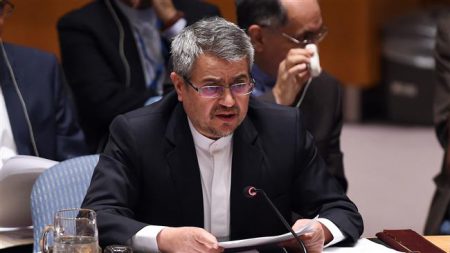
Iran’s ambassador to the UN Gholamali Khoshroo
Press TV – March 29, 2017
Iran’s ambassador to the UN Gholamali Khoshroo has called for the total eradication of nuclear weapons.
Khoshroo reiterated Iran’s call during a UN conference aimed at creating a nuclear weapons ban treaty in New York on Tuesday.
“Iran, as a victim of chemical weapons, strongly feels the danger posed by the existence of weapons of mass destruction and is determined to engage actively in international diplomatic efforts to save humanity from the menace of nuclear weapons,” he said.
Khoshroo stressed that Iran is committed to its Non-Proliferation Treaty (NPT) obligations, which include negotiations based on effective nuclear disarmament measures.
He added that several countries continue to ignore international calls and treaties for nuclear disarmament and even continue to increase their nuclear stockpiles. “They do not have political determination to abandon doctrines of nuclear deterrence and nuclear terror,” he went on to say.
Iran’s UN ambassador noted that boycotting the talks by many countries, including the US, shows that the world’s nuclear powers are by no means committed to the eradication of nuclear arms. Britain and France were also among the some 40 countries that did not join the talks.
“We note that prohibition of nuclear weapons must be accompanied by the elimination of such weapons. There can be no doubt that without complete abolition of nuclear weapons, there will be no absolute guarantee against the danger of nuclear war and the use of such weapons,” Khoshroo added.
Blog Roll
 Aletho News
- DHS docs: Govt bracing for nationwide anti-AI riots, preparing to crack down on dissent
- India signals rethink over West Asia
- Israeli Ex-Navy Chief admits massive damage from Iran missiles
- The strategic arsenal US lost in war against Iran – and why replenishment will take years
- Documents Suggest Fauci Knew COVID Was Created in Wuhan Lab, and mRNA Vaccines Wouldn’t Work
- No return to pre-war status for Strait of Hormuz – Iran’s top diplomat
- Ex-South Korean President sentenced for trying to provoke conflict with Pyongyang
- US publishes docs on ‘dangerous’ Ukrainian biolabs
- Trump’s ERAM cruise missiles for Ukraine blow up his peace overtures to Russia
- EU state lifts arms embargo on Israel after spy scandal
- If Americans Knew
- Israeli Firm Accused of Launching Smear Campaigns During US, European Elections
- As World Cup kicks off, Gaza amputee girls chase football dreams
- Oxfam: More Palestinians killed by Israel across West Bank in last 3 years than previous 17 years combined
- US-Iran ceasefire may be imminent, but will Israel blow it up? – Daily Update
- The Issue of Israel Is Ending Democracy In Michigan
- Israel is stealing homes, livelihoods, and lives in West Bank
- Gaza is not an aberration – Israel planned this genocide decades ago
- Israel is changing the face of Lebanon, mainstream media is normalizing it – 3 articles
- Genocide lobby benefits from EU anti-racist fund
- Watching the World Cup from Gaza
- No Tricks Zone
- New Study: Significant CO2 Fluxes From Non-Volcanic Sources Are Largely Neglected In Carbon Budgets
- Women Climate Scientists Being Harassed, Insulted By Skeptics, Claims Berkeley Earth Researcher
- Germany’s Longterm Spring Climate Data Show “No Climate Trend”
- New Study: Solar Photovoltaic, Wind Power Fail To Meet Annual Energy Demands 62% Of The Time
- Germany’s Die Welt: “Too Much Is Too Much” … Green Energies Are Cannabalizing Each Other!
- Germany’s Ecological Holocaust… Once Fairy Tale Forests Getting Cleared For Wind Turbines
- A Grand Solar Minimum Has Arrived…Global Cooling Of At Least 1°C Is Expected By The 2030s, 2040s
- European “Expert Commission” Urges COVID-19-Like Global Climate State Of Energency!
- Real-World Observations Do Not Support The Position That Climate Change Is Human-Caused
- Germany’s AfD Party Calls Debunked Climate Scenarios “Greatest Fraud In Human History”
 Aletho News