European hypocrisy: empty words for Palestine, deadly weapons for Israel
By Ramzy Baroud | MEMO | October 20, 2020
In theory, Europe and the United States stand on completely opposite sides when it comes to the Israeli occupation of Palestine. While the US government has fully embraced the tragic status quo created by 53 years of Israeli military occupation, the EU continues to advocate a negotiated settlement that is predicated on respect for international law.
In practice, however, despite the seeming rift between Washington and Brussels, the outcome is, essentially, the same. The US and Europe are Israel’s largest trade partners, weapon suppliers and political advocates.
One of the reasons that the illusion of an even-handed Europe has been maintained for so long lies partly in the Palestinian leadership itself. Politically and financially abandoned by Washington, the Palestinian Authority of Mahmoud Abbas has turned to the European Union as its only possible saviour.
“Europe believes in the two-state solution,” PA Prime Minister, Mohammad Ishtayeh, said during a video discussion with the European Parliament’s Committee on Foreign Affairs on October 12. Unlike the US, Europe’s continued advocacy of the defunct two-state solution qualifies it to fill the massive gap created by Washington’s absence.
Ishtayeh called on EU leaders to “recognize the State of Palestine in order for us, and you, to break the status quo.”
However, there are already 139 countries that recognise the State of Palestine. While that recognition is a clear indication that the world remains firmly pro-Palestinian, recognizing Palestine as a State changes little on the ground. What is needed are concerted efforts to hold Israel accountable for its violent occupation as well as real action to support the struggle of Palestinians.
Not only has the EU failed at this, it is, in fact, doing the exact opposite: funding Israel, arming its military and silencing its critics.
Listening to Ishtayeh’s words, one gets the impression that the top Palestinian official is addressing a conference of Arab, Muslim or socialist countries. “I call upon your Parliament and your distinguished Members of this Parliament, that Europe not wait for the American President to come up with ideas … We need a third party who can really remedy the imbalance in the relationship between an occupied people and an occupier country, that is Israel,” he said.
But is the EU qualified to be that ‘third party’? No. For decades, European governments have been an integral part of the US-Israel party. Just because the Donald Trump administration has, recently, taken a sharp turn in favour of Israel should not automatically transform Europe’s historical pro-Israel bias to be mistaken for pro-Palestinian solidarity.
Last June, more than 1,000 European parliamentarians representing various political parties issued a statement expressing “serious concerns” about Trump’s so-called Deal of the Century and opposing Israeli annexation of nearly a third of the West Bank. However, the pro-Israel US Democratic Party, including some traditionally staunch supporters of Israel, were equally critical of Israel’s plan because, in their minds, annexation means that a two-state solution would be made impossible.
While US Democrats made it clear that a Joe Biden administration would not reverse any of Trump’s actions should Biden be elected, European governments have also made it clear that they will not take a single action to dissuade – let alone punish – Israel for its repeated violations of international law.
Lip service is all that Palestinians have obtained from Europe, as well as much money, which was largely pocketed by loyalists of Abbas in the name of ‘State-building’ and other fantasies. Tellingly, much of the imaginary Palestinian State infrastructure that was subsidised by Europe in recent years has been blown up, demolished or construction ceased by the Israeli military during its various wars and raids. Yet, neither did the EU punish Israel, nor did the PA cease from asking for more money to continue funding a non-existent State.
Not only did the EU fail to hold Israel accountable for its ongoing occupation and human rights violations, it is practically financing Israel, as well. According to Defence News, a quarter of all of Israel’s military export contracts (totalling $7.2 billion in 2019 alone) is allocated to European countries.
Moreover, Europe is Israel’s largest trading partner, absorbing one-third of Israel’s total exports and shipping to Israel nearly 40% of its total import. These numbers also include products made in illegal Jewish settlements.
Additionally, the EU labours to incorporate Israel into the European way of life through cultural and music contests, sports competitions and in myriad other ways. While the EU possesses powerful tools that can be used to exact political concessions and enforce respect for international law, it opts to simply do very little.
Compare this with the recent ultimatum the EU has given the Palestinian leadership, linking EU aid to the PA’s financial ties with Israel. Last May, Abbas took the extraordinary step of considering all agreements with Israel and the US to be null and void. Effectively, this means that the PA would no longer be accountable for the stifling status quo that was created by the Oslo Accords, which was repeatedly violated by Tel Aviv and Washington. Severing ties with Israel also meant that the PA would refuse to accept nearly $150 million in tax revenues that Israel collects on behalf of the PA. This Palestinian step, while long overdue, was necessary.
Instead of supporting Abbas’ move, the EU criticized it, refusing to provide additional aid for Palestinians until Abbas restores ties with Israel and accepts the tax money. According to Axios news portal, Germany, France, the UK and even Norway are leading the charge.
Germany, in particular, has been relentless in its support for Israel. For months, it has advocated on behalf of Israel to spare Tel Aviv a war crimes investigation by the International Criminal Court (ICC). It has placed activists, who advocate the boycott of Israel, on trial. Recently, it has confirmed the shipment of missile boats and other military hardware to ensure the superiority of the Israeli navy in a potential war against Arab enemies. Germany is not alone. Israel and most European countries are closing ranks in terms of their unprecedented military cooperation and trade ties, including natural gas deals.
Continuing to make references to the unachievable two-state solution, while arming, funding and doing more business with Israel is the very definition of hypocrisy. The truth is that Europe should be held as accountable as the US in emboldening and sustaining the Israeli occupation of Palestine.
Yet, while Washington is openly pro-Israel, the EU has played a more clever game: selling Palestinians empty words while selling Israel lethal weapons.
Read also:
Zionist War on Palestinian Festival in Rome is Ominous Sign of Things to Come
US, Western intelligence services behind creation of Takfiri terrorist groups: Yemen leader
Press TV – October 19, 2020
The leader of Yemen’s Houthi Ansarullah movement has held the United States and Western intelligence services responsible for the creation of Takfiri terrorist groups, saying France’s external intelligence agency plays a significant role in this regard.
“Takfiris are supported by the US, France and Western countries. They are the parties that have stood by Takfiris to target Muslims as they massacre them. The United States and its allies in Syria, Yemen, and other countries are supporting Takfiris, because they are using the extremists to tarnish the image of Islam. Western intelligence agencies, including the one in France, are involved in monitoring and supporting them,” Abdul-Malik al-Houthi said at a televised speech broadcast live from the Yemeni capital of Sana’a on Monday evening.
Houthi also warned that distortion and misinterpretation of Islamic teachings have created a deep rift among Muslims and posed serious problems to them.
“Enemies have used such deviation to insult the Holy Qur’an and Islam. There is no mercy or sympathy whatsoever in the Western civilization. They trample on [the rights of] human societies, deprive people of their freedom, plunder their wealth and occupy their lands, and then lecture others on human rights,” he highlighted.
The Ansarullah chief then questioned Western states’ respect for human rights in Yemen, Palestine and other Arab and Muslim countries, saying US President Donald “Trump is proud that he is ready to give Arab lands to the [Israeli] enemy and expropriate them as he did in the Syrian Golan Heights. What sort of civilization is this?”
Houthi went on to say that insulting Islam is allowed while criticizing Zionists is prohibited in France and whoever does so will be brought to trial.
“In the West, on the other hand, you are allowed to insult Islam and prophets, become atheists and insult God. But you are not permitted to insult Zionists and stand up to them,” the Yemeni Ansarullah leader pointed out.
“In the world, there is a blatant and insulting attack on the Prophet [Muhammad (PBUH)], Islam and Muslims, and the campaign seeks to target our faith with the goal of cultural dominance,” Houthi noted.
The Ansarullah leader stressed that efforts are being made to turn Muslim nations into subordinates of the US, Western states and the Israeli regime.
“Plots aimed at enslaving and distancing us from our religious teachings and identity must not be accepted at all,” he said.
He then denounced French President Emmanuel Macron’s recent anti-Islam remarks as a form of hostility toward the Muslim world.
“France and the West are insulting Islam and the Prophet Muhammad (PBUH). At the same time, they are caring for Zionists and don’t stand any insults directed at them,” he said.
The Ansarullah leader finally held arrogant powers, led by the US and the Israeli regime, accountable for the sufferings of nations worldwide.
Macron’s Hypocrisy Is Typical of the Subservience to Israel By Most Western Leaders and Mainstream Media
By William Hanna | October 19, 2020
“The term does not necessarily signify mass killings . . . more often [genocide] refers to a coordinated plan aimed at destruction of the essential foundations of the life of national groups so that these groups wither and die like plants that have suffered a blight. The end may be accomplished by the forced disintegration of political and social institutions, of the culture of the people, of their language, their national feelings and their religion. It may be accomplished by wiping out all basis of personal security, liberty, health and dignity. When these means fail the machine gun can always be utilised as a last resort. Genocide is directed against a national group as an entity and the attack on individuals is only secondary to the annihilation of the national group to which they belong.”
Raphael Lemkin (1900-1959), Jewish Polish legal scholar who coined the term genocide
The decapitating in Paris of a French teacher who showed his pupils a caricature of the prophet Muhammad — from the satirical newspaper Charlie Hebdo — during a moral and civic education class discussion about freedom of speech, deserves to be unreservedly condemned by everyone. Extrajudicial executions are barbaric acts of extreme cruelty that violate international standards on human rights irrespective of where, or by whom, such heinous atrocities are committed.
While French President Emmanuel Macron was rightly justified in denouncing that barbaric attack, his comments about “ . . . freedom of expression, the freedom to believe or not believe,” was to say the least extremely hypocritical because in France, as in most other Western nations, freedom of expression — the freedom to hold opinions and to receive and impart information and ideas without interference by public authority and regardless of frontiers — is selective and has been criminalised when it involves criticism of Israel’s irrefutable crimes against humanity in the brutally and illegally Occupied Palestinian Territories.
While speaking at a dinner attended by Jewish leaders in February 2019, Macron claimed the surge in anti-Semitic attacks in France was unprecedented since World War Two and promised a crackdown including a new law to tackle hate speech on the internet; confirmed that France would be adopting the definition of anti-Semitism as set by the International Holocaust Remembrance Alliance (IHRA): and added that “anti-Zionism is one of the modern forms of anti-Semitism.” The World Jewish Congress welcomed Macron’s actions by asserting “this is just the beginning of a long road ahead. Adopting this definition of anti-Semitism must be followed by concrete steps to encode into law and ensure that this is enforced.”
Human rights activists consequently fear being unfairly branded as anti-Semitic because of their criticism of Israel for its occupation of territory internationally recognised as Palestinian; for its inhumane blockade of the Gaza Strip which has devastated the economy and caused unspeakable hardships in what is in effect the world’s largest prison; and for its perpetration of a genocide as defined by Raphael Lemkin who while managing to escape from the Nazis and save his own life, nonetheless lost 49 relatives in the Holocaust: a genocide which prompted the Jewish peoples’ commendable but sadly disregarded vow of “never again.”
Such disregard is the result of Zionism having hijacked and weaponised anti-Semitism and the Holocaust to silence any criticism of Israel’s crimes against humanity which spineless and unscrupulous Western leaders like Macron dismiss with the disingenuous soundbite of “Israel has a right to defend itself”: a right which apparently — according to the Western concept of impartial justice and equal rights for all humanity — is not applicable to the Palestinian people whom “God’s Chosen,” have frequently described as “animals” who have never actually existed as a people.
De-Arabizing the history of Palestine is another crucial element of the ethnic cleansing. 1500 years of Arab and Muslim rule and culture in Palestine are trivialised, evidence of its existence is being destroyed and all this is done to make the absurd connection between the ancient Hebrew civilisation and today’s Israel. The most glaring example of this today is in Silwan, (Wadi Hilwe) a town adjacent to the Old City of Jerusalem with some 50,000 residents. Israel is expelling families from Silwan and destroying their homes because it claims that King David built a city there some 3,000 years ago. Thousands of families will be made homeless so that Israel can build a park to commemorate a king that may or may not have lived 3,000 years ago. Not a shred of historical evidence exists that can prove King David ever lived yet Palestinian men, women, children and the elderly along with their schools and mosques, churches and ancient cemeteries and any evidence of their existence must be destroyed and then denied so that Zionist claims to exclusive rights to the land may be substantiated.
Miko Peled, Israeli peace activist and author
According to Miko Peled “Israel has been on a mission to destroy the Palestinian people for over six decades,” and he asked “why would anyone not give solidarity to the Palestinian people?” He also regarded Israel’s actions in the Six-Day War of 1967 as deliberate acts of aggression rather than a genuine response to a real threat; that “every single Israeli city is a settlement”; and that “expressing solidarity with Palestinians is the most important thing people can do.”
Expressing solidity with Palestinians, however, is a morally justifiable human right which Apartheid Israel has managed to suppress with the complicity of a US-led Western alliance of unprincipled bought and paid for political leaders like Macron aided by a mainstream media which while masquerading as the “the voice of the people,” actually consists of conglomerate-owned news outlets that have gutted newsrooms, abandoned the concept of investigative journalism, and replaced reporting of the true facts with shallow infotainment.
If President Macron and other spineless Western leaders of his ilk are genuinely concerned about the “surge in anti-Semitism,” they would do well to seriously consider the following warning by Yehoshafat Harkabi — Chief of Israeli Military Intelligence (1955-9) and subsequently a professor of International Relations and Middle East Studies at the Hebrew University of Jerusalem — who in his 1989 book, Israel’s Fateful Hour, called for Israel’s withdrawal from the occupied territories and warned that:
We Israelis must be careful lest we become not a source of pride for Jews but a distressing burden. Israel is the criterion according to which all Jews will tend to be judged. Israel as a Jewish state is an example of the Jewish character, which finds free and concentrated expression within it. Anti-Semitism has deep and historical roots. Nevertheless, any flaw in Israeli conduct, which initially is cited as anti-Israelism, is likely to be transformed into empirical proof of the validity of anti-Semitism. It would be a tragic irony if the Jewish state, which was intended to solve the problem of anti-Semitism, was to become a factor in the rise of anti-Semitism. Israelis must be aware that the price of their misconduct is paid not only by them but also Jews throughout the world. In the struggle against anti-Semitism, the frontline begins in Israel.
William Hanna is a London-based freelance writer on democracy and human rights and author of the recently published book, The Grim Reaper. Further information including book reviews, articles, sample chapters, videos, and contact details at: https://www.williamhannaauthor.com/
Popular protectionist policies in France could eventually lead to “Frexit”
By Paul Antonopoulos | October 15, 2020
The majority of French people say they are in favor of protectionism, according to the latest OpinionWay poll by Le Printemps de l’Économie and Inseec U. In fact, the figure has risen sharply since the beginning of the COVID-19 pandemic and the European Union’s weak response to external threats like Turkey. This is a fundamental trend that could lead to a referendum on France’s exit from the European Union.
According to OpinionWay polls, the share of French people in favor of protectionism has gone from 51% in March to 60% in September. The survey confirms the desire for protectionism in France, which has only been reinforced since the pandemic began. The survey shows that 60% of the French people questioned consider globalization as “a threat to France” and 65% believe that “France must protect itself more from the world today,” a level never observed since polling began
In the event of a major crisis, a country will first and foremost try to protect and supply its own population, even if it comes to the detriment of others. This was seen all across the European Union in the first months of the pandemic when most member states abandoned inter-European solidarity to the detriment of other member states. For example, in March, Germany banned the export of protective medical equipment at a time when France did not have enough.
As popularity for protectionism is increasing in France, according to the OpinionWay survey, support for free trade went down from 46% to 35%. Supporters of free trade try to pass off protectionism as authoritarianism and isolationism. However, during the Trente Glorieuses (The Glorious Thirty), which between 1945-1975 saw unprecedented economic growth and development in France, trade was carried out in a fair framework which limited distorted competition, unlike what happens with free trade.
The polls also show that the tide is turning for 18-24-year old’s, “traditionally known to be in favor of opening up to the world,” as Pierre-Pascal Boulanger, president and founder of Printemps, highlighted in the La Tribune article. “The gaps are narrowing sharply since now 44% of very young people are in favor of protectionism against 37% in March.”
Therefore, for all the rhetoric of European sovereignty by French President Emmanuel Macron, it means absolutely nothing as sovereignty can only be national. This year alone we saw Italy abandoned by its partners at the peak of the pandemic, while European Union member states still refuse to pass sanctions against Turkey despite its violations of Greek and Cypriot sovereignty, and constant threats of war.
Any European protectionist inclination is directly undermined by national interests. France is now beginning to prioritize its national interests over that of the European Union, especially with the Minister of the Economy, Bruno Le Maire, suggesting an implementation of a European carbon tax at its borders, something that Paris considers essential but which does not please Berlin.
The same thing could be seen concerning the taxation of GAFAM [Google, Amazon, Facebook, Apple and Microsoft]. The subject has been on the table for years but Germany is blocking taxes against GAFAM because the U.S. is its major trading partner and Berlin is afraid that Washington will retaliate by taxing imported vehicles which would hurt the German economy.
An Elabe poll released on February 12 showed that 80% of the French people questioned were opposed to a new duel between Macron and opposition leader Marine Le Pen in the 2022 elections. However, recent opinion polls show that the two candidates are indeed neck-to-neck and marginally ahead of other opponents. However, the European question encompasses all political and economic dimensions and must be put at the center of discussions. The European question goes beyond the left-right divide and a referendum on France’s exit from the European Union may be at the heart of the political debate. It will blur the ideological divides as people from different political positions would campaign for a “yes” or “no” vote, as we saw with Brexit.
Nigel Farage, leader of the Brexit Party and considered the great architect of the UK’s exit from the European Union, has never won the general elections. But he put such pressure to obtain a referendum and succeeded in creating a real debate on the question of sovereignty and protectionism.
The Brexit referendum has shown that it is possible. If a similar debate can get into the French spotlight, strong Frexit sentiment can build off the back of increasing popularity in protectionist policies. The French in 2005 voted against the treaty to establish a European constitution despite all predictions it would be unanimously passed. Although detached from the European Union, the French also withdrew from NATO for several decades, demonstrating there is a high sense of independence and sovereignty in France.
With Brussels unwilling to take a strong position against external threats like Turkey and/or showing a lack of solidarity when the pandemic was spreading across the continent, France’s possible exit from the European Union can build momentum and popularity.
Paul Antonopoulos is an independent geopolitical analyst.
More on the Anti-Semitism Scam: Jewish Students Get Protected Status
By Philip Giraldi | American Herald Tribune | October 10, 2020
In both the United States and Europe there has been an increase in the passage of laws that are intended to protect Jews. Indeed, one might say that one of the few growth industries in Donald Trump’s United States has been the protection of Jewish citizens and their property from a largely contrived wave of anti-Semitism that is allegedly sweeping the nation. Even while potentially catastrophic developments both in the Middle East and the United States continue to unfold, the threat of anti-Semitism continues to find its way into much of the news cycle in the mainstream media.
A survey conducted last month in all fifty states was released with the headline “First-Ever 50-State Survey On Holocaust Knowledge Of American Millennials And Gen Z Reveals Shocking Results. Disturbing Findings Reveal Significant Number Of Millennials And Gen Z Can’t Name A Single Concentration Camp Or Ghetto, Believe That Two Million Or Fewer Jews Were Killed And A Concerning Percentage Believe That Jews Caused The Holocaust.”
The survey is based on the premise that detailed knowledge of the so-called holocaust should be an essential part of everyone’s education. Currently, 12 states already require holocaust instruction in their public school curricula, though that includes five of the six biggest states, and recently passed federal legislation will eventually fund holocaust education everywhere in the U.S. But, of course, the real back story that one must not mention is that the standard holocaust narrative is at least as much fiction as fact and it is employed regularly to create special benefits and protections for both Jews in general and also for the State of Israel. That is why the usual sources in the media become outraged whenever it seems that the propaganda is not effective.
The ignorance of the holocaust story inevitably received wide play in the mainstream media but there are a number of things that all Americans should know about the anti-Semitism hysteria that drives the process. First of all, the extent to which there is actual anti-Semitism and the background to many of the incidents has been deliberately distorted or even ignored by the press and by the government at all levels. Anti-Semitism is hatred of Jews for either their religion or their ethnicity, but many of the so-called anti-Semitic incidents are actually related to the policies advanced by the state of Israel. Organizations like the Anti-Defamation League (ADL), which have a vested interest in keeping the number of anti-Semitic incidents high, deliberately conflate the two issues in their reports.
In its 2018 report, ADL reported “1,879 acts,” in the United States during the course of the year. It is not a particularly large number given the size and population of the U.S. and also with respect to what is included. There were certainly some physical attacks, including two shooting incidents at synagogues in Pittsburgh and Poway, but most of the incidents were much less kinetic, including shouting and name calling on university campuses between groups supportive of and opposed to Israel’s repression of the Palestinians.
Europe is way ahead of the game when it comes to punishing so-called holocaust denial or anti-Semitism, which now includes any criticism of Jews and/or of Israel. As one critic put it, Europeans generally can exercise something like free speech, but the speech is limited by certain rules that must be observed. Three weeks ago, the French nationalist writer and critic of Jewish power Hervé Ryssen was jailed for the fifth time for the crime of “hate speech.” He faces up to 17 months in prison for having been found guilty of “…insult, provocation, and public defamation due to origin, ethnicity, nationality, race, or religion.” In 2016 he was imprisoned for 5 months, in 2017 for 6 months and in 2018 for one year on similar charges. He also had to pay a 2000 Euros fine to the National Bureau of Vigilance Against Anti-Semitism. In January 2020, Ryssen was found guilty of “contesting the existence of crimes against humanity,” i.e. questioning the so-called holocaust which labels him as a négationniste, a “holocaust denier.”
Ryssen has written numerous books on Jewish power in Europe and on Israel. His scholarship has rarely been questioned, but his willingness to speak out sometimes boldly on issues that are forbidden has put him in prison more often than not. Curiously, the French law against vilifying ethnic groups and religions has de facto only rarely been applied to protecting either Christians or Muslims. Satirical magazine Charlie Hebdo continues to “blaspheme” against both religions without any intervention from the authorities, but it is careful not to make fun of Jews.
The United States is clearly moving in the direction of France, at least insofar as the Jewish community and Israel are concerned. But it is also refreshing to note that a revived progressive wing of the Democratic Party is engaging in a bit of pushback. Three weeks ago, 162 Democratic congressmen plus one Republican and one independent actually voted against an amendment intended to “Protect Jewish Students from Antisemitism at School.”
The vote took place on Sept. 16th, and was over a Republican proposed amendment to the Equity and Inclusion Enforcement Act (H.R.2574). The amendment designated anti-Semitism to be a form of discrimination included in the bill and would allow private citizens to file lawsuits claiming damages under the Civil Rights Act’s Title VI, focusing particularly on education programs. In spite of the considerable level of opposition, unfortunately the amendment still passed by a vote of 255 to 164.
According to the Concerned Women for America (CWA), a group that lobbied for the added language, “The amendment ensures that recipients of federal education funding act against anti-Semitism in our communities. The Boycott, Divestment, and Sanctions movement (BDS) on college campuses is one of the ways such discrimination is being displayed.” The bill allows suits directed against any program receiving federal money if it can be claimed that one is the victim of discriminatory practices that negatively affect a protected class more than another class. Previously, the protected classes were identified as “race, color, or national origin,” but Jews and, by extension, Israel are now also protected. The specific additional language that was inserted was: “In carrying out the responsibilities of the recipient under this title, the employee or employees designated under this section shall consider antisemitism to be discrimination on the basis of race, color, or national origin as prohibited by this title.”
In practice, the new legislation will mean that Jewish students or their families or proxies can use Civil Rights legislation to sue educational institutions if they are made uncomfortable by the presence of critics of Israel. The real targets are groups like BDS, which have obtained some traction on university campuses and have been targeted by both the Israeli government and domestic Israel Lobby organizations. But, of course, the real danger is that once protected status is granted to one chosen group that promotes the interests of a foreign government there is no control over how “hate speech” will be defined and the consequences for American fundamental liberties will be catastrophic, moving far closer to the European model of freedom limited by “rules.”
Marseille to set up own Covid scientific council in a protest over ‘dependency’ on Paris scientists
RT | October 6, 2020
The French city of Marseille has adopted a proposal to form its own scientific council to assess Covid statistics and develop more informed local policies, as it battles against “unjust” lockdown rules imposed by the government.
The proposal was adopted on Monday, having been put forward by outspoken former French senator Samia Ghali, the current second-in-command of the city administration.
The move will see Marseille take a leading role in the assessment of its own health situation and provide the mayor, Michèle Rubirola, and city leaders with the necessary information to manage their own policies on Covid restrictions, Ghali said.
“The mayor must chair a scientific council … to see what the deficiencies are, and so we have a perspective and no longer depend on certain Parisian scientists, but also so we, ourselves, have the capacity to say what is going and what is not, and no longer suffer the thunderbolt of Paris.”
Ghali has been particularly vocal in her criticism of Parisian lawmakers in recent weeks, following the imposition of new Covid restrictions in Marseille and neighboring Aix-en-Provence. The government decreed in September that the southern city would become a ‘maximum alert zone’, causing the closure of all restaurants and bars for 15 days, which was seen by many in Marseille as unjustified. The restaurants were eventually allowed to reopen from Monday under certain conditions, which prompted Ghali to say the earlier strictures were “unfair and therefore not sustainable.”
Paris escaped fresh restrictions in September, leading many elected officials in Marseille to suggest France’s second city was not treated in the same way as the capital. Rubirola had previously shared her disapproval on Twitter, claiming “The announcements of Olivier Véran confirm this evening the unequal treatment suffered by Marseille. Inconsistent and unfair.” Restrictions were eventually introduced in Paris on Monday.
However, the announcement of a scientific council for Marseille has been met with criticism by some political leaders. The president of the Regional Council of Provence-Alpes-Côte d’Azur, Renaud Muselier, said there are already 10 existing and competent health bodies at national and regional level. “In this crisis, each of these structures has its own expertise and role to play. Adding a purely Marseille thing to it can only add confusion and cacophony to an already disturbing disorder,” he noted.
Russia slams ‘disgraceful’ ban on founding OPCW chief speaking at UN Security Council on Syria
RT | October 6, 2020
An ex-OPCW chief, sacked under US pressure, has been barred from briefing the UN Security Council about a controversial probe into an alleged 2018 chemical attack in Syria. Russia called it a “shame” and published his speech.
Jose Bustani, a Brazilian diplomat who led the Organization for the Prohibition of Chemical Weapons (OPCW) from 1997 until 2002, was invited by Moscow to speak at a UN Security Council meeting about the so-called “Syrian chemical dossier,” but his appearance was blocked at the last minute by Belgium, Germany, Estonia, France, the US and the UK.
“What has happened now is yet more sad proof that Western delegations fear the uncomfortable truth,” Russia’s ambassador to the UN, Vassily Nebenzia, stressed while addressing the UN global body on Monday.
He said the six countries had “made history” because the Security Council has never voted “on the presence or absence of a briefer proposed by the [UNSC] president.” Prohibiting the former OPCW director general from speaking was a “shame and disgrace,” Nebenzia concluded, promising to publish Bustani’s statement after the meeting.
UK envoy Jonathan Allen said that Bustani is not in a position to “provide relevant knowledge or information.”
Shortly afterwards, the undelivered speech appeared on the website of the Russian mission to the UN. In it, the sacked OPCW chief raised “serious questions” over “whether the independence, impartiality, and professionalism of some of the organization’s work is being severely compromised, possibly under pressure from some member states.”
As a major example, Bustani cited an OPCW investigation into the alleged use of chemical weapons in the Syrian city of Douma on April 7, 2018. Western governments, and media outlets, maintain that forces loyal to Damascus dropped two gas cylinders as part of an offensive against jihadist forces, killing scores of civilians.
The allegations were used as a pretext for a major US-led airstrike against Syrian government forces later that year. The OPCW launched a probe into the “chemical attack,” and in early March of 2019, the final report by the Fact-Finding Mission (FFM) of the OPCW stated that there were “reasonable grounds” to believe that canisters filled with “molecular chlorine” were dropped from Syrian aircraft in Douma.
The final report gave credence to the Western show of force by implicating the Syrian government of Bashar Assad in conducting the attack, which the Syrian authorities vehemently deny.
Shortly after the release of the OPCW report, an internal memo by OPCW engineers was leaked, suggesting the canisters were likely just placed at the site of the “attack,” and did not come from the skies. Still, the final report did not include such information, and a senior OPCW official reportedly ordered the removal of “all traces” of the dissenting opinion, according to WikiLeaks.
Months later, Bustani noted that he was invited to an expert panel which heard the testimony of an unnamed OPCW investigator, who came forward with damning evidence that his own organization had engineered a report based on a flawed conclusion and likely deliberately steered toward the outcome favored by the West.
That expert provided “compelling and documentary evidence of highly questionable, and potentially fraudulent conduct in the investigative process,” Bustani’s statement recalled. The Brazilian diplomat had been so stunned by the testimony that he personally called on the OPCW to be “resurrected to become the independent and non-discriminatory body it used to be.”
However, he continued, the chemical weapons watchdog did not respond to any calls for greater transparency about the controversial Douma investigation. The probe was “hidden behind an impenetrable wall of silence and opacity, making any meaningful dialogue impossible.”
In conclusion, Bustani called on Fernando Arias, the current OPCW chief, to hear the grievances of OPCW inspectors who voiced dissenting opinions on the Douma incident. They “have dared to speak out against possible irregular behavior in your organization,” Bustani argued, adding that it is “in the world’s interest that you hear them out.”
Bustani noted that he had been removed from his OPCW position “following a US-orchestrated campaign in 2002.” Back then, he was trying to send chemical weapons inspectors to Iraq prior to the 2003 US invasion there. A UN tribunal ruled that his sacking was unlawful.
The Time of Troubles in Transcaucasia – Part 2
By M. K. BHADRAKUMAR | Indian Punchline | October 3, 2020
Part-1 of the three-part essay is here.
The German Chancellor Angela Merkel said in Berlin on October 2 that the European Union seeks a “constructive dialogue and a positive agenda” with Turkey. She had just returned to the German capital after a 2-day summit meeting of the EU countries in Brussels. Germany played a key role at the summit in steering the EU-Turkey relationship away from a confrontationist path to which it was drifting lately. (See my blog EU marks distance from Indo-Pacific strategy.)
Merkel said, “We had a very long, detailed discussion about our relations with Turkey. We came to the conclusion that we would like to enter into a constructive dialogue with Turkey, we want to have a positive agenda,” adding that the Brussels summit had opened a “window of opportunity” for closer cooperation with Ankara.
Merkel disclosed that talks for closer cooperation between the EU and Turkey in the coming months would focus on migration issues, trade, modernising the Customs Union, and liberalised visa regime. In effect, Merkel has made a huge case for Turkish President Recep Erdogan at a particularly sensitive juncture for the latter when there is growing criticism in Europe regarding his regional policies.
In particular, there has been a nasty incident recently involving the Turkish and French navies in the Eastern Mediterranean. It was a rare, if not unprecedented, incident involving two NATO powers in the 7-decade old history of the western alliance.
Again, the US recently strengthened its military bases in Greece and has repeatedly called for restraint on the part of Turkey over its maritime disputes with Greece and vowed to intervene both politically and militarily in the tensions in the Eastern Mediterranean.
Turkey and France support opposite sides in the Libyan civil war, while the US is aligned with militant Kurdish groups in Syria whom Turkey regards as terrorists. And as conflict erupted in Nagorno-Karabakh, Turkey witnesses the US, France and Russia swiftly drawing close in a phalanx to push back at Erdogan’s robust backing for Azerbaijan, including pledges of military help.
To be sure, Merkel spoke with great deliberation. Before leaving for Brussels, Merkel had addressed the German Parliament where she referred to complaints against Turkey’s human rights records, but went on to praise Turkey’s “amazing and remarkable” performance in hosting refugees, highlighting that Turkey is hosting four million refugees.
Interestingly, Merkel compared Greece to Turkey in a poor light. “We have to weigh very carefully how to resolve the tensions and how to strengthen our co-operation on refugees and on the humane treatment of refugees,” she said and proceeded to condemn the manner in which Turkey’s archetypal enemy Greece is handling the migrant camp in Lesvos (Greece).
With biting sarcasm, Merkel noted, “in recent days we have seen horrible images regarding the treatment of refugees. And not from Turkey, I would like to emphasise, but from Lesvos (Greece), from an EU member state.”
Without doubt, Germany has stood up to be counted as Turkey’s friend at a time when the latter faces growing isolation within the NATO and from the EU.
Seminal events
The well-known American professor at Harvard University’s John F. Kennedy School of Government, Stephen Walt once penned an essay titled Great Powers Are Defined by Their Wars where he pointed out that explaining a great power’s foreign policy is a perennial question for scholars of international politics. He argued that major wars have powerful and long-lasting effects on a nation’s subsequent foreign or military policy.
Prof. Walt explained that wars are seminal events from which a great power’s subsequent behaviour follows, independent of its relative power, regime type or its leadership. In his words, “Those who fight in these wars are often scarred by the experience, and the lessons drawn from victory or defeat will be etched deeply into the nation’s collective memory. The experience of past wars is central to most national identities… If you want to understand the foreign policy of a great power, therefore (and probably lesser powers as well), a good place to start is to look at the great wars it has fought.”
Isn’t it a poignant historical memory for Berlin that the Ottomans were Germany’s allies in two world wars when it was hopelessly isolated by the the western powers?
On the other hand, take Russia and Turkey. Russia fought a series of twelve wars with the Ottoman Empire between the 17th and 20th centuries — one of the longest series of military conflicts in European history — which ultimately ended disastrously for the latter and led to its decline and eventual disintegration.
Russia had often fought the Ottomans at different times, often in alliance with the other European powers. Importantly, these wars helped to showcase the ascendancy of Russia as a European power after the modernisation efforts of Peter the Great in the early 18th century. In the Turkish Muslim psyche, however, Russia has figured as a protagonist which had played an historical role in the weakening of the Ottoman Empire in Central Europe, the Balkans and Transcaucasia.
The Russian conquest of the Caucasus mainly occurred between 1800 and 1864. In that era the Russian Empire expanded to control the region between the Black Sea and Caspian Sea, the territory that is present-day Armenia, Azerbaijan and Georgia (and parts of today’s Iran and Turkey) as well as the North Caucasus region of modern Russia. Multiple wars were fought against the local rulers of the regions as well as the Ottoman Empire until the last regions were brought under Russian control by 1864 with the expulsion to Turkey of several hundred thousand Circassians.
Then followed the Russo-Turkish War (1877-78) when Russia seized the the province of Kars and the port of Batumi on the Black Sea. In World War I, aligned with Germany, the Ottomans pushed against Russia as far east as Baku (capital of Azerbaijan) but then withdrew, lacking the strength to advance further, and subsequently in the post-war confusion, somehow contrived to regain Kars.
Suffice to say, in 1991 following the collapse of the former Soviet Union, when Transcaucasia became independent as the states of Georgia, Armenia and Azerbaijan, a lot of blood-soaked history involving Russia and Turkey provided the backdrop. Incidentally, Erdogan’s family originally hailed from Rize Province in the eastern part of Turkey’s Black Sea region (where he grew up as a child), which was a site of battles between the Ottoman and Russian armies during the Caucasus Campaign of World War I and was occupied by Russian forces in 1916-1918, to be finally returned to the Ottomans under the Treaty of Brest-Litovsk in 1918. The Soviet Union returned Rize to Turkey in 1921.
‘Past is never dead’
Amidst all this, an interesting feature of the flow of history has been that from the days of the Roman Empire, Transcaucasia was usually a borderland between Constantinople (Istanbul) and Persia. Areas would shift from one empire to the other, their rulers would have varying degrees of independence and were often vassals of one empire or the other, depending on the size and proximity of the suzerain’s army. By around 1750 the area was divided between the Turkish and Persian vassals. The western two thirds were inhabited by Georgians, an ancient Christian people, and the eastern third mostly by Azeris, Turkic Muslims. And Russia of course was pushing close to the Black Sea and the Caspian against the Ottoman and Persian empires.
Professor Walt in his essay cited a famous quote from the American novelist William Faulkner, “The past is never dead. It’s not even past.” Indeed, for Russia, Turkey or Iran, the current developments in Transcaucasia form part of a vast collective event that shapes their perceptions of danger and definitions of heroism, sacrifice, and even their identity.
In fact, the current line-up in the developing situation around Turkey speaks for itself: Germany voices sympathy for Turkey and offers an enhanced partnership; France lambasts Turkey and seeks EU sanctions against Turkey; France alleges Ankara’s dispatch of Syrian fighters to Nagorno-Karabakh; Germany appreciates Turkey’s big hand in addressing the refugee crisis gripping Europe; France coordinates with Russia at the highest level of leadership to pressure Turkey over Nagorno-Karabakh; the North Atlantic Treaty Organisation (NATO) and the US join Russia and France’s call for cessation of fighting in Transcaucasia; Iran maintains neutrality and suggests a joint effort with Turkey and Russia to resolve the conflict between Armenia and Azerbaijan.
Meanwhile, Moscow has shed its initial ambivalence and is stepping into the arena on the side of Armenia, expressing “serious concern in connection with incoming information about the involvement in hostilities of gunmen from illegal armed units from the Middle East” — plainly put, censuring Turkey’s backing for Azerbaijan. And President Vladimir Putin underscores that he is voicing a common stance along with “the presidents of the countries co-chairing the OSCE Minsk Group” (Russia, France and the United States). Simply put, Russia’s “competitive rivalry” with Turkey is surging.
Interestingly, Turkish President Recep Erdogan has openly drawn attention to the broader regional and geopolitical context in which the various unnamed powers are jockeying and covertly coordinating to encircle Turkey. Erdogan said on October 2, “If we connect the crises in the Caucasus, in Syria and in the Mediterranean, you will see that this is an attempt to surround Turkey.”
It doesn’t require much ingenuity to figure out the identity of the foreign powers he would have had in mind who are attempting to “surround” Turkey — France, the US and Greece (all NATO powers) and Russia, the scourge of the Ottoman Empire.
‘Sort out your own internal affairs,’ Lukashenko tells Macron after French leader calls for his resignation

RT | September 27, 2020
If Emmanuel Macron believes heads of state must resign over street protests, he should have left office himself when Yellow Vest demonstrators took to the streets in France, Belarusian President Alexander Lukashenko has said.
Lukashenko, who has faced weeks of large-scale protests following the August 9 presidential election which the opposition insists was rigged, has labeled Macron an “immature politician.” His words were reported to the BelTA news agency by his press secretary.
As a “mature politician,” the Belarusian president advised his French counterpart “not to get distracted, but instead focus on the internal affairs of France. At least, begin solving the many problems that accumulated in the country,” Lukashenko added.
The statement came after Macron said in an interview with Le Journal du Dimanche that “it is clear that Lukashenko must go” because his “authoritarian administration” is unable to accept democracy.
“Judging by his own logic, the French president should’ve himself resigned two years ago when the Yellow Vests started going out to the streets in Paris,” Lukashenko pointed out.
The Belarusian president went on to note that, as well as the Yellow Vests, France also needs to deal with the BLM movement as well as “Muslim protests” – apparently referring to the 2019 anti-Islamophobia demonstrations.
Responding to Macron, Lukashenko quipped that Minsk is ready to provide a venue for negotiations on “a peaceful transition of power [from the French president] to any of the above-mentioned groups.”
The Yellow Vest demonstrations were provoked by fuel tax hikes in France in November 2018, but they quickly transitioned into a wider protest against Macron’s policies and economic injustice. Weekly rallies in Paris and other cities often turned violent, with French police facing accusations of using excessive force against the protesters.
On Sunday, thousands of people again marched in Minsk and other Belarusian cities, demanding Lukashenko’s immediate resignation and a new, fair election. The police said that around 200 people were arrested across the country.
Featured Video
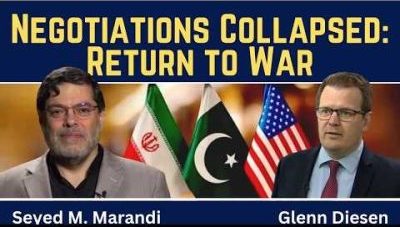
Seyed M. Marandi: Negotiations Collapsed – Return to War
or go to
Aletho News Archives – Video-Images
From the Archives
The US-Iran Scenario That Most Scares Israel
By Ali Haydar | Al-Akhbar | October 9, 2013
Israeli Prime Minister Benjamin Netanyahu issued a series of threats toward Iran and its interlocutors in the West, including the US, as serious negotiations on Iran’s nuclear program seem more plausible.
As a possible rapprochement looms between the US and Iran, Netanyahu has attempted to impose impossible Israeli conditions on the negotiators, such as the full dismantling of Iran’s nuclear program, not to mention threatening military force.
Whatever the deal that could materialize between Iran and the West, Israel is going to find itself before an open-ended path. One can foresee three possible scenarios… continue
Blog Roll
 Aletho News
- EU Defense Agency head says compulsory military service could be necessary
- France To Vote On Bill That Would Criminalize Criticism Of Israel
- There are No Ceasefires with Israel, Only Opportunities for Later Attacks
- China to Ignore Trump’s Blockade: The Strait Remains Open to Us
- Trump’s desperate bombasts amount to war crimes
- Most Israelis oppose Iran ceasefire, reject talks: Poll
- Iran to charge ships from ‘hostile’ nations to cross Hormuz – security chief
- UK, Spain reject Trump’s new scheme to blockade Hormuz Strait
- Russian frigate ‘resurfaces’, chases off NATO pirates days after Kiev ‘sank’ it
- Ukraine Targets Russian Merchant Fleet With NATO Intel Support – Presidential Aide
- If Americans Knew
- Emergency waivers move arms for Israel, UAE to speed lane
- Caitlin Johnstone: Nobody’s “Obsessed” With Israel — It’s Just A Uniquely Horrible Country
- Israel’s Ben Gvir says he feels like the ‘owner’ of Al-Aqsa Mosque
- History of flotilla campaigns to end Israel’s siege of Gaza
- Humanitarian Scorecard: Six Months In, Gaza Ceasefire is Failing
- Mark Levin Seems Upset We Haven’t Nuked Iran
- Israeli prison authorities are blocking hundreds of solidarity postcards being sent to female Palestinian prisoners
- ‘I wished for death’: Sexual violence in Israel’s prisons is an ‘organized state policy’
- Israeli army shoots, kills 9-year-old girl in her Gaza classroom
- Israel is attacking Lebanon to sabotage the Iran ceasefire, but the media is hiding its true motivation
- No Tricks Zone
- Cave Discovery Reveals Today’s Desert Climates Were Recently Far Warmer, Wetter, Teeming With Life
- German Expert: Heat Dome Led To Record Temps In Western USA…Warmer In 1934, 1936
- New Study: No Linear Warming Or Glacier Retreat Along Northern Antarctic Peninsula Since 1980s
- An Inconvenient Tree: Uncovered In Alps… Europe Much Warmer Than Today 6000 Years Ago
- New Study Reports A 60% Slowdown In Greenland’s Ice Loss Rate In The Last Decade
- Low Intensity Tornado Wrecks Major Solar Farm, Creating A Potential Toxic Dump
- New Study Finds Warming Saves Lives…Cold Temperatures 12 Times More Deadly Than Excess Heat
- German Science Blog Accuses PIK Climate Institute Of Hallucinating Climate Tipping Points
- Devastating Assessment Of Comirnaty Vaccine By Former Senior Pfizer Europe Toxicologist
- New Study: CO2 Is ‘Effectively Negligible’ As An Explanatory Climate Change Factor Since 2000
 Aletho News