France and COVID-19: Incompetence and Conceit
By Patrick Howlett-Martin | CounterPunch | April 22, 2020
On December 31, 2019, the Chinese government informed the World Health Organization of an epidemic of animal origin in Wuhan, reporting similarities to SARS-CoV (Severe Acute Respiratory Syndrome Coronavirus, originally appearing in 2002 in the province of Guangdong) and to MERS-CoV (Middle East Repiratory Syndrome, originally appearing in Saudi Arabia in 2012). On January 12, Chinese scientists shared the completely sequenced genome of this new coronavirus with the entire international scientific community.
The epidemic had already killed 80 people in China and thousands were infected. The city of Wuhan (11 million inhabitants) and the province of Hubei (60 million inhabitants the city of Wuhan included) were isolated on January 25-26. Factories, offices, stores, schools, universities, museums, and airports were all closed down.Urban transportation in the city was significantly reduced. As a precaution, the authorities extended the Chinese New Year vacation by one week (January 23-31) to cover the incubation period for the virus among the inhabitants of Wuhan who left the city and could have been infected. They set up shelter hospitals (“fangcang”) in gymnasiums, conference centers, hotels, and other facilities to separate the symptomatic and the likely-infected from their healthy relatives. With the number of ill people exceeding local hospital capacity, the authorities set up two 1,200-bed hospitals in fifteen days and summoned medical and voluntary nursing personnel from all over China. More than 42,000 healthcare personnel responded. Despite the use of Personal Protective Equipment, 4.4% of them (3,387) had tested positive and 23 had died as of April 3 according to the Chinese Red Cross.[1] The lockdown was strict and neighborhood committees were mobilized to ensure food deliveries to the inhabitants. Masks were requisitioned and distributed to the population. Street fixtures and furniture were disinfected, even banknotes were disinfected. The average age of the ill was 55 and 56% of them were men. No case of infection was reported in anyone under the age of 15.
All this information was shared in international medical journals by Chinese doctors and researchers starting on February 20.[2] The creation of hospitals ex nihilo in the space of a fortnight was given ample coverage in the media but the French authorities did not appreciate the gravity of the implications: they preferred to view the initiative as the Chinese marketing their public works. In mid-January, COVID-19 cases were recorded in Bangkok, Tokyo, and Seoul. Thermal sensors were installed in the airports of China, Korea, Thailand, Taiwan, Hong Kong, and Singapore. On January 26, the authorities in Hong Kong cancelled all sports and cultural events. A testing campaign began in the city on February 18.
And what of France? On January 24, the Ministry of Health announced that three patients coming from China had been hospitalized with the coronavirus. The French National Institute of Health and Medical Research (INSERM) outlined two scenarios for the spread of COVID-19: one high-risk, the other low-risk. Given air traffic, the countries estimated to be the most exposed were Germany and the United Kingdom. Italy was not even mentioned. The Minister of Health, Agnès Buzyn, commented on the INSERM scenarios that same day as she left the Council of Ministers: “the risk of secondary infection from an imported case is very low and the risk of propagation of the virus in the population is also very low.”[3]
On January 30, France repatriated 250 French citizens and 100 European immigrants from Wuhan, putting them in quarantine in southern France. On February 10, a British citizen coming from Singapore infected five other people in the small Alpine ski resort of Contamines-Montjoie. A summary screening did not detect other cases at the resort. The infected were hospitalized. Buzyn reminded us on that occasion that “the risk of infection is very low; only close and sustained contact with an infected person can increase it.”[4]
At that point, with 900 reported dead in China, WHO Director-General Tedros Adhanom Ghebreyesus made clear reference to the danger of global propagation, “we may only be seeing the tip of the iceberg.”[5]
But in France the authorities—duly warned but strangely untroubled—took no particular measures. On March 6, while at the theatre with his wife, President Macron stated, “Life goes on. There is no reason, except for the more vulnerable members of the population, to change our outing habits.”[6] His aim was to encourage the French to continue to go out despite the coronavirus epidemic and the lack of protective masks. That same day, the Italian government decided to lock down Lombardy, extending the provision to the entire country the following day. While Macron was enjoying the performance, there were 613 cases of coronavirus in France and the number was doubling every three days (roughly the same rate recorded by Chinese physicians in Wuhan in January and seen in South Korea and Italy). Extrapolating this exponential growth, it could be estimated that on March 16 there would be approximately 6,500 cases; the final official figure was 6,633.
The French government was all focused on the pension reform, president Macron’s top priority. Protests were organized in all French cities: retirees, railway workers, physicians, lawyers, fire fighters, and students all took to the streets. The demonstrations were violently suppressed by the police. Economists were in unanimous agreement—a rare event—that the proposed reform would harm all categories of worker except those in the upper income brackets. Sociologists warned the government about the deepening social schisms, as had been thrust into the public eye earlier with the 12 months revolt of the gilets jaunes [yellow vests]. These protests had been staged every Saturday for nearly a year in all cities in France, drawing in a broad range of the hardest-hit social and occupational categories, a large portion of whom were pensioners. But all for naught: on Saturday afternoon, February 29, with the chamber of the Assemblée nationale -where the debate on the bill was taking place—almost empty because of the of the day, the government seized the opportunity of the COVID-19 pandemic to pass pension reform by constitutional decree. On that date, gatherings of more than 900 people were prohibited because of COVID-19. The authorities no longer risked protests by the people in the street.
But the Macron administration did not stop there. Against the advice of the medical team and the stadium manager, it authorized a Juventus–Olympique Lyonnais football match for the Round of 16 in the Champions League. Three thousand Italian fans were in Lyon on February 26: at that time Italy had 21 coronavirus deaths and 900 people infected. Dr. Marcel Garrigou-Grandchamp, who had warned the new Minister of Health on the morning of the match, published an opinion piece on the website of the Fédération des Médecins de France on March 31, where he spoke of an “explosion” in coronavirus cases in the Département du Rhône some two weeks after the OL–Juventus match. A similar sequence of events had taken place in Italy with the Atalanta B.C. – Valencia match on February 19, termed a “bomba biologica” by many Italian physicians. It was March 4, fifteen days after the match, that the number of cases in the Lombard city of Bergamo exploded, making it the most heavily impacted city in Italy. Walter Ricciardi, Italian representative to the WHO, acknowledged that the match had been a “catalyst for the propagation of the virus”. The Paris-Nice 8-stage professional cycling race was held as scheduled from March 8th to the 15th. More significantly, the government confirmed the first phase of municipal elections on March 15, after it had ordered the closure of schools and universities on March 12 and the shutdown of most stores, bars, and restaurants on March 14. There are 34,000 communes in France that had to organize the elections with local volunteers: volunteers and voters without adequate protection—there were no masks available. The government had requisitioned them for hospital personnel, where the shortage was critical. Half of the voters stayed home for safety’s sake. To make matters worse, Agnès Buzyn announced her candidacy for mayor of Paris on February 16, less than one month before the election, to take the place of the government’s candidate, Benjamin Griveaux, who had been discredited when an explicit video he had sent to a young woman was posted online. Buzyn left the Ministry of Health in the middle of the Coronavirus crisis. The healthcare workers who had organized numerous strikes over the previous eleven months to protest the deterioration of public hospitals felt belittled. Losing by a wide margin, Buzyn declared in an interview for Le Monde that the election had been a “masquerade”.[7] The lockdown was not ordered until the day after the elections, politique oblige.
The new Minister of Health, Olivier Vérant, a member of parliament with the party in power, took up the government’s mantra, one that every minister and secretary of state is expected to chant in unison: “masks are useless, the tests are unreliable”. They all swear by handwashing and lockdowns. No reference is made to the way things had been handled in Seoul, Hong Kong, or Taiwan, where free masks were distributed and people were required to wear them, and large-scale testing was carried out, and where economic life goes on, in slow motion, but it goes on. Today, with 23 million inhabitants, Taiwan has recorded 6 COVID-19 deaths; Hong Kong, with 7 million inhabitants, has lost 4. As for the French doctors who were in Wuhan working alongside their Chinese colleagues and thus well informed, they were not even consulted.
The French police stop and fine transgressors, solitary walkers or joggers, while the metro, airports, trams, and buses are all operating and supermarkets and tobacconists are open for business. The police are themselves without masks and many fall victim to the virus, becoming potential carriers. The same is true of healthcare and administrative personnel, working without personal protective equipment in retirement homes. The authorities refused to report the number of victims among healthcare workers, citing “medical secrecy” concerns. The elderly die but are not counted in the official statistics. Nor are those who die at home. Now that their numbers are so high and can no longer be ignored, we discover that the residents of these retirement homes account for 40% of the deaths recorded in France. They are not hospitalized. Their treatment? Paracetamol for the mildly afflicted, morphine for the rest. Close to half of the nursing staff in retirement homes are affected by the epidemic.[8] But the government is powerless: it does not have sufficient testing solution and will not allow tests to be conducted in retirement homes unless there is a confirmed case there. Ubuesque!
The borders remain open. President Macron refuses to close the border with Italy, which the leader of the Rassemblement National party, Marine Le Pen has been demanding since February 26. For the Head of State, the problem posed by the epidemic “can only be resolved through perfect European and international cooperation.” The events of the following days would quickly contradict this wishful thinking. Every country has closed in on itself. But not France. There are no health controls at French airports, train stations, or ports. Not even today, April 18, 2020, when the official death toll has reached 18,000. In the worksite next to my home, Italian workmen come to work, without protective equipment, every morning on the 7:35 train from Ventimiglia, getting off at the Gare d’Eze: no checks when they depart, no checks when they arrive. Italy has now officially recorded more than 23,660 deaths. On its April 18 evening newscast, the television station Antenne 2 aired the report by journalist Charlotte Gillard, who had taken an Air France flight from Paris to Marseille: the plane was packed, not a free seat, the passengers did not have masks, no one’s temperature was checked on either departure or arrival.
We gradually learn from news reported in the press that France currently has no stores of masks or test kits. For economic reasons—annual savings of 30 million euros—the country’s strategic stocks were depleted in 2012 and never replenished. On the eve of 2020, when the coronavirus epidemic began to spread, France’s supplies consisted of zero FFP2 masks, 117 million adult surgical masks, and 40 million pediatric masks! The hospitals are experiencing critical mask shortages. The nursing staff in retirement homes have no protection (no gloves, no masks, no sanitizing gel). There is no more sanitizing gel available in pharmacies or stores. Doctors and nurses do not have the equipment they need. As for hospitals, they have neither enough beds nor enough ventilators to adequately cope with the epidemic.
The French authorities do not admit it publicly. And they seem to drag their feet for reasons that are impossible to grasp. They did not expect this. And when it began to materialize, they denied it for reasons that can only be called conceit, a traditional mark of distinction among the French political elite. The French regions authorities, realizing the government deficiencies, order and purchase their supplies directly from China. When they arrive, they are requisitioned by the state: thus 4 million masks that were ordered from China by Bourgogne-Franche-Comté for the nursing staff in its retirement homes were confiscated on the tarmac of the Basel-Mulhouse airport by the police on April 4, using methods that would make a gangster blush. As for the rare mayors who have stocks of personal protective equipment and graciously make them available to the local population, requiring the use of masks, they are taken to court by the Ministry of the Interior, which wants to preserve its royal prerogatives. On April 16, the Council of State, the highest administrative body in France, asserted its regal status by limiting the power of mayors. The decision calls to mind its role in 1942-1944 during the Vichy regime. It stays true to itself; it serves the State, not the Nation.
The nurses in the intensive care units in Paris hospitals report that given the shortage of beds and ventilators, they are essentially practicing battlefield medicine. This means there is a triage among the sick, choosing between those considered too old and those the doctors feel have a better chance of recovery.[9] It is no coincidence that the two European countries least afflicted by the pandemic are well-equipped Austria and Germany, which have not, so far, experience a shortage of beds or ventilators. In France, veterinarians are lending their ventilators to hospitals! Instead of nationalizing private clinics as they have done in Ireland, they transport patients long distances in medical trains, helicopters, or buses to less congested hospitals in the province or abroad (Germany, Switzerland, Luxembourg), increasing the possibility of infecting healthcare personnel and the risk of death. The statistics are biased because patients over the age of 75 do not have access to the ICU services: this is a sad fact for retirement homes.
It was not until March 28 that the Minister of Health, Olivier Véran, announced: “More than a billion masks have been ordered from France and other countries for the coming weeks and months.” This was the man who a few days earlier repeated publicly, in a sort of litany, that masks were useless.
In its decision of April 15 on the screening and protection of the elderly, the Council of State revealed the extent of the disaster. Assailed by associations demanding that people living in retirement homes and their caregivers be systematically tested and that protective equipment (masks, sanitizing gel) be distributed, the Council of State limited itself to reciting the paltry figures promulgated by the government (“40,000 tests per day will be available across the country by the end of April; 60,000 will be available in the weeks to come”). So in mid-May, France will be ready to do close to what Germany has already been doing for a month and a half: 500,000 tests per week. As for masks, the “current orders amount to some 50 million masks”. However, given the delivery rate, it will take nine months to receive them all.
There are 430,000 healthcare personnel and 752,000 pensioners in retirement homes and health centers. All told, there are close to a million healthcare professionals (210,000 active doctors and 700,000 nurses and nursing assistants) in France.
Under these conditions, it is clear that Macron’s announcement of the end of the lockdown and the resumption of school classes on May 11 is a gamble. If all teachers were to return to the classroom, that would mean 870,000 masks per day—reuse of masks is contraindicated. And if all the students return on this date, or even gradually, they would have to be supplied with more than 12 million masks per day.
Even with the President publicizing the “grand public” mask, a French invention no doubt handcrafted locally, the end of the lockdown on May 11 and the resumption of school classes is at best a gamble; without reliable masks to protect the entire population, it is a risky and irresponsible act.
The end of a health crisis that the authorities did not anticipate will be all the more painful for the French, both fiscally and socially, with the President and his administration coming out of this ordeal diminished and wholly discredited.
Notes.
1) “Death from Covid-19 of 23 Health Care Workers in China”, The New England Journal of Medicine, April 15, 2020.
2) The Lancet and the New England Journal of Medicine, see Chen Wang “Covid-19 control in China during mass population movements at New Year”, February 20, 2020 (on line).
3) Statement to the press, BFM TV, Palais de l ‘Elysée, January 24, 2020.
4) Benoit Pavan, “Coronavirus : la station de ski de Contamines-Montjoie, en Haute-Savoie, un foyer potentiel en France”, Le Monde, February 10, 2020.
5) Frederic Lemaître, “Coronavirus : la semaine où tout peut basculer”, Le Monde, February 9, 2020.
6) BFM TV, March 7, 2020.
7) Ariane Chemin, “Les regrets d’Agnès Buzyn : ‘On aurait dû tout arrêter, c’était une mascarade’”, Le Monde, March 17, 2020.
8) Béatrice Jérôme, Lorraine de Foucher, “Dans les Ehpad décimés par le coronavirus, ‘c’est un cauchemar collectif’”, Le Monde, April 2,l 2020.
9) “Une situation de médecine de guerre”, Nice Matin, April 16, 2020.
Patrick Howlett-Martin is a career diplomat living in Paris.
Daily Mail Falsely Brands Riots Against Police in Paris Suburbs as ‘Anti-Lockdown’ Protests
Sputnik – April 20, 2020
On 19 April, riots broke out in the suburbs of Paris following an accident where a 30-year-old motocyclist was seriously injured after he collided with a police car, with circumstances of the incident still being reviewed.
The Daily Mail has misleadingly branded anti-police clashes in Villeneuve-la-Garenne near Paris as “anti-lockdown” riots in the headline of its Monday article, while linking the skirmish to Emmanuel Macron’s recent extension of social-distancing orders.
The riots erupted in response to an incident in the evening of 18 April, when a 30-year-old motorcyclist was seriously injured after colliding with the open door of an unmarked police car. The man, whose leg was severely fractured in the incident, was successfully operated on on Sunday but was planning to file a complaint against the police.
According to the local authorities, the police opened the car’s door in order to detain the man, who was riding at a high speed. However, according to witnesses’ accounts and videos on social media, the door could have been opened deliberately in order to stop the motorcyclist. The incident is currently being investigated.
Following the incident, riots broke out in the Parisian suburb of Villeneuve-la-Garenne and continued through Sunday. They erupted again on Monday night, with protesters alighting cars and furniture on the streets and firing fireworks, while local law enforcement rushed into the areas. The videos of the incidents have been extensively circulating on social media.
Churchill’s War: the Real History of World War II
By Paul Craig Roberts • Institute for Political Economy • April 19, 2020
All truth-tellers are denounced, and most end up destroyed. Truth seldom serves the agendas of powerful interests.
The one historian from whom you can get the unvarnished truth of World War II is David Irving.
On the bookjackets of Irving’s books, the question is asked: What is real history?
The answer is that real history is history that travels straight from history-maker to the history-maker’s documents and from the document archives to the historian’s book without political input and free of academic and patriotic prejudice. It is history that cannot be bought.
Irving’s Hitler’s War was published in 1977. Irving was an archaeologist digging in history who located and dug up previously unknown documents and archives. He lets the factual record tell the history. He is exact and scrupulous and does not curry favor. The Board of Deputies of British Jews wrote: “The book was thoroughly researched . . . It confirmed Irving’s reputation as one of the world’s most thorough researchers and an exciting and readable historian.”
 The first volume of Irving’s Churchill’s War was published in 1987. The second volume in 2001. The third and final volume is awaited.
These works far surpass all previous histories of the war and all accounts of the agendas and events that produced the war. Irving is not motivated to curry favor with the ruling establishment, to make us feel self-righteous in our victory by demonizing the opponent or to grind any personal, ideological, or political axe. He lets the history-makers speak for themselves in their own words, and it is seldom a pretty picture.
Irving’s books sold millions of copies, and he was well-to-do. But he fell foul of Zionists, oddly enough because he documented actual atrocities against Jews. The problem was the attrocities he found differed from the official holocaust story. He documented a holocaust of a sort, but it is a different one than the Zionists prefer. If I understand correctly, infuriated Zionists with plentiful funds used unethical tactics and brought lawsuits, the defense against which eventually bankrupted him. Little wonder most historians choose to suck up to powerful interests by validating their claims and explanations. The fake history they write is a self-protective device like a bullet-proof vest.
I previously reported on Hitler’s War and the first volume of Churchill’s War in my most widely read article — The Lies About World War II. As I quoted Irving’s account that Jews were killed, but in a more ad hoc than organized way, Zionists rushed to my already defective Wikipedia biography to attribute Irving’s words to me, thereby labeling me a “holocaust denier.” When I complained of the misrepresentation, I was fobbed off with the reply that I would not have quoted Irving if I had not agreed with him. In other words, if you report in a book review what a writer says, it means you agree with him. I am not qualified to agree or to disagree with Irving. Indeed, few people are.
People in the Western world have been indoctrinated for 75 years into a white hat/black hat story of World War II that exonerates the “allies” and demonizes Hitler and Germany. To tell people, especially elderly ones whose memory of the war was formed by war propaganda, that the “allies” were as bad or worse war criminals than the Germans brings fire and brimstone down on one’s head. It nevertheless needs to be done, because our view of ourselves reflects the make-believe story of the war with which we are inculcated. In the false history comes strength for the opinion that we Americans and our country are exceptional and indispensable and that these traits justify Washington’s hegemony over the world. Our destruction in whole or part of seven countries in the 21st century, our withdrawal from arms limitation agreements, our dangerous demonization of militarily powerful countries such as Russia and China all rest in our self-righteous view of ourselves. Of course, not all Americans share these self-righteous views, but the views are the basis for both Republican and Democrat foreign policy. Even the left-wing, or whatever remains of it, believes in war in order to overthrow dictators and “bring democracy and human rights.”
In what follows I am not going to attempt a review of Irving’s second volume on Churchill. Instead, I will report some of the findings that documents reveal, findings that will be new information for most readers. But first a preface.
Hitler did not start World War II. England and France launched World War II with a declaration of war against Germany. Hitler did not want a war with Britain and France and tried to avoid it and then end it with a peace agreement very favorable to Britain and France. Hitler regarded the British Empire as essential to the survival of European dominance. He promised Churchill in exchange for an end of hostilities that Germany would defend the British Empire with the German military anywhere in the world that it was in jeopardy. Hitler left a large part of France and French North Africa unoccupied. He left the French fleet in French hands.
Hitler’s aim was to restore the integrity of the German nation which had been torn apart and distributed to Czechoslovakia, Poland, Denmark, and France by the Versailles Treaty which had been forced on Germany after World War I by a policy of starvation. Germans in the territories turned over to Czechoslovakia and Poland were being persecuted and murdered. Hitler had no choice but to do something about it. He recovered German territory from France, Czechoslovakia, and Denmark without war.
The same outcome was likely in Poland except the British interfered. The British gave the Polish military dictatorship a “guarantee” to come to Poland’s aid if Poland refused Hitler’s demands. Consequently, the Polish dictatorship broke off negotiations with Germany. Germany and the Soviet Union then split Poland between them.
The guarantee compelled “British honor” to declare war on Germany—but not on the Soviet Union—and the hapless French were pulled along.
 The British relied on the “powerful French military” and sent an expeditionary force which was promptly trapped at Dunkirk where Hitler let them go, thinking that an act of magnanimity and his refusal to humiliate the British would bring an end to the conflict. However, Churchill kept Hitler’s overly generous peace terms from the British people and from Parliament. Churchill had wanted war and had worked hard for one and now that he had power and a chance to repeat the military leadership of his great ancestor, the Duke of Marlborough, he was determined to keep his war.
With Hitler in control of Europe, Churchill began working harder to get the US into the war. All along the way President Roosevelt had given Churchill war encouragement but without promising any definite course of action from America. Roosevelt wanted Britain at war. He knew it would bankrupt the British and place them economically in Washington’s hands, which would permit the US to break up the British system of trade preferences that allowed Britain to control world trade, destroy the British Empire, dethrone the British pound and replace it with the dollar. Roosevelt was an enemy of empire except America’s own. From FDR’s standpoint, World War II was an attack by the US on British trade preferences that were the backbone of the British Empire.
So Churchill got his war which cost Britain her empire, and Roosevelt replaced the British Empire with an American one. FDR paid a cheap price—about 300,000 US combat deaths. In her defeat of Germany, Russia lost about 9,000,000 soldiers in combat deaths and 26 million people altogether,
After the Russians stopped the German offensive, the war could have ended, but FDR and Churchill had established a policy of unconditional surrender, which shackled allied wartime foreign policy to two more years of death and destruction.
As Pat Buchanan said, it was The Unnecessary War. The war served Churchill’s path to power and Washington’s empire.
Volume 2 begins in 1941. Irving has tracked down and unearthed many documents that permit a better understanding of the war. Many official papers are still under lock and key and many have been destroyed. The effort to suppress truth from coming out continues 75 years after the war.
Secrecy is used to hide crimes. It is reputations that are protected, not national security.
Churchill used secrecy to protect his war crime of ordering the bombing of civilian residential areas of German cities with his emphasis on bombing the homes of the working class as they were closer together which helped the conflagation to spread. Churchill would first have the civilian areas firebombed, and then when firemen and rescue workers were engaged the British would drop high explosives. Churchill ignored military targets, preferring instead to break the morale of the German population by bombing civilian areas. He tried to get the British Air Force to include poison gas when dropping incendiary and high explosive bombs on civilian residential areas.
As the British people did not know Churchill was bombing civilians, Churchill hoped Hitler would be provoked into replying in kind. Hitler refused for three months to take the bait, but finally his military insisted that unless he bombed the British they would keep on bombing German civilian areas. Hitler gave in but initially insisted that only British industrial targets be bombed. Once a few bombs went astray, Churchill had his rallying cry that the Nazi barbarians were bombing civilians. He got away with this, but officials in the know worried that the British Air Force, especially “Butcher” Harris, would face war crimes trials when the war was over. British generals and admirals disagreed with Churchill’s bombing policy. They regarded it as unprofessional and unprincipled. They complained that it harmed the war effort by denying the army and navy needed air support.
In November 1942 British Air Chief Portal compared the German bombing of Britain with the British bombing of Germany. The Germans had dropped 55,000 tons of bombs, killing 41,000 British and destroying 350,000 homes. The British had dropped 1,250,000 tons of bombs, killing 900,000 German civilians, maiming one million more, and destroying 6,000,000 German homes. The UK/US firebombing of Dresden at the end of the war stands as one of the worst war crimes in history. It killed as many or more civilians as the atomic bombs Washington dropped on the two Japanese cities, also at war end.
Churchill was determined to bomb Rome, but was resisted by the British Air Force. In contrast, Hitler ordered the German military not to risk the destruction of Rome by defending it.
Churchill ordered the bombing of the French fleet, which Hitler had left in the hands of Vichy France, killing around 3,000 French sailors. Churchill together with FDR and Eisenhower invaded French Northwest Africa which was in the hands of Vichy France. Vichy France Admiral Darlan used his influence to persuade the French not to resist the invasion, thus minimizing British and American casualties. Darlan cooperated in every way. His reward was to be assassinated in a plot organized by Foreign Secretary Anthony Eden, later one of Britain’s disastrous prime ministers. The assassin protested that he was promised immunity by the British, but was quickly executed to silence him. Eden, whose ambition was larger than his intelligence, was in DeGaulle’s pocket, and DeGaulle wanted Darlan out of his way to power.
The military schemes that Churchill imposed on the British military, such as his invasion of neutral Norway, always came to a bad end, but he rescued himself with masterful speeches in Parliament.
The British had a poor opinion of Eisenhower, and FDR had a poor opinion of Eden. There was so much conflict between the British and the Americans that it is amazing they were able to agree to any plan of action. The American people disliked the British for drawing them into “their war.” The British disliked the Americans for the Negro troops sent to England where they were believed to be responsible for rapes and a crime wave. A lot of propaganda was necessary to focus the hate on the Germans.
The British did not want to sacrifice Arab interests to Zionists but usually did because Zionists had the money. Churchill himself was indebted to a multimillionaire Jew who bailed him out when he faced bankruptcy. Zionists attempted to use their leverage over Churchill to force his approval of both more Jewish immigration to Palestine and for the formation of a “Jewish fighting force,” allegedly to fight the Germans but in reality to drive Palestinians out of Palestine. Zionists promised Churchill that if he would agree to their demands, they would bring the US into the war against Germany. Such was their power.
The British saw Zionists’ interests as detrimental to their hold on their Arab colonies. When deportations of Jews and their mistreatment began leaking out, the British Foreign Office saw the reports as the work of the international Zionist campaign to create sympathy and to use the sympathy in behalf of their Palestinian purpose. When 700 Jews found incapable of work were shot in a work camp, the Foreign Office responded, “Information from Jewish refugees is generally coloured and frequently unreliable.” Eisenhower was pleased with Darlan and was unaware of Eden’s plot against him. An American newsman told Eisenhower’s staff that the agitation against Admiral Darlan came from “Jews of press and radio who wish to make certain we were fighting a war to make the world safe for Jews.” The Jews cried wolf so often that when he actually showed up they were not believed.
Much information emerges in the second volume about Churchill’s character, personal habits, excessive drinking—he was dependent on alcohol—and autocratic ways. He could turn people against him and then with a speech or by taking special notice of them put them back in his pocket. Churchill had flaws and the ability to survive them. Irving does not excoriate Churchill. He merely shows us what he was like. There are things to admire and things to disapprove.
Moreover, it is not only Churchill who was ambitious. All were. It is a mystery that organization survived ambition. Somehow officers were able to devote time to war against the Germans from the time they spent warring against one another for commands and promotions. The same with cabinet ministers. The same for the military services fighting one another for resources. And the same for the Germans. The Italian and German generals were so jealous of Rommel’s initial successes in North Africa that they worked to undermine him.
And German efficiency also bites the dust. German intelligence never caught on that the British were reading their codes and knew precisely every shipment to resupply Rommel which the British seldom failed to send to the bottom of the Mediterranean. One would think that after nothing gets through time and again that a light would come on.
Volume 2 has 200 pages of footnote references. It has a 35 page index. It is the kind of history that only gets written once in a century. Irving is clearly the master of historical documentation. When you disagree with Irving, most likely you are disagreeing with the documented historical record.
French Navy flagship & its Only carrier ‘Charles de Gaulle’ cuts Middle East op as Dozens of sailors sicken
RT | April 8, 2020
France’s sole aircraft carrier ‘Charles de Gaulle’ had to suspend its Mediterranean Sea mission and turn back to port shortly after around 40 of its crewmembers were placed under medical observation with suspected Covid-19.
All symptomatic sailors have been “isolated” from the rest of the crew and are being constantly monitored by medical staff, the Defense Ministry said on Wednesday.
“They have symptoms consistent with a possible Covid-19 infection. These first symptoms have appeared recently.”
The illness struck the crew when the nuclear-powered ship was making its way to the Mediterranean Sea to participate in France’s Operation Chammal, directed against Islamist militants in the Middle East. Now, it will return to the southern French port of Toulon, where it had originally planned to dock on April 23.
Last month, the US Navy had to isolate more than 4,000 personnel on board the aircraft carrier ‘USS Theodore Roosevelt’ off Guam, after around 100 of its crew had tested positive for Covid-19.
Europe: Over 520,000 coronavirus cases and almost 38,000 deaths
By Robert Stevens | WSWS | April 3, 2020
European countries, including Spain and the UK, announced record-high daily coronavirus death tolls Thursday. With the 4,199 new deaths yesterday, 37,864 have already perished in Europe. There have been more than 521,000 cases of COVID-19 infections on the continent including 33,661 new cases.
In Spain, 950 died—the third consecutive day of a record high.
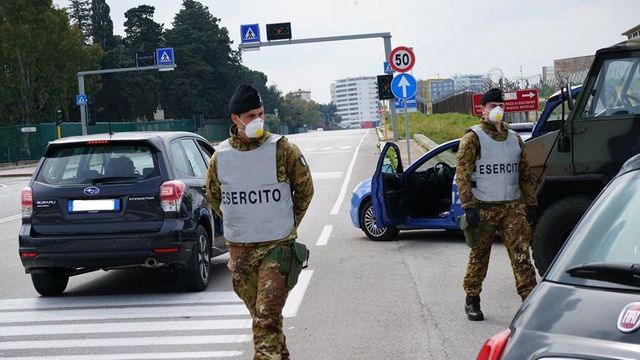
Italian Army soldiers monitoring cars and controlling the streets in Bari: (credit Twitter: Italian Army)
In the UK, the death rate has quadrupled in a week. In just four days since Monday, 1,693 coronavirus deaths have been announced—more than were recorded on all days up to March 29. The Department of Health and Social Care reported a record 569 deaths Thursday, taking the total to almost 3,000 (2,921). This was the second consecutive day Boris Johnson’s Conservative government announced over 500 deaths. Wednesday’s 563 fatalities were a 31 percent increase on the previous day.
With an age range of the latest deaths between 22 and 100 years old, nearly 8 percent (44 people) of yesterday’s victims had no known underlying health conditions.
Britain is now showing the terrible daily toll commonplace in Italy and Spain, with the pandemic taking over 13,000 and 10,000 lives in those countries.
The UK infection rate has also shot up, with 4,324 new cases announced Wednesday and 4,244 Thursday. Total infections in the UK stand at 33,718 but are in reality much higher. Hardly any tests were done when the outbreak began, despite months of warnings. Three weeks ago, Johnson announced—as part of attempting to enforce his “herd immunity” policy aimed at infecting everyone in the country with coronavirus—that no systematic testing would be done and that everyone who showed symptoms should self-isolate.
More than 1.7 million people in the UK have likely caught coronavirus over the past 15 days. Data from the NHS 111 online service revealed that web-based assessments flagged 1,496,651 people as potential carriers; a further 243,543 calls to 111 and the 999 emergency number concluded callers had signs of COVID-19.
It was only after widespread outrage at its social Darwinist policy that the government was forced to pledge that widespread testing would be done. Even now, just 163,194 tests have been completed with yet another promise yesterday of 100,000 a day for the end of April. Only 2,000 of 550,000 National Health Service frontline workers have been tested.
The BBC’s head of statistics, Robert Cuffe, commented Thursday, “if that [UK death rate] keeps up, we’d expect to see in the region of a thousand deaths a day by the weekend.” Sky News economist Ed Conway noted that “For the past week or so,” the UK’s death rate has “been doubling every three days” and “if the growth rate continued like that, in a week’s time there would be 10,000 people dead and the UK would be on a far worse trajectory than Italy.”
An explanation of this steeper curve emerged late yesterday, when NHS England reported that the earliest death in the UK had in fact occurred on February 28, one week earlier than previously reported. In total, six people had died in hospital prior to March 5.
In Italy, 760 died Thursday, taking the total to almost 13,915. Two new studies suggested the true death toll could be significantly higher than reported. The InTwig data analysis firm reveals that while there were 4,500 deaths in the hardest-hit city of Bergamo, the Civil Protection Agency only reported 2,060 deaths. The University of Bergamo, using historical data from the national statistics office compared to current hospital data, showed that deaths in the north of Italy doubled in the first three weeks of March, compared with the average number of deaths during the same period between 2015 and 2019. The uncounted deaths were mostly elderly victims who were not admitted to hospital and never tested for the virus.
The government welfare assistance website remains down, leaving Italy’s most vulnerable unable to receive any COVID-19 scheme for financial support. An estimated 3.3 million Italians work in the black economy and don’t qualify for welfare support schemes. Twenty thousand army soldiers are deployed in southern Campania, Puglia and Sicily to patrol the streets amid rising tensions as citizens run out of food and money.
Germany announced 168 new deaths, taking the total to 1,099. After Berlin approved its “coronavirus aid programme”—a bailout worth €600 billion for the banks, corporations and the super-rich—anger among workers is growing. In the past days, health employees in hospitals, nursing homes and workers in businesses vital to the supply of the population’s needs have criticised catastrophic and unsafe working conditions.
Truck drivers, airport workers, delivery workers and steelworkers are also voicing opposition. A worker at the Outokumpu stainless steel group in Krefeld, speaking anonymously to the WSWS, said, “We’re all angry, feeling betrayed. Even those in risk groups still have to work. An info sheet says they should talk to the company doctor. I did that. He advised me to wash my hands and disinfect myself. But we don’t have any disinfectant, or face masks. I use keyboards, telephones, etc.”
In a dramatic development, France’s death toll shot up by 1,355. Previously, Emmanuel Macron’s government had only released the deaths of those who had died in hospital of coronavirus. Yesterday, it announced that 884 people had also perished in retirement and care homes. On top of the 471 hospital fatalities, this takes total deaths to 5,387. Other countries, including until recently Britain, have also not included those who died outside hospital in their fatality announcements to play down the scale of the catastrophe they are responsible for.
Aware of explosive social anger in workplaces, the Stalinist General Confederation of Labour (CGT) has issued an authorization for public sector workers outside the hospitals to strike in April. The CGT is not calling for strike action or opposition to President Emmanuel Macron, but cynically authorizing isolated action by individual workers while the union bureaucracy keeps working with the government to slash wages and social benefits.
Workers have mounted strikes or walked off the job at Amazon, in supermarkets, in the auto industry and in aeronautics. One worker at an air conditioner manufacturing plant told the press, “This epidemic has woken up a lot of people…now the masks are falling. Usually management manages to calm them down, but today they are seeing that even when it is a matter of life and death, management has no concern for them.”
Lockdowns throughout the continent have led to staggering job losses. The Financial Times reported Wednesday, “Unemployment is growing much faster than in previous recessions because the measures taken to slow the spread of the virus are felt most severely in low-wage, labour-intensive sectors such as retail, hospitality and other consumer-facing services.”
In the UK, more than 1 million people have been forced onto the welfare rolls in just two weeks. Austria reported Wednesday that unemployment now stood at over 12 percent—the highest level since records began in 1946. In Spain, over 900,000 people have been made unemployed since the outbreak began there. In Norway, unemployment has risen from 2.3 percent to 10.4 percent in little over a month. The Financial Times noted the government’s Labour and Welfare Administration statement that a quarter of tourism and transport workers and almost a fifth of retail workers were now claiming unemployment insurance.
The newspaper reported that in Germany, “some 470,000 companies have applied for government wage subsidies through the ‘Kurzarbeit,’ or short-hours, programme—almost five times higher than the 100,000 people who used the scheme during the 2008-2009 recession.”
Another indication of the devastating impact of the coronavirus on the working class is seen in the map produced by the Catalan regional government in Spain, showing that the virus is six or seven times more prevalent in Barcelona’s poorer areas than in wealthier areas.
France, Czechs, & Other US Allies Exit Iraq Over COVID-19 Fears
By Tyler Durden – Zero Hedge – 03/27/2020
The United States has shown itself willing to both keep up its ‘maximum pressure’ campaign on Iran and its proxies while riding roughshod over Iraqi sovereignty by remaining in the country even as Baghdad leaders and the broader population demand a final exit.
But in another sign Europe is ready to divorce itself from US aims in the region, France has abruptly withdrawn its forces from the country after being there for five years. Interestingly the prime reason given was troop safety concerns over the coronavirus outbreak, but we imagine European leaders likely now see an opportunity to make a swift and easy exit without provoking the ire of their US counterparts.
International correspondents say this includes French withdrawal from six bases, with a small contingent of about 100 troops remaining in the country. The Czech Ministry of Defense also announced the exit of its forces Wednesday, which followed a large contingent of British forces leaving last week, also on fears of coronavirus exposure during the mission.
“British, French, Australian and Czech troops who were coaching Iraqi counterparts were being temporarily sent home as Baghdad had put a hold on training operations to prevent the spread of COVID-19,” reports the AFP this week.
All had been there to support coalition anti-ISIL operations led by Washington. But as the US mission to defeat the Islamic State has lately become less relevant given the demise of the terror group, Washington’s focus became Iranian influence inside Iraq – far beyond the original mission scope.
The US itself had been reportedly drawing down from certain bases, but is not expected to ultimately depart given the current high state of tensions with Iran-backed militias in the country.
But Iran and Iraq’s ‘counter-pressure’ campaign is only set to continue, as on Thursday two rockets slammed into the Iraqi capital’s high-security Green Zone early in the morning, in an incident that’s become almost a monthly occurrence. There were no reports of injuries.
Middle East regional correspondent and analyst Elijah Magnier observes of the rapid draw down: “Coronavirus is offering an opportunity for the world to detach itself from US dominance and reshuffle alliances.”
Indeed this will likely be the outcome in geopolitical hot spots and even economies around the globe.
Why France is hiding a cheap and tested virus cure
The French government is arguably helping Big Pharma profit from the Covid-19 pandemic
By Pepe Escobar | Asia Times | March 28, 2020
What’s going on in the fifth largest economy in the world arguably points to a major collusion scandal in which the French government is helping Big Pharma to profit from the expansion of Covid-19. Informed French citizens are absolutely furious about it.
My initial question to a serious, unimpeachable Paris source, jurist Valerie Bugault, was about the liaisons dangereuses between Macronism and Big Pharma and especially about the mysterious “disappearance” – more likely outright theft – of all the stocks of chloroquine in possession of the French government.
Respected Professor Christian Perronne talked about the theft live in one of France’s 24/7 info channels: “The central pharmacy for the hospitals announced today that they were facing a total rupture of stocks, that they were pillaged.”
With input from another, anonymous source, it’s now possible to establish a timeline that puts in much-needed perspective the recent actions of the French government.
Let’s start with Yves Levy, who was the head of INSERM – the French National Institute of Health and Medical Research – from 2014 to 2018, when he was appointed as extraordinary state councilor for the Macron administration. Only 12 people in France have reached this status.
Levy is married to Agnes Buzy, who until recently was minister of health under Macron. Buzy was essentially presented with an “offer you can’t refuse” by Macron’s party to leave the ministry – in the middle of the coronavirus crisis – and run for Mayor of Paris, where she was mercilessly trounced in the first round on March 16.
Levy has a vicious running feud with Professor Didier Raoult – prolific and often-cited Marseille-based specialist in communicable diseases. Levy withheld the INSERM label from the world-renowned IHU (Hospital-University Institute) research center directed by Raoult.
In practice, in October 2019, Levy revoked the status of “foundation” of the different IHUs so he could take over their research.

French professor Didier Raoult, biologist and professor of microbiology, specializes in infectious diseases and director of IHU Mediterranee Infection Institute. Photo: AFP/Gerard Julien
Raoult was part of a clinical trial that in which hydroxychloroquine and azithromycin healed 90% of Covid-19 cases if they were tested very early. (Early, massive testing is at the heart of the successful South Korean strategy.)
Raoult is opposed to the total lockdown of sane individuals and possible carriers – which he considers “medieval,” in an anachronistic sense. He’s in favor of massive testing (which, besides South Korea, was successful in Singapore, Taiwan and Vietnam) and a fast treatment with hydroxychloroquine. Only contaminated individuals should be confined.
Chloroquine costs one euro for ten pills. And there’s the rub: Big Pharma – which, crucially, finances INSERM, and includes “national champion” Sanofi – would rather go for a way more profitable solution. Sanofi for the moment says it is “actively preparing” to produce chloroquine, but that may take “weeks,” and there’s no mention about pricing.
A minister fleeing a tsunami
Here’s the timeline:
On January 13, Agnes Buzyn, still France’s Health Minister, classifies chloroquine as a “poisonous substance,” from now on only available by prescription. An astonishing move, considering that it has been sold off the shelf in France for half a century.
On March 16, the Macron government orders a partial lockdown. There’s not a peep about chloroquine. Police initially are not required to wear masks; most have been stolen anyway, and there are not enough masks even for health workers. In 2011 France had nearly 1.5 billion masks: 800 million surgical masks and 600 million masks for health professionals generally.
But then, over the years, the strategic stocks were not renewed, to please the EU and to apply the Maastricht criteria, which limited membership in the Growth and Stability Pact to countries whose budget deficits did not exceed 3% of GDP. One of those in charge at the time was Jerome Salomon, now a scientific counselor to the Macron government.
On March 17, Agnes Buzyn says she has learned the spread of Covid-19 will be a major tsunami, for which the French health system has no solution. She also says it had been her understanding that the Paris mayoral election “would not take place” and that it was, ultimately, “a masquerade.”
What she does not say is that she didn’t go public at the time she was running because the whole political focus by the Macron political machine was on winning the “masquerade.” The first round of the election meant nothing, as Covid-19 was advancing. The second round was postponed indefinitely. She had to know about the impending healthcare disaster. But as a candidate of the Macron machine she did not go public in timely fashion.
In quick succession:
The Macron government refuses to apply mass testing, as practiced with success in South Korea and Germany.
Le Monde and the French state health agency characterize Raoult’s research as fake news, before issuing a retraction.
Professor Perrone reveals on the 24/7 LCI news channel that the stock of chloroquine at the French central pharmacy has been stolen.
Thanks to a tweet by Elon Musk, President Trump says chloroquine should be available to all Americans. Sufferers of lupus and rheumatoid arthritis, who already have supply problems with the only drug that offers them relief, set social media afire with their panic.
US doctors and other medical professionals take to hoarding the medicine for the use of themselves and those close to them, faking prescriptions to indicate they are for patients with lupus or rheumatoid arthritis.
Morocco buys the stock of chloroquine from Sanofi in Casablanca.
Pakistan decides to increase its production of chloroquine to be sent to China.
Switzerland discards the total lockdown of its population; goes for mass testing and fast treatment; and accuses France of practicing “spectacle politics.”
Christian Estrosi, the mayor of Nice, having had himself treated with chloroquine, without any government input, directly calls Sanofi so they may deliver chloroquine to Nice hospitals.
Because of Raoult’s research, a large-scale chloroquine test finally starts in France, under the – predictable – direction of INSERM, which wants to “remake the experiments in other independent medical centers.” This will take at least an extra six weeks – as the Elysee Palace’s scientific council now mulls the extension of France’s total lockdown to … six weeks.
If joint use of hydroxychloroquine and azithromycin proves definitely effective among the most gravely ill, quarantines may be reduced in select clusters.
The only French company that still manufactures chloroquine is under judicial intervention. That puts the chloroquine hoarding and theft into full perspective. It will take time for these stocks to be replenished, thus allowing Big Pharma the leeway to have what it wants: a costly solution.
It appears the perpetrators of the chloroquine theft were very well informed.
Bagged nurses
This chain of events, astonishing for a highly developed G-7 nation proud of its health service, is part of a long, painful process embedded in neoliberal dogma. EU-driven austerity mixed with the profit motive resulted in a very lax attitude towards the health system.
As Bugault told me, “test kits – very few in number – were always available but mostly for a small group connected to the French government [ former officials of the Ministry of Finance, CEOs of large corporations, oligarchs, media and entertainment moguls]. Same for chloroquine, which this government did everything to make inaccessible for the population.
They did not make life easy for Professor Raoult – he received death threats and was intimidated by ‘journalists.’
And they did not protect vital stocks. Still under the Hollande government, there was a conscious liquidation of the stock of masks – which had existed in large quantities in all hospitals. Not to mention that the suppression of hospital beds and hospital means accelerated under Sarkozy.”
This ties in with anguished reports by French citizens of nurses now having to use trash bags due to the lack of proper medical gear.
At the same time, in another astonishing development, the French state refuses to requisition private hospitals and clinics – which are practically empty at this stage – even as the president of their own association, Lamine Garbi, has pleaded for such a public service initiative: “I solemnly demand that we are requisitioned to help public hospitals. Our facilities are prepared. The wave that surprised the east of France must teach us a lesson.”
Bugault reconfirms the health situation in France “is very serious and will become even worse due to these political decisions – absence of masks, political refusal to massively test people, refusal of free access to chloroquine – in a context of supreme distress at the hospitals. This will last and destitution will be the norm.”
Professor vs president
In an explosive development on Tuesday, Raoult said he’s not participating in Macron’s scientific council anymore, even though he’s not quitting it altogether. Raoult once again insists on massive testing on a national scale to detect suspected cases, and then isolate and treat patients who tested positive. In a nutshell: the South Korean model.
That’s exactly what is expected from the IHU in Marseille, where hundreds of residents continue to queue up for testing. And that ties in with the conclusions by a top Chinese expert on Covid-19, Zhang Nanshan, who says that treatment with chloroquine phospate had a “positive impact,” with patients testing negative after around four days.
The key point has been stressed by Raoult: Use chloroquine in very special circumstances, for people tested very early, when the disease is not advanced yet, and only in these cases. He’s not advocating chloroquine for everyone. It’s exactly what the Chinese did, along with their use of Interferon.
For years, Raoult has been pleading for a drastic revision of health economic models, so the treatments, cure and therapies created mostly during the 20th century, are considered a patrimony in the service of all humanity.“That’s not the case”, he says, “because we abandon medicine that is not profitable, even if it’s effective. That’s why almost no antibiotics are manufactured in the West.”
On Tuesday, the French Health Ministry officially prohibited the utilization of treatment based on chloroquine recommended by Raoult. In fact the treatment is only allowed for terminal Covid-19 patients, with no other possibility of healing. This cannot but expose the Macron government to more accusations of at least inefficiency – added to the absence of masks, tests, contact tracing and ventilators.
On Wednesday, commenting on the new government guidelines, Raoult said, “When damage to the lungs is too important, and patients arrive for reanimation, they practically do not harbor viruses in their bodies any more. It’s too late to treat them with chloroquine. Are these the only cases – the very serious cases – that will be treated with chloroquine under the new directive by [French Health Minister] Veran?” If so, he added ironically, “then they will be able to say with scientific certainty that chloroquine does not work.”
Raoult was unavailable for comment on Western news media articles citing Chinese test results that would suggest he is wrong about the efficacy of chloroquine in dealing with mild cases of Covid-19.
Staffers pointed instead to his comments in the IHU bulletin. There Raoult says it’s “insulting” to ask if we can trust the Chinese on the use of chloroquine. “If this was an American disease, and the president of the United States said, ‘We need to treat patients with that,’ nobody would discuss it.”
In China, he adds, there were “enough elements so the Chinese government and all Chinese experts who know coronaviruses took an official position that ‘we must treat with chloroquine.’ Between the moment when we have the first results and an accepted international publication, there is no credible alternative among people who are the most knowledgeable in the world. They took this measure in the interest of public health.”
Crucially: if he had coronavirus, Raoult says he would take chloroquine. Since Raoult is rated by his peers as the number one world expert in communicable diseases, way above Dr. Anthony Fauci in the US, I would say the new reports represent Big Pharma talking.
Raoult has been mercilessly savaged and demonized by French corporate media that are controlled by a few oligarchs closely linked to Macronism. Not by accident the demonization has reached gilets jaunes (yellow vest) levels, especially because of the extremely popular hashtag #IlsSavaient (“They knew”), with which the yellow vests stress that French elites have “managed” the Covid-19 crisis by protecting themselves while leaving the population defenseless against the virus.
That ties in with the controversial analysis by crack philosopher Giorgio Agamben in a column published a month ago, where he was already arguing that Covid-19 clearly shows that the state of exception – similar to a state of emergency but with differences important to philosophers – has become fully normalized in the West.
Agamben was speaking not as a doctor or a virologist but as a master thinker, following in the steps of Foucault, Walter Benjamin and Hannah Arendt. Noting how a latent state of fear has metastasized into a state of collective panic, for which Covid-19 “offers once again the ideal pretext,” he described how, “in a perverse vicious circle, the limitation of freedom imposed by governments is accepted in the name of a desire for security that was induced by the same governments that now intervene to satisfy it.”
There was no state of collective panic in South Korea, Singapore, Taiwan and Vietnam – to mention four Asian examples outside of China. A dogged combination of mass testing and contact tracing was applied with immense professionalism. It worked. In the Chinese case, with the help of chloroquine. And in all Asian cases, without a murky profit motive to the benefit of Big Pharma.
There hasn’t yet appeared the smoking gun that proves the Macron system not only is incompetent to deal with Covid-19 but also is dragging the process so Big Pharma can come up with a miracle vaccine, fast. But the pattern to discourage chloroquine is more than laid out above – in parallel to the demonization of Raoult.
The ‘Stolen Province’: Why Turkey Was Given A Corner Of Syria By France 80 Years Ago
Sputnik – February 29, 2020
Turkey’s President Recep Tayyip Erdogan is becoming more and more embroiled in a direct fight with Syria over Idlib Province. The fighting is directly across the border from Hatay, a province which was given to Turkey in 1939 after a disputed referendum.
Turkey has lost a total of 54 soldiers in Idlib province this month as Syria’s President Bashar Assad and his Russian allies have accused Turkey of failing to honour a deal to separate extremist groups from other fighters in the region.
The Syrian Army now controls the southern half of Idlib province but the fighting has increased the stream of refugees attempting to cross the border into the Turkish province of Hatay.
The border between Syria and Turkey is a relatively straight line from east to west until it reaches the Orontes river.
Then it suddenly dips and heads southwards for about 80 miles, before turning west again and meeting the Mediterranean just beyond Mount Kilic.
Strategically this little corner of the Levant – known as Liwa Iskanderoun to the Syrians – is vitally important to the Turkish state.
Now called Hatay province, it contains the cities of Antakya and Iskanderun – previously known as Antioch and Alexandretta – and the port of Dortyol, which was known as Chork Marzban to its Armenian population before the genocide which finally ended in 1923.
In that same year the founder of modern Turkey, Kemal Ataturk, signed the Treaty of Lausanne, which enshrined the boundaries of the Turkish state.
Those borders remain exactly the same today – except for Hatay province, which suddenly joined Turkey in 1939.
Syria, Lebanon and much of the Middle East had been part of the Ottoman Empire until it collapsed after being defeated in the First World War.
Under the Treaty of Lausanne, Hatay was part of the French mandate of Syria and Lebanon but just before the Second World War broke out, Paris suddenly decided to hold a referendum and Hatay voted to become part of Turkey.
Syria became independent in 1945 – with Lebanon as a separate state – and refused to recognise Hatay as part of Turkey.
But little was said about it until the conflict in Syria began to draw in President Erdogan and the Turkish armed forces several years ago.
Syrian media began to highlight the suspicious and controversial way Hatay, or Liwa Iskanderoun, was given to the Turks.
In the late 1930s, France was growing increasingly worried about an impending war with Hitler’s Germany and French diplomats were desperately trying to sign up potential allies in Europe and the Middle East.
Ataturk died in 1938 and his successor, Ismet Inonu, was keen to continue his Turkish nationalist fervour.
So when the French suggested a treaty of friendship during the upcoming war, Inonu was willing to accept, on one condition that Turkey recover Hatay.
France agreed, but was technically breaching the Treaty of Lausanne, so in order to give it a fig leaf of respectability, the French suggested a referendum.
Hatay was at the time a mixture of nationalities – Turks, Turkmen, Sunni Arabs, Alawites (Alevis), Armenians and even some Greeks – with no clear majority, but Ankara is widely believed to have bussed in Turks from other parts of Anatolia and rigged the result of the referendum.
Relations between Turkey and Syria were strained for decades over the issue of Hatay but they began to improve in the 1990s as Turkey sought Syrian help in combating Kurdish guerrillas.
Just before the Syrian civil war broke out in 2011, an agreement was signed to build a $28 million Syrian-Turkish Friendship Dam on the Orontes River.
But construction was postponed by the conflict and now Turkey and Syria have had a falling out, with Erdogan furious at Assad for daring to target Turkish troops even though they were siding with jihadist rebels.
Erdogan Confirms Intention to Meet With Putin, Merkel, Macron to Discuss Idlib on 5 March
Sputnik – February 22, 2020
Turkish President Recep Tayyip Erdogan confirmed on Saturday that he intended to meet with Russian President Vladimir Putin, German Chancellor Angela Merkel and French President Emmanuel Macron in Istanbul on 5 March to discuss the situation in Syrian Idlib.
“I held telephone conversations with Putin, Macron and Merkel on Idlib. We will meet together on 5 March and discuss this topic again”, Erdogan said, speaking in Izmir province.
On Friday, Erdogan said that the leaders of France and Germany had offered Putin hold a summit on Syria on 5 March in Istanbul.
Earlier in February, Russian Foreign Minister Sergey Lavrov said that Turkey had not fulfilled several key commitments on Idlib, including its failure to distinguish between the armed opposition, which is ready for dialogue with the government within the framework of the political process, and terrorists. In turn, Turkish Vice President Fuat Oktay has claimed that Ankara had fulfilled its obligations in Idlib.
Idlib remains the last stronghold of militants and terrorists in Syria. In September 2018, Russia and Turkey agreed to create a demilitarized buffer zone in the province, but militants continued to stage attacks on the Syrian government troops and civilians, which resulted in a new offensive of Damascus in the region.
The Death Of Free Speech: Zuckerberg Asks Governments For Instructions On “What Discourse Should Be Allowed”
By Jonathon Turley | February 17, 2020
I have written for years on the effort of European countries to expand their crackdown on free speech globally through restrictions on social media and Internet speech. It appears that Facebook chief executive Mark Zuckerberg has relented in what may prove the death knell for free speech in the West. Zuckerberg seems to relent in asking governments for regulations stipulating what speech will be permitted on Facebook and other platforms. It is the ultimate victory of France, Germany, and England in their continuing attack on free expression though hate speech laws and speech regulation.
Zuckerberg told an assembly of Western leaders Saturday at the Munich Security Conference that “There should be more guidance and regulation from the states on basically — take political advertising as an example — what discourse should be allowed?” He did add: “Or, on the balance of free expression and some things that people call harmful expression, where do you draw the line?” The problem is that his comments were received as accepting that government will now dictate the range of free speech. What is missing is the bright line rule long maintained by the free speech community.
As tragically demonstrated in France, Germany, and the United Kingdom, speech regulations inevitably expand with time. The desire to silence one’s critics becomes insatiable for both governments and individuals.
Zuckerberg is facing great pressure, including from Democratic leaders in the United States, to regulate political speech and he seems to be moving away from the bright-line position against such regulation as a principle. Instead, he is accepting the fluid concept of “balanced” regulations that has always preceded expanding speech codes and criminalization:
“There are a lot of decisions in these areas that are really just balances between different social values. It’s about coming up with an answer that society feels is legitimate and that they can get behind and understand that you drew the line here on the balance of free expression and safety. It’s not just that there’s one right answer. People need to feel like, ‘OK, enough people weighed in, and that’s why the answer should be this, and we can get behind that.’”
US openly paves way for INF-banned missiles to be placed in Europe & Asia – Lavrov
RT | February 17, 2020
Just out of a milestone nuclear missile accord, the US is about to deploy short- and intermediate-range missiles in Europe and Asia, prompting Moscow to engage France and other partners to preserve security on the continent.
“In order to agree on specific solutions, we need multilateral talks and multilateral consultations involving, of course, the United States, who destroyed the treaty,” Russian Foreign Minister Sergey Lavrov said on Monday, referring to the Intermediate-Range Nuclear Forces Treaty.
This pact saw Washington and Moscow eliminate entire classes of ballistic missiles, cruise missiles, and missile launchers capable of carrying nukes back in the 1980s.
Now, they are actively creating the prerequisites for the deployment of these previously banned weapons in Europe, and indeed in Asia, they don’t hide it.
Japan, South Korea and some “Pacific islands” are the likeliest locations for these deployments, Lavrov noted.
Meanwhile, the minister, who unexpectedly met with his American counterpart Mike Pompeo at the Munich Security Conference, said he felt “certain shifts” in how the US approaches arms control now.
“We discussed a number of issues relating to the whole range of problems that are on the agenda of our strategic dialogue, including those that are within the competence of the five permanent members [of the UN Security Council], and those relating to arms control issues,” he revealed.
Lavrov and Pompeo have agreed “to continue pointed professional conversation on it.” But until US-Russia relations thaw, Moscow will reach out to other partners in Europe concerned about the fate of the INF.
“Of course, we will talk about this with the French,” the foreign minister added. France seems to be particularly responsive to Russia’s concerns. This month, President Emmanuel Macron insisted the Europeans cannot sit idle as they “could rapidly face a new race for conventional weapons, even nuclear weapons, on their own soil.”
Featured Video
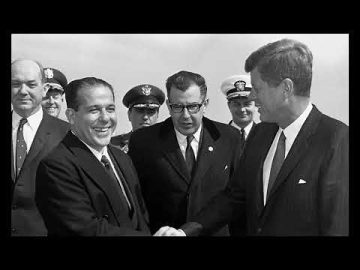
The 1964 Coup in Brazil
or go to
Aletho News Archives – Video-Images
Free Book
Vicious
Lies are Unbekoming | January 25, 2026
The waiting room is clean. The receptionist is polite. The forms ask reasonable questions. Nothing in the physical environment suggests danger. The magazines are current. The hand sanitizer dispenser works. Someone has chosen calming colors for the walls.
A pregnant woman sits in a chair designed for her comfort. She has been told to be here. Not ordered—no one orders. Recommended. Strongly recommended. Everyone does this. Her mother did this. Her friends did this. The women in her prenatal group compare notes about their appointments the way they compare notes about nursery furniture. Which provider did you choose? What tests have you had? The questions assume the answers. The answers assume the questions.
She will be offered things today. Offered is the word used. The offers will come with information sheets that list risks and benefits in tabular form. She will sign consent documents. Everything will be voluntary in the legal sense. No one will hold her down. No one will threaten her. She will choose, and her choices will feel like choices, and she will leave feeling she has done the responsible thing.
What she will not feel is the weight of what has been arranged before she arrived. … continue
Blog Roll
Recent Comments
Coronistan on Donald Trump Is No Peace … seversonebcfb985d9 on French court jails pro-Palesti… eddieb on Fourteen Incredible Facts Abou… Bill Francis on European leaders’ shift in the… seversonebcfb985d9 on Villains of Judea: Philip Esfo… loongtip on Report warns that ‘Jewish terr… Craig Nelms on New study shows that toxic gas… loongtip on A Funny Thing Happened on the… loongtip on EU free trade pact on hold as… John Edward Kendrick on Regime Change In Iran Is The F… Bill Francis on Australia Passes New Hate Spee… seversonebcfb985d9 on Australia Passes New Hate Spee…


 Aletho News
- Trump and Iran, War or Negotiations?
- US pressure contributing to Israeli influence in Latin America: Experts
- China Rejects U.S. Claims of Coercion in Central America
- New US defense strategy downgrades Russian ‘threat’
- EU turns to India for defense cooperation as US ties fracture
- Donald Trump Is No Peace President
- Vicious
- Germany to build 10GW of baseload gas plants (disguised as “future” hydrogen plants)
- French court jails pro-Palestine activist and mother over Gaza genocide speech
- Shot, amputated, and imprisoned: Palestinian man seeks to rebuild life after being maimed and tortured by Israeli forces
- If Americans Knew
- Will Rafah crossing be opened at last? – Not a ceasefire Day 108
- Israeli drone strike kills two children collecting firewood in Gaza – Not a ceasefire Day 107
- Another Gaza baby freezes to death on Netanyahu’s watch – Not a ceasefire Day 106
- Oppose Israel’s Abuses While You Still Can
- UNRWA Heads Tell Ha’aretz: ‘We Don’t Radicalize Palestinians – Their Lived Existence Does’
- Plans Call for “New Rafah” Built in Israel’s Image — Without Palestinians
- Posing as priest, reporter is spat at many times, highlighting anti-Christian sentiment in Israel
- Leaked Documents: “Planned Community” in Rafah Would Force Palestinians Into Israeli Panopticon
- ‘Permits of Humiliation’: How Israel Strangles Christian Education in Jerusalem
- “The world sees death, destruction and injustice – and they see dollar signs” – Not a ceasefire Day 105
- No Tricks Zone
- Germany’s Natural Gas Crisis Escalates … One Storage Site Near Empty …Government Silent
- Polar Colding…Antarctica Saw Its Coldest October In 44 Years!
- New Study: Sea Levels Rose 20 Times The Modern Rate During The Roman Warm Period
- As German Gas Storage Dips Dangerously Low…Shortage Hardly Avoidable
- New Study: Brazil’s Relative Sea Level Was 2+ Meters Higher And SSTs 3-4°C Warmer 6000 Years Ago
- Philosopher Schopenhauer: Climate Science Certainty Stems From Stupidity, Ignorance
- New Study: Species Extinction Rates Declining Since 1980 – ‘Climate Change Is Not An Important Threat’
- Denmark Places Climate Protection Above Animal Welfare, Poisoning And Culling Cows
- New Study: Greenland Was 3-7°C Warmer And Far Less Glaciated Than Today 6000-8000 Years Ago
- German Media Report That Current Frigid Weather Can Be Explained By Arctic Warming!
 Aletho News