Marseille to set up own Covid scientific council in a protest over ‘dependency’ on Paris scientists
RT | October 6, 2020
The French city of Marseille has adopted a proposal to form its own scientific council to assess Covid statistics and develop more informed local policies, as it battles against “unjust” lockdown rules imposed by the government.
The proposal was adopted on Monday, having been put forward by outspoken former French senator Samia Ghali, the current second-in-command of the city administration.
The move will see Marseille take a leading role in the assessment of its own health situation and provide the mayor, Michèle Rubirola, and city leaders with the necessary information to manage their own policies on Covid restrictions, Ghali said.
“The mayor must chair a scientific council … to see what the deficiencies are, and so we have a perspective and no longer depend on certain Parisian scientists, but also so we, ourselves, have the capacity to say what is going and what is not, and no longer suffer the thunderbolt of Paris.”
Ghali has been particularly vocal in her criticism of Parisian lawmakers in recent weeks, following the imposition of new Covid restrictions in Marseille and neighboring Aix-en-Provence. The government decreed in September that the southern city would become a ‘maximum alert zone’, causing the closure of all restaurants and bars for 15 days, which was seen by many in Marseille as unjustified. The restaurants were eventually allowed to reopen from Monday under certain conditions, which prompted Ghali to say the earlier strictures were “unfair and therefore not sustainable.”
Paris escaped fresh restrictions in September, leading many elected officials in Marseille to suggest France’s second city was not treated in the same way as the capital. Rubirola had previously shared her disapproval on Twitter, claiming “The announcements of Olivier Véran confirm this evening the unequal treatment suffered by Marseille. Inconsistent and unfair.” Restrictions were eventually introduced in Paris on Monday.
However, the announcement of a scientific council for Marseille has been met with criticism by some political leaders. The president of the Regional Council of Provence-Alpes-Côte d’Azur, Renaud Muselier, said there are already 10 existing and competent health bodies at national and regional level. “In this crisis, each of these structures has its own expertise and role to play. Adding a purely Marseille thing to it can only add confusion and cacophony to an already disturbing disorder,” he noted.
Russia slams ‘disgraceful’ ban on founding OPCW chief speaking at UN Security Council on Syria
RT | October 6, 2020
An ex-OPCW chief, sacked under US pressure, has been barred from briefing the UN Security Council about a controversial probe into an alleged 2018 chemical attack in Syria. Russia called it a “shame” and published his speech.
Jose Bustani, a Brazilian diplomat who led the Organization for the Prohibition of Chemical Weapons (OPCW) from 1997 until 2002, was invited by Moscow to speak at a UN Security Council meeting about the so-called “Syrian chemical dossier,” but his appearance was blocked at the last minute by Belgium, Germany, Estonia, France, the US and the UK.
“What has happened now is yet more sad proof that Western delegations fear the uncomfortable truth,” Russia’s ambassador to the UN, Vassily Nebenzia, stressed while addressing the UN global body on Monday.
He said the six countries had “made history” because the Security Council has never voted “on the presence or absence of a briefer proposed by the [UNSC] president.” Prohibiting the former OPCW director general from speaking was a “shame and disgrace,” Nebenzia concluded, promising to publish Bustani’s statement after the meeting.
UK envoy Jonathan Allen said that Bustani is not in a position to “provide relevant knowledge or information.”
Shortly afterwards, the undelivered speech appeared on the website of the Russian mission to the UN. In it, the sacked OPCW chief raised “serious questions” over “whether the independence, impartiality, and professionalism of some of the organization’s work is being severely compromised, possibly under pressure from some member states.”
As a major example, Bustani cited an OPCW investigation into the alleged use of chemical weapons in the Syrian city of Douma on April 7, 2018. Western governments, and media outlets, maintain that forces loyal to Damascus dropped two gas cylinders as part of an offensive against jihadist forces, killing scores of civilians.
The allegations were used as a pretext for a major US-led airstrike against Syrian government forces later that year. The OPCW launched a probe into the “chemical attack,” and in early March of 2019, the final report by the Fact-Finding Mission (FFM) of the OPCW stated that there were “reasonable grounds” to believe that canisters filled with “molecular chlorine” were dropped from Syrian aircraft in Douma.
The final report gave credence to the Western show of force by implicating the Syrian government of Bashar Assad in conducting the attack, which the Syrian authorities vehemently deny.
Shortly after the release of the OPCW report, an internal memo by OPCW engineers was leaked, suggesting the canisters were likely just placed at the site of the “attack,” and did not come from the skies. Still, the final report did not include such information, and a senior OPCW official reportedly ordered the removal of “all traces” of the dissenting opinion, according to WikiLeaks.
Months later, Bustani noted that he was invited to an expert panel which heard the testimony of an unnamed OPCW investigator, who came forward with damning evidence that his own organization had engineered a report based on a flawed conclusion and likely deliberately steered toward the outcome favored by the West.
That expert provided “compelling and documentary evidence of highly questionable, and potentially fraudulent conduct in the investigative process,” Bustani’s statement recalled. The Brazilian diplomat had been so stunned by the testimony that he personally called on the OPCW to be “resurrected to become the independent and non-discriminatory body it used to be.”
However, he continued, the chemical weapons watchdog did not respond to any calls for greater transparency about the controversial Douma investigation. The probe was “hidden behind an impenetrable wall of silence and opacity, making any meaningful dialogue impossible.”
In conclusion, Bustani called on Fernando Arias, the current OPCW chief, to hear the grievances of OPCW inspectors who voiced dissenting opinions on the Douma incident. They “have dared to speak out against possible irregular behavior in your organization,” Bustani argued, adding that it is “in the world’s interest that you hear them out.”
Bustani noted that he had been removed from his OPCW position “following a US-orchestrated campaign in 2002.” Back then, he was trying to send chemical weapons inspectors to Iraq prior to the 2003 US invasion there. A UN tribunal ruled that his sacking was unlawful.
The Time of Troubles in Transcaucasia – Part 2
By M. K. BHADRAKUMAR | Indian Punchline | October 3, 2020
Part-1 of the three-part essay is here.
The German Chancellor Angela Merkel said in Berlin on October 2 that the European Union seeks a “constructive dialogue and a positive agenda” with Turkey. She had just returned to the German capital after a 2-day summit meeting of the EU countries in Brussels. Germany played a key role at the summit in steering the EU-Turkey relationship away from a confrontationist path to which it was drifting lately. (See my blog EU marks distance from Indo-Pacific strategy.)
Merkel said, “We had a very long, detailed discussion about our relations with Turkey. We came to the conclusion that we would like to enter into a constructive dialogue with Turkey, we want to have a positive agenda,” adding that the Brussels summit had opened a “window of opportunity” for closer cooperation with Ankara.
Merkel disclosed that talks for closer cooperation between the EU and Turkey in the coming months would focus on migration issues, trade, modernising the Customs Union, and liberalised visa regime. In effect, Merkel has made a huge case for Turkish President Recep Erdogan at a particularly sensitive juncture for the latter when there is growing criticism in Europe regarding his regional policies.
In particular, there has been a nasty incident recently involving the Turkish and French navies in the Eastern Mediterranean. It was a rare, if not unprecedented, incident involving two NATO powers in the 7-decade old history of the western alliance.
Again, the US recently strengthened its military bases in Greece and has repeatedly called for restraint on the part of Turkey over its maritime disputes with Greece and vowed to intervene both politically and militarily in the tensions in the Eastern Mediterranean.
Turkey and France support opposite sides in the Libyan civil war, while the US is aligned with militant Kurdish groups in Syria whom Turkey regards as terrorists. And as conflict erupted in Nagorno-Karabakh, Turkey witnesses the US, France and Russia swiftly drawing close in a phalanx to push back at Erdogan’s robust backing for Azerbaijan, including pledges of military help.
To be sure, Merkel spoke with great deliberation. Before leaving for Brussels, Merkel had addressed the German Parliament where she referred to complaints against Turkey’s human rights records, but went on to praise Turkey’s “amazing and remarkable” performance in hosting refugees, highlighting that Turkey is hosting four million refugees.
Interestingly, Merkel compared Greece to Turkey in a poor light. “We have to weigh very carefully how to resolve the tensions and how to strengthen our co-operation on refugees and on the humane treatment of refugees,” she said and proceeded to condemn the manner in which Turkey’s archetypal enemy Greece is handling the migrant camp in Lesvos (Greece).
With biting sarcasm, Merkel noted, “in recent days we have seen horrible images regarding the treatment of refugees. And not from Turkey, I would like to emphasise, but from Lesvos (Greece), from an EU member state.”
Without doubt, Germany has stood up to be counted as Turkey’s friend at a time when the latter faces growing isolation within the NATO and from the EU.
Seminal events
The well-known American professor at Harvard University’s John F. Kennedy School of Government, Stephen Walt once penned an essay titled Great Powers Are Defined by Their Wars where he pointed out that explaining a great power’s foreign policy is a perennial question for scholars of international politics. He argued that major wars have powerful and long-lasting effects on a nation’s subsequent foreign or military policy.
Prof. Walt explained that wars are seminal events from which a great power’s subsequent behaviour follows, independent of its relative power, regime type or its leadership. In his words, “Those who fight in these wars are often scarred by the experience, and the lessons drawn from victory or defeat will be etched deeply into the nation’s collective memory. The experience of past wars is central to most national identities… If you want to understand the foreign policy of a great power, therefore (and probably lesser powers as well), a good place to start is to look at the great wars it has fought.”
Isn’t it a poignant historical memory for Berlin that the Ottomans were Germany’s allies in two world wars when it was hopelessly isolated by the the western powers?
On the other hand, take Russia and Turkey. Russia fought a series of twelve wars with the Ottoman Empire between the 17th and 20th centuries — one of the longest series of military conflicts in European history — which ultimately ended disastrously for the latter and led to its decline and eventual disintegration.
Russia had often fought the Ottomans at different times, often in alliance with the other European powers. Importantly, these wars helped to showcase the ascendancy of Russia as a European power after the modernisation efforts of Peter the Great in the early 18th century. In the Turkish Muslim psyche, however, Russia has figured as a protagonist which had played an historical role in the weakening of the Ottoman Empire in Central Europe, the Balkans and Transcaucasia.
The Russian conquest of the Caucasus mainly occurred between 1800 and 1864. In that era the Russian Empire expanded to control the region between the Black Sea and Caspian Sea, the territory that is present-day Armenia, Azerbaijan and Georgia (and parts of today’s Iran and Turkey) as well as the North Caucasus region of modern Russia. Multiple wars were fought against the local rulers of the regions as well as the Ottoman Empire until the last regions were brought under Russian control by 1864 with the expulsion to Turkey of several hundred thousand Circassians.
Then followed the Russo-Turkish War (1877-78) when Russia seized the the province of Kars and the port of Batumi on the Black Sea. In World War I, aligned with Germany, the Ottomans pushed against Russia as far east as Baku (capital of Azerbaijan) but then withdrew, lacking the strength to advance further, and subsequently in the post-war confusion, somehow contrived to regain Kars.
Suffice to say, in 1991 following the collapse of the former Soviet Union, when Transcaucasia became independent as the states of Georgia, Armenia and Azerbaijan, a lot of blood-soaked history involving Russia and Turkey provided the backdrop. Incidentally, Erdogan’s family originally hailed from Rize Province in the eastern part of Turkey’s Black Sea region (where he grew up as a child), which was a site of battles between the Ottoman and Russian armies during the Caucasus Campaign of World War I and was occupied by Russian forces in 1916-1918, to be finally returned to the Ottomans under the Treaty of Brest-Litovsk in 1918. The Soviet Union returned Rize to Turkey in 1921.
‘Past is never dead’
Amidst all this, an interesting feature of the flow of history has been that from the days of the Roman Empire, Transcaucasia was usually a borderland between Constantinople (Istanbul) and Persia. Areas would shift from one empire to the other, their rulers would have varying degrees of independence and were often vassals of one empire or the other, depending on the size and proximity of the suzerain’s army. By around 1750 the area was divided between the Turkish and Persian vassals. The western two thirds were inhabited by Georgians, an ancient Christian people, and the eastern third mostly by Azeris, Turkic Muslims. And Russia of course was pushing close to the Black Sea and the Caspian against the Ottoman and Persian empires.
Professor Walt in his essay cited a famous quote from the American novelist William Faulkner, “The past is never dead. It’s not even past.” Indeed, for Russia, Turkey or Iran, the current developments in Transcaucasia form part of a vast collective event that shapes their perceptions of danger and definitions of heroism, sacrifice, and even their identity.
In fact, the current line-up in the developing situation around Turkey speaks for itself: Germany voices sympathy for Turkey and offers an enhanced partnership; France lambasts Turkey and seeks EU sanctions against Turkey; France alleges Ankara’s dispatch of Syrian fighters to Nagorno-Karabakh; Germany appreciates Turkey’s big hand in addressing the refugee crisis gripping Europe; France coordinates with Russia at the highest level of leadership to pressure Turkey over Nagorno-Karabakh; the North Atlantic Treaty Organisation (NATO) and the US join Russia and France’s call for cessation of fighting in Transcaucasia; Iran maintains neutrality and suggests a joint effort with Turkey and Russia to resolve the conflict between Armenia and Azerbaijan.
Meanwhile, Moscow has shed its initial ambivalence and is stepping into the arena on the side of Armenia, expressing “serious concern in connection with incoming information about the involvement in hostilities of gunmen from illegal armed units from the Middle East” — plainly put, censuring Turkey’s backing for Azerbaijan. And President Vladimir Putin underscores that he is voicing a common stance along with “the presidents of the countries co-chairing the OSCE Minsk Group” (Russia, France and the United States). Simply put, Russia’s “competitive rivalry” with Turkey is surging.
Interestingly, Turkish President Recep Erdogan has openly drawn attention to the broader regional and geopolitical context in which the various unnamed powers are jockeying and covertly coordinating to encircle Turkey. Erdogan said on October 2, “If we connect the crises in the Caucasus, in Syria and in the Mediterranean, you will see that this is an attempt to surround Turkey.”
It doesn’t require much ingenuity to figure out the identity of the foreign powers he would have had in mind who are attempting to “surround” Turkey — France, the US and Greece (all NATO powers) and Russia, the scourge of the Ottoman Empire.
‘Sort out your own internal affairs,’ Lukashenko tells Macron after French leader calls for his resignation

RT | September 27, 2020
If Emmanuel Macron believes heads of state must resign over street protests, he should have left office himself when Yellow Vest demonstrators took to the streets in France, Belarusian President Alexander Lukashenko has said.
Lukashenko, who has faced weeks of large-scale protests following the August 9 presidential election which the opposition insists was rigged, has labeled Macron an “immature politician.” His words were reported to the BelTA news agency by his press secretary.
As a “mature politician,” the Belarusian president advised his French counterpart “not to get distracted, but instead focus on the internal affairs of France. At least, begin solving the many problems that accumulated in the country,” Lukashenko added.
The statement came after Macron said in an interview with Le Journal du Dimanche that “it is clear that Lukashenko must go” because his “authoritarian administration” is unable to accept democracy.
“Judging by his own logic, the French president should’ve himself resigned two years ago when the Yellow Vests started going out to the streets in Paris,” Lukashenko pointed out.
The Belarusian president went on to note that, as well as the Yellow Vests, France also needs to deal with the BLM movement as well as “Muslim protests” – apparently referring to the 2019 anti-Islamophobia demonstrations.
Responding to Macron, Lukashenko quipped that Minsk is ready to provide a venue for negotiations on “a peaceful transition of power [from the French president] to any of the above-mentioned groups.”
The Yellow Vest demonstrations were provoked by fuel tax hikes in France in November 2018, but they quickly transitioned into a wider protest against Macron’s policies and economic injustice. Weekly rallies in Paris and other cities often turned violent, with French police facing accusations of using excessive force against the protesters.
On Sunday, thousands of people again marched in Minsk and other Belarusian cities, demanding Lukashenko’s immediate resignation and a new, fair election. The police said that around 200 people were arrested across the country.
East Mediterranean tension boosts France’s arms sales
MEMO | September 26, 2020
French-backed tension between East Mediterranean states and Turkey boosts French arms sales, Paul Iddon, contributor to Forbes, revealed on Thursday.
Iddon noted that French President Emmanuel Macron is a strong critic of Turkey’s foreign policy and poses himself as a supporter of the East Mediterranean states, which are on opposite sides of the tension with Turkey.
Therefore, the French military has participated in a series of military exercises this year with Turkey’s rivals in the Eastern Mediterranean to signal Paris’ support of these countries.
He confirmed that France has shown its support for Greece by deploying two Dassault Rafale fighter jets to the Greek island of Crete, along with a warship in August.
Greece, according to Iddon, turned to France after it had decided to expand its military to buy 18 Rafale jets, including six brand new and 12 second-hand ones that have already served in the French Air Force, noting that Greece is the first European country to buy the Rafale jets.
Iddon also disclosed that Athens already reached a €260 million ($305 million) deal with France to upgrade its existing fleet of Dassault Mirage 2000-5 fighter jets in December 2019. This deal would prevent Turkey from establishing air superiority over the Aegean Sea, or parts of the East Mediterranean.
Meanwhile, the Republic of Cyprus reached a $262 million arms deal with France for short-range Mistral air defence systems and Exocet anti-ship missiles.
These deals are not comparable with those reached between France and Egypt, which has been a major rival of Turkey’s since the current President Abdel Fattah Al-Sisi came to power through his military coup in July 2013.
“Under Sisi,” Iddon wrote in Forbes, “Egypt rapidly became a major multi-billion euro French arms client. His country was the first to buy Rafale jets, along with four Gowind corvettes, a FREEM multipurpose frigate, and two Mistral-class amphibious assault ships.”
Iddon concluded: “So long as these territorial disputes and tensions between these countries and Turkey remain unresolved, France isn’t likely going to have any shortage of arms clients in the Eastern Mediterranean anytime soon.”
Lebanese PM-designate steps down amid political turmoil
Press TV – September 26, 2020
Lebanon’s Prime Minister-designate Mustapha Adib has announced his resignation amid a deadlock over government formation in the crisis-hit country.
In a televised address on Saturday, Adib said he was stepping down from “the task of forming the government” following a meeting with Lebanese President Michel Aoun.
He also noted that the kind of cabinet that he wanted to establish “was bound to fail” and that he was keen on protecting national unity.
“I apologize to the Lebanese people,” he added.
The announcement came almost a month after Adib, former Lebanese ambassador to Berlin, was appointed by the president to form a new government.
Lebanon is currently mired in the country’s worst economic and financial crisis in its modern history.
It has been waiting for a new administration since outgoing Prime Minister Hassan Diab resigned on August 10, a few days after a powerful explosion in the capital killed more than nearly 200 people, injured thousands and caused losses worth billions of dollars.
The blast took place in Beirut port warehouses storing highly explosive material, specifically ammonium nitrate, commonly used in both fertilizer and bombs.
The explosion — one of the biggest non-nuclear explosions the world has ever seen — flattened much of the strategic port and left buildings in ruin.
Following the blast, the US and European countries have been mounting pressure on Lebanese officials to form a government that secures the West’s interests.
The United States on September 8 slapped sanctions on two former cabinet ministers in Lebanon over support for Hezbollah as it vowed to isolate the resistance movement.
French President Emmanuel Macron paid two visits to Lebanon, where he called for a “new political pact” among Lebanese political factions and said he had proposed a roadmap to authorities to unlock billions of dollars in funds from the international community.
In a meeting with Aoun, Macron threatened Lebanese leaders with sanctions if they do not submit to reforms and a “political change,” Lebanon’s Arabic-language al-Mayadeen television news network reported.
The French president’s colonial-style sojourn sparked a swift backlash among the Lebanese nation.
Many Twitter users denounced what they deemed as interference in the internal affairs of Lebanon, which gained independence from the French colonial rule more than seven decades ago.
The False Flag Poisoning of Alexei Navalny

By Max Parry • Unz Review • September 24, 2020
On August 20th, Russian opposition figure and self-styled “anti-corruption” activist Alexei Navalny fell seriously ill while in mid-flight from Tomsk, Siberia to the Russian capital. The Moscow-bound plane was abruptly re-routed to make an emergency landing in the Siberian city of Omsk where the anti-Kremlin politician was subsequently hospitalized for suspected poisoning and placed in a medically-induced coma. Two days later, Navalny was airlifted to Germany in an evacuation arranged by a Berlin-based “human rights” NGO at the request of Pussy Riot spokesman Pyotr Verzilov. His transport on a medically-equipped plane with German specialists was permitted by the Russian authorities who now stand accused of culpability in the alleged attack, all in the midst of the ongoing pandemic.
While the Russian doctors in Omsk (who saved Navalny’s life) maintain they did not find any evidence of chemical weapons substances in his system, upon examination the German government quickly announced that its military lab had discovered “unequivocal evidence” Navalny was poisoned by a Soviet-era Novichok nerve agent and demanded an explanation from the Kremlin — without providing any of said evidence to Moscow or the public, of course. Despite being the supposed victim of an extremely deadly military-grade nerve agent, three weeks later Navalny came out his comatose state and off ventilation, defiantly vowing a return to Russia. Was he ever tested for COVID-19? At this point it seems more likely than this propaganda stunt we are expected to believe.
It is unconvincing precisely because it follows a pattern of improbable events questionably attributed to the Kremlin. As many have noted, the incident strikingly resembles the alleged March 2018 poisoning in Salisbury, England of disgraced former Russian intelligence officer Sergei Skripal and his daughter, Yulia, visiting from Moscow which caused a similar diplomatic row. Skripal, who had been a double agent for MI6 and served ten years imprisonment for high treason, was exiled to the UK after his sentence in a spy-swap between Russia and Britain in 2010. While residing in southern England, Skripal was reportedly in close contact with a security consultant who worked for the author of the salacious but fabricated dossier on U.S. President Donald Trump’s alleged ties to Russia, former British intelligence agent Christopher Steele — and may have even been the source of its unverified contents.
Skripal and his daughter were discovered unconscious on a park bench, but were said to have been initially contaminated hours earlier by the extremely fast-acting substance applied to the door handle of his residence. Similarly, Alexei Navalny is said to have been contaminated by a water bottle in his hotel room, not in the tea he drank at the Tomsk Bogashevo airport cafe before boarding his flight as originally believed. How is the elapsed time in both of these cases possible? The toxin in Navalny’s case was also not discovered until examination in Germany, meaning a bottle laced with a chemical warfare agent was transported all the way to Berlin? None of those who came to Navalny’s aid or treated him suffered any noxious effects, unlike the Skripals where multiple police officers at least showed minor symptoms. Still, both Navalny and the Skripals fully recovered from their supposed exposure to an extremely lethal toxin considered even more deadly than sarin or VX gas. After their release from the hospital, the Skripals immediately went into hiding which has left the enormous questions surrounding the incident still unresolved two years later. However, the damage was already done as the UK government immediately blamed Moscow and more than 100 Russian diplomats were expelled by Britain and its Western allies.
Months later in June 2018, two British nationals were the victims of an accidental poisoning (one fatally) after they discovered a discarded but unopened perfume bottle containing the same poisonous agent. Then that September, Scotland Yard released CCTV footage of two Russian men alleged to be GRU military intelligence agents in Salisbury at the time of the attack. However, no verifiable evidence was ever provided by the British government showing that the two were responsible, though it was conveniently claimed that the would-be culprits clumsily left vestiges of the fatal chemical agent in their hotel room. So, not only is Russian intelligence incapable of carrying out successful assassinations, but carelessly unable to cover their tracks? The premise was already absurd enough but made even more fanciful by Britain’s refusal to comply with the Chemical Weapons Convention in providing Moscow with requested samples of the toxin which purportedly poisoned the treasonous ex-spook and his daughter. Thus far in the Navalny case, Germany is following the same script.
What a coincidence that the attack comes just as Nord Stream 2, the second line of the massive natural gas pipeline under construction from Russia to Germany opposed by the U.S. and several NATO allies, is near completion. Suddenly, the diplomatic fall-out has put the controversial project in limbo, with Chancellor Angela Merkel and the German government under pressure from Washington to withdraw from the project which would increase Russian influence on Europe’s energy infrastructure and rival the U.S.’s costlier exports. As pointed out by Die Linke’s Dietmar Bartsch, where were the calls to halt the purchase of Saudi oil imports after the grisly murder of journalist Jamal Khashoggi? It is clear that the Anglo-Americans are simply desperate to halt the resurgence of Moscow on the international stage, threatening their German counterparts with sanctions as the final sections of the pipeline conveying Russian gas across the Baltic Sea is being constructed. The attack on Navalny could not occur at a more auspicious time for the Atlanticists and a worse time for Moscow.
The notion that Russian President Vladimir Putin would try to assassinate an opposition figure who holds a minuscule 2% support amongst the population, far behind other opponents nonexistent to Western media but the one who just so happens to be favored by Washington, is contrary to any reason or common sense. Not to mention, at the exact moment it would jeopardize a project essential to Russia’s economic growth and frugality, as the pipeline would link Moscow with Western Europe bypassing neighboring transit countries such as the Ukraine (also opposed to Nord Stream 2) which have costly transit fees. Is it really the Russian government who stands to massively benefit from this fiasco? The answer to “cui bono?” could not be more clear: U.S., Saudi and Emirati oil and gas interests, not the Kremlin. Russia was also recently the first nation to develop a COVID-19 vaccine candidate with its Sputnik V registered in August, an international competition that has been heavily politicized by Washington which is eager to cast aspersions on Moscow’s accomplishment. Meanwhile, Germany is also the one Western European country where Washington’s anti-Russian propaganda is falling flat, as recent polls consistently show that the vast majority of Germans don’t see Russia as a threat, likely a result of their high rate of media literacy.
Despite Navalny’s recovery, there are already calls to legislate a ‘Navalny Act’ as a follow-up to the Magnitsky Act, a bipartisan bill previously passed by the U.S. House of Representatives in 2012 under the Obama Administration which sanctioned Russian officials accused of being responsible for the 2009 death of Sergei Magnitsky, an unscrupulous Russian tax lawyer who helped dodgy international financiers like the US-born British tycoon William Browder commit massive tax evasion in Russia. Magnitsky died under mysterious circumstances while in custody awaiting trial for facilitating Browder’s skullduggery and suffering from poor health, with the Russian prison officials first accused of depriving him of medical treatment and then allegedly beating and torturing him to death. The fascinating 2016 documentary The Magnitsky Act: Behind the Scenes explores the case from the perspective of Westernized Putin critic and filmmaker Andrei Nekrasov, who through the course of his investigation unexpectedly discovers that the mainstream media narrative of Magnitsky’s death was a fiction concocted by Browder. Suddenly, Nekrasov’s entire perspective on Russia comes into question and the film takes on a metanarrative of the nature of propaganda itself.
What we are being told about Navalny is likely another fairy tale like the implausible story forged by Mr. Browder about the death of the auditor he hired to enrich himself exploiting Russia’s tax loopholes. Incredibly, the American-born investor is the grandson of Earl Browder, the leader of the Communist Party USA during its heyday until his expulsion at the end of World War II. When the wartime US-Soviet alliance fell apart and the Cold War began, the elder Browder proved more loyal to American imperialism than the communist movement and presided over the liquidation of the CPUSA until it was reestablished with his dismissal as General Secretary. Having grown up in a Russian-speaking family, decades later his grandson decided to cash in on the collapse of the former Soviet Union through various investment ventures as manager of the hedge fund Hermitage Capital Management. When Putin succeeded Boris Yeltsin and numerous oligarchs went into exile or landed themselves in prison, Bill Browder was forced to flee the country after defrauding the Russian government of millions with the help of the late Mr. Magnitsky.
One of those banished oligarchs, billionaire media tycoon Boris Berezovsky, also died under dubious circumstances in the UK when he was found hanging in his apartment bathroom in Berkshire, England in 2013. Like Magnitsky, Putin and the Russian government were suspected of involvement in Berezovsky’s death by the media without a shred of evidence, even though his suspicious purported “suicide” actually came shortly after expressing a written willingness to return to Russia and reconcile with Putin — which almost certainly would have been a stroke of good luck for Russian counter-intelligence and a threat to the West, not the Kremlin. Berezovsky had been close with a former agent of the Federal Security Service (FSB, the KGB’s successor), Alexander Litvinenko, a defector renowned for claiming he had been ordered by Putin to assassinate Berezovsky and subsequently lived in the UK as a consultant for British intelligence until his own polonium poisoning in 2006, the first of a series of episodes framing Moscow. Consistently, however, in every one of these cases it is never the Kremlin which stands to gain.
There is a reason Putin consistently polls over 70% in favorability with the Russian people and that is his directing the country away from Western domination under the ruinous neoliberal economic policies of his corrupt and inebriated predecessor Boris Yeltsin which auctioned off the former state-owned assets to foreign investors such as Browder and oligarchs like Berezovsky. Meanwhile, Navalny has a level of support well under 5%, with recent polls placing him behind the Communist Party’s Pavel Grudinin and the ultra-nationalist Vladimir Zhirinovsky. While Navalny’s own rhetoric has shifted over the years, he has controversially maintained his own cozy relationship with ethnic nationalists who make up a significant amount of his right-wing populist base, even co-organizing annual marches dominated by racist skinheads.
Navalny infamously coined the slogan “Stop Feeding the Caucasus!” advocated by xenophobic nationalists calling for the defunding and secession of the Muslim-majority North Caucasus from Russia, while making frequent Islamophobic statements and stoking anti-immigrant sentiments against Central Asians. You would never know this reading Western media who have completely sanitized Navalny’s politics (if they ever address them at all), while they remain obsessed with the perceived ingratiation between Donald Trump and Vladimir Putin even though the former’s politics have far more in common with Navalny than the Russian President. Given the U.S. support for far right nationalists in the 2014 anti-Russian coup d’etat in Ukraine, Washington has no qualms about backing fascists to undermine Moscow.
In 1831, Russia’s most famous and revered poet, Alexander Pushkin, composed “To the Slanderers of Russia”, a patriotic ode in response to members of the French parliament who were advocating for a military intervention to assist the Polish uprising against the Russian Empire. Pushkin asserted that the Polish uprising was an inter-slavic “ancient, domestic dispute”, while the Poles considered it an issue of national independence which their European allies were eager to exploit against Moscow. For the great Russian writer, the Polish alliance with the tyrant and invader Napoleon was unforgivable. He also reportedly communicated to General Alexander von Benckendorff, the chief of the Tsarist secret police assigned to censor and surveil him, that the Europeans were still bitter over the failed French invasion of Russia in 1812 and had not yet attacked with weapons but were doing so with “daily mad slander.”
Fast forward nearly 200 years later and little has changed in Russia-West relations. The only thing that has arguably transformed is Russia’s standing on the world stage following the collapse of the Russian Empire in 1917 and the Soviet Union almost 75 years later, the latter of which was masterminded by a Polish-born National Security Advisor, Zbigniew Brzezinski, whose Russophobic worldview was a product of the deep-seated “ancient, domestic dispute” Pushkin wrote of a century earlier. Contrary to the Western portrayal of the resurgence of Moscow in the new millennia under Vladimir Putin as neo-tsarist expansionism, post-Soviet Russia is actually a relatively weak capitalist state that has found itself a target of regime change by the West which seeks the colonization and balkanization of Eastern Europe.
The U.S. invasion of Iraq in 2003 caused a spike in oil prices that generated huge profits for Chevron and ExxonMobil, but also had the unintended consequence of benefiting Russia’s state-run oil industry just as Putin was re-nationalizing its energy assets and banishing financial criminals like Browder and Berezovsky. While its strength and influence has certainly been restored, its foreign investments remain low even in the Ukraine where Moscow has been accused of territorial expansion with the so-called “annexation” of Crimea, where the mostly Russian-speaking eastern Ukrainian population actually voted to join its neighbor in a referendum. Russia may no longer be an empire (or communist), but yet it remains in the crosshairs of Western imperialism, whose political leaders and subservient corporate media are still conducting the “mad slander” that Pushkin opined.
Max Parry is an independent journalist and geopolitical analyst. His writing has appeared widely in alternative media. Max may be reached at maxrparry@live.com
Tehran: Guardian report meant to paint black picture of Iran rights situation
Press TV | September 24, 2020
Tehran has denounced a recent report by Britain’s Guardian newspaper about Iran’s treatment of duly convicted prisoners in the country, saying such “commissioned” reports are an attempt to portray the human rights situation inside the Islamic Republic in a negative light.
“The purpose of these commissioned reports, which are meant to paint a black picture of the human rights situation in the Islamic Republic of Iran, especially at the current juncture, is crystal clear,” Foreign Ministry Spokesman Saeed Khatibzadeh said on Wednesday.
He also noted that politicking and selective measures on the part of the United States and some European governments have always dealt the biggest blows to the principle of human rights.
Earlier, The Guradian reported that France, Germany and the UK were summoning Iranian envoys in a protest against Iran’s “detention of dual nationals and its treatment of political prisoners.”
Iran’s Ambassador to London Hamid Baeidinejad was summoned by the Foreign Office on Tuesday and the ambassadors to Paris and Berlin are also being called in this week, it added.
Khatibzadeh said that Iran considers the statements and actions of certain European countries as interference in its domestic affairs, adding that relevant authorities have adopted necessary response in this regard and will do so hereafter.
“It is very strange and unbelievable for us that the same countries not only have not reacted to the gross violations of Iranian nation’s rights by the US regime’s inhumane policy of maximum pressure and its oppressive sanctions, but are also fueling it practically by their inaction and are complicit in it,” he emphasized.
The US unleashed the so-called maximum pressure campaign against Iran in 2018, when it left the 2015 multilateral nuclear agreement.
Following its unilateral withdrawal from the Joint Comprehensive Plan of Action (JCPOA), Washington targeted the Iranian nation with the “toughest ever” economic sanctions.
Tehran remained fully compliant with the JCPOA for an entire year after the US pullout, waiting for the co-signatories to fulfill their end of the bargain by offsetting the impacts of Washington’s bans on the Iranian economy.
Buckling under Washington’s pressure, the European parties to the JCPOA, namely France, Germany and the UK, failed to do so, causing Tehran to move in May 2019 to suspend its commitments under the accord.
The European inaction comes as the sanctions are taking a heavy toll on the Iranian health sector at a time the Islamic Republic, along with other world nations, is fighting to rein in a deadly coronavirus outbreak.
Egypt: 320 trillion cubic feet of gas discovered in Eastern Mediterranean
MEMO | September 23, 2020
The Egyptian Minister of Petroleum and Mineral Resources, Tariq El-Molla, yesterday revealed that 320 trillion cubic feet of gas were discovered in the Eastern Mediterranean region which could turn the area into a global centre for the gas industry.
The seven member states of the East Mediterranean Gas Forum, Egypt, Israel, Cyprus, Greece, Jordan, Italy and the Palestinian National Authority, yesterday officially turned the alliance into a regional organisation headquartered in Cairo.
Speaking at the launching ceremony, El-Molla said the United States wants to join the forum as an observer while France wishes to join as a full member.
The Egyptian Ministry of Petroleum said in a statement that the forum aims to establish a regional market for gas, rationalise the cost of infrastructure and offer competitive prices.
The forum was launched in January 2019 to reinforce cooperation among member states.
However, a spokesman for the Turkish Foreign Ministry, Hami Aksoy, described the forum as an anti-Ankara bloc, adding that transforming it into a regional organisation is “far from reality”.
France says no ‘tangible’ evidence supporting US allegation of secret Hezbollah explosive stores
RT | September 19, 2020
France has pushed back against Washington’s assertion that Hezbollah has stockpiles of ammonium nitrate stashed around Europe, stating there’s no indication of such stores existing in its own country.
“To our knowledge, there is nothing tangible to confirm such an allegation in France today,” French Foreign Ministry spokeswoman Agnes von der Muhll said in response to the US State Department’s alarming claim.
The spokeswoman stressed that France would not allow such “illegal activity” on its territory and that it would respond to such actions with “the greatest firmness.”
On Thursday, Nathan Sales, the US State Department’s coordinator for counterterrorism, alleged that Lebanon’s Hezbollah had caches of dangerous chemicals in France, Spain, Italy, and other European states. He said that the chemicals had been smuggled into the country hidden in first-aid kits, but did not provide evidence backing his incendiary accusation.
Hezbollah is creating stockpiles of chemicals so that “it can conduct major terrorist attacks” at the bidding of Tehran, which backs the group, Sales claimed. He alleged that the stores include ammonium nitrate, an industrial chemical linked to the massive explosion that destroyed much of Beirut, Lebanon last month. It’s believed that the blast was triggered by the unsafe storage of the substance.
The United States has designated Hezbollah as a terrorist organization, but its elected arm is considered a legitimate political organization by France.
Washington recently announced sanctions on two Lebanon-based companies, accusing the companies of being “owned, controlled, or directed by Hezbollah.”
Four ex-directors of French Shia Muslim centre arrested
![French policemen in Paris, France on 18 March 2017 [Mustafa Yalçın/Anadolu Agency]](https://i1.wp.com/www.middleeastmonitor.com/wp-content/uploads/2017/03/20170318_2_22483558_20003387.jpg?resize=1200%2C800&quality=85&strip=all&zoom=1&ssl=1)
MEMO | September 17, 2020
Four ex-directors of a Shia Muslim centre in France have been arrested over concerns they continued to run the organisation despite it being disbanded by authorities in March last year, Agence France Presse (AFP) reports.
The four directors were taken into custody on Tuesday. Three have been remanded in custody, while one was freed over health concerns.
French prosecutors are reportedly investigating the four men for “participation in or maintenance of a dissolved association”, AFP quoted local sources as saying.
The centre was disbanded last year over allegations members were inciting armed jihadism and condoning the actions of regional players, such as Hezbollah, designated as terrorist organisations by the French government.
According to the report, members of the centre also propagated hate speech and anti-Semitism, as well as inciting violence.
The French court, which confirmed the centre’s closure after an appeal last June, said the activities of the organisation amounted to “propaganda intended to glorify the armed struggle and to provoke hatred and violence”, Le Monde reported.
“In the Zahra Centre, sermons are given which call for a fight against Zionism, against Israel and against Saudi Arabia and which, for some, legitimised armed jihad”, the French daily quoted court officials as saying.
According to the AFP report, the four continued preaching at the Zahra Centre’s site in northern France as well as on social media, despite last year’s order to cease and desist, leading to their arrests.
The Zahra Centre was founded in 2009 by Yahia Gouasmi, an Algerian-born Frenchman who also established an anti-Zionist political party in France in the same year. He is believed to have frequently spoken in support of Hezbollah, according to AFP.
The Zahra Centre was also subject to police scrutiny in October 2018, when local authorities raided the group’s headquarters over suspicions of links to terrorist organisations, Reuters reported.
At least 200 police officers, including elite troopers from Paris, took part in the pre-dawn raid on the Zahra Centre, discovering and seizing a cache of illegal weapons. Three people were remanded in custody over the discovery and the organisation’s French financial assets were frozen.
Featured Video
The American Retreat from Vietnam
or go to
Aletho News Archives – Video-Images
From the Archives
Iran UN ambassador calls for destruction of all nuclear weapons
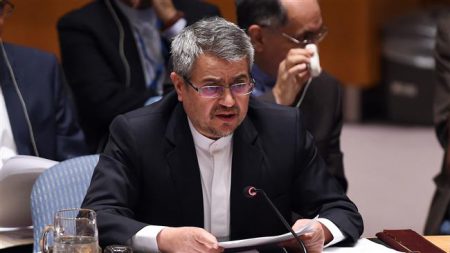
Iran’s ambassador to the UN Gholamali Khoshroo
Press TV – March 29, 2017
Iran’s ambassador to the UN Gholamali Khoshroo has called for the total eradication of nuclear weapons.
Khoshroo reiterated Iran’s call during a UN conference aimed at creating a nuclear weapons ban treaty in New York on Tuesday.
“Iran, as a victim of chemical weapons, strongly feels the danger posed by the existence of weapons of mass destruction and is determined to engage actively in international diplomatic efforts to save humanity from the menace of nuclear weapons,” he said.
Khoshroo stressed that Iran is committed to its Non-Proliferation Treaty (NPT) obligations, which include negotiations based on effective nuclear disarmament measures.
He added that several countries continue to ignore international calls and treaties for nuclear disarmament and even continue to increase their nuclear stockpiles. “They do not have political determination to abandon doctrines of nuclear deterrence and nuclear terror,” he went on to say.
Iran’s UN ambassador noted that boycotting the talks by many countries, including the US, shows that the world’s nuclear powers are by no means committed to the eradication of nuclear arms. Britain and France were also among the some 40 countries that did not join the talks.
“We note that prohibition of nuclear weapons must be accompanied by the elimination of such weapons. There can be no doubt that without complete abolition of nuclear weapons, there will be no absolute guarantee against the danger of nuclear war and the use of such weapons,” Khoshroo added.
Blog Roll
 Aletho News
- India signals rethink over West Asia
- Israeli Ex-Navy Chief admits massive damage from Iran missiles
- The strategic arsenal US lost in war against Iran – and why replenishment will take years
- Documents Suggest Fauci Knew COVID Was Created in Wuhan Lab, and mRNA Vaccines Wouldn’t Work
- No return to pre-war status for Strait of Hormuz – Iran’s top diplomat
- Ex-South Korean President sentenced for trying to provoke conflict with Pyongyang
- US publishes docs on ‘dangerous’ Ukrainian biolabs
- Trump’s ERAM cruise missiles for Ukraine blow up his peace overtures to Russia
- EU state lifts arms embargo on Israel after spy scandal
- French watchdog reveals Israeli propaganda firm meddled in New York, Scottish, African elections
- If Americans Knew
- US-Iran ceasefire may be imminent, but will Israel blow it up? – Daily Update
- The Issue of Israel Is Ending Democracy In Michigan
- Israel is stealing homes, livelihoods, and lives in West Bank
- Gaza is not an aberration – Israel planned this genocide decades ago
- Israel is changing the face of Lebanon, mainstream media is normalizing it – 3 articles
- Genocide lobby benefits from EU anti-racist fund
- Watching the World Cup from Gaza
- Israel to Blame for 56% of 22,600+ Civilians Killed by Explosive Weapons Globally Last Year
- Tucker Carlson and John Mearsheimer on Gaza, Ukraine, Iran, Russia & a Potential Nuclear Strike
- 88 attacks against Palestinian Christians recorded since start of year
- No Tricks Zone
- New Study: Significant CO2 Fluxes From Non-Volcanic Sources Are Largely Neglected In Carbon Budgets
- Women Climate Scientists Being Harassed, Insulted By Skeptics, Claims Berkeley Earth Researcher
- Germany’s Longterm Spring Climate Data Show “No Climate Trend”
- New Study: Solar Photovoltaic, Wind Power Fail To Meet Annual Energy Demands 62% Of The Time
- Germany’s Die Welt: “Too Much Is Too Much” … Green Energies Are Cannabalizing Each Other!
- Germany’s Ecological Holocaust… Once Fairy Tale Forests Getting Cleared For Wind Turbines
- A Grand Solar Minimum Has Arrived…Global Cooling Of At Least 1°C Is Expected By The 2030s, 2040s
- European “Expert Commission” Urges COVID-19-Like Global Climate State Of Energency!
- Real-World Observations Do Not Support The Position That Climate Change Is Human-Caused
- Germany’s AfD Party Calls Debunked Climate Scenarios “Greatest Fraud In Human History”
 Aletho News