Remembering the Earthquake in Haiti Ten Years On
By Yves Engler · January 11, 2020

Ten years ago Sunday an earthquake devastated Haiti. In a few minutes of violent shaking hundreds of thousands perished in Port-au-Prince and surrounding regions and many more were permanently scarred.
It’s important to commemorate this horrifying tragedy. But this solemn occasion is also a good moment to reflect on Canada’s role in undermining the beleaguered nation’s capacity to prepare/respond/overcome natural disasters.
Asked my thoughts on Canada’s role in Haiti the day after the quake, I told reporter Paul Koring that so long as the power dynamics in the country did not shift there would be little change: “Cynically, it feels like a ‘pity time for the Haitians’ but I doubt much will really change,” says Yves Engler, a left-wing activist from Montreal who blames the United States, along with Canada, for decades of self-interested meddling in Haitian affairs. “We bear some responsibility … because our policies have undermined Haiti’s capacity to deal with natural disasters.”
Unfortunately, Canada’s response was worse than I could have imagined. Immediately after the quake decision makers in Ottawa were more concerned with controlling Haiti than assisting victims. To police Haiti’s traumatized and suffering population, 2,050 Canadian troops were deployed alongside 12,000 US soldiers (8,000 UN soldiers were already there). Though Ottawa rapidly deployed 2,050 troops they ignored calls to dispatch this country’s Heavy Urban Search and Rescue (HUSAR) Teams, which are trained to “locate trapped persons in collapsed structures.”
According to internal government documents the Canadian Press examined a year after the disaster, officials in Ottawa feared a post-earthquake power vacuum could lead to a “popular uprising.” One briefing note marked “secret” explained: “Political fragility has increased, the risks of a popular uprising, and has fed the rumour that ex-president Jean-Bertrand Aristide, currently in exile in South Africa, wants to organize a return to power.” Six years earlier the US, France and Canada ousted the elected president.
Canada and the US’ indifference/contempt towards Haitian sovereignty was also on display in the reconstruction effort. Thirteen days after the quake Canada organized a high profile Ministerial Preparatory Conference on Haiti for major international donors. Two months later Canada co-chaired the New York International Donors’ Conference Towards a New Future for Haiti. At these conferences Haitian officials played a tertiary role in the discussions. Subsequently, the US, France and Canada demanded the Haitian parliament pass an 18-month long state of emergency law that effectively gave up government control over the reconstruction. They held up money to ensure international control of the Interim Commission for the Reconstruction of Haiti, authorized to spend billions of dollars in reconstruction money.
Most of the money that was distributed went to foreign aid workers who received relatively extravagant salaries/living costs or to expensive contracts gobbled up by Western/Haitian elite owned companies. According to an Associated Press assessment of the aid the US delivered in the two months after the quake, one cent on the dollar went to the Haitian government (thirty-three cents went to the US military). Canadian aid patterns were similar. Author of The Big Truck That Went By: How the World Came to Save Haiti and Left Behind a Disaster Jonathan Katz writes, “Canada disbursed $657 million from the quake to September 2012 ‘for Haiti,’ but only about 2% went to the Haitian government.”
Other investigations found equally startling numbers. Having raised $500 million for Haiti and publicly boasted about its housing efforts, the US Red Cross built only six permanent homes in the country.
Not viewing the René Preval government as fully compliant, the US, France and Canada pushed for elections months after the earthquake. (Six weeks before the quake, according to a cable released by Wikileaks, Canadian and EU officials complained that Préval “emasculated” the country’s right-wing. In response, they proposed to “purchase radio airtime for opposition politicians to plug their candidacies” or they may “cease to be much of a meaningful force in the next government.”) After the first round of the presidential election the US and Canada pushed Préval party’s candidate out of the runoff in favor of third place candidate, Michel Martelly. A six-person Organization of American States (OAS) mission, including a Canadian representative, concluded that Martelly deserved to be in the second round. But, in analyzing the OAS methodology, the Washington-based Center for Economic and Policy Research, determined that “the Mission did not establish any legal, statistical, or other logical basis for its conclusions.” Nevertheless, Ottawa and Washington pushed the Haitian government to accept the OAS’s recommendations. Foreign minister Lawrence Cannon said he “strongly urges the Provisional Electoral Council to accept and implement the [OAS] report’s recommendations and to proceed with the next steps of the electoral process accordingly.”
A supporter of the 1991 and 2004 coups against Aristide, Martelly was a teenaged member of the Duvalier dictatorship’s Ton Ton Macoutes death squad. He is a central figure in the multi-billion dollar Petrocaribe corruption scandal that has spurred massive protests and strikes against illegitimate, repressive and corrupt president Jovenel Moïse. A disciple of Martelly, Moïse is president today because he has the backing of the US, Canada and other members of the so-called “Core Group”.
There was an outpouring of empathy and solidarity from ordinary Canadians after the earthquake. But officials in Ottawa saw the disaster as a political crisis to manage and an opportunity to expand their economic and political influence over Haiti.
On the tenth anniversary of this solemn occasion it is important to reflect not only on this tragedy but to understand what has been done by Canada’s government in our name and to learn from it so we can stop politicians from their ongoing strangulation of this beleaguered nation.
Iran’s fifth step in suspending nuclear commitments will not mean end to JCPOA: Araqchi

Iranian Deputy Foreign Minister for Political Affairs Abbas Araqchi
Press TV – January 7, 2020
A senior Iranian official says the country’s decision to take the fifth and final step in reducing its commitments under a landmark nuclear deal it clinched with major world powers in 2015 does not mean an end to the accord or Tehran’s withdrawal from it.
Speaking to reporters in Tehran on Tuesday, Iranian Deputy Foreign Minister for Political Affairs Abbas Araqchi said the last step means that “we have reached a reasonable balance” in the nuclear deal, officially known as the Joint Comprehensive Plan of Action (JCPOA).
“The US withdrawal from the JCPOA disrupted the balance of this international accord and now we think that we have reached a reasonable balance in the JCPOA after scaling back the nuclear commitments,” he added.
The Iranian government announced in a statement on Sunday that from now on, the country will observe no operational limitations on its nuclear industry, including with regard to the capacity and level of uranium enrichment, the amount of enriched materials as well as research and development.
“By taking the fifth step in reducing its commitment, the Islamic Republic of Iran eliminates the last key operational restriction it faced under the JCPOA, which is the limitation imposed on the number of centrifuges,” it said.
Araqchi, who is also a senior nuclear negotiator, further said the amount of enrichment would depend on the agenda of the Atomic Energy Organization of Iran (AEOI) and the country’s requirements.
He reiterated that the Islamic Republic would continue to cooperate with the International Atomic Energy Agency (IAEA) and said, “We are ready to come back to the previous process whenever the opposite sides [of the nuclear deal] will be able to meet our demands and fulfill their commitments under the JCPOA.”
“It is possible to save the JCPOA if the opposite sides want,” the Iranian diplomat added.
In response to a question about the possibility of Europe triggering the JCPOA’s “dispute resolution mechanism,” also known as the trigger mechanism, whose activation can lead to the return of the UN sanctions on Iran, Araqchi said it only would accelerate the termination of the deal.
“As Iran acted wisely after the US withdrawal from the JCPOA, the other sides are also expected to behave prudently and refrain from escalating tensions,” he added.
US President Donald Trump, a stern critic of the historic deal, unilaterally pulled Washington out of the JCPOA in May 2018, and unleashed the “toughest ever” sanctions against the Islamic Republic in defiance of global criticism in an attempt to strangle the Iranian oil trade.
In response to the US unilateral move, Tehran has so far rowed back on its nuclear commitments four times in compliance with Articles 26 and 36 of the JCPOA, but stressed that its retaliatory measures will be reversible as soon as Europe finds practical ways to shield the mutual trade from the US sanctions.
Iran’s latest nuclear announcement coincided with a major escalation of tensions with Washington after the US assassination of Lieutenant General Qassem Soleimani, the commander of the Quds Force of the Islamic Revolution Guards Corps (IRGC), in a drone strike in the Iraqi capital of Baghdad early on Friday.
Iran has criticized the three European signatories to the JCPOA — Britain, France and Germany — for failing to salvage the pact by shielding Tehran’s economy from US sanctions.
Some War Truth In A Single Photograph
By Bill Willers | Dissident Voice | January 5, 2020
Once I realized to my dismay that I couldn’t believe a word of what our media and political leaders said about major events in the here and now, their credibility on controversial happenings so long ago and far away entirely disappeared.” — Ron Unz, 2018
The 100th anniversary of Armistice Day, November 11, 1918, generated renewed interest in the First World War, its beginnings, its aftermath, and the lead up to World War II. For anyone brought up with the carefully-crafted narratives that constitute “popular” history, a dive into details of the World Wars can shake one’s faith in the validity of all generally accepted history. A good introduction to long buried aspects of the era of the World Wars is Patrick J. Buchanan’s 2008 book “Churchill, Hitler and the Unnecessary War“, in which all roads lead back to Britain’s 1914 declaration of war on Germany, which soon involved much of the world. Germany’s rising power had threatened British imperial dominance within a Rube Goldberg complexity of formal alliances and secret agreements. A Serbian shot an Austrian archduke, Serbia allied with Russia, but Austria-Hungary allied with Germany, and Russia with Britain and France, etc. Ultimately, the “Great Men” leading the masses appeared powerless to stop the WW I slaughter: 8 million dead, 20 million wounded. Thereafter, the Treaty of Versailles imposed on Germany grossly unjust reparations, this leading ultimately to a humiliated Germany embracing Hitler’s rise, thence to a war with a price tag of more than 50 million human lives.
Massive works on Churchill and Hitler by the towering historian David Irving are based on every conceivable information source down to personal diaries and interviews. Irving’s departure from widely accepted “mainstream” story lines has irked some fellow historians, and because he has not been perfectly in synch with Holocaust dogma, he, like so many, has suffered unwarranted accusations of anti-semitism. He writes that many details in the generally-accepted history of WW II, apparently like much of history itself, are simply wrong. His depiction of Winston Churchill is as a central causative agent of both world wars. What’s that? you say! Churchill, during his lifetime considered the greatest living Englishman, a war monger? Likewise, Adolph Hitler struggled to avoid war? Are these too shocking to accept? Research for yourself, and you may find yourself in agreement with Caitlin Johnstone: “Our species fought two world wars (or arguably one world war with a long intermission to grow more troops) for no justifiable reason at all.”
Insight into how governmentally-sanctioned histories might be managed for mass consumption is offered by Ron Unz who cites an amazing number of A-list commentators (scroll down to subtitle “Purging our Leading Historians and Journalists”) who, on diverging from authorized accounts, were simply blacklisted, thereafter unable to get published. It seems that a thread of decency runs through the human family such that elaborate lies must be maintained by governments in order to justify and generate and perpetuate wars. If the Spanish-American War, the two World Wars, Vietnam and both invasions of Iraq have anything in common, it is that all six involved official lies used to bring We The People on board: Remember the Maine, the Lusitania, Pearl Harbor, the Gulf of Tonkin, Kuwaiti babies, Weapons of Mass Destruction. Lies.
During Christmas, 1914, certain British and German soldiers of WW I got the urge for a truce. Shouts of “Merry Christmas!” across “no man’s land” of the front led to troops emerging from trenches, exchanging food and trinkets, playing a bit of soccer. Photos are easy to find on the Internet, but one in particular crystalizes a truth about humanity, regardless of what contorted propaganda might be coming down from the damned stuffed shirts who send humans to slaughter. Historians necessarily focus on political power players and the decision makers of war, but it is decent folk within the powerless masses who are the ones driven to do the killing and the dying. The two youths in the photo — not many years beyond childhood — could be any soldiers from any period of time, of any ethnicity, in any war. Like healthy people everywhere, they would have greatly preferred to be friends, and it shows.
Dwight Eisenhower, a General turned President, is quoted as having said “I think that people want peace so much that one of these days governments had better get out of the way and let them have it.” Such a day is not yet visible on the horizon.

Bill Willers is an emeritus professor of biology, University of Wisconsin at Oshkosh. He can be contacted at willers@uwosh.edu.
NATO: General Delawarde assesses final London Declaration

By Alexandra Kamyshanova | December 30, 2019
General Dominique Delawarde, the former head of the “Situation – Intelligence – Electronic Warfare 19” section at the joint operational planning staff and a cyberwarfare expert, provides insight into the nine articles of the final London Declaration, published on the NATO website.
Question: Can members of the Alliance really “reaffirm their adherence to the purposes and principles of the United Nations Charter”, as stated in Article 1?
Answer: A simple observation of how history has unfolded after the Cold War demonstrates that two important elements of Article 1 are erroneous, if not flat-out false. Since 1991, NATO actions have been aimed not at preventing conflicts and maintaining peace, but exactly the opposite. They do cause them themselves by their never-ending destructive interference in the affairs of sovereign countries. Over a quarter-century (1995-2019), its member states dropped more than a million bombs on our planet, which entailed, whether overtly or covertly, the death of several million people. The only objective was to establish hegemony over the “international community”. Alliance members cannot “reaffirm their adherence to the purposes and principles of the United Nations Charter” by violating or ignoring international rules established by the United Nations. The illegal occupation of part of the Syrian territory serves as evidence of this.
Q: Can we say that the funding efforts outlined in Article 2 fail to reflect the true situation?
A: This statement about efforts to increase funding for NATO members’ defense capabilities is virtually misleading. It loses sight of the fact that defense spending has halved since 1991 (peace dividends) and does not specify any deadline for reaching the 2% target. Finally, this statement is unfeasible and won’t be implemented in the short or medium term, given the economic and social complexities faced by all the key NATO member states. So this is mere verbiage.
Besides, NATO will not be able to compete with the SCO (Shanghai Cooperation Organization), because defense spending parity in PPP (purchasing power parity) dollars has almost been reached between NATO and the SCO; the cumulative defense budget of NATO member states accounts for 1000 billion dollars (PPP), and that of SCO member states is going to reach parity with the NATO budget in 2020 already. To date, the annual growth rate of defense spending in SCO countries is two to three times higher as compared to NATO countries. The SCO has a much wider scope for expansion (major countries like Iran and perhaps Turkey, why not) than NATO (North Macedonia, Georgia, Bosnia). Speaking of Turkey, an untrained eye should know that the SCO-NATO dual membership is not prohibited, since in 2005, the United States itself applied to join the SCO as nonmember state (the application was unanimously rejected by SCO members, guess why).
Q: Should we consider Russia as a threat, as stated in Article 3?
A: This list of universal threats and perpetual accusations against Russia, which is presented as a source of aggression and threat, are familiar pretexts to justify the very existence of NATO. As for anti-Russian statements, NATO is clearly resorting to an accusatory inversion. It is NATO members, not Russia, who have dropped over a million bombs and caused the death of several million people since 1995, and it is them who violate UN rules by continuing the military occupation of part of the Syrian territory. This is also the case of the coup organized in Ukraine, the division of the former Yugoslavia, and the constant advancing to the borders of Russia, which is in total disregard of the promises made to Gorbachev.
As for terrorism and instability observed beyond our borders, the Alliance forgets to remind that both arise from their omnidirectional interference in the affairs of sovereign states at the slightest pretext. They arise from their unlawful bombings, humiliations at Abu Ghraib and Guantanamo, the replacement of strong secular leaders with the chaos we observe today, and the wars waged under false pretexts (Serbia, Iraq, Libya, Syria). Migration is a blowback.
It should be recognized that state and non-state actors shattering the international order are mostly representatives of the West and NATO. The April 14, 2018 joint strike on Syria by the United States, France and the United Kingdom is yet another proof of this. Anglo-Saxon non-governmental NGOs, ostensibly independent but actually used by government agencies and / or their American sponsors (Soros), are wreaking havoc by promoting North Atlantic strategies. They use various useful idiots for their own purposes, who may inherently have good intentions. Finally, the main and only known cyber threat uncovered by Snowden, Assange and Manning is America, not Russia or China. The United States has installed wiretaps of all the political and economic Western leaders (NSA) and has pretty reliable bargaining chips to blackmail our heads of state and seize our businesses.
Q: Do you agree with the statement of Article 4: “NATO is a defensive alliance and poses no threat to any country”?
A: You need to ask the countries that have been bombed for 25 years.
The Alliance does not act “prudently and responsibly” in relation to Russia: the expansion to the East which runs counter to NATO promises of 1990, the coup in Ukraine, the unilateral withdrawal of the United States from the INF and other treaties, including the Iranian nuclear program. They pretend to be combating terrorism, even though many of its elements are funded by the West itself or some of its Arab allies – this is simply ridiculous. NATO members take us for perfect fools.
Q: What do you think about the phrasing of Article 5 that NATO seeks to “work to increase security for all, deepen political dialogue and cooperation with the United Nations”?
A: NATO provokes chaos, migration crisis, surge of terrorism and anti-Western hatred that have now pummelled Europe. You cannot drop a million bombs over 25 years on the countries that have never attacked a single member of the Alliance. Think about the five thousand soldiers from 11 NATO member states who died for nothing in Iraq, in a deceitful war unleashed in 2003. It is worth paying tribute to the memory of those who fell victim to American aggression supported by 10 European NATO member states that agreed to take part.
Q: What does NATO mean in Article 6 when mentioning “the resilience of our societies”, “our energy security” and “the need to rely on secure and resilient systems”?
A: This reflects the current US obsession: “to increase the resilience of our energy security” means ” NATO’s opposition to the construction of the Nord Stream 2 gas pipeline, to spite the vicious Russians and to the benefit of the goodу American gas market.” “Security of our telecommunications, including 5G” means “the rejection of the Chinese Huawei technology, to the detriment of the Chinese and in favor of American technologies.” The US has long been spying on our political and economic leaders’ telecommunications, while accusing China of “intending” to spy on the alliance members by means of its 5G system.
China poses “challenges that we need to address together”. So, NATO is embarking on a path of confronting China, which is beneficial to the United States alone.
Q: What is meant by “strengthening NATO’s political dimension” referred to in Article 7?
A: NATO’s ten-year strategy is now being updated, and the “relevant expertise” will be that of American and European neoconservatives. The essence of Article 7 is discernable: “strengthening NATO’s political dimension”. Since the end of the Cold War, the 1949 “military-defensive” alliance has been increasingly turning into a political and offensive one, often to accommodate certain economic interests.
Q: What do you think Article 8 is remarkable for?
A: For postponing the revision of the strategic concept from the year 2020 to 2021. Trump’s unpredictability scares Europe, with its people hopeful that he won’t be re-elected and that another President will bring the crisis-stricken Alliance back into the ranks.
Q: Is it serious that Article 9 stresses NATO’s greater protection for the peoples of its member states?
A: NATO has been sowing too much hatred and chaos on the planet since 1991 to be a security factor in Europe, and it has been so since the end of the Cold War. The North Atlantic Charter does not present NATO as an instrument of American hegemony. Therefore, the dissolution of NATO, or at least the withdrawal of France would be the best decision at the moment, unless NATO returns to the original principles of a defensive alliance with its activities covering only the territories of its member states, and ceases to invent new threats to serve as false pretexts to justify wars and intervention aimed at maintaining Western hegemony on the planet.
Q: What conclusion would you draw?
A: It is not just about a “brain death” in NATO. Can their solidarity survive the global economic crisis that experts predict, and the inevitable subsequent upheaval in the hierarchy of forces? Hardly probable. The prosperity of the West and the financing of its armed forces rest today on a whole ocean of debts.
The future will belong to those who keep ahead of the game. A long-term vision is needed to pursue foreign policy. Russia, China and India have long ago grasped this.
Survivors tell of France’s ‘dirty war’ for Cameroon independence
Press TV – December 28, 2019
The Cameroonian war of independence was a “dirty war” waged by French colonial troops but it never made headlines and even today goes untold in school history books.
The brutal conflict unfolded in Cameroon, which on January 1 marks its 60th anniversary of independence — the first of 17 African countries that became free from their colonial masters in 1960.
Many decades on, those who witnessed the violence recall events which shaped countless lives in the central African country yet remain unchronicled today.
“My life was overturned,” Odile Mbouma, 72, said in the southwestern town of Ekite.
On the night of December 30, 1956, French troops arrived in the town and slaughtered dozens of people, perhaps as many as a hundred, she recalls.
“We were sitting under a tree when we suddenly heard the crackle of gunfire,” she said. “It was everyone for themselves.”
Taking to her heels, the seven-year-old found herself jumping over bodies. “They were everywhere.”
The troops were looking for independence fighters — members of the Union of the Peoples of Cameroon (UPC), a nationalist movement established in 1948 that faced repression first by the French and later by Cameroonian soldiers.
French authorities labeled the UPC “communist” and cracked down on them from 1955, driving the movement underground, though its charismatic founder Ruben Um Nyobe preached non-violence.
Buried in cement
In September 1958, Um Nyobe — nicknamed Mpodol (for “he who brings the word” in the Bassa language) — was killed by French troops.
“His body was dragged around and displayed so that everybody (saw the corpse) of a man who was considered immortal,” said Louis Marie Mang, UPC activist in Eseka, where Um Nyobe is buried in a Protestant graveyard.
“To prevent traditional rites from being held, he was put in a block of cement and buried (without) a coffin.”
The conflict continued long beyond independence, for repression of the nationalists continued under Cameroon’s first president, Ahmadou Ahidjo, who also banned public references to the UPC and to Um Nyobe.
The violence “passed unnoticed, wiped from memories,” according to Thomas Deltombe, Manuel Domergue and Jacob Tatsitsa, authors of “La guerre du Cameroun” (“Cameroon’s War”), published in 2016.
They estimate that between 1955 and 1964, tens of thousands of people, including civilians as well as UPC members, were killed.
In Ekite, a wreath of flowers lies on the soil of a scrubland field at the end of a dirt track. “The Nation will remember your sacrifice,” says a memorial notice.
“This is one of the mass graves where the nationalists were buried,” said Jean-Louis Kell, a UPC militant.
A second ditch was apparent a dozen meters away, and “a third was discovered not long ago,” said Benoit Bassemel. He was seven during the French massacre and has tears in his eyes when he tells how his father was murdered.
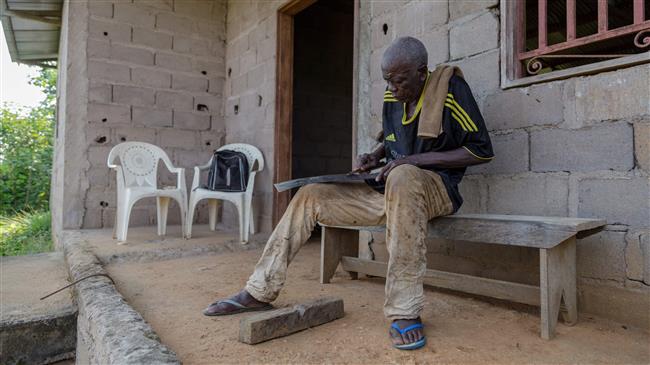
Benoit Bassemel, who’s father was killed during the massacre on the night of December 31 1956, files his machete at his home in Edéa, on December 11, 2019. (Photo by AFP)
‘Free like the others’
UPC nationalists believe that the independence granted on January 1, 1960, was not what they fought for.
They view the country’s two post-independence presidents, Ahidjo and Paul Biya, who has been in office since 1982, as working hand-in-hand with France.
“We wanted to be free like the other countries. We no longer wanted white people to subjugate us,” said 80-year-old Mathieu Njassep, in his tiny family apartment in Petit Paris, a poor district of Douala, the economic capital.
In 1960, aged 21, Njassep joined the Cameroon National Liberation Army (ALNK), the UPC’s armed wing.
After two years of fighting, he was appointed secretary to Ernest Ouandie, a leading figure in the movement. He was sentenced to death but escaped the firing squad, unlike Ouandie, who was executed in 1971.
“We had almost nothing to wage a war with,” Njassep said. “We carried out ambushes with machetes, sticks and homemade guns. If we had had enough weapons, we would have beaten them.”
At the time, the ALNK had established its headquarters in the village of Bandenkop, on the land of the main western tribal group, the Bamileke. Fighting was fierce between the nationalists and the French army.
In the rugged valley from which ALNK commanders led operations, there is no sign of human life today and the only sound is that of a bubbling stream.
“This whole zone was regularly bombed” by the French air force, said Michel Eclador Pekoua, a former UPC official.
Pekoua and other nationalists say French planes dropped napalm. France has neither confirmed nor denied the use of the notorious incendiary weapon.
Decapitations
On a road 30 kilometers to the north, in Bafoussam, a roundabout is known as the “crossroads of the guerrillas,” for it was where the decapitated heads of nationalists were placed on show, said Theophile Nono, head of a historical association, Memoire 60.
The regime’s methods “ranged from the arrest and arbitrary imprisonment of any Cameroonian suspected of ‘rebellion’ to systematic torture, with extrajudicial summary executions,” Nono said.
For many years the conflict mostly remained taboo in Cameroon. It was in the 1990s, when the authorities came under mounting pressure for democratic change, that people began to consider the historic past.
Biya, in a speech in 2010, paid tribute to “people who dreamed of (independence), fought to obtain it and sacrificed their lives for it… Our people should be eternally grateful to them.”
After years of French silence, then president Francois Hollande in 2015 became his country’s first head of state to speak of “a repression” of Cameroonian nationalists leading to “tragic episodes”.
For many survivors, this is not enough.
“France must accept its responsibility,” Nono said. “It must undertake to compensate victims of the dirty war, which has been carefully concealed by both the French side and the Cameroonian side.”
Senior OPCW official ordered deletion of ‘all traces’ of dissenting report on ‘Douma chemical attack’ – WikiLeaks’ new leak

RT | December 27, 2019
The leadership of the chemical weapons watchdog took efforts to remove the paper trail of a dissenting report from Douma, Syria which pointed to a possible false flag operation there, leaked documents indicate.
In an internal email published by the transparency website WikiLeaks on Friday, a senior official from the Organization for the Prohibition of Chemical Weapons (OPCW) ordered that the document be removed from the organization’s Documents Registry Archive and to “remove all traces, if any, of its delivery/storage/whatever.”
Email from the Chief of Cabinet at the OPCW, demanding deletion of dissenting engineering assessment: “Please get this document out of DRA [Documents Registry Archive]… And please
remove all traces, if any, of its delivery/storage/whatever in DRA”https://t.co/j5Jgjiz8UY pic.twitter.com/8yojf8teFC— WikiLeaks (@wikileaks) December 27, 2019
The document in question is a technical assessment written by inspector Ian Henderson after a fact-finding mission to Douma, a suburb of Damascus, in the wake of an alleged chlorine gas attack. Western politicians and media said at the time that the government forces had dropped two gas cylinders as part of an offensive against jihadist forces, killing scores of civilians.
The OPCW inspector said evidence on the ground contradicted the airdropping scenario and that the cylinders could have been placed by hand. Considering that the area was under the control of anti-government forces, the memo lends credence to the theory that the jihadists had staged the scene to prompt Western nations to attack their opponents.
The final report of the watchdog all but confirmed that Damascus was behind the incident, but in the past months an increasing number of leaked documents and whistleblower testimonies have emerged, pointing to a possible fabrication. The OPCW leadership stands accused of withholding opinions contravening the West-favored narrative and using misleading language to report what the inspectors found on the ground.
The alleged email was written by Sebastien Braha, Chief of Cabinet at the OPCW. Its authenticity is yet to be confirmed, but the organization never said any of the previously leaked documents were not real.
Another document published on Friday outlines a meeting with several toxicology experts and their opinions on whether symptoms shown and reported in alleged victims of the attack were consistent with a chlorine gas poisoning. “The experts were conclusive in their statements that there was no correlation between symptoms and chlorine exposure,” the document said, adding that the chief expert suggested that the event could have been “a propaganda exercise.”
The Douma incident in April 2018 spurred Western governments into action, with the US, the UK and France delivering a barrage of missiles at what was dubbed chemical weapons sites in Syria days after. This didn’t prevent the government from seizing control over the neighborhood, but put the reputations of the three governments at stake. The OPCW report gave credence to the Western show of force.
French Union Workers Agree to Halt Production at Key Oil Facility
teleSUR | December 23, 2019
French union workers from the General Confederation of Labour (CGT) voted Monday to halt production at a key oil facility that supplies Paris and the surrounding region, joining other petroleum industry shutdowns in a nationwide strike against Emmanuel Macron’s pension reforms.
“The decision has been taken to halt Grandpuits but with a slight majority. The management has asked for an hour of reflection,” a CGT union official said. Protests began on Dec. 5, when more than 1.5 million citizens joined the demonstrations.
Grandpuits was already producing at minimum capacity before the union vote due to the strike, which is blocking deliveries from the refinery, oil company Total said. While the French Association of Petroleum Industry (UFIP) said only about two percent of France’s 11,000 petrol stations had run dry.
Other oil industry shutdowns have already taken place and are planned for the near future. PetroIneos’ 210,000 barrels-per-day Lavera oil refinery halted production on Sunday after a similar vote from the CGT union workers.
While at the CIM oil terminal in northern France, which handles about 40 percent of French crude oil imports, CGT members decided to stay on strike but held off shutting down operations which would have cut deliveries of crude to refineries and jet fuel to airports.
Despite Macron’s request, the CGT, which has been at the forefront of the industrial strike against the government, has said there will be no Christmas truce. Prime Minister Edouard Philippe’s office said it would restart talks with unions on pension reform on Jan. 7.
Other sectors have also been at the forefront of the protests such as the railroad industry which over the past two weeks have halted services across the country. On Monday hundreds of striking French rail workers clashed with riot police in Paris after holding a demonstration.
The strike, which has disrupted Christmas eve travelers, has also affected other main Paris stations such as the Gare du Nord, which handles Eurostar services to London and Brussels, and the Gare de l’Est.
Unions have announced more demonstrations for Jan. 9 against the reforms.
The CGT, the Workers’ Force, the French Confederation of Management and General Confederation of Executives (CFE-CFC), Solidaires, and the United Trade-Union Federation (FSU) demand the withdrawal of the pension reform project.
The protests come amid the government’s attempts to unify the French pension into a single universal system, effectively removing 42 “special” regimes for sectors ranging from rail and energy workers to lawyers. A measure Macron’s administration argues is “crucial” to keep the system financially viable as the population ages.
Although the CGT has expressed willingness to negotiate the universal pension system, almost all Unions reject any age-related changes. A key reform would be to raise the retirement age from 62 to 64 years in 2027 to receive a full pension.
France chronology in 2019: Year of Yellow Vest rebellion
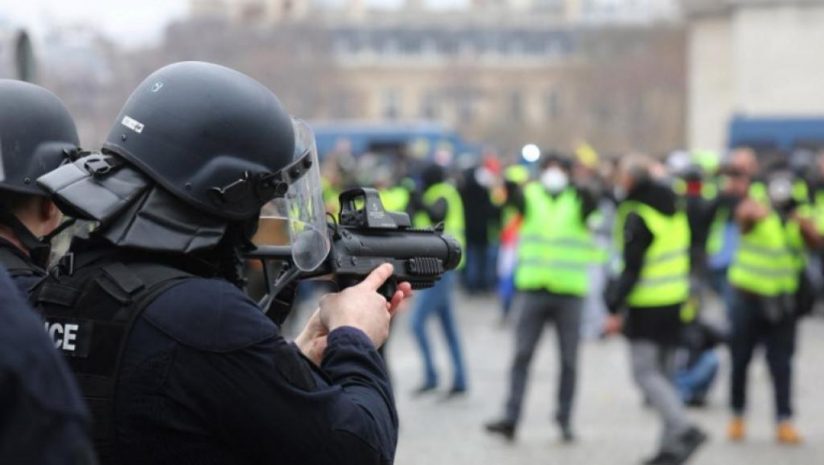
By Ramin Mazaheri | Press TV | December 23, 2019
Before I list the (often unnoticed, misunderstood or covered-up) chronological facts of France’s incredible Yellow Vest year, allow me to briefly summarize it with a personal anecdote:
In mid-April I finally was able to get out of Paris for a few days in between Saturdays and I headed to the countryside, which I adore (in any nation). After a day of decompression something hit me: the metronomic sadism of certain, massive state violence every weekend was not at all a normal state of affairs… and yet Parisians were expending all their psychic energy to convince themselves that everything was indeed “normal”.
What was “everything” from January to mid-April? Every Saturday: Eight thousand cops on the streets of Paris, entire city areas shut down, guaranteed images of violence against unarmed protesters, indiscriminate tear gassings and police brutality, the world aghast at French-style democracy, the knowledge that no way was “President Jupiter” Emmanuel Macron going to make any concessions and that for many people (like me) every Saturday meant certainly risking limb and quite possibly life.
What I realized was that during the first third of the year Parisians did their typical best to be blasé; to act as if all this was quite nothing new whatsoever; to act like getting upset over it was quite poor taste; to act typically Parisian.
That, of course, was total nonsense – pure poseur.
So what I mostly remember is how during this period was that the collective cognitive dissonance in Paris was so immense that it reached a generalized psychosis caused by mass denial.
I also realized that this denial of reality and subsequent psychosis can only be found in imperialist countries. “Our treatment of the aboriginals/those with whom we are living alongside and whom we colonized/non-Whites… is totally normal,” they insist, as they live under a shroud of silence and feigned “normality”. The unsaid reality remains unsaid by both colonized and colonizer (under penalty of social exclusion, jail, death), and the psychosis just mounts and mounts and mounts.
It is normal that this imperialist psychosis occurs in the European Union in 2019, as it is indeed a neo-imperialist project. The question the French cannot quite answer is: are they the still the colonizer, or are they now colonized?
But such questions are all of no importance to the politically regressive. Nothing to see here, even by the French who watch the nightly news – we cannot question “French exceptionalism”.
What do I know about the Yellow Vests? I contend that no “mainstream” journalist attended more Yellow Vest demonstrations than I did, at least in Paris. I would also suggest that while I did hundreds of live interviews from the demonstrations – while getting tear gassed, with rubber bullets flying around, literally in between Black Bloc and police – most journalists did zero.
This article was generated by me going back through my list of reports with Press TV in 2019 – it’s mostly headlines, quotes (mostly from interviews with Yellow Vests) and short excerpts from my reports. I pass on the highlights, and I also tie together the threads with the advantage hindsight – check the key date of March 16th to see what I mean.
If you are too busy to read it all, I suggest only reading March through May 1 – this is when the Yellow Vest demonstration was gutted via reactionary values which we can call “neo-Vichy”, with Brussels replacing Berlin as the master of France’s government.
I didn’t bother to provide a web link to the roughly 175 2-3 minute reports I made with Press TV in 2019, but I did include web links to a score of in-depth written reports I did specifically about the Vesters.
It was not at all an easy year, and I recall being quite exhausted by the summer. It wasn’t just the obvious stress caused by walking into a “near war zone” every Saturday – why on earth did the Vesters insist on marching 10-15 kilometers every Saturday? And so fast, too!
But, as they have shown, their endurance and determination is beyond remarkable. I’m glad the facts are on the record in one place, if only as an expression of admiration for them.
France Year in Review: The rise and rise of the Yellow Vests into a General Strike
2019 in France obviously has to be remembered as the year of the Yellow Vest rebellion.
It began in November 2018, and President Emmanuel Macron thought he had pacified it in December with a pittance of so-called “concessions”, but the rebellion continued.
Why, because as I wrote back then: “It’s just one protest… which has lasted 8 years”. They want you to view the Yellow Vests in isolation instead of as a historical continuum.
In early December every single person I asked agreed that they are a Yellow Vest. Biased, misleading and above all a lack of polling would attempt to hide the Yellow Vests amazing popularity the entire year. By September I was explaining Why France’s 20- and 30-somethings hate the Yellow Vests (foolishly, of course). However, no poll ever showed the Yellow Vests with an approval rating lower than 49%, and they are generally around 60% – this makes them by far the most popular political movement in France, even if not everyone joins their club. And above all: that is a simply enormous score for any protest movement, anywhere.
Many assumed the Vesters would stop protesting over Christmas because that’s what every political/social/union/labor movement had done for decades, no matter how much political momentum they had. Not the Vesters. Right then I knew that this was serious – they had different priorities.
By January it became clear that the French government was going to treat political protesters like football hooligans.
Jan 2 – Start by arresting their leaders for eating dinner
On December 20, 2019, the justice department would admit that France’s top police hierarchy were wrong to order the “disguised arrests” of key Yellow Vest leader Eric Drouet along with 42 others back on January 2nd. They were eating in a restaurant.
A “disguised arrest” is a euphemism for an arrest ordered by the Deep State: one is arrested without any true justification or reason, but simply because security agents have been ordered to do so.
Drouet immediately denied being a “leader”, because organisationally the Yellow Vests are indeed a grassroots, leaderless, “Latin anarchy-style” protest movement and not a political party. I eventually began referring to Drouet and others as “organisers”. Drouet does admit to eating nearly three times a day.
A column I wrote that week pointed out that, like the Vietcong, the Yellow Vests absolutely will not have the early demise which the Mainstream Media hopes for… because they have nowhere to go.
Jan 5 – Vesters surprisingly march after New Year’s Day
Brutal scenes as French cops refuse to let Vesters protest in front of Parliament, even though they had a permit to do so.
That is explanation for essentially all the conflicts between cops and protesters in 2019: protesters get trapped, in violation of their human right to demonstrate, hyper-armed cops use their weapons, protesters respond in a civic rage and in self-defense.
Turnout was down overall, but again, the fact that anything was organised at all was a huge, huge break with vacation-loving French culture. Of course, the media searches for any reason to insist that the Yellow Vest movement is abating, and they do so here.
Jan 12 – ‘Battle of Turnout Figures’ as France returns from vacation
The government claimed only 50,000 protesters marched, but the true figure was closer to 300,000.
Firstly, why are these numbers important? As a cop told me: this is a country of nearly 70 million people, so cops are never going to stand down unless there are 10 or 20 million people in the streets. He’s right. The people who foolishly think the cops are going to see the political light and “switch sides”, and also the people who think the Yellow Vests are just a hair’s breadth from getting Macron to resign, should re-read that.
A secondary point here is how very special and vanguard the Yellow Vests truly are for getting out on the streets: France was not anywhere close to a revolution which overcame their neo-imperial security state, but there sure were a large amount of people who were willing to try.
So numbers do matter, and that’s why the MSM’s parroting of an absurd official line (from their cozy newsroom) is so galling.
However, we should still accept that cops can actually be not reactionary. The poorly named “Union of Angry French Cops”, France’s third-largest cop union, consistently defied the Interior Ministry to give their own tally, mainly because the ministry was just outrageously low. The “Yellow Number” also made its 2nd appearance at this demo, and you can find all 3 of these crowd estimations here – the odd one out is the Interior Ministry.
The union believes the divergence is due to the fact that rural villages are constantly ignored by the government and media. The union has members actually stationed at places like rural roundabouts all day: they count the number of different people who arrive at a demonstration, and then leave, only to be replaced by new protesters.
It should be easy to see why the ministry’s figures are so absurd: why would the government routinely mobilise 80,000 policemen for what they are claimed from Valentine’s Day onwards was less than 47,000 protesters? (See January 27 note.)
Back then I couldn’t help but see the Yellow Vests as the harbinger of the bursting of the West’s “Everything Bubble” which Quantitative Easing has created. Who would have predicted that “QE Infinity” would be unveiled in September?
Jan 19 – Calm day in Paris for Act 10
It’s important to remember they weren’t all days of pitched war, but a lot certainly were until late March. Act 10 was mostly peaceful in Paris, but not elsewhere. Death toll at this point – 10 people.
Protests increase again. It has become clear the Yellow Vests are not going away, so the MSM grapples with trying to describe their class-based demands without violating their blacklist of the word “class”.
I laid it all out here: The Yellow Vests are calling for the world’s third Cultural Revolution, after China and Iran.
It’s not bias or exaggeration: They want to halt the functioning of normal society to have a serious, long, fruitful discussion about France’s role in the euro, the EU, NATO, Françafrique, the 5th Republic itself, austerity policies, foreign policy, environmental policies, housing, education, health care, pensions, etc. That link is Part 8 of an 8-part series I wrote this year to demystify the two state-sponsored Cultural Revolutions simply because the parallels between them and the Yellow Vests were so obvious.
Yellow Vests sure didn’t have state sponsorship, though. However, they did have a 60% approval rating at this time.
Jan 26 – French cops equipped with body cameras for first time
Absolutely nothing has come of this early demand aimed at reducing police brutality.
By the end of 2019 France has prosecuted just two cops for police brutality against the Yellow Vests. So how can we even know what has been recorded, when the cameras were even turned on, that is?
Jan 27 – Reactionary ‘Red Scarves’ demand Yellow Vests stop bothering the establishment
Finally, a demonstration which France’s media feels safe enough to cover!
The one and only such demonstration of this pathetic group. However, never has such a short-lived social movement received such fawning and massive political coverage. Where are the Red Scarves now – nowhere? Or rather: about to annoy the hell out of their family at Christmas.
Just prior to the movement a minister said that if 10,000 people showed up, then that would constitute a success and be a signal that the Yellow Vests have to stop: the Interior Ministry claimed 10,500 people showed up.
Many in the media would never once question the ministry’s figures on the Yellow Vest turnout despite their obvious self-interest to keep the numbers low, yet reported 10,500 despite the real-time indication over an inaccuracy which was widely obvious.
Feb 5 – Yellow Vests and unions march together for first time
Initially, a union member carrying his union insignia was as unwelcome as member of Macron’s political party. The Yellow Vests’ popularity and respect is largely based on their open rejection for not just mainstream politics and the traditional modes of French political culture, but also France’s idea that unions should lead socioeconomic protests. The Western “independent” union model, is perfectly calibrated to be “divided and conquered”, which has been the case in France since 2010, certainly; when unions “win”, the theory is that everyone else should just hope that their gains “trickle down” to the 90% of French workers who aren’t unionised.
This was the first time Vesters tolerated unions to march on the same city streets as them – the unity would be quite short-lived. I don’t blame them. In September 2019 I interviewed the head of a top farmer’s union: I gave her every chance to defend, even just mildly, the Yellow Vests, but she insisted that farmers had nothing in common with rioters.
This is exactly what a Yellow Vest told me that day: “The average union worker supports theYellow Vests, but not the union leaders, who have repeatedly betrayed us. The unions must finally end their selfishness, because everyone is against this government.”
Is it a rural-based movement, as is often said?
The only who people who say that are those who don’t understand/can’t admit that class is the single most dominant political lens.
Like all true revolutions, the nation’s “trash” had become the true political vanguard.
Feb 6 – France passes ‘anti-Yellow Vest law’ amid mass protests
The law allows police chiefs, known as prefects, to ban citizens from attending protests, a power which was previously reserved for judges. The law also gives police greater power to search citizens without warrants, and imposes fines and prison terms for any protester covering their face to avoid identification, or even of using a scarf to to avoid tear gas.
I recall earning some plaudits on the Champs-Elysées around this time. It was cold, and French riot cops were all covering their face to stay warm. I loudly told a cop that if he can cover his face against the law, then I should be able to wear my burqa, LOL. Easy for me to talk back in anger – I’m a journalist: the French protesters who did the same usually found themselves wrestled to the ground and arrested, with the wife screaming, “He didn’t do anything!” behind him.
This is another shift of power towards the executive branch and away from the judiciary and legislative branches, and especially the electorate. This process greatly accelerated under Francois Hollande with the 2-year state of emergency, the so-called “French Patriot Act”, and the repeated use of forcing through unpopular austerity-related laws by executive order. Macron would use executive orders even though he has an absolute majority in Parliament – he just wanted to avoided the bad press of open debate.
Feb 21 – Macron’s ‘Deep State’ scandal deepens with perjury charges
The Benalla affair – nobody knows about it outside of France but it’s Macron’s biggest one.
I would contend that a large reason it is not known outside of France because the constant implication is that Macron and Alexandre Benalla had a homosexual affair, or that Benalla helped cover up such an affair as Macron’s personal – and extremely law-breaking – bodyguard. The 24-year age difference between Macron and his wife helps fuel these rumours.
Regardless of these rumours, these charges came from an exasperated Parliament committee which concluded that Macron showed Benalla an “incomprehensible indulgence”. This “indulgence” was so extreme that nobody can possibly explain why a president would take such risks to protect such a person? It remains baffling.
Anyway, the problem is transparency/independence from blackmail/corruption. A Yellow Vest that week put things into perspective: “Look at the Benalla affair: there is overwhelming proof that President Emmanuel Macron’s right-hand man committed many crimes, yet he remains free, while Yellow Vests stay in jail! It is clear that there is major discrimination in the justice system by France against its very own citizens – some people have special privileges, but the Yellow Vests do not.”
Benalla served one week in jail, but only because he broke his bail – the average prison sentence for a Yellow Vest has been one year.
Feb 22 – Macron to outlaw anti-Zionism, sparking disbelief & outrage
“I’m not gay, but the Yellow Vests are anti-Semitic.” That’s not what Macron said openly of course, but the timeline worked that way.
The proposition was an attempt to slur the Yellow Vests, and to create a long-running distraction.
The resolution – not a law, but one step short of it – would be passed in December. What I found interesting was the huge amount of media coverage on it in December… after, not before, it was passed. I covered it before: it was mostly French Jews fighting against it, because it obviously unjustly makes all Jews responsible for the crimes of Israel. I’ve seen studies that half of European Jews are anti-Zionist. Of course, confusing anti-Semitism with the political, colonialist, segregationist project of Zionism is something nobody involved in politics should be dumb enough to confuse, but Macron did.
At the February 16th Yellow Vest march far-right ideologue Alain Finkielkraut was not welcomed, and called a “dirty Zionist”. This created much media uproar, despite the latter being 100% accurate. The Yellow Vests marched against anti-Semitism on February 19.
Combined with the looming Benalla scandal, anti-Semitism was a very useful distraction for Macron at the time. It was undoubtedly instrumentalised by France’s extremely powerful pro-Zionist lobby.
It gave me a chance to dust off a term I created during the Charlie Hebdo protests: 21st century France as a new “Holy Secular Empire”.
Feb 27 – Council of Europe urges France to stop rubber bullet use
Does anyone care about the Council of Europe, or any pan-European institution, really? Of course not, but it was notable that any major organisation condemned France back then.
For example, Human Rights Watch issued just a single condemnation of French police brutality in 2019 – against ecological protesters, not the Yellow Vests. Reports on Venezuela, Hong Kong, Syria – their reports are innumerable and their hypocrisy crystal-clear.
Five hundred critical injuries at this point; unions and France’s Human Rights League estimated that 10,000 rubber bullets had been fired at Yellow Vests. Most journalists in France still euphemistically calling rubber bullets “flash balls” or, even worse, “defense ball launchers”, which obviously assumes that the protester is always the aggressor.
Mar 6 – UN: ‘full investigation’ of brutality against Yellow Vests
The UN Human Rights chief properly recognised that, “The Yellow Vests have been protesting what they see as exclusion from economic rights and participation in public affairs.”
France totally ignored this, of course. The prime minister said the UN chief lacked the “full picture”, but he obviously summed up the heart of the matter.
However, ignoring condemnations of their police is what France does – French police have been condemned for police brutality over and over by the UN and top NGOs for many years.
During the labor code rollback protests in 2016 at least 4,000 protesters were arrested, with well over 1,000 people hurt by police in Paris alone, according to Amnesty International. Extrapolate those numbers nationwide. I covered all those demonstrations too – it’s why I always said that I perceived that the Yellow Vests were only 15-20% more violent than France’s “normal” violent demonstrations. Only the Yellow Vests ever graffiti-tagged the Arc de Triomphe, sure, but that was just a huge propaganda victory for the Vesters.
Mar 8 – Paris forbids Yellow Vest camp
Why wasn’t there a “French Tahrir Square”?
The Yellow Vests tried – cops weren’t even close to allowing a single sleeping bag get laid on the ground. They would have needed many thousands to establish a camp and I recall only 1-2,000 people being there.
It was a cold night back then. Would have still had to have beat back typical French police brutality, too.
Mar 12 – ‘Anti-Yellow Vest’ law adopted
Officially known as the “anti-rioters” law. This provided the “legal” basis for the oppression which would stem the tide (not turn it) of the Yellow Vests…. We got a couple good quotes from journalist/analyst George Kazolias explaining the law:
“But what really makes this law really dangerous, as one conservative member of Parliament put it last year, is that it’s a Vichy law, referring to the government that ruled France under Nazi occupation in World War II. This law gives administrative personnel judicial powers – it takes the power away from the judiciary. … So what he (Macron) has done now is to make at a local level what he has done at the national level with (unpopular laws which normalised) the state of emergency. I’m surprised not more people have tried to relate the two?”
And, now that massive repression had a new “legal” basis, the upcoming Yellow Vest march would be incredibly repressive and mark the beginning of the end of their long peak. But the day before that…
Mar 15 – Macron’s National Debate ends with universal dissatisfaction
The National Debate was 2.5 months of 10,000 local public debates. It was mainly a public relations effort by Macron to show that he is a president who does listen and who does incorporate public opinion into public policy… even though that is obviously false.
However, much of his time at these town hall meetings was Macron talking for hours and hours, like Fidel Castro. There are big differences between the two: Macron is pushing capitalism, imperialism and technocratism – Fidel pushed rejecting brutal capitalism, patriotism and morality in public policy.
At this point in his term Macron (begun May 2017) has never held a press conference. That is not a typo.
Perhaps this explains why it was “The Macron Show” for six hours a day on mainstream media. The sudden availability of Macron to the masses and journalists was a total 180 from the previous 22 months.
Rather amusingly (unless you are a minority Macronista) a key poll asked what people found positive to say about Macron regarding his method and style at the National Debate: the number one answer, at 48%, was “I didn’t find anything positive about Macron”. That was nearly double the second-most popular response.
So the National Debate had concluded, the laws were in place – the kid gloves came off. We knew it was coming – column here.
Mar 16 – Worst violence in months amid near-secret de-nationalisation machinations
This is when “Sarkozy’s restaurant” Le Fouquet’s was ransacked. (A quintessentially French place… yet they use a possessive apostrophe?)
I remember I got there early – it was already a war zone.
This is because before the demonstration could even start riot police used tear gas and water cannons to provoke the violence which would be required to justify the police tactic changes later this week.
Black Bloc was there, being useless as usual – I recall a protester at the Arc de Triomphe screaming at me, “Why don’t the cops do anything to stop Black Bloc?!” I debunked Black Bloc in a recent article: French Black Bloc’s utter uselessness… except to the French government. I repeatedly saw Yellow Vests intervene to stop looting on the Champs-Elysées; cops were filmed stealing football jerseys from the Paris Saint-Germain team shop.
A good quote from a Vester that day: “Just like at the beginning of the movement, it was the same old tactic from our government. They want the protest to degenerate as quickly as possible in order to discredit the movement. They launch round after round of tear gas, to the point where people are stepping on protesters who have fallen down! They want to scare us into staying at home, but we will never stop protesting!”
Interesting note I have in my report: “Despite 18 consecutive weekends of protests by the Yellow Vests, France’s unions have taken to the streets only rarely this year.” It’s key to remember how independent and isolated the Yellow Vests were – they fought time after time all on their own: they really are like a family.
Shockingly, Macron chose this weekend to go skiing – the photos appall the nation. On seemingly every major day of protest during his term I have noticed that Macron is never in Paris, and often out of the country. Of course, since the Yellow Vests the big establishment fear is that they will reach Elysée Palace near the Champs-Elysées. However, as I am a fellow 41-year old man… he rather acts like a scared old man.
Macron is celebrating because he has given the incredibly anti-democratic orders which will mark the beginning of the “end” of the Yellow Vests – more such orders arrive in days.
However, one final kick in the teeth: At 6:15 in the morning on Saturday March 16th Macron surprisingly called for a Parliamentary vote regarding the biggest wave of privatisation in 15 years. Only 45 of nearly 600 deputies were present, and the bill was approved. Widespread media explanation would later be required to explain why the vote was still legally-binding despite such low parliamentarian turnout. You think I’m making this up don’t you, LOL, but this is the actual chronology.
It would take a couple weeks before this de-nationalisation became a media issue. Think there weren’t monetary reasons for Macron to sic the armed forces on the Yellow Vests to begin with? De-nationalisations to benefit his friends and backers of his meteoric rise put yet another monetary motive at play.
The Yellow Vests would successfully prevent the airports of Paris from being privatised (at least so far), but Macron would sell off more than 50% of the national lottery in November. I didn’t get it: neoliberals say that any state business which doesn’t make profits must be privatised… yet the highly lucrative state gambling monopoly has to be sold off, too? It’s almost as if neoliberals rely on faith instead of facts, logic and history….
Here’s a live interview I did at the Parisian bank which was firebombed – surely the only live interview from there that day, and probably the only “mainstream” media interview which gave an objective explanation of why it happened.
Article I wrote about the March 16 protests. I started with: “Because if Saturday March 16 was a ‘war zone’, then France has been at war since 2010 – I didn’t see a single thing out of the norm for France.” Doctors and nurses treating the wounded disagreed with me over and over – they said the injuries were what they had seen in war. I never said journalists were always right….
Mar 23 – French army doesn’t deter massive Yellow Vest protests
For the first time since the Algerian War for Independence the army was used inside France against the French people. Just prior to Act 19 a French general reported on live radio that he had authorisation to open fire on protesters.
Furthermore, on March 18 the Paris police chief was fired. Part of the reason was given by Prime Minister Philippe: “Inappropriate orders were given to reduce the use of LBD [rubber bullet launchers].” Imagine if Putin had said that?
The new chief looks, and certainly acts, like he would have been quite at home in Vichy France, which is precisely why he was hired. His uniform always appears to be a couple sizes too big for him.
Protests were now officially banned in key parts of urban areas, like the Champs-Elysées. Bans in rural roundabouts would begin in early May (but I thought this was a rural-based, not class-based movement?).
Should we be surprised that Yellow Vest numbers are about to plummet?
In January there were an average of 350,000 protesters per weekend; February 240,000; after March 23rd they reached 100,000 people maybe twice and then never again.
If you are a clueless, secretly-reactionary/fake-leftist Mainstream Media journalist this is what you think in your empty head: “Oh, the numbers have only fallen because the Yellow Vests aren’t popular anymore. Yes, I will accept that promotion, thank you boss!”
So March 12-23 should be remembered as when France became a “neo-Vichy” government. Instead of Berlin, the master is Brussels.
They didn’t destroy the Yellow Vest movement, but they did scare the hell out of the average person.
Mar 28 – French cops wearing Yellow Vests to infiltrate movement
It was discovered that on March 16 cops were wearing Yellow Vests to disguise themselves.
The police union noted that there is no formal law against disguising themselves as protesters, so that should settle the matter
Good Vester quote: “We don’t know if we should fear our own government, or if we can trust it? Such video revelations are going to increase the accusations that the government is pulling the strings with secret militias inside political demonstrations. That sounds like a conspiracy, but these videos give such ideas obvious legitimacy.”
March 30 – Mayor demands city become a “ghost town”
Mayor of Bordeaux commanded citizens to not leave their homes that Yellow Vest day. The phrase “Bordeaux strong”, unlike in Boston, did not become commercially popular.
Again, Mr. and Ms. MSM Journalist – might this explain the drop in attendance? And perhaps also the unveiling of harsher tear gas, guaranteed fines for violating the ban, warrantless searches (Do the women you date even let you go through their purse?), increased arrests, the refusal to engage with Black Bloc despite the vast superiority of the professional armed forces, and on and on? This is why I didn’t get very far in the French newsrooms I worked at….
Similarly, the Yellow Vests insisted on their right to freedom of assembly and defied the bans.
Why? Let’s ask a Vester: “I worked from the age of 14 until the age of 60, and in my entire life I accepted only 1 month of unemployment insurance. And yet, in the last 4 years I have seen my pensioned lowered from 1,150 euros to 1,050 euros. My rent is 800 euros a month, so I cannot afford to live, and I will never accept this injustice.”
Several ministers resign this week, but this is hardly newsworthy with Macron.
April 4 – NGO says 3,000 homeless died in France in 2018
Macron made zero deaths due to homelessness a key campaign promise.
April 6 – Last time anyone counted over 100,000 people at a Yellow Vest demo
Thus, this article is going to start getting shorter. Yellow Vests popularity stands at 53%.
Half the country supports them, but from behind their curtains now.
April 10 – Massive rejection of Macron’s ‘National Debate’ results
The government declared that the main conclusion of the debates is that taxes should be lowered, which is what every peasant under French rule always said.
Reversing Macron’s elimination of the very popular “Wealth Tax” will not be discussed as a possible result, nor is deviating from nine years of austerity budgets: the Yellow Vests continued marching would reverse one of these.
Polls show that just 6% of France called the National Debate a success while 80% said it will not resolve the current political crisis.
April 15 – Notre Dame ravaged by fire, world mourns
In an amazing coincidence, the fire started just an hour before Macron was to reveal his personal conclusions of the 2.5 month so-called “National Debate”.
This was rather a cherry on top of a terribly bitter social sundae which had been forced down France’s gullet thus far in 2019.
Considering how catastrophic it looked on TV, I truly thought it looked pretty good when I saw it the next day.
April 20 – Constant cop violence as Yellow Vests begin 6th month
Key anniversary = higher turnout = more repression. Worst violence in weeks.
Me impersonating an MSM journalist: “Don’t you think that because of the fire at Notre Dame you should stop marching in order to promote national unity (even though this is a “secular” country)?”
French Yellow Vest quote: “The fire at Notre Dame touched everybody, but there is a big controversy over how we could raise a billion euros for a church so quickly, and why we can’t raise such an amount for poor people. There is a lot of anger, and a fire at Notre Dame is not going to change this logical reality.”
The last time the Yellow Vests touched 100,000 protesters, but only by rounding up.
April 24 – Record suicide pace for cops amid Yellow Vest demos
April 25 – Journalists help Macron ignore Yellow Vests at 1st presser
Incredibly, Macron has finally held his very first press conference.
Prior to that he and I had held the same number of press conferences since May 2017. Key difference: I am not the popularly elected president of a country. I am, however, the authoritarian and arrogant leader of “Raminia”.
Incredibly, and we can add another “incredibly” on top of the first “incredibly”: this is when Macron said the words “Yellow Vests” in public for the first time.
Less incredibly, considering the toadying, social-climbing French media class, the mainstream journalists permitted to attend the press conference (Iranian media is banned from official press conferences of the president, PM, FM, etc.) dared to ask Macron just one direct question about the Yellow Vests. The question was posed by the extremely mainstream anchorwoman Laurence Ferrari, and kudos to her: every other journalist failed.
Here was Macron’s initially nihilistic answer, via an explanation which is totally acceptable in Anglophone countries, which are also politically nihilistic; he then switches to total defiance based on technocratism: “We are a country where disagreements are expressed forcefully and where there are always protests. I totally take responsibility for having not given way – during my first two years – to those who want to set back our projects which I deeply believe are good for the country.”
Two subjects which were never mentioned by anyone were the routine police brutality, nor Macron’s raft of anti-democratic measures such as the “anti-Yellow Vest Law”.
Polls showed that 65% of France said they were unconvinced by Macron’s answers. Nearly 80% said he did not address the concerns of the Yellow Vests.
Despite a record-low approval rating of just 27%, Macron said he thinks it “would be best” to stand for re-election. No serious policy changes were announced, because the conclusion that Macron drew from the National Debate was, “Our approach over the past 2 years has been right.”
Ugh… I’m glad I’m banned from there.
May 1 – Record cop violence at huge Paris May Day demo
This was a rough one… it was certainly no celebration of International Workers’ Day.
Never saw so many cops – every 50 meters there was a phalanx of cops along the marching route. People who think Western, liberal democratic, aristocratic (bourgeois) governments don’t fear socialism – explain the measures taken on May 1, 2019?
Long story short: in order to prevent a unified demo at the end the cops used the classic tactic of “divide and conquer”. They repeatedly severed the march, allowing one part to advance to the end (where they were gassed and chased out), while cops fought pitched battles with the section that was kettled and prevented from marching freely. After several rounds of this the streets were a shambles – protesters, unarmed of course, needed to find something to protect themselves with.
This produced the MSM hoax of an alleged “hospital invasion”, which I debunked thoroughly here. Briefly: that day MSM and politicians got apoplectic that protesters – cornered by cops using tear gas, water cannons, batons and rubber bullets – tried to take refuge in a hospital. What those armchair idiots and “hotel room journalists” don’t know is that when tear gassed one moves (don’t run!) in one direction: away from the gas. The only direction left to protesters was jumping a hospital gate.
Mainstream idiots everywhere said protesters were “invading” the hospital. It took a couple days for the truth to come out – only two old, apologetic men actually made it inside the hospital, saying they had been “tear gassed all day”. The internet reactionaries who vengefully and gleefully insist that “Yellow Vests are rioters and they get what they deserve”… they really have no idea what they are talking about.
What I remember from that day is: I’m trying to give a live interview in front of the hospital – amid all the “flash balls”, flying pieces of pavement and tear gas – and the newsroom in Tehran is insisting that I remain motionless in order to “set the frame”. “How on earth are me and my cameraman supposed to stay motionless and not wind up seriously hurt! Just put me on the damn air!!!” Aggravating…
I recall only one other journalist doing a live interview during all that violence – a female journalist for Italian TV, as I recall. Kudos to her. French media? Fuggetaboutit. French public media, who are paid by French taxes? Fuggetaboutit. I’m sure RT was there, but I didn’t see them. I bet they were wearing a helmet, though – I never did once. LOL, a bit of leniency for my egotistical behavior, please: I had been “tear gassed all day”.
On December 19th the first police officer would finally be convicted for police brutality – he was filmed throwing a piece of pavement into a crowd of protesters on May 1st. Apparently his rubber bullets, tear gas, water cannon and truncheon wasn’t enough? He got a minor sentence, no prison time, his identity was not divulged, nor will the conviction even appear on his legal record.
That was the last rough one… for a while, at least. Not sure that’s a good thing.
May 5 – France bans Ramadan, citing secularism & economic stagnation
I never did write that satire… don’t know why? Would’ve been funny. Probably tired – Ramadan had just started, after all, and I had been tear gassed all year. Maybe for 2020.
Just checking to see if you are still reading!
May 8 – France began killing 45,000 Algerians on WWII V-Day
Oh, MSM journalists, where you marking the defeat of European fascism in World War II that day? Why?
France also bombed Damascus that May. Syrians booted the French out that year, thankfully.
May 9 – First major Yellow Vests victory – no to de-nationalising Paris airports
This week the Yellow Vests scored their biggest victory yet, by forcing parliamentarians to accept a referendum on Macron’s attempt to denationalise the airports of Paris.
A column here about stopping the Yellow Vests stopping of denationalisation, and why you never hear that word.
Last week I paid 9 euros to travel for about 15 minutes of travel on a privatised French highway – this is why Yellow Vests demolish tollbooths. Aren’t air tickets costly enough already?
May 11 – France bans rural protests for Yellow Vest #26
Many French media gleefully speculated that the Yellow Vest movement was finished, but 60,000 protesters turned out yet again, despite the government’s efforts to intimidate people in both urban and rural areas.
May 15 – 72196 – Macron at 2 years: 76% policy rejection
A recent poll covered 14 vital questions and sectors, ranging from economics to immigration to security and more. Respondents gave Macron a whopping 76% failure rate on society’s most important questions.
So 24% of respondents support Macron, which was his exact score in the first round of the 2017 presidential elections.
This 24% was also his true score in his victorious second round, due to the highest abstention in 40 years, and the fact that 43% of voters only voted for Macron to block the far-right’s Marine Le Pen. He only won a majority in 2 of France’s 101 departments, after all.
But Macron and his supporters have always manipulated this to claim that he has a “mandate” for his program, especially the pension junking. Yawn… stupidity is boring, but especially when repeated.
May 25 – Mass arrests as Yellow Vest demos go ‘wildcat’
Vesters had been applying for permits… and getting massively repressed. So they went “wildcat”… and got massively repressed.
Yellow Vester says “Ya Hossein!”: “We will continue no matter what the results of the (upcoming EU) vote are. There are too many people who have been hurt, blinded, and killed, and we must think of them. All we have ever asked for is not to keep starving at the end of every month, and to protect our children’s future.”
May 27 – Another loss for Macron as far-right wins EU elections again
We really should care about the EU elections… or focus on a Frexit.
The three Yellow Vest lists combined for less than 1%. Hey, it took Italy’s 5-Star Movement eight years to win power.
Incredibly, the animal rights party scored 2.2% of the vote. The only solution for such people is immediate deportation to India, preferably under a cloud of tear gas.
June 22 – Scores of Yellow Vests blockades on Act 32
The Yellow Vests realised that the French government doesn’t respond to peaceful protests with anything but repression. That’s why this week has marked a change in tactics: blockades which can affect the economy, like at ports, refineries and toll booths. Scores of blockades were reported around the country, but received scant media attention.
If a blockade falls in the woods and no one hears it, does it make a sound? (Uhhh, yeah, it’s called science: sound waves.)
By this point in the year the French media had effectively enforced a blackout on the Yellow Vests, and the Vesters knew it and were incredibly upset about it.
From June 1 until well into autumn only Iranian media reporters (in English & French (me), Spanish and Farsi) and Russian reporters were doing anything at all about the Yellow Vests. People began to question why I had to work on Saturday: “I thought the Yellow Vests are over,” they asked?
France’s media and artistic communities are increasingly being called out with disdain by Yellow Vests. The nation’s private media follows a pro-corporate, pro-austerity line, and the state media either doesn’t cover the protests or simply parrots the government’s statements without challenge. After seven months very few from France’s intellectual circles have dared to publicly defend the Yellow Vests or condemned the government’s repression, and seemingly none have personally joined the protests.
Yellow Vest quote: “So many of these types have been bought off by Macron and are happy to stay in his pocket. Pensioners, the jobless and public workers have been marching for seven months and our so-called intellectuals spit on us! We are getting beaten and gassed, and they criticise us!”
June 24 – French polling agencies ignoring Yellow Vests
Modern media runs a lot of stories based around polls but the latest poll, which gave Yellow Vests a 50% approval rating, dates from two months ago.
More than half the country believes the media has done a bad job covering the Yellow Vests, but that poll is from 3.5 months ago.
Just as there is a revolving door between Western finance ministries and the biggest private banks, there is also a revolving door between the top level of French politics and its polling agencies. Francois Hollande’s former spokesperson, Najat Vallaud-Belkacem, is now a top polling agency executive, for example.
This is a problem for governance of any ideology. The Chinese Communist Party is often called “the world’s biggest polling agency” for good reason, whereas in France their leaders believe public opinion matters once every five years.
Column here about the incredibly uncool, constant MSM claim that rock and roll is dying the Yellow Vests are dying.
Another column here which compared the West’s beloved Hong Kong protests – who are so nativist they make Marine Le Pen look like a cultural centrist – with the far, far greater violence in France.
July 3 – French ‘cyber hate’ bill targets Yellow Vests & Palestinians
July 14 – Champs-Elysées a war zone again on Bastille Day
First time the Yellow Vests protested on the Champs since March 16th.
It required a couple hours of trying to lose the cops until the Vesters finally snuck in and won the field. My producer faulted me for doing a live interview with no Yellow Vests around – uhhh, they were outrunning cops on motorcycles, they can outrun me and a cameraman.
Yellow Vest quote: “Tourists are getting tear gassed and witnessing major violence, when they are only here out of curiosity. Some people are led to believe that only bad people get tear gassed, but these tourists now know better. If the tourists had stayed a bit longer they would have been beaten, as well.”
Bastille Day… I mean, what the heck – y’all lost! Bastille Day celebrates the temporary victory of the French Revolution in 1789. In 1804 Napoleon declared himself emperor, and the house of Bourbon was firmly restored in 1815. Does anyone else’s national holiday celebrate a loss? No wonder the French are so depressed. Or at least get out there and feel bad about it in a united way, like Shia with Karbala. Bringing this up this French exceptionalism is another reason I didn’t get far in French newsrooms….
July 17 – Macron’s #2 forced out over corruption charges
On the taxpayers’ dime the minster, who only looked up to the prime minister, was having lavish dinners with jumbo lobsters and 1,000-euro bottles of wine, bought a gold-leaf hairdryer, had a 3rd chauffeur to take his kids to school, and government-subsidised housing despite a high salary.
He tried to blame his wife, a nonsense socialite journalist (thus the gold-leaf hairdryer, I assumed), and never repented – he had gotten that high up by constantly clamouring against government corruption, so it would be like saying his whole career was a lie (which it was). I recall a top France24 anchorman writing on Twitter how Lobstergate was merely “mostly about the optics”. The top mainstreamers all see things the same way, which is: the masses just don’t understand that we at the top deserve these fancy things.
For those who remember Hollande’s “the homeless are toothless” comments, this provoked similar outrage and perpetually amusing demonstration signs.
July 20 – Yellow Vests honor Black Muslim killed in police custody
Yellow Vest quote: “I didn’t suffer from police or state repression because I am White and because I don’t live in a poor area, but because I joined the Yellow Vests demonstrations I have now suffered from police violence. This issue concerns everyone.”
Nice to hear, White guy – French Muslims have decided you are cool now.
July 25 – French joblessness up 73% since 2008 crisis
Just do the math properly, and add in all of France (don’t exclude their overseas colonies, as the French MSM does): The total number of unemployed people stands at 6.2 million people, 73% higher than in September 2008.
My editors pushed back – they questioned my data. “You know the official figures show that the number of the unemployed people fell in the second quarter,” they emailed
I was glad to see they were paying attention: nobody in France tells the truth about the jobless data, so it was natural that my headline stuck out to them.
I wrote them: “The Mainstream Media is totally biased in favor of the gov’t and capitalism. They are trying to report, absurdly, that a 16,800 decrease in a nation of 65 million is a success!!!!! It is totally absurd. Just look at this Le Monde graph – unemployment is one constant, terrible rise since 2008. No honest media can portray French unemployment efforts as a positive! Again, the MSM are a bunch of (dummies) who are totally inferior to we Iranian journalists! They try to confuse everyone, but our report is good and 100% fact-based.”
The story ran. The Western MSM continues to talk about their “economic recovery”, buttressed by the same “statistics-minus-analysis” which our report rejected.
Are Iranian journalists superior? I’ve met many who aren’t, LOL. But journalists gotta push for their story….
July 27 – 72863 – Yellow Vests march for 37th week amid media silence
Not much going on – hot, marching and lots of cops around.
Aug 28 – 73133 – Amnesty slams state violence at G7 summit
Still waiting/not-waiting for Macron’s promise of an Iran-US summit “within weeks”….
A huge force was deployed to completely lock down the southwestern town of Biarritz for the G7 summit. Macron did not want to be embarrassed by the presence of Yellow Vests, whose presence would also undermine the West’s claim that their democracies are superior to those in other parts of the world, so all protests were banned.
The theme of the G7 meeting was “economic inequality”, which many Vesters found ironic – Macron stole their ethos.
Aug 31 – Yellow Vests complete summer of record mobilisation
First protest movement to not take a Christmas vacation – now the first to not take a summer vacation.
Most widely cited reason I heard from Vesters? “I can’t afford a vacation.”
Sept 6 – Paris lodging breaks €10,000 per square meter mark
The QE “Everything Bubble” obviously includes real estate.
Not just buying, but rented, too: This same month my landlord would insist that she is “Landlord of the Year” for spending a few hundred euros on minor repairs for the first time in seven years.
Sept 13 – ‘Black Friday’: Biggest train strike in France since 2007
Don’t get it twisted: all this year there had also been constant labor protests, especially with hospitals, unions and pensioners – I’ve just been focusing on the Yellow Vests here.
The Macron era has been constant protests during the spring and fall months, or basically any non-vacation period.
Sept 16 – More mass strikes in France against cutting pensions
Sept 17 – Brigitte Macron to go back to teaching
Somehow, a woman who admitted to having an affair with a minor-age student (Emmanuel Macron) is being allowed back into a school in a leadership position.
That is incomprehensible, but so is how she escaped prosecution back when Emmanuel was 15 years old. Answer: she is a chocolate heiress.
Nobody knows the exact date of when their relationship was consummated, but it is widely assumed that she is guilty of statutory rape. The mental effects on little Emmanuel I speculated upon here, in a decidedly non-tabloid/Trump-coverage fashion, which I also contrasted with the effects of similar rape on young Ike Turner.
Sept 19 – French media darling Eric Zemmour guilty of Islamophobia
After summer vacation the government and MSM began a huge wave of Islamo-distractions as a way to divert attention from the certainty that Macron was going to junk the pension system in favor of neoliberal nonsense.
As expected, the new, daily presence of far-right ideologue Eric Zemmour on France’s #2 news channel has produced a steady stream of anti-Muslim and anti-immigrant vitriol.
Sept 21 – Worst French violence in months at Yellow Vest #45
Who is dumber, Black Bloc or climate change protesters? Both were out in spades. I wrote about the day here.
LOL, when Black Bloc struck all the eco-nuts – swilling champagne, dancing to techno music, clearly quite serious – simply started marching in the other direction. Cops showed them that was not allowed in France, no matter how much fun they wanted to have.
Sept 26 – Macron turns to right on refugee crisis
But I thought he was a “centrist”? Obviously he never was on economics, but pay attention and you’ll find that to the MSM nearly all of the wealthy class are alleged “centrists”.
Islamo-distractions obviously continue.
Sept 27 – Yellow Vest force end to 9 years of austerity
A huge Yellow Vest victory!
But nobody seemed to care. Uhhhh, weren’t we all protesting austerity in Europe for the past decade? I write about the victory/non-recognition of victory here.
Macron backed down because he feared that yet another austerity budget would have provoked more social unrest – he wanted to save his powder for the pension rollback, which will save the 1% infinitely more money.
Oct 6 – Ramin Mazaheri’s birthday: your present has still not arrived
Oct 19 – Georges Abdallah, EU’s oldest political prisoner, marks 35 years
Please send my presents to the “Arab Nelson Mandela”. Read more about him here.
Oct 20 – French poverty skyrockets due to Macron’s reforms
Last year alone a shocking 500,000 people were forced into poverty. That represents a rise of almost one full percent in the national poverty rate, which is now at 15%. The total number of France’s poor people has reached a level not seen since 2010, the darkest days of the start of the Great Recession.
Oct 29 – Strikes build as Macron refuses to table pension rollback
Wildcat train strikes are grabbing headlines, while health care staff continues to strike as well. December 5th is now being promoted as the day to start a general strike.
Oct 31 – French 3Q growth ekes out 0.3% thanks to Yellow Vests
Economic growth was boosted by the 10 billion euros which the Yellow Vests forced out of the government last December. That money increased household spending, which kept France out of the negative last quarter.
Unfortunately, the increase to economic growth is only temporary because the government has refused to put more money into the everyday economy.
Also, 0.3% growth is terrible – many MSM have forgotten this.
Nov 2 – Yellow Vests protest Islamophobia on Act 51
I wrote back in April about how France’s Muslims support the Yellow Vest, contrary to MSM complaints.
Nov 7 – Financing terrorism in Syria charges stick for France’s Lafarge
But not crimes against humanity.
From 2010 to 2014 French concrete giant Lafarge paid over 13 million euros to terrorist groups like ISIL in order to keep their plant in northern Syria running. Six million tons of concrete they produced was used by terrorists for fortifications – reportedly the largest on any battlefield since World War II.
Seemingly never reported in the West – and on the day of this news as well – is the crucial leaked testimony which proved that the French Foreign Ministry knew all about Lafarge’s dealings with the terrorists, was in “permanent contact” with the company, and told Lafarge to “hold on” and “that everything would work out”.
But the problem is Islam itself, right? Wrong.
Nov 16 – Massive violence as Yellow Vests mark 1 year of revolution &repression
What appears undeniable is that the Yellow Vests have redeemed France’s claim to possess a political spirit which is revolutionary, egalitarian and unique. I break it down here.
The Yellow Vest Sacrifice Tally: The Yellow Vests were so righteous that they succeeded in attracting first-time protesters. These political innocents were often among the 11,000 arrested, the 2,000 convicted, the 1,000 imprisoned, the 5,000 seriously hurt and the 1,000 critically injured. Ya Hossein!
Yellow Vest quote: “Yes, I am proud of the Yellow Vest movement. We are trying to fix France’s many fundamental problems, and we never stopped despite all the repression. What’s shameful is that we didn’t start sooner, and that our leaders totally ignore us.”
Briefly: no chance at a peaceful protest was permitted, again. In a new twist, cops cancelled the permit at the last moment. This allowed them to trap everyone at the Place d’Italie roundabout for hours. For hours we all walked in circles like a clock’s hands, but trailed by a constant cloud of tear gas. This gave the MSM all the footage they needed to keep discrediting the movement on its anniversary.
People were enraged, trapped and tear-gassed – are we surprised petty vandalism occurred? Cops never once stepped in to stop vandalism, either – they were only concerned with not allowing people to march peacefully.
See note on December 20.
Dec 5 – French general strike begins amid huge walkouts & protests
France’s largest general strike since 1995 got off to a roaring start as 90% of public transport was shut down nationwide and workers walked off the job in massive numbers. Well over a million people marched against the radical pension rollback threatened by President Emmanuel Macron.
Dec 9 – ‘Black Monday’ as French general strike gains steam
Everyone expected four days/a weekend of shutdowns – this day proved the general strike was serious. Eighty percent of public transport would be shut down through Christmas.
We’re general striking, baby!!!!!!
Dec 11 – Macron unveils new pension plan to widespread rejection
The government only released the details a week into the strike. The delay was obviously because they they are so radically right-wing that the government feared inflaming people even further.
No nation has a universal/one-size-fits-all pension system, and for obvious reasons which I explain here. The idea that France, a “socialist” country to Anglophones, could be the very first shows just how Americanised Macron wants France to become.
Or is EU-style liberalism even worse? Considering their structures is so very much more neoliberal and anti-democratic, it’s very possible….
Today the head of France’s largest union, the “moderate” CFDT, gave Macron a very obvious out: remove the 2-year back-door hike to the retirement age and his union will accept the radical new “points” pension system. Very unfortunate he did this….
How greedy is Macron? Sarkozy already raised the retirement age by two years just nine years ago.
The unions have signed off on every major austerity reform, after all – they get a “good deal” for their members and the rest of the country can take a long walk off a short pier. Will the general strike be different? If Macron will make this deal offered by the CFDT the general strike will likely collapse. Macron has never compromised so far, unlike Hollande, but I will be surprised if doesn’t take what he can get here and run: how many years like this can France take?
Dec 17 – Day 13 shocker: Macron’s pension minister quits over corruption
LOL, you can’t make this stuff up. This was the night prior to the 3rd million-person march against the pension scheme.
The architect of the reform admitted to receiving huge salaries from private groups even after taking public office. French media detailed more than a dozen conflicts of interest between these jobs and his public post.
He quit to try and save the reform. Common sense dictates that his plan is obviously the fruit of a corrupt mind/worldview… but no chance it’ll be withdrawn by Macron.
I asked a Vester their thoughts: “His resignation gives us hope that even more ministers will soon join him! What he did was extraordinarily shameful. How can we possibly allow his ideas to govern something which affects the whole country?”
Macron has now set the record for minister resignations – nearly all due to corruption allegations – only halfway through his term.
Dec 20 – France Telecom found guilty over provoking mass worker suicides
Telecom company Orange guilty of the same charge, and was fined €75,000, the maximum. Corporate logic: what’s a €75k fine if we can make workers life so miserable they quit and we can get them off the books? All it takes is years of daily, methodical, heartless harassment. The suicides were in the 2000s, but France’s wheels of justice work slow.
Conversely, on December 16 a Yellow Vest was fined €72,519, plus one year in jail, for degrading the statue of a French general at Place d’Italie on November 16, the Yellow Vest’s birthday. “I saw red – I cracked up. The meltdown lasted 10 minutes,” he testified.
Quite a contrasting story, motive, and punishment for him and France Telecom & Orange, eh?
Dec 21 – No Xmas vacation for France’s Yellow Vests once again
Yellow Vests march instead of going vacation for the 2nd time. They continue to put the nation first.
This was also Macron’s birthday – he is a Yalda baby. Yalda is a pre-Islamic holiday celebrated in Iran which marks the darkest, coldest night of the year – the winter solstice.
Feel free to make your pagan astrological inferences about how Macron’s birthday relates to his personality here.
The rest of the year and 2020
Unions have announced a very strange strategy: remain on strike, but no nationwide protests until January 9. If you aren’t working and getting paid, why not at least enjoy some solidarity at a protest? A general strike works because it touches the profits of the 1%, so it will continue to work… but still, it’s odd.
Of course, it’s the small businessman who is less able to defray the costs of a general strike than a corporation, but what choice is left to the French public? A general strike which does not end is called “revolution”.
The General Strike will thus certainly extend into 2020. Like the Yellow Vests its support is around 60%. Polls show those who oppose it are Macronistas and old people.
Macron’s popularity plummeted, and never recovered in January 2018. That’s when his first budget came into play, and seniors saw how his neoliberalism gutted them. To avoid repeating this political mistake, his pension “deform” is a version of the two-tier system used to sow inequality among the bailed-out US auto companies in 2008: only people born after 1975 (like me) will see their pensions reduced. Macron had originally wanted it to affect everyone born after 1963, and this is being dubbed a “concession” of his by the MSM. He is creating long-term generational conflict an disunity.
After the pension reform Macron will inflict the same radical rollback to the unemployment system, which will be nearly as contentious. France accepts far lower wages than in the Anglophone world because they have good pensions, unemployment, health care, etc. However, there is a belief among France’s leadership that the French will accept losing all this, despite stagnant wages. 2019… that theory didn’t work out so well for France’s leadership.
So we can count on two things for France in 2020: more social unrest, and the courageous Yellow Vests.
Tough year, but first one that I’ve been here that there’s a political force France can be proud of. Kudos to them.
Ramin Mazaheri is the chief correspondent in Paris for Press TV and has lived in France since 2009. He has been a daily newspaper reporter in the US, and has reported from Iran, Cuba, Egypt, Tunisia, South Korea and elsewhere. He is the author of the books ‘I’ll Ruin Everything You Are: Ending Western Propaganda on Red China’ and the upcoming ‘Socialism’s Ignored Success: Iranian Islamic Socialism.’
Why Western Media Ignore OPCW Scandal
Strategic Culture Foundation | December 20, 2019
The credibility of the Organization for the Prohibition of Chemical Weapons is on the line after a series of devastating leaks from whistleblowers has shown that the UN body distorted an alleged CW incident in Syria in 2018. The distortion by the OPCW of the incident suggests that senior directors at the organization were pressured into doing so by Western governments.
This has grave implications because the United States, Britain and France launched over 100 air strikes against Syria following the CW incident near Damascus in April 2018. The Western powers rushed to blame the Syrian government forces, alleging the use of banned weapons against civilians. This was in spite of objections by Russia at the time and in spite of evidence from independent investigators that the CW incident was a provocation staged by anti-government militants.
Subsequent reports by the OPCW later in 2018 and 2019 distort the incident in such a way as to indict the Syrian government and retrospectively exculpate the Western powers over their “retaliatory” strikes.
However, the whistleblower site Wikileaks has released more internal communications provided by 20 OPCW experts who protest that senior officials at the organization’s headquarters in The Hague engaged in “doctoring” their field reports from Syria.
Copies of the doctored OPCW reports are seen to have suppressed important evidence casting doubt on the official Western narrative claiming that the Syrian government was to blame. That indicates the OPCW was engaged in a cover-up to retrospectively “justify” the air strikes by Western powers. This is a colossal scandal which implies the US, Britain and France wrongly attacked Syria and are therefore guilty of aggression. Yet, despite the gravity of the scandal, Western media have, by and large, ignored it. Indicating that these media are subordinated by their governments’ agenda on Syria, rather than exposing the truth as independent journalistic services.
An honorable exception is Fox News anchor Tucker Carlson who has given prominence to the scandal on US national TV. So too has veteran British journalist Peter Hitchens who has helped expose the debacle in the Mail on Sunday newspaper.
Apart from those sources, the mainstream Western media have looked away. This is an astounding dereliction of journalistic duty to serve the public interest and to hold governments to account for abusing power.
Major American news outlets have been engrossed in the Trump impeachment case over his alleged abuse of power. But these same media have ignored an arguably far more serious abuse of power with regard to launching missiles on Syria over a falsehood. That says a lot about the warped priorities of such media.
However, their indifference to the OPCW scandal also reflects their culpability in fomenting the narrative blaming the Assad government, and thereby setting up the country for military strikes. In short, the corporate media are complicit in a deception and potentially a war crime against Syria. Therefore they ignore the OPCW scandal.
That illustrates how Western news media are not “independent” as they pompously claim but rather serve as propaganda channels to facilitate their governments’ agenda.
An enlightening case study was published by Tareq Haddad who quit from Newsweek recently because the editors censored his reports on the unfolding OPCW scandal. Haddad explained that he had important details to further expose the OPCW cover-up, but despite careful deliberation on the story he was inexplicably knocked back by senior editors at Newsweek who told him to drop it. There is more than a hint in Haddad’s insider-telling that senior staff at the publication are working as assets for Western intelligence agencies, and thus able to spike stories that make trouble for their governments.
Given the eerie silence among US, British and European media towards the OPCW scandal it is reasonable to posit that there is a systematic control over editorial policies about which stories to cover or not to. What else explains the blanket silence?
The scandal comes as Western powers are attempting to widen the powers of the OPCW for attributing blame in such incidents. Russia has objected to this move, saying it undermines the authority of the UN Security Council. Given the scandal over Syria, Russia is correct to challenge the credibility of the OPCW. The organization has become a tool for Western powers.
Russian envoy to the OPCW and ambassador to the Netherlands Alexander Shulgin says that Moscow categorically objects to expanding the OPCW’s functions and its powers of attributing blame. The extension of powers is being recommended by the US, Britain and France – the three countries implicated in abusing the OPCW in Syria to justify air strikes against that country.
The Russian envoy added: “The OPCW’s attribution mechanism is a mandate imposed by the US and its allies, which has nothing to do with international law and the Chemical Weapons Convention’s provisions. Any steps in this direction are nothing more than meddling in the UN Security Council’s exclusive domain. We cannot accept this flagrant violation of international law.”
Thus, the OPCW – a UN body – is being turned into a rubber-stamp mechanism by Western powers to legalize their acts of aggression. And yet despite the mounting evidence of corruption and malfeasance, Western corporate media studiously ignore the matter. Is it any wonder these media are losing credibility? And, ironically, they have the gall to disdain other countries’ media as “controlled” or “influence operations”.
French Black Bloc’s utter uselessness… except to the French government
By Ramin Mazaheri – The Saker Blog – December 5, 2019
On December 5th France’s long, long, LONG-awaited General Strike against austerity measures began, and it was a huge success: 90% of trains were shut down nationwide, there was an unprecedented walk out by teachers, and as many as 1.5 million people marched despite temperatures near zero.
And yet the march in Paris was a total failure.
For nearly four hours I watched perhaps 500 Black Bloc members hijack the front of the march and stop an estimated 250,000 people from moving.
Just 500 unarmed Black Bloc – not battle-hardened, insane Daesh terrorists – stopped a quarter million people from advancing for FOUR hours!
The length of the delay was the only really notable aspect, because as far as violent demonstrations in Paris go it was pretty tame. A big reason for that is because the bottleneck Black Bloc chose meant cops couldn’t attack them from many angles.
However, I restate the facts: not Daesh, not armed, 1 Black Bloc for every 250 protesters, 4 hours of protester kettling (if you want to call one-way kettling, “kettling”).
December 5th was thus obviously a major victory for Black Bloc and their online propaganda, and for another reason as well: The bottleneck was also right in front one of the biggest union community centres in Paris. Black Bloc overturned a huge construction trailer and set it ablaze right in front of the center, which I’m sure is covered in black smoke tonight. Clearly, Black Bloc was expressing their total disregard for the unions and trying to say on a day which was to be lead by unions that Black Bloc was more powerful.
That’s understandable, for reasons I’ve listed here and elsewhere. This puts Black Bloc on the side of the Yellow Vests.
But only on this issue. The huge, flaming difference is that Yellow Vests are not about to violate the human right of their fellow citizens to march, AND on such an important day, AND at a protest where the whole point is to show how united the nation’s masses are against the 1%.
Hijacking the march simply defied logic of all who reject violent anarchism as a political goal: On Day 1 of the General Strike the whole point was to show Emmanuel Macron that national unity was strong enough to force the withdrawal of the still shrouded in mystery, far-right neoliberal, never before seen anywhere in the world, one-size-fits-all pension system. The demand of the protest couldn’t have been more nationally ratified, and yet Black Bloc’s actions showed that they insist that THEY are the vanguard party which is allowed to reject any democratically national ratification of something as important as preventing old-age poverty.
Do Black Blockers not want a pension, too?
They don’t matter: there are only 2 questions for Parisians to ask tonight.
How did this happen? What should be done?
There are only a few explanations possible for why 500 Black Bloc should have overpowered the 7-8000 cops drafted to be in Paris that day:
1) Black Bloc is better armed.
This is absolutely not the case, and it just takes one look at a French riot cop to agree. Their entire bodies are defended from pain, whereas Black Bloc usually only has a mask. As far as offensive weapons Black Bloc doesn’t have many of those – otherwise, why were we all watching them break down a bus stop with their hands and feet a few hours ago? Why are they always digging up pavement for rocks to throw? Since the Bataclan attacks and subsequent 2-year state of emergency there are up to 10,000 warrantless searches of protesters at every major demonstration in France to prevent the appearance of violent weapons.
2) French cops are cowards.
They simply didn’t want to take them on, despite having far greater numbers, offensive weapons and defensive protection. Countless times I have heard this from Yellow Vests, who are pointing to Black Bloc, then to cops, then asking me to explain why cops aren’t earning their taxpayer-funded salaries and huge benefits.
3) French cops have orders from above to not engage with Black Bloc.
This is obviously partly the answer. Time after time French cops have stood and stared as Black Bloc tore up public property. At at the 1-year anniversary march last month cops watched Black Bloc deface a national monument and tear it apart for projectiles – all cops cared about was keeping protesters trapped inside the roundabout so they could not protest peacefully: Violence discredits protesters with the average person, obviously, and so cops/the government purposely provoke situations of violence/allows them to continue. On December 5th it was nearly three hours before cops seriously tried to disperse Black Bloc so that protest could take place.
4) Black Bloc is infiltrated by cops.
This is what everybody says, and why shouldn’t we believe it? If three or four young cops dress in black and all stand together, everybody in Black Bloc will obviously think: “Well, he must be ok, he’s got a few friends.” This is what I have long attested because I have seen Black Bloc commit crimes and do such absurd actions that nobody who gave a damn about any of the protest goals would possibly commit them, such were the heinousness of said actions. Attacking the Necker Childrens’ Hospital in 2016, at the height of the labor code rollback protests, is the most flagrant example I have debunked, but I have witnessed countless others.
Everybody knew Black Bloc was coming December 5th. Everyone also knew they were coming on May 1, world climate march day in September, the Yellow Vest 1-year anniversary and multiple other Yellow Vest days earlier in the year, and yet Black Bloc ran amok on all of them, except on May 1.
I say they didn’t dominate on May 1 because that was still quite close to when the Yellow Vests were really big: in late March the government started banning protests, gave orders to cops initiate “engagement” with protesters, and basically scared the average person away via threats of arrests, searches, fines, prison sentences, tons of tear gas and bodily harm. So May 1 was simply lined with cops from start to finish, and they ultimately kettled everyone section by section, which also prevented a united march and which also provoked the Salpêtrière Hospital Hoax, which I throughly debunked here.
Everybody knows Black Bloc is coming because these teenagers/young adults are all bragging about it online openly. There were obvious solutions to stop them, none of which are even taken.
Solutions to protect the right to protest… which are never taken
1) Put a 1,000-strong police contingent at the front of the march.
This is obviously not desirable, but at what point does France become wiling to sacrifice aesthetics for a successful, peaceful protest? The French adore their aesthetics, and this is why they keep losing and have become so faithless but sell out painting museums, but shouldn’t peace and order prevail?
2) Forbid anyone wearing all black from marching, or at least from congregating in large numbers.
This not only violates French ideas of the vital necessity of fashion rights, but also their notion of liberty of expression. What they fail to realise is that they are caring more about liberty of personal expression than they are about the human right to demonstrate – which is the highest social expression there is: political – and on a macro level.
3) Demand unions provide security, if they don’t want cops to be there.
The head of the cortege is reserved for the union bigwigs – they are not going to push past Black Bloc. To me, this makes them not worthy of bigwiggedness, but if security cannot be ensured at the head of the cortege they have to fall back behind their own security members. I have zero doubt that rail workers and steel workers are tougher than Black Bloc – this type of union security is always present at such demos for the union elite and they do not mess around. Unions have to provide better security.
4) Citizens must stand up and push past Black Bloc.
Ultimately, the only way to defeat Black Bloc is if the average citizen pushes past them time after time. Full stop.
It is clear that cops are not going to help.
Union security most likely pleads that this is the cops’ job, so they are not going to help either.
And the People should have pushed past them on December 5: I couldn’t believe how long they waited. I would have pushed past them out of sheer annoyance! Out of sheer cold, just to get the blood moving! For three consecutive hours I did live interviews at the same place at Place de la Republique. “Who on earth is leading this demonstration, and why are they just standing there and not rallying the troops,” I wondered repeatedly?!
The discrediting of protests by Black Bloc is a tactic which is old, obvious and a guaranteed winner for the reactionary side. There is absolutely no reason why the huge, huge crowd – I initially wondered if it was the biggest since Charlie Hebdo, it was so big – chose to wait 4 hours just 20 meters from wide-open Place de la Republique.
Therefore, if cops, unions and the government are unwilling to confront Black Bloc it is the job of media to encourage all citizens to push past them and to not be pushed around them.
Before you start to laugh… I know such a call will never be voiced by France’s Mainstream Media. That is a shame – it would work, such a media campaign. What else can I do but my little part here?
I can’t stress enough how much protesters – especially the truly politically engaged ones – hate Black Bloc for discrediting them. They told me to discredit them in my PressTV report, and I did, and with their willing quotes.
The people who liked Black Bloc on December 5 were the young students…who are NEVER at Yellow Vest demonstrations, as I explained here. These newbies thought the rather piddling level of smashing and the 2 or 3 fires were some kind of big deal. To that I say “Hah! The damage was way, way, way worse at least 20 other times this year but you, young Paris punk, were too cool or too scared to join us.” I must admit that Black Bloc provides a beat-up protester populace, like the Yellow Vests, with a sense of satisfaction: “Yeah, give the cops a taste of their own medicine,” is a thought impossible not to have when you have been tear gassed all day… and all month, and all year. However, Johnny-come-lately students have done NOTHING to merit a sense of justified revenge – therefore, they are merely revelling in excitement and sensuality, in typical Parisian fashion, to the total detriment of a national political movement.
The General Strike is the union’s baby – either they win, or they lose face nationally in a perhaps fatal fashion, meaning nobody will take them seriously anymore (the Yellow Vests already don’t). The Yellow Vests are secondary now, and they are happy, mostly, to “converge forces”, finally: they tried to force the government’s hand and could only win some minor concessions but they all know that they obviously, undoubtedly provided the spark for the General Strike. They have redeemed France’s revolutionary heritage (which I explained here).
What Black Bloc did was pure thuggery because all they wanted to do was show their force. That’s what thugs do – thugs are thugs because they are willing to use violence where and at levels normal, good people will not. But a thug’s victory is small potatoes, and short-lived.
They were in charge of the union-led protest for a few hours, but they didn’t possibly overtake the lead of the unions on the General Strike issue: no worker is abandoning their union’s counsel for Black Bloc’s online ranting about “revolution” because of what occurred in Paris on December 5. Their actions were pure self-aggrandisement or sabotage of national unity, and the vast majority of protesters already believed that for years. Black Bloc did not at all beat up cops and replace them as the nation’s toughest force – there wasn’t even a confrontation!
When I see Black Bloc smashing something my usual journalistic play-by-play is along the lines of, “Take that! You convenient stand-in for my father!”
Just… pathetic. Childish. Inflated sense of importance. Check the scoreboard two paragraphs up – you are the only ones impressed with yourselves, Black Blockers.
And so, the Paris protest debacle notwithstanding – which was obviously orchestrated by the French Deep State (what else should we call the illegal infiltration of Black Bloc?) in order to give plenty of protest-besmirching footage to the Mainstream Media, which is in cahoots with the 1% and the aristocrats which France calls a Parliament – the General Strike is off to a great start! Huge turnout, 70% support – a great, historic start, indeed.
France will be shut down this weekend for certain – we’re all waiting to see if the strike is still strong next week? The government will finally reveal the details of the pension reform next week, which will surely inflame people even more.
Black Bloc… thanks for nothing, as usual. Your father was right: you’re incredibly weak (socially and politically).
In fact, you’re now old news, already.
Featured Video

The 1964 Coup in Brazil
or go to
Aletho News Archives – Video-Images
Free Book
Vicious

Lies are Unbekoming | January 25, 2026
The waiting room is clean. The receptionist is polite. The forms ask reasonable questions. Nothing in the physical environment suggests danger. The magazines are current. The hand sanitizer dispenser works. Someone has chosen calming colors for the walls.
A pregnant woman sits in a chair designed for her comfort. She has been told to be here. Not ordered—no one orders. Recommended. Strongly recommended. Everyone does this. Her mother did this. Her friends did this. The women in her prenatal group compare notes about their appointments the way they compare notes about nursery furniture. Which provider did you choose? What tests have you had? The questions assume the answers. The answers assume the questions.
She will be offered things today. Offered is the word used. The offers will come with information sheets that list risks and benefits in tabular form. She will sign consent documents. Everything will be voluntary in the legal sense. No one will hold her down. No one will threaten her. She will choose, and her choices will feel like choices, and she will leave feeling she has done the responsible thing.
What she will not feel is the weight of what has been arranged before she arrived. … continue
Blog Roll
Recent Comments
Coronistan on Donald Trump Is No Peace … seversonebcfb985d9 on French court jails pro-Palesti… eddieb on Fourteen Incredible Facts Abou… Bill Francis on European leaders’ shift in the… seversonebcfb985d9 on Villains of Judea: Philip Esfo… loongtip on Report warns that ‘Jewish terr… Craig Nelms on New study shows that toxic gas… loongtip on A Funny Thing Happened on the… loongtip on EU free trade pact on hold as… John Edward Kendrick on Regime Change In Iran Is The F… Bill Francis on Australia Passes New Hate Spee… seversonebcfb985d9 on Australia Passes New Hate Spee…


 Aletho News
- Epidemic of fake videos
- Craig Murray, Reporting from Venezuela
- Why Israel’s Drive to Destroy Iran is Ultimately about Palestine
- Trump and Iran, War or Negotiations?
- US pressure contributing to Israeli influence in Latin America: Experts
- China Rejects U.S. Claims of Coercion in Central America
- New US defense strategy downgrades Russian ‘threat’
- EU turns to India for defense cooperation as US ties fracture
- Donald Trump Is No Peace President
- Vicious
- If Americans Knew
- Will Rafah crossing be opened at last? – Not a ceasefire Day 108
- Israeli drone strike kills two children collecting firewood in Gaza – Not a ceasefire Day 107
- Another Gaza baby freezes to death on Netanyahu’s watch – Not a ceasefire Day 106
- Oppose Israel’s Abuses While You Still Can
- UNRWA Heads Tell Ha’aretz: ‘We Don’t Radicalize Palestinians – Their Lived Existence Does’
- Plans Call for “New Rafah” Built in Israel’s Image — Without Palestinians
- Posing as priest, reporter is spat at many times, highlighting anti-Christian sentiment in Israel
- Leaked Documents: “Planned Community” in Rafah Would Force Palestinians Into Israeli Panopticon
- ‘Permits of Humiliation’: How Israel Strangles Christian Education in Jerusalem
- “The world sees death, destruction and injustice – and they see dollar signs” – Not a ceasefire Day 105
- No Tricks Zone
- New Study Affirms Rising CO2’s Greening Impact Across India – A Region With No Net Warming In 75 Years
- Germany’s Natural Gas Crisis Escalates … One Storage Site Near Empty …Government Silent
- Polar Colding…Antarctica Saw Its Coldest October In 44 Years!
- New Study: Sea Levels Rose 20 Times The Modern Rate During The Roman Warm Period
- As German Gas Storage Dips Dangerously Low…Shortage Hardly Avoidable
- New Study: Brazil’s Relative Sea Level Was 2+ Meters Higher And SSTs 3-4°C Warmer 6000 Years Ago
- Philosopher Schopenhauer: Climate Science Certainty Stems From Stupidity, Ignorance
- New Study: Species Extinction Rates Declining Since 1980 – ‘Climate Change Is Not An Important Threat’
- Denmark Places Climate Protection Above Animal Welfare, Poisoning And Culling Cows
- New Study: Greenland Was 3-7°C Warmer And Far Less Glaciated Than Today 6000-8000 Years Ago
 Aletho News