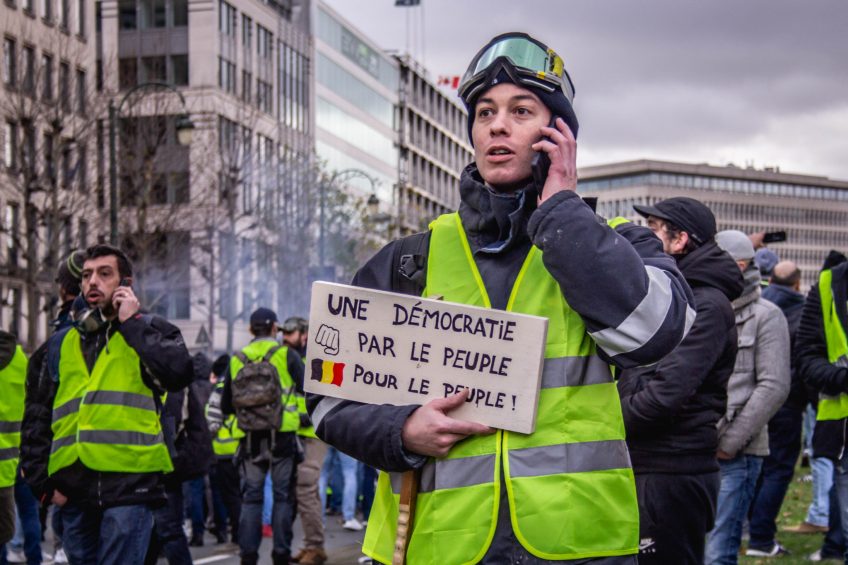
French union workers from the General Confederation of Labour (CGT) voted Monday to halt production at a key oil facility that supplies Paris and the surrounding region, joining other petroleum industry shutdowns in a nationwide strike against Emmanuel Macron’s pension reforms.
“The decision has been taken to halt Grandpuits but with a slight majority. The management has asked for an hour of reflection,” a CGT union official said. Protests began on Dec. 5, when more than 1.5 million citizens joined the demonstrations.
Grandpuits was already producing at minimum capacity before the union vote due to the strike, which is blocking deliveries from the refinery, oil company Total said. While the French Association of Petroleum Industry (UFIP) said only about two percent of France’s 11,000 petrol stations had run dry.
Other oil industry shutdowns have already taken place and are planned for the near future. PetroIneos’ 210,000 barrels-per-day Lavera oil refinery halted production on Sunday after a similar vote from the CGT union workers.
While at the CIM oil terminal in northern France, which handles about 40 percent of French crude oil imports, CGT members decided to stay on strike but held off shutting down operations which would have cut deliveries of crude to refineries and jet fuel to airports.
Despite Macron’s request, the CGT, which has been at the forefront of the industrial strike against the government, has said there will be no Christmas truce. Prime Minister Edouard Philippe’s office said it would restart talks with unions on pension reform on Jan. 7.
Other sectors have also been at the forefront of the protests such as the railroad industry which over the past two weeks have halted services across the country. On Monday hundreds of striking French rail workers clashed with riot police in Paris after holding a demonstration.
The strike, which has disrupted Christmas eve travelers, has also affected other main Paris stations such as the Gare du Nord, which handles Eurostar services to London and Brussels, and the Gare de l’Est.
Unions have announced more demonstrations for Jan. 9 against the reforms.
The CGT, the Workers’ Force, the French Confederation of Management and General Confederation of Executives (CFE-CFC), Solidaires, and the United Trade-Union Federation (FSU) demand the withdrawal of the pension reform project.
The protests come amid the government’s attempts to unify the French pension into a single universal system, effectively removing 42 “special” regimes for sectors ranging from rail and energy workers to lawyers. A measure Macron’s administration argues is “crucial” to keep the system financially viable as the population ages.
Although the CGT has expressed willingness to negotiate the universal pension system, almost all Unions reject any age-related changes. A key reform would be to raise the retirement age from 62 to 64 years in 2027 to receive a full pension.
Before I list the (often unnoticed, misunderstood or covered-up) chronological facts of France’s incredible Yellow Vest year, allow me to briefly summarize it with a personal anecdote:
In mid-April I finally was able to get out of Paris for a few days in between Saturdays and I headed to the countryside, which I adore (in any nation). After a day of decompression something hit me: the metronomic sadism of certain, massive state violence every weekend was not at all a normal state of affairs… and yet Parisians were expending all their psychic energy to convince themselves that everything was indeed “normal”.
What was “everything” from January to mid-April? Every Saturday: Eight thousand cops on the streets of Paris, entire city areas shut down, guaranteed images of violence against unarmed protesters, indiscriminate tear gassings and police brutality, the world aghast at French-style democracy, the knowledge that no way was “President Jupiter” Emmanuel Macron going to make any concessions and that for many people (like me) every Saturday meant certainly risking limb and quite possibly life.
What I realized was that during the first third of the year Parisians did their typical best to be blasé; to act as if all this was quite nothing new whatsoever; to act like getting upset over it was quite poor taste; to act typically Parisian.
That, of course, was total nonsense – pure poseur.
So what I mostly remember is how during this period was that the collective cognitive dissonance in Paris was so immense that it reached a generalized psychosis caused by mass denial.
I also realized that this denial of reality and subsequent psychosis can only be found in imperialist countries. “Our treatment of the aboriginals/those with whom we are living alongside and whom we colonized/non-Whites… is totally normal,” they insist, as they live under a shroud of silence and feigned “normality”. The unsaid reality remains unsaid by both colonized and colonizer (under penalty of social exclusion, jail, death), and the psychosis just mounts and mounts and mounts.
It is normal that this imperialist psychosis occurs in the European Union in 2019, as it is indeed a neo-imperialist project. The question the French cannot quite answer is: are they the still the colonizer, or are they now colonized?
But such questions are all of no importance to the politically regressive. Nothing to see here, even by the French who watch the nightly news – we cannot question “French exceptionalism”.
What do I know about the Yellow Vests? I contend that no “mainstream” journalist attended more Yellow Vest demonstrations than I did, at least in Paris. I would also suggest that while I did hundreds of live interviews from the demonstrations – while getting tear gassed, with rubber bullets flying around, literally in between Black Bloc and police – most journalists did zero.
This article was generated by me going back through my list of reports with Press TV in 2019 – it’s mostly headlines, quotes (mostly from interviews with Yellow Vests) and short excerpts from my reports. I pass on the highlights, and I also tie together the threads with the advantage hindsight – check the key date of March 16th to see what I mean.
If you are too busy to read it all, I suggest only reading March through May 1 – this is when the Yellow Vest demonstration was gutted via reactionary values which we can call “neo-Vichy”, with Brussels replacing Berlin as the master of France’s government.
I didn’t bother to provide a web link to the roughly 175 2-3 minute reports I made with Press TV in 2019, but I did include web links to a score of in-depth written reports I did specifically about the Vesters.
It was not at all an easy year, and I recall being quite exhausted by the summer. It wasn’t just the obvious stress caused by walking into a “near war zone” every Saturday – why on earth did the Vesters insist on marching 10-15 kilometers every Saturday? And so fast, too!
But, as they have shown, their endurance and determination is beyond remarkable. I’m glad the facts are on the record in one place, if only as an expression of admiration for them.
France Year in Review: The rise and rise of the Yellow Vests into a General Strike
2019 in France obviously has to be remembered as the year of the Yellow Vest rebellion.
It began in November 2018, and President Emmanuel Macron thought he had pacified it in December with a pittance of so-called “concessions”, but the rebellion continued.
Why, because as I wrote back then: “It’s just one protest… which has lasted 8 years”. They want you to view the Yellow Vests in isolation instead of as a historical continuum.
In early December every single person I asked agreed that they are a Yellow Vest. Biased, misleading and above all a lack of polling would attempt to hide the Yellow Vests amazing popularity the entire year. By September I was explaining Why France’s 20- and 30-somethings hate the Yellow Vests (foolishly, of course). However, no poll ever showed the Yellow Vests with an approval rating lower than 49%, and they are generally around 60% – this makes them by far the most popular political movement in France, even if not everyone joins their club. And above all: that is a simply enormous score for any protest movement, anywhere.
Many assumed the Vesters would stop protesting over Christmas because that’s what every political/social/union/labor movement had done for decades, no matter how much political momentum they had. Not the Vesters. Right then I knew that this was serious – they had different priorities.
By January it became clear that the French government was going to treat political protesters like football hooligans.
Jan 2 – Start by arresting their leaders for eating dinner
On December 20, 2019, the justice department would admit that France’s top police hierarchy were wrong to order the “disguised arrests” of key Yellow Vest leader Eric Drouet along with 42 others back on January 2nd. They were eating in a restaurant.
A “disguised arrest” is a euphemism for an arrest ordered by the Deep State: one is arrested without any true justification or reason, but simply because security agents have been ordered to do so.
Drouet immediately denied being a “leader”, because organisationally the Yellow Vests are indeed a grassroots, leaderless, “Latin anarchy-style” protest movement and not a political party. I eventually began referring to Drouet and others as “organisers”. Drouet does admit to eating nearly three times a day.
A column I wrote that week pointed out that, like the Vietcong, the Yellow Vests absolutely will not have the early demise which the Mainstream Media hopes for… because they have nowhere to go.
Jan 5 – Vesters surprisingly march after New Year’s Day
Brutal scenes as French cops refuse to let Vesters protest in front of Parliament, even though they had a permit to do so.
That is explanation for essentially all the conflicts between cops and protesters in 2019: protesters get trapped, in violation of their human right to demonstrate, hyper-armed cops use their weapons, protesters respond in a civic rage and in self-defense.
Turnout was down overall, but again, the fact that anything was organised at all was a huge, huge break with vacation-loving French culture. Of course, the media searches for any reason to insist that the Yellow Vest movement is abating, and they do so here.
Jan 12 – ‘Battle of Turnout Figures’ as France returns from vacation
The government claimed only 50,000 protesters marched, but the true figure was closer to 300,000.
Firstly, why are these numbers important? As a cop told me: this is a country of nearly 70 million people, so cops are never going to stand down unless there are 10 or 20 million people in the streets. He’s right. The people who foolishly think the cops are going to see the political light and “switch sides”, and also the people who think the Yellow Vests are just a hair’s breadth from getting Macron to resign, should re-read that.
A secondary point here is how very special and vanguard the Yellow Vests truly are for getting out on the streets: France was not anywhere close to a revolution which overcame their neo-imperial security state, but there sure were a large amount of people who were willing to try.
So numbers do matter, and that’s why the MSM’s parroting of an absurd official line (from their cozy newsroom) is so galling.
However, we should still accept that cops can actually be not reactionary. The poorly named “Union of Angry French Cops”, France’s third-largest cop union, consistently defied the Interior Ministry to give their own tally, mainly because the ministry was just outrageously low. The “Yellow Number” also made its 2nd appearance at this demo, and you can find all 3 of these crowd estimations here – the odd one out is the Interior Ministry.
The union believes the divergence is due to the fact that rural villages are constantly ignored by the government and media. The union has members actually stationed at places like rural roundabouts all day: they count the number of different people who arrive at a demonstration, and then leave, only to be replaced by new protesters.
It should be easy to see why the ministry’s figures are so absurd: why would the government routinely mobilise 80,000 policemen for what they are claimed from Valentine’s Day onwards was less than 47,000 protesters? (See January 27 note.)
Back then I couldn’t help but see the Yellow Vests as the harbinger of the bursting of the West’s “Everything Bubble” which Quantitative Easing has created. Who would have predicted that “QE Infinity” would be unveiled in September?
Jan 19 – Calm day in Paris for Act 10
It’s important to remember they weren’t all days of pitched war, but a lot certainly were until late March. Act 10 was mostly peaceful in Paris, but not elsewhere. Death toll at this point – 10 people.
Protests increase again. It has become clear the Yellow Vests are not going away, so the MSM grapples with trying to describe their class-based demands without violating their blacklist of the word “class”.
I laid it all out here: The Yellow Vests are calling for the world’s third Cultural Revolution, after China and Iran.
It’s not bias or exaggeration: They want to halt the functioning of normal society to have a serious, long, fruitful discussion about France’s role in the euro, the EU, NATO, Françafrique, the 5th Republic itself, austerity policies, foreign policy, environmental policies, housing, education, health care, pensions, etc. That link is Part 8 of an 8-part series I wrote this year to demystify the two state-sponsored Cultural Revolutions simply because the parallels between them and the Yellow Vests were so obvious.
Yellow Vests sure didn’t have state sponsorship, though. However, they did have a 60% approval rating at this time.
Jan 26 – French cops equipped with body cameras for first time
Absolutely nothing has come of this early demand aimed at reducing police brutality.
By the end of 2019 France has prosecuted just two cops for police brutality against the Yellow Vests. So how can we even know what has been recorded, when the cameras were even turned on, that is?
Jan 27 – Reactionary ‘Red Scarves’ demand Yellow Vests stop bothering the establishment
Finally, a demonstration which France’s media feels safe enough to cover!
The one and only such demonstration of this pathetic group. However, never has such a short-lived social movement received such fawning and massive political coverage. Where are the Red Scarves now – nowhere? Or rather: about to annoy the hell out of their family at Christmas.
Just prior to the movement a minister said that if 10,000 people showed up, then that would constitute a success and be a signal that the Yellow Vests have to stop: the Interior Ministry claimed 10,500 people showed up.
Many in the media would never once question the ministry’s figures on the Yellow Vest turnout despite their obvious self-interest to keep the numbers low, yet reported 10,500 despite the real-time indication over an inaccuracy which was widely obvious.
Feb 5 – Yellow Vests and unions march together for first time
Initially, a union member carrying his union insignia was as unwelcome as member of Macron’s political party. The Yellow Vests’ popularity and respect is largely based on their open rejection for not just mainstream politics and the traditional modes of French political culture, but also France’s idea that unions should lead socioeconomic protests. The Western “independent” union model, is perfectly calibrated to be “divided and conquered”, which has been the case in France since 2010, certainly; when unions “win”, the theory is that everyone else should just hope that their gains “trickle down” to the 90% of French workers who aren’t unionised.
This was the first time Vesters tolerated unions to march on the same city streets as them – the unity would be quite short-lived. I don’t blame them. In September 2019 I interviewed the head of a top farmer’s union: I gave her every chance to defend, even just mildly, the Yellow Vests, but she insisted that farmers had nothing in common with rioters.
This is exactly what a Yellow Vest told me that day: “The average union worker supports theYellow Vests, but not the union leaders, who have repeatedly betrayed us. The unions must finally end their selfishness, because everyone is against this government.”
Is it a rural-based movement, as is often said?
The only who people who say that are those who don’t understand/can’t admit that class is the single most dominant political lens.
Like all true revolutions, the nation’s “trash” had become the true political vanguard.
Feb 6 – France passes ‘anti-Yellow Vest law’ amid mass protests
The law allows police chiefs, known as prefects, to ban citizens from attending protests, a power which was previously reserved for judges. The law also gives police greater power to search citizens without warrants, and imposes fines and prison terms for any protester covering their face to avoid identification, or even of using a scarf to to avoid tear gas.
I recall earning some plaudits on the Champs-Elysées around this time. It was cold, and French riot cops were all covering their face to stay warm. I loudly told a cop that if he can cover his face against the law, then I should be able to wear my burqa, LOL. Easy for me to talk back in anger – I’m a journalist: the French protesters who did the same usually found themselves wrestled to the ground and arrested, with the wife screaming, “He didn’t do anything!” behind him.
This is another shift of power towards the executive branch and away from the judiciary and legislative branches, and especially the electorate. This process greatly accelerated under Francois Hollande with the 2-year state of emergency, the so-called “French Patriot Act”, and the repeated use of forcing through unpopular austerity-related laws by executive order. Macron would use executive orders even though he has an absolute majority in Parliament – he just wanted to avoided the bad press of open debate.
Feb 21 – Macron’s ‘Deep State’ scandal deepens with perjury charges
The Benalla affair – nobody knows about it outside of France but it’s Macron’s biggest one.
I would contend that a large reason it is not known outside of France because the constant implication is that Macron and Alexandre Benalla had a homosexual affair, or that Benalla helped cover up such an affair as Macron’s personal – and extremely law-breaking – bodyguard. The 24-year age difference between Macron and his wife helps fuel these rumours.
Regardless of these rumours, these charges came from an exasperated Parliament committee which concluded that Macron showed Benalla an “incomprehensible indulgence”. This “indulgence” was so extreme that nobody can possibly explain why a president would take such risks to protect such a person? It remains baffling.
Anyway, the problem is transparency/independence from blackmail/corruption. A Yellow Vest that week put things into perspective: “Look at the Benalla affair: there is overwhelming proof that President Emmanuel Macron’s right-hand man committed many crimes, yet he remains free, while Yellow Vests stay in jail! It is clear that there is major discrimination in the justice system by France against its very own citizens – some people have special privileges, but the Yellow Vests do not.”
Benalla served one week in jail, but only because he broke his bail – the average prison sentence for a Yellow Vest has been one year.
Feb 22 – Macron to outlaw anti-Zionism, sparking disbelief & outrage
“I’m not gay, but the Yellow Vests are anti-Semitic.” That’s not what Macron said openly of course, but the timeline worked that way.
The proposition was an attempt to slur the Yellow Vests, and to create a long-running distraction.
The resolution – not a law, but one step short of it – would be passed in December. What I found interesting was the huge amount of media coverage on it in December… after, not before, it was passed. I covered it before: it was mostly French Jews fighting against it, because it obviously unjustly makes all Jews responsible for the crimes of Israel. I’ve seen studies that half of European Jews are anti-Zionist. Of course, confusing anti-Semitism with the political, colonialist, segregationist project of Zionism is something nobody involved in politics should be dumb enough to confuse, but Macron did.
At the February 16th Yellow Vest march far-right ideologue Alain Finkielkraut was not welcomed, and called a “dirty Zionist”. This created much media uproar, despite the latter being 100% accurate. The Yellow Vests marched against anti-Semitism on February 19.
Combined with the looming Benalla scandal, anti-Semitism was a very useful distraction for Macron at the time. It was undoubtedly instrumentalised by France’s extremely powerful pro-Zionist lobby.
It gave me a chance to dust off a term I created during the Charlie Hebdo protests: 21st century France as a new “Holy Secular Empire”.
Feb 27 – Council of Europe urges France to stop rubber bullet use
Does anyone care about the Council of Europe, or any pan-European institution, really? Of course not, but it was notable that any major organisation condemned France back then.
For example, Human Rights Watch issued just a single condemnation of French police brutality in 2019 – against ecological protesters, not the Yellow Vests. Reports on Venezuela, Hong Kong, Syria – their reports are innumerable and their hypocrisy crystal-clear.
Five hundred critical injuries at this point; unions and France’s Human Rights League estimated that 10,000 rubber bullets had been fired at Yellow Vests. Most journalists in France still euphemistically calling rubber bullets “flash balls” or, even worse, “defense ball launchers”, which obviously assumes that the protester is always the aggressor.
Mar 6 – UN: ‘full investigation’ of brutality against Yellow Vests
The UN Human Rights chief properly recognised that, “The Yellow Vests have been protesting what they see as exclusion from economic rights and participation in public affairs.”
France totally ignored this, of course. The prime minister said the UN chief lacked the “full picture”, but he obviously summed up the heart of the matter.
However, ignoring condemnations of their police is what France does – French police have been condemned for police brutality over and over by the UN and top NGOs for many years.
During the labor code rollback protests in 2016 at least 4,000 protesters were arrested, with well over 1,000 people hurt by police in Paris alone, according to Amnesty International. Extrapolate those numbers nationwide. I covered all those demonstrations too – it’s why I always said that I perceived that the Yellow Vests were only 15-20% more violent than France’s “normal” violent demonstrations. Only the Yellow Vests ever graffiti-tagged the Arc de Triomphe, sure, but that was just a huge propaganda victory for the Vesters.
Mar 8 – Paris forbids Yellow Vest camp
Why wasn’t there a “French Tahrir Square”?
The Yellow Vests tried – cops weren’t even close to allowing a single sleeping bag get laid on the ground. They would have needed many thousands to establish a camp and I recall only 1-2,000 people being there.
It was a cold night back then. Would have still had to have beat back typical French police brutality, too.
Mar 12 – ‘Anti-Yellow Vest’ law adopted
Officially known as the “anti-rioters” law. This provided the “legal” basis for the oppression which would stem the tide (not turn it) of the Yellow Vests…. We got a couple good quotes from journalist/analyst George Kazolias explaining the law:
“But what really makes this law really dangerous, as one conservative member of Parliament put it last year, is that it’s a Vichy law, referring to the government that ruled France under Nazi occupation in World War II. This law gives administrative personnel judicial powers – it takes the power away from the judiciary. … So what he (Macron) has done now is to make at a local level what he has done at the national level with (unpopular laws which normalised) the state of emergency. I’m surprised not more people have tried to relate the two?”
And, now that massive repression had a new “legal” basis, the upcoming Yellow Vest march would be incredibly repressive and mark the beginning of the end of their long peak. But the day before that…
Mar 15 – Macron’s National Debate ends with universal dissatisfaction
The National Debate was 2.5 months of 10,000 local public debates. It was mainly a public relations effort by Macron to show that he is a president who does listen and who does incorporate public opinion into public policy… even though that is obviously false.
However, much of his time at these town hall meetings was Macron talking for hours and hours, like Fidel Castro. There are big differences between the two: Macron is pushing capitalism, imperialism and technocratism – Fidel pushed rejecting brutal capitalism, patriotism and morality in public policy.
At this point in his term Macron (begun May 2017) has never held a press conference. That is not a typo.
Perhaps this explains why it was “The Macron Show” for six hours a day on mainstream media. The sudden availability of Macron to the masses and journalists was a total 180 from the previous 22 months.
Rather amusingly (unless you are a minority Macronista) a key poll asked what people found positive to say about Macron regarding his method and style at the National Debate: the number one answer, at 48%, was “I didn’t find anything positive about Macron”. That was nearly double the second-most popular response.
So the National Debate had concluded, the laws were in place – the kid gloves came off. We knew it was coming – column here.
Mar 16 – Worst violence in months amid near-secret de-nationalisation machinations
This is when “Sarkozy’s restaurant” Le Fouquet’s was ransacked. (A quintessentially French place… yet they use a possessive apostrophe?)
I remember I got there early – it was already a war zone.
This is because before the demonstration could even start riot police used tear gas and water cannons to provoke the violence which would be required to justify the police tactic changes later this week.
Black Bloc was there, being useless as usual – I recall a protester at the Arc de Triomphe screaming at me, “Why don’t the cops do anything to stop Black Bloc?!” I debunked Black Bloc in a recent article: French Black Bloc’s utter uselessness… except to the French government. I repeatedly saw Yellow Vests intervene to stop looting on the Champs-Elysées; cops were filmed stealing football jerseys from the Paris Saint-Germain team shop.
A good quote from a Vester that day: “Just like at the beginning of the movement, it was the same old tactic from our government. They want the protest to degenerate as quickly as possible in order to discredit the movement. They launch round after round of tear gas, to the point where people are stepping on protesters who have fallen down! They want to scare us into staying at home, but we will never stop protesting!”
Interesting note I have in my report: “Despite 18 consecutive weekends of protests by the Yellow Vests, France’s unions have taken to the streets only rarely this year.” It’s key to remember how independent and isolated the Yellow Vests were – they fought time after time all on their own: they really are like a family.
Shockingly, Macron chose this weekend to go skiing – the photos appall the nation. On seemingly every major day of protest during his term I have noticed that Macron is never in Paris, and often out of the country. Of course, since the Yellow Vests the big establishment fear is that they will reach Elysée Palace near the Champs-Elysées. However, as I am a fellow 41-year old man… he rather acts like a scared old man.
Macron is celebrating because he has given the incredibly anti-democratic orders which will mark the beginning of the “end” of the Yellow Vests – more such orders arrive in days.
However, one final kick in the teeth: At 6:15 in the morning on Saturday March 16th Macron surprisingly called for a Parliamentary vote regarding the biggest wave of privatisation in 15 years. Only 45 of nearly 600 deputies were present, and the bill was approved. Widespread media explanation would later be required to explain why the vote was still legally-binding despite such low parliamentarian turnout. You think I’m making this up don’t you, LOL, but this is the actual chronology.
It would take a couple weeks before this de-nationalisation became a media issue. Think there weren’t monetary reasons for Macron to sic the armed forces on the Yellow Vests to begin with? De-nationalisations to benefit his friends and backers of his meteoric rise put yet another monetary motive at play.
The Yellow Vests would successfully prevent the airports of Paris from being privatised (at least so far), but Macron would sell off more than 50% of the national lottery in November. I didn’t get it: neoliberals say that any state business which doesn’t make profits must be privatised… yet the highly lucrative state gambling monopoly has to be sold off, too? It’s almost as if neoliberals rely on faith instead of facts, logic and history….
Here’s a live interview I did at the Parisian bank which was firebombed – surely the only live interview from there that day, and probably the only “mainstream” media interview which gave an objective explanation of why it happened.
Article I wrote about the March 16 protests. I started with: “Because if Saturday March 16 was a ‘war zone’, then France has been at war since 2010 – I didn’t see a single thing out of the norm for France.” Doctors and nurses treating the wounded disagreed with me over and over – they said the injuries were what they had seen in war. I never said journalists were always right….
Mar 23 – French army doesn’t deter massive Yellow Vest protests
For the first time since the Algerian War for Independence the army was used inside France against the French people. Just prior to Act 19 a French general reported on live radio that he had authorisation to open fire on protesters.
Furthermore, on March 18 the Paris police chief was fired. Part of the reason was given by Prime Minister Philippe: “Inappropriate orders were given to reduce the use of LBD [rubber bullet launchers].” Imagine if Putin had said that?
The new chief looks, and certainly acts, like he would have been quite at home in Vichy France, which is precisely why he was hired. His uniform always appears to be a couple sizes too big for him.
Protests were now officially banned in key parts of urban areas, like the Champs-Elysées. Bans in rural roundabouts would begin in early May (but I thought this was a rural-based, not class-based movement?).
Should we be surprised that Yellow Vest numbers are about to plummet?
In January there were an average of 350,000 protesters per weekend; February 240,000; after March 23rd they reached 100,000 people maybe twice and then never again.
If you are a clueless, secretly-reactionary/fake-leftist Mainstream Media journalist this is what you think in your empty head: “Oh, the numbers have only fallen because the Yellow Vests aren’t popular anymore. Yes, I will accept that promotion, thank you boss!”
So March 12-23 should be remembered as when France became a “neo-Vichy” government. Instead of Berlin, the master is Brussels.
They didn’t destroy the Yellow Vest movement, but they did scare the hell out of the average person.
Mar 28 – French cops wearing Yellow Vests to infiltrate movement
It was discovered that on March 16 cops were wearing Yellow Vests to disguise themselves.
The police union noted that there is no formal law against disguising themselves as protesters, so that should settle the matter
Good Vester quote: “We don’t know if we should fear our own government, or if we can trust it? Such video revelations are going to increase the accusations that the government is pulling the strings with secret militias inside political demonstrations. That sounds like a conspiracy, but these videos give such ideas obvious legitimacy.”
March 30 – Mayor demands city become a “ghost town”
Mayor of Bordeaux commanded citizens to not leave their homes that Yellow Vest day. The phrase “Bordeaux strong”, unlike in Boston, did not become commercially popular.
Again, Mr. and Ms. MSM Journalist – might this explain the drop in attendance? And perhaps also the unveiling of harsher tear gas, guaranteed fines for violating the ban, warrantless searches (Do the women you date even let you go through their purse?), increased arrests, the refusal to engage with Black Bloc despite the vast superiority of the professional armed forces, and on and on? This is why I didn’t get very far in the French newsrooms I worked at….
Similarly, the Yellow Vests insisted on their right to freedom of assembly and defied the bans.
Why? Let’s ask a Vester: “I worked from the age of 14 until the age of 60, and in my entire life I accepted only 1 month of unemployment insurance. And yet, in the last 4 years I have seen my pensioned lowered from 1,150 euros to 1,050 euros. My rent is 800 euros a month, so I cannot afford to live, and I will never accept this injustice.”
Several ministers resign this week, but this is hardly newsworthy with Macron.
April 4 – NGO says 3,000 homeless died in France in 2018
Macron made zero deaths due to homelessness a key campaign promise.
April 6 – Last time anyone counted over 100,000 people at a Yellow Vest demo
Thus, this article is going to start getting shorter. Yellow Vests popularity stands at 53%.
Half the country supports them, but from behind their curtains now.
April 10 – Massive rejection of Macron’s ‘National Debate’ results
The government declared that the main conclusion of the debates is that taxes should be lowered, which is what every peasant under French rule always said.
Reversing Macron’s elimination of the very popular “Wealth Tax” will not be discussed as a possible result, nor is deviating from nine years of austerity budgets: the Yellow Vests continued marching would reverse one of these.
Polls show that just 6% of France called the National Debate a success while 80% said it will not resolve the current political crisis.
April 15 – Notre Dame ravaged by fire, world mourns
In an amazing coincidence, the fire started just an hour before Macron was to reveal his personal conclusions of the 2.5 month so-called “National Debate”.
This was rather a cherry on top of a terribly bitter social sundae which had been forced down France’s gullet thus far in 2019.
Considering how catastrophic it looked on TV, I truly thought it looked pretty good when I saw it the next day.
April 20 – Constant cop violence as Yellow Vests begin 6th month
Key anniversary = higher turnout = more repression. Worst violence in weeks.
Me impersonating an MSM journalist: “Don’t you think that because of the fire at Notre Dame you should stop marching in order to promote national unity (even though this is a “secular” country)?”
French Yellow Vest quote: “The fire at Notre Dame touched everybody, but there is a big controversy over how we could raise a billion euros for a church so quickly, and why we can’t raise such an amount for poor people. There is a lot of anger, and a fire at Notre Dame is not going to change this logical reality.”
The last time the Yellow Vests touched 100,000 protesters, but only by rounding up.
April 24 – Record suicide pace for cops amid Yellow Vest demos
April 25 – Journalists help Macron ignore Yellow Vests at 1st presser
Incredibly, Macron has finally held his very first press conference.
Prior to that he and I had held the same number of press conferences since May 2017. Key difference: I am not the popularly elected president of a country. I am, however, the authoritarian and arrogant leader of “Raminia”.
Incredibly, and we can add another “incredibly” on top of the first “incredibly”: this is when Macron said the words “Yellow Vests” in public for the first time.
Less incredibly, considering the toadying, social-climbing French media class, the mainstream journalists permitted to attend the press conference (Iranian media is banned from official press conferences of the president, PM, FM, etc.) dared to ask Macron just one direct question about the Yellow Vests. The question was posed by the extremely mainstream anchorwoman Laurence Ferrari, and kudos to her: every other journalist failed.
Here was Macron’s initially nihilistic answer, via an explanation which is totally acceptable in Anglophone countries, which are also politically nihilistic; he then switches to total defiance based on technocratism: “We are a country where disagreements are expressed forcefully and where there are always protests. I totally take responsibility for having not given way – during my first two years – to those who want to set back our projects which I deeply believe are good for the country.”
Two subjects which were never mentioned by anyone were the routine police brutality, nor Macron’s raft of anti-democratic measures such as the “anti-Yellow Vest Law”.
Polls showed that 65% of France said they were unconvinced by Macron’s answers. Nearly 80% said he did not address the concerns of the Yellow Vests.
Despite a record-low approval rating of just 27%, Macron said he thinks it “would be best” to stand for re-election. No serious policy changes were announced, because the conclusion that Macron drew from the National Debate was, “Our approach over the past 2 years has been right.”
Ugh… I’m glad I’m banned from there.
May 1 – Record cop violence at huge Paris May Day demo
This was a rough one… it was certainly no celebration of International Workers’ Day.
Never saw so many cops – every 50 meters there was a phalanx of cops along the marching route. People who think Western, liberal democratic, aristocratic (bourgeois) governments don’t fear socialism – explain the measures taken on May 1, 2019?
Long story short: in order to prevent a unified demo at the end the cops used the classic tactic of “divide and conquer”. They repeatedly severed the march, allowing one part to advance to the end (where they were gassed and chased out), while cops fought pitched battles with the section that was kettled and prevented from marching freely. After several rounds of this the streets were a shambles – protesters, unarmed of course, needed to find something to protect themselves with.
This produced the MSM hoax of an alleged “hospital invasion”, which I debunked thoroughly here. Briefly: that day MSM and politicians got apoplectic that protesters – cornered by cops using tear gas, water cannons, batons and rubber bullets – tried to take refuge in a hospital. What those armchair idiots and “hotel room journalists” don’t know is that when tear gassed one moves (don’t run!) in one direction: away from the gas. The only direction left to protesters was jumping a hospital gate.
Mainstream idiots everywhere said protesters were “invading” the hospital. It took a couple days for the truth to come out – only two old, apologetic men actually made it inside the hospital, saying they had been “tear gassed all day”. The internet reactionaries who vengefully and gleefully insist that “Yellow Vests are rioters and they get what they deserve”… they really have no idea what they are talking about.
What I remember from that day is: I’m trying to give a live interview in front of the hospital – amid all the “flash balls”, flying pieces of pavement and tear gas – and the newsroom in Tehran is insisting that I remain motionless in order to “set the frame”. “How on earth are me and my cameraman supposed to stay motionless and not wind up seriously hurt! Just put me on the damn air!!!” Aggravating…
I recall only one other journalist doing a live interview during all that violence – a female journalist for Italian TV, as I recall. Kudos to her. French media? Fuggetaboutit. French public media, who are paid by French taxes? Fuggetaboutit. I’m sure RT was there, but I didn’t see them. I bet they were wearing a helmet, though – I never did once. LOL, a bit of leniency for my egotistical behavior, please: I had been “tear gassed all day”.
On December 19th the first police officer would finally be convicted for police brutality – he was filmed throwing a piece of pavement into a crowd of protesters on May 1st. Apparently his rubber bullets, tear gas, water cannon and truncheon wasn’t enough? He got a minor sentence, no prison time, his identity was not divulged, nor will the conviction even appear on his legal record.
That was the last rough one… for a while, at least. Not sure that’s a good thing.
May 5 – France bans Ramadan, citing secularism & economic stagnation
I never did write that satire… don’t know why? Would’ve been funny. Probably tired – Ramadan had just started, after all, and I had been tear gassed all year. Maybe for 2020.
Just checking to see if you are still reading!
May 8 – France began killing 45,000 Algerians on WWII V-Day
Oh, MSM journalists, where you marking the defeat of European fascism in World War II that day? Why?
France also bombed Damascus that May. Syrians booted the French out that year, thankfully.
May 9 – First major Yellow Vests victory – no to de-nationalising Paris airports
This week the Yellow Vests scored their biggest victory yet, by forcing parliamentarians to accept a referendum on Macron’s attempt to denationalise the airports of Paris.
A column here about stopping the Yellow Vests stopping of denationalisation, and why you never hear that word.
Last week I paid 9 euros to travel for about 15 minutes of travel on a privatised French highway – this is why Yellow Vests demolish tollbooths. Aren’t air tickets costly enough already?
May 11 – France bans rural protests for Yellow Vest #26
Many French media gleefully speculated that the Yellow Vest movement was finished, but 60,000 protesters turned out yet again, despite the government’s efforts to intimidate people in both urban and rural areas.
May 15 – 72196 – Macron at 2 years: 76% policy rejection
A recent poll covered 14 vital questions and sectors, ranging from economics to immigration to security and more. Respondents gave Macron a whopping 76% failure rate on society’s most important questions.
So 24% of respondents support Macron, which was his exact score in the first round of the 2017 presidential elections.
This 24% was also his true score in his victorious second round, due to the highest abstention in 40 years, and the fact that 43% of voters only voted for Macron to block the far-right’s Marine Le Pen. He only won a majority in 2 of France’s 101 departments, after all.
But Macron and his supporters have always manipulated this to claim that he has a “mandate” for his program, especially the pension junking. Yawn… stupidity is boring, but especially when repeated.
May 25 – Mass arrests as Yellow Vest demos go ‘wildcat’
Vesters had been applying for permits… and getting massively repressed. So they went “wildcat”… and got massively repressed.
Yellow Vester says “Ya Hossein!”: “We will continue no matter what the results of the (upcoming EU) vote are. There are too many people who have been hurt, blinded, and killed, and we must think of them. All we have ever asked for is not to keep starving at the end of every month, and to protect our children’s future.”
May 27 – Another loss for Macron as far-right wins EU elections again
We really should care about the EU elections… or focus on a Frexit.
The three Yellow Vest lists combined for less than 1%. Hey, it took Italy’s 5-Star Movement eight years to win power.
Incredibly, the animal rights party scored 2.2% of the vote. The only solution for such people is immediate deportation to India, preferably under a cloud of tear gas.
June 22 – Scores of Yellow Vests blockades on Act 32
The Yellow Vests realised that the French government doesn’t respond to peaceful protests with anything but repression. That’s why this week has marked a change in tactics: blockades which can affect the economy, like at ports, refineries and toll booths. Scores of blockades were reported around the country, but received scant media attention.
If a blockade falls in the woods and no one hears it, does it make a sound? (Uhhh, yeah, it’s called science: sound waves.)
By this point in the year the French media had effectively enforced a blackout on the Yellow Vests, and the Vesters knew it and were incredibly upset about it.
From June 1 until well into autumn only Iranian media reporters (in English & French (me), Spanish and Farsi) and Russian reporters were doing anything at all about the Yellow Vests. People began to question why I had to work on Saturday: “I thought the Yellow Vests are over,” they asked?
France’s media and artistic communities are increasingly being called out with disdain by Yellow Vests. The nation’s private media follows a pro-corporate, pro-austerity line, and the state media either doesn’t cover the protests or simply parrots the government’s statements without challenge. After seven months very few from France’s intellectual circles have dared to publicly defend the Yellow Vests or condemned the government’s repression, and seemingly none have personally joined the protests.
Yellow Vest quote: “So many of these types have been bought off by Macron and are happy to stay in his pocket. Pensioners, the jobless and public workers have been marching for seven months and our so-called intellectuals spit on us! We are getting beaten and gassed, and they criticise us!”
June 24 – French polling agencies ignoring Yellow Vests
Modern media runs a lot of stories based around polls but the latest poll, which gave Yellow Vests a 50% approval rating, dates from two months ago.
More than half the country believes the media has done a bad job covering the Yellow Vests, but that poll is from 3.5 months ago.
Just as there is a revolving door between Western finance ministries and the biggest private banks, there is also a revolving door between the top level of French politics and its polling agencies. Francois Hollande’s former spokesperson, Najat Vallaud-Belkacem, is now a top polling agency executive, for example.
This is a problem for governance of any ideology. The Chinese Communist Party is often called “the world’s biggest polling agency” for good reason, whereas in France their leaders believe public opinion matters once every five years.
Column here about the incredibly uncool, constant MSM claim that rock and roll is dying the Yellow Vests are dying.
Another column here which compared the West’s beloved Hong Kong protests – who are so nativist they make Marine Le Pen look like a cultural centrist – with the far, far greater violence in France.
July 3 – French ‘cyber hate’ bill targets Yellow Vests & Palestinians
July 14 – Champs-Elysées a war zone again on Bastille Day
First time the Yellow Vests protested on the Champs since March 16th.
It required a couple hours of trying to lose the cops until the Vesters finally snuck in and won the field. My producer faulted me for doing a live interview with no Yellow Vests around – uhhh, they were outrunning cops on motorcycles, they can outrun me and a cameraman.
Yellow Vest quote: “Tourists are getting tear gassed and witnessing major violence, when they are only here out of curiosity. Some people are led to believe that only bad people get tear gassed, but these tourists now know better. If the tourists had stayed a bit longer they would have been beaten, as well.”
Bastille Day… I mean, what the heck – y’all lost! Bastille Day celebrates the temporary victory of the French Revolution in 1789. In 1804 Napoleon declared himself emperor, and the house of Bourbon was firmly restored in 1815. Does anyone else’s national holiday celebrate a loss? No wonder the French are so depressed. Or at least get out there and feel bad about it in a united way, like Shia with Karbala. Bringing this up this French exceptionalism is another reason I didn’t get far in French newsrooms….
July 17 – Macron’s #2 forced out over corruption charges
On the taxpayers’ dime the minster, who only looked up to the prime minister, was having lavish dinners with jumbo lobsters and 1,000-euro bottles of wine, bought a gold-leaf hairdryer, had a 3rd chauffeur to take his kids to school, and government-subsidised housing despite a high salary.
He tried to blame his wife, a nonsense socialite journalist (thus the gold-leaf hairdryer, I assumed), and never repented – he had gotten that high up by constantly clamouring against government corruption, so it would be like saying his whole career was a lie (which it was). I recall a top France24 anchorman writing on Twitter how Lobstergate was merely “mostly about the optics”. The top mainstreamers all see things the same way, which is: the masses just don’t understand that we at the top deserve these fancy things.
For those who remember Hollande’s “the homeless are toothless” comments, this provoked similar outrage and perpetually amusing demonstration signs.
July 20 – Yellow Vests honor Black Muslim killed in police custody
Yellow Vest quote: “I didn’t suffer from police or state repression because I am White and because I don’t live in a poor area, but because I joined the Yellow Vests demonstrations I have now suffered from police violence. This issue concerns everyone.”
Nice to hear, White guy – French Muslims have decided you are cool now.
July 25 – French joblessness up 73% since 2008 crisis
Just do the math properly, and add in all of France (don’t exclude their overseas colonies, as the French MSM does): The total number of unemployed people stands at 6.2 million people, 73% higher than in September 2008.
My editors pushed back – they questioned my data. “You know the official figures show that the number of the unemployed people fell in the second quarter,” they emailed
I was glad to see they were paying attention: nobody in France tells the truth about the jobless data, so it was natural that my headline stuck out to them.
I wrote them: “The Mainstream Media is totally biased in favor of the gov’t and capitalism. They are trying to report, absurdly, that a 16,800 decrease in a nation of 65 million is a success!!!!! It is totally absurd. Just look at this Le Monde graph – unemployment is one constant, terrible rise since 2008. No honest media can portray French unemployment efforts as a positive! Again, the MSM are a bunch of (dummies) who are totally inferior to we Iranian journalists! They try to confuse everyone, but our report is good and 100% fact-based.”
The story ran. The Western MSM continues to talk about their “economic recovery”, buttressed by the same “statistics-minus-analysis” which our report rejected.
Are Iranian journalists superior? I’ve met many who aren’t, LOL. But journalists gotta push for their story….
July 27 – 72863 – Yellow Vests march for 37th week amid media silence
Not much going on – hot, marching and lots of cops around.
Aug 28 – 73133 – Amnesty slams state violence at G7 summit
Still waiting/not-waiting for Macron’s promise of an Iran-US summit “within weeks”….
A huge force was deployed to completely lock down the southwestern town of Biarritz for the G7 summit. Macron did not want to be embarrassed by the presence of Yellow Vests, whose presence would also undermine the West’s claim that their democracies are superior to those in other parts of the world, so all protests were banned.
The theme of the G7 meeting was “economic inequality”, which many Vesters found ironic – Macron stole their ethos.
Aug 31 – Yellow Vests complete summer of record mobilisation
First protest movement to not take a Christmas vacation – now the first to not take a summer vacation.
Most widely cited reason I heard from Vesters? “I can’t afford a vacation.”
Sept 6 – Paris lodging breaks €10,000 per square meter mark
The QE “Everything Bubble” obviously includes real estate.
Not just buying, but rented, too: This same month my landlord would insist that she is “Landlord of the Year” for spending a few hundred euros on minor repairs for the first time in seven years.
Sept 13 – ‘Black Friday’: Biggest train strike in France since 2007
Don’t get it twisted: all this year there had also been constant labor protests, especially with hospitals, unions and pensioners – I’ve just been focusing on the Yellow Vests here.
The Macron era has been constant protests during the spring and fall months, or basically any non-vacation period.
Sept 16 – More mass strikes in France against cutting pensions
Sept 17 – Brigitte Macron to go back to teaching
Somehow, a woman who admitted to having an affair with a minor-age student (Emmanuel Macron) is being allowed back into a school in a leadership position.
That is incomprehensible, but so is how she escaped prosecution back when Emmanuel was 15 years old. Answer: she is a chocolate heiress.
Nobody knows the exact date of when their relationship was consummated, but it is widely assumed that she is guilty of statutory rape. The mental effects on little Emmanuel I speculated upon here, in a decidedly non-tabloid/Trump-coverage fashion, which I also contrasted with the effects of similar rape on young Ike Turner.
Sept 19 – French media darling Eric Zemmour guilty of Islamophobia
After summer vacation the government and MSM began a huge wave of Islamo-distractions as a way to divert attention from the certainty that Macron was going to junk the pension system in favor of neoliberal nonsense.
As expected, the new, daily presence of far-right ideologue Eric Zemmour on France’s #2 news channel has produced a steady stream of anti-Muslim and anti-immigrant vitriol.
Sept 21 – Worst French violence in months at Yellow Vest #45
Who is dumber, Black Bloc or climate change protesters? Both were out in spades. I wrote about the day here.
LOL, when Black Bloc struck all the eco-nuts – swilling champagne, dancing to techno music, clearly quite serious – simply started marching in the other direction. Cops showed them that was not allowed in France, no matter how much fun they wanted to have.
Sept 26 – Macron turns to right on refugee crisis
But I thought he was a “centrist”? Obviously he never was on economics, but pay attention and you’ll find that to the MSM nearly all of the wealthy class are alleged “centrists”.
Islamo-distractions obviously continue.
Sept 27 – Yellow Vest force end to 9 years of austerity
A huge Yellow Vest victory!
But nobody seemed to care. Uhhhh, weren’t we all protesting austerity in Europe for the past decade? I write about the victory/non-recognition of victory here.
Macron backed down because he feared that yet another austerity budget would have provoked more social unrest – he wanted to save his powder for the pension rollback, which will save the 1% infinitely more money.
Oct 6 – Ramin Mazaheri’s birthday: your present has still not arrived
Oct 19 – Georges Abdallah, EU’s oldest political prisoner, marks 35 years
Please send my presents to the “Arab Nelson Mandela”. Read more about him here.
Oct 20 – French poverty skyrockets due to Macron’s reforms
Last year alone a shocking 500,000 people were forced into poverty. That represents a rise of almost one full percent in the national poverty rate, which is now at 15%. The total number of France’s poor people has reached a level not seen since 2010, the darkest days of the start of the Great Recession.
Oct 29 – Strikes build as Macron refuses to table pension rollback
Wildcat train strikes are grabbing headlines, while health care staff continues to strike as well. December 5th is now being promoted as the day to start a general strike.
Oct 31 – French 3Q growth ekes out 0.3% thanks to Yellow Vests
Economic growth was boosted by the 10 billion euros which the Yellow Vests forced out of the government last December. That money increased household spending, which kept France out of the negative last quarter.
Unfortunately, the increase to economic growth is only temporary because the government has refused to put more money into the everyday economy.
Also, 0.3% growth is terrible – many MSM have forgotten this.
Nov 2 – Yellow Vests protest Islamophobia on Act 51
I wrote back in April about how France’s Muslims support the Yellow Vest, contrary to MSM complaints.
Nov 7 – Financing terrorism in Syria charges stick for France’s Lafarge
But not crimes against humanity.
From 2010 to 2014 French concrete giant Lafarge paid over 13 million euros to terrorist groups like ISIL in order to keep their plant in northern Syria running. Six million tons of concrete they produced was used by terrorists for fortifications – reportedly the largest on any battlefield since World War II.
Seemingly never reported in the West – and on the day of this news as well – is the crucial leaked testimony which proved that the French Foreign Ministry knew all about Lafarge’s dealings with the terrorists, was in “permanent contact” with the company, and told Lafarge to “hold on” and “that everything would work out”.
But the problem is Islam itself, right? Wrong.
Nov 16 – Massive violence as Yellow Vests mark 1 year of revolution &repression
What appears undeniable is that the Yellow Vests have redeemed France’s claim to possess a political spirit which is revolutionary, egalitarian and unique. I break it down here.
The Yellow Vest Sacrifice Tally: The Yellow Vests were so righteous that they succeeded in attracting first-time protesters. These political innocents were often among the 11,000 arrested, the 2,000 convicted, the 1,000 imprisoned, the 5,000 seriously hurt and the 1,000 critically injured. Ya Hossein!
Yellow Vest quote: “Yes, I am proud of the Yellow Vest movement. We are trying to fix France’s many fundamental problems, and we never stopped despite all the repression. What’s shameful is that we didn’t start sooner, and that our leaders totally ignore us.”
Briefly: no chance at a peaceful protest was permitted, again. In a new twist, cops cancelled the permit at the last moment. This allowed them to trap everyone at the Place d’Italie roundabout for hours. For hours we all walked in circles like a clock’s hands, but trailed by a constant cloud of tear gas. This gave the MSM all the footage they needed to keep discrediting the movement on its anniversary.
People were enraged, trapped and tear-gassed – are we surprised petty vandalism occurred? Cops never once stepped in to stop vandalism, either – they were only concerned with not allowing people to march peacefully.
See note on December 20.
Dec 5 – French general strike begins amid huge walkouts & protests
France’s largest general strike since 1995 got off to a roaring start as 90% of public transport was shut down nationwide and workers walked off the job in massive numbers. Well over a million people marched against the radical pension rollback threatened by President Emmanuel Macron.
Dec 9 – ‘Black Monday’ as French general strike gains steam
Everyone expected four days/a weekend of shutdowns – this day proved the general strike was serious. Eighty percent of public transport would be shut down through Christmas.
We’re general striking, baby!!!!!!
Dec 11 – Macron unveils new pension plan to widespread rejection
The government only released the details a week into the strike. The delay was obviously because they they are so radically right-wing that the government feared inflaming people even further.
No nation has a universal/one-size-fits-all pension system, and for obvious reasons which I explain here. The idea that France, a “socialist” country to Anglophones, could be the very first shows just how Americanised Macron wants France to become.
Or is EU-style liberalism even worse? Considering their structures is so very much more neoliberal and anti-democratic, it’s very possible….
Today the head of France’s largest union, the “moderate” CFDT, gave Macron a very obvious out: remove the 2-year back-door hike to the retirement age and his union will accept the radical new “points” pension system. Very unfortunate he did this….
How greedy is Macron? Sarkozy already raised the retirement age by two years just nine years ago.
The unions have signed off on every major austerity reform, after all – they get a “good deal” for their members and the rest of the country can take a long walk off a short pier. Will the general strike be different? If Macron will make this deal offered by the CFDT the general strike will likely collapse. Macron has never compromised so far, unlike Hollande, but I will be surprised if doesn’t take what he can get here and run: how many years like this can France take?
Dec 17 – Day 13 shocker: Macron’s pension minister quits over corruption
LOL, you can’t make this stuff up. This was the night prior to the 3rd million-person march against the pension scheme.
The architect of the reform admitted to receiving huge salaries from private groups even after taking public office. French media detailed more than a dozen conflicts of interest between these jobs and his public post.
He quit to try and save the reform. Common sense dictates that his plan is obviously the fruit of a corrupt mind/worldview… but no chance it’ll be withdrawn by Macron.
I asked a Vester their thoughts: “His resignation gives us hope that even more ministers will soon join him! What he did was extraordinarily shameful. How can we possibly allow his ideas to govern something which affects the whole country?”
Macron has now set the record for minister resignations – nearly all due to corruption allegations – only halfway through his term.
Dec 20 – France Telecom found guilty over provoking mass worker suicides
Telecom company Orange guilty of the same charge, and was fined €75,000, the maximum. Corporate logic: what’s a €75k fine if we can make workers life so miserable they quit and we can get them off the books? All it takes is years of daily, methodical, heartless harassment. The suicides were in the 2000s, but France’s wheels of justice work slow.
Conversely, on December 16 a Yellow Vest was fined €72,519, plus one year in jail, for degrading the statue of a French general at Place d’Italie on November 16, the Yellow Vest’s birthday. “I saw red – I cracked up. The meltdown lasted 10 minutes,” he testified.
Quite a contrasting story, motive, and punishment for him and France Telecom & Orange, eh?
Dec 21 – No Xmas vacation for France’s Yellow Vests once again
Yellow Vests march instead of going vacation for the 2nd time. They continue to put the nation first.
This was also Macron’s birthday – he is a Yalda baby. Yalda is a pre-Islamic holiday celebrated in Iran which marks the darkest, coldest night of the year – the winter solstice.
Feel free to make your pagan astrological inferences about how Macron’s birthday relates to his personality here.
The rest of the year and 2020
Unions have announced a very strange strategy: remain on strike, but no nationwide protests until January 9. If you aren’t working and getting paid, why not at least enjoy some solidarity at a protest? A general strike works because it touches the profits of the 1%, so it will continue to work… but still, it’s odd.
Of course, it’s the small businessman who is less able to defray the costs of a general strike than a corporation, but what choice is left to the French public? A general strike which does not end is called “revolution”.
The General Strike will thus certainly extend into 2020. Like the Yellow Vests its support is around 60%. Polls show those who oppose it are Macronistas and old people.
Macron’s popularity plummeted, and never recovered in January 2018. That’s when his first budget came into play, and seniors saw how his neoliberalism gutted them. To avoid repeating this political mistake, his pension “deform” is a version of the two-tier system used to sow inequality among the bailed-out US auto companies in 2008: only people born after 1975 (like me) will see their pensions reduced. Macron had originally wanted it to affect everyone born after 1963, and this is being dubbed a “concession” of his by the MSM. He is creating long-term generational conflict an disunity.
After the pension reform Macron will inflict the same radical rollback to the unemployment system, which will be nearly as contentious. France accepts far lower wages than in the Anglophone world because they have good pensions, unemployment, health care, etc. However, there is a belief among France’s leadership that the French will accept losing all this, despite stagnant wages. 2019… that theory didn’t work out so well for France’s leadership.
So we can count on two things for France in 2020: more social unrest, and the courageous Yellow Vests.
Tough year, but first one that I’ve been here that there’s a political force France can be proud of. Kudos to them.
Ramin Mazaheri is the chief correspondent in Paris for Press TV and has lived in France since 2009. He has been a daily newspaper reporter in the US, and has reported from Iran, Cuba, Egypt, Tunisia, South Korea and elsewhere. He is the author of the books ‘I’ll Ruin Everything You Are: Ending Western Propaganda on Red China’ and the upcoming ‘Socialism’s Ignored Success: Iranian Islamic Socialism.’
The credibility of the Organization for the Prohibition of Chemical Weapons is on the line after a series of devastating leaks from whistleblowers has shown that the UN body distorted an alleged CW incident in Syria in 2018. The distortion by the OPCW of the incident suggests that senior directors at the organization were pressured into doing so by Western governments.
This has grave implications because the United States, Britain and France launched over 100 air strikes against Syria following the CW incident near Damascus in April 2018. The Western powers rushed to blame the Syrian government forces, alleging the use of banned weapons against civilians. This was in spite of objections by Russia at the time and in spite of evidence from independent investigators that the CW incident was a provocation staged by anti-government militants.
Subsequent reports by the OPCW later in 2018 and 2019 distort the incident in such a way as to indict the Syrian government and retrospectively exculpate the Western powers over their “retaliatory” strikes.
However, the whistleblower site Wikileaks has released more internal communications provided by 20 OPCW experts who protest that senior officials at the organization’s headquarters in The Hague engaged in “doctoring” their field reports from Syria.
Copies of the doctored OPCW reports are seen to have suppressed important evidence casting doubt on the official Western narrative claiming that the Syrian government was to blame. That indicates the OPCW was engaged in a cover-up to retrospectively “justify” the air strikes by Western powers. This is a colossal scandal which implies the US, Britain and France wrongly attacked Syria and are therefore guilty of aggression. Yet, despite the gravity of the scandal, Western media have, by and large, ignored it. Indicating that these media are subordinated by their governments’ agenda on Syria, rather than exposing the truth as independent journalistic services.
An honorable exception is Fox News anchor Tucker Carlson who has given prominence to the scandal on US national TV. So too has veteran British journalist Peter Hitchens who has helped expose the debacle in the Mail on Sunday newspaper.
Apart from those sources, the mainstream Western media have looked away. This is an astounding dereliction of journalistic duty to serve the public interest and to hold governments to account for abusing power.
Major American news outlets have been engrossed in the Trump impeachment case over his alleged abuse of power. But these same media have ignored an arguably far more serious abuse of power with regard to launching missiles on Syria over a falsehood. That says a lot about the warped priorities of such media.
However, their indifference to the OPCW scandal also reflects their culpability in fomenting the narrative blaming the Assad government, and thereby setting up the country for military strikes. In short, the corporate media are complicit in a deception and potentially a war crime against Syria. Therefore they ignore the OPCW scandal.
That illustrates how Western news media are not “independent” as they pompously claim but rather serve as propaganda channels to facilitate their governments’ agenda.
An enlightening case study was published by Tareq Haddad who quit from Newsweek recently because the editors censored his reports on the unfolding OPCW scandal. Haddad explained that he had important details to further expose the OPCW cover-up, but despite careful deliberation on the story he was inexplicably knocked back by senior editors at Newsweek who told him to drop it. There is more than a hint in Haddad’s insider-telling that senior staff at the publication are working as assets for Western intelligence agencies, and thus able to spike stories that make trouble for their governments.
Given the eerie silence among US, British and European media towards the OPCW scandal it is reasonable to posit that there is a systematic control over editorial policies about which stories to cover or not to. What else explains the blanket silence?
The scandal comes as Western powers are attempting to widen the powers of the OPCW for attributing blame in such incidents. Russia has objected to this move, saying it undermines the authority of the UN Security Council. Given the scandal over Syria, Russia is correct to challenge the credibility of the OPCW. The organization has become a tool for Western powers.
Russian envoy to the OPCW and ambassador to the Netherlands Alexander Shulgin says that Moscow categorically objects to expanding the OPCW’s functions and its powers of attributing blame. The extension of powers is being recommended by the US, Britain and France – the three countries implicated in abusing the OPCW in Syria to justify air strikes against that country.
The Russian envoy added: “The OPCW’s attribution mechanism is a mandate imposed by the US and its allies, which has nothing to do with international law and the Chemical Weapons Convention’s provisions. Any steps in this direction are nothing more than meddling in the UN Security Council’s exclusive domain. We cannot accept this flagrant violation of international law.”
Thus, the OPCW – a UN body – is being turned into a rubber-stamp mechanism by Western powers to legalize their acts of aggression. And yet despite the mounting evidence of corruption and malfeasance, Western corporate media studiously ignore the matter. Is it any wonder these media are losing credibility? And, ironically, they have the gall to disdain other countries’ media as “controlled” or “influence operations”.
Well, it looks like we’ve somehow managed to survive another year of diabolical Putin-Nazi attacks on democracy. It was touch-and-go there for a while, especially coming down the home stretch, what with Jeremy Corbyn’s desperate attempt to overthrow the UK government, construct a British version of Auschwitz, and start rounding up and mass-murdering the Jews.
That was certainly pretty scary … but then, the whole year was pretty scary.
While Resistance members were still wrapping their heads in anti-cricket aluminum foil, Putin (i.e., Russian Hitler) ordered Trump (i.e., Russian-asset Hitler) to launch a coup in Venezuela (i.e., Russian Hitler’s South American ally), probably to distract us from “Smirkboy Hitler” and his acne-faced gang of MAGA cap-wearing Catholic high-school Hitler Youth, who were trying to invade and Hitlerize the capital. Or maybe the coup was meant to distract us from the un-American activities of Bernie Sanders, who had also been deemed a Russian asset, or a devious “Kremlin-Trump operation,” or was working with Tulsi Gabbard to build an army of blood-drinking Hindu nationalists, genocidal Assadists, and American fascists to help the Iranians (and the Russians, of course, and presumably also Jeremy Corbyn) frontally assault the State of Israel and drive the Jews into the sea.
As if all that wasn’t horrifying enough (and ridiculous and confusing enough), by early Spring there was mounting evidence that Putin had somehow gotten to Mueller, possibly with one of those FSB pee-tapes, and was sabotaging the “Russiagate” coup the Intelligence Community, the Democratic Party, the corporate media, and the rest of the Resistance had been methodically preparing since 2016. Liberals’ anuses began puckering and unpuckering as it gradually became clear that the “Mueller Report” was not going to prove that Donald Trump had colluded with Putin and Julian Assange to steal the presidency from Hillary Clinton and transform the United States of America into a genocidal Putin-Nazi Reich.
Meanwhile, the anti-Semitism pandemic that had mysteriously erupted in 2016 (i.e., right around the time Trump won the nomination) was raging unchecked throughout the West. Jews in Great Britain were on the brink of panic because approximately 0.08 percent of Labour Party members were anti-Semitic, as opposed to the rest of the British public, who have never shown any signs of anti-Semitism (or any other kind of racism or bigotry), and are practically a nation of Shabbos goys. Clearly, Corbyn had turned the party into his personal neo-Nazi death cult and was planning to carry out a second Holocaust just as soon as he renationalized the British railways!
And it wasn’t just the United Kingdom. According to corporate media virologists, idiopathic anti-Semitism was breaking out everywhere. In France, the “Yellow Vests” were also anti-Semites. In the U.S.A., Jews were facing “a perfect storm of anti-Semitism,” some of it stemming from the neo-fascist fringe (which has been a part of the American landscape forever, but which the corporate media has elevated into an international Nazi movement), but much of it whipped up by Ilhan Omar, who had apparently entered into a “Red-Brown” pact with Richard Spencer, or Gavin McInnes, or some other formerly insignificant idiot.
Things got very confusing for a while, as Republicans united with Democrats to denounce Ilhan Omar as an anti-Semite (and possibly a full-fledged Islamic terrorist) and to condemn the existence of “hate,” or whatever. The corporate media, Facebook, and Twitter were suddenly swarming with hordes of angry anti-Semites accusing other anti-Semites of anti-Semitism. Meghan McCain couldn’t take it anymore, and she broke down on the Joy Behar Show and begged to be converted to Judaism, or Zionism, right there on the air. This unseemly display of anti-anti-Semitism was savagely skewered by Eli Valley, an “anti-Semitic” Jewish cartoonist, according to McCain and other morons.
Then it happened … perhaps the loudest popcorn fart in political history. The Mueller Report was finally delivered. And just like that, Russiagate was over. After three long years of manufactured mass hysteria, corporate media propaganda, books, T-shirts, marches, etc., Robert Mueller had come up with squat. Zip. Zero. Nichts. Nada. No collusion. No pee-tape. No secret servers. No Russian contacts. Nothing. Zilch.
Cognitive dissonance gripped the nation. There was beaucoup wailing and gnashing of teeth. Resistance members doubled their anti-depressant dosages and went into mourning. Shell-shocked liberals did their best to pretend they hadn’t been duped, again, by authoritative sources like The Washington Post, The New York Times, The Guardian, CNN, MSNBC, et al., which had disseminated completely fabricated stories about secret meetings which never took place, power grid hackings that never happened, Russian servers that never existed, imaginary Russian propaganda peddlers, and the list goes on, and on, and on … and hadn’t otherwise behaved like a bunch of mindless, shrieking neo-McCarthyites.
Except that Russiagate wasn’t over. It immediately morphed into “Obstructiongate.” As the corporate media spooks explained, Mueller’s investigation of Trump was never about collusion with Russia. No, it was always about Trump obstructing the investigation of the collusion with Russia that the investigation was not about, and that everyone knew had never happened. In other words, Mueller’s investigation was launched in order to investigate the obstruction of his investigation.
Or whatever. It didn’t really matter, because, by this time, Assange had been arrested for treason, or for jumping bail, or for smearing poo all over the walls of the Ecuadorean embassy, and The New York Times was reporting that a veritable “constellation” of social media accounts “linked to Russia and far-right groups” was disseminating extremist “disinformation,” and Putin had unleashed the Russian spywhale, and “Jews were not safe in Germany again,” because the Putin-Nazis had formed an alliance with the Iranian Nazis and the Syrian Nazis, who were backing the Palestinian Nazis that Antifa was fighting on behalf of Israel, and Jews were not safe in the UK either, because of Jeremy Corbyn, who Donald Trump (who, let’s all remember, is literally Hitler) was conspiring with a group of “unnamed Jewish leaders” to prevent from becoming prime minister, and Iran was conspiring with Hezbollah and al Qaeda to amass an arsenal of WMDs to launch at Israel and Saudi Arabia, and other peaceful Middle Eastern democracies, and Trump was finally going to go full-Hitler and declare martial law on the Fourth of July, and he was operating literal “concentration camps” where immigrants were being forced to drink out of toilets, which looked almost exactly the same as the “detention facilities” Obama had operated, except for … well, you know, the “fascism.” So who had time to worry about the corporate media colluding with an attempted Intelligence Community coup?
This sudden outbreak of “Trump-inspired terrorism” and the manufactured “fascism” hysteria that followed got the Resistance through end of the Summer and into the Autumn, which was always when the main event was scheduled to begin. See, these last three years have basically been a warm-up for what is about to happen … the impeachment, sure, but that’s only one part of it.
If you thought the global capitalist ruling classes and the corporate media’s methodical crushing of Jeremy Corbyn was depressing to watch … well, prepare yourself for 2020. The Year of Manufactured Mass Hysteria was not just the Intelligence Community and the corporate media getting their kicks by whipping the public up into an endless series of baseless panics over imaginary Russians and Nazis. It was the final phase of cementing the official “Putin-Nazi” narrative in people’s minds.
For the sake of anyone new to my columns, here’s how the Putin-Nazi narrative works …
The Putin-Nazi narrative has two basic parts, or messages, which are constantly repeated: (1) “Russia is attacking our democracy!; and (2) “fascism is spreading like wildfire!,” both of which parts are essentially fictions. This official Putin-Nazi narrative was introduced in the Summer of 2016, and replaced the official “War on Terrorism” narrative, which had run for fifteen years, and which was just as fictional. It has been methodically reinforced and repeated by the neoliberal establishment, the corporate media (and, more recently, the alternative media, and even by extremely intelligent anarchist anthropologists like David Graeber) for the last three years on a daily basis. At this point it has become our “reality,” just as the War on Terror became our “reality” … as the Cold War had previously been our “reality.”
When I say that this narrative has become our “reality,” I mean that it is now virtually impossible to refute it in any mainstream forum without being dismissed as a “conspiracy theorist,” or an “anti-Semite,” or a “Russian asset.” It has become axiomatic and is taken for granted that we are experiencing an explosion of anti-Semitism, and fascism, and that Russia is out to get us (so axiomatic that someone like Graeber falls into the trap of defending Corbyn by relying on, and thus reifying, the very “fascism” hysteria that was used to destroy him).
Never mind that the entire planet continues to be ruled by global capitalism, transnational corporations, and supra-governmental bodies, and that most of it is occupied by the U.S. military, NATO, and other GloboCap allies, and assorted corporate military contractors. Never mind that Russia isn’t “attacking” anyone, and that the “Nazis” haven’t taken over anything, and that no one is rounding up and murdering the Jews, or the Mexicans, or anyone else for that matter … because when have facts had anything to do with maintaining an official narrative?
The answer, in case you were wondering, is “never.” We are, all of us, living in a fiction. A fiction authored by those in power to serve the interests of those in power. That’s what an official narrative is. It makes no difference whether we believe it or not. It functions as “reality” regardless. If you doubt that … well, just ask Jeremy Corbyn. Or watch as the Labour “anti-Semitism crisis” evaporates into thin air, as the War on Terror did in 2016, once it no longer served a useful purpose.
As for 2020, I’m afraid the manufactured mass hysteria is only going to get worse. The global capitalist ruling classes are determined to snuff out this populist rebellion, and to make sure it never happens again, or at the very least not on this scale. Anyone who gets in the way is going to be branded an “anti-Semite,” or a “fascist,” or a “Russian asset.” Politicians who do not toe the line are going to have their political careers and personal reputations destroyed. (Did you notice how it took less than two days after the crushing of Jeremy Corbyn for the smearing of Sanders as an anti-Semite or “soft on anti-Semitism” to begin?)
Mainstream journalists who dare to question the official Putin-Nazi narrative, even in the most respectful way, are going to come under increasing pressure to tone it down or suffer the consequences. Putin-Nazi paranoia will metastasize. Dissident websites will be deplatformed and demonitized. The Internet will be increasingly monitored for any and all forms of non-conformity. Dissent will be increasingly stigmatized. “Reality” will be increasingly policed. It’s all going to get extremely unpleasant, and that’s assuming that civil war doesn’t break out.
And as for me, I’m just a political satirist with a barely respectable cult-sized following, so they’ll probably let me get away with continuing to cover the whole ugly show (as long as no one starts to take me seriously). I’ll try to find the humor in it, but honestly, just between you and me, what’s coming may not be all that funny.
On December 5th France’s long, long, LONG-awaited General Strike against austerity measures began, and it was a huge success: 90% of trains were shut down nationwide, there was an unprecedented walk out by teachers, and as many as 1.5 million people marched despite temperatures near zero.
And yet the march in Paris was a total failure.
For nearly four hours I watched perhaps 500 Black Bloc members hijack the front of the march and stop an estimated 250,000 people from moving.
Just 500 unarmed Black Bloc – not battle-hardened, insane Daesh terrorists – stopped a quarter million people from advancing for FOUR hours!
The length of the delay was the only really notable aspect, because as far as violent demonstrations in Paris go it was pretty tame. A big reason for that is because the bottleneck Black Bloc chose meant cops couldn’t attack them from many angles.
However, I restate the facts: not Daesh, not armed, 1 Black Bloc for every 250 protesters, 4 hours of protester kettling (if you want to call one-way kettling, “kettling”).
December 5th was thus obviously a major victory for Black Bloc and their online propaganda, and for another reason as well: The bottleneck was also right in front one of the biggest union community centres in Paris. Black Bloc overturned a huge construction trailer and set it ablaze right in front of the center, which I’m sure is covered in black smoke tonight. Clearly, Black Bloc was expressing their total disregard for the unions and trying to say on a day which was to be lead by unions that Black Bloc was more powerful.
That’s understandable, for reasons I’ve listed here and elsewhere. This puts Black Bloc on the side of the Yellow Vests.
But only on this issue. The huge, flaming difference is that Yellow Vests are not about to violate the human right of their fellow citizens to march, AND on such an important day, AND at a protest where the whole point is to show how united the nation’s masses are against the 1%.
Hijacking the march simply defied logic of all who reject violent anarchism as a political goal: On Day 1 of the General Strike the whole point was to show Emmanuel Macron that national unity was strong enough to force the withdrawal of the still shrouded in mystery, far-right neoliberal, never before seen anywhere in the world, one-size-fits-all pension system. The demand of the protest couldn’t have been more nationally ratified, and yet Black Bloc’s actions showed that they insist that THEY are the vanguard party which is allowed to reject any democratically national ratification of something as important as preventing old-age poverty.
Do Black Blockers not want a pension, too?
They don’t matter: there are only 2 questions for Parisians to ask tonight.
How did this happen? What should be done?
There are only a few explanations possible for why 500 Black Bloc should have overpowered the 7-8000 cops drafted to be in Paris that day:
1) Black Bloc is better armed.
This is absolutely not the case, and it just takes one look at a French riot cop to agree. Their entire bodies are defended from pain, whereas Black Bloc usually only has a mask. As far as offensive weapons Black Bloc doesn’t have many of those – otherwise, why were we all watching them break down a bus stop with their hands and feet a few hours ago? Why are they always digging up pavement for rocks to throw? Since the Bataclan attacks and subsequent 2-year state of emergency there are up to 10,000 warrantless searches of protesters at every major demonstration in France to prevent the appearance of violent weapons.
2) French cops are cowards.
They simply didn’t want to take them on, despite having far greater numbers, offensive weapons and defensive protection. Countless times I have heard this from Yellow Vests, who are pointing to Black Bloc, then to cops, then asking me to explain why cops aren’t earning their taxpayer-funded salaries and huge benefits.
3) French cops have orders from above to not engage with Black Bloc.
This is obviously partly the answer. Time after time French cops have stood and stared as Black Bloc tore up public property. At at the 1-year anniversary march last month cops watched Black Bloc deface a national monument and tear it apart for projectiles – all cops cared about was keeping protesters trapped inside the roundabout so they could not protest peacefully: Violence discredits protesters with the average person, obviously, and so cops/the government purposely provoke situations of violence/allows them to continue. On December 5th it was nearly three hours before cops seriously tried to disperse Black Bloc so that protest could take place.
4) Black Bloc is infiltrated by cops.
This is what everybody says, and why shouldn’t we believe it? If three or four young cops dress in black and all stand together, everybody in Black Bloc will obviously think: “Well, he must be ok, he’s got a few friends.” This is what I have long attested because I have seen Black Bloc commit crimes and do such absurd actions that nobody who gave a damn about any of the protest goals would possibly commit them, such were the heinousness of said actions. Attacking the Necker Childrens’ Hospital in 2016, at the height of the labor code rollback protests, is the most flagrant example I have debunked, but I have witnessed countless others.
Everybody knew Black Bloc was coming December 5th. Everyone also knew they were coming on May 1, world climate march day in September, the Yellow Vest 1-year anniversary and multiple other Yellow Vest days earlier in the year, and yet Black Bloc ran amok on all of them, except on May 1.
I say they didn’t dominate on May 1 because that was still quite close to when the Yellow Vests were really big: in late March the government started banning protests, gave orders to cops initiate “engagement” with protesters, and basically scared the average person away via threats of arrests, searches, fines, prison sentences, tons of tear gas and bodily harm. So May 1 was simply lined with cops from start to finish, and they ultimately kettled everyone section by section, which also prevented a united march and which also provoked the Salpêtrière Hospital Hoax, which I throughly debunked here.
Everybody knows Black Bloc is coming because these teenagers/young adults are all bragging about it online openly. There were obvious solutions to stop them, none of which are even taken.
Solutions to protect the right to protest… which are never taken
1) Put a 1,000-strong police contingent at the front of the march.
This is obviously not desirable, but at what point does France become wiling to sacrifice aesthetics for a successful, peaceful protest? The French adore their aesthetics, and this is why they keep losing and have become so faithless but sell out painting museums, but shouldn’t peace and order prevail?
2) Forbid anyone wearing all black from marching, or at least from congregating in large numbers.
This not only violates French ideas of the vital necessity of fashion rights, but also their notion of liberty of expression. What they fail to realise is that they are caring more about liberty of personal expression than they are about the human right to demonstrate – which is the highest social expression there is: political – and on a macro level.
3) Demand unions provide security, if they don’t want cops to be there.
The head of the cortege is reserved for the union bigwigs – they are not going to push past Black Bloc. To me, this makes them not worthy of bigwiggedness, but if security cannot be ensured at the head of the cortege they have to fall back behind their own security members. I have zero doubt that rail workers and steel workers are tougher than Black Bloc – this type of union security is always present at such demos for the union elite and they do not mess around. Unions have to provide better security.
4) Citizens must stand up and push past Black Bloc.
Ultimately, the only way to defeat Black Bloc is if the average citizen pushes past them time after time. Full stop.
It is clear that cops are not going to help.
Union security most likely pleads that this is the cops’ job, so they are not going to help either.
And the People should have pushed past them on December 5: I couldn’t believe how long they waited. I would have pushed past them out of sheer annoyance! Out of sheer cold, just to get the blood moving! For three consecutive hours I did live interviews at the same place at Place de la Republique. “Who on earth is leading this demonstration, and why are they just standing there and not rallying the troops,” I wondered repeatedly?!
The discrediting of protests by Black Bloc is a tactic which is old, obvious and a guaranteed winner for the reactionary side. There is absolutely no reason why the huge, huge crowd – I initially wondered if it was the biggest since Charlie Hebdo, it was so big – chose to wait 4 hours just 20 meters from wide-open Place de la Republique.
Therefore, if cops, unions and the government are unwilling to confront Black Bloc it is the job of media to encourage all citizens to push past them and to not be pushed around them.
Before you start to laugh… I know such a call will never be voiced by France’s Mainstream Media. That is a shame – it would work, such a media campaign. What else can I do but my little part here?
I can’t stress enough how much protesters – especially the truly politically engaged ones – hate Black Bloc for discrediting them. They told me to discredit them in my PressTV report, and I did, and with their willing quotes.
The people who liked Black Bloc on December 5 were the young students…who are NEVER at Yellow Vest demonstrations, as I explained here. These newbies thought the rather piddling level of smashing and the 2 or 3 fires were some kind of big deal. To that I say “Hah! The damage was way, way, way worse at least 20 other times this year but you, young Paris punk, were too cool or too scared to join us.” I must admit that Black Bloc provides a beat-up protester populace, like the Yellow Vests, with a sense of satisfaction: “Yeah, give the cops a taste of their own medicine,” is a thought impossible not to have when you have been tear gassed all day… and all month, and all year. However, Johnny-come-lately students have done NOTHING to merit a sense of justified revenge – therefore, they are merely revelling in excitement and sensuality, in typical Parisian fashion, to the total detriment of a national political movement.
The General Strike is the union’s baby – either they win, or they lose face nationally in a perhaps fatal fashion, meaning nobody will take them seriously anymore (the Yellow Vests already don’t). The Yellow Vests are secondary now, and they are happy, mostly, to “converge forces”, finally: they tried to force the government’s hand and could only win some minor concessions but they all know that they obviously, undoubtedly provided the spark for the General Strike. They have redeemed France’s revolutionary heritage (which I explained here).
What Black Bloc did was pure thuggery because all they wanted to do was show their force. That’s what thugs do – thugs are thugs because they are willing to use violence where and at levels normal, good people will not. But a thug’s victory is small potatoes, and short-lived.
They were in charge of the union-led protest for a few hours, but they didn’t possibly overtake the lead of the unions on the General Strike issue: no worker is abandoning their union’s counsel for Black Bloc’s online ranting about “revolution” because of what occurred in Paris on December 5. Their actions were pure self-aggrandisement or sabotage of national unity, and the vast majority of protesters already believed that for years. Black Bloc did not at all beat up cops and replace them as the nation’s toughest force – there wasn’t even a confrontation!
When I see Black Bloc smashing something my usual journalistic play-by-play is along the lines of, “Take that! You convenient stand-in for my father!”
Just… pathetic. Childish. Inflated sense of importance. Check the scoreboard two paragraphs up – you are the only ones impressed with yourselves, Black Blockers.
And so, the Paris protest debacle notwithstanding – which was obviously orchestrated by the French Deep State (what else should we call the illegal infiltration of Black Bloc?) in order to give plenty of protest-besmirching footage to the Mainstream Media, which is in cahoots with the 1% and the aristocrats which France calls a Parliament – the General Strike is off to a great start! Huge turnout, 70% support – a great, historic start, indeed.
France will be shut down this weekend for certain – we’re all waiting to see if the strike is still strong next week? The government will finally reveal the details of the pension reform next week, which will surely inflame people even more.
Black Bloc… thanks for nothing, as usual. Your father was right: you’re incredibly weak (socially and politically).
Another whistleblower leak has exposed the fraudulent nature of the Organization for the Prevention of Chemical Weapons (OPCW) report on the alleged chemical weapons attack in the Syrian city of Douma, close to Damascus, on April 7 last year.
The first leak came from the Fact-Finding Mission’s engineering sub-group. After investigating the two sites where industrial gas cylinders were found in Douma and taking into account the possibility that the cylinders had been dropped from the air it concluded that there was a “higher probability” that both cylinders were placed at both sites by hand. This finding was entirely suppressed in the final report.
The engineering sub-group prepared its draft report “for internal review” between February 1-27, 2018. By March 1 the OPCW final report had been approved, published and released, indicating that the engineers’ findings had not been properly evaluated, if evaluated at all. In its final report the OPCW, referring to the findings of independent experts in mechanical engineering, ballistics and metallurgy, claimed that the structural damage had been caused at one location by an “impacting object” (i.e. the cylinder) and that at the second location the cylinder had passed through the ceiling, fallen to the floor and somehow bounced back up on to the bed where it was found.
None of this was even suggested by the engineers. Instead, the OPCW issued a falsified report intended to keep alive the accusation that the cylinders had been dropped by the Syrian Air Force.
Now there is a second leak, this time an internal email sent by a member of the Fact-Finding Mission (FFM) on June 22, 2018, to Robert Fairweather, the British career diplomat who was at the time Chief of Cabinet at the OPCW, and copied to his deputy, Aamir Shouket. The writer claims to have been the only FFM member to have read the redacted report before its release. He says it misrepresents the facts: “Some crucial facts that have remained in the redacted version have morphed into something quite different from what was originally drafted.”
The email says the final version statement that the team “has sufficent evidence to determine that chlorine or another reactive chlorine-containing chemical was likely released from the cylinders is highly misleading and not supported by the facts.” The writer states that the only evidence is that some samples collected at locations 2 and 4 (where the gas cylinders were found) had been in contact with one or more chemicals that contain a reactive chlorine atom.
“Such chemicals,” he continues, “could include molecular chlorine, phosgene, cyanogen chloride, hydrochloric acid, hydrogen chloride or sodium hypochlorite (the major element in household chlorine-based bleach.” Purposely singling out chlorine as one of the possibilities was disingenuous and demonstrated “partiality” that negatively affected the final report’s credibility.
The writer says the final report’s reference to “high levels of various chlorinated organic derivatives detected in environmental samples” overstates the draft report’s findings. “In most cases” these derivatives were present only in part per billion range, as low as 1-2 ppb, which is essentially trace qualitiea.” In such microscopic quantities, detected inside apartment buildings, it would seem, although the writer only hints at the likelihood, that the chlorine trace elements could have come from household bleach stored in the kitchen or bathroom.
The writer notes that the original draft discussed in detail the inconsistency between the victims’ symptoms after the alleged attack as reported by witnesses and seen on video recordings. This section of the draft, including the epidemiology, was removed from the final version in its entirety. As it was inextricably linked to the chemical agent as identified, the impact on the final report was “seriously negative.” The writer says the draft report was “modified” at the behest of the office of Director-General, a post held at the time by a Turkish diplomat, Ahmet Uzumcu.
The OPCW has made no attempt to deny the substance of these claims. After the engineers’ report made its way to Wikileaks its priority was to hunt down the leaker. Following the leaking of the recent email, the Director-General, Fernando Arias, simply defended the final report as it stood.
These two exposures are triply devastating for the OPCW. Its Douma report is completely discredited but all its findings on the use of chemical weapons in Syria must now be regarded as suspect even by those who did not regard them as suspect in the first place. The same shadow hangs over all UN agencies that have relied on the OPCW for evidence, especially the UN’s Independent International Commission of Inquiry on the Syrian Arab Republic, an arm of the OHCHR (Office of the High Commissioner for Human Rights).
This body is closely linked to the OPCW and while both mostly hide the sources of their information it is evident that where chemical weapons allegations have been made, the commission of inquiry has drawn on the OPCW.
As of January 2018, the commission reported on 34 “documented incidents” of chemical weapons use by various parties in Syria. It held the Syrian government responsible for 23 of them and, remarkably, did not hold the armed groups responsible even for one, despite the weight of evidence showing their preparation and use of such weapons over a long period of time.
The commission has made repeated accusations of chlorine barrel bombs being dropped by government forces. On the worst of the alleged chemical weapons attacks, on August 21, 2013, in the eastern Ghouta district just outside Damascus, it refers to sarin being used in a “well-planned indiscriminate attack targetting residential areas [and] causing mass casualties. The perpetrators likely had access to the Syrian military chemical weapons stockpile and expertise and equipment to manipulate large amounts of chemical weapons.”
This is such a travesty of the best evidence that no report by this body can be regarded as impartial, objective and neutral. No chemical weapons or nerve agents were moved from Syrian stocks, according to the findings of renowned journalist Seymour Hersh. The best evidence, including a report by Hersh (‘The Red Line and the Rat Line,’ London Review of Books, April 17, 2014), suggests a staged attack by terrorist groups, including Jaysh al Islam and Ahrar al Sham, who at the time were being routed in a government offensive. The military would have had no reason to use chemical weapons: furthermore, the ‘attack’ was launched just as UN chemical weapons inspectors were arriving in the Syrian capital and it is not even remotely credible that the Syrian government would have authorized a chemical weapons attack at such a time.
Even the CIA warned Barack Obama that the Syrian government may not have been/probably was not responsible for the attack and that he was being lured into launching an air attack in Syria now that his self-declared ‘red line’ had been crossed. At the last moment, Obama backed off.
It remains possible that the victims of this ‘attack’ were killed for propaganda purposes. Certainly, no cruelty involving the takfiri groups, the most brutal people on the face of the planet, can be ruled out. Having used the occasion to blame the Syrian government, the media quickly moved on. The identities of the dead, many of them children, who they were, where they might have been buried – if in fact they had been killed and not just used as props – were immediately tossed into the memory hole. Eastern Ghouta remains one of the darkest unexplained episodes in the war on Syria.
The UN’s Syria commission of inquiry’s modus operandi is much the same as the OPCW’s. Witnesses are not identified; there is no indication of how their claims were substantiated; the countries outside Syria where many have been interviewed are not identified, although Turkey is clearly one; and where samples have had to be tested, the chain of custody is not transparent.
It is worth stepping back a little bit to consider early responses to the OPCW report on Douma. The Syrian government raised a number of questions, all of them fobbed off by the OPCW. Russia entered the picture by arranging a press conference for alleged victims of the ‘attack’ at the OPCW headquarters in the Hague. They included an 11-year-old boy, Hassan Diab, who said he did not know why he was suddenly hosed down in the hospital clinic, as shown in the White Helmets propaganda video.
All the witnesses dismissed claims of a chemical weapons attack. Seventeen countries (Australia, Bulgaria, Canada, the Czech Republic, Denmark, Estonia, France, Germany, Iceland, Italy, Latvia, Lithuania, the Netherlands, Poland, Slovakia, the United Kingdom and the US) then put out a joint statement (April 26, 2018) expressing their full support for the OPCW report and dismissing the “so-called” information session at the Hague as a Russian propaganda exercise. Their statement claimed the authenticity of the information in the OPCW report was “unassailable.”
Russia followed up with a series of questions directed at the OPCW’s technical secretariat. It noted that the OPCW report did not mention that samples taken from Douma were “split” in the OPCW’s central laboratory in the Netherlands and not in the Syrian Arab republic. Fractions of samples were handed to Syria only after six months of insistent pressure (OPCW response: its terms of reference provided for Syria to be provided with samples “to the extent possible” but do not specify when or where samples should be ‘split’).
Russia also referred to the collection of 129 samples and their transfer to OPCW-designated laboratories. 31 were selected for the first round of analysis and an additional batch of 13 sent later. Of the 129 samples 39 were obtained from individuals living outside territory controlled by the Syrian army. Of 44 samples analyzed 33 were environmental and 11 biomedical: of the 44, 11 (four environmental and seven biomedical) were obtained from alleged witnesses.
As remarked by the Russian Federation, the OPCW report does not explain the circumstances in which these samples were obtained. Neither is there any information on the individuals from whom they were taken; neither is there any evidence demonstrating compliance with the chain of custody (OPCW response: there was respect for the chain of custody, without this being explained; the “standard methodology” in collecting samples was applied, without details being given. It stressed the need for privacy and the protection of witness identities).
Russia observed that the samples were analyzed in two unnamed OPCW laboratories and on the evidence of techniques and results, it raised the question of whether the same laboratories had been used to investigate earlier ‘incidents’ involving the alleged use of chlorine. Of the 13 laboratories that had technical agreements with the OPCW, why were samples analyzed at only two, apparently the same two as used before? Russia also observed that of the 33 environmental samples tested for chlorinated products, there was a match (bornyl chloride) in only one case.
Samples taken from location 4, where a gas cylinder was allegedly dropped from the air, showed the presence of the explosive trinitrotoluene, leading to the conclusion that the hole in the roof was made by an explosion and not by a cylinder falling through it (OPCW response: the Fact-Finding Mission did not select the labs and information about them is confidential. As there had been intense warfare for weeks around location four, the presence of explosive material in a broad range of samples was to be expected but this did not – in the OPCW view – lead to the conclusion that an explosion caused the hole in the roof).
Russia pointed out that the FFM interviewed 39 people but did not interview the actual witnesses of the ‘incident’ inside the Douma hospital who appeared and were easily identifiable in the staged videos (OPCW response: the secretariat neither confirms nor denies whether it interviewed any of the witnesses presented by Russia at the OPCW headquarters “as any statement to that effect would be contrary to the witness protection principles applied by the secretariat”).
Russia also pointed out the contradictions in the report on the number of alleged dead. In one paragraph the FFM says it could not establish a precise figure for casualties which “some sources” said ranged between 70 and 500. Yet elsewhere “witnesses” give the number of dead as 43 (OPCW response: the specific figure of 43 was based on the evidence of “witnesses” who claimed to have seen bodies at different locations).
Russia also pointed out that no victims were found at locations 2 and 4, where the ventilation was good because of the holes in the roof/ceiling. Referring to location 2, it asked how could chlorine released in a small hole from a cylinder in a well-ventilated room on the fourth floor have had such a strong effect on people living on the first or second floors? (OPCW response: the FFM did not establish a correlation between the number of dead and the quantity of the toxic chemical. In order to establish such a correlation, factors unknown to the FFM – condition of the building, air circulation and so on – would have had to be taken into account. It does not explain why this was not attempted and how it could reach its conclusions without taking these “unknown factors” into account).
Finally, Russia raised the question of the height from which the cylinders could have been dropped. It referred to the lack of specific calculations in the OPCW report. The ‘experts’ who did the simulation did not indicate the drop height. The charts and diagrams indicated a drop height of 45-180 meters. However, Syrian Air Force helicopters do not fly at altitudes of less than 2000 meters when cruising over towns because they would come under small arms fire “at least” and would inevitably be shot down.
Furthermore, if the cylinders had been dropped from 2000 meters, both the roof and the cylinders would have been more seriously damaged (OPCW response: there were no statements or assumptions in the FFM report on the use of helicopters or the use of other aircraft “or the height of the flight. The FFM did not base its modeling on the height from which the cylinders could have been dropped. “In accordance with its mandate,” the FFM did not comment on the possible altitude of aircraft. The OPCW did not explain why these crucial factors were not taken into account).
In its conclusion, Russia said there was a “high probability” that the cylinders were placed manually at locations 2 and 4 and that the factual material in the OPCW report did not allow it to draw the conclusion that a toxic chemical had been used as a weapon. These conclusions have now been confirmed in the release of information deliberately suppressed by the OPCW secretariat.
As the leaked material proves, its report was doctored: by suppressing, ignoring or distorting the findings of its own investigators to make it appear that the Syrian government was responsible for the Douma ‘attack’ the OPCW can be justly accused of giving aid and comfort to terrorists and their White Helmet auxiliaries whom – the evidence overwhelmingly shows – set this staged ‘attack ’up.
Critical evidence ignored by the OPCW included the videoed discovery of an underground facility set up by Jaysh al Islam for the production of chemical weapons. All the OPCW said was that the FFM inspectors paid on-site visits to the warehouse and “facility” suspected of producing chemical weapons and found no evidence of their manufacture. There is no reference to the makeshift facility found underground and shown in several minutes of video evidence.
Since the release of the report, the three senior figures in the OPCW secretariat have moved/been moved on. The Director-General at the time, Hasan Uzumlu, a Turkish career diplomat, stepped out of the office in July 2018: Sir Robert Fairweather, a British career diplomat and Chief of Cabinet at the OPCW, was appointed the UK’s special representative to Sudan and South Sudan on March 11, 2019: his deputy, Aamir Shouket, left the OPCW in August 2018, to return to Pakistan as Director-General of the Foreign Ministry’s Europe division. The governments which signed the statement that the evidence in the OPCW report was “unassailable” remain in place.
Jeremy Salt has taught at the University of Melbourne, Bosporus University (Istanbul) and Bilkent University (Ankara), specialising in the modern history of the Middle East. His most recent book is “The Unmaking of the Middle East. A History of Western Disorder in Arab Lands” (Berkeley: University of California Press, 2008.)
One subject that congressmen and the mainstream media tend to avoid is the erosion of fundamental liberties in the United States as a consequence of the war on terror and American involvement in the Middle East. Some of America’s legislators apparently do not even understand that freedom of speech actually means that one can say things that others might find distasteful. The assault on freedom of speech has been accelerated through the invention of so-called “hate speech,” which has in turn morphed into “hate crimes” where punishments are increased if there is any suggestion that hatred of groups or individuals is involved. Some have rightly questioned the whole concept, pointing out that if you murder someone the result is the same whether you hate your victim or not.
Freedom of speech is particularly threatened in any situations having to do with Israel, a reflection of the power of that country’s lobby in the United States. At a recent town hall gathering, Rep. Dan Crenshaw (R-Texas) demonstrated how he and his colleagues run and hide whenever the issue of Israel is raised when he would not respond directly to a question over whether any criticism of Israel should or should not be protected under the First Amendment. Crenshaw is a Republican and generally reliably conservative, though he recently spoke out against the “For the People Act of 2019,” which he claimed “would limit free speech dramatically.”
A constituent specifically asked Crenshaw’s opinion about federal laws that require citizens in some states to sign a pledge that they will not boycott Israel if they wish to get government contracts or obtain a government job. The audience member also mentioned a law passed in Florida that bans anti-Semitism in public schools and universities, defining “anti-Semitism” as criticism of Israel. The constituent observed, “These laws are obviously flagrant and troubling violations of the First Amendment to free speech.”
“Will you honor your oath and denounce these laws here, now and forever?” Crenshaw was then asked. Crenshaw quickly fired back that the critic was “cloaking yourself in the First Amendment” to enable engaging in “vehement anti-Semitism.” Crenshaw then asserted that the questioner was “advocating the BDS movement,” a recent target of much of the legislation that the critic was addressing.
BDS refers to the Boycott, Divestment, and Sanctions movement, which calls on people to protest Israel by pulling investments from and boycotting the country.
Israel is engaged in what might be described as a war with the objective of driving any and all criticism of the Jewish state out of polite discourse, making it illegal wherever and whenever possible. The Knesset has passed legislation criminalizing anyone who supports BDS and has set up a semi-clandestine group called Kella Shlomo to counteract its message. The country’s education minister has called BDS supporters “enemy soldiers” and has compared them to Nazis. Netanyahu has also backed up the new law with a restriction on foreigners who support the BDS movement entering the country, including American Jewish dissidents, several of whom have been turned around at the airport and sent home.
Israel has been particularly successful at promoting its own preferred narrative, together with sanctions for those who do not concur, in the English language speaking world and also in France, which has the largest Jewish population in Europe. The U.S. government under Donald Trump is completely under the thumb of the Israeli prime minister’s office, with Secretary of State Mike Pompeo recently saying “our major focus is stamping out anti-Semitism.”
Sanctions already in place in Europe consist of fines and even jail time. The legal penalties come into play for those criticizing Israel or questioning the accuracy of the accepted holocaust narrative, i.e., disputing that “6 million died.” Even attacking specific Israeli government policies, like its slaughter of Palestinians in Gaza every Friday, can be found guilty of anti-Semitism, which is now considered a hate crime in Britain, France, Germany, and, most recently, the Czech Republic. In Britain, where the Jewish lobby is extremely strong, a law passed in December 2016 made the UK one of the first countries to use the definition of anti-Semitism agreed upon earlier in the year at a conference of the Berlin-based International Holocaust Remembrance Alliance (IHRA).
A statement from the British prime minister’s office at that time explained that the intention of the new definition was to “ensure that culprits will not be able to get away with being anti-Semitic because the term is ill-defined, or because different organizations or bodies have different interpretations of it.”
The British government’s own definition relies on guidance provided by the IHRA, which asserts that it is considered anti-Semitic to accuse Jews of being “more loyal to Israel or their religion than to their own nations, or to say the existence of Israel is intrinsically racist.” In other words, even if many Jews are more loyal to Israel than to the countries they live in and even though Israel is in fact intrinsically racist, it is now illegal to say so in Great Britain.
One should not be surprised, as the British government’s subservience to Jewish and Israeli interests is nearly as enthusiastic as is government in the United States, though it is driven by the same sorts of things—Jewish money and Jewish power, particularly in the media. A majority of Conservative Party members of parliament have joined Conservative Friends of Israel, and the Labour counterpart is also a major force to be reckoned with on the political left.
Here in the United States, the friends of Israel appear to believe that anyone who is unwilling to do business with Israel or even with the territories that it has illegally occupied should not be allowed to obtain any benefit from federal, state or even local governments. Constitutional guarantees of freedom of speech and association for every American are apparently not valid if one particular highly favored foreign country is involved, as the discussion with Crenshaw reveals.
Twenty-seven states now have laws sanctioning those who criticize or boycott Israel. And one particular pending piece of federal legislation that is regularly re-introduced into the Senate would far exceed what is happening at the state level and would set a new standard for deference to Israeli interests on the part of the national government. It would criminalize any U.S. citizen “engaged in interstate or foreign commerce” who supports a boycott of Israel or who even goes about “requesting the furnishing of information” regarding it, with penalties enforced through amendments of two existing laws, the Export Administration Act of 1979 and the Export-Import Act of 1945, that include potential fines of between $250,000 and $1 million and up to 20 years in prison.
Israel, and its friends like Crenshaw, are particularly fearful of the BDS movement because its non-violence is attractive to college students, including many young Jews, who would not otherwise get involved on the issue. The Israeli government clearly understands, correctly, that BDS can do more damage than any number of terrorist attacks, as it represents a serious critique of the behavior of the Jewish state while also challenging the actual legitimacy of the Israeli government and its colonizing activity in Palestine. Much of the current hate crime legislation in places like Germany and the Czech Republic directly targets BDS, stating specifically that it is “inherently” anti-Semitic. In late July, the House of Representatives overwhelmingly passed its own resolution condemning BDS explicitly in a 398-to-17 vote.
Going hand-in-hand with the condemnation of BDS is a drive to maintain the exclusivity of Jewish suffering. In June, when Rep. Alexandria Ocasio- Cortez (D-N.Y.) called border detention centers holding asylum seekers “concentration camps,” she was inundated with protests from Jewish groups that claimed she was denigrating the holocaust and “insulting victims of genocide.” The United States Holocaust Memorial Museum even published a statement objecting to comparisons between “the holocaust and other events.”
It is important for Americans to realize that Israel not only spies on the U.S., digs its paws deep into our Treasury, and perverts Washington’s Middle East policy, it is also attempting to dictate what we the people can and cannot say. And Congress and much of the media are fully on board, which is the real tragedy.
The lower house of France’s Parliament has passed a nonbinding resolution equating criticism of the Zionists occupying Palestinian territories with anti-Semitism, defying warnings that such a move could serve to stifle the advocates of Palestinian rights.
The National Assembly passed the resolution on Tuesday, with 154 votes for and 72 against, various media outlets reported.
The resolution states, “Criticizing the very existence of Israel as a collective composed of Jewish citizens is tantamount to hatred towards the Jewish community as a whole.”
“Such abuses increasingly make anti-Zionism ‘one of the contemporary forms of anti-Semitism’ in the words of the President of the Republic,” it adds, citing French President Emanuel Macron.
The Zionist entity proclaimed existence in 1948 after occupying huge swathes of regional countries during a Western-backed war.
Right before the war, it had already gone on a campaign of ethnic cleansing that lasted until 1949, leading to the expulsion of between 750,000 and 850,000 Palestinians from their homeland while the Israeli regime was replacing them with a similar number of Jewish migrants.
Still using far-and-wide Western backing, the regime staged another wholesale war in 1967 that saw it seizing more chunks of land, including the West Bank, East Jerusalem al-Quds, the Gaza Strip and parts of Syria’s Golan Heights.
Many Jews worldwide are opposed to the occupation of Palestinian land and reject the Zionist concept of Israel being a legitimate Jewish state, arguing that the Zionist entity has hijacked their religious identity so it could push ahead with its land theft agenda.
Israeli Minister of Strategic Affairs Gilad Erdan applauded the French lawmakers’ approval of the resolution, urging Paris to take “practical steps” against the international pro-Palestine Boycott, Divestment, and Sanctions (BDS) movement.
Inspired by the South African anti-apartheid movement, the BDS was initiated in 2005 by over 170 Palestinian organizations and later turned international. It is meant to initiate “various forms of boycott against Israel until it meets its obligations under international law” and end its occupation of Palestinian lands.
The French MPs’ move came despite earlier warnings by activists and rights organizations that such a resolution could work to block any criticism of the occupying entity.
In a letter to National Assembly President Richard Ferrand in October, 39 organizations said the resolution would compromise “defense of freedom of expression and assembly for groups and activists that must be allowed to defend the rights of Palestinians and criticize Israel’s policy without being falsely accused of anti-Semitism.”
The resolution would also “weaken the universalist approach” to combating all forms of racism,” the letter added.
As the French legislators were about to adopt the measure, a group of 129 Jewish and Israeli scholars signed a petition calling on the parliament to vote against the resolution.
The signatories said, “It is cynical and insensitive to stigmatize them (Palestinians) as anti-Semites for opposing Zionism… They oppose Zionism not because they hate Jews, but because they experience Zionism as an oppressive political movement.”
Speaking to France 24, James Cohen, a professor at the Université Sorbonne Nouvelle Paris 3 and one of the signatories, said that “by equating anti-Zionism with anti-Semitism, you’re broadening the definition of anti-Semitism too much […] you’re going very far afield.”
Paris – France’s media has remained nearly silent ahead of a vote on a resolution which is one step away from criminalizing opposition to Zionism.
If the motion passes, in a vote on December 3rd, it will throw open the door to false accusations of anti-Semitism for anyone openly criticising Israeli crimes, war atrocities and its Apartheid policies.
The resolution purposely tries to confuse “Zionism”, which refers to the imperialist and segregationist political project upon which Israel is based, with “anti-Semitism” which is a bigotry against Jews and Judaism that has nothing to do with Israeli massacres and crimes against Palestinians and non-Jews.
The hypocritical irony is that the law arrives just as France is in the midst of its latest wave of Islamophobia. Last month many top, alleged leftist politicians refused to denounce Islamophobia because they said that doing so could mean they are not allowed to publicly criticise the tenets of Islam. Protesters in Paris asked: where are France’s many self-proclaimed defenders of free speech?
The resolution states that, “Criticizing the existence of a Jewish state is a way to express hate towards the entire Jewish community.” Not only is this logically false, but inaccurate: studies show the majority of Jews in Europe are also anti-Zionist. Such a view also unjustly and dangerously tries to hold all Jews responsible for the crimes committed by Israel.
Many believe that nowhere in the world is right and wrong clearer than in Palestine, and the inability to discuss the imperialist, segregationist and constantly murderous project of Zionism will surely lead to more funerals for innocent Palestinians.
Maximilian C. Forte review ofGiants: The Global Power Elite by Peter Phillips (Introduction by William I. Robinson). New York: Seven Stories Press, 2018. LCCN 2018017493; ISBN 9781609808716 (pbk.); ISBN 9781609808723 (ebook); 353 pps.
Giants: The Global Power Elite, by Peter M. Phillips, Professor of Political Sociology at Sonoma State University, opens with a stated intention of following in the tradition C. Wright Mills’ The Power Elite. This book is clearly meant to be a contemporary update and expansion of Mills’ work, such that the “power elite” now becomes the global power elite (GPE) in Phillips’ volume—and central to the idea of a global power elite is the transnational capitalist class that was at the core of the theorization of Leslie Sklair. One of the most important features of this book, in my view, is that it overcomes the unproductive dichotomy that continues to silently inform many academic and political debates on this question: is the contemporary world order one dominated by US imperialism or transnational capital? Phillips’ answer is productive (even if I do not entirely agree): transnational capital has acquired US power and uses the power of the US state to further its aims, protect its interests, and enforce its agenda. Where I differ, the difference is a relatively slight matter of emphasis: Phillips’ model is largely correct, but it is also important to remember that the wealthiest, most numerous, and most powerful membership of the “transnational” capitalist class is in fact American.
Aside from this, Phillips reveals how even now mere mention of the “transnational capitalist class” is obscured in mainstream corporate media coverage. As he points out: “the concept of a global transnational capitalist class is essentially completely absent from corporate news coverage in the United States and Europe” (p. 62).
The centrepiece of this work is its detailed exposition of the 389 individuals who constitute the core of “the policy planning nongovernmental networks that manage, facilitate, and protect the continued concentration of global capital” (p. 10).
I am thankful to the author for providing me with a free copy of this text, so that this review could be written. I have also assigned one of the chapters as required reading in one of my recent courses (DeGlobalization & the Nation), and thus I also have the benefit of feedback from students on some of the book’s key contents.
Chapters—Contents
The Preface to the volume effectively summarizes the key contents of the book and outlines its principal arguments. It was not prepared as a mere formality, and is worth reading on its own.
The Introduction, “Who Rules the World?” was written by William I. Robinson, one of the leading scholars today on the topic of the transnational capitalist class.
Chapter 1, “Transnational Capitalist Class Power Elite: A Seventy-Year History,” aims at explaining the “transition from the nation state power elites described by Mills to a transnational power elite centralized on the control of global capital around the world”. In this chapter Phillips traces the development of the concept of global power elites from the work of C. Wright Mills, through to Leslie Sklair, William Robinson, William Carroll and even David Rothkopf. While the author also invokes “shadow elites,” he does not mention the work of Janine Wedel in this regard. Phillips also provides a detailed outline of the nature of global wealth inequality, ranging from the control of wealth by a few, to over-accumulation, and starvation. In addition to the preface, this is the chapter that makes the central arguments of the book.
Chapter 2, “The Global Financial Giants: The Central Core of Global Capitalism,” identifies the 17 global financial giants—money management firms that control more than one trillion dollars in capital. As these firms invest in each other, and many smaller firms, the interlocked capital that they manage surpasses $41 trillion (which amounts to about 16% of the world’s total wealth). The 17 global financial giants are led by 199 directors. This chapter details how these financial giants have pushed for global privatization of virtually everything, in order to stimulate growth to absorb excess capital. The financial giants are supported by a wide array of institutions: “governments, intelligence services, policymakers, universities, police forces, militaries, and corporate media all work in support of their vital interests” (p. 60).
Chapter 3, “Managers: The Global Power Elite of the Financial Giants,” largely consists of the detailed profiles of the 199 financial managers just mentioned.
Chapter 4, “Facilitators: The Power Elite Policy Planning Center of the Transnational Capitalist Class,” examines the membership of two non-governmental Global Elite policy-planning organizations: the Group of Thirty and the Trilateral Commission. The chapter also goes into some depth in related organizations, such as the Bilderberg Group and the Council on Foreign Relations. Detailed profiles of the directors of the G30 are included in this chapter, as well as profiles of the members of the Trilateral Commission Executive Group.
Chapter 5, “Protectors: The Power Elite and the US Military NATO Empire, Intelligence Agencies, and Private Military Companies,” focuses on the power of “the US/NATO military empire”. As Phillips explains, the US/NATO functions as a “transnational military police state” that operates in nearly every country in the world, and, “threatens nations that do not fully cooperate with global capital with covert activities, regime change, and heavy negative propaganda” (p. 12). Phillips also examines how the global Giants, “invest in war making as a method of using surplus capital for a guaranteed return, with an increasing use of private military/security companies for protection of Global Power Elites and their wealth” (p. 12). Detailed profiles of the 35 members of the Atlantic Council Executive Committee form part of this chapter. This chapter also examines “Private Military Contractors,” focusing on Blackwater and G4S.
Chapter 6, “Ideologists: Corporate Media and Public Relations Propaganda Firms,” concentrates on the extensive investment by the Giants in corporate media and their expanding “use of public relations propaganda companies in the news systems of the world” (p. 13). The six major global media organizations The chapter this focuses on the six leading global media organizations, and how they offer ideological justification for corporate capitalism while censoring contrary perspectives. As Phillips explains early in his book:
“We have a media system that seeks to control all aspects of human thinking and promotes continued consumption and compliance. The dominant ideological message from corporate media today is that the continued growth of the economy will offer trickle-down benefits to all humans and save the planet”. (p.13)
One outstanding fact that is presented at the start of this chapter is that, “corporate media receive anywhere from two thirds to 80 percent of their broadcast and print news content from public relations and propaganda (PRP) firms” (p. 263). Since only a handful of media companies monopolize the world market of information distribution, this fact reveals a monumental bullhorn in the hands of the transnational capitalist class (p. 265). This chapter also informs us that, in the US, the number of media companies has declined from 50 in the early 1980s to just six today, and that 98% of all US cities are served by only one daily newspaper (p. 264).
This chapter also provides detailed profiles of the major media and public relations firms in the US, along with discussion of some of their noteworthy international interventions. In addition, the chapter discusses propaganda and the “engineering of consent”.
Chapter 7, “Facing the Juggernaut: Democracy Movements and Resistance,” offers “a summary and what-needs-to-be-done statement” (p. 13), that emphasizes what needs to be done to reform the system, in very broad terms, with a return to the principles outlined in the UN’s Universal Declaration of Human Rights.
The books ends with a postscript which amounts to a letter to the Global Power Elites “asking them to consider future generations when making decisions regarding global capital, and urging them to take corrective action before more serious and inevitable unrest and environmental devastation take effect” (p. 13).
“Global Power Elites”: the Transnational Capitalist Class
Phillips describes the Global Power Elite as follows:
“The Global Power Elite function as a nongovernmental network of similarly educated wealthy people with common interests of managing, facilitating, and protecting concentrated global wealth and insuring the continued growth of capital. Global Power Elites influence and use international institutions controlled by governmental authorities—namely, the World Bank, International Monetary Fund (IMF), NATO, World Trade Organization (WTO), G7, G20, and many others”. (p. 9)
Therefore what Phillips indirectly points to here is the growing recognition of the fact that, far from the promised obsolescence of the state, globalization has not only been enacted by states, the power of certain states has in fact increased. On the other hand, he apparently endorses Robinson’s claim that nation-states have become, “little more than population containment zones,” while “the real power lies with the decision makers who control global capital” (p. 26). Both propositions are unconvincing: first, populations are clearly not being contained; second, if states matter so little, and the real decision-makers are global capitalists, then why do the latter need states?
Indeed, Phillips appears to be of two minds on this question. He does note, for example: “The World Bank, IMF, G7, G20, WTO, Financial Stability Board, and Bank for International Settlements are institutions controlled by nation-state representatives and central bankers with proportional power/control exercised by dominant financial supporters, primarily the United States and European Union countries” (p. 161). Critical institutions of the global capitalist system are themselves state institutions. Clearly then, states are a lot more than just population containers. The shaky narrative of this book is a product of an underlying theoretical lack of clarity.
Global Power Elites, as Phillips explains, “are the activist core of the Transnational Capitalist Class—1 percent of the world’s wealthy people—who serve the uniting function of providing ideological justifications for their shared interests and establishing the parameters of needed actions for implementation by transnational governmental organizations” (p. 10). They should therefore not be confused with all elites, nor apparently with elite technocrats who serve in government but who are not among the world’s wealthiest people. The GPEs also apparently exclude the lobbyists, academics, media and think tank members who constitute a large part of what Janine R. Wedel describes as flexible “influence elites,” in her own updating of Mills’ work on elites (see “From Power Elites to Influence Elites: Resetting Elite Studies for the 21st Century” in the special issue of Theory, Culture & Societyon Elites and Power after Financialization).
What unites the members of the GPEs are common interests and backgrounds. They tend to interact with each other regularly, and a wide range of mutually reinforcing organizations. It can come down to sharing the same university affiliations and membership in social clubs—“It is certainly safe to conclude they all know each other personally or know of each other in the shared context of their positions of power” (p. 11). Elsewhere in the book, these transnational elites are described as effectively forming a club: “interacting families of high social standing with similar lifestyles, corporate affiliations, and memberships in elite social clubs and private schools” (p. 22). “The power elite policy groups inside the Transnational Capitalist Class,” Phillips observes, “are made up of persons with shared educational experiences, similar lifestyles, and common ideologies” (p. 214). The degree of commonality among the elites studied in this book is striking:
“One hundred thirty-six of the 199 power elite managers (70 percent) are male. Eighty-four percent are whites of European descent. The 199 power elite managers hold 147 graduate degrees, including 59 MBAs, 22 JDs, 23 PhDs, and 35 MA/MS degrees. Almost all have attended elite private colleges, with 28 attending Harvard or Stanford”. (p. 62)
Of those same 199 individuals, 59% are from the US; many of the 199 are dual citizens; and, “they live in or interact regularly in a number of the world’s great cities: New York City, Chicago, London, Paris, Munich, Tokyo, and Singapore” (p. 63). Of the same 199 global financial directors, 69 have attended the World Economic Forum (p. 147).
Less convincing was William Robinson’s assertion, in the Introduction to the book, that suggests that national capitalists have effectively vanished. Presumably they metamorphosed into a transnational capitalist class, and for that reason Mills’ work needs to be updated (p. 17). What was missing here then was a golden opportunity to reflect on the fractious breakup of the dominant elites into a diminished and angered national capitalist faction in opposition to the transnationalist faction. That alone could have done more to explain the rise of Trump, as a champion of national capital, than resorting to facile ideological truisms about “populism”. Unfortunately, Robinson is destined to continue missing this, as elsewhere he quickly rushed to assert that Trump himself was a leading representative of the transnational capitalist class—and it was as unconvincing as it was misleading. Even worse, Robinson risks reducing “transnational capitalist class” to something like “fascist”: a term of abuse, with limited explanatory power. Unlike Robinson’s comments in this book, Phillips seems much more attuned to the reality of factions that exist even among the global power elites (p. 23).
Phillips describes the world’s top billionaires as “similar to colonial plantation owners” (p. 21), which can be a useful way for conceptualizing Western power structures as they have developed over the past five centuries. Phillips thus points to the UK’s Barclays Bank as an example of the colonial heritage at work today: “Barclays Bank [is] the number-one most connected firm. Barclays is a 300-year-old banking company founded in 1690 in London. Barclays grew with the expansion of the British Empire and now offers services in more than 50 countries and territories, serving some 49 million clients” (p. 79)
Transnational capitalists work through an array of institutions such as, “the World Bank, World Trade Organization, International Monetary Fund, the G20, G7, World Economic Forum, Trilateral Commission, Bilderberg Group, Bank for International Settlements,” among others (p. 25). This book also cites the The Handbook of Transnational Governance (2011) which “lists 52 trans-governmental networks, arbitration bodies, multi-stakeholder initiatives (with internet cooperation), and voluntary regulation groups (fair labor/trade associations)” as key bodies of the transnational capitalist class. It’s not clear why, if their interests and agendas are shared in common, they would need so many multilateral international organizations—at the very least it would seem to be an inefficient diffusion of effort.
The other question is, if the global power elites discussed in this book control/manage a total of about $41 trillion, and the world’s total wealth is estimated at $255 trillion, then that would mean the global power elites in fact control a minority share of global wealth (roughly 16%). Then who owns or controls the other 84%? Elsewhere in the book it is revealed that “147 companies controlled some 40 percent of the world’s wealth” (p. 36). Then the question becomes: who controls the remaining 60%? Also, is control the same thing as ownership? Later the book informs us that, “in excess of $74 trillion of inter-invested centralized capital” is controlled by 69 cross-invested firms (p. 49). This would mean that they control just over 29% of the world’s wealth. One wishes that some overall profile of global wealth ownership and distribution had been provided in this book, so as to better contextualize what the “giants” really own.
American Power Elites (APEs)?
One of the ironies in this text is what Phillips reveals in Chapter 1:
“The top six billionaires in 2017, with their country of citizenship and estimated net worth, were Bill Gates (US, $88.8 billion), Amancio Ortega (Spain, $84.6 billion), Jeff Bezos (US, $82.2 billion), Warren Buffett (US, $76.2 billion), Mark Zuckerberg (US, $56 billion), and Carlos Slim Helú (Mexico, $54.5 billion). Forbes’s billionaire list contained 2,047 names in 2017”. (p. 21)
Thus of the top six billionaires, four are American. As for the Forbes list, in 2019, seven of the top 10 billionaires listed are American. In fact, the list has become increasingly American since circa 2012, according to this compilation of annual rankings, returning to the situation that was observed from before 2005. In total, 14 of the world’s richest 20 persons are American. Overall, 607 of the world’s 2,153 billionaires in 2019 are American—or just over 28%, which still reflects a disproportionately large American presence. As mentioned above, the American proportion has been steadily increasing:
So what does one conclude from this picture? Is it in fact transnational capital of a global power elite that has dominated globalization, that we are seeing here? Or would it be more accurately reflective of reality to speak of an American Power Elite that dominates the world’s circuits of wealth creation and concentration? The answer has enormous import for how we think about globalization vs. American imperialism as the best mode of describing contemporary reality.
As we saw in the last section, the inability to explain why transnational capitalists need states is one of the most serious flaws in explanations that claim states have been diminished while transnational capitalists have real power. If they had real power, they would not need states. Thus one of the problems of this book is that it under-theorizes critical areas that really needed attention, if we were really to update Mills’ work.
US Imperialism and Transnational Capitalism
One of the key strengths of this book is that it goes against fashionable theorizing on the political left, prevalent among academics and activists, that minimizes or even refuses to name US imperialism. As Phillips shows in this book, the US is the foundation of transnational policing that works to enforce the interests of global capital. In particular, the global financial giants invest heavily in war-making as a means of profitably deploying excess capital.
Thus Phillips notes that, “the policy elites in the United States have been mostly united in support of an American empire of military power that maintains a repressive war against resisting groups…around the world” (p. 23). He also points out: “uncooperative regimes are undermined and overthrown in support of the free flow of global capital for investments anywhere that returns are possible” (p. 64).
“Humanitarian intervention” is also critically addressed by Phillips. He argues that the transnational capitalist class promotes “military interventions [that] are ideologically justified as peacekeeping or humanitarian missions,” primarily in cases where governments are “viewed as unfavorable to the TCC’s capital interests”—in such cases then, “resistance forces will be supported and encouraged toward regime change, as in…Libya, Syria, Iraq, Yemen, Somalia, Ukraine, Venezuela, and Yugoslavia” (p. 30). It is refreshing to read a North American academic who recognizes this reality. As indicated in the list of contents, Phillips dedicated an entire chapter to the subject of US empire (chapter 5).
The protection of transnational capital, Phillips argues, is what lies behind the production of “failed states, manufactured civil wars, regime changes, and direct invasions/occupations”. Each of these is a manifestation of “the new world order requirements for protecting transnational capital” (p. 215).
NATO is a key part of Phillips’ discussion, and he notes that NATO members collectively account for 85% of the world’s military spending (p. 223). Phillips’ argument is that NATO is the leading military defender of the interests of global capital: “NATO is quickly becoming a US military empire supplemental police force for the Global Power Elite and the Transnational Capitalist Class” (p. 224). In conjunction with this, he discusses the role of the Atlantic Council as the chief purveyor of NATO propaganda.
Yet, despite Phillips’ own arguments about manufactured civil wars, “resistance” groups funded if not created by Western powers, and regime change war—he still manages to produce an unquestioning endorsement of “Arab Spring protests” in North Africa as examples of resistance against neoliberal austerity politics (p. 304).
Global Inequality
Global inequality has become extreme under the dominance of the Global Power Elites. As William Robinson writes in the Introduction,
“the richest 1 percent of humanity in 2017 controlled more than half of the world’s wealth; the top 30 percent of the population controlled more than 95 percent of global wealth, while the remaining 70 percent of the population had to make do with less than 5 percent of the world’s resources”. (p. 15)
Phillips recounts a recent finding that only eight individuals now own half the world’s wealth (p. 21).
While not always clear about whether “the richest 1 percent” are the top 1% in the US or the top 1% of the world as a whole, the book informs us that the top fraction “increased their total wealth by 42.5 percent in 2008, and 50.1 percent in 2017,” and in the latter year, “2.3 million new millionaires were created, bringing the total number of millionaires around the globe to more than 36 million”; these millionaires represent “0.7 percent of the world’s population controlling more than 47 percent of global wealth’; the world’s bottom 70% only control 2.7% of total wealth (pp. 301–302).
This book also relays the following overview of global wealth inequality:
“The world’s total wealth is estimated to be close to $255 trillion, with the United States and Europe holding approximately two thirds of that total; meanwhile, 80 percent of the world’s people live on less than $10 per day, the poorest half of the global population lives on less than $2.50 per day, and more than 1.3 billion people live on only $1.25 per day”. (p. 30)
Robinson offers a partial/partisan view of the political results of increasing inequality, asserting that it has fueled “populist insurgencies” (thus unfortunately reinforcing elitist terminology), and that these are dominated by racist, xenophobic, and nativist concerns. What Robinson does not do is offer an explanation as to why those on the losing end of globalization in North America and Europe have turned to the right, and not the left.
What Robinson predicts is that the global concentration of wealth is, in effect, suicidal: it will lead to a global contraction of demand, and thus the global market will be unable to absorb the output of the global economy, and at that point the system will seize up. Is this something to be celebrated or criticized?
Phillips makes a similar point about the over-accumulation of capital: “there are only three mechanisms of investing excess capital: risky financial speculation, wars and war preparation, and the privatization of public institutions” (p. 30). What needs to be explained to readers is why, if capital over-accumulation is really a problem, would the holders of such capital invest in areas that generate even more capital.
Land and hunger also stand out as one of the strong points of this book’s explanations. First, some important statistics are provided, such as: the UN’s World Food Program estimates that 1 in 9 people go to bed hungry each night, which amounts to 795 million people suffering from chronic hunger; nine million die each year from starvation; one-third of the planet suffers from malnutrition; two billion more people will be lacking food by 2050, according to UN forecasts; and yet, “chronic hunger is mostly a problem of distribution, as one third of all food produced in the world is wasted and lost” (p. 31). Phillips clearly pins the blame of this mal-distribution on global speculation invested in agricultural lands, and global speculation in food, which have both raised the costs of land and food, and displaced populations (pp. 31, 63). As Phillips explains:
“In the last ten years, more than $90 billion has been invested in 78 countries for buying up more than 74 million acres of farmland. The result is mass corporate farming, usually for export, and the removal of these lands as a local food source”. (p. 32)
While the book tends to endorse much of the emergency talk around “climate change,” it’s important to note that Phillips is aware of some of the glaring opportunism that motivates some of the crisis-making:
“Amazingly, TCC/Global Power Elite money managers study the transforming environment for new investment opportunities. Climate change investing can be profitable, according to Forbes, and getting in on low-carbon investments, and sectors that will benefit should climate stress increase—such as defense, health care, and property insurances—can prove lucrative. Increasing interest in new mining opportunities available due to global warming is an important issue in Greenland. Private investment in the control of water sources is seen as an increasingly attractive opportunity for power elite speculation”. (p. 32)
Criticisms of the Book
Unfortunately, much of the book is written for an audience that is already prepared to believe and accept its main arguments and their assumptions. The question then is why such an audience would need this book. The echo-chambering of public discourse is itself echoed louder than ever in academic production. This book is not written for, say, skeptical students who are unconvinced and like to raise questions. On the other hand, it can be useful precisely for generating questions.
What in my view is one of the least attractive features of the book is the tendency to reduce discussion to moral principles. In that respect it is a very American book, which follows the very American tradition of displacing politics into morality. The result is a moralistic appeal for reform. Thus the book is directed at precisely those elites who are least likely to read or care about this book. However, matters become even murkier when the book’s idea of reform means that activists should volunteer to work with billionaires: “An honest, open look at real human options is vitally needed, and social movement activists seeking to end the crisis of humanity may find allies at the top willing to make radical readjustments needed to prevent wars, mass poverty, and environmental degradation” (p. 159). In an open letter to the Global Power Elite at the end of the book, we read this: “We absolutely believe that continued capital concentration and neoliberal austerity policies only bring greater human misery to the vast majority of people on earth” (p. 320, emphasis added). Why reduce what the book shows to be factually true, a matter of objective knowledge, to a matter of belief? Why should anyone care what the author and his colleagues “believe”? Sometimes the book has an unfortunate tendency of diminishing itself.
Theory remains relatively under-developed in this book, which tends to leave major questions unspoken (some of which were discussed in the sections above). The result is that books like C. Wright Mills’ The Power Elite remain as outstanding contributions, and the updating of his work is something that still needs to be done. Neither this book, nor other attempts at updating Mills, are yet ready to be read as “Mills Part 2”.
Related to the latter point, we seem to be generating an ever expanding vocabulary for describing essentially the same phenomenon. Thus, added to the base that is the transnational capitalist class (which is sufficient), we have shadow elites, influence elites, flexible networks, and now global power elites. Pretty soon, rather than having work that takes our understanding further, we will instead have works that lose time and energy in just clearing up the mystifying mass of new labels.
Though I intensely dislike facile comments like, “some of the book’s strengths are also its weakness,” I find myself here needing to make the same comment about the immense catalogue of empirical detail that appears in the profiles of the 389 individuals and the dozens of organizations named in this book. In that respect, the book begins to resemble more of a database, that makes for tedious reading. Seen from another angle, the book serves as a reference resource. However, what really stands out is the limited theorization of the material, that really does not expand on or elaborate on either the works of Mills, Sklair, or William Robinson.
Restrictions on access to the power elites means that the profiles that are provided in the book are based almost exclusively on open source documentation. The profiles thus result as flat, and almost lifeless—useful perhaps for statistical analysis, but almost devoid of oral history and cultural content.
Sometimes this book mirrors a website more than a printed volume, meaning that there can be excessive interleaving with contents that are already widely available. Thus the book unnecessarily reproduces, in full, the UN’s Universal Declaration of Human Rights. The tendency to copy and insert so much that is open source tends to produce excessive length.
Diagrams in the book are often useless spaghetti illustrations of many dozens of crisscrossing lines linking inter-locked firms. The point is to show that each one is connected to every other—and it is far more economical to express that fact with words.
The Introduction by William Robinson was, surprisingly, one of the disappointing elements of this book. Robinson exploited the opportunity to sound off on a range of issues that personally anger and frustrate him—everything from Trump to climate change. I gather that this a popular Californian academic narrative. The chapter on the whole has a certain apocalyptic, doomsday quality to it, which is arguably more of a reflection of how culturally unprepared Americans are when it comes to absorbing the reality of their imperial decline: “If we do not annihilate ourselves in a nuclear holocaust or descend into the barbarism of a global police state, we will have to confront the threat of a human-induced sixth mass extinction that scientists say has already begun” (pp. 15–16).
At times, the book appears to pander to the fixations of the liberal-left, especially where climate emergency alarmism and identity politics are concerned. We are thus told at various points that this or that board of directors is exclusively male, or exclusively white, or white and male—as if the aesthetic veneer of dominance is what should occupy our attention.
Sometimes the book paints an excessively bleak and hopeless picture of inevitable collapse and war. The power of elites is sometimes overstated. Assumptions that poverty leads to rebellion (p. 303) are part of the book’s baggage of truisms, even if there is painfully little evidence to validate such assumptions. The point is that if it is all so bleak, then that defeats the chances of reform, the same reform that the book advocates. Phillips argues that unless something is done soon, movements like Occupy Wall Street will continue to emerge (p. 305)—to which the answer has to be a big “so what?”
Lastly, the index contains some notable errors and omissions, and is actually not very useful for using this book.
Conclusion
Reminding me of the some of the great books written by Susan George in the 1980s on debt crises and hunger, this is one of the more original and important contributions to early 21st-century debates about the decline of the 20th-century phenomenon known as “globalization”. It will serve as a valuable reference to many students of globalization, both within and outside of academia. Thus, despite my criticisms above, I would still recommend this book as required reading for any students in the fields of Political Science and International Relations, Global Sociology, and International Political Economy, as well as perhaps students in Economic Anthropology. What is especially valuable about this book is more than just its detail, but its reconciling of transnational capitalism with US empire. Even where the book falls short, it does so in a manner that provokes many productive and constructive questions.
For me personally, what emerged from studying this text is recognition of the degree to which states still matter immensely in the so-called globalized world (produced by states themselves), and the extent to which the US stands on top of globalization. It is no surprise then that we see the decline of US empire at the same time as the rise of de-globalization. Not discussed in this volume—and hardly mentioned on this site either—is the rise of an embryonic new order dominated by China, as evidenced by its extremely ambitious and widely spread Belt and Road Initiative.
The United States has alleged that Russia’s presence in Libya is having an “incredibly destabilising” impact. Washington is stepping out of the shade and making way to the centre stage of the Libyan conflict.
David Schenker, the State Department’s assistant secretary for near eastern affairs said Tuesday in Washington, “The United States is committed to a secure and prosperous future for the people of Libya. For this to become a reality, we need real commitments from external actors… In particular, Russia’s military interference threatens Libya’s peace, security, and stability.”
Schenker explained, “Russian regulars and the Wagner forces are being deployed in significant numbers on the ground and support of the LNA [Libyan National Army]. We think this is incredibly destabilising. And the way this organisation, the Russians in particular, have operated before raises the spectre of large-scale casualties in civilian populations.”
Schenker spoke only days after a delegation of US civilian and military officials led by the high-flying US Deputy National Security Advisor Victoria Coates met with Khalifa Haftar, the supremo of the LNA. A state department readout said Coates expressed serious concern to Haftar over Russia’s “exploitation of the conflict” at the expense of the Libyan people.
US Delegation meeting with General Khalifa Haftar, Nov 24, 2019
Libya becomes the third theatre after Ukraine and Syria where Washington has locked horns with Moscow in a Cold War-style proxy war. Up until last weekend, two EU members were supposedly conducting a proxy war in Libya over control of Africa’s largest oil and gas resources — France and Italy.
Actually, the alignments in Libya do not warrant a US-Russia standoff, as disparate external powers largely pursue self-interests. Italy, Turkey and Qatar have backed the Government of National Accord (GNA) in Tripoli (also supported by Germany and the UN), while France, Egypt, UAE, Saudi Arabia and Russia backed LNA.
The fight against terrorist groups is a stated common objective of all protagonists, but there are sub-plots too — Libya’s oil and gas (France, Italy, Turkey and Russia); political Islam (Turkey, Qatar, Egypt, UAE); France’s military operations in the five Sahel countries (Mauritania, Mali, Niger, Burkina Faso and Chad), which can end only with the stabilisation of Libya; the migration issue; and geopolitical interests (France, Italy, Russia and Turkey).
Although Haftar was a CIA “asset” for over three decades, Washington largely kept contacts with him under the radar and seemingly watched the struggle between GNA and LNA from the sidelines even after Haftar launched a determined push in April to capture Tripoli. The US policies were incoherent. President Trump apparently viewed Haftar as a factor of stability, while Washington officially pitched for a UN-mediated political settlement in Libya, although that is easier said than done, given the fragmentation in the country.
Washington was marking time, unsure whether Haftar’s military campaign would succeed. Moscow too took a back seat, but in recent months the Kremlin began weighing Haftar’s prospects positively. Moscow (like Cairo) counts on Haftar’s impeccable credentials in the fight against terrorist groups.
Russian military support has decisively helped Haftar’s campaign, which took big leaps lately. Haftar controls something like 80 percent of Libya, whereas, GNA is reduced to a mere rump confined to Tripoli.
Enter Washington. Washington feels alarmed that in the Libyan endgame, with Haftar inexorably gaining the upper hand, thanks to Moscow’s help, the vista opens for cascading Russian influence over the new regime.
Nonetheless, it isn’t easy to find fault with Russia’s military role to stabilise Libya, since NATO intervention in 2011 that wrought havoc and such colossal destruction had enjoyed the backing of Obama Administration. Washington is on weak moral grounds. Geopolitics is dictating its policy trajectory.
Washington’s policy is driven by the project to make Libya the headquarters of the United States Africa Command, one of the eleven unified combatant commands of the United States Armed Forces (which is presently based in Stuttgart, Germany.) Clearly, the rollback of Russian presence and influence in Libya becomes a prerequisite of the US project.
The backdrop, of course, is the big-power struggle erupting over Africa and its vast untapped resources. China has been rapidly expanding its presence in Africa and Russia too is stepping up. Importantly, as the recent Russia-Africa summit in Sochi (October 23-24) signalled, military cooperation is Moscow’s priority.
Russia and China’s growing presence creates space for African leaderships to negotiate with the Western powers. It is a sign of the times that the South African Navy’s first-ever multinational maritime exercise (November 25-30) is exclusively with Russia and China.
Fan Guanqing, the captain of the PLA Navy frigate Wei Fang, said in Cape Town last weekend, “We hope that the exercises will allow China, Russia and South Africa to work together and make an improvement through co-operation and exchanges. This exercise is historical and the first of its kind for these three countries.” Captain Fan said the maritime exercise should help maintain world peace and stability and would also be the starting point of a relationship between the three countries.”
Libya is the perfect gateway for NATO to penetrate the African continent. But a willing government in Tripoli could give the Russian Navy access to the eastern Libyan ports of Sirte and Benghazi on the Mediterranean. If Russia gets ensconced in Libya (in addition to Syria), NATO presence in the Mediterranean is affected. Russia and Libya also have a history of close political, military and economic ties dating back to the Soviet era.
Russia had a traditional presence in Libya’s armaments market and Soviet troops were deployed in Libya. Today, Libya’s reconstruction is the real prize for Moscow in terms of infrastructure (roads, railways, cities). Russia lost heavily due to the NATO-led regime change in Libya in 2011. Moscow had billions of dollars in investments in Libya during Moammar Gadhafi’s rule.
It remains to be seen how far the US pressure tactic on Haftar to sever his links with Russia will work. Russia, France and Egypt are on the same page in helping Haftar militarily. All three countries also bond together. While Moscow’s politico-military relations with Cairo are deepening, France is decoupling from the US’ Russia policies. Washington will be hard-pressed to isolate Russia in Libya. The big question is where indeed Haftar himself stands.
The “Syrian regime” and chemical weapons has become a constant mantra in the Western World and has become synonymous with the Syrian War since it began in 2011. One of the most famous cases was the April 2018 chemical weapon attack in the Damascene satellite city of Douma that led to the U.S., UK and France conducting airstrikes against Syrian Army positions, despite the lack of evidence that the Syrian government was responsible for the incident.
The April 7, 2018 chemical incident killed between 40 and 50 people and was followed up by the Western Powers attack against Syria exactly a week later. Strangely though, the attack took place just mere hours before the Organization for the Prohibition of Chemical Weapons (OPCW) inspectors arrived in Syria to investigate the attack. The U.S., UK and France knew that the eventual OPCW report would not match their claims and allegations against the Syrian government, and were quick to act in wasting their people’s tax dollars by dropping bombs on the Arab country.
The final OPCW report would not match the first report made by the Fact-Finding mission that were actually on the ground in Syria. An email released by whistleblowing Wikileaks on the weekend found that the final OPCW report on the Douma incident had been manipulated and changed by the Office of the Director-General of the OPCW, then held by Turkish diplomat Ahmet Üzümcü. This is an extremely disturbing discovery as the OPCW claims to have a “neutral role” by not assigning blame for chemical weapon use, but to find out the details of how the attack was conducted. This however was reversed last year with the OPCW being given permission to investigate perpetrators – but they still kept the mythology that they are “neutral.”
Although the report did not assign blame, the e-mail claims that the report “morphed into something quite different to what was originally drafted” and that “a bias has been introduced into the report, undermining its credibility” and that it “is disingenuous.” This was of course to bring the illusion that Syria was responsible for the attack, despite no tangible evidence.
In March, the OPCW report claimed that chlorine was the likely agent used in last year’s attack, but the newly released email explains that this claim “is highly misleading and not supported by the facts.”
“Omitting this section of the report has a serious negative impact on the report as this section is inextricably linked to the chemical agent identified… In this case, the confidence in the identity of chlorine or any other choking agent is drawn into question precisely because of the inconsistency with the reported and observed symptoms. The inconsistency was not only noted by the fact-finding mission team, but strongly supported by three toxicologists with expertise in exposure to chemical warfare agents”, the e-mail revealed.
The email then makes a final request that the original report be released in “its entirety” as the author fears that the manipulated report does not “reflect the work of the team” and “would negatively impact on the perceived credibility of the report, and by extension that of the Organisation.”
It must be remembered that when the OPCW report was released in March 2019, nearly a whole year after the incident. The released report ignored evidence provided by the Russian Foreign Ministry that the Al-Qaeda affiliated White Helmets were responsible for the attack, and that rather the report was attempting to justify the U.S.-led attack against Syria.
However, the release by WikiLeaks was only the final nail in the coffin confirming that the OPCW is not “neutral” and rather highly politicized. It was revealed only last week by the Grayzone that a second whistleblower from the OPCW came forward to accuse the top leadership of the organisation of suppressing critical evidence because of pressure from the U.S.
This demonstrates that there is a major rift between the actual inspectors on the ground and the higher-level officials of the organization who are willingly submitting to U.S. pressures despite trying to maintain their credibility of being neutral. The very appointment of Üzümcü, a former Turkish ambassador to Israel and a former Permanent Representative of Turkey to NATO, demonstrates that his very appointment had political motivations knowing Ankara’s aggressive foreign policy towards Syria since the beginning of the war.
There can be little doubt now that the claim of neutrality is far from reality and rather the top leadership of the OPCW are willing to omit, manipulate and change facts that were on the ground and discovered by their own Mission at the behest of the U.S. so it could pressure Syria and legitimize the illegal U.S.-led attack. This can only bring into question now the legitimacy of all the other chemical weapon attacks blamed on the Syrian government over the course of many years.
In addition, the OPCW should be the center of wide condemnation from the international community and the United Nations, who once shared a Joint Mission with the OPCW to remove Syria’s chemical weapons from October 2013 to September 2014. The OPCW has now lost all credibility and should be replaced by a new organization that does not appoint controversial Director-Generals or submit to pressure from external forces, like the U.S., and perhaps even Turkey.
However, the most telling of the politicization of the OPCW occurred at yesterday’s annual OPCW forum in the Hague, where the organization vehemently defended themselves against the well-timed Wikileaks expose. Fernando Arias, the current OPCW Director-General, defended the manipulated report, saying: “the nature of any thorough inquiry for individuals in a team is to express subjective views. While some of these diverse views continue to circulate in some public discussion forums, I would like to reiterate that I stand by the independent, professional conclusion [of the investigation].”
Simply put, WikiLeaks has helped prove that the OPCW can no longer be trusted and certainly is not neutral. Britain and France unsurprisingly at yesterday’s OPCW forum also defended the initial report and rejected the allegations of doctoring. But this of course was always to be expected.
Paul Antonopoulos is a Research Fellow at the Center for Syncretic Studies.
I no longer trust “we the people,” because of the powers influencing them. Media and government schooling form their general ideas on reality and governance. Therefore, it’s not a case of the voter choosing the politicians. Instead, the system is conditioning and conforming the voter to the authorities’ desires.
In democracies, the people are kept occupied working and paying taxes, too busy to acquire information outside the approved sources. You will find they know and care far more about the next iPhone than political philosophy. Of those who hold some interest, 95% just toe the party line, holding the same opinion as the primary media source they listen to. They lack both the desire and time to expand their horizons.
Media’s purpose is to conform people’s thought to a preferred goal, which is why Republican and Democratic voters both firmly hold their parties’ general stances, reciting the same talking points. The people do not originate ideas; their thoughts are fed to them by the media so they can consume, digest, and parrot back whatever they are served. When it comes to politics, we rarely think for ourselves. We are told what to think.
Watch PBS, MSNBC and read your local newspaper for six months, and you will receive a particular view and understanding of the world. Then listen to The Mike Church Show, The Blaze, and The Daily Wire, and you will get not just another perspective but a whole different world of facts and events. The world people believe they live in can be entirely different depending on their news sources.
We enjoy seeing the enemy humiliated, which describes why those engulfed in politics love their preferred media sources; they keep returning for more like a drug addict. Networks ensure their “experts” align with the worldview they and their audience desire. The people who watch PBS, BBC, and so forth expect a specific perspective to be presented. Fox News watchers demand the same. In doing this, we both encourage and assure we are misled.
In their book Democracy for Realists: Why Elections Do Not Produce Responsive Government, professorsChristopher H. Achen and Larry M. Bartels argue, based on substantial research, thatvoters do not decide the party platform and agenda. Instead, the parties control the “ideologies” of the voters. When the party the voter identifies with changes its position, the individuals also change theirs. They discovered the individual would quickly adopt the views of their group; they will ignore or change their own opinions over time to fit in with the collective they identify with. Achen and Bartels wrote “group memberships largely drove policy views, not vice versa.” … continue
This site is provided as a research and reference tool. Although we make every reasonable effort to ensure that the information and data provided at this site are useful, accurate, and current, we cannot guarantee that the information and data provided here will be error-free. By using this site, you assume all responsibility for and risk arising from your use of and reliance upon the contents of this site.
This site and the information available through it do not, and are not intended to constitute legal advice. Should you require legal advice, you should consult your own attorney.
Nothing within this site or linked to by this site constitutes investment advice or medical advice.
Materials accessible from or added to this site by third parties, such as comments posted, are strictly the responsibility of the third party who added such materials or made them accessible and we neither endorse nor undertake to control, monitor, edit or assume responsibility for any such third-party material.
The posting of stories, commentaries, reports, documents and links (embedded or otherwise) on this site does not in any way, shape or form, implied or otherwise, necessarily express or suggest endorsement or support of any of such posted material or parts therein.
The word “alleged” is deemed to occur before the word “fraud.” Since the rule of law still applies. To peasants, at least.
Fair Use
This site contains copyrighted material the use of which has not always been specifically authorized by the copyright owner. We are making such material available in our efforts to advance understanding of environmental, political, human rights, economic, democracy, scientific, and social justice issues, etc. We believe this constitutes a ‘fair use’ of any such copyrighted material as provided for in section 107 of the US Copyright Law. In accordance with Title 17 U.S.C. Section 107, the material on this site is distributed without profit to those who have expressed a prior interest in receiving the included information for research and educational purposes. For more info go to: http://www.law.cornell.edu/uscode/17/107.shtml. If you wish to use copyrighted material from this site for purposes of your own that go beyond ‘fair use’, you must obtain permission from the copyright owner.
DMCA Contact
This is information for anyone that wishes to challenge our “fair use” of copyrighted material.
If you are a legal copyright holder or a designated agent for such and you believe that content residing on or accessible through our website infringes a copyright and falls outside the boundaries of “Fair Use”, please send a notice of infringement by contacting atheonews@gmail.com.
We will respond and take necessary action immediately.
If notice is given of an alleged copyright violation we will act expeditiously to remove or disable access to the material(s) in question.
All 3rd party material posted on this website is copyright the respective owners / authors. Aletho News makes no claim of copyright on such material.