Moratorium on US oil sanctions to open talks with Iran
By M. K. BHADRAKUMAR | Indian Punchline | September 2, 2019
The diplomatic manoeuvrings over the situation around Iran are entering a crucial phase with an Iranian delegation led by Deputy Foreign Minister Abbas Araqchi leaving from Tehran for Paris today to pick up the threads of the 3-way discussions involving France, Iran and the United States at Biarritz a week ago on the sidelines of the G7 summit.
Araqchi is Iran’s chief negotiator with the E3 — France, UK and Germany — on the nuclear issue. Interestingly, Araqchi openly acknowledged on Saturday that the US has “shown some flexibility on the licensing of Iranian oil sales.”
The formula that was tossed around in Biarritz that the US will not oppose income being generated for Iran through oil sales is being finessed and linked to the working of the European Union’s trade mechanism for legitimate trade with Iran known as INSTEX. In essence, the formula is based on the French proposal of “freeze for freeze” — US freezing oil sanctions against Iran while Iran will freeze its steady pullback from the JCPOA commitments.
Araqchi said Iran and its European partners in the nuclear deal faced “difficult and complex” talks towards salvaging the pact. But a note of cautious optimism is apparent in Foreign Minister Javad Zarif’s remark in Tehran following a meeting of the National Security and Foreign Policy Committee at the Iranian parliament on Sunday afternoon that Iran may review the decision to further reduce JCPOA commitments if the European countries take action on INSTEX to live up to their own obligations. Tehran expects the Europeans to take a final decision by Thursday.
In the above backdrop, Iranian President Hassan Rouhani telephoned French President Emmanuel Macron on Saturday to convey Tehran’s interest in resuming the discussions under the latter’s mediation. Macron welcomed the move. Rouhani also assured Macron that Iran is supportive of a political settlement in Yemen and is willing to guarantee the security of the shipping lanes in the Persian Gulf and the Strait of Hormuz.
Perhaps, in an indirect alert to the US President Trump, Rouhani conveyed to Macron Iran’s misgivings that Israel is pulling all stops to derail the current negotiations which are at a delicate stage. Rouhani specifically referred to the Israeli attempt to provoke a flare-up involving Iran somehow, as evident in its recent air attacks on Lebanon, Syria and Iraq successively. The Hezbollah retaliated on Sunday by attacking Israel’s military vehicles, leaving a number of Israeli forces reportedly dead or injured.
In a sure sign that a broad settlement of the situation around Iran is under discussion, Zarif has travelled to Moscow with a high-level delegation aimed at coordinating the Iranian and Russian positions. Iran’s special envoys for Afghanistan, Yemen, and Syria are accompanying him. (Interestingly, Zarif referred to “serious developments” in Afghanistan, hinting at imminent US-Taliban deal this week.) Indeed, Iran is across the board addressing the western disquiet over Iran’s role in the conflicts in Yemen, Syria and Afghanistan. Tehran’s diplomatic priority will be to underscore that it can be a factor of regional security and stability.
From all appearance, Macron is steering the negotiations along three parallel tracks: a) forestall any precipitate crisis in the implementation of the 2015 nuclear deal by enabling Tehran to generate income out of oil sales that helps alleviate the hardships in the Iranian economy; b) persuade the Trump administration to concede Iran’s prerogative to resume trade relations with Europe and generate income through oil sales; and, c) defuse and de-escalate the various ‘hotspots’ in the Middle East where Iran’s role is regarded as critical — principally, Yemen, Syria and Afghanistan.
A convergence of the three tracks can be expected to lead to a new understanding between Tehran and Washington, possibly even a near-future summit involving the US and Iranian presidents. The clock is ticking and there is urgency to generate momentum for Macron’s efforts, as Trump and Rouhani are due to attend the UN General Assembly in September. A meeting is entirely conceivable as things stand.
Indeed, a deeply troubled relationship such as the Iranian-American is bedeviled with a lot of signalling and grandstanding, especially on the part of Tehran where Rouhani has to overcome significant resistance to the very idea of engaging with the US. The Supreme Leader Ali Khamenei has not said a word so far on Zarif’s visit to Biarritz or the 3-way France-Iran-US discussions under way. Tehran keeps repeating the demand on the lifting of the US sanctions as a pre-requisite for a face-to-face meeting between Rouhani and Trump.
However, it is possible to discern that Tehran is open to negotiations without preconditions and to strive for a meaningful breakthrough by optimally resorting to creative and flexible diplomacy. This flexibility factors in the assessment that Washington too is in a chastened mood.
Trump will not brook disruption by “hardliners”. Several Israeli attempts to have a phone conversation between PM Benjamin Netanyahu and Trump at Biarritz failed to materialise. Trump understands that all attempts by the US to create an international coalition against Iran have failed.
The law of diminishing returns is at work. The maximum pressure strategy against Iran is opening the window for an unprecedented expansion of Russian and Chinese influence in Tehran which may damage American regional interests in the long-term. The planned first-ever naval exercises between Iran and Russia in the Persian Gulf has rattled the US.
All in all, we may expect a moratorium on US oil sanctions in exchange for Iran’s compliance with its JCPOA obligations, which would be followed by direct negotiations for a historic thaw in the US-Iran relations.
Washington’s Nord Stream 2 Sanctions May Have Boomerang Effect on US Interests – German Media Reports
By Svetlana Ekimenko – Sputnik – 27.08.2019
The US Congress has moved forward with legislation to impose sanctions on the Nord Stream 2 pipeline project in defiance of criticism from Washington’s allies in Europe, as the joint venture brings together Russia’s Gazprom, Germany’s Uniper and Wintershall, Austria’s OMV, France’s Engie, and Anglo-Dutch Royal Dutch Shell.
Possible US sanctions against companies involved in the construction of the Nord Stream 2 pipeline could potentially harm US oil and gas projects in the Gulf of Mexico, writes the German business newspaper Handelsblatt.
“From the point of view of Germany, the name of the US proposed sanctions bill, ‘Protecting Europe’s Energy Security Act’, is in itself an insolence”, writes the author.
The US is pushing to impose sanctions against Nord Stream 2 despite likely consequences that such restrictions may have.
Thus, European companies involved in laying the pipeline and targeted by Washington’s sanctions play a key role in the global energy market.
For a long time, these companies worked in the Gulf of Mexico as subcontractors of the American corporations Chevron and Exxon Mobil, recalls Handelsblatt.
Therefore, if they are included in the sanctions lists, projects in the Gulf of Mexico will be disrupted, since it is impossible to quickly replace such highly specialised firms.
Overall, the US economy views the proposed sanctions against Nord Stream 2 critically, the author points out. Such restrictions would also be likely to harm US gas exporters, prompting European buyers to reduce LNG imports from the United States and increase supplies from other countries.
Proposed US Sanctions on Nord Stream 2
The Nord Stream 2 project has long drawn opposition from a number of countries, with the United States, which is trying to sell more of its own liquefied natural gas to overseas allies, insisting that the project will make Europe dependent on Moscow – claims that Russia has repeatedly rebuffed.
Moscow has insisted that the pipeline project is strictly commercial, ultimately seeking to boost Europe’s energy security.
Nevertheless, in early August, the US Senate Foreign Relations Committee approved a bill on sanctions against companies providing vessels for the Nord Stream 2 pipeline project.
The document prohibits entry into the US for anyone involved in the “sale, lease, provision or assistance in providing” ships for laying Russian offshore pipelines at a depth of 30 metres or more, as well as the freezing of their assets in US jurisdiction.
Companies from Austria, Germany, the Netherlands, France, Finland, and Sweden may fall under the sanctions.
The project is being implemented by Nord Stream 2 AG, with Gazprom investing half of the funds, and the remainder being contributed by European partners: Germany’s Uniper and Wintershall, Austria’s OMV, France’s Engie, and Anglo-Dutch Royal Dutch Shell.
Germany has been strongly behind Nord Stream 2, emphasizing the commercial focus of the project.
German Chancellor Angela Merkel said that she supported the BDI’s (Federation of German Industries) stance that the Nord Stream 2 pipeline for delivering Russian natural gas to Europe is necessary given the German initiative to stop using nuclear and coal energy.
Austria, which is interested in reliable supplies of fuel, and Norway, whose government owns 30 percent of the shares of Kvaerner, one of the gas pipeline construction contractors, also spoke in favor of the project.
Nord Stream 2 Project
The 745-mile-long (1,200 km) Nord Stream 2 twin pipeline is set to run from Russia to Germany through the territorial waters or exclusive economic zones of Denmark, Finland, Germany, Russia, and Sweden to deliver Russian gas to European consumers.
The completed project will double the capacity of the existing Nord Stream pipeline network, allowing a total of up to 110 billion cubic metres of Russian natural gas to be transported to Western Europe via pipelines at the bottom of the Baltic Sea.
According to a statement made by project operator Nord Stream 2 AG on 26 August, the pipeline is 75 percent complete.
When your beverage of choice is tritium
Welcome to France
By Linda Pentz Gunter | Beyond Nuclear | August 11, 2019
The headline — Police probe opened into rumours of unsafe tap water in Paris — raised hopes that nuclear operators might finally be held accountable for what appears to be routine radioactive contamination of drinking water in France.
News stories had circulated after a French radiological testing laboratory published findings on June 17, 2019, that more than six million French residents were drinking water contaminated with tritium released by the country’s nuclear power plants and other nuclear installations.
The laboratory — L’association pour le contrôle de la radioactivité dans l’Ouest or ACRO — raised the alarm because, it said, the presence of tritium implied there could be other radioactive isotopes in the water as well. None of the tritium levels they measured on this occasion, exceeded those French health authorities have established as “safe”, but research in the past has found higher levels, especially in groundwater, rivers and streams.
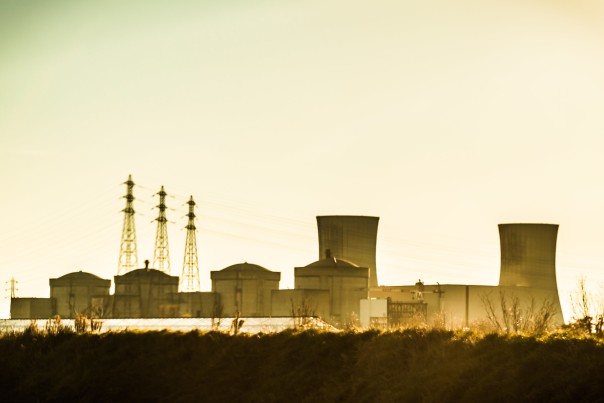
The Tricastin nuclear site — source of multiple leaks and radioactive releases over decades. (Creative Commons/xklima)
That “acceptable” level is 100 Becquerels per liter, not quite as arbitrary as the shocking 10,000 Bq/L level set by the World Health Organization, in thrall to the nuclear power-promoting International Atomic Energy Agency through a 1959 agreement.
The cities affected included Paris and its suburbs, and other large population areas in the Loire and Vienne regions of France such Orléans, Tours and Nantes.
Unsurprisingly, the story spread like wildfire, especially across social media, causing alarm among residents in the communities cited — 268 in all.
But the police investigation in Paris was not of EDF, the country’s chief nuclear facility operator. It was to root out fear-mongering purveyors of “fake news” among the citizenry who, according to the French state, were unnecessarily spreading panic among the populace by claiming drinking water containing tritium is unsafe.
It is.
The independent radiological testing lab CRIIRAD (Commission for Independent Research and Information on Radioactivity) denounced what it called the “trivialization of tritium contamination” and warned French citizens not to be lulled by the 100 Bq/L levels set by the authorities and especially not by the WHO’s 10,000 Bq/L standard. CRIIRAD said the level for tritium in drinking water should be set between 10 and 30 Bq/L.
For context, in our report, Leak First, Fix Later, we noted that the “naturally occurring” levels of tritium found in surface and groundwater is, at its highest, 1 Bq/l. Therefore, tritium is almost non-existent in water in nature.
To CRIIRAD, it is therefore all the more outrageous that that the levels for radiological contamination in France are set at “more than 100 times higher than the maximum allowed for chemical carcinogens.”
Tritium is radioactive hydrogen and is therefore assimilated by all living things as water. It has a half life of 12.3 years. It is produced in huge quantities in nuclear reactor cores, then released into the environment as a gas or in liquid discharges. Tritium cannot be filtered out of water and tritium released into the air can return in rainfall. All nuclear power plants release tritium, and nuclear reprocessing facilities — such as the one at La Hague on the French north coast — release even larger amounts.
These releases, including into rivers, streams and the sea, are regulated by authorities but, as CRIIRAD points out, at levels that are not so much safe as unavoidable, effectively granting nuclear installations “permission to pollute.”
“The liquid and atmospheric releases of tritium cause contamination of the air, water, the aquatic and terrestrial environment and the food chain,” wrote CRIIRAD in a statement put out after the tritiated drinking water news broke.
When rumors began to fly that drinking tap water had been banned, authorities quickly stepped in to “reassure” people that the levels of tritium in the water — already not actually safe according to CRIIRAD — were of no concern.
The criminality of nuclear plants across France releasing huge amounts of tritium into the environment was quickly turned on its head. Instead, in a sinister but not entirely unpredictable turn of events, given that France is a nuclear state, it would be ordinary citizens who would be committing a “crime” if they were found to be “publicizing, spreading and reproducing false information intended to cause public disorder,” according to an AFP article.
In reality, there was genuine cause for concern. ACRO had found levels of tritium in drinking water at 30 Bq/L on five occasions, then at 55 Bq/L and finally at 310 Bq/L in the Loire river.

Picture entitled “Water makes milk.” In France, is that milk radioactively contaminated? (Photo: Graham Knott/Creative Commons)
But drinking tritiated water is not the end of the story — or the danger. Even though tritiated water may pass through the human body in about 10 days, about 10% of it binds organically inside the body. Organically bound tritium remains in the body for far longer than free tritium. According to CRIIRAD, this means that beta radiation from tritium can endure inside the body for years, causing chromosomal mutations, cancers and genetic mutations.
Tritium also binds organically to organisms in the environment such as aquatic plants present in rivers and streams into which nuclear facilities release tritiated water, or crops irrigated using water contaminated with tritium. These are in turn ingested by animals and humans — setting in motion tritium’s journey up the food chain.
The CRIIRAD statement notes the systematic downplaying of these risks by the nuclear safety regulator and other French governmental authorities.
This was never more apparent than during a law suit brought by CRIIRAD, the Sortir du nucléaire network, Stop Nucléaire 26-07 and FRAPNA Drôme in 2013 after the huge multi-unit Tricastin nuclear site leaked tritium into the groundwater at levels as high as 700 Bq/L.
EDF, Tricastin’s operator, claimed then that “tritium is a completely harmless radioactive isotope.”
Of course there is no such thing as a “safe dose.” Even the august and certainly not anti-nuclear National Academy of Sciences agrees. And as CRIIRAD points out, every dose increases the risk. “Since all living matter is made up of hydrogen atoms, a part of any tritium released will eventually be found in the cells of living organisms, including in the DNA, creating long-term internal irradiation that increases cancer risks (among others),” said the lab.
What of course got forgotten in all the dismissal and downplay by authorities — and in the attempts to criminalize those who sounded the alarm — is that some members of the population are more vulnerable than others when it comes to radiation exposure.

There is an Europe-wide movement to abolish the Euratom Treaty. (Photo: PLAGE)
Even while a daily dose of tritiated drinking water is not good for anyone, it is far more dangerous for babies and young children and for women, especially pregnant women. But those already bad standards don’t take the most vulnerable into account.
So how did the 100 BQ/L limit come about? It is no surprise to learn that it was the influence of Euratom (no conflict there) that boosted it that high.
After CRIIRAD had pushed for a 10 Bq/L limit before the European Parliament in 2012-2013, that body settled on a 20 Bq/L limit. But its decision was swept aside after “experts” at Euratom insisted on the 100 Bq/L limit. That, among other issues, is what spurred a Europe-wide movement to abolish the Euratom Treaty.
Clearly, what should have happened in France is an investigation into the cause and source of the tritium in drinking water. Instead, there was a propaganda campaign to neutralize concern and vilify those who sounded the alarm on safety. In Nuclear France, it’s never plus ça change, but always la même chose.
Minister says Epstein’s French connections must be probed despite prison death
RT | August 12, 2019
Sex trafficker Jeffrey Epstein’s connections in France need to be investigated by the nation’s law enforcement, the French minister for gender equality said. Epstein died in US custody last week by alleged suicide.
The US investigation into Epstein’s alleged sexual abuses of minors was undermined by the disgraced financier’s death in a US jail. But it uncovered enough evidence involving France that merit a national investigation, Gender Equality Minister Marlène Schiappa said in a statement on Monday. Such a probe would be “fundamental for the victims” and will also help prevent sexual predation in the future, she argued.
Epstein died in what the authorities called an apparent hanging suicide while being held in custody at the Metropolitan Correctional Center in New York. He was charged with sexual exploitation of minors as young as 14.
The death may be a relief for many powerful people around the world, who allegedly partook in Epstein’s sexual predation dating back to at least 2002. Previously he was convicted for paying for sex with an underage girl and given an 18-month prison sentence.
Parents of French babies born with deformities angry after official probe yields no answers
RT | July 13, 2019
A much-delayed government report failed to identify the cause in a spate of arm malformations across France, and despite calls for a more in-depth study, scientists say a definitive explanation may never be found.
Commissioned last year, the 265-page report examined 18 cases of congenital deformities since 2007 in four different regions across the country, studying whether they were linked by a common cause, such as environmental pollution, toxic drug exposure, or genetic damage.
“Scientific studies screening, questionnaires and local environment testing have been conducted by Sante Publique France which has not identified an obvious cause,” the public health body, which had been asked repeatedly about the case by RT, said in its summary.
The commission did admit that there is a “cluster” of cases in the commune of Guidel in the north-western department of Morbihan, where three babies missing arms were born in 22 months. But for the region of Ain in the east of the country, where eight such babies were born between 2009 and 2014, researchers said there was no statistical anomaly or telling pattern.
Pesticides blamed
But parents and activists who were present during the unveiling of the report were not satisfied, with some saying that only a superficial study was conducted, that some cases were excluded due to arbitrary cut-off points, and that the criteria for why some cases were dismissed as statistical noise were never explained.
“I did not expect big news, but I am surprised by the removal of ‘clusters’, it seems scandalous,” Samuel Bernard, the father of a daughter born without a hand in Morbihan, told France Info.
Bernard complained that an independent body was not put in charge, and bemoaned the lack of communication or investigation of specific hypotheses.
Emmanuelle Amar, the director of the malformations register of the Rhone-Alpes region, who helped bring the story to prominence, continues to believe that pesticides or other manmade chemical agents could be to blame.
“Exactly the same deformity, it never happened in the history of deformities,” she said following the report presentation. “The probability that it is linked to chance is more than infinitesimal. We are facing a possible health scandal.”
It is notable that the investigation said all the pregnancies occurred in the vicinity of growing cereal crops.
“We need to bring together specialists to define what kind of studies we need for this type of reporting, but the answer so far is to say: ‘We do not want to know what kind of studies because we do not want to study,’” Amar said. “And that is irresponsible.”
Field tests are poised to continue, with another report expected at the end of the year.
But there are reasons for believing that even with the best of intentions and sufficient resources, answers may be hard to come by.
One of the problems is the sheer rarity of such malformations. They occur on average in 1.7 cases each 10,000 births, and while several more cases look drastic, they could still just be a relatively random blip. Additionally, with so few cases, it gives doctors fewer children to examine among whom shared explanations could be located.
With many of the children now several years old, the evidence for whatever may have affected their mothers during pregnancy may also be long gone, particularly as the researchers don’t actually know what exactly they are looking for.
In addition to that, only 20 percent of France’s population is covered by registries that record deformities, meaning that even the true scale of the problem, or if it even exists, is impossible to ascertain without overhauling the medical records system, and collecting new data from millions.
Isabelle Taymans-Grassin, mother of another child born in Morbihan without a hand, says that while they are not giving up their fight, they despair at the chances of ever proving a certain link or punishing a culprit.
“Accountability will be impossible to find,” she said.
Two Think Tanks Claim Sputnik Meddled in 2017 French Election, Present No Proof… Again
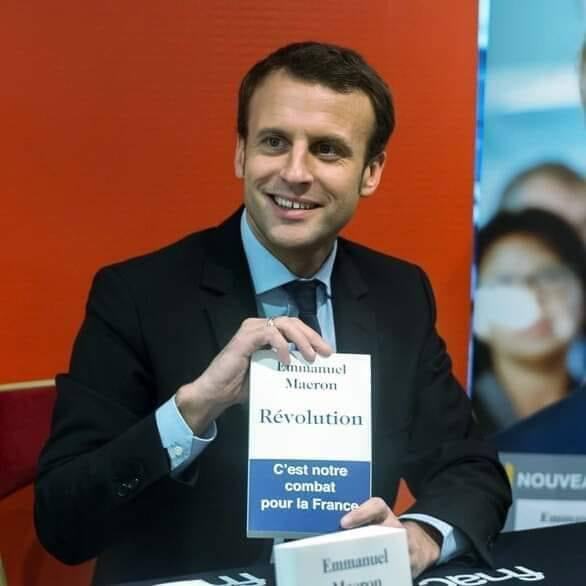
Sputnik – July 11, 2019
Russian media outlets last year faced accusations of interfering in France’s internal politics, but a recent probe by French intelligence has reportedly found no signs of such activities.
The French Institute of Strategic Research of the Military School (IRSEM) and American think-tank the Atlantic Council have in a recent collaborative project produced a report, the latest in a row of similar ones, claiming that Russia meddled in the internal affairs of a foreign government. This time, the researchers accused Moscow of trying to prevent the victory of Emmanuel Macron in the 2017 French presidential election.
The researchers try to prove that by using state-funded media outlets, namely Sputnik, as an “information weapon”, the Kremlin allegedly organised a coordinated “disinformation campaign” against then presidential hopeful Macron. However, like many similar papers on alleged “Russian meddling”, this research also fails to present solid facts that substantiate the claims and stumbles into certain problems when trying to prove that such a targeted “campaign” actually existed in the first place.
Notably, the report’s key author and head of the IRSEM, Jean-Baptiste Jeangène Vilmer, who also serves on the Academic Advisory Board of the NATO Defence College, took most of his points of evidence from the works of Ben Nimmo, a researcher at the Atlantic Council. The latter, like many other Western think tanks, regularly publishes research devoted to proving the existence of Russian attempts to interfere in the internal affairs of Western countries and proposing ways in which they can counter this alleged “threat”.
“Anti-Macron Campaign” or Factual Reporting?
The IRSEM study recalls that back in February 2017, Macron’s digital manager accused Sputnik of publishing “fake news” about his employer from the “very beginning of [the election] campaign”. The author of the paper, Vilmer, claims that this “disinformation campaign” began when the French edition of Sputnik published a report about statements by WikiLeaks founder Julian Assange, in which he revealed that he possessed “interesting information” about Macron, albeit without specifying whether it was compromising in any way.
Referring to the Sputnik article as “menacing”, the IRSEM report draws parallels to the 2016 US presidential election and WikiLeaks’ publication of Democratic National Committee (DNC) emails. At the same time, the paper didn’t elaborate any further on how exactly reporting on an interview with a famous whistle-blower, in which no compromising information about Macron was published, was able to affect the outcome of the election. It also failed to mention that WikiLeaks’ threats, covered by Sputnik, were not limited to Macron, but also touched his main opponent in the second round, Marine Le Pen.
“Hand-Picked” Speakers vs Hand-Picked Examples
The IRSEM head admits in the report that Sputnik didn’t publish any “fake news” during the election campaign in France, but instead accused it of “information manipulation”. Vilmer claims that the Russian media outlet had expressed “a strong bias” by allegedly leaving out important information and by “hiding behind the quotations” of the “right people”.
While failing to present any proof that Sputnik had omitted any important facts in its articles, the researcher instead tried to substantiate his claim by indicating that Sputnik had interviewed only two persons, who happen to be members of the French Parliament – Thierry Mariani and Nicolas Dhuicq – in regards to the upcoming election. However, a simple search on the news outlet’s website reveals that in reality Sputnik had interviewed far more contributors on the topic, such as Jacques Lamblin, another member of the country’s parliament, as well as various European lawmakers and pundits.
Alleged “Focus” on “Macron Affair”
The paper proceeds to claim that Sputnik covered the election in France with “a distinct bias against Macron”. According to Vilmer, this was expressed in a strategy of giving a deaf ear to scandals involving other contenders for the presidency, such as “the Kremlin’s favoured candidate”, Marine Le Pen, and instead focusing on “rumours” about Macron’s alleged offshore accounts.
The IRSEM research insisted that most of Sputnik’s articles were devoted to the “invented Macron affair” involving offshore accounts while it “defended Le Pen and amplified her party”. However, the paper does not include any factual proof of a discrepancy in the coverage of Macron-related scandals and controversies involving his rivals. It also fully omits the actual fact that Sputnik covered the latter.
“Blame Russia” Trend
France was the second Western country to try to blame Russia for interfering in its domestic affairs. This was preceded by an attempt by the US Democratic Party, and specifically its candidate Hillary Clinton, to shift the blame for the defeat in the 2016 presidential election on to supposed meddling by Moscow.
This blame-game later became a trend among Western governments and political parties in countries such as the UK, Germany, and Spain, to name only a few. But just as in the case of the US, none of these states managed to provide any credible evidence to substantiate the claims, at best referring to obscure “intelligence reports”. Moscow has repeatedly pointed out this lack of underlying proof when rejecting these groundless accusations
Notably, following Macron’s victory in the elections his team abandoned the narrative for a while, only to return to it in February 2019, accusing Moscow of “orchestrating” the Yellow Vest rallies, which demanded Macron’s resignation, and pointing to Sputnik and RT for this purpose. However, earlier reports by local news outlets said that the French intelligence services’ investigation had failed to find any signs indicating that the Russian media was able to impact French domestic affairs.
Google’s Empire: The Science Fiction of Power

By Maximilian C. Forte | Zero Anthropology | June 28, 2019
“For as long as I can remember, I always wanted to make a film about libraries,” explains Ben Lewis, the director of Google and the World Brain (2013). About libraries, he says, “they are my favourite places to be. Serene, beautiful repositories of the best thoughts that men and women have ever had”. Political economy, and the rights of citizens in a democracy, also loom large in Lewis’ estimation of the importance of libraries. As he states, libraries are: “Free to use. Far from the din of modern capitalism, libraries are the epitome of the public institution. There is simply nothing bad about a library. It is my paradise”. While praising the value of the Internet, Lewis warns, “the Internet also takes things from us, without asking”. Marrying the Internet and libraries raises hugely problematic issues, especially in the case of Google’s book-scanning project—problems surrounding copyright, national cultures and surveillance.
The political economy of knowledge production is one of the central areas of research interest that constitute the Zero Anthropology Project. This documentary was a good match for that interest, especially as it provokes a number of “big questions”: What are the social and political consequences of knowledge centralization? How, or when, is the digitization of knowledge problematic, and for whom? What role do libraries play in contemporary society? Does copyright protect much more than just authors’ rights and publishers’ profit-making activities? How is the digitization of knowledge linked to surveillance and governance? Should private corporations play any part in creating and/or controlling a universal library? Is a universal library even possible?
Google and the World Brain (2013)
If you were looking for a documentary that was not just another evangelical tract about how “information wants to be free,” spoken by wide-eyed zealots of “open access,” then this is the film for you. While beginning with enthusiasm for open access, for nearly a decade now Zero Anthropology has been warning about the dangers of open access, especially when it comes to facilitating the flow of information to the imperialist military of the US, or bolstering US academic hegemony. Ben Lewis’ Google and the World Brain shows us that we are on the right track. Yet some will argue that there are questionable aspects of Lewis’ critiques and the way they are presented in the film.
Directed by Ben Lewis, Google and the World Brain (2013) runs for 89 minutes. A trailer is included below, but the film in its entirety can be seen online, for free, on Archive.org and on the website of Polar Star Films. If you have 89 minutes to spare, please view it and then let us know if the following analysis was either flawed or unfair.
A trailer for the film is available below:
Polar Star Films, which produced Google and the World Brain, provided a detailed synopsis of the film which forms the basis for the following overview of the film.
Overview
Google and the World Brain is the story of “the most ambitious project ever attempted on the Internet: Google’s project to scan every book in the world and create not just a giant digital global library, but a higher form of intelligence”. The film’s critique draws from the dystopian warnings of H.G. Wells who in his 1937 essay “World Brain” predicted the creation of a universal library that contained all of humanity’s written knowledge, and which would be accessible to all of humanity. However, this would not just be a library in the sense of a static holding of inventoried contents, rather it would form the foundation for an all-knowing entity that would eliminate the need for nation-states and governments. With every increase in the quantity of information that it possessed, the globalist World Brain would be better able to rule over all of humanity, and would thus monitor every human being on the planet.
Supposedly Wells’ dystopian vision of technological progress (has progress ever really produced anything other than a succession of dystopias?) was just science fiction. However, this film shows how a World Brain is being brought into existence on the Internet: “Wikipedia, Facebook, Baidu in China and other search engines around the world are all trying to build their own world brains—but none had a plan as bold, far-reaching and transformative as Google did with its Google Books project”.
Starting in 2002, Google began its project of scanning the world’s books. To do so, they entered into legal agreements with major university libraries in the US, most notably those of Harvard, Stanford, and Michigan, and then expanded to include deals with the Bodleian Library at Oxford in the UK and the Catalonian National Library in Spain. The goal was not simply the collection of all books—instead, as Lewis’ film argues, there was “a higher and more secretive purpose” which was to develop a new form of Artificial Intelligence.
Of the 10 million books scanned by Google by the time this documentary was made, six million of them were under copyright. This fact provoked authors, publishers, and some librarians around the world to not only protest Google, but also to take legal and political action against it. In the fall of 2005 the Authors Guild of America and the Association of American Publishers filed lawsuits against Google. That resulted in a 350-page agreement negotiated with Google, which was unveiled in October of 2008.
However, that agreement which involved Google paying a settlement of $125 million, also granted Google Books huge new powers. The result was that Google would become the world’s biggest bookstore and commercialized library. Google now had the exclusive right to sell scans of all out-of-print books that were still in copyright. What this meant is that Google had a monopoly over the majority of books published in the 20th-century.
Reacting against this settlement, Harvard University withdrew its support for Google’s project. Authors in Japan and China joined a worldwide opposition to Google’s book-scanning. The governments of France and Germany also condemned the agreement. In the US, the Department of Justice launched an anti-trust investigation. Starting in late 2009, US Judge Denny Chin held hearings in New York to assess the validity of the 2008 Google Book Settlement, and in March of 2011 he struck it down.
Google altered its plan in order to continue with a version of its book-scanning project. Google signed deals with many individual publishers that would allow Google to show parts of their books online. Google also continued to scan books out-of-copyright. What Google was not able to do was carry out its master plan for an exclusive library that it controlled alone. The Authors Guild also persevered with suing Google for up to $2 billion in damages for scanning copyrighted books.
In this documentary, Google occupies the spotlight. Issues of copyright, privacy, data-mining, downloading, surveillance, and freedom come to the fore as a result.
The key figures interviewed in this film include some of the leading Internet analysts such as Evgeny Morozov, Jaron Lanier, Kevin Kelly, Clay Shirky, and Pamela Samuelson. Librarians in charge of some of the world’s leading libraries are also interviewed, including Robert Darnton (Harvard), Reginald Carr and Richard Ovendon (Bodleian), Jean-Noel Jeanneney (French National Library). In addition, authors involved in the struggle against Google Books such as Charles Seife, Roland Reuss, and Mian Mian (a best-selling Chinese author), are also key figures in the film.
The filmmakers challenge utopian visions of the Internet as the hoped for means of spreading democracy, freedom, and culture around the globe. Instead, the film argues that the Internet has enabled practices contrary to those ideals by, “undermining our civil liberties, free markets and human rights, while concentrating power and wealth in the hands of powerful new monopolies over which we have little influence”.
Polar Star Films ends its synopsis with this very important warning and urgent call for action:
“Humanity now stands at a crossroads. We can either take action to ensure that all the information and knowledge that the Internet is providing serves us, or we can remain passive consumers, and wait for all that information to take control over us. Whatever we do in the next few years will shape society for centuries to come”.
Contemporary Globalization as Science Fiction
H.G. Wells has to be one of the most prescient thinkers of the past two centuries. It is astounding just how far his supposed science “fiction” was in fact an outline discerning what would soon become reality. He had a particularly keen sense of the patterns taking shape around him, and just as keen a vision of the direction in which forces would move the world.
This is not the first time that we resort to the work of H.G. Wells which, under the guise of “fiction,” seemed to provide what global leaders would then adopt as a plan of action. In “The Shape of Things to Come in Libya,” we witnessed the applicability of Wells’ The Shape of Things to Come with its domineering figures, the “United Airmen”—progressivist autocrats who proclaimed themselves “freemasons of science”. Precursors to the neoliberal globalist mode of governance, the United Airmen came to vanquish local warlords and end all national governments, declaring independent sovereign states at an end, even if it meant war to erase them from the face of the earth.
Google and the World Brain opens with these words from the 1937 essay, “World Brain,” by H.G. Wells:
“There is no practical obstacle whatever now to the creation of an efficient index to all human knowledge, ideas and achievements. To the creation, that is, of a complete planetary memory for all mankind”.
Wells’ depiction of the World Brain was of a new kind of empire: a global dictatorship of technologists and intellectuals. Managers would become the new de facto politicians. This tyranny of expertise sits very well with the current neoliberal world order which sees its future in jeopardy.
It is a peculiar way to start, accompanied by an eerie soundtrack, since one might think that there is nothing especially scary about an “index,” about efficient organization of information, or a complete memory. However, given the mood of the film’s opening, we are immediately invited by the filmmaker to consider these aims in a different light—a much dimmer one.
The film also ends with Wells—all is bad that ends Wells. Quoting from his 1945 book, Mind at the End of its Tether, Wells predicted that this progressivist new world order would come crashing down:
“It is like a convoy lost in darkness along an unknown rocky coast with quarrelling pirates in the chart room and savages clambering up the sides of the ship to plunder and do evil as the whim may take them. That is the rough outline of the more and more jumbled movie on the screen before us. There is no way out. Or round. Or through”.
What is at Stake?
Wells also seemed to predict the Internet as making this world brain possible—this complete database of all human knowledge, past and present, could “be reproduced exactly and fully in Peru, China, Iceland, Central Africa or wherever else”. One of the analysts interviewed in the film, Kevin Kelly, is of the opinion that having instantaneous access to all human knowledge, “changes your idea of who you are”. Some will inevitably ask: “Is that a bad thing?” Kelly himself seems to think not, and he appears in this film as an evangelist for AI, the Internet, and the wonders of the screen.
The film thus turns its attention to the Google book-scanning operation, described by one analyst as, “clearly the most ambitious World Brain scheme that has ever been invented”. Still, some will wonder, what is the problem? How is the scanning of books something that should alarm anyone?
The film focuses further, and becomes a story about Google trying to achieve a monopoly over the digitization of books. Some will ask: “Is the real problem the total digitization of printed knowledge (which is quite distinct, and often separate from all knowledge as such, since not all human knowledge is published), or is the problem that of corporate monopoly?” In its early minutes, the documentary can be confusing about its intended aims.
The third focus comes next: the argument becomes that Google could track everything, and as Pamela Samuelson (law professor, Berkeley) explains, Google “could hold the whole world hostage”. Some viewers might balk: “this is just alarmism”.

Robert Darnton, Director, Harvard Library
What are the stakes? Speaking of the continued importance of libraries, Robert Darnton (Director, Harvard University Library) says in the film that libraries are, “nerve centres, centres of intellectual energy”. Lewis Hyde adds: “Libraries stand for an ideal, which is an educated public. And to the degree that knowledge is power, they also stand there for the idea that power should be disseminated and not centralised”. Are centralization and dissemination opposed and mutually exclusive? Even as he calls for dissemination, Darnton himself utilizes the concept of “centres”.
(Ironically, Darnton calls for the knowledge held by libraries to be opened up and shared—yet when I tried to gain access to some of Harvard’s library collections myself during research visits in 2004 and 2005, I required special written permission just to gain entry into the buildings.)
Expanding and Centralizing the Control of Knowledge
Google was initially successful in seducing a few of the world’s largest libraries, including those of Harvard and Oxford, whose chief librarians interpreted Google’s book-scanning project as a logical extension of a long history of attempts at centralizing knowledge. Among the earlier attempts were encyclopaedias; plans for a catalogue of all knowledge; and, microfilming.
More recently, and since the advent of the World Wide Web, Project Gutenberg became the first digital library, one which scholars have used and will continue to use regularly. Project Gutenberg, founded by Michael Hart, actually started in the early 1970s with the simple act of typing and distributing the Declaration of Independence.
Ray Kurzweil’s invention of the scanner clearly represented the one key advance needed to proceed towards digitizing knowledge. In 1975, Kurzweil created the first omni-font optical character recognition device, which went commercial in 1978. As Kurzweil admits, “we talked about how you could ultimately scan all books and all printed material”.
In the late 1990s the book, the scanner, and the Internet were combined in an effort to create what was hoped would be gigantic digital libraries. The Internet Archive, an indispensable tool for both myself and likely many readers of this review, was established in 1996. Significantly, the director of the Internet Archive, Brewster Kahle, speaks in this film and indicates that he refused collaboration with Google because of the secrecy surrounding the nature of its agreements with libraries, and the fact that Google appeared to be on track to create something exclusive and separate.
Wikipedia, and arguably YouTube, are also massive attempts at acquiring and centralizing knowledge.
Google = Hegemony
Sergey Brin, co-founder of Google with Larry Page, says that Page first conceived of Google Books in 1999. Google Books was then initiated in 2004. In “A Library to Last Forever,” published in The New York Times on October 9, 2009, Brin explained that Google’s digitization effort would be history’s largest-scale effort, primarily because Google invested significantly in the resources needed for the project. In that article, Brin also is clear that Google was zeroing in on out-of-print but in-copyright books, and commercializing them, while also seeking to create new regulations that would allegedly serve the interests of rights holders. Brin argues that Google’s motivation was to preserve “orphan books” against physical destruction and disappearance. Commenting on Google’s supposedly lofty goals, Evgeny Morozov says the following in this film:
“I don’t think that Google is aware of the fact that it’s a corporation. I think Google does think of itself as an NGO that just happens to make a lot of money. And they think of themselves as social reformers who just happen to have their stock traded on stock exchanges and who just happen to have investors and shareholders, but they do think of themselves as ultimately being in the business of making the world better”.
Google, while claiming to be laying the path for others to follow and which says it has aided other digitization efforts, is highly secretive about its scanning operation. It refused the filmmakers access to any of its (secret) scanning locations, and the film thus relies on six seconds of footage—the only such footage in existence—that was leaked out. Google’s secrecy extends to the total number of books it has scanned, and to how much it costs to scan them on average (one estimate is between $30 and $100 per book). Google also worked to prevent any one of its partner libraries from communicating with other partner libraries about the nature of their individual contracts with Google. According to Sidney Verba, former director of Harvard Library, Google “bent over backwards” to make sure that each library would not tell the others what kind of contract they had and how they were working with Google.
How did Google benefit from book-scanning? Five explanations are offered by interviewees in the film.
(1) Lawrence Lessig introduces the point that one of the benefits of massive book-scanning, is that it pumps information into Google’s core, allowing it to develop more sophisticated algorithms that depend on knowing more and more.
(2) Sidney Verba offers a different explanation: by having lots of information in Google, more people would use Google, which would increase the prospective advertising landscape, thus enriching Google by selling advertising space.
(3) Pamela Samuelson, narrowing Google down to a search engine, offers a third viewpoint: having more data (from books, for example), allows Google to perfect its search technology.
(4) Jaron Lanier argues that there is a competition between all sectors of the modern economy (whether healthcare, information and communications technology, finance, criminality, etc.) for more and more data, because data—and specifically data differentials—is a measure of power. Then the data hoarders can in some cases claim that their work is for the common good, by increasing efficiency.
(5) Lanier, Lessig, and Kevin Kelly together make the point that feeding all these books into Google’s servers leads to the creation of something akin to a life-form, a transformative force, a mass of memories that empowers an artificial intelligence system. As the reader will have noted, there is nothing about these five theories that renders them mutually exclusive—they can all be true, at the same time.
The head of Google Books Spain, Luis Collado, the only company official willing to speak to the filmmakers about Google Books, offered a comparatively milder and more innocent explanation. Collado says that Google’s motivation was to amplify the richness of online knowledge. Until it started adding books to the Internet’s offerings, the Internet only consisted of materials that were specifically created for it. For example, in late 1994 in the SUNY-Cortland library I surfed the entire World Wide Web as it then existed, in just one afternoon (at the time I rushed to the conclusion that the Internet was “useless”). For a few years, it was actually practical for me to print everything I found interesting online, because there was so little worth printing. So Collado has a point, even if it does not exhaust the range of plausible explanations.
For Father Damià Roure, Library Director at the Monastery of Montserrat in Spain, Google’s book-scanning was a means of “diffusing our culture” to the rest of the world, while helping to preserve the knowledge contained in its vast library. What he was simply unable to answer was why the monastery had not asked Google to pay for the privilege of scanning the monastery’s collection. As Google turned its operation into a business, from which it would profit, was it fair to get the materials for free? Father Roure went completely silent at this point in the film, in one of the longest, most awkward silences I have ever seen on the screen. He brought it to an end by saying that he was not in a position to comment on anything other than digitization. Reginald Carr, former director of the Oxford’s Bodleian Library, simply downplayed the point: Google, in his view, was fully entitled to make a profit—having invested so much in the scanning—even if the Bodleian’s ethos was to make knowledge available for free.
These two library directors serve a useful purpose: they are a reminder to us that willing collaboration on the part of intermediary local elites is often essential to any grant project of hegemony-building. When it comes to the Internet, and Google in particular, readers of this article are also collaborators—collaborators that, at a minimum, feed Google with content with each search they perform. By continuing to use Google, you make it more powerful.
Assisted Intelligence or Artificial Intelligence?

Jaron Lanier
Speaking of collaboration, the film specifically addresses how Internet users are themselves used. To the extent that this is done unknowingly, unthinkingly, and without compensation, we move from collaboration to exploitation. Jaron Lanier makes this argument forcefully:
“AI is just a religion. It doesn’t matter. What’s really happening is real world examples from real people who entered their answers, their trivia, their experiences into some online database. It’s actually just a giant puppet theatre repackaging inputs from real people who are forgotten. We are pretending they aren’t there. This is something I really want people to see. The insane structure of modern finance is exactly the same as the insane structure of modern culture on the Internet. They’re precisely the same. It’s an attempt to gather all the information into a high castle, optimise the world and pretend that all the people the information came from don’t deserve anything. It’s all the same mistake”.
An absolutely unctuous and all too precious spokesperson for Google, Amit Singhal, actually confirms Lanier’s point when he says the following in the film:
“Google Search is going to be assisted intelligence and not artificial intelligence. In my mind I think of Search as this beautiful symphony between the user and the search engine and we make music together”.
Singhal confirms what Lanier argued, that Google is powered by its users, but then makes the false analogy to a symphony. Musicians performing in an orchestra are clearly instructed on their roles, they perform willingly, and they perform in accordance with known rules and by reading codified music sheets. In other words, the musicians are willing, aware, and informed. Most of Google’s users do not know they are performing in any “symphony”. Google emphasizes harmony where there is in fact concealment, deceit, and exploitation. If there is any music, it is music only to Google’s ears.
Google and Copyright: The Essence of the Confrontation
The film takes a turn into questions of copyright at this stage, when Harvard’s library director, Robert Darnton, points out that its agreement with Google only allowed for the scanning of books in the public domain. However, Google’s agreements with other libraries allowed it to scan all books, including those in copyright. Mary Sue Coleman, president of Michigan University, openly stated that her university allowed Google to scan copyrighted books, claiming that it was “legal, ethical, and noble” to do so (meanwhile universities warn students not to photocopy more than 10% of any given work). Copyright violation is where the legal problems exploded in Google’s face.
However, one of the outcomes of the lawsuits against Google was that the settlement agreement allowed Google to become the world’s biggest bookstore, specializing in out-of-print but in-copyright books. The settlement in fact granted Google an exclusive right to sell such books, without sharing the profits with authors. Google would also not respect the privacy of readers: the company would instead track what readers read, and for how long they read it.
One of the features of copyright that stands out in this film, is that copyright on the Internet takes the place of national borders. Thus we hear from Angela Merkel in this film, asserting that the German government would defend the rights of German authors, by making sure that copyright had a place on the Internet. Likewise, the former President of France, Nicolas Sarkozy, declares in footage shown in this film that France would not allow a large private corporation to seize control of French national heritage, “no matter how nice, important, or American it may be”. Standing against the imperial ambitions of Google therefore was the seemingly old-fashioned principle of copyright. It reached the extent that when the Google book settlement was taken to court in 2009, representatives of foreign authors and foreign governments, accused the US of violating various treaty obligations which could force foreign parties to go to the WTO—and in the likely event of the US losing a case before the WTO, other nations would then have a right to impose trade sanctions on the US.
The outcome is that Google remains the target of publishers’ and authors’ lawsuits, while it continues to scan both out-of-copyright books as well as in-copyright books (in agreement with major libraries, and then offering only “snippets” of the book online). Rivalling Google, various governments and major libraries have undertaken their own library digitization, thus defeating Google’s attempt at becoming an exclusive monopoly. The Digital Public Library of America is one such example of a project that took off in response to the threat posed by Google, as is the case of Europeana.
Google as Empire
The film quotes from William Gibson’s 2010 article in The New York Times, “Google’s Earth,” as part of its argument that Google is building an artificial intelligence entity of a grander scale and sophistication than was even imagined in science fiction. As Gibson explains in that article, Google is “a central and evolving structural unit not only of the architecture of cyberspace, but of the world,” and he adds that this was, “the sort of thing that empires and nation-states did, before,” only now Google’s empire is one that also becomes an organ of “global human perception”. In Google, we are citizens, but without rights.

French National Library

Jean-Noël Jeanneney
Jean-Noël Jeanneney, the former director of the Bibliothèque Nationale de France (the French National Library), represents the voice of the library of the nation-state, that which Google ultimately seeks to erase. He recounts in the film his first encounter with two young Google representatives who came to meet him—he points out that what struck him was their “arrogance” and “brutal commercialism”. These “salesmen,” as he calls them, badly miscalculated his psychology when they brought as a gift a thermo-flask, for which he had no use and which he cast aside. Following his meeting with Google’s representatives, and the company’s announcement that it alone would build a universal digital library, Jeanneney announced to his staff a plan for what he emphatically calls a “counter-offensive”. He criticized the Google book-scanning project as incorporating an Anglo-American cultural bias, and in a noteworthy critique published by Le Monde in 2005 titled “When Google Challenges Europe,” he argued that, “what I don’t want is everything reflected in an American mirror. When it comes to presenting digitized books on the Web, we want to make our choice with our own criteria”. Jeanneney pointed to “the risk of a crushing domination by America in the definition of the idea that future generations will have of the world”. Google suddenly appears not so much as a “new” empire, as in Gibson’s piece, but rather a part of the American empire in a new extension of itself. We are thus back to the familiar problems of Americanization and cultural imperialism.
As Sidney Verba explains in the film, there were two additional sides to the French critique of Google: one had to with the dominant language of Google search results—English—which thus acted as a force undermining French, and the second had to do with who got to decide what would be digitized, its order of priority, and who would get to do the digitization. Who are the Americans at Google who get to digitize France’s books?
Conclusion
While sometimes striking an alarmist tone that was not warranted by the empirical substance that was presented, one could also conclude that the film is only guilty of erring on the side of caution. When dealing with Google in particular, we are well past the point of being cautious: it is a monopolistic entity that for years had a large revolving door between itself and the State Department and the Democratic Party, while also striking deals with the Pentagon and engaging in political censorship. There is nothing innocent about Google, and to the extent that it swallows the Internet, there is little about the Internet that is innocent.
One of the possible lapses of the film is that it does not direct as much attention to China’s Baidu, which has its own extensive book-scanning project that might even rival Google’s. The film presents an interview with Baidu’s communications director, and provides some useful statistics from Baidu employees about the extent of its own book-scanning project—but the bulk of the criticism is reserved for Google.

A book scanning unit in China
However, it has to be said that Ben Lewis does us all an essential service with this film that, ostensibly, appears to be about the simple act of scanning library books, and becomes instead a much larger story about democracy, rights, nation-states, cultures, corporatization, political economy, international law, and the future of globalization.
It was not surprising to see that, once again, one of the top documentaries we have had the privilege of reviewing was produced by Europe’s Arte television company.
This documentary, with all of its thought-provoking questions and careful detail, would be suitable for a wide range of courses in fields such as Information and Communication Studies, Librarianship, Media Studies, Sociology, Anthropology, and Political Science. The film earns a score of 8.75/10.
(This documentary review forms part of the cyberwar series of reviews on Zero Anthropology. This film was viewed four times before the written review was published.)
Facebook to give French courts data on hate speech suspects, says minister
RT | June 25, 2019
Facebook has agreed to give French courts the identification data of users suspected of spreading hate speech on the platform, according to a French minister, in what is being described as a world first.
France’s minister for digital affairs and former top advisor to President Emmanuel Macron, Cedric O, confirmed the agreement on Tuesday, but suggested the courtesy would not be extended to other nations.
“This is huge news, it means that the judicial process will be able to run normally,” O told Reuters. “It’s really very important, they’re only doing it for France.”
The deal between the world’s largest social media network and France came after a series of meetings between Facebook founder Mark Zuckerberg and Macron.
The social network had already been giving French authorities IP addresses and identifying data of suspected terrorists after judges demanded their cooperation, but this is the first time the agreement has extended to hate speech.
Macron has made no secret of his interest in regulating online hate speech and fake news. Recently, parliament has been considering implementing a fine of 4 percent of a tech company’s global revenue if they are found to not have done enough to remove certain content from their network.
Internet Free Speech All but Dead
Unelected, unnamed censors are operating across the Internet to suppress “unapproved” content.

By Philip Giraldi | Global Research | June 8, 2019
The Internet was originally promoted as a completely free and uncensored mechanism for people everywhere to exchange views and communicate, but it has been observed by many users that that is not really true anymore. Both governments and the service providers have developed a taste for controlling the product, with President Barack Obama once considering a “kill switch“ that would turn off the Internet completely in the event of a “national emergency.”
President Donald Trump has also had a lot to say about fake news and is reported to be supporting limiting protections relating to the Internet. In May, a “net neutrality” bill that would have prevented service providers from manipulating Internet traffic passed in the House of Representatives, but it is reported to be “dead on arrival” in the Senate, so it will never be enacted.
Social networking sites have voluntarily employed technical fixes that restrict some content and have also hired “reviewers” who look for objectionable material and remove it. Pending European legislation, meanwhile, might require Internet search engines to eliminate access to many unacceptable old posts. YouTube has already been engaged in deleting existing old material and is working with biased “partners” like the Anti-Defamation League (ADL) to set up guidelines to restrict future content. Many users of Facebook will have already undoubtedly noted that some contacts have been blocked temporarily (or even permanently) and denied access to the site.
Google now automatically disables or limits searches for material that it deems to be undesirable. If Google does not approve of something it will either not appear in search results or it will be very low on the list. And what does come up will likely favor content that derives from those who pay Google to promote their products or services. Information that originates with competitors will either be very low in the search results or even blocked. Google is consequently hardly an unbiased source of information.
In May 2017 Facebook announced that it would be hiring 3,000 new censors, and my own experience of social networking censorship soon followed. I had posted an article entitled “Charlottesville Requiem” that I had written for a website. At the end of the first day, the site managers noticed that, while the article had clearly attracted a substantial Facebook readership, the “likes” for the piece were not showing up on the screen counter, i.e., were not being tabulated. It was also impossible to share the piece on Facebook, as the button to do so had been removed.
The “likes” on sites like Facebook, Yahoo! news comments, YouTube, and Google are important because they automatically determine how the piece is distributed throughout the site. If there are a lot of likes, the piece goes to the top when a search is made or when someone opens the page. Articles similarly can be sent to Coventry if they receive a lot of dislikes or negative marks, so the approvals or disapprovals can be very important in determining what kind of audience is reached or what a search will reveal.
In my case, after one day my page reverted to normal, the “likes” reappeared, and readers were again able to share the article. But it was clear that someone had been managing what I had posted, apparently because there had been disapproval of my content based on what must have been a political judgment.
A couple of days later, I learned of another example of a similar incident. The Ron Paul Institute (RPI) website posts much of its material on YouTube (owned by Google) on a site where there had been advertising that kicked back to RPI a small percentage of the money earned. Suddenly, without explanation, both the ads and rebate were eliminated after a “manual review” determined the content to be “unsuitable for all advertisers.” This was a judgment rendered apparently due to disapproval of what the institute does and says. The ability to comment on and link from the pieces was also turned off.
Dissident British former diplomat Craig Murray also noted in April 2018 the secretive manipulation of his articles that are posted on Facebook, observing that his “site’s visitor numbers [were] currently around one-third normal levels, stuck at around 20,000 unique visitors per day. The cause [was] not hard to find. Normally over half of our visitors arrive via Facebook. These last few days, virtually nothing has come from Facebook. What is especially pernicious is that Facebook deliberately imposes this censorship in a secretive way.
“The primary mechanism when a block is imposed by Facebook is that my posts to Facebook are simply not sent into the timelines of the large majority of people who are friends or who follow. I am left to believe the post has been shared with them, but in fact it has only been shown to a tiny number. Then, if you are one of the few recipients and do see the post and share it, it will show to you on your timeline as shared, but in fact the vast majority of your own friends will also not receive it. Facebook is not doing what it is telling you it is doing—it shows you it is shared—and Facebook is deliberately concealing that fact from you. Twitter has a similar system known as ‘shadow banning.’ Again, it is secretive and the victim is not informed.”
More recently, pressure to censor Internet social networking and information sites has increased, coming both from government and from various interested constituencies. In late May, Facebook founder and CEO Mark Zuckerberg met with French President Emmanuel Macron to discuss how to eliminate “hate speech” on the Internet.
The two men agreed that the United States Internet model, in spite of already being heavily manipulated, is too laissez faire, and expressed an interest in exploring the French system where it is considered acceptable to ban unacceptable points of view. Zuckerberg suggested that it might serve as a good model for the entire European Union. France is reportedly considering legislation that establishes a regulator with power to fine Internet companies up to 4% of their global revenue, which can in some cases be an enormous sum, if they do not curb hateful expressions.
So unelected, unnamed censors are operating all around the Internet to control the content, which I suppose should surprise no one, and the interference will only get worse as both governments and service providers are willing to do what it takes to eliminate views that they find unacceptable—which, curiously enough, leads one to consider how “Russiagate” came about and the current hysteria being generated in the conventional media and also online against both Venezuela and Iran. How much of the anger is essentially fake, being manipulated or even fabricated by large companies that earn mega billions of dollars by offering under false pretenses a heavily managed product that largely does what the government wants? Banning hate speech will be, unfortunately, only the first step in eliminating any and all criticisms of the status quo.
Election? What Election? EU Elite Will Censor Their Way Out of This Mess (or Die Trying)
By Helen Buyniski | Aletho News | June 7, 2019
The neoliberal establishment is wringing its hands in the wake of European elections that proved a resounding victory for populist parties across the continent, casting around for someone to blame but utterly incapable of realizing their own interference has doomed them. Doubling down on the censorship, they are determined to provoke the catastrophe they need to make free speech history.
The NGO-industrial complex was operating at maximum capacity in the weeks leading up to the election, shutting down hundreds of Facebook pages deemed “fake” or “hate speech” in the hope of controlling the messages reaching voters before they made the terrible mistake of voting for a candidate who represents their interests.
Led by Avaaz, which claims to be a “global citizens’ movement monitoring election freedom and disinformation,” this well-heeled fifth column whipped the press into paranoid frenzies with reports like “Fakewatch,” which breathlessly documented 500 “suspicious” pages and groups it claims are “spreading massive disinformation.” The groups have little in common other than their alleged “link[s] to right-wing and anti-EU organizations,” a capital offense for the promoters of “democracy,” which can only be permitted where it doesn’t stray from the center-left path of most #Resistance.
“Far-right and anti-EU groups are weaponizing social media at scale to spread false and hateful content,” the study warns, gloating that after sharing its findings with Facebook, the platform shut down an “unprecedented” number of pages on the eve of the election (77 out of the 500, according to VentureBeat, which has credulously signal-boosted every utterance of Avaaz as if it is divine truth from the Oracle of Delphi). Avaaz’s reports frame the problem as an affliction of the right wing only, even though disinformation is second nature to political operatives at both ends of the spectrum (and, more importantly, in the sanctified center).
The Computational Propaganda Project, an Oxford-based research group, made no secret of its elitist leanings, declaiming, “On Facebook, while many more users interact with mainstream content overall, individual junk news stories can still hugely outperform even the best, most important, professionally produced stories,” as if users have no choice but to consume “professionally-produced” Oxford-approved material or wallow in junk content. And Facebook’s own statistics bear out the hypothesis that coordinated inauthentic behavior has surged – the site removed almost 3.4 billion “fake” accounts from October 2018 to March 2019, more than the number of actual users.
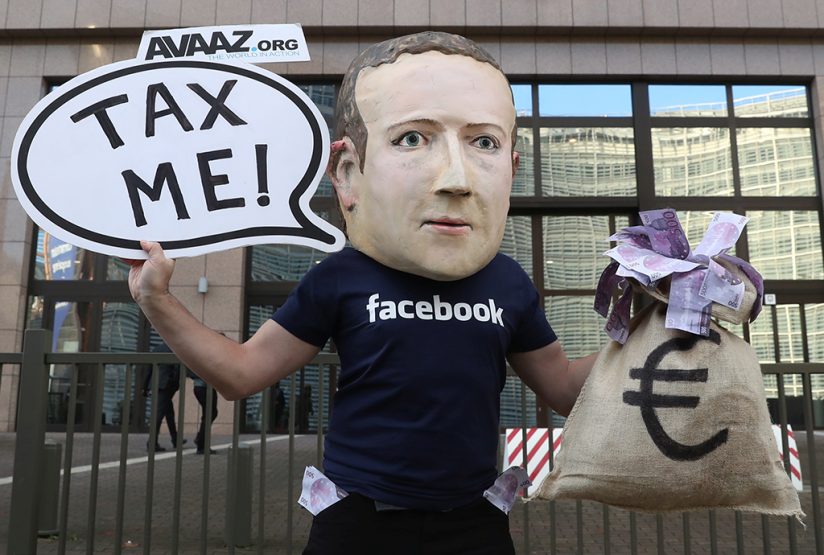
Activist wearing a mask depicting Facebook CEO Mark Zuckerberg demonstrates during the EU finance ministers meeting at EU headquarters in Brussels, Belgium, December 4, 2018. REUTERS/Yves Herman
But Facebook is not simply targeting fake accounts for takedown. Last Sunday, as Europeans prepared to head out to the polls, Facebook froze the largest group used by the Yellow Vests to organize protests and share information, silencing its 350,000+ members at a critical moment in French politics. More than one group member, reduced to commenting on existing posts, pointed out that President Emmanuel Macron met with Facebook chief executive android Mark Zuckerberg three weeks earlier to discuss a first-of-its-kind collaboration in which French government officials are being given access to material censored from users’ newsfeeds, essentially permitting them direct control of what the French are allowed to see on social media. Facebook, then, is providing France with the same techno-fascist services it provides the US government: Facebook will take on the burden of actually censoring dissent, thus skirting any pesky free-speech laws that might otherwise trip up a government that attempted to do the same.
Avaaz focused on the Yellow Vests in its coverage of the French elections, complaining RT France was getting huge quantities of views compared to native French media – perhaps because native French media have been doing Macron’s bidding and attempting to minimize the protests. By framing RT as a perpetrator of “information warfare,” the NGO was making a deliberate effort to have it deplatformed under one of Macron’s controversial police-state laws passed in 2018, by which any outlet spreading so-called “false information” can be gagged for three months leading up to an election. Yet Macron’s own interior minister, Christophe Castaner, lied on Twitter when he claimed the Yellow Vests had attacked the Pitié-Salpêtrière hospital in Paris, and RT was the first outlet to publish the truth about the incident. Who is the disinfo agent?
When the election results came in, Avaaz and its political allies in the neoliberal center could only gape in disbelief. Surely they had wiped La Liga and the Front National (now National Rally) from social media, salting the earth in their wake? How had they won? And what happened in Germany, where Angela Merkel’s CDU performed worse than ever in European election history? Merkel could blame YouTube – 70 influential video stars put out a call to their followers to shun her coalition – but the creators also called for shunning the far-right AfD, so the platform couldn’t be demonized as a tool of the ever-present Nazi Threat. That didn’t stop her party from trying, of course – CDU party leader Annegret Kramp-Karrenbauer complained about online “propaganda” and promised to “tackle this discussion quite aggressively.”
The populist parties won in large part because of the establishment’s unseemly embrace of fascist tactics, from the UK’s totalitarian information warfare disguised as “protecting citizens” or France’s visceral police violence, maiming protesters as if for sport. Europeans voted out of disgust with an establishment so insecure in its control of the narrative that it has sought to annihilate all signs of dissent, dismissing euroskepticism as Russian astroturfing and xenophobia and plugging its ears to the legitimate grievances of its subjects. The National Rally may have beat Macron’s jackbooted thugs, who in the past two months have hauled half a dozen journalists in for questioning by intelligence agencies for publishing stories that embarrassed the regime, but nearly half of French voters refused to vote for anyone at all, according to an Ipsos poll, and Germany’s Greens mopped the floor with Merkel’s coalition among young voters.

The triumph of Nigel Farage’s Brexit party in the UK is the product of a populace wrestling with cognitive dissonance, forced to realize that the “constitutional monarchy” they believed they lived in isn’t so constitutional after all, having jettisoned its democratic mask to cling to the EU under the guise of good old British pragmatism. Even passionate Remainers are happy to see Theresa Maybe go, though it remains to be seen whether her successor will be any more inclined to honor the result of 2016’s referendum. Meanwhile, the Guardian’s embarrassing attempt to shame Farage over a handful of appearances on the Alex Jones show – the paper claimed any reference to “globalists” and “new world order” were dog-whistles for the dreaded “antisemitic conspiracy theories” – proves the establishment media will never regain narrative primacy as long as alternatives exist. Jones, for all his flaws (and they are legion), has a massive audience; the Guardian, despite being propped up by the UK government’s Operation Mockingbird-esque “Integrity Initiative” (and the award for most ironic name ever goes to…), does not.
With the vast American election-fraud apparatus scrambling to prepare itself for 2020, now enabled by Pentagon-funded, Unit-8200-approved Microsoft “election security” software from the makers of the wrongthink-babysitter browser plugin NewsGuard, the US ruling class seems to be poised to make the same mistake as its global peers. Facebook, working hand in hand with the Atlantic Council, has banned and shadowbanned legions of anti-neoliberal activists over the past year, selectively applying (and inventing) new rules in an effort to keep popular content-creators jumping through hoops instead of influencing the discourse. Facebook has been allowed its place of privilege because as a “private corporation” it is legally permitted to violate users’ free speech rights in ways the US government cannot. But if Facebook can’t deliver a victory for the “right guys” this time around, it will be punished. Indeed, a massive anti-trust probe appears to be in the offing, 14 years of Zuckerberg apologies notwithstanding.
The site learned back when it tried to roll out a “disputed” tag for “wrongthink” stories that people were actually more likely to click on those stories; it learned the lesson again when its hugely expensive Facebook Watch news show featuring Anderson Cooper flopped last year. Zuckerberg is on the record begging for government regulation; will Facebook and Twitter use the outcome of this round of elections as a springboard for further crackdowns?
YouTube already has – thousands of creators found their channels demonetized and riddled with takedown notices this week in what has been dubbed the #VoxAdpocalypse after a pathologically whiny Vox blogger became the face of the mass deplatforming, but the censorship appears to be more of a response to Macron’s Orwellian “Christchurch call” to censor “extremism” – that ill-defined conveniently-variable catch-all whose borders are perpetually expanding to engulf all inconvenient speech – aided and abetted by the ADL than Google taking pity on a thin-skinned professional victim.
A sinister coalition of MEPs, “civil society” groups, and the Transatlantic Commission on Election Integrity – a who’s who of war criminals, psychopaths, and oligarchs that includes Michael Chertoff, John “death squad” Negroponte, Victor Pinchuk, and Anders Fogh Rasmussen – has already demanded “parliamentary inquiries into the impact of the use and abuse of technology platforms on democracy and elections.” It’s no coincidence that several of these “election integrity” enthusiasts sit on the board of NewsGuard, which is currently trying to weasel into the EU’s internet regulatory framework by playing up the “disinformation” threat.
The blue-check intelligentsia has been trying for years to convince the hoi polloi that “conspiratorial” thinking is somehow detrimental to democracy. Former Obama labor secretary Robert Reich told Buzzfeed exactly that – “If we become a conspiracy society, we all carry around a degree of paranoia and that’s not healthy for democracy.” But this divorces cause from effect, as if “conspiracy theorists” have formulated their theories out of whole cloth – as if there isn’t evidence for these theories piled knee-deep, as if once-trusted institutions haven’t proven themselves time and again to be as trustworthy as tabloid tales of Elvis risen from the grave. If paranoia is unhealthy for democracy, how is a media incentivized to lie, misdirect and obfuscate any better?
The populist wave has been conflated with an uptick in “hate” in an attempt to delegitimize and demonize it. Outside of groups like the ADL, whose statistics are easily debunked, there is no credible evidence bigotry is on the rise, but as an actual Nazi once said, tell a big enough lie often enough, and it might as well be real. Beginning around 2012, the establishment media began relentlessly flogging the “white privilege” narrative in an effort to fan the flames of interracial conflict. Political science doctoral student Zach Goldberg performed an analysis of several terms using the LexisNexis database and found evidence of heavy narrative manipulation – “whiteness” was mentioned in four times as many news articles in 2017 as in 2012, “white privilege” was mentioned ten times as often in 2017 as in 2012, and “racism” was mentioned ten times as often in the New York Times alone in 2017 as in 2012. Yet even as the media has seemingly talked of nothing else, actual prejudice – by whites against non-whites, at least – has declined since 2008, according to a University of Pennsylvania study published last month, and the FBI’s own statistics show hate crimes against most minority groups are on the decline. Because few European governments separate “hate crimes” from “normal” crime statistics, information on bigotry in Europe often comes solely from NGOs and “civil society” groups that rely for their funding on the perception that Hate is on the march. Populists are capable of prejudice like anyone else, but it is their defining characteristic – a “prejudice” against oligarchy – that motivates the smears churned out by the media.

Protest votes like Trump and Brexit are cries for help from a disenfranchised populace. The European elections boasted the highest turnout in decades, and the ruling class ignores the results at its peril. When the election ritual no longer satisfies a population’s need to feel it is exerting its free will on society, we get public hexings of political figures, people reasoning black magic is more likely to solve their problems than voting. This is the same desperation that leads people like Arnav Gupta to set themselves on fire in front of the White House. Europeans have demonstrated unequivocally that they are sick of unaccountable dictatorship from Brussels, where EC President Jean-Claude Juncker, never one for sympathy with the little guy, sneers at the “populist, nationalists, stupid nationalists” who are “in love with their own countries.” They are sick of being displaced from their homes by a seemingly endless tide of migrants, just as those migrants themselves are displaced from their homes by a seemingly endless tide of American wars. Both groups are victimized by the IMF’s neoliberal austerity policies, epitomized by Juncker, who has done more than perhaps any one person to help Europe’s corporate “citizens” dodge taxes while nickel-and-diming the humans.
Instead of addressing these legitimate grievances, those in power on both sides of the Atlantic tighten the screws on online discourse – out of sight, out of mind. YouTube declares conspiracy theorizing a form of hate speech and plays whack-a-mole with a documentary confirming everyone’s long-standing suspicions that “save-the-migrants” NGOs are cashing in on the desperate human tide. Big Tech promises to work even more closely with Big Brother to crack down on dissident speech, tarring its victims as Nazis while hoping no one will point out such collusion is one of the defining characteristics of fascism.
These measures are guaranteed to further radicalize the discontent. Deleting social media accounts does not delete the people behind them, and France has already proven that starving a protest movement of media attention only makes it angrier. The ruling class may welcome their rage, aiming to use the inevitable outbreak of violence to choke off the last avenues of free expression, but once the guillotines come out, it isn’t the masses’ heads that will be rolling in the streets.
France’s arms sales to Saudis jumped by %50 in 2018: Data
Press TV – June 4, 2019
Newly-released figures show that France increased its weapons sales to Saudi Arabia by 50 percent last year despite growing international concern about the atrocities committed in a Saudi-led war on Yemen.
On Tuesday, an annual report by the French government showed that the country sold 1 billion euros’ worth of arms to Saudi Arabia in 2018, with the main item being patrol boats.
Saudi Arabia and a number of its allies — mainly the United Arab Emirates (UAE) — invaded Yemen in March 2015, with the goal of bringing a former Yemeni client regime back to power. The ongoing war has killed tens of thousands and disrupted the lives of millions by causing widespread famine as well as epidemics.
France, the third-biggest arms exporter in the world, is also among the top weapons exporters to Riyadh and Abu Dhabi.
The Saudi-led coalition has widely used French boats and at least two ships in placing a tight siege on Yemeni ports, particularly Hudaydah, a lifeline for the war-ravaged country’s crippled economy.
The French government has faced massive criticism for complicity in the war but has so far resisted pressure from rights groups to stop the lucrative arms trade with the two Persian Gulf countries, denying that the weapons are being used against the Yemenis. Paris claims that the arms are being deployed in “self defense.”
This is while in mid-April, a classified note from the French military intelligence service (DRM) estimated that over 430,000 Yemenis lived within the range of French artillery weapons on the Saudi-Yemeni border. It further estimated that French weapons had resulted in civilian casualties.
The revelation about the increased sales last year is expected to deepen mistrust in France’s position on the war.
“With such transfers revealing a geopolitical alliance with these regimes and total violation of international commitments, one can only expect worsening conflicts in Yemen or the Horn of Africa, where the United Arab Emirates and Saudi Arabia are beginning to redeploy in partnership with France,” said Tony Fortin, with the Paris-based Observatory for Armament.
The French government report is also likely to draw a sharper contrast between Paris’ public stance versus its actual one.
Late last month, Foreign Minister Jean-Yves Le Drian described the war on Yemen as a “dirty war” and said that it “has to be stopped,” even as his country continued to mostly quietly sell weapons to both Riyadh and Abu Dhabi on a large scale.
Last month, Saudi cargo ship the Bahri-Yanbu, sent to France to pick up purchased French arms, triggered a protest rally by humanitarian groups.
Apart from Paris, the United States, Britain, and other Western countries have faced criticism over arms sales to the Saudi regime and its partners over the consequences for a war that has affected 28 million Yemenis and caused what the United Nations (UN) calls “one of the worst humanitarian crises in the world.”
The war has also taken a heavy toll on the country’s infrastructure, destroying hospitals, schools, and factories. The UN has said that a record 22.2 million Yemenis are in dire need of food, including 8.4 million threatened by severe hunger. According to the world body, Yemen is suffering from the most severe famine in more than 100 years.
The Tuesday report also revealed that France’s total arms sales rose 30 percent to 9.1 billion euros in 2018, driven by a jump in sales to European countries. Its arms exports to the Middle East also rose to four billion euros from 3.9 billion the year before.
Featured Video

Trita Parsi: Iran War Ends Today? Threats of Deporting Trita Parsi
or go to
Aletho News Archives – Video-Images
From the Archives
Iran UN ambassador calls for destruction of all nuclear weapons
Iran’s ambassador to the UN Gholamali Khoshroo
Press TV – March 29, 2017
Iran’s ambassador to the UN Gholamali Khoshroo has called for the total eradication of nuclear weapons.
Khoshroo reiterated Iran’s call during a UN conference aimed at creating a nuclear weapons ban treaty in New York on Tuesday.
“Iran, as a victim of chemical weapons, strongly feels the danger posed by the existence of weapons of mass destruction and is determined to engage actively in international diplomatic efforts to save humanity from the menace of nuclear weapons,” he said.
Khoshroo stressed that Iran is committed to its Non-Proliferation Treaty (NPT) obligations, which include negotiations based on effective nuclear disarmament measures.
He added that several countries continue to ignore international calls and treaties for nuclear disarmament and even continue to increase their nuclear stockpiles. “They do not have political determination to abandon doctrines of nuclear deterrence and nuclear terror,” he went on to say.
Iran’s UN ambassador noted that boycotting the talks by many countries, including the US, shows that the world’s nuclear powers are by no means committed to the eradication of nuclear arms. Britain and France were also among the some 40 countries that did not join the talks.
“We note that prohibition of nuclear weapons must be accompanied by the elimination of such weapons. There can be no doubt that without complete abolition of nuclear weapons, there will be no absolute guarantee against the danger of nuclear war and the use of such weapons,” Khoshroo added.
Blog Roll
 Aletho News
- Trita Parsi: Iran War Ends Today? Threats of Deporting Trita Parsi
- What Is SIDS?
- DHS docs: Govt bracing for nationwide anti-AI riots, preparing to crack down on dissent
- India signals rethink over West Asia
- Israeli Ex-Navy Chief admits massive damage from Iran missiles
- The strategic arsenal US lost in war against Iran – and why replenishment will take years
- Documents Suggest Fauci Knew COVID Was Created in Wuhan Lab, and mRNA Vaccines Wouldn’t Work
- No return to pre-war status for Strait of Hormuz – Iran’s top diplomat
- Ex-South Korean President sentenced for trying to provoke conflict with Pyongyang
- US publishes docs on ‘dangerous’ Ukrainian biolabs
- If Americans Knew
- Israeli Firm Accused of Launching Smear Campaigns During US, European Elections
- As World Cup kicks off, Gaza amputee girls chase football dreams
- Oxfam: More Palestinians killed by Israel across West Bank in last 3 years than previous 17 years combined
- US-Iran ceasefire may be imminent, but will Israel blow it up? – Daily Update
- The Issue of Israel Is Ending Democracy In Michigan
- Israel is stealing homes, livelihoods, and lives in West Bank
- Gaza is not an aberration – Israel planned this genocide decades ago
- Israel is changing the face of Lebanon, mainstream media is normalizing it – 3 articles
- Genocide lobby benefits from EU anti-racist fund
- Watching the World Cup from Gaza
- No Tricks Zone
- New Study: Significant CO2 Fluxes From Non-Volcanic Sources Are Largely Neglected In Carbon Budgets
- Women Climate Scientists Being Harassed, Insulted By Skeptics, Claims Berkeley Earth Researcher
- Germany’s Longterm Spring Climate Data Show “No Climate Trend”
- New Study: Solar Photovoltaic, Wind Power Fail To Meet Annual Energy Demands 62% Of The Time
- Germany’s Die Welt: “Too Much Is Too Much” … Green Energies Are Cannabalizing Each Other!
- Germany’s Ecological Holocaust… Once Fairy Tale Forests Getting Cleared For Wind Turbines
- A Grand Solar Minimum Has Arrived…Global Cooling Of At Least 1°C Is Expected By The 2030s, 2040s
- European “Expert Commission” Urges COVID-19-Like Global Climate State Of Energency!
- Real-World Observations Do Not Support The Position That Climate Change Is Human-Caused
- Germany’s AfD Party Calls Debunked Climate Scenarios “Greatest Fraud In Human History”
 Aletho News