French rights group moves to block Saudi arms cargo
RT | May 28, 2019
A French humanitarian group is seeking to block a delivery of munitions to a Saudi ship docked at a port in southern France, arguing the weapons will be used to commit war crimes in Saudi Arabia’s conflict with Yemen.
The rights group, Action by Christians for the Abolition of Torture (ACAT), filed its legal challenge Tuesday, following up on a previous effort which successfully blocked a shipment of howitzer cannons to the Saudi Kingdom.
The cargo ship “is to load French weapons bound for Saudi Arabia, one of the main belligerents of the Yemeni conflict,” ACAT said in a statement Tuesday, adding it was “calling on civil society … to prevent these munitions from leaving” the port of Marseille-Fos.
The shipment is to include ammunition for the French-made Caesar howitzer, a truck-mounted artillery system, according to sources cited by investigative outlet Disclose. Though ACAT managed to block a howitzer shipment earlier this month, Saudi Arabia obtained several Caesar batteries in previous sales.
ACAT argues that the UN’s Arms Trade Treaty, ratified by France in 2014, provides a legal basis for a court order to block the cargo.
Under the treaty, “France undertook not to authorize the transfer of arms when it ‘has knowledge, at the time the authorization is requested that such weapons or property could be used to commit genocide, crimes against humanity’,” or other violations of humanitarian law, ACAT said, quoting the language of the agreement.
French Defense Minister Florence Parly told lawmakers Tuesday that she had no information on the shipment, but added that France must respect its alliance with the kingdom in any case. Parly has previously stated there was “no proof” that French weapons contributed to rights violations in the Yemen war.
In April, however, French journalists with Disclose published classified military intelligence documents revealing that French weapons likely were involved in strikes on civilians. French authorities have since interrogated the journalists and threatened them with jail time.
Earlier Tuesday Foreign Minister Jean-Yves Le Drian called on Saudi Arabia to end its “dirty war” on Yemen, but stopped short of demanding an end to French weapons sales, adding that France was “extremely vigilant” in its arms transfers.
Activists at Italian and Spanish ports have also attempted to interfere in the Saudi war effort, with Italian dock workers in Genoa refusing to load cargo onto a Saudi vessel earlier this month, and a similar, albeit unsuccessful, protest at the Spanish port of Santander.
The UN says Yemen is suffering the world’s worst humanitarian crisis, with millions dependent on humanitarian aid and tens of thousands killed in the fighting. A coalition of states led by Saudi Arabia began military operations in Yemen in March 2015, seeking to oust rebels from power and reinstate Yemeni President Mansour Hadi. Both the coalition and the rebels have violated the laws of armed conflict, according to rights groups, but the bulk of civilian casualties have been inflicted in the Saudi air war.
Iran slams as politically-motivated France’s extradition of Iranian engineer to US
Press TV – May 25, 2019
Iran has denounced as politically-motivated a French court’s verdict to extradite an Iranian engineer to the United States over accusations of importing American technology for military purposes.
The condemnation came on Saturday after the court in Aix-en-Provence, southern France, approved the extradition of Jalal Rouhollahnejad to the US to face charges of “attempting to illegally import US technology for military purposes on behalf of an Iranian company.”
The Iranian non-governmental Center for Civilian Drones along with a number of knowledge-based firms working in the field of aerospace said in a joint statement that the French court’s verdict was politically-motivated and against the principles of the Iran nuclear deal as well as other international rules.
Rouhollahnejad was detained on February 2 at Nice airport as he got off a plane coming from Tehran. The US judicial officials claimed that the Iranian engineer might have been seeking to import high-power industrial microwave systems from the US to be later used for military purposes in Iran.
The Iranian aerospace firms said in the statement that high-power industrial microwave systems are modern non-military technologies used for detecting Unmanned Aerial Vehicles (UAVs) flying in sensitive sites like airports.
“So the technologies have no military use. They are also not under the US sanctions,” the statement said, adding that it is among the basic rights of any country to use such technologies within the regulations of the International Civil Aviation Organization (ICAO) to protect its airspace and provide security for sensitive sites like civilian airports.
“Such a move will have serious repercussions for the French tradesmen and specialists working in Iran,” the statement warned.
Rouhollahnejad’s lawyer also said the US arrest warrant was politically-motivated and stressed that he would continue to refuse extradition from France.
US judges claim that the 41-year-old engineer acted on behalf of a company linked to Iran’s Islamic Revolution Guards Corps (IRGC), which was blacklisted by the US President Donald Trump’s administration last month.
A decree by the French prime minister is still necessary for the extradition to go ahead.
Hungary’s Foreign Minister Calls Western Europe ‘Hypocrites’ for China Criticism
teleSUR | May 23, 2019
Hungary’s foreign minister Thursday accused major Western European nations of “hypocrisy” and “hysteria” for criticizing central European countries’ business dealings with China, and defended Hungary’s use of Huawei 5G mobile phone technology.
Sixteen central and eastern European countries, including 11 European Union members, held a summit with China in April during which it pledged to increase trade and provide more support for big cross-border infrastructure projects.
The area is part of China’s Belt and Road Initiative, which aims to link China by sea and land with Southeast and Central Asia, the Middle East, Europe and Africa.
France and Germany oppose such independent moves, which they fear might make Europe appear disunited at a time when the EU is trying to forge a more defensive strategy towards China.
On Tuesday, speaking to reporters in Paris, France’s Finance Minister Bruno Le Maire criticized “negotiations of 16 states from the east with China in parallel to negotiations that the EU is leading with China”.
But Hungarian Foreign Minister Peter Szijjarto, who is serving in the government of far-right Prime Minister Victor Orban, rejected such criticism, saying Germany and France do far more business with China than the central European states, and often negotiate directly with Beijing.
“There is such a bad hypocrisy in the European Union when it comes to China,” Szijjarto told Reuters on the sidelines of an OECD meeting in Paris. “The 11 central and eastern European member states … represent 9.9 percent of EU trade with China.”
“When the German chancellor and French president meet China’s leadership nobody thinks that’s a problem,” he said. “Nobody raises a question about how it is possible that they sell 300 aircraft to China, which is a bigger deal than the (entire) trade represented by the 11 central European countries.”
He said it was also unfair for Western European states to criticize Hungary for using technology from Chinese firm Huawei in its 5G mobile phone networks, when those networks were being built under license by German and British companies, Deutsche Telekom and Vodafone.
Hungary’s government has been at odds with Brussels for the erosion of media and judicial independence, attacks on civil organizations, treatment of migrants, laws against poverty, and the ousting of educational institutions like the progressive Central European University.
EU Establishment Set for Popular Rebuke in Elections
Strategic Culture Foundation | May 24, 2019
Over this weekend 28 member states of the European Union go to the polls in an impressive exercise of democracy. Polling takes place over four days, ending on Sunday. The full results won’t be finalized until next week. But already it is widely anticipated that so-called populist parties across the bloc will make significant gains in winning seats in the 751-member chamber of the European Parliament.
One glaring anomaly is that Britain is participating in these elections, even though, in theory, it was supposed to have departed the EU in March. The Brexit wrangling has persisted without a clear result, meaning that the United Kingdom is obliged to hold EU parliamentary elections like the other 27 member states. European parliamentarians elected in Britain may not actually take their seats in Brussels or Strasburg because the Brexit process when complete – whenever that happens – will make their seats redundant.
Another anomaly is that the 2019 elections have been overshadowed with political and media claims in the run-up to the polls that Russia would launch an “interference campaign” to sway voters to vote for political parties opposed to the EU status quo.
Yet on the eve of the ballots being cast, Western news media and various EU security pundits have had to admit that there has been no evidence of the anticipated “Kremlin influence campaign”. Such an alleged Russian meddling campaign in the EU is an echo of the long-running, baseless narrative applied to the US presidential elections in 2016. No evidence has ever been produced to substantiate either scenario.
Russia has consistently and vehemently denied any such notion of “peddling influence” over Western voters. But the great anomaly is that Western media and European security agencies are having to admit that there is no indication that Russia has targeted the EU elections with a campaign of media interference.
The rise of nationalist, anti-immigrant, Eurosceptic, anti-austerity, anti-war, anti-capitalist political movements across Europe is simply due to this: a surge in anti-establishment parties. The surge of protests among European citizens against a neoliberal establishment has nothing to do with alleged “Russian interference” and everything to do with an inherent democratic deficit in the 28-member bloc.
By trying to blame Russia for “malignly influencing” EU citizens and funding “anti-EU parties”, as the government scandal in Austria sought to do this week, is an act of desperate denial politics by the EU establishment as to its own dire political and economic failings. Such official denial and scapegoating of Moscow is only fueling even more popular protest and instability within the EU.
French President Emmanuel Macron this week typically blamed “collusion between nationalist parties and foreign interests for threatening the existence of Europe”. Macron’s elitist views are symptomatic of the establishment malaise which is actually at the core of the problem in the EU’s crumbling cohesion and authority.
Britain’s Brexit referendum held in 2016 was a forewarning of the popular dissent across the EU towards an establishment in Brussels perceived as anti-democratic, beholden to big finance and Neo-liberal capitalist austerity, as well as kowtowing to a Washington-led consensus for illegal overseas wars and NATO expansionism.
The EU status quo has led to massive problems of immigration from pandering to America’s illegal warmongering in the Middle East and North Africa. European citizens have become awake to those problems and are opposed to the degeneration of Europe as an adjunct of Washington’s imperialism. That dissent is also manifest in many European citizens being opposed to the EU’s compliance with US-led sanctions and hostility towards Russia. The fact of that does not mean that Russia is somehow influencing opposition movements. It is simply a fact that European citizens are in revolt against an anti-democratic status quo that is all too often servile to a transatlantic axis that is not in their fundamental democratic interests, like so many other policies that the EU status quo slavishly adheres to.
Emmanuel Macron and other EU establishment figures may push the fantasy that the bloc is under threat from “far-right nationalist parties in cahoots with the Kremlin”.
The fact is that the EU is simply perceived by a growing number of its 512 million citizens as a monolith that is unresponsive to democratic needs. That’s why they are rebelling against the status quo by voting for a range of anti-establishment parties. If the EU can’t recognize the democratic impulse from within its own bloc then its future is destined for further disruption as the Brexit movement portends. Blaming “external enemies” like Russia for its own inherent political problems is being proven for the desperate denial that it is.
The people are speaking this weekend. The EU establishment better listen.
Israel launches massive recruitment drive for social media warriors
MEMO | May 23, 2019
Israel has embarked on a massive recruitment drive to support the country’s online propaganda campaign one day after its companies were exposed for spreading disinformation and meddling in the elections of several African, Asian and Latin American countries.
The new initiative, which would see the government funding pro-Israel groups overseas, was unveiled by Israel’s Ministry of Strategic Affairs, a government arm set up to combat the global rise of pro-Palestinian activism and Israel’s poor global image.
Launching the initiative, Strategic Affairs Minister Gilad Erdan, who is also the public security minister, was quoted by the Times of Israel saying: “I’m proud to launch the first [government] program to support pro-Israel organizations and activists around the world.”
The plan will “encourage grassroots events and online initiatives against the BDS [boycott] movement and in support of Israel. I’m certain that this program will give a significant boost to all our supporters around the world who are battling this anti-Semitism and the boycott activists,” added Erdan.
Details of the tendering process for recruiting pro-Israeli activists was published in the Jewish Chronicle on 17 May a day after Israeli firms were kicked out by social media giant, Facebook, for spreading disinformation by posing as local journalists and influencers working in several African, Asian and Latin American countries.
“The Ministry of Strategic Affairs and Public Diplomacy has announced the opening of submission process for application for grants in 2019 in relation to the topics listed below,” an ad in the Jewish Chronicle said.
The two areas in which the Israeli government was seeking new recruits were in “support for pro-Israeli activities abroad” and “support for pro-Israeli activities on the internet aimed at target audiences abroad.”
$1.6 million was being offered to successful candidates for creating online campaigns battling BDS and supporting pro-Israel events abroad.
Questions over the legality of such a programme were raised by the Times of Israel. “Many of the advocacy organizations that may be a good fit for support from the initiative are registered nonprofits in the United States and other Western nations, thus facing tight restrictions on receiving funds from foreign states.”
These concerns came to light in the UK last summer at the height of the anti-Semitism row within the Labour party when a pro-Israeli British charity, the Campaign Against Anti-Semitism (CAA), was found to be leading a fierce campaign against the party leader Jeremy Corbyn. The group was formed during “Operation Protective Edge” in the summer of 2014 when over 2,000 Palestinians, including 551 children were killed by Israeli missile attacks and shelling of civilian areas.
The group’s activities prompted the Charity Commission and police to launch an investigation into its behaviour.
In addition to Britain, advertisements for the program are said to have been placed in a number of other countries, including the United States, France, Italy, Spain, Germany, Canada, Mexico, South Africa, Brazil and Argentina.
The initiative is likely to fuel concerns over Israel’s nefarious online activities which have caught the attention of Facebook. It will also raise speculations in the UK where “infowar techniques” are said to have been deployed by pro-Israel groups to fuel the anti-Semitism crises.
An investigation by The Electronic Intifada documented 10 fake Twitter profiles posing as Corbyn supporters posting virulent anti-Semitism. The accounts are said to share sufficient similarities to indicate that the same person – or group – is running them.
Read also:
Source of pro-Israel guerrilla warriors on social media exposed
EU’s Russian interference trail goes cold
By Anna Belkina | RT | May 22, 2019
Last-ditch efforts by the European intelligence community, politicians and the mainstream media to find the “Russian trail” ahead of the EU parliamentary elections lead to nowhere.
They tried. They really tried.
For years the European establishment has been sounding the alarm about a seemingly ever-imminent Russian interference campaign in European politics. Accusations against Russian media and, specifically RT, often took center stage. Now, hundreds of conferences, articles and speeches later, and with just a couple of days to go until the European Parliamentary elections; shock horror there is no evidence of interference. Even the final efforts to pre-emptively find a scapegoat for any unsatisfactory result have come up with nothing.
However, it hasn’t stopped attempts to push that narrative.
The most earnest attempt has come from France’s Mediapart, which published an extensive investigation entitled: “The Élysée is worried about Russian interference in the European elections.” The article admits that the President of France is “obsessed with a possible Russian interference.”
This should not come as a surprise. Mr. Macron’s 2017 campaign at times looked like it was running not against its political opponents but against RT, which it repeatedly accused of spreading “fake news” about the then-presidential candidate, despite having failed to produce a single example to date.
Today, the Élysée takes issue with our coverage of the Yellow Vests protests, which have been going on for more than half a year throughout France. It seems protests are only newsworthy when they take place in Russia – then they are covered obsessively by the MSM.
The Mediapart investigation also sees a problem with any person or organization “broadcasting pro-Russian speech.” It is not made clear what makes voicing or hearing such an opinion a subversive act that undermines the EU, unless all European democracy hinges on the unmitigated collective hatred of Russia. A solid platform, no doubt.
BBC’s rude awakening
But the real coup de grace of the “Russian interference” narrative came courtesy of the BBC in its piece entitled: “Is Russia trying to sway the European elections?” I will spoil it for you right away, because the definitive answer to the BBC’s quest is inconspicuously buried in the middle of the report:
“Officials admit that there is currently little evidence of large-scale attempts to spread disinformation directly related to this week’s vote.”
Well, there you have it.
Still, the article is worth looking at in detail, as it – probably inadvertently – carries a comprehensive collection of all the misguided tropes and efforts in the “Russian interference” narrative. For example:
“Officials in Brussels have been taking action against perceived Russian disinformation since at least 2015, when the East Stratcom Task Force was created.”
So, in essence, the EU has a taskforce to assuage their own paranoia – if there have been no attempts – just what have they been doing?
Let’s take another example from the article:
“Attempts have been made […] to denigrate particular politicians, or to misrepresent certain policies.”
This is essentially an admission that some politicians cry “Russian fake news” when they don’t like coverage about them or their policies. That’s the nature of contemporary political life, it seems.
One last example:
“[…] the 2017 elections for the German Parliament, […] right-wing nationalists were allegedly endorsed by Russia. And during French presidential elections in the same year, Kremlin-funded media outlets were accused of “spreading falsehoods” throughout the electoral campaign.”
So, this accusation is simply being “alleged,” aren’t endorsements meant to be cut and dried? Ultimately, it’s an example of the same unquestioning parroting of the Macron campaign, with neither it, nor the BBC producing a single example of the “falsehoods” in question.
Speaking of the 2017 German elections and alleged Russian interference, this September ’17 Washington Post headline speaks for itself: “As Germans prepare to vote, a mystery grows: Where are the Russians?”
Taking the taskforce to task
The aforementioned EU disinformation taskforce deserves a closer look in and of itself.
It is mentioned by the BBC in passing: “Although the [East Stratcom] task force now focuses solely on Russian media outlets with links to the Kremlin, it came under fire in 2018 for listing articles published by Dutch media outlets as examples of disinformation.”
The taskforce and its flagship project “EU vs Disinfo” did not simply “come under fire.” It was outright sued by the three Dutch outlets in question, with support of the Dutch government. What did they publish, to earn the “fake news” label from the EU’s taskforce? Three separate, factually accurate stories that portrayed Ukrainian politics in a negative light.
Did EU vs Disinfo have a “come to Jesus” moment that caused them to see the value in such factual reporting even when it doesn’t fit their pre-determined narrative? Would they have removed the original “offenders,” had they come from a Russian news outlet, from RT? It is obvious that the answer to both of those questions is a resounding “of course not.”
By redefining its mission to only focus on Russian media after the Dutch fiasco, East Stratcom de facto admits that despite its project’s name, it is not fighting disinformation, it is fighting Russia. It is not about facts, but about politics.
It begs the question: Why reporting the same facts, the same stories is considered journalism for some countries, but labeled “disinformation” for others? This double standard exposes the intellectual and ethical bankruptcy of this project in particular, and the general, self-destructing European establishment trend to label any inconvenient, uncomfortable reporting as “Russian disinformation.” Reality be damned.
BREAKING: News outlet covers news!
The concluding passages of the BBC piece concede that very point and expose just how weak and desperate are the attempts to blame the Russian media and RT for any EU discontent:
“The elections have featured prominently in media outlets funded by the Kremlin, including broadcaster RT and the Sputnik news agency.”
It’s almost like we are an international news outlet, or something, covering an internationally-important story!
The BBC continues: “In their search for signs of Russian disinformation campaigns, experts have spotted evidence of similar attempts to deceive – emerging not from Kremlin-linked outlets, but from partisan groups based inside the EU”. And, “It might be that Russia is tapping into this kind of Eurosceptic agenda and they have been doing that for a very long time.”
In other words, 1) the call is coming from inside the house and 2) RT simply covers the stories that already exist in Europe, but that others ignore. Which is what we have been saying all along, and what we repeated, again, for the BBC:
“It is beyond naive to think that if RT didn’t exist that the issues we cover wouldn’t exist. It is an insult to millions of the EU citizens to broadly paint them as fringe and dismiss their concerns. Overlooking disagreeing voices is what has long undermined the media-political establishment, not RT.”
Remarkably, it seems that the Beeb is finally, begrudgingly waking up to this very reality. Deflated, the piece concludes with the following:
“By focusing on [Russian disinformation], the European Commission is shifting the focus from the more pressing underlying political issues and that’s dangerous,” says Julia Rone, a researcher at Cambridge’s Department of Politics and International Studies. “There are people who are legitimately worried about economic inequality, about youth unemployment, and especially about immigration,” she says. “There’s a lot of mobilisation from the far-right all across Europe and it cannot be attributed simply to foreign agents.”
Can we finally hope for a lesson learned?
France wants more govt regulation of Facebook and Zuckerberg calls it ‘model’ approach
RT | May 10, 2019
The French government is pushing for greater regulation of Facebook and other platforms in order to combat what it calls ‘hate speech’, according to a state-commissioned report published as CEO Mark Zuckerberg visits Paris.
The report, issued by the French Minister for Digital Economy Cedric O, found that social media companies were allowing “abuses” to take place on their platforms, particularly in the area of hateful or bigoted speech, and that the companies had not done enough to address the problems.
“Public intervention to ensure that the major players adopt a more responsible attitude protecting the cohesion of our societies is therefore legitimate,” the report said.
Though the report noted the government would “aim for minimum intervention,” it said that previous attempts at private self-regulation were not sufficient. The regulators added the government should look to strike a balance between “repressive” policies that react to ‘hate speech’ after the fact, and more preventative ones that start with the companies’ policies.
The report said the “lawfulness” of content would be decided in the courts, and specifically requested closer oversight of social media platforms’ algorithms which auto-detect supposedly hateful content.
French President Emmanuel Macron, a major advocate for greater regulation of the web, met with Facebook CEO Mark Zuckerberg on Friday to discuss some of the issues touched on in the report. Zuckerberg has also called for more government controls over the internet.
After the meeting, Zuckerberg hailed the French government’s approach as a model for other countries to follow.
“If more countries can follow the lead of what your government has done here, that will likely end up being a more positive outcome for the world in my view than some of the alternatives,” he told reporters at Facebook’s Paris office.
In January, the French digital economy minister said he was “one hundred percent in agreement” with Zuckerberg’s previous calls for regulation, but complained that Facebook’s growing size and power was creating a “huge democratic problem.”
“Facebook decides that something online is legal or not legal” and “plays the role of justice,” O told AFP last year.
Facebook took steps on its own in 2018 to censor “misleading” content it said contributed to violence, and more recently announced that ‘white nationalist’ content would be wiped from the site. The company also faced claims of censorship this month when it banned controversial figures including Alex Jones, Milo Yiannopoulos and Louis Farrakhan, citing violations of its community standards.
Facebook has seen heavy criticism on a number of other fronts in recent years. Some were outraged when the company struggled to keep videos of the Christchurch massacre off its website, while lawmakers in countries around the world have called for tighter control of the platform over the spread of ‘fake news’
Iran says not doing anything in breach of JCPOA
Press TV – May 7, 2019
Iran says the countermeasures it has vowed to unveil Wednesday are all within the framework of the 2015 nuclear deal, and the country is not leaving the Joint Comprehensive Plan of Action (JCPOA).
The remarks were made by Foreign Minister Mohammad Javad Zarif upon his arrival in the Russian capital Moscow, where he plans to hold talks with his Russian counterpart on the Iran nuclear deal, among others.
Speaking to reporters on Tuesday night, he said Iran’s “strategic patience” with the US’ violations of the nuclear accord during the past year is over.
“Unfortunately, the European Union and other members of the international community were not capable of standing up to the US’ pressures,” Zarif said.
Therefore, he added, Iran has decided to stop implementing some of the JCPOA commitments it used to fulfill voluntarily “for now”.
The Iranian top diplomat said the right to stop implementing commitments partially or in full in case of violation by other parties has been preserved for Iran in the JCPOA.
So Iran is not doing anything against JCPOA now; rather, it is acting totally within the framework of Articles 26 and 36 of the deal, Zarif noted.
He described the move as “an opportunity for other parties to the deal to take required measures, and not just issue statements.”
Zarif also noted that the decision has been passed by the Supreme National Security Council, and its details will be announced on Wednesday.
Iran said on Monday it seeks to unveil its countermeasures in response to the US’ 2018 withdraw from the landmark 2015 nuclear agreement signed between Tehran and six major world powers.
The plans will be announced on Wednesday, which marks the first anniversary of the US withdrawal from the nuclear deal.
US President Donald Trump withdrew Washington in May 2018 from the landmark Iran nuclear agreement, reached between Iran and the P5+1 group of countries — the US, Britain, France, Russia and China plus Germany — in July 2015. He also decided to re-impose unilateral sanctions against Tehran.
France threatens to re-impose bans
Sources at the French presidency said on Tuesday international sanctions could be re-imposed on Iran if it reneges on commitments under its nuclear deal.
A French presidential source said the European countries did not yet know precisely what steps Iran was now planning, but they could have to re-impose sanctions on Iran if those steps amount to reneging.
“We do not want Tehran to announce tomorrow actions that would violate the nuclear agreement, because in this case we Europeans would be obliged to re-impose sanctions as per the terms of the agreement,” the source said.
“We sent messages to Tehran to say that we were determined to implement the agreement, that we really wanted them to stay in this agreement even though we took into account the complexity of the situation and passed on the same messages to our American allies.”
A second French official later said that if Tehran failed to comply with the deal, the issue would be treated through a dispute mechanism under the accord itself, which could lead to the re-imposition of UN Security Council sanctions.
Letters to P4+1
Iranian President Hassan Rouhani is expected to write letters to the countries still signed up to the deal – Britain, France and Germany as well as Russia and China – on Wednesday to give them details about plans to “diminish its commitments” under the deal, ISNA quoted a source as saying.
The letters would be handed over to the ambassadors of the five countries by Deputy Foreign Minister Seyyed Abbas Araqchi. A separate letter would also be written to EU Foreign Policy Chief Federica Mogherini.
Different when we do it: Why re-voting is ‘dictatorship’ in Turkey & ‘unity’ in EU

EU Brexit negotiator Guy Verhofstadt © Reuters / Eric Vidal
RT | May 7, 2019
The decision to rerun a local mayoral election in Istanbul has sparked scathing criticism in Brussels — ironically, from none other than the EU’s Brexit negotiator Guy Verhofstadt.
Tweeting about the move, which was branded a “coup” by a Turkish opposition newspaper, Verhofstadt said it highlighted that Turkey was “drifting towards a dictatorship” and offered “full support to the Turkish people protesting for their democratic rights.” Along with the verbal slap on the wrist, he said that under President Recep Tayyip Erdogan’s leadership, talks on Turkey joining the EU are “impossible.”
The irony in Verhofstadt’s outrage, is that the EU itself has a long history of either totally ignoring referendum votes — or just making people vote again until the ‘correct’ result is achieved. But that, of course, does not make the EU a dictatorship. It’s still a “bastion of hope, freedom, prosperity & stability” (as per another recent Verhofstadt tweet). Twitter users wasted no time in pointing out the “irony” and “hypocrisy.”
“How dare [Erdogan] use EU tactics,” one irritated Verhofstadt follower responded, with another saying that the UK itself was currently “battling for its democracy” — a reference to EU officials (including Verhofstadt) who have frequently voiced their personal opposition to Brexit and the ‘Remain’ factions in Britain who have been calling for a re-run of the 2016 referendum.
While there may be at least some merit to the idea of Brexit referendum re-run after two years of failed negotiations and with more accurate information now available to British voters, the idea of simply re-doing EU-related votes is hardly a one-off.
Maybe Verhofstadt should take a trip down memory lane.
France voted ‘no’ to accepting a proposed ‘EU Constitution’ by 54.9 percent in 2005, but the outcome was ignored. The same thing happened in the Netherlands, which rejected it by 61.5 percent. The ‘EU Constitution’ was later repackaged into the Lisbon Treaty and presented to the French parliament where it was adopted, without being put to the people this time (much easier!).
This new Lisbon Treaty was then rejected by Irish voters in 2008, once again sending Brussels into meltdown mode, as the pact needed to be ratified by all member states before taking effect. So, of course, they made some tweaks and asked people to vote again — and got the ‘right’ result the next time. It wasn’t the first time Ireland was asked to re-vote after giving the wrong answer, either. The country also rejected the Nice Treaty in 2001 and accepted it in a second vote a year later.
Greece voted overwhelmingly to reject severe austerity measures desired by the EU in 2015 in exchange for a multi-billion euro bailout. Not long after, under pressure from Brussels, the country’s government agreed to implement even harsher methods — totally ignoring the will of the Greek people.
But way before all that in 1992, Danes, displeased with plans for a single currency, common European defense policies and for joint rules on crime and immigration, rejected the Maastricht Treaty — and were asked to vote again.
Ironically, many European voters voted ‘no’ to these treaties because they were worried that the EU would be turned into some kind of undemocratic superstate where the wills of individual countries and people would be ignored. Being forced to vote until you give the ‘right’ answer doesn’t exactly put those worries to bed. It’s part of the reason why the British voted for Brexit in the first place.
Then there’s Catalonia, where pro-independence leaders were thrown in jail for their role in holding an independence referendum in 2017. One tweeter scolded Verhofstadt and other EU leaders for believing that they have some “moral authority” over Turkey while abuse of pro-independence forces in Catalonia is ignored. “Our leaders are still in prison because they let citizens vote,” they wrote.
With a history like that, maybe it’s a bit rich for Verhofstadt to be going around lamenting the lack of democracy in other countries.
Maimed Yellow Vest Protestors: Worse Than Getting Shot
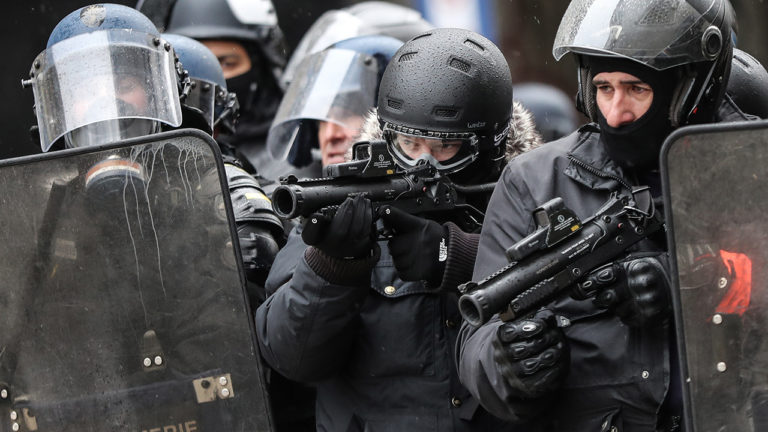
By Tim Kirby | Strategic Culture Foundation | May 2, 2019
The French marched off to war in 1914 in glorious lines of infantry in baby blue coats and bright red trousers to be mowed down by the finest technology the Industrial Revolution had to offer. For us now it is easy to see how insane this was and how flawed the understanding of both the commoners and even the experts was in terms of how combat and war actually worked at the time. This naive view of modern tactics certainly applies to street conflicts we are seeing in France as part of the Yellow Vest protests. The so-called non-lethal (and less-lethal) arms of the French authorities gives them a tactical advantage far beyond that of any assault rifle.
Thanks to the media we have become accustomed to video of protestors getting sprayed by water or having their ranks dispersed thanks to tear gas, leaving everyone wet or coughing respectively but otherwise unharmed. However this humane picture does not meet up with the realities of this civilian vs. cop style warfare.
If we are to take the Yellow Vest protestors at their word then at least 22 of them have lost an eye (from “less-lethal” Flash-ball guns) and 5 have had their hands blown off with 154 being “seriously injured”. Obviously the protestors will want to maximize their statistics but there are plenty of videos from the various actions/demonstrations showing horrible injuries which are too numerous to all be fakes. So the numbers may be off but the overall general tendencies of these injuries do occur from the French authorities in the Human Rights defending EU is a proven fact. The simple reality is that despite a nice marketing phrase non-lethal weapons cripple and on occasion kill.
In order to understand the tactical advantage that non-lethal weapons offer the government (not the individual police but the state itself) we need to put aside our emotional response to seeing French people having their limbs blown off. We have to not jump into ranting about the flagrant hypocrisy of the EU when it comes to human rights and rationally break down how the conflicts between Yellow and Blue vests could look if the arms situation were different.
Scenario A: What if the Yellow Vests were armed?
If the organizers of the Yellow Vests (all movements are organized by someone regardless of what the media tells you) were able to arm their masses with rifles this would indeed lead to horrific short-term violence that would leave a permanent stain on French history. Often hundreds or thousands of protestors are met by dozens of police and handfuls of soldiers, if the protestors were on par with their adversaries in terms of guns, then their numerical advantage would shatter the police’s will to fight.
No policemen are going to fight to the last man against a force 20 times their number, which they may partially agree with dying for nothing, nor will they open fire with tanks in the centers of their own cities. Human psychology would allow them to kill foreigners in some distant country in this manner but not at home.
In this instance of near certain death from pure numbers the police would either “stay home” or possibly switch sides overtly or covertly.
Obviously a full civil war could start from this situation, but in a street warfare sense, escalating from protest to actual hot war is technically a winning scenario as it advances them closer to attaining/changing power.
Scenario B: What if the police fought like an army?
One key component of many Color Revolutions is getting the “bad leader” to be blamed for some sort of direct use of lethal bloody media-friendly massacre. If the French police actually used assault rifles against the protestors this would demonize them to the point of justifying a Revolution. This would not just cause a civil conflict but be a national call to arms to join it, which would be a bad move on the state’s part.
Furthermore, only sociopaths can fire rifles into unarmed crowds (who are not posing a direct threat) of people who speak their own language (i.e. their own “kind”). If the French police just decided to give the order to shoot them all, then in this instance many of the French police would find rifle and bayonet worthless as they would have no desire to shoot.
The result would be a handful of deaths from each protest but the utter collapse of legitimacy of the state and possible “retreats” of police forces unwilling to fire on “their own”.
Scenario C: The “non-lethal” reality we see today.
Psychologically it is much easier for the French police to use non-lethal (in their minds) weapons against the protestors. In the subconscious mind of the policeman he can justify shooting into masses much easier with this type of weapon because in theory it “shouldn’t” kill anyone and if it does it was an “accident”. This is much easier on our psyche and morals than shooting someone in the chest with a Lebel Rifle.
Research by the University of Cambridge supports this tendency. They found that police are far more likely to use force when it is supposedly from non-lethal weapons. This non-lethal status of weapons like tasers (which can and do kill people all the time) makes them so much easier to apply on the populace especially when the subconscious of the police officer tells him that, the guy he fried the other day with a taser died as an accident, one in every so many thousand people just has a weak heart.
So looking at non-lethal weapons tactically they offer the massive psychological advantage of being able to attack without an attack registering in the conscience of the user. As stated above they are also very media and propaganda friendly when anyone who dies from them is just “an accident” giving the government the ability to retain legitimacy while gouging out they eyes of its own populace. Real guns fail at both of these points completely.
Conclusion:
One bizarre irony in our strange postmodern times is that if the Yellow Vests were actually being shot at by real guns and being killed they would be far closer to achieving some sort of systemic change. Being mutilated by all sorts of gadgets and devices of one sort or another makes it easy for the police to do their job psychologically without generating the levels of sympathy and horror from live rounds hitting the innocent that the protestors need to shatter or change the system.
The French Flash-Ball gun should be made the symbol for the EU for it provides crushing repression of the masses with great PR spin to make it seem humane and caring. It is for our safety after all that they use these right?
Yellow vest protests hit Strasbourg in sign of trouble for EU
Press TV – April 28, 2019
The “yellow vest” protests in France have spread to Strasbourg, the seat of the European Parliament, on the 24th consecutive weekend of a revolt which shows no sign of abating.
Thousands gathered near European Union institutions late Saturday, with organizers hoping to make the protest international a month ahead of EU-wide parliamentary elections.
Police fired tear gas to push back protesters trying to march on the European Parliament building and eyewitness footage showed arrests being made.
Authorities had banned protests and barricaded the neighborhood where the parliament and other EU institutions are located.
Protests were held elsewhere across France, coming two days after President Emmanuel Macron outlined policy proposals including tax cuts worth around 5 billion euros in response to the revolt.
The Interior Ministry said around 23,600 protesters took part in rallies across the country, including Paris, Lyon, Bordeaux, Dijon and Toulouse.
The protests, named after motorists’ high-visibility yellow jackets, began in November over fuel tax increases but morphed into a nationwide movement against government policies.
The yellow vests coalition includes numerous anti-Europe protesters, many of whom are calling for a ‘Frexit’, which would see France leave the EU.
Thousands of police and soldiers are drafted into the French capital every Saturday, when there is regular fighting and fires being lit.
The situation is now so extreme that vast areas of Paris – including the district around the Elysee Palace – are shut off every weekend.
The trouble has extended to other major cities, including Bordeaux and Toulouse, where hundreds have been arrested, or injured by police weapons ranging from flash ball rubber bullets to batons.
Macron has pledged more money for rural areas, but he is still regularly described as a “President of the Rich” who is primarily interested in supporting big businesses.
He has already scrapped wealth taxes, and made it far easier for companies to hire and fire employees.
Macron had originally planned to deliver a reform speech to the nation a week ago, but it was postponed because of the fire at Notre Dame Cathedral in Paris.
Some 1 billion euros has now been pledged for the rebuilding of the medieval place of worship – prompting the yellow vests to ask why other funds cannot be found to deal with their own grievances.
Featured Video
Trita Parsi: Iran War Ends Today? Threats of Deporting Trita Parsi
or go to
Aletho News Archives – Video-Images
From the Archives
Iran UN ambassador calls for destruction of all nuclear weapons
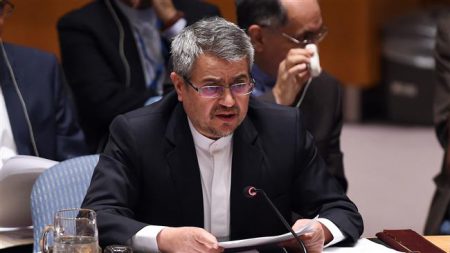
Iran’s ambassador to the UN Gholamali Khoshroo
Press TV – March 29, 2017
Iran’s ambassador to the UN Gholamali Khoshroo has called for the total eradication of nuclear weapons.
Khoshroo reiterated Iran’s call during a UN conference aimed at creating a nuclear weapons ban treaty in New York on Tuesday.
“Iran, as a victim of chemical weapons, strongly feels the danger posed by the existence of weapons of mass destruction and is determined to engage actively in international diplomatic efforts to save humanity from the menace of nuclear weapons,” he said.
Khoshroo stressed that Iran is committed to its Non-Proliferation Treaty (NPT) obligations, which include negotiations based on effective nuclear disarmament measures.
He added that several countries continue to ignore international calls and treaties for nuclear disarmament and even continue to increase their nuclear stockpiles. “They do not have political determination to abandon doctrines of nuclear deterrence and nuclear terror,” he went on to say.
Iran’s UN ambassador noted that boycotting the talks by many countries, including the US, shows that the world’s nuclear powers are by no means committed to the eradication of nuclear arms. Britain and France were also among the some 40 countries that did not join the talks.
“We note that prohibition of nuclear weapons must be accompanied by the elimination of such weapons. There can be no doubt that without complete abolition of nuclear weapons, there will be no absolute guarantee against the danger of nuclear war and the use of such weapons,” Khoshroo added.
Blog Roll
 Aletho News
- Trita Parsi: Iran War Ends Today? Threats of Deporting Trita Parsi
- What Is SIDS?
- DHS docs: Govt bracing for nationwide anti-AI riots, preparing to crack down on dissent
- India signals rethink over West Asia
- Israeli Ex-Navy Chief admits massive damage from Iran missiles
- The strategic arsenal US lost in war against Iran – and why replenishment will take years
- Documents Suggest Fauci Knew COVID Was Created in Wuhan Lab, and mRNA Vaccines Wouldn’t Work
- No return to pre-war status for Strait of Hormuz – Iran’s top diplomat
- Ex-South Korean President sentenced for trying to provoke conflict with Pyongyang
- US publishes docs on ‘dangerous’ Ukrainian biolabs
- If Americans Knew
- Israeli Firm Accused of Launching Smear Campaigns During US, European Elections
- As World Cup kicks off, Gaza amputee girls chase football dreams
- Oxfam: More Palestinians killed by Israel across West Bank in last 3 years than previous 17 years combined
- US-Iran ceasefire may be imminent, but will Israel blow it up? – Daily Update
- The Issue of Israel Is Ending Democracy In Michigan
- Israel is stealing homes, livelihoods, and lives in West Bank
- Gaza is not an aberration – Israel planned this genocide decades ago
- Israel is changing the face of Lebanon, mainstream media is normalizing it – 3 articles
- Genocide lobby benefits from EU anti-racist fund
- Watching the World Cup from Gaza
- No Tricks Zone
- New Study: Significant CO2 Fluxes From Non-Volcanic Sources Are Largely Neglected In Carbon Budgets
- Women Climate Scientists Being Harassed, Insulted By Skeptics, Claims Berkeley Earth Researcher
- Germany’s Longterm Spring Climate Data Show “No Climate Trend”
- New Study: Solar Photovoltaic, Wind Power Fail To Meet Annual Energy Demands 62% Of The Time
- Germany’s Die Welt: “Too Much Is Too Much” … Green Energies Are Cannabalizing Each Other!
- Germany’s Ecological Holocaust… Once Fairy Tale Forests Getting Cleared For Wind Turbines
- A Grand Solar Minimum Has Arrived…Global Cooling Of At Least 1°C Is Expected By The 2030s, 2040s
- European “Expert Commission” Urges COVID-19-Like Global Climate State Of Energency!
- Real-World Observations Do Not Support The Position That Climate Change Is Human-Caused
- Germany’s AfD Party Calls Debunked Climate Scenarios “Greatest Fraud In Human History”
 Aletho News