Saudi, French special forces hold joint drills near Lille: Report

French troops engage in joint drills with Saudi forces on the outskirts of the northeastern French city of Lille (Photo by alsharq.net.sa)
Press TV – October 12, 2016
Special Forces units with the Saudi and French armies have partaken in joint military drills in France.
The exercise engaged the Royal Saudi Land Forces’ crack unit brigade and its French counterpart in the town of Meer, London-based Al-Hayat newspaper reported on Wednesday.
Citing the official Saudi Press Agency (SPA ), the paper said the maneuvers had started last week.
The news comes only three days after the kingdom’s navy finished 10 days of live-fire military exercises in the Persian Gulf, the Sea of Oman and the Strait of Hormuz.
The seaborne drills involved warships, speedboats, marines and special forces in the strategic waters.
The SPA alleged that the maneuvers sought to test combat readiness “in preparation for the protection of the marine interests of the Kingdom of Saudi Arabia against any possible aggression.”
France is known for its close relations with Saudi Arabia. The two sides have been seeking to boost their military ties in recent months.
Saudi Crown Prince Mohammad bin Salman, the kingdom’s defense minister and most powerful figure after the monarch, has twice traveled to France since 2015.
During Salman’s visit to France last June, Paris and Riyadh reportedly sealed military deals worth up to USD 12 billion for the delivery of modern weaponry to the Arab kingdom amid Riyadh’s deadly military campaign against Yemen.
The prince paid another visit to France in July this year, in what was widely seen as an attempt to finalize the agreements reached with Paris the previous year.
Last year, the Paris government raised controversy by closing off a French beach for a visit by Saudi King Salman.
Putin: We know who destroyed aid convoy in Aleppo, Syria
RT | October 12, 2016
The attack on a UN humanitarian aid convoy near the Syrian city of Aleppo last month, which Washington has blamed on Russia, was actually carried out by one of the terrorist groups present in the area, Russian President Vladimir Putin has said.
“It was one of the terrorist groups. And we know that, say, the Americans know it too, but prefer to take a different position, to falsely accuse Russia. This is not helping,” Putin said at an economic forum in Moscow.
The aid convoy was attacked on the night of September 20. The International Committee of the Red Cross reported 20 civilians killed and 18 vehicles destroyed.
The Pentagon alleged that the convoy was destroyed from the air and that Russian warplanes were present in the area, concluding that it was a Russian strike that was responsible.
Russia denied the accusation and said a US drone was monitoring the convoy, so Washington should know the truth about the attack.
Putin also commented on the disagreement at the UN Security Council that eventually led to the cancellation of his visit to France. Paris indicated that it wouldn’t be comfortable hosting the Russian leader after Moscow blocked a resolution it had submitted.
“It’s not our partners who should take offense over us vetoing the French resolution. I’d say we are the offended party here,” Putin said.
He said French Foreign Minister Jean-Marc Ayrault had raised the idea of the resolution when he visited Moscow last week. Ayrault was told the draft pinned too much blame for the Aleppo violence on the Syrian government, but that if France made some amendments, the document could still pass.
However, as Ayrault visited Washington on the eve of the UNSC meeting, no changes were made to the draft and France also “accused Russia of all the deadly sins,” Putin said.
“Knowing our position, and not discussing it with us, they didn’t chuck in the resolution so it would pass, but [did it] to get the veto. What for? To exacerbate the situation and to whip up anti-Russian hysteria in media under their control, and to deceive their own citizens,” he added.
The situation in Syria will be discussed on Saturday in Lausanne, Switzerland, where top diplomats from the US, Russia, Iran, Turkey and Saudi Arabia are to gather for a meeting.
US, Britain and France now air force for terrorists in Syria
By Finian Cunningham | RT | October 9, 2016
For nearly six years, Washington and its allies have gotten away with playing a cynical double game in Syria’s war. But now the mask is slipping to reveal the ugly face of Western involvement – it is openly siding with terrorists.
Russia was correct to veto a French-sponsored draft resolution at the UN Security Council this weekend. Along with American and British vigorous support, the French proposal centered on halting military flights over the besieged northern Syrian city of Aleppo.
As Russia’s foreign ministry commented, the French initiative was tantamount to giving air cover for insurgents dominated by the internationally proscribed terrorist group Jabhat al Nusra. In short, a no-fly zone protecting terrorists would have been imposed in violation of Syrian sovereign rights, as well as international law.
An alternative draft resolution put forward by Russia was subsequently nixed by the US, Britain and France. The Russian proposal was aimed at reviving the ceasefire arrangement declared last month by US Secretary of State John Kerry and Moscow’s Foreign Minister Sergey Lavrov. It reiterated the need for anti-government militants to dissociate from the proscribed terrorist groups affiliated with al Qaeda, including al Nusra and Daesh (ISIS).
Russia is calling for a general ceasefire, but it does not specify the condition of halting military flights over Aleppo.
If France and its Western allies were genuine about wanting to stop the violence, then why don’t they get behind the Kerry-Lavrov deal? They have evidently abandoned that ceasefire arrangement because it was exposing Western claims about supporting “moderate rebels” as distinct from “extremists” as a fallacy.
That the Kerry-Lavrov truce was immediately violated by the insurgents and that there was no separation of “moderates” and “extremists” showed once and for all that Western claims of supporting “legitimate rebels” are a farce. Washington, London and Paris are patently backing a terrorist army fighting for their objective of regime change in Syria.
Since Syria and its Russian ally resumed offensive operations to take the key battleground city of Aleppo on September 22, the Western sponsors of the terror proxies have become increasingly shrill in a media campaign to thwart that offensive.
America, Britain and France have decried “war crimes” allegedly committed by Syrian and Russian air strikes. John Kerry, ahead of the weekend spat at the UN, called for a probe into suspected war crimes attributed to Russia.
Western media have been saturated with unverified reports from the militant-held eastern Aleppo purporting to show Syrian and Russian air strikes on civilian centers, including hospitals. Much of the information coming out of eastern Aleppo is sourced from Western-funded“activists” who are embedded with the Nusra terrorists. Tellingly, Western media and governments are in effect peddling what is terrorist propaganda.
The Russian and Syrian governments deny Western claims. They say their military operations are targeting terrorist groups that are deliberately using the 250,000 civilian population in east Aleppo as human shields.
It is significant that the more the Syrian army and its allies among Iranian, Lebanese and Iraqi militia, as well as Russian air support, make advances to retake Aleppo, the more hysterical Western governments and media become about “war crimes”.
If we start from the premise that the conflict in Syria has from the outset been a Western-orchestrated covert war for regime change involving the sponsoring of a terrorist mercenary army, then the Western hysteria over Aleppo is perfectly understandable.
A defeat for the insurgents in Aleppo means the end of the Western criminal enterprise to install a pro-Western puppet regime in Syria. That would mark a historic blow to the prestige of Washington and its European allies in the Middle East. It would also further expose their criminal complicity.
By contrast, Russian influence in the strategic region would be elevated. And for good reasons too. Moscow will be seen as having stood by a sovereign nation to vanquish Western powers who have wreaked havoc in the region with illegal wars and regime-change subterfuges.
Given the high stakes, this is why Western powers are evidently becoming more desperate to impede Syrian and Russian military success against the insurgents. Western emotive denunciations against Syria and Russia have nothing to do with concern for human suffering. It is all about contriving a moralistic political pressure to hamper the campaign against the West’s terrorist project.
Seen in this context, French calls at the UN for a no-fly zone around Aleppo is a startling admission by the Western powers that they are trying to protect terrorist al Qaeda-affiliated organizations. It is a stunning revelation of the fraudulent and criminal nature of Western governments. Their claims of “fighting terrorism” which have justified overseas wars over the past 15 years are self-evidently bogus. Their claims of supporting a “pro-democracy uprising” in Syria are grotesque.
This giant fraud has, of course, been made possible because Western media corporations have gone along with the vile charade. These media organizations are equally complicit. Giving succor to war crimes is in itself a war crime, as international attorney Christoper Black points out.
Meanwhile, away from Aleppo and the Western distortion of what is happening there, the alternative media report that the US-led military coalition is destroying bridges on the Euphrates in the eastern province of Deir ez-Zor.
According to the Syrian Free Press and others, American air strikes have demolished seven major river crossings over the past week. The latest strike was on the al Syasia bridge north of the city of Deir ez-Zor, the largest bridge in the province.
Targeting civilian infrastructure is a war crime. It will prevent humanitarian aid convoys reaching civilians in government-held Deir ez-Zor. But more significantly, the US, French and British coalition – which is operating illegally in Syria in the first place – is working to block the Syrian army and Russian offensive against the Daesh terror stronghold of Raqqa. The bridges knocked out were providing key linkages for the Syrian and Russian forces from Deir ez-Zor towards Raqqa.
The US-led air strikes also give full meaning to the deadly American attack on the Syrian army base at Deir ez-Zor on September 17. Over 60 Syrian troops and nearly 200 more were wounded when US, British and Australian warplanes blasted the base in a sustained attack. Washington claimed it was an “accident”.
But to many other observers, the massacre was no accident. It was a deliberate assault by the Western coalition to end the Kerry-Lavrov pact because the failing ceasefire was exposing the systematic terror connections of the Western governments in Syria.
Washington and its allies are not just trying to give air cover to the terrorists in Syria indirectly by setting up so-called no-fly zones. They are evidently now giving the terrorists air fire-power.
As in the NATO regime-change war in Libya in 2011, the Americans, French and British are riding shotgun in the air for terrorists on the ground.
And the truly disgusting thing about this criminal collusion is that the Western powers claim to be concerned about international law, war crimes and human suffering.
Read more:
Rival resolutions on Syria sponsored by Russia & France fail at UNSC
No UNSC consensus on Syria
The BRICS Post | October 9, 2016
Russian Permanent Representative to the UN Vitaly Churkin said on Sunday that Moscow hopes to continue working with the International Syria Support Group (ISSG) to end the conflict in Syria.
“I want to assure you that very difficult work continues both in multilateral and bilateral formats, and we still hope that the situation in Syria will be normalized, and that it will have a very favorable effect on the state of affairs in east Aleppo. We hope that this will happen as soon as possible,” Churkin said in a response to fears voiced that the ISSG may be collapsing.
Churkin’s statement came just hours after Russia vetoed down a French-proposed UN resolution on Syria, saying that it would empower Islamist rebels such as Al-Qaeda groups in Aleppo and give them freedom of movement.
The French draft had called for a complete end to aerial bombardment and oveflights of Russian and Syrian war craft over Aleppo.
China abstained on voting on this resolution.
The Russian Foreign Ministry strongly criticized the wording of the French draft.
“The text (of the resolution) indulged by Washington and submitted (to the UN Security Council) immediately after the United States had refused to implement the Russian-US agreements on the Syria settlement, has grossly distorted the actual state of affairs and was of a politicized, unbalanced and one-sided nature,” it said in a statement.
A Russian counter resolution, which the Kremlin says was an attempt to compromise and avoid splitting the 15-member body, was also rejected in the Security Council.
The UK ambassador to the UN criticized Russia’s veto. Matthew Rycroft said that it appeared Russia preferred to allow the misery of Aleppo civilians to continue.
J’Accuse – French Condemnations of Russia in Syria Beyond Cynical
By Finian CUNNINGHAM | Strategic Culture Foundation | 07.10.2016
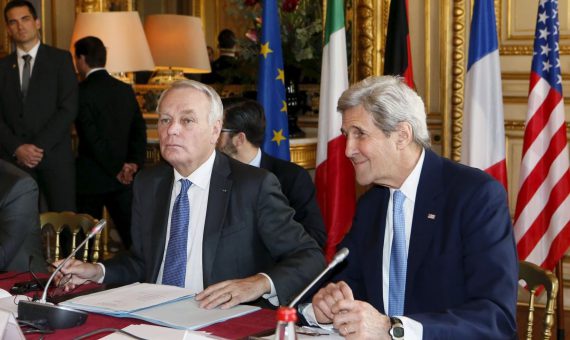
French Foreign Minister Jean-Marc Ayrault worked up his frequent-flyer air miles account this week with consecutive flights to Moscow then to Washington in a bid to push through a UN Security Resolution for a new ceasefire in Syria.
Ayrault began his shuttle diplomacy with stern condemnation of the Syrian government for what he said were «war crimes» committed in the besieged city of Aleppo. The French minister also implied Russian complicity in the same alleged crimes. It wasn’t the first time he made such accusations against Russia and its Syrian ally.
When the ceasefire brokered by US Secretary of State John Kerry and Russia’s Foreign Minister Sergey Lavrov broke down at the end of last month, it was Ayrault who led vociferous denunciations at the UN, along with American UN ambassador Samantha Power, blaming Russia for «barbarous crimes against humanity».
This week on his way to Moscow, Ayrault accused Russia of «cynicism that is fooling nobody» in reference to the renewed Russian-backed offensive by Syrian state forces to recapture the militant-held eastern quarter of Aleppo. That part of the city housing about 250,000 people has been under the control of various Islamist militants dominated by the terrorist group Al Nusra Front since 2012.
France, the US and Britain, amplified by the Western news media, have been conducting a relentless campaign to portray the Russian-backed Syrian operation on Aleppo as criminal and brutally injurious to the civilian population. Since the ceasefire collapsed during the last week of September, the Western media have been saturated with unverified claims of Russian air strikes killing civilians in eastern Aleppo and of targeting hospitals and humanitarian aid facilities.
France 24, the state-owned broadcaster of Ayrault’s country, never gives any reports from the Syrian government-held quarters of Aleppo where the majority of citizens – some 1.5 million – are residing. These areas are routinely shelled by the militants, with hundreds of victims over the past few weeks. Yet, France 24 and the other Western media outlets appear to operate on the basis that the majority of Aleppo’s population simply does not exist.
Nor do the Western media report that the majority of Aleppo’s civilians are willingly residing in the government-held districts out of seeking protection from the Islamist militants. Moreover, neither is it reported that the mainstay of the 250,000 civilians in eastern Aleppo are being held there against their will by the militants as hostages, or human shields. They can’t flee out of fear that remaining family relatives will be murdered in retribution.
The evidently selective humanitarian concern expressed by the French foreign minister and his Western counterparts for the people of Aleppo begins to alert one of a more nuanced – dare we say cynical – agenda.
Claims of Russian and Syrian «war crimes» made by Ayrault and other Western officials are based on «rebel sources» within besieged eastern Aleppo. One of the primary sources is the so-called «volunteer aid» group known as the White Helmets. Video footage purporting to show the aftermath of Russian air strikes is routinely aired by France 24 and other Western channels with the White Helmets logo displayed. It is presented as a bona fide humanitarian agency, when it fact the group is funded by US and British governments to the tune of $23 million and is embedded with the Al Nusra terrorist-controlled Aleppo Media Center. In short, a terrorist propaganda outlet, which serves to feed Western media and government ministers with disinformation that is purveyed to the Western public in order to discredit and demonize Syria and Russian forces.
French diplomats told Reuters this week that France is drafting its proposed resolution to the UN Security Council in such a way that Russia would have to exercise its veto if it is to block it. In that way, the French purpose is to project Russia as an unreasonable member of the Security Council and a stalwart backer of the Syrian «regime». This amounts to more cynical Western attempts to traduce Russia and Syria as the perpetrators for the ongoing violence.
Russia is unlikely to support the French-sponsored resolution because the resolution is impossibly one-sided and belies a political objective of undermining Syria and Russia. France is calling for an immediate cessation of fighting in Aleppo, including no military flights over the city; and, secondly, for the complete humanitarian aid access to eastern Aleppo.
This French initiative – under the guise of urgent humanitarianism – is a de facto «no fly zone» that will bolster the fighting capability of the anti-government insurgents, which, as noted, are dominated by al-Qaeda-affiliated terror groups.
When Russia and Syrian forces agreed to the ceasefire declared earlier on September 12, they did so on the strict condition that militants not associating with terrorist brigades would henceforth separate physical units. But no such separation occurred, as many observers had predicted, because Western government claims of «moderate rebels» being interspersed with «extremists» are nothing but a cynical charade. All these militants belong to the same terrorist front which Western governments have been arming in a covert war for regime change against President Bashar al-Assad – a longtime ally of Russia and Iran.
The only parties to respect the ceasefire called by Kerry and Lavrov last month were the Syrian army and its allies among the Iranian and Hezbollah militias, as well as the Russian air force. The foreign-backed militants continued to carry out hundreds of breaches of the truce, while also using the initial reduction of operations by the Syrian and Russian forces as an opportunity to regroup and rearm.
What French minister Ayrault is calling for in a renewed ceasefire this week is merely a repeat of the previous one – this time without even a pretense that the terrorists might separate into «moderates» and «extremists».
French and Western anxiety to implement some kind of cessation around Aleppo is correlated with the increasingly desperate, losing situation for the regime-change insurgents. Aleppo is a key battleground. If the Syrian and Russian forces manage to vanquish this bastion for the militants then the six-year war in Syria will be over.
The Western sponsors of the covert war in Syria stand to incur a huge strategic defeat. It should be also noted that 66-year-old Jean-Marc Ayrault was previously French prime minister back in 2012, at the very time that France was beginning to covertly supply weapons to illegally armed groups in Syria – in contravention of a European Union embargo.
This is why Ayrault and his American and British allies are now assiduously piling the political pressure on Russia to desist from its offensive in Syria. The Western sponsors are desperately trying to salvage their proxy assets on the ground and to salvage their criminal regime-change project – using the language and emotion of humanitarian concern and legal niceties.
You can’t get much more cynical than that. Now Monsieur Ayrault, just who is accusing who of what?
Terror and Totalitarian Powers: When Will the French State of Emergency End?
By Steven MacMillan – New Eastern Outlook – 01.10.2016
Another day; another terrorist attack: it seems that every day I wake up at the minute there is a new terrorist attack that has shook the European continent, with France being the scene of frequent attacks over the past 19 months. The most recent attack in France (at the time of writing anyway) was on a church in Saint-Étienne-du-Rouvray, Normandy, reportedly carried out by two so-called Islamic State (ISIS) terrorists.
One of the assailants is believed to be Adel Kermiche, an individual who was well known to the French authorities. Kermiche was being monitored by police and was wearing an electronic tag at the time of attack, after being arrested twice last year trying to reach Syria to fight for ISIS. The second attacker is reported to be 19-year-old Abdel Malik Petitjean, an individual who was also known to French authorities and was on a terror watch list after trying to enter Syria via Turkey in June.
This came shortly after the Nice attack on the 14th of July, when a truck was driven into crowds celebrating Bastille Day, killing 84 people and injuring over 300. The attack was reportedly carried out by Mohamed Lahouaiej-Bouhlel, a Tunisian-born delivery driver who was living in France, with ISIS claiming responsibility for the attack. Similar to many other purported terrorist attackers, Bouhlel was shot dead by police before any questions could be asked. Multiple other individuals have also been arrested in relation to the incident.
More to the Official Story?
With the frequency of terror attacks in Europe, there is often a temptation by many who claim to be in the independent media not to ask logical questions and challenge the official narrative in relation to these incidents. There are multiple suspicious elements regarding the official narrative of the Nice attack, which deserve to be highlighted for those interested in uncovering the truth.
As Paul Craig Roberts has reported, the French anti-terrorist police have ordered the authorities in Nice to delete the CCTV footage which recorded the attack. This of course raises some serious questions about what the anti-terrorist police are trying to cover up, and why they are pressuring the authorities to memory-hole such crucial evidence. Roberts has also raised questions regarding the lack of blood in many of the photos of the supposed attack.
Secondly, the officer in charge of Nice’s CCTV control room at the time of the incident, Sandra Bertin, recently revealed that she was “harassed” by an official from the Interior Ministry to alter her report on the attack by adding in the presence of local and national police at the scene. According to Bertin, the official “ordered” her “to put in (the report) the specific positions of the national police” that she “had not seen on the screen.” Did the police have prior knowledge of the attack? Is that why they weren’t at the scene?
Thirdly, the cousin of Bouhlel’s ex-wife has revealed that the reported attacker drank alcohol, ate pork, took drugs and didn’t pray – all strange things for a supposed Muslim extremist to do. Bouhlel also suffered from depression and has had a history of mental health problems. If Bouhlel doesn’t sound like a patsy to you, I don’t know who does.
The fourth suspicious element of the attack was the timing. France has been in a state of emergency since the Paris attacks of November, 2015, with armed troops patrolling the streets. On the 21st of July, French lawmakers voted to extend the state of emergency until the end of January, 2017 – with the emergency powers including giving the authorities the ability to conduct searches without a court authorization, in addition to increasing digital surveillance of phones and computers.
Interestingly, the French President, François Hollande, had planned to lift the state of emergency on the 26th of July. With the Nice attack on the 14th however, the government had no problems passing the extension, with the recent attack on the church ensuring there would be no questions raised on the excessive powers given to the government.
Supporting Terror Externally; Produces Terror Internally
France has played a pivotal role in the destabilization of Syria, through their support for the Syrian rebels who are comprised of extremists and terrorists. Hollande admitted that France delivered weapons – including cannons, machine guns, rocket launchers and anti-tank missiles – to the opposition in 2012. France has also been funding the rebels in Syria, delivering vast amounts of cash that is then used to buy weapons and ammunition.
Hollande has been a vocal proponent of overthrowing Bashar al-Assad, stating as recently as September of last year that “Assad is the origin of this problem, and cannot be part of the solution.” Imagine if Assad had been overthrown at the end of 2015, Syria would be completely handed over to ISIS and other similar terrorist forces, exacerbating the threat for terrorism and the refugee problem even more.
If France (and the wider West) had not pumped arms and money into the Syrian opposition, there is no chance that ISIS would be at the level it is (supposedly) at today. The wave of terror that has hit Europe is a direct result of Western foreign policy, with the 19 months of terror in France starting with an attack carried out by terrorists who had just returned from fighting in Syria. That is even if we accept the official story on Charlie Hebdo, considering the fact that one of the police commissioners involved in investigating the attacks suspiciously committed suicide shortly before his report was going to be released on the incident.
Suicidal Policies of the French State
France’s involvement in funding and arming terrorists in Syria is particularly suicidal for the country, considering the fact that France has a large Muslim population, high rates of unemployment in predominately Muslim areas, increasing levels of discrimination against Muslims, in addition to hardly having a shortage of people with a deep hatred of France’s colonial past. Even if we accept (for a moment) the official story of all the terror attacks on French soil in the last 19 months, the government has created the perfect climate for young, disenfranchised men to be radicalized by a group that France helped to empower in the first place.
With the emergency powers extended into 2017, France could very possibly be in a state of emergency up until the presidential election in April and May of 2017. Is there a chance that the election could be delayed if (or when) more terror attacks take place in the country? Will the spate of terror attacks increase the chances that Marine Le Pen will win the election? Is France really on the brink of civil war? Only time will tell, but one thing is for sure: any semblance of liberté is increasingly becoming impossible to find in France.
Syria’s Heroic Fight Against Western Imperialism
By Andre Vltchek – New Eastern Outlook – 01.10.2016
It is hard to imagine a more resilient, more heroic nation than Syria!
With only 17 million inhabitants (according to the 2014 estimate), Syria is now facing the mightiest coalition on Earth – a coalition that consists of virtually all traditional Western colonialist and neo-colonialist nations.
It is also facing some of the cruelest and deadliest inventions of the West – the extremist and murderous post- and pseudo-Islamic groupings, similar to those that were already unleashed against the Soviet Union during the war in Afghanistan.
Because of the tremendous determination of its people, Syria is still standing! But it is standing against all odds. Its Golan Heights are illegally occupied by Israel, its borders constantly violated by the Turkish military, and by the West’s ‘special forces’ and air force.
Syria’s “political opposition” was created, then groomed and financed by the United States and Europe, in the style of “Color Revolutions”, as has happened in all other socialist countries that the West has been trying to destabilize and return under its deadly rule. Millions of Syrian people have been, during the last six deadly years, terrorized, slaughtered and intimidated by jihadi cadres, implanted by the West and its regional allies: Saudi Arabia, Turkey, Qatar, Israel and others.
It is a terrible and uneven fight! Some of the greatest historical cities on Earth, like Aleppo and Palmira, now lie in ruins and ashes. What the European Christian crusaders failed to fully destroy, is now collapsing under the imperialist onslaught. Like everywhere else on Earth, everything that dares to struggle against Western colonialism is being consistently devastated and burned. Almost everyone who resists is mercilessly slaughtered. Hundreds of thousands of Syrian people have already lost their lives. And with each new day, the awful count is rising.
But Syria is standing!
5 million Syrian people have already been forced to leave their country. Now they are being scattered all over the Middle East: throughout Lebanon, Jordan, Iraq, Egypt, and Turkey. Some have even gone as far as Europe, Canada and Chile.
How much more can one country endure?
And how can the rest of the world just stand by and watch as it is put through hell?
The answer is obvious: the rest of the world does not know; it does not understand! The propaganda coming out of the Western mass media outlets and indoctrination-spreading institutions is so thorough, so professional, that to most people all over the world everything related to Syria appears to be blurry, murky, and incredibly complex. President al-Assad is demonized on a daily basis. Heroic resistance is called the “regime’s brutal actions”, pro-western terror groups are described as “moderate opposition.”
In reality, Syria is suffering because it is refusing to kneel; because it is unwilling to prostitute itself; because it will never beg its torturers to stop, allowing them to grab everything above and under the surface.
The Empire never forgives disobedience. Its fundamentalist terror methods are the most brutal ever invented and implemented on Earth.
All around Syria, countries already lie in ashes. The Middle East hardly exists, anymore. And most of the Syrian people understand: it is perhaps better to die standing, than to live in shackles, on one’s knees, controlled by the kleptomaniacal Western colonialist states!
*
The more terrible the terror that the West is spreading worldwide in general and in this part of the world in particular, the more vicious its vitriolic propaganda is, the brainwashing indoctrination that flows incessantly from London, New York and Paris.
If one watches the BBC, there is no hint of objectivity left, anymore. The ranks are closed and the West is united in its final drive to discredit absolutely everything that is still fighting for survival, against its global terrorist exploits.
President al-Assad of Syria, the heroic Syrian army and the closest Syria’s allies – Russia and Iran – are being relentlessly demonized, as if it were them who began that monstrous war! And Hezbollah, which is fighting countless epic battles against the ISIS, sits firmly on the West’s terrorist list.
Everything seems to be twisted and perverted, upside down.
But what really should one expect from the expansionist hordes, from the bastions of imperialism? Or has the British (or French) propaganda been any different, when their colonialist countries have for centuries been grabbing and devastating countless foreign states and territories, slaughtering hundreds of millions of innocent people? Wasn’t anyone who resisted Western conquest always thoroughly ridiculed and demonized?
Countries like UK, France, Germany, Belgium, Holland, Spain, Portugal and others, have centuries of experience in how to humiliate victims, how to justify their own heinous acts, how to brainwash their own populations and even some of their victims! And the United States, the direct product of Europe, its muscular offspring, is just using the same, only a bit more vulgar, propaganda tactics.
Nothing rational and objective can be expected from the people of Europe or North America, anymore. Except for a few of those insignificant protests and rebellious acts, the Western population is in a total slumber, indifferent towards the horrors that are being administered by its regime all over the globe. There is hardly any pressure to stop acts of terror against Syria. The only thing that seems to matter to Europeans is how to stop the flow of refugees from the devastated countries.
What a shame! What a thorough shame, people of Europe and North America! Your regime is murdering millions, in one country after another, and you are not even capable of recognizing what goes on… instead you are blaming the victims and those rushing to their rescue!
Now your biggest enemy is Russia. Because Russia (same as China) is clearly unwilling to dance to your fatal tune! Because Russia, for many decades, stood by almost all oppressed countries, and supported the de-colonization of the world, in all of its corners. Like China, Cuba and North Korea have always done.
Russia is now defending Syria. Not because it needs natural resources, not because it wants to plunder. It is doing so simply because it is right thing to do. It does it because if the world is abandoned fully to Western imperialism, there will actually soon be no world at all, or at least there will be no world worth inhabiting!
*
“Our country is a socialist country. For us it’s more important to consider the benefits to the entire nation than to particular individuals. I have spent more than 50 years dedicating my life to education, which is the backbone of our country, especially now… Sometimes I feel like quitting my job and returning to teaching at Damascus University, but I know that I am still needed where I am now,” I was told by Dr. Farah Motlak, Deputy Minister of Education of the Syrian Arab Republic.
We met in Cairo, Egypt, at a regional conference. I asked him about the Western propaganda against his country. He replied, shaking his head:
“I am not even angry… I am just endlessly sad. The media attacks; the propaganda that is pouring from the West is clearly designed to destroy our country. But we have hope, and we will continue our struggle.”
The international meetings and conferences clearly show how divided even the Arab world is itself. Syria is a symbol. To some, it is a symbol of resilience, of heroism. To others, mainly to those who are funded and consequently conditioned by the West, it represents everything that is evil.
*
But Egypt itself (where I’m writing this essay), just three years after the pro-Western military coup, is in ruins. Economically it has become a basket case. It is completely devastated, socially.
Of course its destruction is on a “lighter scale”, compared to Iraq, Libya or Yemen. But it is still bad enough: during the coup in 2013, at least 1,000 but most likely 2,000 people were murdered by the junta, while tens of thousands were injured. An estimated 10,000 people are now in prisons all over the country; most of them in terrible conditions; many are being tortured, women prisoners are habitually raped.
“The counter revolution has triumphed,” explained Dr. Mohammed Shafik, a member of the Revolutionary Socialist Movement. “All opposition parties and organizations have been squashed. Thousands of revolutionaries have been imprisoned; hundreds executed by court orders or liquidated by the police… Neoliberalism is taking hold… people are suffering.”
But Western propaganda shows no appetite for criticizing the Egyptian military junta. It is, after all, essentially pro-Western; it is capitalist and to a great extent it is submissive to the Empire and to its allies, including Israel and Saudi Arabia.
As with almost all ‘client’ states of the West, Egypt will never be able to truly improve the lives of the majority of its citizens. The country is already stuck deeply and has been, for decades, in a perpetual social slumber. Those benefiting from the situation are the Western powers and their regional allies, as well as the servile Egyptian elites and the grotesquely colossal, omnipotent military.
If Syria were to surrender, the Egyptian scenario would be ‘the best’ it could hope for. But most likely, it would meet the terrible fate of Iraq or Libya.
*
62 Syrian soldiers were reported killed in a U.S.-led coalition airstrike on the Syrian military base Deir el-Zour, on September 17, in Eastern Syria.
The planes destroyed the base housing soldiers that were involved in a battle with ISIS. Almost immediately, the ISIS took over the hill and the area, in what appeared to be a clearly coordinated operation between the West and the “Islamic State”, against the Syrian government forces.
A few days later, a humanitarian convoy was hit near the city of Aleppo. Without presenting any evidence, the West immediately pointed a finger at the Syrian government and Russia. But the Russian Ministry of Defense released images of a US predator drone operating in the area during the attack, and called for a thorough investigation.
The war goes on. The suffering of Syrian people continues.
There is one simple point that is being constantly overlooked by the West:
The legitimate government of Syria invited Russia, its close ally. It asked Moscow for help, to fight ISIS and other terrorist groups implanted by the West and its allies.
Nobody invited the West!
Or perhaps those groups that the West itself created and supported inside Syria invited it?
Both Syrian government forces and Russia are fighting brutal foreign invaders who are attempting to destroy one of the oldest nations on Earth and take control over the entire Middle East.
Syria is at the frontline of the battle against Western imperialism. And so is Russia. And also Iran, while China is joining!
The sacrifice made by the Syrian people is tremendous. But against all odds, the deadly advance of the imperialists may be stopped here, after all.
As I wrote earlier, the price may be terrible. Aleppo is turning into the Middle-Eastern Stalingrad. But the heroic Syrian nation has made its choice: it will fight brutal and barbaric invaders, as it fought the crusaders under the leadership of great Sultan Saladin.
The alternative would be slavery, something unacceptable for the Syrian people!
French mayor wants to kick all terror list suspects out of town
RT | September 23, 2016
A mayor of the French town of Évreux has come up with a radical suggestion to evict all the potentially dangerous individuals tracked by police out of town. The proposal comes after the official’s request to reveal the names on the watchlist had been rejected.
Guy Lefranc, the head of the town, located in Normandy, says he initially demanded information on all the people on the “Fiche S” list living in Évreux. The “Fiche S” is an indicator used by French police to mark people considered to be a threat to national security.
Lefranc contacted the local prefect, saying that the safety of the town’s residents was at stake and having such information at his disposal would help to tighten security. The mayor’s request, however, was turned down.
Shooting down mayor’s “perfectly legitimate request” led him to making his radical suggestion on the eviction of all dangerous individuals.
“I am furious,” the mayor told AFP on Thursday.
“Given that the state does not give us the means to protect the people of Evreux, I demand the state expels all those who are “Fiche S”. I feel compelled to ask for this expulsion because I am not entitled to a perfectly legitimate request to know all those who “Fiche S” are,” mayor Lefranc said.
The mayor even said that since he was deprived of this vital intelligence he could not really trust other public servants and officials.
“I ask myself a question about some of my staff, who work with the public. I don’t know if they are “Fiche S”, I don’t know if they are dangerous,” the mayor said.
Lefranc noted that due to the current state of emergency it was the prime minister’s responsibility to issue a decree giving local mayors access to “Fiche S” files.
Following the November 2015 Paris terrorist attacks, French Prime Minister Manuel Valls stated that there were some 20,000 people in France flagged “Fiche S.” Roughly half of them were connected to various Islamist movements.
Many, but not all of the jihadists, who have participated in numerous attacks in France had their names on the watchlist, so their potential threat was known to the intelligence services. Arrests of a “Fiche S” flagged woman allegedly planning an attack in Paris and a man allegedly connected to Brussels attacks in Belgium appear to somehow support Lefranc’s point.
The recent murder of a French priest in Normandy by two jihadists known to authorities also fertilized growing anger, fear and frustration in the French society, with some blaming security forces not taking action. Presidential candidate Nicolas Sarkozy said last year he would put anyone with a “Fiche S” file under house arrest and give them an electronic tag. Since then he has gone even further and proposed to simply put all suspected terrorists behind bars. Several calls for establishing a “French Guantanamo” to house all the terror suspects, however, have been shot down by the current government, since it would violate human rights.
The Façade of “Humanitarian Intentions” in Libya
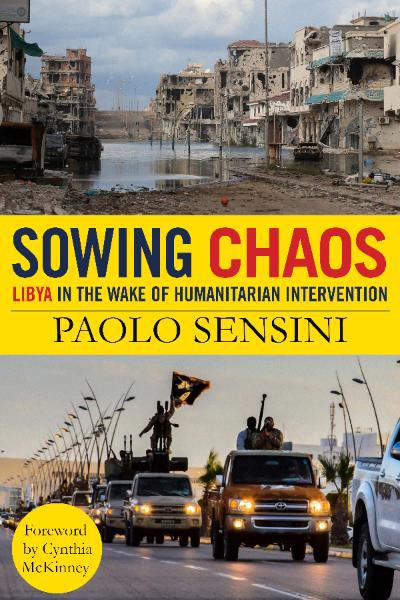
Review of Paolo Sensini’s book, Sowing Chaos: Libya in the Wake of Humanitarian Intervention
By Edward Curtin | Global Research | August 10, 2016
It is rare for a historian to write a history of a significant issue and bring it into the present time; even rarer when the work coincides with the reemergence of that issue on the world stage. Paolo Sensini has done just that with Sowing Chaos: Libya in the Wake of Humanitarian Intervention (Clarity Press, 2016). It is a revelatory historical analysis of the exploitation and invasion of Libya by colonial and imperialistic powers for more than a century.
It is also timely since the western powers, led by the United States, have once again invaded Libya (2011), overthrown its government, and are in the process (2016) of creating further chaos and destruction by bombing the country for the benefit of western elites under the pretext of humanitarian concern.
 As with the history of many countries off the radar of western consciousness, Libyan history is a tragic tale of what happens when a country dares assert its right to independence – it is destroyed by violent attack, financial subterfuge, or both.
Although an Italian and Italy has a long history of exploiting Libya, a close neighbor, Sensini stands with the victims of colonial and imperial savagery. Not an armchair historian, he traveled to Libya during the 2011 war to see for himself what was true. Despite his moral stand against western aggression, his historical accuracy is unerring and his sourcing impeccable. For 234 pages of text, he provides 481 endnotes, including such fine sources as Peter Dale Scott, Patrick Cockburn, Michel Chossudovsky, Pepe Escobar, and Robert Parry, to name but a few better known names.
His account begins with Italy’s 1911 war against Libya that “Francesco Saverio Nitti charmingly described …. as the taking of a ‘sandbox’.” The war was accompanied by a popular song, “Tripoli, bel suol d’amore” (Tripoli, beauteous land of love). Even in those days war and love were synonymous in the eyes of aggressors.
This war went on until 1932 when the Sanusis’s resistance was finally crushed by Mussolini. First Italy conquered the Ottoman Turks, who controlled western Libya (Tripolitania); then the Sanusis, a Sunni Islamic mystical militant brotherhood, who controlled eastern Libya (Cyrenaica). This Italian war of imperial aggression lasted 19 years, and, as Sensini writes, “was hardly noticed in Italy.”
I cannot help but think of the U.S. wars against Afghanistan and Iraq that are in their 15th and 13th years respectively, and counting; they are not making a ripple on the placid indifference of the American people.
Sensini presents this history clearly and succinctly. Most of the book is devoted to the period following the 1968 overthrow of King Idris by the Free Unionist Officers, led by the 27 year old captain Mu’ammar Gaddafi. This bloodless coup d’état by military officers, who had all risen from the poorer classes, was called “Operation Jerusalem” to honor the Palestinian liberation movement. The new government, The Revolutionary Command Council (RCC), had “three key themes …. ‘freedom, socialism, and unity,’ to which we can add the struggle against western influences within the Arab world, and, in particular, the struggle against Israel (whose very existence was, according to Gaddafi, a confirmation of colonialization and subjugation).”
Sensini explains the Libyan government under Gaddafi, including his world theory that was encapsulated in his “Green Book” and the birth of what was called “Jamahiriyya” (State of the Masses). Gaddafi called Libya the “Socialist People’s Libyan Arab Jamahiriyya.”
Under Gaddafi there was dialogue between Christians and Muslims, including the establishment of diplomatic relations with the Holy See, and visits from Eastern Orthodox and Anglican religious leaders. Fundamentalist Islamic groups criticized Gaddafi as a heretic for these moves. Gaddafi described Islamists as “reactionaries in the name of Islam.” His animus toward Israel remained, however, due to the Palestinian issue. He promoted women’s rights, and in 1996 Libya “was the first country to issue an international arrest warrant with Osama bin Laden’s name on it.”
He had a lot of enemies: Israel, Islamists, al Qaeda, the western imperial countries, etc. But he had friends as well, especially among the developing countries.
A large portion of the book concerns the U.S./NATO 2011 attack on Libya and its aftermath. This attack was justified and sanctioned by UN Resolutions 1970 (2/26/11) and 1973 (3/17/11). These resolutions were prepared by the work of the International Commission on Intervention and State Sovereignty (ICISS) that in 2000-2001 produced a justification for powerful nations to intervene in the internal affairs of any nation they chose. Termed the “Responsibility to Protect” (R2P), it justified the illegal and immoral “humanitarian” attack on Libya in 2011. The ICISS, based in NYC, was founded by, among others, the Carnegie Corporation, the Simons, Rockefeller, William and Flora Hewitt, and John D. and Catherine MacArthur foundations, elite moneyed institutions devoted to American interventions throughout the world.
When the US/NATO attacked Libya, they did so despite the illegality of the intervention (an Orwellian term) under the UN Resolutions that prohibit arming of ‘rebels’ who do not represent the legal government of a country. On March 30, 2011 the Washington Post, a staunch supporter of US aggression, reported an anonymous government source as saying that “President Obama has issued a secret finding that would authorize the CIA to carry out a clandestine effort to provide arms and other support to Libyan opposition groups.” None of the mainstream media, including the Washington Post, noted the hypocrisy of reporting illegal activities as if they were legal. The law had become irrelevant.
The Obama administration had become the opposite of the Kennedy administration. Whereas JFK, together with Dag Hammarskjold the assassinated U.N. Secretary General, had used the UN to defend the growing third world independence movements throughout the world, Obama has chosen to use the UN to justify his wars of aggression against them. Libya is a prime example.
Sensini shows in great detail which groups were armed, where they operated, and who they represented. The US/NATO forces armed and supported all sorts of Islamist terrorists, including the Libyan Islamic Fighting Group (LIFG), led by Abu al-Laith al Libby, a close Afghan associate of Osama bin Laden, and al Qaeda’s third in command.
“These fanatical criminals (acclaimed as liberators by the mainstream media worldwide) were to form Libya’s emerging ruling class. These were people tasked to ensure a democratic future for Libya. However, the ‘rebel’ council of Benghazi did what it does best – ensuring chaos for the country as a whole, under a phantom government and a system of local fiefdoms (each with a warlord or tribal chief). This appears to be the desired outcome all along, and not just in Libya.”
Sensini is especially strong in his critical analysis of the behavior of the corporate mass media worldwide in propagandizing public opinion for war. Outright lies – “aligning its actions with Goebbels’ famous principle of perception management” and the Big Lie (thanks to Edward Bernays, the American father of Public Relations) – were told by Al Jazeera, Al Arabiya, and repeated by the western media, about Gaddafi allegedly slaughtering and raping thousands of Libyans. Sensini argues persuasively that Libya was a game-changer in this regard.
Here, the mass media played the part of a military vanguard. The cart, as it were, had been put before the horse. Rather than obediently repackaging and relaying the news that had been spoon fed to them by military commanders and Secretaries of State, the media were called upon actually to provide legitimation for armed actors. The media’s function was military. The material aggression on the ground and in the sky was paralleled and anticipated by virtual and symbolic aggression. Worldwide, we have witnessed the affirmation of a Soviet approach to information, enhanced to the nth degree. It effectively produces a ‘deafening silence’ – an information deficit. The trade unions, the parties of the left and the ‘love-thy-neighbor’ pacifists did not rise to this challenge and demonstrate against the rape of Libya.
The US/NATO attack on Libya, involving tens of thousands of bombing raids and cruise missile, killed thousands of innocent civilians. This was, as usual, explained away as unfortunate “collateral damage,” when it was admitted at all. The media did their part to downplay it. Sensini rightly claims that the U.S./NATO and the UN are basically uninterested in the question of the human toll. “The most widely cited press report on the effects of the NATO sorties and missile attacks on the civilian population is most surely that of The New York Times. In ‘Strikes on Libya by NATO, an Unspoken Civilian Toll’, conveniently published after NATO’s direct intervention had ceased. The article is truly a fine example of ‘embeddedness’:”
While the overwhelming preponderance of strikes seemed to hit their targets without killing noncombatants, many factors contributed to a run of fatal mistakes. These included a technically faulty bomb, poor or dated intelligence and the near absence of experience military personnel on the ground who could direct air strikes. The alliances apparent presumption that residences thought to harbor pro Gaddafi forces were not occupied by civilians repeatedly proved mistaken, the evidence suggests, posing a reminder to advocates of air power that no war is cost or error free.
The use of words like “seemed” and “apparent,” together with the oft used technical excuse and the ex post facto reminder are classic stratagems of the New York Times’ misuse of the English language for propaganda purposes.
Justifying the killing, President Obama “explained the entire campaign away with a lie. Gaddafi, he said, was planning a massacre of his own people.”
Hillary Clinton, who was then Secretary of State, was aware from the start, as an FOIA document reveals, that the rebel militias the U.S. was arming and backing were summarily executing anyone they captured: “The State Department and Obama were fully aware that the U.S.-backed ‘rebel’ forces had no such regard for the lives of the innocent.”
Clinton also knew that France’s involvement was because of the threat Gaddafi’s single African currency plan posed to French financial interests in Francophone Africa. Her joyous ejaculation about Gaddafi’s brutal death – “We came, we saw, he died” – sick in human terms, was no doubt also an expression of relief that the interests of western elites, her backers, had been served.
It is true that Gaddafi did represent a threat to western financial interests. As Sensini writes, “Gaddafi had successfully achieved Libya’s economic independence, and was on the point of concluding agreements with the African Union that might have contributed decisively to the economic independence of the entire continent of Africa.”
Thus, following the NATO attack, Obama confiscated $30 billion from Libya’s Central Bank. Sensini references Ellen Brown, the astute founder of the Public Banking Institute in the U.S., who explains how a state owned Central Bank, as in Libya, contributes to the public’s well-being. Brown in turn refers to the comment of Erica Encina, posted on Market Oracle, which explains how Libya’s 100% state owned Central Bank allowed it to sustain its own economic destiny. Encina concludes, “Hence, taking down the Central Bank of Libya (CBL) may not appear in the speeches of Obama, Cameron and Sarkozy [and Clinton] but this is certainly at the top of the globalist agenda for absorbing Libya into its hive of compliant nations.”
In five pages Sensini tells more truth about the infamous events in Benghazi that resulted in the deaths of US Ambassador Christopher Stevens and three American colleagues than the MSM has done in five years. After the overthrow of Gaddafi, in 2012 Stevens was sharing the American “Consulate” quarters with the CIA. Benghazi was the center of Sanusi jihadi fundamentalism, those who the US/NATO had armed to attack Gaddafi’s government. These terrorists were allied with the US. “Stevens’s task in Benghazi,” writes Sensini, “now was to oversee shipments of Gaddafi’s arms to Turkish ports. The arms were then transferred to jihadi forces engaged in terrorist actions against the government of Syria under Bashar al-Assad.” Contrary to the Western media, Sensini says that Stevens and the others were killed, not by the jihadi extremists supported by the US, but by Gaddafi loyalists who had tried to kill Stevens previously. These loyalists disappeared from the Libyan and international press afterwards. “The reports now focused on al-Qaida, Islamists, terrorists and protesters. No one was to mention either Gaddafi … or his ghosts.”
The stage for a long-term Western intervention against terrorists, who were armed by the US/NATO, was now set. The insoluble disorder of a vicious circle game meant to perpetuate chaos was set in motion. Sensini’s disgust manifests itself when he says, “Given its record of lavish distribution of arms to all and sundry in Syria, the USA’s warning that, in Libya, arms might reach ‘armed groups outside the government’s control’ is beneath contempt.”
Sowing Chaos: Libya in the Wake of Humanitarian Intervention is a superb book. If you wish to understand the ongoing Libyan tragedy, and learn where responsibility lies, read it. If the tale it tells doesn’t disgust you, I’d be surprised.
In closing, I would be remiss if I didn’t mention that former Congresswoman Cynthia McKinney, a stalwart and courageous truth teller, has written a fine forward where she puts Libya and Sensini’s analysis into a larger global perspective. As usual, she pulls no punches.
Copyright © Edward Curtin, Global Research, 2016
Putin to meet Turkish, Saudi, UK leaders at G20 summit
Press TV – August 30, 2016
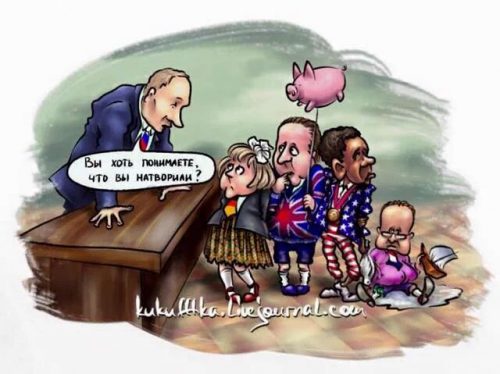 Russian President Vladimir Putin is to hold a series of high-profile meetings with Turkish, British and Saudi leaders, among others, as part of his schedule for attending a summit in China in early September.
Yury Ushakov, a Kremlin aide, told reporters on Tuesday that Putin will hold talks with Turkish President Recep Tayyip Erdogan on September 3, when he is in Hangzhou, China, for the summit of the group of 20 world major economies, known as G20.
Ushakov said Putin’s meeting with Erdogan will take place as the “process of normalization of relations between the two countries is under way.”
Russia downgraded ties with Turkey last November, when Ankara shot down a Russian jet near the Syrian border. Relations began to improve in July after Ankara offered an apology as demanded by Putin. The two met this month in Russia, with reports suggesting they narrowed gaps on the conflict in Syria.
Ushakov said Putin will also hold a meeting with Saudi Arabia’s powerful deputy crown prince, Mohammed bin Salman, to discuss the crisis in Syria. He would not elaborate but said the meeting will come on September 4, the day when the Russian president will also hold an important meeting with British Prime Minister Theresa May to discuss a need for “a new impetus in bilateral relations.”
The official said a trilateral meeting of leaders from Russia, Germany and France, which had previously been agreed to discuss the conflict in Ukraine, was called off and instead Putin would meet separately with French President Francois Hollande and German Chancellor Angela Merkel on September 4 and 5, respectively. He noted that the sensitive meeting on Ukraine was cancelled because of new tensions that have emerged over Crimea, a former Ukrainian territory which rejoined Russia following a referendum in 2015.
Putin will also hold a much-anticipated meeting with Egyptian President Abdel Fattah el-Sisi, who will be in China as a guest to G20, Ushakov said.
Featured Video
Language is a Weapon
or go to
Aletho News Archives – Video-Images
From the Archives
Aaron Siri’s Book: Vaccines, Amen
By Maryanne DemasiMaryanne Demasi | Brownstone Institute | June 15, 2026
For decades, vaccines have been treated as the sacred cow of modern medicine. I was taught that they were the holy grail. To question them was heresy. To raise concerns about safety was to risk professional exile.
Aaron Siri makes it clear in Vaccines, Amen: The Religion of Vaccines that the story we’ve been told about vaccine science rests far more on belief than proof.
“No child should be sacrificed on the altar of the religion of vaccines,” Siri writes, as he turns his focus to America’s overcrowded childhood immunisation schedule.
I assumed little in this book would surprise me. I’ve spent years reporting on drug safety, regulatory capture, and the corruption of science. But Siri showed me how wrong I was.
Siri is not a doctor or a scientist. He is an attorney, and this, he says, is his advantage. In court, rhetoric won’t save you. Evidence does. As he puts it, he doesn’t get to say “trust me” the way many doctors do. “I need to prove claims with real data.”
And he does. … continue
Blog Roll
 Aletho News
- US must cut military, intelligence assistance to Israel to protect Iran deal: Ex-Trump official
- The 12 Screenings That Manufacture the Patients They Claim to Find
- Iran deputy FM says MoU with US finalized, to be signed in Geneva on Friday
- With one strike, Netanyahu tries to kill two peace deals
- Iran warns ‘no point’ in deal with US if Israel remains unrestrained
- Ukraine as a laboratory of ‘techno-fascism’
- Desperate Starmer choosing piracy as distraction over UK crime crisis – Putin envoy
- The Crusades – colliding narratives
- Trita Parsi: Iran War Ends Today? Threats of Deporting Trita Parsi
- What Is SIDS?
- If Americans Knew
- Did Trump just threaten a nuclear attack on Iran? Another merger for Israel-Firster David Ellison –Daily Update
- Israeli Firm Accused of Launching Smear Campaigns During US, European Elections
- As World Cup kicks off, Gaza amputee girls chase football dreams
- Oxfam: More Palestinians killed by Israel across West Bank in last 3 years than previous 17 years combined
- US-Iran ceasefire may be imminent, but will Israel blow it up? – Daily Update
- The Issue of Israel Is Ending Democracy In Michigan
- Israel is stealing homes, livelihoods, and lives in West Bank
- Gaza is not an aberration – Israel planned this genocide decades ago
- Israel is changing the face of Lebanon, mainstream media is normalizing it – 3 articles
- Genocide lobby benefits from EU anti-racist fund
- No Tricks Zone
- Climate Alarmists Now Using Natural Phenomena To Support Their Claims
- New Study: Significant CO2 Fluxes From Non-Volcanic Sources Are Largely Neglected In Carbon Budgets
- Women Climate Scientists Being Harassed, Insulted By Skeptics, Claims Berkeley Earth Researcher
- Germany’s Longterm Spring Climate Data Show “No Climate Trend”
- New Study: Solar Photovoltaic, Wind Power Fail To Meet Annual Energy Demands 62% Of The Time
- Germany’s Die Welt: “Too Much Is Too Much” … Green Energies Are Cannabalizing Each Other!
- Germany’s Ecological Holocaust… Once Fairy Tale Forests Getting Cleared For Wind Turbines
- A Grand Solar Minimum Has Arrived…Global Cooling Of At Least 1°C Is Expected By The 2030s, 2040s
- European “Expert Commission” Urges COVID-19-Like Global Climate State Of Energency!
- Real-World Observations Do Not Support The Position That Climate Change Is Human-Caused
 Aletho News