Israel continues to harass and restrict Gaza fishermen despite truce agreement
Al-Akhbar | September 25, 2014
Every time Gaza fisherman Rami goes to sea, the same thing happens: five nautical miles offshore, shots ring out and a voice over an Israeli loudspeaker demands he turn back.
Officially, Gaza’s fishing fleet has the right to trawl the waters up to six nautical miles off the shore under the terms of Israel’s illegal and brutal eight-year blockade.
Although that outer limit has frequently been reduced, or even cancelled outright over the years, it was formally reinstated by virtue of an August 26 truce agreement which ended a deadly 50-day war between Israel and Hamas militants.
But nearly a month after the ceasefire took effect, even those six nautical miles — which the fishermen say is not nearly enough — are unattainable.
One afternoon, Rami Bakr and his 10-man crew put to sea for a 10-hour fishing expedition. With them was an AFP team.
Very quickly, warning shots skimmed the boat as an Israeli navy vessel approached. On board were around a dozen soldiers armed with machine guns, shouting through a loudspeaker for them to stop.
“These are the worst conditions we’ve ever known,” said the 41-year-old fisherman, who has spent more than three decades of his life fishing the waters off Gaza.
“During the war, the Israelis bombed fishing huts on the beach and now they are preventing fishermen from earning their crust at sea,” he said.
The Gaza Strip has long been known for its plentiful seafood and fish although the stocks have been depleted by pollution, frequent wars and the blockade.
Today, the coastal enclave counts some 4,000 fishermen, more than half of whom live below the poverty line, said Nizar Ayash, head of the Gaza fishermen’s syndicate.
During the recent seven-week war launched by Israel which killed over 2,000 Palestinians, the majority of which are civilians, 80 of Gaza’s fleet of around 1,500 fishing boats and dozens of fishing huts were destroyed in the Israeli bombardment, which also reduced nets and fishing equipment to ashes, he said.
For Ayash, the problems experienced by Rami are widespread.
“Since the ceasefire, many Israeli attacks have been reported,” he said, referring to repeated shooting at fishing vessels.
Israeli forces say the warning shots are necessary because Palestinian boats flout the six-mile limit.
With their tackle destroyed and the price of oil soaring, Gaza’s fishermen are almost working at a loss.
Today, a single fishing expedition can cost up to about $500, said another fisherman called Mehdi Bakr, who lost his hand when an Israeli navy vessel fired at his boat in 1997.
For every night on the water, they need 270 liters (59 gallons) of diesel and 250 liters of petrol, he explained.
And all this for a very small catch.
“September and October is sardine season and they are only found between six to nine nautical miles from the shore, so with a six-mile limit, we’re bringing home hardly anything,” explained Taha Bakr, a 24-year-old member of Rami’s crew.
Because fishing is a trade passed on from father to son, and because he can no longer provide for his family and the job is so dangerous, the young man with green eyes and a neatly-trimmed beard has signed up to journalism school.
“It’s so that I don’t have to fish again, that job is just too risky,” he told AFP.
Maria Jose Torres, deputy head of office in the Palestinian branch of the UN humanitarian agency (OCHA), said that the 1993 Oslo Accords established a fishing zone of up to 20 nautical miles.
“It is essential to increase the fishing zone beyond six nautical miles to allow the fishermen to earn their living,” she said, indicating that the vast majority today are unable to support themselves.
“Some 84 percent of them are only able to survive thanks to help from the UN,” she said.
Rami said he keeps putting out to sea so that he can feed his children.
“It has been a long time since we last heard the singing and laughter of fishermen at sea who returned with their nets full,” he said.
But Mehdi fears for the future of this millennia-old profession in Gaza.
“We, the young generation, are not happy with this. If it carries on like this, there won’t be any more fishing in Gaza at all,” he said.
(AFP, Al-Akhbar)
Gaza farms adjacent to buffer zone suffer greatest losses
MEMO | September 24, 2014
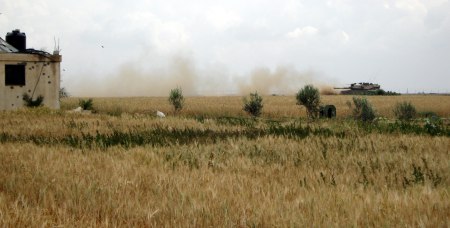
Palestinian residents in the buffer zone along the eastern borders of the Gaza Strip suffer the loss of their homes and source of income in every Israeli escalation.
Palestinian farmer Mohamed Qudih, 60, and his wife Sabiha, 59, lost their house, which was destroyed by the Israeli occupation during the ground invasion in the Khan Younis village of Khuza’a. They also lost their farm, which included around 50 olive and date trees and okra crops.
“I was surprised when I saw the rubble of my house,” Qudih told local Palestinian news agency Quds Net. “I was also surprised to see around 50 olives trees and date palms were uprooted and the okra crop was crushed.”
Qudih’s farm is 800-metres away from the Gaza-Israeli border. “We suffer so much as the Israeli occupation always razes the farms adjacent and near its borders,” he said.
He added: “We are always in danger while working or staying in our farms as the Israeli border troops in the military towers always fire live bullets and tanks and bulldozers move on the ground when they feel anything approaching the borders.”
Iyad Qudih, 40, whose farm is 500-metres from the border, had a similar story: “I came back to my farm to find no sign of my house and all the trees and crops were damaged.”
Mu’taz Al-Najjar, 19, tends to his family’s farm which is 450-metres from the border. He hopes the buffer zone is cancelled in order for his family to freely access their entire farm and benefit from it. He called for the representatives of the Palestinian fighters to the indirect talks with the Israelis in Cairo to stick to this demand.
“This will help hundreds of farmers access all areas of their farms and thus more farmers will have work and agriculture produce will increase,” he said.
Khuza’a is located to the east of Khan Younis, a Palestinian city in the south of the Gaza Strip. It is located on 4,000 Dunams (1,000 acres) of land and is home to 14,000 Palestinians, most refugees.
The Israeli occupation razed a large number of Palestinian houses in the neighbourhood during the latest war on Gaza and wrecked most of its farms and empty lands.
The Gaza war: who won?
The ceasefire agreement between Palestinian resistance fighters and the Tel Aviv regime has been hailed as tantamount to the victory of Palestinians against Israel.
Under the truce deal, Tel Aviv must lift the blockade it has imposed on the Gaza Strip since 2007. Israel must also reopen the border crossings into the besieged Palestinian territory.
In this edition of The Sun Will Rise, we discuss the barbarous Israeli military aggression against Gaza and the victory of resistance against Israel.
Featuring:
– an exclusive from Gaza by Ashraf Shannon, in which he interviews Professor Mosheer Amer from the Islamic University of Gaza and victims of the Gaza war.
– a feature on Palestinian photographic video works – “Voices” – by Rich Wiles exhibited in the P21 Gallery in London.
In the studio, we were joined by:
Fouad Shaat
President, General Union of Palestinian Students (GUPS UK)
&
Khalid Tamimi
Palestinian Student Activist
UN plan to ensure reconstruction materials not diverted to Hamas
Palestine Information Center – 22/09/2014
GAZA – The United Nations’ top Mideast envoy, Robert Serry, wants to station hundreds of international monitors in the Gaza Strip to supervise the reconstruction process in Gaza Strip, the Hebrew newspaper Haaretz learned from European diplomats and senior Israeli officials.
The newspaper pointed out that Robert Serry has agreed upon the proposal along with Palestinian Prime Minister Rami Hamallah and Coordinator of the Israeli government in Palestinian territories Yoav Mordechai.
Serry is liaising with the PA and Israel to bring between 250 and 500 UN monitors into the Strip, the sources added.
50 UN monitors are currently in Ramallah and ready to head to Gaza Strip to participate in supervising rebuilding work in the Strip. The monitors’ mission is mainly to supervise big reconstruction projects and safeguard materials and to ensure that nothing would be diverted to Hamas Movement for tunnels digging.
Hamas has yet to comment on the proposal, the Hebrew newspaper said, adding that the Islamic movement realizes that Israel only allows construction materials’ access to the Strip in the presence of UN monitors.
The proposal is expected to be addressed during the Israeli-Palestinian indirect talks on Wednesday.
The Israeli offensive on Gaza caused full or partial damages to 75 kindergartens and day-care centers
Democracy and Workers’ Rights Center in Palestine | September 21, 2014
Gaza, Occupied Palestine – The Democracy and Workers’ Rights Center field teams have documented full or partial damages to 75 kindergartens and day-care centers caused during the 51 day Israeli offensive against the Gaza Strip this summer.
DWRC’s field workers conducted field visits to all the kindergartens that suffered damages and collected information through filling questionnaires and affidavits from kindergarten owners in the five Gaza governorates, with a particular focus on eastern areas, where these damages were concentrated.
Among the 75 kindergartens and day-care centers that suffered damages, 12 were fully destroyed and 63 partially damaged by shelling and bombing. They are distributed as follows: 10 are located in the North Gaza governorate, 17 in the Gaza governorate, 17 in the Middle Gaza governorate, 21 in Khan Younis governorate, and 10 in Rafah governorate. These kindergartens employ 629 female workers, including educators, administrators and cleaning agents, and they used to care for and provide pre-school education to 12,671 children.


The owners of some of the kindergartens have undertaken repairs at their own cost in order to reopen them and others have relocated to alternative premises near their original location, while a third group has been unable to open their kindergartens or day-care centers to this day.
The Democracy and Workers’ Rights Center strongly condemns Israeli attacks on educational institutions and calls upon the international community to hold the Israeli occupying power accountable for crimes committed during its latest military offensive against the Gaza Strip. The Center stresses the need ensure special care and protection for children under all circumstances as stipulated in international human rights law and humanitarian law, and declarations on the rights of the child. DWRC also emphasizes the urgent need to rehabilitate damaged kindergartens and day-care centers, and compensate their owners as soon as possible due to the society’s need for their essential services.
Early childhood education in the occupied Palestinian territory is provided by private sector or NGOs, and receives no subsidies from the government. 99% of the workers in the sector are women, most of them paid well below the monthly minimum wage of 1450 NIS. It is a sector that has already suffered greatly from high poverty and unemployment rates, particularly in the Gaza Strip, since it largely depends on the capacity of families to pay for its services.
For further information or to access detailed data about the damages incurred by kindergartens and day-care centers, please contact us at extr@dwrc.org
Donors will fail Gaza again
By Nicola Nasser | Al-Ahram | September 19, 2014
On 12 October, Cairo is due to host a conference, sponsored and chaired by Egypt and Norway, of international and Arab donors for the reconstruction of Gaza. This is their ostensible aim. But the reasons that the donors cited for not fulfilling earlier pledges, made in Paris in 2007 and Sharm El-Sheikh in 2009, still exist.
This means that the donors who attend the upcoming Cairo conference will probably make the same pledges they made at the two previous conferences and then once again fail to fulfil them.
Meanwhile, the Palestinian people under blockade in Gaza will remain in suspense, waiting for the next aggression to be unleashed on them by the Israeli occupation, purportedly in order to eliminate the causes that the donors cite for recycling their pledges for the reconstruction of Gaza that is unlikely to happen in the foreseeable future.
Fulfilment of the donors’ old/new pledges is still contingent politically on the imposition of the status quo in the West Bank on Gaza. This entails security coordination with the occupying power, the pursuit and elimination of all forms of resistance to the occupation, rendering all reconstruction activities subject to the approval of the Israeli security regime, and much more.
Even should these conditions be met, the donors’ fulfilment of their pledges will remain contingent on the Palestine Liberation Organisation’s (PLO) continued commitment to negotiations as its sole strategy, and to the agreements that led to the creation of the Palestinian Authority (PA).
All the evidence indicates that the PLO and the PA have spearheaded the battle to impose the donors’ conditions on their behalf. Beneath the rubric of “legitimacy”, “the national project” and “the single central authority” that “alone holds the powers to make decisions on war and peace,” the PLO and PA have demonstrated that they are ready to abide by the donors’ political conditions.
The irony is that Israel has never met the conditions it compelled the donors to impose, not just in order to proceed with the reconstruction of Gaza, but also on the PA in general.
Israel has never renounced violence. It repeatedly wages war and unleashes its instruments of state terrorism against the Palestinians under occupation. It has flagrantly and repeatedly violated every agreement signed with the PLO. It has not even reciprocated the PLO’s recognition of Israel, nor has it officially acknowledged the Palestinians’ right to establish a Palestinian state.
Currently, the occupation authorities are threatening to dissolve the Palestinian national reconciliation government if it does not assert its full authority over Gaza. The message was driven home by PA Deputy Prime Minister Mohammed Mustafa, who said that there would be no reconstruction unless his government can fully assert its control over Gaza.
However, all the evidence also indicates that the resistance is there to stay in Gaza and that its powers to resist the imposition of the donors’ conditions — on it and on Gaza — are increasing.
The only possible way to read all of the foregoing, and other facts, is that the reconstruction of Gaza under such conditions and circumstances will be deferred until further notice and that deferring reconstruction and linking it to a process of cloning the West Bank model in Gaza is actually a strategy that paves the way for yet another invasion of Gaza.
It is also a fact that reconstruction needs in Gaza are accumulating as a result of this strategy. Destruction in Gaza did not begin with the response to action against this strategy in 2007. The reconstruction of Gaza’s airport and seaport, for example, has been pending since the occupation destroyed these facilities in 2002. Reconstruction dues from the destruction wrought by the Israeli assaults on Gaza in 2008-2009 and 2012 are also continuing to accumulate.
A recent report by the Palestinian Economic Council for Development and Reconstruction (PECDAR) estimates that it will cost around $8 billion to rebuild what was destroyed during the last Israeli attack on Gaza. The report says that this process would take five years if the occupation authority were to “fully” lift the embargo on Gaza, which is hardly likely to happen soon.
Clearly, the reconstruction of Gaza requires a new Palestinian strategy, one that draws a line between the grants donors offer and their political conditions, and that rejects once and for all any Palestinian commitment to those degrading conditions that, as the years since the so-called “peace process” began have proven, have brought more destruction than construction, and have served as the chief incubator of Palestinian divisions and not brought even a minimum degree of national benefit.
At the same time, any new government that emerges from a national partnership must embrace resistance against the occupation. The current national reconciliation government, with its six-month term and its principle tasks of preparing for presidential and legislative elections, is by definition an interim government and is not qualified to shoulder heavy and long-term burdens such as the reconstruction of Gaza and securing the end of the blockade.
Both of these tasks are humanitarian and national goals that are higher than any political or factional disputes. Yet the Palestinian presidency’s determination to toe the line with the donors’ conditions, which make no distinction between humanitarian needs and political ends, is a strategy that fails to discriminate between national needs and factional interests. It is a strategy that protracts the humanitarian disaster in Gaza.
Unfortunately, the need to separate politics — factional or otherwise — from the humanitarian issue does not appear to be on the agenda of either foreign and Arab donors, or of Palestinian President Mahmoud Abbas, in spite of the letter he sent to UN Secretary General Ban Ki-Moon on 30 July declaring Gaza a “disaster zone” in the grips of a “dangerous humanitarian crisis.”
This “dangerous humanitarian crisis” is the product of forms of collective punishment that were inflicted against the people of Gaza before the Palestinian rift and that grew worse afterwards. Any Palestinian assent to continuing to adhere to donors’ political conditions, which are responsible for perpetuating the collective punishment, is a form of Palestinian complicity in subjecting the people of Gaza to this punishment. The time has come for all Palestinian leaders to exonerate themselves from all charges of complicity in such punishment.
The collective punishments that have been and continue to be visited on Gaza are not acceptable, even on the pretext of punishing Hamas. Under the Geneva Conventions and before international criminal law they constitute a war crime inflicted on the civilian inhabitants of Gaza, who are protected by international humanitarian law, at least in theory.
To insist that Gaza’s reconstruction be linked to the reinstatement of the “full” authority of the Palestinian presidency and the PA over Gaza, and to the donors’ political conditions which, in fact, are the conditions of the occupying power, is merely another way to say that the reconstruction of Gaza should be linked to the imposition of Fatah’s factional agenda on Gaza.
It also means that civilians in Gaza are to be collectively punished for the factional disputes that Fatah has with Hamas, in which case it becomes very difficult to avoid pointing fingers of accusation at Palestinian complicity in the ongoing collective punishment of the people of Gaza, and more difficult yet to defend any possible Palestinian contribution to the perpetration of such a war crime.
As long as the current situation persists, reconstruction of Gaza will remain pending indefinitely, and the reconstruction burden will only grow. Eventually, the people of Gaza will have no alternative but to look for salvation through other means that they, alone, can control. The Palestinian presidency and its faction must decide to free themselves once and for all from their financial and political dependence on donors and the sterile “peace process” that has so far wrought only death, destruction and division.
It is not too late to opt for the national alternative, which is still available given good intentions, to save the people of Gaza, national unity, the resistance, and decision-making autonomy.
This alternative entails following through on implementation of the mechanisms for national reconciliation, activating the unified command framework for the PLO, agreeing on a new Palestinian strategy based on the principles of partnership and resistance, and creating a new national unity government committed to this strategy and qualified to shoulder such enormous tasks as the reconstruction of Gaza and lifting the blockade.
All of the foregoing requires no more than honest introspection, the prevalence of national conscience, and political free will.
Nicola Nasser is a veteran Arab journalist based in Birzeit, West Bank of the Israeli-occupied Palestinian territories.
Palestine, the US and “Democracy”
By Bob Fantina | CounterPunch | September 19, 2014
Now that the dust has settled on the mutilated bodies of Palestinian men, women and children, the world seems able to ignore the desperate plight of those that survived. Apartheid Israel has accomplished its periodic ‘mowing of the grass’, the leveling of Gaza’s infrastructure, the destruction of schools, hospitals and mosques, and the killing of over 2,000 innocent, unarmed and defenseless Palestinians. Business for Israel now continues as usual, with IDF (Israeli Defense Forces) terrorists focusing their murders on innocent Palestinians in the West Bank. There, with complete impunity, they bulldoze homes, shoot unarmed teenagers, arrest and detain children, establish arbitrary checkpoints and steal land, all in violation of international law, law the international community doesn’t seem particularly interested in enforcing.
This is not meant to imply that Israel is ignoring Gaza. No, in violation of the cease-fire agreement, an agreement that apparently only the Palestinians have to abide by, IDF terrorists shoot Palestinian fishermen fishing within the very limited zone that Israel, again in violation of international law, permits them.
Not all countries of the world seem oblivious to Palestinian suffering. Cuba, Venezuela and Turkey have all sent aid to assist people deprived of food, water and shelter. But the U.S., which traditionally showers all kinds of aid on countries that do its bidding, but ignores or terrorizes those, such as Palestine, that don’t, has not responded.
A recent quotation by U.S. President Barack Obama is interesting: “… we could be looking at hundreds of thousands of people affected, with profound economic, political and security implications for all of us.” This seems to fit the situation in Palestine. At least hundreds of thousands, and, realistically, millions of people have been affected by Israel’s most recent genocidal activities, and the continued financial aid to that apartheid, racist nation has ‘economic, political and security implications’ for the U.S. A total of $3 billion is sent to Israel annually; Detroit, in bankruptcy, is scrambling to find one third of that amount to get through the year. Yet it receives no taxpayer money from the Federal government, as Israel gets $3 billion.
The political implications are beginning to be felt; more and more of the U.S.’s elected officials (this writer simply cannot bring himself to refer to them as ‘representatives’) are being pressured to look away from the money the Israel lobby grants them for their re-elections campaigns, and focus instead on human rights. This is not easy for these officials to do; such a view does not come naturally to them. Yet the political reverberations are beginning to be felt, and can only increase.
In terms of security implications, hatred for and hostility towards the U.S. grows with every bomb Israel drops on Palestine, with every home demolished, with every checkpoint established, with every unarmed youth shot to death. The U.S.’s elected officials ignore this at their peril.
Unfortunately, the quotation shown above was not said by Mr. Obama in reference to Palestine; it was said about the Ebola epidemic in West Africa. The president is right on top of this, because doing so in no way offends a powerful U.S. lobby. One can always take the high road when the bottom line isn’t negatively impacted.
Why, one might reasonably ask, does the U.S. ignore the political, economic and security implications of financing a regime that makes South Africa of a generation ago look almost benign? Why ignore some of the most horrific human rights violations being committed on the planet today? What benefit is there in parroting the blatant lie that Israeli oppression of a nation it illegally and brutally occupies is done for its ‘national security’?
The U.S. continues to proclaim that Israel is the only democracy in the Middle East. This is not surprising, since the U.S. has a very skewed idea of democracy, a concept it has never actually practiced. Yet it is a favorite buzz word, along with ‘freedom’, ‘liberty’ and a few others that officials love to toss around, knowing the lemming-citizens go wild for it. Say them in front of an American flag, with the hand on the heart, and the jingoistic tears will flow. Never mind looking at reality. Ignore the abject poverty in many parts of the U.S.; the suicides (an average of 22 per day) of veterans who have, ostensibly, fought for that ‘freedom’ and ‘liberty’ (what they were actually fighting for is a topic for another essay); the racism that is so obvious, and occasionally cannot be completely ignored, as in Ferguson, Missouri. Forget about the poor performance of U.S. students compared with those of any other industrialized nation, as schools struggle to hold onto qualified teachers in the face of increasing class sizes and reduced budgets, as military contractors make billions by producing more powerful tools to kill.
So, let us summarize. Israel, a country born through genocide, continues to commit this horrific crime, financed mainly by the U.S., the world’s self-proclaimed beacon of peace and freedom. With one of the most powerful military systems on the planet, it periodically bombs, in the name of its ‘national security’, a nation it occupies, that has no army, navy or air force. When this happens, elected officials of its main financier, the U.S., all echo Israeli talking points, disregarding completely the horrific human rights violations that are perpetrated on a daily basis, and those that are exponentially worse with carpet bombing. Additionally, the U.S. press, with few exceptions, ignores Palestinian suffering and focuses on Israeli inconvenience.
This is the work of the ‘only democracy in the Middle East’ as financed by the largest pseudo-democracy operating in the west. Both are criminal regimes, looking only for power and wealth, at the expense of common decency. Both must be stopped, and it won’t be their governments, the United Nations or other governments that will stop them. As with all movements for human rights, it will be the will of the people around the world that, eventually, will no longer be able to be ignored.
Robert Fantina’s latest book is Empire, Racism and Genocide: a History of US Foreign Policy (Red Pill Press).
Victims of deadly shipwreck driven out of Gaza by war, unemployment
Al-Akhbar | September 18, 2014
Unemployed and shattered by the 50-day Israeli assault on Gaza, Yasser decided to seek a better life elsewhere, boarding a boat to Europe that sank off Malta last week.
In one of the deadliest migrant shipwrecks on record, the boat, with 500 people on board, was intentionally capsized by traffickers as it made its way from Egypt to Italy.
Only 10 people are known to have survived, among them four Palestinians from the 100 Gazans believed to have been on board. Yasser, a 23-year-old unemployed graduate, was not one of them.
Yasser’s story is far from unusual and explains why some Palestinians in Gaza are ready to risk everything to flee war and poverty in the coastal enclave, which was battered by a devastating seven-week Israeli aggression that ended late last month.
His brother Osama told AFP by telephone from his home in the United Arab Emirates that Yasser had graduated from university in Gaza but struggled to find work.
“He graduated last year and since then, like all young people, he has been unemployed. There is no future for them in Gaza,” Osama told AFP, asking that his family’s name not be published.
The crippling blockade of Gaza by Israel – and more recently Egypt – and Israeli restrictions in the occupied West Bank limit Palestinians’ ability to compete in export markets and contribute to an unemployment rate of almost 25 percent, the World Bank said in 2013.
“I tried to bring him to the Emirates but after seeing several of his friends reach Europe by boat, he decided to leave too,” he said.
Yasser crossed from Gaza into the Sinai Peninsula via the Rafah crossing, paying some local Egyptians nearly $3,000 (2,300 euros) to fix his passage to Europe.
“You never know who you’re giving the money too,” Osama said.
The last time the brothers spoke was on September 5, the day before the boat carrying Yasser set sail from the port of Damietta in Egypt.
“Now I’m waiting to receive the list of survivors to know if he might still be alive,” Osama said.
Escape through the tunnels
Exact numbers of those leaving Gaza and making their way to Europe are hard to come by.
According to the International Organisation for Migration (IOM), some 2,890 people who declared themselves to be Palestinians have reached Italy so far this year.
But even that number may not be credible as some migrants falsely identify themselves as Palestinians to avoid being repatriated to home countries that have extradition agreements with the European Union.
“We estimate that thousands of people have left the Gaza Strip clandestinely over the past two months, especially during the war,” a local human rights worker told AFP.
“Due to the fact they left through tunnels to Egypt — an illegal, secret way to leave — we have no precise figure,” he said, speaking on condition of anonymity due to the sensitivity of the issue.
With Gaza’s own access to the Mediterranean tightly closed by Israel’s naval blockade, those wanting to go to Europe would be forced to travel through the Rafah border crossing with Egypt.
Rafah is Gaza’s only gateway to the world that is not occupied by Israel, but it has been kept largely closed by Egypt for more than a year, with the only other way across via the handful of precarious cross-border smuggling tunnels.
(AFP, Al-Akhbar)
Abbas’ spurious charges
By Nicola Nasser | Al-Ahram | September 11, 2014
President Mahmoud Abbas and the Fatah movement, which he commands, have unleashed a media campaign against Hamas and the resistance. If pressure from the Palestinian public fails to stop the campaign, Abbas may achieve politically what Israel failed to achieve militarily: forcing the Palestinian presidency to choose “peace with Israel” over national reconciliation.
It appears that President Abbas has, indeed, prioritised “peace with Israel.” He has devised plans for resuming negotiations, and is still banking on American support for such talks. This is the only explanation for the current anti-Hamas media campaign.
Abbas sent his negotiators — Saeb Erekat, Majed Faraj and Maen Erekat — to Washington, where they met with US Secretary of State John Kerry a week ago last Wednesday. US State Department spokesperson Jen Psaki described the more than two-hour meeting as “constructive”. Abbas then prepared to obtain an Arab mandate, which seems guaranteed in advance, for his plans from the 142nd session of the Arab foreign ministers conference, held in Cairo this week.
However, US Ambassador to the UN Samantha Power poured cold water over the Palestinian Authority (PA) president’s bid to obtain US backing for his plan, which he intends to put before the UN Security Council and UN General Assembly. The proposal would end the Israeli occupation of the West Bank and Gaza within three years, during which period negotiations would resume within three months with the occupying power over its borders with the Palestinian state.
“We don’t think there are shortcuts or unilateral measures that can be taken at the United Nations or anyplace else that will bring about the outcome that the Palestinian people most seek,” Power said in a press conference last week. “To think that you can come to New York and secure what needs to be worked out on the ground is not realistic.”
This clearly translates into an unequivocal US “No.” The Palestinian president’s new plan has run up against the same American wall that Palestinian negotiators have faced since negotiations were adopted as a strategic approach. The Zionist route remains the only way these negotiators can access the White House and the UN Security Council.
There can be only one explanation for this plan. It is in fulfilment of a Palestinian promise not to resist the occupation and to offer the occupying power the opportunity to agree to yet another futile round of negotiations. Such negotiations will give Israel the time it needs to turn the Givaot colony into a major settler city on the 4,000 dunams of Palestinian land that it has just seized by declaring it “state land”.
The purpose of this appropriation is to separate the Hebron and South Bethlehem governorates in the West Bank. It is also a means to deflect international humanitarian pressure in reaction to Israeli war crimes in Gaza, to evade Israel’s obligations to the truce agreement with the resistance in Gaza, and to fuel internal Palestinian tensions until they reignite once more.
It was not Hamas or the resistance that described Abbas’s new plan as a “spurious process”. It was independent Palestinian figures who expressed their views in a statement read out by Mamdouh Al-Akr, general commissioner of the Independent Organisation of Human Rights, on 2 September in Ramallah. They called for an urgent meeting of the unified leadership of the Palestine Liberation Organisation (PLO), in accordance with the Cairo agreement of 2011, so that it can serve as a frame of reference for the Palestinian will and take critical national decisions.
Activating the unified leadership framework of the PLO will put President Abbas’s call for a “single Palestinian central authority”, uniquely empowered to “determine matters of war and peace”, into its concrete national context. Only this context can confer legitimacy on a Palestinian leadership that does not derive its authority from resisting the occupation in all forms.
Moreover, the currently missing “electoral legitimacy” is no longer sufficient in and of itself to allow Palestinian decisions on war and peace to remain in the hands of a leadership that is the product of elections that were held with the approval of the occupation power and in the framework of agreements signed with it.
The Palestinian presidency has dropped the available option of resistance from the lexicon of its negotiating strategy, let alone the option of war, which is not available. The PA, in coordination with the occupation’s security apparatus, has become “the security proxy for the occupying power, rather than an instrument to end the occupation and establish the state,” as Palestinian analyst Hani Al-Masri wrote on 26 August.
As a result, the occupying power, alone, holds the keys to the decision of war, which it continues to repeat, and to the decision of peace, which it still refuses to take.
It appears that President Abbas is working against the tide of Palestinian public opinion, as voiced in a recent survey conducted by the Palestinian Centre for Policy and Survey Research (PCPSR) in Ramallah. According to this poll, only 22 per cent of respondents supported a resumption of negotiations, while 53 per cent said they regarded resistance as “the more effective way” to realise the creation of a Palestinian state.
The results of the PCPSR poll contradict all the charges levelled by the president and Fatah against the resistance and Hamas. Of those polled, 79 per cent believe that the resistance emerged victorious from the recent war, while 86 per cent support the defensive use of rockets.
Respondents gave very low ratings to the performance of the Palestinian president, the PA, the national unity government and the PLO, while the approval rating for Hamas was 88 per cent.
What is the substance of this media campaign against Hamas? It ranges from blaming Hamas for prolonging the war and for the consequent loss of lives and material damage, to adopting the Israeli narrative regarding a Hamas-engineered “coup attempt” against the president in the West Bank and the existence of a “shadow government” in Gaza that prevents the national unity government from functioning.
Then there are the charges of keeping Fatah members under “house arrest”, of “opening fire on civilians”, and of “selling emergency relief on the black market.” On top of these come the accusation that Hamas has violated “the law that defines the colours and dimensions of the flag.”
President Abbas’s instructions to create a “committee to hold a dialogue” with Hamas to discuss the “fate of the national unity government,” as announced by Amin Maqboul, secretary of the Fatah Revolutionary Council, does little to encourage optimism. The national unity government, national reconciliation, the Cairo agreement of 2011, the unified leadership framework that it stipulated, and the reactivation of the PLO, all stand at a crossroads.
This is because of the confrontation stirred by the systematic smear campaign that President Abbas and the Fatah movement are waging against Hamas and the resistance. The campaign has created a media smokescreen behind which the occupation authority can conceal its foot-dragging in carrying out its obligations under the truce agreement, which will probably be echoed in Israeli procrastination on continuing with truce talks due to be held in Cairo.
It should also be stressed that to accuse the resistance and Hamas of prolonging the war is to exonerate the occupation power of responsibility. The Israeli media was quick to capitalise on this, further proof of the extensive coverage the campaign has received.
Indeed, Israeli government spokesman Mark Regev virtually reiterated it verbatim when he said that the Egyptian initiative was on the table from 15 July and that while the Arab League and Israel had approved the initiative, Hamas rejected it, only to turn around and agree to it a month later. “If [Hamas] had agreed then to what it agrees to now” it would have been possible “to avoid all that bloodshed,” he said.
The investigatory commission appointed by the UN Human Rights Council will most likely cite the president’s charges to strengthen the claims of the occupying power, as these charges would be regarded as “testimony of a witness from the other side.”
Abbas says that while the “final toll” from the most recent war in Gaza was 2,140 dead, “if added to the number of dead in previous wars, and those who died during the period of the Shalit problem, the number would be 10,000 dead and wounded, in addition to the 35,000 homes that were totally or partially destroyed.”
When Abbas says that “it would have been possible” to avert the human and material losses of the recent conflict he is effectively blaming the resistance, not the occupation, for the last war on Gaza and the two wars since 2008 that preceded it.
The spectre of discord once again hovers over Palestinian unity, with Palestinian opinion divided over a programme of negotiations versus a programme of resistance. This is the breach through which Arab and non-Arab “axes” penetrate into the Palestinian interior, deepening rather than mending Palestinian rifts.
Nicola Nasser is a veteran Arab journalist based in Birzeit, West Bank of the Israeli-occupied Palestinian territories
Poll: Only 10 percent of Gazans would vote for Abbas in presidential election
Al-Akhbar | September 16, 2014
Only 10 percent of Palestinians in the Gaza Strip would vote for current President Mahmoud Abbas if presidential elections were held today, according to a new poll released Tuesday.
The poll, conducted by the Gaza-based House of Wisdom Institute, indicates that 29.8 percent of Gazans would vote for senior Hamas official Ismail Haniyeh, while 28 percent would vote for jailed Fatah leader Marwan Barghouti.
Interestingly, 32.4 percent would choose a different candidate.
The majority of those surveyed thought the Israeli assault unified Palestinians, but expected Hamas-Fatah disputes to continue in the aftermath of the war.
Regarding the Israeli assault on Gaza, 73.6 percent were satisfied with the performance of the different resistance groups.
When it comes to the Egyptian-brokered ceasefire deal, the survey, which was conducted in 30 locations across Gaza, showed that 40 percent were dissatisfied with the deal and 60 percent said they expected Israel to violate the conditions of the deal.
The seven-week Israeli assault on the besieged Gaza Strip has killed more than 2,130 Palestinians, the overwhelming majority of them civilians, including 577 aged 18 or younger.
(Al-Akhbar, Ma’an)
MEPs call for EU-Israel trade agreement to be suspended
MEMO | September 10, 2014
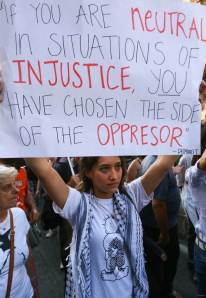 Members of the European Parliament (MEP) yesterday called to hold Israel accountable for its war in the Gaza Strip and to suspend the EU-Israel association agreement, the Anadolu news agency reported.
In a statement, the MEPs declared, “Israel’s direct targeting of civilians and its reckless cause of civilian deaths is a clear breach of international human rights law.”
Member of the Unitarian Left (GUE/NGL) parliamentary group, Martina Anderson said: “You cannot go on with an agreement after you have broken it.”
The European Union condemns the establishment of illegal settlements on the Palestinian territories occupied in 1967 and considers it a violation of international law, but the association agreement with Israel is still valid.
Anderson stressed the Palestinians’ right to sovereignty, freedom and to live with dignity and respect and that they, as parliamentarians, should take responsibility otherwise they will become “partners in crime”.
Portuguese MEP, Marisa Matias said that suspending the association agreement with Israel is not a sufficient step, stressing on the need to apply an arms embargo and start working on a full ban of Israeli products produced in the occupied territories.
Trades Union Congress slams Gaza attack, urges Israel arms embargo
MEMO | September 10, 2014
The Trades Union Congress (TUC) passed a statement on Gaza at its annual congress Wednesday, urging the UK government to impose an Israel arms embargo and calling for the suspension of the EU-Israel Association Agreement.
The statement, overwhelmingly endorsed, condemns the death toll in Gaza that included “many people going about their daily work”, and “deplores attacks on UN facilities”. The TUC recommends that those responsible for breaching international law “should be dealt with in the International Criminal Court”.
The TUC statement also calls for an end to the “blockade of Gaza” and welcomes “the creation of a unity government for the Palestinian Authority” involving both Fatah and Hamas, urging “the UK government and the European Union to support this development”.
In light of Israel’s attacks on Gaza and policies in the Occupied Territories, the TUC statement calls on the UK government and EU to “end immediately arms trading with Israel including all military-industrial collaboration”. The TUC itself, it adds, should work with relevant unions to “press those companies involved in supporting Israel’s military to cease to do so”.
Congress called for “the suspension of the EU-Israel Association Agreement until the rights of the Palestinians are established”, and committed to “rais[ing] the pressure on corporations complicit in arms trading, the settlements, occupation and the wall” through strategies that pressure “complicit companies” – a key part of the Palestinian-led Boycott Divestment Sanctions (BDS) campaign.
The Palestine Solidarity Campaign (PSC) noted that “the statement, and the goals contained within it, are now official TUC policy”, an important boost for Palestine solidarity and BDS activists. The TUC’s statement was condemned by anti-boycott umbrella group Fair Play, who complained that boycotts merely pull “Israeli and Palestinian workers further apart”.
Featured Video

Trita Parsi: Middle East Unraveling — Are We on the Path to World War?
or go to
Aletho News Archives – Video-Images
New Book
Trans agenda is ‘normalization of sadism’ – US author

RT | September 23, 2026
The US Democratic Party has embraced a transgender agenda that amounts to “the normalization of sadism,” author A.J. Rice has said, warning that radical trans policies would return if the party is allowed to regain power.
Speaking to RT’s America First host Scotty Nell Hughes about his new book, ‘The Curse of the Bearded Lady: How the Trans Mafia Whacked American Sanity’, Rice argued that activists have gained significant influence in schools, medicine, and corporate America while people who questioned the agenda have faced pressure to stay silent.
The author described the “trans mafia” as the sprawling network of people and institutions that have helped the movement gain influence. He singled out parts of academia, wealthy backers, and corporations, and stated that providers of transition-related treatment also have a financial incentive to keep young people in their care indefinitely.
Rice argued that the consequences of these policies ultimately fall on children who are being drawn toward gender-affirming medical treatments and on girls who are expected to share locker rooms or compete in sports with biological males.
He noted that while voters rejected the Democrats’ approach to gender in 2024, the party, which has been “captured by madness,” has since only doubled down and is seeking what is effectively “the normalization of sadism.” … Full report
Blog Roll
 Aletho News
- German chemicals giant reveals details of downsizing
- Refaat Al-Areer Was The Canary In The Coal Mine In Israel’s War On The Truth
- Israeli election committee bars candidate from Knesset race over Gaza war opposition
- French-Lebanese man files war crimes complaint over Israeli attacks
- Mahan Air Flight Lands in China Despite US Threat against Iranian Airlines
- US eyes $10bn fund to rebuild war-battered Gulf infrastructure
- Trump meets Rodríguez near Maduro’s prison as Venezuela’s oil flows to US
- Trita Parsi: Middle East Unraveling — Are We on the Path to World War?
- Iran FM meets with US envoy on UN meeting’s sidelines at American side’s insistence: Report
- Qatar PM calls for Gulf security framework with Iran, says war must be ‘wake-up call’
- If Americans Knew
- Caught on Tape: AIPAC CEO Boasted of Controlling Trump’s National Security Officials
- Why Hamas Attacked Israel in October 2023 – Israeli professor Ilan Pappé
- They see them, then kill them: Israeli quadcopters track, deliberately target civilians in Gaza
- Winter could turn Gaza’s treacherous, war-damaged buildings into deathtraps
- Majority of Democratic Voters Want to Prosecute Both Biden and Trump Administration Officials Over Gaza
- As Gaza languishes, world leaders gather at the UN – Daily Update
- Sanctions are collective punishment: immoral and self-defeating
- Phosphorus Munitions Fired by Israel Burn Groves, Orchards in Southern Lebanon
- Israel Carries Out New Ceasefire Violations Across Gaza
- AI – Emphasis on the ‘I’: Israel Is Funding AI Chatbot Propaganda
- No Tricks Zone
- New Study: Earth And Venus Surface Warmth Largely Explained By Convection And Lapse Rate, Not CO2 Or Radiation
- 2025 Nature Paper Claiming Worsening Global Drought Gets RETRACTED …Heavily Flawed
- New Study: ‘Global Drought Shows No Detectable Recent Acceleration Under Climate Warming’
- Economic Masterminds: German Socialists Suggest Taxing Productivity Gains Stemming From Using AI
- The South China Sea Has Not Been Cooperating With The Climate Change Narrative
- Energy Crisis: Germany Enters Heating Season With Historically Low Gas Reserve Fill Levels
- New Study: The Antarctic Ice Sheet Gained Mass From 2020-2024 Due To Staggering Snow And Ice Accumulation
- Study: Ocean Heating Rates From Thousands Of Years Ago ‘Dwarf’ Modern Ocean Heating Rates
- Climate Extremists Target, Attack Large-Scale Power Grid Infrastructure In Germany!
- New Study: Antarctic Ice Melt Has Contributed Less Than 1 Centimeter To Sea Level Rise In The Last 30 Years

