The Israeli war destroyed around 500 economic facilities that form 60 per cent of the manufacturing capability in the Gaza Strip, the Palestinian Ministry of Economy said.
Speaking to the Palestinian news agency Safa, the ministry’s spokesman Azmi Abdul Rahman said that the Israeli occupation premeditatedly targeted hundreds of the industrial, commercial and service facilities.
The commercial facilities included small shops and that paralysed the economy during the Israeli war. He stressed that the effect of the economic paralysis would last until the facilities were reconstructed.
Abdul Rahman said that specialist professional staff are working on evaluating the losses in the Strip; estimating that reconstruction of the economic facilities needs at least one year.
He said initial evaluations showed that the indirect losses exceeded $440 million.
September 10, 2014
Posted by aletho |
Ethnic Cleansing, Racism, Zionism, War Crimes | Gaza, Israel, Palestine, Zionism |
Leave a comment
Israeli forces, during the recent offensive on the the Gaza Strip, used one of UNRWA’s schools in the region as a military base, according to a UN offical.
Leila Zerrougui, Special Representative of the Security-General for Children and Armed Conflict, declared on Monday that the Israeli military bombed 244 schools, 75 of which were run by UNRWA.
While not disclosing the specific location of the school, it was revealed that one of these UNRWA schools was used an Israeli military base, according to the PNN.
Speaking of the aftermath of the assault on besieged Gaza, Ms. Zerrougui stated that, of the children wounded during the conflict, one third now suffer from full disability.
Nearly 600 Palestinian children suffered violent deaths as a result of injuries inflicted by Israeli strikes from the ground, air and sea.
Related: 69% of Gaza Schools Damaged by Israeli Assaults
See also: 08/23/14 Israel Retracts False Claim Regarding Alleged Hamas Rocket Base
September 10, 2014
Posted by aletho |
Ethnic Cleansing, Racism, Zionism, War Crimes | Gaza, Israel, Palestine, Zionism |
Leave a comment
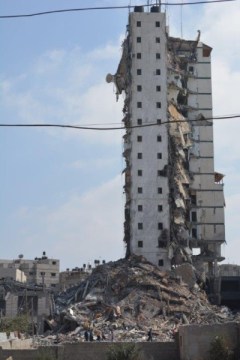 Israel and its supporters abroad have parried accusations of indiscriminate destruction and mass killing of civilians in Gaza by arguing that they were consequences of strikes aimed at protecting Israeli civilians from rockets that were being launched from very near civilian structures.
That defence has already found its way into domestic U.S. politics. A possible contender for the Democratic nomination for president, Sen. Elizabeth Warren, defended her vote for more military aid for Israel during the Israeli assault on Gaza by citing the rocket launch defence.
“[W]hen Hamas puts its rocket launchers next to hospitals, next to schools, they’re using their civilian population to protect their military assets,” said Warren. “And I believe Israel has a right, at that point, to defend itself.”
But although some Hamas rockets were launched near homes or other civilian structures, military developments on both sides have rendered that defence of Israeli attacks on civilian targets invalid.
The rocket launchers for Hamas’s homemade Qassam missiles consist of simple tripods that can be removed in seconds, and the extensive Hamas tunnel network has given it underground launching sites as well as storage facilities for its larger, longer-range Grad and M-75 missiles.
On the other side, the Israeli Air Force possesses air-to-ground missiles that are so accurate that they can destroy a very small target without any damage to civilian structure even if it is very close.
A video released by the Israel Defense Forces (IDF) in a report on Hamas’s “illegal use of civilian infrastructure” last month shows an attack – obviously by an Israeli drone — on an underground rocket launcher only a few metres away from a mosque causing no damage whatever to the mosque.
These technological changes take away any justification for flattening civilian buildings even if a rocket launch site is nearby. In fact, however, the evidence now available indicates that Hamas launch sites are not that close to hospitals, schools and mosques.
The IDF sought in mid-July to use the rocket launcher defence to explain the damage to Al Wafa Rehabilitation and Geriatic Hospital in eastern Gaza City from 15 rockets, which forced the staff to evacuate its patients. An IDF spokesman said the military had “no choice” because rockets had been launched from very near the hospital.
Clearly revealing that the rocket launch justification for the attack was a ruse, however, the spokesman revealed to Allison Degler of Mondoweiss that the alleged launch site was 100 metres from the hospital. That would have been far more space than was needed to strike the launch site without any damage to the hospital whatever.
A report released by the IDF August 19 included an aerial view of Al Wafa Hospital with two alleged rocket launching sites marked at locations that appeared to be much farther from the hospital than the 100 metres claimed by the IDF spokesman.
The IDF nevertheless went so far as to declare on July 21, “Hamas fires rockets from Wafa hospital in the Gaza neighborhood of Shujaiya.”
When the IDF destroyed Al Wafa hospital completely by airstrikes on July 23, it abandoned the pretense that the reason was a Hamas rocket launch site. Instead it released a video purporting to show firing at IDF troops from the hospital.
It turned out, however, the video clips of the firing had been shot during Operation Cast Lead in 2009, not in 2014.
The IDF has continued to suggest that its destruction of public civilian facilities was forced on it by rocket launches from within those facilities. At the end of the Operation Protective Edge the IDF spokesman’s office claimed that 597 rockets had been launched from civilian facilities, of which 160 were allegedly fired from schools, 50 from hospitals, and 160 from mosques.
But those figures were by produced only by pretending that launching sites some distance from the facilities in question were on the premises of the facilities.
An IDF “declassified report” released August 19, aimed at showing that civilian facilities were serving as military infrastructure for Hamas, includes no evidence of any rocket launches on the grounds of any civilian facility.
A very blurry 20-second video appears to show a rocket launch from what is identified as “Abu Nur” school. But it, too, is deceptive. A black streak rises from the area of the school for a little more than a second of the video, but for the entire length of the video two voices declare repeatedly that they saw three rockets launched “from within the school”.
Careful viewing of the footage reveals, however, that the apparent launch comes from outside the wall of the three-story school building rather than from within it.
In three other cases of alleged rocket launches from schools, the IDF provides no visual evidence – only large red dots drawn on an aerial view of the schools.
During the Operation Protective Edge, the IDF openly targeted mosques, claiming they are military targets, demolishing 73 mosques and partially destroying 205 more.
The August 19 IDF report refers to a “rocket cache and gathering point for militants hidden in a mosque” in Nuseirat. But despite frequent repetitions of the notion that Hamas routinely stores rockets in mosques, the IDF has not produced photographic evidence of rocket storage in a single mosque.
Nor has the IDF made public any video evidence of secondary explosions from the destruction of mosques. In a tacit admission that such evidence is lacking, the report instead cites an instance of a “concealed entrance” to a Hamas tunnel located between a mosque and a school.
The most extensive destruction of civilian structures in Operation Protective Edge was the complete leveling of large parts of entire neighbourhoods in the Shujaiya district of Gaza City on July 19. After the United Nations published a map showing the complete destruction of those areas of Shujaiya, the IDF published its own map on August 4 aimed at justifying the destruction.
The map shows that the IDF can’t claim the proximity of Hamas rocket launching sites as the justification for the leveling of many residential blocks in Shujaiya. The Israeli military had identified every home in the devastated neighbourhoods on its map as a “hideout” for Hamas or Islamic Jihad fighters.
The IDF obviously did not have actual intelligence on each of those homes that had been reduced to rubble. The massive designation of houses as “hideouts” indicates the Israelis believed Palestinian fighters were hiding in some of them.
Although the red dots on the IDF map identifying rocket launch sites are too big to estimate accurately the distance between them and the closest houses, only a few such dots appear to be as close as one city block to a house in one of the areas of massive destruction. And all but a few of the homes destroyed are much farther than a block from the alleged launching sites.
An account of the Shujaiya destruction by journalist Mark Perry based on a July 21 U.S. Defence Department report recalls that the IDF fired 7,000 artillery shells at residential areas in the district the night of July 19, including 4,500 shells in the space of just seven minutes.
Such massive and indiscriminate destruction of civilian structures is strictly prohibited by the international laws of war. Israeli officials have frequently said the purpose of IDF military operations in both Lebanon and Gaza was to “deter” their adversaries in the future by imposing heavy costs on the civilian population.
September 10, 2014
Posted by aletho |
Deception, Ethnic Cleansing, Racism, Zionism, War Crimes | Gaza, Israel, Palestine, Zionism |
Leave a comment
BUENOS AIRES – A lawsuit was filed on Saturday against Israel by actors, activists, politicians and pro-Palestinian solidarity groups in Argentina, a statement released by the Palestinian embassy in Buenos Aires said.
The case was brought before the federal court of justice in the city of Cordoba.
The case was named “Lawsuit against the Authorities of Israel for Committing Crimes against Humanity and Genocide against the Palestinian people in the Gaza Strip.”
Journalist Serkhio Ortiz, head of the Argentinean committee of honoring the missing and victims, actor Juan Jose-Tutu, and singer and actress Mara Santosho, were among the people who signed the case.
The signatories called in their lawsuit for issuing an international arrest warrant against Israeli figures through the Interpol and forcing Israel to compensate for the human and material losses that it had caused during its war on Gaza.
September 8, 2014
Posted by aletho |
Ethnic Cleansing, Racism, Zionism, Solidarity and Activism, Timeless or most popular, War Crimes | Argentina, Gaza, Israel, Latin America, Palestine |
Leave a comment
Even though the Arab Bank, considered one of the oldest and largest Arab banks with assets in the tens of billions of dollars, left New York nine years ago because it was investigated on account of its Palestinian connection, US authorities continue to go after the bank threatening it with total bankruptcy. The case is not a new one but its developments demonstrate how far Israeli groups will go to destroy the Palestinian financial sector and even Jordanian and Lebanese banks with the assistance of the US legal system. The trial began in August and it is still going on amid fears of the negative repercussions on the Arab Bank in particular and the Arab banking system in general.
The issue began when lawsuits were filed against the Arab Bank in US courts 10 years ago by 297 Israelis demanding compensation for damages suffered as a result of attacks by Palestinians against Israeli targets in the first half of the last decade. The plaintiffs claim that the bank was responsible for transferring funds to Hamas. The Arab Bank asked the US Supreme Court to review an order issued by a federal court imposing stiff sanctions on the bank for its failure to turn over secret records belonging to its depositors and clients.
The order to impose sanctions on the Arab Bank was issued by U.S. District Judge Nina Gershon. The bank argued that it cannot meet the demands of US authorities without violating Jordan’s banking secrecy laws which will subject it to criminal fines. It argued that Judge Gershon’s ruling means that all foreign banks are subject to the same destructive pattern of indictments. The prosecutor can ask any foreign bank to hand over all their clients’ statements and if the bank refuses, it will be sanctioned.
The Arab Bank appealed the sanctions order to the Supreme Court, but the court refused to hear the appeal in early July. Jordan asked for President Barack Obama’s help by recommending that the Supreme Court order Judge Gershon to reconsider her ruling and the State Department supported the appeal. But the Justice Department found Gershon’s decision useful in ending bank secrecy worldwide.
The Arab Bank is being tried in a court in Brooklyn, New York under the Anti-Terrorism Act issued in 1990. The charges against the bank include aiding Hamas on three levels.
One, by transferring funds provided by the Saudi Committee to 55 Palestinian families of suicide bombers. Two, by having accounts for dozens of charitable organizations that the Israeli plaintiffs say were a mere front for Hamas. Three, the bank had personal accounts for 30 Hamas leaders, including the late Sheikh Ahmed Yassin who had been placed on the US terrorism list since 1995 and the late leader Salah Shehadeh, founder of Hamas’ military wing. According to the prosecutors, the bank knew these people’s relationship to Hamas, designated as a terrorist organization by the US.
The Arab Bank denied the charges saying that no account was opened for a person that was on a US terrorism list. The only exception was one transfer to Sheikh Ahmed Yassin’s account which was the result of a mistake by an employee. The transfers from the Saudi Committee were part of thousands of transfers that the group made to families in need and therefore for humanitarian purposes. US courts have refused any defense stating that the Arab Bank merely followed local laws in the countries where it operates or that the attacks were part of a historical context of violence in the region that the bank does not bear responsibility for.
The Israeli side had dozens of witnesses including a former official in the Israeli military who told the US District Court in Manhattan that the Jordanian bank transferred millions of dollars to the families of those he described as “suicide terrorists” from Hamas. The money came from Saudi Arabia and Hezbollah-affiliated al-Shahid Foundation during the period between 1998 and 2004, with evidence focused on the period between 2001 and 2004. There were monthly payments from the Saudi Committee at a rate of $140 per family.
The Arab Bank’s defense lawyer said there is no evidence that links the transfers to anti-Israel attacks, warning of the danger of this case that puts the responsibility on the shoulder of every bank employee anywhere in the world to investigate every little thing before completing any transaction or transfer. The bank said in a statement that the case raises very important issues for the international finance system which processes trillions of dollars in transfers each day. Most of these transfers are automated and the plaintiff’s theory, “if adopted by the Court, would undermine the automated compliance systems that regulators around the world require banks to employ, and create vast uncertainty and risk in the international finance system.”
Lawsuit developments
Israeli witness Ronnie Shaked said that Hamas was responsible for every one of the 24 attacks before the court. According to the Israeli daily The Jerusalem Post, this witness is a journalist who had previously served as an Israeli intelligence officer.
Another prosecution witness called Arieh Dan Spitzen said that 18 Hamas members were known by the staff at the Gaza branch of the Arab Bank and it is highly likely that they received thousands or even hundreds of thousands of dollars through the Arab Bank’s transfers.
The prosecution stressed that the burden of proof is on the bank which is refusing to hand over documents of accounts for individuals who are Hamas members to the court.
The bank’s defense lawyer argued that the prosecution is using Israeli laws and evidence in its suit while the bank is not allowed to rely in its defense on relevant laws in the areas where it operates in Jordan and Lebanon which have bank secrecy rules, concluding that the trial is based on double standards.
The court heard 24 testimonies by Israeli witnesses. The Arab Bank is expected to put on 21 witnesses including the bank’s director general. The defense is expected to challenge the impartiality of Judge Brian Cogan, who described an objection raised by the defense as absurd only to accept it later on without going back to the jury.
If the US lawsuit against the Arab Bank is successful, it will inevitably lead to the bank’s bankruptcy, as it might be forced to pay billions of dollars. It also means trouble for the Jordanian and Palestinian economies, as Israelis are expected to file thousands of lawsuits. The outcome might also force Arab countries to disclose all their bank secrets to the US justice system out of fear that they might be liable to similar lawsuits. This could mean capital flight and bankruptcy for these banks. The Swiss example is not encouraging in withstanding US and even European pressure.
September 6, 2014
Posted by aletho |
Corruption, Economics, Ethnic Cleansing, Racism, Zionism, Timeless or most popular, Wars for Israel | Gaza, Hamas, Israel, Palestine, United States, Zionism |
Leave a comment
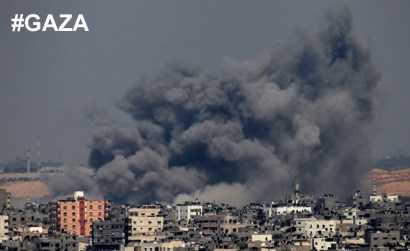 Now even the Shin Bet, Israel’s secret police, admits in court documents that the group behind the kidnapping and murder of the three Israeli youths in the West Bank in June was a rogue cell, comprising only four individuals. Further, the man named as the mastermind behind the plot was “lukewarm” about it.
Hussam Qawasmeh was apparently originally lukewarm about the plan proposed to him by a relative, Marwan Qawasmeh, who with Amer Abu Aisheh has been named as having carried out the kidnapping and murder and is still wanted by Israel.
So who’s going to remind us that Netanyahu’s invasion of the West Bank, his rounding up of hundreds of Hamas activists, and the ensuing confrontation with Hamas in Gaza that led to Israel’s use of massive military force, killing more than 2,100 Palestinians, the vast majority of them civilians, were all based on a lie: that he had cast-iron evidence that Hamas was responsible for the murders?
A crime of aggression against Gaza is a crime against humanity – in fact, the supreme crime, as determined by the Nuremberg tribunals. But this crime against humanity is going straight down the memory hole because Israel, rather than an official enemy, was responsible.
September 5, 2014
Posted by aletho |
Ethnic Cleansing, Racism, Zionism, Mainstream Media, Warmongering, War Crimes | Gaza, Israel, Palestine, Zionism |
Leave a comment
Once the surveillance cameras of Palestinian shopkeepers in East Jerusalem’s Shuafat neighborhood revealed the images of the Israeli abductors of Muhammed Abu Khdeir, the fabricated Israeli propaganda that the 16-year-old Palestinian boy had been gay and the victim of an honor killing perpetrated by his own people became completely unsustainable. Soon after, hoping to contain the resulting clashes that erupted in Shuafat and extended to many nearby neighborhoods, Israeli police announced that they had captured six suspects involved in the crime.
Just days later, however, it was announced that three of them already had been freed. The others were described as two minors and a mentally unstable adult with a dominating personality who is on psychiatric medication, according to Yediot Ahronot.
That has a familiar ring to it! In 1969 Dennis Michael Rohan, an evangelical Protestant from Australia, set fire to the al-Aqsa mosque in order to hasten the second coming of the Messiah and create an opportunity to rebuild the Jewish Temple. Rohan was later declared mentally ill and exonerated for his actions.
In 2007 Julian Soufir confessed to having murdered Palestinian taxi driver Taysir Karaki, saying he did not feel guilty because he considered Arabs the equivalent of cattle and he was simply slaughtering one. Soufir had entered the victim’s taxi in Jerusalem and asked to be driven to Tel Aviv. He then persuaded Karaki to come to his brother’s apartment with an offer of coffee and the use of the bathroom, and attacked the Palestinian with a knife he had obtained ahead of time. At his 2008 trial, the court accepted the testimonies of two defense witnesses who claimed that Soufir was not fully “conscious” at the time of the murder—despite the fact that he had explained his motive for murdering Karaki—and Soufir was acquitted.
A few years ago, I testified as an expert witness at the Jerusalem district court regarding the case of one of my psychiatric patients who, while suffering an acute psychotic episode, stabbed an Israeli soldier. My patient was 30 years old; after sustaining severe injuries during his arrest, which required 12 surgeries and left him handicapped, he was sentenced to 30 years in prison! The insanity defense certainly did not do my patient much good.
It is one of many pretexts used to avoid the prosecution, imprisonment or punishment of Jewish Israelis who murder Palestinians—but not the other way around. When a Palestinian minor attacks an Israeli, the youngster appears in court with bruises and fractures. Nor are charges dropped because he is a minor. We shall see what happens to the minors who tortured Abu Khdeir and burned him alive.
Settlers’ Law
For many years—in Hebron, especially—radical Jewish settlers have been attacking Palestinians under the very noses of Israeli soldiers, who only intervene to defend the settlers from Palestinians responding to their attacks. In 1994 American-born Dr. Baruch Goldstein massacred 30 Palestinians praying at Hebron’s Ibrahimi mosque, which he entered under the eyes of Israeli soldiers who—instead of acting to stop the massacre—fired live ammunition into the fleeing crowd, killing even more Palestinians!
In 2008 Ze’ev Braude, a settler from nearby Kiryat Arba, was caught on camera as he shot at close range two Palestinians from the Matariya family during the evacuation of a Palestinian house in Hebron. The film was provided to Israeli police as evidence, but the indictment against Braude was dropped. In his ruling, Judge Elyakim Rubinstein held that “in this instance, the right of the accused to a fair trial outweighed the harm to national security!”
These and similar actions are the consequences of ideologies held by Gush Emunim and other radical movements that encourage the building of settlements in the belief that the coming of the Messiah can be hastened through Jewish settlement of occupied Palestinian land that God promised the Jews. Rather than working to eradicate these beliefs, the Israeli government instead has endorsed them through such vehicles as the Sebastia agreement, which encourages Jewish settlements on occupied Palestinian land.
Israeli intelligence, so effective in hunting down every Palestinian boy who so much as throws a stone, remains inept at imposing limits on the actions of Jewish Israelis—from the fanning of anti-Arab sentiment and racist slogans by the Beitar football team, to attacks on Arab employees of Israeli restaurants, to settler “Price Tag” vandalism and assaults, with graffiti boasting “Price tag blood vengeance.” The official Israeli response to these and other outrages is one of indulgence, and actions to counteract them are minimal. But these groups are inspired by the undercurrent of hatred and dehumanization of Palestinians—a sentiment expressed by Israeli politicians, rabbis and the arbiters of public opinion. Israel’s consistent unwillingness to bring settlers to justice for their violent actions against Palestinians only encourages and incites further settler violence.
Impunity for Israeli Soldiers
In 1984, during what became known as the Bus 300 affair, Shin Bet officers first allowed Israeli Jews to beat up two Palestinians who had hijacked a bus, then executed the two men on the spot—after the hostages had been freed and the hijackers captured and handcuffed. The Shin Bet initially claimed that the hijackers had died when the hostages were being rescued. But these lies were exposed when photos were released showing the hijackers alive after their capture. Nevertheless, Shin Bet head Avraham Shalom and all the officers involved received a presidential pardon for unspecified crimes—before any charges were even brought against them.
In 2004, Iman al-Hams, a 13-year-old Gaza student, lay injured on the ground after having been shot by Israeli soldiers when she entered a “closed military zone” on her way to school. Captain “R,” a Givati Brigade soldier, approached her and shot her at point-blank range. (See Jan./Feb. 2005 Washington Report, p. 9.) According to transcripts of radio exchanges between the soldiers during the incident, Captain “R” said he did this “to confirm the kill.” In court he later claimed that he believed the young girl posed a serious threat and that he had opened fire, not directly aiming at Iman, as a deterrent. Haaretz later reported that Israel would award Captain “R” 80,000 NIS in compensation, after he was acquitted of a charge related to the shooting.
In 2005, Israeli soldier Eden Natan-Zada opened fire on Palestinian citizens of Israel at the border of Shafa Amre, killing 4 and wounding 21. When he paused to reload his rifle, those who survived the massacre overpowered and killed him. The state of Israel, however, chose to indict 12 of the town’s residents! Many were charged with attempted murder for “taking the law into their own hands.”
Last year, Arafat Jaradat, a young student from Hebron, died five days after being detained for allegedly throwing stones at Israeli forces during a protest. An autopsy revealed three broken ribs, severe contusions on his legs and forehead, and blood in his mouth and nose. A Turkish forensic specialist found the injuries consistent with torture. The Israeli medical examiner described the same wounds on Jaradat’s body but was unable to determine a cause of death. The Israeli Foreign Ministry released a statement claiming that Jaradat died of a heart ailment—even though none of the medical specialists, including the Israeli medical examiner, had noted any evidence of a heart condition!
Just a few months ago, on March 10, Israeli troops at Allenby Bridge killed unarmed Palestinian-Jordanian Judge Raed Zeiter, 38, who was on his way to the West Bank to collect rent money to pay for the treatment of his ill son. The Israelis alleged that he tried to snatch a weapon from a soldier, but eyewitnesses told a different story: When the judge lit a cigarette while waiting to be searched; a soldier pushed him, yelling that he couldn’t smoke; Judge Zeiter pushed back, shouting, “Don’t insult me!” The soldier then shot the judge, who was left bleeding for half an hour at the feet of a crowd of Palestinians who waited in line, paralyzed by fear. Judge Zeiter finally died of his wounds. Israeli officials claim surveillance cameras were not functioning on that particular day, and the investigation is now closed, leaving the Israeli officials’ version unchallenged.
Palestinians who kill or even attempt to kill Israelis invariably receive heavy sentences. By contrast, Israelis who kill Palestinians get away with their crimes or receive very minimal sentences, suspended sentences, or fines—if they are not given medals and awards! We have seen soldiers who film themselves while they abuse Palestinians. Many of my own patients who have been tortured under interrogation describe appalling events that took place within four closed walls. Who pays for that? Who is held accountable? Israel makes it impossible to document or track these cases, destroying the evidence and hiding the truth.
The Israeli army, Israeli institutions and individual Israelis violate Palestinians’ human rights with complete impunity. International laws have been created to provide an effective remedy to victims of human rights abuses, but Israeli laws are carefully designed and amended to make Jewish Israelis immune from them. For example, Law 5712 of 1952 was amended to make it impossible for a Palestinian who has sustained damages at the hands of a state agent in any area of the West Bank or Gaza Strip to claim compensation. While “national security” is invoked to drop all charges against Israeli Jews, “secret evidence” is used to prosecute and detain Palestinians through administrative detention without disclosing the charges against them, thus depriving them of the right to due process.
Julian Soufir did not consider himself a murderer because he believed Arabs were like cattle and he was just slaughtering one; Captain “R” felt threatened by an injured 13-year-old schoolgirl and shot her at point-blank range. Not only does the Israeli government and public opinion share these delusions, but the international community supports Israel’s paranoia by endorsing its “right to defend itself.”
After “Operation Cast Lead” in 2008-09 and “Operation Pillar of Defense” in 2012, in July Israel launched “Operation Protective Edge.” We have witnessed three wars in less than six years, all on the pretext of weakening resistance groups. The failure of the international community to set limits and hold Israel accountable for its actions and the inertia of the official Palestinian leadership in going to the International Court of Justice will only invite young people like the friends of Muhammed Abu Khdeir to overcome their fear and act on behalf of the victims of Israel’s insane policies. ❑
Samah Jabr is a Jerusalemite psychiatrist and psychotherapist who cares about the wellbeing of her community—beyond issues of mental health.
September 5, 2014
Posted by aletho |
Ethnic Cleansing, Racism, Zionism, Timeless or most popular | Gaza, Hebron, Human rights, Israel, Palestine, West Bank, Zionism |
Leave a comment
How much longer is the farce of the Palestinian Authority going to continue? I ask because it has been obvious over the past few months that the PA, under President Mahmoud Abbas, is there more for Israel’s benefit than that of the people it is meant to serve, the Palestinians. In such circumstances, any claim of “victory” by the resistance groups in Gaza is illusory.
So-called “security cooperation” with the Israeli occupation forces makes the PA’s own 70,000-strong security agencies collaborators in the eyes of many Palestinians. Has anyone ever seen any PA security forces coming to the aid of Palestinian protesters against Israel’s Apartheid Wall at the weekly demonstrations across the occupied West Bank? Such protests usually start peacefully but end in violence as those taking part are attacked by Israeli soldiers and illegal settlers. Do Palestinian security officers rush to their defence? Well, do they? Of course not, for that is not their role; they exist to police the Palestinians on Israel’s behalf and stifle any form of resistance not tackled by the absurdly-named Israel Defence Forces. Hence, mass round-ups of non-Fatah activists and the suppression of anti-Israel demonstrations during the latest of the Zionist state’s attacks on the civilians of the Gaza Strip.
The EU is the “biggest multilateral donor of assistance to the Palestinians”, and in 2011 this aid amounted to €453 million. Ostensibly there to “build up the institutions of a future democratic, independent and viable Palestinian State living side-by-side with Israel in peace and security”, the bulk of the aid is spent on security and salaries for PA officials and employees. It has been said that one of the reasons for Mahmoud Abbas’ reluctance to sign up to the International Criminal Court to pursue alleged Israeli war criminals through legal means is that the funding which pays his and his cronies’ salaries and pensions will be cut-off if he takes such a step. In other words, he has sold out, placing his personal wellbeing over and above justice for his people.
The “international community”, meanwhile, goes through with the charade that the two-state solution is still viable and, through the “Middle East Quartet”, seeks to impose its own conditions on the Palestinians to get them to acquiesce and offer yet more concessions “for peace”. Israel is spared such pressure and gets away, literally, with murder as it continues to steal ever more Palestinian land while paying lip-service to a moribund peace process.
This is why I am concerned but not surprised to learn that PA negotiator Saeb Erekat has met with US Secretary of State John Kerry in Washington to discuss ways to reopen negotiations with the Israelis. It is as if the recent slaughter of Palestinian civilians in Gaza hasn’t happened; that Israel’s intense military bombardment and destruction of the infrastructure was just a blip on the screen; that normal service will be resumed as soon as possible.
Equally shocking is that the pre-Operation Protective Edge status quo is likely to be the “norm” that prevails, because that is what Israel and the Zionist Lobby in capitals around the world want. Israel will proceed with its expansion unhindered, with more and bigger settlements, arrest campaigns, torture (by Israeli and Palestinian security forces alike), checkpoints and all of the other paraphernalia of its brutal military occupation. The Palestinians will continue to be besieged, brutalised and killed by trigger-happy Israeli soldiers and settlers.
Despite all of this, Mahmoud Abbas and his team of negotiators will be pushed into giving Israel concessions that will not be reciprocated, with little thought, one is led to believe, for the fact that illegal settlements, land grabs and ethnic cleansing should never be subject to “negotiation” in the first place. It is a question that has been asked before but is worth repeating until someone involved in the whole sordid process can provide a legitimate answer: since when have criminals been able to “negotiate” their way out of paying for their crimes?
Euphoria in Palestinian circles, especially in Gaza, over the “victory” against the IDF is, I believe, not only premature but also misleading. How many more “victories” will be celebrated before the world wakes up to the reality that the two-state solution is long dead and buried and efforts to find a “solution” serve only Israeli interests; that we have all been duped by a slick Israeli PR machine aided and abetted by a compliant media and politicians in the West (which now includes a number of Arab capitals in thrall to Zionism) into believing that Israel is the victim in all of this and entitled to “self-defence”? Such a conclusion rides roughshod over international law and natural justice, but it is accepted by Washington, London, Berlin and the other capitals which support Israel right or wrong.
Only when its Western supporters stand up to Israel’s illegitimacy and illegal activity is there ever any likelihood that peace and genuine justice may prevail. Until and unless that happens (and I am not holding my breath), the Palestinians in the occupied West Bank and Gaza Strip will be squeezed between the rock of Israeli oppression and the hard place of the Palestinian Authority. They are now two sides of the same coin, but neither carries any currency for the people of Palestine.
September 5, 2014
Posted by aletho |
Corruption, Ethnic Cleansing, Racism, Zionism, Timeless or most popular | Gaza, Human rights, Israel, Palestine, Zionism |
Leave a comment
 Rebuilding Gaza will cost $7.8 billion, the Palestinian Authority said on Thursday, in the most comprehensive assessment yet of damage from the seven-week Israeli assault during which whole neighborhoods and vital infrastructure were flattened.
The cost of rebuilding 17,000 Gazan homes razed by Israeli bombings would be $2.5 billion, the Authority said, and the energy sector needed $250 million after the Strip’s only power plant was destroyed by two Israeli missiles.
“The attack on Gaza this time had no precedent, Gaza has been hit with a catastrophe and it needs immediate help because many things can’t wait long,” Mohammed Shtayyeh, a Palestinian economist and a senior member of the West Bank’s dominant Fatah party, told reporters in Ramallah.
Rebuilding Gaza would depend heavily on foreign aid and requires an end to Palestinian rivalry and Israel opening its border crossings, said Shtayyeh, who heads the Palestinian Economic Council for Research and Development (PECDAR) which ran the survey.
But none of the factors mentioned by Shtayyeh appeared forthcoming. A donor conference in Cairo has yet to be formally scheduled, Palestinian institutions remain divided between Gaza and the West Bank and Israel has yet to fundamentally ease the movement of people and goods at its Gaza border.
The PA’s assessment also found that the Strip’s education sector would need around $143 million to get back on its feet. About half a million children have been unable to return to their schools due to damage or because the buildings are being used to house refugees.
Over 106,000 of Gaza’s 1.8 million residents have been displaced to UN shelters and host families, the UN says.
The remaining billions of dollars in the PECDAR assessment, which was compiled by 13 experts resident in Gaza and their research teams, were allocated to the financial, health, agriculture, and transportation sectors, all of which suffered widespread damage during the war.
The assessment also earmarked $670 million for an airport and sea port, which Shtayyeh said was a Palestinian right, but Israel has so far rejected.
The Israeli assault on Gaza killed over 2,100 Palestinians, most of them civilians, along with 64 Israeli soldiers and five civilians.
In the week since an Egyptian-mediated ceasefire took hold on August 26, little progress has been made in getting the rebuilding underway or settling the bitter political rifts around Gaza.
An international donor conference jointly chaired by Egypt and Norway has yet to be formally scheduled, and Israel has not fundamentally changed its curbs on the movement of people and goods, especially crucial building materials, on Gaza’s border.
The cash-strapped Palestinian Authority barely has enough money to pay its own employees in the West Bank and has no immediate plans to pay employees in the Hamas-run Gaza Strip, despite a unity pact signed between Fatah and Hamas in April.
“The Authority needs to be able to work as an authority to become completely responsible for all aspects of life in Gaza,” Shtayyeh told reporters.
(Reuters, Al-Akhbar)
September 5, 2014
Posted by aletho |
Economics, Ethnic Cleansing, Racism, Zionism, War Crimes | Gaza, Israel, Palestine, Zionism |
Leave a comment
Rashid Khalidi, Edward Said Professor of Arab Studies at Columbia University, former advisor to Palestinian negotiators, and author of Brokers of Deceit: How the U.S. Has Undermined Peace in the Middle East (2013) and The Iron Cage: The Story of the Palestinian Struggle for Statehood (2006).
Diana Buttu, Ramallah-based analyst, former advisor to Palestine Liberation Organization Chairman Mahmoud Abbas and Palestinian negotiators, and Policy Advisor to Al-Shabaka: The Palestinian Policy Network.
Q&A
Q – Palestine Liberation Organization Chairman and Palestinian Authority President Mahmoud Abbas recently announced a new diplomatic initiative calling on Israel to end its occupation within three years and to allow for the creation of a Palestinian state with borders based on the pre-1967 lines. If Israel refuses, or fails to negotiate in good faith, Abbas says the Palestinians will take action at international forums like the International Criminal Court.
How does this plan differ fundamentally, if at all, from Abbas’ previous strategy, and what is the likelihood that it will succeed, or at least advance the cause of Palestinian freedom in some way?
RK – “It appears that it would delay further the possibility of pressure on Israel by the International Criminal Court, and provide further opportunity for Israeli foot-dragging, prevarication and aggression, while settlement building and occupation continue. This Israeli government has never negotiated in good faith, and there is no proper forum or structure for a negotiation in any case, the Oslo process having been revealed as a device for strengthening Israeli occupation control and colonization of Palestinian lands.”
DB – “This plan does not differ, in any way, from previous failed plans put forward by Mahmoud Abbas. Abbas is one of the architects of the Israeli-Palestinian negotiations process known as Oslo. As such, he appears to have only one plan — negotiations — and despite the indisputable fact that this process has failed to bring Palestinians any closer to their freedom after more than two decades, he continues to insist on returning to this same strategy.
“To be clear, Israel has no interest in reaching a fair and lasting peace agreement with the Palestinians, but does have an interest in resuming negotiations. Under the cover of ‘peace talks,’ Israel can continue to build and expand its illegal settlements on stolen Palestinian land, and it can continue to maintain a brutal military occupation while at the same time reaping the benefits of increased trade and normalized international relations.
“Therefore, Abbas needs to change course and pursue a different strategy. Instead of demanding more negotiations, he should push the international community to isolate and ostracize Israel for its continued military occupation, colonization, and other violations of international law. This should take the form of advocating for sanctions and boycotts against Israel, and pushing for Israel’s isolation from the international arena. At the same time, he should mobilize large-scale nonviolent resistance on the ground in Palestine, something he has failed utterly to do up until now. Another three years of negotiations will only serve to provide Israel with yet more time to build more settlements, and make even further demands that Palestinians concede more of their territory to accommodate Israel’s criminal behavior.”
Q – According to reports, Israel is refusing to send negotiators to Cairo for follow-up talks to ease its blockade of Gaza and to address other issues, as stipulated in the ceasefire agreement that ended its latest bloody military assault on the occupied and besieged coastal territory last week. If Israel refuses to abide by its word to discuss a loosening of the siege and other matters, what avenues of redress do Palestinians have, and does Israel’s continued intransigence make another war in Gaza inevitable?
RK – “If occupation and settlement continue, and in the absence of international efforts to call Israel to account for its violations of UN Security Council resolutions and international law, there will unfortunately inevitably be more violence. The Palestinians should be actively seeking to reunite their national movement, agreeing on a consensus strategy involving popular mobilization, and expanding international and regional support for their cause in order to put pressure on Israel, which has managed to maintain the status quo of occupation and colonization of Palestinian land for nearly five decades now.”
DB – “Israel has no incentive, whatsoever, to resume discussions over Gaza. Unlike its negotiations with PA President Mahmoud Abbas, in which a resumption of talks provides Israel with the opportunity to expand its settlement enterprise without international repercussions, Israel is under no pressure to open Gaza. Rather, Israel has been allowed to maintain a seven-year blockade of Gaza, deny Palestinians freedom of movement and the ability to import and export goods, and deny Palestinians access to their fishing rights without any reaction from the international community. Israel has reneged on previous promises to open a seaport and airport in Gaza and to open the crossing points. Yet, it has done so with impunity.
“Given that no people can be expected to sit idly by while being denied their freedom, caged in an open-air prison, and targeted by repeated military attacks, sadly it will only be a matter of time before yet another war in Gaza breaks out. This is why Palestinians have been urgently pressing for the international community’s involvement, and highlights the necessity of a comprehensive approach to address Israel’s military occupation and denial of Palestinian rights and freedoms.”
Q – On Sunday, the Israeli government announced plans to expropriate almost 1000 acres of occupied Palestinian land in the West Bank near Bethlehem, in what is reportedly the largest Israeli land grab in three decades. In response, the international community, including the United States and UN Secretary General Ban Ki-moon, condemned the move, with the latter pointing out that all settlement activity is “illegal under international law and runs totally counter to the pursuit of a two-state solution.” Even before this latest large-scale Israeli theft of Palestinian land, a growing number of observers had concluded that the two-state solution, which is predicated on the creation of a Palestinian state in territories that Israel continues to aggressively colonize, was dead. What, if any, impact do you think this move will have on the situation on the ground, Abbas’ new diplomatic initiative, and prospects for a two-state solution to the conflict?
RK – “Israel has long since buried the two-state solution with its colonization efforts all over occupied Arab East Jerusalem and the West Bank. Prime Minister Netanyahu has repeatedly publicly stated that Israel will never give up its control of these territories. It is unclear what more he could do to drive a stake through the heart of the two-state solution, so far without provoking any serious international or regional reaction. The Oslo paradigm is dead, and we seem to be in a new phase, but neither Palestinian and Arab leaders, nor the US and Europe, have yet reacted in an appropriate way, which would be to finally hold Israel responsible for its actions and to impose serious sanctions on this serial violator of international law and norms.”
DB – “Israel cannot claim to favor a negotiated settlement or to support the two-state solution while also expropriating Palestinian land, demolishing Palestinian homes and building settlements. While Israeli actions like settlement building are blatantly illegal, the international community has failed to hold Israeli leaders accountable or to censure Israel in any way, apart from the occasional toothless verbal condemnation. Unfortunately, Abbas’s ‘new’ diplomatic initiative will only serve to provide Israel with more time to build and expand more settlements while the world sits, watches, and does nothing. Israel killed the two-state solution a long time ago, aided and abetted by the international community’s apathy and inaction. One can only hope that this latest large-scale theft of Palestinian land will lead to a shift in international thinking, forcing world leaders to realize that the only way forward is to hold Israel accountable for its illegal actions — rather than demanding a return to useless, counterproductive negotiations.”
~
For further reference, see our recently released expert Q&A: Amnesty International & Human Rights Watch on Being Denied Entry to Gaza, and our recently released fact sheets, Putting Palestinians “On a Diet”: Israel’s Siege & Blockade of Gaza and The Children of Gaza: A Generation Scarred & Under Siege.
September 4, 2014
Posted by aletho |
Ethnic Cleansing, Racism, Zionism, Illegal Occupation, Timeless or most popular | Gaza, Israel, Palestine, Zionism |
Leave a comment
UNRWA Commissioner-General, Pierre Krähenbühl, says that the reconstruction process of Gaza may take over a decade, if the current blockade on the Gaza Strip is not lifted.
According to Al Ray Palestinian Media Agency, Kraehenbuel declared, during a two-day official visit to Switzerland, that the blockade on Gaza “must be lifted”.
“I would like to thank the government and people of Switzerland for their generous and unwavering support to UNRWA and the refugees we serve. The recent fighting in Gaza and the UNRWA response demonstrated once more how vital our services have become,” he said.
“As the discussions intensify about the reconstruction of Gaza, it is becoming clear that UNRWA will be central to that effort. But we have to remember that Swiss funds are supporting our services beyond Gaza, across the Middle East in war-torn Syria, Lebanon, Jordan and the West Bank.”
Mr. Krähenbühl announced that at least 20,000 homes were destroyed during the recent Israeli assault on the Gaza Strip, and that there had been widespread destruction of public infrastructure.
He states that it was “an imperative for the international community and for the people of Gaza to reconstruct after the devastation”, which was unprecedented in recent history:
“I visited Gaza three times during the recent conflict and the impact of the fighting on individual human lives, particularly the young, is palpable and profound. Hundreds of thousands of children are deep in trauma. We estimate that of one thousand injured children out of three thousands will suffer permanent disabilities.”
Krähenbühl noted that several hundred UNRWA counselors are working to restore a sense of normality to the region. “UNRWA will do all it can to restore human dignity to a community that has suffered enough,” he said.
He also expressed his concern for “more than 50,000 people” who are still living in Gaza’s UNRWA schools due to the fact that their homes had been destroyed:
“We need to do all we can to find alternative accommodation for these people, as we are determined to begin our delayed school year on 14 September… It will be a challenge.”
September 3, 2014
Posted by aletho |
Economics, Ethnic Cleansing, Racism, Zionism, War Crimes | Gaza, Israel, Palestine, Zionism |
Leave a comment

A Palestinian school damaged during Operation Protective Edge. 7 August, Gaza City. [Jordi Bernabeu Farrús/Flickr]
A row is brewing over claims that Israel is earning millions of euros from a de facto policy of preventing non-Israeli reconstruction aid from entering the Gaza Strip.
At least 65,000 people in the Gaza Strip are homeless after the recent seven-week conflict. Infrastructure ranging from water desalination centres to power plants lies in ruins.
No formal Israeli ban prevents the import of reconstruction materials that were not made in Israel, but EU sources speaking on condition of anonymity say that in practice, Israeli security demands present them with a fait accompli.
“If you want aid materials to be permitted to enter, they will almost inevitably come from Israeli sources,” an EU official said. “I don’t think you’ll find it written down anywhere in official policy, but when you get to negotiate with the Israelis, this is what happens. It increases construction and transaction costs, and is a political problem that has to be dealt with.”
As well as Israel’s security restrictions on aid, “it can be very difficult to export materials to Gaza,” the official said. “A lot of goods for a Gaza private sector reconstruction project we had, ended up being held in Ashdod port for very lengthy periods of time – months if not years – so there was de facto no alternative but to use Israeli sources.”
The source added that the policy had benefited Israel’s economy to the tune of millions of euros and was, in his view, deliberate.
The European Commission donates some €300 million in development aid to Gaza and the West Bank every year, and around €200 million in humanitarian aid.
The EU official’s allegation received backing from international agencies canvassed by EurActiv and is broadly in line with findings in a UN report due to be published later today (3 September).
The United Nations Conference on Trade and Development (UNCTAD) study will say that half of all donor assistance to Palestinians in the West Bank and Gaza – who the UN body say constitute a captive market – is spent on servicing a trade deficit to Israel.
‘Dual use items’
Tel Aviv imposed a full blockade on the Gaza Strip in 2007 after the ascent to power of the Islamist Hamas movement, which has used suicide bombing and rocket attack tactics against Israel’s occupation, that have claimed hundreds of civilian lives.
But the UN and international NGOs have protested the blockade’s prevention of free movement and trade for the vast majority of Gazans as a collective punishment.
Building materials such as steel and cement, necessary for the reconstruction of Gaza, have been designated by Israel as ‘dual use’ items – adaptable for munitions – that may only be imported to Gaza by the UN and aid agencies under Israeli supervision.
Mark Regev, a spokesman for the Israeli prime ministers’ office, denied claims that Israel’s entry policy to Gaza prevented non-Israeli-made reconstruction materials from entering the Strip.
“I know that policy, and it is not true,” he told EurActiv over the phone from Jerusalem. He was unable though to give examples of non-Israeli reconstruction materials allowed into Gaza, referring inquiries on to Cogat.
The Israeli body, Cogat, which coordinates the entry of aid into Gaza, did not respond to requests for comment.
But “there are not many choices,” Amir Rotem, the public affairs director for Gisha, an Israeli NGO, told EurActiv. “The Israeli market has a monopoly of cement in just one company, and I don’t know of any Palestinian-made cement in the West Bank, so there’s not much to choose from.”
‘Chutzpah writ large’
International reactions to the EU official’s claims were strong.
“It is outrageous that a country which has just demolished 25,000 houses is demanding that their construction industry benefit from rebuilding them at the expense of the international community,” one Western diplomat told EurActiv.
“Talk about chutzpah writ large!” he said.
Mahmoud el-Khafif, UNCTAD’s special coordinator for assistance to the Palestinian people, told EurActiv that he believed the EU official’s claims were correct.
“If you look at steel or cement, I think the only source for it would be Israel,” he said. “It is a serious problem in my opinion as an economist. What happened in Gaza and what is happening in the West Bank in terms of controlling Area C is an ongoing process to reduce the ability of the Palestinian economy to produce, and the only alternative is to import from Israel.”
Later today, a new UNCTAD report will say that economic growth (measured by GDP) in the economy of the occupied Palestinian Territories declined from 11% in 2011 to just 1.5% last year, far below the rate of population growth.
‘An unliveable place before 2020’
Even before the recent fighting, unemployment in Gaza was running at 36% and people were poorer than in the 1990s, when the Oslo peace process began.
Rebuilding the battered Strip now will take 20 years under the current regime of restrictions, according to a report published earlier this week by Shelter Cluster, an NGO chaired by the Norwegian Refugee Council, with the participation of the UNHCR and the International Red Cross.
That could be too late for many Gazans. The UN’s relief and works agency (UNRWA) has previously estimated that Gaza will not be “a liveable place” by 2020 because of population increase and a depletion of fresh water sources by 2016.
“lf Gaza was going to be an unlivable place by 2020 – before the latest fighting – it will now be an unlivable place considerably before then,” Christopher Gunness, a spokesman for UNRWA told EurActiv, from the Gaza Strip.
“With at least 20,000 homes damaged or destroyed, with miles of water infrastructure devastated, with millions of gallons of raw sewage flowing into the sea every day, and the corrosive impacts of blockade, the sustainability of Gaza will be even more short lived,” he said.
More than 2,100 Palestinians – mostly civilians – were killed in Israel’s recent Operation Protective Edge, as were 73 Israelis – mostly soldiers.
The international reconstruction effort in Gaza could cost more than $6 billion, according to the Palestinian deputy prime minister.
September 3, 2014
Posted by aletho |
Economics, Ethnic Cleansing, Racism, Zionism | European Union, Gaza, Israel, Palestine, West Bank, Zionism |
Leave a comment


 Aletho News
