Israeli airstrike kills 3 Palestinians in southern Gaza

Ismail Abu Judah, Shahir Abu Shanab, and Abd al-Shafi Muammar.
Ma’an – 11/03/2014
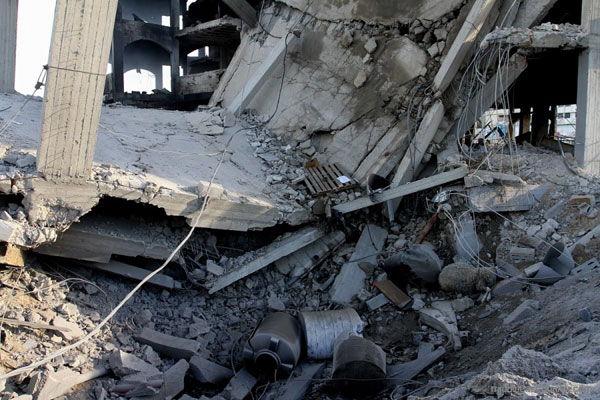
GAZA CITY – An Israeli airstrike killed three Palestinians in the southern Gaza Strip on Tuesday, an official said.
Gaza Ministry of Health spokesman Ashraf al-Qidra told Ma’an that three Palestinian resistance fighters were killed by the airstrike in southeast Khan Younis near the Sufa crossing.
Al-Qidra identified the victims as Ismail Abu Judah, 23, Shahir Abu Shanab, 24, and 33-year-old Abd al-Shafi Muammar.
The bodies were taken to the European Hospital in Khan Younis, al-Qidra said.
Al-Quds Brigades, the military wing of the Islamic Jihad movement, said in a statement that the victims were militants affiliated to the group.
“They were in confrontation with the occupation trying to stop the progress of Israeli military vehicles which were approaching the area,” the statement said.
The Israeli army said in a statement that “terrorists affiliated with the Palestinian Islamic Jihad in the southern Gaza Strip fired a mortar shell at IDF forces.”
“An IAF aircraft responded immediately in order to prevent further attacks on Israeli civilians and targeted the terrorist squad. Direct hits were confirmed, the army statement said.
Earlier on Tuesday morning, an Israeli drone fell in the area of the attack.
The airstrikes came just hours after Palestinian security sources said a man died after Israeli soldiers fired at him while he was driving near the West Bank city of Tulkarem.
The Israeli army also killed two Palestinians in the West Bank on Monday.
Israeli soldiers shot and killed 18-year-old Saji Darwish near Ramallah late Monday, after he allegedly threw stones at Israeli vehicles.
Earlier, Israeli forces shot and killed a Palestinian-Jordanian judge at the Allenby Bridge crossing with Jordan.

Analysis: EU aid to Palestinians — help or hindrance?
IRIN – 19/02/2014
JERUSALEM — The European Union has long been one of the most reliable foreign sources of humanitarian, economic and political aid in the Occupied Palestinian Territories (OPT), providing 426 million euros ($575 million) in 2013 alone.
In 2011, overall overseas development aid to the OPT was worth $2.5 billion, according to the Organization for Economic Co-operation and Development.
Much of this aid to the Palestinian people is focused on a single long-term objective, according to EU officials — the building up of the institutions of a future democratic, independent and viable Palestinian state, living side-by-side in peace and security with Israel.
But with limited progress so far in the current US-brokered peace talks and the wider aim of the realization of a Palestinian state, some in the more austerity-minded EU are starting to wonder if the aid is being well spent, when humanitarian crises in Syria and Mali are in need of greater funds.
“By now there is no Palestinian state. The point is: what are we funding here? Are we helping Israel to maintain the occupation, or are we actually helping Palestinians to build independence?” Caroline du Plessix, a French political scientist specialized on EU policy towards the two-state-solution, told IRIN.
“EU member states are today much more aware than before that their aid has not made possible the creation of an independent Palestinian state,” she said, adding: “The EU is trying to figure out what the best strategy may be. Member states need to show that their policy is reaching its ends and is effective. But if the main solution still is the two-state-solution and we are not really going in that direction, this policy is not sustainable and cannot go on for ever.”
Carrot and stick
A substantial reduction in EU aid seems unlikely at the moment. Such a move would have dramatic consequences for the Palestinian economy and the livelihoods of tens of thousands of families.
“There will be a price to pay if these negotiations falter,” the EU’s ambassador to Israel, Lars Faaborg-Andersen, said in late January. In December 2013, an EU official was cited in the Israeli newspaper Haaretz as saying that the EU may cut off financial aid to the Palestinian Authority if peace talks fail, while “some people suggested giving the money to other countries, like Syria, Mali and other places around the world.”
On the other hand, EU foreign ministers are making unprecedented offers, setting out a very substantial set of incentives designed to encourage both parties to finalize a peace agreement.
“These incentives aim at boosting prosperity for both Israelis and Palestinians by increasing access to European markets, facilitating trade and investment and deepening business and cultural ties,” EU-representative John Gatt-Rutter told IRIN, adding: “Therefore, at this stage our approach is one of encouraging both parties to seize this unique opportunity provided by the peace negotiations.”
“In spite of donor fatigue in Europe we will not see more than a limited gradual reduction — say 10 percent a year — in European aid if negotiations fail because European leaders do not want to trigger major instability or a humanitarian crisis,” Ofer Zalzberg, senior analyst at the International Crisis Group, told IRIN.
Building the state to come
Of the 426 million euros provided by the EU to Palestinians in 2013, 168 million was Direct Financial Support to the PA under the so-called PEGASE-mechanism.
PEGASE helps the PA to meet its recurrent expenses through paying salaries, pensions and social allowances to people in extreme poverty, and through supporting essential public services and revitalizing the private sector through policy reforms, institution-building and strengthening the relations between Palestinian enterprises and European counterparts.
The funds are transferred directly to individual beneficiaries like 55-year-old Nabila from the Qaddura refugee camp. “I get 750 shekels ($210) every three months, have a disabled son, and my husband died 10 years ago. How can I move on?” she told IRIN at the Ramallah district office of the PA’s Ministry of Social Affairs.
“There is poverty and we get tired of this situation,” she said, adding though that restrictions on movement (caused, for example, by the Barrier and numerous Israeli checkpoints allegedly set up for security reasons) highlighted a greater problem that aid would never solve.
“How do you want to solve this problem? Why do we have to be in this miserable situation?”
In addition to the direct financial support, humanitarian aid is provided through the European Commission Humanitarian Aid and Civil Protection Department (ECHO), which spent 35 million euros in 2013 on areas such as humanitarian coordination, legal assistance and emergency response to demolitions and evictions.
Propping up the status quo
EU aid faces the same challenges as non-governmental aid groups have faced — that by providing support they may inadvertently be playing a political role by helping prop up the status quo, giving life-support services that should normally be provided by Israel, as the occupying power.
“EU funding is strategic. Its main aim is to prevent instability. It is thus scared of the PA’s breakdown,” said Caroline Du Plessix.
For Sami Abu Roza, former economic policy adviser to the Palestinian president, this system of dependency has a bitter political aftertaste.
“If you take away the good intention behind the money, aid is a substitute for not having real remedies,” he told IRIN at the PA’s Ministry of Education, where he currently works.
The EU’s approach to solving the conflict, he says, is part of a larger trend he calls “peaceconomics”, the feeding of an illusionary idea that institution-building and economic aid can contribute to real progress, while the actual political causes behind the difficult situation are side-lined and remain unresolved.

Ashraf Azzam sits in the ruins of his house in eastern Gaza City in Jan. 2013 after it was destroyed in an Israeli attack in Nov. 2012. (Ahmed Dalloul/IRIN)
‘Patronizing’ attitude
“The EU’s attitude towards Palestinians is patronizing, as if money was the only thing Palestinians needed,” he said, adding: “They are sacrificing real solutions for economic aid, building a smoke screen around the real problems.”
“Palestinians know that any money coming to Palestinians is political. But they also know that the world won’t stop paying for Palestinians under occupation. That’s the strange kind of peace Palestinians live in.”
In an attempt to decrease the political dependence from aid, the Ministry of Education has implemented a new mechanism, the Joint Financing Agreement, which has been running for about three years.
With aid money flowing from the German KfW Development Bank, Finland, Ireland, Norway and Belgium, directly into a pool at the treasury of the PA’s Ministry of Finance, the Ministry of Education has full ownership of the money and decides how and where it is spent.
“It’s a small path to independence, towards political independence,” Abu Roza said.
But for one senior official in the Ministry, who asked to remain anonymous, the notion of independence remains unreal.
“We don’t have control of our own borders, no taxation, and all of Area C is under Israel’s control. What economic independence are we speaking of?” he said, adding that the PA was not created to become a social entity providing salaries and services to Palestinians. “Its aim was political, and so are our problems.”
‘Aid has not helped to fulfill Palestinians dreams’
Some anomalies in the EU’s funding to the PA emerged recently in a report of the European Court of Auditors (ECA), which criticized the EU’s paying of salaries to Palestinian civil servants in the Gaza Strip “who no longer work.” The report suggested financial assistance “be discontinued and redirected to the West Bank.” Hamas, which took control [won elections] of the Gaza Strip in 2007, is classified by the EU as a terrorist group.
So the EU continues to support the former PA structure in Gaza with salary payments even though the PA no longer has any control: The political cost of stopping funding is seen as too great.
From 2008 to 2012, the average number of civil servants and pensioners whose salaries were at least partly paid by the EU rose from 75,502 to 84,320, about half of the PA’s 170,000 civil servants and pensioners.
During the same period, the average monthly PA wage bill for EU-beneficiaries rose from 45.1 million euros to 62.9 million euros, an increase of 39 percent.
But at the same time, contributions to PEGASE for Civil Servants and Pensioners fell from 21.3 million euros (47 percent of total pay to eligible beneficiaries) in 2008 to 10.4 million euros (16 percent) in 2012, mainly due to reductions in contributions from donors, such as Spain.
These pressures point to a new funding environment in which the PA is finding it increasingly difficult to pay salaries and pensions on time.
The UN Works and Relief Agency for Palestinian Refugees (UNRWA) faces similar challenges. This year it has a deficit of $65 million in its core budget and struggles with declining international funding. The EU is UNRWA’s largest donor.
“Aid has not helped to fulfill Palestinians dreams, nor did it lead to sustainable development. Independence is today further away than 20 years ago,” Alaa Tartir, program director of the Palestinian Policy Network, told IRIN.
Despite the contradictions in EU aid policy, it is clear that without EU aid the humanitarian situation in OPT would worsen significantly.
“If we reach a condition where there is no more aid for PA employees, who will fill this gap? This will have a severe humanitarian impact,” said Tommaso Fabri, head of the Jerusalem office of Doctors Without Borders.
One beneficiary of the EU’s direct assistance to the PA is 49-year-old Said Samara, a teacher at the Secondary Boarding School in Ramallah.
“As a teacher, I hope that this aid will continue. But as a teacher, and for my students, I also need some hope for an independent Palestinian country,” he said.
Israel continues military violence against Palestinian fishermen in Gaza waters
By Charlie Andreasson | International Solidarity Movement | February 19, 2014

Palestinian fishermen paddle a small fishing boat, or hasaka, off the Gaza coast. (Photo by Charlie Andreasson)
Gaza, Occupied Palestine – Three Palestinian fishermen were arrested and had their boats and gear confiscated by occupation forces on Tuesday, 11th February, in two separate incidents, despite the fact that they were well within the Israel-permitted zone and could not be classified as security threat to the State of Israel, its civilians or its military.
Mohamed Sleeby, 42, paddled out early in the morning in his hasaka with his son, Ahmed, 16, from the beach at Shati, north of Gaza City. Mohamed’s is a smaller hasaka without an engine, four meters long, and can only fish close to shore. While they pulled on their nets about half a nautical mile from the shore, Israeli patrol boats approached. When they started shooting, other Palestinian fishing boats nearby fled.
“It was like a horror movie,” Mohamed said. “I closed my eyes. When I opened them again, they were right in front of the hasaka with aimed guns and masked faces. They shot into the water right next to us and ordered us to strip completely naked and swim, one at a time, towards them. It was humiliating to stand there completely naked in front of them, stripped of all humanity, with my son at my side. But I dared not disobey.”
Despite his fear, Mohamed asked that his son be spared. The soldiers shouted at him to shut up. They shot near his son, even though he held his hands outstretched while waiting for his turn to step into the cold water. Once they were pulled onto one of the patrol boats, they were given clothes, but hoods were also pulled over their heads. They were taken to a waiting, larger military boat outside the zone allowed by Israel to Palestinian fishermen. Even with shackles on the hands and feet, they were forced to kneel on their knees. Fadel Al-Sultan, 25, was also on board. Earlier that morning, he had also been detained, and had his small hasaka without an engine seized, less than half a nautical half from the shore.
In Ashdod, they all underwent health checks, were photographed holding their results and their personal details on sheets of paper, and were accused of having been outside the permitted zone. Fadel, who had previously been captured twice while fishing, was threatened with being sent directly to jail without trial if he was caught again. As with previous detentions of Palestinian fishermen, the interrogators focused on collecting information about government buildings and their staff in Gaza, on possible contacts with insurgents and on personal networks. Unlike previous detentions, they also asked where any fish farms were located on land. Later they were transported to Erez, where a new hearing began with Mohamed Sleeby, his skin was checked for traces of explosives and attempts were made to recruit him to the Israeli intelligence service.
“He [the lone interrogator] knew everything about me,” Muhamed said. “He knew I did not pay taxes on electricity. He offered to pay them, promised I would get my hasaka and nets back, and even said I would get a little money. He said I should not be afraid, that I am in good hands and that no one but me, him and God would know anything about this, that I ought to think about my family and not miss the chance. But I cannot do that to my brothers and neighbors. He said I should think about it and that he would contact me by phone. But how can he do that? I was left with my clothes in the hasaka they seized. No, I would rather starve than help the ones keeping us in poverty.”

Fadel Al-Sultan. (Photo by Charlie Andreasson)
Muhamed Sleeby and Fadel Al-Sultan’s answers on why the Israeli military attack the fisherman so close to the shore, even though they can pose no threat to the State of Israeli or its residents, were consistent. “They want to make life even more difficult for us,” they say, “to prevent us from supporting ourselves.” Fadel also says that to get better catches, they need to go 7-8 nautical miles from the coast, but that is impossible because Israel has limited them to six nautical miles. But even that limit is irrelevant, as they are attacked so far inside it that they all have to fight for the small catches along the beach. Those who have to paddle out to fish are now competing with larger boats forced toward the shore.
In January, thirteen attacks have been carried out by the Israeli military against Palestinian fishermen. At one time the occupying power decreed a six-nautical mile limit, at another three miles, but it has consistently attacked far within three nautical miles from the coast. Both these attacks and the limits are violations of international law.
Related articles


Will the flowers of Gaza break Israel’s siege this Valentine’s Day?
By Tom Anderson and Therezia Cooper | Corporate Watch | February 12, 2014

Flowers from Gaza being prepared for export (Photo by Corporate Watch)
Gaza, Occupied Palestine – Valentine’s Day is almost upon us and for supermarkets and florists that means a massive increase in the sale of flowers. But how many romantic couples consider where the flowers they exchange are grown?
Farmers in Gaza have long been encouraged by Israeli export companies to focus their production on high risk ‘cash crops’ such as flowers and strawberries, and the arrival of carnations from Rafah to European markets for Christmas or Valentine’s day is often cheered on by the Israeli Government who uses it as a PR exercise to show how it ‘facilitates’ Palestinian exports. Unsurprisingly, this is not the full story.
According to the Palestinian Union of Agricultural Work Committees (UAWC) there used to be over 500 dunams of carnations planted in the Gaza Strip, but since the beginning of the siege in 2007 flower exports have plummeted year on year and there are only around 60 dunams left. The planted land used to produce over forty million stems for export, but now the few carnation farmers who are left are struggling to sell 5-10 million.
“The Israeli occupation allows us to export a small quantity of produce, just to show the world that they are nice to the Palestinians, but they are using us. Everything we do is controlled by them”, said Saad Ziada from UAWC when we met him in his Gaza City office in November last year, just before what was supposed to be the start of the flower exporting season. This statement is true of all produce in Gaza but flower exporters are particularly susceptible to the control Israel holds over exports, as their produce relies on hitting the market at exactly the right time for popular flower buying holidays. If the border is closed for a week and the flowers miss the export window for Valentine’s Day, for instance, their profit for the whole year can be lost.
We visited Rafah to talk to one of the few flower growers still in business and hear about the situation for farmers under the siege.
“The problem is the border and the siege”
Hassan Gazi al Hijazi has been in the flower business for over 25 years and has seen many changes in the flower export industry. When he started out he had to be registered as an Israeli grower, despite growing his flowers in Gaza, and he gave classes in the art of flower growing to new farmers. “There used to be 53 flower farmers in the Rafah area and now there are only 4 of us left” he told us. “I personally used to have 40 dunams and now I only have 4”. He said that he needs assistance from outside to even operate them now, his flower packing house displays signs showing that he receives financial support from Spain.

(Photo by Corporate Watch)
Just as with all produce from Gaza, his flowers have to be exported via Israel, through an Israeli company. In the past this used to be Carmel Agrexco, which used the name Coral for Palestinian produce, but after its liquidation he now works with a Palestinian Co-operative which exports under the brand name Palestine Crops using the slogan ‘From Palestine Land to Global Markets’. Palestine Crops is a Gaza initiative which works with agricultural co-ops in the strip and aims to create a market for Palestinian labelled goods and, eventually, independent exports. For now, however, this is impossible and although some exports from Gaza come with Palestine Crops branding, they are dependent on their Israeli distributor. In the case of flowers, this is primarily the Flower Board of Israel. Once transported out of Gaza, the flowers are taken to the big flower auction houses in Holland, where they are sold by grower name. By the time the bouquets reach our shops they will have been mixed with other flowers and it is unlikely the the buyer will be aware of their origin.
Talking to Hassan, it becomes obvious just how much the farmers of Gaza are at the mercy of the Israeli occupation forces. Palestine’s flower export season lasts from December until May. The most important sales periods are Christmas and Valentine’s Day. According to Hassan, these are often the seasons when the border is closed. Our interview took place on 5 December, a time which should be busy in Rafah. “I should be exporting my flowers around the 15th of December to be in time for the Christmas market, but I do not know how much I will be allowed to export yet”, Hassan told us. “if you are not able to export for those occasions the price for flowers drops and you lose”. Farmers in Gaza are not able to export flowers during the summer as this is the season when Holland grows the same crops.
“The problem is not the growing of the flowers, the problem is the border and the siege” Hassan said whilst showing us his beautiful dunams of ready to go flowers. As with most custom designed cash crops there is not enough of a local market for Hassan’s flowers if he fails to export them, they either just go to waste or become animal food. No one in Gaza can pay a price which would even make the enterprise break even.
In the past Hassan could get around $120 000 for exporting two million flowers if he had a good season, but for the last five years he has been paying the big upfront outlay necessary in flower growing from his own pocket, just dreaming that he will be able to get a return on his investment.
The statistics: The decline of Gaza’s flower exports
Recorded Gaza Flower Exports (according to Palestine Crops):
Date Carnations Stems Trucks End of 2004 44,000,000 200 2005 30,700,000 210 2006 21,500,000 205 2007 37,400,000 187 2008 2,100,000 10 2009 0 0 2010 10,668,520 74 2011 8,974,890 57 2012 0 0
The table above shows that flower exports have decreased to a fraction of what they were in 2004. During 2012 and 2009, the years of major Israeli attacks on the Strip, exports were prevented entirely.
Gaza’s flower growers see no light at the end of the tunnel with most not having the cash flow to continue their profession. Exports are declining and becoming even more unpredictable with increased border closures.
We asked Hassan for his opinion about the boycott, divestment and sanctions movement. We particularly wanted his opinion as his livelihood relies on exporting produce through Israeli companies. “You should continue these campaigns even if it damages our business” he said. “The problem for us is that there is no other way we can export, but people on the outside should continue to boycott and help us keep the borders open”.
This sentiment was one that was repeated over and over again across the Gaza Strip, and the challenge for the solidarity movement is clear: in order for Palestinians to be able to control their own exports we first need to break the siege -permanently.
We will publish some further articles on the problems faced by Palestinian exporters in the coming weeks.
Related article

Gaza official: Israel ‘killed 6 Palestinians, injured 41’ in January
Ma’an – 01/02/2014
 GAZA CITY – Israeli forces killed six Palestinians and injured 41 in attacks on Gaza in January, a ministry official said Saturday.
Ashraf al-Qidra, spokesman for Gaza’s Ministry of Health, said in a statement that “the Israeli occupation intensified airstrikes against unarmed civilians, particularly in the eastern Gaza Strip” in January.
The statement pointed out that a large number of the injured were children.
The health sector in the Strip has been suffering a severe shortage in medicines and medical equipment, al-Qidra added.
Over the past month, tensions have risen in and around Gaza after more than a year of relative calm following Israel’s war on the coastal territory in November 2012 which killed over 170 people, mainly civilians, and injured thousands.
Israeli army figures show nine rockets have struck Israeli territory since Jan. 1, and another five were intercepted by the Iron Dome anti-missile system. None of the rockets caused injuries.
Israeli airstrikes this year on targets in Gaza have injured dozens of people, mainly civilians.
“Paths to Peace”: Normalizing Israel’s Collective Punishment of Gaza!
Palestinian Students’ Campaign for the Academic Boycott of Israel (PSCABI) | January 28, 2014
Besieged Gaza, Occupied Palestine – It has come to our knowledge that Paths to Peace,[i] a program that brings students of different faiths and backgrounds from Israel and Palestine (West Bank and Gaza) to study together for one semester at New York University has been recruiting university students from Gaza. The program is dedicated to training future leaders, endowing them with the skills and experience to advance “reconciliation and coexistence for future generations.”
This is supposed to be an experience the academic objective of which is “to focus on the historical, political, cultural, and religious relationships between Israelis and Palestinians.” Students in this program participate in two weekly workshops “conducted by experienced Palestinian and Israeli facilitators.” Students engage in “an in-depth process of exploration, observation and analysis of the conflict” and have the opportunity “to gain important insights into their identities as well as the dynamics of groups in conflict.”
The Palestinian Students’ Campaign for the Academic boycott of Israel considers this an act of normalization that violates the boycott guidelines issued by the Palestinian Campaign for the Academic and Cultural Boycott of Israel (PACBI)2. Paths to Peace program seems to ignore the fact that the reason why Palestinians and Israelis cannot get together is because the former are colonized and the latter are settler colonists. It also ignores the fact that Israel is an apartheid state, as former American president Jimmy Carter and anti-Apartheid activist and Nobel Laureate Desmund Tutu called it; a state that discriminates not only against the Palestinians of the Gaza Strip and the West Bank (whom the program targets), but also against the 1.2 million Palestinians living in it as third class citizens.
We, Palestinian youth of Gaza, ask if the Israeli students participating in the program will be willing to admit to their Palestinian counterparts that the creation of the state of Israel was responsible for the (continuing) ethnic cleansing of the Palestinian people since 1948? That it illegally occupies the West Bank and the Gaza Strip, and racially discriminates against the 1948 Palestinians in what the United Nations Special Rapporteur John Dugard described as the only remaining case after Apartheid South Africa of a “Western-affiliated regime that denies self-determination and human rights to a developing people and that has done so for so long.”[3] ? A state responsible for ongoing house demolitions, illegal settlement expansions and the building of a monstrous Apartheid Wall—not to mention the collective punishment of 1.5 million Palestinians of Gaza, who are subjugated to a brutal, medieval siege entering its seventh year?
The program brings a group of students of different faiths and backgrounds from Israel and Palestine to endow them with “the skills and experience to advance reconciliation and coexistence for future generations.” We wonder whether the program will allude to the 500 children and teenagers killed by Israel in the last two genocidal wars of 2009 and 2012 against the Palestinians of Gaza. Will that also be referred to as from of “dialogue” between “two equal parities” engaged in a “conflict?’ Will it state the fact that two thirds of the Palestinians of Gaza are refugees who were ethnically cleansed from the towns and villages where their Israeli counterparts live now, and who are entitled to their right of return in accordance with UNGA resolution 194?
Where are the “two sides” of this “conflict?” Do we understand from the Paths to Peace program that there was a “conflict” between the native Blacks of South Africa and the White supremacists of the apartheid regime? Or the Americans of African descent and those of European descent in the South? If recruiting Palestinian university students in the program means that the Israeli “partners” will admit to these atrocities committed by their own state, as a group of a few, albeit courageous, Israeli activists from Boycott From Within have done, then perhaps we can reconsider our position.
This initiative is one more arrogant attempt to equate between colonizer and colonized; oppressor and oppressed; victim and executioner. We ask: will it speak about the cultural confiscation, the occupation of Palestinian history, the system of racial discrimination, home demolition, settlement expansion, settler colonialism and land expropriation? Will it tell of how apartheid Israel slices the West Bank into Bantustans separated by more than 600 checkpoints and a monstrous Apartheid Separation Wall preventing Palestinians from access to local hospitals, schools and universities, not to mention their families and relatives? Will it even mention Israel’s policy of occupation, colonization and apartheid? Isn’t it telling that some of those Gaza-based Palestinian students who have been offered this “opportunity” have been barred by Apartheid Israel from travelling to the US.4
“Visions” of real “coexistence” would involve spreading the voices of the marginalized, suppressed, and silenced Palestinians in the impoverished and crowded refugee camps, in the Gaza concentration camp, and in the Bantustanized West Bank, promoting their right to self-determination and the right of return of all those displaced and forcefully removed throughout Israel’s occupation and colonization of Palestinian lands in accordance with International Law.
We, therefore, consider this project a continuation of a campaign of normalization that aims at whitewashing Israel’s tarnished image and does nothing but falsely creates the facade that there are actually two equal sides to “the conflict.” Palestinian students from Gaza, and elsewhere, should refrain from joining such programs.
Coexistence that is not based on equality is a form of blatant racism! This is the lesson we’ve learned from Nelson Mandela and Martin Luther King.
1. http://www.nyu.edu/global/international-immigration-services/programs-and-events/paths-to-peace.html
2. http://pacbi.org/einside.php?id=69
3. http://electronicintifada.net/content/un-rapporteur-compares-israel-apartheid-south-africa/6779
4. http://www.haaretz.com/news/diplomacy-defense/.premium-1.570281#.UuFhwFZzL4E.facebook
pscabi@gmail.com
Endorsed by University Teachers’ Association
Related article

Israeli forces kidnap two teenagers fishing off Gaza

(Photo by Charlie Andreasson)
By Rosa Schiano | International Solidarity Movement | January 27, 2014
Gaza, Occupied Palestine – On Monday, 20th January, at about 6:00 am, Yousef Amin Abo Warda (age 18) and his cousin Ahmad Kamal Abo Warda (age 16) left their house to go fishing in a small boat without an engine.
Around 7:30 am they were fishing in front of the al-Waha area, in the northern Gaza Strip, and sank their fishing nets about three kilometers, or 1.6 nautical miles, offshore.
The arrest
Yousef said two large Israeli gunboats approached the fishing boats. While other fishermen were able to escape, for Yousef and Ahmad it was impossible, as their boat had no engine and was made heavy by seawater seeping through a hole.
“Soldiers from one of the gunboats began shooting into the water, while the second gunboat quickly turned around us to create waves,” Yousef said.
The soldiers, as they usually do when they want to arrest fishermen, asked the two young Palestinians to undress, dive into the water and swim to the Israeli ship.
“I tried to get closer to their ship by swimming, but the ship moved away, so it became hard for me,” Yousef said. ”I cried that I was tired moving my arms. I could no longer swim. The ship stopped. I went directly to the ladder that they putdown and I climbed on board the ship.”
“They made me kneel down and handcuffed my hands behind my back,” Yousef added. ”They gave me some clothes and helped me put them on. They yelled to my cousin Ahmad to swim toward the ship. After about half hour Ahmad was sitting behind me. Our hands and feet were tied.” Moreover, the soldiers kicked the two fishermen on their back.
The arrival at the port of Ashdod
After about half an hour the ship reached the Israeli port of Ashdod. The soldiers removed the bandages from the fishermen’s eyes, as well as their cuffs, to allow them to get off the ship. On shore, the fishermen were again handcuffed and blindfolded. They were asked personal information: their names, place of residence, dates of birth, phone numbers. Some soldiers wrote this information in Hebrew on a paper. They asked Yousef to hold the paper in his hands and took a picture of him. Yousef and Ahmad were held in two separate rooms for about three hours. Then some soldiers took Yousef into the room where Ahmad was detained. They left them handcuffed in a room for another three hours. Then some soldiers made the fishermen get in a Jeep and brought them to Erez.
Erez and the interrogation
At Erez, the two fishermen were brought into a room and interrogated separately.
The investigator asked Yousef about his name, his family, his brothers, the age of his relatives, his work and other personal information. “The detective showed me on a computer a map of the city of Jabalia, he told me the name of the streets with specific details,” he said. “He asked me to select my house. He showed me a house in which some people working for Hamas and the al-Qassam brigades are living, and he asked me if I know them. I said no. Then he showed me other houses belonging to people connected with Hamas. He indicated more than two houses. He was trying to get information from me. I said I don’t know anything. He told me ‘Are you afraid? You are in a safe place and you can tell us everything. These people are trying to destroy your life, they are terrorists.’ He indicated about six families that live in my neighborhood”.
The investigator showed him also the beach and asked him on which part of the beach he usually works and where he keeps his boat. The investigator also asked him about a police site in the area and how many people work there. Yousef replied that he knows only two policemen, to whom the fishermen show their permits on the beach, and that he doesn’t go to the governmental site. The investigator asked Yousef about a training site of the al-Qassam brigades. Yousef replied that he doesn’t know anything about it. “The investigator then showed me photos of some hasakat [small fishing boats] and asked me to whom they belong, and he asked me about some cafes on the beach and about the harbor. I told him that I don’t know anything about the harbor and I don’t go there. The investigator asked me ‘In Jabalia refugee camp there is a site that belongs to Hamas?’ I told him that I don’t know.”
“The investigator asked me what I thought of al-Sisi [commander of the Egyptian armed forces] and how the relation are between Hamas and al-Sisi. I told him that I do not follow the news or politics. I said,‘I go to fish and I go home’.
“The detective told me ‘If you are near the border and you get shot by the army, who will you blame and would you consider responsible?’ ‘You are responsible,’ I said. He replied ‘Hamas should be blamed, not us.’”
“The investigator then asked me, ‘What do you think of the Hamas government and what is your opinion of it in comparison with Fatah? Do you feel comfortable? Why did you elect them? You were happy under the Israeli government. Many Palestinians came here to work and had money. Can you compare your current life to the life in which Israel controlled Gaza?’ I told him that I’m only 18 years old. I can’t know and I have never gone to Israel.”
The investigator then asked Yousef about the tunnels , Yousef replied that he’s just a fisherman and has never seen one. Finally, the investigator asked him if he was feeling hungry. Yousef said yes. The soldiers brought him a shawarma sandwich and a Coke.
Yousef was then taken to another room and remained there for an hour. Meanwhile, investigators had questioned his cousin Ahmad. The soldiers then accompanied the two young fishermen to the Erez gate and told them to return to the Gaza Strip.
“They closed the door behind us,” he said.
Their relatives, frightened by the lack of news, had tried to contact the International Committee of the Red Cross and other organizations. They also asked some fishermen to look for them in the sea. But only around 11:00 pm did the ICRC inform them that the two had been arrested.
Escalation
The fishermen told us that since the beginning of 2014, there has been an increase in Israeli attacks on Gaza fishermen and the situation is worsening day by day. According to the fishermen, Israeli attacks increase during fishing seasons.
Loss and hope
The large family Abo Warda, whose name is also used to denote the area where it lives, includes about 35 fishermen, of whom about half have been arrested.
In November, two other young men from the same family, Saddam and Mahmoud Abo Warda, were also arrested. One of them suffered a light injury in the abdomen caused by Israeli gunfire. Both were attacked while fishing on a boat without an engine, and were therefore unable to escape.
Several of the family’s boats have been confiscated and are currently in the Israeli port of Ashdod.
Yousef and Ahmad have lost their fishing nets.
“Before, we had three boats with nets,” Yousef said. ”Now my family has only one boat and no nets. I ask the international community to stop these Israeli attacks.”
“Eight persons in this house are fishermen,” another fisherman said. “One of our boats was damaged during Israel’s ‘Operation Pillar of Defense’ in November 2012. We can’t fix it and need to buy new nets.”
Background
Israel has progressively imposed restrictions on Palestinian fishermen’s access to the sea. The 20 nautical miles established under the Jericho agreements, between Israel and the Palestine Liberation Organization (PLO) in 1994, were reduced to 12 miles in the Bertini Agreement of 2002. In 2006, the area Israel allowed for fishing was reduced to six nautical miles from the coast. After its military offensive “Operation Cast Lead” (December 2008 – January 2009) Israel imposed a limit of three nautical miles from the coast, preventing Palestinians from accessing 85% of the water to which they are entitled under the Jericho agreements of 1994.
Under the ceasefire agreement reached by Israel and the Palestinian resistance after the Israeli military offensive “Operation Pillar of Defense” (November 2012), Israel agreed that Palestinian fishermen could again sail six nautical miles from the coast. Despite these agreements, the Israeli navy has not stopped its attacks on fishermen, even within this limit. In March 2013, Israel once again imposed a limit of three nautical miles from the coast. On 22 May, Israeli military authorities announced a decision to extend the limit to six nautical miles again.
Related articles


Israeli gunfire blocks sowing of Palestinian farmland in Gaza
Resistenza Quotidiana | January 22, 2014
 Gaza, Occupied Palestine – Since the Zionist occupation forces’ bulldozers had destroyed part of Khaled Qudaih’s field in Khuza’a, east of Khan Younis, he and his family went out to sow it again. The military responded with about half an hour of gunfire, threatening to strike Qudaih directly if he had not moved away.
Qudaih had sown wheat a little less than a month ago. It was growing, it was green and in May would be ripe. On 19th January, he went to his lands with his family to spray fertilizer. Samiha, his twelve year old daughter, wanted to get closer to the separation barrier, but she knew that it was forbidden: mamnua in Arabic.
She came as close as she could, until she reached foreign activists with yellow jackets. She approached and, with the voice of a twelve-year-old child, with the slightly clumsy behavior of those approaching foreigners for the first time, explained that the land is forbidden to her.
“I am forbidden to approach the barrier more than this,” she said. “Over there, there are the Israelis and they shoot. That land is prohibited (mamnua). It is my family’s land and is prohibited. Sometimes the Israelis shoot even when we are away from the barrier, but today it is quiet. Will you come back when we will harvest? For the harvesting, the whole family will come. There will also be my grandfather, uncles … a few days ago the bulldozers came and destroyed this plot of land that we had sown. Now it is destroyed.”
 It gives a certain feeling to hear that horrible word mamnua from a young girl referring to her family’s land, “prohibited.”
In any case, on the 19th, fertilizer was sprayed fertilizer and there was no Zionist aggression.
Qudaih, however, was not entirely satisfied.
There was the land he had planted at the edge of the field, beside the barrier, which had been destroyed by occupation bulldozers. Even that was his land. The Zionists had no right to prevent him from cultivating it, to prevent him from reaping its benefits. He would be back the next day to reclaim it. That land could not be mamnua, “forbidden,” because it was his land, because he had also sown there, because the grain was used to make bread for his family, because the stems and bran are used to feed the sheep in his backyard , and they produce milk to drink and wool for warmth. No, not even the extreme limit of his land, 50 meters from the barrier, could be mamnua land.
So Qudaih promised that the next day he would return. He would come back with hoes to clear the ground , and with the donkey and plow for after sowing. If it was not under Zionist threat he would do it all with the tractor. But not here. This area is too close to the separation barrier. The Zionists would not let him use a tractor.
Qudaih’s case is not an isolated one. Indeed, one can almost say that he is lucky, because usually, it is impossible to approach the less than 300 meters from the separation barrier. This is not only to attack the freedom of movement of Palestinians in their own land, but also their right to work, and , even worse, their food self-sufficiency. The Gaza Strip’s population density is among the highest in the world and, with its demographic explosion in progress, the enclave is becoming increasingly dependent on external aid, unable to meet its own needs.
 Qudaih reaches his land with his wife, his wife’s sister, and three of his sons. Wael, no older than ten years, is also among them. Some foreign activists accompany them. A donkey cart carries the seeds, hoes and plow; Qudaih leaves the cart at the edge of the field, farthest from the barrier, and carries everything by hand. The Zionists cannot claim they could not see what was on the cart, and nothing, neither the donkey nor the material it brought could pose a threat to Israel’s security or the safety of the soldiers of the occupation forces.
Qudaih and his sons aggressively work the ground with hoes. After about ten minutes a Jeep arrives. A few seconds after it stops, the Zionists shoot a few rounds of gunfire, without any warning, without any provocation toward them. Qudaih and his sons, including Wael, are not intimidated and continue to work. Their land cannot be mamnua just because a racist and unjust occupation force has decided so. Who is stronger, the occupation forces with all their weapons and armor, or these farmers armed with hoes? The older children continue to pave the way. Khaled holds the plow in the right position while Wael drives the donkey. It takes a long time to plow the land with the donkey, because it cannot pull a heavy plow, only a small plow, which must go back and forth several times.
While the farmers continue to work, several Jeeps pass on the other side of the barrier. They continue to shoot every now and then, just to remind that they are not gone, and that the land is mamnua. But Qudaih and his family do not move away until a soldier exits a Jeep. He remains a few minutes hidden behind a mound of earth, created to hide the occupation forces, and then comes out shouting, in Arabic with a strong Hebrew accent, that they have to leave otherwise he will shoot to hit them.
While it is nice to think that the presence of internationals helped ensure the soldier got the first shot in the air, and that it has discouraged them from directly targeting Qudaih, on the other hand, it is frustrating to realize that if this happens it is only because the world is fundamentally racist, and a witness from the West is more inconvenient than a Palestinian witness.
Meanwhile, the soldier continues to shoot. Not only single shots, but also bursts of gunfire. At first Qudaih continues to plow the land. Then he must desist: He has a family, he can not afford to get hurt, he needs be able to continue working. Then, half an hour after the first rounds of gunfire, all of us return to where the donkey had been left, with the cart, in safer territory. A few grains of wheat remain on a spot that Qudaih has not been able to plow, in a Palestinian land where a violent occupying force said mamnua.
Related articles


Palestine Under Siege
By Richard Hugus
A video documentary of the destruction caused by the April 2002 Israeli attack on Jenin refugee camp in Palestine. Filmed three months after the attack. Also visits Jerusalem and Gaza. 41 minutes.
Winner of 2006 award from Al-Awda, The Palestine Right to Return Coalition worldwide film contest at Al-Awda’s Third Annual International Convention in Los Angeles
Full screen view recommended.
Related article

3 Israeli airstrikes on Gaza injure motorcyclist, child
Ma’an – 19/01/2014
GAZA CITY – A young Palestinian man and a child were injured on Sunday morning after Israeli air forces launched three strikes across the Gaza Strip.
An Israeli airstrike in the northern Gaza Strip hit a motorcyclist on Saftawi Street near Jabaliya, injuring the driver and a number of passersby.
Two other airstrikes in the central and southern Gaza Strip left no reported injuries.
Spokesman for the Gaza Strip Ministry of Health Ahraf al-Qidra told reporters that the motorcyclist was a 22-year-old man, and that he was taken to al-Shifa Hospital in Gaza City after he sustained serious injuries.
Al-Qidra added that a 12-year-old boy was taken to Kamal Udwan Hospital in Jabaliya, and that doctors said he suffered moderate wounds.
A statement by Israeli forces said that they had “successfully targeted a terrorist operative” named Ahmad Saad, who they described as “a senior operative in the ‘Palestinian Islamic Jihad'” organization.
The statement added that Saad was a specialist “in rocket launching” and is “personally responsible for the launching of 5 rockets towards Ashkelon” on Thursday.
Also on Sunday morning, Israeli air forces bombed two sites in the central and southern Gaza Strip used as training sites for Palestinian militants.
Witnesses told Ma’an that at least three missiles hit a military training site in the town of Bani Suheila east of Khan Younis in the southern Gaza Strip.
The site and neighboring civilian houses sustained material damage, but no injuries were reported.
Less than 10 minutes later, another Israeli airstrike targeted a training site of the Hamas’ military wing the al-Qassam Brigades near Nuseirat refugee camp in the central Gaza Strip.
No injuries were reported in that strike either.
An Israeli military spokesperson said the attacks came after a homemade shell fired from the Gaza Strip landed in the Western Negev.
The airstrikes come only days after four Palestinian children and a woman were injured in Israeli bombing in the Gaza Strip early on Thursday, and a day after after Israeli forces opened fire on Palestinian protesters near the border, injuring two.
The Gaza Strip has been under a severe economic blockade imposed by the State of Israel since 2006.
Britain says every state should join the ICC apart from Palestine
By David Morrison | Friends of Lebanon | January 16, 2014
It is British policy to extend the jurisdiction of the International Criminal Court (ICC) to every corner of the earth, except the Palestinian territories occupied by Israel since 1967, that is, the West Bank, including East Jerusalem, and Gaza.
And it is not as if the Occupying Power isn’t committing acts that Britain regards as illegal in these territories, in particular, settlement building. British policy on this issue as stated on the FCO website is as follows:
“Our position on Israeli settlements in the Occupied Palestinian Territories is clear: they are illegal under international law, an obstacle to peace and make a two-state solution harder to achieve.” [1]
Settlement building is a war crime
Though the British Government never says so explicitly, settlement building is a war crime under the Rome Statute which defines the offences that can be prosecuted by the ICC. It is a war crime because it involves the Occupying Power transferring some of its own civilian population to the territory it occupies. And under Article 8.2(b)(viii) of the Rome Statute “the transfer, directly or indirectly, by the Occupying Power of parts of its own civilian population into the territory it occupies” [2] is a war crime.
Since there is no doubt that Israel has transferred well over 500,000 Israeli civilians into territory it occupies, and that the process is still going on, there is a prima facie case that Israelis responsible for the settlement building programme, including the present Prime Minister Benyamin Netanyahu, are guilty of war crimes. It may be that Americans and others who fund settlement building are guilty of aiding and abetting war crimes.
Yet the British Government is opposed to Palestine becoming a party to the Rome Statute so that it is possible that Israelis responsible for settlement building will be brought to account for what the British Government itself regards as illegal actions.
Challenging impunity around the world
In July last year, the British Foreign Office launched an ICC strategy paper [3], which expressed Britain’s enthusiastic support for international systems of justice in general and the ICC in particular.
A key element of British policy set out in the paper is the extension of the jurisdiction of the ICC by encouraging states that are not party to the Rome Statute of the ICC to join, with the objective of the ICC eventually acquiring universal jurisdiction. The paper explains that the British Government intends to:
- “Work with other States Parties to encourage more states to ratify and accede to the Rome Statute and to fully implement its provisions in domestic law. …
- “Urge States not party to the Rome Statute to consider ratifying or acceding to the Treaty …”
The paper explains:
- “Widening the reach of the Court beyond the current 122 States Parties will increase accountability and help challenge impunity.”
Inappropriate to challenge Israeli impunity
This enthusiasm for extending ICC jurisdiction was sadly missing when Foreign Minister William Hague spoke in the House of Commons a few months later on 28 November 2012. Then, he offered UK support for a UN General Assembly resolution granting Palestine statehood, providing Palestinian leaders promised, amongst other things, that if Palestine acquired statehood it would not become a party to the Rome Statute.
Here’s what he told the House of Commons:
“Our country is a strong supporter, across all parties, of international justice and the International Criminal Court. We would ultimately like to see a Palestinian state represented throughout all the organs of the United Nations. However, we judge that if the Palestinians were to build on this resolution by pursuing ICC jurisdiction over the occupied territories at this stage, it could make a return to negotiations impossible.” [4]
Yes, believe it or believe it not, it is British policy to extend the jurisdiction of the ICC to every corner of the earth, except the Palestinian territories occupied by Israel since 1967. There it is apparently inappropriate for Britain to challenge impunity.
Two days later, when in retaliation for the UN granting statehood to Palestine, Israel announced plans for yet more building in settlements, William Hague reacted as follows:
“I am extremely concerned by reports that the Israeli Cabinet plans to approve the building of 3000 new housing units in illegal settlements in the West Bank and East Jerusalem. Israeli settlements are illegal under international law and undermine trust between the parties.” [5]
Dare I suggest that, if settlements are illegal under international law, then, if at all possible, those responsible should be tried in an international court and, if found guilty, punished appropriately? Dare I suggest that, to this end, Palestine should be encouraged to accept the jurisdiction of the ICC?
Palestinian Authority tried to grant the ICC jurisdiction
In January 2009, the Palestinian Authority tried to grant the ICC jurisdiction over the occupied territories so that it would be possible for Israelis to be prosecuted by it for actions against Gaza during Operation Cast Lead.
The ICC can prosecute individuals for genocide, war crimes or crimes against humanity, as defined in the Rome Statute of the Court [2]. It acquires jurisdiction in respect of these crimes by states granting it jurisdiction under Article 12 of the Statute. A state can grant jurisdiction to the Court
(a) by becoming a Party to the Statute (Article 12(1)) or
(b) by making an ad hoc declaration accepting the Court’s jurisdiction (Article 12(3)).
The ICC can try individuals for genocide, war crimes or crimes against humanity, committed in the territories of states (or by its nationals anywhere) that have granted the Court jurisdiction.
On 21 January 2009, the Palestinian Authority made an ad hoc declaration to the Court under Article 12(3) in the following terms:
“In conformity with Article 12, paragraph 3 of the Statute of the International Criminal Court, the Government of Palestine hereby recognizes the jurisdiction of the Court for the purposes of identifying, prosecuting and judging the authors and accomplices of acts committed in the territory of Palestine since 1 July 2002” [6].
It took the ICC Prosecutor over three years (until April 2012) to decide that the Court couldn’t accept the jurisdiction offered. This decision hung on whether or not Palestine was a “state” within the meaning of Article 12(3), which says that a “State may, by declaration lodged with the Registrar, accept the exercise of jurisdiction by the Court with respect to the crime in question”.
Strangely, the Prosecutor concluded that it wasn’t up to him to decide whether or not Palestine was a “state”, within the meaning of Article 12(3), saying that “competence for determining the term “state” within the meaning of article 12 rests, in the first instance, with the United Nations Secretary General who, in case of doubt, will defer to the guidance of General Assembly” [7].
However, now that the UN General Assembly passed resolution A/RES/67/19 [8] accepting Palestine as a state, there is little doubt that Palestine can simply become a Party to the Statute under Article 12(1). Given that Palestine has been accepted as a state by the UN, it is almost certain that the answer would be YES.
During a public discussion held at the Academie Diplomatique Internationale in Paris on 20 March 2013, Fatou Bensouda, the Prosecutor of the International Criminal Court, said that it was clear that ICC membership for the State of Palestine was Palestine’s for the asking (see John Whitbeck, Palestine and the ICC, Al Jazeera, 16 April 2013 [9]).
Whitbeck also reported Fatou Bensouda’s view on the issue of retroactivity, that is, whether individuals could be prosecuted for past crimes committed before Palestine becomes a party to the Rome Statute. She said that she did not think that retroactivity could extend back to the birth of the court in 2002 and if any retroactivity was permitted, it would not be earlier than 29 November 2012, when the UN General Assembly recognised Palestine as a state.
Palestine to join other UN bodies?
A year has passed since Palestine was granted statehood by the UN General Assembly. It was generally expected that, having achieved that, the Palestinian Authority would press ahead to join other bodies associated with the UN, of which there are about 20, including the ICC.
There is little doubt that, had it done so, it would have been admitted to all of them. Remember that in October 2011, a year before it achieved statehood and in the teeth of fierce opposition from the US and Israel, it was admitted to full membership of UNESCO by 107 votes to 14 with 52 abstentions.
But, it hasn’t done so, because there has been fierce pressure on it not to do so, especially from the US. And, it has now promised theUS that it will not apply for membership of any of these bodies until April 2014 during the 9 month period of “negotiations” with Israel, brokered by the US Secretary of State, John Kerry.
It is absolutely outrageous that the US, with the support of Britain and others, has pressurised Palestinians into forgoing a possible legal means of redress against the illegal actions by the power that has held them under military occupation for almost 50 years.
Comoros asks ICC to prosecute Israelis re Mavi Marmara
On a brighter note, there is a possibility that Israelis may be arraigned before the ICC for the Israeli military assault on the Mavi Marmara on 31 May 2010. This took place in international waters, when it was part of a humanitarian aid convoy to Gaza, and resulted in the deaths of 9 civilian passengers.
This is possible because the Mavi Marmara was registered in the Comoros Islands and the Union of the Comoros is a state party to the Rome Statute. Under Article 12(2)(a) of the Rome Statute, the ICC has jurisdiction in respect of crimes committed, not only in the territory of a state party, but also on ships or aircraft registered in a state party. On 14 May 2013, the Union of the Comoros requested that the ICC mount an investigation into the Mavi Marmara assault.
This request has been made under Article 14 of the Rome Statute which states:
“A State Party may refer to the Prosecutor a situation in which one or more crimes within the jurisdiction of the Court appear to have been committed requesting the Prosecutor to investigate the situation for the purpose of determining whether one or more specific persons should be charged with the commission of such crimes.” [2]
On 14 May 2013, lawyers representing the Union of the Comoros presented a document to the ICC prosecutor, under Article 14, requesting her “to initiate an investigation into the crimes committed within the Court’s jurisdiction, arising from [the Mavi Marmara] raid’’[10]. The document sought to make a case that Israeli military personnel committed war crimes (for example, ‘wilful killing’ under Article 8(2)(a)(i) of the Rome Statute) and crimes against humanity under Article 7.
The prosecutor has to conduct a preliminary examination in order to establish whether the ICC’s criteria for opening an investigation are met. That examination is ongoing at the time of writing.
References:
[1] http://www.gov.uk/government/policies/working-for-peace-and-long-term-stability-in-the-middle-east-and-north-africa/supporting-pages/making-progress-on-the-middle-east-peace-process
[2] http://www.icc-cpi.int/NR/rdonlyres/EA9AEFF7-5752-4F84-BE94-0A655EB30E16/0/Rome_Statute_English.pdf
[3] http://www.gov.uk/government/uploads/system/uploads/attachment_data/file/223702/ICC_Strategy_Final.pdf
[4] http://www.publications.parliament.uk/pa/cm201213/cmhansrd/cm121128/debtext/121128-0001.htm
[5] http://www.gov.uk/government/news/foreign-secretary-extremely-concerned-at-proposed-new-housing-settlements-in-the-west-bank-and-east-jerusalem
[6] http://www.icc-cpi.int/NR/rdonlyres/74EEE201-0FED-4481-95D4-C8071087102C/279777/20090122PalestinianDeclaration2.pdf
[7] http://www.icc-cpi.int/NR/rdonlyres/C6162BBF-FEB9-4FAF-AFA9-836106D2694A/284387/SituationinPalestine030412ENG.pdf
[8] unispal.un.org/unispal.nsf/47d4e277b48d9d3685256ddc00612265/181c72112f4d0e0685257ac500515c6c
[9] http://www.aljazeera.com/indepth/opinion/2013/04/201341561759725150.html
[10] http://www.icc-cpi.int/en_menus/icc/structure%20of%20the%20court/office%20of%20the%20prosecutor/reports%20and%20statements/statement/Pages/otp-statement-14-05-2013.aspx
David Morrison is a Political Officer of Sadaka: The Ireland Palestine Alliance and co-author of A Dangerous Delusion: Why the West is Wrong about Nuclear Iran (April 2013). Morrison can be reached at david@sadaka.ie.
(December 2013)
Editorial note: For a glimpse at a similar situation with Lebanon, see “Justice campaigners say US urged Lebanon not to join International Criminal Court,” by Andrew Wander, The Daily Star, 12 March 2009.
Related articles
IRS Targets Cuba Solidarity Group
Weekly News Update on the Americas | January 12, 2014
The New York-based nonprofit Inter-religious Foundation for Community Organization (IFCO) announced on Jan. 6 that the US Internal Revenue Service (IRS) has recommended ending the group’s 501(c)(3) tax-exempt status. Founded in 1967 by the late Rev. Lucius Walker [see Update #1048], IFCO is the first national foundation in the US controlled by people of color. It is probably best known as the sponsor of Pastors for Peace, which for the past 22 years has organized the US-Cuba Friendshipment Caravan, an annual shipment of humanitarian aid to Cuba; Pastors for Peace has also provided humanitarian aid for Nicaragua, Haiti and other countries.
The IRS’s two-year investigation started with a letter to the service from two members of Congress—Rep. Brad Sherman (D-CA) and Rep. Sue Myrick (R-NC)—suggesting that IFCO was tied to terrorist organizations because of some $1.2 million in aid it sent to the people of Gaza through the Viva Palestina group in 2009. In its report, the IRS cites a “comprehensive report” by Steve Emerson’s notoriously inaccurate Investigative Project on Terrorism to suggest that some of the aid may have gone to the Hamas organization, which the US lists as a terrorist group. The IRS also charges that the Friendshipments and some aid for US medical students in Cuba may violate the 50-year US embargo against Cuba. In an appeal by New York attorney Martin Stolar, IFCO denies sending aid to Hamas; notes that the relevant US agency, the Office of Foreign Assets Control (OFAC), has never penalized it for the Friendshipments; and states that OFAC has licensed the medical students to spend money in Cuba.
IFCO has asked supporters to contact US Congress members “and let them know that we need their support. Ask them to contact the Treasury Department to ask them to stop this political persecution and harassment against IFCO.” Treasure can also be contacted directly by fax at 202-622-6415 or via internet at http://www.treasury.gov/connect/Pages/contact-us.aspx. (IFCO letter 1/6/14; Vice (Montreal) 1/8/14; Ahora (Cuba) 1/10/14 from Radio Havana)
Related articles


Featured Video

Trita Parsi: Middle East Unraveling — Are We on the Path to World War?
or go to
Aletho News Archives – Video-Images
New Book
Trans agenda is ‘normalization of sadism’ – US author

RT | September 23, 2026
The US Democratic Party has embraced a transgender agenda that amounts to “the normalization of sadism,” author A.J. Rice has said, warning that radical trans policies would return if the party is allowed to regain power.
Speaking to RT’s America First host Scotty Nell Hughes about his new book, ‘The Curse of the Bearded Lady: How the Trans Mafia Whacked American Sanity’, Rice argued that activists have gained significant influence in schools, medicine, and corporate America while people who questioned the agenda have faced pressure to stay silent.
The author described the “trans mafia” as the sprawling network of people and institutions that have helped the movement gain influence. He singled out parts of academia, wealthy backers, and corporations, and stated that providers of transition-related treatment also have a financial incentive to keep young people in their care indefinitely.
Rice argued that the consequences of these policies ultimately fall on children who are being drawn toward gender-affirming medical treatments and on girls who are expected to share locker rooms or compete in sports with biological males.
He noted that while voters rejected the Democrats’ approach to gender in 2024, the party, which has been “captured by madness,” has since only doubled down and is seeking what is effectively “the normalization of sadism.” … Full report
Blog Roll
 Aletho News
- Integrity Initiative: UK-funded network framed dissent as Russian disinformation for years
- ‘We don’t seek permission to defend our country’: Snippets from President Pezeshkian’s UNGA address
- NATO chief wants Europeans to fight American wars [for Israel]
- German chemicals giant reveals details of downsizing
- Refaat Al-Areer Was The Canary In The Coal Mine In Israel’s War On The Truth
- Israeli election committee bars candidate from Knesset race over Gaza war opposition
- French-Lebanese man files war crimes complaint over Israeli attacks
- Mahan Air Flight Lands in China Despite US Threat against Iranian Airlines
- US eyes $10bn fund to rebuild war-battered Gulf infrastructure
- Trump meets Rodríguez near Maduro’s prison as Venezuela’s oil flows to US
- If Americans Knew
- Caught on Tape: AIPAC CEO Boasted of Controlling Trump’s National Security Officials
- Why Hamas Attacked Israel in October 2023 – Israeli professor Ilan Pappé
- They see them, then kill them: Israeli quadcopters track, deliberately target civilians in Gaza
- Winter could turn Gaza’s treacherous, war-damaged buildings into deathtraps
- Majority of Democratic Voters Want to Prosecute Both Biden and Trump Administration Officials Over Gaza
- As Gaza languishes, world leaders gather at the UN – Daily Update
- Sanctions are collective punishment: immoral and self-defeating
- Phosphorus Munitions Fired by Israel Burn Groves, Orchards in Southern Lebanon
- Israel Carries Out New Ceasefire Violations Across Gaza
- AI – Emphasis on the ‘I’: Israel Is Funding AI Chatbot Propaganda
- No Tricks Zone
- New Study: Earth And Venus Surface Warmth Largely Explained By Convection And Lapse Rate, Not CO2 Or Radiation
- 2025 Nature Paper Claiming Worsening Global Drought Gets RETRACTED …Heavily Flawed
- New Study: ‘Global Drought Shows No Detectable Recent Acceleration Under Climate Warming’
- Economic Masterminds: German Socialists Suggest Taxing Productivity Gains Stemming From Using AI
- The South China Sea Has Not Been Cooperating With The Climate Change Narrative
- Energy Crisis: Germany Enters Heating Season With Historically Low Gas Reserve Fill Levels
- New Study: The Antarctic Ice Sheet Gained Mass From 2020-2024 Due To Staggering Snow And Ice Accumulation
- Study: Ocean Heating Rates From Thousands Of Years Ago ‘Dwarf’ Modern Ocean Heating Rates
- Climate Extremists Target, Attack Large-Scale Power Grid Infrastructure In Germany!
- New Study: Antarctic Ice Melt Has Contributed Less Than 1 Centimeter To Sea Level Rise In The Last 30 Years

