Hamas: Israel made decision to resume its criminal aggression

Palestine Information Center – December 1, 2023
GAZA – The Hamas Movement said in a statement issued Friday that the Israeli occupation bore responsibility for the end of the truce for rejecting terms to free more hostages and extend it.
The Movement pointed out that Israel refused an offer to release more captives and the dead bodies of an Israeli family killed in Israeli air strikes.
“We offered to hand over the bodies of the Bibas family, release their father so that he can participate in their burial, and hand over two Israeli captives,” the group said in a statement.
Israel refused “all these offers because it had made a prior decision to resume its criminal aggression against the Gaza Strip,” it added.
Hamas held the US administration and its president, Biden, fully responsible for the continuation of Israeli war crimes in the Gaza Strip after its absolute support and the green light it gave it following its Secretary of State Anthony Blinken’s visit to Israel.
The group also stressed that the Palestinian people and resistance led by Al-Qassam Brigades are steadfast.
Father of British student killed by Israel urges Tel Aviv to change ‘inhuman’ military tactics

Tom Hurndall was volunteering at a refugee camp in Gaza when he was shot by an Israeli sniper in the Gaza Strip in 2003.
Press TV – November 29, 2023
Father of a British student killed by Israeli soldiers has urged the occupying regime to change its “unethical and inhuman” military tactics, warning Tel Aviv that it will lose support from the West by continuing such policies.
Anthony Hurndall, whose 22-year-old son was killed by Israeli snipers in 2004, denounced Israel’s “fundamentally unethical and inhuman attitudes,” in an interview with The Times published on Wednesday.
Tom Hurndall, who was a photography student, a volunteer for the International Solidarity Movement (ISM), and an activist against the Israeli occupation of the Palestinian territories, was shot in the head by an Israeli sniper in the Gaza Strip in April 2003 and lost his life in January 2004 after spending some nine months in a coma.
He was shot when he was assisting Palestinian children caught in the crossfire in the impoverished Palestinian enclave.
Soroka Hospital’s medical staff initially claimed that the critical injuries to his head were caused by a baseball bat but an investigation later revealed that the staff had removed bullet fragments from Tom’s brain before making up the baseball bat story.
When the fabricated account was refuted, Tel Aviv claimed that the young photographer was allegedly carrying a weapon and was a gunman.
“The investigation further revealed that, as standard practice,” the Israeli military “routinely falsely misrepresent civilians and children as militants, or as armed, and fabricate accounts of events as a pretext for their killing,” Hurndall, who is director of the Center for Justice, told The Times.
“These claims appear similar to the claims that” the Israeli military is “currently making to justify their bombing, missile and other attacks on civilian targets and hospitals in Gaza. It was the view of those in diplomatic circles, expressed to us at the time, that” the Israeli military “appeared to consider themselves immune from accountability and free to misrepresent innocent civilians as legitimate military targets and to target them, as a form of intimidation or collective punishment,” he added.
Hurndall denounced the narrative portrayed by the media and the governments in the West as “one-sided” that ignores the facts.
“If Israel does not change fundamentally unethical and inhuman attitudes and policies and stop committing war crimes, it will build up even greater resistance from the Palestinian people and lose the sympathy and support of the West,” he stressed.
Israel launched the war on Gaza on October 7 after the Palestinian resistance movement Hamas waged the surprise Operation Al-Aqsa Storm against the occupying entity in response to the Israeli regime’s decades-long campaign of bloodletting and devastation against Palestinians.
According to the Gaza-based health ministry, over 15,000 Palestinians, including more than 6,000 children, were killed in Israeli strikes, during the 49 days of war. Many more dead are feared to be under the rubble.
‘Israel destroyed Central Archives of Gaza City’: Head of Gaza Municipality
MEMO | November 29, 2023
The head of Gaza Municipality said, Wednesday, that Israel destroyed the “Central Archives” which contained thousands of historical documents dating more than 150 years, Anadolu Agency reports.
“Targeting the Central Archives poses a great danger to the city, as it contains thousands of historically valuable documents for the community” Yahya Al-Sarraj told Anadolu.
He pointed out that “these documents … represent an integral part of our history and culture.”
“The Central Archives contains plans for ancient buildings of historical value and documents in the handwriting of well-known national figures,” he said.
“These documents, dating back a long time, were burned, turning them into ashes, erasing a large part of our Palestinian memory” he noted.
Al-Sarraj said: “The Occupation targeted many buildings, including large and monumental cultural centres, as well as public parks belonging to the municipality.”
“Targeting included the Rashad Al-Shawwa Historical Cultural Centre, a very important centre that includes a theatre and a central library, which was targeted without any justification
“The Israeli Occupation also targeted the Palestinian Legislative Council and the memorial monument in the Memorial Park for the (Al-Jundi Al-Majhool) Unknown Soldier,” he said.
Al-Sarraj said “the attempt by the Occupation to destroy everything beautiful, to erase Palestinian memory, and to impose a policy of obscuring the people, making Palestinian cities uninhabitable.”
As part of the targeting of the Palestinian people and everything related to their values, heritage, culture and identity, Israel targeted memorials in several governorates since the start of its war early last month, including the Memorial of the Martyrs of the Marmara Ship in Gaza Port, the memorial of late journalist Shireen Abu Akleh in the Jenin Refugee Camp and the memorial of late President Yasser Arafat in Tulkarm, in the West Bank.
The main library in the Gaza Strip also did not escape the Israeli war machine, which bombed it during raids that targeted Gaza City since the outbreak of the war on 7 October.
The library, known as the Public Offices Building, is the largest in the Strip, containing historical documents and books.
According to statements made, Tuesday, by the spokesperson for the Gaza City Municipality, Hosni Muhanna, residents of the city consider it the memory of the country and its present.
Musk responds to Hamas invitation
RT | November 29, 2023
Tesla and SpaceX CEO Elon Musk has declined an invitation by a senior Hamas official to tour Gaza to see the fallout of the relentless Israeli attacks on the Palestinian enclave. The US billionaire recently paid a visit to Israel during which he agreed that the country had no other choice but to destroy Hamas.
On Tuesday, Osama Hamdan, a member of the Hamas politburo, told a press conference in Beirut, Lebanon, that the Palestinian armed group would be happy to show Musk “the extent of the massacres and destruction committed against the people of Gaza, in compliance with the standards of objectivity and credibility.”
Asked by a user on X (formerly Twitter) to comment on the invitation, Musk replied that “[it] seems a bit dangerous there right now.” “But I do believe that a long-term prosperous Gaza is good for all sides,” he added.
The US tycoon’s remarks came after Musk traveled to Israel on Monday, where he met with Prime Minister Benjamin Netanyahu and President Isaac Herzog, and walked through a kibbutz destroyed by Hamas.
He also had a conversation with Netanyahu during which he agreed with the latter’s stance on Hamas, arguing that “those who are intent on murder must be neutralized.”
Musk’s trip to Israel came after the billionaire found himself in hot water over accusations that he harbored “anti-Semitic” sentiments. In particular, he emphatically concurred with one post accusing Jewish people of “pushing the exact kind of dialectical hatred against whites that they claim to want people to stop using against them.”
He has also previously been at odds with the Anti-Defamation League (ADL), a Jewish advocacy group, which accused the mogul of allowing hate speech on X. Musk has denied the anti-Semitism allegations and has threatened to sue the organization.
The conflict, which erupted after Hamas’ attack on Israel on October 7, has caused thousands of casualties on both sides, as well as a humanitarian crisis and widespread devastation in Gaza. As the hostilities intensified, tensions between pro-Palestinian and pro-Israeli communities around the world have also surged.
United for Gaza: Time now for Palestinians to protect their collective sumud

By Ramzy Baroud | MEMO | November 28, 2023
Shortly after the start of a four-day ceasefire in the war on Gaza, the prime ministers of Spain and Belgium, Pedro Sanchez and Alexander De Croo, appeared in a joint press conference at the Rafah Crossing.
While Sanchez described “what is happening (as) a disaster,” De Croo called for a “permanent cessation of hostilities” and for an end to the killing of children.
Equally significant, the two European leaders declared that “we may decide to recognise the State of Palestine, if the European Union does not.”
Coupled with the strong position of Ireland, some in Europe seem to be waking up to the fact that the Israeli occupation is the primary cause of the recent Gaza ‘hostilities’.
Israel was not pleased by the evolving European position. It immediately summoned the ambassadors of both countries and sharply ‘rebuked’ them. This exaggerated response comes to show that Israel is not willing to give Europe even the narrowest of margins – as in condemning the killing of children or, expecting some kind of a peaceful settlement centered round Palestinian sovereignty.
Spain and Belgium’s phrase of “we may decide” to recognise Palestine even without EU consensus is indicative of an actual foreign policy schism within Europe itself. It turned out that not all EU governments have the same tolerance towards the genocide in Gaza as, for example, Germany and Britain.
Interestingly, other EU officials, too, are calling for a Palestinian State, though their intention is neither to ensure Palestinian freedom nor to safeguard Palestinian rights.
EU chief diplomat Josep Borrell, for example, argued on 20 November that “the creation of a Palestinian state would be the best way of ensuring Israel’s security”.
Even the former British prime minister, now secretary of state for foreign affairs, used similar logic. Israel will not have security unless it guarantees “long-term safety, security and stability” for the Palestinian people, David Cameron said.
Regardless of the reasoning behind the growing emphasis on a ‘solution’ and rights for the Palestinians, this language was almost entirely absent from the Western political discourse prior to 7 October.
The truth is that Palestinians have succeeded, through their resistance and sumud, to reassert Palestine on the global agenda. But how did Palestinians succeed in doing so, despite the utter marginalisation of their cause before the war?
First, unlike previous wars, especially those that preceded the Unity Intifada of May 2021, this time around Palestinians spoke in unison.
Without rehearsing or even coordinating, it felt as if the Palestinian message flew seamlessly, when all Palestinians, regardless of their ideological backgrounds, placed the focus on the Israeli atrocities, without falling into the trap of the typical factional blame game.
Even children who have lost members of their families in Gaza would stand bravely in front of cameras reiterating that they will never weaken and that nothing would remove them from their homeland. Young and old repeated the same logic, used similar language, even from their hospital beds.
This led Israel to do everything in its power to excommunicate the 2.3 million Palestinians in Gaza from the rest of the world, shutting down the internet, electricity and any form of communications, even among Palestinians themselves.
Yet, somehow, a clear, united Palestinian message continued, amplified countless times by an army of social media activists who impressively helped balance out mainstream media bias, eventually overpowering corporate media’s control over the war narrative altogether.
The Palestinians have done this, and more, without powerful lobby groups, media consultants or a hasbara machine, like that which attempted, to no avail, to sway the public opinion in favour of Israel.
Secondly, the factional Palestinian suddenly disappeared.
For years, factional narratives, dividing Palestinians into conflicting interest groups, have thwarted the Palestinian people’s attempt to unify behind a single leadership – one that is capable of conveying, representing and defending Palestinian political aspirations.
Yet, all the Fatah-Hamas talks and agreements have failed, leaving the people with no other alternative but to explore different manifestations of unity that go beyond the interests of politicians.
This unity is now on full display, compelling everyone, including those affiliated with the Palestinian Authority itself, to adhere to the line of the people. While Gazans fought to free prisoners in the West Bank, West Bankers rose, and died in large numbers, in defence of Gaza.
This popular unity must continue, so that it would eventually be harnessed in the form of political unity, which will bring all Palestinian groups together under a single leadership. This is the only way to ensure the tremendous Palestinian sacrifices and the precious blood that spilled in Gaza, eventually translate into the freedom that all Palestinians covet.
Thirdly, unity beyond Palestine also proved critical.
Arabs and Muslims served as the core of Palestinian solidarity throughout the Israeli war on Gaza. They protested, boycotted, fought and mobilised. Moreover, tens of millions of people, beyond the confines of the Arab and Muslim worlds, also marched around Palestinian rights and priorities.
Indeed, whole new conversations on Palestine are now occupying many public spheres around the globe. The Global South is once more embracing the struggle for Palestine, while the Global North is challenging governments, big corporations and mainstream media for justifying, supporting and financing the Israeli genocide.
The Palestinian people will now have to lead and direct this momentum of solidarity so that it may serve their righteous objectives, those of equality, justice and freedom – all enshrined in international law.
No public space should be left without engagement, no audience should be overlooked or neglected, and no stone should be left unturned in the search of that critical mass needed to hold Israel accountable for its crimes.
Western leaders and officials are speaking out now because they understand that the Palestinian cause has become a global one, and that the prolonging of Israeli occupation and apartheid will not bode well, neither for Tel Aviv nor for the collective West.
It is time for Palestinians to utilise this significant moment. It is time for them to lead the process of their own liberation. In fact, in Gaza, Jenin and elsewhere, this process has already begun.
UN: Aid entering Gaza is 5% of what entered before 7 October
MEMO | November 28, 2023
The spokesman for the United Nations Relief and Works Agency for Palestine Refugees (UNRWA), Adnan Abu Hasna, today confirmed that dozens of trucks of aid had entered Gaza City and the northern Gaza Strip during the truce.
He said it contains food supplies, drinking water, baby milk, flour, canned goods and various other foodstuffs.
Abu Hasna noted that the volume of humanitarian aid entering through the Rafah crossing is only five per cent of the volume that entered before the Israeli aggression on the Gaza Strip on 7 October.
On average, he explained, 50 trucks are entering the Strip each day, while before the aggression 500, sometimes 600, trucks entered per day.
“What we need is the entry of 200 trucks daily for at least two continuous months in order to respond to the necessary humanitarian needs,” Abu Hasna said. The Rafah crossing alone is not sufficient for the entry of Gaza’s aid needs, he explained, adding that “the only crossing that has the capabilities, mechanisms, and detection devices is the Karam Abu Salem crossing.”
With winter temperatures setting in, Abu Hasna said, “we need bedding, covers and winter clothes, and we are working hard to bring them in or at least open a commercial corridor to bring in goods so that people can buy.”
Israel’s ground war conundrum
By Hasan Illaik | The Cradle | November 27, 2023
Before dusk on 26 November, fighters from Hamas’ military wing, Al-Qassam Brigades, began the process of handing over to the International Red Cross a number of Israeli captives taken during the 7 October Al-Aqsa Flood operation. The transfer of these women and children took place in the Gaza Strip amid what appeared to be a security parade. Al-Qassam fighters arrived in four-wheel-drive vehicles and deployed themselves around the site, wearing full uniforms and bearing arms. Surrounded by civilians cheering on the resistance, the transfer of the Israeli captives was completed smoothly and quietly.
This event took place in Palestine Square in Gaza City on the third day of the truce that followed a 49-day war. Throughout the war, Gaza City has been subjected to a suffocating siege and an unprecedented Israeli air and artillery assault, not seen since at least 1982.
The handover process in Palestine Square also took place more than a month after the Israeli army began its ground operation, in which it aims to occupy Gaza City and all areas north of the Strip, destroy them, and displace their population permanently. But the visual of Al-Qassam fighters confidently standing guard in Palestine Square on 26 November, suggested to all present that they remained unharmed by Israel’s war.
The fighters transported the Israeli prisoners from their various hideouts and agreed-upon pickup sites to the square, while ensuring that these safe houses would not be discovered. Somebody issued the order, and others carried it out seamlessly, in a highly visible geographical area of less than 150 square kilometers. Keep in mind that Israel and the US have allocated enormous intelligence resources over the past six weeks to unearth the vast network of Hamas tunnels, and to discover the whereabouts of the prisoners.
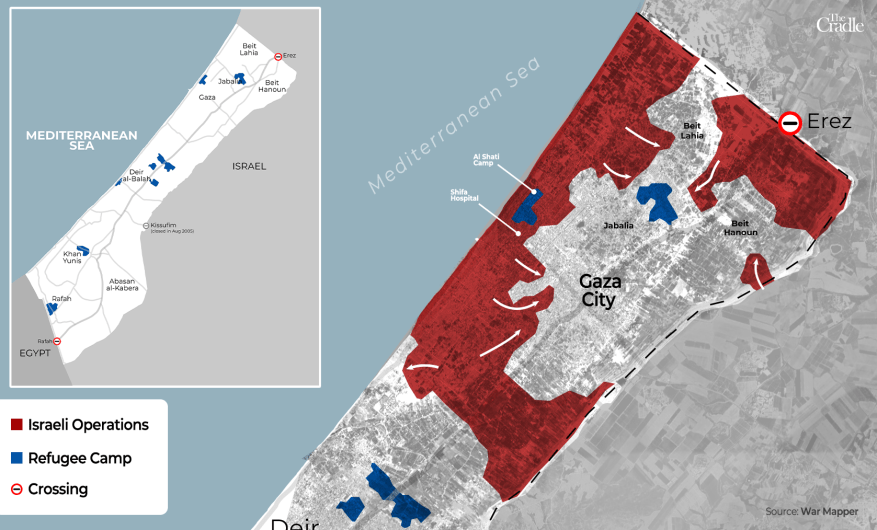
Map of Israeli operations in Gaza
This picture reveals, to a large extent, the results of Israel’s ground operation: civilian massacres and infrastructural destruction galore, but with little damage to the military structure of the Palestinian resistance. A number of its leaders have indeed been killed – most recently Al-Qassam’s northern commander and military council member Ahmed al-Ghandour – but its command and control system still ticks on effectively.
Israel’s ground limits
Further evidence of this lies in the inability of the occupation army to penetrate, unimpeded, all of northern Gaza. Israel precedes its ground movements with intense air strikes, then artillery shelling. After destroying everything in its path, its tanks begin advancing. It is almost impossible to confront tanks as they enter, because air fire clears spaces 500 meters ahead, while artillery shells pave the path 150 meters in front of the ground units.
However, whenever possible, the resistance fighters launch anti-armor missiles – Cornet, Conkurs, or similar types – with ranges exceeding one thousand metres. After the tanks reach their designated target, the resistance fighters emerge like ghosts from under the ground or rubble and fire anti-armor shells at them, usually Al-Yassin homemade shells, with a range of fewer than 150 meters. Or, alternatively, a fighter physically approaches the Israeli tanks and plants a sticky bomb that explodes in much the same way as a hand grenade.
The work of resistance does not end there. If the tanks do not retreat, and the occupation soldiers settle in, they will be attacked with machine gun fire or explosive devices. The Palestinian fighters film many of these operations, and the footage is delivered to the operations room, which decides what to publish.
It is clear that the resistance’s command and control system is still operating effectively.
Bigger than the 1973 war?
The Israeli ground operation in the northern Gaza Strip began after three weeks of preliminary air attacks and preparation by the invasion forces.
More than 100,000 soldiers were mobilized around the Gaza Strip, which has a total area of about 360 square kilometers.
Most of these troops belong to the regular forces, and Israel called up a further 300,000 reserve soldiers and officers – more than the number of reservists called up by Russia to fight on a 1,500 km front. In northern Gaza, Israel has thus far deployed its regular (non-reserve) combat brigades and battalions: Golani Brigade, Nahal Brigade, Givati Brigade, Paratroopers, Special Operations Force “Shayetet 13,” Special Staff Operations Unit (Sayeret Matkal), and so forth. All the regular forces that the occupation army could muster have been fully deployed in the Gaza Strip since the start of the fourth week of the war.
In addition, Israel has mobilized half of its artillery stock, half of its air force, and one thousand armored vehicles, including tanks and troop carriers.
Estimates of the Palestinian resistance suggest that the total number of regular and reserve forces deployed on the borders of the Gaza Strip, and inside it, exceeds the number of Israeli troops that participated in the 1973 war counterattacks on the Syrian and Egyptian fronts.
In this war, the Israelis have not attempted to penetrate Gaza from the “traditional axes,” that is, from the east toward the Shuja’iya neighborhood in Gaza City. Their incursion, instead, commenced in the center of the Strip, in the area called “Wadi Gaza” with low population and urban density, which means that the resistance’s ability to confront it is also low.
The occupation army was able to enter this area, from east to west, effectively severing the north of the Strip from its south. However, until the truce took effect, resistance fighters were still carrying out operations against Israeli troops, particularly in the Juhr al-Dik area.
The other axis of the incursion was in the Beit Lahia and Beit Hanoun areas of northern Gaza. As of 24 November, when a temporary truce was announced, the occupation army had been unable to control the region and continued to face deadly operations carried out by various resistance troops.
The third and main axis of advance is in western Gaza, along the shoreline of the northern Strip. Israeli tanks advanced from the north and from the centre, along the Mediterranean coast, to penetrate all the way to Al-Shifa Hospital and other government centers, such as the Legislative Council building.
Gaza Beach… the resistance’s weak point
Along the coastline, there are no defensive resistance tunnels, due to the nature of the land, the lack of population and infrastructure, and the possibility of seawater leaking into the tunnels. The most that the resistance could have achieved, defensively, in this axis, was to repel naval landings – not to stop the advance of tanks or the devastating airstrikes that precede them.
The main node in this axis is the Beach camp, which the occupation army has been unable to enter because of the ferocity of the resistance there.
So far, Tel Aviv has acknowledged the death of over 70 soldiers and officers, with hundreds of others wounded. Palestinian resistance sources confirm that the actual confrontation with Israeli troops only began after they entered the Shifa Medical Complex.
The frequency and intensity of Israel’s aerial and artillery bombardments do not allow resistance fighters to repel the occupation’s advancement, as the overwhelming firepower detonates most of the IEDs intended for tanks or infantry and blocks or destroys entrances to tunnels.
For this reason, the resistance waits for a lull in the bombing, the entry of tanks, and the reopening of the tunnels to begin its operations. At this stage, the fighters wait for Israeli infantry to emerge from their armored vehicles in order to target them. This has already occurred in a number of operations in the northern and western axes of occupation troops movements.
So far, the resistance confirms that it has damaged and destroyed more than 300 Israeli armored vehicles. Some of them were removed from service, while others are maintained in the field for reuse. The sources further confirm to The Cradle that the number of Israeli troop casualties, both dead and wounded, is many times greater than what Tel Aviv has announced.
Now, where to?
Before the 24 November truce, the occupation army had exhausted its ability to maneuver on the ground, having already deployed the majority of its regular combat forces in the northern and western axes.
It will need to search for innovative solutions if it seeks to advance toward densely populated areas in northern Gaza, such as Jabalia refugee camp, the Al-Zaytoun and Al-Shuja’iya neighborhoods, Al-Shati beach camp, and other vital places the Israelis have failed to penetrate. These areas are the ground zero of the Palestinian resistance, in which these forces have prepared themselves – and their tunnel infrastructure – for fierce and protracted confrontations.
The main reason the occupation government agreed to a short truce is that its ground incursion had hit this wall – in addition to other factors such as US pressure to release American captives. Simply put, the Israeli army needs to re-examine its plans and develop new strategies to advance in the field.
It is important to note that norms applicable in regular armed conflicts, as in Ukraine, Syria, Iraq, or Sudan, do not necessarily apply to the Gaza Strip. When a control map shows the Ukrainian army controlling a region, the Russian army has withdrawn from it, and vice versa.
In Gaza, a map showing the Israeli army in an area does not necessarily mean a withdrawal of Palestinian resistance forces, as the latter do not have armored vehicles or traditional formations to remove from enemy-invaded areas. Its fighters simply disappear underground to await the emergence of occupation soldiers from their tanks and such.
The bottom line is that maps currently circulated by governments, media, and think tanks that display Israel’s field advancement in Gaza – accurate or not – are not illustrating Israel’s ground control, but rather the depth of its incursions.
At the truce’s end, even if extended further, Tel Aviv will relaunch its ground operation. It will first prep the field with even more ferocious air bombardment than before, intended to displace more than 700,000 civilians remaining in the northern Gaza Strip and to impact the morale of resistance fighters.
It is also expected that the latter has studied the ground reality well, modified its defensive plans, carefully determined its goals, and reorganized its defense lines to fight the enemy with greater efficacy and inflict the greatest possible losses upon it.
Israel’s goal is to crush the resistance in northern Gaza in preparation for its next-phase war on the south – which may be fought differently, both strategically and tactically. What the resistance wants is to force the enemy to stop the war.
From the outset, Tel Aviv set two goals for its war in general, and for its ground operation in particular: destroy the resistance and liberate the prisoners. The 26 November scene in Palestine Square, in the heart of Gaza City, showed us a resistance still intact and able to exact a price from Israel.
Days later, the occupation government is still seething that Israeli captives were released according to terms dictated mainly by the resistance: military operations had to be frozen (and heavily monitored), Palestinian prisoners were liberated from Israeli detention, and aid began flowing back into the besieged Gaza Strip.
Fifty days into Israel’s staggeringly disproportionate war on Gaza, the Palestinian resistance is still able to impose its will – despite the occupation military’s unprecedented massacre of more than 20,000 civilians, the displacement of hundreds of thousands more, and the wholesale destruction of residential homes, hospitals, and schools.
When the conflict resumes in the days ahead, and the war between troops begins in earnest, the resistance may exact an even higher price from Israel, one that the Israelis can not tolerate.
Israel must stand trial for committing ‘4 core international crimes’ in Gaza: Iran deputy FM

Press TV – November 27, 2023
An Iranian deputy foreign minister says the Israeli regime should be brought to justice for all four core international crimes it committed against the Palestinian people in the Gaza Strip during its latest large-scale military operation.
Reza Najafi, Iran’s deputy foreign minister for legal and international affairs, made the remarks in the 28th session of the Conference of the States Parties to the Chemical Weapons Convention in The Hague, the Netherlands, on Monday.
“During the past eight weeks, the Israeli regime has committed all four core international crimes, namely genocide, war crimes, crimes against humanity and the crime of aggression repeatedly and concurrently,” he said.
“This entails the international responsibility of the Israeli regime and its supporters as well as the individual criminal responsibility of all those who ordered and committed such crimes or facilitated, aided and abetted their commission, including by providing the required means,” he added.
The senior Iranian diplomat emphasized that all those responsible for the crimes against the Gazans shall be held to account and be brought to justice.
Since the beginning of Israel’s war on Gaza on October 7, more than 15,000 Palestinian civilians have been killed only in Gaza while over 6,000 are still missing and more than 36,000 are wounded, Najafi said, adding that over 70 percent of those killed, missing or wounded are women and children.
He reiterated that in addition to these figures, the “horrifying” reports and “heart-breaking” images of Israel’s barbaric invasion once again revealed, clearly and undeniably, the very “murderous” nature of the regime which possesses weapons of mass destruction (WMDs), including chemical weapons in its stockpiles.
Najafi emphasized that Israel’s crimes along with a call by a regime’s minister for dropping even a nuclear bomb on the Gaza Strip once again proved the serious danger of the Israeli chemical weapons for the regional and international peace and security.
He stressed the importance of making every effort for the speedy universalization of the Chemical Weapons Convention, particularly by compelling the Israeli regime to join it without any precondition or further delay.
Israel is the sole possessor of nukes in the Middle East. The regime, which pursues a policy of deliberate ambiguity about its nuclear weapons, is estimated to possess 200 to 400 nuclear warheads in its arsenal.
Unlike Iran, Israel has not signed the Non-Proliferation Treaty (NPT) and continues its unsupervised nuclear activities with the support of the United States and European countries.
The Magician’s Hat, and the Great Simulacrum of Palliative Balm
By Alastair Crooke | Strategic Culture Foundation | November 27, 2023
The Magician steps onto the stage, his black cloak swirling about him. Centre stage, he flourishes his hat: It is empty. He punches it lightly to demonstrate its solidity. The Magician then picks up certain objects and places them into his hat. Into it goes AnsarAllah’s seizure of an Israeli-owned vessel (the situation is being ‘monitored’); into it goes the Iraqi strikes on U.S. bases (barely noticed by the main-stream media); into it too go the 1,000 missiles fired into northern Israel by Hizbullah; into it goes the hot war in the West Bank. The Magician turns to the audience – the hat is empty. But the audience knows those objects have a physical reality, but somehow they are magically obfuscated.
It is in this way that the western main-stream media maintains deterrence by playing down the state of war through what Malcom Kyeyune describes as “a simulacrum of peace” – of a gently subsiding conflict and the quieting deployment of (paraphrasing Kyeyune) a very “post-modern question”: What exactly is the meaning of civilian ‘non-combatant’ anyway?
One aspect to the image of easing conflict is the hostage exchange that has been agreed. It is both real, and at the same time it underpins the simulacrum that once Hamas is annihilated, and the hostages released, then the problem of 2.3 million Palestinians can go into the magician’s hat, and be eased from sight. For some, the hope is sincere and well intentioned – that once the fighting ceases, it will stay ceased, and that an end to the bombardment in Gaza might open a window to some political ‘solution’ – if it can be extended sine dei.
‘Solution’ being here but a polite word for the EU’s attempted bribery of Egypt and Jordan. Reportedly, the EU President, Ursula von der Leyen, visited Egypt and Israel to present them with financial offers ($10bn for Egypt and $5bn for Jordan), in exchange for the dispersal of the inhabitants of the Gaza Strip elsewhere – effectively to facilitate the evacuation of the Palestinian population from the Strip in line with Israel’s aims of ethnically-cleansing Gaza.
However, former minister Ayalet Shaked’s tweet – “After we turn Khan Yunis into a soccer field, we need to tell the countries that each of them take a quota: We need all 2 million to leave. That’s the solution to Gaza” – is but one by senior Israeli political and security figures extoling what Israel increasingly sees as the “solution” for Gaza.
But by being so explicit, Shaked likely has torpedoed Von der Leyen’s initiative – for no Arab state wants to be complicit in a new Nakba.
A Hudna or ‘time out’ inevitably is highly precarious. In the 2014 fighting, when IDF forces initiated military sweeps in Gaza after a ceasefire had begun, it led to a fire-fight and the collapse of the cease-fire. The fighting continued for another full month.
Two key lessons that I learnt from trying to initiate truces on behalf of the EU during the Second Intifada were that a ‘truce is a truce’ and only that – both sides use it to reposition themselves for the next round of fighting. And secondly, that ‘quiet’ in one confined locality does not spread de-escalation to another geographically separate locality; but rather, that one outbreak of egregious violence is virally contagious, and spreads geographically instantly.
The present hostage exchange is centred on Gaza. However, Israel has three fronts of hot conflict open (Gaza, its northern border with Lebanon, and in the West Bank). An incident occurring in any one of the three fronts may be enough to collapse confidence in the Gaza understandings and re-launch Israel’s assault on Gaza.
On the eve of the truce, by way of example, Israeli forces heavily bombed both Syria and Lebanon. Seven Hizbullah fighters were killed.
The point here, plainly said, is that the historical precedents of Hudnas leading to political openings are not that great. A hostage release, per se, resolves nothing. The issue in the present crisis runs far deeper. When, ‘once upon a time’, Britain promised the Jews a homeland, western powers also (in 1947) promised Palestinians a state, but never took it to implementation. This lacuna ultimately is culminating in a head-on train crash.
The Israeli Cabinet’s ambition for a Jewish State on the biblical lands of Israel simply is intended to block any Palestinian State from emerging either in part of Jerusalem, or elsewhere in historic Palestine. In this context, Hamas’ actions were precisely intended to break this impasse and the endless paradigm of fruitless ‘negotiations’.
Unsurprisingly, Israel’s Defence Minister already has announced Israel’s intention to renew fighting immediately after the end of the cease-fire. Israeli officials have been telling their U.S. counterparts that they anticipate several more weeks of operations in the north of the Strip, before shifting focus to the south.
Thus far, the IDF has been operating in areas close to the shoreline in Gaza, and in places, such as the Wadi, south of Gaza City, where the subsoil does not facilitate the building of tunnels. These are the areas, therefore, where Hamas does not have significant defensive capabilities. Should military action be renewed, the IDF is likely to move away from the northern coastline towards the Gaza City epicentre, allowing Hamas to manoeuvre more easily, and inflict greater losses on the IDF and their armoured vehicles. In this sense – away from the simulacra – the war is just beginning.
Prime Minister Netanyahu has been described both in Israel and in the western MSM as a ‘dead man walking’ in political terms. Be that as it may, Netanyahu has his strategy: He has openly defied the Biden Team on every war-related issue, except that of eradicating Hamas.
During a press conference last Sunday, Netanyahu touted a “diplomatic Iron Dome”, saying he would not give in to “increasingly heavy pressure … used against us in recent weeks … I reject these pressures and say to the world: We will continue to fight until victory — until we destroy Hamas and bring our hostages back home”.
Yonatan Freeman, from the Hebrew University, perceives the gambit in Netanyahu’s vague statements: He defies Team Biden, yet takes care to leave sufficient ‘wiggle room’ so that he can always blame Biden, whenever he is ‘forced’ by America into some reversal.
The Israeli Cabinet’s strategy, therefore, rests on the big bet that Israeli public opinion will hold – despite Netayahu’s personal disapproval ratings – due to the overwhelming public support at this point for the two declared objects set by the War Cabinet: Destroying the ‘Hamas regime’ and its capabilities, and the release of all Israeli hostages.
At its core, ‘the bet’ lies in the conviction that public sentiment – contextualised deliberately by the Israeli cabinet in absolute Manichean terms (light versus the dark; civilisation versus barbarism; all Gazans being complicit with ‘Hamas’ evil’) – will ultimately arouse a wave of support for the further move of taking “the fiction” of a Palestinian state off the table “once and for all”. The table is being set for a long war against ‘cosmic evil’.
The ‘solution’, as National Security Minister Smotrich and his allies underline, is to offer Palestinians a choice – ‘to renounce their national aspirations and continue living on their land in an inferior status’, or to emigrate abroad. Put bluntly, the ‘solution’ is the removal of all non-subservient Palestinians from the lands of Greater Israel.
Turning now to the contending perspective:
The ‘united axis’ supporting Palestinians observe that Israel continues to adhere to its initial military goals of destroying Gaza to the point where there is nothing left – no civilian infrastructure at all – by which Gazans might live, were they even to try to return to their collapsed homes.
They see this Israeli objective fully supported by Biden when his spokesman said:
“We believe that they have the right to [embark on further combat operations in Gaza]; but [such actions] … should include greater and enhanced protections for civilian life”.
Regional security commentator, Hasan Illaik, notes,
“Axis officials also believe that conciliatory-sounding U.S. statements, which sometimes suggest that a de-escalation phase is imminent, are nothing but an effort to repair a public image heavily damaged by unstinting U.S. support for Israel’s continuing massacre of Palestinians in Gaza”.
So, is Israel, supported by Team Biden and some EU leaders, winning?
Tom Friedman – an intimate of Team Biden – wrote in the New York Times on 9 November – after traveling around Israel and the West Bank:
“I now understand why so much has changed. It is crystal clear to me that Israel is in real danger — more danger than at any other time since its War of Independence in 1948”.
Far-fetched? Possibly not.
Back in 2012, U.S. author Michael Greer wrote that Israel was founded at a particular propitious time, despite being surrounded by hostile neighbours:
“Several of the major Western powers supported the new state with significant financial and military aid; of at least equal importance, members of the religious community responsible for creating the new state, who remained back in those same Western nations, engaged in vigorous fundraising efforts to support the new state, and equally vigorous political efforts to get existing governmental support maintained or increased. The resources thus made available to the new state gave it a substantial military edge against its hostile neighbours, and its existence became enough of a fait accompli that some of its neighbours backed away from a wholly confrontational stance”.
“Still, the state’s survival depended on three things. The first, and by far the most crucial, was the ongoing flow of support from the Western powers to pay for a military establishment far larger than the economic and natural resources of the territory in question would permit. The second was the continued fragmentation and relative weakness of the surrounding states. The third was the maintenance of internal peace within the state and of collective assent to a clear sense of priorities, so that it could respond with its full force to threats from outside – instead of squandering its limited resources on civil strife or popular projects that contributed nothing to its survival”.
“In the long run, none of these three conditions could be met indefinitely … When it happens that these early patterns of support break down, Israel may find itself backed into a corner”.
Last week, a leading Israeli commentator noted:
“You might think a Presidential visit, presidential speech, three Secretary of State visits, two Secretary of Defence visits, the dispatching of two aircraft carrier groups, a nuclear submarine and Marine expeditionary unit, and the pledge of $14.3 billion in emergency military aid, are testament to the unwavering support the U.S. is extending to Israel” …
“Think again”.
“Underneath the full and robust backing of the Biden administration, there are dangerous and treacherous currents that are chipping away and encroaching on public sympathy for Israel across the United States. Polls released last week contained the most alarming and telling data: Public support for Israel is cratering – particularly amongst the 18 – 34 age group. Another poll shows that 36% of Americans say they oppose additional funding for Ukraine and Israel: Support for funding Israel, only – was at 14%”.
What is truly remarkable is that the leaders of the new narratives are the youth of Generation Z, Y, and Alpha. Leveraging social media, and speaking directly to their peer groups, they have conveyed the grievances of the Palestinians to the world. Many had limited knowledge of Palestine, but their unfiltered sense of justice fuelled their collective anger against Israel’s ongoing ethnic cleansing of Palestine.
Greer’s second and third conditions for Israel’s survival also are metastasizing as the global tectonic plates grind and move: Non-western powers are not siding with Israel. They are coalescing in opposition to the Israeli Cabinet’s aspiration to end the notion of a Palestinian State, once and for all. And today, Israel is bitterly divided on the vision for its future; what it is exactly that constitutes ‘Israel’ and even that very post-modern question, ‘what it is to be Jewish’.
Region ‘let down’ by West’s reaction to Israeli crimes in Gaza: Qatar
Press TV – November 27, 2023
Qatar’s Prime Minister and Foreign Minister Mohammed bin Abdulrahman al-Thani has slammed the West’s support for Israel’s war on the besieged Gaza Strip, warning against the risk of a regional spillover.
“There’s a big disappointment in the region from the West’s reaction… We were expecting from the West the killing of Palestinian people is something to be condemned,” the Financial Times quoted al-Thani as saying on Sunday.
“And what we expect at least is [the West] to step up to the same standards, the same principles that they stood up to with other wars,” al-Thani added.
Noting that the war on Gaza was not treated like other conflicts, Sheikh Mohammed said “calling for a ceasefire after this destruction and killing [in Gaza] and displacement is a duty on everyone.”
Destruction of Hamas ‘not realistic’
Al-Thani emphasized that Israel’s declared aim of eliminating Hamas resistance movement was not realistic.
“At the end of the day, Hamas’s destruction by the continuation of this war will never happen,” he said, calling for a political solution to the conflict.
He stressed that Palestinians in Gaza and the occupied West Bank needed to have a “political horizon” for a viable state of their own and to be able to choose their own leadership, adding “Other than that . . . there won’t be a solution.”
The minister noted that Qatar now focuses on stopping the war. “Our only plan is to stop the war.”
“Talking about the day after as the killing and the massacres is ongoing is just like endorsing this war,” he said.
“The amount of anger and agitation in the Arab population in the region is unprecedented when they see these images, and nobody is stepping up to stop it.”
Al-Thani also warned that the failure to secure an extended ceasefire would risk the war spilling over and destabilizing “the entire region.”
He slammed Western powers for not exerting more pressure on Israel to end the war.
Referring to the underway temporary ceasefire in Gaza, al-Thani said it could be extended if Hamas managed to locate women and children captives who are held in Gaza and secure their release.
“If they get additional women and children, there will be an extension,” he said, adding “We don’t yet have any clear information how many they can find because . . . one of the purposes [of the pause] is they [Hamas] will have time to search for the rest of the missing people.”
Israel launched the war on Gaza on October 7 after the Palestinian resistance movement Hamas waged the surprise Operation Al-Aqsa Storm against the occupying entity in response to the Israeli regime’s decades-long campaign of bloodletting and devastation against Palestinians.
Nearly 15,000 Palestinians, most of them women and children, have been killed in the Israeli strikes.
Israel dropped 40,000 tons of explosives on Gaza Strip since Oct. 7, says media office
MEMO |November 26, 2023
The Gaza government’s media office said on Sunday that the Israeli army has dropped 40,000 tons of explosives on the Gaza Strip since Oct. 7, with the apparent goal of rendering the enclave uninhabitable.
Salama Maarouf, the head of the media office, issued a statement on Telegram on the third day of the temporary humanitarian pause between Israel and Hamas, which came into effect on Friday morning.
“The Israeli occupation forces have dropped 40,000 tons of explosives on the Strip (since Oct. 7), and the atrocities of the occupation (forces) have unfolded away from the scrutiny of cameras,” Marouf said.
He explained that “the bombs recently used by the occupation (forces) have never been used before, and hundreds of martyrs are buried in the places where they died. The devastation by the occupation (forces) reflects its intent to make Gaza uninhabitable.”
In the statement, Maarouf also discussed the temporary pause, emphasizing that “the days of respite have laid bare the enormity of the significant massacre, resulting in substantial destruction to infrastructure and residences.”
“One-third of the Gaza Strip’s population has yet to receive essential supplies, and the absence of all international institutions is evident,” he stated, calling on the international community to act.
“There is a pressing need for the establishment of a sizable field hospital,” he added.
Featured Video

Armando Mema: Finland Used as New Frontline Against Russia
or go to
Aletho News Archives – Video-Images
New Documentary
Hospital Horror
Documented in the film,“Bad Medicine”
Blog Roll
 Aletho News
- Araghchi: Failure to punish aggressors against Iran endangers all nations
- Iran tells UN Security Council to stop reversing roles of ‘aggressor and victim’
- Disgraced neocons Feith & Libby: stop whining about ‘endless war’
- CENTCOM rejects Israeli claims of preparations for new Iran attacks
- Your Shopping Bag Runs Through Hormuz
- Armando Mema: Finland Used as New Frontline Against Russia
- Gestapo 2.0? Germany grants spy agencies sweeping new powers
- Franco-Palestinian group seeks court ban on Israeli real estate fair in Paris
- How British foreign policy is frozen in the ruins of empire
- EU risks investor exodus over Russian assets – Euroclear chief
- If Americans Knew
- An error has occurred; the feed is probably down. Try again later.
- No Tricks Zone
- New Study: Barents Sea Temperatures Were Warmer And Sea Ice Less Extensive In The 1700s Than Today
- German Authorities Start Initiative To Evaluate Public Register For Climate “Disinformation” Spreaders!
- Zonal Asymmetry of Temperature Change in the Antarctic Circumpolar Current
- New Study: The Net Fossil Fuel Contribution To Rising Atmospheric CO2 Has Been Zero For 500 Years
- Germany’s Green Energy Transition Becoming Increasingly Expensive…Another 6 Trillion Euros!
- Sudden Stratospheric Warming, Powerful El Niño Combination May Lead To Extreme Europe Cold, Energy Crisis!
- Two New Studies Find Thwaites Glacier Melt Cannot Be Driven By Human Activity Or A Warming Ocean
- E-Cars Reduce CO2 Emissions By Only 41% Compared To Internal Combustion Engine Vehicles
- Predictions Made By Renowned Climate Professor Over Past Decades Have Been Proven To Be Poor
- New Study Suggests Large Regions Of The Pacific Ocean Have Been Cooling For The Last 80 Years

