Increased Israeli attacks on civilians in Gaza endanger two-year-old ceasefire
MEMO | September 8, 2016
Israeli forces markedly increased their attacks on Palestinian civilians in the Gaza Strip during the second quarter of 2016, United Nations (UN) data has revealed, with concerns that such violence endangers the viability of the ceasefire that ended ‘Operation Protective Edge’ in 2014.
During the period April-June, there were an average of more than 90 shooting incidents per month by Israeli forces in Gaza’s so-called access restricted areas (ARA) – some 60 on land, and 30 at sea. This is more than double the equivalent average figures for the last six months of 2015.
Israeli forces have long attacked farmers, fishermen and other civilians in Gaza’s ARA. As the UN described in July, Israel’s unilaterally-imposed access restrictions are “enforced by firing direct or warning live ammunition, the destruction of property, arrests and the confiscation of equipment.”
Presenting the latest figures in a quarterly update published last month, the UN’s Office for the Coordination of Humanitarian Affairs (OCHA) in the Occupied Palestinian Territory (OPT) described “the use of force by Israel” in the ARA as a “particular cause for concern.”
According to James Heenan, head of office at the Office of the United Nations High Commissioner for Human Rights in the occupied Palestinian territory, “there are almost daily shooting incidents by Israeli forces into Gaza, often resulting in injury and even death as well as destruction of property.”
In most cases, Heenan told Middle East Monitor, “there are no indications that Israeli forces were in any imminent threat to have justified the level of force employed, including use of firearms. Often victims are farmers, fishermen, children, and demonstrators.”
On April 3, the Israeli authorities announced an expansion of the permitted fishing zone off the southern Gaza coast from six to nine miles (note that the Oslo Accords stipulate a 20-mile limit). However, on June 26, less than three months later, the six-mile limit was re-imposed.
By July, according to OCHA, more than 90 fishermen had been arrested and detained, “the highest figure in any year since records began in 2009.” Over nine days in August, for example, Israeli forces attacked Palestinian fishermen on six different occasions (Aug. 21, 23, 25, 27, 28, 29).
In May, meanwhile, it was reported that the Israeli army would allow farmers to access land close to the border fence, under the supervision of the International Committee of the Red Cross (ICRC). Since 2014, the ICRC has been helping Gaza’s farmers to rehabilitate land and secure access.
While some farmers have clearly benefited, a Jerusalem-based ICRC spokesperson declined to comment on Israeli forces’ continued attacks in the ARA, saying that “any issues of concern are addressed as part of our confidential and bilateral dialogue with all parties to the conflict.”
As one farmer told activists recently: “My lands are relatively close to the fence, so I cannot set foot in them between 6pm and 6am without getting shot at. What can I do if the electricity does not come before 6pm? I have to leave my land without watering, risking the loss of the crop.”
The violence used by Israeli forces against Palestinian civilians in the Gaza Strip is vastly under-reported in the English-language Western media. The majority of attacks on fishermen, farmers, and demonstrators do not even get a mention.
Such attacks, however, cannot be divorced from the bigger picture in the Gaza Strip, including the ‘security’ dimension that is typically understood by journalists, analysts, and policy-makers in terms of projectile fire and Israeli military responses.
According to Fawzi Barhoum, a Gaza-based Hamas spokesperson, Hamas views Israeli forces’ routine use of violence against Palestinians in the ARA as a violation of the 2014 ceasefire. “Hamas records all the violations, and updates the regional sponsors of the ceasefire accordingly”, he said.
Furthermore, Barhoum added, such attacks by Israeli forces “endanger the status quo.”
Each time, Hamas discusses what happens with the other Palestinian factions, who evaluate together what is the best response to the Israeli violation in question; whether it is silence, condemnation, warnings, firing short-range rockets, unleashing snipers on the borders, etc.
Thus, aside from the cost for farmers and fishermen of Israel’s policy of violently enforcing a ‘no-go zone’ inside Gaza, such attacks, clearly on the rise, also risk further undermining a ceasefire agreement that brought ‘calm’ for Israel, but nothing like it for Palestinians.
Without Israeli occupation, Palestinian economy would double – UN report
RT | September 7, 2016
In a damning report, the UN development body (UNCTAD) described the ways Israeli occupation of Gaza and West Bank has been preventing the Palestinian economy from recovery and getting twice as big as it is now.
The document detailing the “staggering economic cost” of Israeli occupation was released on Tuesday by the United Nations Conference on Trade and Development (UNCTAD).
“The Palestinian economy would be at least twice as large without Israeli occupation,” the findings reveal.
Among the key reasons for the high unemployment and staggering poverty the agency cites “confiscation of Palestinian land, water and other natural resources.” It adds that “restrictions on the movement of people and goods; destruction of assets and the productive base;” also played a major role here.
According to the latest estimations by the Palestinian Central Bureau of Statistics nearly 27 percent of people of the autonomy are currently without job. Meanwhile UNCTAD has revealed that over 66 percent of the Palestinians were food-insecure last year.
“The continuous process of de-agriculturalization and de-industrialization” has contributed to a severe degradation of Palestinian economy, according to the UN report. The paper states that in Gaza “producers are denied access to half of the cultivable area and 85 per cent of fishery resources.”
The West Bank area is facing a similar problem, according to the UN. In the so-called area C, which constitutes over 60 percent of West Bank “more than 66 per cent of its grazing land, is not accessible to Palestinian producers”.
The figures published in the report say that the Israeli occupation of the Area C “costs the Palestinian economy the equivalent of 35 per cent of GDP ($4.4 billion in 2015).”
The Israeli military campaign in 2014 whose proclaimed goal, was to prevent rocket attacks on its territories from the Palestinian areas delivered another blow to the financial recovery of the Palestinians.
The following tightening of the Gaza blockade, in place since 2007, made the things even worse, the report states. It resulted in additional civilian items being banned after labeled “dual-use”, meaning they can be also implemented for causing harm.
The crisis resulted in additional severe shortages of medical equipment as well as serious reduction in water supplies in the occupied territories, the UN finds. The problem also contributed to the rising infant mortality of almost 20 out of 1,000 live births. The trend is labeled “unprecedented” and found only in countries “affected by HIV epidemics”
In addition UNCTAD points out that the expanding settlement policies by the Israeli authorities are contributing to the Palestinian plight.
“There are now 142 settlements in the West Bank, bringing the number of Israeli settlers to over one fifth of the Palestinian population. This expansion undermines the prospects for a two-State solution,” UNCTAD claims.
The so-called two-state solution, proposed by the UN would see an establishment of an independent state of Palestine alongside Israel, west of the Jordan River. The potential boundaries however remain one of the key stumbling blocks here.
In the latest development, Israeli PM Benjamin Netanyahu’s press service has issued a statement saying he is considering Russia’s offer to host Israeli-Palestinian talks in Moscow
“[Netanyahu] presented Israel’s position whereby he is always ready to meet [Abbas] without preconditions and is therefore considering the Russian president’s proposal and the timing for a possible meeting,” the statement said.
Palestinian President Mahmoud Abbas has already accepted the offer to meet with Netanyahu, although the date for the talks has not been yet set.
Israel to deploy machine gun-equipped autonomous vehicles along Gaza border
MEMO | September 2, 2016
Israel is set to use fully autonomous unmanned vehicles along the border with the Gaza Strip, according to a report published by FoxNews.com.
While currently unarmed, the Israeli military plans to add machine guns to the so-called Border Protector Unmanned Ground Vehicles (UGVs) by “the beginning of next year”.
An unnamed Israeli military official told the website: “This is the future – the border is a very dangerous place… Sending unmanned vehicles to do these patrols means that troops’ lives are not at risk.”
According to the report, the Israeli army has worked with defence giant Elbit Systems to convert Ford pick-up trucks into UGVs by adding “specialised remote driving technology”, along with “four driving cameras and a 360-degree observation camera.”
UGV testing reportedly began in July 2015 and the trucks “became operational in February [2016].”
While each vehicle is currently “driven by an operator in a remote control room using a steering wheel, joystick and pedals”, an army official told FoxNews.com that “in the future, we will have the capability of fully autonomous driving.” The machine gun “will be operated from a control room.”
On ceasefire anniversary, UN agencies urge end to Gaza’s ‘de-development spiral’
MEMO | August 26, 2016
UN agencies have urged an end to what they describe as the Gaza Strip’s “de-development spiral”, in a report marking the two-year anniversary of the ceasefire that ended ‘Operation Protective Edge’.
In a statement released Friday, 16 heads of United Nations agencies in Palestine call for the “uninterrupted and predictable flow of material and increased funding to address humanitarian needs and boost economic prospects for Gaza’s 1.9 million residents.”
In the report, UN agencies “document collective progress made in the last two years, as well as some of the remaining challenges in the recovery and reconstruction effort.” To date, “half of the homes which suffered partial damages and a third of destroyed homes have been rebuilt.”
Robert Piper, the UN Coordinator for Humanitarian Aid and Development Activities, warned that “repairing the damages from the 51-day hostilities cannot be our only measure of success, given that humanitarian and socio-economic indicators were already so dire before 2014.”
Piper added: “We must reverse Gaza’s de-development trajectory and address the needs of a population that has gone through three rounds of conflict, nine years of an Israeli blockade and the consequences of the Palestinian internal divide.”
The senior UN official emphasised that “addressing economic recovery requires much greater financial investments and serious policy changes, including a lifting of [Israeli-imposed] restrictions on both imports and exports.”
On October 2014, donors pledged US$ 3.5 billion to support Gaza. According to the World Bank, only an estimated 40 percent had been disbursed by April this year.
Casuistry
By Thomas S. Harrington | CounterPunch | August 19, 2016
Casuistry, which one dictionary defines as “specious, deceptive, or oversubtle reasoning, especially in questions of morality” is, rightly or wrongly, inextricably linked to the history of Jesuit order of the Catholic Church. And the rise of the Jesuit order is deeply enmeshed with the Counter-Reformation, a set of measures designed to roll back the spread of Protestantism in Europe during the late 16th and early 17th centuries. The control center of the movement was Spain, the world-striding superpower of that historical moment.
Rightfully fearful that Protestantism’s rejection of long-standing modes of clerical privilege and the Church’s “right” to collect vast sums of money from parishioners would undermine their ability to bully and bribe Italian, French, Dutch and German potentates into compliance with their political demands, the Spanish Monarchy undertook an endless series of military adventures against “heretics” across the Continent in the years between 1530 and 1648. This military thrust was accompanied by a well-organized propaganda campaign in which the highly educated Jesuits priests played a crucial role.
Appearing morally and intellectually reasonable while serving as a convinced advocate for the systematic subjugation of other people and their animating ideals is not a simple task. In the long run it is, in fact, an impossible one. No amount of argument can convince a person or group of persons who see them selves as suffering under the boot of another that their bondage is a good and necessary thing. What such a rhetorical posture can do, for a time at least, is convince the subjects of the hegemonic country of, if not the inherent nobility of their bloody mission, its generally benign nature.
A key, if generally unstated, goal of the 16th and 17th century Jesuits was to insure that the highly problematic matter of Rome’s corruption, and the brutal Imperial designs of the Spanish monarchy that lay behind it, never be allowed to occupy the center zone of what then passed for “public” discourse.
When confronted by the emergent Protestant movements about the clear violations of Christian morality practiced by the Church of Rome, they responded with complex disquisitions on the largely circumstantial nature of all moral reasoning. By constantly parsing the intricacies of how overarching moral rules should, or should not, be applied in each particular circumstance (and teaching others to do the same), they very effectively prevented the emergence within the Church, and by extension in the leadership class of the Spanish Empire, of a frank discussion of the quite real and deeply-felt grievances of their many enemies.
I am reminded of all this when I read or watch the news after every so-called “terrorist” attack against a US or European target. Within minutes of the violence, mainstream journalists, begin intense speculation about what particular ethnic group the assailant came from, how he or she became “radicalized” (as if the desire to kill was akin to some sort of contagious moral flu) and whether the “West’s” latest stand-in for PURE EVIL™ (e.g. Al-Qaeda, ISIS, ISIL) was behind the act.
What will almost never be talked about are the many very good reasons a person from the vast region stretching from Morrocco in the west, to Pakistan in the east, have to be very angry at, and to feel highly vengeful toward, the US, its strategic puppeteer Israel, and their slavishly loyal European compadres like France, Germany and Great Britain.
There is never any talk of that group of august “democracies” long-standing penchant for implanting, then staunchly supporting, ruthless and deeply corrupt regimes in that region.
No talk of the very long Algerian experience of French colonialism, nor the US and French- backed coup of that country’s government in 1992 which led to a civil war that left 200,000 people dead.
No talk of the coup against the legally elected president of Egypt in 2013, nor the cold-blooded massacres carried out by his US-backed successor upon hundreds of that same president’s followers.
No talk of the decision of the US to back elements of ISIS in order to cynically extend a Syrian Civil War that was on its way to peace—albeit an imperfect one—by means of a Syrian government victory by late 2013.
No talk of the planned destruction of Libya in 2011 and its enormous effects on the stability of life in that once wealthy country as well as all of northern Africa.
No talk of the US-Israeli nullification of the results of the Palestinian elections of 2006, Israel’s coldly planned siege of Gaza nor the “shoot-fish-in-a barrel” assaults on that benighted enclave by Israel in 2006, 2008, 2012 and 2014.
No talk of the ongoing Saudi—and therefore US-approved—war on Yemen, nor the ruthless Saudi march on Bahrain in 2011 in which several dozen people died and thousands of democracy activists were tortured and/or carted off to prison.
No talk of the 18-year Israeli—and therefore, US-backed—occupation of Southern Lebanon nor Israel’s 1993, 1996 and 2006 assaults upon that same country.
Oops, I almost forgot. There is no talk of the small matter the calculated US destruction of Iraq, pre-invasion Libya’s rival as the Arab world’s most wealthy and socially progressive state.
But hey, why talk about all that off-putting stuff when you can boil it all down to neat tales of personal ideological contamination, Svengali-like recruiters lurking in mosques, and that old standby, the development of an urgent need to bang virgins in the hereafter.
It seems the media believes that the delicate imperial mind must be left free from understanding the effects of the actions for which it regularly cheers and prays.
The best way to insure this? Casuistry, as the old saying goes, “Pure casuistry”.
Thomas S. Harrington is a professor of Iberian Studies at Trinity College in Hartford, Connecticut and the author of the recently released Livin’ la Vida Barroca: American Culture in a Time of Imperial Orthodoxies.
ISM statement concerning Israeli measures against activists

International Solidarity Movement | August 8, 2016
The ISM is a Palestinian led movement with a mandate to support Palestinian nonviolent popular resistance to Israeli military occupation and apartheid. Palestinian led nonviolent resistance includes the Palestinian call for Boycott, Divestment and Sanctions of Israel, until it adheres to its obligations under international law.
ISM volunteers also accompany children to school and farmers to harvest their olives in areas where they face ongoing settler and military violence. We find that our presence sometimes results in reducing the level of lethal force used by the Israeli military against unarmed Palestinians. Further isolation of Palestinians by denying access and/or deporting human rights activists aims to make Palestinian communities already vulnerable and suffering from abuse even more vulnerable.
As a civilian population living under military occupation Palestinians in the occupied territories are promised protection under international law. All parties signed to the fourth Geneva Convention have the obligation to insure that others, including Israel, adhere to international law. Civilians are being called on to fill in the gap created by the failure of governments and official international bodies to provide protection and fulfill their obligations.
Israel’s isolation of Palestinians both by denying Palestinians and their supporters access to Palestine as well as by denying Palestinians including human rights defenders the right to leave Palestine is not a new strategy. It is most brutal and lethal in the besieged Gaza strip but all parts of Palestine are under some degree of siege.
We condemn Israeli suppression of Palestinian nonviolent resistance. The recent announcement by the occupation authorities that they will attempt to further isolate Palestinians indicates the occupation authorities unwillingness to do the only thing that will actually bring an end to Israel’s isolation – to adhere to international law, end the occupation and grant Palestinians their rights.
See the statement By the Boycott National Committee here.
Hamas, World Vision deny Israeli claims that Halabi diverted cash to Hamas
Palestinian Information Center | August 5, 2016
GAZA – Hamas on Thursday denied Israeli allegations that the manager of World Vision’s Gaza office, Mohammed al-Halabi, passed millions of dollars to Hamas.
Hamas spokesperson Abdullatif al-Kanou’ said the group had “no connection to al-Halabi and therefore, all Israeli accusations are counterfeit and aim to suppress our people and toughen the blockade”.
Israel’s Shin Bet agency accused al-Halabi of funneling millions of dollars in aid money to Hamas, charges that the resistance group denied and the charity voiced skepticism over.
World Vision official Mohammed al-Halabi appeared before a court on Thursday, facing charges of using millions of charity funds in aid to Hamas.
The Israeli intelligence agency Shin Bet claimed Hamas recruited al-Halabi more than a decade ago.
The agency said since al-Halabi took over World Vision operations in Gaza in 2010, roughly 60 per cent of World Vision’s annual budget in the territory was diverted to Hamas.
Mohammad al-Halabi, World Vision’s manager of operations in Gaza, was arrested by Israel on June 15 while crossing the border into the enclave.
World Vision said it was “shocked” by Israel’s allegations and said in a statement that it had regular internal and independent audits and evaluations as well as a broad range of internal controls to ensure aid reached intended beneficiaries.
World Vision added that al-Halabi has worked with the group for 10 years, and that they have “no reason to believe” the allegations against their employee are true.
“World Vision is a Christian relief, development and advocacy organization dedicated to working with children, families and communities to overcome poverty and injustice,” the statement further read.
“World Vision serves all people regardless of religion, race, ethnicity or gender. World Vision has been working in the occupied Palestinian territories for over 40 years, striving to give hope to over 500,000 of the most vulnerable children, through education, health, child protection and resilience programs. We continue to call for a fair, legal process,” it added.
400 commodities still banned from Gaza
MEMO | August 4, 2016
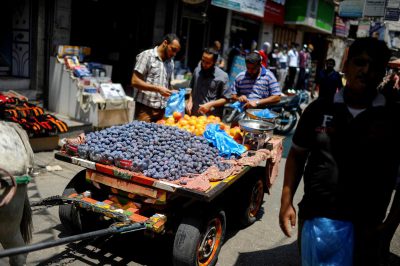 Israeli occupation authorities continue to prevent the entry of 400 commodities into the Gaza Strip, a senior Palestinian official said yesterday.
Maher Al-Tabbaa, is a senior official in Gaza’s Chamber of Industry and Commerce, said Israeli occupation authorities had tightened measures against Palestinian traders, companies and businessmen.
These remarks came a day after occupation authorities said they had facilitated the movement of goods and commodities into the Gaza Strip.
Speaking to QudsNet, Al-Tabbaa said: “Israel bans all chemical raw materials needed for the industrial sector, cleaning materials, sponges, paints, welding skewers and other materials needed for making furniture.”
He noted that Israel had tightened its restrictions by withdrawing more than 1,500 travel permits from traders and businessmen.
It is still controlling the entry of cement and construction materials, he explained, paralysing the construction industry.
Palestinians Lose Hope That Turkey Will Help to Solve Gaza’s Power Crisis
Sputnik | July 23, 2016
Ankara has pledged to help the Gaza Strip to tackle its decade-long electricity crisis as part of a deal to normalize ties with Israel that were severed six years ago, but Palestinians told Sputnik that they doubt that Turkish authorities will deliver on the promise.
Mustapha Al-Agha who lives in Gaza said that locals have lost their hope in Turkey after Ankara decided not to pressure Israel to lift the blockade which has been in place since 2007. Turkey’s “help is limited to humanitarian aid,” he said. “All promises given to the Gaza Strip have turned out to be a ‘downer pill’ meant to receive support for the agreement between Turkey and Israel.”
Itaf Mukhanna, a mother of seven, maintained that lifting the blockade was a priority, urging Arab nations to do something about it.
“Situation here is unbearable. Youth unemployment has worsened. Electricity, water and gas have become an everyday dream that each local is trying to fulfil,” she said.
On June 28, Turkey and Israel announced that they would restore diplomatic ties. Ankara has agreed to provide humanitarian aid to and build a power plant in Gaza as part of this deal. Two weeks later a Turkish delegation visited the region to discuss ways to resolve the crisis with Israeli and Hamas officials.
The delegation is expected to prepare a report that will be directed to Turkey’s Energy and Natural Resources Minister Berat Albayrak, the cabinet and President Recep Tayyip Erdogan. The government will then work on a roadmap to implement measures outlined in the report.
Last week Turkey delivered 11,000 tons of humanitarian aid meant for Gaza. The cargo was offloaded in the Israeli port city of Ashdod.
The Gaza Strip’s electricity crisis is acute. The region has a single power plant that has operated at less than 50 percent capacity since 2006 when Israel bombed the facility.
Gaza needs at least 450 megawatts per day, but it receives no more than 185 megawatts in the summer and 200 megawatts during the winter, Tare Lubbad, communications director at a Gazan electric company, told Sputnik.
“The energy crisis in the Gaza Strip has become worse since one of [four] generators at the power plant has not been working due to the lack of fuel,” he said.
The plant needs at least 500 tons of fuel per day to operate at its current full capacity, but the Palestinian Authority in Ramallah has imposed a tax on fuel purchased in Israel.
Featured Video

Racist Seinfeld Dances for Joy as Bibi Unveils His New Map
or go to
Aletho News Archives – Video-Images
TV Drama Review
Japanese drama projects Japan’s wartime atrocities onto Chinese characters

Global Times | October 25, 2026
By portraying Chinese characters as perpetrators of ruthless violence while casting Japanese Self-Defense Forces (SDF) intelligence operatives as defenders, the season 2 of the Japanese drama Vivant has recently drawn criticism from Chinese netizens, who argue that its depiction turns historical reality on its head while ignoring Japan’s wartime atrocities.
The TBS drama series – a spy suspense story in which an alleged unofficial intelligence unit of the SDF operates across the globe — has attracted a passionate fanbase. Its currently airing season 2 opened with a household rating of 18.8 percent, the highest for a TV drama this year, according toa commentary article by Japanese media Toyo Keizai.
What draws attention is the portrayal of the enemies in the series, the article noted. Scenes in which the Chinese organization subjects kidnapped members of the SDF unit to brutal torture are repeated with unrelenting intensity.
It is rare for Japanese TV dramas to explicitly portray a real-life country as the enemy, the article noted.
Japanese Prime Minister Sanae Takaichi also made a reference to the drama, saying that she has been recording Vivant and hopes to binge-watch it over the year-end and New Year holidays, according to Japanese media outlets.
China’s CCTV News report on Sunday revealed that the drama features scenes in which Chinese personnel cut off the fingers of and stab Japanese intelligence operatives in the abdomen. Such acts bear striking similarities to the torture inflicted on Chinese nationals by invading Japanese troops during the World War II.
The drama distorts the truth by attributing these atrocities to modern Chinese characters. Beneath the surface, it subtly glorifies Japan’s cross-border overseas operations, blurs the functional boundaries of the SDF and implicitly promotes an expansionist narrative, per CCTV News. … continue
Blog Roll
 Aletho News
- EU facing trillion-euro debt hole while seeking more cash for Kiev
- How US, Europe, Persian Gulf states exhausted missile stockpiles, splurged billions to defend Israel
- Up in arms… Koreans reject U.S. empire’s plan to make South Korea the next Ukraine
- Iran, Turkey, Pakistan, Saudi Arabia could advance region-led security framework in Tehran: FM spox
- Netizens condemn Japanese drama for projecting Japan’s wartime atrocities onto Chinese characters
- Racist Seinfeld Dances for Joy as Bibi Unveils His New Map
- A West Bank War for Netanyahu’s Election Campaign, Could It Backfire?
- Yemen denounces European Parliament’s ‘hypocritical’ push to blacklist Ansarullah
- Qalibaf: UAE’s UN bid aims to ‘clear the runway’ for ‘Greater Israel’, whitewash genocide
- Pakistan reopens Iran border after boosting security: Report
- If Americans Knew
- An error has occurred; the feed is probably down. Try again later.
- No Tricks Zone
- Sudden Stratospheric Warming, Powerful El Niño Combination May Lead To Extreme Europe Cold, Energy Crisis!
- Two New Studies Find Thwaites Glacier Melt Cannot Be Driven By Human Activity Or A Warming Ocean
- E-Cars Reduce CO2 Emissions By Only 41% Compared To Internal Combustion Engine Vehicles
- Predictions Made By Renowned Climate Professor Over Past Decades Have Been Proven To Be Poor
- New Study Suggests Large Regions Of The Pacific Ocean Have Been Cooling For The Last 80 Years
- Germany’s Green Energy Debacle: High Energy Costs Force Kahla Porzellan to Close After 182 Years!
- New Study: 50 Years Of The Most Aggressive ‘Net Zero’ Policies Can Only Affect The Global Climate By 0.03°C
- US September “Heat” Was No Record…Many Records Set Decades Ago
- Latest European Green Energy Debacle; Portugal’s Largest Flagship Solar Park Insolvent!
- Green Energy Debacle: German Expert Professor Fritz Vahrenholt Warns Of Severe Economic And Social Consequences

