Will it work? German email companies adopt new encryption to foil NSA
RT | August 9, 2013
Communications sent between Germany’s two leading email providers will now be encrypted to provide better security against potential NSA surveillance. Experts say the move will do little to thwart well-equipped snoopers.
The “E-mail made in Germany” project has been set up in the wake of US surveillance revelations made by NSA whistleblower Edward Snowden. National Security Agency documents show that the agency intercepts 500 million phone calls, texts, and emails in Germany each month.
“Germans are deeply unsettled by the latest reports on the potential interception of communication data,” said Rene Obermann, head of Deutsche Telekom, the country’s largest email provider. “Now, they can bank on the fact that their personal data online is as secure as it possibly can be.”
Deutsche Telekom and United Internet, which operate about two-thirds of Germany’s primary email accounts, said that from now on they will use SSL (Secure Sockets Layer) – a modern, industry-standard form of encryption that scrambles signals as they are sent through cables, which is the point at which the NSA often intercepts communication. The companies will also employ exclusively German servers and internal cables when sending messages between each other.
Obermann told the media that no access to users’ email will now be possible without a warrant. However, experts claim the impact of the measure is likely to be mostly psychological and symbolic.
“This initiative helps to tackle the-day-to-day sniffing around on the communication lines but it still doesn’t prevent governments from getting information,” Stefan Frei, a research director at information security company NSS Labs, told Reuters.
As Snowden’s files revealed, the NSA specifically focuses on foreign servers – often with backing from the country that hosts them – when intercepting communication. The agency is also able to crack the SSL code, with and without help from the email operator. However, it is much harder to do so without an operator-issued “key.”
It is notable that Google and other leading companies implicated as willing participants in the PRISM surveillance program also offer SSL encoding with their email service.
“Of course the NSA could still break in if they wanted to, but the mass encryption of emails would make it harder and more expensive for them to do so,” said Sandro Gaycken, a professor of cyber security at Berlin’s Free University.
NSA docs prove Germany complicit in spying program: Report
Press TV – July 22, 2013
A report has revealed that German intelligence services themselves used one of US National Security Agency’s most valuable spying programs.
The new information was published by German weekly Spiegel on Sunday and was based on secret documents from the US intelligence service.
This report comes as another blow to German Chancellor Angela Merkel and her ministers, who all claim that they first learned about the NSA spying programs from press reports.
The documents show that Germany’s foreign intelligence service, the BND, and its domestic intelligence agency, the Federal Office for the Protection of the Constitution (BfV), both used an NSA surveillance program called XKeyScore.
The obtained documents also revealed that the XKeyScore program collected the major part of the up to 500 million phone calls and data activities monitored monthly by the NSA.
The XKeyScore program is able to reveal retroactively any terms the target person has typed into a search engine through collected metadata, i.e. information about which data connections were made and when, according to an internal NSA presentation from 2008.
The system is also capable of receiving a “full take” of all unfiltered data over a period of several days, including contents of communications.
Furthermore, the secret documents show that the BND head, Gerhard Schindler, had an “eagerness and desire” for Germany’s intelligence agencies to intensify cooperation with the NSA.
“The BND has been working to influence the German government to relax interpretation of the privacy laws to provide greater opportunities of intelligence sharing,” the NSA stated in January.
Elsewhere in the document, the NSA said that in Afghanistan the BND had proved to be the agency’s “most prolific partner” when it came to information gathering.
Moreover, the documents show that a 12-member high-level BND delegation was invited to the NSA at the end of April to meet with various experts on “data acquisition”, just a few weeks before first revelations by the NSA surveillance programs by Edward Snowden were published.
In June, Snowden, an American former technical contractor for the NSA and a former employee of the CIA, leaked documents showing the US spied on the European Union and monitored up to a half-billion German telephone calls and internet activities each month.
Related article
Merkel justifies NSA eavesdropping surveillance
RT | July 11, 2013
Despite “justified questions” to the American intelligence community regarding eavesdropping on German networks, the US remains Berlin’s “most loyal ally”, announced Chancellor Angela Merkel in interview to Die Zeit weekly.
Merkel has made her first detailed comment into the unraveling diplomatic scandal with the America’s National Security Agency (NSA) global telecommunication eavesdropping, including those of its European allies, Germany foremost among them.
It emerged recently that Germany happens to be the most-snooped-on EU country by the American National Security Agency (NSA). The NSA’s real-time online surveillance PRISM program allows US intelligence agencies to intercept virtually any communications over the internet, phone calls and makes possible direct access to files stored on the servers of major internet companies.
Merkel declared that she herself has learnt about the US surveillance programs, such as the NSA’s PRISM spy program, “through the current reporting” in the media.
In early July spokesman Steffen Seibert announced on the behalf of Chancellor Merkel that “The monitoring of friends – this is unacceptable. It can’t be tolerated,” adding that Merkel had already delivered her concerns to the US. “We are no longer in the Cold War,” Seibert added.
The German government subsequently summoned US Ambassador Philip Murphy to Berlin to explain the incendiary reports.
At the same time according to new revelations made by former NSA contractor Edward Snowden to Germany’s Spiegel magazine, the American NSA and Germany’s intelligence agencies are “in bed together.”
Seibert told Reuters this week that German’s Federal Intelligence Agency’s (BND) cooperation with the NSA “took place within strict legal and judicial guidelines and is controlled by the competent parliamentary committee.”
‘Intelligence is essential for democracies’
Merkel stressed that intelligence “has always been and will in future be essential for the security of citizens” of democratic countries. “A country without intelligence work would be too vulnerable,” Merkel said.
At the same time, she observed that there must be a “balance between maximum freedom and what the state needs to give its citizens the greatest possible security.”
Merkel emphasized that German-American special relationship should not be endangered by the incident.
“America has been, and is, our most loyal ally over all the decades,” Merkel said, but pointed out that Washington should clear up the situation with the US allegedly bugging the embassies of the European countries and the EU facilities, noting that “the Cold War is over.”
Stasi and NSA are not comparable
In acknowledgment of the Germany’s contemporary history, Merkel, who grew up in East Germany, refused to make any parallels between the methods of work of DDR’s secret police Stasi and America’s NSA.
“For me, there is absolutely no comparison between the Stasi and the work of intelligence agencies in democratic states,” she was quoted as saying. “They are two completely different things and such comparisons only lead to a trivialization of what the Stasi did to [East Germany’s] people,” said Merkel.
Rhetoric shift
In the face of the national elections in September, Angela Merkel has come under fierce criticism in connection with the NSA spying scandal for not protesting unequivocally enough, while various German politicians demanded to stop spying immediately.
Germany’s center-left opposition insists on questioning country’s officials with a view to find out what exactly they knew about the American surveillance of German communications before the eavesdropping scandal emerged.
Earlier Germany’s Interior Minister Hans-Peter Friedrich and Justice Minister Sabine Leutheusser-Schnarrenberger both declined any knowledge of the eavesdropping performed by the American US in German networks.
In the interview to Die Zeit Chancellor Merkel revealed that reports from German intelligence agencies are being delivered to her chief of staff, Ronald Pofalla who coordinates their work from the chancellery.
The head of the center-left opposition Social Democratic Party (SPD) Sigmar Gabriel told Spiegel Online that “Ms. Merkel is now trying to shift political responsibility to her chief of staff.”
“That’s an old game: [pretending] not knowing anything at first, trying to play down the problem and then finally pointing the finger at a staff member. But it’s not going to work because it’s clear that the dimensions of this scandal are so great that no person other than the chancellor can ensure that basic rights are defended in Germany,” the SPD leader claimed.
Today battling terrorism is impossible “without the possibility of telecommunications monitoring,” Merkel told the weekly. “The work of intelligence agencies in democratic states was always vital to the safety of citizens and will remain so in the future.”
In the meantime, Friedrich is meeting US Attorney General Eric Holder and White House counterterrorism adviser Lisa Monaco in Washington on Friday for talks dedicated to the NSA scandal. Though Merkel’s government is not likely to pedal the spying issue, Berlin surely expects explanation from Washington in regards of the ‘Snowdengate’ “for all the more-than-justified questions”, Merkel was quoted as telling Die Zeit.
Luxembourg PM resigns over spying scandal
RT | July 11, 2013
Luxembourg’s long-serving Prime Minister Jean-Claude Juncker officially announced he would resign following a spying scandal involving illegal phone-taps and other illicit activities.
The announcement comes as Juncker’s junior coalition partner called for the dissolution of the house and early parliamentary elections.
Juncker’s departure follows allegations the country’s security services abused their power under his watch, including illegally bugging politicians, purchasing cars for private use, and taking payments and favors in return for access to local officials from 2003 to 2009.
A report commissioned by Luxembourg’s parliament into the matter determined that Juncker failed to rein in the agency despite it being under his auspices. The July 5 document further said that the outgoing PM was “politically responsible” for failing to inform the parliamentary committee of control or justice authorities about the Luxembourg State Intelligence Service’s (SREL) alleged illegalities.
The report was commissioned after a Luxembourg weekly newspaper published a secretly-taped conversation from 2008 between Juncker and the head of SREL at the time, Marco Mille.
On tape, Mille revealed that his staff had secretly recorded a conversation involving Luxembourg’s Grand Duke – the monarchial head of state – and that the sovereign was in regular contact with Britain’s Secret Intelligence Service.
The ensuing parliamentary inquiry revealed extensive illicit activity: the existence of 13,000 secret files on people and businesses, illegal wire-taps on business leaders, and a counter-terror operation which was in actually a front to help a Russian oligarch pay US$10 million to a Spanish spy, and even a shadowy private dealership in luxury cars, AFP reports.
In June, the PM survived Luxembourg’s first no confidence vote in 150 years after the opposition Liberals and Greens accused Finance Minister Luc Frieden of pressuring the state prosecutor to stop legal proceedings against a group implicated in a series of 1980s bombings.
However, the specter of a fresh no confidence vote once again hung over Juncker, who became prime minister in 1995 and is the European Union’s longest-serving head of government, following the report.
The PM delivered a defiant speech to lawmakers on Wednesday in which he attempted to refute allegations that he has used the SREL to bolster both him and his Christian Social People’s Party.
Juncker initially refused to step down, claiming the PM should not be expected to resign over the alleged wrongdoing of a few intelligence agents.
“The intelligence service was not my top priority,” Juncker told parliament. “Moreover, I hope Luxembourg will never have a prime minister who sees SREL as [his or her] priority.”
However, Junker’s junior partner, Luxembourg Socialist Workers’ Party (LSAP) President Alex Bodry, called on the PM to take” full political responsibility” for the scandal.
“We invite the prime minister to take full political responsibility in this context and ask the government to intervene with the head of state to clear the path for new elections,” Bodry said.
Juncker, who said it would be impossible to take personal responsibility for the allegations leveled at him, ultimately resigned to avoid a vote of no confidence.
“I will convene the government tomorrow morning at 10am (08:00 GMT) and will go to the Palace to suggest snap elections to the Grand Duke,” he told parliament on Wednesday.
As head of state, only the Grand Duke can officially dissolve parliament.
In line with Junker’s recommendation, the government will continue its work until early elections are held on October 20. It remains unclear whether the outgoing PM intends to run.
Political responsibility as last resort
Luxembourg, a tiny state nestled between Belgium, France and Germany, is viewed as a major European financial hub, where some 40 percent of the country’s 500,000 residents are foreigners working in banks and other European institutions.
Juncker’s departure over intelligence service malfeasance was a major wave in one of Europe’s most politically-stable states.
As the outgoing PM admitted the intelligence service scandal left him “no other choice than to hand in the government’s resignation,” other European leaders are increasingly being scrutinized for the alleged role in sweeping surveillance activities.
UK Foreign Secretary William Hague, who oversees the Government Communications Headquarters (GCHQ), has recently come under fire for the agency’s Tempora surveillance program, as well as its collusion with US National Security Agency’s (NSA) sweeping spying programs.
Last week the European Union began investigating whether Britain had broken EU law following reports it had tapped international phone traffic and shared vast amounts of personal data with the US, an EU source told Reuters.
Viviane Reding, the vice-president of the European Commission and EU commissioner for justice, wrote to Hague asking him to clarify the “scope of the [Tempora surveillance] program, its proportionality and the extent of judicial oversight that applies.”
In Germany, where the US a reportedly combs through half a billion German phone calls, emails and text messages on a daily basis, NSA whistleblower Edward Snowden recently accused the country’s political leadership of ‘being in bed’ with the NSA.
On Wednesday Chancellor Angela Merkel defended Germany’s cooperation with US intelligence, dismissing charges its methods resembled those deployed in the former German Democratic Republic.
“For decades, intelligence services have been working together under certain conditions that are tightly regulated in our country, and this serves our security,” Merkel told the German weekly Die Zeit.
“For me, there is no comparison at all between the state security [Stasi] of the GDR and the work of intelligence services in democratic states,” she continued.
“These are completely different things and such comparisons only lead to a trivialization of what the state security did to people in East Germany,” she said.
With elections slated for September 22, the center-left opposition has pounced on the issue, claiming Merkel, whose office coordinates and oversees Germany’s intelligence services, must have known more about NSA operations.
Related article
- Veteran Luxembourg PM Juncker resigns in spy scandal (vietnamnews.vn)
‘German government sells the privacy of German citizens to the US’
RT | July 08, 2013
The recent NSA spying scandal showed the German government behaves towards US like a puppet regime, involving all major political parties just before the September elections, German journalist Manuel Ochsenreiter told RT.
RT: Let’s just discuss it now with the journalist Manuel Ochsenreiter who is joining us from Berlin. Mr. Ochsenreiter, to what extent do you think Germany may have cooperated with the NSA?
Manuel Ochsenreiter: Well, I think it’s a matter of fact that we know that the German authorities, the German mainstream politicians, the German government they all cooperate in a very intense way with US intelligence. I feel a little bit weird to use the term “cooperation” for this because when we look exactly at what is going on that they were spying on German citizens we have to say that the German government behaves towards the US government in this question more or less like a US puppet regime. No claim of sovereignty. No claim of independence. Of course, no claim of privacy, for the right to privacy of their own citizens. So, the German citizens are not at all protected by their own government. The German government sells the privacy of German citizens to the US government. And this is the really, really serious case, it’s a big scandal.
RT: Snowden claims top politicians were insulated in case of a scandal – yet now they seem to be outraged. What you are saying is that they might be doing this because of the public outrage. What’s got them more angry then, if that’s the case that they did not know, or that they did not know about the scale of the operations that they would too be spied on?
MO: To be honest I believe that they are angry that it became public, that now all the facts are open and the citizens can see what’s going on because I wouldn’t believe any word right now of a government politician. By the way, I’m also not fond of opposition politicians in the German parliament. We have to know that the government before the Merkel government was built by the GPD opposition. And they cooperated as well with the Americans as today’s government is doing. And when we listen very well to the words of mainstream politicians in Germany we hear right now a lot of justifications of this. Yes, let us say cooperation as they call it. They say it’s for our security, they say that this is a partnership, that this is a friendship but, of course, it’s not. It’s pure spying. And we have to watch a little bit back in the past we had in the 1990s the ECHELON project. It was also a USA spy project especially on Germany. And this spying project was especially for economic espionage. The German companies, the German economy was monitored by the US secret service. So, what we see here is that Germany is behaving more or less like, well, let me say like a state fully under control of the US without any independence. And the scandal’s not that US are doing that. The real scandal’s that the German politicians are not doing something against it…
‘German politicians should expel the US American military bases’
RT: Snowden did say that this went beyond agreements between the countries in terms of what they can share, what they can… in terms of sharing information. So, how is this affecting the politicians knowing that. They have been spied on far more than the agreement they had. So, yes, so, we say “yes” they did know about this. But to the extent that they have been spied on, I mean, this is going beyond spying on just their own citizens. It goes it is spying within politicians as well. How are they reacting to that? Is it going to create tension between the US and its allies now? Are they not seeing this? Are we just reading too much into something which is been happening anyway?
MO: We are knowing a very interesting time Germany because we have in September the elections. And I think the spying scandal is really really disturbing the election campaigns of all the mainstream parties because they all are involved in the scandal. So, what they are doing now is that they all try to give the impression that on the one side they knew about so-called cooperation but that they are completely surprised about how far it went. And to be honest I wouldn’t believe any word because we had already the experience in the past about how far the US governments go and how they treat their so-called allies or their so-called partners. So, if the German politicians… Let me finish with one sentence. If they are really so upset and so surprised as they act now then we have to see the consequences. And there are many consequences we could do with. For example, that the US ambassador is summoned to the Chancellor and is so criticized that there is diplomatic protest, that, for example, we make it to initiate that we have until today US barracks and US army troops on Germans soil. And we know that those military bases are also used for the NSA projects. So we invite the Americans to our country or our politicians invite them in our country to establish their military and intelligence bases there. So, if the German politicians want to do something it’s very easy to them just expel the US American military bases. Don’t make Germany any more do the military aircraft carried out in Europe of the US Americans. It would be easy but they will not do it, because they believe in this partnership which is not a partnership.
RT: So, how does the spying on the EU leaders sit, with the intelligence community cooperating. I mean, is that a sign that the US doesn’t trust its allies? Or it’s just keeping a close eye on its allies?
MO: I think this shows a lot about the attitude that the American government has towards the allies because we are never talking about the partnership we are talking about hegemonic politics. They want to be able to control a partnership or something else. Partnership is when two countries make an agreement with each other. But what we see here is that the US have gained control of those countries. I’m not sure that it will really bring mistrust in the EU bureaucracy because these people are used to that and I’m not sure if they are really upset about this because they know about this. But the interesting question is how long will the population be so tolerant to bear those problems. This is the interesting question.
RT: Just one more from you. In terms of destroying itself, I mean, we now have been focusing a lot on Snowden instead of what he’s actually been leaking. Do you think we are just kind of missing why politicians in the EU are trying to cover all of this up, by focusing on him rather then what actually Snowden keeps on releasing?
MO: Why? I don’t know. Perhaps, it might be interesting what Snowden has on his four laptops he took with him and I’m pretty much sure the information we got until now is not really 100% percent of what he has with him. I think you know he is in Moscow. Now, I think, the Russians are very interested in the content and the Germans again (I’m from Germany) my politicians, my government, they should be really interested in the content of the full-scale, of these espionage practices if they really want to know this. But I don’t see that right now. But I think in the near future we will get may be a lot of surprises how intense the spying is really.
Related articles
- Snowden: West ‘in bed with NSA’… (spiegel.de)
- European anger growing over extent of alleged U.S. electronic surveillance (mcclatchydc.com)
NSA spies in bed with Germany, other Western states: Snowden
Press TV – July 7, 2013
U.S. intelligence leaker Edward Snowden said the National Security Agency (NSA) has massive spying partnerships with other Western states that are now grumbling about the agency’s surveillance programs.
He made the comments in an interview with U.S. cryptography expert Jacob Appelbaum and documentary filmmaker Laura Poitras before revealing the NSA’s internal and global surveillance programs last month.
NSA spies are “in bed together with the Germans and most other Western states,” Snowden said in remarks published by the German news weekly Der Spiegel on Sunday.
The fugitive leaker added that the NSA has a department called the Foreign Affairs Directorate which coordinates work with Western spying agencies.
Snowden said the NSA, for example, provides Germany’s BND foreign intelligence agency with “analysis tools” for data passing from regions like the Middle East through Germany.
The former NSA contractor has also revealed that the American agency spies on European Union offices in New York, Washington and Brussels, drawing ire from European leaders, especially Germany.
The NSA, according to top secret documents disclosed by Snowden, also collected around half a billion telephone calls, emails or mobile phone text messages and Internet chat entries in Germany per month.
Germany demanded an immediate explanation from the U.S. over the surveillance programs.
Justice minister, Sabine Leutheusser-Schnarrenberger, strongly condemned the U.S. spying, saying it was reminiscent of “the methods used by enemies during the Cold War.”
Snowden, 30, has reportedly holed up in the transit area of Moscow’s Sheremetyevo International Airport since arriving on a flight from Hong Kong on June 23. He is wanted in the US on espionage charges.
Related articles
UK spying on Germany’s major data cable to US triggers media storm
RT | June 25, 2013
A wave of outraged comments have swept the German media after it was revealed Monday that British secret Government Communications Headquarters (GCHQ) wiretapped the dataflow of Germany’s major transatlantic cable.
The northern German public broadcaster NDR and Süddeutsche Zeitung newspaper reported late on Monday that Germany’s external intelligence service BND (Bundesnachrichtendienst) has been in the dark about GCHQ wiretapping Transatlantic Telephone Cable No. 14 (TAT-14) connecting Germany with the US via UK, in the framework of its Tempora data collection project.
The TAT-14 fiber optic cables entered service in 2001. It is operated by private consortium German Telekom and used by around 50 international communication companies for phone calls, internet connection, data transfer etc.
Countries like Denmark, France, the Netherlands, and the UK itself also use this cable for internet connection to North America.
The capacity of the 15,000km TAT-14 is enormous; it transfers hundreds of gigabytes of data per second in both directions. The report claimed British GCHQ has already had access to 21,600 terabytes of private and business German data transferred through the cable.
‘We haven’t asked NSA and GCHQ to protect us’
The initial reaction from official Berlin concerning Edward Snowden’s revelations about British intelligence straddling Germany’s major fiber optics cables without Berlin’s knowledge was rather moderate.
Senior German Interior Ministry official Ulrich Weinbrenner admitted to the Bundestag committee that it was known “in general form” that foreign tapping programs – like American PRISM and British Tempora – existed.
Having met American President Barack Obama last week, German Chancellor Angela Merkel cautiously commented that collecting information needs ‘proportionality’ and that “the free democratic order is based on people feeling safe.”
However, German government spokesman Steffen Seibert announced that Berlin wanted explanations from NATO allies “on what legal basis and to which extent” surveillance had been conducted.
The head of the Free Democratic Party parliamentary group, Rainer Brüderle, demanded an investigation.
“A comprehensive monitoring of citizens in the network cannot and will not be accepted ,” he told Passau Neue Presse.
“We need to step back here and say clearly: mass surveillance is not what we want,” said Jan Philipp Albrecht, a German Green member in charge of a planned overhaul of the European Union’s data protection laws.
“We urge the Federal Government and the EU Commission to initiate an infringement proceedings against the UK government,” which would have to deal with the matter, Albrecht said to Berliner Zeitung.
“The Federal Government and the Commission must take the issue of protecting fundamental rights seriously,” the rapporteur added in the Judiciary Committee.
Albrecht’ thoughts were echoed by CSU MEP Manfred Weber who told Berliner Zeitung that “If European law has been broken, such as in relation to the retention, the Commission must act.”
The harshest comment came from German Justice Minister Sabine Leutheusser-Schnarrenberger, who dubbed the total eavesdropping from a NATO ally a “Hollywood nightmare.”
Federal Commissioner for Data Protection Peter Schaar called on the federal government to proceed on an international level against data espionage from abroad.
“The federal government must insist that our emails will not be penetrated by foreign intelligence services,” he demanded according to Bild newspaper.
The methods used by the American NSA and British GCHQ agencies are “secret, but lawful” and “subject to proper UK statutory controls and safeguards,” stated UK Foreign Secretary William Hague.
But such statements have produced little effect on the public or within expert communities.
“How much and which data of German citizens and companies had been secretly accessed by the Anglo-American intelligence services NSA and GCHQ, for example by tapping glass fiber cables?” questioned Greens party parliamentarian Hans-Christian Ströbele, as quoted by Deutsche Welle (DW).
‘Not our laws’
“The shoulder-shrugging explanation by Washington and London that they have operated within the law is absurd. They are not our laws. We didn’t make them. We shouldn’t be subject to them,” Spiegel online columnist Jakob Augstein. “We have not asked the NSA and GCHQ to ‘protect’ us,” he said.
Gisela Pilz, a data protection expert with the parliamentary group of the liberal FDP, the junior partner in the governing coalition, agrees.
“We observe with a great deal of concern and dismay the amount of data that has been collected and stored,” she told DW.
Chancellor Angela Merkel’s coalition government was caught in the crossfire of criticism for not ensuring national digital security.
It is the responsibility of the German government to see that foreign agencies no longer process the data of German citizens and companies, Augstein stressed, because “a government that cannot make that assurance is failing in one of its fundamental obligations: to protect its own citizens from the grasp of foreign powers,” he concluded. “Germans should closely observe how Angela Merkel now behaves.”
The head of the Bundestag’s intelligence supervisory committee, opposition Social Democrats deputy Thomas Oppermann, called to speed up the elaboration of data privacy legislation currently being drafted in the EU.
Related articles
- ‘Brit brother’ taps Germany-US data cable (thelocal.de)
- A simple guide to GCHQ’s internet surveillance program Tempora (wired.co.uk)
- Germany blasts UK over cable trawl (realnewsnow.com)
Spying on the World From Domestic Soil
By Katitza Rodriguez | EFF | June 21, 2013
The world is still reeling from the series of revelations about NSA and FBI surveillance. Over the past two weeks the emerging details paint a picture of pervasive, cross-border spying programs of unprecedented reach and scope: the U.S. has now admitted using domestic networks to spy on Internet users both domestically and worldwide. The people now know that foreign intelligence can spy on their communications if they travel through U.S. networks or are stored in U.S. servers.
While international public outrage has justifiably decried the scope and reach of these revelations, carte blanche foreign intelligence surveillance powers over foreigners are far from new. In the U.S., foreign intelligence has always had nearly limitless legal capacity to surveil foreigners because domestic laws and protections simply don’t reach that surveillance activity.
This legal framework, with no protection for foreigners and little oversight besides, has been exacerbated by the growth in individuals now living their lives online, who conduct their most intimate communications in cloud services that are hosted in the U.S. and across different jurisdictions. To make matters worse, the vast amount of Internet traffic globally is routed through the U.S. Last but not least, logistical barriers to powerful, mass surveillance have lowered and the application of existing legal principles in new technological contexts has become unclear and shrouded in secrecy, especially in a extra-territorial surveillance context. The US government’s FISA powers, which in 2008 opened the door to broad surveillance of communications where one side is an American and the other side is a foreigner, represent just an example of an increasing state capacity to conduct nearly limitless invasive extra-territorial surveillance from domestic soil.
International Backlash
On June 18, Germans rallied at a well-known Berlin Wall crossing point called Checkpoint Charlie. Under the motto: “Yes We Scan!” German activists protested against PRISM and NSA surveillance in response to President Barack Obama’s Berlin visit. Pictures of the rally show protest signs claiming that the Obama administration has become “Stasi 2.0” with the quote “All your data belong to us”.
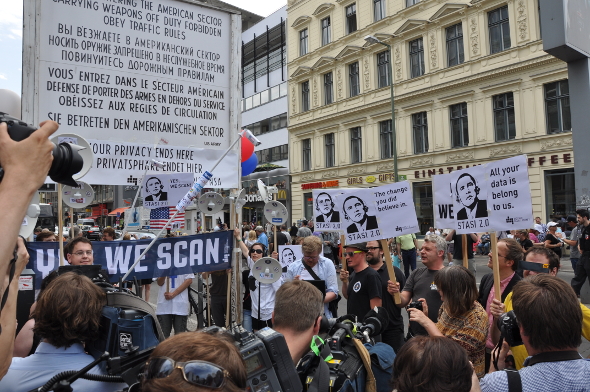
The Stasi 2.0 campaign was originally designed in 2007 to fight Germany’s mandatory data-retention law, a law implementing an EU Directive that force ISPs and telecom providers to continuously collect and store records documenting the online activities of millions of ordinary Europeans. Roughly 34,000 citizens filed a lawsuit against the mandatory data retention in protest. The campaign was successful and in March 2010 a German court declared the law unconstitutional and ordered the deletion of the collected data. Now, the Stasi 2.0 campaign has shifted focus on calling upon their government to protect them against overreach scope of NSA foreign surveillance practices, Sandra Mamitzsch from Digitale Gesellschaft told EFF.
Germany has also increased its capacity to conduct sweeping and invasive extra-territorial surveillance from its domestic soil. As we noted, the German government has leveraged its ability to remotely compromise computer systems in order to spy on its citizens. The government has used commercial malware to hack private data. While there has been no confirmation that Germany is deploying these investigative techniques against persons outside German territories, extra-territorial surveillance is feasible because infection occurs via email and other Internet transmissions.
Campaigns against the NSA spying overreach are now being planned for July 6 all around Australia. Australians can get involved here: http://ourprivacy.org.au/
Micheal Vonn, policy director at the B.C. Civil Liberties Association in Canada, told to the Global News in Canada: “[w]e fully intend to get some pointed questions to the Canadian government about knowledge, complicity, alliance with this program. And whether, in fact, very, very quietly, the Canadian security establishment has been harvesting the fruits of this program for some time.”
EFF is demanding Internet companies to join our cause and protect the privacy of their international customers calling on Congress to create a committee to uncover the truth about the NSA alarming allegations. You can take action here. Current foreign intelligence surveillance targetting foreigners must be challenged to ensure strong human rights safeguards, transparency and accountability across the world. A global dialogue on extra-territorial foreign intelligence surveillance among all nations is much needed.
EFF will continue blogging about the impact of the NSA leaks on Internet users abroad in our Spies Without Borders series. Next, we will examine what implications the government’s use of these FISA powers has for Internet users abroad, with an eye to other jurisdictions and the requirements of international law.
This is the 5th article of our Spies Without Borders series. The series are looking into how the information disclosed in the NSA leaks affect Internet users around the world whose private information is stored in U.S. servers, or whose data travels across U.S. networks.
Image: Digitale Gesellschaft, licensed under a Creative Commons BY SA 3.0 license.
Related article
Germany slams US for ‘Stasi methods’ ahead of Obama visit
RT | June 12, 2013
Germans are expressing outrage as details of a US internet spy program – revealed by a former CIA employee-turned-whistleblower – are prompting comparisons with that of former communist East Germany’s Ministry for State Security.
Unfortunately for Obama’s upcoming trip to Berlin, it was revealed that Germany ranks as the most-spied-on EU country by the US, a map of secret surveillance activities by the National Security Agency (NSA) shows.
German ministers are expressing their outrage over America’s sweeping intelligence-gathering leviathan, with one parliamentarian comparing US spying methods to that of the communist East Germany’s much-dreaded Ministry for State Security (Stasi).
Washington is using “American-style Stasi methods,” said Markus Ferber, a member of Chancellor Angela Merkel’s Bavarian sister party and member of the European Parliament.
“I thought this era had ended when the DDR fell,” he said, using the German acronym for the disposed German Democratic Republic.
Clearly, enthusiasm for the American leader’s upcoming visit will be much more tempered than it was in 2008 when 200,000 people packed around the Victory Column in central Berlin to hear Obama speak of a world that would be dramatically different from that of his hawkish Republican predecessor, George W. Bush.
Merkel will question Obama about the NSA program when he visits in Berlin on June 18, government spokesman Steffen Seibert told reporters on Monday. Some political analysts fear the issue will dampen a visit that was intended to commemorate US-German relations on the 50th anniversary of John F. Kennedy’s famous “Ich bin ein Berliner” speech.
Bush excesses, Obama digresses
One year into his second term, Barack Obama seems powerless to roll back the military and security apparatus bolted down by the Bush administration in the ‘War on Terror.’
One consequence of this failure of the Obama administration to reign in Bush-era excesses emerged last week when former National Security Agency employee Edward Snowden, 29, blew the whistle on a top-secret intelligence system named Prism, which collects data on individuals directly from the servers of the largest US telecommunications companies.
According to documents leaked to the Washington Post and Guardian newspapers, PRISM gave US intelligence agencies access to emails, internet chats and photographs from companies like Google, Facebook, Twitter, Verizon and Skype.
Justice Minister Sabine Leutheusser-Schnarrenberger said leaked reports that US intelligence services are able to track virtually all forms of Internet communication demanded an explanation.
“The more a society monitors, controls and observes its citizens, the less free it is,” she wrote in a guest editorial for Spiegel Online on Tuesday. “The suspicion of excessive surveillance of communication is so alarming that it cannot be ignored. For that reason, openness and clarification by the US administration itself is paramount at this point.”
All of the facts must be put on the table, the minister added.
Obama has defended the intelligence-gathering system as a “modest encroachment” that Americans should be willing to accept on behalf of security.
“You can’t have 100 per cent security and also then have 100 per cent privacy and zero inconvenience,” he said. “We’re going to have to make some choices as a society. There are trade-offs involved.”
The United States, however, is not legally restricted from eavesdropping on the communications of foreigners, meaning in theory that Washington could be listening to and collecting the private communications of individuals anywhere in the world.
Peter Schaar, Germany’s federal data protection commissioner, said the leaked intelligence was grounds for “massive concern” in Europe.
“The problem is that we Europeans are not protected from what appears to be a very comprehensive surveillance program,” he told the Handelsblatt newspaper. “Neither European nor German rules apply here, and American laws only protect Americans.”
Meanwhile, German opposition parties hope to gain from the scandal, especially with parliamentary elections approaching in September, and Merkel looking to win a third term.
“This looks to me like it could become one of the biggest data privacy scandals ever,” Greens leader Renate Kuenast told Reuters.
Obama is scheduled to hold talks and a news conference with Merkel on Wednesday followed by a speech in front of the Brandenburg Gate, the 18th triumphal arch that is one of Germany’s most recognizable landmarks.
Related articles
- Why Did Edward Snowden Go to Hong Kong?
- The NSA Black Hole: 5 Basic Things We Still Don’t Know About the Agency’s Snooping
- NSA Document Leak Proves Conspiracy To Create Big Brother Style World Control System
- DOJ launches criminal probe of NSA leaker
- US security officials said NSA leaker, journalist should be ‘disappeared’ – report
- Government Spying: Should We Be Shocked?
- Boundless Informant: NSA’s complex tool for classifying global intelligence
- The NSA’s Favorite Weasel Word To Pretend It’s Claiming It Doesn’t Spy On Americans
- The “Congress knew” defense
- NSA memo pushed to ‘rethink’ 4th Amendment
Featured Video
Integrity Initiative: UK-funded network framed dissent as Russian disinformation for years
or go to
Aletho News Archives – Video-Images
From the Archives
Why Saudi Ties to 9/11 Mean U.S. Ties to 9/11
By Kevin Ryan | Dig Within | September 27, 2015
Media interest in Saudi Arabian connections to the crimes of 9/11 has centered on calls for the release of the 28 missing pages from the Joint Congressional Inquiry’s report. However, those calls focus on the question of hijacker financing and omit the most interesting links between the 9/11 attacks and Saudi Arabia—links that implicate powerful people in the United States. Here are twenty examples. … continue
Blog Roll
 Aletho News
- Big tech hands in its DSA censorship reports to the EU
- ‘A Big Victory’ – Palestine Chronicle Wins Two-Year Legal Battle
- IAEA inspectors cannot return to Iran amid US threats: Russia
- Senate Rejects Iran War Powers Resolution Passed By House
- ‘We did not attack Pakistan with drones’: Afghan sources
- Iraqi Resistance faction links arms to sovereignty, questions US exit
- Cannon fodder no more… South Korea rejects Trump’s pressure to join his criminal war on Iran
- Neria Leiter Was A Legitimate Military Target
- Integrity Initiative: UK-funded network framed dissent as Russian disinformation for years
- ‘We don’t seek permission to defend our country’: Snippets from President Pezeshkian’s UNGA address
- If Americans Knew
- ‘This is where I live now, the back of a truck’: a day in the life of a grandmother in Gaza
- In UN Speech, Iran’s President Displays Pictures of Children Killed by US, Brings Attention to Israel’s Nuclear Arsenal
- Israel displaces hundreds of Palestinians amid wave of demolitions in West Bank
- Aid, reconstruction, and Israel’s history of obstruction in Gaza
- Trump administration digs an ever-deeper hole of complicity in genocide – Daily Update
- US-Israel $2.8 Billion Arms Deal, 40,000-Bomb Supply Faces New Gaza Complicity Accusations
- Caught on Tape: AIPAC CEO Boasted of Controlling Trump’s National Security Officials
- Why Hamas Attacked Israel in October 2023 – Israeli professor Ilan Pappé
- They see them, then kill them: Israeli quadcopters track, deliberately target civilians in Gaza
- Winter could turn Gaza’s treacherous, war-damaged buildings into deathtraps
- No Tricks Zone
- New Study: Earth And Venus Surface Warmth Largely Explained By Convection And Lapse Rate, Not CO2 Or Radiation
- 2025 Nature Paper Claiming Worsening Global Drought Gets RETRACTED …Heavily Flawed
- New Study: ‘Global Drought Shows No Detectable Recent Acceleration Under Climate Warming’
- Economic Masterminds: German Socialists Suggest Taxing Productivity Gains Stemming From Using AI
- The South China Sea Has Not Been Cooperating With The Climate Change Narrative
- Energy Crisis: Germany Enters Heating Season With Historically Low Gas Reserve Fill Levels
- New Study: The Antarctic Ice Sheet Gained Mass From 2020-2024 Due To Staggering Snow And Ice Accumulation
- Study: Ocean Heating Rates From Thousands Of Years Ago ‘Dwarf’ Modern Ocean Heating Rates
- Climate Extremists Target, Attack Large-Scale Power Grid Infrastructure In Germany!
- New Study: Antarctic Ice Melt Has Contributed Less Than 1 Centimeter To Sea Level Rise In The Last 30 Years

