Germany halts ACTA approval
RT – February 10, 2012
Germany has delayed its approval of the ACTA treaty after the Justice Ministry voiced its concerns about the legislation. It is the third EU country after Poland and the Czech Republic to challenge the controversial treaty.
The Justice Ministry said that the European Parliament should vote on ACTA before it is considered by the state’s parliament.
Three of Germany’s parties, the Pirate Party, the Left Party and the Greens, have also spoken out against ACTA.
German protesters are expected to stage demonstrations in over 60 towns across the country on Saturday.
Earlier Poland and the Czech Republic had refused to approve the agreement. Both countries saw major protests in the streets. Critics of ACTA accuse its authors of hammering out the agreement in secret and say the deal will limit online freedom of speech.
On January 26, the controversial ACTA treaty was signed by the 22 of 27 European Union member states, and the EU itself. It now has to be ratified by the European Parliament and is scheduled to be debated in June.
ACTA is an international agreement aimed at protecting intellectual property. It shares similarities with the Stop Online Piracy Act (SOPA) in the US, which was shelved by lawmakers after a partial blackout by Wikipedia and Google in protest.
The ACTA treaty was negotiated by industrialized countries struggling for ways to fight intellectual property theft. The US, most of the EU, Australia, Canada, Japan and several other countries have signed the treaty.
Related articles
Anti-war activists in Munich protest major security confab
Press TV – February 5, 2012

German policemen block demonstrators trying to approach Munich’s Bayerischer Hof Hotel, where the 48th Munich Security Conference is held.
Hundreds of anti-war activists have taken to the streets in the southern German city of Munich to protest against an annual, high-profile security conference.
Some 800 demonstrators marched on Saturday toward the Bayerischer Hof Hotel in Munich where the 48th Munich Security Conference is being held.
The three-day event brings together foreign and defense ministers and military experts from around the world.
The activists said that they were demonstrating against global arms deals, calling for a genuine global peace. The anti-war protesters also condemned the conference for ‘only paving the way for future conflicts.’
The event gathers the world’s major weapons producers who seek to invent wars and move profit backwards and forwards with certain countries, they said.
The 48th Munich Security Conference, focusing on Europe’s debt crisis and strategies for global security, was held with security provisions that were not as tight as the previous years, with police presence at a 3,100-strong low.
Related articles
- Rudd heads to the Munich Security Conference to get his orders from Kissinger (seeker401.wordpress.com)
- Clinton Urges Bulgaria to Be Energy Independent (abcnews.go.com)
German people in unprecedented rebellion against government
1,000 injured in nuclear protests, police at breaking point
By Jane Burgermeister – November 8, 2010
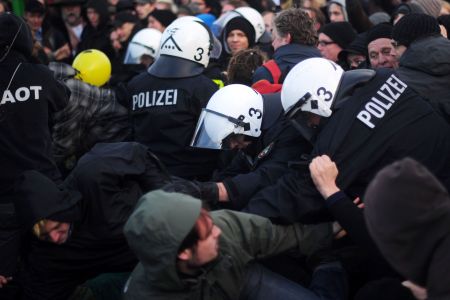
Like the Roman legions vanquished in the Teutoburger Wald in Lower Saxony in 9 AD, the 17,000 police officers that marched into the woods around the nuclear storage facility in Gorleben in northern Germany on Sunday morning looked invincible. Police personnel from France, Croatia and Poland had joined in the biggest security operation ever mounted against protestors against a train carrying nuclear waste to a depot in an isolated part of Lower Saxony’s countryside. Helicopters, water canons and police vehicles, including an armoured surveillance truck, accompanied an endless column of anti-riot police mounted on horses and also marching down the railway tracks into the dense woods. Tens of thousands of anti riot police clattered along the tracks, their helmets and visors gleaming in the morning sun, and wearing body armour, leg guards and carrying batons.
But by Sunday night, those same police officers were begging the protestors for a respite.
Trapped in black, icy woods without supplies or reinforcements able to reach them because of blockades by a mobile fleet of farmer’s tractors, the exhausted and hungry police officers requested negotiations with the protestors. A water cannon truck was blocked by tractors, and yet the police still had to clear 5,000 people lying on the railway track at Harlingen in pitch darkness. The largest ever police operation had descended into chaos and confusion in the autumn woods of Lower Saxony, defeated by the courage and determination of peaceful protestors who marched for miles through woods to find places to lie down on the tracks and to scoop out gravel to delay the progress of the “the train from hell.”
The police union head Reiner Wendt gave vent to the general frustration when he issued a press statement via the DPA news agency last night saying the police had reached exhaustion point and needed a break. Behind the scenes, a battle seemed to be raging between the police chiefs, tucked up in their warm headquarters urging more action, and the exhausted officers on the ground.
The police on the ground won out. The Castor train – called a “Chernobyl on wheels” because it has been carrying 133 tonnes of highly radioactive waste to an unsafe depot – was stopped in the middle of the countryside and NATO barbed wire was placed around it. Lit by floodlights and guarded by a handful of police, the most dangerous train on the planet was forced to a halt after a 63 hour journey across France and Germany.
The defeat of the legions at Teutoburg marked the end of the attempt by the Roman empire to conquer Germania magna. And the failure of the biggest ever police operation two thousand years later in the woods of Lower Saxony to tame women, elderly people and school children protesting the government’s nuclear policy, could well also go down as a turning point.
The Berlin government can no longer rely on the discredited mainstream media to control the way people see issues. Too many people recognise it to be a tool of propaganda. The government now needs to resort to brute force to bludgeon through decisions that enrich corporations and banks and impoverish everyone else. But the police forces at its disposal are simply not sufficient given the scale of the protests now gripping Germany. Only 1,500 police reinforcements could be mustered on Morning from the entire territory to deal with road blockades by thousands of protestors aiming to delay the transport of the nuclear waste on the final leg of its journey.

The police officers were exhausted after shifts of 24 hours or more, often without any food or just a cappuccino and snack bar, and they had nothing to look forward to but more of the same drudgery after a night spent four to a room in a Youth Hostel.
http://newsticker.sueddeutsche.de/list/id/1065325
A leading figure in a German police police union Bernard Witthaut today even lashed out at the government for trying to drive through unpopular policies using the police.
“Whether in Stuttgart or in Wendland today my colleagues are simply not getting out of their anti riot gear because of the wrong decisions by the government,” he said.
Many police officers also expressed sympathy with the protestors’ aims.
The question now is: how long can the use of police to bludgeon protestors continue when the protests are reaching this scale? How long can Germany be governed by a semi authoritarian regime using brute force when the force at its disposal is so small? The German army cannot be deployed on this kind of mission without sparking even more outrage. A false flag terrorist operation will hardly wash when the people are so fed up with the government lies and the media lies. EU soldiers will find it hard to deal with the Germans. The German and EU secret police cannot infiltrate all of the protestor’s organizations when there are simply so many.
The German people as a whole are on the march.
“Citizens in rebellion,” shouted a TAZ headline.
“Civil war in Wendtand,” fumed Bild.
NGO chief Kersin Rudek spoke for many when she said:
“We have lost faith in the government until they prove that their politics is for the people and not for the corporations.”
She talked about the “anger” among people at the “arrogance of the political class.”
As in the Stuttgart 21 railway protests, it was people from all walks of life, a genuine grass roots movement, that arrived in Wendland to protest the decision by the CDU/CSU/FDP government to ignore a legally binding deadline to phase out nuclear power. Against the wishes of the majority, Bilderberg Chancellor Angela Merkel announced this autumn that 17 reactors would continue for another 12 years at gigantic cost to the tax payer in subsidies.
The tax payers of Lower Saxony even have to foot the bill of 50 million euro for the police operation to protect the nuclear waste – and not the electricity companies making a fortune from the extravagant energy source while the government keeps investments in ground-breaking new renewable energy technologies such as the third generation solar cells at a negligible amount.
As in Stutggart, the police used savage force against peaceful demonstrators reinforcing the impression of a government out of control and refusing to respect the basic democratic right of people to hold protests without being beaten to a pulp. Videos of the Castor transport on Sunday show police beating people with their truncheons, punching them and throwing them to the ground. Police also used tear gas, pepper spray and water canon.
http://www.spiegel.de/politik/deutschland/0,1518,727706,00.html
One clip shows a police officer using his fist to punch a man lying on the railway track in the head.
About a 1,000 people were injured, it is reported. 950 people are reported to have suffered eye injuries due to pepper spray and tear gas, according to a spokesperson of “Castor schottern”. Another sixteen protestors suffered broken bones. There were 29 severe head wounds. Two people had to be taken to hospital.
One person had to be taken by helicopter after suffering multiple bone fractures after being trampled by a police horse.
But as in Stuttgart, the people did not give up in spite of the risk of savage beatings at the hands of the police. They insisted on their civic right enshrined in the constitution to hold peaceful political protests.
More than 50,000 people from all parts of the country and all walks of life attended a rally on a field close to Dannenberg. Thousands then marched through the autumn woods, splitting into small groups to descend into the valley, break through police lines to chain themselves to the rails or remove gravel from the tracks to delay the train.
According to Spiegel, 7,000 people alone took part in the road and railway blockades.
An armoured police car was set on fire by masked men but it is not clear if this was an agent pravocateur acting to discredit the protestors. A video shows a man able to walk up to the armoured car and set it alight unhindered.
The overwhelming number of protestors were peaceful.
In spite of the sub zero temperatures and ground frost, up to 5000 protestors lay down on the railway tracks at Harlingen late in the evening and refused to move. Supplies of hot tea, food and blankets were brought to them by mobile kitchens. Fires were lit to help stay warm.
The police worked from midnight until 7 am to clear protestors blocking the track, dragging many to an open air “prison concentration camp” where people were forced to sleep in fields surrounded by police trucks.
This morning, the protestors have regrouped today and thousands are reported to be preparing to block the transport by road of the nuclear waste from Dannenberg to Gorleben.
The organisers of the protest kept journalists and the public informed using live tickers, press releases and at Infopoints so that the whole country could follow the events outside the mainstream media. Radio Wendland is also broadcasting updates on the incredibly heroic resistance of so many people. At great personal risk, tens of thousands of people gave an example of courageous and peaceful non-violent resistance that will surely go down in history.
If this is the resistance for Castor and Stuttgart 21, just imagine what will happen when Germans finally grasp the scale of the banking scam being carried out by their “elite.”
The CDU/CSU/FDP government has already hit record lows in the polls and after Sunday’s savage police operation against peaceful protestors, support for them is sure to plummet further.
The feudal lords without a feudal army to push through their agenda of robbery are facing the end of the road now that their media propaganda apparatus based on the Springer and Bertelsmann empire is falling apart and their strategy of divide and rule through a false left/right political paradigm is no longer working.
A new freedom and power was born in the woods of Wendland. And it belonged to the people who have had enough of the arrogant authoritarian political class.
See also:
German police battle nuclear train protesters
Featured Video

Broke Princes: Saudi Arabia’s Powder Keg
or go to
Aletho News Archives – Video-Images
From the Archives
A sample of vaccine and injectable medication tragedies during my lifetime
This is what happens when you demand speedy production in an era of politicized regulation
By Meryl Nass, MD | February 12, 2022
All these tragedies have been due to failures of testing or failures in manufacturing processes. Most occurred before vaccine manufacturers were given virtually complete protection from liability in 1987.
With the duration of patent exclusivity determining how much new products earn, products are rushed to market as quickly as possible, most using a shortened path for FDA review. Recalls and market removals of approved products are much more common than they used to be. We can only expect more of these disasters in the future, especially if the products are mandated for everyone. … continue
Blog Roll
 Aletho News
- Broke Princes: Saudi Arabia’s Powder Keg
- Albania’s Crisis: Rama, Israeli Investments and the Demand for Accountability
- Hezbollah Categorically Denies Syrian Accusations: We Aim at Confronting Israeli Enemy, Not Undermining Syria’s Stability
- Trump claims funding to Israel ending in 2026 as merger of Israeli–US armies looms
- Iran Weathering The Storm, But Saudi Arabia Is Sinking
- Sunk Ships Don’t Sail Home: Why Peace Won’t Save the Oil Market and War Will Wreck It
- No Cossacks at the gates, fix Italy instead – opposition leader to Meloni
- The Pits: Zelensky’s torture chamber network in the public eye
- Moscow mocks Kiev’s language hypocrisy exposed by ‘torture chamber’ scandal
- Military ‘torture chamber’ triggers new scandal in Kiev
- If Americans Knew
- An error has occurred; the feed is probably down. Try again later.
- No Tricks Zone
- New Study: The Net Fossil Fuel Contribution To Rising Atmospheric CO2 Has Been Zero For 500 Years
- Germany’s Green Energy Transition Becoming Increasingly Expensive…Another 6 Trillion Euros!
- Sudden Stratospheric Warming, Powerful El Niño Combination May Lead To Extreme Europe Cold, Energy Crisis!
- Two New Studies Find Thwaites Glacier Melt Cannot Be Driven By Human Activity Or A Warming Ocean
- E-Cars Reduce CO2 Emissions By Only 41% Compared To Internal Combustion Engine Vehicles
- Predictions Made By Renowned Climate Professor Over Past Decades Have Been Proven To Be Poor
- New Study Suggests Large Regions Of The Pacific Ocean Have Been Cooling For The Last 80 Years
- Germany’s Green Energy Debacle: High Energy Costs Force Kahla Porzellan to Close After 182 Years!
- New Study: 50 Years Of The Most Aggressive ‘Net Zero’ Policies Can Only Affect The Global Climate By 0.03°C
- US September “Heat” Was No Record…Many Records Set Decades Ago

