German Energy Apocalypse Update VII
eugyppius – October 25, 2022
The only published footage of the damage to the Nord Stream pipelines, featured on my Nord Stream Conspiracy Thread, turns out to come from Expressen, a Swedish newspaper. Their reporters hired undersea drone operators and took a boat out to the site of the explosions off the island of Bornholm. There, they found a sizeable crater and 50 metres of missing pipeline. That this is how the images should have made their way to us, rather than through any official path, speaks volumes about the eagerness of Swedish authorities to suppress this story.
Protests against the insane energy policy of the German government are gathering momentum, particularly in the East; sporadic reports are even appearing in major media outlets now. This is surely one reason that the Minister President of Saxony, Michael Kretschmer, continues to stray from official CDU talking points, calling for negotiated peace in Ukraine and likening EU sanctions to a “tsunami” threatening the German economy.
Feared gas shortages are causing chaos as customers rush to change suppliers in search of better prices, or because their current contracts have been cancelled. Several municipal utilities have flatly stopped accepting new customers, but this option is not available to the so-called Grundversorger or “basic suppliers”—the utilities that supply the majority of gas in their region. These are legally bound to take all comers, and many of them are already having difficulty meeting sudden surges in demand.
Their day-to-day solvency may also soon be a problem:
[I]t is not only the procurement prices that have risen sharply, but also the interim financing costs—that is, the sum with which the municipal utilities must bridge the time from the purchase of gas to the onward sale to the customer, and to the increase in customers’ instalment payments, [an Association of Municipal Enterprises] spokesman explained. “Both together increase the liquidity needs of the municipal utilities, and this in turn affects their ability to supply customers with electricity and gas.”
Who knows how all this will play out, and what effect (if any) proposed price limits on electricity and gas will have on the markets, but I have a crazy vision of a near-future dystopia, where a minority of wealthy customers who have maintained wildly expensive contracts with alternate providers can still heat their homes, while everyone else deals with constant outages and ad-hoc rationing schemes.
Zelensky’s economic advisor has announced that he expects the Federal Republic to contribute 500 million dollars every month to Ukraine’s defence. That sounds like a lot, but we must remember that Germany’s antigen testing program, at its height, cost around a billion Euros a month. The government has pissing away money on crazy things for a long time now.
A survey of German companies, the majority of them small businesses, shows that 25% (up from 14% four months ago) are considering whether to lay off employees, and that 90% are planning to raise prices further than they already have. Almost six in ten are delaying planned investments.
“We have been seeing a creeping shift in industrial production for some time now,” says Rainer Kirchdörfer, Chairman of the Family Business Foundation [which conducted the survey]. “We will only recognise the deindustrialisation and loss of prosperity years from now, and by then it will be irreversible.”
The economic chaos has hit the chemical industry especially hard, and among the early shortages are iron and aluminium salts, crucial precipitating agents used in wastewater treatment. Four federal states have already relaxed their rules on water purification. Chemicals necessary for the treatment of drinking water are also increasingly scarce.
Can’t we just increase our production of biogas to end our dependence on Russia and save the climate at the same time, asks the drooling knuckle-dragging morons at Westdeutscher Rundfunk ?
Overall, the share of biomethane in the German gas market could triple, according to a study by the German Biomass Research Centre in Leipzig. The Capital Bioenergy Office says in a statement that biogas plants could offset about 4 percent of Russian natural gas imports in the short term. It also says it is possible for biogas to provide 46% of the electricity from gas-fired power plants.
So, if we put all of our grain into power production, we have the prospect not only of freezing to death, but of starving to death too. I’m glad state media are investigating this promising angle.
Finally, Business Insider has discovered that the real victims of the gas crisis won’t be young children in fragile health or elderly pensioners on fixed incomes, but female professionals. Ordinances requiring offices to set thermostats at 19C, according to some garbage study, will cognitively disadvantage women, while (even worse) advantaging men, who bizarrely are alleged to perform their best at this precise temperature. Happily, though, Tagesschau has consulted Dr. Georg Ertl from University Hospital at Würzburg, who believes this unfortunate sexism, brought upon us by the furtherance of liberal democracy, can be countered by … caps and stockings.
Nord Stream repair time frame assessed
Samizdat – October 24, 2022
Russia’s Nord Stream gas pipelines, which were damaged and made inoperable by underwater explosions in late September, can be repaired within a few months.
That’s according to the state-backed Danish Broadcasting Corporation (DR) which was citing Sten Ussing, Chief Engineer with consultant group COWI.
Ussing assessed from underwater video-footage that the pipes will not be damaged by rust for some time as there is little oxygen at a depth of 80 meters, where they are located. He noted that the fracture surfaces look “very clean and almost shiny,” which suggests that “the pipe will not rust in a few weeks, as one would expect in a more oxygenated environment.”
“We can expect corrosion inside the pipe to be limited as well,” he added.
The engineer, however, explained that the explosion caused a pressure surge, and that could have damaged sections of the pipeline some distance from the site, adding that they can be repaired by elevating the pipes slightly above the seabed, which would allow underwater welders to remove the damaged sections and replace them with new ones.
“It is standard procedure to weld such a piece of pipe under water. It has been done many times before, and the technologies – vessels, pipes and specialists – that need to be used already exist,” Ussing explained.
“Finally, the pipeline would have to be emptied, the strings cleaned of dirt and grime, blown and dried – and that’s it, you can have gas flowing again,” the engineer concluded, saying the process will likely take several months. He warned, however, that even with little oxygen, the fractured pipes can accumulate rust over time, and advised to carry out the repairs within a year.
The footage of the pipeline fractures which Ussing inspected was taken by Swedish media outlet Expressen, which sent a camera down one of the pipes.
The cause of the explosions which damaged three out of four strings of Russia’s 1,200-kilometer Nord Stream 1 and 2 gas pipelines is still being investigated. Sabotage is suspected to be the likely cause. President Vladimir Putin branded it “an act of international terrorism.”
Germany forced to slash rearmament plans
Berlin loudly announced the scheme earlier this year, after years of pressure from the US
Samizdat | October 23, 2022
Germany is “massively” reducing its rearmament plans as high inflation and a strong dollar have made the equipment too expensive to buy for the country, unnamed political and defense industry representatives have told Handelsblatt newspaper.
Many projects, especially those for the navy and airforce, would likely have to be canceled, the outlet reported on Friday.
The fate of a third batch of K130 corvettes is now hanging in the balance, along with new Eurofighter jets for electronic warfare, frigates, and self-propelled howitzers, which were to be ordered to replace equipment sent by Berlin to Ukraine, the sources claimed.
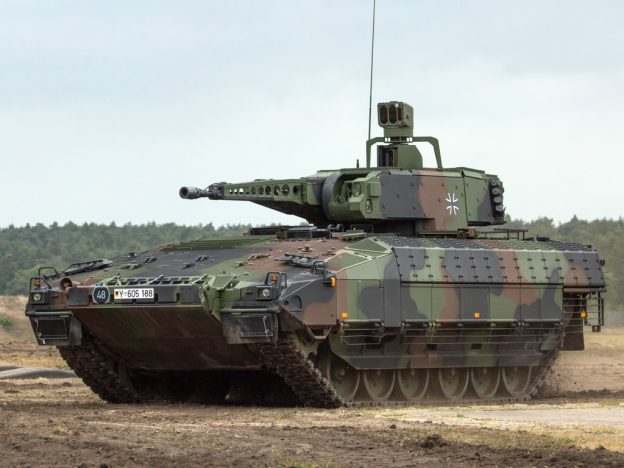
The number of units in a second batch of Puma infantry fighting vehicles, the cost of which was estimated at €304 million ($299.8 million) earlier this year, is also being reduced on a weekly basis, an unnamed politician from the ruling ‘traffic light’ coalition told the paper.
“Since many projects run for five to seven years, inflation in this dimension creates a serious financial problem,” one of the sources explained. The economic situation has been fraught in Europe as the burden of the Covid-19 pandemic was further aggravated by the fallout from sanctions imposed by the EU on Moscow over its military operation in Ukraine, and the subsequent reduction in the supply of Russian energy to the bloc.
Arms manufacturers have reportedly been unhappy with the size of a special €100 billion ($98.6 billion) fund allocated by the German government for rearmament purposes. “In order to fulfill the wishes of the Bundeswehr, €200 billion is needed,” a defense firm manager told Handelsblatt.
When announcing the investment in June, Chancellor Olaf Scholz promised that it would help turn the German military into the “biggest conventional army” among European NATO member states. The Bundeswehr would be able to “defend every square meter” of the US-led military bloc’s territory, he insisted.
Reports about Putin’s threat are false – Scholz
Samizdat | October 22, 2022
German Chancellor Olaf Scholz has dismissed reports that Russian President Vladimir Putin has threatened to escalate the conflict in Ukraine.
When asked about the issue during an interview with Die Welt newspaper on Saturday, Scholz said the media had been too loose in its interpretation of official reports from Berlin on its discussions with Moscow.
“For good reasons, I don’t speak about the negotiations that I have with the Russian president. But here’s what I can say: The reports that I read about the alleged threats during these negotiations are false,” the chancellor said.
The Russian and German leaders last talked on the phone in mid-September. According to Berlin, Scholz urged Putin to find a diplomatic solution for the conflict in Ukraine based on a ceasefire and the complete withdrawal of Russian troops during their 90-minute conversation. He also “emphasized that any further Russian annexation steps would not go unanswered and would not be recognized under any circumstances.”
According to the Kremlin, Putin told Scholz about the incessant shelling of cities in Donbass by Ukraine, which had led to civilian deaths and the destruction of infrastructure. The Russian leader called it a “gross violation of humanitarian law” by Kiev.
A few weeks after that, referendums on joining Russia were held in Kherson and Zaporozhye Regions, and in the People’s Republics of Donetsk and Lugansk, with the territories being officially incorporated into the Russian state in early October.
Earlier this week, Scholz told Deutschlandfunk outlet that the tone of his conversations with Putin “is always friendly, even if we have very different views on the matter.”
“I think it’s important that we have this conversation,” the chancellor said, but added that one shouldn’t “harbor any illusions” about those contacts bringing swift results.
Russia’s homage to Nord Stream pipelines
BY M. K. BHADRAKUMAR | INDIAN PUNCHLINE | OCTOBER 22, 2022
David Brinkley, the legendary American newscaster with a career that spanned an amazing fifty-four years from World War II once said that a successful man is one who can lay a firm foundation with the bricks others have thrown at him. How many American statesmen ever practised this noble thought inherited from Jesus Christ remains doubtful.
Russian President Vladimir Putin’s stunning proposal to Turkish President Recep Erdogan to build a gas pipeline to Turkiye to create an international hub from which Russian gas can be supplied to Europe breathes fresh life into this very “Gandhian” thought.
Putin discussed the idea with Erdogan at their meeting in Astana on October 13 and since spoke about it at the Russian Energy Week forum last week where he proposed creating the largest gas hub in Europe in Turkey and redirecting the volume of gas, the transit of which is no longer possible through the Nord Stream, to this hub.
Putin said it may imply building another gas pipeline system to feed the hub in Turkiye, through which gas will be supplied to third countries, primarily European ones, “if they are interested.”
Prima facie, Putin does not expect any positive response from Berlin to his standing proposal to use the string of the Nord Stream 2, which remained undamaged, to supply 27.5 billion cu. metres of gas through the winter months. Germany’s deafening silence is understandable. Chancellor Off Scholz is terrified about President Biden’s wrath.
Berlin says it knows who sabotaged the Nord Stream pipelines but won’t reveal it as it affects Germany’s national security! Sweden too pleads that the matter is far too sensitive for it to share the evidence it has collected with any country, including Germany! Biden has put the fear of God into the minds of these timid European “allies” who have been left in no doubt what is good for them! The western media too is ordered to play down Nord Steam saga so that with the passage of time, public memory will fade away.
However, Russia has done its homework that Europe cannot do without Russia gas, the present bravado of self-denial notwithstanding. Simply put, the European industries depend on cheap, reliable supplies of Russian gas for their products to remain competitive in the world market.
Qatar’s energy minister Saad al-Kaabi said last week that he cannot envisage a future where “zero Russian gas” flows to Europe. He noted acerbically, “ If that’s the case, then I think the problem is going to be huge and for a very long time. You just don’t have enough volume to bring (in) to replace that (Russian) gas for the long term, unless you’re saying ‘I’m going to be building huge nuclear (plants), I’m going to allow coal, I’m going to burn fuel oils.’”
Quintessentially, Russia plans to replace its gas hub in Haidach in Austria (which Austrians seized in July.) Conceivably, the hub in Turkiye has a ready market in Southern Europe, including Greece and Italy. But there is more to it than meets the eye.
Succinctly put, Putin has made a strategic move in the geopolitics of gas. His initiative rubbishes the hare-brained idea of the Russophobic European Commission bureaucrats in Brussels, headed by Ursula von der Leyen, to impose a price cap on gas purchases. It makes nonsense of the US’ and EU’s plans to put down Russia’s profile as a gas superpower.
Logically, the next step for Russia should be to align with Qatar, the world’s second biggest gas exporter. Qatar is a close ally of Turkey, too. At Astana recently, on the sidelines of the summit of the Conference on Interaction and Confidence-Building Measures in Asia (CICA), Putin held a closed-door meeting with the Emir of Qatar Sheikh Tamim bin Hamad Al Thani. They agreed to follow up with another meeting soon in Russia.
Russia already has a framework of cooperation with Iran in a number of joint projects in the oil and gas industry. Russian Deputy Prime Minister Alexander Novak recently disclosed plans to conclude an oil and gas swap deal with Iran by the end of the year. He said that “technical details are being worked out – issues of transport, logistics, price, and tariff formation.”
Now, Russia, Qatar and Iran together account for more than half of the world’s entire proven gas reserves. Time is approaching for them to intensify cooperation and coordination on the pattern of the OPEC Plus. All three countries are represented in the Gas Exporting Countries Forum (GECF).
Putin’s proposal appeals to Turkiye’s longstanding dream to become an energy hub at the doorstep of Europe. Unsurprisingly, Erdogan instinctively warmed up to Putin’s proposal. Addressing the ruling party members in the Turkish parliament this week, Erdogan said, “In Europe they are now dealing with the question of how to stay warm in the coming winter. We don’t have such a problem. We have agreed with Vladimir Putin to create a gas hub in our country, through which natural gas, as he says, can be delivered to Europe. Thus, Europe will order gas from Turkey.”
Apart from strengthening its own energy security, Turkiye also can contribute to Europe’s. No doubt, Turkiye’s importance will take a quantum leap in the EU foreign policy calculus, while also strengthening its strategic autonomy in regional politics. This is a huge step forward in Erdogan’s geo-strategy — the geographic direction of Turkish foreign policy under his watch.
From the Russian viewpoint, of course, Turkiye’s strategic autonomy and its grit to pursue independent foreign policies works splendidly for Moscow in the present conditions of western sanctions. Conceivably, Russian companies will start viewing Turkiye as a production base where western technologies become accessible. Turkiye has a customs union agreement with the EU, which completely removes customs duties on all industrial goods of Turkish origin. (See my blog Russia-Turkey reset eases regional tensions, Aug 9, 2022)
In geopolitical terms, Moscow is comfortable with Turkiye’s NATO membership. Clearly, the proposed gas hub brings much additional income to Turkiye and will impart greater stability and predictability to the Russia-Turkey relations. Indeed, the strategic links that tie the two countries together are steadily lengthening — the S-400 ABM deal, cooperation in Syria, the Akkuyu Nuclear Power Plant, Turk-stream gas pipeline, to name a few.
The two countries candidly admit that they have differences of opinion, but the way Putin and Erdogan through constructive diplomacy keep turning adverse circumstances into windows of opportunity for “win-win” cooperation is simply amazing.
It does need ingenuity to get the US’ European allies to source Russian gas without any coercion or boorishness even after Washington buried the Nord Stream gas pipelines in the depths of the Baltic Sea. There is dramatic irony that a NATO power is partnering Russia in this direction.
The US foreign policy elite drawn from East European stock are rendered speechless by the sheer sophistication of the Russian ingenuity to bypass without any trace of rancour the shabby way the US and its allies — Germany and Sweden, in particular — slammed the door shut on Moscow to even take a look at the damaged multi-billion dollar pipelines that it had built in good faith in the depths of the Baltic Sea at the insistance of two German chancellors, Gerhard Schroeder and Angela Merkel.
The current German leadership of Chancellor Olaf Scholz looks very foolish and cowardly – and provincial. The European Commission’s Ursula von der Leyen gets a huge rebuff in all this which will ultimately define her tragic legacy in Brussels as a flag carrier for American interests. This becomes probably the first case study for historians on how multipolarity will work in the world order.
Four German states are repealing rules on water purification
Free West Media | October 21, 2022
Sewage treatment plants in Germany are running out of chemicals. Four federal states are therefore taking drastic steps and they have been allowing the phosphate limit values to be exceeded.
The European production of the “precipitants”, which are essential for the chemical cleaning of sewage water, has fallen by more than 50 percent due to the self-imposed energy crisis. A quarter of German sewage treatment plants have since reported delivery failures.
The chemical industry currently has its back to the wall – more and more companies are threatened with bankruptcy. Wolfgang Große Entrup, General Manager of the industry association VCI, said in an interview with ntv recently: “The skyrocketing energy prices are hitting our industry brutally.”
The VCI boss added: “We are therefore looking extremely critically and with deep concern into the future”. And that has serious consequences, not only for the employees of the affected companies but also for the public in general.
Many sewage treatment plants in Germany no longer have enough iron and aluminum salts to comply with the strict guidelines for phosphates. The so-called precipitating agents, which bind the phosphates and are disposed of with the sewage sludge, are normally a by-product of the production of hydrochloric acid.
This production, in turn, is in trouble. There are two reasons for this: Firstly, the production of hydrochloric acid is energy-intensive and therefore very expensive in times of high electricity and gas prices. Secondly, as the economy suffers because of inflation, there is also less demand for products that normally use hydrochloric acid in their manufacturing process. These are, for example, paints and varnishes.
The German Association for Water Management, Wastewater and Waste (DWA) reported after a representative survey in September that a quarter of the sewage treatment plants had already reported delivery failures of the urgently needed chemicals. For October it was expected that the delivery bottlenecks would affect every second sewage treatment plant operator in the country.
In order for sewage treatment plants to be able to continue to work despite the shortage, decrees have been issued in North Rhine-Westphalia, Mecklenburg-Western Pomerania, Lower Saxony and Schleswig-Holstein, which allow the plants to exceed the phosphate limit values. Comparable regulations have been announced in Thuringia, and a corresponding decree is being prepared in Saxony-Anhalt.
What does all this mean?
Sewage treatment plants have to pay a wastewater fee to the state for discharging phosphorus compounds – which in turn is passed on to the public in the form of wastewater fees. The higher the phosphorus levels, the higher the fees. So water treatment could become significantly more expensive.
In the long term, higher phosphorus discharges into water bodies, whereby the substances could reach the sea via rivers, could also lead to eutrophication. If there is a lack of precipitants, the operators can no longer bind enough phosphates from the wastewater.
When this poorly treated water is discharged into rivers, the phosphates become a problem because they serve as nutrients for algae, for example. This in turn could deprive other plants and animals in the water of nutrients and oxygen. Some types of algae also excrete toxins into the water that are harmful to flora and fauna. If too many phosphates get into the sea, algae carpets can form there, which also block sunlight and thus harm other living beings.
In this context one speaks of “dead zones”.
Another problem
Drinking water is also affected: Not only sewage treatment plants, but also the drinking water suppliers are reporting a lack of chemicals – the flocculants, which are necessary to free the water from so-called suspended matter, are also becoming scarce. This could have serious consequences. “In the worst case” without flocculants, the water could become cloudy, “which would no longer make it possible to supply it as drinking water,” the Association of Municipal Enterprises (VKU) told the Neue Osnabrücker Zeitung (NOZ).
According to the VKU, the drinking water suppliers which are affected, are especially those who get their water from dams, for example. This water must be treated for suspended matter
At the request of NOZ, the four federal states confirmed that they had issued decrees allowing the sewage treatment plants to exceed phosphate limits and added that the operators were required to report exceedances to the authorities.
Higher phosphate concentrations in rivers are possible in winter because algae hardly grows in the cold season but if the emergency continues in the coming spring or even summer, it could become a major headache.
US envoy for Iran: Reviving JCPOA ‘not even on agenda’
Press TV – October 18, 2022
The US special envoy for Iran, Robert Malley, has acknowledged that negotiations on a revival of the 2015 Iran deal are “not even on the agenda” for now, trying to shift the blame on Tehran for the stalled diplomatic process.
Malley, in an interview with CNN on Monday, accused the Islamic Republic of not being interested in restoring the deal and claimed that the administration of US President Joe Biden believed diplomacy was the best way to prevent Iran from what he called “acquiring a nuclear weapon.”
“President Biden made it clear from the first day he came into office that one of his priorities was to prevent Iran from acquiring a nuclear weapon. And he believes and we continue to believe that diplomacy is the best way to achieve that goal,” Malley told CNN.
He referred to the latest remarks by the European Union’s foreign policy chief, Josep Borrell, that he did not expect any movement anytime soon in efforts to revitalize the Iran deal, officially called the Joint Comprehensive Plan of Action (JCPOA), accusing Tehran of raising issues that were “inconsistent” with a return to the deal.
Iran has demanded that the United States provide assurances that it would not leave the JCPOA again before it could reenter the agreement. Washington has refused to give a legally enforceable guarantee, leaving Iranian negotiators suspicious of the Biden administration’s seriousness in the talks.
“The reason the talks are at a standstill and at an impasse and why they’re not so far moving at all and why they’re not the focus is because Iran has taken a position in those talks for the past two months which is simply inconsistent with a return to the deal; they’re making demands that have nothing to do with the JCPOA and as long as that’s the case, the talks will be stopped,” Malley claimed.
Asked about the fate of negotiations on the JCPOA’s revival, Malley said, “It’s not even on the agenda. It’s not the focus because there’s no movement… We will see whether this is a government that is interested in reaching that deal. But at this point, the focus is on what’s happening around because the talks are stalled.”
Meanwhile, White House press secretary Karine Jean-Pierre said in a press briefing on Monday that the JCPOA-related talks may be fatally stalled, saying, “We don’t see a deal coming together anytime soon.”
Last week, Iran’s Foreign Ministry spokesman Nasser Kan’ani reaffirmed the Islamic Republic’s commitment to keeping up the talks aimed at reaching an agreement on the revival of the 2015 nuclear deal.
“The Islamic Republic of Iran’s approach is to remain in the course of negotiations so as to reach a lasting and sustainable agreement that would simultaneously guarantee the fundamental interests of the government as well as those of the Iranian nation,” Kan’ani told reporters.
Kan’ani said the three EU parties to the deal – France, Britain and Germany – and the United States have linked the talks to the latest violent riots in Iran, asserting that Tehran will not allow other states to interfere in its domestic affairs.
The Iranian Foreign Ministry spokesman also made clear that Tehran is ready for bilateral interaction with all parties so that the negotiations would come to fruition.
The current crisis over Iran’s nuclear program was created in May 2018, when former US president Donald Trump pulled Washington out of the 2015 nuclear deal and imposed tough economic sanctions against the Islamic Republic under what he called the “maximum pressure” policy.
The talks to salvage the agreement kicked off in the Austrian capital of Vienna in April last year, months after Biden succeeded Trump, with the intention of examining Washington’s seriousness in rejoining the deal and removing anti-Iran sanctions.
Despite notable progress, the US indecisiveness and procrastination have caused multiple interruptions in the marathon talks.
Et Tu, PayPal? The EU’s Role in Defunding Dissent
BY ROBERT KOGON | BROWNSTONE INSTITUTE | OCTOBER 15, 2022
PayPal appears unsure whether it should participate in the current crusade against online “disinformation” or not.
First it closed the PayPal accounts of The Daily Sceptic and the Free Speech Union, and even the personal account of their founder Toby Young, and then, two weeks later, it restored them. Then it announced that it would be docking $2,500 from anyone who uses its services in connection with “promoting misinformation” and then, two days later, it again reversed course and announced that this language was never intended to be included in its new Acceptable Use Policy (AUP).
It was not intended to be included? Well, where did it come from then?
Could the EU’s Code of Practice on Disinformation and its Digital Services Act (DSA), about which I wrote in my last Brownstone article, have something to do with PayPal’s skittish forays into “combatting disinformation?” Well, yes, they could, and you may rest assured that EU officials or representatives have already had a word with PayPal about them.
As discussed in my previous article, the Code requires signatories to censor what is deemed by the European Commission to be disinformation on pain of massive fines. The enforcement mechanism, i.e. the fines, has been established under the DSA.
PayPal is not, for the moment, a signatory of the Code. Furthermore, since it is neither a content platform nor a search engine – the potential channels of “disinformation” targeted in the DSA – it is obviously not in a position to censor per se. But the very first commitment in the “strengthened” Code of Practice unveiled by the European Commission last June is dedicated precisely to demonetization.
Unsurprisingly, given the nature of the business models of the most prominent signatories – Twitter, Meta/Facebook and Google/YouTube – this commitment and the six “measures” it comprises are mostly related to advertising practices.
But the “Guidance” that the Commission issued in May 2021, prior to the Code’s drafting, explicitly calls for “broadening” efforts to defund alleged purveyors of disinformation and contains the following highly pertinent recommendation:
Actions to defund disinformation should be broadened by the participation of players active in the online monetisation value chain, such as online e-payment services, e-commerce platforms and relevant crowd-funding/donation systems. (p. 8; emphasis added)
PayPal, the online e-payment service par excellence, was thus already in the Commission’s sights.
Somewhat illogically, given their own emphasis on advertising and the fact that an advertising-based revenue model and a donation or pay model would ordinarily be regarded as alternatives, the signatories of the “strengthened” Code thus pledged to
… exchange best practices and strengthen cooperation with relevant players, expanding to organisations active in the online monetisation value chain, such as online e-payment services, e-commerce platforms and relevant crowd-funding/donation systems. … (Commitment 3)
But the outreach to PayPal has not only occurred via third parties like the Code signatories.
In late May, shortly after the text of the Digital Services Act had been finalized – but before the European Parliament had even had the opportunity to vote on it! – an 8-member delegation from the parliament was dispatched to California to discuss the DSA and the related Digital Markets Act (DMA) with relevant “digital stakeholders.”
In addition to Code signatories Google and Meta, the “host list,” so to say – since the parliamentarians were to be the guests and they were inviting themselves! – also included PayPal. (See the delegation report here.)
Curiously, Twitter was not included among the companies and organizations to be visited, perhaps because of the turmoil unleashed by Elon Musk’s takeover bid. But, as touched upon in my prior article, Thierry Breton, the EU’s Internal Market Commissioner, had already paid a visit to Musk in Austin, Texas earlier in the month to have a word with him about the DSA.
No less than three of the delegation’s eight members – Alexandra Geese, Marion Walsmann and delegation head Andreas Schwab – were German, whereas Germans only account for around 13% of the total members of the parliament. This stark overrepresentation is telling, since Germany has undoubtedly been the prime mover behind the EU’s censorship drive, having already adopted its own online censorship law in 2017 with the express motivation of “combatting criminal fake news in social networks” (p. 1 of the legislative proposal in German here).
The German legislation, commonly known as “NetzDG” or the Network Enforcement Act, threatens platforms with fines of up to €50 million for hosting content that infringes any of a variety of German laws that restrict speech in ways that would be unthinkable and unconstitutional in the United States. It is also the source of the Twitter notices that many Twitter users will have received informing them that their account had been denounced by “a person from Germany.”
As noted above, PayPal is not presently a signatory of the Code of Practice on Disinformation. On July 14, however, just nine days after the passage of the DSA, the Commission issued a “Call for interest to become a Signatory” of the Code. The call is explicitly addressed to, among others, “e-payment services, e-commerce platforms, crowd-funding/donation systems.” The latter are identified as “providers whose services may be used to monetize disinformation.”
Evidently not satisfied merely with “deplatforming,” the Commission has thus made clear that the next frontier in its combat against “disinformation” is attempting to defund dissenters who, despite their discrimination by or banishment from the major online platforms, have managed to preserve a place in the online discussion thanks to platforms of their own.
PayPal, moreover, will know that the “exclusive” – in effect, dictatorial – powers that the DSA confers on the European Commission include the power to designate the “very large” online platforms that are susceptible to incurring the massive DSA fines of up to 6% of global turnover. PayPal will easily satisfy the “very large” size criterion of having at least 45 million users in the EU, but it is obviously not a content platform.
Nonetheless, this appears not to be so obvious to the European Commission. For the Commission press release on the call for signatories treats it precisely… as a content platform! Thus, the press release refers to “providers of e-payment services, e-commerce platforms, crowd-funding/donation systems, which may be used to spread disinformation.” Huh?
In the meanwhile, on September 1, the EU has opened a specially-dedicated office or “embassy” in San Francisco to conduct what it itself describes as “digital diplomacy” with US tech firms. The “ambassador,” Commission official Gerard de Graaf, is reportedly one of the drafters of the DSA. Perhaps he will be able to explain the intricacies of the DSA to PayPal – or even already has. PayPal headquarters are, after all, just a stone’s throw away in Palo Alto.
In any case, PayPal has been put on notice, and, with it, so too have dissident websites that depend on user support for their survival. Ignore the EU at your peril.
Robert Kogon is a pen name for a widely-published financial journalist, a translator, and researcher working in Europe. He writes at edv1694.substack.com.
PUTIN’S ASTANA PRESS CONFERENCE – HE AIN’T BIDEN
By Larry Johnson | A Son Of The New American Revolution | October 15, 2022
If you take the time to watch Vladimir Putin’s press conference yesterday (Friday) in Astana and then watch any recent cluster fark by Joe Biden, you will understand why the Russians are so calm in dealing with Ukraine. Putin is remarkable. Low key, well informed, articulate and not afraid of tough questions. He did not get any softballs here and, in fact, faced some tough questions. So much for the myth that Russia is a totalitarian state that brokers no dissent and requires everyone to toe a party line. That characterization more aptly describes the United States under the demented Joe Biden.
Here are the highlights with the relevant time stamp:
9:15 Putin is asked about Germany’s behavior. He notes incisively that Germany has put a priority on serving NATO rather than the interests of its nation and people.
14:40 Putin is asked about attending the G20 and meeting with Joe Biden. Putin said, there is no point. “There is no platform for any kind of negotiations at this point.” And we are in constant contact with some members of the G20, e.g. Turkey.
18;00 Putin is questioned directly about recent arrest of man in Moscow for listening to Ukrainian music. Putin responded that the arrest is wrong and we (Russia) should not behave like the West in trying to cancel a culture, in this case Ukrainian culture. He noted that Ukrainian is still a recognized language in Crimea and would remain so. He emphasized that Neo-Nazis and Nazi symbols on display in Ukraine are NOT Ukrainian culture and must be eliminated.
20:10 Mobilization was a hot topic. Will there be another wave of mobilization? Will there be “total mobilization”? Putin said the Defense Ministry initially planned a smaller number than the 300,000. Putin remarked that he doesn’t see any need right now to expand that number. There are 220,000 mobilized and the work of mobilization will be finished in two weeks.
22:00 Putin was asked about the men who fled Russia for other countries and calls in the Duma to confiscate their property. Putin said it must not be handled based on emotions. Rather it must be dealt with according to the law. In other words, each case must be litigated on an individual basis instead of a blanket action.
24:00 Another reporter cited one person mobilized who died allegedly with no training. Putin emphasized that the mobilized are supposed to receive 5 to 10 days refresher training. Then they go for specialized training that lasts 5 to 15 days. Then they undergo joint combat training. So far 33,000 men have been mobilized already with front line units and 16,000 in units with combat missions. Putin said he will order a review of the training regimen to ensure it is being done appropriately.
29:15 A reporter asked about the retaliatory strikes in response to the terrorist bombing of the Crimea bridge. Putin said there is no massive retaliation. Russia hit 22 of 29 targets and is now working on hitting the remaining 7. He said he saw no need for “massive retaliation” at this point.
30:00 Final question–NATO says that defeat of Ukraine by Russia will be the defeat of NATO. What happens if NATO deploys troops to Ukraine. Putin said “it could lead to a global catastrophe and I hope that those who talk about this will be smart enough not to undertake such dangerous steps.”
Whether you like or despise Putin, give the man his due. He spoke off the cuff. No notes in hand. He did not shy away from any question and he did not get angry or lose his cool. What a contrast with a Joe Biden press encounter. I think that Western politicians and pundits who disparage Putin as an incompetent dictator are making a very dangerous mistake. They fail to take this man at his word. Putin is establishing himself as a man who says what he means and means what he says
EU parliament wants to give up both Nord Stream pipelines: “Nord Stream” to be abolished
Establishment parties vote for doom in Brussels
FRONT NIEUWS | October 15, 2022
It should now be official. Nord Stream 1 and 2 are not repaired. Last week the EU parliament already voted on the further procedure with the two pipelines. Without much ado they simply decided to abandon the project, with the CDU/CSU, SPD, Greens, FDP and Free Voters voting in favour. This means: a further rise in gas prices and further deindustrialization of Germany and Europe, reports Wochenblick.at.
Europe on its way to the abyss
Germany, Austria and all of Europe are suffering from the suicidal sanctions against Russia. The industry goes bankrupt or migrates to the US, which lures German entrepreneurs with cheap energy and good conditions, traditional companies that have already survived economic crises and two world wars will not survive the impoverishment program of the system. The fate of Germany as one of the most important industrialized countries is thus sealed.
This vote shows very clearly that the old parties are simply not interested in promoting the interests of their own country, and even of Europe. They have opened the door to ever-increasing poverty and stabbed their own citizens in the back.
Bernhard Zimniok, MEP of the AfD, reported in a video about the vote and the attempted cover-up by Brussels:
Europe Reloaded – Heartfelt thanks to journalist and ER contributor Michel van der Kemp for producing a translation of the video:
Hello from Brussels. Last week, the EU Parliament voted on a motion to finally give up Nord Stream 1 and 2. In doing so, the EU Parliament made a mistake that was very helpful to us:it accidentally initiated a roll-call vote instead of an electronic vote, which nobody noticed at first and which the EU Assist website, which documents all voting results, has therefore recorded on its site. On the one hand, an electronic vote means that it is known exactly how many votes were cast for or against a motion or how many abstained. But it also means that the election takes place more or less anonymously, because no member of parliament has to raise their hand, they just press a button. A roll-call vote is practically the opposite: It is documented exactly which member of parliament voted and how. When the administration realized their mistake and changed it on their website, the child had already fallen into the well, because EU Assist documented exactly who voted and how. Of all the German MPs, only the three non-attached, one from the SPD, the left and of course we from the AfD voted against giving up Nord Stream 1 and 2. The Greens, FDP, Freier Wahler (Free Choice), CDU/CSU and all but one of the SPD MPs voted to finally abandon Nord Stream 1 and 2 and thus voted for the fact that gas prices will continue to rise and that we may soon run out of gas, so voting for potential blackouts and cold apartments. Anyone who supports these parties is calling for a loss of prosperity and the collapse of the German economy, indeed of the entire country. Only the AfD makes politics for Germany!
The “creative” destruction of Europe
The future impoverishment of Germany and all of Europe is probably entirely in the interest of those forces who have [in mind] something very different for the world. With the destruction of the European continent, the breeding ground for the Great Reset has been created. The peoples have been disintegrated and fragmented by mass migration, the economy is virtually non-existent, the population is impoverished and destitute.
“You will own nothing” is one of the dogmas of the future, which the WEF has put into circulation. No one will voluntarily surrender his property, and taking it is not possible without arousing the resentment of the people. This is different in the event of a major crisis, perhaps even a war, where in the end – except for a few – no one is left with anything. A dystopian “brave new world” can be built on such a foundation.
After the end of “Nord Stream” one no longer has to face the unpleasant question of who is responsible for the terrorist attack on the pipelines.
Corona is a Flat Circle
For the third autumn in a row, the German press screeches about overwhelmed hospitals, and there’s no reason to think they’ll ever stop.
eugyppius | October 15, 2022
It’s virus season, and the headlines are already here: Many New Corona Infections: Hospitals Demand Indoor Mask Mandate — Lauterbach Already Hopes for Corona Restrictions — High Covid Incidences: Medical Association Wants Compulsory FFP2 Masks Indoors — Corona: Baden-Württemberg Health Minister Considers Mask Mandate Possible. I could add a dozen more, but you get the idea. It’s the same reheated pablum from last year. Hospital staff have their backs against the wall; a new tide of Corona patients threatens to overwhelm their meagre resources; the Apocalypse threatens if we don’t immediately return to indoor plastic face coverings.
If you look at hospitalisations, though, you’ll have a hard time finding any crisis at all. Here, for example, are hospitalisations for severe acute respiratory infections since 2017, as published last week by the Robert Koch Institut:
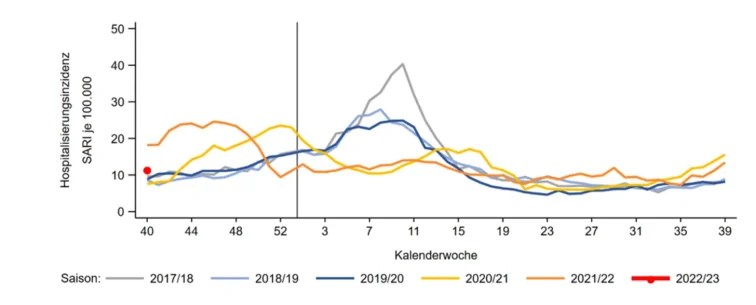
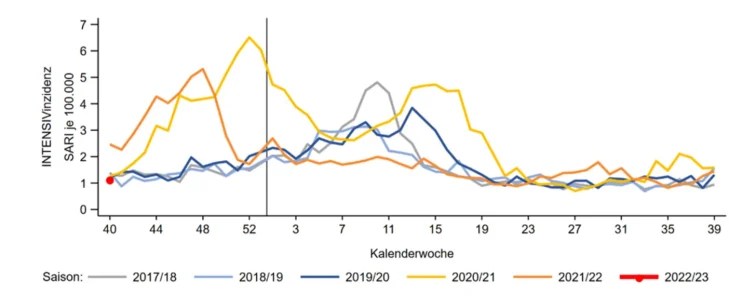
The red dot is where we are right now. Admissions are totally in line with the pre-pandemic era. The ICU admissions tell exactly the same story:
Nor is anybody really dying at the moment:
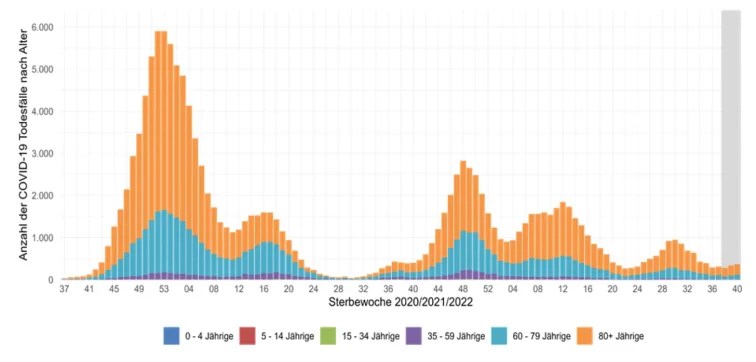
To the extent that there is any crisis at all here, it’s of our own making. Hospital patients with Corona diagnoses have to be treated according to strict isolation protocols, in special wards. These rituals are staff-intensive, and they effectively reduce across-the-board hospital capacity. It’s the same as our quarantine laws, which induce worker shortages by forcing millions of otherwise healthy Germans into isolation whenever they test positive. We could declare a rhinovirus pandemic tomorrow and suffer all the same problems from the common cold, and by the same token we could end all of this ourselves in an instant, by abolishing our foolishness and choosing to ignore SARS-2. Instead, we insist that this virus is dangerous and through our own behaviour we make it so.
The most onerous part of all this, is the inability of the German press to find a new narrative, ask new questions, or to change their reporting in any way at all — despite the totally different behaviour of Omicron and the near-universal levels of immune exposure to SARS-2. I know some of you complain that I repeat the same themes and arguments overmuch, but Germany has descended into some kind of purgatorial alternate reality, where it’s always March 2020, and our hospitals are always on the verge of melting down, and we never have enough information, so we just have to try masking and social distancing and hope for the best. They’re wrong about everything and they just keep telling the same lies over and over.
Featured Video

The Truth About the Trump Shootings with Ken Silva
or go to
Aletho News Archives – Video-Images
From the Archives
Trans ‘milk’ as good as the real thing – NHS
RT | February 18, 2024
The drug-induced nipple secretions of trans women are as good as mothers’ breast milk for babies, the University of Sussex Hospitals NHS Trust claimed in a letter to campaigners made public in a report by British think tank the Policy Exchange on Sunday.
The healthcare trust’s medical director, Rachel James, argued that the off-label prescription drug cocktail men transitioning to female take in order to produce milk was “similar to the natural hormones which encourage lactation to develop when the baby is newly born.”
“The evidence which is available demonstrates that the milk is comparable to that produced following the birth of a baby,” James wrote in the letter, sent to Children of Transitioners last August.
Biological men who wish to lactate must first take hormones to grow milk glands and then take high doses of either domperidone or metoclopramide to stimulate milk production. Neither drug is approved for this use, though they are occasionally prescribed off-label to biological women who have trouble lactating.
However, domperidone’s own manufacturer, Janssen, warns patients the drug “may cause unwanted side effects affecting the heart in a breastfed baby” and “should be used during breastfeeding only if your physician considers this clearly necessary.” … continue
Blog Roll
 Aletho News
- Russia Voted Under Fire. Washington Is Loading the Tankers.
- 12 Things Your Oncologist Was Trained Not to Tell You
- Anthrax Attacks Paved Way for COVID-Era ‘Junk Drugs and Vaccines’
- How Real Is the Impact of Western Sanctions on Israel?
- France, You Are Guilty: How Paris Turned Western Sahara into the Maghreb’s Powder Keg
- 2025 Nature Paper Claiming Worsening Global Drought Gets RETRACTED …Heavily Flawed
- Your Milk Is Not the Problem
- The Truth About the Trump Shootings with Ken Silva
- ARE PATIENTS BEING PROPERLY INFORMED ABOUT OZEMPIC?
- US lawmaker blocks $2.8 billion weapons sale to Israel: Report
- If Americans Knew
- Salah Sarsour’s Legal Team Says DHS Has Not Met Its Burden to Prove He Is Deportable
- An analysis of tax forms by The Intercept show Kraft’s charity and LLC have donated to Friends of the IDF and AIPAC’s super PAC.
- Israeli attacks kill four Palestinians in Gaza – Daily Update
- Inside Gaza’s death trap of collapsing, bombed-out buildings
- The everyday items Israel bans from Gaza every day
- Inside the siege, the ruined buildings of Gaza – Daily Update
- Debunking The Claim That Macklemore Has A “History Of Antisemitism”
- CPJ demands release of arrested Palestinian-US journalist near Bethlehem
- Robert Kraft: The Billionaire Friend of Netanyahu Pulling The Strings Behind the Macklemore/Ed Sheeran Blow Up
- Columbia Administered Fund Gives Big Money to Pro-Israel Groups
- No Tricks Zone
- 2025 Nature Paper Claiming Worsening Global Drought Gets RETRACTED …Heavily Flawed
- New Study: ‘Global Drought Shows No Detectable Recent Acceleration Under Climate Warming’
- Economic Masterminds: German Socialists Suggest Taxing Productivity Gains Stemming From Using AI
- The South China Sea Has Not Been Cooperating With The Climate Change Narrative
- Energy Crisis: Germany Enters Heating Season With Historically Low Gas Reserve Fill Levels
- New Study: The Antarctic Ice Sheet Gained Mass From 2020-2024 Due To Staggering Snow And Ice Accumulation
- Study: Ocean Heating Rates From Thousands Of Years Ago ‘Dwarf’ Modern Ocean Heating Rates
- Climate Extremists Target, Attack Large-Scale Power Grid Infrastructure In Germany!
- New Study: Antarctic Ice Melt Has Contributed Less Than 1 Centimeter To Sea Level Rise In The Last 30 Years
- Fear Of Debate: Alarmist German Climate Scientist Calls On Mainstream Media To Discredit Skeptic Voices
 Aletho News