Occupation raids, attacks Palestinian organizations: EU, US and Canada are complicit!
Samidoun Palestinian Prisoner Solidarity Network | August 21, 2022
In the early morning hours of Thursday, 18 August, armed Israeli occupation forces invaded the offices of seven prominent Palestinian NGOs, civil society organizations and human rights defenders: the Health Work Committees, Addameer Prisoner Support and Human Rights Association, Al-Haq, Union of Palestinian Women’s Committees, Bisan Centre, Defence for Children International – Palestine, and the Union of Agricultural Work Committees. These organizations have all been designated by the Israeli occupation as “terrorist” in retaliation for their advocacy and community organizing work for Palestine, and then labeled “illegal organizations” in a military order covering the occupied West Bank of Palestine.
The invading forces ransacked the offices, confiscating computers, legal client files, documentation, printers and monitors and leaving clutter behind — as documented by the organizations’ surveillance cameras, recording the occupation forces’ invasion. The doors of the organizations were welded shut and a paper military order affixed to the door declaring their operation “illegal” under the occupation’s (illegal) military orders.
The organizations declared that they would not be silenced by these attacks, holding press conferences and returning to the offices to reopen them and continue their work. The attacks received widespread condemnation not only from Palestinian and pro-Palestinian forces but even from European governments whose policies and practices consistently target the Palestinian people and their fundamental rights.
Now, on Sunday, 21 August, occupation intelligence authorities — the Shin Bet — phoned Al-Haq director Shawan Jabarin to threaten him with interrogation and arrest if the organization’s work continues, while Defence for Children International – Palestine director Khaled Quzmar was summoned to and held under interrogation.
“Terror” Designations and Political Control
The invasions, interrogations, ransacking and attacks on these organizations reflect the failure of the occupation’s regime of “terror” designations to undermine their work. In 2021, not only did the regime designate Al-Haq, Addameer, DCI, Bisan, the UPWC and the UAWC as “terrorist” organizations — quickly followed by the military orders banning their work in the occupied West Bank of Palestine — it earlier in the year designated Samidoun (on 21 February 2021), followed by three more organizations. Previously and in a similar pretext, the occupation had issued a similar designation against the Health Work Committees along with designations of groups including the Arab Organization for Human Rights UK, the Palestinian Return Centre and Euro-Mediterranean Human Rights Monitor.
As we noted at the time, this
“indicates just how meaningless the term ‘terrorist’ is in the hands of the Israeli regime. It means precisely any organization, activist, or freedom fighter that challenges Zionist colonialism through any method or means of resistance at all. The flurry of ‘terrorist’ designations for organizations working to expose Israel’s crimes and organize Palestinians underlines this reality….These designations are not attacks on individual organizations but against Palestinian human rights defenders and those around the world who stand up for Palestinian liberation — and, fundamentally, the Palestinian people as a whole, especially the Palestinian prisoners in Israeli occupation prisons. They attempt to repress growing support for the legitimate resistance of the Palestinian people and confrontation of imperialism and Zionism.”
Further, it is clear that the use of such designations is intended to further political control over Palestinian society. These designations hinge on the allegation that organizations are close to one or another Palestinian resistance organizations, most commonly the Popular Front for the Liberation of Palestine or Hamas. Israeli officials have shopped around “evidence” to various governments that is so weak so as to be ludicrous, consisting almost entirely of unsubstantiated statements or on the idea that employing a person who supports a political organization (or, in some cases, relatives of people in political organizations “designated” by the occupation) is “funding” that organization by paying employees a salary for doing their job.
While it is obvious that these are false claims, the objective of this type of attack goes beyond simply lobbing allegations. Indeed, the European governments that have criticized the attacks and designations have also repeatedly affirmed their willingness to “examine evidence” and “act” if the Israeli regime “proves” that popular organizations, civil society groups and human rights advocates are in some way “tied” to Palestinian resistance movements. Not only are the organizations “innocent” of the Israeli claims, the claims themselves are fundamentally repugnant. The Palestinian people have the right to resist occupation and to be a part of political, social and armed movements in that resistance; this is not “terrorism” but an essential right of people under occupation and colonization.
Rather than affirming the right of Palestinians to resist and to organize themselves to achieve those goals, these European governments instead use these attacks to impose even greater political scrutiny and conditions. In many cases (such as the Netherlands), these governments recommend or require that all employees of these organizations must not be associated with any “banned” Palestinian political organization. If Palestinians are part of a political party or movement, they must be unemployable and impoverished: this is both the argument of the occupation and of the European states providing a meager “defense” of Palestinian civil society.
For the European funding agencies and many large foundations, supporting Palestinian NGOs has never been primarily about empowering or supporting the Palestinian people to achieve their liberation but rather about redirecting Palestinian energies into “state-building” and/or “reform” projects that exist within the confines of Oslo. Time and time again, these forces have introduced new conditional funding mechanisms and restrictions on everything from the political affiliation of individual employees to the names of buildings and schools.
European Union: Partners in Colonialism and Apartheid
This is borne out once again by the statement of nine European states — Belgium, Denmark, France, Germany, Ireland, Italy, the Netherlands, Spain and Sweden — which invokes the promotion of “democratic values and the two-state solution,” a fundamental contradiction as the so-called “two-state solution” itself is the legitimization of the colonization and occupation of 78% of Palestine and no solution at all for the Palestinian people. This brief comment lays bare the real political motivation for European involvement in funding Palestinian organizations, which is to limit rather than to achieve rights, justice and liberation. Further, the statement notes that “should convincing evidence be made available to the contrary, we would act accordingly.”
Here, the “evidence” being referred to would be any “links” between these NGOs and the Palestinian resistance. By including this statement in their alleged defense of the organizations, these European states actually encourage the occupation to continue its raids and ransacking, confiscation of files, arrests and interrogations, in an attempt to manufacture such “evidence”.
Of course, the position of these states themselves — members of the aggressive NATO alliance, defenders of the Israeli occupation in international arenas — is all too clear. The European Union, while rejecting the designation of advocacy and civil society organizations, continues to designate Palestinian resistance organizations as “terrorists.”
France continues to imprison Georges Ibrahim Abdallah while doing almost nothing to advocate for its citizen Salah Hamouri, jailed without charge or trial under Israeli administrative detention, as the government attempts to criminalize Palestinian activism, such as the Collectif Palestine Vaincra. Germany not only engages in weapons deals with the occupation, it also engages in severely repressive practices against Palestine organizing, particularly Palestinian communities in exile and diaspora, from the expulsion of Palestinian writer Khaled Barakat and Palestinian torture survivor and feminist Rasmea Odeh to the ban on 15 May Nakba demonstrations in Berlin. This is not to mention the links between Zionism and European colonialism from the very beginning of the Zionist project.
Now, Israeli prime minister and war criminal Yair Lapid is scheduled to come to Brussels on 6 October to convene the “Association Council” with all EU member states’ foreign ministers, for the first time in 10 years. This is the council under the EU-Israel Association Agreement, the agreement that provides for free trade for occupation products inside the EU and allows for occupation institutions to receive European grants for research and development.
Ending the EU-Israel Association Agreement is a long-time demand of the Palestine solidarity movement, but despite their expressed “concerns” about the violent repression imposed on Palestinians, these European states are planning to welcome Lapid and convene the Association Council after a long hiatus, celebrating their complicity in war crimes and crimes against humanity.
The Canadian government has refused to make any meaningful statement about these attacks, despite posing as a defender of “human rights.” U.S. officials stated their “concern,” while continuing to provide $3.8 billion in military support to the occupier.
**
Samidoun Palestinian Prisoner Solidarity Network affirms that these attacks are part and parcel of the ongoing war on Palestinian existence and organization, carried out by the Zionist state and supported by the imperialist powers that ally with the Israeli occupation, as well as Arab reactionary regimes engaged in “normalization” and the Palestinian Authority. While PA officials declare their public support for the targeted organizations, the PA continues to engage in security coordination with the occupation, declined the use of its security forces to defend the organizations, and has even previously detained leaders, directors and staff of these organizations challenging its repression at the behest of the occupier.
We reaffirm that the primary way that we can confront these designations is by intensifying our organizing, action, mobilization and resistance to bring down the structures of colonialism, implement the right to return for Palestinian refugees, and support the liberation of all Palestinian prisoners and of Palestine, from the river to the sea. This includes campaigning to bring an end to the so-called “terrorist lists” used to terrify Palestinian communities and Palestine solidarity organizers, which only provide a weapon in the hands of the occupation and encourages it to engage in further specious designations.
We also urge all to take action to confront Lapid’s visit on 6 October in Brussels and to bring down the “EU-Israel Association Agreement,” an agreement built on the colonization of Palestine and the massacres targeting the Palestinian people. It is incumbent upon all institutions and organizations concerned about these raids and about the Palestinian people to adopt and implement the boycott and international isolation of Israel, including at the United Nations and its bodies.
Further, we urge all to join us in organizing to march in Brussels on 29 October for the March for Return and Liberation to the European Parliament, to demand an end to European complicity, involvement in and support for the colonization of Palestine, the siege on Gaza, the imprisonment of Palestinians and the denial of millions of Palestinians’ right to return home.
Crisis Government
eugyppius | August 20, 2022
To reduce energy consumption in the face of the looming German gas crisis, Economics Minister Robert Habeck has proposed a bizarre set of indoor temperature ordinances that continue the pattern of direct state interventions in the everyday life first established by mass containment.
Workspaces where hard physical labour is performed are not to be heated above 12 C, under the new rules. Those involving moderate labour while standing will have their temperatures capped at 16 C, and moderate labour while sitting at 17 C. Places where light labour is performed standing, will be permitted temperatures as high as 18 C, while white-collar office spaces where everybody sits and types will be permitted nothing warmer than 19 C. The heating of hallways and other common spaces will be outlawed, as will certain kinds of restroom water heaters. There will be a general ban on using electricity or gas to heat private pools, and shops will be ordered to keep external doors closed at all times. Political pressure is growing for similar ordinances limiting gas consumption in residences.
While some doubt that these rules can be enforced, German police have already proven effective at enforcing pandemic-era contact limits in private homes. And even if indoor temperatures are never systematically checked by authorities, I’m pretty sure that the simple prospect of unannounced inspections and fines will be enough for most employers to declare a third season of home office, with the added prospect of offloading higher gas prices onto their employees.
It is most curious, how this totally new catastrophe should call forth some of very same measures demanded by the Corona pandemic. Not only will home office return, but municipal pools will close again and cities will be kept dark at night, a de facto limitation on evening mobility that might well encourage some places to reimpose the curfews last seen in the winter of 2020/21. Meanwhile, some of the very same spaces recently commandeered for excess hospital capacity and mass vaccination will be repurposed as heated shelters for the old, the sick and the poor.
Not any unified plan, but rather a long series of contingencies, have caused the German gas crisis. Yet the steadfast refusal of the Scholz government to consider any course of action that might ameliorate the shortage, always with a new excuse, grows every day more unsettling.
There’s the obvious explanation, that the Greens in government are merely taking advantage of this opportunity to achieve their higher goal of restricting fossil fuel consumption, as they’ve always wished. But I think there might be another, deeper way to understand this too. I suggest that we’re seeing here the emergence of a new political style, which you might call Crisis Governance—or, as a friend put it, “the continuation of Corona policy by other means.” One of my core themes here has been the deepening demobilisation of western states, as power is diffused downwards from the political apex into the bureaucratic institutions, the press and major corporate enterprises. The great advantage of this power-sharing is a near-total uniformity of political views that it has inspired across the socio-cultural elite, but it comes at the cost of initiative, coordination and strategy. Crises seem to be one of the only ways our new, demobilised states can overcome their paralysis and act to further any kind of positive political programme.
More at A Plague Chronicle.
German Electricity Prices Spiraling Out Of Control… Tripling Since 2000… Blackouts, Unrest Loom
By P Gosselin | No Tricks Zone | August 19, 2022
Sun and wind don’t send any electric bills, the green energy swindlers used to tell us.
Changing over to sun and wind energy would cost only one euro a month more, Germany’s former Environment Minister Jürgen Trittin once promised. All we had to do was accept their master plan.
Today the swindle is uncovering, and it may be too late to avert the massive damage that’s coming our way.
At Facebook, Helmut Bauer posted the most recent chart depicting Germany’s electricity rates for end-consumers. It’s a blood bath:

Electricity prices for German end-consumers, in eurocents per kilowatt-hour. Source: BDEW, Verivox.
What a mess; they’ve reached 41 cents a kilowatt-hour and it’s about to get much worse – especially for the people who can least afford it. Expect social unrest to boil over the months ahead as prices and shortages inflict pain on the poor. We’re in uncharted territory.
Hey, not to worry: German Chancellor Olaf Scholz promised that police will not open fire on demonstrators.
German Official Trashes Cost of Living Protesters as “Enemies of the State”
Says they’re extremists who want to overthrow the government

Getty Images
By Paul Joseph Watson | Summit News | August 17, 2022
A top German official has trashed people who may be planning to protest against energy blackouts as “enemies of the state” and “extremists” who want to overthrow the government.
The interior minister of the German state of North Rhine-Westphalia (NRW), Herbert Reul (CDU), says that anti-mandatory vaxx and anti-lockdown demonstrators have found a new cause – the energy crisis.
In an interview with German news outlet NT, Reul revealed that German security services were keeping an eye on “extremists” who plan to infiltrate the protests and stage violence, with the unrest being planned via the Telegram messenger app, which German authorities have previously tried to ban.
“You can already tell from those who are out there,” said Reul. “The protesters no longer talk about coronavirus or vaccination. But they are now misusing people’s worries and fears in other fields. (…) It’s almost something like new enemies of the state that are establishing themselves.”
Despite the very real threat of potential blackouts, power grid failures and gas shortages, Reul claimed such issues were feeding “conspiracy theory narratives.”
However, it’s no “conspiracy theory” that Germans across the country have been panic buying stoves, firewood and electric heaters as the government tells them thermostats will be limited to 19C in public buildings and that sports arenas and exhibition halls will be used as ‘warm up spaces’ this winter to help freezing citizens who are unable to afford skyrocketing energy bills.
As Remix News reports, blaming right-wing conspiracy theorists for a crisis caused by Germany’s sanctions on Russia and its suicidal dependence on green energy is pretty rich.
“Reul, like the country’s federal interior minister, Nancy Faeser, is attempting to tie right-wing ideology and protests against Covid-19 policies to any potential protests in the winter.”
“While some on the right, such as the Alternative for Germany (AfD), have stressed that the government’s sanctions against Russia are the primary factor driving the current energy crisis, they have not advocated an “overthrow” of the government. Instead, they have stressed the need to restart the Nord Stream 2 pipeline, end energy sanctions against Russia, and push for a peaceful solution to end the war.”
Indeed, energy shortages and the cost of living crisis are issues that are of major concern to everyone, no matter where they are on the political spectrum.
To claim that people worried about heating their homes and putting food on the table this winter are all “enemies of the state” is an utter outrage.
As we highlighted last week, the president of the Thuringian Office for the Protection of the Constitution, Stephan Kramer, said energy crisis riots would make anti-lockdown unrest look like a “children’s birthday party.”
“Mass protests and riots are just as conceivable as concrete acts of violence against things and people, as well as classic terrorism to overthrow it,” Kramer told ZDF.
Infertility Pandemic: Number Of Births In Germany For January-April 2022 Period Plummets 12%
By P Gosselin – No Tricks Zone – August 10, 2022
Germany has seen a “dramatic drop” in birthrate during the first 4 months of 2022, according to transitionnews.de, leading to rising suspicions over COVID vaccine safety.
“Compared to the previous year, the number of births has fallen by 12 percent – that’s about 25,000 fewer births in the first four months of 2022,” reports Sternfried Müller of transitionnews.de.

Chart source: transitionnews.de
The above chart shows the number of births for the January-April period each year since 2018. During the Corona years of 2020 and 2021, Germany saw a rise in the number of births, climbing to 250,000 births. But in 2022, the number of births mysteriously plummeted a whopping 12%!
Something unusual must have triggered the phenomenon. Going back 9 months prior to the January-April 2022 period takes us to the April to July 2021 period, which coincides to COVID vaccination of younger adults in earnest. Remarkably, Germany’s media have been silent on the latest published statistics, issued by the German Federal Statistical Office (Destatis).
The next transitionnews.de chart shows the monthly number of births and just how dismally 2022 lags so far compared to the previous years:
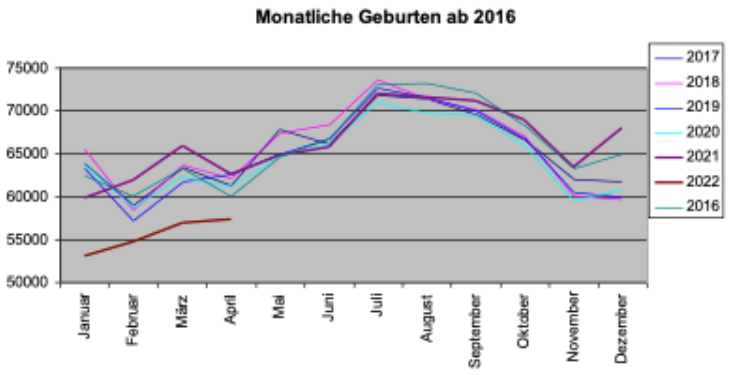
Chart source: transitionnews.de
A number of reasons have been proposed to explain the dramatic decline, among them fewer marriages. But that remains highly doubtful.
There are increasing suspicions that it is vaccine linked, as some studies already suggest: see here and here.
For the time being German authorities obstinately continue to remain in denial mode when it comes the the adverse effects of the COVID vaccines. Currently the Ministry of Health is gearing up to roll out another mass wave of vaccinations and restrictions in the run-up to the fall flu season.
See entire article at transitionnews.de
Also read here.
Germany plans China-style color code vaccine passport upgrade with multiple tiers of “rights”
By Tom Parker | Reclaim The Net | August 10, 2022
German Health Minister Karl Lauterbach has announced that the nation’s digital contact tracing and vaccine passport app, Corona-Warn-App (CWA), will start assigning different colors to citizens based on whether they received a COVID-19 vaccine within the last three months.
The CWA will assign one color to citizens who add proof that they received a vaccine within the last three months and a different color to citizens who add proof of vaccination that’s more than three months old. Only those with the color showing that they’re “freshly vaccinated” (have received a vaccine within the last three months) will be exempt from Germany’s mask requirement in public indoor spaces.
Other citizens, including those who received multiple vaccines but had their last vaccine more than three months ago, will have to show proof of recent recovery from COVID or a current negative test to get an exemption from this mask requirement.
Germany’s Berliner Zeitung noted that the colors codes in the vaccine passport app would “give different rights in the future” and said the system would put citizens who are already quadruple vaccinated on the same legal footing as those who are unvaccinated.
Berliner Zeitung also reported that this new German vaccine passport system would be similar to China’s color code vaccine passport system. China’s system assigns a green, yellow, or red code to citizens. Those with a green code are allowed to move freely, those with a yellow code may be asked to stay home for seven days, and those with a red code have to quarantine for two weeks.
Despite moving to this color code vaccine passport system, Lauterbach has admitted that the goalposts could shift at any time and that if too many freshly vaccinated people make use of the mask exception, Germany will change the rules and close the exception.
Lauterbach, who is quadruple vaccinated, announced this new color code vaccine passport system four days after he contracted COVID. The new vaccine passport system is being introduced as part of Germany’s “Infection Protection Act.”
Health agencies defended the rollout of vaccine passports and other COVID surveillance measures by claiming that they would prevent the spread of the coronavirus. However, in recent weeks, government health experts have admitted that COVID vaccines don’t prevent infection.
Despite this admission, Germany and other nations are continuing to push far-reaching, restrictive vaccine passport systems. Some countries are also combining vaccine passports with digital ID or rolling out more invasive COVID surveillance devices such as wristbands and ankle bracelets.
EU Robbing Global South of Cheap Gas in Quest to Replace Lost Russian Supplies
Samizdat – 08.08.2022
The European Union is in the throes of an unprecedented energy crisis after taking steps to reduce dependence on Russian oil, natural gas, and coal to “punish” Moscow for its military operation in Ukraine. Skyrocketing energy prices and falling availability have sparked growing concerns about bloc countries’ fate come winter.
European countries are resolving the energy shortfall at home by outbidding developing nations for gas contracts, “increasing the misery of millions of people,” and threatening to plunge entire countries into chaos, Handelsblatt reports.
“While Europe fears supply shortages in winter, the energy crisis has already hit other parts of the world with full force. In Bangladesh’s capital Dhaka, power supply is not guaranteed even in hospitals. Young mothers report on how they torment themselves with their newborns during hot summer nights because even fans cannot be switched on,” Handelsblatt contributor Mathias Peer wrote.
A similar situation is seen in Pakistan, which has experienced “one power blackout after another,” and “also as a consequence of Europe’s failed energy policy,” Peer indicated.
The observer explained that the EU’s headlong rush to reduce dependence on Russian gas has triggered “massive turbulence on global energy markets,” with fleets of liquefied natural gas (LNG) tankers which ordinarily carry cargoes to Asia diverted to Europe instead.
“In the bidding competition for deliveries, states like Bangladesh, whose per capita income is 95 percent below that of Germany, have what has become a hopeless mission,” losing out on contracts, resulting in the paralysis of gas-fueled power plants “and massive problems for hundreds of millions of people in the affected countries,” Peer noted.
The Handelsblatt contributor suggested that it was “all too understandable” for the EU to try to reduce its dependence on Russian energy in the wake of the Ukraine crisis, and suggested that Europe is not to blame for the energy crisis.
“But Europe’s attempt to find alternatives must not be at the expense of uninvolved third countries. It is the EU’s responsibility to ensure that by solving its supply shortages, not further aggravate the crisis in other countries. Reducing consumption must therefore take priority over diverting resources from other parts of the world, and in this regard the European gas contingency plan is far from being ambitious enough,” the observer suggested.
Peer emphasized that a more “considerate approach” is needed to stop Brussels from continuing to “play into [Vladimir] Putin’s hands.”
“His propaganda – which states that it is not Russia but the West and its sanctions that are responsible for the current crisis – is already affecting many more people in emerging countries than Europe would like,” the columnist concluded.
The crisis in Ukraine as well as US and EU moves to curb Russian energy and food exports to the West and other countries have served to exacerbate the inflation, energy price crunch, and global hunger crises which have accumulated over the past two years after the breakdown of the world economy thanks to COVID. President Vladimir Putin has characterized Brussels’ push to wean itself off Russian energy as “suicidal,” and warned that higher energy costs would collapse the bloc’s economic competitiveness.
The energy crisis has prompted European countries to begin a search for new sources of energy in Africa, including Algeria, Nigeria, and Tanzania. However, even before the escalation of the Ukraine crisis, some African leaders have resisted the new European energy “scramble for Africa,” with Algeria shutting off the taps to Spain over Madrid’s support for Morocco in the dispute over Western Sahara, and Nigerian Environment Minister Mohammad Mahmood Abubakar accusing developed nations of spending years starving Africa’s natural gas projects of funds on the grounds that they contribute to climate change.
Former German chancellor says Russia wants a ‘negotiatated solution’
Free West Media | August 3, 2022
Former German Chancellor Gerhard Schröder has expressed confidence that Russia would seek a negotiated solution to the Ukraine war. During his recent trip to Moscow, he also met with the Russian President. According to him, the Kremlin would like to negotiate.
“The good news is that the Kremlin wants a negotiated solution.”
In an interview with Stern magazine and RTL/ntv broadcaster, he said that the recently reached agreement on grain exports from Ukraine was an “initial success” that could perhaps “slowly be expanded into a ceasefire”.
In addition, the SPD politician again defended his contacts with Russia stating that it was not illegal.
In view of the gas crisis, the former chancellor also recommended commissioning the Nord Stream 2 pipeline from Russia and described this as the “simplest solution” in view of possible gas bottlenecks.
“It’s over. When things get really tight, there is this pipeline, and with the two Nord Stream pipelines there would be no supply problem for German industry and German households.”
“If you don’t want to use Nord Stream 2, you have to bear the consequences. And they will also be huge in Germany,” said Schröder. Anyone who heats with gas is already feeling the effects: that is half of the country’s 40 million households. Compared to the prices of December 31, 2022, gas will quadruple after further increases for consumers have been announced.
What The Future Holds For Our Climate Leaders
By Francis Menton | Manhattan Contrarian | July 28, 2022
If my posting has been a little light for the last month or so, it’s because I’ve been working on a big Report for the Global Warming Policy Foundation on the subject of energy storage as a means to back up electricity generation from wind and solar facilities. The Report is basically finished, and now going through an editing process. It will probably be published some time in September.
In doing the research for the Report, I have had occasion to look carefully into the plans of many countries and U.S. states that claim to be the “leaders” in climate virtue, specifically on the subject of how they intend to reach the goal of Net Zero carbon emissions from generation of electricity. These climate “leaders” include, in Europe, Germany and the UK, and in the U.S., California and New York. One would think that for any jurisdiction pursuing Net Zero ambitions, and seeking to abolish use of fossil fuels, it would be completely imperative that some energy storage solution absolutely must be found to provide back-up for the electricity system when the wind and sun are not producing. But what my research has shown is that every one of these jurisdictions seeking to be the leader toward Net Zero has given astoundingly insufficient consideration to the energy storage problem.
I previously have covered some of the more incredible deficiencies in the Net Zero planning of these places, for example in “Can California Really Achieve 85% Carbon-Free Electricity By 2030?” on May 16, and “And The Winner Is, Germany!” on June 29.
The single most astounding universal failure of all jurisdictions pursuing Net Zero is the failure to pursue any sort of working prototype or demonstration project of a Net Zero electricity system before committing the entire jurisdiction to the project on the basis of a blank check to be paid by the taxpayers and ratepayers. Who has ever heard of such a thing? in the 1880s, when Thomas Edison wanted to start building central station power plants to supply electricity for his new devices like incandescent lightbulbs, he began by building a prototype facility in London under the Holborn Viaduct, and followed that with a larger demonstration plant on Pearl Street in Lower Manhattan that only supplied electricity to customers within a few square blocks. Only after those had been demonstrated as successful did a larger build-out begin. Similarly, the provision of nuclear power began with small government-funded prototypes in the late 1940s and early 1950s, followed by larger demonstration projects in the late 1950s and early 1960s. Only in the late 1960s, twenty years into the effort and after feasibility and cost had been demonstrated, were the first large-scale commercial nuclear reactors built. No competent person would take any other approach.
But somehow our politicians have now become so filled with hubris that they think they can just order up a functioning wind/solar electricity system and assume that backup energy storage devices will magically get invented and it will all work fine and not be financially ruinous, all by some arbitrarily-ordered date in the 2030s.
Today, all the mentioned jurisdictions and many more have embarked on ambitious Net Zero plans, and yet there does not exist anywhere in the world a functioning prototype or demonstration project that has actually achieved Net Zero in electricity generation, or anything even close. Indeed, it’s worse than that. There is a fairly substantial project that set out to achieve Net Zero (although they weren’t using the term at the time, which was 2014), and has fallen remarkably short. That project is on the island of El Hierro, one of the Canary Islands off the coast of Spain. El Hierro installed a collection of wind turbines and a pumped storage/hydro reservoir as back-up to great fanfare, but it struggles to achieve 50% of the electricity from the wind/storage system over the course of a year. The rest comes from a diesel generator. The system operator puts out monthly statistics (with substantial lag), typically with excited verbiage about “tons of carbon emissions saved,” without ever admitting that the system has totally failed in its original goal of getting rid of the fossil fuel piece. Instead they now have three redundant systems for providing the electricity — wind turbines, hydro reservoir and turbines, and the diesel generator — all of which must be paid for, and all to provide the same electricity that the diesel generator was fully capable of providing on its own. The cost has been calculated at about 80 euro cents per KWh, roughly 7 to 8 times average U.S. consumer rates; but the cost is largely hidden from El Hierro ratepayers by subsidies from the EU and government of Spain.
My research also covered in depth the question of how much energy storage would be needed for various jurisdictions to fully back up a predominantly wind/solar generation system without any use of fossil fuels. Credible calculations previously discussed here have included the calculation of Roger Andrews, done in 2018, that either California or Germany would require at least about 25,000 GWh of energy storage to back up a fully wind/solar generation system for a year without use of fossil fuels; and a calculation by Ken Gregory done on very similar methodology in late 2021 showing that the full U.S. (lower 48 states) would require about 250,000 GWh of storage for the same purpose. These are truly huge numbers.
Facing such requirements to reach Net Zero and banish fossil fuels from the electricity system, the plans of these jurisdictions for acquisition of storage are quite shocking. The consultancy Wood Mackenzie reported on April 11, 2022 that Germany had announced plans to acquire all of 8.91 GWh of energy storage by 2031 — a ridiculously puny amount if Germany is actually serious about Net Zero. Utility Dive reported on April 12, 2022 that New York had plans to acquire all of 6 GW of storage (likely corresponding to about 24 GWh, since the batteries are to be of the lithium-ion type that generally have capacity for four hours of discharge at full capacity). This figure is only slightly less puny than Germany’s. Another piece from Utility Dive on April 6, 2022 reported that California’s regulators had ordered utilities to acquire what would be the equivalent of about 42 GWh of storage as part of the Net Zero plans of that jurisdiction. All of these storage acquisition plans are in the range of about 0.1% to 0.2% of the storage that would actually be needed to achieve the Net Zero goal.
So what will the future of energy usage actually look like in these places as fossil fuels get phased out and wind and solar take over, with woefully insufficient energy storage to cover the intermittencies? To get an idea, let’s take another look at the Report for California put out by consultancy Energy Innovations on May 9, with the title “Achieving an Equitable and Reliable 85 Percent Clean Electricity System by 2030 in California.” Note that this in not actually Net Zero, but only 85% of same. Here are a few tidbits. First, their graphic on the nature of the transition:
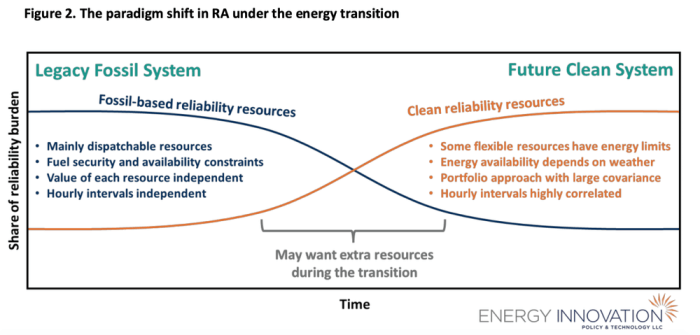
We’re going to have a “paradigm shift” in “RA,” which seems to mean “Resource Adequacy.” Check out that list on the right under “clean reliability resources” — “Energy availability depends on weather.” Are you starting to get the picture now?
Read through the report until you get into pages in the mid-30s, where the subject becomes what they euphemistically call “demand response.” It’s a lot of bafflegab to make it seem oh so pleasant. Excerpt:
Demand-side measures can substitute for supply-side resources and therefore contribute to resource diversity; their increased availability hedges against the risk of deploying new clean supply-side resources too slowly (including generators and storage). For example, the technical report finds that deploying Load Shift could reduce load by 1,500 MW in the early evening hours solar output falls, hedging against battery deployment challenges such as supply chain. . . . Demand-side measures also provide complementary reliability, resiliency, and public safety benefits to supply-side solutions or imports, as they lie closest to the affected load. While centralized generators provide the bulk of our power under most system conditions, they can be rendered less effective or useless under certain disaster conditions.
This is bureaucratese meaning “we’ll turn off your electricity at random times when we feel like it.” Get ready for this, California, Germany, et al. I guess New York is on the same path too, but I have my secret escape plans ready.
German mayors want Nord Stream 2 opened
Samizdat | July 27, 2022
Berlin’s policy of trying to give up imports of Russian natural gas is likely to create hardship and spark unrest, seven mayors from the German island of Ruegen wrote in a letter sent to the regional and federal governments on Wednesday. They also urged the federal government to allow gas imports via the Nord Stream 2 pipeline, given the current technical difficulties with Nord Stream 1 – something Berlin has steadfastly rejected.
In the letter addressed to federal economy minister Robert Habeck and Manuela Schwesig, prime minister of Mecklenburg-Vorpommern, the mayors “strongly condemn” the current conflict in Ukraine but urge the government to consider the damage its policy could do to the German population and the economy, according to the news agency DPA.
“We are of the opinion that the path taken by the federal government to disconnect from Russian energy sources is not the right one,” the seven mayors wrote. Initially drafted by the leaders of Bergen, Binz and Sassnitz, the letter was later signed by four more jurisdictions on Ruegen, Germany’s largest island and a popular tourist destination.
Giving up gas imports from Russia would mean an explosion in the cost of living, which would lead to social instability and unrest that could get out of control, the mayors wrote, according to German media. Calls from the federal government to save energy – such as showering less and foregoing hot water – “defy understanding,” they added.
“As the mayors of this island, we don’t want to have to accept any further restrictions,” Sassnitz city manager Frank Kracht told the Mecklenburg-Vorpommern affiliate of the TV station NDR.
Rejecting the proposals to expand the number of wind turbines near residential areas, calling them a health hazard, the mayors advocated “a general rethinking of the solution to the current problems in relations with Russia.”
Among their suggestions was to get additional natural gas via the Nord Stream 2 pipeline. Finished in late 2021, the pipeline from Russia to Germany under the Baltic Sea was just waiting for the operating permit from Berlin – which was suspended indefinitely on February 22, two days before Russia sent troops into Ukraine.
NS2 was supposed to double the volume of Russian gas exports, but was delayed by US sanctions seeking to protect Ukraine’s gas transit earnings. Nord Stream 1, which continues to supply Germany with gas, is currently operating at only 20% capacity, due to maintenance requirements. Its operator, Gazprom, says several turbines at the Portovaya compressor station need servicing to maintain certification. The first one was held up by Canada, citing anti-Russian sanctions over the conflict in Ukraine, until Berlin intervened seeking an exemption. NS2 does not use Siemens turbines, and can be maintained regardless of the sanctions.
Berlin has refused to even consider the possibility of using NS2, however. Economy minister Habeck has said that the pipeline cannot operate without certification. He also accused Russian President Vladimir Putin of trying to damage EU solidarity with Ukraine by driving up the price of gas.
“Putin has the gas, but we have the power,” Habeck said on Tuesday, appealing to Germans to stand together.
Recent polls showed widespread pessimism in German industry regarding future business prospects. Commenting on the turbine delay last week, Foreign Minister Annalena Baerbock said gas shortages could lead to an insurrection.
“If we don’t get the gas turbine, then we won’t get any more gas, and then we won’t be able to provide any support for Ukraine at all, because then we’ll be busy with popular uprisings,” she told the TV outlet RND. Baerbock hastened to add that this may have been “exaggerated” and insisted most Germans supported sending weapons to Ukraine, though.
BASF Prepares To Slash Ammonia Production In Germany Amid Worsening NatGas Crunch
By Tyler Durden | Zero Hedge | July 27, 2022
German chemicals company BASF SE paid an extra 800 million euros ($809.5 million) to keep its plants operating in the second quarter compared with a year earlier amid skyrocketing natural gas prices. The impact of high energy prices has forced the company to make a difficult decision: slash the production of ammonia, which could have potential consequences for farming to the food industry.
“We are reducing production at facilities that require large volumes of natural gas, such as ammonia plants,” BASF Chief Executive Martin Brudermuller said in a conference call after an earnings report.
Brudermuller said BASF would tap external suppliers to fill the deficit as German plants reduced output. He warned about potential supply disruptions that could boost fertilizer costs for farmers.
Reuters details how ammonia plays a critical role in manufacturing nitrogen-based fertilizers, plastic-making, and diesel exhaust fluid. A byproduct of ammonia production is high-purity carbon dioxide (CO2) which is heavily used in the food industry.
The news of BASF reducing ammonia production because of soaring NatGas prices comes as Russian state-owned energy producer Gazprom PJSC is expected to halve supplies via Nord Stream 1 to Europe to about 20% today. EU member states agreed Tuesday to reduce NatGas demand by 15% over the next eight months, though countries like Germany, without any liquefied natural gas (LNG) port terminals to replace Russian pipeline NatGas, might have to make more considerable sacrifices.
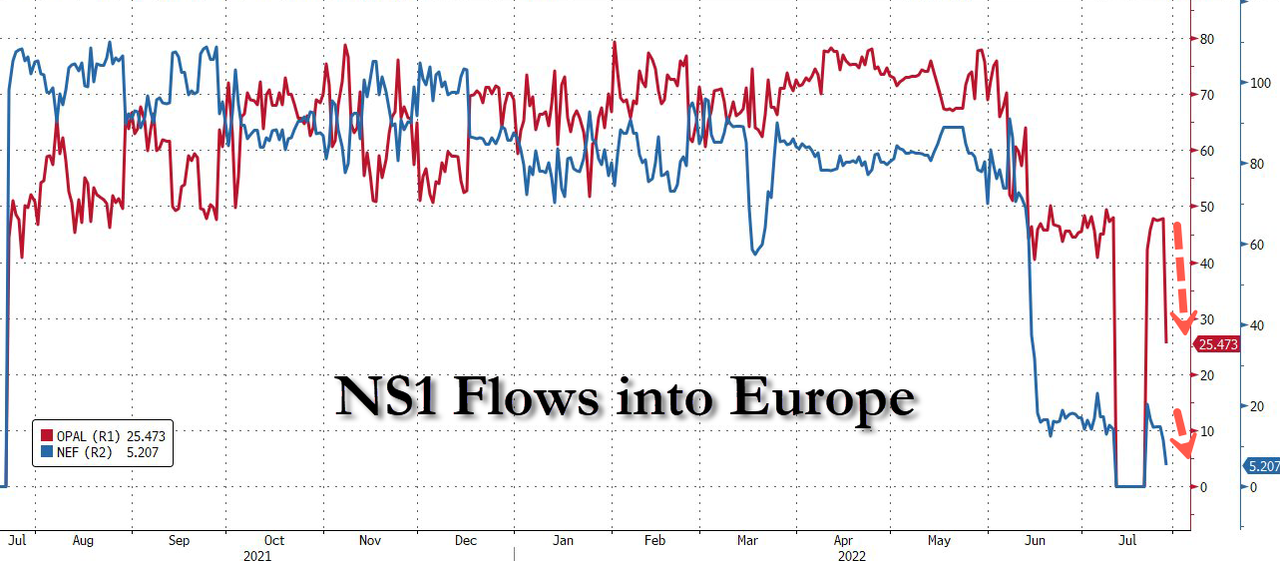
Benchmark NatGas prices in Europe at the Dutch TTF hub hit their highest level since March. Prices have shot up 35% in a week, over 200 euros per megawatt-hour (MWh), as Putin turns the screws on Europe by reducing pipeline capacity to Europe.
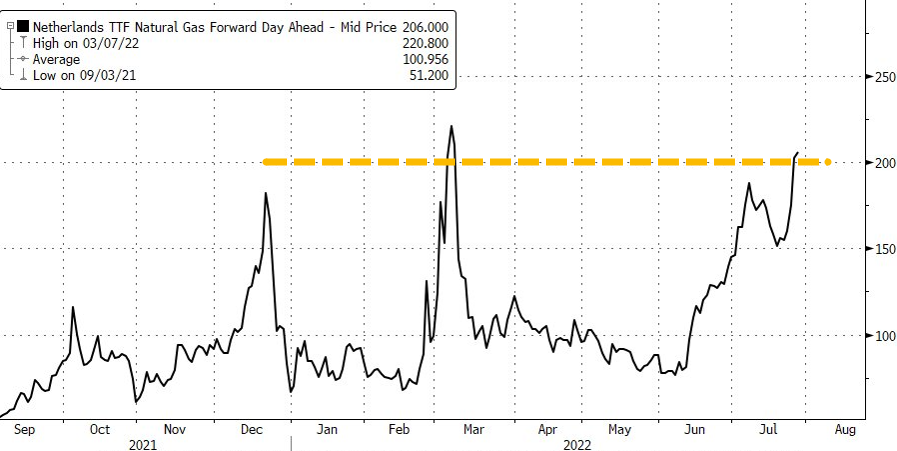
“Chemical companies are the biggest industrial natural-gas users in Germany, and ammonia is the single most gas-intensive product within that industry,” Reuters said.
Arne Rautenberg, a fund manager at Union Investment, said ammonia is a prime candidate by chemical companies to cut production first over the NatGas supply squeeze.
“In the northern hemisphere, nitrogen fertilizer is applied primarily during the spring. It can also be produced in the United States and shipped to Europe,” Rautenberg said, adding that the CO2 supply for the food industry could experience disruptions.
The chemical industry lobby VCI indicates German ammonia production has been curbed (some of which began last October) considerably because of soaring energy prices. This could soon impact industries that rely heavily on ammonia and ripple through the economy already facing recession.
Featured Video

The Truth About the Trump Shootings with Ken Silva
or go to
Aletho News Archives – Video-Images
From the Archives
Trans ‘milk’ as good as the real thing – NHS
RT | February 18, 2024
The drug-induced nipple secretions of trans women are as good as mothers’ breast milk for babies, the University of Sussex Hospitals NHS Trust claimed in a letter to campaigners made public in a report by British think tank the Policy Exchange on Sunday.
The healthcare trust’s medical director, Rachel James, argued that the off-label prescription drug cocktail men transitioning to female take in order to produce milk was “similar to the natural hormones which encourage lactation to develop when the baby is newly born.”
“The evidence which is available demonstrates that the milk is comparable to that produced following the birth of a baby,” James wrote in the letter, sent to Children of Transitioners last August.
Biological men who wish to lactate must first take hormones to grow milk glands and then take high doses of either domperidone or metoclopramide to stimulate milk production. Neither drug is approved for this use, though they are occasionally prescribed off-label to biological women who have trouble lactating.
However, domperidone’s own manufacturer, Janssen, warns patients the drug “may cause unwanted side effects affecting the heart in a breastfed baby” and “should be used during breastfeeding only if your physician considers this clearly necessary.” … continue
Blog Roll
 Aletho News
- Seyed M. Marandi: U.S. Strike Imminent – Toward Total War in the Middle East
- Russia Voted Under Fire. Washington Is Loading the Tankers.
- 12 Things Your Oncologist Was Trained Not to Tell You
- Anthrax Attacks Paved Way for COVID-Era ‘Junk Drugs and Vaccines’
- How Real Is the Impact of Western Sanctions on Israel?
- France, You Are Guilty: How Paris Turned Western Sahara into the Maghreb’s Powder Keg
- 2025 Nature Paper Claiming Worsening Global Drought Gets RETRACTED …Heavily Flawed
- Your Milk Is Not the Problem
- The Truth About the Trump Shootings with Ken Silva
- ARE PATIENTS BEING PROPERLY INFORMED ABOUT OZEMPIC?
- If Americans Knew
- Salah Sarsour’s Legal Team Says DHS Has Not Met Its Burden to Prove He Is Deportable
- An analysis of tax forms by The Intercept show Kraft’s charity and LLC have donated to Friends of the IDF and AIPAC’s super PAC.
- Israeli attacks kill four Palestinians in Gaza – Daily Update
- Inside Gaza’s death trap of collapsing, bombed-out buildings
- The everyday items Israel bans from Gaza every day
- Inside the siege, the ruined buildings of Gaza – Daily Update
- Debunking The Claim That Macklemore Has A “History Of Antisemitism”
- CPJ demands release of arrested Palestinian-US journalist near Bethlehem
- Robert Kraft: The Billionaire Friend of Netanyahu Pulling The Strings Behind the Macklemore/Ed Sheeran Blow Up
- Columbia Administered Fund Gives Big Money to Pro-Israel Groups
- No Tricks Zone
- 2025 Nature Paper Claiming Worsening Global Drought Gets RETRACTED …Heavily Flawed
- New Study: ‘Global Drought Shows No Detectable Recent Acceleration Under Climate Warming’
- Economic Masterminds: German Socialists Suggest Taxing Productivity Gains Stemming From Using AI
- The South China Sea Has Not Been Cooperating With The Climate Change Narrative
- Energy Crisis: Germany Enters Heating Season With Historically Low Gas Reserve Fill Levels
- New Study: The Antarctic Ice Sheet Gained Mass From 2020-2024 Due To Staggering Snow And Ice Accumulation
- Study: Ocean Heating Rates From Thousands Of Years Ago ‘Dwarf’ Modern Ocean Heating Rates
- Climate Extremists Target, Attack Large-Scale Power Grid Infrastructure In Germany!
- New Study: Antarctic Ice Melt Has Contributed Less Than 1 Centimeter To Sea Level Rise In The Last 30 Years
- Fear Of Debate: Alarmist German Climate Scientist Calls On Mainstream Media To Discredit Skeptic Voices
 Aletho News