German Government Admits Covid Vaccines Cause Serious Injury for One in 5,000 Doses – But its Own Data Show the Real Rate is One in 300 Doses
BY WILL JONES | THE DAILY SCEPTIC | JULY 21, 2022
The German Government publicly acknowledged on Wednesday that the Covid vaccines cause serious side effects for one in every 5,000 doses.
A tweet from the Ministry of Health stated (via Google translate): “One in 5,000 people is affected by a serious side effect after a COVID19 #vaccination. If you suspect #sideeffects, get medical attention and report your symptoms to @PEI_Germany.” It later added a correction that the figure related to the reporting rate and to doses rather than individuals: “Correction: According to @PEI_Germany, the reporting rate for serious reactions is 0.2 reports per 1,000 vaccine doses.”
This is an unusual and welcome admission from a Government, and perhaps the beginning of governments properly acknowledging the scale of injuries caused by the novel Covid vaccines.
However, the one in 5,000 figure is certainly on the low side. The correction tweet clarified that it was a reporting rate of serious reactions, and it appears from the PEI website to refer to the rate of adverse event reports to the German equivalent of the Yellow Card and VAERS passive reporting systems. Assuming this is correct, then we might expect an under-reporting factor of around 10, meaning the true number of serious side-effects may be 10 times higher.
The Germans are actually very good at monitoring vaccine safety. In addition to their passive reporting system, the German medicines regulator, the PEI, runs an active vaccine safety monitoring app called SafeVac 2.0. The data from this monitoring tool were included in a Europe-wide report on vaccine safety published last month; they showed that 0.3% of vaccine recipients in Germany reported at least one serious adverse reaction to the first dose of the vaccine. The report states:
Of the 520,076 participants from Germany who had received the first dose of a COVID-19 vaccine, 1,838 (0.3%) reported experiencing at least one serious adverse reaction. A total of 1,191 (0.2%) and 39 (0.2%) participants receiving BioNTech/Pfizer and Moderna respectively reported experiencing a serious adverse reaction while 608 (0.7%) receiving AstraZeneca reported a serious reaction.
These German figures are in line with the overall rates across Europe, according to the report: “Across the sites 0.2-0.3% reported at least one serious adverse reaction after receiving the first and/or the second dose.”
However, note that a rate of 0.3% is 15 times higher than the rate of 0.2 per 1,000 (i.e., 0.02%) quoted in the tweet. If the figure in the tweet comes, as I suspect, from a passive reporting system (which seems likely as the tweet directs readers to the PEI’s passive reporting portal), this would be an under-reporting factor of 15, which is about what we expected.
But why, then, is the German Government using the 0.02% figure instead of the 0.3% figure from its state-of-the-art vaccine safety monitoring tool when drawing attention to vaccine side effects? I’d like to think that question didn’t answer itself.
In addition, it wasn’t easy to find the SafeVac 2.0 data. I searched in vain for them on the PEI website; if they’re there then they are nowhere obvious. In the end I could only find them, via a general web search, embedded in the Europe-wide study cited above.
Worries about high rates of serious vaccine side effects have been raised before in Germany. In May, Professor Harald Matthes, a scientist leading a separate study into the safety of the vaccines, said that according to his data around 0.8% of vaccinated people in Germany were struggling with serious side-effects. This was in line with international evidence, he said, and much more needs to be done to help them.
The number is not surprising. It corresponds to what is known from other countries such as Sweden, Israel or Canada. Incidentally, even the manufacturers of the vaccines had already determined similar values in their studies… Most side effects, including severe ones, subside after three to six months, 80% heal. But unfortunately there are also some that last much longer.
In view of around half a million cases with serious side effects after Covid vaccinations in Germany, we doctors have to take action. We have to come to therapy offers, discuss them openly at congresses and in public without being considered anti-vaccination.
A board member of a large German insurance company also spoke out in February, saying that his company’s data showed serious vaccine injuries running at around 10 times the rate reported by the German Government.
Elsewhere, an Israeli Government survey found that 0.3% of vaccinated people reported being hospitalised as a result of their Covid vaccination, while a U.S. CDC survey found 0.9% of vaccinated people reported seeking medical care as a result of their vaccination.
The evidence is consistent, then, that 0.3-0.9% of vaccinated people (the percentage partly depending on the number of doses) suffer a serious reaction to the vaccine that leads them to require medical care or hospitalisation.
These data should be much more widely publicised as part of obtaining informed consent. Everyone who receives a Covid vaccine should have been told in writing that the rate of serious side effects is around one in 300 doses (with variations for age and sex). Note that such a frequency is properly termed ‘uncommon’ rather than ‘rare’, as the serious side effects are currently labelled. This is an extremely high frequency for a vaccine of course, and raises serious questions about whether the vaccines should be approved at all, especially for younger age groups.
As it is, hardly anyone knows that these are the Government’s own data on serious vaccine reactions, and governments are making no obvious effort to tell them.
So, it’s one cheer for the German Government for actually doing something to raise awareness of serious vaccine side effects. But next time, maybe use the actual data, rather than a figure that’s 15 times smaller.
Kremlin Says Western Restrictions to Blame for Technical Problems With Russian Gas Deliveries
By Ilya Tsukanov – Samizdat – 21.07.2022
Russian gas deliveries via the Nord Stream 1 pipeline were resumed on Thursday morning following scheduled maintenance work. Last month, Gazprom was forced to cut supplies sent through the network to about 40 percent of capacity due a refusal by Canada to send a Siemens turbine used by Nord Stream 1 to Russia due to sanctions.
All technical problems related to the delivery of Russian gas to Europe are the result of various restrictions Western countries themselves have placed on Russian energy exports, Kremlin spokesman Dmitry Peskov has indicated.
“I suggest that you carefully reread the statement made by the [Russian] president in Tehran. He explained in great detail how many compressor stations there are, what kinds of problems have been recorded by Siemens – and in connection with this, what type of situation is occurring where it is impossible to build pressure up to 100 percent. These are technical reasons connected to the impossibility of proper technical maintenance,” Peskov said, speaking to reporters on Thursday.
“Any technical difficulties associated with this stem from the restrictions that European states and the European Union themselves have introduced… It is these restrictions which do not allow for the repair of equipment, including turbines operating at compressor stations. And it is these restrictions which lead to the fact that some units cannot currently receive the necessary maintenance,” he stressed.
Peskov indicated that Gazprom remains committed to fulfilling its obligations in full, and rejected recent statements made by Western officials and media about alleged Russian attempts to “pressure or blackmail” Europe in the energy sector. “These are absolutely false statements and we categorically deny them,” he said.
Asked to comment on Wednesday’s remarks by State Department spokesman Ned Price that the resumption of Nord Stream 1’s operation would be “an important element” in ensuring Europe’s security, Peskov said Moscow was “no longer surprised” by anything Washington says. “As for the energy security factor, yes, we agree – we constantly say that Russia, as a supplier of energy resources, is very important and integral factor for European energy security. This is true,” he said.
Nord Stream 1, which has become Gazprom’s central gas supply route to Europe amid machinations by Poland and Ukraine, resumed operations on Thursday morning following scheduled summer maintenance work, and is now expected to resume operations at about 40 percent of its capacity of 55 billion cubic meters of gas per year. Gazprom was forced to reduce shipments via the network in mid-June over delays in the repair of a Siemens-built high-pressure gas pumping turbine in Canada. Ottawa deliberately delayed the return of the turbine, which had undergone maintenance work, back to Europe, citing anti-Russian sanctions. Last week, amid pressure from Germany, Ottawa relented, with the turbine now thought to be on route back to Europe for installation at Gazprom’s Portovaya Compression Station on the Russian Baltic Sea coast. Ukrainian authorities blasted Canada over the move, vowing that Kiev would “never accept” Ottawa’s decision.
President Putin commented on the European energy crisis in remarks to reporters at the conclusion of his working visit to Iran on Tuesday, indicating that the EU and its allies in Kiev are wholly responsible for current situation regarding gas deliveries from Russia.
“Until recently, we supplied… around 30 billion cubic meters [of gas] a year to Turkey, and 170 billion to Europe, 55 billion of that via Nord Stream 1, and, if memory serves, 33 billion via Yamal-Europe, through two strings running through Ukraine. And about 12 billion to Europe through Turkey via Turkstream,” Putin said.
“Ukraine suddenly announced that it was going to close one of the two routes on its territory, allegedly because the gas pumping station is not under its control but on the territory of the Lugansk People’s Republic. It found itself under the control of the LPR several months earlier, but they closed it just recently without any grounds,” he said.
After that, Putin said, Poland imposed sanctions on the Soviet-era Yamal-Europe network, first shutting it down and then turning it back on in reverse mode to send about 32 million cubic meters of gas per day from Germany eastward.
“Where is the gas from Germany coming from? It is our Russian gas. Why from Germany? Because it turned out to be cheaper for the Poles. They used to get it from us at a very high price, closer to the market price, whereas Germany gets it from us 3-4 times cheaper than the market price under long-term contracts,” he explained.
“So, first one of the routes in Ukraine was shut down, then Yamal-Europe was shut down; now Nord Stream 1, which is one of the main routes – we pump 55 billion cubic meters a year through it,” Putin said.
The Russian president noted that there are five Siemens-built gas compressor turbines used by Nord Stream 1, plus one more on standby. One turbine was sent out for repairs to a Siemens plant in Canada, but was slapped with sanctions by Ottawa. On top of that, another turbine at Portovaya is out of order due to technical problems, leaving two operational units currently pumping 60 million cubic meters of gas per day.
“So, if one more is delivered, fine, we will have two in operation. But if it is not, only one will be left, and it will pump only 30 million cubic meters per day. You can imagine how much time it will take to pump the rest. How is this Gazprom’s responsibility? What does Gazprom even have to do with this? [The West] cut off one route, then another, and sanctioned this gas pumping equipment. Gazprom is ready to pump as much gas as necessary. But they have shut everything down,” Putin stressed.
The Russian president added that the new Nord Stream 2 pipeline network, which could double the Nord Stream network’s capacity to 110 billion cubic meters of gas per year over the long term, remains ready for launch, but has been frozen by Germany.
European economies are bracing for a cold winter and rushing to fill up underground gas storage facilities amid the largely self-inflicted energy crisis brought on by sanctions and Brussels’ push to “phase out” or restrict purchases of Russian oil, gas and coal to “punish” Moscow over its military operation in Ukraine. This week, the International Monetary Fund predicted that some countries’ economic output could fall up to 6 percent in the event of a total shutoff of Russian gas. Business leaders in Germany, the EU’s main industrial powerhouse, have warned that the country could face its gravest economic crisis since the Second World War amid the tensions over Russian gas deliveries.
Let the people pay: EU leaders make their citizens suffer the fallout from their failed Russia policy
Samizdat | July 20, 2022
In a Bastille Day interview, French President Emmanuel Macron told citizens to “prepare ourselves for a scenario where we have to do without Russian gas entirely.” At the same time, Macron accused Moscow of using the fuel as a “weapon of war,” echoing the spin emanating from a European Union leadership that obscures the real reason the bloc is facing an energy shortage that’s driving up the cost of living.
This crisis is entirely self-inflicted.
European Commission President Ursula von der Leyen accused Russia of energy “blackmail” at the end of April, citing the state-owned Gazprom’s announcement of a halt in gas deliveries to Poland and Bulgaria for failing to pay for in rubles. What von der Leyen – and now Macron – conveniently omitted was that it was the EU’s own anti-Russian sanctions, adopted in a knee-jerk and ideologically-driven fashion at the outset of the Ukraine conflict, that represent the root cause of these disruptions.
The West quickly adopted a strategy of targeting and sanctioning various aspects of the Russian financial system, including banks and foreign reserves, cutting it off from the SWIFT global transaction system – and then had the gall to complain that Moscow was asking for payment for its gas exports in its own currency to mitigate the hassle of navigating a system from which it was effectively blocked. “Export your gas but good luck trying to get paid,” is hardly a reasonable expectation.
It wasn’t Russian President Vladimir Putin who called on the EU to cut off Russian gas. Rather, it was his Ukrainian counterpart Vladimir Zelensky, who has constantly pushed for ever more Western sanctions on Russian fossil fuels. And the West has only been to happy to recklessly indulge him to the detriment of their own citizens.
Earlier this month, Zelensky even admonished Canada for agreeing to return repaired turbines for reintegration into the Nord Stream 1 gas pipeline that provides gas to Germany, and demanded that Ottawa reverse its decision. Canada had earlier faced the dilemma of violating the West’s own anti-Russian sanctions by virtue of even returning the critical parts – even though the pipeline is so vital to EU industry that the bloc’s leaders have even been freaking out about its scheduled maintenance shutdown.
Why would you be so worried about Russia failing to turn the tap back on when you’ve been saying repeatedly that you’ll gladly do without it “for Ukraine.”
But even in defending the return of the turbines, Canadian Prime Minister Justin Trudeau cited the same ridiculous Western establishment propaganda of Russia’s “weaponization” of gas, when in reality it’s the West’s own sanctions that have wreaked energy havoc and caused all this drama.
“We have seen Russia consistently trying to weaponize energy as a way of creating division amongst the allies,” Trudeau said. So if Canada doesn’t violate its own sanctions and return the turbines to Germany, then Putin wins. The Olympic level rhetorical gymnastics required by Western leaders to justify violating their own failed sanctions are second only to their recent defense of firing up coal plants again, and redefining fossil fuel energy as “green,” amid the current shortages.
EU leaders are calling for an end to Russian energy imports, citing their decision to sanction their own gas supply as a reason to expedite a transition to unproven renewables. But rather than take responsibility for the fact that they set fire to their sails and are now stranded in the middle of the ocean while awaiting the manifestation of their renewable energy transition fantasy, they’re blaming Russia for their own shortsightedness and trying to spin it as a withholding of energy orchestrated by Moscow.
Russia is only too happy to sell its fuel to whomever wants to buy it. And if the EU sanctions were lifted, the Western energy crisis would end. But that would mean admitting to a failed policy. So, instead, we’re being told that it’s all Putin’s fault, but also that the best way to stick it to Vladimir Putin is to take short, cold showers and to reduce “night lighting,” as Macron has recently suggested.
Western leaders aren’t just taking their citizens for credulous fools with their ridiculous propaganda as cover for their own failures, but they’re treating the livelihood of the average person as collateral economic damage in their hopeless bid to isolate Russia. They’ve convinced themselves, from their ideologically-isolated elite bubble, that they represent the entire world. But they’re mostly just fooling themselves.
Even the EU’s chief diplomat, Josep Borrell, admitted to a rude awakening recently at the G20 summit. “The G7 and like-minded countries are united in condemning and sanctioning Russia and in trying to hold the regime accountable,” Borrell said in a statement on the EU’s website. “But other countries, and we can speak here of the majority of the ‘Global South’, often take a different perspective.”
But then Borrell gave away the game. “The global battle of narratives is in full swing and, for now, we are not winning,” he said. “As the EU, we have to engage further to refute Russian lies and war propaganda.” But who’s really peddling the propaganda? On one hand, the EU has been trying to portray the impact of their own irresponsible and devastating sanctions on their own economies and citizens as Putin’s doing even as they try to convince Westerners that their suffering is some kind of a war effort that’s doing harm to Russia.
However, in reality, Russia can pivot to the rest of the entire world and simply leave West Europeans to wallow in their own costly delusions. They may be about to find out whether moral superiority and virtue-signaling will heat the house or feed the kids this winter.
Russia teaches Europe ABCs of gas trade
BY M. K. BHADRAKUMAR | INDIAN PUNCHLINE | JULY 20, 2022
The unthinkable is happening for the second time in five months: Russian gas giant Gazprom writes to German gas companies announcing force majeure effective from June 14, exonerating it from any compensation for shortfalls since then.
The first time shock and awe appeared in German-Russian relations this year was on February 22 when Chancellor Olaf Shloz surprised even hardened political observers by freezing approval process for the newly-constructed Nord Stream 2 gas pipeline. The $11 billion pipeline beneath the Baltic Sea would have doubled the volume of gas sent directly from Russia to Germany, but Scholz instead blocked its commissioning. Those were halcyon days when Berlin talked of “defeating” Russia.
Scholz’s move was in reaction to Moscow’s decision on February 21 to recognise two breakaway regions of Ukraine as independent republics. Russia hawks in Germany applauded his decision. Acclaim came pouring in. Jana Puglierin, head of the European Council on Foreign Relations in Berlin, praised Scholz, saying he was “raising the bar for all other EU countries… this is real leadership at a crucial moment.”
However, in Moscow, which has a thorough understanding of the German energy market, Scholz’s move was seen as an act of deliberate self-harm. Moscow reacted with a flash of sardonic humour. Dmitry Medvedev, former president and deputy head of Russia’s Security Council, tweeted, “Welcome to the brave new world where Europeans will soon be paying €2,000 per 1,000 cubic meters of gas!”
He was alluding to the grim reality that gas accounted for a quarter of Germany’s energy mix, and more than half of it came from Russia. Indeed, it was plain to see that Germany’s reliance on gas could only rise having decided to shelve nuclear power in the aftermath of the 2011 Fukushima disaster in Japan and committed to phasing out coal-fired power by 2030.
But Scholz insisted that Germany would expand solar and wind power capacity “so we can produce steel, cement and chemicals without using fossil fuels.” His confidence actually stemmed from the fact that Germany had a long-term contract with Russia to supply gas at a friendly price via Nord Stream 1.
The first indication that something was going horribly wrong was when the influential Russian daily Izvestia wrote on July 11 quoting industry experts in Moscow that the scheduled routine stoppage of NS1 for annual servicing and repairs from July 11-21 might continue due to Canada holding back, under sanctions against Russia, the turbine that had gone for repair.
The daily went on to forecast that Gazprom might announce force majeure because of western sanctions, as Siemens twice already failed to return equipment to Gazprom after repairs in Canada, which resulted in a reduction in the gas flow from the planned 167 million cubic meters.m to 67 million cubic meters.m per day.
Izvestia noted that the situation would lead to a spike in spot market price for LNG upward of $2,000 per 1,000 cubic meters — perhaps, “even more — up to $ 3,500” — from the July 8 price level of $1800.
Acting on an urgent request from Berlin and recommendation for Washington for waiver of sanctions, Canada since agreed, but, according to Izvestia, even after Siemens returns the turbines to Gazprom, “there will be a long period of testing the turbines to find out how correctly they were repaired. No one wants to install turbines that are at risk of failure after being repaired in an unfriendly country. So the real time for launching turbines and returning SP-1 (NS1) to its design capacity is two to three months.”
That is, gas may flow through NS1 earliest only by September/October. Even then, Gazprom may not be able to utilise more than 60 percent of its capacity, since overhauls are overdue for two more turbines.
Therefore, the experts told Izvestia that problems with gas shortages in the European Union would persist for the next few winters and authorities may have to “limit the supply of hot water, dim street lights, close swimming pools and turn off energy-consuming equipment” and, furthermore, instead of green energy, switch to coal.
Kommersant newspaper reported today that while classic force majeure events could be natural disasters, fires, etc., in the case of Gazprom, “we are talking about a technical malfunction of equipment,” which may lead to litigation — and, “what will be decisive will be whether Gazprom’s actions to cut gas supplies were proportionate to the real scale of the technical problems.”
Evidently, Gazprom is well-prepared. Germans suspect that Gazprom’s alibi of non-delivery of gas turbines from Canada, et al, is bogus. And Kommersant foresees a “lengthy trial.” Now, the catch is, in the long run, we are all dead.
For Germany, however, this is a grave situation, as many industries may have to shut down, and there could be serious social unrest. Germans are convinced that Moscow is resorting to the “nuclear option.” The big question is whether Germany’s solidarity with Ukraine will survive a cold winter.
Scholz’s confidence was predicated on the belief that Russia desperately needed the income from gas exports. But then, Moscow is today generating more income from less exports. Arguably, Russia’s best strategy today would be to reduce gas deliveries without ending them altogether, as even if Russia sells only a third of the gas it sold previously, its revenues do not get affected, since the shortage of LNG globally has exponentially spiked the market price. It’s a fair bet that’s what Gazprom would do.
Putin once disclosed that under the long-term contracts, Russia sold gas to Germany at ridiculously low price — $280 per thousand cubic meters — and Germany was even reselling Russian gas to other customers for a tidy profit!
Where it hurts Germany most is that this is not only about freezing homes, but the implosion of its entire economic model that is over-reliant on industrial exports, thanks to imports of cheap fossil fuels from Russia. German industry is responsible for 36 percent of its gas use.
Germany behaved in an unprincipled way on all aspects of the Ukraine crisis. It pretended to support Zelensky but shied away from giving military support, triggering a nasty diplomatic spat between Kiev and Berlin. On the other hand, when Moscow introduced the new payment scheme for gas exports, making it mandatory to pay in rubles, Germany was the first country to fall in line, knowing well that the new regime undercut EU sanctions.
Thus, Moscow insists that German gas buyers keep euro and dollar accounts at Gazprombank (which is not subject to EU sanctions) and convert the currencies into rubles, since the Russian central bank is subject to western sanctions and can no longer transact in foreign exchange markets!
Russians have made monkeys out of Europeans. Clearly, it is impossible to sanction a country that is sitting on valuable commodities. Russia is the world’s second largest exporter of oil, the largest exporter of gas, and the largest exporter of wheat and fertilisers — plus the range of rare earth metals like palladium.
Both Boeing and Airbus have complained of risks in their supply chain. Airbus imports large quantities of titanium where about 65 percent of the supply of the metal comes from Russia. It has publicly requested the EU not to impose restrictions on the material, which is used to manufacture critical components of aircraft.
Thus, it comes as no surprise that the EU is slowing down the pace of sanctions against Russia. The bureaucrats in Brussels have exhausted the potential for increasing sanctions and the political elites admit that the sanctions were a mistake.
The consequences for European economies are already extremely serious. The rising energy prices are fuelling inflation in all EU countries. According to forecasts, in France inflation will reach 7% this year; in Germany – 8.5-9%; and in Italy – 10%. And this is just the beginning. Most countries will also face a serious drop in GDP next year — from 2 to 4 percent.
WHO Used Bad Measure of Excess Mortality
BY NOAH CARL | THE DAILY SCEPTIC | JULY 18, 2022
As I’ve repeated ad nauseum here at the Daily Sceptic, excess mortality provides a far better measure of the pandemic’s impact on mortality than the ‘official’ Covid death rate.
When it comes to cross-country comparisons, the ‘official’ Covid death rates are particularly deficient. Testing and diagnosis vary dramatically, so two countries with the same actual death tolls may still have very different ‘official’ death tolls – just because one tested more or had broader criteria for diagnosis.
Excess mortality, as most readers are no-doubt aware, is the difference between the number of deaths observed during the pandemic and the number that were expected, based on previous years. A five-year average is often used for the number of expected deaths – though one can use a linear trend or more complicated extrapolation instead.
Here’s a very simple example. Suppose a country had roughly 100,000 deaths per year in 2015, 2016, 2017, 2018 and 2019. Then in 2020, it records 120,000 deaths. In that case, excess mortality would be 20,000 deaths.
But of course, if we want to compare this country to other countries, the ‘20,000 deaths’ isn’t very useful. Larger countries will have more excess deaths just because there are more people at risk of death. And this is something we need to account for when making comparisons, or else we’ll conclude that all the small countries did well and all the large ones did badly.
So why not just divide the ‘20,000 deaths’ figure by the country’s population, thereby obtaining ‘excess deaths per 100,000 people’? Indeed, that’s exactly what the WHO did for its recent estimates of excess deaths associated with the pandemic (which were widely covered in the media).
Well, there’s a problem with this method of adjustment: countries have different age structures. And this matters because the risk of death (from both Covid and everything else) is far higher in older age-groups than in younger age-groups.
Consider two countries with the same number of excess deaths, say 20,000. One has a population of 10 million and one has a population of 12 million. Suppose the 2 million ‘extra’ people in the second country are all under the age of 40. So above the age of 40, the two countries have identical age structures.
Using the WHO’s method of adjustment, excess mortality would be 200 per 100,000 in the first country, but only 167 per 100,000 in the second country. Yet this clearly ‘rewards’ the second country. Why? Very few deaths occur among people under 40, so including them in the denominator artificially pulls down the rate of excess mortality.
Rather than dividing by the country’s population, there’s a much better way of making excess mortality figures comparable: divide by the number of expected deaths. This gives you a percentage, which is neither biased against large countries, nor against countries with aging populations.
As a matter of fact, the WHO’s decision to divide by the country’s population may help to explain its widely-reported (but almost certainly wrong) finding that Britain had less excess mortality than Germany. Estimates based on percentages clearly show that Britain had more excess mortality. Yet because Germany’s population pyramid has a narrower base, the denominator in the WHO’s calculation will have been smaller.
Having said that, I doubt the WHO’s estimates are substantially different from those based on percentages. But that’s not the point. The point is they used a bad method of adjustment, when an equally simple and better one was available.
Germany’s Energy Crisis About To Get Even Worse As Rhine Water Levels Plummet
By Tyler Durden | Zero Hedge | July 18, 2022
What has already been a year from hell for Germany, which is suffering energy hyperinflation as a result of Europe’s sanctions on Russia, and which is “facing the biggest crisis the country has every had” according to the president of the German employers association, is about to get even worse as the declining water level of the Rhine river, which has historically been a key infrastructure transit artery across Germany, continues to fall and as it does, the flow of commodities to inland Europe is starting to buckle threatening to make an already historic crisis even worse.
The alarming lack of water is contributing to oil product supply problems in Switzerland and preventing at least two power plants in Germany from getting all the coal they need, and what’s more, the continent’s sizzling summer temperatures are forecast to climb even higher in the coming week, leading to even lower water levels.
The 800-mile (1,288-kilometer) Rhine river runs from Switzerland all the way to the North Sea and is used to transport tens of millions of tons of commodities through inland Europe. But with water levels at their lowest for the time of year in 15 years, there is a limit how much fuel, coal and other vital cargo that barges can carry up and down the river.
Low water levels on the Rhine River mean that barges hauling middle distillate-type oil products – typically gasoil/diesel – past Kaub in Germany, are limited to loading about 30% of capacity, according to maritime brokerage services firm Riverlake.
A barge loading in the energy hub of Amsterdam-Rotterdam-Antwerp (or ARA), which can haul 2.5k tons when fully laden, is restricted to taking on about 800 tons if sailing to destinations beyond Kaub. The water level at Kaub has fallen in recent days and is at its lowest on a seasonal basis since at least 2007. According to Riverlake, further decreases in loading volumes for barges hauling middle distillates from ARA to inland destinations beyond Kaub are expected in coming days.
This – coupled with capacity issues on German railways – has meant that Switzerland is struggling with supplies of oil products, mainly diesel/heating oil, according to Avenergy Suisse, the landlocked country’s organization for fuel importers.
Low Rhine water level combined with capacity problems on German railways are the reasons, managing director Roland Bilang told Bloomberg, adding that supply problems mainly concern diesel/heating oil.
“It has happened from time to time in the past that temporarily not enough mineral oil products could be transported to Switzerland and therefore the compulsory stocks had to be tapped.” Biland recommends private households fill their heating oil tanks early.
Meanwhile, Bloomberg reports that power plants at Mannheim and Karlsruhe in Germany, operated by Grosskraftwerk Mannheim and EnBW, have been struggling to source coal because of the shallow water – just as the country frets that Russia won’t restart flows on a key gas pipeline. The companies said their generation operations aren’t currently affected.
Because of the tight coal market and low Rhine levels making it hard to deliver the fuel, only 65% of Germany’s coal capacity will be available in coming months, according to S&P Global Commodity Insights analyst Sabrina Kernbichler. This is bad news for a country whose biggest energy utilities are starting to drain natgas reserves as a result of the halt in Nord Stream 1 shipments, jeopardising millions of Germans with freezing should the country fail to restock fully ahead of the winter.
Germany also imports oil products up the Rhine, including fuel and heating oil. There’s currently no shortage of gasoline or diesel in the country, according to Herbert Rabl, spokesman for Tankstellen-Interessenverband e.V., which represents fuel station leaseholders and owners in Germany.
Shell – which owns the Wesseling and Godorf refineries along the Rhine – is monitoring the situation, according to a spokesperson.
Germany and France ‘killed’ Minsk agreements – Russia
Samizdat | July 18, 2022
Germany is demanding that Russia guarantee Ukraine’s territorial integrity, but such a deal was previously signed, only to be “killed” by Berlin and Paris, Russian Foreign Minister Sergey Lavrov said on Monday.
“When [German Chancellor] Olaf Scholz demands that Russia should be compelled to sign an agreement granting Ukraine guarantees of territorial integrity and sovereignty, all his attempts are in vain. There was already such a deal – the Minsk agreements – which was killed by Berlin and Paris. They were shielding Kiev, which openly refused to comply,” he wrote in an op-ed for the Russian newspaper Izvestia.
Russia, Germany and France brokered the 2015 Minsk agreements between Ukraine and Donbass, which were designed to put an end to hostilities. But according to Lavrov, Berlin and Paris failed to ensure Kiev’s compliance.
The Russian foreign minister noted that former Ukrainian President Petro Poroshenko admitted the Minsk agreements meant nothing for Kiev, and Ukraine used them only to buy time.
“Our task was to stave off the threat… to buy time to restore economic growth and create powerful armed forces. This task was achieved. The Minsk Agreements have fulfilled their mission,” Poroshenko said in June.
Lavrov also mentioned that in December 2019, Ukrainian President Volodymyr Zelensky had a chance to fulfil the Minsk agreements at the so-called Normandy format summit held in Paris. After negotiations with leaders of Russia, Germany and France, Zelensky pledged to resolve issues surrounding the special status of Donbass. “Of course, he did nothing, and Berlin and Paris were shielding him once again,” he noted.
The Minsk agreements included a series of measures designed to rein in hostilities in Donbass and reconcile the warring parties. The first steps were a ceasefire and an OSCE-monitored pullout of heavy weapons from the frontline, which were fulfilled to some degree.
Kiev was then supposed to grant a general amnesty to the rebels and extensive autonomy for the Donetsk and Lugansk regions. Ukrainian troops were supposed to take control of the rebel-held areas after Kiev granted them representation, and otherwise reintegrate them as part of Ukraine.
Poroshenko’s government refused to implement these portions of the deal, claiming it could not proceed unless it fully secured the border between the breakaway republics and Russia. He instead endorsed an economic blockade of the rebel regions, initiated by Ukrainian nationalist forces.
Zelensky’s presidency gave an initial boost to the peace process, but stalled after a series of protests by right-wing radicals, who threatened to depose the new Ukrainian president if he tried to deliver on his campaign promises.
Kiev’s failure to implement the roadmap, and the continued hostilities with rebels, were among the primary reasons cited by Russia when it attacked Ukraine in late February. Days before launching the offensive, Moscow recognized the breakaway Ukrainian republics as sovereign states, offering them security guarantees and demanding that Kiev pull back its troops. Zelensky refused to comply.
New Data from Germany: Births and Even Abortions are Down!
Accidental Pregnancies are an Independent Indicator of Fertility
By Igor Chudov | July 17, 2022
Three weeks ago, I wrote an article about Germany, highlighting a very large and consistent drop in births starting January this year, 9 months after vaccination of young people began, until March.
Since then, I found more data regarding Germany:
- Arkmedic pointed out that April births are available (read his article!)
- I found data on 2021 ABORTIONS in Germany, also showing an uncharacteristically large decline in abortions (accidental pregnancies). The abortion data is a completely independent confirmation of the declining fertility of Germans.
Births
We have new data for April — births dropped by 12% in 2022, compared to April of 2021.
Before I go further, I have to remind my readers: birth rates are always seasonal! Most parents prefer to make a “spring baby”, which often ends up with them making a “summer baby” because conception takes more time than expected. So, never compare adjacent months as they are guaranteed to have dramatic changes that are simply seasonality-driven, with differences very repeatable over the years. Only compare months of one year with the same months of another year, please.
The data comes from the German Bureau of Statistics. (if this link does not bring you to the exact page, select “population” and drill down to “births”). I summarized it for you:
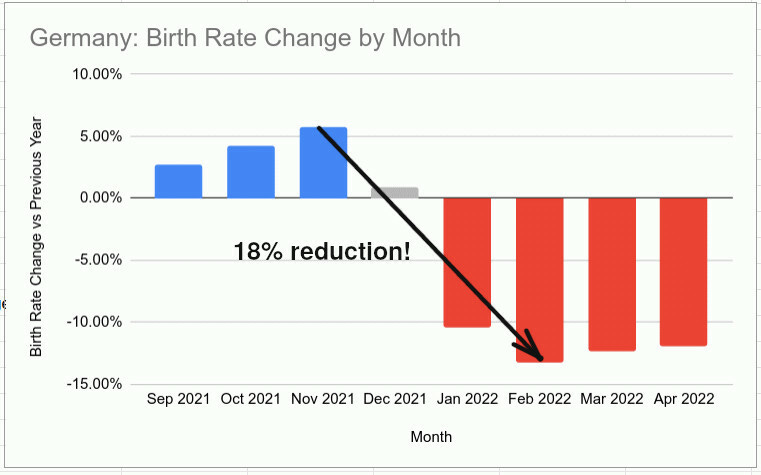
You can see that births suddenly started dropping in Dec 2021, (going from +5% yoy in November to 1% in December, down to -10% in January and -13.28% in February. The suddenness and extent of this drop are unprecedented.
The data for April confirmed that the reduction in birth rate over the first three months is not a fluke and is continuing for the fourth month.
Many people feel strongly about abortions. I understand. I am asking you to suspend your feelings for a moment and look at abortions like a demographer would.
Remember: abortions result from unplanned pregnancies! Aside from a relatively small amount of abortions happening due to fetal abnormalities, most abortions happen because the pregnancy was unexpected, unwanted, and accidental.
What this means is, absent large changes in the laws of the land, sudden increases or decreases in abortions happen only because of changes in fertility.
Live births may see increases or decreases because of changed desire to have children due to social factors. In the case of abortions, however, the pregnancy is ALMOST ALWAYS unplanned to begin with, so social factors like economic expectations have little to do with most abortions. Those abortions are only indications of fertility and desire to have unprotected sex.
So… abortions in 2021 fell by 5.3%!
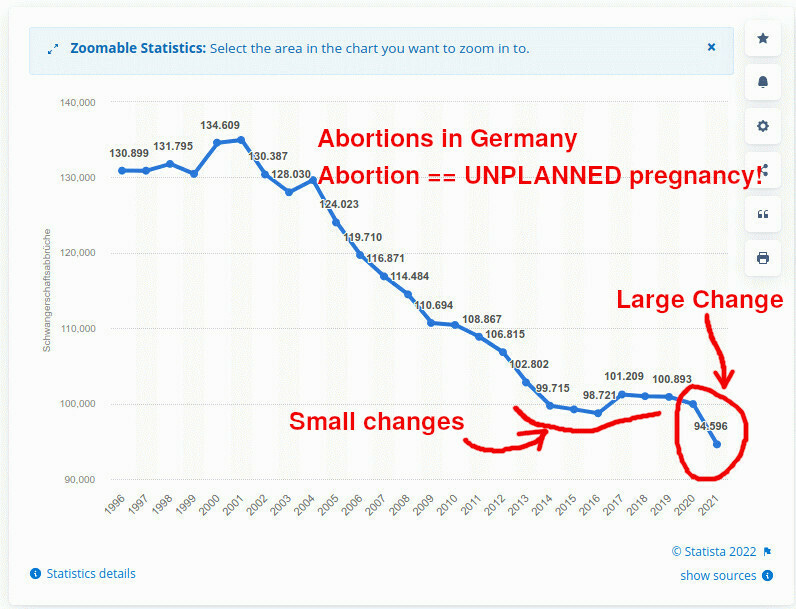
How large is this effect? Between 1996 and 2021, abortions fell by an average of 1,452 abortions per year. In the year 2021, abortions fell by 5,352! The recent years prior to 2021 saw little change in abortions. Thus, the decline of 5,352 abortions in the year 2021 likely is due to the changed fertility of young people in Germany and shows a great decline in unplanned, accidental pregnancies. Abortions are never planned, remember!
Please recall that younger Germans in 2021 did not start vaccinations until about May or so. Thus, if vaccinations are the cause of lower fertility, their effect on pregnancies would not be seen until the second half of 2021.
Furthermore, since abortion is done after about a month into the pregnancy, you can add about a month and deal with about 5 months out of 12 in 2021, most affected by vaccinations. Thus, a 5% drop in abortions could roughly mean a 12% decline in fertility starting about July.
This is a rough, back-of-the-envelope calculation that indicates that abortion data largely agrees with the hypothesis that declines in birth rates are caused by vaccination, and not by social conditions.
The abortion story is not, as such, a proof of causation: it is a piece of evidence that agrees with my vaccination hypothesis, and strongly disagrees with the possibility that change in fertility is caused by social factors.
So we see that both abortions, as well as April birth data in Germany, coincide and suggest that vaccinations caused a large drop in fertility among the people of Germany.
See Also
- Jestre just wrote a scary post about Canada birth rates — please take a look! 11% decline (like in Germany)!
- Sweden (dramatic steady decline to -10% this year)
- Taiwan (-28% decline)
- Germany (previous article), North Dakota, UK, and Switzerland. (12-13% declines)
“Made in America” Mini-nukes to be used in a “Nuclear First Strike” coming soon to Italy, Belgium, Germany, Netherlands.
By Manlio Dinucci – byoblu – July 15, 2022
“Production of the B61-12 nuclear bomb begins,” Sandia National Laboratories announced from the United States. The B61-12, which replaces the previous B61 deployed by the U.S. at Aviano and Ghedi and other European bases, is a new type of weapon. It has a nuclear warhead with four power options, selectable depending on the target to be destroyed. It is not dropped vertically, but at a distance from the target on which it is directed guided by a satellite system. It can penetrate underground, exploding deep to destroy command center bunkers in a nuclear first strike.
The B61-12s, classified as “non-strategic nuclear weapons,” are deployed in Europe — in Italy, Germany, Belgium, the Netherlands, Britain and probably other countries — at distances far enough to strike Russia. They thus have offensive capabilities similar to those of strategic weapons.
Another nuclear weapon system, which the United States is preparing to install in Europe against Russia, is ground-based intermediate-range missiles. They can also be launched from “anti-missile shield” installations, deployed by the U.S. at bases in Deveselu in Romania and Redzikowo in Poland, and aboard five warships cruising in the Mediterranean, Black Sea and Baltic Sea close to Russia.
That such installations have offensive capabilities is confirmed by Lockheed Martin itself. Outlining the characteristics of the Mk 41 vertical launch system, used in both land and naval installations, it specifies that it is capable of launching “missiles for all missions, both defense and long-range attack, including Tomahawk cruise missiles.” These can be armed with nuclear warheads.
Europe is thus being turned by the U.S. into the front line of a nuclear confrontation with Russia, even more dangerous than that of the Cold War.
Road accidents to stop Putin: Augsburg to switch off traffic lights

Free West Media | July 9, 2022
In its sanctions policy against Russia, EU leaders are increasingly overstepping boundaries – also against their own people.
One of the most active globalist trendsetters is once again the German State of Bavaria. CSU Prime Minister Söder already distinguished himself with particularly drastic measures during the Corona crisis. Citizens are now expected to accept questionable measures in the fight against Russian President Putin.
In the Bavarian city of Augsburg, for example, it has been calculated that energy costs are likely to rise by almost 80 percent in the current year. That is why everything that can be switched off, including traffic lights, will soon be switched off.
Mayor Eva Weber (CSU) explained: “The situation is serious.” Therefore, room temperatures in municipal offices are to be lowered in autumn and winter, and some buildings will be left completely cold through “effective room management”.
Water temperatures in swimming pools will be reduced. The façade lighting on historical buildings and museums will be switched off, and fountains will also be turned off. Street lighting will be dimmed. Switching off of traffic lights will also be considered.
The city and the police will be explaining which traffic lights are most relevant to safety – all others could be switched off without further ado. There are no longer any taboos when it comes to saving energy in the state.
The taboo, however, is to demand an end to the self-imposed energy shortage. This could be done quickly and easily: by ending sanctions against Russia and by opening the Nord Stream 2 Baltic Sea pipeline, which has long been completed.
Chancellor gets carried away
Chancellor Scholz has now let himself be carried away into making an extremely partisan (and possibly illegal) statement about the AfD. He called it the “party of Russia” during the government’s questioning in the Bundestag on Wednesday.
The chancellor was responding to a question from AfD MP Steffen Kotré, who had called sanctions against Russia “useless” and called for the Nord Stream 2 gas pipeline between Russia and Germany to be put into operation. Scholz responded, “I stand fast: the AfD is not only a right-wing populist party, but also the party of Russia.”
Scholz reiterated that Germany was preparing to do without Russian oil and gas and was also building the necessary infrastructure to do so. He added: “This is real energy security for Germany in the interest of all citizens.” Scholz’s argument does not sound convincing in the face of the many hardships that ordinary Germans now have to struggle with.
In the past, the AfD had filed a lawsuit against similar statements by then Chancellor Angela Merkel before the Federal Constitutional Court (BVerfG) in Karlsruhe and won the case. As recently as June 15 this year, the BVerfG ruled that Angela Merkel was not allowed to comment on the outcome of the Thuringia state parliamentary election, in which FDP politician Kemmerich had been elected with votes from the AfD, among others, as “unforgivable” and a result that “must be reversed”.
That ministers are obliged to neutrality when they make public statements in their function as members of the government has been cast in stone by the BVerfG. Politicians must therefore remain neutral towards all parties as a matter of principle.
This also applies to a Federal Chancellor, the Federal Constitutional Court ruled. If the Federal Constitutional Court sticks to this assessment, Scholz should also expect a similar rebuke from Karlsruhe.
Ukraine seeks to block return of gas turbine to Russia
Samizdat – July 8, 2022
The Ukrainian government is pressuring Canada not to return a gas turbine to Russia that could boost the supply of Russian fuel to Germany, Reuters and a Ukrainian news site have reported. Kiev argues the precedent would erode anti-Russia sanctions.
Previously, Russian gas monopoly Gazprom reduced the flow through the Nord Stream pipeline to 40% of capacity, claiming that Germany failed to return a Siemens gas turbine from maintenance in Canada. The crucial piece of equipment had become stuck due to Ottawa’s sanctions against Russia.
According to sources in the Ukrainian government cited on Thursday and on Friday by Reuters and the Ukrainian news website Evropeyskaya Pravda, Kiev was informed that Canada had decided to return the turbine. Officials in Ukraine argued that it was a bad move.
“If, God forbid, this decision is approved, we will undoubtedly appeal to our European colleagues that their approach must be reassessed,” a source in Ukraine’s Energy Ministry was quoted as saying by Reuters. “Because, if countries do not follow decisions they have agreed about sanctions, how can we talk about solidarity?”
Both outlets said Ukrainian Energy Minister German Galushchenko had lobbied Canada not to return the turbine, claiming that Russia could ramp up gas supplies to Germany. The Ukrainian newspaper said the minister had sent a two-page letter to his Canadian counterpart, Jonathan Wilkinson, on June 22, in which he explained that more Russian gas could be pumped through Ukraine.
Kiev is concerned that by bowing down to what it considers Russian energy blackmail, Canada would set a bad precedent for the Western sanctions regime.
Germany activated the second phase of its gas emergency plan after Russia reduced supplies through Nord Stream. Berlin reportedly asked Ottawa to return the turbine before 10 days of scheduled maintenance starts on the pipeline next week.
Vaxsplainers
German state media “debunks” eugyppius

eugyppius – July 6, 2022
I’m happy to report that my remarks on lower case rates in lesser-vaccinated East Germany, after being recycled by BILD, are now the subject of a long state media debunking in Tagesschau.
Why Are Case Rates Lower in the East? ask “science” reporter Anna Behrend and official state media “fact-finder” Pascal Siggelkow.
The nationwide seven-day incidence in Germany has been on the rise again for several weeks now. Health Minister Karl Lauterbach has already spoken of a summer Corona wave. But a look at the developments reveals that there are huge differences between the federal states:
While the incidences in Lower Saxony and Schleswig-Holstein have already passed the threshold of 900, the numbers in Thuringia and Saxony are still under 400. In general, it’s remarkable that all the East German states – with the exception of Mecklenburg-Vorpommern – are significantly below the national average incidence of of 687.7. And this is despite the fact that Saxony, Brandenburg and Thuringia have some of the poorest vaccination rates. In conspiracy-theory circles, people are already fantasising about “negative efficacy”, especially with regard to booster vaccinations, saying that the figures amount to proof that the vaccines are ineffective. But is there really a causal connection between the vaccination rate and the incidence?
Before they get into that, Siggelkow and Behrend light the incense and cycle through the familiar vaccinator nostrums. “Vaccination protects against severe outcomes and death,” even though the rise of Omicron has led to a great many “breakthrough infections.” Mysterious “studies,” which are never further characterised, are said to show “that vaccinated people … are slightly less contagious,” although they have to concede that “there isn’t enough data to conclude this decisively.”
Then, when they’re reasonably sure most people have stopped reading, comes an uncomfortable admission. Case incidences, the cornerstone of Tagesschau Corona reporting since 2020, are of, uh, “limited significance”:
If the vaccination rate … is not the decisive factor … how is it that the number of new infections in the East is comparatively low right now? First of all, it must be said that the current infection figures are only of limited significance. “One must always also consider that incidences are calculated on the basis of reported laboratory results,” says [virologist Johannes] Knobloch. As before, only positive PCR tests count in the RKI statistics. Willingness to be tested and the accessibility of PCR tests therefore have a very large influence on the measured incidence. … “The number of unreported cases is probably higher than in all previous phases of the pandemic.”
According to experts, the incidence continues to indicate whether the wave of infection is rising or falling. Caution is advised, however, when making regional comparisons, as the testing strategies and also the number of tests differ greatly across states. Fewer tests mean that fewer infections are detected. A high proportion of positive tests … indicates a high number of unreported cases …
Ah, so they just have super high positivity rates in the East then? That’s the explanation?
Ha no:
But it’s not the case that Eastern states have uniquely high positive rates compared to the others. So different testing patterns alone cannot explain the current low incidence there either.
It wasn’t that long ago that all manner of respectable journalists, especially those working for Pravda operations like Tagesschau, wrote long think pieces on the “global menace” of “vaccine scepticism,” complete with histrionics about the lower vaccination rates in Eastern Europe causing “much higher infection figures.” Lazy Googling yields many typical items, such as this piece from MDR in November, lamenting that the “incidence among unvaccinated in Sachsen-Anhalt is significantly higher than among the vaccinated.” This at a time when the vaccinated were exempt from most testing, while many unvaccinated had to submit to daily antigen tests before they could even go to work.
Now that these games no longer favour the vaccinated, though, we’re allowed to wonder about things like positivity rates. These certainly matter, but – unbeknownst to our crack fact-checking team – they’ve become totally meaningless in the era of lateral flow testing, as a plurality of PCR tests in Germany are conducted to confirm a positive antigen result, and nobody has any idea what the true rate of testing might be.
Frustrated on this front, Siggelkow and Behrend look for other signs that infections might really be higher in the East, even though the official incidence is lower there. More and more, you have the feeling of a desperate grasping after straws:
If the true incidence were in fact higher, you would expect to see this in ICU admissions …
Yet the proportion of Covid patients in ICU is currently not conspicuously high in the East compared to the rest of Germany.
Foiled again!
So were most people in the low-incidence states already infected and now immune? Those who become infected with the coronavirus usually form antibodies against it. How long and how well these antibodies protect against a new infection with the virus has not yet been conclusively researched.
However, if we assume that there is at least some protection for a while, one conceivable reason for the low incidence in some states would be that more people have already come into contact with the virus there and are therefore less likely to be infected now.
… It’s not known precisely how much of the population in which states has already recovered from infection. If you take the number of new infections … since the beginning of the year as a rough approximation of the circulation of Omicron, you find no confirmation of the assumption that the population of the East has had greater contact with the virus. …
How confusing. Do Tagesschau no longer stand by their dire proclamations, uttered just this past winter, that lower vaccination rates were to be blame for higher infections in the East? Is their position now that the East never saw higher rates of infection at all, even though the vaccines definitely protect against infection? Also too, why have we abandoned so soon our thesis that the incidence is of “limited significance,” can only tell us when cases are going up or down, and says nothing about how many cases there actually are? I thought regional comparisons of case numbers were bad?
Way down at the bottom, when Behrend and Siggelkow are triply sure nobody is reading anymore, they toss out the possibility that cases might indeed be lower in the East – not because of the vaccines, but because the new Omicron variants haven’t gotten there yet:
One reason the nationwide incidences are rising so sharply in the first place is the Omicron subtypes BA.4 and BA.5, which experts consider more contagious than the previously known “sister variants.” BA.5 is now dominant … It’s of course possible that some states are more affected by the new variants than others, where these variants have not yet arrived.
If BA.5 infects the vaccinated preferentially, and vaccination rates vary substantially across regions, there will be many places where BA.5 never quite seems to have arrived. Perhaps aware of this close brush with crimethink, our braintrust wraps things up with some cleansing mantras:
What is certain, though, is that there is no scientifically sound reason to assume that a high vaccination rate could be partly responsible for a high incidence. On the contrary: Scientific data show instead that people infected with Omicron are less likely to infect others than the unvaccinated.
Every conspiracy theory must first be ignored, then denied, and finally debunked, before it becomes true.
Featured Video

The Truth About the Trump Shootings with Ken Silva
or go to
Aletho News Archives – Video-Images
From the Archives
Trans ‘milk’ as good as the real thing – NHS
RT | February 18, 2024
The drug-induced nipple secretions of trans women are as good as mothers’ breast milk for babies, the University of Sussex Hospitals NHS Trust claimed in a letter to campaigners made public in a report by British think tank the Policy Exchange on Sunday.
The healthcare trust’s medical director, Rachel James, argued that the off-label prescription drug cocktail men transitioning to female take in order to produce milk was “similar to the natural hormones which encourage lactation to develop when the baby is newly born.”
“The evidence which is available demonstrates that the milk is comparable to that produced following the birth of a baby,” James wrote in the letter, sent to Children of Transitioners last August.
Biological men who wish to lactate must first take hormones to grow milk glands and then take high doses of either domperidone or metoclopramide to stimulate milk production. Neither drug is approved for this use, though they are occasionally prescribed off-label to biological women who have trouble lactating.
However, domperidone’s own manufacturer, Janssen, warns patients the drug “may cause unwanted side effects affecting the heart in a breastfed baby” and “should be used during breastfeeding only if your physician considers this clearly necessary.” … continue
Blog Roll
 Aletho News
- Seyed M. Marandi: U.S. Strike Imminent – Toward Total War in the Middle East
- Russia Voted Under Fire. Washington Is Loading the Tankers.
- 12 Things Your Oncologist Was Trained Not to Tell You
- Anthrax Attacks Paved Way for COVID-Era ‘Junk Drugs and Vaccines’
- How Real Is the Impact of Western Sanctions on Israel?
- France, You Are Guilty: How Paris Turned Western Sahara into the Maghreb’s Powder Keg
- 2025 Nature Paper Claiming Worsening Global Drought Gets RETRACTED …Heavily Flawed
- Your Milk Is Not the Problem
- The Truth About the Trump Shootings with Ken Silva
- ARE PATIENTS BEING PROPERLY INFORMED ABOUT OZEMPIC?
- If Americans Knew
- Salah Sarsour’s Legal Team Says DHS Has Not Met Its Burden to Prove He Is Deportable
- An analysis of tax forms by The Intercept show Kraft’s charity and LLC have donated to Friends of the IDF and AIPAC’s super PAC.
- Israeli attacks kill four Palestinians in Gaza – Daily Update
- Inside Gaza’s death trap of collapsing, bombed-out buildings
- The everyday items Israel bans from Gaza every day
- Inside the siege, the ruined buildings of Gaza – Daily Update
- Debunking The Claim That Macklemore Has A “History Of Antisemitism”
- CPJ demands release of arrested Palestinian-US journalist near Bethlehem
- Robert Kraft: The Billionaire Friend of Netanyahu Pulling The Strings Behind the Macklemore/Ed Sheeran Blow Up
- Columbia Administered Fund Gives Big Money to Pro-Israel Groups
- No Tricks Zone
- 2025 Nature Paper Claiming Worsening Global Drought Gets RETRACTED …Heavily Flawed
- New Study: ‘Global Drought Shows No Detectable Recent Acceleration Under Climate Warming’
- Economic Masterminds: German Socialists Suggest Taxing Productivity Gains Stemming From Using AI
- The South China Sea Has Not Been Cooperating With The Climate Change Narrative
- Energy Crisis: Germany Enters Heating Season With Historically Low Gas Reserve Fill Levels
- New Study: The Antarctic Ice Sheet Gained Mass From 2020-2024 Due To Staggering Snow And Ice Accumulation
- Study: Ocean Heating Rates From Thousands Of Years Ago ‘Dwarf’ Modern Ocean Heating Rates
- Climate Extremists Target, Attack Large-Scale Power Grid Infrastructure In Germany!
- New Study: Antarctic Ice Melt Has Contributed Less Than 1 Centimeter To Sea Level Rise In The Last 30 Years
- Fear Of Debate: Alarmist German Climate Scientist Calls On Mainstream Media To Discredit Skeptic Voices
 Aletho News