CPJ: Israel must explain targeting of journalists in Gaza
CPJ | December 2, 2012
Dear Prime Minister Netanyahu,
The Committee to Protect Journalists is gravely concerned that Israeli airstrikes targeted individual journalists and media facilities in the Gaza Strip between November 18 and 20. Journalists and media outlets are protected under international law in military conflict.
A series of Israeli airstrikes struck two buildings that house news media, resulting in injuries to nine journalists, while separate missile attacks resulted in the deaths of three journalists, according to news reports and CPJ research. Israeli officials have broadly asserted that the individuals and facilities had connections to terrorist activity but have disclosed no substantiation for these very serious allegations. CPJ has repeatedly sought, by email and phone, supporting details or evidence from the Israel Defense Forces spokesperson’s office. We have yet to receive information from the spokesperson’s office to substantiate its allegations.
On November 18 and 19, airstrikes targeted Al-Shawa and Housari Tower and Al-Shuruq Tower, both of which are well-known for housing numerous international and local news organizations. The attacks damaged the offices of Hamas-run Al-Aqsa TV and Al-Quds TV, Sky News, Russia Today, Al-Arabiya, and the independent Bethlehem-based Ma’an News Agency. Among the nine wounded journalists was Khader al-Zahhar, a cameraman for Al-Quds TV who lost his right leg in the explosion, according to news reports. Several other international and local news organizations, including Reuters, Agence France-Presse, The Associated Press, and CNN, also have offices in the targeted buildings. Israeli spokesman Mark Regev told Al-Jazeera English on November 19 that Al-Aqsa TV is a “Hamas command and control facility” and that “Hamas used communication facilities on top of the buildings.” He did not state whether or how Hamas used the station militarily.
On November 20, Mahmoud al-Kumi and Hussam Salama, cameramen for the Hamas-run Al-Aqsa TV, were driving away from an assignment at Al-Shifaa Hospital when an Israeli missile hit their vehicle, according to Al-Aqsa TV. The car was marked “TV” in neon-colored letters, the Hamas-run station said. The two men were killed.
A third journalist was killed when his car was hit by a missile that same day, AP reported, citing a Gaza health official. Local news reports identified the victim as Mohamed Abu Aisha, director of the private Al-Quds Educational Radio, whose vehicle was hit while he was driving in the Deir al-Balah neighborhood. The reports did not say whether Abu Aisha was engaged in journalistic work at the time, and CPJ continues to investigate the circumstances of his death.
Al-Aqsa TV, the official Hamas-run television channel, provides news and information that overtly reflect the organization’s anti-Israel perspective. Al-Quds Educational Radio is a private radio station geared toward educational programs; it also provides a pro-Hamas perspective.
On November 20, AP cited Lt. Col. Avital Leibovich, an Israeli military spokeswoman, as saying the three individuals were Hamas operatives. “The targets are people who have relevance to terror activity,” AP quotes Leibovich as saying. An unsigned entry posted on the Israel Defense Forces blog that day asserted that an individual named Muhammed Shamalah, whom it referred to as a Hamas military commander, had been targeted in an airstrike that struck a vehicle identified as “TV.” Neither Leibovich nor the IDF blog entry provided any details to support the claims. Leibovich reiterated these unsupported claims in a letter to The New York Times published on November 29.
CPJ has contacted the IDF spokesperson’s office multiple times, beginning on November 20 and then again on November 27, 28, and 29, and we have sent three written requests seeking an explanation for its claims. We were directed to a Maj. Zohar Halevi who has not responded to our requests.
Alarmingly, spokeswoman Leibovich seeks to erase the crucial legal distinction between armed combatants and journalists covering the perspective of an adversary. “Such terrorists, who hold cameras and notebooks in their hands, are no different from their colleagues who fire rockets aimed at Israeli cities and cannot enjoy the rights and protection afforded to legitimate journalists,” Leibovich writes in the letter to The Times.
All journalists, whether local or foreign, regardless of the perspective from which they report, are afforded the same civilian protections under international law. The Israeli government does not have the right to selectively define who is and who is not a journalist based on national identity or media affiliation. International law also places strict limits on military attacks on all civilian sites, including media outlets. Article 51 of Additional Protocol I to the Geneva Conventions prohibits attacks on civilian sites in which potential damage and loss of civilian life “would be excessive in relation to the concrete and direct military advantage anticipated.”
We request your government provide an immediate and detailed explanation for its actions in targeting Mahmoud al-Kumi, Hussam Salama, and Mohamed Abu Aisha and the two media buildings in the Gaza Strip.
We ask that you consider this a matter of urgency.
Sincerely,
Joel Simon
Executive Director, CPJ
Related articles
- Israel’s War on Palestinian Children (alethonews.wordpress.com)
- #GazaUnderAttack | 2 journalists killed in Israeli airstrike on Gaza (occupiedpalestine.wordpress.com)
Israeli Terror: The “Final Solution” to the Palestine Question
By James Petras :: 11.28.2012
Introduction
For the past forty-five years the state of Israel has been dispossessing millions of Palestinians living in the Occupied Territories, confiscating their lands, destroying homes, bulldozing orchards and setting-up ‘Jews-only’ colonial settlements serviced by highways, electrical systems and water works for the exclusive use of the settlers and occupying soldiers.
The process of Israeli territorial expansion throughout the West Bank and East Jerusalem has greatly accelerated in recent years, converting Palestinian-held territory into non-viable isolated enclaves – like South Africa’s Bantustans – surrounded by the Israeli soldiers who protect violent settler-vigilantes as they assault and harass Palestinian farmers at work in their fields, beat Arab children on their way to school, pelt Palestinian housewives as they hang their laundry and then invade and defecate in Palestinian mosques and churches.
The Rage and Rape of Gaza and its Apologists
Israel’s strategic goal is to impose ‘Greater Israel’ on the region: to take over all of historical Palestine, expel the entire non-Jewish population and subsidize ‘Jews-only’ settlements (for settler-immigrants, often from the US and former USSR). While bulldozers and tanks have dispossessed Palestinians in the West Bank for decades, the launching of thousands of missiles and bombs have become the ‘weapons of choice’ for uprooting and eliminating the Palestinians in Gaza. In just eight days, Israel’s latest blitzkrieg resulted in the killing of 168 Palestinians (42 children and 100 civilians), the wounding of 1,235, the destruction of over 1,350 buildings and the further traumatizing of over 1.7 million children, women and men fenced in the world’s largest concentration camp. According to the Israeli Defense Minister, the Jewish State dropped “a thousand times more bombs onto Gaza” than the Palestinians fired back into Israel.
The current Israeli offensive began with the gruesome assassination of a prominent Hamas leader, Ahmed Jabari, and immediately escalated into an assault on the entire Palestinian population of Gaza. Secure in the knowledge that the Palestinians had no capacity to retaliate with similar weaponry, the Israeli High Command ordered the systematic destruction of civilian life, workplaces and densely populated neighborhoods. Over 75% of the casualties have been non-combatants; almost half are children, women and elders.
The Israeli propaganda machine and its ‘Fifth Column’ in the US fabricated and repeated the Big Lie: that the Jewish state was ‘defending itself’… Right… with only six (mostly military) deaths and 280 wounded versus the nearly 200 Palestinians, mostly civilians, slaughtered. The US Zionist power configuration (ZPC), embedded in the policy centers of the US Executive, the Congress and both political parties, parroted this line. All the major US TV networks and print media reproduced verbatim Israeli Foreign Office press handouts about Israel’s ‘defensive’ … genocide … while entire Palestinian families were being buried under the rubble of their bombed apartments.
Death and destruction, planned and executed with the unanimous support of all the major Israeli political parties and leaders, enthralled the mass of its Jewish citizens: Indeed, over 80% of Israeli Jews supported the terror blitz against Gaza. As the Russian media outlet (RT) reported: “A new wave of hatred towards Palestinians is sweeping through Israel from public figures to the man (person) in the street”. The Israeli Interior Minister declared that “Gaza should be bombed into the Middle Ages”. Israeli demonstrators in Tel Aviv shouted; “they (the Palestinians) don’t deserve to live, they must die”, “may your children die” and “now we must go back there (to Gaza) and kick out all Arabs”. The prominent Israeli Rabbi Yaakov Yosef, the son of a former chief rabbi, made a speech in the Cave of the Patriarchs in occupied Hebron where he blessed the Israeli soldiers and urged them “to slaughter their enemy”.
Even more to the point, Israel Katz, Israel’s Transport Minister, demanded “Gaza be bombed so hard the population will have to flee into Egypt (the Sinai desert)”. Avi Dichter, the Minister of Home Front Defense, incited the Israeli military to “re-format” Gaza – that is to erase its population with bombs.
Almost half of Israeli Jews considered Netanyahu’s terror bombing of Gaza insufficient: According to the independent Israeli Maagar Mohot poll, half of Israelis opposed the cease fire and demanded the bloody assault against the Palestinian population of Gaza continue. The same poll reported that almost a third of Israeli Jews though their government should have sent ground forces into Gaza, an invasion which would have led to tens of thousands of Palestinian casualties and total destruction of their vital infrastructural life-lines. Netanyahu and his allies in power now confront a new, totalitarian mass opposition that openly embraces a genocidal ‘Final Solution’ to the Palestinian problem.
Genocide at the Service of Greater Israel
The parallels between the pronouncements and actions of Nazi Germany and Zionist Israel are overwhelming. The blood lust in Israel goes far beyond psychopathic raving of a few deranged rabbis and marginal politicians: it extends from the top Cabinet members to the average citizen.
In Israel, almost an entire people – over 80% of Jews – support, with varying degrees of intensity, the terror bombing and slaughter of the people of Gaza. Setting aside the profound sociopathic disorders of the raging and racist multitude in Israel, what is politically more significant are the totalitarian rants of leading Israeli public figures, published as editorials, in such newspapers as the respectable Jerusalem Post: “We need to flatten all of Gaza. There should be no electricity in Gaza, no gasoline or moving vehicles, nothing,” writes Gilad Sharon and the statements of prominent Knesset members, like Michael Ben-Ari , “There are no innocents in Gaza … mow them (all) down”. These outbursts reveal Israel’s strategic goal: Genocide at the service of Greater Israel – the bloody purge of 5 million Palestinians, the creation of a 100 percent ‘pure’ Jewish State. Overseas (mostly US) Zionist-Jewish media moguls, Ivy League university academics, billionaires, US Congress people and government officials finance, underwrite, propagandize for and promote with single-minded perseverance the defense of Israel’s most heinous war crimes, its violations of international law and its ongoing crimes against humanity.
During the entire period of the recent Israeli blitzkrieg, Israel’s Fifth column, the Presidents of the 52 Major American Jewish Organizations, the New York Times and the rest of the major US press rose to the dirty task of giving unconditional support for Israel’s war crimes. Vocal support from the US White House and by extension the leaders of the European Union echoed Netanyahu’s lies. In order to grasp the media white wash of these ongoing crimes against humanity one could compare the US press reports on Israel’s bombing of Gaza to those which would have appeared in the leading fascist newspapers at the time of Hitler’s ‘defensive’ attacks on Poland and Belgium and the bombing blitz of civilians in London.
The true purpose of Israel’s terror bombing raids and assassinations in Gaza and the cutting up of the West Bank is to make these territories uninhabitable for the Palestinians. The daily humiliation and destruction of the basic conditions for normal life are designed to force young, educated, ambitious Palestinians to abandon their land, homes and families for less grotesquely barbaric sites, where they might achieve a normal civilized existence, free from foul-mouthed Jewish settlers, unending military incursions, Israeli soldiers pistol-whipping their fathers or breaking the legs and arms of stone-throwing Arab schoolkids.
The Logic of Public Flogging
This obscene Israeli-Jewish behavior is intentionally open and flagrant: Flaunting Jewish military superiority over the defenseless Arab is a vital part of the psychological war reinforcing the idea of Arab inferiority and of Palestinians as aliens in their own country. Israel’s underlying slogan “Arab Raus!” (Arabs Get Out!) echoes the Nazi screed, “Juden Raus!” (Jews Get Out!). The message is clear: “If you are not a Jew then you do not exist! Your very alien presence is an abomination in the eyes of the Zionist God. So if you won’t leave politely we will hasten your departure with a few thousand bombs, missiles and a rain of white phosphorous.” That is the deeper meaning of Israel’s rape of Gaza.
The Impact of Israel’s Genocide on US Society
Leading journalists in the most politically influential US newspapers, academics from the most prestigious universities and ‘experts’ from the leading research institutes have systematically defended each and every Israeli war-crime, including the rape of Gaza, the demolition of Palestinian civil society and the cruel blockade of 1.7 million Palestinians in the biggest ‘open air concentration’ camp in the world.
As usual, the Uber-Zionist Harvard law professor, Alan Dershowitz and his acolytes provide a legal gloss on the savage bombing of essential public services and private communication and media centers. Not to be outdone by the loudmouths in Harvard Square, Yale and Princeton professors, with tribal loyalties to the Jewish state, describe the Israeli killing machine as a righteous citizen army defending its eternally victimized people. “Experts” at the Brookings Institute, Hudson Institute and dozens of other ‘research’ (read propaganda) centers provide ‘scientific’ explanations regarding Israel’s unique right to dispossess millions of Palestinians. The experts’ justifications of Israeli war crimes permeate the mass media, penetrate the homes of millions of Americans and fill the heads of elected officials. Meanwhile they ‘convince’ and/or browbeat thousands of non-tribal school teachers and educators into complicity or silence, thus perverting and hollowing out what residual humane and democratic values remain embedded in the citizenry. It is precisely the much-vaunted ‘high achievements’ of so many Israel-Firsters that has led to their rise to the most influential positions in US society and state and makes their support of terror bombings, ethnic cleansing and genocide so deeply destructive to the US political culture. In spite of this, some of the same expert-academic apologists for Israel’s terror against the Arab civilians are the most vociferous defenders of human rights everywhere else in the world – including the US (piously condemning US war crimes whenever and wherever they are not explicitly aligned with the interest of the Jewish State). These ‘experts’ have perverted the concept of universal human rights in the minds of the US public.
As the US mass audience and political class watches the smoke, debris and wreckage of Gaza – and even catch glimpses of a child’s dismembered small body – they are told by the tribal loyalists that this destruction is morally justified, that the target is really “Hamas” – even over the piercing cries of Palestinian mothers for their slaughtered children. US citizens are told that Israel’s aggressive aerial bombing and mass shelling from warships off-shore is really a “defensive” maneuver against a “terrorist” regime – one which just happens to lack a single airplane, warship, tank or missile capable of hitting a single major Israeli military or civilian installation.
The Zionist Academic –Journalist Propaganda Complex
The Israeli academic-journalist propaganda complex in the US has pushed the entire US political narrative even further to the fascist right. It has perverted our political vocabulary, equating mass slaughter with national defense; equating the ‘anxiety’ of Israeli Jewish civilians with the homeless, jobless and traumatized widows and children emerging from their devastated densely-populated urban neighborhoods.
The tribal scholars and mass media pundits excel in transforming executioners into victims and victims into executioners. The Liberal-Zionists, peace-time critics of Israel, remove their peace buttons and pick up scripts defending ‘just wars’, as soon as Israel starts bombing another Arab population or adversary. For the liberal (human-rights-spouting) Zionists, bombing civilians is always illegal – except when it is Israel launching the missiles. Propaganda zealots for Israel saturate the media attacking any human rights activist critical of Israel with charges of “anti-Semitism”. They smear, threaten and blackmail each and every dissenting voice daring to oppose their narrative.
The entire mass media and the most prestigious universities censor any mention of Israeli crimes against humanity. As bombs rained on Gaza not one single Congressional voice denounced the odious American President Obama when he defended Israel’s eight-day “Guernica” against a defenseless population. Unlike the citizens in Nazi Germany, we, in the US and Western Europe, cannot claim that we did not know about Israeli war crimes as they were happening. On the other hand, how can the mass of semi-literate TV viewers in the US really ‘know’ what is going on when Israel-Firsters have so thoroughly ‘framed the context’ – claiming it’s all defensive, that only Hamas “terrorists” are targeted … despite the images of children being frantically pulled from the wreckage of their homes. However, the educated classes in the US do know about Israel’s tradition and practice of mass civilian bombings; they do remember Lebanon 2006 as well as Gaza 2008-2009 (and countless Israeli massacres in the late 20th century). At the same time, they also “remember” the vicious reprisals and vitriolic attacks the Zionist ideological attack-dogs launched against the critics. Having ‘learned their lessons’ from the Zionist ‘thought-cops’ they conveniently remember … to forget and walk away… from the whole ‘Middle East mess’. Worse still, they sanctimoniously blame the Palestinians for their efforts to retaliate in the face of Israel’s blatant murders of their most prestigious leaders as well as their stubborn refusal to surrender.
There are a few Left-Zionists who actually praise the ‘resilience’ of the Palestinians and their refusal to surrender to the dictates of Israel and its occupying army. They note how the Gazans ‘celebrate’ their ‘victory’ amidst the rubble after having secured a very tenuous cease fire. Any reasonable observer could reply to this sentimental nonsense: Is survival in an open air concentration camp for another day, the daily prospect of Israeli drone flights overhead and a brutal land and sea blockade any “victory”? There is no cause for celebration: Transforming Israeli war crimes into Palestinian virtues is a cheap liberal Zionist sideshow. An eight-day Israeli assault, which had successfully destroyed every major and minor public office responsible for providing the people of Gaza with essential services, and the savaging of the water and sewage systems, power and electrical grids and media offices (not to mention perishable food and medicine) is nothing to celebrate. In fact the underlying strategic goal of the Jewish state – to make the remains of historical Palestine uninhabitable (a modern ‘howling wilderness’) for its people – has been advanced by leaps and bounds. Surviving another day in order to bury loved ones and scrounging among the burnt ruins of a home for a birth certificate or photograph is hardly the noble “Hamas victory” proclaimed by Norman Finkelstein and Uri Avneri.
Why NATO/Washington Support Israel’s Genocidal War
Unlike in the past, where some international organizations and European states raised tepid objections to Israel’s military assaults against Palestine or Lebanon, this time around nothing took place. The White House immediately embraced Israel’s terror bombing as did the governments of Western Europe. Meanwhile, Turkey, the Gulf States, the Arab League and the pan-Islamic organizations did nothing concrete, offering no arms, no boycotts, no oil embargoes – only shallow symbolic gestures.
Netanyahu timed his assault to take advantage of the western imperial offensive against independent countries and leaders who had historically supported the Palestinian liberation struggle for decades. Since NATO states had invaded and bombed the sovereign nation of Libya back into the Stone Age, Netanyahu’s Cabinet Ministers must have reasoned, “Why can’t we send the Gazans back to the Middle Ages with our bombs”? When NATO and the Gulf States now arm, finance and support a prolonged terrorist-led assault against the secular regime, people and infrastructure of Syria, Netanyahu reasons, “Why don’t we do the same to the Palestinians”?
With the EU, Washington and the Gulf States engaged in covert and overt wars against all of Palestine’s staunchest allies (Iraq, Afghanistan, Libya, Syria, Iran and the Sudan) and against the people’s movements in Yemen, Bahrain and Pakistan, Netanyahu’s plan to ethnically purge Palestine has advanced with total impunity – indeed with overt Western approval and without concern for any international ‘humanitarian’ sanctions or even protest.
Netanyahu’s murderous war on Gaza, with full US complicity, has unmasked the collaborationist-nature of Egypt’s Islamist President Morsi. Morsi, together with US Secretary of State Hilary Clinton, secured a cease fire only after Netanyahu had accomplished his immediate goal of destroying the public institutions of civil society and undermining the vital public functions of the Hamas government.
Against the protests of the blood-thirsty Israeli public, who wanted their bombers and army to ‘finish the job’, Israeli Prime Minister Netanyahu negotiated and signed an agreement overseen by Morsi on a cease fire where Israel will pay no indemnity to the devastated civilians of Gaza while confirming the Mubarak-era Israeli– Egyptian treaty and starvation blockade of Gaza. Right after the ‘cease-fire’, President Morsi assumed dictatorial powers over the Egyptian state. With the shameful terms of the cease fire and Morsi’s assumption of dictatorial powers the ‘Arab Spring’ has come to a tragic end.
Conclusion
The people of the Middle East, especially the Palestinians, are in their worst position ever. Palestinians have lost the political, financial and military support of the independent, secular regimes of Libya, Syria and Iraq. And Iran, the principle source of arms for the Palestinians, faces a US Naval armada off its coast. Israel is accelerating its naked land grabs in the West Bank. The PLO continues to be Israel’s front-line ‘cop on the block’ – jailing resistance fighters and dissidents by the hundreds. Israel’s Fifth Column in the US ensures unconditional support for Israel’s ethnic cleansing of its non-Jewish population. Above all, as the terror bombing of Gaza reveals, Israel, as a state and as a people, is free to bomb and destroy Gaza in order to force a mass exodus of the Palestinians so that they may establish a ‘pure’ and unadulterated Jewish state on historical Palestine.
Epilogue
Less than 24 hours after the so-called “cease fire” Israeli soldiers murdered an unarmed Palestinian protestor and wounded dozens with live ammunition on the Gazan side of the border. Israeli storm troopers raided West Bank homes and arrested 55 Palestinians accused of supporting Hamas. Scores more Palestinians in the Beit Lahia area of the West Bank were summarily arrested and jailed as suspected Hamas members. Jewish vigilante settlers near occupied Hebron uprooted 400 olive trees belonging to Palestinian farmers from the village of Hawara. As the missile murderers take their break, the bulldozers rev up their engines: Israel’s leaders pursue their strategic objective of a “pure” Jewish state with their inexorable and destructive juggernaut. The ‘cease fire’ merely changed the methods and the terrain of dispossession for the time being.
Israel’s assault on Gaza has totally demolished its vibrant recovery and growth since the previous war of destruction. In 2011 the economy of Gaza grew by 20%; after the recent Israeli attack who would dare consider Gaza as a place to live and invest?
Related articles
- Refusing to Acquiesce in Gaza (alethonews.wordpress.com)
- Origins of Israel’s Anti-Arab Racism (alethonews.wordpress.com)
- stories from the border, where donkeys and carts are potential threats to Zionist security (ingaza.wordpress.com)
- 15th Violation of truce by #Israel | Israeli gunfire injures 2 in Gaza (occupiedpalestine.wordpress.com)
A Different War in Gaza, and the war ahead
By RAMZY BAROUD | Palestine Chronicle | November 28, 2012
In life, some phenomena cannot be explained by ordinary logic or technical language, let alone official discourses. How did Gaza manage to fight back with such ferocity and undying vigor in quelling the latest Israeli war despite years of a bloody siege and one-sided war in 2008-9? It simply cannot be explained by the outmoded language of today’s media analysts. Notwithstanding, a new reality is about to emerge.
During the 2008-09 ‘Operation Cast Lead,’ Israel killed over 1,400 Palestinians and wounded over 5,000 others. It was like shooting fish in a barrel. Most victims were civilians as is always the case in such wars of ‘self-defense’. A United Nations investigation published in September 2009 concluded there is “evidence indicating serious violations of international human rights and humanitarian law were committed by Israel during the Gaza conflict, and that Israel committed actions amounting to war crimes, and possibly crimes against humanity.”
Back then there was no shortage of indictments and condemnations, as will surely emerge from its latest 8-day war on Gaza. Many spoke of how the tide of public opinion is turning against Israel, how the self-declared Jewish State was losing its command over an ever-skewed narrative of David vs. Goliath, of how the US will no longer be able to shield Israel against the profound anguish of millions of besieged people imploring the world for help and solidarity.
Much of this was in fact true, but equally true was that Israel succeeded in dragging Gaza and the rest of Palestine back to the same status quo – despite the heinous crimes committed four years ago -that preceded the war. Former Israeli Foreign Minister, Tzipi Livni, told journalists on January 12, 2009 that her country was deliberately ‘going wild’ in Gaza to “restore … Israel’s deterrence. Hamas now understands that when you fire on its citizens it responds by going wild – and this is a good thing.”
It certainly was good enough for the United States, but also for many European powers who giddily wined and dined with Livni in Brussels, shortly after the war, as if thousands of people had not been killed and wounded or that whole families hadn’t just perished for no fault of their own and as if a whole nation was not still in mourning for its lost children, men and women.
It is not that Israel was particularly crafty in restoring its standing among official western circles in the last four years, thus giving it the needed confidence to assault Gaza once more. The fact is that Israel never lost that standing to begin with. These very powers (starting with Washington and London) never ceased backing Israel with the latest killing technology, bolstering Israel’s economy despite their own economic woes and of course, supporting Israel’s ‘right to defend itself’ at every available opportunity.
The 22-day war on Gaza of 2008-09 was in actuality a continuation of another long war, which is difficult to demarcate by specific dates and times. Palestinians in Gaza (as in the rest of the occupied territories) have been dying at rates that decelerate and accelerate depending on the political mood in Tel Aviv. In 2008, embattled Kadima party officials sought war to boost their rating among a war and security-obsessed public. In 2012, national elections in Israel are upon us once more. In both cases, Palestinian blood had to be exacted in that same bloody game of Israeli politics. And all rising stars in Israeli politics needed to be there to impress the ever-approving public.
When “more than 90 percent of Israeli Jews support Gaza war” (Haaretz, Nov 19), it becomes less shocking to read Gilad Sharon (son of former Israeli Prime Minister and repeatedly accused war criminal Ariel Sharon) writing in the Jerusalem Post: “There should be no electricity in Gaza, no gasoline or moving vehicles, nothing. Then they’d really call for a ceasefire … We need to flatten entire neighborhoods in Gaza. Flatten all of Gaza. The Americans didn’t stop with Hiroshima – the Japanese weren’t surrendering fast enough, so they hit Nagasaki, too.”
Yet what was thought of as another hunting season of Gaza’s civilians and fighters alike didn’t turn out as desired. ‘Operation Pillar of Cloud’ was meant to present Israeli Prime Minister Benjamin Netanyahu and his Defense Minister Ehud Barak with ample opportunities so that they may wave their fingers in threatening gestures and score as many political points as they could before international pressure mount. Instead, it ended up being a political debacle of historic proportions.
Israel’s trial balloons were downed by hundreds of Palestinian rockets that reached as far as northern Tel Aviv and even west Jerusalem. What was meant to break the resistance, so that Palestinians may never dare complain of occupation, of Israel-imposed political isolation and suffocating siege, along with Israel’s ‘deterrence’ wars, resulted in a new strange reality that sent Israelis everywhere seeking shelter. When sirens blared, Israel came to a halt as Israelis experienced bloody glimpses of what Palestinians experience too often. 167 Palestinians were killed and over a thousand wounded. 6 Israelis were killed, including a soldier who died from his wounds after a ceasefire was achieved through Egypt on Nov 21. But it was not the amount of spilled blood that made this war different, for the ratio of horrific deaths remains tilted. It was different because of the nature of the message that Hamas and other resistance factions delivered. Even starved and besieged Gazans are capable of fighting back after six long years of a hermetic blockade that forced them to dig hundreds of tunnels seeking salvation through neighboring Egypt.
In Ramallah, the Palestinian Authority, with little credibility to begin with, became more irrelevant than ever before. Mahmoud Abbas tried to impose himself as a party in the conflict by speaking of a popular but peaceful resistance in a televised speech. He conveniently explained the Israeli war as an attempt to coerce him not to seek the UN vote on a non-member state status for Palestine. And as Israeli leaders struggled to understand the new variable in their unfair war equation with the Palestinians, Arab officials poured into Gaza signaling that this time around things would be different. The Americans took notice too. Just as the US media spoke of a shift in US foreign policy focus to East and Southeast Asia, the alarming nature of the new war forced Secretary of State Hilary Clinton to rush to Israel to offer its support and solidarity. European leaders did the same. The lines were being demarcated once more. This time Gaza was a dividing point of regional and international politics, its resistance being the main factor behind a seismic shift.
Many in Israel tried to distort the facts by explaining that a ceasefire for Hamas would be good for Israel as it would bring “quiet” to border communities. Thus the Israeli objectives were achieved in a roundabout sort of way. Haaretz military correspondent Amos Harel labored to soften the blow by saying “The art of measuring the level of deterrence power is far from an exact science. Nobody expected that failed actions against Hezbollah in 2006 would lead to six-and-a-half years of quiet (which for the time being persists) on the Lebanon border”.
However, Israel’s intentions were not exactly about achieving peace and tranquility. For decades, Israel’s sought to have complete monopoly over violence, thus the right to punish, deter, intervene, occupy and ‘teach lessons’ to whomever it wanted, whenever it wanted. Its recent targeting of Sudan, its past strikes against Iraq, Tunisia, Syria, appalling wars in Lebanon, and constant threats against Iran are all cases in point.
Certainly, something big has changed. Not that Palestinians managed to narrow the imbalance of power, but that they succeeded in imposing their resistance as a factor in Israel’s ‘security’ equation that was exclusively determined by Israel.
Despite their heavy losses, thousands of Palestinians danced with joy throughout the Gaza Strip. They knelt and prayed among the rebels, thanking God for their ‘victory’. Masked armed men were crowded by jubilant Gazans cheering for resistance. Israel and its benefactors began assigning blame by pointing the finger mostly at Iran. But their words drowned in the echoes of Palestinian chants. All parties know that something fundamental has been altered, although the battle is anything but over. A war of a different kind is about to begin.
Hamas Welcomes UN Palestine State Vote
Al-Manar | November 30, 2012
The Palestinian resistance movement Hamas hailed the UN General Assembly’s vote to grant the Palestinians an upgraded status of non-member observer state, calling it a “victory.”
“This is a new victory on the road to the liberation of Palestine and return and we congratulate ourselves,” said a senior Hamas official, Ahmed Yussef, on Friday.
“We in Hamas consider this a shared achievement that casts joy on our people,” he added.
On November 26, Hamas Political Bureau Chief Khaled Meshaal voiced support for acting Palestinian Authority chief Mahmoud Abbas in his bid for an upgraded status at the United Nations.
On Thursday, the 193-member General Assembly voted 138-9 with 41 abstentions at the United Nations for a resolution approving the upgrade. Nine countries, including Canada, ‘Israel’, and the United States, voted against it.
Hundreds of Palestinians streamed out into the streets of the Gaza Strip and the occupied West Bank to celebrate the upgrade.
Acting Palestinian Authority chief Mahmoud Abbas also said that, “Indeed today is a historic day. Today we have really taken a step on the path to Palestinian independence.”
“We have a long road and difficult road ahead of us. I don’t want to spoil our victory tonight but the road ahead is still difficult,” he said, adding, “Tomorrow we begin the real war.”
UN Recognizes Palestine as Non-Member Observer State
Al-Manar | November 30, 2012
The UN General Assembly on Thursday overwhelmingly voted to make Palestine a non-member observer state, inflicting a major diplomatic defeat on the United States and the Zionist entity.
Palestinian Authority Chief Abbas considered the move at the UN a “birth certificate” for a Palestinian state and got the backing of 138 countries in the 193-member assembly. Nine voted against and 41 abstained, while five did not participate.
A Palestinian flag was unfurled in the General Assembly as the victory was pronounced.
The vote lifts the Palestinian Authority from an observer entity to a non-member observer state”on a par with the Vatican.
Palestine has no vote in the General Assembly but can now join UN agencies and potentially the International Criminal Court (ICC), where it could ask for a probe of Israeli actions, including during the recent offensive against Gaza.
Abbas said he hoped to use the status upgrade as a launch pad for renewed direct talks with the Zionist entity — frozen for more than two years — calling the resolution “the last chance to save the two-state solution.”
In a 22-minute speech Abbas said time for an accord is running out. “The rope of patience is shortening and hope is withering.”
Afterwards, he said the vote had been “historic.”
“Tomorrow we begin the real war,” Abbas said at a celebration reception. “We have a long road and difficult road ahead of us. I don’t want to spoil our victory tonight, but the road ahead is still difficult.”
WASHINGTON, TEL AVIV CONDEMN
The United States and the Zionist entity immediately condemned the vote, which US Secretary of State Hillary Clinton called “counterproductive.”
US Ambassador Susan Rice sternly told the General Assembly that the resolution would be “an obstacle to peace” because it would not lead to a return to direct talks between the Israelis and Palestinians.
“Today’s grand pronouncements will soon fade. And the Palestinian people will wake up tomorrow and find that little about their lives has changed, save that the prospects of a durable peace have only receded,” she said.
The United States blocked a Palestinian application for full UN membership — made by Abbas in September 2011 — at the Security Council.
For his part, Prime Minister Benjamin Netanyahu slammed Abbas’s address. “The world watched a defamatory and venomous speech that was full of mendacious propaganda,” his office said.
Israeli UN Ambassador Ron Prosor said recognizing Palestine “will place further obstacles and preconditions to negotiations and peace,” and could even lead to further violence.
~~~
View country by country recorded votes here.
Israel’s War on Palestinian Children
By VIJAY PRASHAD | CounterPunch | November 29, 2012
On 18 November, the Israeli armed forces bombed a house and killed the al-Dalou family, all ten members that were present and two neighbors. When the dust and fires settled, it became clear that amongst the dead were five children and five women. Among them was Mohammed Jamal al-Dalou, 29, who his neighbors said worked at a grocery store. The Israeli military said at the time that there was an error: either its ground operatives failed to laser-paint the correct target or its munitions misfired (as reported by Gili Cohen at Ha’aretz). Hamdi Shaqqura of the Palestine Centre for Human Rights in Gaza noted, “There is now a complete disregard for human life, shown by the attack on the Dalou family home in the middle of a residential area. This was not the home of a militant.”
Now, with the ceasefire in place, the Israeli military’s spokesperson Lt. Col. Avital Leibovich has reversed the Israeli view. “There was no mistake from the IDF,” she noted. “It’s tragic when a terror operative is hiding among civilians but unfortunately it is part of Hamas and Islamic Jihad tactics.” The Israelis now say that al-Dalou was a member of the police unit of Hamas charged with the security detail for high-level officials. In other words, al-Dalou sounds like a functionary of the Hamas organization. The Israelis are not saying that he was part of the military wing, let alone was part of any unit that had either done or planned to undertake any kind of operations in Israel. At most, al-Dalou was a Hamas bodyguard and driver. His terror level is even lower than that of Salim Hamdan, Osama Bin Laden’s driver who was acquitted by a US appeals court in mid-October.
It is contrary to the customs of war to bomb civilian areas. The jargon of warfare (Proportionality and Distinction) makes it clear that the threshold for prevention of civilian casualties must be very high and the imminent threat from the person being targeted must be demonstrable. The attack on the Dalou home meets none of these tests. Mohammed al-Dalou was at home, not “hiding among civilians,” as the Israeli spokesperson put it. The IDF bombed his home, knowing that his family would be inside. To have bombed a family as they cowered in their home is reminiscent of the Israel’s Dahiya Doctrine, so baldly enunciated by Israel’s General Gadi Eisenkott, “What happened in the Dahiya quarter of Beirut in 2006 will happen in every village from which Israel is fired on. We will apply disproportionate force on it and cause great damage and destruction there. From our standpoint, these are not civilian villages, they are military bases. This is not a recommendation. This is a plan. And it has been approved.” To bomb civilian areas, then, is part of the Israeli government’s plan – and it is a violation of the international rules of war.

Why did the IDF kill and injure so many children during this bombing run? Seventy-five percent of the population of Gaza is under 25. This means that if the IDF attacks civilians, it is more likely to kill or maim children than adults. Israeli officials conceded by the fourth day of the bombing that there was a “decline in the number of quality targets available to Israeli intelligence and Israel Air Force” (as reported by Avi Issacharoff in Ha’aretz). Israel took to “bombing real estate” – empty Hamas facilities – and bombing secondary and tertiary targets, which included residential areas and UN facilities (the Palestine Chamber of Commerce estimates that the damage amounts of $300 million, a fortune in the impoverished Strip). In congested Gaza no amount of “precision” bombing is going to prevent the “flattening” of the civilian population and its infrastructure. Whether Mohammed al-Dalou is a member of Hamas or not, Israel was prepared to attack his home in a residential area. This was not a “quality target.”
Among the “secondary targets” were the media center, which was bombed because of the presence of a Hamas media unit in the building, and it bombed a car owned by the Hama-run al-Aqsa television channel (Mahmoud al-Kumi and Hussam Salama, cameramen for al-Aqsa, died in this attack). Lt. Col. Leibovich said, “The targets are people who have relevance to terror activity.” The al-Aqsa car also had Mohamed Abu Aisha, director of al-Quds Educational Radio, and the car in front of them was carrying the New York Times’ translator. Israel did not care for freedom of speech and the freedom of journalists to travel in war zones. It sent out a tweet, “Advice to reporters in #Gaza. For your own safety, stay away from #Hamas positions and operatives.” In other words, Israel declared it a terrorist act to talk to Hamas during its bombardment. One of those who made the mistake was Omar Misharawi, age 11, son of Jihad Mishrawai, a BBC cameraman. Their house in Gaza City drifted too close to Israeli positions.
Concern for the human rights of the Palestinians is minimal. No wonder that Raji Sourani, the director of the Palestine Centre for Human Rights in Gaza, came on Democracy Now and said quite plainly that Palestinians are entitled to protection, that “Geneva Conventions are not for the intellectuals or academics; it’s for civilians to have it on their skin, to be protected at the time of war, not peace.” To have rights on the skin is a decisive image: it is on the skin that the bombs begin their intrusion into the world of the civilian. Impunity delivered to Israel from one callous US administration after another provides the bombs with permission to break the skin of the Palestinians. “We are the targets of this war,” said Sourani, meaning that it is civilians, and children, who carried the weight of the cynicism from the Israeli and US governments.
The noise, the stress and the danger of the war take its toll on children. UNICEF’s Communications officer in Gaza, Sajy Elmughanni says, “My one year old son Kamal has not been the same since the air strikes started. He used to be a happy baby, but now he sits and stares blankly. It makes me feel powerless.” Meanwhile, in a classroom in Gaza, children gather for their first day. Desks have been left empty for the dead. One desk has a sign. It reads: The Dear Martyr Sarah al-Dalou. She came too close to a terrorist.
Israel detains leading MP near Nablus
Ma’an – 27/10/2012
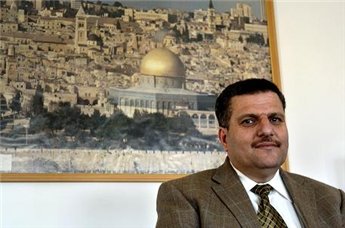
Mahmoud al-Ramahi is secretary-general of the Palestinian parliament. (MaanImages/File)

NABLUS – Israeli forces detained the secretary-general of the Palestinian parliament Mahmoud al-Ramahi on Saturday afternoon as he passed through a northern West Bank checkpoint.
Al-Ramahi was driving south from Nablus when he was seized at the Huwwara checkpoint. His car was also confiscated.
The MP was last released from Israeli jail less than four months ago.
An Israeli military spokeswoman confirmed the detention and said he is “suspected of involvement in illegal activity,” without elaborating.
Months after al-Ramahi was appointed to the leadership the Palestinian Legislative Council in 2006, he was seized by Israeli forces in his hometown of al-Bireh, near Ramallah, as part of a sweep of arrests after Hamas won elections.
Al-Ramahi, a medical doctor, was elected on the Hamas-affiliated Change and Reform list.
He was jailed from August 2006 until March 2009. The MP was again arrested in November 2010, and held in administrative detention until July 4 this year.
Al-Ramahi has brokered talks between Hamas and Fatah, and Hamas officials said his last detention was an Israeli attempt to disrupt reconciliation talks.
According to latest statistics, 13 Palestinian MPs are being held in Israeli jails.
Related articles
- Al-Ramahi: PA has to protect citizens or let the resistance do so (altahrir.wordpress.com)
- PA arrests eight Hamas members and summons teachers who returned to their work (occupiedpalestine.wordpress.com)
Sudan vows no retreat from supporting Hamas in aftermath of Israeli “aggression”
Sudan Tribune | October 25, 2012
KHARTOUM – The speaker of the Sudanese parliament, Ahmad Ibrahim Al-Tahir, declared on Thursday that the Israeli attack on Al-Yarmook arms factory will not deter his country from continuing its support to the Palestinian Islamist movement Hamas.
During an emergency meeting of the parliament’s affairs committee in the capital Khartoum, Al-Tahir stressed that the “Israeli aggression” will not prevent Sudan from fulfilling its duties towards the causes of the Arab and African people.
“If Israel is targeting Sudan because of its stand on the side of the Palestinian resistance, then Sudan will continue down that road as dictated by the religion, history and fate it shares with the Palestinian people” he added.
Israel neither denied nor confirmed responsibility for the airstrike that Sudan says caused the destruction of AL-Yarmook military factory in the capital Khartoum on midnight of Tuesday, 23 October. But it is known that the Jewish state sees the Muslim east African country as an ally of its arch enemy Iran as well as a conduit for arms smuggling activities toward the Hamas-ruled Gaza Strip.
Al-Tahir warned that by this attack Israel has rendered itself in “a state of war” with Sudan and that the latter will respond in kind. The parliament later issued a statement condemning Israel for “using high-tech to execute a criminal deed that violated all laws”
For its part, Hamas issued a statement on Thursday condemning the alleged Israeli attack saying it proves that Tel Aviv “continues to violate international laws and international norms, and to exercise state terrorism not only against Palestinian people.” The statement reiterated Hamas’s support to the people and government of Sudan, and praised their backing of Palestinian people and their rights.
In a related development, Sudanese authorities alleged on Thursday that the attack, which Khartoum says was executed by four fighter jets that used high-technology to jam the country’s radars and violated its airspace, could have had worse effects if it was not for their quick response.
The commissioner of Khartoum State, Omer Nimir, said that the competent authorities managed to contain the damage inflicted on the factory and defuse many bombs before they explode.
Meanwhile, Sudanese officials continue to fulminate against the attack which Khartoum also alleges killed two people.
Sudan President Omer Al-Bashir, in a speech before the emergency meeting of the cabinet on Wednesday, accused Israel of targeting Sudan because of its position against the Israeli occupation of Palestine.
He also said that the attack’s aim was to weaken Sudan’s defense capabilities and stop its progress in the field of military production.
Sudan claims the factory was only used for the production of light weapons. The country’s media minister Ahmad Bilal Osman said on Wednesday that Israel attacked the factory based upon false intelligence that it was being used for the production of nuclear arms.
A Sudanese opposition daily was shut down in 2010 after it published a report alleging that a military factory in Khartoum was being used to manufacture and supply arms to Hamas, the Iranian Revolutionary Guards and Al-Shabab in Somalia. Sudan and Iran signed a military cooperation agreement in 2008.
Al-Yarmook is affiliated to Sudan’s Military Industry Corporation (MIC) whose website says it also runs two other military factories, both located in Khartoum. MIC claims its products conform to the international civil and military standards.
The Sudanese president acknowledged that Sudan will not be able to import defense systems to prevent jamming of its radars or counter the high technology with which the attack was carried out. He however said that the only hope is to continue their reliance on “local minds” and support of scientific research in order to reach high military technology.
Al-Bashir promised that the authorities will compensate the citizens who lost properties as a result of the attack, and lauded the joint stand of Sudanese people against the attack that targeted their gains and those of the country as a whole.
Vice-President Ali Osman Mohammed Taha told a gathering of supporters in front of the cabinet building in Khartoum following Wednesday’s meeting that “it’s time for this state [Israel] be put in her place”
The leadership bureau of Sudan’s ruling National Congress Party (NCP) also held an emergency meeting that lasted until the early hours of Thursday under the chairmanship of President Omer Al-Bashir.
Following the meeting, the NCP issued a statement urging world powers and friendly states to condemn the attack in the strongest terms and apply international law against the perpetrators.
The statement maintained that Sudan reserves the right to respond to the attack and called on the government to wage an international outreach campaign to condemn it.
Related articles
- Israeli official: Sudan a “dangerous terrorist state” (Al Akhbar)
- Israel strikes Sudan military facility: minister (Aletho News)
Qatar invites bids to reconstruct Gaza
Ma’an – 02/10/2012
GAZA CITY – The Qatari government on Tuesday invited tenders for four construction projects, in the first stage of a $254 million project to rebuild the war-torn Gaza Strip.
Qatar’s ambassador to Gaza Muhammad al-Imadi is heading a committee overseeing the work.
Consultants have been invited to submit designs for a city to be named after Sheikh Hamad Ben Khalifa al-Thani. The $30-million development will include 1,000 residential units in five-story apartment blocks, schools, stores, clinics, parks and entertainment facilities, the ambassador said in a statement.
Companies were also invited to bid for the repair of three major roads in the enclave. The 35-kilometer coastal highway al-Rashid Street will cost around $50 million to repair, and $18 million has been allocated to reconstruct the 10-kilometer al-Karama Street.
The 28-kilometer Salah Addin Street will be repaired first, at a cost of $60 million, as the plans and designs are ready, al-Imadi said.
In the coming days, consultants will be invited to bid for several agricultural projects, budgeted at $12.5 million.
Housing projects worth $32 million will also be announced this week to house needy families and to re-home those who were evicted for building on public land.
Related articles
- Hamas Asks Egypt To Transfer Qatar Fuel To Gaza (eurasiareview.com)
‘Israel likely orchestrated Sinai attacks’
PressTVGlobalNews | August 15, 2012
It all began on 5th of August when masked gunmen attacked Egyptian border guards in Sinai Peninsula killing 16 of them and injuring many others. The attackers then sneaked into Israel, six of whom were killed in a firefight with the Israeli soldiers. No Israeli was injured.
Tel-Aviv said the incident is a “wake up call” for Egypt in dealing with it QUOTE “terrorists”.
The Egyptian President vowed to retake the Sinai Peninsula and declared three days of mourning. Hamas accused Israel of planning and executing the terrorist attack.
But who would benefit from such an attack?
Related articles
- August 5 Sinai Attack Bears All the Hallmarks of an Israeli False Flag (alethonews.wordpress.com)
Featured Video

“Historic Russia”: The Land Putin Will Not Give Back
or go to
Aletho News Archives – Video-Images
From the Archive
How Ukraine Tortured and Slaughtered Donbass
By Kit Klarenberg | Al Mayadeen | July 11, 2024
Almost immediately after the proxy war erupted, ISIS-tier footage of the torture and murder of Russians in Ukrainian custody emerged.
On July 6th, the New York Times published an astonishing investigation: In Ukraine, Killings of Surrendering Russians Divide an American-Led Unit. The article documents in grim detail how Chosen Company, an international volunteer battalion for Kiev, routinely executes Russian prisoners of war. It is the very first mainstream admission that this practice – a brazen breach of the Geneva Conventions, and a grave war crime – is widespread among Ukraine’s fighters, both foreign and homegrown. … continue
Blog Roll
 Aletho News
- BRITAIN’S WARNING: PREPARE FOR WAR
- “Historic Russia”: The Land Putin Will Not Give Back
- How the Cambridge Analytica scandal still haunts Mark Zuckerberg
- The Ongoing Cancellation Campaign Against a Dissenting Academic in Norway
- Yemen and ‘the Houthis’: Challenging Sami Hamdi’s Narrative
- No, Christians did not invent Zionism
- AIPAC-led lobbying network opens branches in Cypriot, Greek parliaments
- Araghchi blasts ‘parasitic’ alliance as US taxpayers pay for Israel’s war on Iran
- Easy fix for Europe’s chaos? Stop fueling war against Russia
- Putin’s key remarks on peace talks and Europe’s ‘schizophrenia’
- If Americans Knew
- An error has occurred; the feed is probably down. Try again later.
- No Tricks Zone
- Two New Studies Find Thwaites Glacier Melt Cannot Be Driven By Human Activity Or A Warming Ocean
- E-Cars Reduce CO2 Emissions By Only 41% Compared To Internal Combustion Engine Vehicles
- Predictions Made By Renowned Climate Professor Over Past Decades Have Been Proven To Be Poor
- New Study Suggests Large Regions Of The Pacific Ocean Have Been Cooling For The Last 80 Years
- Germany’s Green Energy Debacle: High Energy Costs Force Kahla Porzellan to Close After 182 Years!
- New Study: 50 Years Of The Most Aggressive ‘Net Zero’ Policies Can Only Affect The Global Climate By 0.03°C
- US September “Heat” Was No Record…Many Records Set Decades Ago
- Latest European Green Energy Debacle; Portugal’s Largest Flagship Solar Park Insolvent!
- Green Energy Debacle: German Expert Professor Fritz Vahrenholt Warns Of Severe Economic And Social Consequences
- Two More Paleo Reconstructions Affirm Meters-Higher Sea Levels Across Ireland, Brazil 7000-6000 Years Ago

