Majdal Shams residents mourn martyrs, reject any Israeli presence
Al Mayadeen | July 28, 2024
Residents of Majdal Shams in the occupied Syrian Golan held a funeral ceremony on Saturday for the victims of the Israeli attack that targeted a football field in the town.
An Israeli Iron Dome interceptor missile struck a playground in the town, which is made up entirely of Druze Syrians, killing at least 12 civilians, including children, and wounding at least a dozen others.
“Israel” was quick to pin the blame on Hezbollah and claimed that the Lebanese group targeted the town with an “Iranian rocket”.
The Israeli Channel 13 reported that residents of Majdal Shams attacked members of Prime Minister Benjamin Netanyahu’s Likud party who attended the funeral.
Meanwhile, the Israeli news website Walla mentioned that Finance Minister Bezalel Smotrich was met with rejection and protests upon his arrival in the town.
“Get out of here. We don’t want you here, you killer,” the residents told Smotrich, accusing the Israeli Minister of making use of their children’s blood.
Following the Golan incident, Israeli occupation Prime Minister Benjamin Netanyahu vowed that “Israel will not let this murderous attack go unanswered and Hezbollah will pay a heavy price for it, a price it has not paid before,” according to a statement from his office.
Hezbollah denied Saturday that it targeted Majdal Shams, a Druze town where many residents have rejected Israeli nationality since the Israeli occupation of the Golan Heights in 1967.
In a statement, the Lebanese Resistance group said it “categorically denies the allegations reported by certain enemy media and various media platforms concerning the targeting of Majdal Shams.”
“The Islamic Resistance has no connection to this incident,” it affirmed.
Later, Axios cited an American official as saying Hezbollah officials told the UN that the Golan Heights incident was the result of an Israeli interceptor missile hitting the playground in Majdal Shams.
Hezbollah Denies Israeli Allegations of Targeting Majdal Shams
Hezbollah | July 27, 2024
The Islamic Resistance in Lebanon categorically denied in a statement the allegations made by some Israeli media outlets and various media platforms about targeting the Majdal Shams area in the occupied Golan Heights.
Hezbollah thus issued the following statement:
The Islamic Resistance in Lebanon categorically denies the allegations reported by some Israeli media outlets and various other media platforms about targeting the Majdal Shams area. Hezbollah affirms that it has no connection to the incident whatsoever and emphatically denies all false claims in this regard.
Commenting on the incident, Ghaleb Saif, head of the Druze Initiative, stated that the missiles that fell on the Syrian Golan and Galilee were Israeli interceptor missiles, which often cause significant damage to property and lives. “Every day, we see how Iron Dome missiles miss their targets and end up falling on us,” Saif added.
Lavrov: Hezbollah, Lebanese govt. avoid full-scale war with Israel, but some within regime seek conflict
Press TV – July 18, 2024
Russian Foreign Minister Sergei Lavrov says Lebanon’s Hezbollah resistance movement and the Lebanese government do not want a “full-blown war” with Israel but “some” within the regime are seeking it.
Speaking at a press conference at the UN headquarters in New York on Wednesday, the top Russian diplomat said “there’s a suspicion that some circles in Israel are trying to achieve just that.”
Lavrov, citing some American and European analysts, stressed that “escalation, as the practical developments show, is something which Israel is interested in.”
Hezbollah and Israel have been exchanging deadly fire since early October, shortly after the regime launched a genocidal war on Gaza following a surprise operation by the Palestinian Hamas resistance group.
Hezbollah has vowed to keep up its retaliatory attacks as long as the Tel Aviv regime continues its Gaza onslaught.
“Hezbollah has been very much restrained in its actions,” Lavrov further said, adding that its leader, Sayyed Hassan Nasrallah, has already “delivered a number of public statements which reaffirmed that position.”
“However, the sentiment is that there’s an attempt to provoke them, and to provoke them into a full-blown engagement,” the top Russian diplomat warned.
According a tally by the Associated Press, Israeli airstrikes on southern Lebanon since October have killed more than 450 people while Hezbollah’s retaliatory attacks have claimed 34 lives.
Israeli media say Hezbollah’s retaliatory strikes have displaced around 60,000 Israeli settlers from northern parts of the occupied lands.
Israel’s war on Gaza slammed as ‘collective punishment’
Elsewhere in his remarks on Wednesday, Lavrov stressed that Israel’s war on the besieged Gaza Strip has crossed the line and is now a form of “collective punishment” on the territory’s 2.3 million Palestinians.
“When it comes to collective punishment in violation of international humanitarian law, one cannot fight against one form of violation through other violations. It’s the same principle here,” he said.
The Tel Aviv regime has killed about 38,800 Palestinians, mostly women and children, in Gaza, since October 7.
Since the start of the war, the United States has supplied Israel with more than 10,000 tons of military equipment and used its veto power against all UN Security Council resolutions that called for an immediate ceasefire in Gaza.
Despite the unabated campaign of bloodletting, the occupying regime has so far fallen short of realizing its two main “goals”, namely defeating and eliminating Hamas, and releasing Israeli captives.
Hezbollah-affiliated group launches 1st operation against Israel since Al-Aqsa Flood
MEMO | July 14, 2024
The Lebanese Resistance Brigades, a paramilitary group linked to Hezbollah, claimed responsibility yesterday for a military operation against Israel in southern Lebanon. This announcement marks the group’s first since the launch of Al-Aqsa Flood last year.
Founded by Hezbollah in 1997, the Brigades include volunteer fighters from various Lebanese sects. On Friday, they reported launching rockets at the Israeli ‘Rweisat al-Qarn’ site in the occupied Lebanese Shebaa Farms, achieving a “direct hit.” Hezbollah and Israel have engaged in near-daily exchanges of fire since the war on Gaza began.
Hezbollah which supports Hamas has vowed to cease attacks only with a Gaza ceasefire. The Lebanese government and Hezbollah rejected the occupation state’s demand to evacuate the border area of Hezbollah fighters. Nabih Berri’s parliamentary bloc welcomed international efforts to end Israel’s aggression against Gaza and opposed establishing buffer zones in Lebanon.
In October, the Lebanese Resistance Brigades lost two of its fighters, Ali Kamal Abdel Aal “Jihad” and Hussein Hassan Abdel Aal “Bilal”, from the town of Helta in southern Lebanon, who were martyred while performing their national duty, reports Al Mayadeen.
Cross-border fire continues, with a Lebanese army vehicle recently hit by Israeli gunfire. The personnel escaped unharmed. The Brigades affirmed their mission to resist Israeli occupation and liberate Lebanese territories.
Hidden fronts: Intelligence and assassinations in the Israeli–Hezbollah conflict
By Khalil Nasrallah | The Cradle | July 9, 2024
In addition to the escalation between Israel and Hezbollah, the occupation state has intensified its assassinations of Lebanese resistance leaders at various levels, specifically targeting field commanders directly involved on the frontlines. These assassinations are part of a longstanding conflict between the two sides, not merely a reaction to the events following Operation Al-Aqsa Flood on 7 October.
The elimination of these resistance leaders is often framed within the occupation state as a significant achievement. However, it often serves more to influence perceptions within the settler community and the security establishment than to achieve strategic victories against Hezbollah.
Intelligence-driven warfare
The ongoing war between the Lebanese resistance and the occupation army differs fundamentally from conventional military conflicts. This confrontation’s asymmetric nature necessitates intricate intelligence operations and adaptive strategies. Both sides continually enhance their intelligence capabilities to support direct military engagements.
In southern Lebanon and northern occupied Palestine, the security dimension of the conflict is clear. The resistance has notably advanced its knowledge of Israeli positions, surprising Israeli intelligence and creating a heightened state of alert within the occupation army.
The recent killings of key figures like Abu Talib, head of the Nasr unit, and Abu Naama, leader of the Aziz unit, demonstrate the complexities of the conflict.
Frontline commanders remain vulnerable targets despite stringent security measures. Their deaths do not equal a significant victory but rather a tactical maneuver within the broader scope of the war.
In addition, security clashes become easier during military warfare for both sides and not the occupation army alone.
Israel’s objectives behind assassinations
The primary objectives of these assassinations go beyond mere score-settling. Israeli officials have historically debated the effectiveness of targeting resistance leaders, recognizing that the resistance operates as a system rather than a set of individuals.
Amit Saar, former head of the research unit in Israel’s military intelligence, emphasized this point, noting that targeted assassinations do not fundamentally change the resistance’s trajectory.
The assassination of the Secretary-General of the Allah Party, Abbas al-Moussawi, did not change the course of Hezbollah in Lebanon, and there are those behind him, and the confrontation is over. As well as the assassination of Palestinian leaders, whether military or political.
When asked about the possibility of assassinating Hamas leader Yahya Sinwar, he said: “Should we kill him? I don’t focus on assassinating one person in a confrontation with a system. But he could be a target in any future battle.”
What Saar, who resigned after Operation Al-Aqsa Flood, said helps to understand the objectives of the assassinations carried out by the occupation army in Lebanon now.
Despite this, the Israeli security establishment pursues these assassinations for several reasons, chief among them psychological impact, boosting the morale of the Israeli military and public. Another reason is internal competition, showcasing achievements within the establishment.
Additionally, these actions compensate for the occupation forces’ “defensive” posture, unprecedented since the establishment of the occupation entity in 1948. Lastly, there is an element of settling historical scores by targeting leaders with long records of resistance.
Resistance adaptation and intelligence
Contrary to Israeli narratives, the resistance, whether in Lebanon or Gaza for that matter, has not been significantly impacted by the assassinations. Instead, these events have driven the resistance to enhance its reconnaissance capabilities. Many of Hezbollah’s recent successes stem from intelligence gathered after 7 October, demonstrating its ability to adapt and respond effectively.
Public statements align with behind-the-scenes assessments, revealing that the assassination of several field commanders did not deter the resistance. Instead, these losses catalyzed the development of operations, particularly in intelligence gathering.
Gathering intelligence on new points and headquarters requires extensive security efforts. According to some reports, this intelligence work is what troubles the Israeli security establishment the most, as it directly impacts ground operations.
While Israelis might see targeted assassinations as achievements, these are often just tactical points scored in an ongoing conflict. Meanwhile, the resistance strengthens its intelligence and security capabilities, maintaining mobile and fixed target banks.
This dynamic affects Israel’s operations, especially in scenarios where clashes may expand – something the occupation army fears.
Hezbollah’s fierce retribution
Examining the response to the assassination of Abu Naama, commander of the Aziz unit operating in the western sector of southern Lebanon, reveals several strategic considerations. The resistance chose to retaliate from the eastern sector, specifically from the Nasr unit’s area, whose commander, Abu Talib, was also assassinated. This tactical decision was intended to deliver several critical messages to the enemy:
First, Hezbollah’s response from an unexpected area caught the occupation army off guard, as it anticipated retaliation from the area controlled by the Aziz unit. This highlighted a failure in accurately predicting the resistance’s reactions.
Second, by responding from the Nasr unit’s territory, the resistance aimed to convey that the assassination of Abu Talib, followed by its counteraction, did not disrupt its operations. So, the assassination of Abu Naama would similarly not impact the resistance operations.
The recent retaliation for the assassination of Abu Naama, coupled with a response to another resistance fighter’s death in the Bekaa, demonstrated the resistance’s resilience. Notably, for the first time since 1973, it targeted a long-range technical and electronic reconnaissance center in Mount Hermon, within the occupied Syrian Golan Heights.
The resistance’s capabilities remain robust and evolve to deliver more impactful military and security responses. It is committed to ongoing support operations as deemed necessary until the aggression in the Gaza Strip ceases.
The response to the assassinations of its leaders indicates that Hezbollah’s structure and operations remain largely unaffected. Its actions, whether within the ‘security belt’ in northern occupied Palestine or in more distant areas targeted by its strikes, continue to impact the occupation army.
This is evident in both the current confrontation and potential future conflicts, as inferred from Israeli military performance and statements from senior officers, particularly former ones.
Israel vs Hezbollah: Strategic stakes and regional implications
By Shivan Mahendrarajah | The Cradle | July 5, 2024
There are known knowns; there are things we know we know. We also know there are known unknowns; that is to say we know there are some things we do not know. But there are also unknown unknowns—the ones we don’t know we don’t know. — Former US secretary of defense, Donald Rumsfeld
As tensions escalate between Hezbollah and Israel, analysts are meticulously wargaming potential conflict scenarios. For Prime Minister Benjamin Netanyahu and his religious-nationalist coalition, a confrontation with the Lebanese resistance movement is more than speculation – it is a strategic consideration. This coalition views a potential war as a means to address longstanding security concerns and strengthen its political position.
A key part of Tel Aviv’s strategic thinking is the hope that the US might be forced into taking a more active role in confronting Israel’s adversaries – Hezbollah, Syria, and Iran – thereby neutralizing threats that have persisted for decades. This concept of “clearing the decks” of regional enemies remains a central theme in Israeli strategic discussions.
Historical roots of Israel’s strategic confidence
For the occupation state, this potential conflict is a “war of choice” driven by historical and ethnonationalist motivations. But it is also premised on past Israeli military advantages that are long gone in today’s missile-laden West Asia.
The Six-Day War of 1967 fostered a belief in the invincibility of the Israeli military, the superiority of Zionism, and the manifest destiny of its ‘chosen people.’ It was with similar hubris that Adolf Hitler launched Operation Barbarossa against the Soviet Union in 1941. Fast forward eight decades, and today, Israelis are informing US officials “that it can pull off a ‘blitzkrieg’” in Lebanon.
In 1967, the psychological impact on neighboring Arab states was profound due to the decisive defeat of their armies. This sentiment persisted until 2006, when Lebanon’s Hezbollah emerged politically victorious, shattering the perception of Israeli invulnerability and altering regional power dynamics.
Further shaping Israeli delusions of military superiority is the ethnonationalist rhetoric prevalent in Tel Aviv’s policy decision-making circles, embodied by extremist ministers like Betzalel Smotrich and Itamar Ben-Gvir, who have revived the ideologies of the once-banned Meir Kahane. While a few sober military voices in Israel advocate for a diplomatic solution to the northern border crisis, hubris and ethnonationalism currently dominate the discourse.
Strategic imperatives for Hezbollah and Iran
Conversely, for Hezbollah and Iran, this conflict is a “war of necessity,” something neither can publicly admit nor provoke directly. Both have been marginalized and sanctioned by the US on Israel’s behalf, causing untold domestic pressures and economic hardships – an untenable situation that demands a direct challenge of Israeli policies.
But reversing sanctions cannot happen at the negotiating table. Israelis are arrogant and obstinate; they will not negotiate in good faith. Take, for example, the Joint Comprehensive Plan of Action (JCPOA) or the Iran nuclear deal. When former US president Barack Obama finalized the agreement, Netanyahu whined that Israel needed “compensation.” Obama offered Israel a military package, but as soon as he left office, Netanyahu, Jared Kushner, and AIPAC manipulated the “very stable genius,” former president Donald Trump. JCPOA was annulled. The compensation package, by the by, was not returned to US taxpayers.
Iran–Hezbollah must drag Israel to the edge of the precipice. Tel Aviv must stare into the abyss and realize that with a gentle push by the region’s Resistance Axis, it will lie mangled at the bottom of the chasm. Iran–Hezbollah, however, cannot push it over the edge, as this could lead to a nuclear nightmare. Today, in its “war of choice,” Israel has already hinted at using “unprecedented” and “unspecified” weapons against Hezbollah, implying a possible nuclear threat.
The Axis must instead show Israel a path back from the edge: a treaty that settles outstanding concerns. Tehran offered Tel Aviv and Washington a “Grand Bargain” in 2003 but was rejected. A new grand bargain is indispensable for Israel and the Axis of Resistance, yet the conditio sine qua non for a lasting treaty is Israel’s military defeat by the Axis.
The threats and counter-threats are flying, each aiming to gain “leverage” and deterrence.
Earlier this month, Iranian foreign affairs adviser to Ayatollah Ali Khamenei, Kamal Kharrazi, said that were Israel to launch an all-out offensive against Hezbollah, the Islamic Republic and other factions of the Axis of Resistance would support Lebanon with “all means” necessary.
Iran has previously warned that it may be compelled to revise its nuclear doctrine in response to Israeli aggression. It is suspected that Iran may have already crossed the nuclear threshold. Even without nuclear capabilities, Iran has the ballistic missile and warhead capabilities to destroy Tel Aviv, Haifa, and other major cities. Israel is a “one-bomb country”: it is minuscule, and its population is concentrated in a few central hubs. Iran and the Axis do not have any need for multiple nuclear warheads.
As General Hajizadah explained in a speech, the Khorramshahr missile can deliver 80 warheads. If the IRGC launched 100 missiles, that’s 8,000 warheads on major Israeli cities. Israel would be foolish to trust in its integrated air defense system after the IRGC’s successful strikes on 13 April.
2024 is not 2006
Comparing the potential 2024 conflict with the 2006 Israel–Hezbollah war is a popular frame of reference, but both sides have learned lessons since then. In particular, there have been significant advancements in military technology and tactics over the past 18 years.
Hezbollah has developed new tactics and weapons, such as the Almas Anti-Tank Guided Missile (ATGM), which has proven effective against Israeli military assets. Additionally, Hezbollah’s air defense capabilities have posed new challenges for Israeli drone offensives.
The Israeli air force ruled the skies in 2006, but whether it can do so in 2024 is unclear. Hezbollah has air defense capacity (such as the Sayyad-2 medium-range surface-to-air missile). It is not known if it has newer models, like Iran’s Khordad-3. This could be a surprise.
Israeli intelligence assessments of Hezbollah’s capabilities are likely to be imprecise. Past successes against groups like the PLO and Black September are no longer relevant. Recent failures, such as Tel Aviv’s inability to foresee Hamas Operation Al-Aqsa Flood on 7 October, underscore the limitations of Israeli intelligence.
US involvement
This has been Israel’s objective since 9/11: have Americans fight Israel’s wars. Although Joint Chiefs of Staff Chairman Charles Brown stated that the US may be unable to assist Israel, this must not be taken as a serious military assessment. It is a political statement on behalf of the Biden Administration, which does not want to join a major war until after the 5 November election. Netanyahu, however, knows that Israel controls Congress and American media. Congressman Thomas Massie is the exception, among 435 Representatives and 100 Senators, who AIPAC has not bought. Once war begins, Israel’s minions in the White House, media, and Congress will campaign for US military participation. As Netanyahu said, “I know what America is. America is a thing you can move very easily; move it in the right direction.” He is correct.
If the US intervenes – a high-probability event – Hezbollah and Iran will (reluctantly) welcome it. For the Axis to secure a “Grand Bargain,” it must inflict catastrophic damage on US land-based and sea-based assets in West Asia. Washington will only abandon Israel if ships, bases, and hundreds (or thousands) of American lives are destroyed because of Israel.
Russia
Russia is a wildcard, a “known unknown.” The US security apparatus warring against Russia and supporting Israel is top-heavy with Zionists/neo-cons. Iran’s enemies and Russia’s enemies are nearly congruent: Victoria Kagan née Nuland; Kagan family (Robert, Fred, Kim, their ISW); Antony Blinken (grandson of a founder of Israel); Avril Haines (Director of National Intelligence); deputy director CIA David Cohen, Alejandro Mayorkas (Secretary of DHS), and more. It behooves Russia to punish its tormentors by damaging the only country to which they are loyal: Israel.
Moscow has been chafing at US support for Ukraine. Elena Panina, Director of the Institute of International Political and Economic Strategies, wrote on her Telegram channel in December 2023, “The best option for Russia is to respond to America in a similar way: with a hybrid war far from its own borders. The most obvious at the moment is a proxy attack on American forces in the Middle East.” In May 2024, Putin said the same thing. Terror attacks in Belgorod and in Sevastopol on a religious holiday may tip the scales in favor of Iran, especially if the US jumps into the fray. Defeating the US will increase popular support for Russia among global Muslims and help eject the US from West Asia – a goal supported by Russia and China. Iran is “too big to fail”: Moscow has made military and economic investments and alliances with Tehran, particularly after the Ukraine War began, and is on the cusp of signing a new comprehensive cooperation agreement with Tehran. The Kremlin cannot allow Iran to be defeated and the republic to collapse. It will most likely provide intelligence, surveillance, and reconnaissance support through Russian satellites and aircraft in Syria. Russia allows IRGC to use its Humaymim/Khmeimim air base in Syria because IDF tries to prevent supplies from Iran from arriving at airports in Aleppo and Damascus. Russia could (if not already, given recent air traffic between Russia and the air base) deliver air defense batteries, missiles, and more for the Syrian Army and Hezbollah.
Unknown unknowns
The factors outlined above, along with China and North Korea’s investments in and relationships with Iran, complicate any predictions about the looming war between Israel and the Lebanese resistance. While their direct military participation is unlikely, these nuclear powers could supply Iran with essential weapons and ammunition. The “known unknowns,” a few of which are noted, are enough to complicate wargaming, but the “unknown unknowns” may render such scenarios moot.
If the war expands, will western facilities become the new target banks?
The Cradle | June 28, 2024
Israel’s brutal, nine-month military assault on Gaza has full support from several western-allied states, not only in supplying the occupation army’s war machine with a broad range of armaments and ammunition but also through direct military participation. The United States and Britain, for example, have provided vital reconnaissance and intelligence data and have sent their special forces to assist Israel in military operations.
An 8 June New York Times report revealed that US forces assisted the Israelis in retrieving four Israeli captives from Gaza’s Nuseirat refugee camp, killing at least 274 Palestinian civilians and three additional captives and leaving over 698 wounded. According to the paper’s Israeli sources, the US and UK provided intelligence from the air and cyberspace that Israel could not obtain on its own.
On 29 May, the Declassified UK media project reported that London authorized an unprecedented 60 Israel-bound flights using cargo planes that took off from the UK’s RAF Akrotiri air base in Cyprus, a facility covertly used by the US Air Force to move weapons to Israel.
The British government has not revealed the content of the air cargo transported – and maintains that no “lethal aid” is included. London instead claims that RAF flights to the occupation state are used to support its “diplomatic engagement” with Tel Aviv and repatriate British subjects – an odd use of military aircraft when Israel’s Ben Gurion Airport is still operational for regular passenger travel.
London has vigorously invoked its D-Notice since just after the war’s onset, a military and security directive aimed at preventing media outlets from publishing information that could harm national security, specifically relating to British airborne Special Forces (SAS) operations in Gaza. No further information has been revealed since the directive was issued on 28 October 2023.
How western intel penetrates West Asia
But all those concealment efforts were cracked open during Israel’s disproportionate military operation to secure the release of captives during the recent Nuseirat camp fiasco. Trending videos appeared of an Israeli helicopter landing next to the recently-installed $320 million US’ aid pier’ and of ‘aid trucks’ carrying special ops teams that were flanked by armored vehicles during the operation.
Media then reported that dozens of US and UK drones assisted in the Nuseirat camp assault, ostensibly by providing reconnaissance services to the Israeli military.
These incidents highlight not only direct western military participation in the war on Gaza but also the brazen exploitation of diplomatic cover or humanitarian work to prepare and carry out military actions that have led to mass civilian casualties and war crimes, as described by many United Nations institutions.
The question now is whether western facilities and troops will come under target as the war expands, potentially to Lebanon, given the evident collusion of western states in Israel’s aggressions – especially those in flagrant violation of international norms and law.
Although the use of embassies and civilian institutions – in the modern sense – as bases for intelligence gathering and launching special missions is not a new practice and dates back to at least the nineteenth century, current developments in technology and computing have enabled these facilities to act as spying and eavesdropping centers, monitoring and storing information for an entire country.
What was previously impossible has become reality through wireless communication and the Internet. Signal intelligence formerly gained by planting eavesdropping and listening devices can now be accessed via the common smartphone – with data funneled to these centers inside sovereign states.

Aerial view of the US embassy complex, northern Beirut.
‘Second-biggest US Embassy in the world’
Spawling approximately 174 thousand square meters, around 13 kilometers from the Lebanese capital of Beirut, lies the second largest embassy in West Asia – and the world. The new US Embassy in Beirut is surpassed in size only by its counterpart in Baghdad’s “Green Zone.”
Subtracting from the massive size of the embassy and its cost of nearly a billion dollars, there are many questions about the need for such facilities and what they contain.
The computer-generated images published by the embassy show a complex featuring multi-story buildings with tall glass windows, entertainment areas, a swimming pool surrounded by greenery, and views of the Lebanese capital. According to the project website, the complex includes an office, representative housing for employees, community facilities, and associated support facilities.
In May 2023, the Intelligence Online website reported that the massive billion-dollar complex will include a data collection facility, preparing the site as the new regional headquarters for US intelligence. The report says that because of its proximity to Syria, “Lebanon is considered a safe and strategic location for the deployment of intelligence agents already in the region as well as new personnel, who are selected directly from Washington-based agencies.”

Construction of the new US embassy, 13 kilometers north of the Lebanese capital of Beirut.
Although it is not possible to obtain precise information about the design of this embassy, the excavations below surface level, the use of reinforced concrete in the structure, and its fortified location on top of a hill suggest that there is more to its operations, especially since several precedents of the US Beirut diplomatic mission being implicated in the work of intelligence services exist.
The 1983 bombing of the American Embassy revealed a high CIA death toll, with eight killed, including the CIA’s chief West Asia analyst and Near East director, Robert Ames, station chief Kenneth Haass, James Lewis, and most of the CIA’s Beirut employees.
The embassy was not only used as a CIA hub but also as a key regional intelligence base due to Lebanon’s proximity to both the sea and two British NATO bases in southern Cyprus, Dhekelia and Akrotiri, from which reinforcements or helicopter transfers can arrive rapidly onto Lebanese soil. A recent example, in 2020, is Washington’s smuggling of its agent Amer al-Fakhouri from the US embassy using an Osprey helicopter.
British Watchtowers on Lebanon’s borders
On 3 May, Lebanon announced the visit of an official delegation and a senior British intelligence officer the previous month to discuss the construction of new UK-built watchtowers. These are in addition to the more than three dozen watchtowers built by Britain during the Syrian war along the sensitive border between Lebanon and Syria.
According to leaks reported by Lebanon’s Al-Akhbar newspaper, the British delegation had asked the Lebanese army “to approve a plan to establish watchtowers along the border with occupied Palestine, similar to those existing on the eastern and northern borders with Syria.”
Following the low-profile visit, Lebanese caretaker Prime Minister Najib Mikati disclosed: “Establishing the towers and taking measures along the border are Israel’s conditions for stopping the war with Lebanon.”
Last February, the Lebanese Foreign Ministry received an official Syrian protest note classifying the British watchtowers as a threat to Syrian national security on several levels. The main threat is the tower systems’ sensitive intelligence and espionage equipment, which “shines deep into Syrian territory and collects information about the Syrian interior.”
According to Al-Akhbar’s report, “the information output from this equipment reaches the hands of the British, and the Israeli enemy benefits from the output to target Syrian territory and carry out strikes deep inside Syria.” The Syrian memorandum also refers to “the presence of some British officers at the towers.”

A 30-foot British watchtower near the Lebanese-Syrian border
Security cameras monitor the surrounding area at a border point on Lebanon’s border with Syria (Photo by the Lebanese Army Command, Orientation Directorate)
The 38 British watchtowers that claim to assist Lebanese authorities in “combating smuggling” raise many questions instead, among them the reasoning behind the erection of such a large number of these structures. Why, too, do the towers contain thermal monitoring, eavesdropping, signal intelligence, and communications equipment – especially in light of the close relationship between Tel Aviv and London and the periodic presence of British officers in these towers under the pretext of training the Lebanese army?
A commanding officer of the Lebanese Armed Forces (LAF), interviewed at length by The Cradle in August 2021, contradicts London’s public claims about the towers, saying: “The aim of the towers today is to monitor the movements of Hezbollah and the Syrians.”
Dutch special forces in Dahiyeh
In March, Hezbollah captured several Dutch military forces operating covertly in Dahiyeh, the southern suburb of Beirut, which hosts several offices of the Lebanese Resistance. The detainees claimed they were operating under cover of the Dutch Embassy in Lebanon and were found with hundreds of thousands of dollars worth of military equipment and advanced communications devices on their persons and in their vehicles.
During investigations, the Dutchmen claimed they had entered the southern suburb as part of a training exercise for evacuating Dutch citizens and diplomats in the event of a war. However, no Dutch nationals of the embassy resided in that area. It was also found that the servicemen had not communicated about their mission with the Lebanese Ministry of Foreign Affairs, the Lebanese security services, or their country’s embassy.
That same month, a Spanish citizen was arrested for filming inside the same southern suburb of Beirut, only to discover later that he had a diplomatic passport and that his phone contained advanced software that prevented access to its data.
These events and a myriad of other examples show that some western governments continuously use western diplomatic and civilian facilities to gather intelligence or conduct special missions training in sovereign Lebanon.
These actions constitute a clear violation of the Vienna Convention on International Relations and the Vienna Convention on Consular Relations, which prohibit embassy diplomats from carrying out espionage activities. These actions don’t only place civilian populations in danger but also the thousands of professional diplomats in the country, all diplomatic missions, and the civilian facilities used as cover for illicit operations. They also drag otherwise immune diplomatic facilities into the legal framework of “hostilities,” intentionally or accidentally.
This danger is reinforced by Israel’s repeated violations of diplomatic and international norms, which are either ignored or protected by western allied states. Israel’s unprecedented military strikes against Iran’s consulate building in Damascus in April, for instance, did not receive the deserved condemnation from most western capitals, which helped it avoid the requisite UN Security Council censure.
Since the basic value of international norms is the precedent and event on which this law is built, the possibility increases that such western-supported attacks will backfire wildly and lead to the retaliatory targeting of western facilities and embassies – all in the context of new legal precedents and customs created that no longer prohibit strikes on suspect non-military facilities.
It is yet unknown to what extent western governments can expect to maintain their double standards in the application of international law and customs, especially if the Gaza war they are materially supporting expands to Lebanon or other West Asian regions.
The Resistance Axis, which has, in the past nine months, normalized military strikes on Israel, missile attacks on Israel-destined shipping vessels, and weekly strikes on US and UK naval fleets, are but one escalation away – as in, a declared war on Lebanon – to create a new set of target banks that surpass their last ones.
Does that then include the US embassy in Baghdad, the largest in the region – and the world – hosting 10 thousand American employees and troops, or, closer to home, the second largest embassy in West Asia, the US embassy in Beirut?
It is difficult to imagine that such facilities will remain immune if western involvement remains apparent, which we already know to be a constant, daily flow of armaments to fuel Israel’s war machinery and provide Tel Aviv with military intelligence and target banks.
It will be even harder to protect diplomatic missions if they reveal themselves to essentially act as military command centers or intelligence hubs during the conduct of war. Targeting these facilities – which are already in breach of the Vienna Convention – can easily fall within the framework of self-defense and reciprocity as long as western states and Israel continue to normalize these illicit activities.
If the Gaza war established entirely new rules of engagement throughout the region, do Israel’s western allies expect to escape unscathed in an expanded war? How do they think they can arm military aggression against a country and yet remain safely in its capital city?
Over 80 UK war planes deployed from Cyprus to Lebanon since 7 Oct: Report
The Cradle | June 28, 2024
The UK has sent over 80 military transport planes to the Lebanese capital of Beirut since the start of Israel’s war on Gaza nine months ago, Declassified UK reported on 28 June.
All the flights have gone from the UK’s massive Akrotiri airbase on the nearby island of Cyprus, long a staging post for UK bombing missions in West Asia.
Declassified UK notes that the number of UK military flights to Beirut has risen dramatically in recent months. The group tracked 25 flights in April and May and 14 so far in June.
Flights from the UK base take around 45 minutes to reach Beirut, which Israel has increasingly threatened to bomb in a possible full-scale war with the Lebanese resistance movement, Hezbollah.
The Ministry of Defense declined to disclose the number of UK military flights to Lebanon since the start of the war on 7 October or their purpose.
A defense source told Declassified UK that the flights “have been primarily for the purpose of facilitating senior military engagement” with the Lebanese army.
But it is widely assumed the planes are carrying weapons to Beirut to arm anti-Hezbollah militias. The US, UK, and Israel would presumably use these militias to attack Hezbollah from within the country in the case of an Israeli invasion from the south.
Declassified UK notes that nearly every Royal Air Force flight to Lebanon has been the Voyager KC mark 2, which can carry a payload of 45 tons and 291 personnel or provide air-to-air refueling. Another flight involved a vast C-17 cargo plane.
Israeli threats to invade Lebanon have accelerated in tandem with the increase in flights.
Israeli military leaders have increasingly warned of a Lebanon campaign to push Hezbollah away from the border and past the Litani River.
Last week, the Israeli army approved “operational plans for an offensive in Lebanon,” and the US pledged to support Israel with weapons if a full-scale war breaks out.
Hezbollah leader Hassan Nasrallah warned the resistance movement will use its massive rocket and missile arsenal to hit targets across Israel in a “total war” if Tel Aviv decides to launch an invasion.
Nasrallah also threatened Cyprus, noting its role as a US, UK, and Israeli staging ground.
“The Cypriot government must be warned that opening Cypriot airports and bases for the Israeli enemy to target Lebanon means that the Cypriot government has become part of the war and the resistance [Hezbollah] will deal with it as part of the war,” he said.
Nasrallah’s threat appeared to include the Akrotiri base, which lies in territory retained by the UK when Cyprus gained independence in 1960. The territory now hosts vast military and intelligence hubs for Britain and the US, Declassified UK notes.
Magazine Depth and Shields
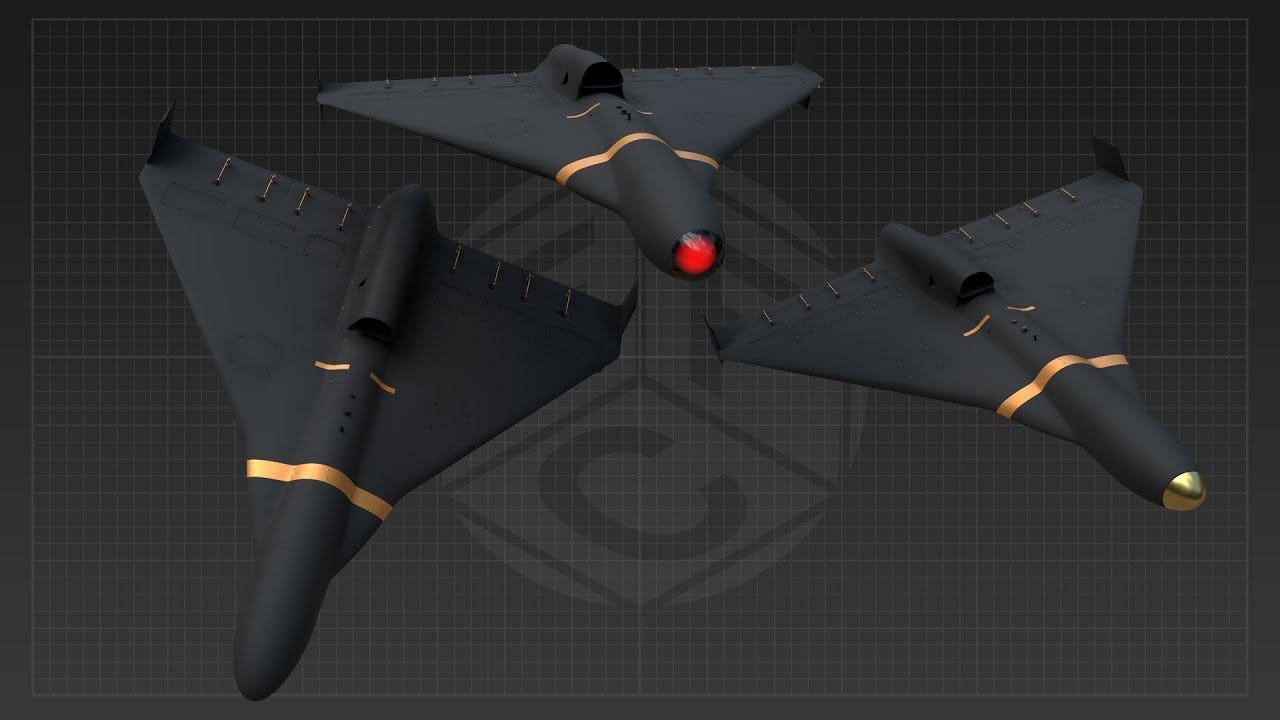
Iranian Shahed Drones – Three Variants
By William Schryver – imetatronink – June 26, 2024
In addition to the already-in-progress wars in Ukraine, Gaza, and the Red Sea, we are now staring down the barrel of yet another — rumored to be imminent in southern Lebanon.
There is no doubt Israel (just like its great benefactor, the United States) is, in the context of a “big war”, capable of executing several damaging strikes against a potential peer or near-peer adversary.
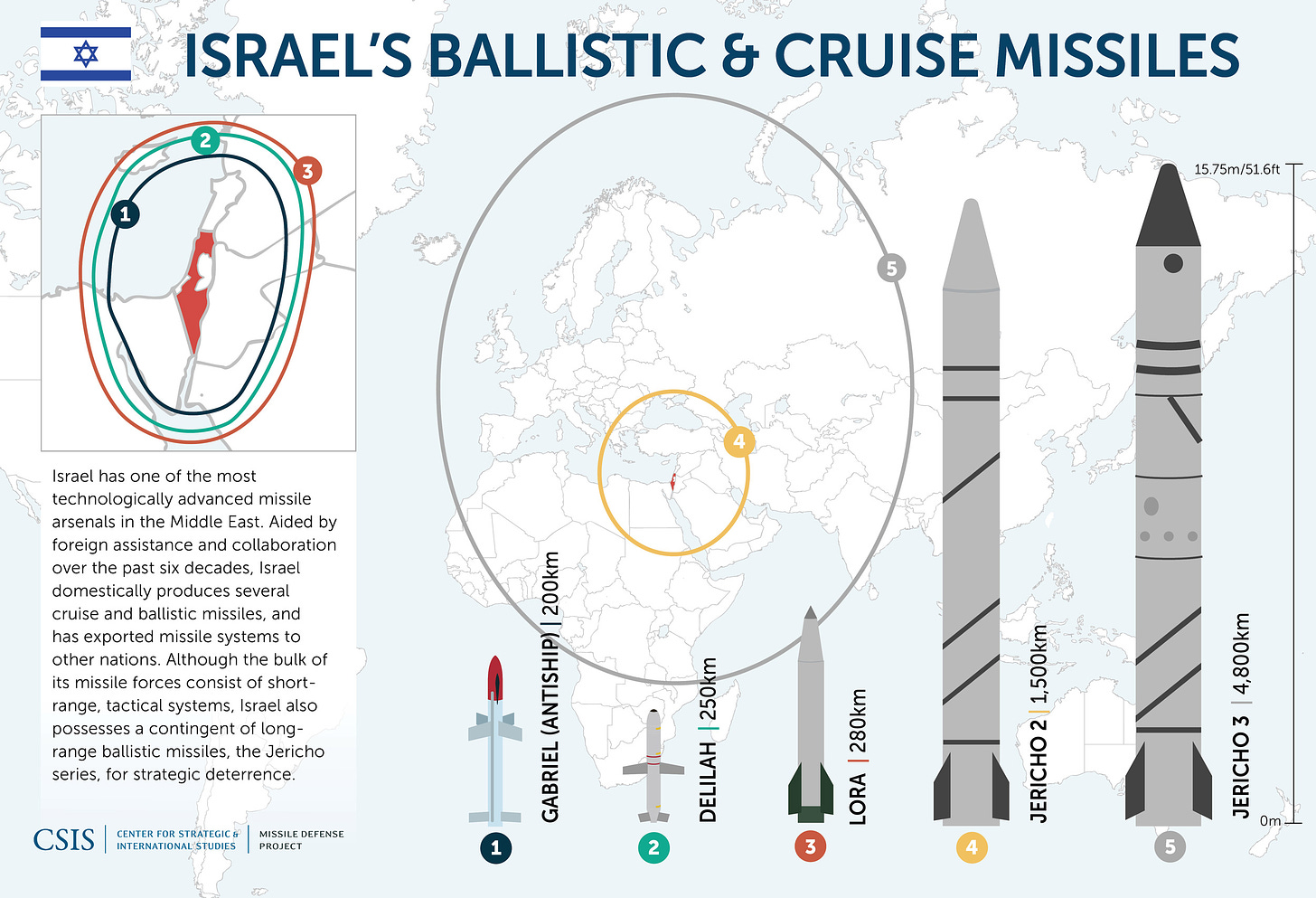
Israeli Ballistic and Cruise Missiles and Ranges
But, throughout the imperial domain, there are fatal weaknesses that exist right now, and which cannot be turned into strengths at any point in the near- or medium-term.
The first is what military types call “magazine depth”: munitions stockpiles sufficient to offensively overwhelm, defensively defeat, and strategically outlast the enemy.
Neither the United States, nor any of its largely impotent client nations, possess “magazine depth” sufficient to prosecute anything more than a relatively brief campaign against their potential peer adversaries: Russia, China, Iran — and all or any of their lesser-power partners.
The second problem is a corollary of the first. It is what I will term “shields”: the capacity to defeat a decisive proportion of the strikes one’s enemy can launch against you.
Neither the United States, nor any of its largely impotent client nations — by their own admission — possess anything even approximating comprehensive and effective “shields” against the quantity and quality of the types of strike weapons its potential adversaries can launch against them.
NATO sources themselves recently confessed that they only have about 5% potential air defense coverage against Russian missile strikes.
Now, of course, many will reflexively argue that, for example, the US could, with a massive “shock and awe” first-strike air campaign, effectively disarm Russian counterstrike capabilities.
This is patently ridiculous wishful thinking.
No one who actually understands the parameters of the military equation believes this to be true. And one need only examine the results of the months-long campaign against the lowly Yemenis to see confirmation of this incontrovertible fact.
Earlier this year we witnessed the Iranians launch a relatively modest missile strike against Israel, whose defenses were massively reinforced by American air and naval assets.
Using maybe 300 antiquated long-range strike drones and cruise missiles as decoys, the air defense response of both the US and Israel was massively attrited. And then, with a mere dozen or so seriously capable ballistic missiles, the Iranians blew right through the interception attempts of both the multiple land-based Patriot systems and a US guided-missile destroyer positioned off the eastern Mediterranean coast.
The Patriot systems were a total bust, and the Israelis summarily retired them in the immediate aftermath of the Iranian strike.
The US destroyer is reported to have launched eight top-shelf SM-3 missile defense interceptors (quite likely its entire “magazine depth”) at the incoming Iranian strike package.
They might have damaged one of the 12-15 incoming Iranian missiles.
The others hit with precision comparable to the 5-meter CEP Iran achieved in its 2020 strikes against the US airbase at Ayn al-Asad in Iraq.
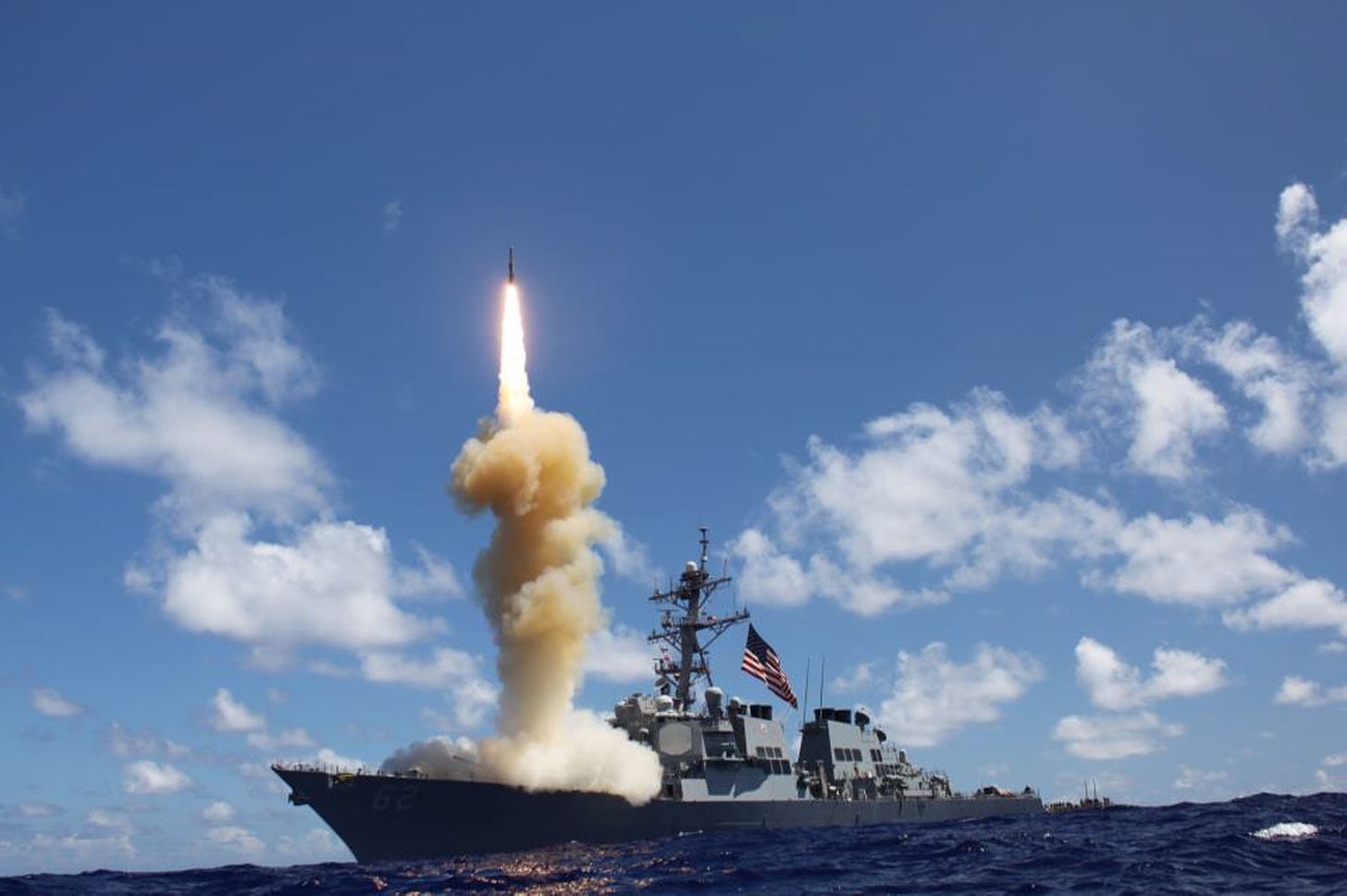
SM-3 Missile Interceptor Launched from a US Guided-Missile Destroyer
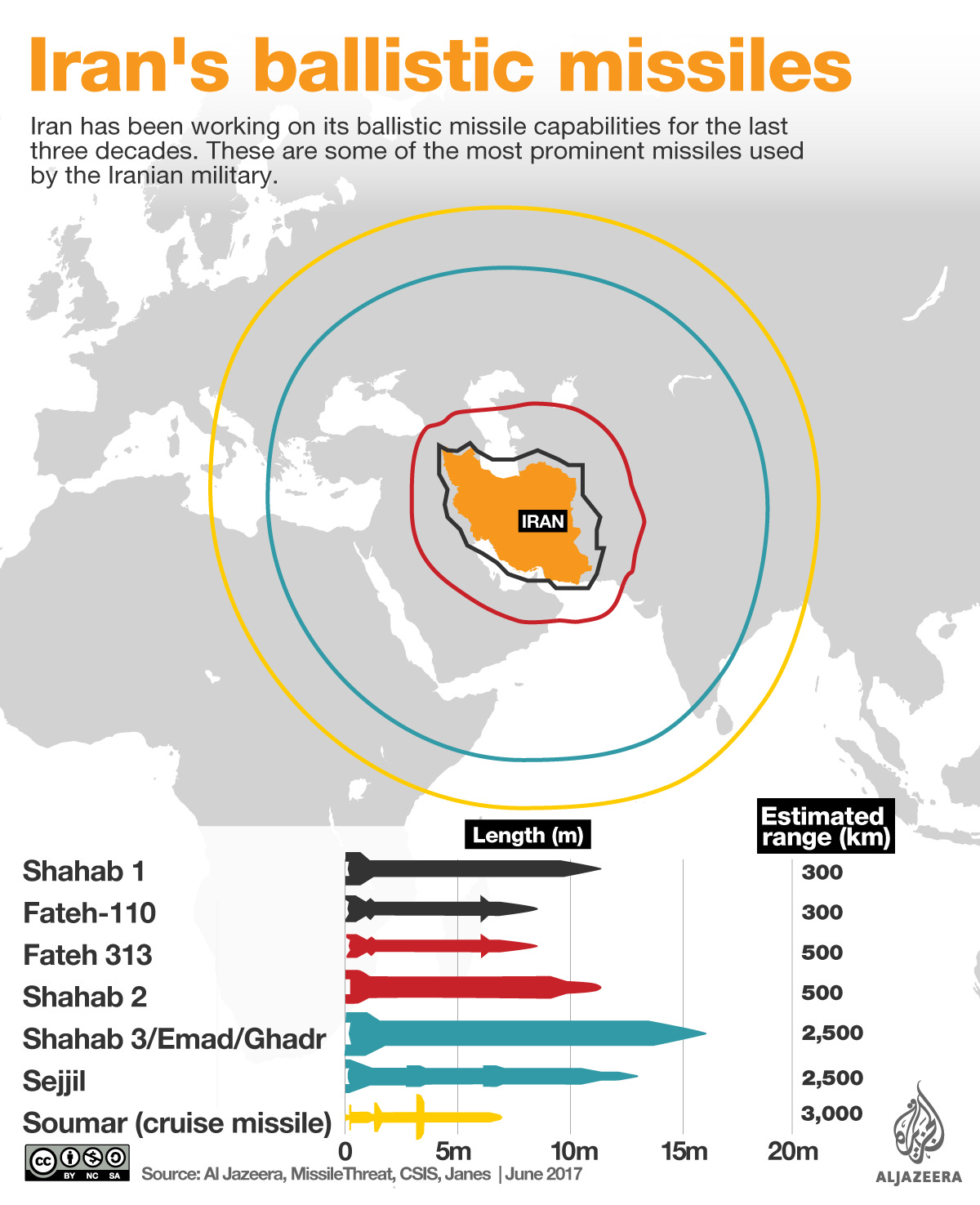
Iranian Ballistic Missiles and Ranges
Had Iran, at that moment in time, opted to follow up with an even larger strike consisting of several hundred of its best ballistic missiles, the US and Israeli defenses would have been penetrated to an overwhelming degree. It would have put to shame the opening-night show of the Americans’ 1991 “shock and awe” cruise missile attack against Baghdad.
Fortunately the Iranians didn’t press the matter, and let their modest yet impressive demonstration of strength suffice for the time being.
In recent months, Iran’s close partner Hezbollah — which is reputed to possess at least 100,000 missiles and drones of various types — has been routinely penetrating Israel’s once-vaunted “Iron Dome” missile defense system.
Indeed, Hezbollah has almost appeared to be mocking the Israelis’ impotence at times.
In any case, the Iron Dome has been revealed to be acutely vulnerable to penetration by Hezbollah drones and missiles.
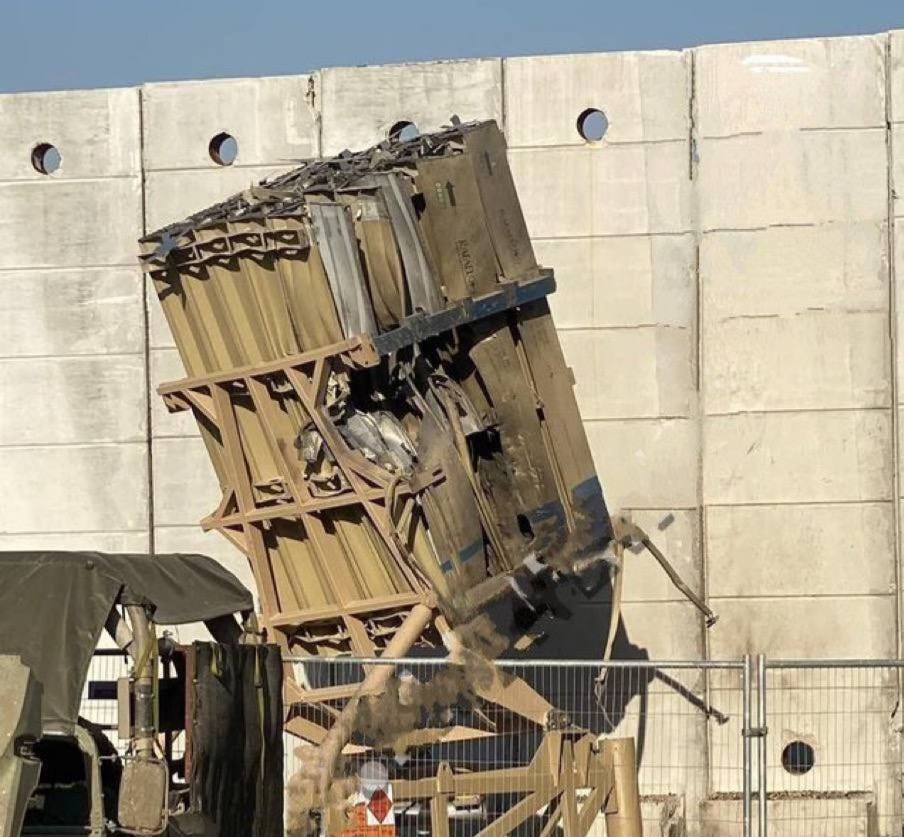
Israeli Iron Dome Launcher Destroyed by Hezbollah Drone Strike
It is not known with precision how many missiles and drones of various types Iran possesses. But it is reasonable to assume that their “magazine depth” is considerably larger than that of Hezbollah.
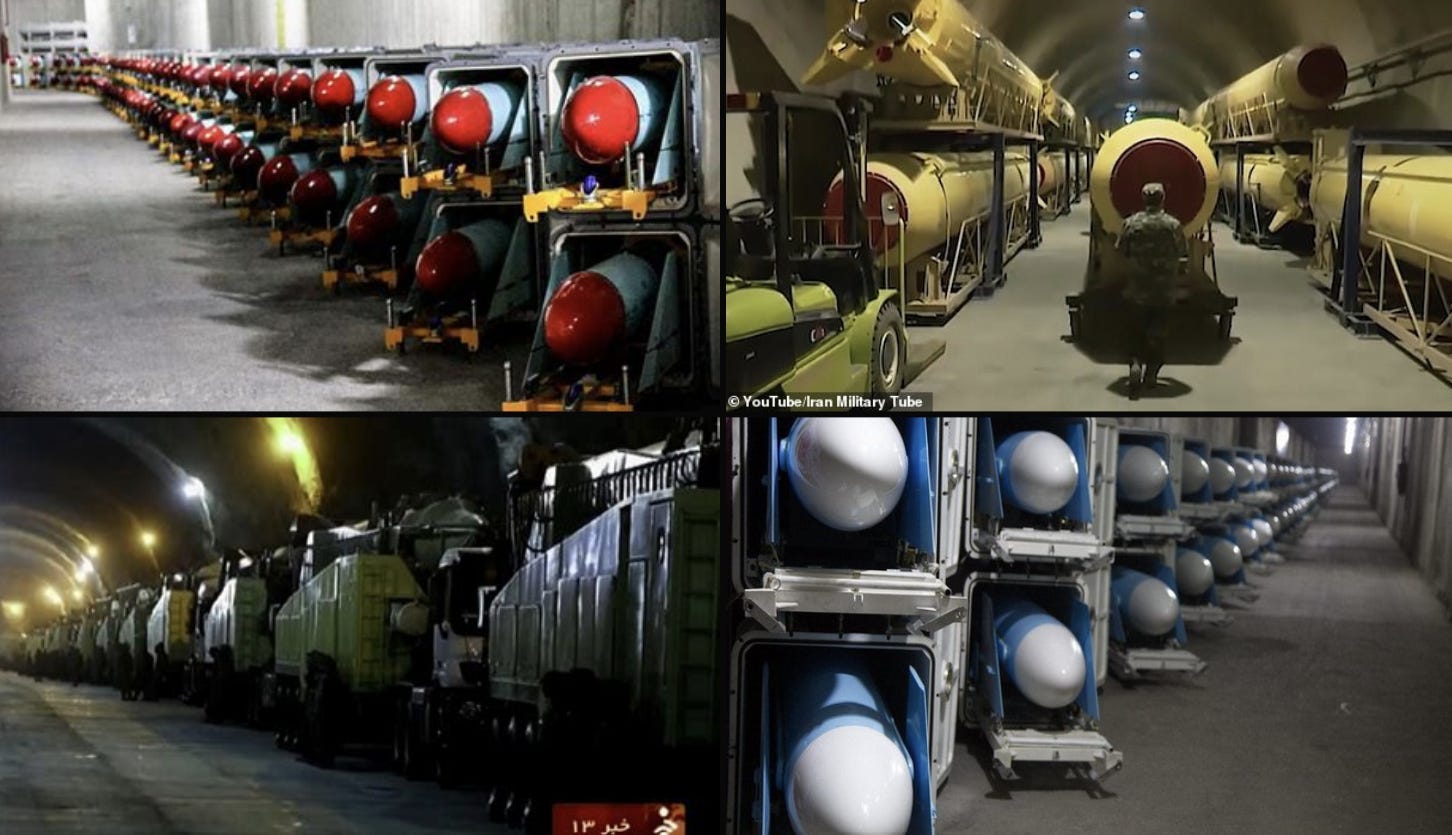
Iranian Missiles
It is also not known with precision how many missiles and drones of various types Russia possesses. But it is reasonable to assume that their “magazine depth” is considerably larger — and exceedingly more potent — than that of Hezbollah and Iran combined.
Even more importantly, the Russians have, over the course of the war in Ukraine, demonstrated an unprecedented capability to routinely shoot down the best strike missiles the US and its NATO vassals have been able to launch against them.
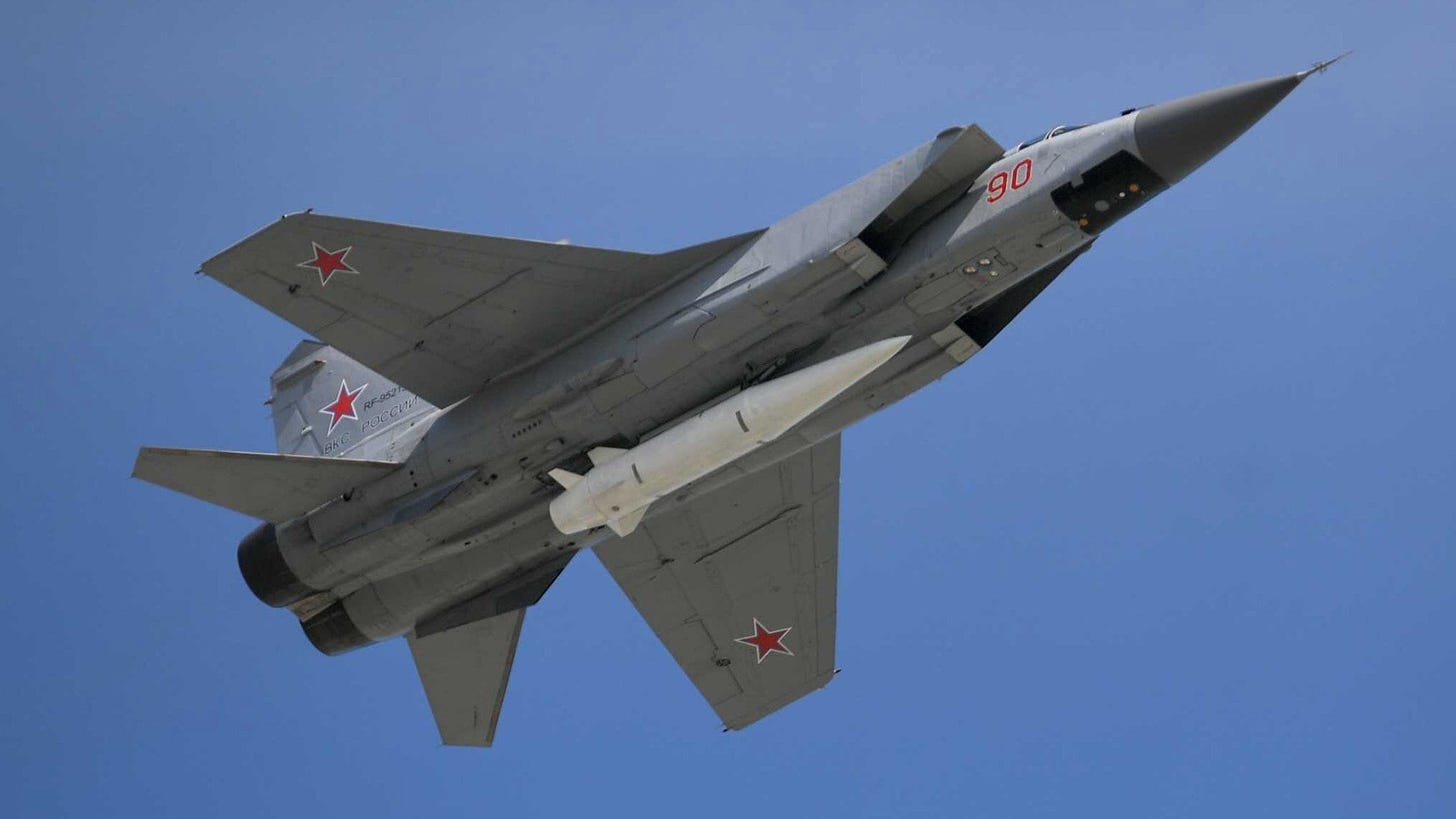
Russian MiG-31 Carrying a Hypersonic Kinzhal Missile
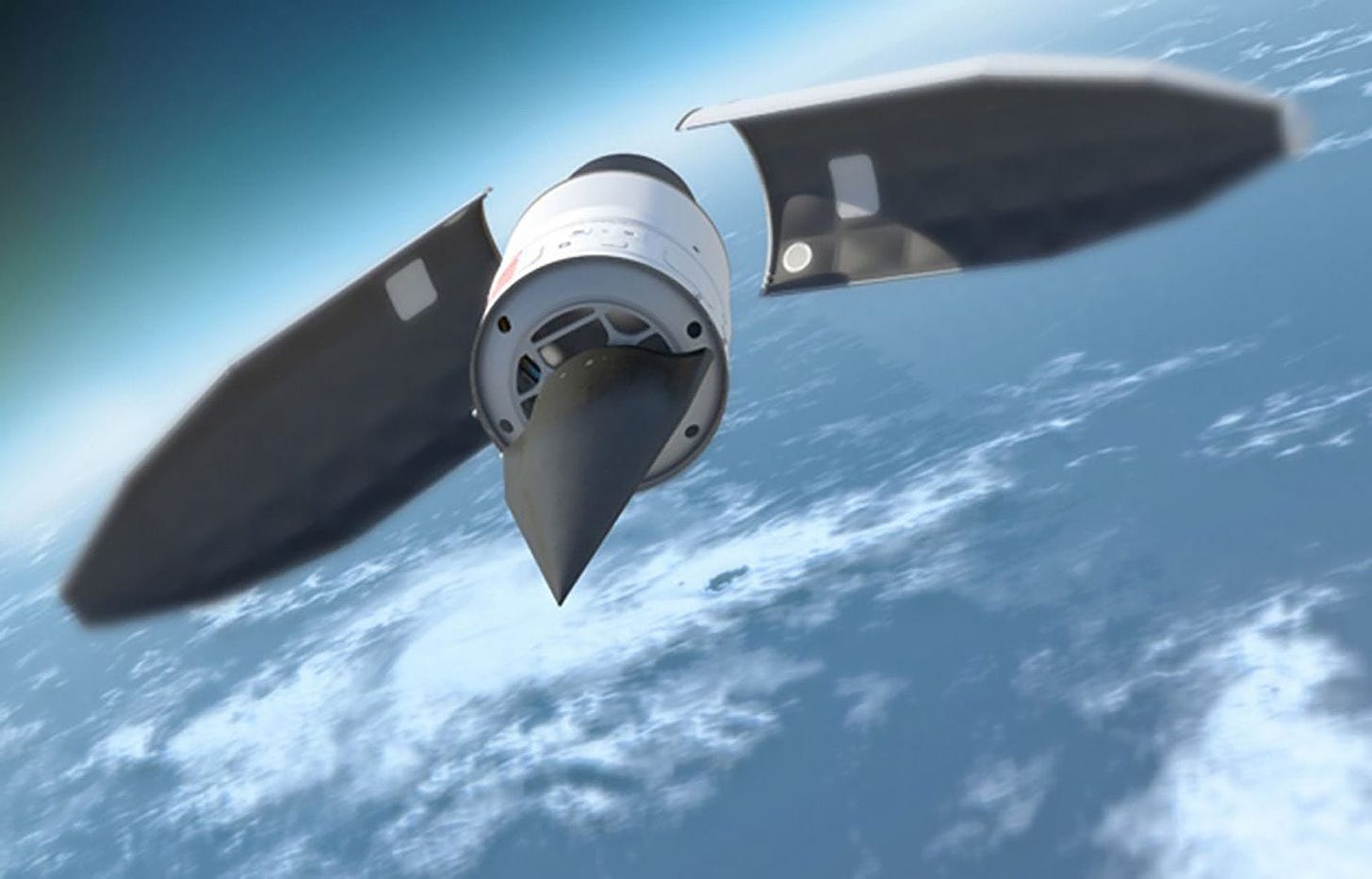
Russian Avangard Hypersonic Missile
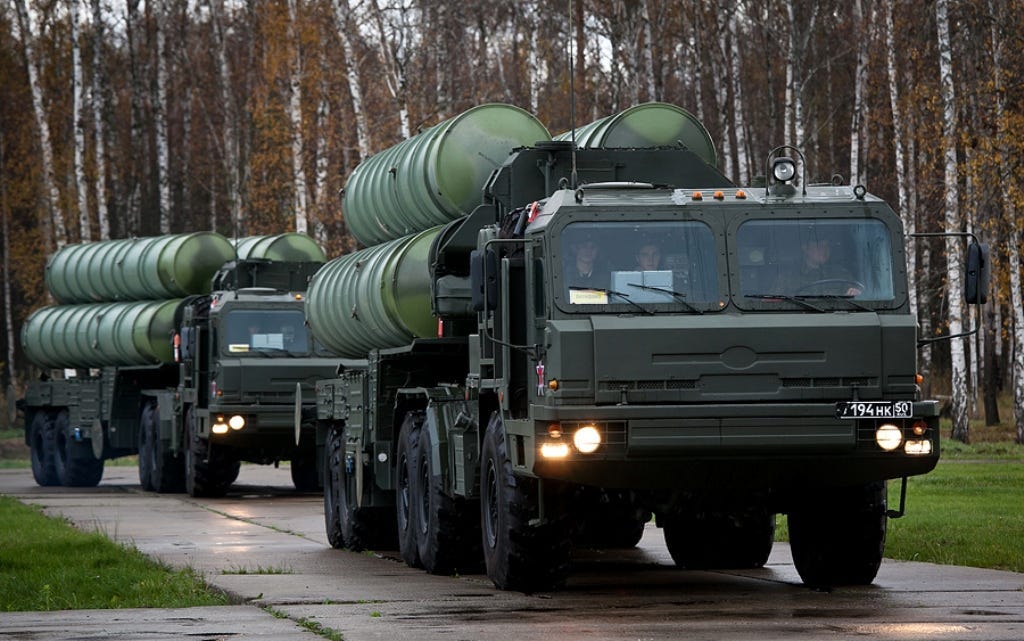
Russian S-400 Air Defense System
Lastly, it is not known with precision how many missiles and drones of various types China possesses. But it is reasonable to assume that their “magazine depth” is at least an order of magnitude larger than Hezbollah, Iran, and Russia combined.
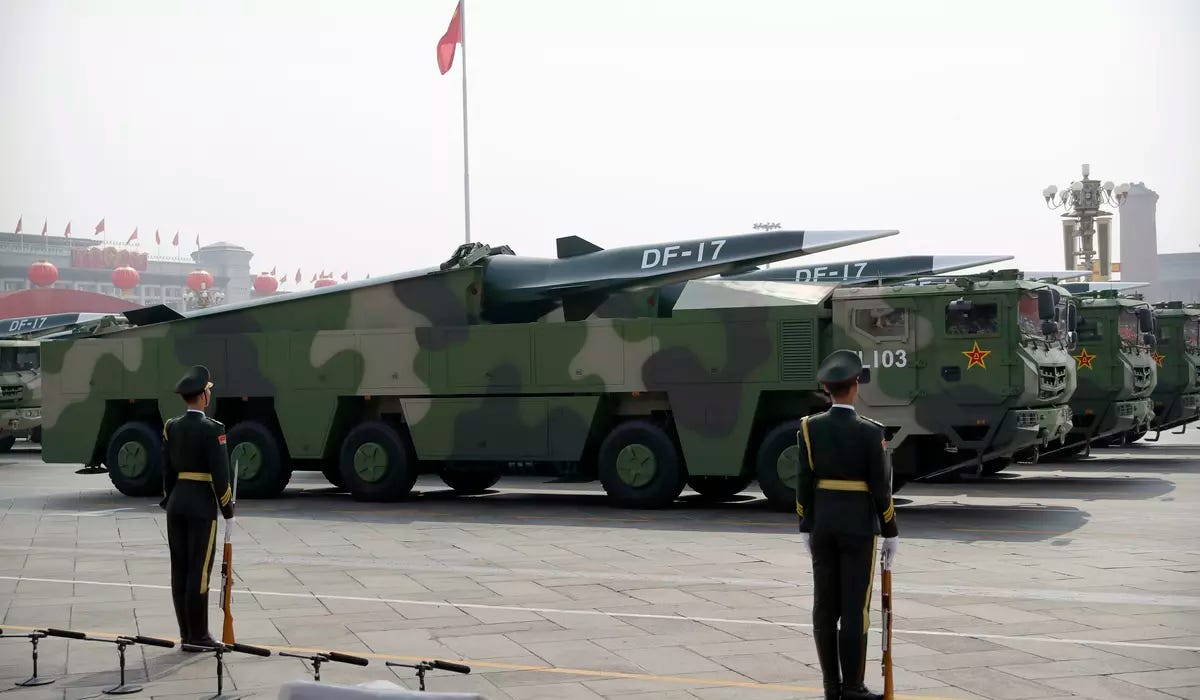
Chinese DF-17 Hypersonic Missiles
Of course, I’ve not yet made any mention of North Korea, who has now been formally received into the Russia, China, Iran mutual-defense partnership. People love to mock Kim Jong-Un and his people, but the empire underestimates them at their peril.
The Israelis can talk tough about making war against Hezbollah and its friends, but if they actually attempt it, it will end very, very badly for them.
The Americans and their almost laughably impotent allies can talk tough about making war against Russia or China, but if they actually attempt it, it will end catastrophically for them.
Then we’ll really have a dangerous situation on our hands.
Why Israel is Unprepared for War With Hezbollah
By Ekaterina Blinova – Sputnik – 24.06.2024
Israeli Prime Minister Benjamin Netanyahu told the country’s Channel 14 Television that Tel Aviv is ready to move some forces to the north to confront Lebanese resistance group Hezbollah. Could Tel Aviv wage a war on two fronts?
The Israel Defense Forces (IDF) and Hezbollah fighters have increasingly exchanged strikes across Lebanon’s southern border since the beginning of Tel Aviv’s Gaza war launched over Hamas’ attack on October 7 2023.
“From an Israeli perspective it would be very hard to imagine a double front war, even though we know that within the Israeli Cabinet of war, there are many ministries who are willing to try to open the second front with Hezbollah,” Dr Lorenzo Trombetta, Beirut-based scholar and analyst specialising on the Middle East, told Sputnik.
Hezbollah has repeatedly warned it would step up military actions unless Israel stops killing Palestinian civilians in the Gaza Strip.
Hezbollah has intensified attacks over Israel’s Rafah invasion.
Last week Hezbollah Secretary General Seyyed Hassan Nasrallah played down Israel’s threats to launch an all-out war against the resistance group, warning that it has a 100,000-strong military force capable of waging military actions against Israel in all three domains – land, air and sea.
Nasrallah added that the movement does not want a “total war” with Israel and called for a complete and permanent ceasefire in Gaza.
Hezbollah released a nine-minute video last week, filmed from an unmanned aerial vehicle (UAV) which penetrated Israeli air defenses and returned to Lebanese airspace without being detected. The footage shows sensitive civilian and military locations in and around Haifa, one of Israel’s largest cities.
According to some estimates, Hezbollah has up to 150,000-200,000 rockets and missiles and has also mastered the use of unmanned vehicles.
But Dr Hasan Selim Ozertem, an Ankara-based security and political analyst, told Sputnik that a repeat of the Israeli invasions in 1982 and 2006 would bring “catastrophe” to southern Lebanon.
“The plot is valid for a possible operation against Lebanon because looking in the past, in 2006, Israel also could carry out another operation against Hezbollah and, as you remember, left behind a kind of catastrophe in the Lebanese terrain,” Ozertem said. “Israel has all the capabilities, especially the air capability and also land capability to carry out an operation.”
While conceding that the Israeli military capabilities are “very strong and very high,” Trombetta expressed doubts about Tel Aviv’s chances of succeeding in a war against Hezbollah.
“Technically speaking, Hezbollah has drones and mainly it showed recently, during May and June, its abilities to launch soil-air missiles that can hit or can counter not only Israeli drones, the Hermes 450 and Hermes 900, but also Israeli jet fighters,” the pundit said. “So first of all, Hezbollah could try to increase its abilities to defend the Lebanese territory with these surface-to-air missiles.”
“Secondly, they also showed in the last weeks the ability to offend, to pose a threat within the Israeli territories with armed drones, suicide drones, and other flight weapons that breached the Iron Dome system on more than one occasion, even recently,” Trombetta continued.
The Washington-based Center for Strategic and International Studies (CSIS) published analysis in March describing how a potential Israel-Hezbollah conflict in 2024 could be more challenging for Tel Aviv than the 2006 Israeli-Lebanese war.
The think-tank drew attention to the fact that Hezbollah has for years built upon its successful 2006 tactics of “decentralizing its command and control and reorganizing to force the IDF into more urbanized terrain where [Hezbollah] fighters can take advantage of concealed, fortified positions.”
Hezbollah has beefed up its military stockpiles with new weapons over the past 18 years. It has also gained extensive military experience during the war against ISIS and other Islamist terrorists in Syria and has had “access to capabilities and competencies used by conventional armies.”
The CSIS also noted that the geography of southern Lebanon offers advantages for Hezbollah guerrillas, including positions on rocky hills where they can hide and fire rockets, unmanned aircraft systems and anti-tank guided missiles at Israeli positions on the border.
The Israeli Reichman University Institute for Counter-Terrorism assumes that Hezbollah could fire up to 3,000 missiles a day and overwhelm Israel’s air defenses.
The researchers warned that intensive attacks would deplete the Israeli stockpiles of surface-to-air missiles within a few days of combat, exposing the nation to further Hezbollah missile and drone attacks. They argued that Tel Aviv is unprepared for an all-out war with the resistance force.
“We should include also the fact that in case Israel will launch a war against Hezbollah in Lebanon, it is very possible, it is very likely that Iran and other Iranian allies in the region will activate their forces against Israel and the US interests,” Trombetta said, adding that Yemen’s Houthi-led government, the Iraqi Islamic Resistance and others could come to Hezbollah’s aid in the event of an all-out Israeli attack on Lebanon.
Israel and Hezbollah on the brink of war
By Steven Sahiounie | Strategic Culture Foundation | June 23, 2024
The Middle East is sitting on a powder keg, and every minute that passes brings heightened tensions between Israel and Hezbollah.
Canada, the U.S., Great Britain and Kuwait have all warned its citizens in Lebanon to evacuate.
The impending war is caused by Israeli refusal of a ceasefire in Gaza. Hezbollah says they will continue to stand in solidarity with the Palestinians of Gaza as the continuing genocide is perpetrated by Israel, but as soon as a ceasefire begins, Hezbollah’s response will cease.
Hezbollah is a Lebanese resistance group which is heavily armed. Most experts agree that the military might of Hezbollah and Israel are quite comparable on many levels, but Israel has air superiority.
Israel has a sophisticated air defense system, the ‘Iron Dome’. However, this system can be overwhelmed by Hezbollah if they were to launch a massive amount of missiles at Israel, and all agree that Hezbollah has a huge arsenal of missiles.
If the ‘Iron Dome’ was inundated by missiles launched from Lebanon, the effectiveness of the Israeli defenses would stop, and Israel could suffer destruction on a scale it has never experienced before. We have witnessed the destruction of Israeli missiles on Gaza, and homes and buildings across Israel could face a similar disaster.
Hezbollah demonstrated it has an air defense system, but it has been secretive in showing the capabilities of its defense from Israeli jets; however, on at least one occasion Hezbollah utilized their air defenses to repel an Israeli jet flying over Lebanon.
Amos Hochstein, the U.S. special envoy dispatched recently to Israel and Lebanon in hopes of averting a war between Israel and Hezbollah, came back empty-handed. Hochstein had been successful in a negotiation between Israel and Lebanon in 2022 over the maritime borders, but this time he was not negotiating with the Lebanese government alone, but with the most powerful resistance group in the Middle East.
The root cause of all conflicts in the Middle East emanate from the brutal Israeli occupation of Palestine, which has stripped away all human rights, and civil rights, from about six million Palestinians, while the six million Jews in Israel live in a quasi-democracy with human rights and civil rights comparable to most western democracies.
U.S. President Joe Biden and U.S. Secretary of State Antony Blinken have repeatedly told Israeli officials the U.S. does not want to see a wider war in the Middle East, where other nations could be involved should Lebanon face destruction.
Israeli Prime Minister Benjamin Netanyahu has warned Israel would “turn Beirut into Gaza” in the event of a war.
Experts agree that Biden would continue to support Israel even in the face of a war on Hezbollah. The international community has come out against Israel and its genocide on Gaza, but Biden continues to support war crimes and crimes against humanity committed by Israel.
Biden has sponsored a ceasefire plan, but Israel refused it, and experts suggest that the Biden plan was not designed by Washington to succeed, but was drafted only as an exercise in buying time for Israeli Prime Minister Benjamin Netanyahu.
The Israeli public and military are divided on the war on Gaza. Many are demanding Israel stop the war and get the hostages out after almost 9 months of captivity. Others support the war on Gaza as part of the Zionist plan to eliminate all non-Jews and create one Jewish nation from the ‘river to the sea’.
Netanyahu firmly demands the continuation of the war on Gaza and demands that Hamas be destroyed, but his military leaders have said that is an impossible task, as Hamas is an ideology, that of resistance to occupation, which is guaranteed to all people through the Geneva Convention.
On June 18, the Israel Defense Forces (IDF) said plans for an attack in southern Lebanon had been approved and steps had been taken to “accelerate readiness in the field.” The statement came from Major General Ori Gordin, the head of IDF Northern Command, and Major General Oded Basiuk, who heads the IDF’s Operations Division.
Israeli Foreign Minister Israel Katz threatened Hezbollah that they faced “destruction” amid “all-out war” at the Israel-Lebanon border.
Katz’s threat came after Hezbollah published a surveillance video that it took by a drone over various Israeli military, infrastructure and civilian installations, including some in the Israeli port city of Haifa.
“In an all-out war, Hezbollah will be destroyed and Lebanon will be severely hit,” Katz wrote on X.
On June 21, Hezbollah said it fired dozens of rockets into northern Israel in retaliation for a deadly air strike in south Lebanon that Israel said killed one of the group’s operatives. Hezbollah also claimed several other attacks on Israeli troops and positions over the course of the day.
In a meeting with visiting Israeli officials in Washington, Blinken underscored “the importance of avoiding further escalation in Lebanon and reaching a diplomatic resolution that allows Israeli and Lebanese families to return to their homes”, according to a statement.
Hezbollah chief Hassan Nasrallah had warned “no place” in Israel would “be spared our rockets” if a wider war began, in a TV address on Wednesday. He also threatened Cyprus if it opened its airports or bases to Israel “to target Lebanon”. Cyprus houses two British bases, including an airbase.
Israel invaded and brutally occupied Lebanon from 1982 to 2000. Its withdrawal was a victory for Hezbollah. In 2006, Israel launched a second war on Hezbollah which saw Israel prevented from invading by the might of Hezbollah, and in the following years the resistance group has gotten much stronger militarily.
Dozens of Israeli towns are now deserted, with around 60,000 Israelis evacuated to temporary accommodation, while about 90,000 have also fled from southern Lebanon.
Israel has launched roughly four times as many attacks as Hezbollah over the course of the conflict, according to the Armed Conflict Location and Event Data Project, a Wisconsin-based research group specializing in conflict data analysis. Last week, Israel made its deepest attack yet into Lebanon, striking 75 miles north of the border.
Israeli troops have also deployed white phosphorus in Lebanon, a substance that burns at high temperature and can be used to create smokescreens to obscure troop movements, but can cause respiratory damage and deadly burns. Its use near civilian areas is a violation of international humanitarian law.
“It’s not a question of if it will happen but when it will happen,” Avichai Stern, the mayor of Kiryat Shmona, the largest town in Israel’s north, said in an interview, and added, “We have to wipe them out.”
The war between Israel and Lebanon can be avoided if Israel will stop the unrelenting attacks on Gaza, which have resulted in over 36,000 deaths, mostly women and children.
Advantage Hezbollah
By Alon Mizrahi | June 23, 2024
Remember last week’s video from Hezbollah, with the drone over Northern Israel?
Well, there’s a new one, and it is also very interesting. It doesn’t look like footage from a drone, but rather like satellite imagery.
But this is not Google Earth or some nonsense like that. No publicly accessible satellite service will show you Israel’s top security sites. Try it. You’ll get nothing. It’s all blurred out.
So by publishing this Hezbollah accomplished two goals: first, they know many Israeli secrets and their specific locations. Second, they have access to high-quality satellite imagery.
This means Hezbollah can not only potentially hit sensitive sites with high accuracy. What it also means, and is just [as] problematic for Israel, is that Hezbollah may be able to track the movements of Israeli forces deep in Israeli territory in relative real-time. A capability no enemy of Israel ever had while directly involved in an armed conflict against it.
We know that Iran has dozens of satellites in space, some capable of state-of-the-art high resolution. When Israel fought Hezbollah in 2006 Iran had no such capability. Today it is a major international satellite powerhouse, using domestically-developed missiles and launchers.
Featured Video
Trita Parsi: Israel Set a Trap for Total War in the Region
or go to
Aletho News Archives – Video-Images
From the Archive
Zionism’s Violent Legacy
By Donald Neff | Washington Report On Middle East Affairs | January 1996
On January 4, 1948, Jewish terrorists drove a truck loaded with explosives into the center of the all Arab city of Jaffa and detonated it, killing 26 and wounding around 100 Palestinian men, women and children.[1] The attack was the work of the Irgun Zvai Leumi – the “National Military Organization,” also known by the Hebrew letters Etzel – the largest Jewish terrorist group in Palestine. The Irgun was headed by Revisionist Zionist Menachem Begin and had been killing and maiming Arabs, Britons and even Jews for the previous ten years in its efforts to establish a Jewish state.
This terror campaign meant that at the core of Revisionist Zionism there existed a philosophical embrace of violence. … continue
Blog Roll
 Aletho News
- Trita Parsi: Israel Set a Trap for Total War in the Region
- Trump’s Iran war is on an Israeli leash
- Saudi oil boss issues global supply warning
- Riyadh Says Its Oil System Is Intact. The Numbers Say Otherwise.
- Trump and Netanyahu Want to “Finish the Job” on Iran
- US ‘one-sided dictation’ not Iran’s beliefs makes rational talks impossible: Baghaei
- Iran’s Next Strike May Not Explode. It Could Shut You Down /Col Doug Macgregor
- Iran: US political targets legitimate if assassinations return
- Iraq shuts key border crossing with Iran under US pressure: Report
- Undersea Internet cables could be targeted in retaliation for attacks on Iran: IRGC deputy chief
- If Americans Knew
- The Israel Lobby’s Changing Fortunes
- AIPAC has become such a political liability that it’s shifting to a more “nimble” approach to buying politicians
- At least 160 Israeli settler attacks in 2 weeks
- Will Gaza’s Ancient Christian Community Disappear Forever?
- Israel’s vision of regional security rests on keeping Arab states weak
- Heidi Levine recounts how Palestinian youths helped save her in settler attack
- DAILY UPDATE: Latest essential news on Palestine, Israel, & region
- Trump’s Intensifying Sabotage of the ICC, for Israel’s Sake
- Israeli military detain US and UK volunteers in West Bank including Democratic NY politician Brad Lander
- Americans at National Conservatism Conference held in Israel this year criticize Israel
- No Tricks Zone
- E-Cars Reduce CO2 Emissions By Only 41% Compared To Internal Combustion Engine Vehicles
- Predictions Made By Renowned Climate Professor Over Past Decades Have Been Proven To Be Poor
- New Study Suggests Large Regions Of The Pacific Ocean Have Been Cooling For The Last 80 Years
- Germany’s Green Energy Debacle: High Energy Costs Force Kahla Porzellan to Close After 182 Years!
- New Study: 50 Years Of The Most Aggressive ‘Net Zero’ Policies Can Only Affect The Global Climate By 0.03°C
- US September “Heat” Was No Record…Many Records Set Decades Ago
- Latest European Green Energy Debacle; Portugal’s Largest Flagship Solar Park Insolvent!
- Green Energy Debacle: German Expert Professor Fritz Vahrenholt Warns Of Severe Economic And Social Consequences
- Two More Paleo Reconstructions Affirm Meters-Higher Sea Levels Across Ireland, Brazil 7000-6000 Years Ago
- New Study: Earth And Venus Surface Warmth Largely Explained By Convection And Lapse Rate, Not CO2 Or Radiation

