A Need to Clear Up Clinton Questions
By Ray McGovern | Consortium News | May 5, 2016
“Some people think they can lie and get away with it,” said former Defense Secretary Donald Rumsfeld with feigned outrage. And, of course, he has never been held accountable for his lies, proving his dictum true.
The question today is: Will former Secretary of State Hillary Clinton’s Teflon coat be as impermeable to deep scratches as Rumsfeld’s has proven to be?
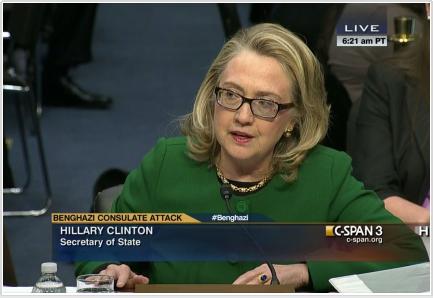
With the “mainstream media” by and large giving Hillary Clinton a pass on her past, few Americans realize how many Pinocchio faces need to be tacked onto many of her statements. Clinton is said to be “unquestionably” the frontrunner for the Democratic nomination, essentially the presumptive nominee. That is unquestionably true – but only because she has not been questioned with much rigor at all. And on those few occasions when she has been asked hard questions, she has often ducked them.
For example, at the March 9 debate in Miami, Jorge Ramos, the longtime anchor for Noticiero Univision, asked Secretary Clinton whether she would quit the presidential race if she were indicted for putting classified information on her private email server.
She replied: “Oh, for goodness sake, it’s not going to happen. I’m not even answering that question.” [See Consortiumnews.com’s “Is Hillary Clinton Above the Law?”]
Not so fast, Madame Secretary. It is looking more and more as if you will, after all, have to answer that question.
Those “Damn Emails” Again
On Wednesday in Washington, DC, a federal judge issued an order that may eventually require Clinton to testify under oath in a lawsuit related to the private email server she used while Secretary of State.
The judge gave Judicial Watch, a conservative watchdog group, permission to take sworn testimony from close Clinton aide Huma Abedin and others over the next eight weeks. It is possible that Clinton herself will have to testify under oath on the serious email issue before arriving at the Democratic convention in July.
One key issue in question is whether all relevant documents have been provided to Judicial Watch. My guess is that – given lawyers’ propensity, and often their incentive, to secure delay after delay in such proceedings – there may not be much likelihood of all this happening that quickly.
More precarious for Secretary Clinton, in my view, is the possibility that FBI Director James Comey will be allowed to perform a serious investigation and pursue Clinton on sworn testimony she has already given; for example, on whether she was aware of an operation run out of Benghazi to deliver Libyan weapons to rebels in Syria.
During her marathon testimony on Oct. 22, 2015, to the House Select Committee on Benghazi chaired by Rep. Trey Gowdy, R-South Carolina, Rep. Mike Pompeo, R-Kansas, was very specific in his questioning, leaving Clinton little wiggle-room:
Pompeo: Were you aware or are you aware of any U.S. efforts by the U.S. government in Libya to provide any weapons, directly or indirectly, or through a cutout, to any Syrian rebels or militias or opposition to Syrian forces?
Clinton: No.
Pompeo: Were you aware or are you aware of any efforts by the U.S. government in Libya to facilitate or support the provision of weapons to any opposition of Gadhafi’s forces, Libyan rebels or militias through a third party or country?
Clinton: No.
Did Secretary Clinton think we were “born yesterday,” as Harry Truman used to say? From what is already known about the activities of the U.S. “mission” and “annex” in Benghazi and the role played by the late Ambassador Christopher Stevens there, it seems quite likely that Clinton perjured herself in answering No.
And I believe this will become quite clear, if the FBI is allowed to pursue an unfettered investigation – and even clearer if the National Security Agency shares the take from its dragnet surveillance.
But those are big IFs. If I read President Barack Obama correctly, he will be more inclined to tell Attorney General Loretta Lynch to call off the FBI, just as he told former Attorney General Eric Holder to let retired General (and CIA Director) David Petraeus off with a slap on the wrist for giving his mistress intelligence of the highest classification and then lying about it to the FBI.
As for Clinton, perjury is not the kind of rap that she would welcome as she pursues the presidency. Trouble is, not only FBI investigators but also NSA collect-it-all snoopers almost certainly have the goods on whatever the truth is, with their easy access to the content of emails both classified and unclassified. [See Consortiumnews.com’s “Hillary Clinton’s Damning Emails.”]
Sadly, Comey and his counterparts at NSA are likely to cave in if the President tells them to cease and desist. Indeed, like legendary FBI Director J. Edgar Hoover, they may relish the prospect of being able to hold their knowledge of Hillary Clinton’s possible perjury and other misdeeds like a sword of Damocles over her head if she becomes president.
Whistleblower Needed
Thus, unless another patriot with the courage of an Edward Snowden or a Daniel Ellsberg recognizes that his primary duty is to honor his/her oath “to support and defend the Constitution of the United States against all enemies foreign and domestic,” and acts accordingly, the country could end up with a compromised President beholden to Hoover’s successors and the NSA sleuths who “collect everything,” including the emails of the Secretary of State – and those of the President.
Those at the FBI and NSA with the courage to consider whistleblowing need to be aware of the proud tradition they would be joining. The first recipient of the Sam Adams Award for Integrity in Intelligence (2002) was Coleen Rowley of the FBI, and in 2004 the award was given to FBI analyst and translator Sibel Edmonds.
As for signals intelligence, no fewer than four Sam Adams whistleblower awardees have come from NSA and its British counterpart GCHQ: the UK’s Katharine Gun (2003), and three from NSA itself – Thomas Drake (2011), Edward Snowden (2013), and William Binney (2015).
More distinguished company among people of integrity would be difficult – if not impossible – to find. In a few months, we will be considering nominations for the award to be given in 2017.
Neocons Make Trump Sound Like Peacenik on Foreign Policy
Sputnik – May 1, 2016
Donald Trump’s long-awaited, much-discussed speech on foreign policy has been praised by some and slammed by others, but the more neocons recoil in horror over his ideas, the more those who are not otherwise inclined to support him might warm up to the Republican frontrunner’s ‘radical’ ideas.
Trump’s exploratory speech on foreign policy had its bright moments, with the candidate emphasizing that US foreign policy disasters in the Middle East threw the region into chaos, and saying that the cycle of hostility between Washington and Moscow must come to an end (“from a position of strength only” on the US’s part, naturally).
At the same time, long-standing non-interventionists including Ron Paul Institute political analyst Daniel McAdams weren’t as enthusiastic about Trump’s proposals, McAdams telling Sputnik that Trump’s proposals are a mixed bag, since his advisors appear to be realists, and “that is not super satisfying to a non-interventionist and an anti-war person because realists…lack the philosophy…of avoiding war and avoiding entangling alliances.”
Nevertheless, the neocons’ incessant bashing of Trump has created the potential to make the candidate appealing to those Americans sick of aggressive policy against Russia, and those opposed to never-ending wars in the Middle East.
This holds true in the case of neocon pundit Anne Applebaum, who has previously gone so far as to say that a Trump presidency would mark “the end of the West as we know it.”
Responding to Trump’s foreign policy speech in an op-ed for the Washington Post, Applebaum suggested that his rhetoric was not only ridiculous and contradictory, but also dangerous (to the neocons, of course).
“On the one hand, he said that ‘your friends need to know that you will stick by the agreements that you have with them.’ On the other hand, he threatened to ‘walk’ if those same friends didn’t pony up to his demands. He wants to invest heavily in the military, but he wants to stop using the military. He doesn’t want to do ‘nation-building’ but does want to promote ‘regional stability’.”
Ratcheting up the pretentiousness, Applebaum suggested that “there was no sense” that Trump even “knew what either of those terms meant,” adding that unfortunately, neither may many American voters.By the same token, she said, the ‘multiple contradictions’ in the speech indicate “that audiences can pick and choose their message. Isolationists and ‘realists’ heard what they wanted to hear. On the other hand, Trump’s call to ‘reinvigorate Western values and institutions’ might well appeal to those voters who aren’t isolationist at all. He says he likes American soldiers and wants to spend more on defense, so what’s wrong?”
At the same time, “foreign audiences are already hearing different Trump messages and are picking and choosing the ones that they like. The Russians love the way he talks about foreign policy as if it were a cynical business deal, because that’s exactly how President Vladimir Putin sees it. A part of the European left is already warming up to the suggestion the United States withdraw from Europe, because that’s what it has always wanted, too. And yes, all concerned will be perfectly capable of ignoring, simultaneously, all of the things about Trump that they should in theory deeply dislike.”
Ultimately, Trump’s foreign policy proposals do appear to be somewhat contradictory and hazy, in contrast to the more principled approach proposed by Dr. Ron Paul. Nevertheless, the fact that neocons continue to throw a fit over Trump’s remarks on foreign policy, despite his status as the presumptive Republican nominee, is an indication that he remains a thorn in the side of Washington’s neoconservative foreign policy establishment.At the same time, with fellow non-interventionist Bernie Sanders effectively sidelined by Hillary Clinton and the Democratic Party establishment, Trump may yet prove to be the lesser hawk compared to the former secretary of state, who voted for the Iraq war, pushed the Libyan intervention, and whose aides promoted the Maidan coup d’etat in Ukraine. In any case, Trump’s ‘common sense conservative’ views certainly never helped him win support among hawkish Republican elites. But they have given him the ear of those sick and tired of business as usual in Washington’s political and and military relationship with the rest of the world.
The Lingering Danger of Google & Facebook
By Ulson Gunnar – New Eastern Outlook – 30.04.2016
During the 2011 Arab Spring, it was clear to those who bothered to look, that the US State Department and the various arms of soft power attached to it were directly responsible for what was otherwise initially passed off as a spontaneous, region-wide uprising.
Eventually, what was dismissed as “conspiracy theory” regarding the US-backed nature of the uprising, was finally admitted to by the New York Times in an April 2011 article titled, “U.S. Groups Helped Nurture Arab Uprisings,” which admitted that:
A number of the groups and individuals directly involved in the revolts and reforms sweeping the region, including the April 6 Youth Movement in Egypt, the Bahrain Center for Human Rights and grass-roots activists like Entsar Qadhi, a youth leader in Yemen, received training and financing from groups like the International Republican Institute, the National Democratic Institute and Freedom House, a nonprofit human rights organization based in Washington, according to interviews in recent weeks and American diplomatic cables obtained by WikiLeaks.
The New York Times would go on to admit direct ties between the above-mentioned organizations and both the US Congress and the US State Department.
The article would also admit:
Some Egyptian youth leaders attended a 2008 technology meeting in New York, where they were taught to use social networking and mobile technologies to promote democracy. Among those sponsoring the meeting were Facebook, Google, MTV, Columbia Law School and the State Department.
The 2008 meeting wasn’t the only one. And, as it would turn out, Facebook and Google’s role in preparing the ground for the Arab Spring, quite literally years before the “spontaneous” protests erupted, was much more complicated than merely being sponsors of a single event in New York.
Hillary Clinton was serving as US Secretary of State both during and in the lead up to the Arab Spring. She even attended via teleconference one of these “technology meetings” briefly mentioned by the New York Times.
Also attending the meetings were actually staff from the US State Department and various staff from both Google and Facebook. Also in attendance were members of the US media. In other words, the event was not only sponsored by the US government and these two tech-giants, it was organized and conducted by them as well. Their event program (PDF) makes this abundantly clear.
The purpose was clearly to create a unified network combining the US State Department’s direction, the tech-giant’s technical capabilities, and influence of the US media together to overwhelm the information space when finally the time came for the Arab Spring to unfold. And overwhelm it did. The governments of Tunisia, Egypt, Yemen, and Libya fell, with violence and even war breaking out in the latter three, while Syria to this day remains engulfed in violence that began in the wake of the 2011 operation.
More recently, e-mails leaked from then US Secretary of State Hillary Clinton, reveal further details on just how close the tech-giants work with the government. Some could even say they are an extension of the government.
A CBS article titled, “Clinton Emails Show State Department’s Close Relationship With Google,” reveled that:
The latest release of emails sent to and from Hillary Clinton’s private email server reveals a close relationship between Google and the State Department.
A 2012 email recently uploaded onto Wikileaks’ searchable archive came from Google Ideas director Jared Cohen, who formerly worked as an advisor to Secretary Clinton, indicates that Google wanted to help bolster support for those who defected from Syrian President Bashar al-Assad’s military.
It also showed that before launching a “defection tracker” Cohen wanted the State Department to weigh in on the idea and potentially provide feedback.
Not only does the leak expose what appears to be a revolving door between the tech-giant and the US State Department, but it exposes the fact that regardless of who is working where, Google was working in tandem with the State Department. Cohen was actually listed in the above cited event program as Policy Planning Staff of the Office of the Secretary of State meaning that before moving to Google he was working with Google to undermine various foreign governments, and continued to do so after he moved from government to the private sector.
Just Warming Up
Google and Facebook are still very much engaged in information warfare for the US government and the special interests that it serves. Likewise, the US State Department is still very much in the business of subverting foreign nations by recruiting, training, equipping and directing collaborators from targeted nations.
Facebook, for example, has expressed plans to get everyone on the planet on the Internet. The seemingly humanitarian mission is in all actuality an attempt to get the world on Facebook, which through its algorithms and ability to censor, ban and delete accounts at will, would virtually control what the world saw and didn’t see.
More forward-thinking states like Russia and China have noted this reality of the 21st century battlefield and have responded by creating their own domestic versions of Google and Facebook. An arms race of sorts has begun between these competing services both in terms of reach and capabilities for everything from artificial intelligence deep learning algorithms to the ability to control and influence the flow of information over and within borders.
Tech-centric US-funded nongovernmental organizations have begun to spring up alongside their traditional US-funded collaborators in nations around the world, specializing in doing many of the sort of workshops initially conducted by the US State Department, Google and Facebook before the Arab Spring. For nations either not aware of this or incapable of responding to this threat, it could be comparable to a new weapon of war taking to the battlefield one has no defense to or anything which which to strike back with.
This threat will only increase, with the “information war” becoming more and more literal as advances are made in information technology. The US is openly using information technology to augment its hegmonic ambitions around the world, with e-mail leaks confirming what many have already suspected all along. What is more worrisome is the collaborations and technologies being used now that are not being disclosed or “leaked.”
For nations around the world, raising literacy in terms of information technology and the threat it poses can help inoculate their populations from the overwhelming nature of foreign-backed operations like the Arab Spring. By creating and cultivating a domestic information technology sector and recruiting talent before the US does, creating competitive services like Russia’s VK and China’s Baidu not only serves as a means of improving and diversifying one’s economy, but can also serve as an important pillar of national security in the 21st century.
Hillary Clinton’s Damning Emails
By Ray McGovern | Consortium News | April 30, 2016
A few weeks after leaving office, former Secretary of State Hillary Clinton may have breathed a sigh of relief and reassurance when Director of National Intelligence James Clapper denied reports of the National Security Agency eavesdropping on Americans. After all, Clinton had been handling official business at the State Department like many Americans do with their personal business, on an unsecured server.
In sworn testimony before the Senate Intelligence Committee on March 12, 2013, Clapper said the NSA was not collecting, wittingly, “any type of data at all on millions or hundreds of millions of Americans,” which presumably would have covered Clinton’s unsecured emails.
But NSA contractor Edward Snowden’s revelations — starting on June 5, 2013 — gave the lie to Clapper’s testimony, which Clapper then retracted on June 21 – coincidentally, Snowden’s 30th birthday – when Clapper sent a letter to the Senators to whom he had, well, lied. Clapper admitted his “response was clearly erroneous – for which I apologize.” (On the chance you are wondering what became of Clapper, he is still DNI.)
I would guess that Clapper’s confession may have come as a shock to then ex-Secretary Clinton, as she became aware that her own emails might be among the trillions of communications that NSA was vacuuming up. Nevertheless, she found Snowden’s truth-telling a safer target for her fury than Clapper’s dishonesty and NSA’s dragnet.
In April 2014, Clinton suggested that Snowden had helped terrorists by giving “all kinds of information, not only to big countries, but to networks and terrorist groups and the like.” Clinton was particularly hard on Snowden for going to China (Hong Kong) and Russia to escape a vengeful prosecution by the U.S. government.
Clinton even explained what extraordinary lengths she and her people went to in safeguarding government secrets: “When I would go to China or would go to Russia, we would leave all my electronic equipment on the plane with the batteries out, because … they’re trying to find out not just about what we do in our government, they’re … going after the personal emails of people who worked in the State Department.” Yes, she said that. (emphasis added)
Hoisted on Her Own Petard
Alas, nearly a year later, in March 2015, it became known that during her tenure as Secretary of State she had not been as diligent as she led the American people to believe. She had used a private server for official communications, rather than the usual official State Department email accounts maintained on federal servers. Thousands of those emails would retroactively be marked classified – some at the TOP SECRET/Codeword level – by the department.
During an interview last September, Snowden was asked to respond to the revelations about highly classified material showing up on Clinton’s personal server: “When the unclassified systems of the United States government, which has a full-time information security staff, regularly gets hacked, the idea that someone keeping a private server in the renovated bathroom of a server farm in Colorado is more secure is completely ridiculous.”
Asked if Clinton “intentionally endangered US international security by being so careless with her email,” Snowden said it was not his place to say. Nor, it would seem, is it President Barack Obama’s place to say, especially considering that the FBI is actively investigating Clinton’s security breach. But Obama has said it anyway.
“She would never intentionally put America in any kind of jeopardy,” the President said on April 10. In the same interview, Obama told Chris Wallace, “I guarantee that there is no political influence in any investigation conducted by the Justice Department, or the FBI – not just in this case, but in any case. Full stop. Period.”
But, although a former professor of Constitutional law, the President sports a checkered history when it comes to prejudicing investigations and even trials, conducted by those ultimately reporting to him. For example, more than two years before Bradley (Chelsea) Manning was brought to trial, the President stated publicly: “We are a nation of laws. We don’t let individuals make decisions about how the law operates. He [Bradley Manning] broke the law!”
Not surprisingly, the ensuing court martial found Manning guilty, just as the Commander in Chief had predicted. Though Manning’s purpose in disclosing mostly low-level classified information was to alert the American public about war crimes and other abuses by the U.S. government, Manning was sentenced to 35 years in prison.
On March 9, when presidential candidate Clinton was asked, impertinently during a debate, whether she would withdraw from the race if she were indicted for her cavalier handling of government secrets, she offered her own certain prediction: “Oh, for goodness sake! It’s not going to happen. I’m not even answering that question.”
Prosecutorial Double Standards
Merited or not, there is, sadly, some precedent for Clinton’s supreme confidence. Retired General and ex-CIA Director David Petraeus, after all, lied to the FBI (a felony for “lesser” folks) about giving his mistress/biographer highly classified information and got off with a slap on the wrist, a misdemeanor fine and probation, no jail time – a deal that Obama’s first Attorney General Eric Holder did on his way out the door.
We are likely to learn shortly whether Attorney General Loretta Lynch is as malleable as Holder or whether she will allow FBI Director James Comey, who held his nose in letting Petraeus cop a plea, to conduct an unfettered investigation this time – or simply whether Comey will be compelled to enforce Clinton’s assurance that “it’s not going to happen.”
Last week, Fox News TV legal commentator Andrew Napolitano said the FBI is in the final stages of its investigation into Clinton and her private email server. His sources tell him that “the evidence of her guilt is overwhelming,” and that the FBI has enough evidence to indict and convict.
Whether Napolitano has it right or not, it seems likely that Clinton is reading President Obama correctly – no profile in courage is he. Nor is Obama likely to kill the political fortunes of the now presumptive Democratic presidential nominee. Yet, if he orders Lynch and Comey not to hold Hillary Clinton accountable for what – in my opinion and that of most other veteran intelligence officials whom I’ve consulted – amounts to at least criminal negligence, another noxious precedent will be set.
Knowing Too Much
This time, however, the equities and interests of the powerful, secretive NSA, as well as the FBI and Justice, are deeply involved. And by now all of them know “where the bodies are buried,” as the smart folks inside the Beltway like to say. So the question becomes would a future President Hillary Clinton have total freedom of maneuver if she were beholden to those all well aware of her past infractions and the harm they have done to this country.
One very important, though as yet unmentioned, question is whether security lapses involving Clinton and her emails contributed to what Clinton has deemed her worst moment as Secretary of State, the killing of Ambassador Christopher Stevens and three other U.S. personnel at the lightly guarded U.S. “mission” (a very small, idiosyncratic, consulate-type complex not performing any consular affairs) in Benghazi, Libya, on Sept. 11, 2012.
Somehow the terrorists who mounted the assault were aware of the absence of meaningful security at the facility, though obviously there were other means for them to have made that determination, including the State Department’s reliance on unreliable local militias who might well have shared that inside information with the attackers.
However, if there is any indication that Clinton’s belatedly classified emails contained information about internal State Department discussions regarding the consulate’s security shortcomings, questions may be raised about whether that information was somehow compromised by a foreign intelligence agency and shared with the attackers.
We know that State Department bureaucrats under Secretary Clinton overruled repeated requests for additional security in Benghazi. We also know that Clinton disregarded NSA’s repeated warnings against the use of unencrypted communications. One of NSA’s core missions, after all, is to create and maintain secure communications for military, diplomatic, and other government users.
Clinton’s flouting of the rules, in NSA’s face, would have created additional incentive for NSA to keep an especially close watch on her emails and telephone calls. The NSA also might know whether some intelligence service successfully hacked into Clinton’s server, but there’s no reason to think that the NSA would share that sort of information with the FBI, given the NSA’s history of not sharing its data with other federal agencies even when doing so makes sense.
The NSA arrogates to itself the prerogative of deciding what information to keep within NSA walls and what to share with the other intelligence and law enforcement agencies like the FBI. (One bitter consequence of this jealously guarded parochialism was the NSA’s failure to share very precise information that could have thwarted the attacks of 9/11, as former NSA insiders have revealed.)
It is altogether likely that Gen. Keith Alexander, head of NSA from 2005 to 2014, neglected to tell the Secretary of State of NSA’s “collect it all” dragnet collection that included the emails and telephone calls of Americans – including Clinton’s. This need not have been simply the result of Alexander’s pique at her disdain for communications security requirements, but rather mostly a consequence of NSA’s modus operandi.
With the mindset at NSA, one could readily argue that the Secretary of State – and perhaps the President himself – had no “need-to-know.” And, needless to say, the fewer briefed on the NSA’s flagrant disregard for Fourth Amendment protections against unreasonable searches and seizures the better.
So, if there is something incriminating – or at least politically damaging – in Clinton’s emails, it’s a safe bet that at least the NSA and maybe the FBI, as well, knows. And that could make life difficult for a Clinton-45 presidency. Inside the Beltway, we don’t say the word “blackmail,” but the potential will be there. The whole thing needs to be cleaned up now before the choices for the next President are locked in.
Ray McGovern works with Tell the Word, a publishing arm of the ecumenical Church of the Saviour in inner-city Washington. He served as a CIA analyst for 27 years, during which he prepared and briefed the morning President’s Daily Brief for Presidents Nixon, Ford, and Reagan.
US presidential elections: A view from the Middle East
By Sharmine Narwani | RT | April 30, 2016
Although the era of US global hegemony is coming to a close, the Middle East – more than most regions – is still reeling from the nasty last jabs of that Empire in decline.
It is little wonder, then, that the US presidential election season is scrutinized carefully in all corners of the Mideast.
Over here, the debate over the likely victor is less about economic, political and social projects than it is about which candidate is least likely to launch wars against us.
Anecdotally, there seems to be a consensus that Hillary Clinton would be the worst for the region, though of course – like in the United States – that perception changes dramatically when the conversation is with regional elites and ‘liberals.’
And just like their American counterparts, Middle Easterners get bogged down in arguments about Donald Trump’s ‘racism,’ Bernie Sanders’ ‘viability’ and Clinton’s ‘hawkishness.’ Media, after all, has never been more uniform in its pronouncements – we all, universally, receive the same talking points.
But US Presidential Election 2016 means a lot more than US polls in decades past. From the Levant to the Persian Gulf to North Africa, borders have never been so frayed, terrorism so pervasive, security and resources so threatened.
The Middle East is a wretched mess. And at the heart of each and every one of these quagmires stands the United States, imposing itself, its military ‘expertise’ and its humanitarian ‘do-gooding’ into our suffering. Ironically, perhaps, there are few problems in the Mideast that have not been caused or exacerbated by the destructive hand of US foreign policy.
The last playground
The Middle East is the last global playground where the US can act with impunity. Part of the reason for this is that most of the two dozen states that make up the region are still headed by US-backed dictators and monarchs – American proxies that prioritize Washington’s interests over those of its citizenry. The US plays hard in this region because it wishes to maintain this remarkably favorable status quo, which it has lost virtually everywhere else.
Even as the Cold War was drawing to a close – vanquishing the old Soviet bloc proxy leaders in the Mideast and replacing them with US-friendly ones – the 1979 Iranian Revolution flipped the region once more, ushering in a new framework for independence from the ‘Anglo imperialist.’
In the aftermath of Iraq’s war with Iran, which had placed Iranian aspirations on hold for eight long, destructive years, Tehran began to forge regional relationships that formed the underpinnings of a new Axis of Resistance to US and Western hegemonic ambitions.
The US expanded its military role in the Middle East mainly to eradicate this ‘Shia’ thorn in its side – but it has not only failed to do so with each consecutive US administration, it has willfully unleashed the well-contained demons of sectarianism to achieve this goal.
Hello, Sunni Wahhabi fundamentalism. Hello, Al Qaeda. Hello, ISIS.
Why even get into this recent history? It’s important for one main reason. Even as the US now turns its guns on the Frankenstein monster it created from its invasions of Afghanistan, Iraq, Libya and now its intervention in Syria… Washington also has its guns aimed at Iran, Syria, Hezbollah and other entities that are fighting this very terrorism.
When Trump debuted his foreign policy vision earlier this week, he pointed out that current US policy was “reckless, rudderless and aimless” – “one that has blazed the path of destruction in its wake.”
It’s all we’ve heard in recent years – certainly since the start of the Arab ‘uprisings’ – with pundits and commentators alike scratching their heads in confusion over US goals in the region.
American policy is not confused – it is very deliberate. Get your head around this: Washington seeks to thwart the Iranian-led axis by unleashing sectarian, Wahhabi-influenced extremists into parts of the region viewed as Iran’s strategic depth, AND it seeks to counter the proliferation of these extremists by reaching out to Iran, tactically – hence the sudden P5+1 nuclear deal in the midst of all this conflict.
This is what I call America’s “strategic dissonance” – playing both sides to engineer protracted conflict in an effort to gradually drive the two sides into extinction.
Only problem is the unpredictability of it all – and the ensuing chaos, destruction and terrorism that has now poured over these borders into Europe and beyond.
Mr. America versus Ms. Beltway
It is clear that this strategic dissonance has once more led to an American “unintended consequence.” It is equally clear that it will take nothing less than a sledgehammer to alter the destructive bent of US foreign policy.
What’s interesting about this election year is that voters have put their backs behind unlikely candidates Bernie Sanders and Donald Trump, mostly, it seems, to buck the establishment.
The two long-shot candidates have delivered scathing reviews of Beltway politicos and the ‘interest groups’ that prop them up – foreign and domestic, both.
By contrast, Hillary Clinton – the ‘deserving’ establishment candidate who was a shoo-in until a few short months ago – has had to fight for every vote in her contests with Democratic Party newcomer Sanders.
And the easiest blows against Clinton have been in the foreign policy arena, where the Beltway hawk has a long record of backing the wrong plan – in Iraq, in Libya, in Syria.
In the Mideast, Clinton’s militaristic leanings scuttle any goodwill one would otherwise have for a Democratic Party candidate. Egyptians lobbed tomatoes, shoes and water bottles at her motorcade when the then-secretary of state made an appearance after the ousting of longtime US ally President Hosni Mubarak.
It was under her stewardship at the Department of State when “foreign hands” began to make their marks on the Arab uprisings – none to the benefit of the Arab masses.
Her support for the ill-conceived US invasion of Iraq, which led to the establishment of Al Qaeda in that country, is a constant refrain here in the Mideast – much as it is in the United States. And her refusal to acknowledge the disastrous consequences of US military intervention in Libya remain proof that she never learned from Iraq.
Like him or not, Clinton’s maniacal laughter over Libyan leader Muammar Gaddafi’s violent death as she sanguinely declared “We came, we saw, he died,” has been forever imprinted on our collective memories.
We have since learned that US President Barack Obama’s decision to militarily intervene in Libya came down to her vote. Libyan blood cannot be washed off those hands.
And now Clinton wants to escalate in Syria by carving out a “safe zone” – which is how her Libyan adventure started.
If Clinton suffers from a likeability problem in the US, she is downright reviled in the Mideast – except among the usual suspects which include dictators, monarchs and other super-wealthy elites who have either contributed to the Clinton Foundation or are desperate to maintain their cushy positions within a US-dominated region.
Then there’s Trump
The highly controversial billionaire businessman Donald Trump has been roundly bashed in this region for his prejudicial comments against Muslims, but there’s a quiet parade of thinkers in the Mideast – from Arab nationalists to progressives to intellectuals – who have been casting coy second glances his way.
“Trump can turn the system upside down,” says a leading Lebanon-based Arab nationalist. “He’s his own man, he will not be dragged into the trappings of the deep state,” says an influential writer.
“Who else is willing to put the brakes on NATO, disengage from lousy alliances, hook up with Putin and others to fight terrorism the right way, prioritize diplomacy over military options? Not Clinton, no way,” a college student rants.
There is that.
Unlike Clinton, there’s not much we know about Trump. He has no foreign policy record, except of course his non-stop reminder that he opposed the US invasion of Iraq and warned that it would be a “disaster.”
But if you’re going to take a chance on a candidate – if you’re going to try to read between the lines of campaign promises – I suggest taking the unconventional, risky declarations more seriously than predictable, voter-friendly platitudes like “I support the state of Israel unconditionally.”
And Trump has some doozies.
On key US ally Saudi Arabia, arguably ground zero for the militant extremism rampant in the region – and a country that former Defense Secretary Robert Gates says was prepared to “fight the Iranians to the last American” – Trump warns that he might halt purchases of Saudi oil unless Riyadh commits ground troops to the ISIS fight. His comments mirror those of Gates – as disclosed in a 2010 Wikileaks cable – who said of the Saudis that it “is time for them to get in the game.”
“If Saudi Arabia was without the cloak of American protection, I don’t think it would be around,” suggests Trump, quite correctly.
On Russia, Syria and US support of rebels: “Putin does not want ISIS. The rebel groups… we have no idea who these people are. We’re training people, we don’t know who they are… we’re giving them billions of dollars to fight Assad… If you look at Libya, look what we did there, it’s a mess. If you look at Saddam Hussein, with Iraq, look at what we did there, it’s a mess…”
In what seemed like a swipe at US support of questionable militants in Syria and elsewhere, Trump says: “We need to be clear sighted about the groups that will never be anything other than enemies. And believe me, we have groups that no matter what you do, they will be the enemy. We have to be smart enough to recognize who those groups are, who those people are, and not help them.”
Asked if the Mideast would be more secure if Saddam and Gaddafi were still around and Assad were stronger, Trump boldly declares: “It’s not even a contest… Of course it would be.”
And this: “I like that Putin is bombing the hell out of ISIS. Putin has to get rid of ISIS because Putin doesn’t want ISIS coming into Russia.”
In short…
Trump is an unknown quantity, but he is delivering some home truths to restive voters in an unconventional election year.
Clinton is the quintessential establishment candidate, the sure-thing that voters wish they could like, who is running for president at the wrong time for a beltway insider.
Trump has defied all the odds thus far, and there is no reason he can’t continue to do that all the way to the White House. Whether or not he can keep surprising once he is there is anyone’s guess. Will he become co-opted by the system? Will he strike down entrenched Washington dogmas with his trademark arrogance? Nobody knows.
If Trump runs against Clinton, his campaign mantra has to be “Clinton: tons of experience, no judgment.” It’s pretty much the only way he can compete with a seasoned politician who is sure to throw his inexperience back in his face at every opportunity.
For the Mideast, this is not the time to pick the ‘devil we know.’ We know how that story ends every single time: destabilization, chaos, terrorism.
Trump is definitely the lesser evil, whichever way one looks at it. He simply cannot be worse than her.
But there is one solitary upside to a Clinton presidency. If Hillary Clinton is the next president of the United States… we will see the world shift decisively into a new multi-polar order. The battle over Syria became a red line for the Russians, Chinese and Iranians, and they placed protective arms around key states, in turn forging closer relations with each other – some of these, military dimensions – and with a number of other ‘middle powers’ that threatened to up-end US hegemonic ambitions once and for all.
Imagine then, the reactions of Russia, China, Iran, Brazil, South Africa and other states irked by US-backed destabilizing campaigns, if a hawk like Clinton is ensconced in the White House.
We’ll slip into a new world order faster than you can say ‘Goldman Sachs.’
Follow Sharmine Narwani on Twitter at @snarwani
Read more:
‘Neocon Clinton courts regime change, isolationist Trump wants less US meddling abroad’
Is Hillary Clinton ‘Honest’?
By Robert Parry | Consortium News | April 24, 2016
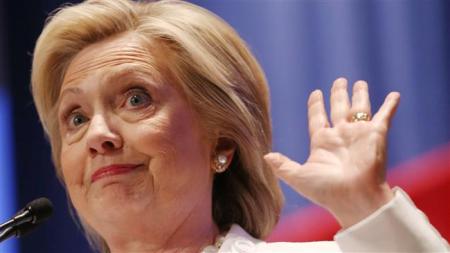
New York Times columnist Nicholas Kristof has offered a curious defense of Hillary Clinton’s “honesty,” refuting the public’s widespread view that she is a liar by narrowly defining what it means to be “honest” and arguing that she is less dishonest than she is a calculating and corner-cutting politician.
Kristof writes, “as we head toward the general election showdown, by all means denounce Hillary Clinton’s judgment and policy positions, but let’s focus on the real issues. She’s not a saint but a politician, and to me this notion that she’s fundamentally dishonest is a bogus narrative.”
Kristof cites, for instance, that half of her campaign statements, as evaluated by PolitiFact, were rated either true or mostly true, comparable to how the group assessed statements by Sen. Bernie Sanders and Sen. Ted Cruz and much better than Donald Trump’s 22 percent. Leaving aside the “conventional wisdom” bias of this mainstream media organization, Kristof does seem to have a point. In a narrow definition of “honesty,” former Secretary of State Clinton may be “truthful” or kind of truthful half the time.
But Kristof misses the larger point that the American people are making when 56 percent of them rate her negatively and many call “crooked” and “dishonest.” They seem to be commenting on her lack of authenticity and perhaps her resistance to sincerely acknowledging major errors in judgment. She only grudgingly apologized for her pro-Iraq War vote and still insists that her bloody “regime change” scheme for Libya was a good idea, even as the once-prosperous North African nation slides into anarchy and deprivation – with the chief beneficiary the head-choppers of the Islamic State.
A Nixonian Quality
Many Americans sense that there is a Nixonian quality to Hillary Clinton – her excessive secrecy, her defensiveness, her rigidity, her unwillingness to acknowledge or learn from mistakes. Even when she is forced into admitting a “mistake,” such as her violation of State Department rules when she maintained a private email server for official correspondence, she acts as if she’s just “apologizing” to close off further debate or examination. As with Richard Nixon, there’s a feeling that Clinton’s apologies and rationales are self-serving, not forthcoming.
Yet, while it’s true that Nixon was a deceitful character – his most famous lie being when he declared “I am not a crook” – I would argue that he had some clear advantages over Clinton as President. He was a much more strategic thinker than she is – and sometimes went against the grain of expectations as encapsulated in the phrase “Nixon goes to China,” meaning that Nixon could open up to communist China precisely because he was viewed as such a hardliner who would never do such a thing but who finally judged that the move was in America’s interests.
While it’s impossible to say whether Clinton would seize unexpected openings as President, she showed none of that creativity, subtlety and courage as Secretary of State. She marched down a straightforward neocon line, doing precisely what Israel’s Prime Minister Benjamin Netanyahu wanted in the Middle East.
Clinton tried to sabotage President Barack Obama’s diplomatic outreach to Iran and favored military solutions to Afghanistan, Libya and Syria. She also followed a rightist approach in backing the 2009 coup in Honduras that ousted an elected progressive president who had offended some of the Honduran oligarchs and outside corporate interests.
Lack of Self-Criticism
In addition, Clinton appears to have learned nothing from her support for the catastrophic Iraq War and has argued against “conflating” her Iraq decision with her Libya decision. But that suggests that she is incapable of learning a lesson from one mistake and applying it to a similar situation, an almost disqualifying characteristic for someone who hopes to become President.
Being a successful President requires extracting painful lessons from one mistake and making sure you don’t make the same mistake again. But Clinton’s personal arrogance or defensiveness (it’s hard to figure out which is dominant) prevents her from that sort of self-criticism.
Indeed, her ritualistic (and politically timed) apology for her Iraq War vote in 2006 came across less than an honest recognition that she had done something horribly wrong than that she had to say something to appease a furious Democratic electorate as she mounted her first run for President against anti-Iraq War candidate Obama.
After losing to Obama and becoming his Secretary of State, she privately hedged her Iraq War apology by saying privately that she thought that President George W. Bush’s “surge” in Iraq was successful and admitting that she had only opposed it in 2007 for political reasons, according to former Defense Secretary Robert Gates in his memoir, Duty.
On Oct. 26, 2009, as Gates — a holdover from the Bush administration — and Clinton joined forces to pressure Obama into approving a similar “surge” for Afghanistan, Gates recalled a meeting in which Clinton made what he regarded as a stunning admission, writing:
“The exchange that followed was remarkable. In strongly supporting the surge in Afghanistan, Hillary told the president that her opposition to the surge in Iraq had been political because she was facing him in the Iowa primary [in 2008]. She went on to say, ‘The Iraq surge worked.’
“The president conceded vaguely that opposition to the Iraq surge had been political. To hear the two of them making these admissions, and in front of me, was as surprising as it was dismaying.” (Obama’s aides disputed Gates’s suggestion that the President indicated that his opposition to the Iraq “surge” was political, noting that he had always opposed the Iraq War. The Clinton team has not challenged Gates’s account.)
But the exchange, as recounted by Gates, indicates that Clinton not only let her political needs dictate her position on an important national security issue, but that she accepts as true the superficial conventional wisdom about the “successful surge” in Iraq, which claimed the lives of about 1,000 American soldiers and a much larger number of Iraqis but failed its principal mission of buying time for the Iraqis to resolve their sectarian differences.
So, when one considers Hillary Clinton’s “honesty” more should be in play than simply whether she accurately describes her policy positions half the time. Honesty, as most people would perceive it, relates to a person’s fundamental integrity, strength of character, readiness to acknowledge mistakes and ability to learn from them. On that measure, the American people seem to have sized up Hillary Clinton pretty well.
[For more on this topic, see Consortiumnews.com’s “Yes, Hillary Clinton Is a Neocon.“]
Investigative reporter Robert Parry broke many of the Iran-Contra stories for The Associated Press and Newsweek in the 1980s. You can buy his latest book, America’s Stolen Narrative, either in print here or as an e-book (from Amazon and barnesandnoble.com).
A Note on Clinton’s Faux-Concern
By Andrew Smolski | CounterPunch | April 22, 2016
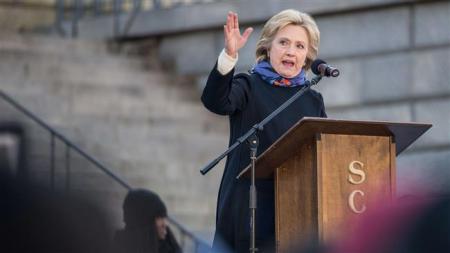 Hillary Clinton’s recent comments on the 43 students for La Opinión show the media’s failure to judge her pandering rhetoric against her actual, substantive actions. When she states she is indignant about the case, she erases her role in the violence engulfing Mexico. The corporate media allows this, because their pages never print about the US-role in Mexico’s War on Drugs.
Hillary Clinton was Secretary of State from 2009 to 2013. During that time, State Department officials under her direction continued to vet and clear Mexican security forces to receive arms transfers. When she says rhetorically, “If there was something the US could do to help, I would be the first to offer it”, it is the theatre of faux-naivety. She knows quite well that the US could end support for policies militarizing Mexico. It’s just that she is not concerned with human rights if that means demilitarization.
It was under the Clinton State Department that the Merida Initiative continued passed its original 3-year time frame. The Merida Initiative enables the Mexican government to repress dissent, while at the same time increasing Mexican elite dependence on the infusion of US armaments. She has called for more of this Plan Colombia-style policy in the future, which means that under a Clinton presidency we can expect more violence throughout Central America.
So, when Clinton exclaims that she is indignant about the Mexican government’s role in covering up the Ayotzinapa case, it belies the fact that she would support (and possibly ramp up) policies that enable the Mexican government to do exactly what she says is a “violation of the law”. The evidence is quite clear on this point, and reported by countless others, like Dawn Paley, Greg Grandin, and Jesse Franzblau. The fact that the corporate media has ignored the record is typical. Clinton’s pandering hypocrisy, typical as well.
Sadly, Clinton is using the tragedy of the 43 to justify and continue policies that brought it about. That is why I am indignant. That is why we should all be indignant.
Hillary PAC spending $1m to ‘forcefully correct’ social media trolls
RT | April 22, 2016
A pro-Hillary Clinton Super Pac is spending serious money to tackle negative Clinton comments across social media.
Describing its focus as being “to defend Hillary Clinton from baseless attacks”, Correct the Record is launching a digital taskforce and investing over $1million to “push back on online harassment”.
“Correct The Record will invest more than $1 million into Barrier Breakers 2016 activities, including the more than tripling of its digital operation to engage in online messaging both for Secretary Clinton and to push back against attackers on social media platforms like Twitter, Facebook, Reddit, and Instagram,” said the PAC in a statement released Thursday.
The statement says “lessons learned from online engagement with ‘Berni Bros’ during the Democratic Primary will be applied to the rest of the primary season and general election – responding quickly and forcefully to negative attacks and false narratives”.
The PAC also says it will be “pushing out information to Sanders supporters” to encourage them to support Clinton.
Super PACs aren’t normally allowed to coordinate with candidates, but FEC loopholes mean Correct the Record can – a move discovered by the Sunlight Foundation’s Libby Watson.
“The whole reasoning behind (Supreme Court decision) Citizens United rests on (PACs) being independent, but Correct the Record claims it can coordinate,” Watson told The Daily Beast.
“It’s not totally clear what their reasoning is, but it seems to be that material posted on the Internet for free — like, blogs — doesn’t count as an ‘independent expenditure’.”
Not Feeling the Bern
By Margaret Kimberley | Black Agenda Report | April 20, 2016
“Only Bernie Sanders can break the power of capitalism in the U.S.” So read a bizarre headline in an online edition of the Guardian. It is just one example of the drivel, magical thinking, misplaced concerns and out and out lies produced by liberal love for Bernie Sanders.
How would Bernie Sanders, or any other presidential candidate, break the power of capitalism? The answer is simple. He can’t. It is difficult to imagine capitalists quaking in their boots because a liberal darling was in the oval office. Then again Sanders has never made a claim to want anything of the kind so the headline is doubly foolish.
The Sanders fans do not let any opportunity pass to make much ado about very little. Sanders’ much vaunted trip to the Vatican was nothing but a public relations gimmick carried out by Jeffrey Sachs, one of his foreign policy advisers. Sachs was at the center of every neo-liberal heist which took place in the last twenty years. He coined the term “shock therapy” which means privatization of publicly owned assets, elimination of price controls, withdrawal of state subsidies, job cuts and a litany of measures which create suffering for millions of people. People in Russia, Poland and Bolivia all endured the Sachs punishment.
So while Sachs wangled an invite for Sanders to attend a Vatican academic conference, the episode was used by the starry eyed to further their trip down the rabbit hole. Well paid pseudo-progressive Democratic functionaries like David Sirota waxed poetic about something that didn’t amount to much. Sirota tweeted a photo of Sanders at the Vatican with Bolivian president Evo Morales. “In scope of history, this image is epic: US Jewish POTUS candidate at Vatican with indigenous Latin American leader.” There is nothing epic about a senator meeting a foreign head of state nor is it miraculous that a Jewish and indigenous American man sat next to each other. This nonsense substitutes for politics and serious thought. But then again liberals aren’t very serious about politics or thought.
The Sanders phenomenon is a repeat of the Obama 2008 marketing extravaganza. Sanders is the flavor of the month for people who are disenchanted with the front runner, Hillary Clinton. Her presence creates mass revulsion and first Obama and now Sanders moved up in voter preference when given an opportunity to make a case before the public.
But there is something particularly disconcerting about the Sanders phenomenon. Like Obama he allows liberals to be proud of uttering mealy-mouthed words instead of acting to make the change they say they want. In a recent debate in New York City Sanders famously declared that “we have to treat the Palestinians with respect and dignity.” He added that Israel has a “right to exist” and said only that the Israel massacre in Gaza was “a disproportionate response.”
His words regarding the Palestinians are rarely heard from the mouth of an American politician, certainly not a presidential candidate. However, kudos showered on Sanders give the impression that Palestinians weren’t worthy of respect and dignity until he said they were. The reaction from Sanders acolytes is in fact an indictment of U.S. foreign policy and Americans acquiescence to decades of pro-Israel propaganda. He doesn’t challenge the Zionist project, in fact he constantly mentions that he once lived in Israel and has family there.
The Palestinians get nothing but pats on the head from Bernie Sanders. They need an end to occupation and a right to return to the land and the homes stolen from them. The Sanders paternalistic feint may impress liberals looking for a politician to love but it does nothing to address a grave injustice.
The injustices that Democrats don’t want to fight were much closer to home on primary voting day in New York. Voting in New York state is very restrictive, with long periods needed to change party affiliations or to request absentee ballots. The board of elections is an ineffective patronage mill that doesn’t serve voters’ needs.
The state has one of the lowest rates of voter participation because of these obstacles but no one cared very much until masses of white people were prevented from voting for their new idol. New York has always had closed primaries and no one can vote without a party affiliation. Open primaries allow for mischief such as against left candidates like Cynthia McKinney. The former congresswoman lost her last election in 2006 because Republicans were allowed to vote for her opponent.
A good case can be made for restricting primaries to party members. Suddenly that defensible position is cast aside because people who aren’t politically involved didn’t pay attention and then couldn’t get their way.
The Sanders people are conspicuous in their absence from other disenfranchisement issues. Convicted felons can’t cast a ballot at all but that is less interesting than tales of Bernie supporters who found out they can’t vote. If they want a revolution they can start by helping others get the right to vote too.
There is a long slog ahead until the Democratic party convention in July. Hillary Clinton will continue to repulse and Bernie Sanders will claim the Pope or a king or a queen wanted to meet him. The Sanders people need to do as Black Agenda Report advised and plan for his eventual exit. Despite all the nonsensical hype, they still don’t have their Plan B.
Margaret Kimberley can be reached via e-Mail at Margaret.Kimberley(at)BlackAgendaReport.com.
Media Scoundrels Ignore NY Primary Irregularities
By Stephen Lendman | April 20, 2016
America resembles a banana republic. Its sham political process has no legitimacy, democracy in name only, voters with no say whatever.
Democrat party bosses intend nominating Clinton at their July convention – rigging primaries to assure it, perhaps the tainted NY one the latest example.
Republican counterparts want anyone but Trump, despite overwhelming GOP voter support he enjoys.
America’s political process is rigged, too debauched to fix, a vital issue media scoundrels ignore. Instead they pretend US elections show democracy works – for the privileged few alone, excluding most others.
A same day article asked if Clinton stole the NY primary, explaining it was rife with irregularities, including disenfranchising over 125,000 NYC voters and various other disturbing practices.
Media scoundrels airbrushed Tuesday electoral irregularities from their reports. The New York Times headlined “A Homecoming, and a Triumph, for Hillary Clinton in New York” – instead of explaining electoral irregularities too serious to ignore, tainting Democrat primary results, questioning their legitimacy.
The Times suppressed dirty politics, diverting attention from what’s most important, saying Clinton “danced the merengue in Washington Heights.”
“She slammed down a mean game of dominoes in East Harlem (and) d(ug) into an ice cream concoction named the Victory.”
The entire article was an unabashed Clinton commercial. Times editors endorsed her earlier, shill for her repeatedly, outrageously call her “the most broadly and deeply qualified (aspirant) in modern history.”
They ignore her pure evil, the greatest threat to world peace among all the deplorable candidates – none worthy of any public office, let alone the nation’s highest.
The neocon Washington Post was no better, highlighting Clinton saying “(t)here’s no place like home,” the Democrat party nomination “nearly within her grasp…”
WaPo quoted her hawkishness, risking possible global war if elected, saying “at a time when terrorists are plotting new attacks and countries like Russia, China and Iran are making aggressive moves, protecting America’s national security cannot be an afterthought.”
“Our next president has to be just as passionate about defending our country as she is about fixing our economy.”
No WaPo explanation about America facing no threats except ones it invents. Nothing about Clinton’s ties to Wall Street, war-profiteers and other corporate favorites.
Not a word about likely NY primary electoral rigging, voter rolls purged, other disturbing irregularities, or explaining America’s sham political process.
The Wall Street Journal highlighted Clinton, saying “(t)he race for the Democratic (sic) nomination is in the home stretch, and victory is in sight.”
The fix is in to hand it to her, the nation’s highest office likely following after November elections.
She represents monied interests, not popular ones, supports endless wars of aggression, not world peace and stability.
She’s the greatest threat to humanity’s survival, more than any other presidential aspirant in US history. If elected in November, WW III may follow.
Media scoundrels ignore what’s most vital to hammer home to readers and viewers without letup. Instead they support what demands condemnation.
Stephen Lendman can be reached at lendmanstephen@sbcglobal.net.
His new book as editor and contributor is titled “Flashpoint in Ukraine: US Drive for Hegemony Risks WW III.”
Featured Video
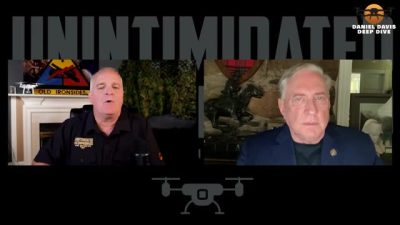
Macgregor: We Haven’t Seen the Worst of the Iran War Yet
or go to
Aletho News Archives – Video-Images
From the Archives
15 Saudi ‘hijackers’ were CIA agents working for US: Scholar
Press TV – April 13, 2016
Fifteen of the 9/11 “hijackers” from Saudi Arabia were CIA agents working for the United States government, which was seeking to destroy the Middle East for Israel and to double the American military budget, says Dr. Kevin Barrett, an American academic who has been studying the events of 9/11 since late 2003…. continue
Blog Roll
 Aletho News
- Iran’s Plan to Shut Down AI in the Persian Gulf
- Israel seeks ‘compensation’ from Washington over Saudi F-35 sale
- Saudi crown prince seeks dialogue with Ansarullah after Yemeni blows: Report
- Damascus rejects Saudi request for Syrian fighters to counter Yemen: Report
- South Korea says will not send troops to join terrorist US war on Iran
- Russia Just Struck the Eyes of NATO’s War Machine in Ukraine
- Russia summons UK charge d’affaires over Kiev drone support
- NATO member warns bloc seeking pretext for war with Russia
- Macgregor: We Haven’t Seen the Worst of the Iran War Yet
- ‘We are not like everyone else’ laws that bind other nations do not apply to Israel, says Likud lawmaker
- If Americans Knew
- Debunking The Claim That Macklemore Has A “History Of Antisemitism”
- CPJ demands release of arrested Palestinian-US journalist near Bethlehem
- Robert Kraft: The Billionaire Friend of Netanyahu Pulling The Strings Behind the Macklemore/Ed Sheeran Blow Up
- Columbia Administered Fund Gives Big Money to Pro-Israel Groups
- Deportation Case of Palestinian Activist Salah Sarsour Tests First Amendment
- ‘We Will Not Forget’: Palestinians Mark 44 Years since Sabra and Shatila
- Why do we let Zionists decide what we can and can’t say?
- US welcomes Israeli, Iranian delegations to UN, but not Palestinians – Daily Update
- Biden’s Genocide Accomplices Targeted by New Accountability Campaign
- AIPAC’s Network Has Already Spent $67.2 Million to Shape the Midterm Elections
- No Tricks Zone
- New Study: ‘Global Drought Shows No Detectable Recent Acceleration Under Climate Warming’
- Economic Masterminds: German Socialists Suggest Taxing Productivity Gains Stemming From Using AI
- The South China Sea Has Not Been Cooperating With The Climate Change Narrative
- Energy Crisis: Germany Enters Heating Season With Historically Low Gas Reserve Fill Levels
- New Study: The Antarctic Ice Sheet Gained Mass From 2020-2024 Due To Staggering Snow And Ice Accumulation
- Study: Ocean Heating Rates From Thousands Of Years Ago ‘Dwarf’ Modern Ocean Heating Rates
- Climate Extremists Target, Attack Large-Scale Power Grid Infrastructure In Germany!
- New Study: Antarctic Ice Melt Has Contributed Less Than 1 Centimeter To Sea Level Rise In The Last 30 Years
- Fear Of Debate: Alarmist German Climate Scientist Calls On Mainstream Media To Discredit Skeptic Voices
- End-Of-August Arctic Sea Ice Extent Hasn’t Fallen In 20 Years, Official Data Show!
 Aletho News