A Note on Hillary Clinton, the Queen of Chaos
By Diana Johnstone – CounterPunch – April 15, 2016
About a year ago, I concluded my book on Hillary Clinton, “Queen of Chaos”, with a fairly pessimistic chapter on the “War Party” which controls United States foreign policy. At the time, I wrote:
“A last-minute peace candidate would be a divine surprise. But a real alternative to the War Party must be built up over time…”
In fact, this primary campaign has produced a couple of surprises, more earthly than divine. Both surprises reveal widespread grassroots discontent with both Hillary Clinton and the whole American political establishment. However, this discontent so far fails to focus on the point of my book: the need to combat the ideology and practice of U.S. war policy personified by Hillary Clinton. Where is the effective alternative to the War Party?
Donald Trump has made it clear he wants to end the current hysterical anti-Putin pre-war propaganda and do business with Russia. This sounds like a major step toward preventing nuclear war. All to the good. The problem is, Trump is a lone wolf. Many of his supporters seem more excited by style than by content. Their multiple incoherent grudges against the system do not add up to an anti-war movement. Trump is unpredictable, and it is hard to see where he would find the foreign policy team and the support needed to overthrow the entrenched foreign policy elite.
With Bernie Sanders, things are a bit the other way around. The Sanders campaign is creating an enthusiastic popular movement, with specific aims in domestic policy. Bernie calls for a “political revolution” and insists that he cannot accomplish all this by himself. All to the good. But Bernie Sanders has said little about foreign policy. The radical shift in domestic priorities advocated by Bernie implies drastic cuts in military spending, but he has not been spelling this out. Despite his strong opposition to the 2003 invasion of Iraq, he has been susceptible to the “humanitarian” war cries of the liberal interventionists, who would certainly strive to take charge of his foreign policy should he miraculously be elected.
So, Trump has the defiance, and Bernie has the movement.
What is still lacking in this campaign is clear denunciation of the very worst of Hillary Clinton’s many negative traits: her eagerness to go to war. And it is not merely Hillary who needs to be defeated: it is the entire militaristic power structure she represents.
One hopeful sign is the resignation from the Democratic National Committee of Hawai’i Congresswoman Tulsi Gabbard in order bring her strong voice against “regime change” wars into the Sanders campaign. There is a chance that as it develops, anti-war sentiment may grow more explicit in the Sanders movement, influencing Bernie himself and providing the social force needed to confront the liberal interventionists within the Democratic Party.
The occasion of this campaign should be seized not only to expose the lies of Hillary Clinton, but also to seek freedom from America’s seven decades of subjugation to the military-industrial complex and its organic intellectuals who never cease conjuring up “threats” and “enemies” to justify the war economy. This entire policy needs to be exposed, denounced and rejected. That is what I tried to do in Queen of Chaos.
CounterPunch invited me to write this letter to advertise my book at this crucial time, but I prefer to quote someone I admire, David Swanson, who wrote:
“Diana Johnstone’s forthcoming book, Queen of Chaos: The Misadventures of Hillary Clinton, succeeds in providing an understanding of Hillary Clinton’s own worldview like nothing else I’ve read — and it does so despite being largely not about Hillary Clinton. Johnstone’s book is culture and political criticism at its finest. It’s a study of the American neo-liberal, with a particular focus here-and-there on Clinton. I strongly recommend reading it, whatever your level of interest in the ‘Queen of Chaos’ herself, for its illumination of the ideologies underlying U.S. adventurism, exceptionalism, and ‘responsibility to protect’, obsession with identifying believable threats of ‘genocide’ in nations disloyal to Washington or Wall Street.”
Diana Johnstone is the author of Fools’ Crusade: Yugoslavia, NATO, and Western Delusions.
Yes, Hillary Clinton Is a Neocon
By Robert Parry | Consortium News | April 16, 2016
If there were any doubts that Hillary Clinton favors a neoconservative foreign policy, her performance at Thursday’s debate should have laid them to rest. In every meaningful sense, she is a neocon and – if she becomes President – Americans should expect more global tensions and conflicts in pursuit of the neocons’ signature goal of “regime change” in countries that get in their way.
Beyond sharing this neocon “regime change” obsession, former Secretary of State Clinton also talks like a neocon. One of their trademark skills is to use propaganda or “perception management” to demonize their targets and to romanticize their allies, what is called “gluing white hats” on their side and “gluing black hats” on the other.
So, in defending her role in the Libyan “regime change,” Clinton called the slain Libyan leader Muammar Gaddafi “genocidal” though that is a gross exaggeration of Gaddafi’s efforts to beat back Islamic militants in 2011. But her approach fits with what the neocons do. They realize that almost no one will dare challenge such a characterization because to do so opens you to accusations of being a “Gaddafi apologist.”
Similarly, before the Iraq War, the neocons knew that they could level pretty much any charge against Saddam Hussein no matter how false or absurd, knowing that it would go uncontested in mainstream political and media circles. No one wanted to be a “Saddam apologist.”
Clinton, like the neocons, also shows selective humanitarian outrage. For instance, she laments the suffering of Israelis under crude (almost never lethal) rocket fire from Gaza but shows next to no sympathy for Palestinians being slaughtered by sophisticated (highly lethal) Israeli missiles and bombs.
She talks about the need for “safe zones” or “no-fly zones” for Syrians opposed to another demonized enemy, Syria’s President Bashar al-Assad, but not for the people of Gaza who face the wrath of Israeli Prime Minister Benjamin Netanyahu.
“Yes, I do still support a no-fly zone [in Syria] because I think we need to put in safe havens for those poor Syrians who are fleeing both Assad and ISIS and have some place that they can be safe,” Clinton said. But she showed no such empathy for Palestinians defenseless against Israel’s “mowing the grass” operations against men, women and children trapped in Gaza.
In Clinton’s (and the neocons’) worldview, the Israelis are the aggrieved victims and the Palestinians the heartless aggressors. Referring to the Gaza rocket fire, she said: “I can tell you right now I have been there with Israeli officials going back more than 25 years that they do not seek this kind of attacks. They do not invite the rockets raining down on their towns and villages. They do not believe that there should be a constant incitement by Hamas aided and abetted by Iran against Israel. …
“So, I don’t know how you run a country when you are under constant threat, terrorist attack, rockets coming at you. You have a right to defend yourself.”
Ignoring History
Clinton ignored the history of the Israeli-Palestinian conflict, which dates back to the 1940s when Israeli terrorist organizations engaged in massacres to drive Palestinians from their ancestral lands and murdered British officials who were responsible for governing the territory. Israeli encroachment on Palestinian lands has continued to the present day.
But Clinton framed the conflict entirely along the propaganda lines of the Israeli government: “Remember, Israel left Gaza. They took out all the Israelis. They turned the keys over to the Palestinian people. And what happened? Hamas took over Gaza. So instead of having a thriving economy with the kind of opportunities that the children of the Palestinians deserve, we have a terrorist haven that is getting more and more rockets shipped in from Iran and elsewhere.”
So, Clinton made clear – both at the debate and in her recent AIPAC speech – that she is fully in line with the neocon reverence for Israel and eager to take out any government or group that Israel puts on its enemies list. While waxing rhapsodic about the U.S.-Israeli relationship – promising to take it “to the next level” – Clinton vows to challenge Syria, Iran, Russia and other countries that have resisted or obstructed the neocon/Israeli “wish list” for “regime change.”
In response to Clinton’s Israel-pandering, Sen. Bernie Sanders, who once worked on an Israeli kibbutz as a young man, did the unthinkable in American politics. He called out Clinton for her double standards on Israel-Palestine and suggested that Netanyahu may not be the greatest man on earth.
“You gave a major speech to AIPAC,” Sanders said, “and you barely mentioned the Palestinians. … All that I am saying is we cannot continue to be one-sided. There are two sides to the issue. … There comes a time when if we pursue justice and peace, we are going to have to say that Netanyahu is not right all of the time.”
But in Hillary Clinton’s mind, the Israeli-Palestinian dispute is essentially one-sided. During her speech to the American Israel Public Affairs Committee last month, she depicted Israel as entirely an innocent victim in the Mideast conflicts.
“As we gather here, three evolving threats — Iran’s continued aggression, a rising tide of extremism across a wide arc of instability, and the growing effort to de-legitimize Israel on the world stage — are converging to make the U.S.-Israel alliance more indispensable than ever,” she declared.
“The United States and Israel must be closer than ever, stronger than ever and more determined than ever to prevail against our common adversaries and to advance our shared values. … This is especially true at a time when Israel faces brutal terrorist stabbings, shootings and vehicle attacks at home. Parents worry about letting their children walk down the street. Families live in fear.”
Yet, Clinton made no reference to Palestinian parents who worry about their children walking down the street or playing on a beach and facing the possibility of sudden death from an Israeli drone or warplane. Instead, she scolded Palestinian adults. “Palestinian leaders need to stop inciting violence, stop celebrating terrorists as martyrs and stop paying rewards to their families,” she said.
Then, Clinton promised to put her future administration at the service of the Israeli government. Clinton said, “One of the first things I’ll do in office is invite the Israeli prime minister to visit the White House. And I will send a delegation from the Pentagon and the Joint Chiefs to Israel for early consultations. Let’s also expand our collaboration beyond security.”
Pleasing Phrases
In selling her neocon policies to the American public, Clinton puts the military aspects in pleasing phrases, like “safe zones” and “no-fly zones.” Yet, what she means by that is that as President she will invade Syria and push “regime change,” following much the same course that she used to persuade a reluctant President Obama to invade Libya in 2011.
The Libyan operation was sold as a “humanitarian” mission to protect innocent civilians though Gaddafi was targeting Islamic militants much as he claimed at the time and was not engaging in any mass slaughter of civilians. Clinton also knew that the European allies, such as France, had less than noble motives in wanting to take out Gaddafi.
As Clinton confidant Sidney Blumenthal explained to her, the French were concerned that Gaddafi was working to develop a pan-African currency which would have given Francophone African countries greater freedom from their former colonial master and would undermine French economic dominance of those ex-colonies.
In an April 2, 2011 email, Blumenthal informed Clinton that sources close to one of Gaddafi sons reported that Gaddafi’s government had accumulated 143 tons of gold and a similar amount of silver that “was intended to be used to establish a pan-African currency” that would be an alternative to the French franc.
Blumenthal added that “this was one of the factors that influenced President Nicolas Sarkozy’s decision to commit France to the attack on Libya.” Sarkozy also wanted a greater share of Libya’s oil production and to increase French influence in North Africa, Blumenthal wrote.
But few Americans would rally to a war fought to keep North Africa under France’s thumb. So, the winning approach was to demonize Gaddafi with salacious rumors about him giving Viagra to his troops so they could rape more, a ludicrous allegation that was raised by then-U.S. Ambassador to the United Nations Susan Rice, who also claimed that Gaddafi’s snipers were intentionally shooting children.
With Americans fed a steady diet of such crude propaganda, there was little serious debate about the wisdom of Clinton’s Libyan “regime change.” Meanwhile, other emails show that Clinton’s advisers were contemplating how to exploit Gaddafi’s overthrow as the dramatic moment to declare a “Clinton Doctrine” built on using “smart power.”
On Oct. 20, 2011, when U.S.-backed rebels captured Gaddafi, sodomized him with a knife and then murdered him, Secretary of State Clinton couldn’t contain her glee. Paraphrasing a famous Julius Caesar quote, she declared about Gaddafi, “we came, we saw, he died.”
But this U.S.-organized “regime change” quickly turned sour as old tribal rivalries, which Gaddafi had contained, were unleashed. Plus, it turned out that Gaddafi’s warnings that many of the rebels were Islamic militants turned out to be true. On Sept. 11, 2012, one extremist militia overran the U.S. consulate in Benghazi killing U.S. Ambassador Christopher Stevens and three other Americans.
Soon, Libya slid into anarchy and Western nations abandoned their embassies in Tripoli. President Obama now terms the Libyan fiasco the biggest mistake of his presidency. But Clinton refuses to be chastened by the debacle, much as she appeared to learn nothing from her support for the Iraq invasion in 2003.
The Libyan Mirage
During Thursday’s debate – instead of joining Obama in recognition of the Libyan failure – Clinton acted as if she had overseen some glowing success: “Well, let me say I think we did a great deal to help the Libyan people after Gaddafi’s demise. … We helped them hold two successful elections, something that is not easy, which they did very well because they had a pent-up desire to try to chart their own future after 42 years of dictatorship. I was very proud of that. …
“We also worked to help them set up their government. We sent a lot of American experts there. We offered to help them secure their borders, to train a new military. They, at the end, when it came to security issues, … did not want troops from any other country, not just us, European or other countries, in Libya.
“And so we were caught in a very difficult position. They could not provide security on their own, which we could see and we told them that, but they didn’t want to have others helping to provide that security. And the result has been a clash between different parts of the country, terrorists taking up some locations in the country.”
But that is exactly the point. Like the earlier neocon-driven “regime change” in Iraq, the “regime change” obsession blinds the neocons from recognizing that not only are these operations violations of basic international law regarding sovereignty of other nations but the invasions unleash powerful internal rivalries that neocons, who know little about the inner workings of these countries, soon find they can’t control.
Yet, America’s neocons are so arrogant and so influential that they simply move from one catastrophe to the next like a swarm of locust spreading chaos and death around the globe. They also adapt readily to changes in the political climate.
That’s why some savvy neocons, such as the Brookings Institution’s Robert Kagan, have endorsed Clinton, who The New York Times reported has become “the vessel into which many interventionists are pouring their hopes.”
Kagan told the Times, “I feel comfortable with her on foreign policy. If she pursues a policy which we think she will pursue it’s something that might have been called neocon, but clearly her supporters are not going to call it that; they are going to call it something else.”
Now with Clinton’s election seemingly within reach, the neocons are even more excited about how they can get back to work achieving Syrian “regime change,” overturning Obama’s nuclear deal with Iran, and – what is becoming their ultimate goal – destabilizing nuclear-armed Russia and seeking “regime change” in Moscow.
After all, by helping Assad bring some stability to Syria and assisting Obama in securing the Iranian nuclear deal, Russian President Vladimir Putin has become what the neocons view as the linchpin of resistance to their “regime change” goals. Pull Putin down, the thinking goes, and the neocons can resume checking off their to-do list of Israel’s adversaries: Syria, Iran, Hezbollah, Hamas, etc.
And what could possibly go wrong by destabilizing nuclear-armed Russia and forcing some disruptive “regime change”?
By making Russia’s economy scream and instigating a Maidan-style revolt in Moscow’s Red Square, the neocons see their geopolitical path being cleared, but what they don’t take into account is that the likely successor to Putin would not be some malleable drunk like the late Russian President Boris Yeltsin but, far more likely, a hardline nationalist who might be a lot more careless with the nuclear codes than Putin.
But, hey, when has a neocon “regime change” scheme veered off into a dangerous and unanticipated direction?
A Neocon True-Believer
In Thursday’s debate, Hillary Clinton showed how much she has become a neocon true-believer. Despite the catastrophic “regime changes” in Iraq and Libya, she vowed to invade Syria, although she dresses up that reality in pretty phrases like “safe zones” and “no-fly zones.” She also revived the idea of increasing the flow of weapons to “moderate” rebels although they, in reality, mostly fight under the command umbrella of Al Qaeda’s Nusra Front.
Clinton also suggested that the Syria mess can be blamed on President Obama’s rejection of her recommendations in 2011 to authorize a more direct U.S. military intervention. “Nobody stood up to Assad and removed him,” Clinton said, “and we have had a far greater disaster in Syria than we are currently dealing with right now in Libya.”
In other words, Clinton still harbors the “regime change” goal in Syria. But the problem always was that the anti-Assad forces were penetrated by Al Qaeda and what is now called the Islamic State. The more likely result from Clinton’s goal of removing Assad would be the collapse of the Syrian security forces and a victory for Al Qaeda’s Nusra Front and/or the Islamic State.
If that were to happen, the horrific situation in Syria would become cataclysmic. Millions of Syrians – Alawites, Shiites, Christians, secularists and other “infidels” – would have to flee the beheading swords of these terror groups. That might well force a full-scale U.S. and European invasion of Syria with the bloody outcome probably similar to the disastrous Iraq War.
The only reasonable hope for Syria is for the Assad regime and the less radical Sunni oppositionists to work out some power-sharing agreement, stabilize most of the country, neutralize to some degree the jihadists, and then hold elections, letting the Syrian people decide whether “Assad must go!” – not the U.S. government. But that’s not what Clinton wants.
Perhaps even more dangerous, Clinton’s bellicose rhetoric suggests that she would eagerly move into a dangerous Cold War confrontation with Russia under the upside-down propaganda theme blaming tensions in Eastern Europe on “Russian aggression,” not NATO’s expansion up to Russia’s borders and the U.S.-backed coup in Ukraine in 2014 which ousted an elected president and touched off a civil war.
That coup, which followed neocon fury at Putin for his helping Obama avert U.S. bombing campaigns against Syria and Iran, was largely orchestrated by neocons associated with the U.S. government, including Assistant Secretary of State for European Affairs Victoria Nuland (Robert Kagan’s wife), Sen. John McCain and National Endowment for Democracy President Carl Gershman.
After the violent coup, when the people of Crimea voted by 96 percent to secede from Ukraine and rejoin Russia, the U.S. government and Western media deemed that a “Russian invasion” and when ethnic Russians in eastern Ukraine rose up in resistance to the new authorities in Kiev that became “Russian aggression.”
NATO on the Move
Though President Obama should know better – and I’m told that he does know better – he has succumbed this time to pressure to go along with what he calls the Washington “playbook” of saber-rattling and militarism. NATO is moving more and more combat troops up to the Russian border while Washington has organized punishing economic sanctions aimed at disrupting the Russian economy.
Hillary Clinton appears fully onboard with the neocon goal of grabbing the Big Enchilada, “regime change” in Moscow. Rather than seeing the world as it is, she continues to look through the wrong end of the telescope in line with all the anti-Russian propaganda and the demonization of Putin, whom Clinton has compared to Hitler.
Supporting NATO’s military buildup on Russia’s border, Clinton said, “With Russia being more aggressive, making all kinds of intimidating moves toward the Baltic countries, we’ve seen what they’ve done in eastern Ukraine, we know how they want to rewrite the map of Europe, it is not in our interests [to reduce U.S. support for NATO]. Think of how much it would cost if Russia’s aggression were not deterred because NATO was there on the front lines making it clear they could not move forward.”
Though Clinton’s anti-Russian delusions are shared by many powerful people in Official Washington, they are no more accurate than the other claims about Iraq’s WMD, Gaddafi passing out Viagra to his troops, the humanitarian need to invade Syria, the craziness about Iran being the principal source of terrorism (when it is the Saudis, the Qataris, the Turks and other Sunni powers that have bred Al Qaeda and the Islamic State), and the notion that the Palestinians are the ones picking on the Israelis, not the other way around.
However, Clinton’s buying into the neocon propaganda about Russia may be the most dangerous – arguably existential – threat that a Clinton presidency would present to the world. Yes, she may launch U.S. military strikes against the Syrian government (which could open the gates of Damascus to Al Qaeda and the Islamic State); yes, she might push Iran into renouncing the nuclear agreement (and putting the Israeli/neocon goal to bomb-bomb-bomb-Iran back on the table); yes, she might make Obama’s progressive critics long for his more temperate presidency.
But Clinton’s potential escalation of the new Cold War with Russia could be both the most costly and conceivably the most suicidal feature of a Clinton-45 presidency. Unlike her times as Secretary of State, when Obama could block her militaristic schemes, there will be no one to stop her if she is elected President, surrounded by likeminded neocon advisers.
Investigative reporter Robert Parry broke many of the Iran-Contra stories for The Associated Press and Newsweek in the 1980s. You can buy his latest book, America’s Stolen Narrative, either in print here or as an e-book (from Amazon and barnesandnoble.com).
As in Libya, Avaaz Campaigns for Syria No-Fly Zone That Even Top Generals Oppose
By John Hanrahan | ExposeFacts | April 11, 2016
(First of two articles)
- “I worry sometimes that, when people say ‘impose a no-fly zone,’ there is this almost antiseptic view that this is an easily accomplished military task. It’s extraordinarily difficult. Having overseen imposing a no-fly zone in Libya, a force that is vastly inferior in air forces and air defenses to that which exists in Syria, it’s a pretty high-risk operation…It first entails — we should make no bones about it. It first entails killing a lot of people and destroying the Syrian air defenses and those people who are manning those systems. And then it entails destroying the Syrian air force, preferably on the ground, in the air if necessary. This is a violent combat action that results in lots of casualties and increased risk to our own personnel.” — Now-retired four-star General Carter Ham, former commander, U.S. Africa Command, who oversaw U.S. military enforcement of the Libyan no-fly zone in 2011 [CBS News]
- “It is quite frankly an act of war and it is not a trivial matter… I know it sounds stark, but what I always tell people when they talk to me about a no-fly zone is . . . it’s basically to start a war with that country because you are going to have to go in and kinetically take out their air defense capability.” — Four-star General Philip Breedlove, NATO’s current supreme allied commander, U.S. European Command [Stars and Stripes ]
- The New York Times reported that in 2012 General Martin E. Dempsey, chairman of the Joint Chiefs of Staff, told the White House that imposing a no-fly zone in Syria — in the Times paraphrasing — “would require as many as 70,000 American servicemen to dismantle Syria’s sophisticated antiaircraft system and then impose a 24-hour watch over the country.” [New York Times ] (Dismantle being a Times polite euphemism for bombing the bejeezus out of Syria’s antiaircraft defenses.)
Readers of the national edition of the June 18, 2015 New York Times were greeted with a dramatic full-page ad featuring a photo of an apparently injured baby fitted with a breathing device and being tended to by a partially visible adult beneath a big, bold-type headline: “PRESIDENT OBAMA, WHAT ARE YOU WAITING FOR?” (A partial picture of the ad can be found here.)
In smaller type, under the picture of the baby and the adult, was the message: “Trapped and under chemical attack, the Syrian people are desperate for help.”
And below that in slightly smaller type was the risky military operation that the ad’s sponsors wanted the reluctant President to undertake. To wit: “A majority of Americans support a No-Fly Zone in Syria to save lives and 1,093,775 people around the world [in an on-line petition] are calling for action now.”
The on-line petition cited in the ad also has an urgent headline calling for a “Safe zone for Syrians, now!” The body of the petition demands the establishment of an “air-exclusion zone in Northern Syria, including Aleppo, to stop the bombardment of Syria’s civilians and ensure that humanitarian aid reaches those most in need.” The petition — slightly different than the New York Times ad — was addressed not only to Obama, but also to Turkish President Recep Tayyip Erdogan, French President Francois Hollande, British Prime Minister David Cameron “and other world leaders.”
Now it’s not surprising to see such an expensive ad in the current political climate in which Syrian war fever has seized much of the U.S. political establishment. A climate in which Democratic presidential candidate Hillary Clinton (but not Bernie Sanders or Donald Trump), and every neoconservative and “humanitarian interventionist” and chicken-hawk in creation have, at the very least, called for a no-fly zone in northern Syria as part of a greater U.S. military involvement to remove President Bashar al-Assad.
What stood out about this ad, then, isn’t so much the neocon-like call to action — a move toward a wider war in Syria which could entail even more U.S. and western military air bombardments, as well as additional displacement and death for civilians — but rather the ad’s sponsors.
This ad wasn’t the product of a gaggle of bellicose Republicans or acolytes of the Brookings Institution’s war-enthusiast-in-chief Michael O’Hanlon — or even supporters of regime change advocate Hillary Clinton — offering one of their bold, armchair-military solutions to the many-sided, complex Middle East conflicts.
Rather, the ad and its supporting on-line petition were the handiwork of the Internet phenom activist organization Avaaz.org. With the staggering claimed number of 43.1-million members in 194 countries as of mid-March 2016 (anyone who has ever signed an Avaaz petition is considered by the organization to be a member), the New York City-based Avaaz is easily the largest and most influential Internet-based, international advocacy organization on the planet. (Having myself signed many Avaaz petitions over the years, I am counted as one of those 43 million.)
Avaaz, which means “voice” or “song” in many languages, was started in 2006 and officially launched in 2007 by the U.S. online powerhouse MoveOn.org Civic Action and the little known global advocacy group Res Publica. With initial significant financial backing from — and some blogger critics allege, continued influence of — financier and liberal philanthropist George Soros and his Open Society Foundations (then called Open Society Institute), Avaaz has grown at a mind-boggling pace each year. Since 2011, the organization has increased six-fold to its current membership of almost 43-million. (The second of our two articles on Avaaz will provide more background on the organization, its key issues, its founders and current officials, and funding sources.)
Although widely regarded as liberal to progressive in its campaigns, Avaaz stands alone on the left as the one major on-line activist organization to call for an escalation of the U.S. military role in Syria — just as before that it was alone on the left in 2011 in campaigning successfully for a no-fly zone for Libya, with subsequent disastrous consequences for that country. (More about this in a follow-up article.)
For this article, we submitted a series of questions to Avaaz media personnel, with an emphasis on obtaining specifics as to its rationale for its support for no-fly zones in Libya and Syria. These questions included why the organization had not informed its members of the warnings (cited above) of top U.S. generals and other experts about the potential dangers to civilians and military personnel inherent in the establishment of a no-fly zone in Syria.
After requests (and reminders) on five occasions in November, December and January, we finally received a response on February 11, but that addressed only a few of our specific questions. The organization ignored our question as to why Avaaz had not presented petition-signers with the potential dangers of a Syrian no-fly zone that the prominent generals had warned of. Our follow-up questions, submitted on February 12, have gone unanswered.
What Avaaz spokesperson Nell Greenberg did tell us is: “When it comes to Syria, millions of Avaaz members have repeatedly over the last six years demonstrated that they believe the world has an obligation to protect civilians in Syria as well as those who have fled the country as refugees. In addition to Avaaz members calling for a targeted no-fly zone back in spring of 2015, Avaaz members have called for diplomacy, negotiations and ceasefire as well as raising over a million dollars for the victims inside and outside Syria and volunteering to house and support refugees displaced by this war.”
Avaaz and signers of its no-fly zone petition, “see every human life as equally precious and deserving of protection,” Greenberg said, adding: “At the time of the Syria no-fly zone campaign, a majority* of our membership supported the call for a targeted no-fly zone in northern Syria. But there were deep questions and concerns brought up by other members of the Avaaz movement that we did not ignore. A Q and A was written to go along with the campaign that you can find here, which spoke to many of their questions and I think addresses the heart of yours: http://avaaz.org/en/syria_safe_zone_faq/. To be clear, this Q and A was written by the Avaaz Campaign Director [John Napier Tye] who developed this campaign and is his personal perspective, which is why he signed it. It is not a statement from the Avaaz community.” (* A majority of a random sample of 10,000 Avaaz members, not a majority of its entire membership, supported the campaign for a no-fly zone.)
What exactly those last two sentences of Avaaz’s statement mean is anyone’s guess. Someone ostensibly speaking for the organization is really speaking only for himself? The buck stops with John Tye and not with executive director Ricken Patel and others in the Avaaz hierarchy? And, curiously, the Q and A link cited above was disabled sometime in March and no longer worked as of this writing.
Interestingly, Tye himself is a former U.S. State Department official who upon leaving the agency in April 2014 filed a whistleblower complaint. The complaint alleged, as The New York Times reported, that the National Security Agency’s practices abroad — as authorized by Reagan-era Executive Order 12333 permitting the NSA to gather and use U.S. citizens’ communications overseas — “violated Americans’ Fourth Amendment rights” to be free from unreasonable searches and seizures. While at the State Department from 2011-2014, Tye “worked on Internet freedom issues and had top-secret clearance.” Unlike whistleblower Edward Snowden, Tye wrote in an opinion piece in The Washington Post that he had gone through channels in making his complaint and had not disclosed any classified information.
Greenberg’s response did not address my questions about the generals’ warnings about a no-fly zone in Syria. Instead, she stated: “In addition, as with all of our campaigns, the emails about this campaign included links to articles with multiple viewpoints to support deliberative discussion of the issue and provide resources for members to fact check and do more research on their own.”
Contrary to this statement, I found no link in the Avaaz materials to any article quoting the generals or other critics of imposing a no-fly zone in Syria. Nor did I see even a generic statement, suggesting this is a controversial issue that might merit further research before an Avaaz member would consider signing.
Avaaz Involved on the Ground in Syrian Conflict; Without Proof, Blamed Russians for ‘Coordinating Atrocities’ Against Journalists
It’s important to note that Avaaz’s past activities regarding Syria have gone far beyond petitions calling for a no-fly zone. In 2011-2012 (and perhaps beyond), Avaaz interjected itself into the Syrian conflict in a controversial manner not usually associated with on-line activism — spiriting several dozen western journalists in and out of Syria; helping rescue trapped journalists and other civilians; smuggling in medical supplies; training and then providing “citizen journalists” with cameras to document Syrian government forces’ war crimes; and serving as a major conduit of war information from inside Syria to western journalists outside the country.
As The New Republic’s Simon van Zuylen-Wood reported, Avaaz’s Wissam Tarif, a Lebanese activist, “helped smuggle medical supplies into Syria, as well as more than 35 western journalists… He also oversaw the training of ordinary Syrians who subsequently re-entered their country to report on what was going on. As Syria became increasingly dangerous and difficult to penetrate, Western journalists came to rely ever more on Avaaz’s daily e-mail briefings, which compiled information from 200 such Syrian ‘citizen journalists.’”
Several hundred reporters were reportedly receiving Avaaz’s email briefings at the time, putting the organization in a unique position of being the major source of anti-regime news and propaganda coming out of Syria. For example, as NPR’s Deborah Amos reported, Avaaz’s “citizen journalists” provided casualty figures that “Many media organizations, as well as United Nations officials” relied on “to track the violence inside the country.”
Amos reported in March 2012 that Avaaz “has given crucial support to the uprising and the Syrian activist networks that aim to topple the regime of President Bashar Assad.” Amos’s piece raised the question of whether Avaaz had overstepped its role by engaging in operations in which a large number of Syrian activists had been killed (as many as 23, Avaaz’s executive director Ricken Patel subsequently said).
Amos’s report appeared shortly after Avaaz, in February 2012, announced that it had coordinated the rescue of British photographer Paul Conroy of the London Sunday Times, who had been wounded when government security forces attacked the Baba Amr neighborhood in the city of Homs. Two journalists — Marie Colvin, also of the London Sunday Times, and French photographer Remi Ochlik — were killed in the attack. Conroy was evacuated by his rescuers to Lebanon. Thirteen Syrian activists were initially reported killed in the rescue operation, and Avaaz’s Patel told the BBC at the time that seven others were arrested by government forces and then “shot in the back of the head with their hands tied behind their backs.”
The Avaaz press release on the rescue said: “This operation was carried [out] by Syrians with the help of Avaaz. No other agency was involved” — a claim that Avaaz later had to retract.
Around the same time, in another interview with the BBC4 radio program PM, Patel stated that more than 50 Syrian activists had agreed to participate in the rescue operation — and 23 of them had been killed (a slightly higher number than initially cited.)
In that interview, Patel asserted that repeated attacks on the Homs media center by Assad’s forces were “targeted assassinations” of journalists — and he contended on the flimsiest of information that either the Russians or Iranians — most likely the Russians — “were coordinating these atrocities.” Asked about his evidence for this, Patel said that a drone constantly positioned over Baba Amr conducted surveillance of the area. “…(T)o our knowledge,” Patel said, “the Syrians certainly have not been able to build a drone themselves or own one, so it’s got to be coming from Russia or from Iran, actually coordinating these atrocities.”
Patel said he assumed the drone was Russian operated because the Russians were providing large amounts of military assistance to Assad. Patel said “common sense would suggest there is some sort of cooperation going on” between Russia and Syria’s government and the Russians would have to know the Syrians are “targeting citizens and civilians.”
The New Republic’s Zuylen-Wood subsequently challenged Avaaz’s initial claim of being the sole coordinator of the Conroy rescue, and got Patel to back off to correct both his earlier statement and the Avaaz press release. Patel said that he and Avaaz had made an honest mistake in the confusion and chaos of the rescue, and that the opposition Free Syria Army “played a significant role” in the operation but with substantial planning, input and backing from Avaaz. Although guilty of over-hype in claiming sole credit, Avaaz in its back-and-forth with The New Republic certainly showed that it had, indeed, played an important part in the rescue operation.
Whether this was an appropriate role for an activist organization is another question. Amos’s NPR piece raised the issue, stating: Given the deaths “of so many Syrian activists in the operation” this might suggest that “Avaaz has crossed a line, not just a border.”
For her report, Amos interviewed Randa Slim, a research fellow at the New America Foundation and a specialist in the Syrian opposition, who said: “I am not questioning their motives. But lives are at stake. Are they the right entity to do it. Is an NGO the right outlet?”
Answering press criticism at the time — and giving an indication of its success in getting the opposition’s view of the Syrian conflict to western journalists — Avaaz stated it was “proud of 18 months of outstanding work by our staff and our community to support the voices of the Syrian people to reach the world in thousands of news articles assisted by citizen journalists we have supported or helped connect to the media.”
Additionally, Avaaz commented, “Our community has donated almost $3 million for communications equipment, humanitarian aid and advocacy, and taken millions of actions including petition signatures, messages, phone calls and advocacy visits to press governments to take action to support the Syrian people.”
It is not clear whether Avaaz has continued to provide the same sort of on-the-ground assistance to opposition forces and civilians as it was offering a few years ago, although it indicated at the time that it would continue such activities.
In Forefront of Many Progressive Causes, Avaaz’s Advocacy for Military Actions in First Libya and Now Syria Seems Out of Sync
At first blush, the petition advocating for a Syria no-fly zone was a jolt to those not familiar with Avaaz’s swing toward “humanitarian” military action in recent years. It seemed surprising because Avaaz has on other occasions called for negotiated peaceful solutions to various conflicts (including in Syria itself), and has been substantially in sync with other major progressive organizations on scores of U.S. and international issues in its nine years of existence.
Based on the overwhelming majority of the hundreds of Avaaz petitions I have seen over the years and in preparation for this article, I had assumed that the organization adhered to a basic principle of nonviolence in international affairs — and it has even said so on occasion. But as one person who has had close connections to Avaaz noted to me: Although favoring diplomatic solutions, Avaaz does not rule out the use of military force, as its no-fly zone advocacy for Libya and Syria amply demonstrate.
On its website home page, Avaaz does not have an out-front display of its past campaign for a no-fly zone in Libya and its current one in Syria (and does not ever mention the ongoing disaster in Libya, or its support for a no-fly zone there). Rather, it focuses its out-front materials on its multitude of campaigns that involve nonviolent, political, diplomatic and public relations remedies. And even allowing for organizational self-hype, Avaaz has an impressive record of advocacy.
Through its petitions, street actions, billboards and newspaper ads, Avaaz has been highly visible on hundreds of issues worldwide — including Palestinian rights, support for U.S. government whistleblowers including Chelsea Manning and Edward Snowden, campaigns for endangered species, etc. This is, after all, an organization that played a major role along with 350.org and other activist groups in organizing the massive People’s Climate March in New York City in September 2014; it was also an organizer of the Global Climate March that was to coincide with the opening last November of the U.N. Climate Change Conference in France. That march was blocked by the French government in the aftermath of coordinated attacks attributed to ISIS that killed at least 130 people in Paris earlier in November.
Most — if not all — of Avaaz’s campaigns seem right in line with current day activism of various groupings on the political Left. Even on Syria, an Avaaz campaign urging the United States to take in more refugees is in a more traditional humanitarian vein (that is, one that doesn’t involve military hardware, needless to say). Typical was Avaaz’s full, back-page color ad in the March 10, 2016 Politico headlined (in a play on a Republican presidential debate topic): “IT TAKES BIG HANDS (and a Bigger Heart) TO WELCOME 25,000 SYRIAN REFUGEES.” The ad praised Canadian Prime Minister Justin Trudeau for “showing the world what it means to have a giant heart” through Canada’s acceptance and resettlement of 25,000 refugees in the previous four months — “while America debates the size of candidates’ hands” and has taken in fewer than 1,000 refugees. The ad urged President Obama and Congress to “do better, and show the world the size of our hearts, not our hands.”
Also recently, in February 2016, more than 749,000 people signed an Avaaz petition that called on members of the European Parliament (MEPs) and leaders of the United States, the United Kingdom, Canada, Germany and France to “suspend all arms deals with Saudi Arabia until they end their assaults in Yemen and begin a genuine peace process.” The campaign, which also included targeting MEPs with phone calls and personal messages, won a major success when the European Parliament voted on February 25 “for an embargo on arms sale to Saudi Arabia,” in response to a United Nations report documenting 119 Saudi violations of international law in Yemen. Because European Union states are not bound by the action, Avaaz is continuing the campaign to get the European governments and the United States to follow the European Parliament’s lead.
This Saudi campaign makes Avaaz’s repeat advocacy for a no-fly zone — first in Libya and now in Syria — appear on initial impression to be way out of sync with progressive thought and most other Avaaz campaigns, and so much in line with neocon and “humanitarian interventionist” regime-change advocates.
Avaaz Has Long Favored No-Fly Zone in Syria, Based in Part on the Dodgy Sarin Gas Story
The organization’s renewed campaign in the spring of 2015 for a Syrian no-fly zone was no sudden philosophical switch by Avaaz. In fact, as noted earlier, Avaaz had in 2011 campaigned for a no-fly zone in since-devastated Libya, and then turned its attention to a no-fly zone for Syria. It continued that Syrian effort in 2013-2014, while at the same time pushing for President Obama to get together with Iranian President Hassan Rouhani to work out a diplomatic solution. That diplomacy petition netted 1,126,000 signers.
This diplomatic approach seemed more in line with what progressive individuals and organizations could get behind. But with no such diplomatic talks forthcoming, Avaaz then continued with its no-fly zone strategy.
Even in calling for negotiations, though, as well as in points raised in its on-line advocacy for a no-fly zone, Avaaz has regularly repeated a now-questionable allegation against the Syrian government — made on numerous occasions by Secretary John Kerry and then President Obama. The U.S. leaders and war advocates used the allegation as a justification for war when it appeared that the United States was going to launch a bombing campaign against Syria in September 2013: Namely, that Assad’s forces had used sarin gas on the civilian population near Damascus in August 2013. This charge that Assad was using chemical weapons on his own people has provided a continuing emotional selling point for Avaaz and other interventionists in the campaign for upping the military ante against the Assad regime.
“Right now,” the message accompanying the Avaaz diplomacy petition stated, “the global drums of war are beating over Syria, but if enough of us make sure Rouhani and Obama know the world wants bold diplomacy, we could end the nightmare for thousands of terrified Syrian children under gas attacks. We have no time to lose…”
But as pointed out repeatedly by Robert Parry of Consortium News and a few other independent journalists over the last two years — as well as recently by an organization of former U.S. intelligence professionals, Veteran Intelligence Professionals for Sanity (VIPS) — the Obama administration has publicly offered not one shred of evidence to back up its early claims that Assad gassed his own people in August 2013.
To the contrary, recent disclosures in Turkey provide evidence that strongly suggest it was not Assad’s military that carried out the sarin gas attack.
As Parry recently wrote, summing up his findings from his earlier articles, there is “growing evidence that it was a jihadist group, possibly with the help of Turkish intelligence, that staged the outrage as a provocation to draw the U.S. military into the conflict against Syria’s military by creating the appearance that Assad had crossed Obama’s ‘red line’ on using chemical weapons.” The sarin gas attack, it should be recalled, came at a very tense time when Obama was considering military action against Assad, and seemed in the eyes of many hawks to provide final justification for attacking Syria and removing Assad from power.
The VIPS group, in a December 22, 2015 memorandum it sent to Kerry and to Foreign Minister of Russia Sergey Lavrov, noted comments made in the Turkish Parliament 12 days earlier by member Eren Erdem from the opposition Republican People’s Party. In his remarks in Parliament, and four days later in an RT television interview, Erdem confronted the Turkish government on its possible role in the sarin gas issue. He cited a closed criminal case, official reports and electronic evidence documenting a sarin gas smuggling operation that was allegedly carried out with Turkish government complicity.
In the RT interview, according to the VIPS memo, “Erdem said Turkish authorities had acquired evidence of sarin gas shipments to anti-government rebels in Syria, and did nothing to stop them.” The General Prosecutor in the Turkish city of Adana “opened a criminal case, and an indictment stated ‘chemical weapons components’ from Europe ‘were to be seamlessly shipped via a designated route through Turkey to militant labs in Syria.’” Erdem cited evidence implicating the Turkish Minister of Justice and the Turkish Mechanical and Chemical Industry Corporation in the smuggling of sarin.”
This bombshell piece of information, largely ignored by the mainstream news media, is a strong indication that the original sarin gas story linking the chemical attack to Assad’s forces is either false or at best unproven.
This information also undercuts one of the major shocking and emotion-filled underpinnings for Avaaz’s campaign for a no-fly zone — as well as the rationale repeatedly voiced by other advocates of stepped-up military action against the Syrian government.
Gassing your own people is about as low as a dictator can get. True or not, it’s a powerful piece of propaganda that provides a clinching bit of information to someone considering whether or not to sign something like the Avaaz no-fly zone petition. Since the mainstream media have ignored the Turkish Parliamentarian’s disclosures, it’s a safe bet that most of the petition signers to this day harbor no doubts about the source of the sarin gas attack, since no one in the Obama administration, much less Avaaz or other no-fly zone advocates, has ever publicly offered any contrary information to suggest it might not have been Assad who unleashed the attack.
The shaky nature of the sarin gas allegation is one of the areas about which ExposeFacts queried Avaaz further, but we have received no response to date.
Avaaz Didn’t Tell Members That Top U.S. Generals Warned Against Syria No-Fly Zone
Among our unanswered questions submitted to Avaaz were ones noting that the organization’s Syria petitions and accompanying supporting materials made no mention of the warnings by top U.S. generals (cited earlier) of the dangers inherent in establishing a no-fly zone there — including risking drastically expanding that bloody, many-sided war and thereby endangering civilians.
Without any indication of such dangers, potential petition signers could very easily get the idea that there is little down-side to a no-fly zone. And, after all, if lives could be saved and there is little down-side, isn’t that a course of action every compassionate human being could get behind? Especially if the organization calling for it has built up trust with its members through its hundreds of other liberal and progressive petitions?
Also, in information provided by Avaaz in its emails to members and on its website relating to its Syria no-fly zone petition, there was no mention of Libya, or any explanation of what Avaaz leaders thought, in retrospect, about the chaos, death, destruction, displacement and rise of ISIS there in the aftermath of the military intervention by NATO including its use of a no-fly zone. (Or, more recently, what Avaaz might think of news reports that the United States is going back into Libya with airstrikes and commando raids to counter ISIS — which did not exist in Libya until after the NATO bombing campaign and the killing of Libyan leader Muammar Gaddafi.)
Surely, you would think that the experience in Libya would limit an organization’s willingness to push once again for a no-fly zone, this time in Syria. Yet, despite that ongoing disaster in Libya, Avaaz was apparently not chastened. (See our follow-up article for an in-depth discussion of Avaaz’s advocacy for no-fly zone in Libya.)
As with our other questions, Avaaz did not answer whether the Libya experience made the organization’s leaders think twice about taking up the Syria no-fly zone issue. It was possibly obscurely referencing the Libya no-fly zone when it stated to us: “Much of what you’re asking for are reflection on past campaigns given the geopolitical landscape today. But based on the way we work, I cannot tell you how any Avaaz member would feel today about a past campaign without going back and asking them.”
Our follow-up question made it clear that we were not asking how any Avaaz member might feel about the Libya campaign, but rather how Avaaz’s leaders felt about proposing a no-fly zone for Syria when the Libya enterprise had turned out so disastrously.
No-Fly Zones As an Act of War
Regardless of the sincerity of petition-signers who believe no-fly zones can save civilians’ lives, the recent history in Iraq and Libya demonstrate that no-fly zones are actually precursors to — or accompanists of — stepped-up military action by the United States and other western powers to bring about regime change.
And many of those signing the Libya and Syria petitions — having developed trust in Avaaz after signing some of the organization’s previous, meritorious petitions — are inclined to accept Avaaz’s version of events and the benign explanation that a no-fly zone poses little risk and will save thousands of civilians’ lives.
Whatever humanitarian clothes you dress it up in, though, establishing a no-fly zone using air power is by its very nature a provocative act, an act of war, a threat to a sovereign nation (no matter how reprehensible that nation’s government might be).
It is one thing for an activist organization to push its members in support of a diplomatic solution, or to provide food, shelter and other humanitarian assistance to civilian war victims; it is quite another to buy into a dubious no-fly zone notion, which actual generals — not humanitarian armchair generals — warn would involve the deaths of multitudes of civilians.
Yet, in its petition and accompanying materials on Syria, Avaaz gives little hint that a no-fly zone is a move toward an expanded war and likely even more displacement and death for civilians. Instead, it appeals to people’s humanitarian instincts and downplays the risk to both civilians and military personnel.
Typical of the emotional appeal to members’ humanitarian instincts was a September 30, 2015 Avaaz posting that pressed the urgency of a no-fly zone even with the Russians having recently entered the air war in Syria in support of Assad’s government. On the basis of just one eyewitness to an alleged Russian bombing of civilian neighborhoods near Homs, Avaaz said this makes the further case for a no-fly zone.
The September 30 posting, in line with Avaaz’s general practice of casting the Russians as the arch-villains in the war in Syria, was headlined “Russian bombing of Syrian civilian neighbourhoods kills women and children – eyewitness,” and quoted Emma Ruby-Sachs, deputy director of Avaaz, thusly:
“Russia says it’s bombing ISIS, but eyewitnesses say their brutal attacks targeted areas way outside of ISIS control. This will only sow instability and radicalization and should be a wake-up call to the U.S. and its allies to enforce a targeted no-fly zone to save lives, counter ISIS and alleviate the refugee crisis. Syrian civilians need protection now, not further attacks from Russian bombs.”
Now it just might be that everything in this posting is true — that Russian planes bombed a bakery and a vegetable market, killing four children and two women — but we are asked to accept this on the word of just one person. We are also asked to accept that neither ISIS nor other anti-regime units operated in the area, on the basis of the one eyewitness who is apparently quoting local residents. We are also asked to believe that this is conclusive justification for going full speed ahead with a no-fly zone — never mind that the Russians might not want to give up Syrian air space without a fight and possibly send the ongoing disaster in Syria into a whole new dimension of slaughter.
Despite the lies and propaganda emitting from all of the many sides in the Syrian conflict, despite the uncertainties of just who is bombing whom in some situations, Avaaz sticks to its narrative that the Syrian regime — now along with its Russian bombing partners — are virtually alone in endangering civilians and that a no-fly zone is somehow going to make all that right without posing much of a problem, really.
The possibility that a no-fly zone could increase the likelihood of a direct U.S.-Russian confrontation and an even wider war was apparently not part of Avaaz’s equation. How the no-fly zone would counter ISIS is not explained, since ISIS does not have an air force, but Avaaz presents it and its claims of saving lives and easing the refugee crisis as some sort of sure thing.
Stephen Wrage, a professor of American foreign policy at the Naval Academy, and Scott Cooper, national security outreach director at Human Rights First and a retired Marine Corps aviator, make the point that a no-fly zone in Syria would fail in its mission to protect civilians. As they wrote last October in Defense One in an article titled, “The History of No-Fly Zones Doesn’t Bode Well for Syria”: “If the no-fly zone is a humanitarian instrument aimed at saving innocents…it will not be effective because it cannot separate the killers from their victims. Saddam and Qaddafi were constrained by geography: by Iraq’s Zagros Mountains and the Libyan Desert. In Syria, President Bashar al-Assad’s forces, now protected by Russian President Vladimir Putin’s air cover, would have no difficulty reaching the people he intends to kill.”
And as noted in the introduction to this article, the nation’s leading generals — no shrinking violets they — have repeatedly warned over the last several years of the drastic consequences of establishing a no-fly zone in Syria.
And all of these generals gave these warnings before Russian aircraft entered the fray.
It isn’t often I would say this, but in this instance of Syria the war-makers — the generals — are presenting the real-world, provocative implications of establishing a Syria no-fly zone, while Avaaz with its stated goal of protecting Syrian civilians presents a sugar-coated, little-harm version. And its petition and related materials, with a focus on the despicable Assad government’s violence against the civilian population, doesn’t adequately take into account the violence against civilians by ISIS and other opponents of Assad’s regime.
Near the end of each year, Avaaz (as do other on-line organizations) asks people on its email list to weigh in on a self-generated organizational list of priorities for the coming year. In no year has that list of priorities included setting up no-fly zones in, first, Libya, and now in Syria. The 2016 list of priorities, as voted on by members, includes a reference to peace in Syria, but no mention of a no-fly zone, stating: “Peace in Syria – campaign for the Syrian regime and all warring parties to stop brutal violence on innocent Syrian families, and ensure Syrian voices are heard in international peace talks.”
On its home page and in messages sent periodically to members to report on the organization’s campaigns and accomplishments, the call for a no-fly zone is not included as one of its showcase items. Nevertheless, Avaaz keeps raising the issue in dramatic ways throughout the year.
In an email sent to members last June, three days after publication of its New York Times ad, Avaaz renewed its call for a no-fly zone as it reported that a humanitarian worker had informed the organization that the “Syrian air force just dropped chlorine gas bombs on children.” Noting that a number of countries — including the United States, the United Kingdom, Turkey and France — were “seriously considering a safe zone in Northern Syria,” Avaaz added: “Advisors close to President Obama support it, but he is worried he won’t have public support. That’s where we come in… Let’s tell him we don’t want a world that watches as a dictator drops chemical weapons on families in the night. We want action.”
Avaaz said that the unnamed humanitarian worker told it that “I wish the world could see what I have seen with my eyes. It breaks my heart forever.”
Whatever the veracity of Avaaz’s source — and, again, it’s just one source at that moment — and whatever Avaaz’s good intentions, there is still that notion that setting up a no-fly zone is a walk in the park, rather than a dangerous move toward a wider war. The sense of frustration in that Avaaz missive is palpable: People are being slaughtered as the world watches. Something must be done. We want action!
Journalist and Middle East expert Charles Glass reported on the war in Syria in The New York Review of Books after a September 2015 trip there. Citing the United Nations’ latest “Report of the Independent International Commission of Inquiry on the Syrian Arab Republic,” Glass said the report “paints a depressing portrait of the population’s unimaginable torment at the hands of government and opposition forces alike.”
Wrote Glass: “The regime drops barrel bombs in Aleppo, and the rebels respond with gas canisters of explosives and shrapnel. ISIS rapes and brutalizes Yazidi women whom it has declared slaves to be bought and sold. The regime’s security forces practice torture on an industrial scale. Both sides besiege villages, and both sides commit massacres. The UN report’s forty-four pages of horrific war crimes should be sufficient for the outside powers to budge and call a halt to this war. What are they waiting for?”
Unlike Avaaz’s posture of diplomacy and a no-fly zone, Glass was calling strictly for diplomacy, not escalation of the violence. He was seeing the civilian population suffering “at the hands of government and opposition forces alike.”
Avaaz — unlike, for example, Human Rights Watch on occasion — does not emphasize human rights abuses or killings of civilians by all forces involved in the Syrian fighting, concentrating instead on the abuses by Assad’s forces.
In a 79-page report on Syria in March 2015, Human Rights Watch (HRW) concluded: “Opposition armed groups in Syria have indiscriminately attacked civilians in government-held territory with car bombs, mortars, and rockets…The attacks have killed and maimed hundreds of civilians and destroyed civilian infrastructure in violation of the laws of war…[The report] documents scores of attacks in heavily populated, government-controlled areas in Damascus and Homs between January 2012 and April 2014, and which continue into 2015. The findings are based primarily on victim and witness accounts, on-site investigations, publicly available videos, and information on social media sites.”
Many of the attacks, Human Rights Watch found, were indiscriminate, were carried out in areas where there were no government forces, and “seemed primarily intended to spread terror among the civilian population.”
An earlier 2013 HRW report, titled “Syria: Executions, Hostage Taking by Rebels — Planned Attacks on Civilians Constitute Crimes Against Humanity,” contained similar findings of abuses by opposition forces.
This is not about who is the worst human-rights abuser or murderer of civilians — Assad or ISIS or the various other groupings of the opposition — but rather about what a trusted organization such as Avaaz tells its members in getting them to sign a petition aimed at halting a humanitarian crisis that involves the killing and maiming of civilians. By its singular focus on Assad’s military and its supporters as the sole killers and abusers of the civilian population, Avaaz is not being straight with its members. It is holding back key information — information that just might make a potential signer think twice before opting for a military action that Avaaz is selling as a tactic that in its view would lessen a horrible humanitarian crisis.
Also absent in Avaaz’s pitch for no-fly zone signatures is any note to members that its stated humanitarian-inspired stance puts it in the company of the neocons, Democratic presidential candidate Hillary Clinton, and assorted congressional and think-tank war hawks who see a no-fly zone as part of a bigger military strategy to oust Assad from power. A no-fly zone, in the interventionists’ view, is a step toward this end, not an end in itself.
People like Anne-Marie Slaughter, a Clinton ally and president of the nonpartisan centrist think tank New America, who in an article last summer called — as she has before — for establishing a no-fly zone in Syria in order to save civilians’ lives. But that’s only the beginning. Slaughter, who was director of policy planning for the U.S. State Department for two years under Secretary Clinton, writes that the U.S. government had finally come to “the recognition that a new Syrian government is vital to defeat — or even contain — the Islamic State.”
While mentioning that civilians are also sometimes killed by rebel and Islamic State fighters, Slaughter posits that “Assad represents the greater threat, and thus will have to be removed from power before attention can be focused on defeating the Islamic State.” Hillary Clinton makes basically the same argument — and, like Slaughter, can’t really enlighten us as to what a successor Syrian government would look like.
Avaaz is thus allied with those for whom a no-fly zone is a euphemism for — a stalking horse for — regime change in Syria, regardless of the organization’s stated goal of protecting civilians and saving lives, and not of producing regime change.
But as Adam Johnson put it in an article for FAIR :
“… A no-fly zone would only be applied to Assad because anti-Assad forces don’t have an air force… While it may sound like a simple humanitarian stop gap — and that’s no doubt how it’s being sold — literally every no-fly zone in history has eventually led to regime change. Which is fair enough, but those pushing for one should at least be honest about what this means: the active removal of Assad by foreign forces. Indeed, if one recalls the NATO intervention in Libya was originally sold as a no-fly zone to prevent a potential genocide, but within a matter of weeks, NATO leaders had pivoted to full-on regime change.”
Johnson also makes the important point — in reference to the devastating, poignant picture late last summer of the drowned Syrian Kurdish refugee, 3-year-old Alan Kurdi, whose body washed up on a Turkish beach — that this boy and his family were not fleeing the Assad government’s bombing of cities. Rather, they were “escaping ISIS and the U.S. bombing of his hometown of Kobani, far from anything the Assad government is doing. A no-fly zone would not have saved his hometown…”
Since Johnson wrote that, and since Avaaz’s dramatic New York Times ad last June, the Russians entered the air war on the side of Assad and in opposition to rebel forces and ISIS. Although Russia announced its withdrawal from military action in Syria in mid-March, it is keeping in place “its powerful S-400 air defense system… That would maintain Russian dominance of Syrian airspace…” This would mean that any U.S./NATO effort to impose a no-fly zone would surely meet with Russian and Syrian resistance.
So the questions for Avaaz and other advocates of a no-fly zone in Syria include: Are you thinking beyond a no-fly zone? If not, why not? Doesn’t it matter? What comes next or in conjunction with a no-fly zone? Ousting Assad? Replacing him with whom? How? Full-scale bombardments and drone strikes that somehow miraculously avoid killing masses of civilians, and that avoid triggering more killings by Assad’s forces? More special ops assassination missions? Those “boots on the ground” so beloved of armchair militarists everywhere?
What if Turkey and Saudi Arabia invade Syria, as they have threatened to do? What happens in the fight against ISIS if Assad is out of the picture? What does Russia do? Does some minuscule crew of supposed Syrian moderates that the U.S. has identified take power, and ISIS just pauses while the new government organizes itself (or rather is organized for it by the ever-helpful United States, United Kingdom and other enlightened western governments)? What happens to Assad’s military? How will a no-fly zone affect not only government violence, but also ISIS violence, or other opposition violence, against civilians? And on and on.
Shouldn’t the still unfolding Libya tragedy make an organization like Avaaz a little gun-shy (so to speak) in calling for the same kind of policy in the even more complicated, confusing case of Syria — what with the Syrian military, various countries, the anti-Assad rebel opposition groups, ISIS and al Qaeda and al Nusra and their spinoff groups, and Kurds, and Assad loyalists all slugging it out to the death?
In a Syrian war with atrocities on all sides, isn’t there something to be learned from the Libya experience in which Gaddafi’s crimes were exaggerated to inflame the western public against his regime? As Patrick Cockburn of The Independent in London reported in November 2014, human rights groups in Libya “discovered that there was no evidence for several highly publicized atrocities supposedly carried out by Gaddafi’s forces that were used to fuel popular support for the air war in the U.S., Britain, France and elsewhere.”
These included, Cockburn continued, “the story of the mass rape of women by Gaddafi’s troops that Amnesty International exposed as being without foundation. The uniformed bodies of government soldiers were described by rebel spokesmen as being men shot because they were about to defect to the opposition. Video film showed the soldiers still alive as rebel prisoners so it must have been the rebels who had executed them and put the blame on the government.”
And, wrote Cockburn, “The majority of Libyans are demonstrably worse off today than they were under Gaddafi, notwithstanding his personality cult and authoritarian rule. The slaughter is getting worse by the month and is engulfing the entire country.”
Writing more than a year later, The New York Times reported on February 29, 2016 that in the aftermath of the killing of Gaddafi and regime change in Libya, that country “dissolved into chaos, leading to a civil war that would destabilize the region, fueling the refugee crisis in Europe and allowing the Islamic State to establish a Libyan haven that the United States in now desperately trying to contain.”
Syria, of course, is not Libya. But there is a lesson there that “humanitarian interventionists” should learn.
When Members Pushed Back, Avaaz Defended Its Syria No-Fly Zone Advocacy
Although Avaaz has ignored most of our specific questions, it did last summer post on its website a “Syria No Fly Zone Questions & Answers” page in response to “thoughtful concerns” expressed by members that, according to Avaaz, boiled down to these main objections: “a) Avaaz is relying on unverified news reports and has the facts wrong. b) Avaaz is pushing for more war in the Middle East. c) Avaaz is serving the imperial interests of western powers, notably the U.S.” (As noted earlier, the Q&A page was deleted sometime last month, and when you click on the above link you get a blank Avaaz page as of this writing.)
To this, I would again add, among other things, Avaaz completely ignoring — or not even considering — the warnings of top U.S. generals and other experts expressed earlier in this article. These warnings are not even mentioned in Avaaz’s Q&A, nor is there any mention of Avaaz’s previous disastrous “humanitarian” call (along with interventionists from across the political spectrum) for a no-fly zone in Libya.
In response to the criticisms, the previously mentioned Avaaz campaign director and former State Department official John Tye emphasized that his organization was only trying to save lives and was not seeking more war in the Middle East or doing the bidding of U.S. or other imperial interests. Tye wrote that with “more than 210,000 killed. Over 10 million people driven from their homes. More than half the country’s hospitals damaged or destroyed. Millions of children out of school. This is the worst refugee crisis since World War II… the humanitarian disaster of our generation, and it continues to crush innumerable lives.”
Tye went on to note that Avaaz had tried everything short of recommending military action to alleviate the plight of Syria’s civilians. Wrote Tye:
“… We supported civilians and non-violent activists to document human rights abuses, and gave millions of dollars for food, medicine, and humanitarian supplies and to put refugee children in school. We campaigned to stop arms dealers from sending weapons to the country, called for sanctions, and then urged the U.N. to help stop the fighting. More than a million of us from across the world called on the U.S. and Iran to come together to help craft a negotiated solution, and then once again we backed UN-sponsored negotiations. This community has worked for nearly four years to stop the war and help the needy, but the crisis continues and is spreading.”
Tye wrote that having tried all these other forums and methods, “it is up to a community like ours to continue to look for legal ways to intervene to stop the carnage.” And this is where the no-fly zone comes in.
Rather than being “the deceitful ‘pre-emptive war’ doctrine advocated by neo-conservatives looking to remake and dominate the Middle East,” Tye — presumably drawing primarily on his State Department and other governmental contacts — wrote that the Avaaz call for a no-fly zone (NFZ) “is a very serious strategy made only after intensive consultation with diplomats, regional experts, and Syrians to save tens of thousands of civilians’ lives. [My emphasis.] After four years of brutal violence on all sides, the war in Syria will be extremely difficult to end. But a NFZ could help curb the violence and bring the warring parties into peace negotiations. Right now Assad has no incentive to negotiate peace. He believes he can continue exterminating his people until they submit. A NFZ will show Assad that the world will act to stop this carnage, and it will change Assad’s calculus.”
Additionally, Tye wrote, a no-fly zone “will also provide a safe place for the Syrians who have been driven into extremists’ territory as they are fleeing from the regime’s terror. Lastly it would reinforce the international military campaign against ISIS.” He added that an NFZ “that protects civilians in northern Syria could strengthen the conditions for a negotiated, political solution to the conflict.”
Tye continued that the most common criticism of Avaaz is that it claims as fact certain allegations of Syrian government forces’ atrocities that had not been confirmed when Avaaz published them — such as Avaaz alleging chlorine gas attacks from the air killing civilians, when it lacked corroboration for the allegation. While acknowledging that “it continues to be difficult to independently and unequivocally confirm details on the ground in Syria,” Tye said the Syrian military “have relied on non-chemical weapons dropped from aircraft to kill thousands upon thousands of civilians in northern Syria. Even if, contrary to current evidence, it somehow turns out that the Assad regime was not responsible for this recent chlorine attack, it is still the case that a no-fly zone in northern Syria would dramatically reduce civilian deaths.”
As to the criticism from some Avaaz members that the organization is pushing for more war in Syria, Tye responded: “The answer is an unqualified ‘no’. U.S. and allied aircraft are already patrolling airspace in northern Syria, as part of the U.S.-led anti-IS coalition, so a no-fly zone would not require significant new deployments. Bloodshed in Syria will continue with or without a no-fly zone, but a no-fly zone would dramatically decrease civilian casualties.”
Yes, Tye is saying, take it from us that this is exactly how a no-fly zone would work out. Ignore those pesky generals who say otherwise — and I do mean ignore them. Do not let their warnings enter the Avaaz dialogue.
Avaaz’s only acknowledgement of possible dangers comes in this one paragraph from Tye: “As with any military mission, a no-fly zone may endanger the pilots enforcing it, or Assad forces trying to break it.”
Tye continued: “Those possibilities are real, but we know what will continue to happen until there is a no-fly zone: weaponized chlorine bombs will fall on sleeping families; and near daily barrel bombing will continue over Aleppo. Thousands and thousands of people will die, for years to come, if we turn away and wring our hands…Prior efforts to put an end to this, through diplomacy and sanctions, have all failed. If nothing changes, another 100,000 could be killed” in 2015 alone.
Note again, there is no mention that a no-fly zone could — and in Syria, likely would — endanger not only U.S. and NATO pilots and Assad’s forces, but the very civilians Avaaz says it wants to protect.
Responding to comparisons to U.S. involvement in Iraq, Tye said: “A no-fly zone over Syria is not the same as the disastrous war in Iraq… This campaign for Syria is not invasion or regime change, it’s about protecting defenseless families.”
As for one of the other criticisms — that Avaaz is serving U.S. and western interests “to (re)shape and exercise imperial ambitions in the Middle East,” Tye responded: “The answer again is a very definitive ‘no’. Our community regularly campaigns against morally unjustifiable foreign engagement in the Middle East, whether it be Israel’s brutal occupation of Palestinian lands or the U.S. and E.U.’s rapprochement with a new tyrant in Egypt. We understand the tragic and often cynical legacy of foreign engagement in the Middle East and North Africa.”
Tye wrote that he understands that a no-fly zone “could conjure up images of George W. Bush’s foreign policy and illegal Western interventions. This is a different thing.” In Avaaz’s vision, a targeted no-fly zone can’t just be a U.S. undertaking. “It must be an international effort, with a clear objective: the protection of civilians. And the states like Turkey, Saudi Arabia, United Arab Emirates that have openly called for a no-fly zone, and the protection of civilian populations in Syria, must take the lead in providing resources to implement it. France’s Socialist government has also voiced strong support for a targeted no-fly zone. But, these governments won’t act without some support from the United States, which has the diplomatic and military resources to serve as coordinator for a limited period of time — until the safety of civilians is secured.”
Finally, Tye said, Avaaz is a member organization and as such was responding to tens of thousands of Syrian members who were calling for a no-fly zone. It should be noted that Avaaz shows 54,000 members in Syria in a population of 23 million — which means that even if every Avaaz member supported a no-fly zone, this would still mean that only one of every 426 Syrians had “voted” for one.
Nevertheless, Tye concluded, “The Avaaz community has repeatedly stood behind the principle that defenseless civilian populations should be protected — and these tens of thousands of Syrian Avaaz members deserve no less.”
It seems an odd notion that it is “Syrian Avaaz members” — rather than Avaaz staffers in New York promulgating petitions for a no-fly zone — who are somehow responsible for the direction of this campaign. Seriously?
In its call for no-fly zones in Libya and Syria, Avaaz has turned the concept of progressive advocacy on its head and appears to be untrue to the direction it has followed in the overwhelming majority of its campaigns. Advocacy organizations should be about stopping wars, not asking their members to buy into a dubious military tactic for Syria that even leading U.S. generals say “entails killing a lot of people… [and is] a violent combat action that results in lots of casualties” for those very Syrian civilians that Avaaz argues it is trying to protect.
John Hanrahan, currently on the editorial board of ExposeFacts, is a former executive director of The Fund for Investigative Journalism and reporter for The Washington Post, The Washington Star, UPI and other news organizations. He also has extensive experience as a legal investigator. Hanrahan is the author of Government by Contract and co-author of Lost Frontier: The Marketing of Alaska. He wrote extensively for NiemanWatchdog.org, a project of the Nieman Foundation for Journalism at Harvard University.
Hillary Clinton Justifies her Support for 2009 Coup in Honduras
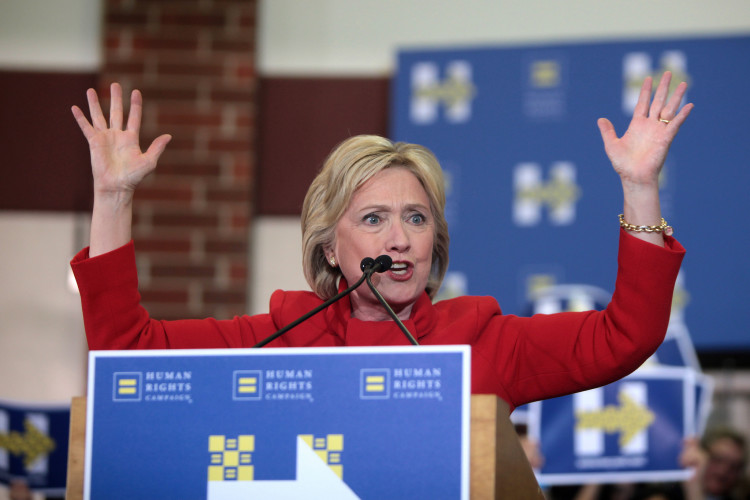 (Photo – Gage Skidmore on Flickr)
teleSUR – April 11, 2016
Democratic presidential frontrunner Hillary Clinton did not express any regret Monday about her support for the 2009 coup in Honduras, despite the deteriorating human rights situation, recently highlighted with the murder of prominent Indigenous activist Berta Caceres.
In fact, in an interview with the New York Daily News, in her opinion, the U.S. aid to military and police forces in Central America will eventually pay off just like Plan Colombia.
Plan Colombia was established under the administration of Bill Clinton in 1999 under the guise of fighting the war on drugs. The U.S. aid package, totalling almost US$2 billion, gave 78 percent of the funds to the Colombian military and police for counternarcotics and military operations against the rebel forces.
Despite a long list of studies and evidence that shows that Plan Colombia contributed to human rights abuses by security forces and the rise of paramilitary forces, Clinton took most of the credit for the current peace talks between the government and the FARC rebels, suggesting Plan Colombia brought peace to Colombia.
“I didn’t like the way it looked or the way they did it but (the coup leaders) had a very strong argument that they had followed the constitution and the legal precedence,” she said in an interview with the New York Daily News.
Democratically-elected president Manuel Zelaya was forcibly put on a plane and sent out of the country by the Honduran military in June 2009.
Clinton justified the move despite opposing advice from her top aides, who urged her to declare it a military coup, and to cut off U.S. aid, as some emails leaked in July revealed.
She admitted that the coup leaders “really undercut their argument by spiriting (Zelaya) out of the country in his pajamas, where they sent the military to take him out of his bed and get him out of the country.”
Nevertheless she strongly rejected the idea of cutting U.S. aid for Honduras, claiming this would have harmed the Honduran people, although it is mainly directed to the country’s security forces. It is used to keep the drug war within Honduran borders – as well as to keep Central American migrants running away from drug violence from reaching the United States.
Would a Clinton Win Mean More Wars?
By Robert Parry | Consortium News | April 10, 2016
The Democratic Party establishment seems determined to drag Hillary Clinton’s listless campaign across the finish line of her race with Bernie Sanders and then count on Republican divisions to give her a path to the White House. But – if she gets there – the world should hold its breath.
If Clinton becomes President, she will be surrounded by a neocon-dominated American foreign policy establishment that will press her to resume its “regime change” strategies in the Middle East and escalate its new and dangerous Cold War against Russia.
Hillary Clinton (Photo credit: AIPAC)
If Bashar al-Assad is still president of Syria, there will be demands that she finally go for the knock-out blow; there will pressure, too, for her to ratchet up sanctions on Iran pushing Tehran toward renouncing the nuclear agreement; there are already calls for deploying more U.S. troops on Russia’s border and integrating Ukraine into the NATO military structure.
President Clinton-45 would hear the clever talking points justifying these moves, the swaggering tough-guy/gal rhetoric, and the tear-jerking propaganda about evil enemies throwing babies off incubators, giving Viagra to soldiers to rape more women, and committing horrific crimes (some real but many imagined) against defenseless innocents.
Does anyone think that Hillary Clinton has the wisdom to resist these siren songs of confrontation and war, even if she were inclined to?
President Barack Obama, who – for all his faults – has a much deeper and subtler intellect than Hillary Clinton, found himself so battered by these pressures from the militaristic Washington “playbook” that he whined about his predicament to The Atlantic’s Jeffrey Goldberg, himself a neocon war hawk.
The Washington foreign policy establishment is now so profoundly in the hands of the neocons and their “liberal interventionist” sidekicks that the sitting President presumably couldn’t find anyone but a neocon to give those interviews to, even as he complained about how the U.S. capital is in the hands of warmongers.
Given this neocon domination of U.S. foreign policy – especially in the State Department bureaucracy, the major media and the big think tanks – Clinton will be buffeted by hawkish demands and plans both from outside of her administration and from within.
Already key neocons, such as the Brookings Institution’s Robert Kagan, are signaling that they expect to have substantial influence over Clinton’s foreign policy. Kagan, who has repackaged himself as a “liberal interventionist,” threw his support to Clinton, who put him on a State Department advisory board.
There is also talk in Washington that Kagan’s neocon wife, Assistant Secretary of State for European Affairs Victoria Nuland, another Clinton favorite and the architect of the “regime change” in Ukraine, would be in line for a top foreign policy job in a Clinton-45 administration.
Neocons Back in Charge
So, Clinton’s election could mean that some of the most dangerous people in American foreign policy would be whispering their schemes for war and more war directly into her ear – and her record shows that she is very susceptible to such guidance.
At every turn, as a U.S. senator and as Secretary of State, Clinton has opted for “regime change” solutions – from the Iraq invasion in 2003 to the Honduras coup in 2009 to the Libyan air war in 2011 to the Syria civil war since 2011 – or she has advocated for the escalation of conflicts, such as in Afghanistan and with Iran, rather than engaging in reasonable give-and-take negotiations.
Though her backers tout her experience as Secretary of State, the reality was that she repeatedly disdained genuine diplomacy and was constantly hectoring President Obama into adopting the most violent and confrontational options.
He sometimes did (the Afghan “surge,” the Libyan war, the Iran nuclear stand-off) but he sometimes didn’t (reversing the Afghan escalation, finally negotiating a nuclear deal with Iran after Clinton left, rejecting a direct U.S. military assault on the Syrian government, and working at times with the Russians on Iran and Syria).
In other words, Obama acted as a register or brake restraining Clinton’s hawkishness. With Clinton as the President, however, she would have no such restraints. One could expect her to endorse many if not all the harebrained neocon schemes, much as President George W. Bush did when his neocon advisers exploited his fear and fury over 9/11 to guide him into their “regime change” agenda for the Middle East.
The neocons have never given up their dreams of overthrowing Mideast governments that Israel has put on its enemies list. Iraq was only the first. To follow were Syria and Iran with the idea that by installing pro-Israeli leaders in those countries, Israel’s close-in enemies – Lebanon’s Hezbollah, Hamas and other Palestinian militant groups – could be isolated and crushed.
After Bush’s Iraq invasion in 2003, Washington’s neocons were joking about whether Iran or Syria should come next, with the punch line: “Real men go to Tehran!” But the Iraq War wasn’t the “cakewalk” that the neocons had predicted. Instead of throwing flowers at the U.S. troops, Iraqis planted IEDs.
As it turned out, a lot of “real men” and “real women” – as well as “real children” – died in Iraq, including nearly 4,500 American soldiers and hundreds of thousands of Iraqis.
So the neocon timetable took a hit but, in their view, only because of Bush’s incompetent follow-through on Iraq. If not for the botched occupation, the neocons felt they could have continued rolling up other troublesome regimes, one after another.
Professionally, the neocons also escaped the Iraq disaster largely unscathed, continuing to dominate Washington’s think tanks and the op-ed pages of major American news outlets such as The Washington Post and The New York Times. Barely missing a beat, they set about planning for the longer haul.
An Obama Mistake
Although they lost the White House in 2008, the neocons caught a break when President-elect Obama opted for a Lincoln-esque “team of rivals” on foreign policy. Instead of reaching out to Washington’s marginalized (and aging) foreign policy “realists,” Obama looked to the roster of the neocon-dominated establishment.
Obama recruited his hawkish Democratic rival, Sen. Hillary Clinton, to be Secretary of State and kept Bush’s Defense Secretary Robert Gates. Obama also left in place most of Bush’s military high command, including neocon favorite, General David Petraeus.
Obama’s naïve management strategy let the neocons and their “liberal interventionist” pals consolidate their bureaucratic control of Washington’s foreign policy bureaucracy, even though the President favored a more “realist” approach that would use America’s power more judiciously — and he was less enthralled to Israel’s right-wing government.
The behind-the-scenes neocon influence became especially pronounced at Clinton’s State Department where she tapped the likes of Nuland, a neocon ideologue and an adviser to Vice President Dick Cheney, to become the department’s spokesperson and put her on track to become Assistant Secretary of State for European Affairs (although the appointment wasn’t finalized until after Clinton left in 2013).
The neocon/liberal-hawk bias is now so strong inside the State Department that officials I know who have gone there reemerge as kind of “pod people” spouting arrogant talking points in support of U.S. intervention all over the world. By contrast, I find the CIA and the Pentagon to be places of relative realism and restraint.
Perhaps the best example of this “pod people” phenomenon was Sen. John Kerry, who replaced Clinton as Secretary of State and suddenly became the mouthpiece for the bureaucracy’s most extreme war-like rhetoric.
For instance, Kerry advocated a retaliatory bombing campaign against Syria’s military in August 2013, ignoring the intelligence community’s doubts about whether President Bashar al-Assad’s regime was responsible for a sarin-gas attack outside Damascus.
Instead of listening to the intelligence analysts, Kerry fell in line behind the neocon-driven “group think” pinning the blame on Assad, the perfect excuse for implementing the neocons’ long-delayed Syrian “regime change.” The neocons didn’t care what the facts were — and Kerry fell in line. [See Consortiumnews.com’s “What’s the Matter with John Kerry?”]
But Obama didn’t fall in line. He listened when Director of National Intelligence James Clapper told him that there was no “slam dunk” evidence implicating the Syrian military. (Ultimately, the evidence would point to a provocation carried out by Islamic extremists trying to trick the U.S. military into intervening in the war on their side.)
Obama also got help from Russian President Vladimir Putin who persuaded President Assad to surrender all his chemical weapons (while Assad still denied any role in the sarin-gas attack). Putin’s assistance infuriated the neocons who soon recognized that the Obama-Putin cooperation was a profound threat to their “regime change” enterprise.
Targeting Ukraine
Some of the smarter neocons quickly identified Ukraine as a potential wedge that could be driven between Obama and Putin. Carl Gershman, president of the National Endowment for Democracy, called Ukraine “the biggest prize” and a potential first step toward driving Putin from power in Russia.
It fell to Assistant Secretary of State Nuland to shepherd the Ukraine operation to fulfillment as she plotted with U.S. Ambassador to Ukraine Geoffrey Pyatt how to remove Ukraine’s pro-Russian President Viktor Yanukovych. Nuland and Pyatt were caught in an intercepted phone call discussing who should take over.
“Yats is the guy,” Nuland said referring to Arseniy Yatsenyuk who indeed would become the new prime minister. Nuland and Pyatt then exchanged ideas how to “glue this thing” and how to “midwife this thing.” This “thing” became the bloody Feb. 22, 2014 coup ousting elected President Yanukovych and touching off a civil war between Ukrainian “nationalists” from the west and Ukraine’s ethnic Russians in the east.
As the “nationalists,” some of them openly neo-Nazis, inflicted atrocities on ethnic Russians, Crimea voted by 96 percent to leave Ukraine and rejoin Russia. Resistance to the new Kiev regime also arose in the eastern Donbas region.
To the State Department – and the mainstream U.S. news media – this conflict was all explained as “Russian aggression” against Ukraine and a “Russian invasion” of Crimea (although Russian troops were already in Crimea as part of the Sevastopol naval base agreement). But All the Important People agreed that the Crimean referendum was a “sham” (although many polls have since confirmed the results).
When citizen Clinton weighed in on the Ukraine crisis, she compared Russian President Putin to Hitler.
So, today the neocon/liberal-hawk Washington “playbook” – as Obama would call it – calls for massing more and more U.S. troops and NATO weapons systems on Russia’s border to deter Putin’s “aggression.”
These tough guys and gals also vow to ignore Russia’s warnings against what it views as military threats to its existence. Apparently “real, real men” go to Moscow (perhaps riding a nuclear bomb like the famous seen from “Dr. Strangelove.”).
Ian Joseph Brzezinski, a State Department official under President George W. Bush and now a foreign policy expert for the Atlantic Council, a NATO think tank, has co-authored an article urging NATO to incorporate Ukrainian army units into its expansion of military operations along Russia’s border.
“High-level Ukrainian national security officials have urged the international community to be bolder in its response to Russia’s provocative military actions,” wrote Brzezinski (son of old Cold Warrior Zbigniew Brzezinski) and Ukrainian co-author Markian Bilynskyj.
“The deployment of a battle tested, Ukrainian infantry company or larger unit to reinforce the defense of NATO territory in Central Europe would be a positive contribution to the Alliance force posture in the region.”
Following the Playbook
This kind of tough-talking jargon is what the next President, whoever he or she is, can expect from Official Washington. From Obama’s interview in The Atlantic, it’s clear that he feels surrounded and embattled by these warmongering forces but takes some pride in resisting – from time to time – the Washington “playbook.”
But how would President Hillary Clinton respond? When she appeared before the American Israel Public Affairs Committee on March 21 – at a moment when it appeared she had all but nailed down the Democratic nomination – Clinton showed what you might call her true colors, fawning over how loyal she would be to Israel and promising to take the very cozy relationship between the U.S. and Israel “to the next level.”
By reviewing Clinton’s public record, one could reasonably conclude that she is herself a neocon, both in her devotion to Israel and her proclivity toward “regime change” solutions. She also follows the neocon lead in demonizing any foreign leader who gets in their way. But even if she isn’t a full-fledged neocon, she often bends to their demands.
The one possible deviation from this pattern is Clinton’s personal friendship with longtime adviser Sidney Blumenthal, who was an early critic of the neoconservatives as they emerged as a powerful force during the Reagan administration. Blumenthal and his son Max have also dared criticize Israel’s abusive treatment of the Palestinians.
However, the Israel Lobby appears to be taking no chances that Sidney Blumenthal’s voice might be heard during a Clinton-45 administration. Last month, a pro-Zionist group, The World Values Network, bought a full-page ad in The New York Times to attack Blumenthal and his son and declared that “Hillary Clinton must disavow her anti-Israel advisors.”
Though Clinton might not publicly disassociate herself from Sidney Blumenthal, the preemptive strike pushed him further toward the margins and helped clear the path for the Kagan/Nuland faction to rush to the center of Clinton’s foreign policy.
Indeed, Clinton’s primary focus if she gets elected is likely to be ensuring that she gets reelected. As a traditional politician, she would think that the way to achieve reelection is to stay on the good side of the Israeli leadership. Along those lines, she promised AIPAC that, as President, she would immediately invite Prime Minister Benjamin Netanyahu to the White House.
So, what would happen if Clinton takes the U.S.-Israeli relationship “to the next level”? Presumably that would mean taking a super-hard line against Iran over last year’s nuclear deal. Yet, already Iran is questioning whether its acceptance of extraordinary constraints on its nuclear program was worth it, given the U.S. unwillingness to grant meaningful relief on economic sanctions.
A belligerent Clinton approach – decrying Iran’s behavior and imposing new sanctions – would strengthen Iran’s hard-line faction internally and might well lead to Iran renouncing the agreement on the grounds of American bad faith. That, of course, would please the neocons and Netanyahu by putting the “bomb-bomb-bomb Iran” option back in play.
A Stunning Reversal
Clinton may have viewed her AIPAC speech as the beginning of her long-awaited “pivot to the center,” but afterwards she suffered a string of primary and caucus defeats at the hands of Sen. Bernie Sanders, most by landslide margins.
Besides those stunning defeats, Clinton’s campaign clearly has an “enthusiasm gap.” Sanders, the 74-year-old “democratic socialist” from Vermont, draws huge and excited crowds and wins younger voters by staggering percentages. Meanwhile, Clinton confronts polls showing high negatives and extraordinary public distrust.
If she gets the Democratic nomination, she may have little choice but to engage in a fiercely negative campaign since — faced with the lack of voter enthusiasm — her best chance of winning is to so demonize her Republican opponent that Democrats and independents will be driven to the polls out of fear of what the crazy GOP madman might do.
Right now, many Clinton supporters see her as the “safe” — not exciting — choice, a politician whose long résumé gives them comfort that she must know what’s she’s doing. African-American voters, who have been her most loyal constituency, apparently feel more comfortable with someone they’ve known (who has also served in the Obama administration) than Sanders who is unknown to many and is seen as someone whose ambitious programs appear less practical than Clinton’s small-bore ideas.
But a look behind Clinton’s résumé, especially her reliance on “regime change” and other interventionist schemes in the Middle East and Eastern Europe, might give all peace-loving voters pause. [See Consortiumnews.com’s “Is Hillary Clinton ‘Qualified’?”]
Savvy neocons, like Robert Kagan, have long understood that Clinton could be their Trojan Horse, pulled into the White House by Democratic voters. Kagan told The New York Times, “I feel comfortable with her on foreign policy. If she pursues a policy which we think she will pursue it’s something that might have been called neocon, but clearly her supporters are not going to call it that; they are going to call it something else.”
The same Times article noted that Clinton “remains the vessel into which many interventionists are pouring their hopes.” However, if she is that “vessel” carrying a neocon foreign policy back into the White House, this “safe” choice might prove dangerous to America and the world.
Investigative reporter Robert Parry broke many of the Iran-Contra stories for The Associated Press and Newsweek in the 1980s. You can buy his latest book, America’s Stolen Narrative, either in print here or as an e-book (from Amazon and barnesandnoble.com).
The Disappearance of Hillary Clinton’s Healthcare Platform
By Benjamin Day | Common Dreams | March 30, 2016
What would happen if the media lifted the curtain on Clinton’s healthcare platform and introduced any level of scrutiny to her proposed improvements on the Affordable Care Act?
In an extraordinary magic trick, performed on a national scale, Hillary Clinton’s healthcare platform has been disappeared. While policy analysts, news anchors, and columnists have been engaged in an intense debate over Bernie Sanders’s “Medicare for All” proposal, Clinton’s incremental alternative has escaped almost all scrutiny – even among those who say they prefer it.
Combining the election-season writings of our most prolific, liberal-leaning columnists at the New York Times, Huffington Post, Vox, Mother Jones, Politico, The American Prospect, etc. you’ll find dozens of articles critiquing Sanders’s single-payer plan. None have mentioned a single Clinton healthcare proposal as a point of comparison – merely that she supports a philosphy of incremental reform.
Take Paul Krugman, a high-profile advocate of Clinton’s approach to healthcare reform. Krugman has published two op-eds in the New York Times and five additional blog posts arguing that “[progressives] should seek incremental change on health care… and focus their main efforts on other issues – that is… Bernie Sanders is wrong about this and Hillary Clinton is right.” In all seven pieces, Krugman focuses exclusively on Sanders’s single-payer proposal and fails to mention even a single Clinton policy.
The disappearance of the Clinton healthcare platform has even been carried out by pollsters. The Kaiser Health Tracking Survey included a bizarre question in its February 2016 poll, which was widely cited in the press. Respondents were asked to pick one of four possible directions for the future of U.S. healthcare. Among the choices were “The U.S. should establish guaranteed universal coverage through a single government plan” and “Lawmakers should build on the existing health care law to improve affordability and access to care.” Thirty-three percent of Democrats chose the single-payer option, while fifty-four percent chose the incremental option. The questions were clearly intended as stand-ins for the Sanders and Clinton healthcare proposals, but note that the single-payer option is a policy, whereas the incremental option mentions no actual policies, but asks respondents whether they support the (universally desirable) outcomes of improving affordability and access.
What would happen if the media lifted the curtain on Clinton’s healthcare platform and introduced any level of scrutiny to her proposed improvements on the Affordable Care Act? They would find two categories of Clinton proposals: some that are so vague they’re difficult to evaluate, and other more concrete plans that follow in the footsteps of one of Congress’s most practiced healthcare incrementalists: Senator Bernie Sanders.
For example, one of Clinton’s clearest incremental proposals is to repeal the Affordable Care Act’s poorly named “cadillac tax” on health plans with high premiums. She announced this proposal on September 29, drawing the ire of White House spokespeople. The move, however, followed in the footsteps of a Senate bill to repeal the Cadillac tax introduced by Bernie Sanders and seven Democratic Senators just a few days previously on September 24. Clinton’s position was correctly seen by reporters as necessary if she didn’t want to lose labor union support to Sanders.
“Because Clinton’s healthcare platform has received zero public scrutiny, she has had the luxury of floating other policy ideas in broad outlines, too vague to evaluate.”Many of Clinton’s well-defined healthcare proposals are rolled into a package of prescription drug reforms, which she released on September 22, 2015. They bear a striking resemblance to the Sanders prescription drug plan announced on September 1, filed as legislation on September 10. Both would legalize importation of prescription drugs from Canada, where costs for identical drugs are much lower due to Canada’s single-payer healthcare system. Sanders was a pioneer of importation, and in 1999 started driving busloads of American patients who couldn’t afford breast cancer drugs across the Canadian border. Both candidates call for empowering Medicare to negotiate drug prices – even Donald Trump jumped on board in January. Both would ban “pay-for-delay” deals between brand-name and generic drug makers, and increase prescription drug rebates for Medicaid and/or Medicare.
Because Clinton’s healthcare platform has received zero public scrutiny, she has had the luxury of floating other policy ideas in broad outlines, too vague to evaluate. Take the proposal to expand the use of Accountable Care Organizations. How? According to Clinton’s December policy brief: “In the coming months, [Clinton] will provide full detail on her plans for delivery system reforms that drive down costs.” With the primaries drawing to a close, no such details have been released. The same could be said of another proposal to “create a fallback process” to review insurance premium rate hikes in states that don’t already review rates. There has been no explanation of how such a plan would work, or whether it would require new legislation.
This is the double standard at work in almost all national coverage of Clinton and Sanders on healthcare reform: Clinton has been taken at her word that her incremental plans will be politically feasible, succeed in improving affordability and access to care, and are not shared by her opponent. Sanders on the other hand received intense public pressure to release details of his single-payer healthcare proposal, and when he did the proposal was subject to an avalanche of public analysis and scrutiny.
This double standard is all the more remarkable because single-payer healthcare is an established policy, practiced in one form or another in almost every developed nation in the world. Incremental reforms that work within the market-based healthcare system of the U.S. are far more uncertain, and deserve greater scrutiny. They are easier to enact but dramatically more likely to fall short of their goals. This is because incremental reforms in the United States usually focus on expanding access to care, without significant cost controls, in order to avoid opposition from the healthcare industry. The resulting policies are often unsustainable; make little headway against national trends of rising costs and eroding access; or simply move costs around (e.g. from premiums to deductibles and co-payments, or vice versa).
Previous national trends in incremental healthcare reform – from managed care through pharmacy benefit management, chronic disease management, narrow networks, and beyond – have often created lucrative new industries, but had dubious impacts on underlying healthcare costs or access to care. Most of Clinton’s healthcare platform falls exactly into these danger zones, and should be received with a critical eye.
The national discussion of single-payer healthcare reform is long overdue. However, when the full range of national media outlets force one candidate to run on real policies, while allowing another to run on values and aspirations, we aren’t having a real discussion of systemic vs. incremental reform, we are merely aiding the corrosion of informed democracy.
Benjamin Day is the Executive Director of Healthcare-NOW.
Featured Video

Macgregor: We Haven’t Seen the Worst of the Iran War Yet
or go to
Aletho News Archives – Video-Images
From the Archives
15 Saudi ‘hijackers’ were CIA agents working for US: Scholar
Press TV – April 13, 2016
Fifteen of the 9/11 “hijackers” from Saudi Arabia were CIA agents working for the United States government, which was seeking to destroy the Middle East for Israel and to double the American military budget, says Dr. Kevin Barrett, an American academic who has been studying the events of 9/11 since late 2003…. continue
Blog Roll
 Aletho News
- Iran’s Plan to Shut Down AI in the Persian Gulf
- Israel seeks ‘compensation’ from Washington over Saudi F-35 sale
- Saudi crown prince seeks dialogue with Ansarullah after Yemeni blows: Report
- Damascus rejects Saudi request for Syrian fighters to counter Yemen: Report
- South Korea says will not send troops to join terrorist US war on Iran
- Russia Just Struck the Eyes of NATO’s War Machine in Ukraine
- Russia summons UK charge d’affaires over Kiev drone support
- NATO member warns bloc seeking pretext for war with Russia
- Macgregor: We Haven’t Seen the Worst of the Iran War Yet
- ‘We are not like everyone else’ laws that bind other nations do not apply to Israel, says Likud lawmaker
- If Americans Knew
- Debunking The Claim That Macklemore Has A “History Of Antisemitism”
- CPJ demands release of arrested Palestinian-US journalist near Bethlehem
- Robert Kraft: The Billionaire Friend of Netanyahu Pulling The Strings Behind the Macklemore/Ed Sheeran Blow Up
- Columbia Administered Fund Gives Big Money to Pro-Israel Groups
- Deportation Case of Palestinian Activist Salah Sarsour Tests First Amendment
- ‘We Will Not Forget’: Palestinians Mark 44 Years since Sabra and Shatila
- Why do we let Zionists decide what we can and can’t say?
- US welcomes Israeli, Iranian delegations to UN, but not Palestinians – Daily Update
- Biden’s Genocide Accomplices Targeted by New Accountability Campaign
- AIPAC’s Network Has Already Spent $67.2 Million to Shape the Midterm Elections
- No Tricks Zone
- New Study: ‘Global Drought Shows No Detectable Recent Acceleration Under Climate Warming’
- Economic Masterminds: German Socialists Suggest Taxing Productivity Gains Stemming From Using AI
- The South China Sea Has Not Been Cooperating With The Climate Change Narrative
- Energy Crisis: Germany Enters Heating Season With Historically Low Gas Reserve Fill Levels
- New Study: The Antarctic Ice Sheet Gained Mass From 2020-2024 Due To Staggering Snow And Ice Accumulation
- Study: Ocean Heating Rates From Thousands Of Years Ago ‘Dwarf’ Modern Ocean Heating Rates
- Climate Extremists Target, Attack Large-Scale Power Grid Infrastructure In Germany!
- New Study: Antarctic Ice Melt Has Contributed Less Than 1 Centimeter To Sea Level Rise In The Last 30 Years
- Fear Of Debate: Alarmist German Climate Scientist Calls On Mainstream Media To Discredit Skeptic Voices
- End-Of-August Arctic Sea Ice Extent Hasn’t Fallen In 20 Years, Official Data Show!
 Aletho News