Trump Way to the Left of Clinton on Foreign Policy – In Fact, He’s Damn Near Anti-Empire
By Glen Ford | Black Agenda Report | March 30, 2016
If the Bernie Sanders campaign has propelled the word “socialism” – if not its actual meaning – into common, benign American usage, Donald Trump may have done the world an even greater service, by calling into question the very pillars of U.S. imperial policy: the NATO alliance; the U.S. nuclear “umbrella”; the global network of 1,000 U.S. bases; military “containment” of China and Russia; and U.S. “strategic” claims in the Persian Gulf. Were the U.S. to actually rid itself of these strategic “obligations,” the military hand on the doomsday clock would immediately be rolled back, giving humanity the breathing space to tackle other accumulated crises.
Of course, Donald Trump may over time rephrase, reverse or “clarify” out of existence some of his profoundly anti-imperial, “America First” foreign policy points, elicited in extended interviews with major U.S. media. However, if Trump’s tens of millions of white, so-called “Middle American” followers stick by him, despite his foreign policy heresies – as seems likely – it will utterly shatter the prevailing assumption that the American public favors maintenance of U.S. empire by military means. If the rank and file right wing of the Republican Party is not a pillar of such policies, then who is? – rank and file, Black, white and brown Democrats? If the Trump candidacy can continue to thrive while rejecting the holiest shibboleths of the bipartisan War Party, then we must conclude that the whole U.S. foreign policy debate is a construct of the corporate media and the corporate-bought duopoly political establishments, and that there is no popular consensus for U.S. militarism and no true mass constituency for war in either party.
If Donald Trump is to be the catalyst for such a revelation, then may all the gods bless him – because lots of assassins will be out to kill him.
Trump’s language is sloppy, but there can be no mistaking the thrust of his position on key points. He calls NATO, the globe-strutting Euro-American military juggernaut that extended its domain to Africa with the 2011 war of regime change in Libya, an alliance that is “unfair, economically, to us.” Trump told the New York Times that NATO should focus on “counter-terrorism” – clearly a fundamentally scaled-down mission.
He repeated his often-expressed willingness to withdraw U.S. forces from Japan and South Korea, where American troops have been stationed since the end of World War Two, unless both countries pay a lot more money to maintain them. Trump actually seems eager to get out of the region, based on the number of times he has brought the subject up in his campaign. As with everything else in the Trump paradigm, he hooks the alliance to his quest for a “better deal” – but the point is that he doesn’t think the “price” of the far-flung U.S. military commitment is “worth it.” Trump’s stated intention to renegotiate virtually all of the “deals” the U.S. has made around the world – the military architecture of imperialism – means he is pointedly applying a cost-benefit test to the 1,000 U.S. bases around the globe. He is reluctant to offer other nations the “protection” of U.S. nuclear weapons.
The crucial point is: Trump does not accept the fundamental premise that these bases exist for U.S. “security” interests, but rather, he frames them as a kind of “service” that the clients should pay for. Once the “national security” veneer is withdrawn, the military-imperial rationale evaporates and all that is left is a business transaction – not enough to call a nation to war, or to risk a world over.
Trump appears to welcome a strategic break with Saudi Arabia, threatening to cut off U.S. purchases of oil from the kingdom unless it “substantially reimburse[s]” Washington for fighting the Islamic State, or unless the Saudis and the other rich oil states commit troops to the anti-jihadist battle – at their own expense. It’s all nonsense, of course, since Washington and Saudi Arabia have been partners in global jihadism for two generations – but so what? Trump seems to relish the idea of severing the Saudi connection. “If Saudi Arabia was without the cloak of American protection, I don’t think it would be around,” he said. His threat to withdraw the “cloak” unless the potentates pay for protection would negate the U.S. “national security” rationale in the Persian Gulf going back to President Franklin Roosevelt’s 1943 declaration that “the defense of Saudi Arabia is vital to the defense of the United States.” President Carter, another Democrat, upped the ante in 1980 with his doctrine that the United States would use military force if necessary to defend its “national interests” in the Persian Gulf. Bush presidents One and Two were simply building on these previous national security rationales. Trump recognizes no such imperative, without which U.S. imperial policy in the region has no political basis.
Trump plays the trade card rather than the military gambit in dealing with China. He would threaten economic retaliation for China’s fortification of islands in the China Sea – not military encirclement. “We have tremendous economic power over China, and that’s the power of trade,” he said. The same, presumably, would apply to Russia.
The presidential candidate shows no interest in “spreading democracy,” like George W. Bush, or assuming a responsibility to “protect” other peoples from their own governments, like Barack Obama and his political twin, Hillary Clinton. On the contrary, Trump has stated that the U.S. should not have invaded Iraq and Libya and killed their leaders, Saddam Hussein and Muammar Gaddafi, because they killed terrorists – in contrast to Hillary Clinton’s macabre cackling over Gaddafi’s body. He opposed the U.S. proxy war against the al-Assad government in Syria, for similar reasons.
He even briefly defied the ultimate taboo, using the word “neutral” to describe the stance he would take on Palestine.
In sum, albeit sloppily, and with no guarantee that he won’t change his mind at any moment, Trump has rejected the whole gamut of U.S. imperial war rationales, from FDR straight through to the present. For who knows what reason, Trump is busily delegitimizing U.S. imperial policy since World War Two.
It’s not that the Empire has no clothes, but that it is being stripped of its rationale to march around the planet in battle gear. Thanks, not to Bernie, but to The Donald.
Trump has reduced white American nationalism to Race, his “trump” card – but without his hero, Teddy Roosevelt’s Great White Fleet sailing the world to plant the flag on distant shores.
The first effect of Trump’s intervention in the Republican primaries was to demonstrate that his white hordes really don’t give a damn for the GOP establishment’s corporate agenda; indeed, Trump gave them a chance to show they hated what global capitalism has done to “their” jobs. The fact that this cohort despises and fears non-whites of whatever citizenship status is nothing new – it’s a constant in U.S. politics, which is why there has always been a White Man’s Party. What makes this electoral season different – and, hopefully, a turning point in U.S. history – is that much of the rank and file of the White Man’s Party, the GOP, is rejecting the economic agenda of its corporate masters. If the Republican voters accept Trump’s assault on the ideological rationale undergirding U.S. foreign policy and its imperial structures, there will be nothing left of the GOP for the corporate rulers to defend. The Republican house of cards is collapsing, inevitably throwing the whole duopoly system out of whack.
The job of the Left, at this historic juncture, is to ensure that the two-party duopoly is permanently broken, to create the space for a much broader national discourse and, especially, to free Black America from the “trap within a trap” of the corporate-controlled Democratic Party. As we have written before in these pages, the best scenario of 2016 would be a fracture at both ends of the Rich Man’s Duopoly. It is insane – although perfectly explainable – that the most leftish constituency in the nation, Black America, is aligned with the right wing of the Democratic Party in the person of Hillary Clinton, while white Democrats man the barricades for the nominal socialist, Bernie Sanders. Blacks are the most pro-peace ethnicity in the nation, but have also been the indispensable bloc behind Hillary Clinton, the warmonger who is on her way to becoming the sole candidate of both Wall Street and the Pentagon.
It is magnificent, grand and glorious that the duopoly system is in deep trouble. But it is sad beyond measure that the near-extinction of independent Black politics has placed African Americans in the most untenable position imaginable at this critical moment: in the Hillary Clinton camp. Fortunately, key elements of the Movement for Black Lives have pledged not to endorse any candidates this election season. We hope that they stick with that commitment, continue to build a grassroots movement, and resist the corporate Democratic hegemony that has strangled and subverted Black politics for the past 40 years. The Black Left, broadly defined, must engage in a thorough reassessment of its politics and practice, in light of the great fissures that are occurring in the structures of the rulers’ system. That’s why the Black Is Back Coalition for Social Justice, Peace and Reparations is holding a National Conference on the 2016 U.S. Presidential Election and the Struggle for Black Self-Determination, on April 9th, in Harlem, New York City. This electoral season will see massive realignments of parties and coalitions – events that will happen whether Black people are organized or not. But Black self-determination is only moved forward if people push it. The most optimum time to press issues of Black self-determination is when the larger polity is in flux, such as exists today – thanks, in great measure, to the racist billionaire, Donald Trump.
Actually, there’s no need to thank him. That wealth-born son-of-a-rich-developer has already been paid. And by his own standards, that’s all that matters.
BAR executive editor Glen Ford can be contacted at Glen.Ford@BlackAgendaReport.com.
A ‘Silent Coup’ for Brazil?
By Ted Snider | Consortium News | March 30, 2016
Brazil keeps its coups quiet (or at least quieter than many other Latin American countries). During the Cold War, there was much more attention to overt military regime changes often backed by the CIA, such as the overthrow of Guatemala’s Jacobo Arbenz in 1954, the ouster of Chile’s Salvador Allende in 1973 and even Argentina’s “dirty war” coup in 1976, than to Brazil’s 1964 coup that removed President João Goulart from power.
Noam Chomsky has called Goulart’s government “mildly social democratic.” Its replacement was a brutal military dictatorship.
In more modern times, Latin American coups have shed their image of overt military takeovers or covert CIA actions. Rather than tanks in the streets and grim-looking generals rounding up political opponents – today’s coups are more like the “color revolutions” used in Eastern Europe and the Mideast in which leftist, socialist or perceived anti-American governments were targeted with “soft power” tactics, such as economic dislocation, sophisticated propaganda, and political disorder often financed by “pro-democracy” non-governmental organizations (or NGOs).
This strategy began to take shape in the latter days of the Cold War as the CIA program of arming Nicaraguan Contra rebels gave way to a U.S. economic strategy of driving Sandinista-led Nicaragua into abject poverty, combined with a political strategy of spending on election-related NGOs by the U.S.-funded National Endowment for Democracy, setting the stage for the Sandinistas’ political defeat in 1990.
During the Obama administration, this strategy of non-violent “regime change” in Latin America has gained increasing favor, as with Secretary of State Hillary Clinton’s decisive support for the 2009 ouster of Honduran President Manuel Zelaya who had pursued a moderately progressive domestic policy that threatened the interests of the Central American nation’s traditional oligarchy and foreign investors.
Unlike the earlier military-style coups, the “silent coups” never take off their masks and reveal themselves as coups. They are coups disguised as domestic popular uprisings which are blamed on the misrule of the targeted government. Indeed, the U.S. mainstream media will go to great lengths to deny that these coups are even coups.
The new coups are cloaked in one of two disguises. In the first, a rightist minority that lost at the polls will allege “fraud” and move its message to the streets as an expression of “democracy”; in the second type, the minority cloaks its power grab behind the legal or constitutional workings of the legislature or the courts, such as was the case in ousting President Zelaya in Honduras in 2009.
Both strategies usually deploy accusations of corruption or dictatorial intent against the sitting government, charges that are trumpeted by rightist-owned news outlets and U.S.-funded NGOs that portray themselves as “promoting democracy,” seeking “good government” or defending “human rights.” Brazil today is showing signs of both strategies.
Brazil’s Boom
First, some background: In 2002, the Workers’ Party’s (PT) Luiz Inacio Lula da Silva came to power with 61.3 percent of the vote. Four years later, he was returned to power with a still overwhelming 60.83 percent. Lula da Silva’s presidency was marked by extraordinary growth in Brazil’s economy and by landmark social reforms and domestic infrastructure investments.
In 2010, at the end of Lula da Silva’s presidency, the BBC provided a typical account of his successes: “Number-crunchers say rising incomes have catapulted more than 29 million Brazilians into the middle class during the eight-year presidency of Luiz Inacio Lula da Silva, a former trade unionist elected in 2002. Some of these people are beneficiaries of government handouts and others of a steadily improving education system. Brazilians are staying in school longer, which secures them higher wages, which drives consumption, which in turn fuels a booming domestic economy.”
However, in Brazil, a two-term president must sit out a full term before running again. So, in 2010, Dilma Rousseff ran as Lula da Silva’s chosen successor. She won a majority 56.05 percent of the vote. When, in 2014, Rousseff won re-election with 52 percent of the vote, the right-wing opposition Brazilian Social Democratic Party (PSDB) went into a panic.
This panic was not just because democracy was failing as a method for advancing right-wing goals, nor was the panic just over the fourth consecutive victory by the more left-wing PT. The panic became desperation when it became clear that, after the PT had succeeded in holding onto power while Lula da Silva was constitutionally sidelined, he was likely returning as the PT’s presidential candidate in 2018.
After all, Lula da Silva left office with an 80 percent approval rating. Democracy, it seemed, might never work for the PSDB. So, the “silent coup” playbook was opened. As the prescribed first play, the opposition refused to accept the 2014 electoral results despite never proffering a credible complaint. The second move was taking to the streets.
A well-organized and well-funded minority whose numbers were too small to prevail at the polls can still create lots of noise and disruption in the streets, manufacturing the appearance of a powerful democratic movement. Plus, these protests received sympathetic coverage from the corporate media of both Brazil and the United States.
The next step was to cite corruption and begin the process for a constitutional coup in the form of impeachment proceedings against President Rousseff. Corruption, of course, is a reliable weapon in this arsenal because there is always some corruption in government which can be exaggerated or ignored as political interests dictate.
Allegations of corruption also can be useful in dirtying up popular politicians by making them appear to be only interested in lining their pockets, a particularly effective line of attack against leaders who appear to be working to benefit the people. Meanwhile, the corruption of U.S.-favored politicians who are lining their own pockets much more egregiously is often ignored by the same media and NGOs.
Removing Leaders
In recent years, this type of “constitutional” coup was used in Honduras to get rid of democratically elected President Zelaya. He was whisked out of Honduras through a kidnapping at gunpoint that was dressed up as a constitutional obligation mandated by a court after Zelaya announced a plebiscite to determine whether Hondurans wanted to draft a new constitution.
The hostile political establishment in Honduras falsely translated his announcement into an unconstitutional intention to seek reelection, i.e., the abuse-of-power ruse. The ability to stand for a second term would be considered in the constitutional discussions, but was never announced as an intention by Zelaya.
Nevertheless, the Supreme Court declared the President’s plebiscite unconstitutional and the military kidnapped Zelaya. The Supreme Court charged Zelaya with treason and declared a new president: a coup in constitutional disguise, one that was condemned by many Latin American nations but was embraced by then-Secretary of State Hillary Clinton.
This coup pattern reoccurred in Paraguay when right-wing Frederico Franco took the presidency from democratically elected, left-leaning Fernando Lugo in what has been called a parliamentary coup. As in Honduras, the coup was made to look like a constitutional transition. In the Paraguay case, the right-wing opposition opportunistically capitalized on a skirmish over disputed land that left at least 11 people dead to unfairly blame the deaths on President Lugo. It then impeached him after giving him only 24 hours to prepare his defense and only two hours to deliver it.
Brazil is manifesting what could be the third example of this sort of coup in Latin America during the Obama administration.
Operation Lava Jato began in Brazil in March of 2014 as a judicial and police investigation into government corruption. Lava Jato is usually translated as “Car Wash” but, apparently, is better captured as “speed laundering” with the connotation of corruption and money laundering.
Operation Lava Jato began as the uncovering of political bribery and misuse of money, revolving around Brazil’s massive oil company Petrobras. The dirt – or political influence-buying – that needed washing stuck to all major political parties in a corrupt system, according to Alfredo Saad Filho, Professor of Political Economy at the SAOS University of London.
But Brazil’s political Right hijacked the investigation and turned a legitimate judicial investigation into a political coup attempt.
According to Boaventura de Sousa Santos, Professor of Sociology at the University of Coimbra in Portugal and Distinguished Legal Scholar at the University of Wisconsin-Madison, although Operation Lava Jato “involves the leaders of various parties, the fact is that Operation Lava Jato – and its media accomplices – have shown to be majorly inclined towards implicating the leaders of PT (the Workers’ Party), with the by now unmistakable purpose of bringing about the political assassination of President Dilma Rousseff and former President Lula da Silva.”
De Sousa Santos called the political repurposing of the judicial investigation “glaringly” and “crassly selective,” and he indicts the entire operation in its refitted form as “blatantly illegal and unconstitutional.” Alfredo Saad Filho said the goal is to “inflict maximum damage” on the PT “while shielding other parties.”
Neutralizing Lula
The ultimate goal of the coup in democratic disguise is to neutralize Lula da Silva. Criminal charges — which Filho describes as “stretched” — have been brought against Lula da Silva. On March 4, he was detained for questioning. President Rousseff then appointed Lula da Silva as her Chief of Staff, a move which the opposition represented as an attempt to use ministerial status to protect him from prosecution by any body other than the Supreme Court.
But Filho says this representation is based on an illegally recorded and illegally released conversation between Rousseff and Lula da Silva. The conversation, Filho says, was then “misinterpreted” to allow it to be “presented as ‘proof’ of a conspiracy to protect Lula.” De Sousa Santos added that “President Dilma Rousseff’s cabinet has decided to include Lula da Silva among its ministers. It is its right to do so and no institution, least of all the judiciary, has the power to prevent it.”
No “presidential crime warranting an impeachment has emerged,” according to Filho.
As in Honduras and Paraguay, an opposition that despairs of its ability to remove the elected government through democratic instruments has turned to undemocratic means that it hopes to disguise as judicial and constitutional. In the case of Brazil, Professor de Sousa Santos calls this coup in democratic disguise a “political-judicial coup.”
In both Honduras and Paraguay, the U.S. government, though publicly insisting that it wasn’t involved, privately knew the machinations were coups. Less than a month after the Honduran coup, the White House, State Department and many others were in receipt of a frank cable from the U.S. embassy in Honduras calling the coup a coup.
Entitled “Open and Shut: the Case of the Honduran Coup,” the embassy said, “There is no doubt that the military, Supreme Court and National Congress conspired on June 28 in what constituted an illegal and unconstitutional coup.” The cable added, “none of the . . . arguments [of the coup defenders] has any substantive validity under the Honduran constitution.”
As for Paraguay, U.S. embassy cables said Lugo’s political opposition had as its goal to “Capitalize on any Lugo missteps” and “impeach Lugo and assure their own political supremacy.” The cable noted that to achieve their goal, they are willing to “legally” impeach Lugo “even if on spurious grounds.”
Professor de Sousa Santos said U.S. imperialism has returned to its Latin American “backyard” in the form of NGO development projects, “organizations whose gestures in defense of democracy are just a front for covert, aggressive attacks and provocations directed at progressive governments.”
He said the U.S. goal is “replacing progressive governments with conservative governments while maintaining the democratic façade.” He claimed that Brazil is awash in financing from American sources, including “CIA-related organizations.” (The National Endowment for Democracy was created in 1983, in part to do somewhat openly what the CIA had previously done covertly, i.e., finance political movements that bent to Washington’s will.)
History will tell whether Brazil’s silent coup will succeed. History may also reveal what the U.S. government’s knowledge and involvement may be.
Trump and Clinton: Censoring the unpalatable
By John Pilger | March 29, 2016
A virulent if familiar censorship is about to descend on the US election campaign. As the cartoon brute, Donald Trump, seems almost certain to win the Republican Party’s nomination, Hillary Clinton is being ordained both as the “women’s candidate” and the champion of American liberalism in its heroic struggle with the Evil One.
This is drivel, of course; Hillary Clinton leaves a trail of blood and suffering around the world and a clear record of exploitation and greed in her own country. To say so, however, is becoming intolerable in the land of free speech.
The 2008 presidential campaign of Barack Obama should have alerted even the most dewy-eyed. Obama based his “hope” campaign almost entirely on the fact of an African-American aspiring to lead the land of slavery. He was also “antiwar”.
Obama was never antiwar. On the contrary, like all American presidents, he was pro-war. He had voted for George W. Bush’s funding of the slaughter in Iraq and he was planning to escalate the invasion of Afghanistan. In the weeks before he took the presidential oath, he secretly approved an Israeli assault on Gaza, the massacre known as Operation Cast Lead. He promised to close the concentration camp at Guantanamo and did not. He pledged to help make the world “free from nuclear weapons” and did the opposite.
As a new kind of marketing manager for the status quo, the unctuous Obama was an inspired choice. Even at the end of his blood-spattered presidency, with his signature drones spreading infinitely more terror and death around the world than that ignited by jihadists in Paris and Brussels, Obama is fawned on as “cool” (the Guardian).
On March 23, CounterPunch published my article, “A World War has Begun: Break the Silence”. As has been my practice for years, I then syndicated the piece across an international network, including Truthout.com, the liberal American website. Truthout publishes some important journalism, not least Dahr Jamail’s outstanding corporate exposes.
Truthout rejected the piece because, said an editor, it had appeared on CounterPunch and had broken “guidelines”. I replied that this had never been a problem over many years and I knew of no guidelines.
My recalcitrance was then given another meaning. The article was reprieved provided I submitted to a “review” and agreed to changes and deletions made by Truthout’s “editorial committee”. The result was the softening and censoring of my criticism of Hillary Clinton, and the distancing of her from Trump. The following was cut:
Trump is a media hate figure. That alone should arouse our scepticism. Trump’s views on migration are grotesque, but no more grotesque than David Cameron. It is not Trump who is the Great Deporter from the United States, but the Nobel Peace Prize winner Barack Obama … The danger to the rest of us is not Trump, but Hillary Clinton. She is no maverick. She embodies the resilience and violence of a system … As presidential election day draws near, Clinton will be hailed as the first female president, regardless of her crimes and lies– just as Barack Obama was lauded as the first black president and liberals swallowed his nonsense about “hope”.
The “editorial committee” clearly wanted me to water down my argument that Clinton represented a proven extreme danger to the world. Like all censorship, this was unacceptable. Maya Schenwar, who runs Truthout, wrote to me that my unwillingness to submit my work to a “process of revision” meant she had to take it off her “publication docket”. Such is the gatekeeper’s way with words.
At the root of this episode is an enduring unsayable. This is the need, the compulsion, of many liberals in the United States to embrace a leader from within a system that is demonstrably imperial and violent. Like Obama’s “hope”, Clinton’s gender is no more than a suitable facade.
This is an historical urge. In his 1859 essay “On Liberty,” to which modern liberals seem to pay unflagging homage, John Stuart Mill described the power of empire. “Despotism is a legitimate mode of government in dealing with barbarians,” he wrote, “provided the end be their improvement, and the means justified by actually effecting that end.” The “barbarians” were large sections of humanity of whom “implicit obedience” was required.
“It’s a nice and convenient myth that liberals are the peacemakers and conservatives the warmongers,” wrote the British historian Hywel Williams in 2001, “but the imperialism of the liberal way may be more dangerous because of its open ended nature – its conviction that it represents a superior form of life [while denying its] self righteous fanaticism.” He had in mind a speech by Tony Blair in the aftermath of the 9/11 attacks, in which Blair promised to “reorder this world around us” according to his “moral values”. The carnage of a million dead in Iraq was the result.
Blair’s crimes are not unusual. Since 1945, some 69 countries — more than a third of the membership of the United Nations – have suffered some or all of the following. They have been invaded, their governments overthrown, their popular movements suppressed, their elections subverted and their people bombed. The historian Mark Curtis estimates the death toll in the millions. With the demise of the European empires, this has been the project of the liberal flame carrier, the “exceptional” United States, whose celebrated “progressive” president, John F Kennedy, according to new research, authorised the bombing of Moscow during the Cuban crisis in 1962.
“If we have to use force,” said Madeleine Albright, US secretary of state in the liberal administration of Bill Clinton and today a passionate campaigner for his wife, “it is because we are America. We are the indispensable nation. We stand tall. We see further into the future.”
One of Hillary Clinton’s most searing crimes was the destruction of Libya in 2011. At her urging, and with American logistical support, NATO, launched 9,700 “strike sorties” against Libya, according to its own records, of which more than a third were aimed at civilian targets. They included missiles with uranium warheads. See the photographs of the rubble of Misurata and Sirte, and the mass graves identified by the Red Cross. Read the UNICEF report on the children killed, “most [of them] under the age of ten”.
In Anglo-American scholarship, followed slavishly by the liberal media on both sides of the Atlantic, influential theorists known as “liberal realists” have long taught that liberal imperialists – a term they never use – are the world’s peace brokers and crisis managers, rather than the cause of a crisis. They have taken the humanity out of the study of nations and congealed it with a jargon that serves warmongering power. Laying out whole nations for autopsy, they have identified “failed states” (nations difficult to exploit) and “rogue states” (nations resistant to western dominance).
Whether or not the targeted regime is a democracy or dictatorship is irrelevant. In the Middle East, western liberalism’s collaborators have long been extremist Islamists, lately al-Qaeda, while cynical notions of democracy and human rights serve as rhetorical cover for conquest and mayhem — as in Iraq, Afghanistan, Libya, Syria, Yemen, Haiti, Honduras. See the record of those good liberals Bill and Hillary Clinton. Theirs is a standard to which Trump can only aspire.
Follow John Pilger on Twitter @johnpilger and on Facebook
Hillary’s Latest Bow to AIPAC
By Ralph Nader | March 25, 2016
It is well known to Washington political observers that politicians invited to speak at the annual, giant AIPAC convention ask for suggested talking points from this powerful pro-Israeli government lobby. Hillary Clinton’s pandering speech must have registered close to 100% on AIPAC’s checklist.
Of course, both parties pander to AIPAC to such depths of similar obeisance that reporters have little to report as news. But giving big-time coverage to sheer political power is automatic. Compare it to the sparse attention given to the conference a few days earlier at the National Press Club on the Israeli lobby featuring scholars, authors and the well-known Israeli dissenter, Gideon Levy of the respected Haaretz newspaper (see israellobbyus.org/).
But Mrs. Clinton’s speech was newsworthy for its moral obtuseness and the way in which it promised unilateral White House belligerence should she become president. A reader would never know that her condemnation of Palestinian terrorism omitted any reference to the fact that Israel is the occupier of what is left of Palestinian lands, colonizing them, seizing their water and land, brutalizing the natives and continuing the selective blockade of Gaza, the world’s largest Gulag ever since Israel closed its last colony there in 2005.
Clinton emphasized her condemnation of Palestinian children being taught “incitement” against their Israeli oppressors and the recent deplorable knife attacks against Israeli soldiers and civilians. She neglected to point to massive, daily Israeli incitement backed up by U.S.-supplied deadly weapons that over the last decade have caused 400 times more Palestinian fatalities and serious injuries to innocents than the defenseless Palestinians have caused their Israeli counterparts. One of Prime Minister Netanyahu’s coalition partners, for example, from the Jewish Home Party, called for the slaughter of all Palestinians, the elderly and women in general. “Otherwise,” the partner said (in an English-language translation from the Hebrew), “more little snakes will be raised there.”
Clinton did not mention any of these brutalities, though they are components of what is an illegal occupation under international law and the United Nations charter. The Yale Law graduate simply chooses not to know better. Instead, she told her wildly-applauding audience of her support for increasing the amount of U.S. taxpayer spending for the latest military equipment and technology to over $4 billion a year. For the record, Israel is an economic, technological and military powerhouse that provides Israelis with universal health insurance and other social safety nets that are denied the American people.
In an obvious slap at President Obama, whose name she never mentioned (even Netanyahu thanked Obama in his address to AIPAC), Clinton almost shouted out: “one of the first things I’ll do in office is invite the Israeli Prime Minister to visit the White House.” This was a thinly-veiled reference to Netanyahu’s trip to a joint session of Congress, where he tried to undermine President Obama’s negotiations with Iran in what was an unprecedented interference by a foreign leader. Not surprisingly, Obama did not ask Netanyahu over to visit the White House for a drink before he headed back to Israel.
High on AIPAC’s checklist is to insist that all speakers condemn what Clinton called the “alarming boycott, divestment and sanctions movement known as BDS.” She then twice slanderously associated this modest effort (in which many Jews are active participants) to get Israel to lift some oppression from the occupied Palestinian territories, with antisemitism. However, by totally erasing any nod, any mention, any compassion toward the slaughter of Palestinian children, women and men in their homes, schools and hospitals, Hillary Clinton makes a mockery of her touted Methodist upbringing and her declared concern for children everywhere.
For repeated applause at AIPAC’s convention and its associated campaign contributors, she has lost all credibility with the peoples of the Arab world. Moreover, such hostility in her words registers “the other antisemitism,” to cite the title of an address by James Zogby before an Israeli university in 1994.
With all her self-regarded experience in foreign affairs, Mrs. Clinton could pause to ponder why she is backing state terrorism against millions of Arab Palestinians trapped in two enclaves, surrounded by walls, military outposts, and suffering from deep poverty, including widespread diseases and severe anemia among Palestinian infants and children.
Unlimited is her militant animosity toward Iran, bragging about crippling sanctions that she spearheaded (which caused untold harm to the health and care of civilians), and threatening military force “for even the smallest violations of this [nuclear] agreement.” Yet for decades Israel has violated numerous U.N. resolutions to withdraw its occupation and repression of Palestinians without a murmur from Secretary of State Clinton, who as a candidate opposes a role for the U.N. Security Council (over which the U.S. has an often-used veto) in the peace process.
There were some restraints. She repeated her support for a Palestinian state but wondered whether the Palestinian Leadership was up to the negotiations. Also, she resisted going along with recognizing the shift of Israel’s capital from Tel Aviv to Jerusalem.
Her very oblique reference to illegal, expanding Israeli settlements did not amount to anything more than a wink, foreshadowing no action on her part to stop the expansion of colonies in the occupied territories should she reach the White House.
Near the conclusion of her deferential remarks, she stated “If you see bigotry, oppose it. If you see violence, condemn it. If you see a bully, stand up to him.” Some courageous Israeli human rights groups, such as B’Tselem, who defend Palestinian human rights, might view her words as applicable daily to how they perform their noble work.
At the Intersection of Zionism and Social Justice
By Michael Howard | Dissident Voice | March 25, 2016
In her oily, cringe-inducing and totally predictable speech to AIPAC on March 21, Hillary Clinton argued that, since (according to her) “anti-Semitism is on the rise across the world… we must repudiate all efforts to malign, isolate and undermine Israel and the Jewish people.” In other words, we must do what we can to shut down any legitimate criticism of Israeli policy. A reliable means of doing so is to conflate said criticism with anti-Semitism and thus vilify the critic in question. This particular strategy has been perfected and institutionalized for decades, and was perhaps best deconstructed by Norman Finkelstein in “The Holocaust Industry.”
By dismissing BDS advocates as irrational, Jew-hating troublemakers, Hillary Clinton, the great bastion of liberalism and progress, makes common cause with the jingoist far right (where she actually belongs). But she also makes common cause with a good chunk of US academia, where criticism of Israel and its atrocities is often met with censorship and intimidation. In a comprehensive report on the subject, Palestine Legal details the extent of the suppression: “From January 2014 through June 2015, Palestine Legal interviewed hundreds of students, academics and community activists who reported being censored, punished, subjected to disciplinary proceedings, questioned, threatened, or falsely accused of anti-Semitism or supporting terrorism for their speech in support of Palestinian rights or criticism of Israeli policies.”
Needless to say, this is a gross violation of First Amendment rights, and it needs to be challenged at every opportunity. The university system is based on the principles of free inquiry and unfettered discourse; absent the open exchange of conflicting ideas and opinions, academia is essentially worthless. When certain viewpoints are institutionally favored, colleges cease to be places of learning and instead become places of indoctrination. Who could desire such a circumstance? Well, apart from authoritarians, fascists, religious fanatics (including Zionists) and Hillary Clinton, it’s becoming more and more apparent that “liberal” student activists do.
On college campuses across the country, students are mobilizing and protesting against institutionalized discrimination. Few on the left would argue that this is a negative development. After all, if nothing else these students are contesting authority—a noble and worthy exercise in itself. However, what do we say when fundamental democratic values like free speech are subordinated to an ideology? This is the precarious situation in which many student activists currently find themselves. It’s bizarre: presumably, the students protesting at places like Yale and the University of Missouri (to take two high-profile examples from last year) would stand with the BDS activists who are targeted and censored by pro-Israel forces. And yet these same students—exhibiting a degree of schizophrenia—would have their own ideological opponents treated in the same fashion.
Take a recent incident. At Emory College in Atlanta, some students used chalk to write “Trump 2016”—and other similarly anodyne messages—throughout the campus. Curiously (or perhaps not at this point), controversy erupted when a number of students declared that they felt physically threatened by the chalk drawings, which were considered by some to be acts of violence. “I thought we were having a KKK rally on campus,” one student reportedly told the Daily Beast. She “legitimately feared for [her] life.” Another student said that “some of us were expecting shootings” and thus “feared walking alone.” They demanded that the Emory administration identify the perpetrators, presumably so some sort of disciplinary action could take place—perhaps a public flogging. When the administration responded with a tepid defense of the anonymous chalkers’ right to free speech, the offended shifted their ire onto the college itself, for failing to provide an adequate safe space. All of which is par for the course by now.
So here we have a conflation of Donald Trump supporters with homicidal white supremacists; of political campaigning with physical violence. This is not dissimilar to the conflation of BDS with anti-Semitism, which plagues Palestinian rights activists everywhere. In fact, it’s closer to the profoundly stupid idea that all Muslims endorse terrorism—a notion that the offended students at Emory surely find abhorrent. There is one obvious distinction that must be made: the censorship of BDS on college campuses comes from the top, while the attempted censorship of Donald Trump supporters comes from the comparatively impotent student body. The former case is a much graver threat to free speech, but that is not an excuse to ignore the latter. Soon enough the student body will hold positions of authority.
ESP seems to be a trait common to advocates of censorship. For example, in a recent pro-Israel memo from the Regents of the University of California, it is contended that “opposition to Zionism often is expressed in ways that are not simply statements of disagreement over politics and policy, but also assertions of prejudice and intolerance toward Jewish people and culture.” Translation: the mind readers at the Regents of the University of California can tell when critics of Israel are actually rabid Jew-haters, and they will adjudicate such cases accordingly. Similarly, the would-be student censors use their clairvoyance to judge when an opinion they don’t like is motivated by race hatred or some other form of bigotry. Support for Donald Trump, as we have already seen, implies a desire to kill minorities. It is therefore no different from real physical violence.
What would happen if an entire college was founded on this line of thinking? A recent petition drawn up by some student activists at Western Washington University spells it out for us. The group calls themselves the Student Assembly for Power and Liberation, which is more than a little ominous-sounding. In their own words: “We are a growing group of students from a multitude of communities and disciplines around campus combatting the systemic oppression embedded within our society that is inevitably upheld through this institution, as it was created to uphold white supremacy at its core.”
Note the aggressively bureaucratic language (the grammar of which unravels throughout the petition). Prolixity of this sort is often employed by postmodernist academics—in whose tradition these students are working—for reasons that aren’t entirely clear. Noam Chomsky once argued that, in general, postmodernism “allows people to take a radical stance—more radical than thou—but to be completely dissociated from anything that’s happening, for many reasons. One reason is nobody can understand a word they’re saying. So they’re already dissociated. It’s kind of like a private lingo.”
Obviously, Michel Foucault these kids are not, but the postmodernist influence is plain to see. It’s like that smug kid in your Creative Writing workshop whose stories are all cheap Bukowski imitations. They don’t really have any idea what they’re doing, but they’re busting with self-satisfaction nevertheless.
What these students want, and what their petition is meant to facilitate, is the creation of a brand new college: the College of Power and Liberation. The function of this hypothetical college would be the “development of academic programs that are committed to social justice.” The first step in realizing this goal is “a cluster hire of ten tenure-track faculty to teach at the college.” Fair enough. However, there is something of a catch: “the Student Assembly for Power and Liberation will have direct input and decision-making power over the hiring of faculty for the college.”
That’s right—the professors at the College of Power and Liberation are to be hired by the students attending that college. The “power,” then, is to reside entirely in the hands of the student body. Naturally, they also reserve the right to take “disciplinary action” against “everyone in a teaching position within the university.” And it gets weirder. Demanded in part three of the petition is “the creation and implementation of a 15 persxn [sic] paid student committee, The Office for Social Transformation.”
The misspelling of “person” here is deliberate, as is the discontinuous misspelling of “history” (hxstory) later on. The implication is that these nouns are gendered (person, history) and thus microaggressive residue of an outmoded patriarchal system of thought. Therefore they have been changed. This, I suppose, is an example of the “de-colonial work” for which the College of Power needs “an annually dedicated revenue of $45,000.”
The Office for Social Transformation doesn’t just sound Orwellian—it quite literally is. Here is its express purpose: “to monitor, document, and archive all racist, anti-black, transphobic, cissexist, misogynistic, ablest, homophobic, islamophobic, xenophobic, anti-semitism [sic], and otherwise oppressive behavior on campus.” This oppressive behavior, the petition continues, is regularly found “in faculty curriculum.” By that I assume they mean curriculum including books with controversial subject matter, for instance the novels of James Baldwin and Mark Twain. So much for the English professors who wish to teach the “Adventures of Huckleberry Finn”—a terribly oppressive book.
The petition does not explicitly propose thought crime legislation, but it doesn’t rule it out either. One inevitably wonders about the criteria by which a person’s behavior is judged oppressive (i.e., punishable). For example, what becomes of the student or faculty member who is caught reading Kipling? Surely owning a copy of The Cantos is grounds for disciplinary action—Ezra Pound was a bona fide fascist. Hemingway was anti-Semitic and homophobic: it follows that The Sun Also Rises is beyond the pale. Tolstoy abused his wife, and so reading War and Peace implies an endorsement of misogyny.
Simone de Beauvoir once appealed to the censors of her time: “Must we burn [the Marquis de] Sade?” Indeed we must—and most others, for that matter.
Never fear, though: the College of Power and Liberation has a “three-strike disciplinary system that corresponds to citations that are processed.” Thank heavens for the three-strike disciplinary system, without which people might be fired and expelled unreasonably.
You get the picture. The mini despots comprising the so-called Student Assembly for Power and Liberation are concerned very much with Power and very little with Liberation. Their ultimate goal is to establish a totalitarian microcosm of a state, very far removed from reality, in which power and wealth is concentrated in the hands of a few self-righteous 20-somethings with delusions of grandeur. Because the First Amendment is overrated anyway.
The Holocaust Industry would be proud. And that’s what makes all of this so distressing. If so-called liberal student activists believe in censorship (and many of them evidently do), who can we rely on to challenge the unconstitutional suppression of BDS activism on college campuses? It necessarily devolves into a battle of hypocrites: the right rationalizes their brand of censorship while condemning the left’s, and vice versa. The reality is that both need to be condemned, because both represent explicit attacks on basic democratic principles. The crucial difference, I suppose, is that the Zionists (who know exactly what they’re doing) must be fought, while the overzealous students (who don’t) need merely to be educated. We can and should do both at once.
Michael Howard is a freelance writer from Buffalo, NY. He can be reached at mwhowie@yahoo.com .
How Western media largely ignored State Dept-Google-Al Jazeera plot against Assad
RT | March 26, 2016
The Western media has quietly ignored an unexpected collaboration between Washington, Google, and “independent” Al Jazeera aimed at helping to overthrow Syria’s Bashar Assad. Would they be as oblivious to a similar cozy “partnership” involving Russia?
Last Monday, WikiLeaks lifted the lid on a correspondence between Jared Cohen, the President of ‘Google Ideas,’ and then-Secretary of State Hillary Clinton’s staff in the summer of 2012. In his July 25, 2012 email to top State Department’s officials, Cohen pitched his about-to-be-launched “tool” to Clinton’s inner circle, asking it to “keep close hold” of it.
The leak revealing the project, which would seem to be an outrageous scandal to some, has actually been quite difficult to spot in the news. Since WikiLeaks released the latest batch of Clinton’s emails on March 21, a Google news search spits back about 30 web sources related to the story.
Of those, only two – The Independent and Daily Mail – could arguably be considered major mainstream media outlets. That means there were slim chances that the eye of an average newsreader would catch wind of the State Department’s teamwork with the US’ biggest tech giant, Google, and Arab media outlet Al Jazeera.
According to what Cohen wrote, it appears that Google’s innovative visualizer worked to “publicly track and map the defections in Syria and which parts of the government they are coming from.”
“Our logic behind this is that while many people are tracking the atrocities, nobody is visually representing and mapping the defections, which we believe are important in encouraging more to defect and giving confidence to the opposition,” he said.
Google also collaborated with Al Jazeera, which took primary ownership over the tool, because of “how hard” it was to get information out of Syria.
At the State Department, the idea was lauded and passed on to Clinton via her private email by deputy chief of staff Jake Sullivan as “a pretty cool idea.”
RT asked media expert Lionel why the revelations failed to receive much attention in the Western media.
“I don’t expect a reaction from Western media because Western media hasn’t even read this, has no idea about this,” Lionel told RT. “But can you imagine if the same set of facts were involved with the different countries, different corporations around the world depending upon your frame of reference. This would either be an outrage or ‘well, maybe this is a delightful and benign cooperation, an independent tech giant… and all for the common good of liberty’ and whatever. It depends upon your perspective.”
Another curious aspect is the fact that the WikiLeaks release directly involved Clinton’s email, which has been a hot topic tainting her presidential campaign for a year now. Clinton’s opponents as well as the US media have been taking nearly every opportunity to poke her for her “careless” misdeed – with the notable exception of this story.
The three parties in this collaboration did not end up together by chance, either.
Funded by the Qatari government, Al Jazeera portrays itself as “the first independent news channel in the Arab world” and “one of the world’s most influential news networks,” whose main goal is it to give “a global audience an alternative voice.”
Qatar has been largely supporting the rebels in the Syrian conflict, along with Washington and other anti-Assad powers that even mulled launching a direct military intervention on Syrian soil last October.
It turned out that Google’s Syrian Defector Tracking was a good fit for Al Jazeera. It even ended up winning the channel a prestigious Online Media Award for “Best technical innovation.”
“This is going to show you very fascinating aspects of the new warfare – how media, and corporations and various platforms are merging together. We are not sure who the military is, who is the government,” Lionel said.
He suggested that the State Department’s reluctance to release Clinton’s emails could be explained by the intention to hide “the conflation of allegedly private industry with the government.”
“We have this new world here. We have the government and we have the Pentagon, DAPRA and defense advanced research program agency, we have private industry, we have these various platforms. We have this new introduction of mercenary groups and private contacting teams. [But] our country [the US] has had a very strict barrier, Posse Comitatus, that separates private law enforcement from military,” Lionel said. “There have always been distinctions and barriers and jurisdiction alliance. In this new world, these barriers are being eliminated, dissolved.”
As Lionel says, the collaboration between Google and the US government only seems to be “innocent” if there is a bias towards “who you like… and the information that’s being propagated.”
When contacted by RT, Google declined to comment on the situation, yet did not hesitate to proudly stress Al Jazeera’s achievement.
“No comment, but pointing out that this data visualization project was very public, Al Jazeera won a journalism award for it,” the tech giant said in an email.
Given these circumstances, it would not hurt to wonder what the Western media’s reaction might have been if the same collaboration had occurred across the ocean and involved, let’s say, the Russian government, a well-known media outlet, and a Russian internet giant.
Since its inception in 2005, RT has often been labeled as anything ranging from a “Russian propaganda machine” to a “propaganda bullhorn” by high-profile Western officials and politicians.
“If RT wanted PR in American media, this is exactly the move it should make. You would never hear the end of that on American media,” Ted Rall, a political cartoonist and author, told RT. “You really don’t have a right to call anyone a propaganda if you yourself is doing the same thing.”
As for Al Jazeera’s prize winning tool, it appears to be currently defunct for unspecified reasons.
‘Non-negotiable’: Clinton attacks Trump at AIPAC for ‘neutrality’ remarks about Israel
RT | March 21, 2016
In a speech to the annual policy conference of the American Israel Public Affairs Committee, Democratic front-runner Hillary Clinton took Republican front-runner Donald Trump to task for voicing a “neutral” position on Israeli-Palestinian talks.
“We need steady hands,” Hillary Clinton, a former secretary of state, told thousands of attendees at the AIPAC conference in Washington, DC on Monday. “Not a president who says he’s neutral on Monday, pro-Israel on Tuesday, and who-knows-what on Wednesday, because everything’s negotiable.
Israel’s security, she proclaimed to loud applause, “is non-negotiable.”
Clinton’s criticism of Trump, while not naming him directly, stemmed from remarks he made during a CNN-hosted Republican debate on February 26, when all of the candidates were asked about their stances on Israel and a peace agreement between the Jewish State and Palestine.
Trump said he supported Israel but added, “As president there is nothing I wouldn’t do to bring peace to Israel and its neighbors. It is probably the toughest negotiation in the world. I am pro-Israel. It doesn’t do any good to take sides against the neighbors,” said Trump. “If I could bring peace it would be one of my greatest achievements.”
Clinton told AIPAC about her long ties to Israel, having first visited the country 35 years ago. Then she moved on to highlight her work as a New York senator and as secretary of state, all of which led to a “deepening and strengthening the US ties to Israel” and supporting a “secure and democratic homeland for the Jewish people,” according to Clinton.
The Democratic presidential hopeful said the US couldn’t be neutral when “rockets rain down on residential neighborhoods, when civilians are stabbed in the street, when suicide bombers target the innocent. Some things aren’t negotiable, and anyone who doesn’t understand that has no business being our president.”
A new president from day one, Clinton told conference goers, will immediately face a world of “both perils and opportunities.”
“The next president… [will] start making decisions that will affect the lives and livelihoods of Americans and the security of our friends around the world, so we have to get this right,” Clinton said.
“Candidates for president who think the United States can outsource Middle East security to dictators, or that America no longer has vital, national interests at stake in this region are dangerously wrong,” said Clinton. “It would be a serious mistake for the United States to abandon our responsibilities or cede the mantel of leadership for global peace and security to anyone else.”
Clinton pointed to three evolving threats in the Middle East: “Iran’s continued aggression, a rising tide of extremism across a wide arc of instability, and the growing effort to de-legitimize Israel on the world stage,” which she noted make the “US-Israel alliance more indispensable than ever.”
“We have to combat these trends with even more security and diplomacy,” said Clinton.
While Trump was due to address AIPAC later on Monday, Clinton also referred to his proposal to temporarily ban all foreign Muslims from entering the US and “playing coy with white supremacists.”
“We’ve had dark chapters in our history before,” Clinton said, pointing to America’s refusal to allow a ship packed with Jewish refugees to dock in the US in 1939.
“But America should be better than this, and I believe it’s our responsibility as citizens to say so. If you see bigotry, oppose it. If you see violence, condemn it. If you see a bully, stand up to him,” Clinton said, receiving a standing ovation from the group.
AIPAC bills itself as nonpartisan and has never endorsed a candidate, but the organization does play a big role in partisan political debates over issues of interest to Israel.
A group of rabbis and other pro-Israel leaders were planning to protest Trump’s speech. Clinton’s comments were well-received, as the audience of Israel supporters loudly cheered throughout her address, not just when she was taking swipes at Trump.
Hillary Clinton: Iran poses threat to Israel
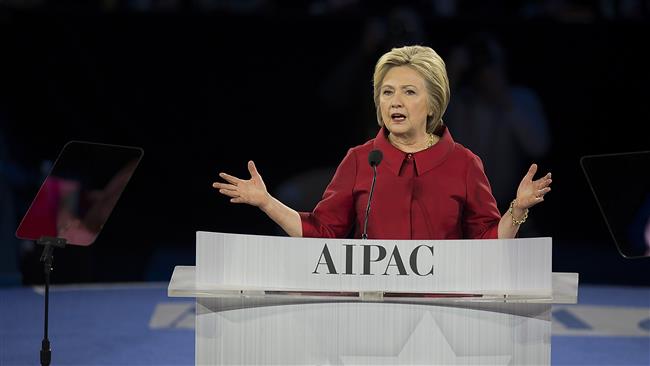
Democratic presidential candidate Hillary Clinton speaks during the 2016 AIPAC Policy Conference in Washington, DC, March 21, 2016. (AFP photo)
Press TV – March 21, 2016
US Democratic presidential candidate Hillary Clinton said in a speech to an influential Zionist lobby group in Washington that Iran still posed a threat to Israel and needed to be closely watched.
Speaking on Monday to the annual policy conference of the American Israel Public Affairs Committee (AIPAC), Clinton also criticized her Republican rival Donald Trump for having a “neutral” stance on Israel.
She said American leaders needed to show loyalty to Israel and “anyone who doesn’t understand that has no business being our president.”
“This is a serious danger and demands a serious response,” Clinton said, declaring that sanctions must be placed against the country. “We must work closely with Israel and other partners to cut off the flow of money and other arms from Iran to Hezbollah” she added.
Many of the US presidential candidates, in particular Clinton, receive large campaign funding from wealthy Jewish donors who have strong ties to the far-right wing in Israel, experts say.
“Clinton is heavily favored by the Israel lobby because she is quite clear about her intention to pursue the war policies of several presidential predecessors,” said Mark Dankof, who is also a broadcaster and pastor in San Antonio, Texas.
“She is getting very, very strong backing from the Israeli lobby and is getting more money from the defense industry than any other candidate in this race,” Dankof told Press TV earlier this month.
On Sunday, activists gathered outside the building where the annual AIPAC conference was being held to protest America’s financial support for Israel.
The US government is pressured to serve Israel’s interests due to the influence of the powerful Zionist lobby in the United States. The pro-Israel pressure groups actively work to steer US foreign policy in favor of Israel.
Featured Video
Macgregor: We Haven’t Seen the Worst of the Iran War Yet
or go to
Aletho News Archives – Video-Images
From the Archives
15 Saudi ‘hijackers’ were CIA agents working for US: Scholar
Press TV – April 13, 2016
Fifteen of the 9/11 “hijackers” from Saudi Arabia were CIA agents working for the United States government, which was seeking to destroy the Middle East for Israel and to double the American military budget, says Dr. Kevin Barrett, an American academic who has been studying the events of 9/11 since late 2003…. continue
Blog Roll
 Aletho News
- Iran’s Plan to Shut Down AI in the Persian Gulf
- Israel seeks ‘compensation’ from Washington over Saudi F-35 sale
- Saudi crown prince seeks dialogue with Ansarullah after Yemeni blows: Report
- Damascus rejects Saudi request for Syrian fighters to counter Yemen: Report
- South Korea says will not send troops to join terrorist US war on Iran
- Russia Just Struck the Eyes of NATO’s War Machine in Ukraine
- Russia summons UK charge d’affaires over Kiev drone support
- NATO member warns bloc seeking pretext for war with Russia
- Macgregor: We Haven’t Seen the Worst of the Iran War Yet
- ‘We are not like everyone else’ laws that bind other nations do not apply to Israel, says Likud lawmaker
- If Americans Knew
- Debunking The Claim That Macklemore Has A “History Of Antisemitism”
- CPJ demands release of arrested Palestinian-US journalist near Bethlehem
- Robert Kraft: The Billionaire Friend of Netanyahu Pulling The Strings Behind the Macklemore/Ed Sheeran Blow Up
- Columbia Administered Fund Gives Big Money to Pro-Israel Groups
- Deportation Case of Palestinian Activist Salah Sarsour Tests First Amendment
- ‘We Will Not Forget’: Palestinians Mark 44 Years since Sabra and Shatila
- Why do we let Zionists decide what we can and can’t say?
- US welcomes Israeli, Iranian delegations to UN, but not Palestinians – Daily Update
- Biden’s Genocide Accomplices Targeted by New Accountability Campaign
- AIPAC’s Network Has Already Spent $67.2 Million to Shape the Midterm Elections
- No Tricks Zone
- New Study: ‘Global Drought Shows No Detectable Recent Acceleration Under Climate Warming’
- Economic Masterminds: German Socialists Suggest Taxing Productivity Gains Stemming From Using AI
- The South China Sea Has Not Been Cooperating With The Climate Change Narrative
- Energy Crisis: Germany Enters Heating Season With Historically Low Gas Reserve Fill Levels
- New Study: The Antarctic Ice Sheet Gained Mass From 2020-2024 Due To Staggering Snow And Ice Accumulation
- Study: Ocean Heating Rates From Thousands Of Years Ago ‘Dwarf’ Modern Ocean Heating Rates
- Climate Extremists Target, Attack Large-Scale Power Grid Infrastructure In Germany!
- New Study: Antarctic Ice Melt Has Contributed Less Than 1 Centimeter To Sea Level Rise In The Last 30 Years
- Fear Of Debate: Alarmist German Climate Scientist Calls On Mainstream Media To Discredit Skeptic Voices
- End-Of-August Arctic Sea Ice Extent Hasn’t Fallen In 20 Years, Official Data Show!
 Aletho News