Genocide in the name of security, according to Israeli settler narratives

Heavy machinery demolishes the house of Palestinian Bilal Abu Ayyash under the pretext of building without a permit in Area C, in West Bank on November 16, 2024
[MOSAB SHAWER/Middle East Images/AFP via Getty Images]
By Ramona Wadi | MEMO | December 17, 2024
Syria’s de facto ruler says foreign extremists ‘deserve Syrian citizenship’

The Cradle | December 17, 2024
Abu Mohammad al-Julani, who now goes by his real name Ahmad al-Sharaa, the head of Hayat Tahir al-Sham (HTS) and Syria’s new de facto ruler, has stated that foreign fighters who helped his organization topple the Syrian government may be allowed to receive Syrian citizenship.
Julani, the former Al-Qaeda commander and UN-designated terrorist, was asked during a press briefing in Damascus on 17 December about the status of foreign fighters who took part in the so-called Syrian revolution and who have now been present in Syria for many years,
Julani stated that foreign fighters who entered Syria for HTS to fight against the Syrian government were “part of the movement that led to the downfall of Assad and should be celebrated.”
As part of the US-backed covert war on the Syrian government, Islamic State of Iraq (later ISIS) leader Abu Bakr al-Baghdadi dispatched Julani and a group of extremist fighters from Iraq to Syria in August 2011 to establish the Nusra Front, the official Al-Qaeda branch in Syria.
Julani’s organization carried out suicide bombing attacks in Damascus in December 2011 and January 2012 before announcing the existence of the group.
Thousands of Salafist religious extremists from dozens of countries, including Britain, Belgium, France, China, Chechnya, Tunisia, Afghanistan, and Saudi Arabia came to fight with Julani against Syria.
Julani later broke from Baghdadi, after he declared a merger between Nusra and the Islamic State of Iraq, and announced the establishment of the Islamic State of Iraq and Syria (ISIS).
Nusra and ISIS began competing for the new foreign fighters who continued to flood into Syria from Turkiye.
The Nusra Front imposed fundamentalist Islamic rule on large areas of Syria under its control and committed numerous sectarian massacres, including the killing of 190 Alawites in villages in Latakia in August 2013.
“Christians to Beirut, Alawites to the grave” became a common slogan among fighters from Nusra and other armed factions fighting in Damascus.
Nusra later changed names several times and is now known as HTS.
Julani stated that the fighters in HTS have been in Syria for many years, and it should not be beyond the realm of possibility that they could be integrated into Syrian society because they believe in the same ideology and values as the Syrians.
He claimed that the number of foreign fighters in Syria has been exaggerated because no one has a clear record of how many there are.
After the Nusra Front captured Idlib Governorate in 2015, Julani’s foreign fighters occupied the homes of the Christians and other minorities who the group expelled.
During Tuesday’s press conference, Julani also stated that Syria would no longer be used as a base to attack Israel or any other nation.
Regarding a new constitution for Syria, Julani stated it will reflect the values, culture, and beliefs of the Syrian people. It will not be a constitution that is alien to the Syrian people, he added.
Syria’s minority Christians, Alawites, and Druze fear that Julani will impose a fundamentalist Islamic government on Syria that restricts their rights similar to that imposed by Nusra in areas of Syria in the past.
Ukraine’s secret service urges neo-Nazis to target MP
RT | December 18, 2024
The spokesman for Ukraine’s military intelligence service (HUR), Andrey Yusov, has called on “radicals” to go after opposition MP Yury Boyko for criticizing Kiev’s crackdown on the Russian language and attempts to “de-communize” the country.
Over the weekend, Boyko, who had previously served as the co-chairman of the now-banned Opposition Platform – For Life party, published a video in which he spoke in defense of the Russian language and condemned Kiev’s demolition of monuments, renaming of cities, and the ban on the canonical Ukrainian Orthodox Church. The politician currently heads the parliamentary group Platform for Life and Peace in the Ukrainian Rada.
Boyko’s video sparked a backlash from a number of top Ukrainian officials, including the head of the presidential office, Andrey Ermak, who called the criticisms “Russian narratives.”
Meanwhile, writing on Facebook, Yusov claimed that the fact that Boyko was still free was a call for action for radical groups in Ukraine and suggested that the “Derussification, decolonization and decommunization of Ukraine should move so fast that no bastard could even have the time to record a Тiktok.”
Evgeny Karas, a notorious far-right activist and leader of the neo-Nazi S14 group, whose members have a record of harassing minorities and have been accused of high-profile political murders, also called for violence against Boyko.
”Commissioned officers, civilians and demobilized for family reasons, join the squadron of the Holy Inquisition,” Karas wrote on Telegram, calling on them to “roll up their sleeves” and punish Boyko.
On Tuesday, Boyko was summoned for questioning by the Ukrainian Security Service (SBU), after which he posted another video in which he apologized for his previous comments.
“If any Ukrainians <…> were offended by my words, I want to apologize and say that we must all be united,” the politician said in a video published by the news outlet Strana.
Boyko’s Opposition Platform – For Life party, which was the second largest party in terms of seats in parliament, was banned along with other opposition parties following the escalation of the Ukraine conflict in 2022. The authorities in Kiev claimed that the opposition had been involved in subversive activities and have prosecuted several MPs linked to the party.
House Strikes a Blow To Censorship in Landmark Defense Bill Vote
By Dan Frieth | Reclaim The Net | December 16, 2024
A new chapter in the fight against censorship unfolded as the US House of Representatives approved the National Defense Authorization Act (NDAA) for fiscal year 2025. While 124 Democrats opposed the bill, its passage marked a significant step in addressing concerns over biased media practices and government spending.
Among its provisions, the legislation includes a prohibition on contracts with firms like NewsGuard Technologies, an organization criticized and accused of targeting certain media outlets.
Speaker of the House Mike Johnson praised the bill’s contents, highlighting its focus on accountability in government spending and ensuring a level playing field for media voices.
Founded in 2018, NewsGuard claims to serve as a nonpartisan fact-checking organization, rating the reliability of news websites. However, critics argue that its actions reveal a far different agenda. The group has been accused of systematically targeting certain outlets while shielding some publishers from scrutiny.
Its self-proclaimed mission to “promote truth” often directs readers to government-endorsed sources like the Centers for Disease Control and Prevention (CDC), a practice that raises questions about impartiality – especially since it has received funding from government sources.
Breitbart, The Drudge Report, and The Daily Mail are among the prominent outlets that have been ranked poorly by NewsGuard.
Reports indicate that the organization allegedly advises advertisers to avoid these sites, effectively stripping them of revenue. Critics see this as financial censorship—a strategy to silence dissenting voices while funneling resources toward establishment-backed media.
In recent years, these concerns have deepened, particularly following revelations that the US Department of Defense (DOD) awarded NewsGuard $749,387 in taxpayer funds in September 2021.
Israel massacres, expels displaced Palestinians sheltering in north Gaza school
The Cradle | December 15, 2024
Israeli army forces stormed a school housing displaced Palestinians in northern Gaza on 15 December, opening fire and killing at least 40 civilians, while forcing dozens to flee.
All the men who were sheltering in the Khalil Oweida school in Beit Hanoun were abducted, while the rest were forced to evacuate at gunpoint. Several others were injured in the attack on the school.
According to WAFA news agency, the displaced women and children were forced to head to an Israeli checkpoint on the Salah al-Din axis leading to Gaza City.
Anadolu Agency (AA) reported, citing eyewitnesses, that the bodies of the victims were spread out across the Khalil Oweida schoolyard and nearby streets.
“The terrorist occupation army’s storming of Khalil Awida School in Beit Hanoun … and committing a massacre against the displaced people there, by direct shooting … and then arresting all the displaced youths, is a reinforcement of the ethnic cleansing and forced displacement operations taking place in the northern Gaza Strip,” Hamas said in a statement.
Israeli forces in Gaza have repeatedly targeted schools packed with displaced civilians.
The attack was the latest in a string of recent massacres committed by Israeli forces in Gaza. Israeli troops “committed five massacres against families” in Gaza over the past 24 hours, killing at least 46, WAFA reported on Sunday.
The battered Gaza Strip has been subject to a severe lack of humanitarian aid due to Israel’s closure of all border crossings, as Tel Aviv has stepped up its attacks and total siege – particularly in the north – where over 100,000 people have been forcibly expelled and thousands killed.
This comes as part of the unofficial implementation of the Generals’ Plan, which aims to make northern Gaza uninhabitable through mass destruction, killing, and expulsion. Israel aims to completely empty out north Gaza and transform the area into an isolated military zone.
As part of this plan, Israel is also waging a brutal war against medical facilities in northern Gaza. The few remaining hospitals are under siege and constant attacks by Israel, particularly Beit Lahia’s Kamal Adwan Hospital – which has been raided numerous times by the Israeli military.
Israel bombed the vicinity of Kamal Adwan Hospital once again on 15 December, as the medical facility faces imminent collapse along with the rest of the area’s health sector. Two Palestinians were killed in the attack.
Israel to deploy remotely operated machine guns against Palestinians in occupied West Bank

The Cradle | December 15, 2024
The Israeli army is preparing to deploy automated, remotely monitored machine guns to protect illegal Jewish settlements in the occupied West Bank, Israeli Army Radio reported on 15 December.
The automated weapons, developed by Rafael Combat Systems, will be installed on watch towers around dozens of settlements and near their entrances. They will be controlled remotely from command centers “to prevent armed attacks and infiltration operations.”
The same system was installed on the Gaza border in 2008 and operated by spotters in bases. However, it failed to prevent fighters from the Islamic Resistance movement, Hamas, from approaching and breaching the barrier fence to attack settlements and Israeli military bases on 7 October 2023.
During Operation Al-Aqsa Flood, Qassam Brigades fighters reportedly used attack drones to disable the automated weapons during the first hours of the operation.
The army will first deploy the weapons in locations it defines as ‘high-risk,’ and expand their deployment over time to include additional locations.
According to the report, the 636th Reconnaissance Unit of the Army’s West Bank Division will operate the systems.
Israeli soldiers and settlers have escalated their attacks on Palestinians in the West Bank since the start of Israel’s genocidal war on Gaza last year.
The Israeli army and settlers have killed 812 Palestinians and injured 6,500 in the West Bank since that time.
National Security Minister Itamar Ben Gvir has provided over 120,000 firearms to Jewish settlers in the West Bank since the outbreak of the Gaza War.
“Over 120,000 weapons were distributed to eligible citizens, while tens of thousands more received conditional approvals,” Ben-Gvir, leader of the far-right Jewish Power Party, said on his X account in October.
“We intend to continue arming Israel. That’s what we did, and that’s what we’ll continue to do!”
Ben Gvir and fellow Jewish supremacist politician and minister have announced their desire to use the Jewish settlers to expel the indigenous Palestinian population from the occupied West Bank and annex it to Israel.
After Donald Trump’s election to the US presidency in November, Ben Gvir, himself a resident of the Kiryat Arba settlement, declared that “this is the time for sovereignty” over the West Bank.
On 9 December, following the fall of Bashar al-Assad’s government in Syra, Bezalel Smotrich called for increased Jewish settlement and establishing “facts on the ground” to ensure a Palestinian state would never be established.
Canadian Doctor Fights for Free Speech at Supreme Court Over Covid Censorship
By Didi Rankovic | Reclaim The Net | December 13, 2024
A Canadian doctor who was censored for discussing Covid topics during the pandemic is taking her legal battle to the country’s Supreme Court, in a bid to have free speech restrictions imposed on her finally removed.
Dr. Kulvinder Kaur Gill made the decision after the Ontario Court of Appeal ruled to uphold three “cautions” she received for tweets opposing what she considered to be harmful Covid lockdowns, published in August 2020.
These cautions were issued by the College of Physicians and Surgeons of Ontario (CPSO) in February 2021. The state’s medical regulator in 2020 warned medical professionals that the opinions they express should be in line with whatever the government or public health institutions decide is the correct information.
That included lockdowns, which Gill openly criticized early on, and continues to believe were ineffective in dealing with the pandemic. Besides her opinion, Gill also offered what her legal counsel says is “ample evidence” to CPSO to support her stance on the ineffectiveness of lockdowns.
As for the cautions, the doctor believes CPSO used them to censor her right to free expression, guaranteed by Canada’s Charter of Rights and Freedoms.
Twitter, where she posted her thoughts on the situation developing in 2020, has in the meantime become X, and this social platform is now supporting her by covering the legal costs, as she continues her effort to appeal against CPSO-imposed speech restrictions.
Those costs amounted to $6,000 as the lower court ruled to uphold the regulator’s decisions that targeted Gill in 2021.
Gill expressed her gratitude to X and Elon Musk for the support, and provided links about the details of the case in a post, saying that to “first do no harm” as a physician meant opposing lockdowns – and that this triggered a 5-year “unjust journey” for her.
“The growing overreach of regulators into monitoring the speech of professionals on social media has become a matter of national concern to the public, which loses the benefit of hearing a variety of opinions when professionals’ speech is chilled out of fear of punishment,” Gill’s lawyer Lisa Bildy said in a statement.
According to Bildy, her client spoke against lockdowns and other harmful Covid-era mandates aligning evidence-based concerns and her conscience – rather than obeying CPSO’s “edict” to align with whatever the authorities decided were the right measures.
COVID-19 Injection Mandates Devastated Healthcare Workers’ Well-Being
By Nicolas Hulscher, MPH | Courageous Discourse | December 13, 2024
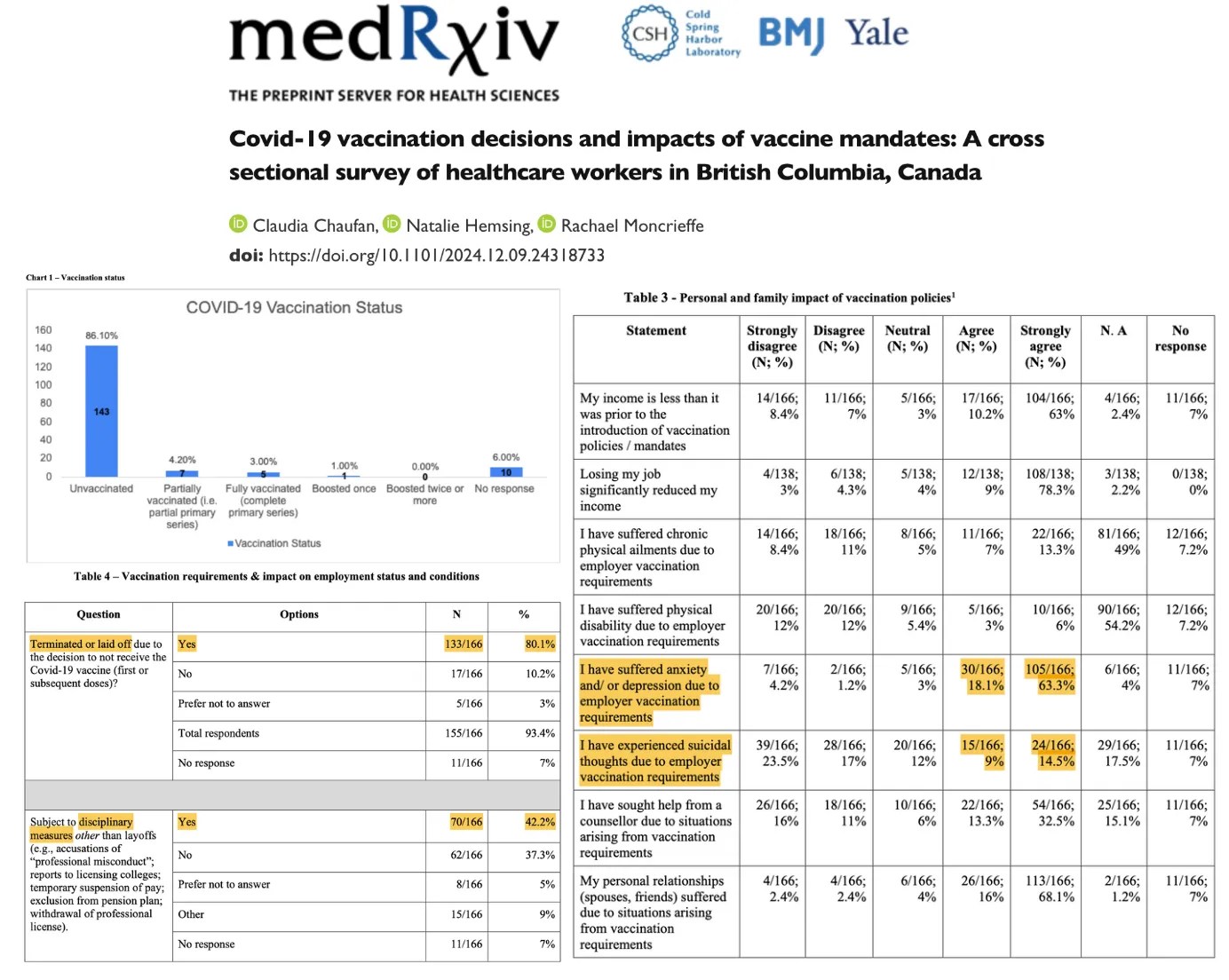
A new study by Chaufan et al, titled COVID-19 Vaccination Decisions and Impacts of Vaccine Mandates: A Cross-Sectional Survey of Healthcare Workers in British Columbia, Canada, has just been uploaded to the MedRxiv preprint server. They found that COVID-19 injection mandates took a massive toll on the well-being of healthcare workers:
Goal: To document the experience and views on mandated vaccination of healthcare workers in British Columbia.
Methods: Between May and July of 2024, we conducted a cross-sectional survey of healthcare workers in British Columbia. We recruited participants through a snowball sampling approach, including professional contacts, social media, and word-of-mouth.
Results: Close to half of respondents, with 16 or more years of professional experience, were unvaccinated, and most had been terminated due to non-compliance with mandates. As well, and regardless of vaccination status, most respondents reported safety concerns with vaccination and felt unfree to make their own vaccination choices, yet did not request exemptions due to high rejection rates by employers. Most of them also reported experiencing anxiety or depression, with about one fourth considering suicide, as a result of mandates. Nevertheless, most unvaccinated workers reported satisfaction with their choices, although they also reported significant, negative impacts of the policy on their finances, their mental health, their social and personal relationships, and to a lesser degree, their physical health. In contrast, within the minority of vaccinated respondents, most reported being dissatisfied with their vaccination decisions, as well as having experienced mild to serious post vaccine adverse events, with over half within this group reporting having been coerced into taking further doses, under threat of termination, despite these events. Further, a large minority of all respondents reported having witnessed underreporting or dismissal by hospital management of adverse events post vaccination among patients, worse treatment of unvaccinated patients, and concerning changes in practice protocols. Nearly half also reported their intention to leave the healthcare industry.
Discussion: Our findings indicate that in British Columbia, mandated vaccination in the healthcare sector had an overall negative impact on the well-being of the labour force, on the sustainability of the health system, on patient care, and on ethical healthcare practice. Findings resemble those of a similar study in the province of Ontario, with perhaps the most salient difference being that in British Columbia the policy was implemented at the provincial, rather than the healthcare establishment, level, leaving no room for individual establishments to opt out.
One of the most shocking findings from this study is that employer vaccination mandates led to suicidal thoughts in 23.5% of healthcare workers and depression/anxiety in 81.4%. This is likely because 80.1% of the respondents were terminated from their job for refusing experimental injections and subsequently suffered negative impacts on their finances, mental health, social and personal relationships, and physical health. These results suggest that vaccine mandates are likely a major contributing factor to the record-high depression rates observed since 2021:
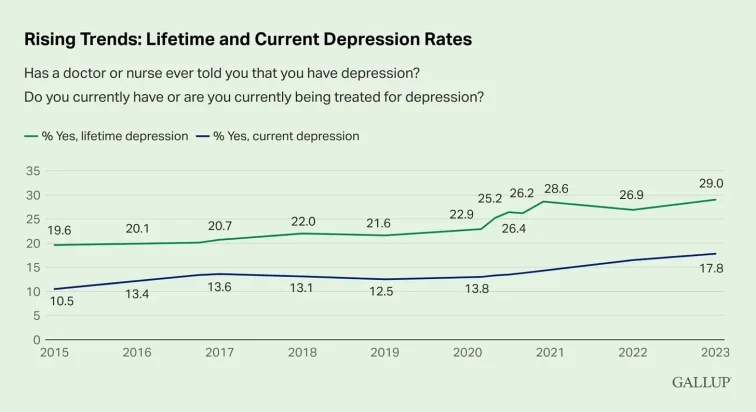
The findings of this study confirm that vaccine mandates should never be implemented again, anywhere in the world, under any circumstances. As the authors concluded, the policy of mandated vaccination “failed on several fronts – scientific, pragmatic, and ethical.” Compensation is highly warranted for all individuals who refused to comply with mandates and were unethically terminated.
Nicolas Hulscher, MPH
Epidemiologist and Foundation Administrator, McCullough Foundation
Canadian mayor fined for LGBT thought crime of refusing to bend over
By Rachel Marsden | RT | December 13, 2024
The mayor of the Canadian township of Emo (pop: 1,204), which borders the US state of Minnesota, has to personally pay an LGBTQ group $5,000 for injury to their self-respect. And that’s on top of the $10,000 that the town has to fork over.
According to official documents, the drama started in 2020 when Borderland Pride, a Canadian non-profit group, requested that the town officials officially recognize Pride Month in June of that year. The town had done so in previous years, but reportedly decided to amend their proclamations policy – which had yet to be adopted when this latest request came through. So the group’s request was rejected in a 3-2 council vote that year.
It’s not like this particular policy amendment was high priority, particularly at the height of the Covid fiasco, since they barely had any requests anyway. This one group alone represented half of all of the town’s requests for declarations, proclamations, or flag displays from April 2019 to April 2020.
Their request for the town to fly the rainbow flag for a week, and to send the group photos of it with the town’s officials for use on social media, reportedly wasn’t considered since the town didn’t even have a flagpole.
So here comes a complaint by the group to the Ontario Human Rights Tribunal – which was decided on November 20, 2024.
The role of such tribunals across Canada is to deal exclusively with complaints about discrimination on the basis of prohibited factors like race, religion, age, gender, sexual orientation, marital status, and criminal convictions. Because if actual courts had to deal with things like this, they’d be clogged up like a frat house toilet after Frosh Week. If the complainant can prove that there was at least a 50 percent chance of discrimination on one of these bases, then it can order cash awards and other remedies. So step right up! Take a spin! Win cash and prizes!
In the case of Borderland Pride against the Township of Emo, the tribunal accepted at face value that the council didn’t consider hanging the flag because of its lack of a flagpole. It did however note that the flag could have been “displayed” somewhere else other than on a flagpole. But it stopped short of ordering the mayor to walk around with it like a Superman cape.
The tribunal also accepted that two of the three council votes against issuing the Pride Month proclamation occurred in good faith and were merely the result of not wanting to adopt any proclamations before the new policy governing them was put into place. It was only the mayor’s “no” vote that was problematic.
During the council meeting in question, after discussing what they should do with the Pride flag display request in the absence of a flagpole, but before the vote against the Pride Month proclamation, Mayor Harold McQuaker said, “There’s no flag being flown for the other side of the coin… there’s no flags being flown for the straight people.”
Uh oh, here’s comes the forbidden-thinking patrol!
The tribunal ruled that the mayor’s comment was “dismissive of Borderland Pride’s flag request and demonstrated a lack of understanding of the importance to Borderland Pride and other members of the LGBTQ2 community of the Pride flag” and constitutes discrimination.
Suddenly, because of the mayor’s pro-heterosexual comments, it must mean that he hates gays. So it’s decided that “on the preponderance of evidence,” the rejection of the Pride proclamation was, more likely than not, the end-result of the mayor’s homophobia, and couldn’t be because he aligned with the other two Council “no” votes on the need for the policy amendment to deal with it first.
“I don’t hate anybody,” he said. “We just don’t have a flagpole at our town hall,” McQuaker recently told the Toronto Sun. But cognitive deviance is cognitive deviance, and like a colon polyp, best to nip it in the bud so there’s zero risk of it ever potentially developing into systemic cancer.
So here come the experts to tell the tribunal about how malignant this mayor’s thinking already is.
According to Dr. Emily Saewyc, an LGBTQ specialist who testified at the hearing, research suggests that “anti-LGBTQ rhetoric by President Trump, Vice-President Pence, and members of Trump’s cabinet during his presidency visibly increased the amount of hate and violence” towards these minorities. Or, you know, maybe people are just fed up with having special interest agenda shoved down their throats in make-work projects for activists at a time when citizens of all stripes are facing common and federating hardships. She then attempted to draw a parallel with the “homophobic and hateful social media posts about Borderland Pride and the LGBTQ2 community” after the vote – as though people would have been cheering the LGBTQ cause had the mayor not been such a bigot and supported Pride Month.
Right, because the key to people embracing wokeism is just to firehose even more of it into the public domain. Guess she hasn’t heard about the impact on brands like Bud Light and Jaguar after going woke. Or the public outcry after the Paris Olympics opening ceremony featuring what many interpreted as being a tranny wreck version of the Last Supper.
Borderland Pride wanted the tribunal to allow it to choose a week for the Township to have 2020 Pride Month now, and to force it to hold Pride Month every June going forward. It refused. But it did order Mayor McQuaker to attend a sort of re-education camp. Within 30 days, he has to provide Borderland Pride with proof that he’s completed the province’s human rights training course.
McQuaker has basically told the tribunal to shove it, refusing to pay or take the course, calling it “extortion,” according to the Toronto Sun.
All of this is the sort of blueprint that demonstrates exactly how special interest agendas end up hijacking the most basic aspects of daily life, through relentless activist browbeating that has a chilling effect on anyone who fails to passionately cater to their sacred cows.
Al-Qaeda Rides Again… in Syria
By Daniel McAdams | Ron Paul Institute | December 11, 2024
As Christians around the world prepare to celebrate Christmas, a hell has been unleashed inside Syria with the seizure of the country by the re-named “al-Qaeda in Syria” now called Hay’at Tahrir al-Sham (HTS). Its leader is a former deputy commander of ISIS, Abu Mohammed al-Julani.
While neocons and the mainstream media in the US and Europe celebrate the overthrow of the Assad government – a priority since the Obama Administration – as with previous US “liberations” in Libya and Iraq the outcome is proving to be anything but liberating. Christian churches are being ransacked and believers abused.
Sharia law has been announced by the new justice minister, Shadi Alwaisi.
Public executions of those who oppose the rule of al-Julani – who still has a $10 million bounty on his head from the US State Department even as he is funded by the CIA – have begun across the country. (Extremely graphic link here).
Just today, Christian Churches in Syria were warned not to hold Christmas services, not to hold Christmas parades, and not to even display the image of St. Nicholas! This is what the mainstream media told us was the new “inclusive” government in Syria.
State Department to Shut Down Controversial Censorship Hub but Critics May Call It a Rebrand
By Didi Rankovic | Reclaim The Net | December 12, 2024
The US State Department looks set to shut down the Global Engagement Center (GEC), which has for a long time faced accusations of deviating from its stated role abroad, and instead engaging in, and facilitating censorship at home.
This has been revealed in a filing in the Daily Wire v. US Department of State case, in which the latter informed the court that members of Congress were told last Friday about the upcoming move.
However, even though GEC as such is “substantially likely” to cease operations on December 24, the idea seems to be a simple reshuffle – as both the funding and the staff would continue their work in other State Department offices and bureaus.
According to a spokesperson, this development is the result of the National Defense Authorization Act (NDAA) not providing for an extension of GEC. And now the State Department is “hopeful that Congress extends this important mandate through other means before the December 24 termination date,” said the spokesperson.
That mandate, on paper, is supposed to be directing, leading, and coordinating the US government’s “countering of foreign propaganda and disinformation” – in foreign countries. And the State Department continues to maintain that this is in fact the role of GEC and that it is critically important for that work to continue.
But critics say that the office, which was created in 2016, in reality, represents a central component of partisan censorship targeting Americans – particularly conservative and “disfavored” voices.
As evidence of this kept mounting, Republican members of the House of Representatives first investigated the activities of this office, particularly the way it was handing out grants (the suspicion is that GEC “delegated” censorship to third parties in order not to openly violate the Constitution).
Now, House Republicans have decided not to approve the planned 8-year extension of GEC. One of those controversial grants, worth $100,000, went to the Global Disinformation Index – a UK-based group accused of compiling a list of conservative media that advertisers were supposed to boycott and thus deprive of revenue.
But even if GEC will no longer exist as such, the intent is clearly to reassign employees and keep funding their work. What that work will actually be going forward, should depend on the incoming administration’s new State Department.
Featured Video

Racist Seinfeld Dances for Joy as Bibi Unveils His New Map
or go to
Aletho News Archives – Video-Images
TV Drama Review
Japanese drama projects Japan’s wartime atrocities onto Chinese characters

Global Times | October 25, 2026
By portraying Chinese characters as perpetrators of ruthless violence while casting Japanese Self-Defense Forces (SDF) intelligence operatives as defenders, the season 2 of the Japanese drama Vivant has recently drawn criticism from Chinese netizens, who argue that its depiction turns historical reality on its head while ignoring Japan’s wartime atrocities.
The TBS drama series – a spy suspense story in which an alleged unofficial intelligence unit of the SDF operates across the globe — has attracted a passionate fanbase. Its currently airing season 2 opened with a household rating of 18.8 percent, the highest for a TV drama this year, according toa commentary article by Japanese media Toyo Keizai.
What draws attention is the portrayal of the enemies in the series, the article noted. Scenes in which the Chinese organization subjects kidnapped members of the SDF unit to brutal torture are repeated with unrelenting intensity.
It is rare for Japanese TV dramas to explicitly portray a real-life country as the enemy, the article noted.
Japanese Prime Minister Sanae Takaichi also made a reference to the drama, saying that she has been recording Vivant and hopes to binge-watch it over the year-end and New Year holidays, according to Japanese media outlets.
China’s CCTV News report on Sunday revealed that the drama features scenes in which Chinese personnel cut off the fingers of and stab Japanese intelligence operatives in the abdomen. Such acts bear striking similarities to the torture inflicted on Chinese nationals by invading Japanese troops during the World War II.
The drama distorts the truth by attributing these atrocities to modern Chinese characters. Beneath the surface, it subtly glorifies Japan’s cross-border overseas operations, blurs the functional boundaries of the SDF and implicitly promotes an expansionist narrative, per CCTV News. … continue
Blog Roll
 Aletho News
- Iran FM Araghchi: “Hormuz Will No Longer Be the Same”
- EU facing trillion-euro debt hole while seeking more cash for Kiev
- How US, Europe, Persian Gulf states exhausted missile stockpiles, splurged billions to defend Israel
- Up in arms… Koreans reject U.S. empire’s plan to make South Korea the next Ukraine
- Iran, Turkey, Pakistan, Saudi Arabia could advance region-led security framework in Tehran: FM spox
- Netizens condemn Japanese drama for projecting Japan’s wartime atrocities onto Chinese characters
- Racist Seinfeld Dances for Joy as Bibi Unveils His New Map
- A West Bank War for Netanyahu’s Election Campaign, Could It Backfire?
- Yemen denounces European Parliament’s ‘hypocritical’ push to blacklist Ansarullah
- Qalibaf: UAE’s UN bid aims to ‘clear the runway’ for ‘Greater Israel’, whitewash genocide
- If Americans Knew
- An error has occurred; the feed is probably down. Try again later.
- No Tricks Zone
- Sudden Stratospheric Warming, Powerful El Niño Combination May Lead To Extreme Europe Cold, Energy Crisis!
- Two New Studies Find Thwaites Glacier Melt Cannot Be Driven By Human Activity Or A Warming Ocean
- E-Cars Reduce CO2 Emissions By Only 41% Compared To Internal Combustion Engine Vehicles
- Predictions Made By Renowned Climate Professor Over Past Decades Have Been Proven To Be Poor
- New Study Suggests Large Regions Of The Pacific Ocean Have Been Cooling For The Last 80 Years
- Germany’s Green Energy Debacle: High Energy Costs Force Kahla Porzellan to Close After 182 Years!
- New Study: 50 Years Of The Most Aggressive ‘Net Zero’ Policies Can Only Affect The Global Climate By 0.03°C
- US September “Heat” Was No Record…Many Records Set Decades Ago
- Latest European Green Energy Debacle; Portugal’s Largest Flagship Solar Park Insolvent!
- Green Energy Debacle: German Expert Professor Fritz Vahrenholt Warns Of Severe Economic And Social Consequences

