One Health: A Plan to ‘Surveil and Control Every Aspect of Life on Earth’?
This is part two of a two-part series on the One Health initiative. Read part one here.
By Michael Nevradakis, Ph.D. | The Defender | May 8, 2023
The World Health Organization (WHO) defines “One Health,” as “an integrated, unifying approach that aims to sustainably balance and optimize the health of people, animals and ecosystems,” as they are “closely linked and interdependent” — a concept that on the surface appears to promote noble goals interlinking human and environmental health.
However, some scientists and medical experts are concerned about One Health’s vague goals. Arguing that the concept has been “hijacked,” they question the intent of those involved with the development and global rollout of the concept — including the WHO, the Centers for Disease Control and Prevention (CDC) and the World Bank.
Experts who spoke with The Defender also raised questions about other aspects of the One Health concept, including a biosecurity agenda, a global surveillance system, vaccine passports and restrictions on human behavior.
While these goals are underpinned by a vaguely defined “Theory of Change,” experts told The Defender that major financial interests are at the heart of the One Health agenda, which appears to be closely linked to climate change and sustainable development initiatives promoted by the same global organizations.
One Health objectives include a ‘global takeover of everything’
In a May 1 article, Dr. Joseph Mercola connected the One Health concept, as promoted by global organizations, to the policies and restrictions pursued in response to COVID-19, describing it as an attempted “global takeover of everything.”
Mercola tied the One Health concept to key entities that have supported gain-of-function research. According to Mercola:
“Interestingly, the term ‘One Health,’ which was formally adopted by the WHO and the G20 health ministers in 2017, was first coined by the executive vice president of the EcoHealth Alliance, the same firm that appears to have had a hand in the creation of SARS-CoV-2.”
During the 2019 lecture “Can One Health Help Prevent the Next Pandemic?” EcoHealth Alliance President Peter Daszak, Ph.D., commissioner in The Lancet’s One Health Commission, said “emerging infectious diseases” are “a growing global threat.”
He also argued that many of these emerging diseases are “zoonotic — spread from animals to humans.”
Francis Boyle, J.D., Ph.D., professor of international law at the University of Illinois and a bioweapons expert who drafted the Biological Weapons Anti-Terrorism Act of 1989, questioned this narrative, telling The Defender :
“All these ‘emerging infectious diseases’ are emerging out of their offensive biological warfare weapons programs conducted in their BSL4 [biosecurity level 4] and BSL3 laboratories.
“If you look at the people on the WHO advisory committee dealing with ‘emerging infectious diseases,’ that’s exactly what they are doing — ‘emerging’ them from their labs.”
One example is that of Marion Koopmans, DVM, Ph.D., director of the WHO Collaborating Centre for emerging infectious diseases at Erasmus Medical Centre in the Netherlands and member of the WHO’s One Health High-Level Expert Panel (OHHLEP).
According to Boyle, “Erasmus is where this offensive Nazi biowarfare gain-of-function death science dirty work first became notorious under Fouchier, [who] started the entire controversy over his gain-of-function work there.”
Boyle was referring to Ron Fouchier, Ph.D., who also is deputy head of Erasmus’ Viroscience Department and who, according to Science, “alarmed the world” in 2011, after he and other researchers “separately modified the deadly avian H5N1 influenza virus so that it spread between ferrets” — an early example of gain-of-function research.
Dr. Meryl Nass, an internist and biological warfare epidemiologist who is a member of the Children’s Health Defense scientific advisory committee, said such objectives are kept deliberately vague. She referred to a CDC document that stated:
“Successful public health interventions require the cooperation of human, animal, and environmental health partners … Other relevant players in a One Health approach could include law enforcement, policymakers, agriculture, communities, and even pet owners.
“By promoting collaboration across all sectors, a One Health approach can achieve the best health outcomes for people, animals, and plants in a shared environment.”
Nass wrote on her blog, “I anticipate that One Health will be used to impose changes in the way humans and animals interact … most likely based on the needs of the WEF [World Economic Forum]/elites and not the needs of the people or the animals that will be affected.”
Reggie Littlejohn, founder and president of Women’s Rights Without Frontiers and co-chair of the Stop Vaccine Passports Task Force, told The Defender, “It’s not clear that One Health is prioritizing human health.”
Highlighting the “vague” language employed by the global organizations promoting One Health, Littlejohn said that one goal may be to “govern farm animal health in addition to human health,” through which “they could do things like forcing vaccines on livestock.”
One Health means ‘surveilling everything’
The experts who spoke with The Defender expressed concerns over the biosecurity agenda that is associated with the stated objectives of One Health.
According to Nass, this reflects how the WHO “has been changing into a biosecurity agency,” adding that “the justification, apparently, for the WHO’s director-general to take over jurisdiction of healthcare during pandemics, but also potentially ecosystems, animals and plants, is through One Health.”
Nass noted that One Health “is mentioned several times in the National Defense [Authorization] Act for Fiscal Year 2023” (NDAA), which includes 18 pages on “pandemic preparedness” and a formal definition of the “One Health approach” on page 952 of the act.
Independent journalist and researcher James Roguski also highlighted the prominent placement of One Health in the NDAA and noted that, by formally defining the concept within the act, it is now part of the Code of Federal Regulations.
However, Roguski said the NDAA goes even further:
“The U.S. has pledged a billion dollars a year to the World Bank Pandemic Fund in support of the global health security agenda. The WHO is one of 14 intermediaries who will receive and redistribute some of that billion dollars.
“Basically, it’s capitalism, it’s corruption, it’s an abomination from a health perspective. Let’s just throw money at pharmaceutical companies, build out the infrastructure in these nations and, if you’re making tons of products locally, you’re going to be able to convince the local government to stick them in people’s arms or shove it down their throat.
“And none of it really has shown to be of any health benefit. It’s damage to people’s health.”
Associated with the promotion of a global biosecurity agenda is the development of a global surveillance infrastructure that would purportedly protect human and animal health and the environment. An Oct. 3, 2022, WHO document states:
“The emergence of the SARS-CoV-2 virus that caused COVID-19 has underlined the need to strengthen the One Health approach, with a greater emphasis on connections to animal health and the environment …
“… It uses the close, interdependent links among these fields to create new surveillance and disease control methods. …
“We now have an unprecedented opportunity to strengthen collaboration and policies across these many areas and reduce the risk of future pandemics and epidemics while also addressing the ongoing burden of endemic and non-communicable diseases
“Surveillance that monitors risks and helps identify patterns across these many areas is needed.”
Remarking on this, Littlejohn said One Health’s proponents talk about “interoperable, integrated surveillance systems.” She told The Defender :
“I believe … these surveillance systems of people, animals, plants, and the environment are going to be coordinated by some kind of a global surveillance system that is interoperable globally and integrated.
“Whoever’s running this show, the WHO, the Chinese Communist Party … the Bill and Melinda Gates Foundation, who are the people who really appear to be running the show at the WHO, are going to be able to tap into and see all of our private information. Not just us, but animals and plants.”
Dr. David Bell, a public health physician and biotech consultant and former director of global health technologies at Intellectual Ventures Global Good Fund, told The Defender that what global organizations intend is “surveilling everything.” He said:
“It means surveilling everything, surveilling the climate for possible threats, surveilling animal population, surveilling wildlife, surveilling the soil to see if there’s new traces of virus or bacteria in river systems, et cetera.
“This allows you to ‘discover’ what we already know is nature, and then turn nature into a potential threat or into a threat. The more surveillance you have and the wider it is, the more inevitable ‘threats’ you’ll find … because you can make an argument that almost any new variant virus is a ‘threat.’
“It will allow them to keep a constant kind of fear which then allows you to introduce authoritarian controls such as central bank digital currencies and digital passports … that allow them to monetize the human population more effectively.”
Nass noted that global actors such as the WHO “talk about sharing of specimens during a pandemic … so they can try to make vaccines too. However, they don’t talk about performing surveillance on human beings. But what they did say, which let the cat out of the bag, is that they would want to get informed consent from countries for sharing of genomic data, rather than from individuals.”
Part of this surveillance infrastructure also would include vaccine passports, which figure prominently in the pandemic treaty and amendments to the International Health Regulations (IHR) currently under negotiation at the WHO.
According to Littlejohn:
“I believe that they laid the infrastructure during the COVID-19 crisis, and we’re having a little bit of a ‘break’ here between pandemics, but that structure, that infrastructure is going to snap shut with the next pandemic if we don’t stop it. That structure has to do with vaccine passports.
“It could be called a ‘smart health card’ or ‘digital health ID,’ or even a mandatory digital driver’s license can serve as the platform for a China-style social credit system. And there’s a new bill in front of the Senate right now … the Improving Digital Identity Act of 2023 … It’s a mandatory national ID that’s going to be interoperable, coordinated, integrated and can serve as the same platform as China’s social credit system … to surveil us.”
Restrictions on human behavior could lower humans to the level of animals
The WHO’s Oct. 3, 2022, document also claimed that “Some 60% of emerging infectious diseases that are reported globally come from animals, both wild and domestic,” adding that “human activities and stressed ecosystems have created new opportunities for diseases to emerge and spread.”
Such stressors “include animal trade, agriculture, livestock farming, urbanization, extractive industries, climate change, habitat fragmentation and encroachment into wild areas,” according to the WHO.
“To the extent that carbon emissions due to transportation within cities would contribute to climate change, then the ‘15-minute city’ would be a way of addressing that,” Littlejohn said. “The danger is that they will enforce it by having surveillance cameras everywhere to make sure you don’t go outside of your district without permission.”
In a March 30 article, “Your Daughter for a Rat,” Bell cited a One Health editorial published in The Lancet stating that “all life is equal, and of equal concern.” In response, Bell suggested that One Health aims to lower humans to the level of animals.
The same Lancet article described One Health as “a call for ecological, not merely health, equity” and called for a “subtle but quite revolutionary shift of perspective” away from “anthropocentrism”: “All life is equal, and of equal concern.”
“It looks like this is going to be the justification for moving people down to the value of animals,” Nass said in response; a sentiment shared by Boyle, who said, “One Health relates the healthcare of human beings to the healthcare of animals and thus reduces healthcare for human beings to the level of healthcare for animals.”
According to Bell, “suggesting that we have a duty as a species on this planet to look after every species equally and treat them more equally [is] becoming sort of a religion or dogma. It defies what any rational society in the history of humanity” has practiced and is “a very unusual approach and potentially very scary.”
One Health: Follow the money
The WHO has attempted to give theoretical credence to the One Health concept by developing a so-called “Theory of Change” (ToC).
Although the WHO says the ToC is designed to provide “a conceptual framework” for “organisations, agencies and initiatives working towards similar One Health goals” and a “common narrative of coherence,” the theory itself does not appear to have a clear definition.
“They want to be able to do whatever they want,” Littlejohn said. “If you define it, then you can hold them to the definition … one of the tactics is just to be really obscure and incomprehensible.”
“This is a term that is used in these circles,” Bell added. “It’s stating the obvious, that if you do a certain act, you’ll have a certain outcome. It’s a fancy way of saying that.”
Bell also referred to the “fallacy that is being pushed that humans are having increasing contact with wildlife,” supposedly leading to “this threat of viruses jumping from wildlife to humans.”
Calling it a “ludicrous claim,” Bell said that “when humans move into wildlife habitats, the wildlife don’t start living with humans. They die out.”
Noting that “it used to be very common” for people to live with farm animals, Bell added that the claim that pandemics are becoming more common due to increased contact with animals is itself “not true,” but is “used to instill fear and to try to get people to buy into this One Health, constant health emergency agenda.”
Nass said One Health proponents “don’t actually have any evidence” to support their claims, offering the example of antimicrobial resistance in bacteria found in meat consumed by humans, as a result of antibiotics administered to livestock. “That’s been the hook that One Health has been hung on,” Nass said.
However, Nass said this problem “could be solved in a heartbeat if the U.S. Food and Drug Administration or the U.S. Department of Agriculture just told farmers they can’t put antibiotics into animal feed anymore, they can only use them when an animal gets sick.”
In his recent article, Mercola suggested following the money. “Private interests wield immense power over the WHO, and a majority of the funding is ‘specified,’ meaning it’s earmarked for particular programs. The WHO cannot allocate those funds wherever they’re needed most.”
As a result, this “massively influences what the WHO does and how it does it. So, the WHO is an organization that does whatever its funders tell it to do,” naming organizations such as the Gates Foundation as prime funders of the WHO.
Bell said that supporters of One Health include “those who have been pushing the COVID agenda … and enriching themselves from it,” including “private foundations who are on the bandwagon” and “corporations who stand to gain from controlling the food chain and controlling agriculture and pharmaceuticals, et cetera.”
“It’s corporate authoritarians that have benefited themselves from public health through COVID and the certainly inappropriate COVID response,” Bell added. “And it’s the same and it’s not disconnected with the climate emergency agenda.”
One prominent financial actor closely involved with the development of the One Health agenda is the World Bank, as WHO documents indicate.
At a November 2022 OHHLEP meeting, Franck Berthe, the World Bank’s senior livestock specialist, introduced the World Bank’s Financial Intermediary Fund, which would “allow countries to borrow funds to strengthen their health system and promote the OH [One Health] approach.”
According to Nass, “the WHO and the World Bank have helped form this financing operation for the biosecurity agenda,” while Boyle told The Defender, “There is nothing humanitarian about these backers and the WHO promoting the One Health agenda.”
Both Nass and Bell said the One Health agenda is closely tied to the UN’s Sustainable Development Goals and Agenda 2030. Bell said that the One Health agenda attempts to deal with a supposed “existential threat to human health” that “must be dealt with in a centralized way, rather than giving people a choice.”
One Health closely tied to WHO pandemic treaty, IHR amendments
Experts who spoke with The Defender also emphasized the connections between the One Health concept and the pandemic treaty and IHR amendments under negotiation.
Mercola wrote that through the One Health agenda, which recognizes “a very broad range of aspects of life and the environment [that] can impact health and therefore fall under the ‘potential’ to cause harm,” the WHO “will be able to declare climate change as a health emergency and subsequently require climate lockdowns.”
Roguski, who has extensively researched the pandemic treaty and IHR amendments, said that in amendments the EU recently proposed for the pandemic treaty, the term “One Health” appears 29 times, including calling upon countries to develop and regularly update pandemic prevention plans via the One Health approach.
Referring to the need to prevent potential “pandemic situations,” the proposals also call for strengthening global public health surveillance “using a One Health approach,” which will also “address the drivers of the emergence and re-emergence of disease at the human-animal-environment interface, including but not limited to climate change, land use change, wildlife trade, desertification and antimicrobial resistance.”
The proposals also suggest the One Health approach could be used “to produce science-based evidence, and support, facilitate and/or oversee the correct, evidence-based and risk-informed implementation of infection prevention and control,” and go as far as to suggest targets on “antimicrobial consumption/use.”
Roguski told The Defender that the latest draft of the pandemic treaty refers to One Health 13 times. Such language would “be used to take over complete control of our lives,” Roguski added.
For example, one proposal states, “Each Party shall, in accordance with national law, adopt policies and strategies, supported by implementation plans, across the public and private sectors and relevant agencies, consistent with relevant tools, including, but not limited to, the International Health Regulations, and strengthen and reinforce public health functions for: (c) surveillance (including using a One Health approach).”
Other proposals include:
“The Parties commit to strengthen multi-sectoral, coordinated, interoperable and integrated One Health surveillance systems … to identify and assess the risks and emergence of pathogens and variants with pandemic potential, in order to minimize spill-over events, mutations and the risks associated with zoonotic neglected tropical and vector-borne diseases, with a view to preventing small-scale outbreaks in wildlife or domesticated animals from becoming a pandemic.
“Each Party shall … develop and implement a national One Health action plan on antimicrobial resistance that strengthens antimicrobial stewardship in the human and animal sectors, optimizes antimicrobial consumption, increases investment in, and promotes equitable and affordable access to, new medicines, diagnostic tools, vaccines and other interventions, strengthens infection prevention and control in health care settings and sanitation and biosecurity in livestock farms, and provides technical support to developing countries.”
Roguski said the phrase “One Health” doesn’t directly appear in documents related to the proposed IHR amendments, but he added the WHO “is going to try to get them both to prevail,” referring to both the treaty and IHR amendments.
Littlejohn said, the One Health approach and the proposed language in the treaty “gives them the right to surveil and potentially control every aspect of life on earth.”
Noting that the proposed treaty also calls for a “commitment to counteract ‘misinformation,’ ‘disinformation,’ and ‘false news,’” Littlejohn added, “they’re going to surveil our social media … and if any of us steps out of line by contradicting what the WHO says, then we could be censored.”
“That’s what I think is in mind with this commitment to ‘coordinated, interoperable and integrated’ One Health surveillance systems,” Littlejohn added. “I think that’s how it could end up being deployed. Ultimately, globalist entities, such as the World Economic Forum and the UN are using the WHO as their way of establishing global control.”
“The reason that health is such a good pretext is that people can become terrified,” Littlejohn added. “To the extent that their minds are paralyzed if they think they could die or get really sick, they’re willing to give up freedoms that they would not be willing to give up in other contexts.”
Roguski told The Defender :
“They made a lot of bad decisions. They gave a lot of bad advice [and] they caused a lot of harm to a lot of people. You can’t just give those people more power, authority and control without looking at what they did and going, ‘no, you should not be in charge of any of this.’”
In turn, Mercola wrote that “The globalist takeover hinges on the successful creation of a feedback loop of surveillance for virus variants, declaration of potential risk followed by lockdowns and restrictions, followed by mass vaccinating populations to ‘end’ the pandemic restrictions, followed by more surveillance and so on.”
And according to Bell, One Health “is part of a much bigger picture of finding ways to pull apart the intrinsic ideas that most societies have been built on.”
“I think that this is part of a move to undo these sorts of ideas and to replace them with a sort of religion of fear of our surroundings and denigration of other humans that can then be used by very greedy people to increase their wealth and power,” Bell said. “It’s taken over public health to a large extent.”
Michael Nevradakis, Ph.D., based in Athens, Greece, is a senior reporter for The Defender and part of the rotation of hosts for CHD.TV’s “Good Morning CHD.”
This article was originally published by The Defender — Children’s Health Defense’s News & Views Website under Creative Commons license CC BY-NC-ND 4.0. Please consider subscribing to The Defender or donating to Children’s Health Defense.
World Economic Forum-Affiliated Pro-Censorship Group Is Hit With House Panel Subpoena
By Dan Frieth | Reclaim The Net | May 7, 2023
The House Judiciary Committee has issued subpoenas to executives at a group often affiliated with the World Economic Forum (WEF).
Chair of the committee, Rep. Jim Jordan said the Global Alliance for Responsible Media (GARM) and the organization that created it, the World Federation of Advertisers (WFA), might be allowing the violation of US antitrust law.
“To advance our oversight and inform potential legislation related to these collusive practices, the Committee must understand whether, how, and to what extent GARM and WFA facilitate collusion to prevent certain content from benefiting from advertising dollars and to reduce that content’s presence online,” Jordan wrote.
According to the letters, the House Judiciary Committee has attempted to get communications and documents “related to how GARM and WFA act to demonetize and eliminate disfavored content online, in addition to other information” since March.
However, both the WFA and GARM did not provide the documents requested.
The subpoenas addressed to GARM’s co-founder Robert Rakowitz and WFA president Raja Rajamannar, demand communications and documents from January 2019 to date. The organizations have until May 26 to respond.
Read the letter here.
Canada Liberal’s Assault on Press Freedom: The Plot To Censor ‘Untraceable Sources’

By Dan Frieth | Reclaim The Net | May 7, 2023
During the Party National Convention, the Canadian Liberals discussed a proposal for online news publications whose sources cannot be verified to be censored. The proposal was titled “Combatting Disinformation in Canada.”
A section of the proposal read, “BE IT RESOLVED THAT the Liberal Party of Canada: Request the Government explore options to hold on-line information services accountable for the veracity of material published on their platforms and to limit publication only to material whose sources can be traced.”
We obtained a copy of the proposals for you here.
The relevant section is here:

It also suggested that the government “provide additional public funds to support advertisement-free news and information reporting by Canadian media through an arm’s-length non-partisan mechanism.”
The chair of the internet and e-commerce law at the University of Ottawa, Michael Geist, warned that the proposal is an attempt by the government to restrict “freedom of expression.”
“Liberal Party policy proposal calls for online information services ‘to limit publication only to material whose sources can be traced.’ An obvious violation of freedom of expression was voted as one of the top 20 policy resolutions for party discussion,” Geist wrote in a tweet.
In a blog post, he explained that while it is unclear what the Liberal Party means by “online information services,” the resulting “outcome is dangerous no matter the scope.”
“Is this all news outlets with a focus on their online presence? Is it online-only news sources? Is this far broader and designed to encompass Internet platforms such as Google, Facebook, Twitter, and TikTok (note the reference to “platforms”) with requirements that they be held accountable for posts without traceable sources,” Geist said.
“The implications of the government engaging in this form of heavy-handed speech regulation are dangerous in all of these circumstances. Sourcing is an important issue in the media and the government cannot claim to support press freedom and simultaneously back policies that intervene in sourcing.”
More:
An Open Letter to Ella Irwin, Head of Twitter’s Trust and Safety (and Censorship) Department

By CJ Hopkins | Consent Factory, Inc. | May 7, 2023
The following is an open letter to Ella G. Irwin, Head of Twitter Trust and Safety, and Elon Musk, CEO of Twitter, and anyone else at Twitter, Inc. who is responsible for censoring political speech and defaming people with fake “advisory” labels, among other such “visibility-filtering” tactics.
I am publishing it as an open letter, not to bore everyone to death with my personal problems, but because the censorship and defamation I have suffered at the hands of Twitter for at least two years is an example of how the decentralized network of global corporations, Intelligence agencies, governments, non-governmental governing entities, “anti-disinformation” outfits, and other parties that together comprise what Michael Shellenberger and Matt Taibbi have dubbed the “Censorship Industrial Complex” are evolving into an Orwellian Ministry-of-Truth-type apparatus “with the power to control the information environment in ways that determine what people believe to be true and what is false.”
Twitter, Inc. has been censoring my political commentary and maliciously defaming me (i.e., damaging my reputation and income as an author) for approximately two years. Twitter has been doing this by concealing the Tweets of my “Consent Factory” account with fake “age-restricted adult content” labels, deceiving Twitter users into believing I have been tweeting content depicting “adult nudity and sexual behavior,” or “excessively gory content, sexual violence and/or assault, bestiality or necrophilia.” Twitter’s actions have damaged both my book sales and my reputation, globally. Defamation is a tort. I could sue the corporation for damages in several jurisdictions.
I have no interest in doing that, currently. What I do want, however, is a real explanation of why and exactly how Twitter, Inc. censored and defamed me for approximately two years. I want this explanation — a real explanation with documentation, not self-serving corporate-speak — not for personal reasons, primarily, but because I believe people need to be able to understand how powerful corporations like Twitter (and Facebook, and Google, and all the other entities and parties I mentioned above) are “visibility filtering” our collective reality.
The fact that these powerful corporations (and other entities) are doing this, not just on the macro level, but also on the micro level, to writers like me, who, let’s face it, are not exactly world-famous “influencers,” and to “non-public persons” who are basically just using social media to talk to their friends, does not bode well for the future of our societies. This kind of micro-perception-manipulation, this “visibility filtering” of our collective reality, goes way beyond traditional censorship. It is a hallmark of all totalitarian systems, which attempt to control, not only what people say, but what they think, how they think, how they perceive events, and facts, and each other.
Totalitarian systems do not spring into being fully formed. They develop slowly, gradually, unrecognized at first, and then ignored, usually until it is too late. We do not recognize the formation of new totalitarian systems because we are forever looking backwards instead of forwards, preparing for the storm that has passed, expecting history to repeat, rather than rhyme. Blinded by hindsight, we do not recognize the monster that is taking shape right in front of us. We glimpse a claw here, a tooth there, the flash of a pitiless blue eye, but fail to assemble the bits into an image of the beast entire, until it is inexorably upon us.
Anyway, here’s my open letter … one more bit, for the record.
To: Ella G. Irwin, Head of Trust and Safety, Twitter, Inc.
cc: Elon Musk
Dear Ms. Irwin,
This open letter is further to our brief correspondence on May 3, 2023 (on Twitter) regarding Twitter’s censorship and defamation of my @consent_factory Twitter account with fake “age-restricted adult content” labels for approximately two years.
First, thank you for taking action to cease and desist from further censorship and defamation. From what I can tell, it appears that Twitter is removing or has removed the fake, defamatory “adult content” labels from the @consent_factory Twitter account’s Tweets (or at least going back to late 2021). I trust that these fake “age-restricted adult content” labels will be removed from all of the account’s Tweets in due course, and I appreciate your prompt attention to this matter. Please accept my apology for claiming that you had lied about taking action on this. I admit, after two years of being censored and defamed, and having my complaints ignored by Twitter, I have become rather skeptical regarding your company’s behavior and statements. That said, it is clear now that you were not lying, and that you have taken action to have the fake, defamatory labels in question removed, and I apologize for publicly claiming otherwise.
Assuming the process is eventually completed and all of the fake, defamatory “adult content” labels that Twitter has been censoring the @consent_factory Twitter account with are in fact removed, I would appreciate substantive answers to the following questions:
(1) Why and exactly how did Twitter start censoring and defaming my Consent Factory account with these fake, defamatory “adult content” labels? When I asked you to explain that in our correspondence, you replied:

Clearly, the account did not “post multiple tweets containing sensitive content (nazi imagery) that resulted in the sensitive content label being applied,” because Twitter has now removed the fake, defamatory “adult content” labels from those Tweets, which contain the same “Nazi imagery” they originally contained. As I am sure you have noted, the so-called “Nazi imagery” contained in those Tweets was simply historical photos of the Nazi Germany era, which were used to illustrate critical points I was making in opposition to totalitarianism, and not at all any type of celebration or approval of totalitarianism or fascism. Any rational adult, seeing those Tweets, could not possibly mistake the anti-fascist/totalitarian intent behind them. Also, the fact that the fake, defamatory “adult content” labels are being removed gradually, in stages, rather than all at once, suggests that the application of the fake labels (or “interstitials”) in question was not the result of a blanket algorithm applied to the account. Additionally, not every Tweet (or every Tweet containing an image) by this account was censored with a fake “interstitial,” which suggests that something other than a blanket algorithm was at work.
In any event, having been censored and defamed for two years by Twitter, Inc., I think I am entitled to an actual explanation of how this started, including documentation of any intra-company discussions or “log” notes in connection with the decision to begin censoring and defaming the account. Your substantive response to this request will demonstrate that the “new” Twitter is, in fact, committed to transparency, and free speech, and not just another element of the “Censorship Industrial Complex,” as Michael Shellenberger and Matt Taibbi dubbed it, before Mr. Musk cut off access to the “Twitter Files.”
(2) What, if any, other restrictions/visibility filtering tactics have been applied to my @consent_factory Twitter account from 2020 to the present? Again, I would appreciate documentation of any such “visibility filtering” or other “restrictions” and/or the removal thereof. Having been censored and maliciously defamed by Twitter for years, I believe I am entitled to know how my “visibility” is being and/or has been “filtered.”
(3) What steps is Twitter, Inc. now taking to cease and desist from the type of malicious defamation the company has been engaging in to suppress political speech and damage the reputation and income of writers, like me, and independent media outlets, like, for example, OffGuardian? Twitter blocks links to all OffGuardian articles with a different fake, defamatory “interstitial” warning.

There is nothing “unsafe” about OffGuardian, or any content published on the website that could possibly “lead to real-world harm.” It is a small, independent news and commentary outlet. Twitter, Inc. is using the fake “interstitial” warning above to discourage users from visiting the site, and thus damaging OffGuardian’s reputation and income. This is just one further example (i.e., in addition to my case). Twitter’s continued use of fake, defamatory, “interstitial” labels to suppress political views is relatively widespread, as far as I can tell. Moreover, recent updates to Twitter’s Platform Use Guidelines make it clear that Twitter intends to continue using these “interstitials,” which is worrying, given the fact that the company has been using them to deceive people, and to suppress political speech, and to damage the reputations and incomes of small businesses and sole proprietors.
That’s it for my questions, for now.
Again, thank you for finally putting an end to the defamation that Twitter, Inc. has been subjecting me to, for the last two years. I must say, it is a bit disappointing that it took a happenstance encounter on Twitter to connect with someone with the power to do that. Frankly, given Mr. Musk’s initial and ongoing publicity campaign to portray himself as a champion of free speech, and a stalwart opponent of censorship, and Twitter under his leadership as the antipode of “old, bad, censorship-happy Twitter,” I had expected that immediate steps would be taken to … you know, stop deceiving people, and maliciously defaming people, and manipulating the “visibility” of political views according to some unarticulated ideological schema, but I guess these things take time.
I look forward to your substantive response to the above questions.
Very truly yours,
C. J. Hopkins
P.S. Should you happen to run into Mr. Musk there at Twitter HQ, you might also want to suggest that he resume providing access to the “Twitter Files” to reporters like Matt and Michael Shellenberger, and Alex Gutentag (if I can put a word in for her). Doing so would demonstrate that the “Twitter Files” thing was not just a limited hangout, and a PR stunt designed to whitewash the company and kill public interest in the nefarious activities of Twitter, Inc., and other powerful global corporations, and their partners at the FBI, DHS, whatever that CIS or CISA acronym stands for, and … well, you know, “other agencies.”
WHO Denies Pandemic Treaty Will Reduce Sovereignty of States – But it’s Pure Propaganda
BY DR DAVID BELL | THE DAILY SCEPTIC | MAY 6, 2023
The Director General of the World Health Organisation (WHO) reassures us that the WHO’s ‘pandemic accord’ (or ‘treaty’) won’t reduce the sovereignty of Member States. The WHO trusts that these words will serve as a distraction from reality. Those driving the perpetual health emergency agenda are planning to give WHO more power, and states less. This will happen whenever WHO designates a ‘Public Health Emergency of International Concern’ (PHEIC), or considers we may be at risk of one.
The WHO’s proposed treaty, taken together with its ‘synergistic’ amendments to the International Health Regulations (IHR), aim to undo centuries of democratic reform that based sovereignty with individuals, and by extension their state. The discomfort of facing this truth and the complexities it raises is providing the cover needed to push these changes through. This is how democracy, and freedom, wither and die.
Why it’s hard to acknowledge reality
Our society in the West is built on trust and a feeling of superiority – we built the institutions that run the world and they, and we, are good. We consider ourselves humanitarians, the public health advocates, the unifiers, and anti-fascist freedom-lovers. We consider our system is better than the alternatives – we are ‘progressive’.
It takes quite a step for comfortable, middle-income, Left-leaning professionals to believe that the institutions and philanthropic organisations we have admired all our lives might now be pillaging us. Our society relies on having ‘trusted sources’, the WHO being one of them. Among others are our major media organisations. If our trusted sources told us we were being misled and pillaged, we would accept this. But they are telling us these claims are false, and that all is well. The WHO’s Director General himself assures us of this. Anyone who thinks rich corporate and private sponsors of WHO and other health institutions are self-interested, that they might mislead and exploit others for their own benefit, is a conspiracy theorist.
We are all capable of believing the rich and powerful of past ages would exploit the masses, but somehow this is hard to believe in the present. For proof of their benevolence, we rely on the word of their own publicity departments and the media they support. Somehow, malfeasance on a grand scale is always a figment of history, and now we are smarter and enlightened.
Over recent decades we have watched individuals accumulate wealth equivalent to medium-sized countries. They meet our elected leaders behind closed doors at Davos. We then applaud the largesse they bestow on the less fortunate, and pretend all this is fine. We watch as corporations expand across national borders, seemingly above the laws that apply to ordinary citizens. We allowed their ‘public-private partnerships’ to turn international institutions into purveyors of their commodities. We ignored this descent because their publicity departments told us to, becoming apologists for obvious authoritarians because we want to believe they are somehow doing a ‘greater good’.
Whilst a schoolchild might see through this facade to the conflicted greed beyond, it is much harder for those with years of political baggage, a peer network, reputation and career to admit they have been duped. The behavioural psychologists that our governments and institutions now employ understand this. Their job is to keep us believing the trusted sources they sponsor. Our challenge is to put reality above right-think.
The remaking of WHO
When the WHO was set up in 1946 to help coordinate responses to major health issues, the world was emerging from the last great bout of fascism and colonialism. Both these societal models were sold on the basis of centralising power for a greater good. Those who considered themselves superior would run the world for those less worthy. The WHO once claimed to follow a different line.
Since the early 2000s WHO’s activities have been increasingly dictated by ‘specified funding’. Its funders, increasingly including private and corporate interest, tell it how to use the money they give. Private direction is fine for private organisations promoting their investors’ wares, but it is obviously a non-starter for an organisation seeking to mandate medicines, close borders and confine people. Anyone with a basic understanding of history and human nature will recognise this. But these powers are exactly what the amendments to the International Health Regulations and the new treaty intend.
Rather than consider alternate approaches, WHO is seeking censorship of opinions not fitting its narrative, publicly denigrating and demeaning those who question its policies. These are not the actions of an organisation representing ‘we the people’, or confident in its ability to justify its actions. They are the trappings we have always associated with intellectual weakness and fascism.
WHO’s impact on population health
In its 2019 pandemic influenza recommendations, WHO stated that “not in any circumstances” should contact tracing, border closures, entry or exit screening or quarantine of exposed individuals be undertaken in an established pandemic. It wrote this because such measures would cause more harm than good, and disproportionately harm poorer people. In 2020, in conjunction with private and national sponsors, it supported the largest wealth shift in history from low to high income by promoting these same measures.
In abandoning its principles, WHO abandoned millions of girls to nightly rape through child marriage, increased teenage pregnancies and child mortality, reduced childhood education, and grew poverty and malnutrition. Despite most of these people being too young to be troubled by Covid and already having immunity, they promoted billions of dollars of mass vaccination whilst traditional priorities such as malaria, tuberculosis and HIV/AIDS deteriorate. Western media have met this with silence or empty rhetoric. Saving lives does not turn a profit, but selling commodities does. The WHO’s sponsors are doing what they need for their investors, whilst WHO is doing what it needs to keep their money flowing.
The new powers of WHO
The IHR amendments will reduce the sovereignty of any WHO Member State that fails to actively reject them, giving a single person (the Director General) direct influence over health policy and the freedom of its citizens is indisputable. It is what the document says. Countries are required to “undertake” to follow the WHO’s “recommendations”, which are no longer simply suggestions or advice. Whilst the WHO does not have a police force, the World Bank and IMF are on board, and control much of your money supply. The U.S. Congress passed a bill last year recognising that the U.S. Government should address countries that do not comply with the IHR. We are not witnessing toothless threats; most countries, and their people, will have little choice.
The real power of the WHO’s proposals is in their application for any health-related matter they proclaim to be a threat. The proposed amendments state this explicitly, whilst the ‘Treaty’ expands the scope to ‘One-Health‘, a hijacked public health concept that can mean anything perceived to be affecting human physical, mental or social well-being. Inclement weather, crop failures or the promulgation of ideas that cause people stress – everyday things that humans have always coped with, now become reasons to confine people and impose solutions dictated by others.
In essence, those sponsoring WHO are manufacturing crises of their own desiring, and are set to get wealthier from other’s misery, as they did during Covid. This under the guise of ‘keeping us safe’. As WHO implausibly insists, “no one is safe until all are safe”, so removal of human rights must be broad and prolonged. Behavioural psychology is there to ensure that we comply.
Facing the future
We are building a future in which compliance with authoritarian dictates will win the return of stolen freedoms, whilst censorship will suppress dissent. People who wish to see evidence, who remember history or insist on informed consent will be designated, in WHO parlance, far-Right mass killers. We have already entered this world. Public figures who claim otherwise are presumably not paying attention, or have other motivations.
We can meekly accept this new disease-obsessed world, some may even embrace the salaries and careers it bestows. Or we can join those fighting for the simple right of individuals to determine their own future. At the very least, we can acknowledge the reality around us.
Dr. David Bell is a clinical and public health physician with a PhD in population health and background in internal medicine, modelling and epidemiology of infectious disease. Previously, he was Programme Head for Malaria and Acute Febrile Disease at FIND in Geneva, and coordinating malaria diagnostics strategy with the World Health Organisation. He is a member of the Executive Committee of PANDA.
Unrepentant Corona arch-villain Christian Drosten re-emerges to give the vaccines credit for ending the pandemic
Insists that lockdowns and school closures remain policy options in the future
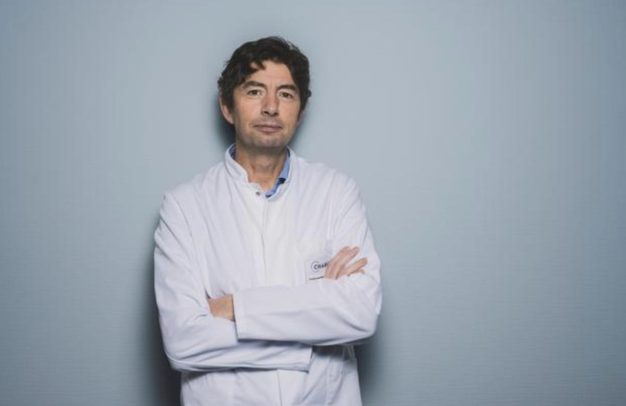
Virus-understander-in-chief Christian Drosten posing as a scrappy compassionate avatar of The Science, rather than the conniving and perpetually wrong loser that he is.
eugyppius: a plague chronicle | May 6, 2023
That eternal turd who will not flush, Christian Drosten, has resurfaced with an odious media interview, demanding that the vaccines receive credit for ending the pandemic and that oppressive non-pharmaceutical interventions like lockdowns and school closures remain on the table for future pandemics.
From Tagesspiegel :
The measures taken by the federal and state governments in the Corona pandemic proved highly controversial and triggered fierce debates. The Berlin Charité virologist Christian Drosten, among the advocates of harsh restrictions, has now warned against drawing the wrong conclusions. The “fundamental, ideological exclusion of lockdowns and school closures” is foolhardy, Drosten told the newspapers of the Funke Mediengruppe.
“Not all pathogens have the same characteristics. A virus could surface that is especially dangerous for children, for example, or that triggers insidious sequelae despite a harmless initial infection.”
“The school closures in 2020 and 2021 were a mistake, but please don’t take away our power to close schools again in the future! The next virus might really be dangerous to children! We don’t always cry wolf, except when we do!”
Infections such like mumps and measles have caused brain inflammation, diabetes or infertility, the director of the Institute of Virology added. “If such a virus developed into a highly transmissible pandemic pathogen, politicians would inevitably have to take measures. You can’t categorically rule out things like lockdowns and school closures, that’s neither realistic nor responsible.”
Yes, you can categorically rule out lockdowns and school closures. We literally never did any of this before at this scale or for this duration in response to any virus, nor were lockdowns or other invasive measures ever even contemplated until the Chinese gave you guys a bunch of evil ideas three years ago. What’s more, all of your interventions were utter, abject failures; they did nothing.
Drosten also criticised the public debate on Covid vaccinations, which “is often still destructive.” The fact that further Covid vaccinations for children and many adults are now no longer recommended “does not prove that vaccines have always been unnecessary,” the Charité professor emphasised.
“Rather, with the help of vaccinations, we have mitigated the impact of infections and developed a high level of immunity in the population. This is the only reason that the vaccine recommendations could now be changed.”
Had we vaccinated not a single soul, we’d have identical levels of immunity in the population right now from Omicron. We also wouldn’t have all those awkward vaccine injury headlines.
In case you’re not yet angry enough, though, it gets worse:
The director of the Institute for International Health at Charité, Beate Kampmann, warned against vaccine scepticism. “Vaccination is not only about the well-being of the individual, but also about the health of society as a whole, that is public health, and that also means solidarity,” she told the newspapers.
“Sometimes people forget that they contribute to the protection of everyone with their personal decision. That was true for Corona, but it’s also true for measles, for example.”
Why are these assholes always lying, I want to know. The vaccines were not intended to stop transmission, the trials weren’t designed to show whether they would stop transmission, and we’ve known beyond all doubt since the summer of 2021 that they don’t stop transmission. Nobody who was vaccinated against Corona contributed to anybody else’s health at all, this is all just a straight-up untruth.
The pandemicists aren’t going away. They have amassed a great toolkit of new powers, and they will be slinking around for decades waiting for the next opportunity to try them out all over again. Now that the virus hysteria has boiled off and some minimal standards of rationality have returned to the discussion, it should be a priority to discredit every last one of these virus pests, Corona astrologers, modellers, and panic mongerers, now and for all time. Otherwise we’re at great risk for getting the same thing all over again.
Odessa Massacre 9 Years On… West’s Shameful Silence
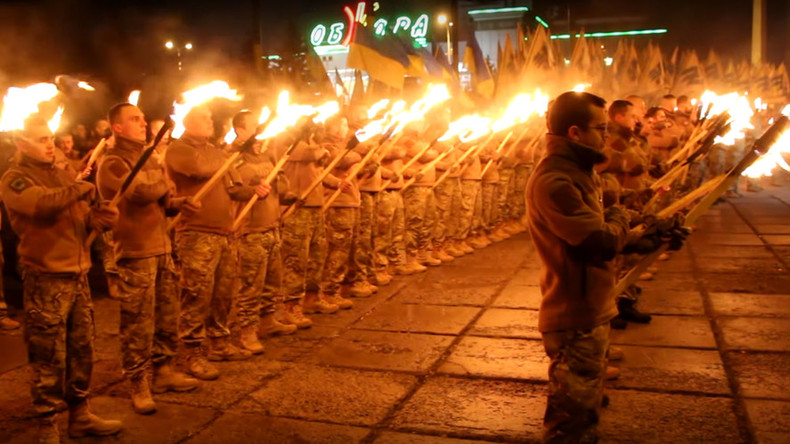
Strategic Culture Foundation | May 5, 2023
This week saw the ninth anniversary of a shocking massacre of 42 civilians in Odessa by Ukrainian fascists. Only weeks prior to that, the fascists’ political leaders had carried out a violent coup in Kiev.
The barbarity of the Odessa atrocity was unspeakable but emblematic of the NATO-backed fascist regime that seized power illegally in February 2014.
Significantly, and shamefully, the Western media and governments hardly mention that horror, or if they do, they tend to distort the incident and typically, yet baselessly, accuse Russia of disinformation.
On May 2, 2014, hundreds of protesters in Odessa against the fascist Kiev regime became embroiled in violent clashes with supporters of the regime. Thousands of far-right paramilitaries belonging to the NeoNazi Right Sector had been transported from the north to the southern port city of Odessa on the Black Sea under the guise of attending a football match.
Street battles ensued all day with cobblestones, Molotov cocktails and gunfire exchanged by both factions. By evening, the more numerous pro-regime crowds turned their focus on a tent encampment of anti-regime protesters near the Soviet-era Trade Unions building in the center of Odessa. The encampment was a peaceful gathering which included women and children. It had been set up for several weeks to demonstrate opposition to the Maidan events in Kiev.
The anti-regime protesters were opposed to the coup that had taken place in Kiev weeks earlier by the so-called EuroMaidan movement. On February 20, a gruesome sniper massacre in Kiev (later found to have been carried out by CIA-backed fascists) led to the overthrow of elected President Viktor Yanukovych. The latter had maintained friendly relations with Russia which far-right Ukrainian factions abhorred. Yanukovych’s government was strongly supported by Ukrainians of ethnic Russian heritage mainly in the south and eastern parts of the country.
The fascist regime that came to power in Kiev in February 2014 and which prevails till this day – albeit with a president, Vladimir Zelensky, who is nominally of Jewish ancestry – was opposed from the outset by many Ukrainians. They viewed the new rulers as unelected and illegitimate. They were also fearful of the NeoNazi factions that openly glorified Ukrainian figures like Stepan Bandera who had collaborated with Nazi Germany during the Second World War in the mass murder of their own compatriots.
That is why the people of the Crimea peninsula voted in a referendum in March 2014 to secede from Ukraine and join the Russian Federation. In other parts of Ukraine, the southeast Donbass region also repudiated the Kiev regime and its “anti-Russian” hostility. In May, 2014, the Kiev regime proceeded to launch its so-called Anti-Terror Operation on the self-declared republics of Donetsk and Lugansk with the backing of then CIA chief John Brennan on a visit to the country. The U.S. vice president at the time was Joe Biden who served as Washington’s point man for the new regime. That aggression marked the beginning of the civil war in Ukraine which culminated in the present conflict with Russia, and the joining last year of the Donbass and neighboring regions with the Russian Federation.
This was the context in Ukraine in May, 2014. The country was in turmoil and splitting into ethnic and political divides. Cities like Odessa had strong historical and cultural connections with Russia. The city known as the Pearl on the Black Sea owing to its storied trading economy was founded in 1795 by Catherine the Great, the empress of Russia.
When the NATO-backed putschists seized power in Kiev in a bloody coup and began organizing Nazi-style torchlit processions, many ethnic Russian people in Ukraine and others were horrified. Odessa was one such city with a large Russian population. The city had suffered mass killings by Nazi Einsatzgruppen SS death squads and their local henchmen.
When the Kiev regime fascists targeted the protest camp in Odessa on the evening of May 2, some 300 of the protesters took refuge inside the Trade Unions building. The mob outside bombarded the historic building with incendiary devices setting it ablaze. The deliberate intention was to incinerate all those inside. The hatred shown by the Right Sector attackers towards the trapped victims was appalling. Several of the people in the building tried to escape the flames by jumping out of high-rise windows. As their bodies smashed the ground below, frenzied crowds clubbed them to death.
In all, 42 people were murdered in the Trade Unions building massacre. Not one attacker was ever prosecuted. The Kiev regime refused to carry out any adequate investigation.
However, the horror of that day was a turning point for many Ukrainians and Russians. It revealed the hideous nature of the regime that had seized power over the country and its vile fascist hostility toward Russia.
This is the regime that was brought to power by Washington and its NATO partners. Since 2014, it has been armed and built up to be a war machine to aggress Russia and obliterate all cultural connections with Russia.
The massacre in Odessa should be remembered for the sake of the victims that day. But also remembered because it helps explain the background of how the present U.S.-led NATO proxy conflict in Ukraine with Russia has come about.
For that reason, Western news media and their governments chose to studiously ignore the Odessa massacre. Their shameful silence is necessary in order to conceal the criminal complicity of the West in Ukraine’s deadly turmoil.
The American Government Arguably Played A Role In Kiev’s Arrest Of US Journalist Gonzalo Lira
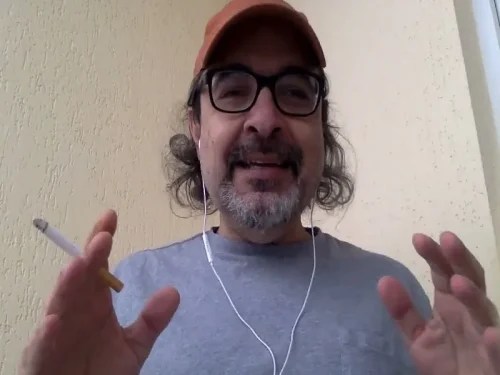
BY ANDREW KORYBKO | MAY 6, 2023
Dual American-Chilean national Gonzalo Lira was recently arrested by Ukraine’s secret police on charges pertaining to “wartime propaganda”, for which he faces the possibility of 5-8 years in jail. The US Government’s (USG) silence on this incident completely contrasts with its hysteria over Wall Street Journal (WSJ) employee Evan Gershkovich’s arrest in Russia last month on charges of espionage after he was caught red-handed soliciting classified military-industrial information from a regional lawmaker.
This is a betrayal of American principles since the freedom of speech is regarded as a sacred right of all its citizens no matter where they might be at any given time. Regardless of whatever one might think about Lira’s views and the particular piece of Ukrainian legislation that was cited as the basis for arresting him, the USG is supposed to support the rights of its nationals abroad. This is especially so whenever they’re arrested for expressing an opinion and/or practicing journalism like he was.
Its silence in the face of this scandalous incident suggests a degree of complicity in, or at the very least tacit approval of, Lira’s arrest since nothing else cogently explains the conspicuous lack of any response. These suspicions are further reinforced by the fact that one of the USG’s leading information warfare assets in Ukraine, transgender mercenary Michael John Cirillo, admitted to the Daily Beast that he colluded with the SBU on its case against Lira and even plans to testify against him.
In his exact words, “I’ve already given my sworn statement to SBU about Gonzalo Lira several months ago and expect to be called as a witness in his prosecution.” Cirillo also added on Twitter that “When I’m on Capitol Hill in 10 days, no doubt the arrest of Gonzalo Lira will be a prime topic of conversation.” Instead of seeking his release, the USG is relying on one of its top propagandists in that country to pursue Lira’s conviction, prior to which their proxy brazenly plans to boast about this to Congress.
It should also be noted that Cirillo told this to Julia Davis, who’s banned by Russia on the basis of having worked against its national interests at the behest of hostile powers, which obviously refers to the USG in this context. Her article also mentions that she obtained exclusive footage of Lira’s arrest, which could only have been obtained by the SBU, whose employees shared it with her precisely because they know that she’s one of their patron’s most reliable agents and would thus use it to humiliate Lira in her piece.
These facts lead to the conclusion that the USG is indeed complicit in Ukraine’s arrest of this dual American national. It’s not even hiding its complicity in Lira’s persecution either after one of its leading information warfare assets in that country admitted to colluding with the secret police on this case, told the media that he plans to testify against him, and even plans to brag about this to Congress. The USG is perversely proud of this since it hopes to pressure critics of its proxy war into self-censoring.
This objective also clearly includes its own citizens like Lira, who the USG hates with a passion since his brave reporting from Kharkov discredited many of their claims about this conflict. It could have simply requested that Kiev deport him in order to lessen the damage that he’s inflicted on their information warfare operations, but it preferred to make an example out of him by pursuing his prosecution. Cirillo’s role in this incident and his plans to brag about it to Congress leave no doubt about the USG’ complicity.
The Galician genocide: How Russian identity was wiped out in what is now Western Ukraine

By Dmitry Plotnikov | RT | March 15, 2023
Galicia, a historical region in the West of Ukraine, is currently the center of the country’s nationalist movement. However, things were once very different. A little over a hundred years ago, representatives of opposing Russophile and pro-Ukrainian political movements competed for the loyalty of the local Ruthenian population, also known as Rusyns. Galicia’s Russophiles welcomed the beginning of the First World War as a step toward an anticipated reunion with Russia. However the Ukrainian movement remained loyal to Austria-Hungary. With the help of the latter, Vienna killed off the Rusyn intelligentsia, which it considered a “fifth column”. To accomplish this, the Hapsburgs set up concentration camps.
What happened next amounted to a genocide.
The beginning of the tragedy
By the start of the First World War, the Russophile movement in Galicia was experiencing tough times. As a result of the “divide and rule” policy implemented by the Austrians, the movement suffered a split. The oldest and most respected organizations ended up in the hands of pro-Austrian leaders who advocated Ukrainian, not Rusyn, identity.
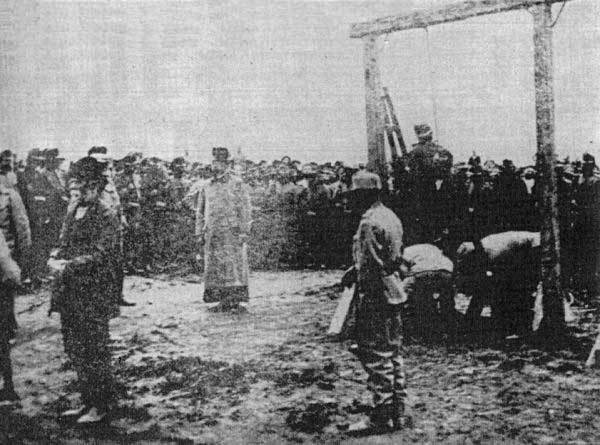
After the army of the Russian Empire crossed the border on August 18, 1914, and launched an offensive in Galicia, mass repressions swept through the region. People fell victim to the rage of the Austrian authorities over trifling matters – like possessing Russian literature, being a member of a Russian society, having a Russian education, or just sympathizing with Saint Petersburg. In some cases, people were arrested just for calling themselves Russians. Prisons were full of “enemies of the state” and “dangerous Moscow agents”, and the streets were lined with gallows.
“Those suspected of ‘Russophilia’ were hung on these trees in front of the windows. People were hung right on the trees. They would hang there for a day, then would be taken off and others would take their place… ” recounted one of the peasants in the Gorodetsky district. The repressions primarily affected the intelligentsia and Orthodox priests, most of whom completed spiritual studies in the Russian Empire.
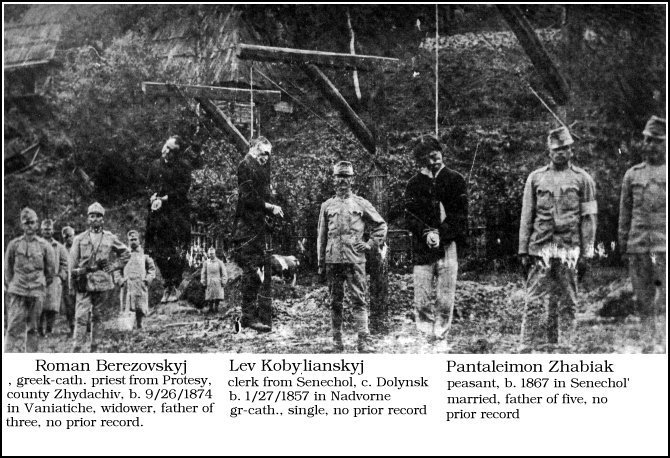
Austro-Hungarian servicemen pose against the background of three hanged men executed on August 30, 1914 in Mukachevo. © Wikipedia
Repressions against the intelligentsia were followed by those against the general public. Anyone who was thought to sympathize with Russia or Russian culture became a suspect. This included people who had once visited Russia, read Russian newspapers, or were just known as “Russophiles.” Military courts worked around the clock and a simplified procedure of legal proceedings was introduced for cases of suspected treason.
Members of Galicia’s Rusyn movement who chose the “Ukrainian way” actively participated in the repressions. Pro-Austrian politicians prepared lists of “unreliable” suspects and based on mere accusations, and arrested anyone who sympathized with Russia. As Russophile public figure Ilya Terekh described, “At the beginning of the war, the Austrian authorities arrested almost the entire Russian intelligentsia of Galicia and thousands of peasants, based on the lists handed over to the administrative and military authorities by the Ukrainophiles.”
“People who recognized themselves as Russian or simply had a Russian name were seized indiscriminately.
Anyone who possessed a Russian newspaper, book, sacred image, or even a postcard from Russia was grabbed, abused, and taken away. And then, there were gallows and executions without end – thousands of innocent victims, seas of martyr blood and orphan tears,” said another Russophile, Julian Yavorsky.
Talerhof in 1917, the place where the camp executions were carried out. © Wikipedia
In October 1914, the Russian writer Mikhail Prishvin, who served as a medical assistant at the front, wrote in his diary: “When I got to Galicia … I felt and saw the living images of the times of the Inquisition.” Prishvin described the feelings of the Galician Rusyns toward Russia as follows: “Galicians dream of a great, pure, and beautiful Russia. A seventeen-year-old schoolboy walked with me around Lvov [now Lviv, then Lemberg] and spoke Russian without an accent. He told me about the persecution of the Russian language. Students were not even allowed to have a map of Russia, and before the war he was forced to burn books by Pushkin, Lermontov, Tolstoy, and Dostoevsky.”
Hell on earth
The prisons of Galicia were not big enough to accommodate all the repressed. On August 28, 1914, there were two thousand prisoners in Lviv alone. It was then that the Austrian authorities decided to establish concentration camps. In September 1914, the huge Thalerhof place of incarceration was set up in Styria. The first prisoners were delivered on September 4. According to the testimony of one of the survivors, priest Theodor Merena, prisoners were “people of different class and age”. They included clergy, lawyers, doctors, teachers, officials, peasants, writers, and students. The age of the prisoners ranged from infants to 100-year-olds.
Occasionally, Ukrainian activists who were loyal to the Austrian regime were accidentally placed into Thalerhof. Most of them were removed quickly. One later recalled that all prisoners had a chance to escape by giving up their Russian name and registering as “Ukrainians” in the “Ukrainian list.”
Up to the winter of 1915, there were no barracks in Thalerhof. People slept on the ground in the open air despite the rain and frost. The camp’s sanitary conditions were awful. The latrines were uncovered and used by twenty people at a time. When the barracks were built, they were overcrowded, housing 500 people instead of the intended 200. The prisoners slept on straw beds which were rarely replaced. Naturally, epidemics were widespread. In just two months following November 1914, over three thousand prisoners died of typhus.
“In Thalerhof, death rarely came naturally – it was injected through the poison of infectious diseases. Violent death was commonplace in Thalerhof.
There was no question of any treatment of the sick. Even doctors were hostile toward the prisoners,” wrote imprisoned Rusyn writer Vasily Vavrik.
The prisoners weren’t provided with any adequate medical care. In the beginning, Thalerhof didn’t even have a hospital. People died on the damp ground. However, when the hospital barracks were finally built, the doctors gave almost no medicine to the patients.
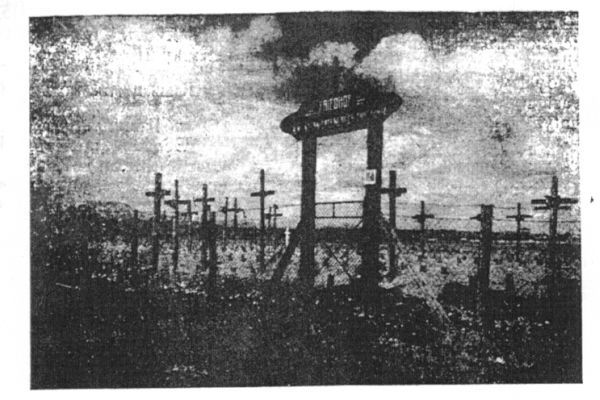
Talerhof. Cemetery “under the pines” in 1917. © Wikipedia
To instill fear, prison authorities constructed poles throughout the camp and regularly hung “violators” on these poles. The violation could be a mere trifle, like catching someone smoking in the barrack at night. Iron shackles were also used as punishment, even on women. Moreover, the camp was supplied with barbed wire, observation towers with sentries, barking dogs, posters with slogans, propaganda, torture facilities, a moat for executions, gallows, and a cemetery.
The camp operated for nearly three years and was closed down in May 1917 on the order of Charles I of Austria. The barracks stood on the site until 1936, when they were finally demolished. 1,767 corpses were then exhumed and reburied in a common grave in the nearby village of Feldkirchen.
The exact number of victims in Thalerhof is still disputed. The official report by Field Marshal Schleer dated November 9, 1914, stated that 5,700 Russophiles were imprisoned there at the time. According to one of the survivors, in the autumn of the same year there were about 8,000 prisoners. Twenty to thirty thousand Russian Galicians and Bukovinians passed through Thalerhof in total. In the first year and a half alone, about 3,000 prisoners died. According to other sources, 3,800 people were executed in the first half of 1915. Overall, in the course of the First World War, the Austro-Hungarian authorities killed at least 60,000 Rusyns.
Remembering the forgotten
In the period between the two world wars, the former prisoners strived to preserve the memory of the tragedy that affected Galicia’s Ruthenians and to perpetuate the memory of the victims of Thalerhof. The first monument was erected in 1934, and soon similar memorials appeared in other parts of the region. In the years 1924-1932, the Thalerhof Almanac was published. It provided documentary evidence and eyewitness accounts of the genocide. In 1928 and 1934, Thalerhof congresses, which gathered over 15 thousand participants, were held in Lviv.
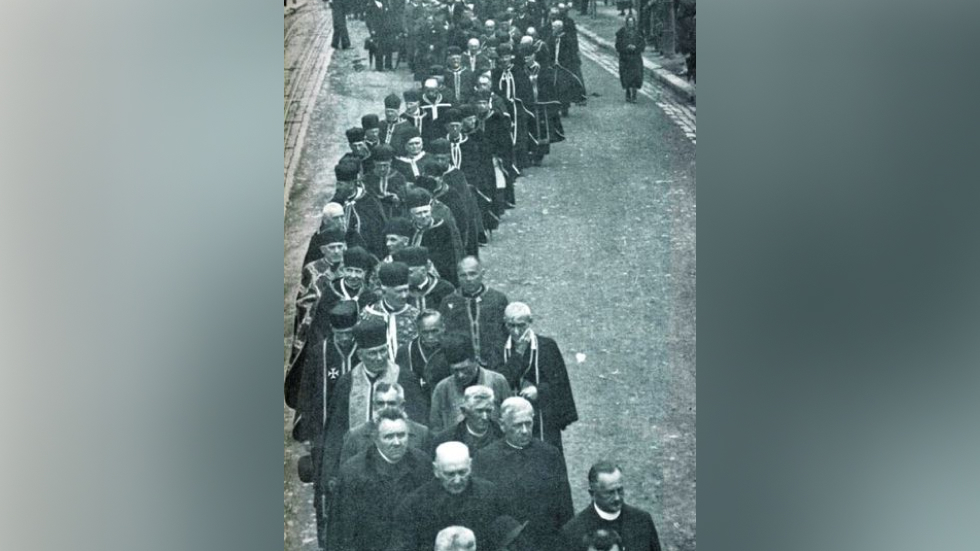
The procession of the participants of the Talerhof Congress on the occasion of the opening of the monument to the victims of Talerhof, 1934. © Wikipedia
Galicia became part of the USSR in 1939. Even before Soviet times, there was an unspoken ban on the topic Thalerhof, because the very fact of Russian existence in Galicia was seen as an impediment to Ukrainization, which was actively cultivated in Western Ukraine following World War Two. After Galicia and Volhynia became part of the USSR, most Russophile organizations in Lviv were closed. However, memorial services by the monuments continued. As the eyewitnesses and contemporaries of the events grew older and died, a new generation of Galicians was brought up in the spirit of atheism and took on a Ukrainian national identity. As a result, fewer and fewer people came to the memorials.
In modern Ukraine, the Rusyn genocide isn’t publicly discussed. Thalerhof is not mentioned in any school textbooks on the history of the country. The idea that Russians once lived in Galicia – the proud center of “Ukrainian culture” – does not fit the nationalistic ideology of contemporary Ukraine. Most young people have never even heard of Thalerhof.
The tragedy marked the end of the Russophile movement in Galicia. All those who did not submit and did not take on a Ukrainian identity were physically annihilated. Just a few years after the tragic events, public views changed. The region came under the influence of other movements and politicians. When Austria-Hungary fell apart after the First World War, Galicia turned into a powerful center of the Ukrainian nationalist movement.
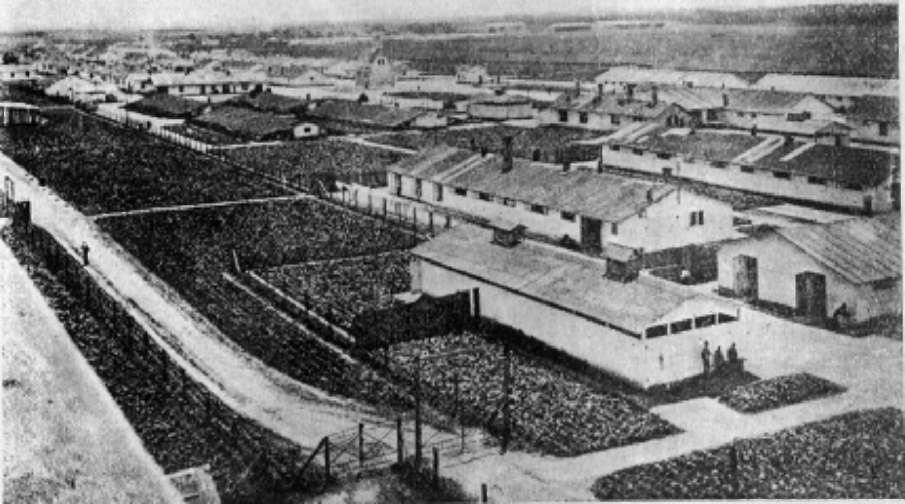
Bird’s-eye view of the Talerhof concentration camp. © Wikipedia
Dmitry Plotnikov is a political journalist exploring the history and current events of ex-Soviet states.
Chilean journalist arrested in Ukraine
RT | May 5, 2023
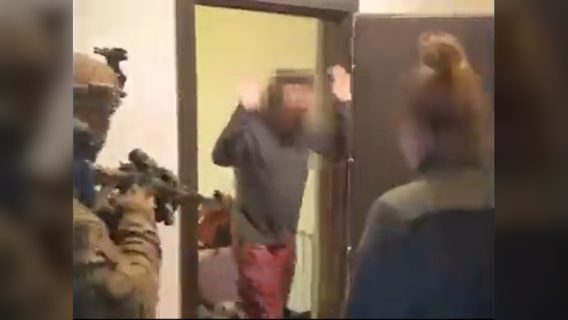
The Security Service of Ukraine (SBU) on Friday confirmed the arrest of Gonzalo Lira, a Chilean national living in Kharkov, suspecting him of pro-Russian sympathies. Lira was detained in April 2022, but released after a week and ordered not to leave the city.
According to a SBU statement quoted by Ukrainian media, Lira “publicly justified the armed aggression” of Russia, denied or glorified alleged Russian war crimes, and “engaged in discrediting the top military and political leadership and the Defense Forces of our state.”
The SBU filmed Lira’s second arrest by heavily armed agents, blurring out the faces of everyone involved.
He is suspected of “producing and distributing materials justifying the armed aggression of the Russian Federation against Ukraine, committed repeatedly.” A court ordered him jailed pending the outcome of the investigation.
The SBU has reportedly seized Lira’s computer and multiple cell phones as evidence.
Lira, 55, is a writer and filmmaker who used to work in the US. Several years ago, he moved to Kharkov, where he got married and began blogging as ‘Coach Red Pill’.
This is the second time he has been detained by the SBU. He was first arrested in April 2022, but was released after a week. No charges were pressed at the time, and Lira would not discuss the details of what happened, saying only that he was not allowed to leave Kharkov.
He blamed the US outlet Daily Beast for directing Kiev’s attention to his work, accusing the outlet of trying to get him killed. The tabloid had reported on Lira’s activities in March 2022, calling him “sleazy” and a “pro-Putin shill,” and noting its reporters had reached out to Ukrainian authorities.
While Lira kept a low profile for several weeks after his release, he eventually returned to social media and continued voicing criticism of Kiev’s policies. Since then, Ukraine has enacted laws criminalizing dissent and allowing President Vladimir Zelensky to ban opposition political parties, nationalize the media and even persecute the Ukrainian Orthodox Church for being in canonical communion with Moscow.
Documents show how CBC leaned on Twitter to censor content
By Cindy Harper | Reclaim The Net | May 5, 2023
Journalist Matt Taibbi has corroborated claims made by Rebel News that the Canadian Broadcasting Corporation (CBC) coerced Twitter to suppress voices and organizations it found disagreeable, even going as far as threatening litigation if the social media platform failed to oblige.

Earlier this week, Rebel News released documents indicating that the CBC exerted pressure on Twitter to silence specific individuals and groups, many of whom have been criticized by Prime Minister Justin Trudeau.

These documents contained correspondence between Michele Austin, former Director of Public Policy for Twitter in the US and Canada, and key figures within the CBC, including President Catherine Tait and Cam Gordon, who at the time headed communications for Twitter in Canada. Austin’s communication with Gordon revealed that the CBC had explicitly threatened legal action during a call with the pair, prompting them to terminate the conversation.

Austin further deliberated on whether they should respond to a letter sent by the CBC or simply ignore it, while also mentioning that she had already escalated the case.
Another email highlighted by Taibbi was sent by Claude Galipeau, a CBC executive, addressed to several Twitter executives and Tait. The email contained a follow-up letter regarding the issue they had previously discussed on May 26, 2021.
Additional documents obtained by Rebel News showed that Tait warned Twitter that the CBC would cease advertising on the platform if it failed to suppress the voices that the publicly-funded media organization wanted censored.
THOUGHT CRIME
Computing Forever | May 3, 2023
BEWARE: THE END OF FREEDOM OF EXPRESSION AND SPEECH IS NIGH (MIRRORED FROM TRACEY O’MAHONY): https://www.bitchute.com/video/PsKmHq4lhaFV/
Buy How is This a Thing Mugs here: https://teespring.com/stores/computing-forever-store
Support my work on Subscribe Star: https://www.subscribestar.com/dave-cullen
Support my work via crypto: https://computingforever.com/donate/
Follow me on Bitchute: https://www.bitchute.com/channel/hybM74uIHJKg/
http://www.computingforever.com
KEEP UP ON SOCIAL MEDIA:
Gab: https://gab.ai/DaveCullen
Subscribe on Gab TV: https://tv.gab.com/channel/DaveCullen
Minds.com: https://www.minds.com/davecullen
Subscribe on Odysee: https://odysee.com/@TheDaveCullenShow:7
Telegram: https://t.me/ComputingForeverOfficial
Featured Video
New positive ivermectin evidence
or go to
Aletho News Archives – Video-Images
From the Archives
Fanatical Followers of the Covid Regime: A Jim Jones-Style Cult?
By Professor Roger Watson and Dr. Niall McCrae | The Daily Sceptic | November 15, 2021
As scholars at leading British universities over recent decades, we witnessed the replacement of critical thinking and debate by narrative: facts are discrimination and scientific method is imperialism; truth, instead, is derived from ‘progressive’ values. This educational trend may be a major contributory factor to the ease in which society has been inculcated to the Covid ‘new normal’ of masking, testing, and repeated doses of vaccines for a disease of similar risk to severe influenza.
One doesn’t need much critical reasoning to observe the flawed logic of some vaccination enthusiasts, such as people who respond to experiencing any side effects, however debilitating, by saying “at least I know it’s working”, or, after contracting the disease despite their promised inoculation (over 90% effective, according to initial drug company claims), “I’d have been worse off without the jab.” … continue
Blog Roll
 Aletho News
- EU Council Advances Chat Control 2.0 Scanning Proposal
- Ex-Greek MEP files complaint against Israeli spyware firm over alleged Pegasus surveillance
- Troubling ideas throughout the Torah, Talmud, Mishneh Torah and Tanya
- ‘Grave, alarming’: Iran mission on Trump’s UNGA ‘annihilation’ threats
- Najaf airport to reopen to Iranian flights within 24 hours: Ambassador
- From ‘How Will This End For Iran’ to ‘When America Walks Away’: A tale of two Economist covers
- Tehran blasts ‘baseless’ speculation linking Iran to alleged bomb plot at UK air base
- The Rise And… Rise Of ‘Color Revolutions’
- The Coming GOP Bloodbath?
- Arctic Scare Stories Melt Away
- If Americans Knew
- Netanyahu Asked UAE Leader to Deny Report on Oct. 7 Warning in Secret Visit, Sources Say
- CNN Chief Int’l Correspondent Clarissa Ward on Journalists in Gaza
- Democratic Party Consultants Surround Troy Jackson with Pro-Israel Donors
- Christian Leader Responds To Netanyahu’s Claims Regarding Palestinian Christians
- In Gaza, ‘Whoever Survives the Bombing Won’t Survive the Rubble’
- Israel kills more Palestinians, amid push to resettle Gaza – Daily Update
- Israel forces Gazans to live in constant peril – Daily Update
- Deconstructing Netanyahu’s pants-on-fire UN rant – Daily Update
- Trump betrayed voters with his campaign lies and prioritized a foreign country once he took office
- Netanyahu calls Israel’s war in Gaza ‘opposite of genocide’ in UN speech to near-empty hall
- No Tricks Zone
- New Study: Earth And Venus Surface Warmth Largely Explained By Convection And Lapse Rate, Not CO2 Or Radiation
- 2025 Nature Paper Claiming Worsening Global Drought Gets RETRACTED …Heavily Flawed
- New Study: ‘Global Drought Shows No Detectable Recent Acceleration Under Climate Warming’
- Economic Masterminds: German Socialists Suggest Taxing Productivity Gains Stemming From Using AI
- The South China Sea Has Not Been Cooperating With The Climate Change Narrative
- Energy Crisis: Germany Enters Heating Season With Historically Low Gas Reserve Fill Levels
- New Study: The Antarctic Ice Sheet Gained Mass From 2020-2024 Due To Staggering Snow And Ice Accumulation
- Study: Ocean Heating Rates From Thousands Of Years Ago ‘Dwarf’ Modern Ocean Heating Rates
- Climate Extremists Target, Attack Large-Scale Power Grid Infrastructure In Germany!
- New Study: Antarctic Ice Melt Has Contributed Less Than 1 Centimeter To Sea Level Rise In The Last 30 Years

