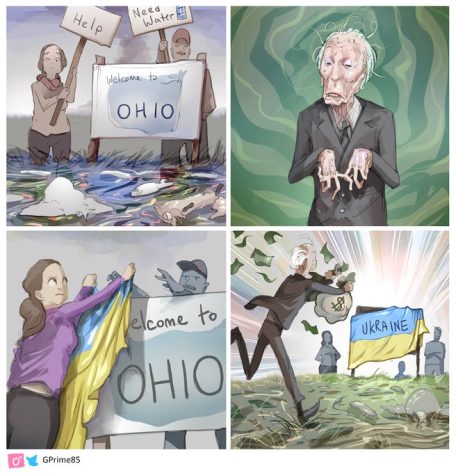
US President Joe Biden’s trip to Ukraine was “a slap in the face to every American,” Republican Rep. Paul Gosar declared on Monday. Already under fire over the hundreds of billions of dollars he’s handed Kiev, Biden is now being savaged by Republicans for his handling of a disastrous chemical accident on US soil.
Biden made an unannounced visit to Kiev on Monday, where he told Ukrainian President Vladimir Zelensky that his administration was readying a $500 million military aid package for his forces. Biden’s administration has handed Zelensky almost $30 billion in military aid since last February, and has set aside more than $110 billion for continued military and economic assistance to Ukraine.
“Joe Biden visiting Ukraine is a slap in the face to every American, especially the people of East Palestine, Ohio,” Gosar tweeted. “Ukraine is not our friend, and Russia is not our enemy.”
Gosar has bitterly opposed Biden’s bankrolling of Ukraine, and sponsored a resolution earlier this month that would halt US aid to Kiev. The resolution, signed by 11 members of the anti-interventionist ‘Freedom Caucus’, calls on Russia and Ukraine to reach a peace agreement.
Republicans from the Freedom Caucus and beyond have hammered Biden for his handling of the East Palestine chemical spill. A train carrying vinyl chloride and other hazardous chemicals derailed in this small Ohio town earlier this month, and a controlled burn of these substances blanketed the town in a cloud of black smoke.
Biden has not visited East Palestine, nor has he approved a disaster declaration. Biden’s transportation secretary blamed the derailment on former President Donald Trump, and although Biden has sent Environmental Protection Agency and Health and Human Services officials to the location to declare it safe, residents have complained of alarming physical symptoms as well as dead pets, livestock and fish.
“That was the biggest slap in the face,” East Palestine Mayor Trent Conway said of Biden’s trip to Kiev. “That tells you right now he doesn’t care about us. He can send every agency he wants to, but I found out this morning that he was in Ukraine giving millions of dollars away to people over there and not to us…on President’s Day in our country, so I’m furious,” he told Fox News.
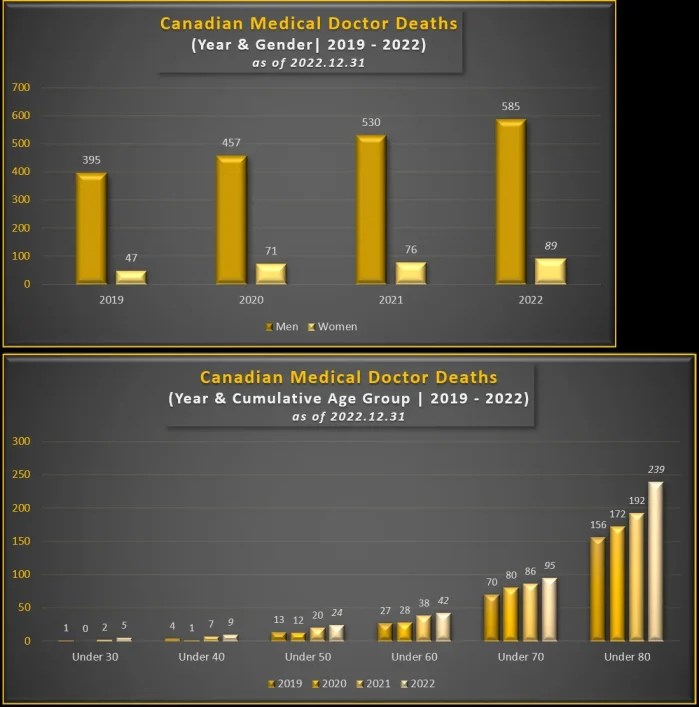
Overall Canadian physician mortality in 2022 was 53% higher than 2019, however, as with all excess mortality data in highly COVID-19 vaccinated jurisdictions, this mortality is heavily skewed towards the younger age groups, with the youngest doctors – medical students or medical residents under age 30 dying at a 900% higher rate in 2022, compared to the 2019/2020 average.
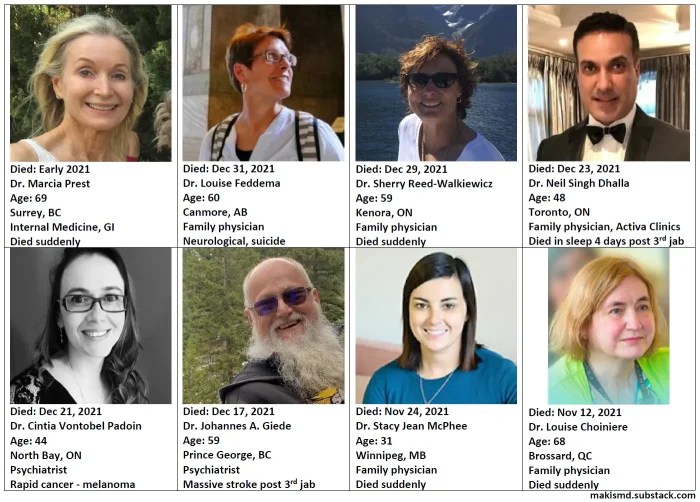
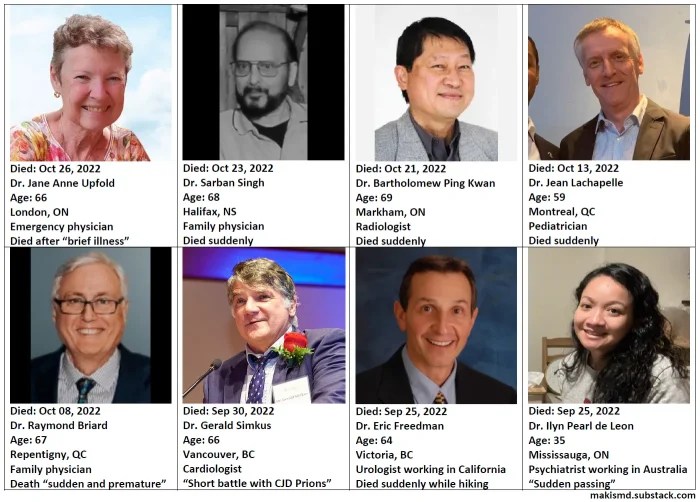
2021 Sudden and unexpected Canadian doctor deaths:
Acknowledgements
I would like to thank Michael for the tremendous work and hundreds of hours spent compiling this important data from official medical sources: (Canadian Medical Association, Royal College of Physicians and Surgeons of Canada, Provincial Medical Associations, Canadian Medical University Alumni Associations, Provincial Colleges of Physicians and Surgeons, and online obituary aggregators), as well as Sonja, VA and everyone else who provided valuable contributions over time.
This data has been available to the Canadian Medical Association as well as the Royal College of Physicians and Surgeons of Canada.
In 2021, Canadian doctors were mandated to be fully COVID-19 vaccinated, in order to keep their jobs. Very few escaped these mandates. No exemptions given.
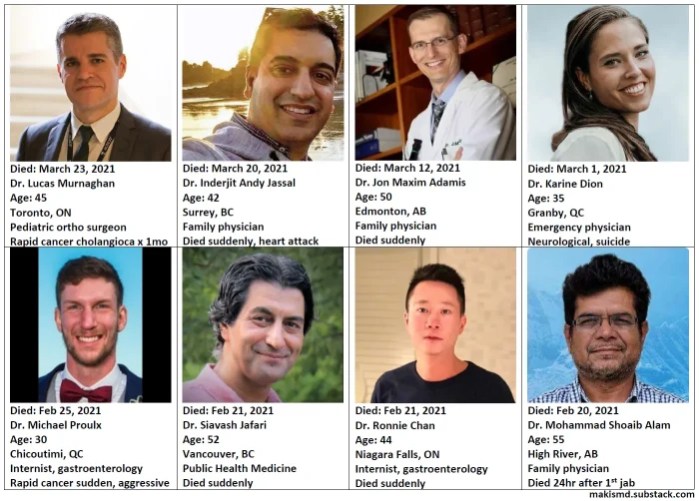
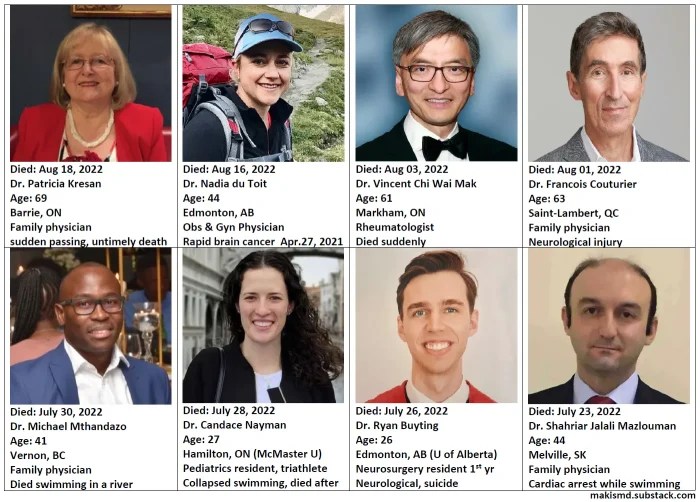
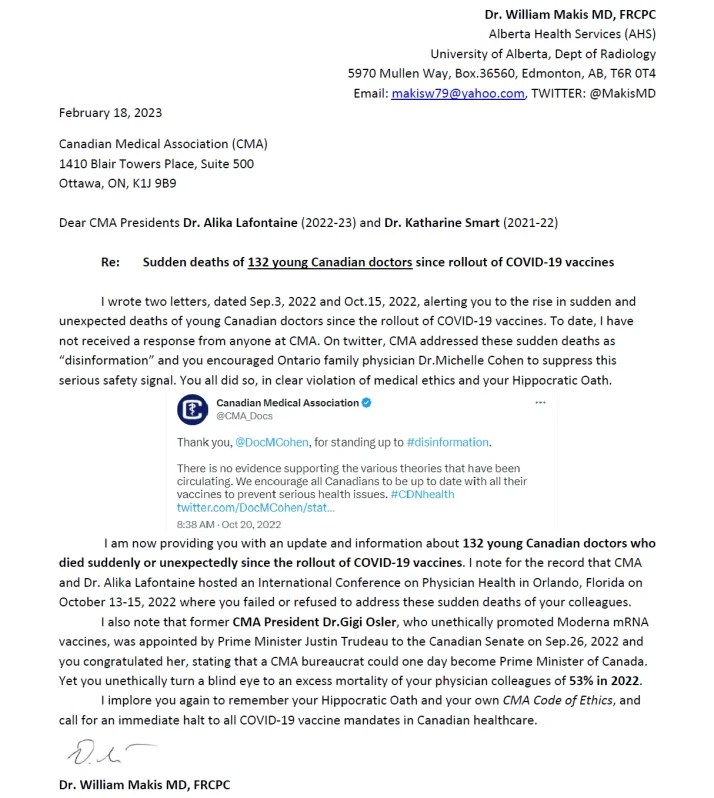
Since the rollout of COVID-19 vaccines in December 2020, a total of 132 actively practicing Canadian doctors under age 70 have died suddenly or unexpectedly.
Canadian physician mortality in 2022 was 53% higher than 2019, based on the largest database of its kind assembled diligently by our team (a total of 2250 doctor deaths documented, spanning the years 2019-2023). This data is solid.
I have sent a third letter to the Canadian Medical Association (“CMA”) about these sudden deaths. To date, CMA has refused to respond. CMA fully supported unscientific and unethical COVID-19 vaccine mandates that were forced on their own physician members. Now this Ottawa-based bureaucracy ignores the damage done.
2022/23 Sudden and unexpected Canadian doctor deaths:
A new report by the Anti-Defamation League (ADL) said pressuring online platforms and other internet services to remove those it deems to be far-right extremists is effective in limiting their reach. The report was authored by the ADL’s Center for Technology and Society Belfer fellow Megan Squire.
In preparing the report, Squire analyzed four deplatformed websites, including forum website The Donald, website The Daily Stormer, forum 8chan, and political commentator Nick Fuentes.
Squire compared the individuals and sites’ popularity before and after they were deplatformed, saying the objective is limiting the spread of hateful ideology, not cutting traffic. And according to Squire, deplatforming is an effective way of achieving that goal.
“Deplatforming websites—removing infrastructure services they need to operate such as website hosting—can reduce the spread and reach of extremism and hate online,” she wrote.
Deplatforming also financially affects content creators in other ways. For instance, Fuentes was removed from YouTube and forced to incur the cost of hosting his content on his website. On YouTube, he hosted the content for free and was able to monetize the content. Currently, “he has to run all of that infrastructure himself. He has to find the developers, he has to maintain the website, he has to pay for all that bandwidth,” Squire said.
However, the content creators in Squire’s report have survived even after deplatforming. Others have disappeared.
Squire notes that while deplatforming “works,” the creators of these websites and platforms often “bounce back because there is someone out there that will replatform them.”
Cloudflare, an internet infrastructure and security company, last year acknowledged in its Q3 2022 filing with the Securities and Exchange Commission that its departure from its neutral position, including the recent blocking of the Kiwi Farms online forum, has resulted in significant negative feedback and a loss of potential customers.
The company has recognized that taking actions against its customers, including banning them from using its products, may cause harm to its brand and reputation. Publicly traded companies such as Cloudflare are obligated to file quarterly reports, which include a section on risk factors.
Seven Just Stop Oil eco-loons who were found guilty of raids on an Esso Fuel Terminal in Birmingham last year have been spared jail by a sympathetic judge in Wolverhampton Magistrates’ Court… and told by the very same judge they should “feel proud” that they “care” so much. “Thank you for opening my eyes”…
In his extraordinary closing statement at the trial, loony left Judge Wilkinson lavished the criminal activists with praise, claiming “it’s abundantly clear that [they] are all good people” and promising to go easy on them:
“It’s abundantly clear that you are all good people. You are intelligent, articulate and a pleasure to deal with. It’s unarguable that man-made global warming is real and we are facing a climate emergency. Your aims are admirable and it is accepted by me and the Crown Prosecution Service that your views are reasonable and genuinely held. Your fears are ably and genuinely articulated and are supported by the science.” […]
“No-one can criticise your motivations. You all gave evidence that was deeply moving. I certainly was moved. The tragedy is that good people have felt so much, without hope, that you feel you have to come into conflict with the criminal justice system. Thank you for opening my eyes to certain things. Most, I was acutely and depressingly aware of, but there were certain things.
“I say this and I mean this sadly, I have to convict you. You are good people and I will not issue a punitive sentence. Your arrests and loss of good character are sufficient. Good people doing the wrong thing cannot make the wrong thing right. I don’t say this, ever, but it has been a pleasure dealing with you.”
“You should feel guilty for nothing. You should feel proud that you care, have concern for the future. I urge you not to break the law again. Good luck to all of you.”
After hearing that glowing testimonial from the man expected to enforce the law on them, the seven protesters were eventually sentenced to a 12-month conditional discharge and made to pay a £22 surcharge each. Is it any wonder they’re not put off from making people’s lives miserable?
Early this week the European Commissioner for Energy Kadri Simson delivered the opening speech at the Egypt Petroleum Show 2023 Strategic Conference, the largest oil, gas and energy conference and exhibition across Egypt, North Africa and the Mediterranean.
Simson highlighted the EU’s need to diversify its energy sources, pointing out that this became a necessity after the Russian-Ukrainian war. In an attempt to decrease the bloc’s energy imports from Russia, Simson said, it had started to look for new energy sources. Fortunately, the EU found Israel and Egypt.
“The EU is serious about investing in trusted, reliable energy partnerships,” Simson told attendants. “That describes Egypt perfectly.” Referring to the base of their partnership, she said: “In the immediate wake of the crisis a year ago, the very first energy agreement the EU concluded was the Memorandum of Understanding with Egypt and Israel on trade, transport and natural gas cooperation.”
Simson referred to that MoU as a “remarkable political milestone for energy,” stressing that it was “something we are very proud of,” reiterating “how grateful” she is “to both Egypt and Israel, for their cooperation to turn the political vision of mutual cooperation into a reality.”
The European commissioner for energy also made it very clear that “the EU could count on the partnership” with Israel and Egypt due to the “landmark” agreement, which came “at the height of the energy crisis,” stressing “it was central to our efforts to diversify and stabilise the supplies for our citizens.”
But has Simson thought about the source of this energy? How much blood was shed, how many people were forced out of their homes, or how many villages and cities were destroyed in order to get this energy? Has she questioned the human rights situation of the countries which are selling this energy?
The energy which comes from Israel is stolen from Palestinians from whom the Zionists stole land with the help of many countries, mainly the United States and the United Kingdom. Israel was created on bodies of thousands of Palestinians, the ruins of their homes, mosques, schools, villages and cities. Israel has been stealing Palestinian land, resources, history and culture.
Has Simson not seen reports of the daily killing of Palestinians, their detention, the demolition of their homes, stealing of their land, suppression of their freedoms, the night raids, desecration of their holy sites, restriction of their movement, the apartheid policies imposed on them and the deadly blockade hindering life for those living in Gaza over the past 16 years?
Numerous international rights groups, even Israeli rights groups, have investigated Israeli aggression on the Palestinians and found that the Israeli occupation state has committed war crimes against the Palestinians. In February last year, Human Rights Watch issued a report that proved Israeli war crimes against Palestinians.
Gerry Simpson, associated crisis and conflict director at HRW, said: “Israeli forces carried out attacks in Gaza in May [2021] that devastated entire families without any apparent military target nearby.” The UN and many other official bodies have condemned the Israeli occupation and its continuous aggression against Palestinians.
In a statement issued in 2020, the UN Special Rapporteur on the Human Rights Situation in the Palestinian Territory Occupied since 1967 said: “The Israeli occupation continues to deepen. The number of announced new Israeli settlement units has risen dramatically. Gaza remains besieged and beleaguered.”
Throughout its occupation, Israel has prevented Palestinians from accessing their natural resources, water, land and the offshore gas fields.
The UN Special Rapporteur said in his statement: “Israel has maintained a comprehensive land, air and sea blockade on Gaza … and it controls virtually everything and everybody that enters or leaves the Strip. The blockade has contributed mightily to the civilian suffering in Gaza, which has a collapsed health care system, an aquifer with almost completely undrinkable water, enormous rates of unemployment and poverty, intermittent electrical power and densely packed housing.”
While Simson is praising Israel for selling stolen Palestinian gas to the EU to help it through its energy crisis, Palestinians are languishing under a brutal occupation and suffering in the cold without access to electricity and gas.
There is so much I could highlight about the brutality of the occupation and how deals with it are emboldening it and encouraging the oppression of Palestinians. But here I lay down only the foundations for what Simon has to learn about the deal she is praising.
It is very clear the EU deals with the Russian occupation of Ukraine differently from the Zionist occupation of Palestine; ending trade deals with Moscow while strengthening ties to Tel Aviv. Proof of apartheid practices have done little to change the ‘moral’ EU’s stance on the occupation state because its needs are greater than its will to protect the lives and rights of others.
In an unprecedented step, Youtube has severely restricted as “inappropriate or offensive” Seymour Hersh’s blockbuster Nord Stream Pipelines interview with Amy Goodman on Democracy Now!
Hersh won his Pulitzer Prize more than a half-century ago in 1970 as the fiercely independent reporter who uncovered America’s My Lai Massacre in the Vietnam War. During his following decades at the New York Times and the New Yorker he broke some of the biggest stories in journalistic history, including the domestic spying activities of the CIA, the Abu Ghraib prison abuses of the Iraq War, and the killing of Osama bin Laden, while being honored with two National Magazine Awards, five George Polk Awards, and numerous other accolades.
Hersh’s long career arguably ranks him as the most renowned living American journalist, and indeed Prof. Jeffrey Sachs of Columbia University described him as such in a recent interview.
Then late last week, Hersh dropped a bombshell as big as anything in his career, revealing on his Substack platform the exact details of how the Biden Administration had secretly destroyed the Nord Stream pipelines, an attack on $30 billion of vital European energy infrastructure that constituted an act of war against Germany, one of our closest NATO allies.
How America Took Out The Nord Stream Pipeline The New York Times called it a “mystery,” but the United States executed a covert sea operation that was kept secret—until now
Seymour Hersh • Substack• February 8, 2023 • 5,200 Words
As I discussed in my own column, despite Hersh’s stellar career and the massive implications of his remarkable story, almost all our mainstream media outlets boycotted it, ensuring that it received minimal attention.
Hersh said he wanted his story to stand on its own, and was only willing to do a very limited number of interviews, with the first of these being with a small radio podcaster:
He soon followed this up with a half-hour appearance on Amy Goodman’s Democracy Now!, a leading left-liberal news program broadcast on more than 1,400 radio and television stations worldwide, many of them PBS and NPR affiliates.
During that interview, Hersh responded to criticisms and explained that Ukraine’s war with Russia was going far worse than reported by the American media. According to Hersh and some of his government sources, the American attack on the pipelines may have been a disastrous mistake that could result in the collapse of NATO once most Europeans became aware of what had happened.
Democracy Now! has 1.3 million subscribers on its large Youtube channel, and immediately released Hersh’s important interview on that platform. Within hours the segment was approaching 250,000 views on its way to a likely total of many millions, becoming one of the channel’s most popular videos. I naturally linked it in several comments on our website.
But the same day it was released, Youtube suddenly censored Hersh’s Democracy Now! appearance, claiming that it represented “a violation of community standards” and was “offensive”:
As a result, Hersh’s Democracy Now! segment can no longer be viewed anywhere except on the Youtube site itself, and then only after clicking through two layers of warnings. The obvious intent was to drastically reduce Hersh’s potential audience and this will surely succeed. I assume that these restrictions have been combined with the most severe sort of shadow-banning. So a segment that would have probably been seen by many millions will only get a small fraction of that total.
Such Youtube censorship of a top mainstream journalist on a leading mainstream channel seems completely unprecedented, a massive escalation of the previous measures directed against the political fringe. The move was probably driven by concerns of how Youtube had earlier allowed the views of other important public figures to circumvent the blockade of media gatekeepers:
Prof. John Mearsheimer of the University of Chicago, one of our most distinguished political scientists, had spent many years making exactly these same points and blaming America and NATO for the simmering Ukraine crisis, but his warnings had been totally ignored by our political leadership and media. His hour-long lecture explaining these unpleasant realities had quietly sat on Youtube for six years, attracting relatively little attention, but then suddenly exploded in popularity…as the conflict unfolded
Mearsheimer’s lengthy explanation of the origins of the Ukraine war has now accumulated 28 million views, quite possibly more than any academic lecture in the history of the Internet.
Mearsheimer’s other Ukraine interviews and lectures accumulated many millions of additional views, and as a direct consequence of his suddenly enormous Internet presence, the once-boycotted academic was invited to contribute lengthy expositions of his views to such extremely establishmentarian outlets as the Economist and Foreign Affairs, and selected to participate in prestigious public forums such as Canada’s Munk debate and Europe’s Holberg Debate. As a result, probably tens of millions worldwide became exposed to a perspective previously excluded from the Western mainstream media.
In another example, Jeffrey Sachs has expressed very similar concerns about the Ukraine war and over the last few months a couple of his interviews on Democracy Now! have accumulated well over 4 million views, while a different interview with geopolitical scholar Alfred McCoy had reached nearly 2 million more:
When Sachs suggested on Bloomberg TV that the American government had probably been responsible for the pipeline attacks, he was quickly yanked off the air, but his clip went super-viral on Twitter, accumulating several million views.
Meanwhile, the clips of President Biden and other top American national security officials promising to eliminate the Nord Stream pipelines and then crowing about the mysterious explosions that destroyed them have also became ubiquitious on the Internet.
Hersh’s work and record were widely promoted on Twitter.
Tucker Carlson had covered the pipeline attacks from the very beginning and immediately discussed Hersh’s remarkable reporting.
Similarly, Max Blumenthal and Aron Mate did the same on the Grayzone:
But the audiences of both these shows are already overwhelmingly hostile to the Biden Administration, so these segments would be far less threatening than Hersh’s own lengthy interview with Amy Goodman on a program often watched by Biden supporters. Other than that practical consideration, I see no reason why Hersh’s interview would have been censored.
The problem faced by our political establishment is that their current position on the Ukraine war has drawn increasing opposition from individuals with the highest public stature and credibility, not only top journalists and academics like Hersh, Mearsheimer, and Sachs, but also top national security experts such as Col. Douglas Macgregor and Ray McGovern.
Our failed current Ukraine war policy against Russia has only been maintained by one of the tightest information blockades in modern American history, with 99% of the mainstream media and a large majority of the alternative media tolerating no dissenting voices. But the disastrous potential flaws in our strategy become immediately become apparent once they are mentioned and a critical mass of leading figures has now begun to do so, with their views increasingly reaching the public. So a regime of unprecedented censorship may now be imposed to prevent the American people from hearing both sides of the story.
Hence a factual interview of one of our most renowned journalists by a leading media outlet has been stamped “offensive” and heavily suppressed.
Such restrictions are hardly unknown to me. Just days after I published my first April 2020 article pointing to strong perhaps even overwhelming evidence that the global Covid epidemic was result of a botched American biowarfare attack against China (and Iran), our entire website was banned by Facebook with all our pages deranked by Google.
The Government Junta of Chile was the highest organ of state power in the South American nation during the 1973-1990 military dictatorship. The period was characterized by repressive policies and extensive economic transformation. It is estimated that more than 3,000 people were killed, and tens of thousands disappeared during the military rule.
New research into the remains of Chilean poet Pablo Neruda has confirmed that poisoning was the cause of his death in 1973, the poet-diplomat’s nephew Rodolfo Reyes has said.
Following the court-approved exhumation of the body, international experts were called in to examine the remains of the Nobel laureate. According to Reyes, the results of the study confirmed he died not from cancer, as stated in official documents, but from poisoning.
Reyes has detailed that the final report outlined traces of the botulism agent had been found in the poet’s remains. Moreover, experts at McMaster University in Canada and the University of Copenhagen determined the bacteria had entered his body before death, thus confirming the idea of poisoning.
“We now know that there was no reason for the clostridium botulinum to have been there in his bones,” Reyes told Spanish media. “What does that mean? It means Neruda was murdered through the intervention of state agents in 1973.”
The report was released to Paola Plaza, a Chilean judge, on Wednesday; however, she has not made the findings public. It’s expected the report will be publicly released on March 7.
In Chile, Neruda is known not only as a poet but also as a diplomat and public figure. The Chilean Communist Party nominated him for president in 1970, although he later withdrew his candidacy in favor of socialist Chilean President Salvador Allende, who would later go on to be overthrown by General Augusto Pinochet in a US-backed coup.
Neruda died on 23 September 1973, 12 days after the coup d’état that toppled the Allende government. He died at the Santa Maria Hospital in Santiago. Speculation on Neruda’s cause of death has remained a hot talking point for decades, with his body having been first exhumed under court order in 2017.
In late 2019 and early 2020, I was asked to work on the front line in an emergency department to help with the ‘war effort’. We had no idea what was going on, apart from a few videos of the Chinese suddenly collapsing due to this new contagion. We were waiting for it to hit the U.K.
It hit, I saw what it did to people, they became unwell, x-ray x-ray x-ray, PPE, barriers, red lights, code words, panic, panic. Our world changed overnight, and my world changed especially. One minute we were told not to wear masks, the next moment it was made mandatory etc.
At this point, my sole focus was to protect myself and my family, so I began studying in order to do so successfully. I read papers during my breaks and at night before work. I reflected on what I saw at work and made a mental note of the real-life evidence.
The emergency department warped as time went on; I saw a lot of errors and mismanagement of resources. Patient care was being delayed, which led to staff burnout and medical errors. I could see that if this went on, people would needlessly die.
I knew something had to change. So in efforts to bring about some change, I wrote a book outlining how Toyota’s lean manufacturing methods could aid in improving patient safety as well as reducing costs in emergency departments. The book was called Saving A&E The Toyota Way. While researching for it, I learned a lot about healthcare infrastructure, artificial intelligence and preventative medicine. I knew what the national health situation was like; I knew we had to change as a species.
I presented that book to my hospital; my consultants liked it, but as an academic piece. That was not my intention, but hey ho, life goes on. There were more pressing matters at hand.
As the pandemic was progressing, I continued to research, write blogs and share what I saw. And I saw a lot of unscientific rubbish, unethical practices and poor care. The research papers said one thing, and yet we were doing something completely different. I knew very early on that not everyone needed to be jabbed. Something seemed fishy.
I worked in the emergency department and then paediatrics during the second peak. There was one child admitted due to COVID-19 who was later discharged. The ward was largely empty. And yet many doctors online were saying that COVID-19 was extremely dangerous to children. Nonsense.
Something was off: doctors weren’t being doctors, autopsies weren’t being done, the medical field was ignoring anyone who didn’t have COVID-19, and yet staff were doing TikTok dances. They asked me to join. I refused.
While all this was happening, I lost my grandma. The doctors didn’t want to see her in her home; her infection got bad; she didn’t want to go to the hospital; she became septic; she had to go in. I visited her after my shifts and fed her during my breaks.
I got the bad news from a doctor on the night she died. I asked the doctor if we could see her as a family, and he approved. We saw her one after the other, in tears and trying not to wake the other patients. Midway through, a matron I used to work with told us we couldn’t see her due to hospital policy and warned us that if we carried on she would call security on us. I told her we had approval already. She didn’t care. I saw evil in her eyes.
I asked her why she became a nurse. It was surely to treat and help people with compassion. She didn’t budge. I said, “Go ahead and call security then.”
Thank God, we had enough time for our family to all say their goodbyes. I made sure I was the last one. I knew and saw that many others weren’t as lucky as I was. Many had to FaceTime their dying family members. We were treated so badly and healthcare professionals encouraged it. I also knew the evils that lurked inside mankind that day.
During paediatrics I asked my colleagues about masks and jabs. Why did we only allow one parent to see their newborn child while wearing a mask, whereas we could all snuggle up together in the staff room maskless? I’d get responses that sounded like parrots. “It’s the rules”; “Policy”; “To stop infection”; “We just have to do it”. No science. No debate. No conversation. No brain.
I later worked in a children’s psychiatric ward, and what I witnessed was truly backward. Many children, many of whom wanted to commit suicide, were placed in solitary confinement so that useless PCR swabs could be taken. Two would need to be done, and the nurses would sometimes forget to do these. I actually had to make them a table so they would remember. Children were required to be swabbed, but staff members who would go wherever they pleased over the weekend were not.
I told my seniors that none of this made sense and that children did not suffer with COVID-19, but they just told me it was policy. The hospital trust actually recruited people to make sure staff were changing into scrubs before work too. The worst of it was when we had a ward round on one occasion. In psychiatry, the patient would sit in the room with the rest of the staff. This particular time my consultant found out that the young person who was in the room with us wasn’t swabbed. After the patient had left, she made us all stay in the room and asked us to lock the door and find ways to disinfect the room. She was seriously considering bleaching all surfaces. In disbelief, I asked her if we had to all strip down naked and shower together too. I had work to do, so I left.
The mental health of children and adults during lockdown was the lowest I’ve ever seen it in my career. Children were arriving with life disruption-related issues such as trauma, abuse, etc. all related to lockdowns.
My next job was in general practice. I was working towards becoming a GP. I enjoyed understanding and caring for all sorts of patients. I’m a generalist at heart. However, this transition marked another difficult time for me.
On the last day of hospital medicine and just before the first day of GP work, a close work colleague of mine went to play football, collapsed and never woke up. Deep down, I knew what had caused this. I knew the link between mRNA technology and myocarditis early on.
I cried finding this information out. I cried in front of my mother for the first time in my adult life. I’m in fact tearing up typing this. My friend was killed.
I went to his parents’ house to give my condolences. His parents were there, broken. He recently proposed to his fiancée. She was there too, broken. We viewed his funeral via Zoom.
There’s a spot in the park I dip into regularly while looking up at the leaves. I am reminded of him when I do this. I am reminded of how lucky I am to be alive. Deep down, I was terrified about what this meant for people around the world.
Time went on, and I worked in general practice. There was discussion about making vaccinations mandatory for all healthcare workers. I knew this was not only unscientific and unethical, but murderous. Yet my colleagues didn’t seem to care. They were safe, I guess.
Regardless, I could not do anything about it, so I plodded along. I never stopped reading papers, writing, tweeting and sharing information. I saw patients; I saw jab-related side effects, missed periods, new-onset whole-body inflammation, hair loss, etc. I saw cognitive dissonance too.
All of a sudden, one day, my practice asked me for my full jab status. This puzzled me because the managers knew I had to be jabbed with everything else in order to work in all the other specialties. I knew they wanted to know only one result. Whether or not I had taken the COVID-19.
I didn’t lie. I told them the truth. The next day, in a panic, they asked me to stop seeing patients face-to-face. They had made a team decision as a team, without me, that I was no longer able to see patients. They felt that I was a threat to them and that I would scare them away.
I have never had COVID-19. I worked on my health and immunity every day, and I purposely breathed in the virus in the emergency department to stimulate T cells. I knew jabs increased one’s risk of infection and showed them evidence. I was the least risky person in the practice and I knew it.
They didn’t care. They didn’t care about evidence. They didn’t care about ethics, about immunity, about anything. I shrugged this off and called patients instead. I was ostracised at work and many colleagues acted coldly towards me. I was alone, but not lonely; I knew I had evidence on my side.
Many doctors had to take sick leave from work multiple times due to COVID-19. I had meetings discussing my jab status. A doctor with myocarditis on long-term meds post-jab urged me to get the shot. One said I was “too principled”, It was surreal.
They admitted it was all politics. I asked them why they didn’t read papers? I asked them about T cells. Silence.
I have wanted to become a doctor since the age of six. I love biology and enjoy helping people using my knowledge. But I understood that I was working in an environment that was harming people. I had many sleepless nights thinking about leaving.
One morning, after parking my car at work, I felt a warmth around my head. It had no words, but if it did, it told me that everything would be okay. As soon as I had that experience, my decision was made, and I felt light; a colossal weight had been lifted.
I asked to quit, and a few meetings later (carried out to make sure I wasn’t crazy), I left healthcare and then deregistered myself from the medical register. I wanted to be totally free. I needed to be.
The flat my girlfriend and I were planning to buy fell through. I was in financial turmoil. My mother cried for weeks. I was lost, but I was free. I wasn’t part of the killing system.
I did what I only knew – I began writing. I started a Patreon and am grateful for those who did and continue to contribute to that. But it wasn’t enough. I ended up being on the dole for just less than a year. The guy I had to call every two weeks was surprised I was once a doctor.
I began learning and researching everything I could to help people who had been jabbed. I knew what was going on and I didn’t want another pandemic to happen. I wanted to save as many lives as possible.
I would take my bike, cycle across the park to my local library, and work feverishly every day till close. Around this time, I was permanently suspended on Twitter for stating facts.
I see this as a blessing now, as it made me work even harder to produce something that could never be banned. A book. I worked and researched to make sure I got this book out before 2023.
I was blessed around this time to come into contact with Alex Mitchell. He introduced me to other people injured by the shots. I was determined to make sure their voices got heard. I included their stories in the book.
During this time, on my walks, I had many insights and extraordinary experiences that many people may not believe or might dismiss as crazy. I saw light, and I ended my fears.
Before the new year, I released my book, Calling Out The Shots. It goes through what genetic agents are, what they do to our bodies, how we can improve our immunity, ways we may mitigate jab damage and what we need to do as a society to heal.
The book marks my first gift to the world. I am working on many more and other projects. I will fight for humanity until my final breath.
Dr. Eashwarran Kohilathas is a medical doctor, qualified personal trainer and author who aims to help people achieve physiological, psychological and spiritual freedom. This article first appeared as a Twitter thread.
A judge has blocked a New York law that attempted to regulate “hateful conduct” online.
The legislative package, signed into law last summer, was Gov. Kathy Hochul’s attempt to force the moderation of content under nebulous terms such as “hate.”
The bill required, “social media networks to provide and maintain mechanisms for reporting hateful conduct on their platform.” It defined hateful conduct broadly as, “the use of a social media network to vilify, humiliate, or incite violence against a group or a class of persons on the basis of race, color, religion, ethnicity, national origin, disability, sex, sexual orientation, gender identity or gender expression.”
The law also said that platforms must have a “clear and concise policy readily available and accessible on their website and application which includes how such social media network[s] will respond and address the reports of incidents of hateful conduct on their platform[s].”
On Tuesday, Judge Andrew L. Carter, Jr. (S.D.N.Y.) blocked the law. “Speech that demeans on the basis of race, ethnicity, gender, religion, age, disability, or any other similar ground is hateful; but the proudest boast of our free speech jurisprudence is that we protect the freedom to express ‘the thought that we hate,’” the court wrote.
In an unsurprising fashion, Judge Carter ruled that the law was a violation of the First Amendment. “The First Amendment protects from state regulation speech that may be deemed ‘hateful,’” the court wrote, “and generally disfavors regulation of speech based on its content unless it is narrowly tailored to serve a compelling governmental interest.”
The court added that the law, “chills the constitutionally protected speech of social media users,” adding “social media websites are publishers and curators of speech, and their users are engaged in speech by writing, posting, and creating content. Although the law ostensibly is aimed at social media networks, it fundamentally implicates the speech of the networks’ users by mandating a policy and mechanism by which users can complain about other users’ protected speech.”
The court highlighted the ways in which the law violated the First Amendment, saying, “the law also requires that a social media network must make a ‘policy’ available on its website which details how the network will respond to a complaint of hateful content. In other words, the law requires that social media networks devise and implement a written policy—i.e., speech.”
The other factor considered by the court was that the law “requires a social media network to endorse the state’s message about ‘hateful conduct’” – another First Amendment violation.
“Implicit in this language is that each social media network’s definition of ‘hateful conduct’ must be at least as inclusive as the definition set forth in the law itself. In other words, the social media network’s policy must define ‘hateful conduct’ as conduct which tends to ‘vilify, humiliate, or incite violence’ ‘on the basis of race, color, religion, ethnicity, national origin, disability, sex, sexual orientation, gender identity or gender expression.’”
The court singled out how the law would have forced free speech platforms such as Rumble “whose websites have dedicated ‘pro-free speech purpose[s],’ which likely attract users who are ‘opposed to censorship’” to “speak about hateful conduct.” This would be a form of compelled speech.
The court ruled that Rumble has, “an editorial right to keep certain information off their websites and to make decisions as to the sort of community they would like to foster on their platforms. It is well-established that a private entity has an ability to make ‘choices about whether, to what extent, and in what manner it will disseminate speech…’”
“The founding fathers would be proud today,” Rumble CEO Chris Pavlovski tweeted. “Rumble’s legal team is next level amazing.”
I don’t normally watch TVNZ’s Seven Sharp, but on 5th October 2021 we were told that an immunologist would be on the programme to debunk certain ‘Covid myths’.
One such ‘myth’ was the belief that natural immunity is superior to vaccine-induced immunity. In response, clinical immunologist Dr. Maia Brewerton said that natural immunity to Covid-19 is not as good as the vaccine.
No evidence was given. Just an assertion.
As an ex-science teacher, I found Dr Brewerton’s statement to be unsatisfactory, for the following simple reason: the vaccine can only generate antibodies to a single viral antigen (the ‘spike’ protein), whereas the whole virus particle reportedly contains 29 proteins, which can therefore evoke the production of a correspondingly greater diversity of antibodies.
So, if the part of the viral RNA that codes for the spike protein RNA undergoes a mutation, the vaccine-induced antibody may be unable to bind to the mutant antigen, but with natural immunity there will a range of ‘back-up’ antibodies that can bind to the other proteins of the virus.
I wrote to Dr. Brewerton to make this point, asking her if she could provide evidence for her Seven Sharp statement.
I received no reply.
This was particularly disappointing because we had repeatedly been urged by the authorities to ‘accept the science’.
One might think that such a single experience may not be particularly significant; Dr. Brewerton might be snowed under with work. But soon after Dr. Brewerton’s appearance,Stuff invited readers to submit questions on Covid, so I sent a similar question to the one I had asked of Dr. Brewerton.
Again, I received no reply.
I was beginning to sense that the authorities might not be too keen to take their own advice to ‘go with the science’, since the very essence of science is examination and questioning of evidence.
This feeling was solidified in August 2022, when I came across a paper co-authored by Professor Michael Baker, an epidemiologist at the University of Otago, who has been one of chief advocates for the wearing of masks during Covid-19. The paper was titled “The Covid-19 experience in Aotearoa New Zealand and other comparable high-income jurisdictions and implications for managing the next pandemic phase”.
In the article I could find no evidence supporting the efficacy of masks in the Covid-19 ‘pandemic’, so I wrote to Prof. Baker, saying that I had looked for, but had failed to find, any research evidence supporting the efficacy of mask wearing and hoped that he might be able to provide it.
Again, I received no reply.
An essential element in science is the challenging of established ideas in robust, untrammelled debate, in an environment that encourages questioning. Without such openness, science can be misused by powerful interests as a means of disguising misinformation as information.
In the complete absence of evidence-based debate in the media, I was forced to go elsewhere to find out what’s going on. One such source is Ian Miller’s “Unmasked: The Global Failure of Mask Mandates”. Using data from North America, Europe, and parts of South America, and county level in the U.S., Miller presents a compelling case that masks have failed their most significant test – to significantly reduce transmission of Covid. Indeed, it’s clear that masks have no health utility at all, but are an emblem of obedience to power.
In March 2020, Dr. Anthony Fauci, the U.S. Government’s chief medical expert was interviewed on 60 Minutes, and he unequivocally expressed his opinion on masks:
There’s no reason to be walking around with masks.. . . . .when you’re in the middle of an outbreak, wearing a mask might make people feel a little better and it might even block a droplet, but it’s not providing the perfect protection that people think that it is. And, often, people keep fiddling with the mask and they keep touching their face.”
Until his recent retirement, Dr. Fauci has spent his half-century-career as the US Government’s chief medical expert, whose calm, avuncular charm inspired confidence in millions, so his word on the airwaves carried a lot of weight.
Though his was the most familiar voice, organisations such as the Centers for Disease Control (CDC) and the World Health Organisation (WHO) prior to Covid, had expressed similar reservations on the utility of masks.
In February 2020, the CDC issued a document called “Community Mitigation Guidelines to Prevent Pandemic Influenza – United States, 2017”. It drew on the findings of nearly 200 research articles published over the years 1990 and 2006, and was specifically concerned with non-pharmaceutical interventions (NPI’s) by which people could protect themselves in the event of an epidemic.
The NPI’s the CDC document described for influenza pandemics included voluntary home quarantine of exposed household members and use of face masks in community settings when ill (emphasis added). There was no recommendation that masks should be used by healthy people in the general population.
The evidence base on the effectiveness of NPIs in community settings is limited, and the overall quality of evidence was very low for most interventions. There have been a number of high-quality randomized controlled trials (RCTs) demonstrating that personal protective measures such as hand hygiene and face masks have, at best, a small effect on influenza transmission …”
And in the United Kingdom’s Department of Health issued a guidebook titled “UK Influenza Pandemic Preparedness Strategy 2011” which, in point 4.15, said [emphasis added]:
Although there is a perception that the wearing of facemasks by the public in the community and household setting may be beneficial, there is in fact very little evidence of widespread benefit from their use in this setting. Facemasks must be worn correctly, changed frequently, removed properly, disposed of safely and used in combination with good respiratory, hand, and home hygiene behaviour in order for them to achieve the intended benefit. Research also shows that compliance with these recommended behaviours when wearing facemasks for prolonged periods reduces over time.”
It’s clear, then, that pre-Covid, public health authorities were unconvinced of the utility of mask-wearing by the general public. So, one is entitled to wonder why, soon after the WHO announced that Covid-19 had pandemic status, governments in North America, Europe, and Australasia began to ‘encourage’ people to wear masks in indoor public places. This was achieved by a combination of legislation and publicly expressed statements by ‘experts’.
In some cases the language was hyperbolic, verging on blood-curdling. In an interview on Newshub in July 2022 Prof. Michael Baker said:
“If you go out when you have this infection and infect your friends and family…you are going to kill some people – just like drinking and driving. We need a massive shift in thinking,”
In my e-mail to Prof. Baker, I had mentioned that I had been unable to find any evidence to support enforced wearing of masks in indoor public places. Since then I have come across two research papers, the most recent showing an investigation into the effects of masking by Beny Spira, Associate Professor of Infectious Disease at the University of São Paulo in the Journal Cureus, Journal of Medical Science.
Data from 35 European countries on morbidity, mortality, and mask usage during a six-month period were analysed. They found that countries with high levels of mask compliance did not perform better than those with low mask usage. On the contrary, there was a positive (though not strong) correlation between mask usage and mortality, suggesting that mask use was associated with slightly greater risk of death.
Of course, correlation does not prove causation, but these results are, or should be, cause for reflection by the authorities. But it seems not.
Whereas the Beny Spira study was retrospective, studying possible effects of mask-wearing in whole populations, a prospective study follows the fate of samples of volunteers, some of whom wore masks and others who did not.
A particularly important study by scientists at the University of Copenhagen during April and May 2020 was published in the academic journal Annals of Internal Medicine. It cast doubt on policies that force healthy individuals to wear face coverings in hopes of limiting the spread of COVID-19. The New York Timesreported that…
“Researchers in Denmark reported on Wednesday that surgical masks did not protect the wearers against infection with the coronavirus in a large randomized clinical trial.”
The experiment involved over 6,000 participants who had tested negative for Covid-19 immediately prior to the experiment. Half the participants were given surgical masks and asked to wear them at all times in public places; the other, control half, were instructed to not wear masks. After a month, participants were tested for Covid-19 and for antibodies against the virus.
The Times reported that of the 4,860 participants who finished the experiment, 42 people in the mask group, or 1.8 percent, got infected, compared with 53 in the unmasked group, or 2.1 percent. The difference was not statistically significant.
Dr. Henning Bundgaard, lead author of the experiment and a physician at the University of Copenhagen, told the Times the results of his research were clear.
“Our study gives an indication of how much you gain from wearing a mask,” Bundgaard said. “Not a lot.”
Surprisingly, or perhaps (in view of what follows) unsurprisingly, the most elite medical journals – TheLancet, TheNew England Journal of Medicine and the Journal of the American Medical Association – all refused to publish the paper.
Though the study’s researchers have been reticent about their results, some have hinted that it was their conclusions rather than their methodology that lay behind the rejections. Christian Torp-Pedersen, professor and chief physician at the research department at North Zealand Hospital, told Denmark’s Berlingske Daily:
We can’t start discussing what they are dissatisfied with. For if so, we must also explain what the study showed. And we do not want to discuss this until it has been published.”
When asked when the study would be published, one of its researchers, Thomas Benfield, Professor of infectious disease at the University of Copenhagen replied:
As soon as a journal is brave enough to accept the paper.”
In their paper, the Danish scientists described their findings as ‘inconclusive’, yet it seemed that their failure to produce evidence to support the official narrative was enough for the most élite journals to refuse to publish it.
Anyone who was cynical enough to suspect that discouragement of open debate was not confined to these journals would have found support for this ‘conspiratorial’ view from two leading Oxford University academics, Carl Heneghan, professor of evidence-based medicine, and Dr Tom Jefferson, a Clinical epidemiologist and Senior Associate Tutor, when they published an article in the Spectator magazine on Nov 19, 2020. The article was titled: ‘Landmark Danish study shows face masks have no significant effect.’
In quoting the Danish findings, Heneghan and Jefferson added: “As a result, it seems that any effect masks have on preventing the spread of the disease in the community is small.”
But then Facebook warned that the article was ‘false information’ claiming that it had been ‘checked by independent fact-checkers’
An angry Prof Heneghan told 70,000 followers on Twitter: ‘I’m aware of this happening to others – what has happened to academic freedom and freedom of speech? There is nothing in this article that is false.’
Such attempts to shut down views contrary to the official narrative should come as no surprise, especially in light of recent revelations about what amounts to ‘public-private censorship’ of free speech.
The revelations began soon after billionaire Elon Musk bought Twitter, in which he pledged to release internal documents that would reveal how the previous owners of Twitter had suppressed free speech. The files were released for examination by two independent journalists, Matt Taibbi and Bari Weiss. In an interview on Fox News, Taibbi said:
I think the major revelation of the Twitter files so far is that we’ve discovered an elaborate bureaucracy of what you might call public-private censorship. Basically, companies like Twitter have a system by which they receive ten tens of thousands of requests for action on various accounts, typically through the DHS [Department of Home Security] and FBI, but these requests were coming from basically every agency in the government. We’ve seen them from the HHS, from the Treasury, from the DOD [Department of Defence], even from the CIA, and they will send basically long lists of accounts in Excel spreadsheet files and ask for action on those accounts. And in many cases, Twitter is complying.”
So it’s not too much of a stretch to think that governments have been using Twitter to stifle public dissent over masks.
And it’s not just censorship that’s been the only tool in the box; even more has been the deliberate stoking up of fear, as Laura Dodsworth explains in an introduction to her book A State of Fear. In an introductory article to her book she gives some examples of things to be afraid of. A small sample:
Being tall: “People over 6ft have double the risk of coronavirus, study suggests” (DailyTelegraph 28 July 2020)
Being bald: “Bad news for baldies as new US study finds they’re 40% more at risk of coronavirus. New research has found a strange link between male baldness and the severity of the virus showing men without hair are more likely to end up in hospital.” (Daily Star, July 23, 2020).
Owning a dog and taking home supermarket deliveries: “Dog-owners face 78% higher risk of catching Covid-19 – and home grocery deliveries DOUBLE the risk, study finds.” (Mailonline 17 November 2020).
Being male: “Is testicle pain potentially a sign of Covid? 49-year-old Turkish man who had no other symptoms is diagnosed with the virus” (Mailonline 18 November 2020) and
Erectile dysfunction: “COVID-19 could cause erectile dysfunction in patients who have recovered from the virus, doctor warns” (Daily Mail, Dec 6, 2020)
Your toes: “Coronavirus: People who contract COVID may develop red and swollen toes which turn purple, say scientists” (Sky News UK 29 October, 2020
Taken individually, these might be amusing, but together, they are part of “a panoply of doom-mongering headlines”.
No doubt some will say that Dodsworth is a ‘conspiracy theorist’, but her allegations are confirmed by UK Government publications. On 22nd March 2020, SPI-B, the behavioural science sub-group of the Scientific Advisory Group for Emergencies (SAGE), published a document titled “Options for increasing adherence to social distancing measures”, advocating the use of applied psychology to influence social behaviour. Though the focus of the document was on social distancing rather than masks, the intention to use fear is clear:
“The perceived level of personal threat needs to be increased among those who are complacent, using hard-hitting emotional messaging. To be effective this must also empower people by making clear the actions they can take to reduce the threat.”
Moreover, Option 2 of Appendix B recommends using the media“to increase sense of personal threat” [emphasis added].
The cynical use of behavioural psychology to manipulate the attitudes and behaviour of populations has not been restricted to the U.K.; it’s been international. Here in New Zealand, in the early days of the pandemic, Jacinda Ardern’s use of the phrase ‘team of 5 million’ was a masterstroke.
But while this might have worked with a fearful, apathetic, naïve, and gullible public, masks and lockdown rules were flouted by some of our leaders in New Zealand, who didn’t see the need for such petty restrictions.
Chief among these was Siouxsie Wiles, the 2021 Kiwibank New Zealander of the Year, and a key adviser to Jacinda Ardern. On Sept 18, 2021 Radio New Zealand’s Nine to Noon interviewed her.
“Now that we know Covid-19 is airborne, stay away from people who aren’t in your bubble. With new knowledge that Covid-19 is airborne, that’s no longer something safe to do. Please don’t go out and chat with a friend while you are out. Don’t hang around and have a chat, connect in other ways. We’ve got phones, we’ve got Skype, we’ve got Zoom…we need to physically disconnect for a little while,” she said.
“Stay away from people.”
The trouble is, Wiles wasn’t following her own advice. On September 3, 2021, while Auckland was still in Level Four lockdown, she was observed “hanging around and having a chat” with a journalist at Judges Bay, Parnell.
Even more damning, the whole episode was recorded on video, in which Wiles was shown sitting in close proximity to the journalist, and neither was wearing a mask, in clear breach of her own and the government’s advice and mandates.
It depends on where the wind is blowing you could have a gust of wind that if someone infected blows it to you or if you were infected blows it to someone else… For the good of everybody, wearing a mask when you’re out of your home is a good idea.”
As independent journalist Cameron Slater pointed out: “If her advice is to wear a mask at Level Two, presumably it would apply doubly at Level Four.” And “Siouxsie Wiles lives in Freemans Bay, and in order to get to Judges Bay would require a trip in excess of 5km one way and 5km back again. This is in contravention of Level Four regulations that require you to ‘stay local’”.
Slater reported that when the Prime Minister was approached for comment about why it was acceptable for one of her key science advisers to be seen breaking lockdown rules, while Police are busy harassing shoppers, no reply had been received.
In a healthy democracy, the media would be speaking truth to power, so why were the media silent on Wiles’ flouting of the rules? Slater explained why the BFD made it public:
The simple reason is that we are not part of the Prime Minister’s Team of $55 million [a reference to the NZ government fund to rescue “grassroots public interest journalism”, which many see as a form of government control]. This story was given to 1News journalist Benedict Collins. After sitting on the story for five days he informed my source that they had spiked the story. The reason given was that it wasn’t a politician so there was no public interest in the story. Make no mistake, this story was suppressed by an editor at 1News.”
The Wiles case is one of many. The one garnering the most international odium was the 2021 G7 Summit in Carbis Bay, Cornwall, U.K. Among the leaders attending were President Joe Biden, Canadian Prime Minister Justin Trudeau, UK Prime Minister Boris Johnson, Queen Elizabeth, Prince Charles, and German Chancellor Angela Merkel. Photographs taken of the President and First Lady, the Queen, President Trudeau and Prince Charles show them clearly in breach of the ‘two metre’ social distancing rule, and neither is any of them wearing masks, and some show them with arms on each other’s shoulders.
Cynical comments referred to their ‘hypocrisy’ – ‘do as I say, not as I do’, and so on, but their behaviour goes deeper than that.
For one thing, the elite clearly didn’t believe there was any medical need for such social measures, implying that the real purpose was the enforcement of obedience.
Moreover, in making no attempt to conceal their flouting of their own rules, they were showing ostentatious contempt for us, the proles.
In the greater scheme of things, Covid-19 is but one ‘dot’ of many in the picture. While many can cope with the individual ‘dots’, joining them together to see the whole picture is, for some, just too much.
One thing that can make it easier is the fact that it’s nothing new. Over 2300 years ago the Greek philosopher Plato dealt with the problem of how hierarchical societies ensure that people did not think ‘incorrectly’ using his Allegory of the Cave, described in his Republic. The allegory takes the form of an imaginary conversation between Socrates and his pupil, Glaucon.
Socrates asks Glaucon to imagine people living in a huge cave that is only open to the outside world with difficulty. Most of the people in the cave are prisoners since early childhood. They are chained to the wall, facing the back of the cave, unable to move so they cannot turn their heads to see a fire behind them. Between the prisoners and the fire is a low wall, behind which is a path along which non-prisoners carry puppets and other objects that cast shadows on the wall of the cave. The shadows playing on the wall are all the prisoners can see; unable to see the fire, the prisoners believe the shadows to be real.
The central message of Plato’s allegory is that the human-created shadows are the political doctrine of a nation state. Although that was over two millennia ago, the cave allegory is more relevant than ever today. Industrial society is living in a state of deep ignorance, in which ‘reality’ is created by powerful agencies and their ‘puppeteer’ stenographers, the media.
Nearly a century ago, Edward Bernays, nephew of Sigmund Freud, implied that we are being manipulated by the clever use of psychology. Bernays is widely regarded as the ‘father’ of public relations, the polite term for the manipulation of public opinion. In his 1928 book Propaganda he wrote:
The conscious and intelligent manipulation of the organized habits and opinions of the masses is an important element in democratic society. Those who manipulate this unseen mechanism of society constitute an invisible government which is the true ruling power of our country… it remains a fact that in almost every act of our daily lives, whether in the sphere of politics or business, in our social conduct or our ethical thinking, we are dominated by the relatively small number of persons… who understand the mental processes and social patterns of the masses. It is they who pull the wires which control the public mind, who harness old social forces and contrive new ways to bind and guide the world. This is merely a logical result of the way in which our democratic society is organised.
38 years later, Harvard history professor Carroll Quigley published an extraordinary 1300-page book Tragedy and Hope, and in 2016 Joseph Plummer published a condensed 200 page version, Tragedy and Hope 101.
Quigley reveals that real political power operates in secret, over which ‘democratic’ elections have little or no influence. He shows that secret, powerful networks of individuals are behind world events, and that “representative government” is a fraud.
Real power is unelected. Politicians change, but the power structure does not. The Network operates behind the scenes, for its own benefit, without ever consulting those who are affected by its decisions.
The Network is composed of individuals who prefer anonymity. They are “satisfied to possess the reality rather than the appearance of power.” This approach of secretly exercising power is common throughout history because it protects the conspirators from the consequences of their actions.
A primary tactic for directing public opinion and ‘government’ policy is to place willing servants in leadership positions of trusted institutions (media, universities, government, foundations, etc.). If there is ever a major backlash against a given policy, the servant can be replaced. This leaves both the institution and the individuals who actually direct its power unharmed.
Historically, those who establish sophisticated systems of domination are not only highly intelligent; they are supremely deceptive and ruthless. They completely ignore the ethical barriers that govern a normal human being’s behavior. They do not believe that the moral and legislative laws, which others are expected to abide by, apply to them. This gives them an enormous advantage over the masses that cannot easily imagine their mind-set.
Advances in technology have enabled modern rulers to dominate larger and larger areas of the globe. As a result, the substance of national sovereignty has already been destroyed, and whatever remains of its shell is being dismantled as quickly as possible. The new system they’re building (which they themselves refer to as a New World Order), will trade the existing illusion of democratically directed government for their long-sought, “expert-directed,” authoritarian technocracy.
This disturbing reality contradicts everything our governments, education and media instil in us from cradle to grave, so it is inevitable that such ideas will be dismissed as the ravings of a crazy ‘conspiracy theorist’.
The trouble is, far from being a conspiracy nutter, Quigley was a distinguished member of the Ivy League; a pre-eminent historian who taught at Princeton and Harvard universities and an adviser to the American Defense Department and US Navy.
So how did Quigley arrive at this ‘secret knowledge’? Plummer explains:
Carroll Quigley was a well-connected and well-credentialed member of Ivy League society. Based on his own words, and his training as a historian, it appears that he was chosen by members of a secret network to write the real history of their rise to power. However, as Quigley later realized, these individuals did not expect or intend for him to publish their secrets for the rest of the world to see. Shortly after publishing Tragedy and Hope in 1966, “the Network” apparently made its displeasure known to Quigley’s publisher, and the book he’d spent twenty years writing was pulled from the market.”
Much of the above will be very disturbing to neophytes, so much so that many will throw up their hands and reject it out of hand. To such doubters, I would ask them to explain the facts I’ve presented in any other way.
Martin Hanson is a retired biology teacher living on New Zealand’s South Island. He was born and educated in the UK, where he received a degree in zoology from the University of Manchester.
The leader of the Canadian Conservative Party, Pierre Poilievre, said that if he were to be elected Prime Minister, he would not impose digital IDs. He made the comment on a campaign trail in Windsor, Ontario.
Prime Minister Justin Trudeau’s government announced its federal Digital Identity Program last August.
“And to answer your question, I will never allow the government to impose a digital ID,” Poilievre said.
Poilievre’s comment came a few days after Alberta and Saskatchewan’s premiers said that they were not interested in a federal digital ID.
“The government of Saskatchewan is not creating a Digital ID nor will we accept any requirements for the creation of a digital ID tied to healthcare funding,” said Saskatchewan’s Premier Scott Moe.
Alberta’s Premier Danielle Smith said that she fully supported what Moe said.
Transport Canada has recently announced that the Known Traveller Digital Identity (KTDI) project is ongoing, contrary to earlier reports suggesting that the project has been discontinued.
The KTDI is a collaborative effort between the World Economic Forum (WEF), Accenture, INTERPOL, various government entities, and the governments of the Netherlands and Canada. The project was initiated in 2018 to create a secure and decentralized digital identity system for travelers between the Netherlands and Canada. The system utilizes cryptographic encryption and distributed ledger technology to ensure the protection of travelers’ personal information.
By Professor Roger Watson and Dr. Niall McCrae | The Daily Sceptic | November 15, 2021
As scholars at leading British universities over recent decades, we witnessed the replacement of critical thinking and debate by narrative: facts are discrimination and scientific method is imperialism; truth, instead, is derived from ‘progressive’ values. This educational trend may be a major contributory factor to the ease in which society has been inculcated to the Covid ‘new normal’ of masking, testing, and repeated doses of vaccines for a disease of similar risk to severe influenza.
One doesn’t need much critical reasoning to observe the flawed logic of some vaccination enthusiasts, such as people who respond to experiencing any side effects, however debilitating, by saying “at least I know it’s working”, or, after contracting the disease despite their promised inoculation (over 90% effective, according to initial drug company claims), “I’d have been worse off without the jab.” … continue
This site is provided as a research and reference tool. Although we make every reasonable effort to ensure that the information and data provided at this site are useful, accurate, and current, we cannot guarantee that the information and data provided here will be error-free. By using this site, you assume all responsibility for and risk arising from your use of and reliance upon the contents of this site.
This site and the information available through it do not, and are not intended to constitute legal advice. Should you require legal advice, you should consult your own attorney.
Nothing within this site or linked to by this site constitutes investment advice or medical advice.
Materials accessible from or added to this site by third parties, such as comments posted, are strictly the responsibility of the third party who added such materials or made them accessible and we neither endorse nor undertake to control, monitor, edit or assume responsibility for any such third-party material.
The posting of stories, commentaries, reports, documents and links (embedded or otherwise) on this site does not in any way, shape or form, implied or otherwise, necessarily express or suggest endorsement or support of any of such posted material or parts therein.
The word “alleged” is deemed to occur before the word “fraud.” Since the rule of law still applies. To peasants, at least.
Fair Use
This site contains copyrighted material the use of which has not always been specifically authorized by the copyright owner. We are making such material available in our efforts to advance understanding of environmental, political, human rights, economic, democracy, scientific, and social justice issues, etc. We believe this constitutes a ‘fair use’ of any such copyrighted material as provided for in section 107 of the US Copyright Law. In accordance with Title 17 U.S.C. Section 107, the material on this site is distributed without profit to those who have expressed a prior interest in receiving the included information for research and educational purposes. For more info go to: http://www.law.cornell.edu/uscode/17/107.shtml. If you wish to use copyrighted material from this site for purposes of your own that go beyond ‘fair use’, you must obtain permission from the copyright owner.
DMCA Contact
This is information for anyone that wishes to challenge our “fair use” of copyrighted material.
If you are a legal copyright holder or a designated agent for such and you believe that content residing on or accessible through our website infringes a copyright and falls outside the boundaries of “Fair Use”, please send a notice of infringement by contacting atheonews@gmail.com.
We will respond and take necessary action immediately.
If notice is given of an alleged copyright violation we will act expeditiously to remove or disable access to the material(s) in question.
All 3rd party material posted on this website is copyright the respective owners / authors. Aletho News makes no claim of copyright on such material.











 Aletho News
