French former interior minister accused of concealing evidence in death of 80yo killed by riot police tear gas grenade in her home
RT | December 2, 2020
The daughter of an 80-year-old woman killed when a tear gas grenade was fired into her apartment by French riot police two years ago has filed a legal complaint against former Interior Minister Christophe Castaner over the death.
In 2018, Zineb Redouane was closing the shutters of her flat in Marseille when she was struck by the canister, fired during a Yellow Vest demonstration. Experts estimated it had been travelling at more than 97km/h when it hit her chest and face, and she died in hospital shortly thereafter. A report earlier this year into the incident cleared the police of any wrongdoing.
However, a recent investigation conducted by the French non-governmental organization Disclose, using reconstructions by a research group at the University of London, contradicted that report and alleged that the officer who had fired the canister was targeting residential homes.
As a result of the NGO’s findings, Redouane’s daughter, Milfed, has now lodged a legal complaint against Castaner, who was the interior minister at the time of her mother’s death.
Her daughter’s lawyer, Yassine Bouzrou, has repeatedly accused the former minister and others of obstructing justice, and now, in the formal complaint, is accusing him of concealing and interfering with evidence.
Castaner, who currently leads the ruling La République En Marche! party, has repeatedly claimed Redouane’s death was not linked with the tear gas grenade. In 2019, pronouncing claims that police killed her as false, he told France’s Inter radio station, “We must stop this talk of police violence”.
The complaint will now be heard before the Cour de Justice de la République – a special court that was set up to try cases of ministerial misconduct.
Five Burning Questions About the New Covid Vaccine
By Kit Knightly | OffGuardian | December 2, 2020
The United Kingdom government has today announced its approval of the first Covid19 vaccine for general use. 800,000 doses are slated to be released for general use by the end of the week, and has already signed a contract for 40 million more doses (to go along with over 300 million doses of as-yet-unreleased vaccines from other companies).
With the newest phase in the Covid19 roll-out set to begin, it’s time we addressed the five biggest questions about this vaccine, its effectiveness, its safety and whether or not we’ll be forced to use it.
1. Does it work?
Clearly, the company claims it does, and the UK government seems to believe them. The Guardian, in their coverage of the vaccine, claim it has a 95% efficacy rating, but does not provide a source for this or any kind of data at all.
Fortunately, better journalists and researchers are writing for the British Medical Journal, including this piece from Peter Doshi just last week.
To explain where this “95% effective” claim actually comes from:
The Pfizer vaccine trial included nearly 44,000 people. Half getting their vaccine, half getting a placebo. In total, from the 44,000 people, 170 were later recorded as having become ‘infected with Covid19’. 162 of them were in the placebo group, 8 of them in the vaccine group.
The vaccine is therefore credited with preventing 154 cases of Covid19… or 95%.
You don’t need to be a medical researcher or virologist to see how potentially flawed this reasoning is. The entire trial of 44,000 people is deemed a success based on the potentially multi-variant outcome from less than 4% of those involved.
The details of the trial are hard to come by, so we have yet to find out how these 170 people were even diagnosed with “Covid19”. Was it a clinical diagnosis based on symptoms? Or PCR test? Either method would raise serious questions about accuracy.
In short, the answer to “Does it work?” is “we have no idea.”
2. Is it safe?
Potentially more important than the question of efficacy is the question of safety. No one, not even the vaccines most ardent defenders, is denying that this vaccine process has been rushed – vaccines typically take years and years to produce, whereas this one has been hurried on to the market in less than nine months. Some of them have skipped important stages in testing altogether.
Even supposing the short term trials have not shown any side effects, there has simply been no time to do long-term outcome studies. The potential for complications, months or years down the line, certainly exists.
Further, the vaccine is based on new technology – an mRNA vaccine, which injects viral genetic material to generate an immune response. The technology has been in development for years, but this would be the first mRNA vaccine actually put to use.
So, again, the short answer to “is it safe?” is “we don’t know”.
However, the vaccine pushers and manufacturers clearly have doubts about its safety, since they have gone out of their way guarantee they have total legal indemnity from prosecution or civil suits should something go wrong. Not a confidence booster that.
Ask yourself: if Ford or BMW were releasing a new type of car based on “cutting edge technology”, but before you buy one you have to sign a waiver saying you can’t sue the car manufacturers in the event you explode in a fiery ball of death…would you drive that car?
3. What’s in it?
This is a simple one. We don’t know, they won’t say. At least not in anything but the vaguest terms.
4. Who will get it?
First on the docket are the elderly and NHS workers. We don’t know who will be excluded. Immunocompromised people were excluded from the efficacy study, so presumably, they’ll also be excluded from taking the vaccine. If not, that’s a potential disaster waiting to happen (although they have legal protection, so I guess that doesn’t matter).
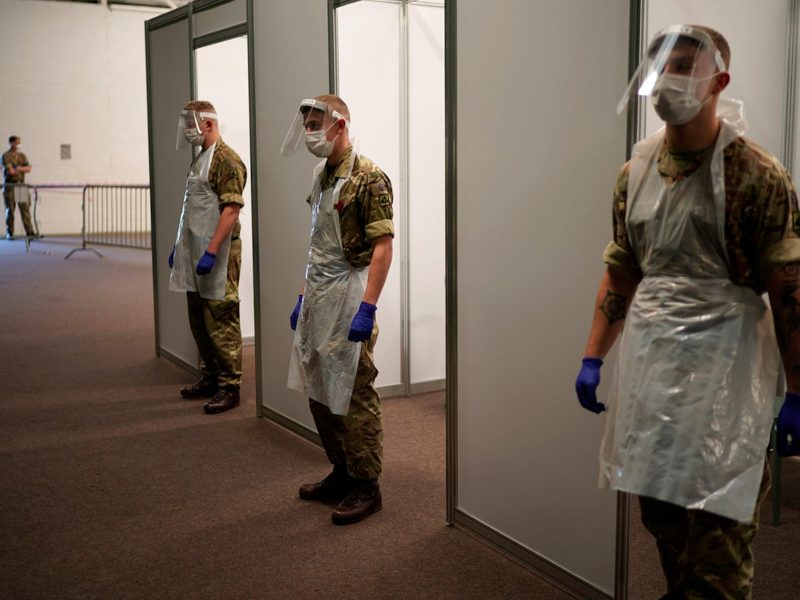
The British military are already busily setting up “mass vaccination centres”. So eventually, of course, almost everyone will be expected to get injected if they want to partake of society in any way at all. Which leads us onto question five…
5. Will it become mandatory?
The question of “mandatory vaccines” has been buzzing around since the earliest stages of the pandemic narrative. The final result will obviously vary country-to-country, but it’s certainly a possibility here in the UK.
A few months ago a group of scholars submitted written evidence to the UK Parliament that mandatory vaccinations would be defensible on a human rights basis, and that there was already legal precedent for this action in UK legislation (specifically, treating mental health patients who may be a danger to themselves).
In the end, and this is purely my speculation, I doubt the vaccine will ever be literally legally mandatory. Parliament will reject the “expert advice” suggesting Covid19 vaccines be forced on people.
This will accomplish two goals at once: a) It will give the government a veneer of “libertarianism”, a thin facade to cover it’s tyrannical nature. And b) It will allow a potential “third wave” of Covid19 to be blamed on “vaccine hesitancy”.
Though it will probably never be literally mandatory, they will certainly make it much easier to function should you get the vaccine.
There’s been much talk of “immunity passports”, meaning digital documents showing your vaccination status which make you exempt from lockdown and social distancing rules.
In the future it’s not hard to see these documents (either physical or digital) being vital to the ability work, socialise, travel, get loans, apply for state benefits or even receive medical treatment.
So, even if not forced to partake of the vaccine, you will likely be bribed, blackmailed or coerced into doing so eventually.
*
To sum up – we don’t know exactly what’s in the vaccine, it might not work, it may not be safe, and we’re probably all going to end up being forced to use it.
Merry Christmas everyone.
“And Why Stop There?”: CNN Analyst Calls For Sweeping Regulation of Free Speech On The Internet
By Jonathan Turley | November 30, 2020
We previously discussed the unrelenting drumbeat of censorship on the Internet from Democratic leaders, including President-elect Joe Biden. Those calls are growing as anti-free speech advocates see an opportunity in the Biden Administration to crackdown on opposing views. One vocal advocate of censorship and speech controls has been CNN media analyst Oliver Darcy who just ratcheted up his call for de-platforming opposing views. Like many anti-free speech advocates, Darcy simply labels those with opposing views as spreading “disinformation” and demands that they be labeled or barred from social media. In a recent newsletter, Darcy calls for every tweet by Trump to be labeled as disinformation while asking “and why stop there?” Precisely. Once you cross the Rubicon of speech regulation, there is little reason or inclination to stop. Just look at Europe.
Darcy wrote:
“Nearly every tweet from the president at this point is labeled for misinfo. Which had me thinking. Why doesn’t Twitter just take the step of labeling his entire account as a known source of election disinfo? And why stop there? Why not label accounts that repeatedly spread claims the platform has to fact-check?”
There was a time when the very touchstone of American journalism was the rejection of such calls for censorship, including at CNN.
What is chilling about Darcy’s writings is that they reflect the view of many now in Congress and in the Democratic Party. Indeed, they reflect many in the Biden campaign. Once a party that fought for free speech, it has become the party demanding Internet censorship and hate speech laws. President-Elect Joe Biden has called for speech controls and recently appointed a transition head for agency media issues that is one of the most pronounced anti-free speech figures in the United States. It is a trend that seems now to be finding support in the media, which celebrated the speech of French President Emmanuel Macron before Congress where he called on the United States to follow the model of Europe on hate speech.
Darcy is calling for a more active and extensive regulation of speech to protect users from thoughts or views that he considers false or dangerous: “Think of it as a version of NewsGuard for Twitter.”
“NewsGuard” has a lovely Orwellian sound to be added to other codes for censorship like Sen. Richard Blumenthal recently calling for “robust content modification” on the internet. Who can object to a NewsGuard, which Darcy describes like some beneficent St. Bernard watching over our news and social postings? Of course, what Darcy considers “disinformation” or what Blumenthal considers “robust content modification” is left dangerously undefined.
So put me down as preferring free speech without the helpful guards and content modification. Instead, I hold a novel idea that people can reach their own conclusions on such is disinformation just as Darcy does.
Warp Speed Ahead: COVID-19 Vaccines Pave the Way for a New Frontier in Surveillance
By John W. Whitehead | The Rutherford Institute | December 1, 2020
Like it or not, the COVID-19 pandemic with its veiled threat of forced vaccinations, contact tracing, and genetically encoded vaccines is propelling humanity at warp speed into a whole new frontier—a surveillance matrix—the likes of which we’ve only previously encountered in science fiction.
Those who eye these developments with lingering mistrust have good reason to be leery: the government has long had a tendency to unleash untold horrors upon the world in the name of global conquest, the acquisition of greater wealth, scientific experimentation, and technological advances, all packaged in the guise of the greater good.
Indeed, “we the people” have been treated like lab rats by government agencies for decades now: caged, branded, experimented upon without our knowledge or consent, and then conveniently discarded and left to suffer from the after-effects.
You don’t have to dig very deep or go very far back in the nation’s history to uncover numerous cases in which the government deliberately conducted secret experiments on an unsuspecting populace, making healthy people sick by spraying them with chemicals, injecting them with infectious diseases and exposing them to airborne toxins.
Now this same government—which has taken every bit of technology sold to us as being in our best interests (GPS devices, surveillance, nonlethal weapons, etc.) and used it against us, to track, control and trap us—wants us to fall in line as it prepares to roll out COVID-19 vaccines that owe a great debt to the Pentagon’s Defense Advanced Research Projects Agency for its past work on how to weaponize and defend against infectious diseases.
The Trump Administration by way of the National Institute of Health awarded $22.8 million to seven corporations to develop artificial intelligence (AI), machine learning, etc., with smart phone apps, wearable devices and software “that can identify and trace contacts of infected individuals, keep track of verified COVID-19 test results, and monitor the health status of infected and potentially infected individuals.”
This is all part of Operation Warp Speed, which President Trump has likened to the Manhattan Project, a covert government effort spearheaded by the military to engineer and build the world’s first atomic bomb.
There is every reason to tread cautiously.
There is a sinister world beyond that which we perceive, one in which power players jockey for control over the one commodity that is a necessary ingredient for total domination: you.
By you, I mean you the individual in all your singular humanness.
Remaining singularly human and retaining your individuality and dominion over yourself—mind, body and soul—in the face of corporate and government technologies that aim to invade, intrude, monitor, manipulate and control us may be one of the greatest challenges before us.
These COVID-19 vaccines, which rely on messenger RNA technology that influences everything from viruses to memory, are merely the tipping point.
The groundwork being laid with these vaccines is a prologue to what will become the police state’s conquest of a new, relatively uncharted, frontier: inner space, specifically, the inner workings (genetic, biological, biometric, mental, emotional) of the human race.
If you were unnerved by the rapid deterioration of privacy under the Surveillance State, prepare to be terrified by the surveillance matrix that will be ushered in on the heels of the government’s rollout of this COVID-19 vaccine.
Everything we do is increasingly dependent on and, ultimately, controlled by our internet-connected, electronic devices. For example, in 2007, there were an estimated 10 million sensor devices connecting human utilized electronic devices (cell phones, laptops, etc.) to the Internet. By 2013, it had increased to 3.5 billion. By 2030, it is estimated to reach 100 trillion.
Much, if not all, of our electronic devices will be connected to Google, a neural network that approximates a massive global brain.
The end goal? The creation of a new “human” species, so to speak, and the NSA, the Pentagon and the “Matrix” of surveillance agencies are part of the plan.
Neuralink, a brain-computer chip interface (BCI), paves the way for AI control of the human brain. “In the most severe scenario, hacking a Neuralink-like device could turn ‘hosts’ into programmable drone armies capable of doing anything their ‘master’ wanted,” writes Jason Lau for Forbes.
There’s no limit to what can be accomplished—for good or ill—using brain-computer interfaces.
Clearly, we are rapidly moving into the “posthuman era.”
Transhumanism—the fusing of machines and people—is here to stay and will continue to grow.
In fact, as science and technology continue to advance, the ability to control humans will only increase. In 2014, for example, it was revealed that scientists have discovered how to deactivate that part of our brains that controls whether we are conscious or not.
Add to this the fact that increasingly humans will be implanted with microchips for such benign purposes as tracking children or as medical devices to assist with our health. Such devices “point to an uber-surveillance society that is Big Brother on the inside looking out,” warns Dr. Katina Michael. “Governments or large corporations would have the ability to track people’s actions and movements, categorize them into different socio-economic, political, racial, or consumer groups and ultimately even control them.”
As I make clear in my book Battlefield America: The War on the American People, control is the issue.
All of this indicates a new path forward for large corporations and government entities that want to achieve absolute social control. Instead of relying solely on marauding SWAT teams and full-fledged surveillance apparatuses, they will work to manipulate our emotions to keep us in lock step with the American police state.
Now add this warp speed-deployed vaccine to that mix, with all of the associated unknown and fearsome possibilities for altering or controlling human epigenetics, and you start to see the perils inherent in blindly adopting emerging technologies without any restrictions in place to guard against technological tyranny and abuse.
It’s one thing for the starship Enterprise to boldly go where no man has gone before, but even Mr. Spock recognized the dangers of a world dominated by AI. “Computers make excellent and efficient servants,” he observed in “The Ultimate Computer” episode of Star Trek, “but I have no wish to serve under them.”
Constitutional attorney and author John W. Whitehead is founder and president of The Rutherford Institute. His new book Battlefield America: The War on the American People is available at www.amazon.com. Whitehead can be contacted at johnw@rutherford.org.
Brutal police beating of maskless French man hints at frightening future for locked-down Europe

By Damian Wilson | RT | November 27, 2020
A shocking video of French police beating up a man who wasn’t wearing a mask showed the authorities’ iron-fist approach to enforcing regulations and suppressing protests. Will this be the new norm when the pandemic has passed?
A British shopper recently spotted by police failing to wear a face mask decided to heap abuse on the hapless copper patiently explaining the rules to her before she simply flung her basket to the ground and strolled off without a care in the world. All very British, and no one was hurt – but it illustrated the frustration normal people are feeling over this never-ending pandemic.
Meanwhile, in Paris, a young, black music producer leaving his studio without wearing a face mask was spied by three policemen who set upon him and forced him back into his studio, where they kicked, punched and beat him with a truncheon for five minutes before he managed, with the help of friends, to bundle them out the door.
That didn’t deter the trio of plod as they tossed tear-gas grenades through the window to flush their prey from safety so he could be arrested.
The young chap, identified only as Michel, was later released without charge or having to pay the €135 fine for failing to comply with face-mask rules in Paris. The three policemen involved have been suspended from duty after it emerged that the entire incident was caught on a studio video camera.
And while it would be right to flag up clear concerns of racism surrounding this assault, looking at what prompted this inexplicable outburst of violence from law enforcement officers is even more disturbing.
It wasn’t police on the lookout for yet another terrorist, or a bank robber or wanted fugitive. It was all about not wearing a face mask. This is what we have come to.
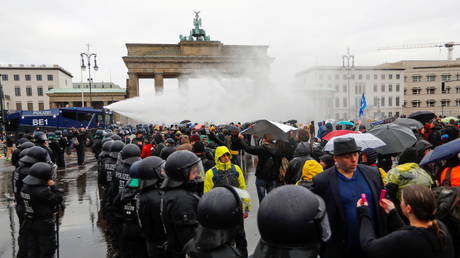 And it’s not just France. In Berlin last week, police fired water cannon and pepper spray at a crowd of people, including children, protesting against Germany’s coronavirus restrictions. In the aftermath, police justified the action saying people were refusing to wear face masks. So you blast them with water?
Spain, which suffered a particularly restrictive 100-day lockdown, has also seen trouble. On top of street protests by families missing their loved ones, there have been running battles with the police, barricades set on fire, and shops looted across the country.
Likewise in Italy, where even the Mafia is alleged to have joined in the looting and trashing of property, all in the guise of a coronavirus protest. Police there also used tear gas to disperse the crowds.
And it’s not just these nations. Protests in the UK have attracted thousands, the USA has seen violence flare at street marches, there have been rallies across the globe – Argentina, Brazil, Nigeria, Serbia, Russia, Australia, South Africa, Mexico. Even in countries most of us would struggle to find on a map, like Malawi.
Everywhere, the riot police have steamed in to break up crowds, leading to countless clashes and arrests creating even further upset. Is this where we are now? This is what this infernal Covid-19 virus has driven us to? Police in riot gear using batons, shields, water cannon and tear gas on their fellow citizens who are venting their anger, having become simply tired of being cooped up indoors?
Back in Paris, the young music producer who had been assaulted told journalists outside police headquarters that “people who should have been protecting me attacked me. I did nothing to deserve this.”
Anyone expecting some sort of climbdown from their government and public health officials has no doubt given up waiting by this point. Across the world, people are preparing for a crappy Christmas and grim warnings that breaching restrictions will mean a terrible price to be paid come the new year.
In France, the controversial new global security law has passed its first legislative stage, meaning anyone taking a photo or filming on-duty police that enables them to be identified faces a year in prison and a whopping €45,000 fine.
Prime Minister Jean Castex has suggested the government may backtrack on the controversial law but it’s naive to believe there’s any real honesty in that claim.
Meanwhile, French police will continue to pursue their thuggery, beating and teargassing innocent citizens, tipping people from their tents when clearing temporary camps of asylum seekers and trampling over protestors at will. Anyone caught filming them will simply be arrested and flung in jail.
No doubt this sort of behaviour will be repeated across the globe at organised protests against coronavirus restrictions wherever they may be. The lingering concern is that once this cursed pandemic passes, will things return to normal, where those we expect to protect us do just that?
Or has there been a subtle but sinister shift towards a more brutal state in many countries, where governments have been emboldened by newly tried and tested authoritarianism? Let’s see what answer to that 2021 brings.
Damian Wilson is a UK journalist, ex-Fleet Street editor, financial industry consultant and political communications special advisor in the UK and EU.
Guatemala on the brink of serious social crisis
By Lucas Leiroz | November 26, 2020
A major crisis is unfolding in Guatemala. Violent protests, vandalism and mutual accusations fill the scenario of great political, social, and institutional tensions that are forming in this Central American country. Last weekend, amid protests against the government in the center of Guatemala City, there was an attempt to set fire to the National Congress, which gained prominence in the news across Latin America. At first, the main suspicions pointed to criminal actions of violent protesters, but some investigations point to completely different possibilities.
Initially, investigators began to question the fact that the Parliament’s security team was very scarce at the time of the demonstrations – even though it was clear that on November 21 there would be protests in the vicinity, having previously been publicly announced. The Congressional protection scheme was limited to a few individuals scattered around the area, without any organized staff to prevent potential acts of vandalism. Still, according to reports, the Guatemalan National Civil Police simply did not try to prevent some of the acts of vandalism carried out during the protests, remaining inert while the crimes were being committed. Witnesses say the police watched passively as the protesters set fire to the Parliament without any reaction. Several photo and video records were posted on social networks around the world, proving police inertia in the face of vandalism, which caused indignation and suspicion.
It was then that the Guatemalan political opposition, led by the party “Unidad Nacional de la Esperanza” (UNE), began to claim that such acts were not committed by protesters, but by government infiltrators, protected by security forces, trying to boycott the legitimate civil acts. The government’s intention, according to the opposition’s allegations, would simply be to delegitimize popular demonstrations through propaganda about the acts of vandalism practiced by such infiltrators, which would make a perfect excuse for the government to take exceptional measures and act violently against the protesters.
To understand the Guatemalan crisis properly, we must analyze the country’s situation profoundly. The peak of popular dissatisfaction, which motivated the violent protests of November 21, was the approval by the parliamentarians of the Budget of the Republic for 2021. The project of State accounts significantly reduced health and education expenses, which generated legitimate popular indignation. Among the social programs that lost funding under the new budget are child nutrition projects, for example – even in a country where the poverty line reaches 50% of the total population. In the same vein, provisions for universities, maternity centers and medical clinics have declined substantially and are now in real risk. After the increase in violence in the protests, budget approval was temporarily suspended.
Despite this being the peak of the revolt, popular indignation began much earlier and encompasses several factors. Guatemala suffers from a serious case of structural corruption, as well as great incompetence to deal with the country’s main social problems. The country has not yet overcome the crisis generated by the new coronavirus pandemic and the two consecutive hurricanes that hit the region recently, leaving hundreds of dead people.
Popular indignation is not restricted to the acts of the Parliament. In the Executive Branch, the situation is similar. Alejandro Giammattei’s first year in office is being marked by criticism and scandals, in addition to a notable inability to overcome internal differences between members of his own team. For example, recently, Vice President Guillermo Castillo criticized Giammattei for invoking international legal documents to legitimize a severe response against acts of vandalism during the demonstrations. Castillo classified the attitude as exaggerated and said that the Guatemalan people do not practice such acts.
In addition, the vice president stated during an interview that he asked the president to resign from his office with the aim of alleviating social tensions in the country. Castillo openly defends the creation of a Guatemalan “commission of notables”, led by religious and popular institutions, which should give to the Congress a list with possible names to occupy the office of new president. This is sufficient to reveal the deep level of dissatisfaction, disunity, and lack of strategic planning within the Guatemalan government and parliament.
While the accusations continue on both sides and the Guatemalan state is fragmented into several political factions, the population suffers from the consequences of many incompetent policies. Now, with the arson attack against the Parliament, popular demonstrations are likely to be suppressed with extreme violence. Although Congress has suspended the approval of the new budget, there is no indication that such suspension will continue – it may be only a temporary measure while the demonstrations remain violent. It is likely that the government will tighten up its security policies and that the restriction on popular acts will grow to the point of preventing any legitimate demonstration against austerity measures. Given the recent history of the country and the entire Central American region, it is difficult to establish any positive scenario for the near future in Guatemala.
Lucas Leiroz is a research fellow in international law at the Federal University of Rio de Janeiro.
The Thanksgiving Rebellion of 2020
By Jeffrey A. Tucker | American Institute for Economic Research | November 25, 2020
The Centers for Disease Control warned us not to travel or meet in multigenerational gatherings during Thanksgiving. Which is to say: government tried to make Thanksgiving, probably the most iconic of all American holidays, practically disappear from the calendar this year.
They didn’t put it that way exactly. Thanksgiving is not canceled but merely “postponed” — a strange thing to say about a holiday that has a fixed day of the year and surely the one that most means “family” to people.
What they said was you need to go through a 7-point checklist that most everyone would fail. You have to check local cases (never mind that cases aren’t deaths and cases might not even be cases), check hospital capacity as if you will be stricken down like in the movie Contagion and thereby be turned away at the door, observe local quarantine rules that bespot the whole country, do not travel with someone not in your household, make sure no old people will be at the gathering, make sure never to get closer than 6 feet to another human being, and…OK this is all ridiculous. It’s fear porn, distributed by “science.”
And it’s true that our airports are getting scarier by the day with all the convoluted quarantine rules. Imagine showing up back home and knowing that you are barred from even so much as visiting a convenience store. Plus people really do not know the rules because they change by the day and hour.
The governor of Washington State proclaimed that “Gatherings have grave consequences right now.” (He was obsequious and deferential toward mass protests in June: BLM = good; Thanksgiving = bad.)
The governor of Vermont has pledged to interview any student coming back to school about whether they had gatherings outside their home. If so, they get thrown out for two weeks. Probably the track-and-trace machinery will go into place.
In Texas, the health department ran ads all over radio claiming that something as innocent as a small birthday party will spread the coronavirus, based on a now-famous case in which no one was either hospitalized or died but all got immunities.
The ads even deployed the voices of young children (“we feel guilty for gathering”) bemoaning that they got the dreaded disease which in fact has an infinitesimally small to nonexistent risk to children.
And so on it goes, the entire country pounded with anti-Thanksgiving propaganda via every public messaging source. On an 80s-style radio station in Texas, one I heard while driving, the music all proclaimed the glories of parties, dancing, defying authority, standing up against evil, taking big risks, and living large. But the ad breaks hectored people to stay home and stay safe and not have any fun. The contrast was striking, to say the least.
This bureaucratic hydra of federal, state, and local governments tried to delete Thanksgiving. And this is at a time of unprecedented sadness and depression when people are most in need of family and companionship. This is absolutely cruel.
What the heck has become of us? Well, Americans being Americans, they rebelled.
“According to the American Automobile Association,” writes Jason Riley, “there could be as many as 50 million Thanksgiving travelers this year, only 10% less than in 2019.” I saw the same at the two airports I visited. They were about 75% as busy as the old days but still bustling. Rental cars were in high demand. Americans will not be locked down on Thanksgiving.
Riley further writes:
This is a form of mass civil disobedience like nothing the country has seen since the 1960s. Some of it is born of Covid fatigue, to be sure. But the endless parade of politicians flouting their own rules surely has also played a role. It began shortly after the spring lockdowns and if anything has become more commonplace, even farcical.
Riley points out that the politicians themselves do not follow their own ridiculous rules. Like the Soviet apparatchiks of old, they believe that the theater of dictatorial compliance is for the worker and peasants but not for themselves. The “vanguard of the proletariat” has a special exemption from the rules they make for others.
They live well. Everyone else: line up at the food bank.
There is a reason why so many Americans are not buying it anymore. It’s become rather obvious that this is less about health and science than it is about social/economic/political control, regardless of the costs.
This becomes obvious once you see through the incredibly foggy blizzard of data, studies, official pronouncements, and furrowed-browed scientists Skyping into network news shows. The real underlying story here is that lots of people in powerful positions believe that they should be in charge of your life and know better how to make choices over health and safety than you do.
Once you see it this way, you stop being intimidated by their alleged authority and experience and start living your life again. After all, it is not the case that the governments have special access to health wisdom that is denied to you and yours. By now, you have read the risks, seen the problems with the posture of certainty of the supposed experts, and observed the way they utterly fail to consider the downsides of shutting businesses, schools, sports, and the arts.
Consider the following editorial in one of three of the world’s most prestigious medical journals, the Lancet in the UK. The article pits Martin Kulldorff of the Great Barrington Declaration against Massachusetts General Hospital’s Rochelle Walensky. Martin points to the carnage of lockdowns and a more humane solution to the presence of disease. Walensky’s entire argument against basic exercise of public health of the past is as follows:
“The Great Barrington Declaration is predicated on the idea that you know who is going to get sick and you can somehow isolate and protect them, but there is absolutely no evidence that we can do this”, she said. She pointed out that the US Centers for Disease Control and Prevention estimates that up to 40% of Americans have some kind of co-morbidity that makes them vulnerable to the ravages of COVID-19. Identifying all these people is not straightforward. “No-one is suggesting that lockdowns should be the default position. They are a last resort. But if we just let the virus run free without mitigation strategies, such as masking, our hospitals will overflow and that would mean we would no longer be able to take care of the population’s health across the board.”
Notice her insistence that “we” cannot achieve intelligent risk assessment of the population. By we, she means experts such as herself. And she is right! They cannot. And that’s the whole point. That needs to be left to individuals. Central planning does not work for all the reasons that F.A. Hayek explained: the necessary knowledge to make intelligent decisions is decentralized and not available in useful forms for elite overseers or anyone else.
As for lockdowns as a last resort, please: they were used as a first resort in the presence of a virus that turned out to be far less severe than the models predicted. It is barely a disease at all for large swaths of the population. The fatality demographics are overwhelmingly concentrated on a low-life-expectancy population in a world where people are living longer than ever. The average age of death from Covid exceeds average life spans.
Then finally we get the invocation of the overflow problem. Hospitals cannot scale, she alleges. Why? Restaurants, bars, stores, office buildings, and supply and demand for a billion other things scales just fine. It’s a matter of increasing supply to match increased demand – a core economic problem and answer. Why does this not apply to medical services too?
Do you see what is going on here? We have a medical doctor who is pronouncing on economics and she doesn’t even know it. She sums up the problem we have had this entire year. Many health officials have stepped outside their role to become central planners of the entire society and economy. They never explained why people should grant them this power. They just took it for themselves by intimidating fearful and ignorant politicians to do their bidding.
With all due respect to the good doctor, I would translate her statement to the Lancet as follows: “You people out there are too stupid, fat, and unhealthy to be in charge of your lives; that’s where I come in!”
And the carnage is everywhere. I had hoped when I came to Texas to find a society that had long ago gone back to normal. What I find instead is heartbreaking. In this town, half the local businesses seem to be boarded up. The one movie theater for the whole county is bankrupt and closed. Most of the independently owned shops are dead. The shopping mall is barely surviving, and the masked employees are demoralized and seeing their doom.
Who survives? The big-box chain stores in town. Wal-Mart seems fine and so does Home Depot. These companies are well-capitalized enough to survive. I’m glad for them but there is something unjust about all of this. The lockdowns benefited elites at the expense of everyone else.
This small and wonderful town is now sad and broken – thanks to people like Dr. Walensky who undoubtedly had the best of intentions. She lives in Boston. I’m right now in rural Texas. The people who surround me have had their lives shattered by her and her fellow intellectuals who bear no real consequence for being wrong.
So, yes, she is correct that she does not have the capacity to know who is vulnerable and who is not. No one knows that with certainty. The solution is not to lock the whole of society down until the virus magically goes away. That is not public health. That is an unprecedented imposition of top-down brutalism.
The battle over lockdowns and public health is the struggle of our lives, the greatest crisis in generations. But the problems and solutions are not different from the ones that have consumed intellectuals for centuries. What institutions better manage society in good times and in bad: governments (run by experts, with power and resources) or free people acting with intelligence and creativity as best they can? One might have supposed we had the answer to this question already. But human beings forget. Then the tragic lessons have to be learned all over again.
Calling on International Civil Society to Join Them: Palestinians, Israelis Call for a Single Democratic State

One Democratic State Campaign
The following statement was issued by the One Democratic State Campaign (ODSC) on November 15, 2020. The ODSC is one the largest initiatives of Palestinians and Israelis championing a one-state solution as an alternative to the Israeli military occupation and apartheid in Palestine.
(November 15, 2020) The Palestinian-led One Democratic State Campaign (ODSC), comprised of Palestinians from every major community (’48, the West Bank and Gaza Strip, the refugee camps and the Diaspora/Exile), together with their critical Israeli Jewish partners, has issued a call for the establishment of a single democratic state including everyone living between the River and the Sea, including Palestinian refugees who choose to return to their homeland.
Over the past three years, the ODSC, founded in Haifa but with working relations throughout the worldwide Palestinian community, has formulated a 10-point political program setting out the vision and framework of a shared democracy in which all the inhabitants of historic Palestine would enjoy common citizenship and equality under the law in a new and pluralistic political community. After decades in which the justice of the Palestinian struggle against Zionist colonization has been recognized by the international community, after decades of chasing after the chimera of a “two-state solution,” and after decades of asserting Palestinian rights with no viable political expression, the time for an effective campaign of decolonization and liberation is now, and it is urgent. Every day the Israeli government, aided by the international community, imposes draconian and irreversible “facts on the ground,” locking the country’s majority population, the Palestinians, into tiny, impoverished enclaves, perpetuating as well the exile of half the Palestinian population. A democratic state in historic Palestine is no utopia if we organize around a just political program, organize, strategize and effectively mobilize our forces, the global grassroots, the international civil society — you. We call on you to join our One Democratic State Campaign and help us build it into an effective anti-colonial, liberation movement.
For further information, contact us at contact@onestatecampaign.org. Much work still needs to be done to flesh out our program. We understand that we all will not agree on every issue, but our task in this historic moment is clear: armed with a clear and compelling political program, we need to fully enter the political arena. We call on the entire international community, and especially civil society, to support our Call for a democratic state in historic Palestine. The time has come.
It is in this spirit of solidarity, as part of a process of liberation, that we are reaching out to you to join us, beginning by endorsing our program. The struggle goes on.
In solidarity,
Awad Abdel Fattah, Galilee
Nadia Naser Najab, Ramallah, UK
Livnat Konopni, Tel Aviv
Haidar Eid, Gaza
Jeff Halper, Jerusalem
Leila Farsakh, USA
Diana Buttu, Haifa, Canada
Samah Sabawi, Australia
Mohamed Kabha, Galilee
Mohammad Al Helu, Ramallah
Rula Hurdal, Galilee
Jonathan Cook, Nazareth
Ilan Pappe, Haifa
Sami Miaari, Sakhnin
Saleh Hijazi, Ramallah
Nur Masalha, UK
Ramzy Baroud, USA
Jowan Safadi, Haifa
Rafah Anabtawi, Shefa-ʻAmr
Hamada Jaber, Ramallah
Naji al-Khatib, France
Sari Bashi, Ramallah
Bassem Tamimi, Nabi Salah
Johnny Mansour, Haifa
Jamil Hilal, Ramallah
Susan Abulhawa, USA
Haim Bresheeth, UK
Areen Hawari, Nazareth
Abdallah Grifat, Galilee, South Africa
Amir Kaadan, Galilee
Munir Nuseibah, Jerusalem
Ronnen Ben-Arie, Haifa
Eitan Bronstein, Brussels
Umar al-Ghubari, Triangle
Raja Deeb, Yarmouk Camp, Netherlands
Bilal Yousef, Galilee
Areej Sabbagh, Nazareth
Yoav Haifawi, Haifa
Mohamed Noman, Jordan
Mazin Qumsiyeh, Bethlehem
Majd Nasrallah, Triangle
Wehbi Badarni, Nazareth
Ghada Karmi, UK
Bana Shaghri, Kufr Yaseef
Miko Peled, USA
George Bisharat, USA
Issa Debi, Haifa, Switzerland
Ramez Eid, Eilabun
Radi Jarai, Ramallah
Hatem Kanaaneh, ‘Arrabat al-Battuf
Nidal Rafa, Haifa
Issam Odwan, Gaza
Asaad Abu Sharkh, Gaza, Ireland
Shir Hever, Germany
Featured Video
Houthis Don’t Have to Conquer Saudi Arabia to Make It Pay
or go to
Aletho News Archives – Video-Images
From the Archives
A Lesser “Grade” of Human
By Michael Hoffman | Revelation of the Method | January 3, 2024
Will the more than 100 Iranians killed by terrorist bombs today be mourned in the West as victims of terrorism? Certainly not. Allied doctrine has it that the killing of Israeli or American civilians is a crime of cosmic proportions, while shedding the blood of “enemy” women and children is perfectly acceptable; indeed commendable.
The West does not memorialize the hundreds of thousands of civilians bombed by the U.S. in Serbia, Iraq, Afghanistan and every major German city 1943-1945. America’s fire-bombing of the city of Tokyo by General Curtis LeMay in March 1945 was followed by Harry Truman’s atomic incineration of Hiroshima and Nagasaki in August of that year. Truman never had a moment of doubt or regret over the murder of more than a 100,000 Asian children, mothers and non-combatant boys and men. It was business as usual for the “noble” Allies during the “Good War.”
In the West human rights signifies passionate concern only for civilians designated as truly human: Israelis first, then Americans and British, followed by their satraps.
This inhumanity is the legacy of Talmudic ideology, beginning with tractate Sanhedrin 57a from 400 A.D., concerning liability for capital punishment: “If a Jew murders a gentile, he is exempt.”
This teaching of contempt was reiterated in the dogma of Chabad Lubavitch founder Rabbi Shneur Zalman in the 18th century. … continue
Blog Roll
 Aletho News
- Houthis Don’t Have to Conquer Saudi Arabia to Make It Pay
- MOE: Nearly 22,000 Students and Education Workers Killed
- Guterres in Islamabad: Genocide, cowardice, and the cage of Imran Khan
- Johnson, Marandi say Yemen holds upper hand over Saudi Arabia
- False flags won’t save aggressors, Iran FM spokesman says
- The Makkah Pact Enters Into Force: The End of American Dominance or Its New Form?
- NATO’s top generals gather in Kiev
- EU’s continuing expansion – greater threat to Russia
- US Senator Murphy says Pentagon denied him entry to US base in Qatar
- Israel expands “incitement” charge to target Palestinian education and memory
- If Americans Knew
- Three Years of Genocide: How America’s Israel-First Media Filtered Out the Truth
- Israeli war chief briefs ministers on potential war against Palestinian Authority
- New Report: Israel Killed nearly 21,000 Palestinian Students and Education Workers in Past Three Years
- Israel’s flailing chatbot army
- Five Palestinians Killed, Others Injured by Israeli Fire in Gaza
- Israel is rewriting the Palestinian curriculum in East Jerusalem to erase Palestinian identity
- Three years of genocide: Israel turned prisons into killing grounds and torture sites
- Three years of genocide. Words fail. Daily Update
- ‘I’d rather die than go back’: A Palestinian teen’s 10-month nightmare in Israeli jail
- How Jared Kushner’s firm’s investment in an Israeli company could be a major conflict of interest
- No Tricks Zone
- US September “Heat” Was No Record…Many Records Set Decades Ago
- Latest European Green Energy Debacle; Portugal’s Largest Flagship Solar Park Insolvent!
- Green Energy Debacle: German Expert Professor Fritz Vahrenholt Warns Of Severe Economic And Social Consequences
- Two More Paleo Reconstructions Affirm Meters-Higher Sea Levels Across Ireland, Brazil 7000-6000 Years Ago
- New Study: Earth And Venus Surface Warmth Largely Explained By Convection And Lapse Rate, Not CO2 Or Radiation
- 2025 Nature Paper Claiming Worsening Global Drought Gets RETRACTED …Heavily Flawed
- New Study: ‘Global Drought Shows No Detectable Recent Acceleration Under Climate Warming’
- Economic Masterminds: German Socialists Suggest Taxing Productivity Gains Stemming From Using AI
- The South China Sea Has Not Been Cooperating With The Climate Change Narrative
- Energy Crisis: Germany Enters Heating Season With Historically Low Gas Reserve Fill Levels

