Canada’s Privacy Watchdog Not Consulted on Bill C-8, Enabling Secret Internet & Phone Shutdowns
By Dan Frieth | Reclaim The Net | October 13, 2025
Legislation that would allow federal ministers to secretly order telecom providers to cut off a Canadian’s phone or internet access is advancing without any input from the country’s top privacy authority.
Privacy Commissioner Philippe Dufresne told a Commons committee that his office was never asked to review Bill C-8 before it was introduced.
The bill would authorize the cabinet to compel telecom companies to block services to individuals considered a security threat, without needing a judge’s approval or any public disclosure.
“The issue never came up,” Dufresne said during testimony before the House of Commons ethics committee. He confirmed, “We are not consulted on specific pieces of legislation before they are tabled.”
Bill C-8 would allow the federal cabinet to direct a telecom provider to deny all services to a specific person, based solely on the government’s assessment of a threat. No warrant would be required. No independent body would be tasked with reviewing the decision.
Conservative MP Michael Barrett raised an alarm over what he described as a dangerous overreach. He said the bill would allow the government to quietly seize control of individuals’ communications, with no transparency and no legal checks.
“Without meaningful limits, bills like C-8 can hand the government secret powers over Canadians’ communications,” said Barrett. “It’s a serious setback for privacy and for democracy.”
He pressed Dufresne on whether Parliament should be required to conduct privacy assessments before passing legislation with such broad surveillance potential.
“Isn’t Parliament simply being asked to grant sweeping powers of surveillance to the government without a formal review?” Barrett asked.
Dufresne responded, “It’s not a legal obligation under the Privacy Act.”
While acknowledging the importance of national security, Dufresne warned that such measures must not override core privacy protections. “We need to make sure that by protecting national security, we are not doing so at the expense of privacy,” he said.
A previous version of the idea, Bill C-26, failed in an earlier Parliament after concerns over its civil liberties implications.
Spain’s COVID restrictions declared unconstitutional, over 90k fines struck down
By Andreas Wailzer | LifeSiteNews | October 10, 2025
More than 90,000 COVID fines have been overturned so far after the Spanish constitutional court declared the draconian 2020 COVID measures unconstitutional.
As Spanish news outlet The Objective reported, 92,278 fines have been annulled as of September 3, 2025, following the declaration of certain provisions of the 2020 state of emergency decree, which was in effect during the first COVID-19 lockdown, as unconstitutional.
However, these penalties only represent the first wave of fines set to be annulled, with many more expected to follow. During the strict lockdown under the state of alarm in 2020, more than 1 million penalties were imposed nationwide, and an estimated 1.3 million people were fined for violating the prohibitive restrictions.
In its ruling, the Constitutional Court determined that certain sections of Article 7 of Royal Decree 463/2020, which pertains to the general prohibition on movement, implied an unjustified suspension of the fundamental right to freedom of movement, rather than merely a limitation. This suspension exceeded the power of the declared state of alarm, the court found. The court determined that such a severe restriction could only have been implemented under a stricter state of emergency, which requires more rigorous parliamentary proceedings.
This ruling now retroactively applies to all penalties issued during the 2020 lockdown, putting a significant burden on the administrative state. The Objective reports that “enforcement has been slow and uneven depending on each territory,” showing that the refunds could take months or years.
The Objective reiterates that the 92,278 cases revoked to date “are just the tip of the iceberg of a regulatory crisis” stemming from the draconian lockdown policies imposed by the Spanish government in 2020.
World cities rise in solidarity with Gaza: Marches and calls to hold Israel accountable
Palestinian Information Center – October 12, 2025
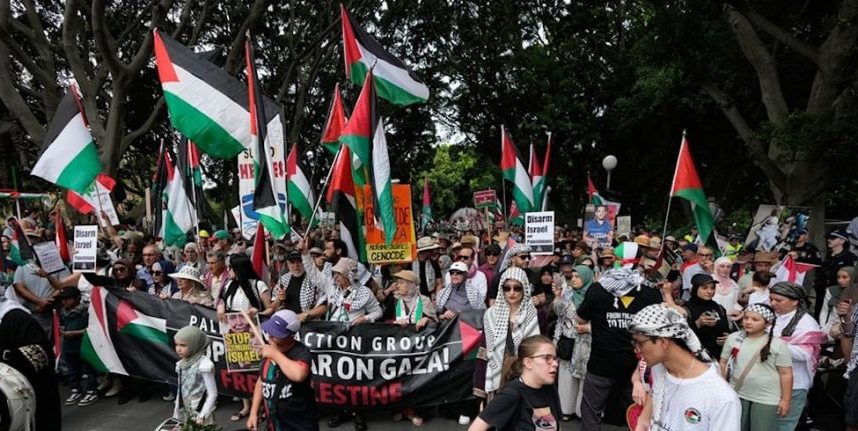
Demonstrations and solidarity rallies with the Palestinian people continued across various capitals and cities around the world, in a scene that reflects the growing global awareness of the scale of the humanitarian catastrophe caused by the Israeli aggression on the Gaza Strip, along with mounting calls to hold Israel accountable and end the ongoing genocide that has lasted for two years.
In Australia, the group Palestine Action said that demonstrations took place on Sunday in 27 cities and towns in support of the Palestinians, most notably in Sydney, Melbourne, and Brisbane. Protesters demanded that the government impose sanctions on Israel and halt all arms exports to it, stressing that continued cooperation with a state committing war crimes constitutes political and moral complicity.
In Indonesia, thousands gathered at Independence Square in central Jakarta to celebrate the ceasefire in Gaza, chanting slogans rejecting all forms of normalization with Israel, political, commercial, and sporting alike. They also expressed solidarity with Palestinians in the West Bank, who continue to face escalating assaults and raids by Israeli forces.
In Seoul, the South Korean capital, a solidarity protest was held calling for the rapid entry of humanitarian aid into Gaza and the lifting of the siege imposed for more than two years. Participants raised Palestinian flags and chanted for an end to the suffering of civilians.
Massive marches were held in London, where organizers said around half a million people took part in a demonstration that filled the streets of the British capital and headed toward the government headquarters on Downing Street. Protesters demanded an end to arms sales to Israel and accountability for those responsible for war crimes.
Participants stressed the need to achieve justice based on international law and to end occupation and apartheid.
In Berlin, thousands of demonstrators marched from the Brandenburg Gate to the city center, calling for a halt to Israeli arms shipments and an end to official support for the war on Gaza. Protesters denounced restrictions on pro-Palestine activism in Germany and chanted slogans such as “Freedom for Palestine” and “No peace on stolen land.” Limited clashes later broke out with police, who used force and arrested several demonstrators.
In Paris, a large protest took place that included activists and healthcare workers, some of whom had served in Gaza’s hospitals during the war. They called for the release of imprisoned doctors, foremost among them Dr. Hossam Abu Safiya, and for guarantees to uphold the ceasefire and deliver urgent medical aid.
In Milan, hundreds of Italians joined a solidarity march where demonstrators demanded the reconstruction of Gaza and an end to the blockade imposed on it.
In Oslo, protests were held outside the parliament building, where participants called for the closure of the Israeli embassy and the severing of diplomatic ties with Tel Aviv.
In the Netherlands, the Plant an Olive Tree foundation organized a memorial event in Maastricht to honor the victims of the aggression, dedicated especially to Palestinian children and journalists killed in Israeli bombardments. Participants lined up in front of the historic St. Servatius Church, where photos and names of the martyrs were displayed, and thousands of children’s shoes were placed in the square in tribute to the young victims.
In Stockholm, hundreds joined a demonstration condemning the Israeli army’s attack on the Global Solidarity Flotilla, calling for a comprehensive embargo on Israel due to its repeated crimes against civilians. Protesters carried banners reading “Total blockade on Israel for a free Palestine,” before marching toward the Swedish parliament.
This global wave of protests, spanning more than thirty cities in just two days, reaffirmed that the Palestinian cause is no longer a local or regional issue, but rather a matter of global conscience calling for justice and an end to decades of occupation and collective punishment against civilians in Gaza and the West Bank.
Soldiers, Settlers Injure 20 Palestinians in Beita
International Solidarity Movement | October 11, 2025
October 10 was the opening of the Zaytoun2025 olive harvest campaign. Here’s a wrap-up of the events:
Beita, South Nablus
About one hundred farmers joined by some 60 Palestinian and solidarity activists, were attacked by armed Israeli citizens and soldiers, near a recently established Israeli settlement in the Jabal Qamas area. The soldiers both ignored the attacks on the farmers and used violence themselves to try and repel the harvesters from their lands, and ignored the assault of Palestinians by the Israeli civilians, and therefore enabling them. The soldiers used tear-gas concussion grenades and physical violence, while the Israeli civilians attacked harvesters with baton blows, stone throwing and by shooting live ammunition.
- 20 injuries were recorded. 11 of the injured Palestinians were evacuated to the Rafidia hospital in Nablus. In addition, one solidarity activist was evacuated to the Belinson hospital after Israeli civilians assaulted her with batons and broke her arm.
- One of the Palestinians suffered a gunshot wound after being shot by an Israeli civilian.
- Three of those injured are journalists: Wahaj Bani Mufleh, Saja al-Alami and Jaafar Astaya, whose car is one of those torched.
- Eight cars were torched by the Israeli civilians.
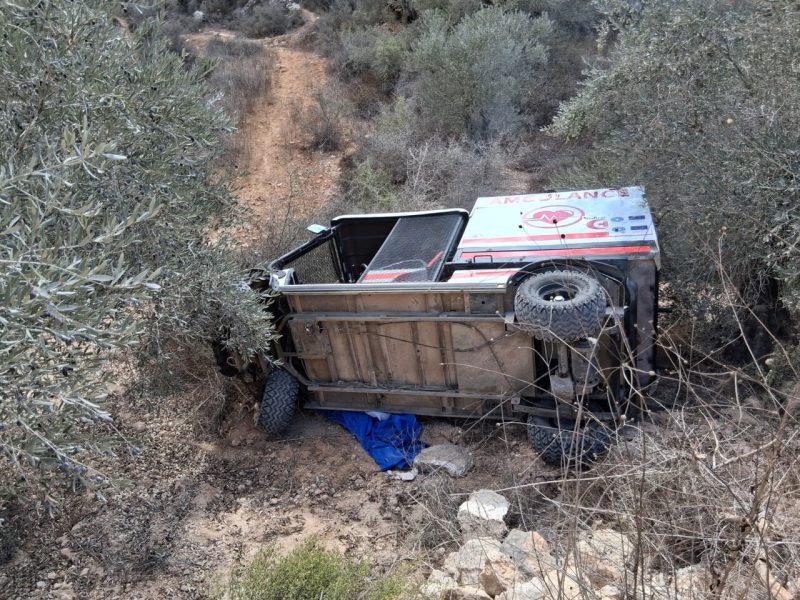
- An ambulance was attacked and flipped over. An attempt to torch it as well was foiled by Palestinians who came to the crew’s rescue.
Jorish and Aqraba, South-East Nablus
Israeli civilians armed with batons prevented farmers from the two villages accompanied by solidarity activists from accessing their lands in the Wad Issa agricultural area.
Duma, Sout-East Nablus
Israeli soldiers prevented farmers from harvesting their olives in the Houma and Khallet al-Hassad areas, asserting access to these lands requires security coordination with Israeli authorities. The Houma area is in Area B.
Yanoun, East Nablus
Israeli civilians expelled farmers and stole their harvested olives.
Deir Istia, North Salfeet
Israeli civilians harassed harvesters in an attempt to prevent them from accessing their lands near the Yaqir settlement.
Kufer Thulth, East Qalqilya
Settlers attacked harvesters and shepherds, killing several goats.
Farata, East Qalqilya
Israeli civilians shot at farmers harvesting olive with live fire in the presence of Israeli soldiers, who did not intervene. Both the soldiers and Israeli civilians then continued to raid the village, stop residents in the street and question them.
Kobar, North Ramallah
Israeli forces arrested harvesters in their lands near the village.
‘Persecute’ Russian speakers – ex-Ukrainian deputy speaker
RT | October 11, 2025
Kiev should launch a full-blown crackdown on Russian speakers, threatening them with financial and criminal penalties if they are reluctant to use Ukrainian, a former deputy parliamentary speaker said on Friday.
Koshulinsky, who held his post from 2012 to 2014 and remains a senior figure in the far-right Svoboda party, told local media that “discomfort for people who use the language of the occupiers” must be imposed.
”Deny education, deny work, punish with money, remove from positions … Only in this way will we oblige those people who do not honor or respect Ukrainians… These people do not understand other measures besides discomfort and financial or criminal persecution,” Koshulinsky said. He added that what he calls “the Moscow language” helps Russia “spread its narratives” among Ukrainians.
Last month, language ombudsman Elena Ivanovskaya warned that harsh or coercive methods to impose Ukrainian on the country’s large Russian-speaking community could backfire on the government. She said proposals for “language patrols” are both unrealistic and potentially destabilizing, calling instead for slower but steadier measures to promote Ukrainian among children.
Ivanovskaya also sounded the alarm over the fact that the use of Russian is on the rise in daily life, particularly among younger Ukrainians, adding that it was caused by the population growing accustomed to the conflict with Russia.
Following the Western-backed coup in 2014, Kiev has adopted a series of policies aimed at curbing the use of Russian in public life – making Ukrainian mandatory in schools and state institutions, significantly tightening quotas on Russian-language media and cultural products, and restricting Russian books and music.
Russia has condemned Ukraine’s language policies, accusing it of pursuing “a violent change of the linguistic identity” of its population.
West turning internet into ‘tool of control’ – Telegram founder
RT | October 10, 2025
Western surveillance and censorship is eroding digital freedom and is turning the internet into a “tool of control,” Telegram founder Pavel Durov has warned.
The Russian-born billionaire has long portrayed Telegram as an outpost for free speech and privacy, contrasting it with what he describes as authoritarian censorship efforts by Western governments.
“Our generation is running out of time to save the free Internet built for us by our fathers,” Durov said in a statement on Telegram on Friday, marking his 41st birthday.
“What was once the promise of the free exchange of information is being turned into the ultimate tool of control,” he added, noting that nations once considered free are adopting authoritarian digital practices. He cited measures such as digital IDs in the UK, compulsory online age verification in Australia, and the mass scanning of private messages in the EU.
Durov said people have been misled by the West into believing that their mission is to dismantle traditional values – privacy, sovereignty, free markets, and free speech – and by doing so, society has embarked on a path of “self-destruction.”
“A dark, dystopian world is approaching fast – while we’re asleep. Our generation risks going down in history as the last one that had freedoms – and allowed them to be taken away… We are running out of time,” he said.
Durov has long clashed with Western governments over Telegram’s policies, facing fines in Germany for not removing ‘illegal’ content and criticism in the US for allegedly enabling extremist groups.
Last year, he was arrested in Paris and charged with complicity in crimes linked to Telegram users, but was released on bail. He called the case politically motivated. He later accused French intelligence of pressuring him to censor conservative content during elections in Romania and Moldova, and condemned France for waging “a crusade” against free speech.
Durov has also warned that EU laws such as the Digital Services Act and the AI Act are paving the way for the centralized control of information.
When Presidents Kill
By Andrew P. Napolitano | Ron Paul Institute | October 9, 2025
During the past six weeks, President Donald Trump has ordered US troops to attack and destroy four speed boats in the Caribbean Sea, 1,500 miles from the United States. The president revealed that the attacks were conducted without warning, were intended not to stop but to kill all persons on the boats, and succeeded in their missions.
Trump has claimed that his victims are “narco-terrorists” who were planning to deliver illegal drugs to willing American buyers. He apparently believes that because these folks are presumably foreigners, they have no rights that he must honor and he may freely kill them. As far as we know, none of these nameless faceless persons was charged or convicted of any federal crime. We don’t know if any were Americans. But we do know that all were just extrajudicially executed.
Can the president legally do this? In a word: NO. Here is the backstory.
The Constitution was ratified to establish federal powers and to limit them. Congress is established to write the laws and to declare war. The president is established to enforce the laws that Congress has written and to be commander-in-chief of the armed forces. Restraints are imposed on both. Congress may only enact legislation in the 16 discrete areas of governance articulated in the Constitution — and it may only legislate subject to all persons’ natural rights identified and articulated in the Bill of Rights.
The president may only enforce the laws that Congress has written — he cannot craft his own. And he may employ the military only in defense of a real imminent military-style attack or to fight wars that Congress has declared. The Constitution prohibits the president from fighting undeclared wars, and federal law prohibits him from employing the military for law enforcement purposes.
The Fifth Amendment — in tandem with the 14th, which restrains the states — assures that no person’s life, liberty or property may be taken without due process of law. Because the drafters of the amendment used the word “person” instead of “citizen,” the courts have ruled consistently that this due process requirement is applicable to all human beings. Basically, wherever the government goes, it is subject to constitutional restraints.
Traditionally, due process means a trial. In the case of a civilian, it means a jury trial, with the full panoply of attendant protections required by the Constitution. In the case of enemy combatants, it means a fair neutral tribunal.
The tribunal requirement came about in an odd and terrifying way. In 1942, four Nazi troops arrived via submarine at Amagansett Beach, New York, and exchanged their uniforms for civilian garb. At nearly the same time, four other Nazi troops arrived via submarine at Ponte Vedra Beach, Florida, and also donned civilian clothing. All eight set about their assigned task of destroying American munitions factories. After one of them went to the FBI, all eight were arrested.
President Franklin Roosevelt panicked and ordered all eight summarily executed. When two of the eight protested in perfect English that they were born in the US, and their protests proved accurate, FDR decided to appoint counsel for all of them and to hold a trial.
At trial, all eight were convicted of attempted sabotage behind enemy lines — a war crime. The Supreme Court quickly returned to Washington from its summer vacation and unanimously upheld the convictions. By the time the court issued its formal opinion, six of the eight had been executed. The two Americans were sentenced to life in prison. Their sentences were commuted five years later by President Harry Truman.
The linchpin to all this was FDR’s decision to appoint counsel and have a trial. The Supreme Court made it clear that even unlawful enemy combatants — those out of uniform and not on a recognized battlefield — are entitled to due process; and, but for the trial afforded to the Nazi saboteurs, it would not have permitted their executions.
This jurisprudence was essentially followed in three Supreme Court cases involving foreign persons whom the George W. Bush administration had arrested and characterized as enemy combatants detained at the US Naval Base in Guantanamo Bay, Cuba.
In wartime, US troops can lawfully kill enemy troops that are engaged in violence against them. But, pursuant to these Supreme Court cases, the United Nations Charter — a treaty that the US wrote — as well the International Covenant on Civil and Political Rights — another treaty that the US wrote — if combatants are not engaged in violence, they may not be harmed, but only arrested. All this presumes that Congress has in fact declared war on the country or group from which the combatants come. That hasn’t happened since Dec. 8, 1941.
Now, back to Trump ordering the military to kill foreigners in the Caribbean. International law provides for stopping ships engaged in violence in international waters. It also provides for stopping and searching ships — with probable cause for the search — in US territorial waters. But no law permits, and the prevailing judicial jurisprudence deriving from the Constitution and federal statutes absolutely prohibits, the summary murders of folks not engaged in violence — on the high seas or anywhere else.
The Attorney General has reluctantly revealed the existence of a legal memorandum purporting to justify Trump’s orders and the military’s killings — but she insisted the memorandum is classified. That is a non sequitur. A legal memorandum can only be based on public laws enacted by Congress and interpreted by the courts. There are no secret laws, and there can be no classified rationale for killing the legally innocent.
If the memorandum purports to permit the president to declare non-violent enemy combatants on a whim and kill them, it is in defiance of 80 years of consistent jurisprudence, and its drafters and executors have engaged in serious criminality. Where will these extrajudicial killings go next — to Chicago?
To learn more about Judge Andrew Napolitano, visit https://JudgeNap.com.
COPYRIGHT 2025 ANDREW P. NAPOLITANO
DISTRIBUTED BY CREATORS.COM
Italian PM Meloni Embroiled in ICC Complaint Alleging Complicity in Gaza Genocide
21st Century Wire | October 9, 2025
Italian Prime Minister Giorgia Meloni and a number of ministers are confronted with an ICC complaint that accuses them of complicity in genocide, as a group of jurists and attorneys point to ongoing arms collaboration with Israel and a lack of protection for the Global Sumud Flotilla. Jurists and Lawyers from Giuristi e Avvocati per la Palestina (GAP) have initiated two legal actions aimed at holding Italy accountable for its involvement in the Gaza conflict. The first initiative, submitted to the ICC, charges the Italian government with complicity in war crimes, crimes against humanity, and genocide. The second initiative addresses the government’s purported negligence in safeguarding the Global Sumud Flotilla, a civilian fleet transporting humanitarian aid to Gaza, which was intercepted by Israeli forces in international waters.
According to a report from Lavialibera, the initiative has garnered backing from more than fifty notable figures in Italy, many of whom are active in politics and culture. The initiative has currently attracted the support of nearly 6,000 citizens. Gianluca Vitale, one of the GAP lawyers behind this action, explained to Lavialibera:
“We are calling for proceedings to be initiated against the Italian government, namely Prime Minister Giorgia Meloni , Foreign Minister Antonio Tajani , and Defense Minister Guido Crosetto , as well as Leonardo Spa CEO Roberto Cingolani” adding, “If there is substantial collaboration with Israeli authorities who are committing crimes, it means that the Italian authorities are complicit in the crime being committed.”
In a recent interview with Italian state broadcaster RAI 1, Meloni acknowledged that she and the aforementioned individuals faced a complaint at the International Criminal Court for their alleged involvement in the Gaza genocide.
Despite Meloni’s nervous reaction, the move is not unexpected, given that comparable actions have already been taken throughout Europe. In Germany, legal actions have been filed with the ICC and local courts targeting government officials and arms manufacturers for their alleged involvement in supporting Israel’s military actions in Gaza. Furthermore, more than 100 lawyers in France have officially requested the ICC to look into France’s potential complicity in genocide concerning Gaza.
In her July 2025 report, Francesca Albanese, the UN Special Rapporteur on the Palestinian Territories, indicates that eight states and at least 1,650 companies, including Italian manufacturer Leonardo S.p.A., contribute to the manufacturing and distribution of components and parts for the Israeli F-35 fleet, which Israel customizes and maintains in partnership with US defense contractor Lockheed Martin and local companies. INVESTIGATE, a project run by Action Center for Corporate Accountability of the American Friends Service Committee (AFSC), which exposes corporate complicity in state violence, issued a comprehensive report regarding Leonardo S.p.A., Italy’s largest weapons manufacturer and its dealings with Israel.
As per information from the Stockholm International Peace Research Institute (SIPRI), Italy was among just three nations that exported “major conventional arms” to Israel between 2020 and 2024. However, it is noteworthy that the United States and Germany accounted for a staggering 99 percent of the exports in the broader category of larger weaponry, which encompasses aircraft, missiles, tanks, and air defense systems.
Furthermore, the Jurists and lawyers for Palestine organization (GAP) formally cautioned the Italian government on September 24, urging it to “take all necessary measures to genuinely safeguard the Global Sumud Flotilla and its participants.” With civilian ships trying to breach the Israeli naval blockade and provide humanitarian assistance to Gaza being intercepted and their crew members detained, legal proceedings are being contemplated to assess the potential accountability of the Italian government regarding the actions of the Israeli Navy. It is generally recognized that the Israeli military’s recent actions against the Global Sumud Flotilla are deemed illegitimate, as they took place in international waters where Israel lacks the legal right to intervene, intercept and abduct its passengers against their will, making such actions a potential act of piracy.
In accordance with the recommendations issued by the UN International Court of Justice (ICJ), all state parties the UN Convention on the Prevention and Punishment of the Crime of Genocide, and the Rome Statute of the International Criminal Court—which Italy ratified on July 26, 1999—are required upon learning of, the existence of a serious risk that genocide will be committed, to implement reasonable measures within their power to prevent genocide. However, according to GAP, Meloni’s Government has not only refrained from doing so but, to the contrary, contributed to Israel wae crimes against the Palestinians.
According to GAP’s lawyer, the Italian government’s liability hinges on two key factors:
Firstly, demanding compliance to the Israeli blockade and thus deeming it legitimate amounts to complicity in the crime. The blockade is integral to Israel’s criminal actions, whether they be war crimes or genocide, as it plays a role in perpetuating the offensive within the Gaza Strip and employs starvation as a weapon.
The second factor pertains to the choice to withdraw the Navy vessel that was only briefly sent to escort the Global Sumud Flotilla. Withdrawing and consequently denying assistance signifies a failure to fulfill the duty of protection and, once again, inadvertently aids in the perpetration of a crime.
White House Has Not Provided Proof That Boats Destroyed in Caribbean Were Carrying Drugs
By Kyle Anzalone | The Libertarian Institute | October 8, 2025
Two US officials said the White House has not provided proof to Capitol Hill that the four boats destroyed by the US military in the Caribbean were part of drug trafficking operations.
Starting in September, the US military began targeting vessels in the Caribbean Sea that were allegedly smuggling drugs for cartels designated as Foreign Terrorist Organizations. The US has destroyed at least four ships, killing 21 people.
Two sources speaking with the AP said the Trump administration has not provided evidence to Congress that the boats were in fact linked to narco-terrorist cartels. The officials explained the White House has only pointed to the videos published by President Donald Trump and Secretary of War Pete Hegseth showing the boats being destroyed by US strikes.
The Constitutionality and legality of the strikes are in question. Congress has not declared war on the cartels. President Donald Trump says the US is now engaged in an armed conflict with the narco-terrorist organizations.
The White House has been tight-lipped about its legal authority to use military force in law enforcement matters. Attorney General Pam Bondi refused to tell Congress how the White House believes it has the authority to conduct extrajudicial executions.
While the Trump administration says the goal of the attacks is to stop the flow of lethal drugs to the US, reports say the White House is moving towards attempting to remove Venezuelan President Nicolas Maduro from power.
Secretary of State Marco Rubio claims that Maduro is the leader of a narco-terrorist cartel.
UK universities spied on students for arms firms supplying Israel: Report
Press TV – October 8, 2025
Leaked emails have revealed that UK universities spied on students’ social media and chat groups at the request of arms companies supplying weapons to Israel.
According to internal correspondence obtained by The Guardian and Liberty Investigates, several universities assured these weapons manufacturers that they would keep watch over students’ online activity to detect and preempt potential protests.
Over the past two years, large-scale pro-Palestinian demonstrations have taken place across UK campuses, with students demanding an end to arms sales to the Israeli regime.
In one case, a university responding to a weapon manufacturer’s “security questionnaire” said it would conduct “active monitoring of social media” to detect any planned protests against Rolls-Royce during a careers fair.
Rolls-Royce, the UK’s second-largest arms manufacturer, directly supplies key components for Israeli military vehicles. Its German subsidiary, MTU, also produces engines used in Israel’s battle tanks, armored personnel carriers, and warships.
Loughborough University told a recruitment firm running a “Rolls-Royce roadshow” that its security team was conducting “active monitoring of social media … to provide early intelligence about protests.”
Emails from Heriot-Watt University suggest that Raytheon UK requested the university to “monitor university chat groups” on its behalf before a careers fair — and the university agreed to “implement the measures you have suggested.”
Similarly, Glasgow and Cardiff universities faced pressure from major UK aerospace firms — BAE Systems and Leonardo — to track online activity before career events. Some events were later moved online after potential protests were identified.
The UK also supplies BAE-made components to a global pool of F-35 fighter jets that Israel can access.
The surveillance of students’ social media has sparked outrage among advocacy groups, who argue that universities should support peaceful protest, not criminalize it.
Jo Grady, general secretary of the University and College Union, called the universities’ actions “utterly shameful,” adding that “so many universities have spent time and resources surveilling students who are engaged in peaceful protest against genocide.”
Data compiled by Liberty Investigates shows that one in four UK universities — 37 out of 154 — launched disciplinary investigations into pro-Gaza student and staff activists between October 2023 and March 2025, affecting up to 200 people.
The United Kingdom maintains close political and military ties with Israel, including arms sales, intelligence sharing, and military partnerships.
British arms companies continue to provide key components for Israeli military vehicles, fighter jets, and naval vessels — a relationship that human rights groups say makes the UK complicit in the regime’s war crimes in Gaza.
Are You On a Secret TSA Watchlist?
By Jim Bovard | The Libertarian Institute | October 7, 2025
In 1999, the Supreme Court recognized that the “‘constitutional right to travel from one State to another’ is firmly embedded in our jurisprudence.” Unless, of course, federal agents secretly disapprove of you, your beliefs, or your suspected connections.
The Transportation Security Administration has vexed Americans for more than twenty years. Last week, three separate idiotic TSA surveillance programs were exposed by Congress and the Trump administration.
In 2021, the Transportation Security Administration (TSA) created a secret watchlist of individuals who publicly opposed President Joe Biden’s COVID mask mandate. Operation Freedom to Breathe resulted in dozens of individuals being either banned from flying or hit with additional groping or patdowns. As journalist Matt Taibbi reported, “12 were placed on a watch list for removing their masks in-flight,” which a TSA memo characterized as “an act of extreme recklessness in carrying out an act that represents a threat to the life of passengers and crew.” That covert crackdown only ended when a federal judge struck down Biden’s mask mandate in April 2022. Only in Washington would an edict to banish all dissidents be labeled Operation Freedom to Breathe.
The Biden’s TSA secretly condemned hundreds of people allegedly linked to the January 6, 2021 Capitol protests. TSA approved “enhanced screening” and watchlists for anyone “suspected of traveling to the National Capital Region” for that protest, Senator Rand Paul (R-KY) revealed. TSA bloated the list of January 6 suspects by tapping a George Washington University database of alleged extremists—which was as credible as randomly selecting names of Trump donors. A TSA privacy officer protested, “TSA is punishing people for the expression of their ideas when they haven’t been charged, let alone convicted of incitement or sedition.”
New dirt also came to the surface about the Quiet Skies program, which sent TSA air marshals to covertly surveil travelers on the flimsiest pretexts. If you fell asleep or used the bathroom or glared at noisy kids during a flight, those incriminating facts might have been added to your federal dossier. Air marshals noted whether suspects gained weight or were balding or were paranoid about the undercover federal agents who followed them into the parking lot to their cars. If you fidgeted, sweat, or had “strong body odor”—BOOM! the feds were onto you. Air marshals also zeroed in on “facial flushing,” “gripping/white knuckling bags,” “face touching,” or “wide open, staring eyes,” and “rapid eye blinking.”
Quiet Skies, which cost $200 million a year, was scandalized last year after it targeted former congresswoman Tulsi Gabbard (currently the Director of National Intelligence) after she criticized Democratic presidential nominee Kamala Harris. Turns out Quiet Skies was also tracking three Republican congressmen prior to the program being abolished in June. TSA has not yet revealed the names of those congressmen.
Legions of women bitterly complain on social media about TSA screeners molesting them. But if a woman pushes a TSA screeners hands away from her breasts, then she can placed on the TSA secret “95 list” of potentially troublesome travelers. TSA’s official watchlist defines troublemaker to include someone who merely “loiters” near a TSA checkpoint or demonstrates any “concerning behavior.” Any behavior which is “offensive [to the TSA] and without legal justification” can get a person secretly listed, according to a confidential TSA memo. TSA assistant administrator Darby LaJoye told Congress that any traveler who demonstrated “concerning” behavior can be secretly placed on the list. “Concerning behavior” is vague enough to add 10,000 chumps a day to the watchlist. The TSA would have been more honest if it announced that anyone who fails to instantly and unquestioningly submit to all TSA demands is guilty of insubordination.
TSA can also place someone on the watchlist simply because they are “publicly notorious.” Did getting denounced by TSA chief John Pistole in 2014 for “maligning” and “disparaging” TSA agents in an op-ed qualify me for the list and endless TSA supplemental patdowns when I travel? The Brennan Center for Justice warned that TSA could add “pretty much anyone with even a modest public profile, such as journalists or activists,” to the “95 list.” ACLU attorney Hugh Handeyside warns that the new watchlist “permits TSA officials to blacklist people for conduct that could be wholly innocuous. This is conduct that’s so completely subjective, and in many cases likely completely innocent, it just gives officers too much latitude to blacklist people arbitrarily and to essentially punish them for asserting their rights and in doing anything other than complying with officers’ demands.”
There are other TSA surveillance programs and watchlists that desperately need sunshine if not legal de-lousing. A 2023 report by the U.S. Senate Homeland Security and Governmental Affairs Committee noted that “U.S. travelers may be screened for at least 22 different reasons.” An Iron Curtain of secrecy covers the operation:
“The executive branch has revealed hardly any information about what watchlists it maintains, who is included, and why or how those lists are used.”
DHS receives requests from almost 20,000 people a year complaining about being banned from flying or subjected to enhanced screening, and 98% of those people are not on terrorist watchlists, according to TSA.
The Senate report revealed the existence of TSA’s Security Notification List which “includes individuals who may pose a threat to aviation security, but who do not warrant additional screening.” So if they pose a threat to airline safety, why are they permitted to fly? The report noted:
“These individuals may seek to intentionally evade or defeat security measures or may attempt to disrupt the safe and effective completion of screening…Individuals on this list may not be referred for additional screening solely by virtue of their placement on this list, but TSA personnel may be given forewarning of their travel.”
Is this simply the “Bad Attitude List” or the “Give Hell to Anyone Who Complained Since 9/11 List”?
The Senate report warned, “A watchlist that is not properly maintained… breaks the trust with innocent Americans who get caught up in this net with no way out.” TSA watchlists are perilous to freedom because TSA proudly hires many employees who failed every intelligence test they ever took. “Senator Ted Kennedy and former U.S. Representative John Lewis, and even babies, have been stopped at airports because they shared biographical information with individuals on the [No Fly] terrorist watchlist,” the Senate report noted.
How many other secret watchlists has TSA or DHS not yet revealed? We have no idea how many Americans’ rights and liberties continue to vanish into TSA black holes.
Endless false alarms at TSA checkpoints are a clue that the agency is still on par with a drunk blindfolded person swinging at a pinata. Airport security seems like a perpetual psycho-pathological experiment to determine how much degradation Americans will tolerate. Despite squeezing millions of butts and boobs, TSA has never caught a real terrorist. After pointlessly groping millions of Americans, TSA has no excuse for groping millions more.
Spain to file ICC complaint over Israel’s mistreatment of Sumud flotilla activists
Press TV – October 7, 2025
Spanish Interior Minister Fernando Grande-Marlaska has suggested that legal measures might be pursued at the International Criminal Court (ICC) following reports from Spanish citizens on board the Global Sumud Flotilla regarding mistreatment by Israeli guards during their custody.
“I am concerned as a minister, and I am concerned as a Spanish citizen, and simply as a person, about any violation of a fundamental right, evidently. But for that, there are also legal channels: the International Criminal Court and also the Spanish courts when it concerns national citizens,” Marlaska said in an interview with public television broadcaster TVE on Monday.
He reiterated that criminal liabilities regarding individuals who might have been victims will be assessed and dealt with through the relevant national and international legal frameworks.
Marlaska also emphasized that boarding ships in international waters is subject to an international criminal law classification, as defined by clear conventions and also recognized within the national legal system, because “this would be a deprivation of liberty, absolutely illegal, for the people who were victims of these acts.”
Marlaska noted that the foremost priority is for the final 28 members of the flotilla to return to Spain “safe and sound.”
He underscored that the Spanish government “is absolutely proactive” in this case, “appearing before the International Criminal Court to defend the fundamental rights and public freedoms of Spanish citizens and other citizens.”
“There will be time to respond from a legal perspective. The Spanish government has already stated this from the very beginning, as I mentioned, appearing before the International Criminal Court,” the senior Spanish official said.
He also said that the attorney general’s office has initiated investigative proceedings as well.
“I believe that, in defending human rights and fundamental freedoms, no one can say that we have not been defending them from minute one,” he said.
The remarks come as the Gaza flotilla activists were deported from the Israeli-occupied territories amid numerous accounts of their mistreatment in Israeli detention centers.
According to the Spanish EFE news agency, they reported a lack of access to legal counsel and were also unable to contact their families.
The activists added that armed personnel entered the cells accompanied by dogs, directing them towards their heads.
They said they were deprived of sleep, moved between cells to prevent them from resting, and were treated “worse than animals.”
Approximately 450 individuals involved in the flotilla were detained from last Wednesday to Friday as Israeli forces intercepted the vessels, which aimed to breach a naval blockade of Gaza and provide aid to Palestinians in the besieged region.
Israel has maintained the blockade on Gaza, which is inhabited by nearly 2.4 million individuals, for nearly 18 years.
According to the health ministry of Gaza, Israeli attacks have claimed the lives of at least 67,160 Palestinians, predominantly women and children, in the besieged Gaza Strip since October 2023.
Featured Video
“Historic Russia”: The Land Putin Will Not Give Back
or go to
Aletho News Archives – Video-Images
From the Archive
How Ukraine Tortured and Slaughtered Donbass
By Kit Klarenberg | Al Mayadeen | July 11, 2024
Almost immediately after the proxy war erupted, ISIS-tier footage of the torture and murder of Russians in Ukrainian custody emerged.
On July 6th, the New York Times published an astonishing investigation: In Ukraine, Killings of Surrendering Russians Divide an American-Led Unit. The article documents in grim detail how Chosen Company, an international volunteer battalion for Kiev, routinely executes Russian prisoners of war. It is the very first mainstream admission that this practice – a brazen breach of the Geneva Conventions, and a grave war crime – is widespread among Ukraine’s fighters, both foreign and homegrown. … continue
Blog Roll
 Aletho News
- US taxpayer money laundered back through Ukraine – Musk
- Before COVID, an NIH lab chief proposed making a SARS-like bat virus more infectious
- Gates, Bourla on Trial in Netherlands Accused of ‘Great Reset’ Scheme at Vaccine Injury Hearing
- BRITAIN’S WARNING: PREPARE FOR WAR
- “Historic Russia”: The Land Putin Will Not Give Back
- How the Cambridge Analytica scandal still haunts Mark Zuckerberg
- The Ongoing Cancellation Campaign Against a Dissenting Academic in Norway
- Yemen and ‘the Houthis’: Challenging Sami Hamdi’s Narrative
- No, Christians did not invent Zionism
- AIPAC-led lobbying network opens branches in Cypriot, Greek parliaments
- If Americans Knew
- Damning report shows the media must confront its failures on Gaza
- BBC senior broadcaster speaks out on Gaza coverage
- Netanyahu vows vast West Bank invasion in response to 20-minute skirmish that left 2 Israeli soldiers and 2 Palestinian fighters dead
- Tied up and tortured: Israel using US-made electroshock weapons on Palestinian detainees
- The outsourced risk: how newsrooms rely on Gaza’s freelancers without protecting them
- Gaza bakeries forced to shut as Israel blocks flour shipments
- Gaza’s breast cancer patients face a deadly wait for treatment amid Israel’s genocide
- DAILY UPDATE: Latest essential news on Palestine, Israel, & region
- The Israel Lobby’s Changing Fortunes
- AIPAC has become such a political liability that it’s shifting to a more “nimble” approach to buying politicians
- No Tricks Zone
- Two New Studies Find Thwaites Glacier Melt Cannot Be Driven By Human Activity Or A Warming Ocean
- E-Cars Reduce CO2 Emissions By Only 41% Compared To Internal Combustion Engine Vehicles
- Predictions Made By Renowned Climate Professor Over Past Decades Have Been Proven To Be Poor
- New Study Suggests Large Regions Of The Pacific Ocean Have Been Cooling For The Last 80 Years
- Germany’s Green Energy Debacle: High Energy Costs Force Kahla Porzellan to Close After 182 Years!
- New Study: 50 Years Of The Most Aggressive ‘Net Zero’ Policies Can Only Affect The Global Climate By 0.03°C
- US September “Heat” Was No Record…Many Records Set Decades Ago
- Latest European Green Energy Debacle; Portugal’s Largest Flagship Solar Park Insolvent!
- Green Energy Debacle: German Expert Professor Fritz Vahrenholt Warns Of Severe Economic And Social Consequences
- Two More Paleo Reconstructions Affirm Meters-Higher Sea Levels Across Ireland, Brazil 7000-6000 Years Ago

