India strips Kashmir of autonomous status; Pakistan warns of ‘all options’
Press TV – August 5, 2019
The Indian government has scrapped the special autonomy status for the disputed region of Kashmir as part of attempts to fully integrate the Muslim-majority region with the rest of the country.
The Indian Ministry of Home Affairs announced on Monday that India’s President Ram Nath Kovind had signed a decree abolishing Article 370 of the constitution that grants a measure of autonomy to Jammu and Kashmir, including the right to draft its own laws.
The decree declared the measure came into force “at once.”
The president also moved a bill proposing that the Indian-administered part of Kashmir be divided into two regions directly ruled by New Delhi.
The government in New Delhi lifted a ban on property purchases by people from outside Jammu and Kashmir, opening the way for Indians to invest and settle in the disputed region like any other part of India, a measure likely to provoke a backlash in the territory.
The controversial move came after large parts of the Muslim-majority territory was placed under lockdown, with mobile networks, internet services and telephone landline services having been cut.
Moreover, prominent political leaders in the Indian-administered region of Kashmir were placed under house arrest and the Indian paramilitary forces deployed thousands of extra troops across the region, raising fears of a crackdown.
Indian Prime Minister, Narendra Modi, had earlier pushed for radical political changes in Jammu and Kashmir even before he won a re-election in May.
Modi said the old laws had hindered Kashmir’s integration with the rest of India.
Pakistan slams ‘illegal’ India move in Kashmir
The Indian government’s move on Monday to strip Kashmir of the special autonomy it has had for seven decades prompted a furious response from nuclear-armed rival Pakistan.
Pakistan’s foreign ministry denounced the move as “illegal” in a statement, saying, “as the party to this international dispute, Pakistan will exercise all possible options to counter the illegal steps.”
Meanwhile, a senior Pakistani security source said that a meeting of the Pakistani military’s top commanders had been called for Tuesday.
Kashmir has been split between India and Pakistan since it was partitioned in 1947. Both countries claim all of Kashmir and have fought three wars over the territory.
Indian troops are in constant clashes with armed groups seeking Kashmir’s independence or its merger with Pakistan. India regularly accuses Pakistan of arming and training militants and allowing them across the restive frontier in an attempt to launch attacks. Pakistan strongly denies the allegation.
In recent years, southern Kashmir has seen intense fighting between Indian forces and armed Kashmiri fighters, who are demanding independence for the Himalayan region.
The conflict has left tens of thousands dead, mostly civilians.
Palestine’s UN Delegation Criticizes Secretary-General for Not Including Israel on ‘List of Shame’
By Ali Salam | IMEMC | August 4, 2019
To the dismay of Palestine’s delegation to the United Nations, Secretary-General António Guterres did not include Israel in his new “list of shame”, which includes states committing grave violations against children, despite the figures and statistics in the report about serious violation of rights of children in Palestine, said Riyad Mansour, Palestine’s permanent representative to the UN.
The UN Security Council held in New York yesterday an open debate on the annual UN report on situation of children in times of conflict, which Guterres released on Wednesday.
According to the report, the number of Palestinian children killed or injured reached its highest level in 2018 since 2014. It said 59 were killed in 2018, 56 of them by the Israelis army, nearly a four-fold increase over 2017. In the West Bank, Israeli forces injured 1,398 children in 2018, while in Gaza they injured 1,335 children. The Injuries included permanent disabilities and limb amputations.
It also said 203 children are held in Israeli prisons, most of them in administrative detention, without charge or trial. By the end of December 2018, 87 children were sentenced to serve time in Israeli prisons for resisting the occupation, said the report, and these children are subjected to harsh conditions of detention and ill-treatment.
“The UN secretary-general should include Israel in the ‘list of shame’ and add it to the countries that commit horrendous acts, especially against children,” said Mansour before the start of the session.
He said that not including Israel on the list undercuts efforts to put an end to criminal violations against children around the world and questions the credibility of the list while making it open for criticism and endangers the lives of Palestinian children due to the lack of any kind of accountability to Israel.
Gutierrez instructed his personal representative, Virginia Gamba, to visit the region and occupied Palestine to further investigate what came in the report regarding the injuries and maiming of Palestinian children.
The Palestinian delegation called on Guterres to take into account that the Israeli violations in Palestine were caused by the military occupation, which should be mentioned in the section on Palestine in the report, and to make sure that Israeli practices amount to collective punishment, particularly the blockade imposed on the Gaza Strip since 2006.
They also said that since 2000, Israel, the occupying Power, had arrested 10,000 Palestinian children.
“We call on the international community to save an entire generation. The difficult circumstances, humiliation, panic and trauma caused by the detention of the Palestinian child are impeding society and aim at weakening it,” said the delegation.
It attributed Israel’s persistence in its inhuman practices to its enjoyment of international impunity, which protects it from sanctions and accountability.
Human Rights Watch has also criticized the UN secretary-general for not including Israel in the list.
“The UN secretary-general simply refuses to hold to account all warring parties that have inflicted tremendous suffering on children,” said Jo Becker, children’s rights advocacy director at Human Rights Watch. “By listing selected violators but not others, Secretary-General Guterres is ignoring the UN’s own evidence and undermining efforts to protect children in conflict.”
Guterres failed to list the Israeli army in the new report as responsible for grave violations against children, including killing and maiming, despite considerable evidence of violations by these parties, said HRW in a press release issued last week.
“Previous reports have also found the Israel Defense Forces responsible for killing and maiming Palestinian children, but the secretary-general has yet to include the Israeli forces in his list of abusers,” it said.
Israel summons 8-year-old Palestinian girl for interrogation

MEMO | August 1, 2019
Israeli authorities yesterday summoned an eight-year-old Palestinian girl from the occupied West Bank city of Hebron for interrogation, making her the third minor to be called in for questioning this week.
According to sources who informed the Palestinian news agency Wafa, Israeli soldiers raided the home of Hebron resident Shadi Sadr last night and gave him a summons for his eight-year-old daughter Malak to appear at an interrogation centre. Her crime, the father was told, was allegedly harassing the military-backed Israeli settlers.
The incident comes amid a recent spate of summons and interrogations of extremely young Palestinian children this past week for a number of alleged crimes including throwing cartons at occupation forces and “harassing” settlers and settlement projects. The first arrest was that of four-year-old Muhammad Rabi’ Elayyan on Tuesday and the second was issued to the father of six-year-old Qais Firas Obaid yesterday, both of whom were residents of the same east Jerusalem neighbourhood of Issawiya.
According to the Palestine branch of the rights group Defence for Children International, at least 8,000 Palestinian children have been arrested and prosecuted in the Israeli military detention system since 2000.
Let them sail yachts: Why Greta Thunberg and the environmental elite hate you
By Graham Dockery | RT | July 31, 2019
Swedish climate activist Greta Thunberg will sail across the Atlantic by boat to attend two climate conferences. But the teenager’s carbon-neutral odyssey reveals the disregard – even contempt – the elite have for the rest of us.
Thunberg shot to fame for organizing school walkouts against climate change last year. A series of talks lamenting her generation’s impending doom have since made her the poster child for a strange, apocalyptic brand of environmentalism, with British lawmakers nodding along to her declaration that “we probably don’t even have a future anymore” in April, and the world’s power-brokers listening intently to her exhortation that they should “feel the fear I feel every day,” made at the World Economic Forum in Davos several months earlier.
She offers only one path to salvation: an immediate halt to all carbon emissions – there can be no compromise.
Thunberg practices what she preaches, though, and eschews all forms of internal combustion while she treks from climate conference to parliamentary speech. Rather than fly to the UN Climate Action Summit in New York next month, Thunberg will sail, a journey expected to take two weeks.
However, the young proselytizer will not cobble together a boat from upcycled oil drums and driftwood. Instead she’ll be traveling on the Malizia II, a 60-foot racing yacht. The Malizia II is loaded with eco-friendly innovations, like a lightened hull and an array of solar panels powering a backup turbine.
Its crew are also a far cry from the ragtag band of crusties you might imagine. The Malizia II will be captained by renowned yachtsman Boris Herrmann and Pierre Casiraghi, grandson of Monaco’s late Prince Ranier III and actress Grace Kelly. The boat, too, was once named the Edmond de Rothschild, after the financial baron and founder of a fleet of racing yachts. Its construction cost upwards of €4 million.
Despite the cheers of bourgeois bugmen, Greta’s trip of a lifetime reveals the feckless elitism at the heart of her activism. Sailing across the Atlantic on a multimillion dollar racing yacht is a wonderful stand against climate change when you’re Greta Thunberg. But to dock in New York and demand the miserable masses give up car and air travel is the ultimate in anti-humanitarianism.
Us common folk don’t have access to vessels like the Malizia II. In Thunberg’s utopia, we’d have to row. And even if we did, how many of us can take two weeks’ annual vacation just to get to America to see our friends? Or hire actual Monegasque royalty to get us there in one piece?
The airplane and the automobile have democratized travel, and Thunberg wants to take that away from us. Troublingly, Thunberg is not a lone crusader. As she addressed the British parliament in April, the streets of London were thronged with ‘Extinction Rebellion’ climate protesters. Holding placards demanding an end to fossil fuels, meat eating and, seemingly, modernity itself, these activists visibly and forcefully demanded the government strong-arm them into being green. “Please tread on me,” they may as well have cried.
In the US, 104 members of Congress have co-sponsored the ‘Green New Deal,’ an ambitious piece of legislation that calls for a complete abolition of fossil fuel consumption by 2050, alongside government-mandated wealth redistribution programs. An earlier draft of the Green New Deal also called for the immediate elimination of air travel and “farting cows,” and for the dismantling of industry.
The green fervor preached by Thunberg et al. has two potential outcomes. In one scenario, the political elite will listen to her sermons, clap politely, pose for selfies and then go back to doing nothing: case in point, her meeting with French President Emmanuel Macron, who rode to power promising environmental reforms, but found his cities almost razed by protesters when he tried so much as a fuel tax hike last year.
The second, more terrifying outcome, is that Thunberg’s pontification will become policy. And, if the world’s governments decide to commit civilizational hara-kiri like this, they already have a propaganda department working overtime to bludgeon the masses with their message.
The elite don’t just want to regulate how you travel and how you heat your home. They want to control what you eat and how you breed, too. Open the pages of any mainstream magazine; turn on your television; scroll through any mainstream news site and you’ll see headlines like “To feed the world, why not eat bugs?,” “Eating insects is good for you – and the planet!,” “To Confront Climate Change, the Modern Automobile Must Die,” and “Want to fight climate change? Have fewer children.”
Thunberg, her elite backers, and their court scribes – if they’re to be taken at their word – want you alone, immobile and, literally, eating insects in the name of environmentalism.
Human Sacrifice: A Grand Old American Political Tradition
By Thomas L. Knapp – Garrison Center – July 31, 2019
On July 25, US Attorney General William Barr ordered the Federal Bureau of Prisons to update its execution protocol and schedule five executions starting this December.
Whether you support the death penalty or not — I don’t because I prefer limited government and the power to kill disarmed prisoners in cold blood and with premeditation is by definition unlimited government — it’s worthwhile to ask: Why? More to the point, why now?
Politics, that’s why.
There’s a presidential election next year. US president Donald Trump’s re-election strategy, for lack of ability to grow his electoral “base,” is to keep that base energized and enthused so that they’ll turn out to vote instead of sitting at home catching up on re-runs of their favorite TV shows. And that base overwhelmingly supports capital punishment.
With this move Trump is quite literally throwing his supporters some red meat.
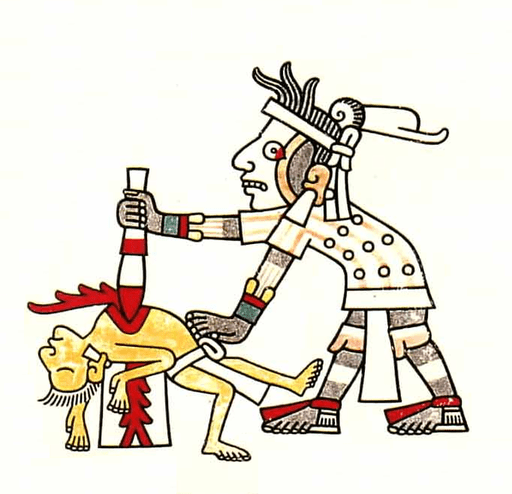
There’s nothing new about the idea. Indeed, the history of public human sacrifice for political purposes runs all the way back to ancient history in the Americas.
The last large-scale pre-Columbian example of the practice, that of the Aztecs, involved removing the beating heart of the victim atop a pyramid temple before flinging his or her corpse down the steps to the approval of a roaring crowd.
In this way, Aztec kings not only maintained support from their own populace through religious appeals, but kept smaller tribes too busy raiding each other (for sacrificial captives to be given to the Aztecs in tribute) to ally with each other against the Aztecs themselves.
If these five executions occur, they will be the first federal executions since 2003. There have only been three since 1963.
So, again, why? And why now?
Deterrence isn’t an answer that fits. Overall, violent crime (including murder) in the US has trended downward, not upward in recent decades (from 758 per 100,000 population in 1992 to 383 per 100,000 in 2017).
Neither is reducing the costs of incarceration. Of the more than 200,000 federal prisoners, only 61 are on “death row.” It’s unlikely that killing every last one of them would make a big dent in the Bureau of Prisons’ $7.3 billion annual budget.
Speaking which, if money was the problem, all five of the prisoners to be killed could as easily have been left to the justice systems of the states in which their crimes were committed and would have likely been sentenced to either death or life imprisonment without involving federal tax dollars in the first place.
The same is true regarding any moral “eye for an eye” imperative. Handling this kind of crime, and this kind of criminal, was never supposed to be the federal government’s job.
That leaves politics. Trump is playing Montezuma in hopes of holding on to his adoring crowd.
Thomas L. Knapp (Twitter: @thomaslknapp) is director and senior news analyst at the William Lloyd Garrison Center for Libertarian Advocacy Journalism (thegarrisoncenter.org).
Israel sentences prisoners’ lawyer to 13 years behind bars
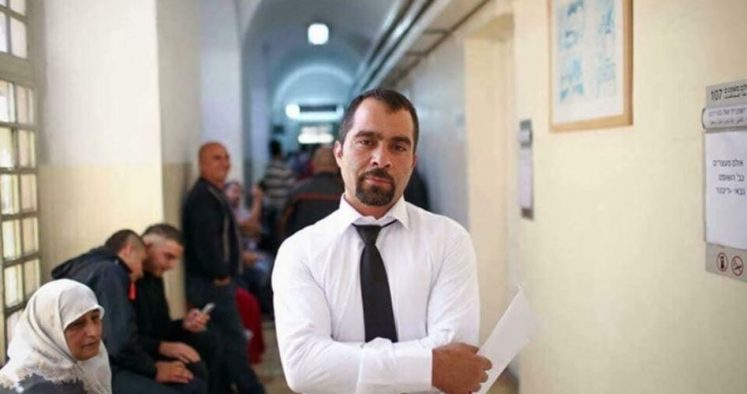
Tariq Barghouth, a prominent lawyer known for defending Palestinian prisoners held by Israel
MEMO | July 31, 2019
An Israeli court sentenced the lawyer of the PLO’s Prisoners’ Committee to 13 years, six months in prison on Tuesday, Quds Press has reported. Tariq Barghouth was arrested by the Israeli occupation forces on 27 February this year before undergoing harsh interrogation.
To put pressure on him in order to give what are said to be false confessions, the Israelis also arrested his wife and sister. The two women were released later.
Barghouth is one of the most prominent lawyers known for defending Palestinian prisoners held by Israel. He is currently in Nafha Prison in the south of Israel.
Meanwhile, the Israeli prison service has detained Shorouq Mohammed Al-Badan, 25, from Taqu village near the occupied West Bank city of Bethlehem. She has been given an administrative detention term of six months with neither charge nor trial.
The Prisoners’ Committee said that the occupation authorities arrested Al-Badan on 15 July during a night raid on her house. She was taken to the Etzion interrogation centre and then to HaSharon Prison for five day; she is now in Al-Damoun Prison.
Whilst in HaSharon, Al-Badan was held in a very small room which was extremely hot due to the prevailing high temperature. This led to her suffering from acute pain in her kidneys, presumably as a result of severe dehydration.
The Committee said that there are currently around 500 Palestinian prisoners being held under administrative detention orders inside Israeli jails, including nine who are on hunger strike in protest against their detention. Such orders can be renewed indefinitely.
Crimes in limbo: SDF commits horrific crimes against Syrians under the cover of the international coalition
Euro-Med | July 30,2019
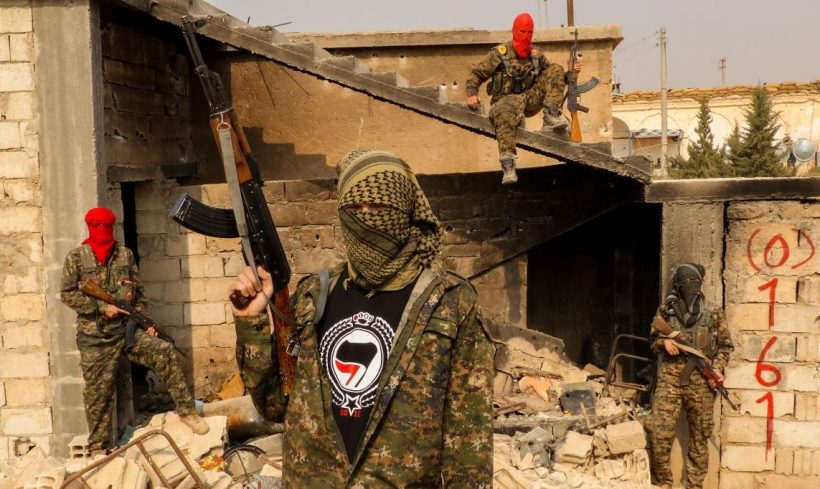
The Euro-Mediterranean Human Rights Monitor (Euro-Med) in a brief report today, shed light on numerous extrajudicial executions and other human rights violations carried out by the coalition-backed Syrian Democratic Forces (SDF) against civilians living in the eastern part of the country.
SDF continues to violate the rights of Syrians in the face of unjustifiable silence from the international community and continues to receive military and logistical support and air cover from the US-led international coalition forces, Euro-Med said.
The SDF was established in the city of Qamishli in northern Syria on the 10th of October 2015 to fight against the Islamic State. At that time, they defined themselves as “a unified national military force for all Syrians, Arabs, Kurds, Syriac, and all other components.” But the ethnic composition of the SDF forces suggests this is not the case, and it is in fact dominated by Kurdish forces. Currently, 70% of its troops are Kurds, while Arabs and other communities account for just 30%.
In their report, Euro-Med highlighted the continued suffering of thousands of Syrians in the cities of Raqqa and Deir al-Zour following the defeat of the Islamic State in the region and the takeover of the eastern part of Syria by the SDF.
The report authors were particularly concerned by some of the alleged recruitment practices of the SDF. It was alleged that the SDF had been undertaking forced recruitment of civilians in their battle against the Islamic State, even compelling children to fight in some cases.
Other atrocities committed by SDF forces that were brought to the attention of Euro-Med staff included the torture and extrajudicial killing of civilians. A video was recently leaked to the Al Forat Network by a member of the SDF that showed the torture and execution of two Arab youths in an SDF prison. It was alleged that the young men were killed because of their refusal to submit to the forced recruitment campaign.
Euro-Med staff later obtained a different video of a similarly appalling crime. It showed a member of the SDF torturing a girl and a man for refusing to go to a recruitment camp. The video also showed a different masked soldier beating the girl and the man after handcuffing them and insulting them.
The report also referenced a widely-circulated video clip from various social media sites that shows a member of the SDF executing a married couple just for walking past a wall marked with anti-Kurdish slogans.
Another video showed SDF fighters torturing two handcuffed civilians to try to extract the hiding places of Islamic State forces. The video shows one of the soldiers beating a detainee around the head with a plastic chair.
The report also accuses the SDF of preventing civilians forced from their homes by the Islamic State or those who escaped Islamic State-controlled areas from returning to their homes, while also detaining hundreds of civilians in prisons lacking even the most basic amenities.
According to information collected by the Euro-Med from local human rights organisations, the SDF tortured hundreds of displaced Syrians and imprisoned them in detention centres for days on end in the hope of extracting any information relating to the Islamic State.
The Euro-Med report also contains testimony from Syrian civilians suggesting an intentional policy on the part of the SDF to alter the demographic makeup of areas under their control. The SDF confiscated dozens of houses in villages they captured, before annexing them to “self-managed” status within the framework of their planned Kurdish federal territory.
Mohamed Imad, Euro-Med’s legal researcher, described recent events in eastern Syria Syria as a serious violation of the most basic legal rights guaranteed by international law. He added that the right to a dignified life, freedom of movement, safe living and access to basic services for Syrian civilians is guaranteed under multiple international agreements, including the Universal Declaration of Human Rights, the International Covenant on Civil and Political Rights, the International Covenant on Economic and Social Rights, and the Convention on the Rights of the Child.
“The human and legal violations and executions carried out by SDF members outside the framework of the law represent war crimes and crimes against humanity. They should be held responsible for their actions before the International Criminal Court,” Imad stressed.
Imad expressed his concern at the uncritical support of the SDF amongst the international community, which continued despite the obvious human rights violations being perpetrated by the opposition group.
The report concludes by calling on the United Nations Security Council to intervene urgently to halt the SDF atrocities. Euro-Med also called for an end to all material and logistical support for the SDF from the international community, as well as an end to all coordinated military operations.
Euro-Med also called on the United Nations to set up a special investigation into the atrocities in Eastern Syria and demanded that the perpetrators appear before the International Criminal Court to face justice for their war crimes and crimes against humanity.
Brazil’s toxic pesticides ‘affecting people all over the world’ through agricultural exports
RT | July 30, 2019
“EU-banned pesticide[s are] being manufactured in the EU, and then coming back to citizens in the EU, in the food we eat,” environmental journalist and founding member of the Green Economic Institute think tank Oliver Tickell told RT, explaining that as one of the largest soy exporters in the world, Brazil supplies a significant quantity of the feed that cattle and other livestock worldwide consume. European consumers tucking into a juicy steak have no idea that the creature they’re eating might have been nourished on soy sprayed with highly toxic pesticides.
“This is not just a problem for Brazil and Brazilian people and people exposed in the countryside to these pesticides and consumers and farmers,” Tickell warned. “It is actually affecting people all over the world through Brazil’s agricultural exports.”
ANVISA, the Brazilian public health regulatory agency, relaxed pesticide regulations last week so that only those chemicals with lethal potential can be classified as “extremely toxic,” triggering a massive backlash from environmental groups, human rights organizations, and food safety advocates. The fervently pro-business government of President Jair Bolsonaro has already approved 262 pesticides this year, 82 of which are classed as “extremely toxic,” as he follows through on campaign promises to demolish environmental regulations and open up protected rainforest lands to mining and agriculture.
Dozens of pesticides banned or strictly regulated in the EU, including paraquat and chlorpyrifos, were already permitted for use in Brazil before Bolsonaro took power, and the country uses approximately 400,000 tons of pesticides per year, according to Human Rights Watch. While Agriculture Minister Tereza Cristina has flatly denied Brazil uses any more pesticides than any other country, attributing such allegations to “data manipulation” and accusing critics of “terrorism,” EcoWatch claims the country consumes more pesticides per capita than any other nation.
Facebook Continues Censorship Crackdown by Purging Police Accountability Pages
Sputnik – July 30, 2019
In October 2018, Facebook conducted a mass purge of pages connected to alternative and independent news platforms and journalists without warning or explanation, some of which had hundreds of thousands if not millions of followers.
Among those affected were a host of pages promoting police accountability and documenting brutality, criminality and corruption on the part of law enforcement officials, such as Cop Block, Filming Cops and Police the Police, the latter boasting over five million followers. The individuals running these pages were undeterred, and quickly established ‘2.0’ successors, which gradually began regaining the footprint their fallen forebears boasted.
However, Facebook has now struck anew, deleting the replacements on the basis “it looks” like the pages’ activities don’t follow the social media giant’s internal policies.
“The implications of such a move to censor those who expose the police state are horrifying. Before it was deleted last year, Police the Police was the largest police accountability group on the internet and now, despite making back a lot of that ground, it is no longer. For years, we have exposed criminal cops and shined light into the darkness where other media outlets were scared to go. Police the Police and these other pages taught people how to flex their rights, film the police, and to not be afraid to stand up to the police state,” Free Thought Project, the online news outlet behind ‘Police the Police’, said in a statement.
The publication suggests the latest censorship blitz is related to the institution of ‘Blue Lives Matter Laws’ in US states, which elevate former and serving police officers to a protected status under ‘hate crime’ legislation, meaning authorities are now lumped in with “historically persecuted categories” like race, gender, creed, religion, and sexual orientation have been. As a result, criticism of police, even if constructive, could potentially be considered a hate crime, with significant penalties for offenders.
“Simply reporting on police crimes has apparently become a violation in the eyes of Facebook. Unless we fight back in the form of sharing information deemed ‘wrong think’ by the censors, this problem will only continue to get worse. We must continue to alert our fellow humans to this censorship before it becomes the norm. We must use this recent purge as our Streisand moment and turn this massive and blatant act of censorship around as a tool to expose the tyrants behind it,” Free Thought Project concluded.
Atlantic Censors
An alternative explanation for Facebook’s resistance to establishment-critical content could be the organisation’s intimate ties with ‘think tank’ Atlantic Council, an offshoot of NATO with a board of directors that’s a veritable ‘who’s who’ of contentious political figures old and new, including Henry Kissinger, Condoleezza Rice, Colin Powell, Robert Gates, Michael Hayden and David Petraeus, among others, funded by a number of Western governments and Ukrainian oligarchs such as Victor Pinchuk.
The pair launched an initiative to combat ‘fake news’ on Facebook in May 2018, although critics have suggested far from battling false information and propaganda, the alliance in fact simply blocks dissenting views from the social network. It has also seen a number of real people – including popular anti-interventionist Maram Susli (‘SyrianGirl’), Ukrainian concert pianist Valentina Lisitsa, and British pensioner Ian Shilling – labelled bots and banned from the platform, albeit temporarily.
The leak in December 2018 of a 1,400-page rulebook outlining Facebook’s internal censorship policies amply validates the view the social media monopoly isn’t concerned with battling ‘disinformation’, and cares far more about silencing views elite individuals and organisations simply don’t like. One section of the file outlines every group and individual the company has deemed a “hate figure” – algorithms and paid human moderators are required to remove any post praising, supporting or representing any of the entities listed.
Is India Preparing To Unleash “Weapons Of Mass Migration” In Kashmir?
By Andrew Korybko | Eurasia Future | 2019-07-30
A Military Deployment For Political Ends
The indigenous population of Indian-occupied Kashmir is becoming seriously concerned that New Delhi is preparing to rescind Article 35A ahead of the country’s upcoming independence day celebrations next month following the planned deployment of 20,000 more paramilitary forces to the region. The aforementioned provision bars non-residents from purchasing property there, which was thought at the time to be a clever tactic for quelling pro-independence unrest following India’s occupation of the formerly independent country. Popular international political commentator and former Indian diplomat Melkulangara Bhadrakumar, however, revealed in a recent op-ed curiously published just a few days before the phased deployment began that “the Modi government plans to integrate J&K by divesting or eroding some of its so-called ‘special status’”, hinting that there might be some credence to the locals’ concerns given that such a well-connected individual as Mr. Bhadrakumar himself thought it fitting to publicly make his “reasonable guess” at such a coincidental time.
No Comparison To China
Should this scenario come to pass, then it could dangerously lead to the disruptive large-scale influx of foreigners along the lines of Ivy League scholar Kelly M. Greenhill’s “Weapons of Mass Migration” model whereby demographic changes in a targeted area are triggered and/or manipulated by certain actors for strategic ends. The Indian government no doubt considers occupied Kashmir to be what it terms as an “integral part of the country” despite its internationally disputed status and previous UNSC Resolutions being passed in the past demanding that the locals be allowed to hold a plebiscite on their political status, which is why it would frame events as a “purely internal matter” and might even provocatively attempt to draw comparisons to the situations in China’s Tibet and Xinjiang Autonomous Regions in order to deflect criticism (though doing so might also counterproductively provoke its own separate criticism from other quarters). Such a comparison would be very deceptive, however, since both Chinese regions are universally recognized components of the People’s Republic whereas Kashmir isn’t regarded the same way vis-a-vis India.
The Khalistan Factor
This means that the large-scale movement of Han and other Chinese from elsewhere in the People’s Republic to Tibet and Xinjiang is by legal definition a purely internal matter, whereas the large-scale movement of Indians to Kashmir is a purely international one because of the region’s UN-recognized status as a disputed territory. India’s motivations in curtailing some of Kashmir’s “autonomy” at this specific moment might also stem from the increasingly popular Khalistan movement in neighboring Punjab, which has revived interest in the revolutionary 1973 Anandpur Sahib Resolution‘s decentralization principles and could eventually form the core of an alternative national vision to the ruling Hindutva one. It could partially be because of those fast-moving developments that the Indian government is panicking and wants to gradually remove as much of the occupied Kashmiris’ “autonomy” as possible in order to preempt the scenario of the other minority-majority regions under its control demanding similar rights as well after becoming reacquainted with the aforementioned manifesto and realizing that there’s no reason why they can’t have their own special status too.
A Dangerous Mistake
As the Modi government has been prone to do over the past half-decade, this speculated policy would represent yet another massive mistake if it’s ever implemented. Not only has the planned military deployment already generated intense talk about occupied Kashmir’s “autonomy” — thus negating the possible purpose of keeping such discourse out of the national discussion following the revival of the Khalistan movement — but it could also lead to more forceful resistance from the locals who fear an impending demographic invasion of ‘Weapons of Mass Migration”. Modi clearly wants to deliver on his party’s recent election promise to eliminate Articles 370 and 35A granting “autonomy” to Kashmir and the right to residents to be the sole purchasers of property in the occupied region respectively, but the blind devotion to electioneering rhetoric could prove to be extremely dangerous in this context because of the high likelihood that it’ll backfire by drawing intense international condemnation and possibly even provoking uncontrollable violence.
FCO Fails to Condemn Bahrain Embassy Incident
Press TV – July 30, 2019
Four days after Bahraini embassy staff in London allegedly tried to throw a protester off the embassy roof, the Foreign and Commonwealth Office (FCO) has yet to comment on the incident.
There were angry protests outside the Bahraini embassy in London on July 26, prompted by the imminent execution of two activists.
The event climaxed after a protester, one Moosa Abd-Ali, climbed onto the roof of the embassy and was intercepted there by embassy staff who allegedly tried to throw him off the roof.
The event was live streamed and prominently tweeted by British-Iranian journalist, Nargess Moballeghi.
Wider media coverage, notably by the online Independent, identified the protester as “Moosa Mohamed”, and reported that he had unfurled a banner reading: “I am risking my life to save two men about to be executed in the next few hours. Boris Johnson act now!”
Whilst the police eventually stormed the building to save Abd-Ali’s life, however instead of taking action against embassy staff they ended up arresting Abd-Ali for alleged trespass.
Abd-Ali’s dramatic protest proved fruitless as the two activists, Ali al-Arab and Ahmed al-Malali, were executed by the Bahraini authorities the following morning.
Hitherto, the dramatic events at the Bahraini embassy and the alleged attempted murder by embassy staff, has not elicited any reaction from the British government, let alone a condemnation.
This is not the first time that Bahraini embassy staff in London have tried to harm protesters and got away with it. In 2017, Bahraini embassy employees were accused of throwing hot water on demonstrators from a balcony.
The FCO’s failure to admonish Bahrain for this potentially criminal behavior on British soil is entirely in keeping with the British government’s policy of supporting the ruling Al-Khalifa dynasty.
The British government admits to training Bahraini security forces on “command and control” techniques designed to suppress demonstrations.
A 2017 report by the human rights organization “Reprieve” revealed that the FCO had paid for six Bahraini police officers to visit Belfast in August 2015 for “public order” training.
The Guardian reported in August 2016 that the UK’s College of Policing had a contract with Bahrain’s Ministry of Interior to train Bahrain’s police forces.
Featured Video
The Search for Truth: Charlie Kirk’s Assassination One Year Later
or go to
Aletho News Archives – Video-Images
From the Archives
Did Israel Kill the Kennedys?

By Laurent Guyénot • Unz Review • June 3, 2018
Introduction
Just after midnight of June 6, 1968, Senator Robert Kennedy was assassinated in a backroom of the Ambassador Hotel in Los Angeles. He had just been celebrating his victory at the California primaries, which made him the most likely Democratic nominee for the presidential election. His popularity was so great that Richard Nixon, on the Republican side, stood little chance. At the age of 43, Robert would have become the youngest American president ever, after being the youngest Attorney General in his brother’s government. His death opened the way for Nixon, who could finally become president eight years after having been defeated by John F. Kennedy in 1960.
John had been assassinated four and a half years before Robert. Had he survived, he would certainly have been president until 1968. Instead, his vice-president Lyndon Johnson took over the White House in 1963, and became so unpopular that he retired in 1968. Interestingly, Johnson became president the very day of John’s death, and ended his term a few months after Robert’s death. He was in power at the time of both investigations.
And both investigations are widely regarded as cover-ups. In both cases, the official conclusion is rife with contradictions. We are going to sum them up here. But we will do more: we will show that the key to solving both cases resides in the link between them. And we will solve them beyond a reasonable doubt. … continue
Blog Roll
 Aletho News
- The Search for Truth: Charlie Kirk’s Assassination One Year Later
- ‘Harsh reality’: Iran says France seeks monopoly on power and intimidation, not peace for all
- When Will This White House Madness End?
- Huckabee aide goes to ‘unusual lengths’ to portray ‘Israel’ positively
- Trump Announces Diesel Supply Deal With Putin Following Phone Call
- MEP blasts ‘Euro-Gestapo’ for lecturing Russia on democracy
- Syria May Send Troops to Saudi Arabia Amid War with Ansar Allah
- UK whines about losing billions to ‘Putin tax’
- Baghaei to Rubio: Distorted narratives cannot erase US record of broken commitments
- Houthis Don’t Have to Conquer Saudi Arabia to Make It Pay
- If Americans Knew
- Gaza ceasefire exists in name only, say more than 100 organizations
- Nearly 2 Million in Gaza Need Urgent Shelter Assistance as Winter Looms: IOM Chief Warns
- Suppressing Palestinian resistance: US charity under fire for AI monitoring of Gaza classrooms
- Thousands Are Held in Israeli Torture Camps. This Is What Happens Inside
- Israel puts Gaza’s sick, injured, newborn in peril – Daily Update
- Report claimed Mark Levin used by Israeli government to influence Trump
- Over 2,000 Gazans have died awaiting medical evacuation amid Israel’s continued siege
- How a U.S. Diplomat Suppressed and Altered Reports Critical of Israel
- 5 Palestinians Die from Israeli Strikes in Gaza as Relentless Attacks Continue
- Report: Ceasefire Slows Killing but Leaves Devastation Intact
- No Tricks Zone
- New Study: 50 Years Of The Most Aggressive ‘Net Zero’ Policies Can Only Affect The Global Climate By 0.03°C
- US September “Heat” Was No Record…Many Records Set Decades Ago
- Latest European Green Energy Debacle; Portugal’s Largest Flagship Solar Park Insolvent!
- Green Energy Debacle: German Expert Professor Fritz Vahrenholt Warns Of Severe Economic And Social Consequences
- Two More Paleo Reconstructions Affirm Meters-Higher Sea Levels Across Ireland, Brazil 7000-6000 Years Ago
- New Study: Earth And Venus Surface Warmth Largely Explained By Convection And Lapse Rate, Not CO2 Or Radiation
- 2025 Nature Paper Claiming Worsening Global Drought Gets RETRACTED …Heavily Flawed
- New Study: ‘Global Drought Shows No Detectable Recent Acceleration Under Climate Warming’
- Economic Masterminds: German Socialists Suggest Taxing Productivity Gains Stemming From Using AI
- The South China Sea Has Not Been Cooperating With The Climate Change Narrative

