Israel Has “The Most Moral Army in the World”?
The creepy French “intellectual” Bernard-Henri Levy gets it wrong

By Philip Giraldi • Unz Review • July 30, 2019
Eight days ago eleven Palestinian buildings containing seventy family apartments located in the illegally Israeli occupied East Jerusalem village of Wadi al-Hummus were demolished in a military-led operation by more than 1,000 Israeli soldiers, policemen and municipal workers using bulldozers, backhoes and explosives. Residents who resisted were beaten by the soldiers, kicked down flights of stairs and even shot at close range with rubber bullets. The soldiers were recorded laughing and celebrating as they did their dirty work. Occupants who did not resist and who held their hands up in surrender were also not spared the rod, as were also foreign observers who were present to add their voices to those who were protesting the outrage. The injuries sustained by some of the victims have been photographed and are available online.
Twelve Palestinians and four British observers were injured badly enough to be hospitalized. The British reported that they were “stamped on, dragged by the hair, strangled with a scarf and pepper sprayed by Israeli border police.” One who was hospitalized described how Israeli soldiers dragged him by his feet, lifting him up, and kicking him in the stomach, while one soldier stamped on his head four times “at full force” before standing on his head and pulling his hair. Another suffered a fractured rib after “[the policeman] then stamped on my throat and others started punching my torso. It was a sadistic display of violence…”
Yet another foreign observer was dragged out of the house, “… her hands were crushed so badly that she suffered a fractured knuckle on her left hand, and her right hand suffered severe tissue damage ‘which will be permanently misshapen unless she gets cosmetic surgery.’”
Edmond Sichrovsky, an Austrian activist of Jewish origin, who was in one of the houses, described how Israeli forces broke the door down, first dragging out the Palestinians, “knocking the grandfather to the floor in front of his crying and screaming grandchildren.” Cell phones were forcibly removed to eliminate any picture taking or filming before soldiers began attacking him and four other activists. “I was repeatedly kicked and kneed, which left a bloody nose and multiple cuts, as well breaking my glasses from a knee in the face. Once outside, they slammed me against a car while shouting verbal insults at me and women activists, calling them whores.”
The buildings were destroyed due to claims that they were too close to Israel’s illegal separation wall, with the Benjamin Netanyahu government citing “security concerns.” The families living in the buildings that did not have either the time or ability to remove their furniture and other personal items will now have to comb through the rubble to see what they can recover, if the Israeli soldiers will even allow them that grace. They will also have to find new places to live as the Israelis have made no provision for housing them.
The homes were legally constructed on land that is nominally controlled by the Palestinian Authority (PA), a fine point that the Israeli authorities chose to consider irrelevant. When the Palestinians object to such arbitrary behavior, they are sent to Israeli military courts that always endorse the government decisions. And the Netanyahu regime of kleptocrats has made clear that it does not recognize international law about treatment of people who are under occupation.
The buildings were destroyed a few days after rampaging Israeli settlers on the West Bank continued their campaign to destroy the livelihoods of their Palestinian neighbors. Hundreds of olive trees were burned on the West Bank on July 10th, a deliberate attempt to drive the Arabs from their land by making it impossible to farm, strangling the local economy. Olive trees are particularly targeted as they are a cash crop and the trees take many years to mature and produce. The Israeli settlers have also been known to kill livestock, poison water, destroy crops, burn down buildings, and beat and even kill the Palestinian farmers and their families. And in Hebron the settlers have surrounded the old town, dumping excrement and other refuse on the Palestinians shops below that are still trying to do business. It should surprise no one that the Jewish settlers who engage in the violence are rarely caught, even less often tried, and almost never punished. The ghastly Benjamin Netanyahu’s government has declared that what was once Palestine is now a country called Israel and it is only for Jews. Killing a Palestinian by a Jewish Israeli is considered de facto to be a misdemeanor.
And meanwhile the carnage continues in Gaza, with the death toll of unarmed demonstrating Palestinians now at more than 200 plus several thousand wounded, many of them children and medical workers. Recently, orders to the Israeli army snipers direct them to shoot demonstrators in the ankles so they will be crippled for life. This is what it takes to be the “most moral army” in the world as defined by French fop pseudo intellectual Bernard-Henri Levy, demonstrating only yet again that the tribe knows how to stick together. But the war crimes carried out by Israel also require unlimited support from the United States, both in money and political cover to allow it all to happen. Israel would not be killing Palestinians with such impunity if it were not for the green light from Donald Trump and his settler-loving mock Ambassador David Friedman backed up by a congress that seems to cherish Israelis more than Americans.
How is it that the horrific treatment of the Palestinians by the Israelis as aided and abetted by the worldwide Jewish diaspora is not featured in headlines all over the world? Why isn’t my government with its highly suspect but nevertheless declared agenda of bringing democracy and freedom to all saying anything about the Palestinians? Or condemning Israeli behavior as it once did regarding South Africa?
Can one even imagine what The New York Times and Washington Post would be headlining if American soldiers and police were evicting and beating the residents of a housing project in a U.S. city? But somehow Israel always gets a pass, no matter what it does and politicians from both parties delight in describing how the “special relationship” with the Jewish state is cast in stone.
In the wake of the home demolitions, Washington yet again shielded Israel from a United Nations censure for its behavior by casting a Security Council veto. The Jewish state is consequently never held accountable for its bad behavior, and let us be completely honest, Israel is the ultimate rogue regime, dedicated to turning its neighbors into smoking ruins with U.S. assistance. It is evil manifest and it is not in America’s own interest to continue to be dragged down that road.
Philip M. Giraldi, Ph.D., is Executive Director of the Council for the National Interest, a 501(c)3 tax deductible educational foundation (Federal ID Number #52-1739023) that seeks a more interests-based U.S. foreign policy in the Middle East. Website is councilforthenationalinterest.org, address is P.O. Box 2157, Purcellville VA 20134 and its email is inform@cnionline.org
Vancouver City Council Won’t Set Precedent in Endorsing IHRA Definition
By Marion Kawas | Palestine Chronicle | July 28, 2019
The City of Vancouver, Canada might seem to be an odd place for a battle over the International Holocaust Remembrance Alliance (IHRA) definition of Anti-Semitism. But that is exactly what happened in the last week, and it all concluded with at least a temporary victory for free speech, human rights and common sense.
At the end of June, the federal government of Canada endorsed the IHRA definition as part of its new official “Anti-Racism Strategy” announced by minister Pablo Rodriguez. This was a unilateral move by the government which did not involve a vote in the House of Commons. The Israeli lobby, however, in their ecstatic gloating over the endorsement, made it clear they would be pushing to have the IHRA definition adopted at all levels of government, including provincial and municipal.
Which brings us to the Vancouver City Council, where one Non-Partisan Association (NPA) councilor introduced a motion to be heard at the last meeting before summer break. The motion contained the standard reasoning that one has come to expect from the Israeli lobby promoting the IHRA definition and concluded with adoption of the definition and its examples; it also explicitly instructed staff to share the definition with various city departments including the Police Department, School Board, Parks Board and the Public Library for “review and consideration as an additional practical tool.”
What the outcome would be of this “additional practical tool”, especially by the Police Department, one could only speculate. The history of what has transpired so far in other countries regarding the IHRA definition is extremely troubling and was called out a year ago by over 40 Jewish groups in an open letter. They noted that the definition is “intentionally worded such that it equates legitimate criticisms of Israel and advocacy for Palestinian rights with antisemitism, as a means to suppress the former.”
The IHRA definition includes several parts, two vaguely worded sentences that are accompanied by 11 illustrative examples; it is the examples and the way they have been applied that are the focus of most of the critique, including from one of the original authors of the document. As noted by Independent Jewish Voices Canada, the initial sentences fail to even clearly “identify antisemitism as a form of prejudice or racism, instead calling antisemitism ‘a certain perception of Jews, which may be expressed as hatred toward Jews’.” They add that “7 of the 11 examples refer not just to Jewish people, but to the state of Israel, a deliberate rhetorical strategy to label criticism of Israel and of Zionism antisemitic.”
In fact, some of these examples have been included almost verbatim in the justification for the anti-BDS bills that have been passed or are winding their way through several U.S. states, including Florida.
Passing this motion would have set a dangerous precedent as being the first municipal council in Canada to endorse the IHRA definition. Vancouver, however, has a long and proud tradition of being both anti-racist and defending free speech and Palestinian rights. A popular campaign was immediately launched to tell Vancouver City Council why this motion should not be adopted – letter writing, social media and articles in local papers all happened.
People from both within the Jewish community and other sectors were adamant in stating that this definition had more to do with squashing criticism of Israel than it did with contributing to the fight against racism.
The Palestinian community also pointed out that the definition actually promotes anti-Palestinian racism, as it severely limits and defines what the Palestinian narrative can be. The Vancouver & District Labour Council (VDLC), the BC Civil Liberties Association (BCCLA) and civic parties like the Coalition of Progressive Electors (COPE) all took the position that adopting the IHRA definition would be divisive and harmful.
It seems City Council heard the message. In a vote of 6-5 (the 5 were all NPA councilors), the Council decided to not proceed with the motion and instead referred it to committee for recommendations on how to combat ALL forms of racism.
“THAT Council refer this motion to the Racial and Ethno-Cultural Equity Advisory Committee to provide recommendations to Council on how the City of Vancouver can increase action to combat all forms of racism and hatred, including Antisemitism.”
Although referral to committee is often the bureaucratic tactic to not deal with issues, in this case, the instructions in the referral made it more meaningful. And most importantly, Vancouver City Council refused to set a precedent as the first Canadian city to endorse the IHRA definition.
Activists know that the struggle will continue at the committee level but the small amount of time they had to prepare for the council vote allowed them to educate many people on the dangers of the IHRA definition; they feel confident that more time is only to their advantage.
Canada’s main Israel lobby group, Centre for Israel and Jewish Affairs (CIJA), was not happy with the outcome. They had invested heavily in promoting the motion and one of their officials stated he would be at City Hall when it was introduced.
They issued a statement expressing their “disappointment”, claiming that this was a “setback in the struggle against racism and bigotry”.
They went on to allege that,
“By delaying the initiative to protect Jewish community members at a time of rising antisemitism, those councilors who voted against the motion are on the wrong side of history.”
Vancouver residents do not need these lectures by a lobby group that is more interested in punishing critics of Israel than it is in fighting racism. Members of the Jewish community in Vancouver made this exact point in their submissions to Council.
The active involvement of many progressive Jews against this motion endorsing the IHRA definition was one of the more uplifting aspects of this campaign, along with the support from broader sections of Vancouver society. This was also reflective of the majority of Canadians who support Palestinian human and national rights.
Palestinian activists have not had many occasions lately to be optimistic, especially in the Canadian political arena. Hopefully, what happened at Vancouver City Council is just the first step in pushing back against the censoring of free speech and the bullying of activists who support Palestinian rights.
– Marion Kawas is a member of the Canada Palestine Association and co-host of Voice of Palestine. Visit: www.cpavancouver.org.
Abbas must take practical measures concerning suspension of all deals with Israel: Hamas
Press TV – July 28, 2019
A senior official from the Palestinian Hamas resistance movement says the recent decision made by President of the Palestinian Authority (PA) Mahmoud Abbas to suspend all agreements signed with the Israeli regime needs practical steps.
Mousa Abu Marzouk, in a post published on his official Twitter page on Saturday, described the move as “a step reflecting the wishes of Palestinian people, who aspire for freedom and independence.”
He added that Abbas’s decision to stop implementing agreements signed with the Israeli regime needs practical steps, national unity and internal reconciliation in order to yield results, and to confront potential risks facing Palestinians.
On Thursday, the 84-year-old Palestinian president declared the suspension of all agreements with the Tel Aviv regime.
The measure came after an emergency meeting of the Palestine Liberation Organization in the wake of recent demolition of a cluster of Palestinian homes in Sur Baher neighborhood on the southeastern outskirts of occupied East Jerusalem al-Quds.
“We announce the leadership’s decision to stop implementing the agreements signed with the Israeli side,” Abbas said at a speech in the central occupied West Bank city of Ramallah.
He added that a committee would be formed in order to implement the decision, but did not provide further details.
“We will not bow to dictates and imposing a fait accompli by force in al-Quds (Jerusalem) and elsewhere,” Abbas stated.
Abbas said the move comes as Israeli authorities “ignore” all the signed agreements with the PA.
The Palestinian Authority and the Israeli regime work together on various matters, including water distribution, electricity, economic relations and security coordination.
Hundreds of Israeli troops with bulldozers tore down about 70 homes in 10 apartment buildings in Sur Baher on July 22, despite local protests and international criticism.
On Wednesday, the United States blocked the United Nations Security Council from passing a resolution condemning Israel’s demolitions.
Indonesia, Kuwait and South Africa had earlier circulated a draft statement, expressing grave concern over the demolitions. They stated that such practice would undermine the viability of the so-called two-state solution, and the prospect for a just and lasting resolution of the decades-long conflict between Israelis and Palestinians.
‘Progressives’ Vote AGAINST BDS
If Americans Knew | July 24, 2019
Notable votes against BDS/Pro-Israel: Gabbard, Khanna, Lewis
Notable votes supporting BDS: Ocasio-Cortez, Tlaib, Omar
Produced by Chris Smiley: https://www.twitter.com/chrissmileyla
More news and headlines: https://israelpalestinenews.org/
US passes bills against BDS and Hamas
MEMO | July 24, 2019
The US House of Representatives passed a resolution yesterday to sanction Hamas and another to oppose the Boycott, Divestment and Sanctions (BDS) movement.
House Resolution 1850 entitled “Palestinian International Terrorism Support Prevention Act of 2019” would impose sanctions upon individuals or agencies identified as supporting Hamas or its affiliates. Sponsored by Florida Republican Brian Mast, the bill requires the US President to submit a yearly report to Congress that identifies “each foreign or agency or instrumentality of a foreign state” that supports Hamas financially.
Mast, who volunteered for the Israeli army after his US army service, said in a statement, “Hamas is single-handedly responsible for the deaths of numerous Americans and Israelis. These sanctions send a strong message to anybody who supports these radicals preaching the destruction of Israel and death to everything we hold dear in the United States.”
The bill was passed by a motion to suspend the rules, a procedure generally used to pass resolutions quickly, and not by a roll call vote in which each representative gives their individual vote.
On the same day, the House passed a resolution opposing BDS in a roll call vote of 398 to 17. House Resolution 246 “opposes the BDS movement targeting Israel, including efforts to target US companies that are engaged in commercial activities that are legal under US law, and all efforts to delegitimise the State of Israel.”
This bill was met with strong opposition from some progressive members of the Democratic Party, including Palestinian-American Rashida Tlaib and Somali-American Ilhan Omar. Tlaib gave an impassioned speech on the House floor arguing that the resolution would infringe upon freedom of speech: “I can’t stand by and watch this attack on our freedom of speech and the right to boycott the racist policies of the government in the state of Israel.” She referred to historic boycotts in American history, such as the Boston Tea Party, the Montgomery Bus Boycott and the United Farm Workers Grape Boycott, as examples of how “the right to boycott is deeply rooted in the fabric of our country.”
 Though the House voted overwhelmingly to pass the anti-BDS resolution, notable representatives who voted “nay” include three quarters of the “squad”: Tlaib, Omar and New York Representative Alexandria Ocasio-Cortez. The other member of the “squad”, Massachusetts Representative Ayanna Pressley, voted “yea” on the resolution.
The passing of this resolution drew much criticism on social media, with the BDS movement calling it a “McCarthyite, anti-Palestinian measure” and anti-occupation group IfNotNow criticising the Democratic Leadership for allowing this vote to happen only a day after Israel’s demolition of Palestinian homes in occupied Jerusalem.
Last week, Omar introduced House Resolution 496 affirming the American right to boycott. The resolution doesn’t specifically refer to the Palestinian-Israeli conflict and is heralded by the BDS movement as a “ground-breaking resolution” that defends “freedom of expression and the right of oppressed communities… to peacefully fight for their rights.”
Omar’s bill is co-sponsored by nine other Democratic representatives, including Pressley, civil rights activist John Lewis and New Jersey Representative Donald Payne. However, these three voted for the anti-BDS bill yesterday, raising questions about their positions on the issue.
READ ALSO:
US Democrats remove ‘occupation’ from two-state solution resolution
Killing Tariq: Why We Must Rethink the Roots of Jewish Settlers Violence

Tariq Zebania, 7 years old, was killed early this morning in hit and run by settler near Hebron.
By Ramzy Baroud | Palestine Chronicle | July 24, 2019
Seven-year-old Tariq Zabania from Al-Khalil (Hebron) was killed on the spot when an Israeli Jewish settler ran his car over him on July 15. Little Tariq’s photograph, lying face down on the road, was circulated on social media. His untimely death is heartbreaking.
Tariq’s innocent blood must not go in vain. For this to happen, we are morally obliged to understand the nature of Jewish settler violence, which cannot be viewed in isolation from the inherent racism in Israeli society as a whole.
We are all often guilty of perpetuating the myth that militant Jewish settlers in the occupied Palestinian territories are a different and distinct category from other Israelis who live beyond the so-called “Green Line”.
Undoubtedly, the violent mentality that propels Israeli society, wherever it is located, is not governed by imaginary lines but by a racist ideology, of which disciples can be found everywhere in Israel, not just in the illegal Jewish colonies of the West Bank.
Israel is a sick society and its ailment is not confined to the 1967 Occupation of East Jerusalem, the West Bank and Gaza.
While Palestinians are imprisoned behind walls, fences and enclosed regions, Israelis are a different kind of prisoners, too. “A man who takes away another man’s freedom is a prisoner of hatred, he is locked behind the bars of prejudice and narrow-mindedness,” wrote the late anti-Apartheid hero and long-time prisoner, Nelson Mandela.
It is this racism and bigotry that makes Tariq invisible to most Israelis. For most Israelis, Palestinian children do not exist as real human beings, deserving of a dignified life of freedom. This callousness is a defining quality, common among all sectors of Israeli society – right, left and center.
An example is the terrorist attack carried out by Jewish settlers against the Palestinian Dawabshe family in the village of Duma, in the northern West Bank in July 2015, resulting in the death of Riham and Sa’ed, along with their 18-months old son, Ali. The only member of the family spared that horrific death was Ahmad, 4, who was severely burned.
This cruelty was further accentuated in the episodes that followed this criminal incident. Later that year, Israeli wedding guests were caught on tape while dancing with knives, chanting in celebration of the death of the Palestinian baby.
Three years later, as the Dawabshe family members were leaving an Israeli court, accompanied by Arab parliamentarians, they were greeted by a crowd of Israelis chanting “Where is Ali? Ali’s dead” and “Ali’s on the grill”.
The passing of time only cemented Israelis’ hatred of a little child whose only crime was his Palestinian identity.
The only survivor, Ahmad, was punished thrice: when he lost his whole family; with his severe burns and when he was denied compensation. The then Israeli Defense Minister, Avigdor Lieberman, simply resolved that the boy was not a “terror victim.” Case closed.
Although the Dawabshes were killed by Jewish settlers, the Israeli court, army, and political system all conspired to ensure the protection of the killers from any accountability.
This was no different in the case of Israeli soldier, Elor Azaria, who, on March 24, 2016, killed an unconscious Palestinian man in Hebron. In his defense, Azaria insisted that he was following army manual instructions in dealing with alleged attackers, while top Israeli government officials came out in droves to support him.
When Azaria was triumphantly released following only nine months in jail, he was hailed by many Israelis as a hero. Possibly, he will have a successful career in politics should he decide to pursue that route. In fact, he was courted by Israeli politicians to help them garner more votes in April’s general elections.
Condemning solely Jewish settlers while sparing the rest of Israeli society is equivalent to political whitewashing, one that presents Israel as a healthy society prior to the occupation of the West Bank and Gaza. This view presents Jewish settlements as a cancerous disease that is eating up at the otherwise proud and noble achievements of early Zionists.
It is convenient to classify Jewish settlers as rightwing extremists and to link them with Israel’s ruling right-wing political parties. But history proves otherwise.
It was Israel’s Labor Party that created the settlement projects originally, soon after the colonization of the West Bank. Some of Israel’s largest, and most militant colonial enterprises, in occupied East Jerusalem – Ramat Eshkol, Gilo, Ramot, and Armon Hanatziv – are all the creation of the Labor Party, not the Likud.
Neither is the ‘settler’ a new phenomenon. Historically, the early settlers who preceded the establishment of Israel in 1948 were idealized as true Zionists, celebrated as “cultural heroes” – the Jewish redeemers, who eventually ethnically cleansed historic Palestine from its native inhabitants.
“The original Labor movement,” wrote Amotz Asa-El in The Jerusalem Post, “never thought settling beyond the Green Line was illegal, much less immoral.” If there was any debate in Israel regarding settlements, it was never truly concerned with the issue of legitimacy or legality, but practicality: whether these colonial projects can be sustained or defended.
Protecting the settlements is now the overriding task of the Israeli occupation army. The Israeli human rights organization, B’Tselem, which monitors the conduct of the Israeli army and Jewish settlers in the West Bank, explained the nature of this relationship in a report published in November 2017.
“Israeli security forces not only allow settlers to harm Palestinians and their property as a matter of course – they often provide the perpetrators escort and back-up. In some cases, they even join in on the attack,” B’Tselem wrote.
Another Israeli organization, Yesh Din, concluded in a report published earlier that 85% of cases involving settler violence against Palestinians are never pursued by law. Of the remaining cases, only 1.9% led to conviction, which is likely to be inconsequential.
Jewish settler violence should not be analyzed separately from the violence meted out by the Israeli army, but seen within the larger context of the violent Zionist ideology that governs Israeli society entirely.
This violence can only end with the end of the racist ideology that rationalizes murder, like that of little Tariq Zabania.
– Ramzy Baroud is a journalist, author and editor of Palestine Chronicle. His last book is ‘The Last Earth: A Palestinian Story’ (Pluto Press, London). Baroud has a Ph.D. in Palestine Studies from the University of Exeter and was a Non-Resident Scholar at Orfalea Center for Global and International Studies, University of California Santa Barbara.
Israeli forces laugh and cheer as tower collapses
RT | July 23, 2019
Israeli police and military were filmed laughing and cheering as they blew up a Palestinian building in the West Bank district of Wadi Hummus in East Jerusalem on Monday.
The footage shows three men looking down on the area where Israel began demolition of 13 buildings, after a High Court ruled against an appeal to stop the demolition ordered by the Defense Ministry, which said the buildings were too close to the separation barrier Israel constructed around and inside the West Bank in the 2000s.
A man wearing a balaclava holds the controls to set off the explosions inside the building below. Once it starts to explode, the men laugh and celebrate as other people can be heard cheering and whistling.
The buildings are located on the outskirts of Sur Baher in Wadi Hummus, which is in Area A of the West Bank, meaning it is under the administration of the Palestinian Authority (PA). The separation barrier left Wadi Hummus on the Israel side of the structure, even though it remains part of the West Bank. The buildings that were demolished had permits issued by the PA.
Their destruction was condemned as a “grave aggression” by Palestinian Prime Minister Mohammad Shtayyeh, who said that a complaint would be made to the International Criminal Court. “This is a continuation of the forced displacement of the people of Jerusalem from their homes and lands – a war crime and a crime against humanity,” he said.
Last week UN officials called on Israel to halt its demolition plans and the EU said the policy “undermines the viability of the two-state solution and the prospect for a lasting peace.”
See also:
Boycotting Israel a Constitutional Right and Personal Obligation
By Stephen Lendman | July 20, 2019
In NAACP v. Claiborne Hardware Co. (1982), a landmark civil rights case, the Supreme Court unanimously upheld the organization’s right to boycott white-owned businesses in Mississippi – protesting against segregation and racial injustice, its constitutional right.
The ruling stressed that states may not prohibit peaceful advocacy of a politically-motivated boycott, what First Amendment rights are all about.
Yet 28 states enacted legislation, restricting or banning individuals or entities doing business with the state if advocate boycotting Israel.
Their measures defy the Supreme Court’s ruling and fundamental First Amendment right of free expression — wanting the constitutionally protected right to boycott or otherwise publicly criticize Israel delegitimized, falsely equating it to anti-Semitism.
Only eight US states so far haven’t introduced or considered a measure in some form against boycotting the Jewish state.
Last May, the ACLU stressed the unconstitutionality of these laws, judicially struck down in Kansas, Arizona, and Texas by federal courts, the ACLU saying:
The rulings affirm “that the right to boycott is protected under the First Amendment… (They’re) stinging rebuke(s) of state legislators and members of Congress who have repeatedly attempted to strip the American people of that very right.”
Hardliners at the federal and state levels want anti-boycott laws enforced, no matter their unconstitutionality.
In January, on behalf of 13 constitutional scholars, Colombia University’s Knight First Amendment Institute filed am amicus brief in the Ninth Circuit Court of Appeals — “explaining that BDS boycotts are protected by the First Amendment in Jordahl v. Brnovich (Arizona).”
The constitutional scholars include:
William D. Araiza (Brooklyn Law School); Jack Balkin (Yale Law School); Erwin Chemerinsky (University of California, Berkeley, School of Law); Owen Fiss (Yale Law School); Katherine Franke (Columbia Law School); Jeremy Kessler (Columbia Law School); Seth F. Kreimer (University of Pennsylvania Law School); Genevieve Lakier (University of Chicago Law School); Burt Neuborne (New York University School of Law); Robert Post (Yale Law School); Amanda Shanor (University of Pennsylvania); Geoffrey R. Stone (University of Chicago Law School); Nadine Strossen (New York Law School).
Knight Institute staff attorney Ramya Krishnan said “(t)his is an easy First Amendment case.”
“Politically motivated consumer boycotts are a form of protected speech, as the Supreme Court held almost four decades ago.”
“The First Amendment forecloses a state (or federal government) from suppressing or burdening a political boycott simply because it disagrees with the boycott’s message.”
The Arizona law was struck down by a federal state district court.
In April, the Center for Constitutional Rights (CCR) Palestine Legal, and the Law Office of Matthew Strugar filed an amicus brief in the Eighth Circuit Court of Appeals in support of striking down an anti-BDS Arkansas law — calling it “part of a broader effort to suppress speech in support of Palestinian human rights.”
Days earlier, Rep. Ilhan Omar introduced HR 496: “Affirming that all Americans have the right to participate in boycotts in pursuit of civil and human rights at home and abroad, as protected by the First Amendment to the Constitution.”
The measure was referred to the House Judiciary Committee for further action. It’s co-sponsored by Rep. John Lewis and Palestinian-American Rep. Rashida Tlaib.
Omar said the following: “We are introducing a resolution… to really speak about the American values that support and believe in our ability to exercise our first amendment rights in regard to boycotting.”
The measure “affirms that all Americans have the right to participate in boycotts in pursuit of civil and human rights at home and abroad, as protected by the First Amendment to the Constitution.”
It “opposes unconstitutional legislative efforts to limit the use of boycotts to further civil rights at home and abroad.”
It “urges Congress, states, and civil rights leaders from all communities to endeavor to preserve the freedom of advocacy for all by opposing anti-boycott resolutions and legislation.”
The measure counters HR 246 (March 2019) — “Opposing efforts to delegitimize the State of Israel and the Global Boycott, Divestment, and Sanctions Movement targeting Israel” — co-sponsored by Rep. John Lewis, making it unclear what he supports.
It’s impossible to be for and against the same thing. Throughout his tenure in Congress since 1987, Lewis expressed strong support for Israel, ignoring its appalling human and civil rights abuses against Palestinians, along with its high crimes of war and against humanity.
On July 17, the Arab American Institute endorsed HR 496, urging its members and supporters to write or email their congressional representatives to support the measure, suggesting the following text:
“Subject: Affirm the 1st Amendment- Co-sponsor H.Res.496
I urge you to support H.Res.496, which affirms the First Amendment-protected right of all Americans to participate in boycotts in pursuit of civil and human rights at home and abroad.
The right to boycott is central to the political expression envisioned by the Founders when the First Amendment was added to the Constitution.
Americans have a long and proud history of boycotts, from the Boston Tea Party to opposing apartheid in South Africa, and that history includes the instrumental Civil Rights Era boycotts which were planned in part by original cosponsor Representative Lewis himself.”
The Global BDS Movement issued a statement, saying it “warmly welcomes the resolution introduced by Congress members Ilhan Omar, Rashida Tlaib and… John Lewis “Affirming that all Americans have the right to participate in boycotts in pursuit of civil and human rights.”
Palestinian Campaign for the Academic and Cultural Boycott of Israel (PACBI) member Hind Awway issued a statement, saying “(t)his groundbreaking resolution will inspire human rights defenders everywhere including BDS activists for Palestinian rights.”
“It affirms the right of all activists and people of conscience to advocate for human rights through boycotts against systems of oppression.”
“It reassures us that progressives, including in Congress, are defending freedom of expression and the rights of oppressed communities, including Palestinians to peacefully fight for their rights. The defense of those rights is more vital in light of the rise of far-right racism and white supremacy, including Israel’s decades-old apartheid regime.”
The measure is an important statement even though most congressional members strongly support Israel, while disdaining Palestinian rights.
It’s why HR 496 has virtually no chance of becoming the law of the land.
Stephen Lendman’s newest book as editor and contributor is titled Flashpoint in Ukraine: How the US Drive for Hegemony Risks WW III.
Contact at lendmanstephen@sbcglobal.net.
Israel to Demolish Residential Buildings near Jerusalem
Palestine Chronicle | July 18, 2019
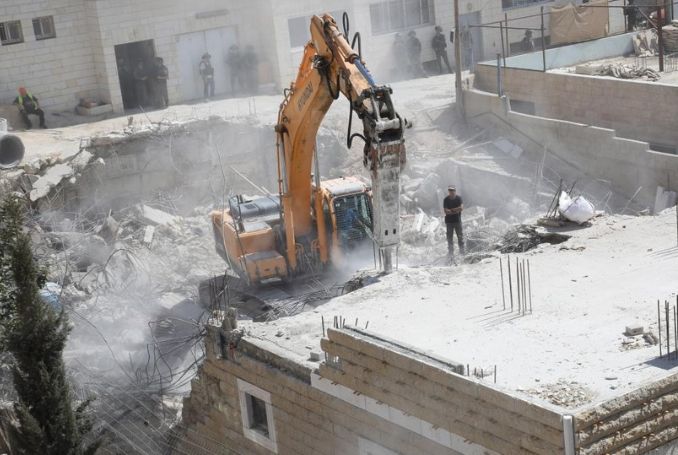
Israeli forces today took measurements of 16 Palestinian residential buildings slated for demolition in Wadi al-Hummus neighborhood, located on the edge of Sur Baher, southeast of the occupied city of Jerusalem.
Head of the Wadi al-Hummus Committee Hamada Hamada told WAFA that Israeli forces along with staff from the so-called Israeli municipality took measurements of the 16 buildings, which comprise of 100 apartments, in preparation to demolish them as was confirmed one of the owners Mohammed Abu Tair.
This step, Hamada explained, came after the period given by Israeli authorities to the owners to demolish their apartments on their own came to an end today, thus the demolition will be carried out at any moment.
The owners are expected to pay exorbitant demolition fees as the Israeli authorities will carry out the demolition.
The Israeli high court has recently approved the demolition of the buildings, thus upholding military allegations that the buildings are “close to the Annexation Wall” and “pose a security threat” due to their proximity to the illegal wall.
Palestinian appeals to demolition orders are frequently dismissed by Israeli courts, which are in fact complicit in perpetuating the Israeli policies of forcible transfer and ethnic cleansing of Palestinians.
The demolition is expected to have a disastrous effect on all other areas of the West Bank adjacent to Israel’s wall, putting these areas at a high risk of mass demolitions under security pretenses and putting the lives of Palestinians living in such areas at the risk of imminent forcible transfer.
2020 presidential candidates’ views on Israel – Montage
If Americans Knew | July 17, 2019
The New York Times videotaped 21 presidential candidates’ responses to the question: “Do you think Israel meets international standards of human rights?” This is a short montage of their answers.
For more information see https://iakn.us/2Ya0pGe
Featured Video
The Search for Truth: Charlie Kirk’s Assassination One Year Later
or go to
Aletho News Archives – Video-Images
From the Archives
Did Israel Kill the Kennedys?

By Laurent Guyénot • Unz Review • June 3, 2018
Introduction
Just after midnight of June 6, 1968, Senator Robert Kennedy was assassinated in a backroom of the Ambassador Hotel in Los Angeles. He had just been celebrating his victory at the California primaries, which made him the most likely Democratic nominee for the presidential election. His popularity was so great that Richard Nixon, on the Republican side, stood little chance. At the age of 43, Robert would have become the youngest American president ever, after being the youngest Attorney General in his brother’s government. His death opened the way for Nixon, who could finally become president eight years after having been defeated by John F. Kennedy in 1960.
John had been assassinated four and a half years before Robert. Had he survived, he would certainly have been president until 1968. Instead, his vice-president Lyndon Johnson took over the White House in 1963, and became so unpopular that he retired in 1968. Interestingly, Johnson became president the very day of John’s death, and ended his term a few months after Robert’s death. He was in power at the time of both investigations.
And both investigations are widely regarded as cover-ups. In both cases, the official conclusion is rife with contradictions. We are going to sum them up here. But we will do more: we will show that the key to solving both cases resides in the link between them. And we will solve them beyond a reasonable doubt. … continue
Blog Roll
 Aletho News
- Putin Conveys to Trump Iran’s Vision on Possible Conflict Resolution – Kremlin
- The Search for Truth: Charlie Kirk’s Assassination One Year Later
- ‘Harsh reality’: Iran says France seeks monopoly on power and intimidation, not peace for all
- When Will This White House Madness End?
- Huckabee aide goes to ‘unusual lengths’ to portray ‘Israel’ positively
- Trump Announces Diesel Supply Deal With Putin Following Phone Call
- MEP blasts ‘Euro-Gestapo’ for lecturing Russia on democracy
- Syria May Send Troops to Saudi Arabia Amid War with Ansar Allah
- UK whines about losing billions to ‘Putin tax’
- Baghaei to Rubio: Distorted narratives cannot erase US record of broken commitments
- If Americans Knew
- Gaza ceasefire exists in name only, say more than 100 organizations
- Nearly 2 Million in Gaza Need Urgent Shelter Assistance as Winter Looms: IOM Chief Warns
- Suppressing Palestinian resistance: US charity under fire for AI monitoring of Gaza classrooms
- Thousands Are Held in Israeli Torture Camps. This Is What Happens Inside
- Israel puts Gaza’s sick, injured, newborn in peril – Daily Update
- Report claimed Mark Levin used by Israeli government to influence Trump
- Over 2,000 Gazans have died awaiting medical evacuation amid Israel’s continued siege
- How a U.S. Diplomat Suppressed and Altered Reports Critical of Israel
- 5 Palestinians Die from Israeli Strikes in Gaza as Relentless Attacks Continue
- Report: Ceasefire Slows Killing but Leaves Devastation Intact
- No Tricks Zone
- New Study: 50 Years Of The Most Aggressive ‘Net Zero’ Policies Can Only Affect The Global Climate By 0.03°C
- US September “Heat” Was No Record…Many Records Set Decades Ago
- Latest European Green Energy Debacle; Portugal’s Largest Flagship Solar Park Insolvent!
- Green Energy Debacle: German Expert Professor Fritz Vahrenholt Warns Of Severe Economic And Social Consequences
- Two More Paleo Reconstructions Affirm Meters-Higher Sea Levels Across Ireland, Brazil 7000-6000 Years Ago
- New Study: Earth And Venus Surface Warmth Largely Explained By Convection And Lapse Rate, Not CO2 Or Radiation
- 2025 Nature Paper Claiming Worsening Global Drought Gets RETRACTED …Heavily Flawed
- New Study: ‘Global Drought Shows No Detectable Recent Acceleration Under Climate Warming’
- Economic Masterminds: German Socialists Suggest Taxing Productivity Gains Stemming From Using AI
- The South China Sea Has Not Been Cooperating With The Climate Change Narrative

