Facebook bans British anti-immigrant groups including EDL, BNP and Britain First
RT | April 18, 2019
Facebook has banned 12 high-profile, anti-immigrant British organizations and individuals including the English Defence League, the British National Party, Britain First and Jayda Fransen.
The silicon valley company said it took the decision because it bans users who “proclaim a violent or hateful mission or are engaged in acts of hate or violence.”
“Individuals and organisations who spread hate, or attack or call for the exclusion of others on the basis of who they are, have no place on Facebook,” it said in a statement.
The following organizations and people are now prohibited from the site: The British National Party and Nick Griffin, Britain First and Paul Golding and Jayda Fransen, English Defence League and Paul Ray, Knights Templar International and Jim Dowson, National Front and Tony Martin, and Jack Renshaw.
They were all outlawed under Facebook’s ‘Dangerous Individuals & Organisations policy’. They will no longer be allowed a presence on Facebook or Instagram and posts and other content which expresses praise or support for them will also be banned.
“Our work against organised hate is ongoing and we will continue to review individuals, organisations, pages, groups and content against our Community Standards,” the statement added.
The Knights Templar International said it was “horrified” by the ban, and that it was investigating legal options. “Facebook has deemed our Christian organisation as dangerous and de-platformed us despite never being charged, let alone found guilty of any crime whatsoever,” it said in a statement. “This is a development that would have made the Soviets blush.”
In February the social media giant banned EDL founder Tommy Robinson from its platforms saying the prominent anti-immigration activist repeatedly breached its policies on Hate speech.
Academic: Saudi arrest campaign against Palestinians
MEMO | April 18, 2019
Saudi is carrying out an arrest campaign against Palestinians in the country, an exiled academic has said according to Al-Resalah newspaper.
On Twitter, Said Bin Nasser Al-Ghamdi wrote: “In the kingdom, a new and wide arrest campaign against a number of Palestinians, another number under travel ban, their accounts were frozen and their organisations were confiscated.”
Al-Ghamdi said that these Palestinians are accused of “sympathising with the resistance in Palestine, having an interest in the issue of Jerusalem and Gaza or supporting Hamas.”
He also said that authorities arrested Saudis, who sponsored the Palestinians or employed them in the kingdom.
In early March, Saudi announced the arrest of 50 people over security concerns, they included 30 of its own nationals, six Palestinians and three Jordanians.
Israel is holding 22 Palestinian journalists behind bars: NGO
Press TV – April 16, 2019
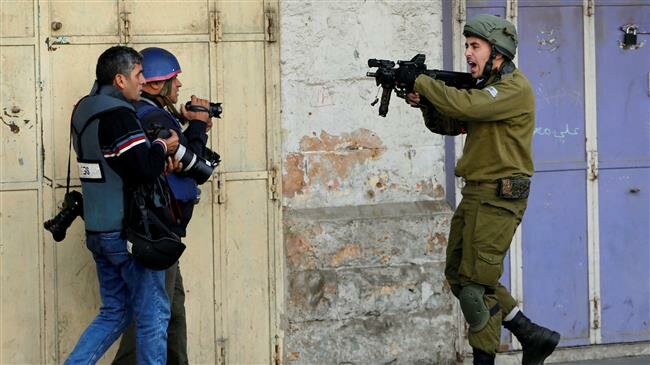
A non-profit organization representing journalists, writers and broadcasters says nearly two dozen Palestinian journalists are currently being held in harsh conditions in Israeli jails contrary to various treaties and international law.
The Journalists Support Committee (JSC), in a statement released on the eve of Palestinian Prisoners’ Day – which is marked on April 17 every year, highlighted that four journalists are being incarcerated under the so-called administrative detention, a policy under which Palestinian inmates are kept in Israeli detention facilities without trial or charge.
“The Israeli occupation arrests [Palestinian] journalists for their opinions and then hauls them before military courts using racist laws,” the statement read.
The JSC further noted that the practice violates international rights conventions guaranteeing freedom of the press.
The NGO then condemned Israel’s practice of arresting journalists or banning them from entering certain areas.
Palestinian journalists Ahmad Abu Hussein and Yaser Murtaja succumbed to Israeli-inflicted gunshot wounds last year, while covering anti-occupation protests along the border between the besieged Gaza Strip and occupied land.
The Tel Aviv regime has thus been seeking a media blackout on the criminal acts of its soldiers, with Israeli cabinet ministers authorizing a contentious bill in mid-June 2018 that would criminalize the filming of certain military activities.
Under the proposed legislation, those found photographing, recording or filming Israeli troops “with the intention of undermining the spirit” of the army “shall be liable to five years imprisonment” and those “intending to harm” Israel’s security could be given 10 years in jail.
The bill, which has been widely censured as an attack on media freedom, needs several parliamentary votes to become law.
In recent months, Israeli troops have on numerous occasions been caught on camera brutally killing Palestinians, with the videos going viral online and sparking condemnations of the regime’s military.
Israel confiscates 51,000 dunams from Jordan Valley

Ma’an – April 16, 2019
TUBAS – The Israeli authorities confiscated 51,000 dunams and isolated five villages in the Jordan Valley area in the northern occupied West Bank, an official in charge of Jordan Valley’s Israeli settlements file at the Palestinian Authority (PA) reported.
Mutaz Bisharat told the Voice of Palestine radio station that the Israeli authorities confiscated 51,000 dunams, isolated 5 villages and seized control over water springs, agricultural machinery and solar cells.
Bisharat added that the Israeli policy is very clear in isolating villages of the Tubas district, pointing out that these areas were marked as closed military areas banning their owners from entering without an Israeli-issued permit.
He stressed that Israel aims to expel Palestinians from the area under its plan to seize the Jordan Valley area.
The Jordan Valley forms a third of the occupied West Bank, with 88 percent of its land classified as Area C — under full Israeli military control.
International rights organizations consider the continuation of the Israeli campaign which targets Palestinians in the Jordan Valley, whether though confiscations, demolitions or evictions under the pretext of holding military exercises, as a violation of international humanitarian law.
Since the beginning of the 1967 occupation of the West Bank, Israel has confiscated hundreds of thousands of dunums by declaring it state land.
Israeli authorities in 1968 banned Palestinians from registering their lands and subsequently took advantage of previously low rates of land registration to confiscate areas currently or previously in use by locals but not registered as such.
The confiscated lands are then used to construct Jewish-only settlements on the land, while further confiscation often uses the pretext of the settlements’ security.
Palestinian prisoners reach agreement to achieve demands, end hunger strike
Samidoun Palestinian Prisoner Solidarity Network | April 16, 2019
Palestinian prisoners have reached an agreement with the Israeli prison administration to achieve their demands and suspend their hunger strike, the Battle of Dignity 2, on Monday, 15 April. The agreement came as hundreds of Palestinian prisoners were engaged in their eighth day of a collective hunger strike.
According to the leadership of the Palestinian prisoners’ movement, the agreement includes the installation of public telephones in the prison sections, which prisoners would be allowed to use three times a week for 15-minute calls, as well as stopping the installation of cell-phone jamming devices. In addition, the repressive measures and sanctions imposed in the past year upon the prisoners will also be lifted, while fines imposed on prisoners in recent struggles inside the prisons would be reduced. Hundreds more prisoners have been set to join the hunger strike in the coming days, especially 17 April, Palestinian Prisoners’ Day.
The Palestinian Prisoners’ Society said that the agreement also included provisions to transfer the women prisoners from Damon prison to another detention center; the prisoners have repeatedly cited harsh, difficult conditions unsuitable for human life in the Damon prison. In addition, sick prisoners would be returned to the previous section in the Ramleh prison clinic, an area that was considered better than their current location.
The National and Islamic Forces held a press conference in Gaza City to highlight the prisoners’ final statement. “The battle is not over; the hardest phase of this struggle is to implement what has been agreed upon,” the prisoners wrote, noting that previous agreements have been repeatedly broken by the Israeli prison administration.
They saluted the prisoners in section 4 of the Negev desert prison and section 1 in Ramon prison who were attacked by Israeli repressive forces, noting that “their great sacrifices underline that freedom and dignity are… human rights that cannot be denied.” They saluted Palestinians in Gaza, the West Bank, occupied Palestine ’48 and exile and diaspora, as well as supporters of freedom around the world, journalists and prisoners’ centers, that stood with the prisoners in their struggle. The statement particularly saluted “the people and leadership in Gaza,” noting their unity in commitment to the struggle.
Samidoun Palestinian Prisoner Solidarity Network expresses its strongest salutes and greetings to all of the Palestinian prisoners on this occasion of victory. These achievements follow on many historical accomplishments of the Palestinian prisoners’ movement, on the front lines of the Palestinian liberation struggle, extracting their victories through great sacrifice, with their bodies and lives on the line. As Palestinian Prisoners Day approaches, we emphasize our continuing dedication to work for the freedom of all Palestinian prisoners and the freedom of Palestine from the river to the sea.

In addition, we urge people around the world to continue their solidarity activities to support the Palestinian prisoners, throughout the coming days, months and years, until their freedom is achieved. In particular, we emphasize the cases of three Palestinian prisoners who remain on hunger strike: Hussam al-Ruzza (61), Mohammed Tabanja (40) and Khaled Farraj (31). Al-Ruzza has been on hunger strike since 19 March – nearly one month – while Tabanja and Farraj have been on hunger strike since 25 March. All are held without charge or trial under administrative detention orders, and their detention has been repeatedly and arbitrarily renewed.
They are among nearly 500 Palestinians out of approximately 5,500 Palestinian prisoners jailed with no charges and no trial for indefinitely renewable periods under administrative detention. The end of administrative detention is a long-time demand of the Palestinian prisoners’ movement and supporters of justice and liberation around the world. Join the call to free Hussam al-Ruzza, Mohammed Tabanja, Khaled Farraj and all Palestinian prisoners!
Medicare for All 64-Year-Olds
By Dean Baker | CEPR | April 12, 2019
The push for universal Medicare was given new momentum by Bernie Sanders campaign for the 2016 Democratic nomination. While it is still quite far from becoming law in even an optimistic scenario, it is certainly now treated as a serious political position. This is probably best demonstrated by the fact that the Medicare for All (M4A) bill put forward by Washington representative Pramila Jayapal has 107 co-sponsors, nearly half of the Democratic caucus in the House.
As much progress as M4A has made, it will still be a huge lift to get it implemented. A universal Medicare system would mean shifting somewhere around 8 percent of GDP ($1.6 trillion at 2019 levels) from the private system to a government-managed system. It would also mean reorganizing the Medicaid program and other government-run health care programs, as well as the Medicare program itself. The current system has large co-pays and many gaps in coverage, such as dental care, that most proponents of M4A would like to fill. It also has a large role for private insurers in the Medicare Advantage program, as well as the Part D prescription drug benefit.
The difficulty of a transition is demonstrated by the fact that there is no agreed-upon mechanism for paying for this expansion of Medicare. Instead of a specific financing mechanism, the Jayapal bill features a menu of options. Actual legislation, of course, requires specific revenue sources, not a menu. The fact, that even the most progressive members of the House could not agree on a financing proposal that they could put their names to, shows the difficulty of the transition.
If it is not likely that we will get to M4A in a single step, then it makes sense to find ways to get there piecemeal. There have been a variety of proposals that go in this direction. Many have proposed lowering the age of Medicare eligibility from the current 65 to age 50 or 60. The idea is that we would bring in a large proportion of the pre-Medicare age population, and then gradually go further down the age ladder. (We can also start at the bottom and move up.)
This sort of age reduction approach is a reasonable incremental path, but going to age 50 or even age 60 would still be a considerable expense. There are over 60 million people in the age cohorts from 50 to 64. Including these people in Medicare at a single point would be a very serious lift. Even the more narrow group from age 60 to 64 still has almost 20 million people. That would a substantial expense.
But we can make the first step even more gradual. We can just add people when they turn age 64 instead of the current 65. At first glance, this would be a bit less than 4 million people. Medicare’s payments per enrollee (net of premiums) are roughly $11,500. That would translate into $46 billion annually, roughly 1.0 percent of the total budget.
But this is likely to hugely overstate the actual cost for two reasons. First, many 64-year olds will already have their insurance covered by the government. Roughly 20 percent of this age group is on Medicare as a result of being on Social Security disability. At least 10 percent more is covered by Medicaid. If we add people who are getting insurance as current or former government employees, we would almost certainly get over 40 percent already being insured through some government program, and possibly as high as 50 percent.
In addition, the Medicare costs for the new group of 64-year-olds are likely to be far less than the overall average. On average, people in this age group would have health care costs of around 70 percent of the over 65 population as a whole. But the least healthy portion of the 64-year-old population is likely already covered by either Medicare, as a result of disability, or Medicaid.
If we assume that the average costs for the people we are adding to the government’s tab are half of the overall average for Medicare, this gets us $5,750 per person. If we assume that we are adding 60 percent of this age group, that comes to 2.4 million people. That gives us a total tab of $13.8 billion, less than 0.3 percent of total spending, or roughly the amount the Pentagon spends in a week. It would be pretty hard to argue that this is not an affordable tab.
If even that expense proves too much for the deficit hawks to handle, then maybe we can move up the age of eligibility by one month or one week. At that point, we’re talking about the cost of a few weekends for Donald Trump at Mar-a-Lago.
Doing this one-year reduction in the Medicare age would be a test of how easily a reduction in the age of eligibility can be done. It should open the door to further reductions in future years. It is also likely to be popular politically. People in their late 50s and early 60s will surely appreciate the fact that they are one year closer to qualifying for Medicare. That is especially likely to the case with people who do not have good insurance through their employer and/or have serious health conditions.
The proposal for a one-year reduction in the age of eligibility should also help to clarify where things stand within the Democratic caucus. Many members have argued against having the party endorse M4A.
Some of this opposition undoubtedly reflects realistic political concerns that a quick switchover from the current system to M4A will not be popular in many districts. Many people are satisfied with the insurance they have now and will be reluctant to support what they will view as a big leap into the unknown. Perhaps these people can be convinced over time that a universal Medicare-type system will be at least as good for them, but they are not there now.
However, some of the pushback stems from the fact that many Democrats have long depended on campaign contributions from the health care industry. While the party has not gotten as much money as the Republicans, many members do get substantial contributions, which they are not prepared to abandon.
Medicare for All 64-Year-Olds should be a great way to clearly identify these people. They can’t have a principled objection to moving up the age of Medicare eligibility by one year. Nor can they plausibly claim that this is some budget-busting proposal. Congress routinely approves spending increases of this size for the military without batting an eye.
If some Democrats in Congress dig in their heels and insist that Medicare for All 64-Year-Olds is something that they cannot support, it is not because they are afraid that it won’t work. It’s because they are afraid that it will.
Of course, lowering the age of Medicare eligibility is not the only thing that we should be doing as part of near-term health care reform. We should look to open Medicare to the population as a whole on a voluntary basis. We should also look to make the subsidies under the Affordable Care Act more generous. And, we should be looking to bring our payments for prescription drugs, medical equipment, and doctors more in line with payments in other wealthy countries.
We pay twice as much in all three areas as other wealthy countries. There is no justification for such massive overpayments in the United States. In the case of prescription drugs and medical equipment, in the short term, we should adopt the same sort of price controls as are used in other countries. In the longer term, we should be moving away from patent monopoly financing for the development of these items. We should instead do direct upfront public funding, with the idea that these products will in the future be sold as generics at free market prices (see Rigged, chapter 5 [it’s free]).
But lowering the Medicare age to 64 is a really big first step. It is also a great way of clarifying the debate by letting us know which Democrats work for the health care industry.
Gradually Re-establishing Historical Truth about Jeju Uprising
By Konstantin Asmolov – New Eastern Outlook – 14.04.2019
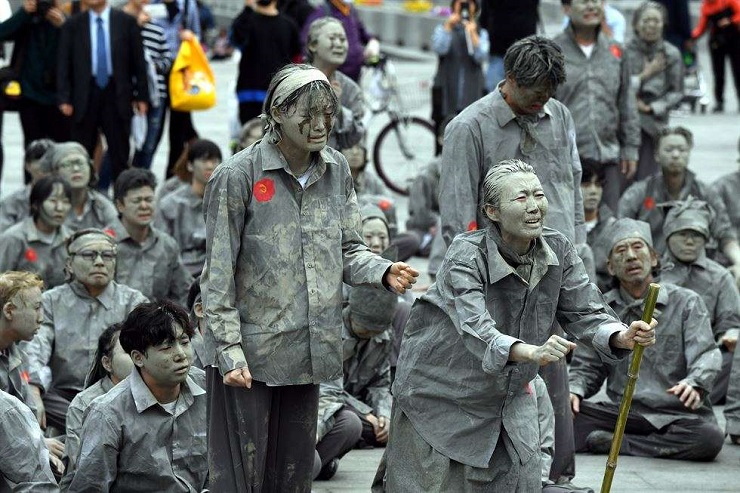
On 3 April, 2019 a commemoration ceremony to honor victims of a bloody suppression by government forces of the people’s uprising in 1948-1954 was held on the island of Jeju. More than 10,000 people, including representatives of the government and the National Assembly, revolt participants and offspring of the victims of its clampdown, took part in the memorial. South Korea’s Prime Minister, Lee Nak-yeon, gave a speech at the ceremony. He proposed to honor the memory of all those lost and expressed his deepest condolences to their families. The minister also referred to the incident in Jeju as the worst event in South Korea’s modern history. Lee Nak-yeon emphasized that Moon Jae-in’s administration has undertaken the monumental task of uncovering the truth behind the Jeju massacre, and of restoring the victims’ dignity.
The head of South Korea’s National Police Agency, Min Gap-Ryong, participated in a commemoration ceremony in Seoul. He wrote the following words in the visitor’s book: “I humbly share my condolences before the spirits of all those innocent people who were killed during Jeju April 3, and I respectfully share my wishes that they rest in peace.” Vice Minister of National Defense Seo Joo-seok, who made the aforementioned statement, was also in attendance. He highlighted that the army was fully committed “to the government investigation efforts going forward” and would “take part in healing the wounds and suffering of the family members while restoring the honor of those who were slain”. This was the first comment about the incident made by a South Korean military agency.
Officially, at least 10,000 Jeju residents were killed and almost 3,600 went missing, as a result of the tragedy that stemmed from Korea’s ideological split following its emancipation from Japanese colonial rule, which lasted from 1910 to 1945. In reality, the situation was even more complex. Propaganda from both North and South Koreas portray the uprising as a communist revolt against elections, which were to take place in the South on dividing the peninsula. However, in reality, the uprising was instigated by actions of the police and agitators from so-called “youth groups”, who used racketeering and violence to bring the region, with a powerful left-wing movement, under control.
South Korea’s current strategic policy has its origins at the start of the rebellion, 1 March 1947, when a child who suffered a blow from a police horse’s hoof died during a street protest in celebration of May Day. This led to a confrontation with the police and the crowd was fired on. In response, the Workers’ Party of South Korea declared a general strike. Instead of calming people down, the government made a decision to destroy the left-wing forces once and for all, which led to an even tougher response from the people.
On 3 April 1948, more than 350 armed civilians simultaneously attacked 12 police precincts and homes of representatives of legislative bodies, in order to free detained relatives and force the government to reconsider its policy. The leadership reacted even more violently in turn. Death squads mercilessly dealt with protesters and local residents who helped them. On 17 October 1948, a ban on movement in inner and mountainous regions of the island, with the exception of its 5-km coast line, was introduced. All the villages outside this perimeter were completely destroyed and so were their residents if they refused to leave these territories. 2,500 islanders were imprisoned although there were no charges against them or any written verdicts.
The bloodshed continued during the Korean War too. The truth is, however, in 1953 armed units had only approximately 60 people in them, and by the beginning of 1954, this number decreased to 5. 21 September 1954 is viewed as the last day of the uprising, when the ban on movement was finally lifted. The last guerrilla member was arrested on 2 April 1957.
Since a substantial portion of the population was massacred, and their bodies were often submerged or burned, the number of estimated victims ranges from 14,000 to 30,000 people. And if those who were indirectly affected by the government’s crackdown (i.e. victims of hunger or subsequent social cleansing) are added to the total, the number is even higher. Incidentally, only 14% of protesters were killed.
For decades after the uprising, memories of this event and the atrocities committed during the rule of Syngman Rhee were hidden from the public by means of censorship and repression. And only on 12 January 2000, a Special Act was decreed, in accordance with which a truth committee was established to investigate the Jeju massacre and to exonerate its victims. Approximately 14,000 people applied to have the status of a victim of those events. On 28 August of the same year, the special committee for investigating causes of death of the residents and their exoneration began their work.
In 2006, Roh Moo-hyun’s government issued an official apology for its role in the massacre. The leadership also promised reparations for the victims, but by the end of 2018 nothing had been done to this end.
On the plus side, a lot of work is being done to clear the good name of people, who, during the uprising, were preemptively jailed and tortured, without a single charge brought against them. Those who were released had to live under the umbrella of suspicion. And, finally, in January 2019, the Jeju District Court dismissed military court’s rulings with regard to the 18 plaintiffs, who survived, and recognized them as victims instead. The accusations levelled against them were deemed unsubstantiated since the military court did not follow prescribed legal procedures. This conclusion, in the opinion of those who issued the verdict, is supported by the fact that the plaintiffs were not aware of the criminal charges against them. Also the sheer number of people brought before the military courts-martial within a short period of time indicated relevant investigations were unlikely to have been carried out.
The plaintiffs demanded that their cases be reviewed as far back as 2017, as they claimed to have been arrested and jailed for a period of up to 20 years without as much as a fair trial. Since that time not a single court record has been found to indicate why the plaintiffs received such harsh sentences. Even after researchers had travelled to the peninsula and accessed central archives, they were unable to find any existing records about the investigation at that time. It turns out that people were detained and tortured without being charged for any crimes , which is consistent with the practice of preemptive arrests.
The court decided to retry the case in September 2018 due to renewed interest in the incident following the commemoration of its 70th anniversary and the official apology issued by President Moon Jae-in.
A few months later, on 17 January 2019, the Jeju court exonerated all the participants of the people’s uprising on 3 April 1948, who had served the sentences handed down to them by the military courts-martial.
This policy, exercised by Moon Jae-in’s government towards residents of Jeju, is part of a common trend. As part of this new shift, “a former police investigation building in Namyeong-dong, Seoul”, where intelligence agents “tortured hundreds of pro-democracy” and anti-government “activists in the 1970s and 1980s, has been turned into a memorial hall for human rights and democracy.” The Ministry of the Interior and Safety plans to outsource the building’s “operation to the Korea Democracy Foundation”. Prime Minister Lee Nak-yon participated in the transfer ceremony, along with Minister of the Interior and Safety Kim Boo-kyum; Seoul Mayor Park Won-soon; Commissioner General of the Korean National Police Agency Min Gap-Ryong, and victims of torture and their family members.
In 1976, the anti-communism investigation division office was located where the current facility stands now. During both the Park Chung-hee and Chun Doo-hwan administrations, the building was used to detain, interrogate and torture anti-government activists. Over a period of approximately 30 years, a combined total of 391 activists were tortured there. Their ranks included Seoul National University student Park Jong-chul, whose death resulted in mass protests that led to the fall of the Fifth Republic of South Korea.
In response to criticism, in 2005 the National Police Agency closed the Namyeong-dong division and transformed it into a human rights police center. However, civic groups demanded that the police stop operating this facility. This process began in earnest in June 2018, when Moon Jae-in promised to convert the building into a memorial for human rights and democracy.
In his speech, Prime Minister Lee Nak-yon said that Namyeong-dong “will forever contribute to the people and history as a place to warn against the state’s abuse of power”.
A similar policy is being used with respect to persecuted members of the Bodo League. This political organization was comprised of “re-educated” left-wing activists. But once the Korean War began, most of its members were subject to repression (as a preventative measure), and the majority were executed by firing squads. Groups, such as the Korean War Bereaved Family Members’ Association, claim that after this war 200,000 members of the League were killed throughout the country.
Numerous testimonies from family members of victims paint a grim picture: activists were gathered together under the pretense of going on an excursion to the mountains or to a ceremony. They were then transported out of town or city, executed by a firing squad and buried in unmarked graves.
Only in June 2014, did a number of residents gather enough courage to corroborate evidence of a civilian massacre, which local witnesses remembered. They carried out an excavation and unearthed burial sites, but there have not been any official exhumations so far.
On 22 June 2016, a testimony by prosecutor Song Jung-won (1918-2014), who is viewed as the founder of the Bodo League, became public knowledge. On 18 October 2007, he testified in front of the Truth and Reconciliation Commission and said that many members of the League were not partisans and, in fact, did not even know what a communist party was. As a rule, these were simple peasants or intellectuals, who wished to expunge the “Red Menace” label from their family name.
Civilian activists think this testimony may be viewed as proof of the fact that the government massacred countless numbers of innocent people knowing full well that they were not members of the Communist Party.
In addition, as far back as 2009, the Truth and Reconciliation Commission confirmed mass killings of at least 3,400 civilians and inmates held in prisons in Busan, Masan and Jinju from July to September 1950. Jail employees, police officers and members of counterintelligence services took part in these reprisals. Victims were either killed inside prisons or taken to the mountains, executed, and their bodies were disposed of in the sea. Only in a few cases were executions carried out after an official sentence was handed down by a military tribunal. Incidentally, most of these victims were prisoners sentenced to less than three years in jail, and they were killed only because of concerns that they would collaborate with DPRC.
Most investigations of this nature were conducted in the course of the work performed by the Truth and Reconciliation Commission. It was established in December 2005 and tasked with researching information connected with the anti-Japanese independence movement; mass killings of civilians during the Korean War, and violation of human rights by government forces during the military dictatorship. During a fairly short 5-year period, the commission uncovered the truth about 8,468 cases by concluding that extrajudicial massacres had taken place during the Korean War and earlier. In addition, the commission ascertained that evidence in a number of espionage cases from the 1980s was either distorted or completely fabricated.
However, during Lee Myung-bak’s presidency the work conducted by the Truth and Reconciliation Commission was discontinued. The final report highlighted the fact that both sides were responsible for atrocities, but failed to mention the fact that there were twice as many victims of the “White Terror”, and many culprits were absolved of responsibility. “As a result, true reconciliation and reckoning with the past ended up being put off until another day.”
And now, possibly, this day has arrived. Although old political myths often have a tendency to transform into new ones during Moon Jae-in’s presidency, hope remains that the final picture will be an accurate reflection of the historical truth.
Konstantin Asmolov, Ph.D. in History, is a leading research fellow at the Center for Korean Studies of the Institute of the Far East at the Russian Academy of Sciences.
Euro-Med to EU: Stop funds for project serving Israeli settlements
Ma’an – April 13, 2019
BETHLEHEM – The Euro-Mediterranean Human Rights Monitor (Euro-Med) sent an urgent letter to the European Union’s European Commission regarding their participation in funding EuroAsia Interconnector, a power transmission project aiming to build the infrastructure necessary to link energy sources between Israel, Cyprus, and Greece.
The project, expected to be implemented in June 2019 with an estimated budget of 3.5 billion Euros, will not only link the electricity infrastructure between Israeli cities with Greece and Cyprus, however, will also include illegal settlements in the occupied Palestinian territories, including occupied East Jerusalem.
According to a Euro-Med press release, the EU has been labeled as one of the financiers and supporters of the project that nurtures and strengthens settlements built illegally on Palestinian lands in the West Bank and Jerusalem, a move that shows sheer disregard for international law and amounts to complicity in Israeli war crimes and crimes against humanity.
Audrey Ferdinand, Euro-Med’s legal researcher, said, “The EU must adhere to its legal obligations under international law, including by not violating its own long-held commitment to a two-state solution.”
Ferdinand stressed, “While Israel is working on projects to boost its energy sources, it denies Palestinians access to basic needs such as energy and clean water,” calling on the EU to “respect its international obligations and not to establish partnerships with states violating international human rights law and international humanitarian law for decades.”
Euro-Med expressed deep shock and surprise at the contradictory policies and non-neutral practices of the European Union. On the one hand, it funds projects to help Palestinians suffering under occupation, it also funds projects that serve Israeli settlers, calling the move as setting for a “double-standard logic.”
Euro-Med called on the European Union to seriously reconsider its policies that are biased to the Israeli authorities at the expense of the Palestinian people, to uphold its human rights obligations and to rise above the discourse of selfish interest, to stop the project, especially as Israel continues to expand its illegal settlement activities in the West Bank and East Jerusalem, and not reward them for such infamous record of human rights abuse.
WHO calls for protection of health workers, facilities in Gaza

Ma’an – April 13, 2019
BETHLEHEM – The World Health Organization (WHO) called for the protection of health workers and health facilities in the besieged Gaza Strip, following a rise in the number of health workers killed or injured and facilities damaged by Israeli army gunfire.
WHO said in a press statement that it has recorded an unprecedented “446 attacks on health care in Gaza since the start of ‘The Great March of Return’ on 30th March 2018.”
Who stressed that these attacks have resulted in three deaths and 731 injuries among health workers, in addition to 104 ambulances and six other forms of health transport have been damaged, as well as five health facilities and one hospital.
In addition to personal risk and damage to health care, health workers also face substantial barriers to carrying out their work: firing between health workers and those injured prevents or hampers access and witnessing such events has significant implications for longer term mental health and continued work.
WHO concluded, “WHO reiterates its call for the protection of health workers and health facilities. Health care is #NotATarget.”
Yet Another Senator from Israel

Cory Booker shines at AIPAC
Philip Giraldi • Unz Review • April 9, 2019
How do you take a typical progressive and turn him or her into a fascist? One possible way is to send the poor bastard off on an all expenses paid trip to Israel where a meticulously crafted and sophisticated brainwashing program will make one believe almost anything regarding the noble and God-chosen Israelis versus the satanic Arab terrorists. Add into that the fact that being pro-Israel is a plus in many career fields and it is easy to understand why a monster like Prime Minister Benjamin Netanyahu gets favorable press and commentary in the United States even as he is reviled in most of the rest of the world.
The liberal to fascist metamorphosis is most evident among Democratic Party politicians, who have been successfully targeted by the Israel Lobby and its deep pocketed supporters for many years. It is all part of a massive public relations campaign, which some might instead refer to as disinformation, planned and executed by the Israeli foreign ministry and its diaspora supporters to advance Israeli interests in spite of the fact that the government of Netanyahu has implemented and executed fundamentally anti-democratic programs while at the same time committing war crimes and violating a whole series of United Nations resolutions.
Israel works hard to influence the United States at all levels. Its tentacles dig deep, now extending to local and state government levels where candidates for office can expect to be grilled by Jewish constituents regarding their views on the Middle East. The constituents often insist that the responses be provided in writing. The candidates being grilled understand perfectly well that their answers will determine what kind of press coverage and level of donations they will receive in return.
One of the most blatant propaganda programs is the sponsorship of free “educational” trips to Israel for all newly elected congressmen and spouses. The trips are normally led by Israel boosters in Congress like Democratic House Speaker Steny Hoyer, who recently boasted at an AIPAC gathering how he has done 15 trips to Israel and is now preparing to do another with 30 Democratic congressmen, including nearly all of those who are newly elected. The congressional trips are carefully coordinated with the Israeli government and are both organized and paid for by an affiliate of the American Israel Public Affairs Committee called the American Israel Education Foundation (AIEF). Other trips sponsored by AIEF as well as by other Jewish organizations include politicians at state and even local levels as well as journalists who write about foreign policy.
As noted above, all the trips to Israel are carefully choreographed to present a polished completely Israel-slanted point of view on contentious issues. Visits to Palestinian areas are arranged selectively to avoid any contact with actual Arabs. Everyone is expected to return and sing the praises of the wonderful little democracy in the Middle East, which is of course a completely false description as Israel is a militarized ethno-theocratic kleptocracy headed by a group of corrupt right-wing fanatics who also happen to be racists.
Even progressive politicians who are aware that the Israeli message is bogus and also resent the heavy handedness of the Israelis and their diaspora friends often decide that it is better to go along for the ride rather than resist. But some embrace it enthusiastically, like Senator Cory Booker of New Jersey, a liberal Democrat running for his party’s nomination for president, who has, by his own admission, visited Israel many times. Israel and its friends are, of course, both courting and promoting him assiduously.
Booker inevitably reminds one of ex-President Barack Obama because he is black but the similarity goes beyond that as he is also presentable, well-spoken and slick in his policy pronouncements. One suspects that like Obama he would say one thing to get elected while doing something else afterwards, but we Americans have become accustomed to that in our presidents. More to the point, Booker was and is a complete sell-out to Israel and its Jewish supporters during his not completely successful career in New Jersey as mayor of Newark as well as in his bid for the presidential nomination. Booker is a close friend of the controversial “America’s rabbi” Shmuley Boteach and has taught himself enough Hebrew to pop out sentences from Torah with Jewish audiences.
Last week the Intercept published a secret recording of Booker meeting with a group of Jews from New Jersey at the recently concluded AIPAC summit in Washington, which Booker, unlike a number of other Democratic presidential hopefuls, attended enthusiastically. Booker pandered so assiduously that it is hard to believe that he actually knows what he is saying in an effort to be more Israeli than the Israelis. He described an Israel that deserves total commitment from Washington and stated clearly that he wants to create a “unified front” against the nonviolent boycott movement (BDS). He said that there is “no greater moral vandalism than abandoning Israel.”
Phil Weiss on Mondoweiss sums up the high points of what Booker said and did not say in the meeting: “Donald Trump is endangering Israel’s security in Syria; there is no ‘greater moral vandalism’ than dividing the U.S. and Israel; Booker would cut off his right hand before abandoning Israel; he lobbied black congresspeople not to boycott Netanyahu’s 2015 speech because we need to show a ‘united front’ with Israel; AIPAC is an ‘incredible… great’ organization whose mission is urgent now because of rising anti-Semitism; he ‘text messages back and forth like teenagers’ with AIPAC’s president Mort Fridman; and he swears to uphold bipartisan support in the Congress for Israel and give it even more money. And Booker says not one word about Palestinian human rights or Israel’s persecution of Palestinians. That’s right. A progressive senator who invokes Martin Luther King Jr. over and over again has not one word to say about the Jim Crow status of Palestinians while describing Israel as a ‘country that I love so deeply, that changed my life from the day I went there as a 24 year old.’”
Booker elaborated in his own words: “Israel is not political to me. It’s not political. I was a supporter of Israel well before I was a United State Senator. I was coming to AIPAC conferences well before I knew that one day I would be a federal officer. If I forget thee, o Israel, may I cut off my right hand.”
Booker described how he is appalled by the rise of alleged anti-Semitic incidents in the U.S. and worldwide. Rather than using that possible development as leverage to get Israel to behave more humanely, he instead prefers to punish all Americans with new legislation intended to strip all everyone of their First Amendment rights. Per Booker “We must take acts on a local stage against vicious acts that target Israel. That’s why I’m cosponsor of Senate Bill 720. Israel anti-Boycott Act.”
Normally progressive Booker, who has criticized the endless war in Afghanistan on the campaign trail, has hypocritically condemned Trump for not continuing war in Syria to protect Israel, saying
“This administration’s seeming willingness to pull away from Syria makes it more dangerous to us, makes it more dangerous to Israel, and this is not sound policy…. When you’re tweeting about pulling out of Syria within days, when that would create a vacuum that would not only endanger the United States of America but it would endanger our ally Israel as well. We need a comprehensive strategy for that region because Israel’s neighborhood is getting more dangerous than less. Syria is becoming a highway for Iran to move more precision guided missiles to Hezbollah. There has got to be a strategy in this country to support Israel that is bipartisan that is wise and that frankly calls upon all the resources of this country, not just military”.
And because Israel always needs more money, Booker is ready to deliver: “Unequivocally 100 percent absolutely [yes] to the 3.3 billion [a year]. I have been on the front lines every time an MOU is up to make sure Israel gets the funding it needs. I even pushed for more funding.”
Do we need a man like Cory Booker as President of the United States? He is articulate enough to cite “moral vandalism” but not perceptive enough to take the concept one step further and appreciate that uncritical close ties to Israel’s feckless and fascist government could easily lead to a nuclear war that would constitute something far worse. He further believes that Israel’s hand deep in the U.S. Treasury is a desirable policy, that unlimited “all resources” support of Israel is a U.S. national imperative, that ending the continued American military presence in the Middle East “would endanger our ally” Israel, and that moves to nonviolently oppose Israel’s oppression of the Palestinians must be made illegal.
One does not see an actual American interest in any of that, but perhaps special spectacles made in Israel are needed, an environment where Booker has clearly spent a great deal of time both physically and metaphorically. Or maybe it’s the Benjamins. Booker will need millions of dollars to mount his campaign and he knows where to go and what he needs to say to get it.
One struggles to see just a tiny bit of humanity in Booker vis-à-vis the Arabs who have lost their homes and livelihoods to Israeli criminality, but none of that comes through in a session in which, admittedly, the Senator from New Jersey is speaking with his Jewish donor/supporters. Booker is on record favoring an Israel-Palestine “two state solution,” which is no longer viable, though he has not objected to Israeli army snipers shooting dead children, journalists, medical personnel and unarmed protesters in Gaza. Frankly, we already have an American leader who puts Israel first in Donald Trump and we don’t need another round of wag the dog in our next president. Cory Booker should work hard to maintain his perfect attendance record at AIPAC as he texts “like a teenager” with Mort Fridman, but maybe someday he will actually grow up and learn to think for himself. As he is a U.S. Senator that certainly is something we might all hope for.
Philip M. Giraldi, Ph.D., is Executive Director of the Council for the National Interest, a 501(c)3 tax deductible educational foundation that seeks a more interests-based U.S. foreign policy in the Middle East. Website is councilforthenationalinterest.org, address is P.O. Box 2157, Purcellville VA 20134 and its email is inform@cnionline.org.
Journalists worried as new UK law could send citizens to jail for going to terror hotspots
RT | April 12, 2019
New UK counter-terrorism legislation could see Britons face up to 10 years in jail if it’s proven they have entered or remained in a “designated area” overseas, as free press campaigners warn British journalists face arrest.
Coming into force on Friday, the Counter-Terrorism and Border Security Act 2019, will give UK border guards enhanced powers to stop and search individuals without suspicion, on the grounds of tackling “hostile state” activity.
UK ministers unveiled the sweeping new proposals last year in a bid to tackle the threat from so-called foreign fighters. The act allows Home Secretary Sajid Javid to designate an area, dependent on parliamentary approval.
There are exemptions written into the legislation to protect those that have legitimate reasons to be in ‘designated areas,’ but campaigners fear that varying interpretations of the new laws could see journalists being locked up.
Free press and free speech groups, including Reporters Without Borders and Index, warn that due to the vague nature of the new counter-terrorism act, it could lead to a crackdown on journalists’ freedom to travel if they fail to answer questions.
A journalist taking a domestic flight could be stopped without any suspicion of wrongdoing. It would be an offence for the journalist not to answer questions or hand over materials, with no protection for confidential sources.
A UK cross-party committee report on human rights last year, warned the government that the new powers on counter-terrorism risk crossing the line on human rights, restrict freedom of speech and place obstacles on access to information.
Featured Video
The Search for Truth: Charlie Kirk’s Assassination One Year Later
or go to
Aletho News Archives – Video-Images
From the Archives
The 9/11 “Double-Cross” Conspiracy Theory
BY LAURENT GUYÉNOT • UNZ REVIEW • SEPTEMBER 6, 2022
Is it true that “9/11 was an inside job”? Yes, insofar as Israel is “inside” the U.S. But for the 9/11 truthers who have identified Israel as the main perpetrators, “9/11 was an inside job” is at best a half-truth, and at worst an integral part of the Zionist operation, like a secondary flag sewn as a lining under the false flag of Islamism. Victor Thorn (1963-2017) wrote in his book 9/11 made in Israel: The Plot Against America (2011): “In essence, the ‘9-11 truth movement’ was created prior to Sept. 11, 2001 as a means of suppressing news relating to Israeli complicity. . . . The slogan ‘9-11 was an inside job’ was quite possibly the greatest example of Israeli propaganda ever devised.” In milder terms, it is “controlled opposition”.
A genuine truth movement would have pointed to Israel as the prime suspect from the start. From day one, it was obvious who would benefit. … continue
Blog Roll
 Aletho News
- Europe’s mounting social chaos… chickens coming home to roost for proxy war against Russia
- US-Russia Diesel Deal Becomes Massive Defeat for Ukraine
- Hormuz and the Looming Economic Catastrophe
- Dhubab offensive, media blitz and the rapid unraveling of Saudi-backed coalition’s new gambit
- Putin Conveys to Trump Iran’s Vision on Possible Conflict Resolution – Kremlin
- The Search for Truth: Charlie Kirk’s Assassination One Year Later
- ‘Harsh reality’: Iran says France seeks monopoly on power and intimidation, not peace for all
- When Will This White House Madness End?
- Huckabee aide goes to ‘unusual lengths’ to portray ‘Israel’ positively
- Trump Announces Diesel Supply Deal With Putin Following Phone Call
- If Americans Knew
- Israeli forces kill another child in Gaza – Daily Update
- Gaza ceasefire exists in name only, say more than 100 organizations
- Nearly 2 Million in Gaza Need Urgent Shelter Assistance as Winter Looms: IOM Chief Warns
- Suppressing Palestinian resistance: US charity under fire for AI monitoring of Gaza classrooms
- Thousands Are Held in Israeli Torture Camps. This Is What Happens Inside
- Israel puts Gaza’s sick, injured, newborn in peril – Daily Update
- Report claimed Mark Levin used by Israeli government to influence Trump
- Over 2,000 Gazans have died awaiting medical evacuation amid Israel’s continued siege
- How a U.S. Diplomat Suppressed and Altered Reports Critical of Israel
- 5 Palestinians Die from Israeli Strikes in Gaza as Relentless Attacks Continue
- No Tricks Zone
- New Study: 50 Years Of The Most Aggressive ‘Net Zero’ Policies Can Only Affect The Global Climate By 0.03°C
- US September “Heat” Was No Record…Many Records Set Decades Ago
- Latest European Green Energy Debacle; Portugal’s Largest Flagship Solar Park Insolvent!
- Green Energy Debacle: German Expert Professor Fritz Vahrenholt Warns Of Severe Economic And Social Consequences
- Two More Paleo Reconstructions Affirm Meters-Higher Sea Levels Across Ireland, Brazil 7000-6000 Years Ago
- New Study: Earth And Venus Surface Warmth Largely Explained By Convection And Lapse Rate, Not CO2 Or Radiation
- 2025 Nature Paper Claiming Worsening Global Drought Gets RETRACTED …Heavily Flawed
- New Study: ‘Global Drought Shows No Detectable Recent Acceleration Under Climate Warming’
- Economic Masterminds: German Socialists Suggest Taxing Productivity Gains Stemming From Using AI
- The South China Sea Has Not Been Cooperating With The Climate Change Narrative

