The Zionist Circular Maze
By Gilad Atzmon | December 7, 2018
On Thursday Israel cheered as the EU called on its member states that have not yet done so “to endorse the non-legally binding working definition of antisemitism employed by the International Holocaust Remembrance Alliance (IHRA).”
Israel called this move a “breakthrough,” the European Jewish Congress hailed the declaration as “unprecedented.” Both are correct: the Europeans ‘adoption of the IHRA definition of antisemitism is both a ‘breakthrough’ and ‘unprecedented.’ It confirms that Europe has explicitly abandoned its Athenian ethical ethos.
Rather than declaring its opposition to racism as a universal precept and denouncing all forms of discrimination and prejudice against any group or person of any X’ simply for being X’ (for example, a Jew for being a Jew, a Black person for being Black, a Gay person for being Gay, etc.), the EU has fallen into the most banal trap and subscribed to the primacy of Jewish suffering.
A lot has been written criticising the IHRA definition, how it stifles free speech and treats one particular group as exceptional but I think we have failed to address the most important question the IHRA raises. Why are Jewish institutions so enthusiastic about a definition that clearly extinguishes the Zionist promise to make ‘Jews people like all other people.’ The IHRA validates the vile antisemitic claim that Jews are somehow different than others, as no other people have advocated for nor benefit from an IHRA-like definition of prejudice directed solely against them. One should wonder why Jewish institutions see a need to impose such a definition on individuals, organisations, states and even continents.
The answer is circular. Jewish institutions need the IHRA definition simply because they have managed to impose such a definition — since the acceptance of the IHRA definition points at boundless political power, the IHRA definition serves to target and suppress any exploration, discourse or even discussion of such power.
This reflexive reasoning recalls the old rude joke; ‘why does a dog lick its testicles? Because it can.’ Why does the Lobby impose the IHRA definition on us? Because it can.
I wish the effects were merely so simple. The dog joke is amusing because it hints that if men could indulge in a similar gratifying act, the world would be somehow calmer and friendly like the happy dog. The joke is basically a comical illustration of Freud’s pleasure principle. But the IHRA definition is neither funny nor pleasing. It is hardly gratifying for those who have endorsed it, and in some cases its adoption has involved a chain of abuse and harassment (in the British Labour Party, for instance). While the dog is thrilled or titillated by his own act, it is not clear whether Europeans and Americans are at all happy to have to endorse a ‘non legally binding definition’ imposed on them by a powerful foreign lobby. It is reasonable ask why the EU Council has adopted a non universal definition of racism. It has done so because it doesn’t have another option.
This state of affairs is far from simple, harmonious or peaceful. It is in fact, pretty much a situation that incites instability, fear and anger.
Hamas thanks UN member states for foiling US draft resolution
Palestine Information Center – December 7, 2018
GAZA – The Hamas Movement has expressed its appreciation to all the countries that opposed on Thursday the US-drafted resolution on the Palestinian resistance at the UN General Assembly and defended the justice of the Palestinian cause.
In a statement, Hamas stressed that the real terrorism that must be confronted and condemned by all countries is Israel’s occupation of the Palestinian land.
The Palestinian resistance movement called for condemning Israel’s occupation of the Palestinian land, its displacement of millions of Palestinians from their areas and homes, the massacres and crimes it had committed against them, its Judaization activities in Jerusalem, its construction of settlements, and its refusal to allow Palestinian refugees to return to their homes.
Hamas also urged the countries that voted for the US draft resolution at the General Assembly to reconsider their positions and correct what it described as “the historic and dangerous mistake against the oppressed Palestinian people.”
Unz Goes Nuclear
By Israel Shamir • Unz Review • December 6, 2018
Some discoveries are just too shocking to digest. Recently I wrote of intrepid Ron Unz, the Californian maverick publisher and IT-genius, who dared to share with his readers his insights into the ideas and motifs of revisionists, or Holocaust Deniers, as their enemies call them. But this absolutely verboten topic fades into irrelevance in comparison with his most momentous discovery that has made somewhat less resonance, paradoxically, because of its magnitude. It was too big. Dark pages of the world war history or of interracial relations in 1930s, or even the whodunit of 9/11, all that is fine and very interesting, but hardly a Stop Press kind.
His other, most significant discovery is not just Stop Press, but Burn the Press Down. He discovered and proved with hard data that Jews discriminate against you to a degree you could not even guess. While you queue at the front door of the Elites, they enter freely by the back door. Chances of a smart non-Jewish “white” American kid getting there are ten-fold lower than that of a Jew. There are ten times more smart non-Jewish white American kids than smart Jewish kids, but there are more Jewish students in the Ivy League than white non-Jews. The system is biased, and not in your favour.
Once you could work your way up to success, like Henry Ford did. That was the American Dream. Not anymore. Now the only way to the best jobs, into the American elites leads through a few top colleges of the Ivy League. You can’t bypass this funnel of opportunity. “A greater and greater proportion of our financial, media, business, and political elites being drawn from a relatively small number of our leading universities” (all unattributed quotes are from the Unz essay). Unless you get the imprimatur of Harvard or Yale, your future is dim. Well-paid middle class jobs in the manufacturing sector for those lacking college degrees are scarce, and workers are being paid less now than forty years ago. When America’s richest 1 per cent has as much wealth as the bottom 95 per cent, it is winner takes all, and this winner is probably a Jew.
The elites have duties, too. The elite universities are supposed to pick the best boys and girls to lead America to its glory and greatness. By your own experience you already know that it does not happen; that the new US elites lead themselves to prosperity, while pushing you to poverty and perdition. The new elites failed you, failed your country, failed the world (always excepting the Jewish state). This failure is the main reason to explore how the elites produce their new generation.
The great surprise is that WASPs, the legendary descendants of the Founding Fathers, have lost their privilege, or even their fair chance to success. Unz proves that a smart Christian American boy of English or German parentage has ten times less chance to get into these crème-de-la-crème universities than an average Jewish boy. This very unfair way of forming tomorrow’s elites has been made possible by the sheer nepotistic networking of the universities’ admission offices. Clannishness, the Jews were (justifiably) accused of.
In actual words of Ron Unz, “Jews are enrolled at Harvard and other elite colleges at a rate some 1,000% greater than white Gentiles of similar academic performance”. One thousand per cent, OMG! Provided that these Ivy League colleges are the only sure-fire way into American elites, into best jobs and into good and important positions, this biased enrolment guarantees the Jews their position of the top dog well into next generation.
In 1920s, Jews accused the WASPs of discriminating them at university admission. The WASPs kept them under 15% of admissions. Now with Jews at the top they show what real discrimination is all about. However, there is one major difference. Then, the Jews volubly complained, now the Christians do not even dare to complain.
While the White Christian Americans kept mum, the Asians dared to speak and went to court against the colleges. The colleges have been forced to explain how they admit students. The heavily-Jewish elites of the legal system and MSM allowed this case of Asian-Americans to proceed (after many years of rejection) for a good reason: they wanted to obscure this fragrant discrimination against white Gentiles by Jews by a SEP device.
In Douglas Adams’s 1982 novel Life, the Universe and Everything, (a sequel to his Hitchhiker’s Guide), the protagonist explains: a SEP is something we can’t see, or don’t see, or our brain doesn’t let us see, because we think that it’s somebody else’s problem. That’s what SEP means. Somebody Else’s Problem. The brain just edits it out, it’s like a blind spot. SEP is the best way to hide a pink elephant in a room: people would have walked past the elephant, round it, even over it, and simply never have noticed that the thing was there.
The problem of Asian-American discrimination is an excellent SEP. Indeed, as Unz said, the Asian-Americans are discriminated at Ivy League universities (though much less than ordinary Americans). But even if they are discriminated, who cares? There are not too many of them, and they anyway manage well. Thus the real point of Unz – you are discriminated! – had been hidden.
The UNZ essay is very long with its 26,000 words, too long for average reader, so here are its salient points:
- Jews organized a clannish network to get themselves into best universities in numbers well beyond their share in population, and (!!!) well beyond their abilities;
- their fight against discrimination of Blacks has being carried at the expense of America’s white Christians. If previously discriminated minorities, be it Afro-Americans or whatever, enjoy the fruits of affirmative action (positive discrimination), it is no loss for Jews, as only Gentiles, once privileged WASPs are being screwed up.
- if once upon a time Jews had got into best colleges because they were smart, smarter than Gentile kids, now they are noticeably less smart, but they get there anyway because they are Jews.
The numbers distilled by Ron Unz out of dusty spread sheets are terrifying. You can look at the diagram he compiled, or immerse yourself in the ocean of data he provides, to get convinced: the discrimination is very real.
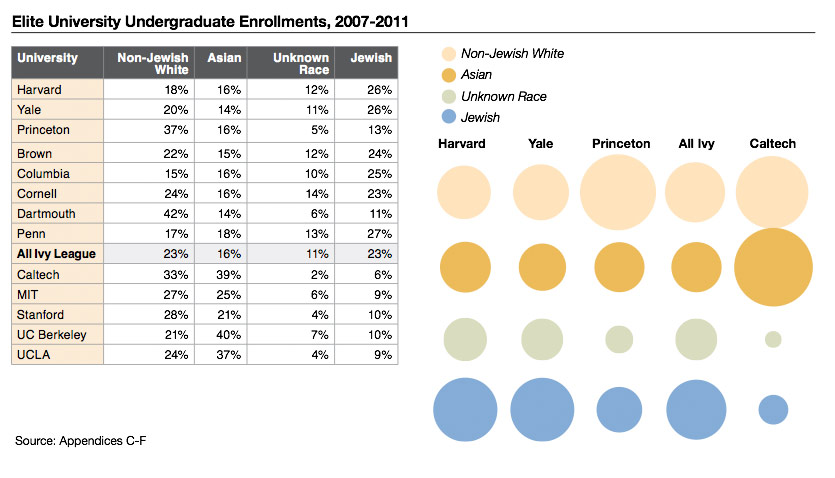
Unz quotes a Jewish writer who exhilarates that “the WASP demographic group which had once so completely dominated America’s elite universities and virtually all the major institutions of American life had by 2000 become a small and beleaguered minority at Harvard, being actually fewer in number than the Jews whose presence they had once sought to restrict.” For a Jewish nationalist, it is a cause for celebration. For a WASP, it is a reason to regret the unwise decisions of his fathers who tried to play a fair game with Jews and were Jew’d.
But for an average American, the answer lays in the macro picture. Do the new Jewified elites manage America better than WASPs did? Are they better shepherds? Is America-2018 (with Jews getting over 25% of all seats in the express train to better future, leaving 20% or less to WASPs) better for Americans than America-1962 with 15% of Jews and 80% of WASPs in Yale and Harvard? If you belong to 1% of Americans, the answer is positive; if you are one of the 99%, it is not.
Unz is very meticulous, very cautious in his approach. He asks an almost-insulting question: perhaps the Jews are so smart (after all, that is the kin of Einstein and Freud) that their share in the Ivy League is a result of meritocratic selection? And he provides an almost-insulting answer: no, they aren’t. There are some universities that admit strictly by merit; in these universities Jews do not exactly star. Caltech, the California Institute of Technology is one of them. The Jewish presence there is quite small; Hillel, the Jewish students’ body, gives it as zero. In reality, it is about 6 per cent, like in other merit-based competitions.
It can’t be zero, for sure. In 2003, two Palestine Solidarity activists, Adam Shapiro and Huwaida Arraf, had been booed there by pro-Israeli Jews who tried their beastly best to drive away the speakers. But there are not many Jews. There are few Jewish Olympiad winners; once they were in dozens, now there are hardly any. Altogether Jewish kids make up some six per cent of NMS, the highest-performing students’ list. This is a good result, in line with Jewish admissions into meritocratic colleges, but it is four times less than what you would expect judging by their Yale admissions. The Jewish IQ, as Unz found out, is also in line with that of their Gentile peers, and not the fabulous 110-115, as the Jewish newspapers claim. Jews are not all that smart anymore, judging by their score.
Unz explains this “sudden collapse of Jewish academic achievement” by inertia. The youngsters just do not try hard enough, in contradistinction to their fathers’ generation. They will succeed, they think, by their old-school-tie connections or through their parents’ links. Indeed when you look at the face of President Trump’s son-in-law, Mr Jared Kushner, you understand that the Nature took a nap in his generation. His parents’ generation were predators and major crooks (his father actually served two years in jail for tax evasion while obtaining his two-billion-dollar loot), but Jared’s generation could not enroll or graduate without assistance, while his political meddling made a mess of already troubled American Middle East politics.
This is the Nature way to deal with problems. Thomas Mann in his 1901 novel Buddenbrooks subtitled The Decline of a Family depicts three generations of a North German family: the first generation amasses fortune, the second maintains it, the third wastes it away in Bohemian pleasures. Smart people’s kids are usually not that smart, and have much less drive. For this reason, I wouldn’t be bothered too much by Jewish achievement of the elder generation; the young generation will waste it all right.
The problem is, there is more than one way to shine. One is to be brilliant, another is to dim others to shine in their background. In Israel, the Jews promoted plethora of laws and regulations circumcising Palestinians’ ability to compete. In the US, Jewish support of migration from underdeveloped countries and discrimination of the white American students achieve a similar effect as it lowers the average ability of non-Jewish population and allows the Jews to excel in comparison.
Unz exploration could bring enormous benefits to the American society. His diagnosis of the malady allows to cure it. In his consequent article on the subject, Unz discovered that after publication of his article, the numbers of Jewish admissions in the best colleges had been sharply readjusted downwards. What was 25% (Jews in Harvard) became 12%. But do not rejoice before time. The Jews responded with subterfuge instead of correcting action. Now they refer in their statistics only to Jews who state that they are followers of Jewish faith; and this is a dwindling lot. If one counts the students who refer to themselves as “descendants of Holocaust survivors” and speak of “my true home Israel”, we are back to 25%.
So the US Jews have learned how to perpetuate their dominance, by jealously guarding the gates of the best universities. Can it be corrected?
Jews broke the glass ceiling of admissions to Harvard by mass protests and media pressure. The Gentiles are not likely to emulate their strategy as they became even more obedient and placid as if being bred for these traits. The Americans aren’t rebellious by nature; that’s why the US is so prosperous and that’s why the lot of a working American is going from bad to worse. Yes, Scylla and Charybdis guard the passage to well-being: over-rebellious folk grows poor as revolutions diminish the treasury; on the other hand, over-docile folk grows poor because their betters oppress them fearing not for harsh response. Wise elites navigate these narrow straits cautiously like the Swedes did until 1990. Obstinate elites have to be cured by revolution, like in England or France, or by state terror, as in Russia or China.
Now you have to live with Jewified elites. Historically, the record is not encouraging. Jews are not very good in the top dog position. They are too obstinate, doctrinaire and despise the low classes to whom they feel no affinity. A single person of Jewish origin can be very good as a leader (Bruno Kreisky, the Austrian chancellor, is a good example). Some Jewish politicians are very loyal – the much-denigrated Kaganovich remained loyal to Stalin when all the rest switched to Khrushchev. But when Jews form a prominent part of elites, like it happened in a few states in different times, the result is not very good. We have the example of Israel, where the natives have nor basic rights neither citizenship, and by millions they are deprived of property and locked up in the ghetto of Gaza.
The Unz revelation demonstrates the main feature of Jews: as a rule, they are immoral (or, if you prefer, they have a different, Jewish moral, as many Rabbis claim). It gives them an advantage in some dealings but eventually courts disaster. In the Tsar’s days, the Jews complained vociferously about two things: one, Numerus Clausus, (a Jewish quota of students) and two, the Pale of Settlement, a part of the country where Jews could reside freely. They – my grandparents – sounded so sincere denouncing these evils. Nowadays, the victorious Jews established the Pale of Settlement for Gentiles in Palestine, while in the US, they fixed the low quota for previous lords of the land, and very few Jews complain about it, as I noted at length.
When it is good for Jews, it is bad for Gentiles, says the Talmud. “If you hear that Caesarea (a symbol of Gentile rule) and Jerusalem (a symbol of Jewish rule) are both in ruins or that both are flourishing peacefully, do not believe it. Believe only a report that Caesarea is in ruins and Jerusalem is flourishing or that Jerusalem is in ruins and Caesarea is flourishing”. (Talmud, Tractate Megillah 6a). History confirms it – up to a point. Jews can have it good under Gentile rule, though not as good as they would like to. But under Jewish rule, not only Gentiles, but even middle-to-low-class Jews are being screwed up, as you can observe in the Jewish state of Israel – and in the heavily Jewified US, as well. Like fire, like women, – Jews are good when under control and dangerous and destructive when they are in control.
Still, there is a free will; everyone can choose one’s own way. Nobody born in the Jewish family has to stick with Jews. The best of Jews, from Christ Apostles to Joseph Brodsky and Ron Unz always escaped it to join the people.
Israel Shamir can be reached at adam@israelshamir.net
Israeli forces demolish Palestinian primary school in al-Khalil

IMEMC News | December 5, 2018
Israeli soldiers invaded, Wednesday, the Sammoa’ town, south of Hebron, in the southern part of the occupied West Bank, and demolished a Palestinian school.
Media sources in Hebron said the soldiers surrounded Seemia area, north of the Sammoa’ town, and declared it a closed military zone, preventing the Palestinians from entering it.
They added that the soldiers then used their armored bulldozers to demolish the Tahadi 13 small school of several classrooms and their facilities.
The school was sponsored by the Palestinian Ministry of Education through European funding, with a total cost of 40,000 Euros, and was supposed to open in two days.
The Ministry of Education denounced the ongoing Israeli violations, targeting educational facilities and students, and added that the school is located in Area C of the West Bank, under full Israeli military and administrative control.
The school was built to make it easier for students in that area to reach it, especially due to Israeli military roadblocks and restrictions imposed by the military in various areas of Hebron.
It is worth mentioning that the soldiers have demolished many Tahadi schools in that same area, and other parts of the West Bank, as part of Israel’s illegal attempts to confiscate the lands to use them for military purposes and colonialist activities.
Chile: Mapuche Leaders Meet, Call For Demilitarization
teleSUR | December 2, 2018
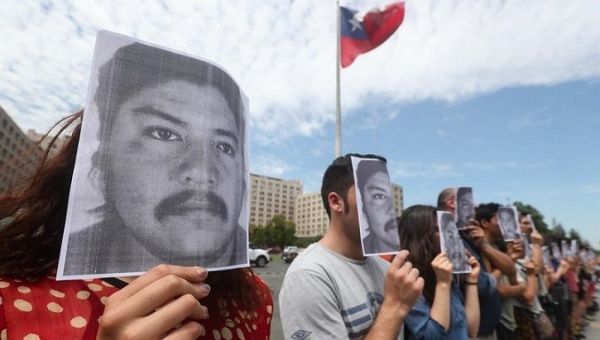
A group of Mapuche leaders Saturday met in Temucuicui to decide next possible steps after the assassination of Camilo Catrillanca on Nov. 14 by Chilean Carabineros (police).
The leaders decided on four demands they will put forward to the Chilean state.
“We demand the current government to urgently dismantle and remove said police unit (Jungle Command) considering that this constitutes a permanent threat, violating our right to live in peace, violating the rights of our children, women and the elderly,” they said in a statement.
The other three demands of the community are; self-determination for the Mapuche people, establishing a commission of historical truth ‘to clarify the crimes against humanity’ against the Mapuche people, and territorial restitution.
Marcelo Catrillanca, father of Camilo was in charge of the meeting. He urged the Mapuche people to continue their mobilizations and civil disobedience in the country.
Jorge Huenchullan, a community leader said that the participants of the meeting expressed “their pain and outrage at how the State has been carrying out policies regarding the Mapuche people”, adding that “if the authorities agree to carry out the demands, we are willing to talk. If they are not, there will be a call to rebellion.”
Additionally, they added that “we remind the Chilean State that the lands and territory (of Mapuche) were taken over and occupied by military violence,” so those who are not Mapuche lack legitimacy and legality in that land.
The four carabineros who took part in the operation which killed Camilo were ordered into preventive detention on Nov. 30. They are charged with homicide and obstruction of justice for destroying evidence. A period of two months for the investigation was established by the prosecutor’s office.
RELATED:
Mexico’s EZLN Expresses Solidarity With Chile Mapuche Struggle
Iran opposes US-drafted resolution against Palestinian resistance Hamas: FM
Press TV – December 3, 2018
Iran has voiced its objection to a US-drafted resolution condemning the Palestinian resistance movement Hamas, saying the Islamic Republic would do its utmost to prevent its ratification at the United Nations General Assembly.
In a telephone conversation with Head of Hamas Political Bureau Ismail Haniyeh on Monday, Iranian Foreign Minister Mohammad Javad Zarif reaffirmed the Islamic Republic’s full support for the Palestinian people’s rights.
The UN General Assembly plans to vote on Tuesday on the motion that would reportedly condemn the resistance movement “for repeatedly firing rockets into Israel and for inciting violence.”
“Iran will make its utmost efforts at the General Assembly in coordination with other Muslim and progressive countries to prevent the ratification of the resolution [which is] a violation of the United Nations Charter and runs counter to the Palestinian people’s resistance,” the top Iranian diplomat said.
He added that the policies of certain regional countries have emboldened the administration of US President Donald Trump not only to relocate its embassy in Israel from Tel Aviv to Jerusalem al-Quds in violation of the international law, but also to propose a resolution against the Palestinian people’s resistance at the General Assembly.
Earlier on Monday, Palestinian Authority President Mahmoud Abbas’s Fatah party vowed to support its rival Hamas at the General Assembly against the US-drafted resolution.
“We will stand against all hostile efforts to condemn Hamas at the United Nations,” Fatah spokesman Osama Qawassmeh said.
In a letter addressed to UN General Assembly President Maria Fernanda Espinosa late last month, the Hamas political bureau chief condemned “aggressive” attempts by the US to pass the resolution against the resistance movement, urging the world body to end Tel Aviv’s “abhorrent” occupation of the Palestinian territories.
Haniyeh highlighted the importance of international work to thwart Washington’s efforts meant to delegitimize the Palestinian resistance.
The letter came days after Israel’s UN Ambassador Danny Danon said that US diplomats had been in talks with their EU counterparts to win their backing for a draft resolution against Hamas.
The Palestinian leadership has been divided between Fatah and Hamas since 2006, when the latter scored a landslide victory in parliamentary elections in the Gaza Strip.
Ever since, Hamas has been running the coastal enclave, while Fatah has been based in the autonomous parts of the Israeli-occupied West Bank.
Canada backs repression, killing of protestors in Haiti
By Yves Engler · December 1, 2018
The Ugly Canadian has shown his elite-supporting, poor-bashing repressive face in Haiti.
Ottawa is backing the repression of anti-corruption protests and Justin Trudeau is continuing Canada’s staunch support for that country’s reactionary elite.
Over the past three months there have been numerous protests demanding accountability for public funds. Billions of dollars from Petrocaribe, a discounted oil program set up by Venezuela in 2006, was pilfered under former President Michel Martelly, an ally of current leader Jovenel Moise. After having forced out the prime minister in the summer over an effort to eliminate fuel subsidies, protesters are calling for the removal of Moise, who assumed the presidency through voter suppression and electoral fraud.
According to the Western media, a dozen protesters have been killed since a huge demonstration on October 17. But, at least seven were killed that day, two more at a funeral for those seven and pictures on social media suggest the police have killed many more.
Ottawa is supporting the unpopular government and repressive police. While a general strike paralyzed the capital on Friday, Canadian Ambassador André Frenette met Prime Minister Jean Henry Céant with other diplomats to “express their support to the government.” Through the “Core Group” Ottawa has blamed the protesters for Canadian trained and financed police firing on them. The Canada, US, France, Spain, EU, UN and OAS “Group of Friends of Haiti” published a statement on Thursday criticizing the protesters and backing the government. It read, “the group recalls that acts of violence seeking to provoke the resignation of legitimate authorities have no place in the democratic process. The Core Group welcomes the Executive’s commitment to continue the dialogue and calls for an inclusive dialogue between all the actors of the national life to get out of the crisis that the country is going through.” (translation)
In a similar release at the start of the month these “Friends of Haiti” noted: “The group praises the professionalism demonstrated by the National Police of Haiti as a whole on this occasion to guarantee freedom of expression while preserving public order. While new demonstrations are announced, the Core Group also expresses its firm rejection of any violence perpetrated on the sidelines of demonstrations. The members of the group recall the democratic legitimacy of the government of Haiti and elected institutions and that in a democracy, change must be through the ballot box and not by violence.”
But, in late 2010/early-2011 the Stephen Harper Conservatives intervened aggressively to help extreme right-wing candidate Michel Martelly become president. Six years earlier Trudeau’s Liberal predecessor, Paul Martin, played an important role in violently ousting Jean-Bertrand Aristide’s government. For two years after the February 29, 2004, overthrow of Haitian democracy, a Canada-financed, trained and overseen police force terrorized Port-au-Prince’s slums with Canadian diplomatic and (for half a year) military backing.
Since that time Ottawa has taken the lead in strengthening the repressive arm of the Haitian state (in 1995 Aristide disbanded the army created during the 1915-34 US occupation). Much to the delight of the country’s über class-conscious elite, over the past decade and a half Canada has ploughed over $100 million into the Haitian police and prison system.
Since his appointment as ambassador last fall Frenette has attended a half dozen Haitian police events. In April Frenette tweeted, “it is an honour to represent Canada at the Commissaires Graduation Ceremony of the National Police Academy. Canada has long stood with the HNP to ensure the safety of Haitians and we are very proud of it.” The previous October Frenette noted, “very proud to participate today in the Canadian Armed Forces Ballistic Platelet Donation to the Haitian National Police.”
Canada also supports the Haitian police through the UN mission. RCMP officer Serge Therriault currently leads the 1,200-person police component of the Mission des Nations unies pour l’appui à la Justice en Haïti. For most of the past 14 years a Canadian has been in charge of the UN police contingent in Haiti and officers from this country have staffed its upper echelons.
Canada is once again supporting the violent suppression of the popular will in Haiti. Justin Trudeau has taken off his progressive mask to reveal what is inside: The Ugly Canadian.
Yves Engler is the co-author, with Antony Fenton, of Canada in Haiti: Waging War on the Poor Majority. His latest book is Left, Right: Marching to the Beat of Imperial Canada
Yellow Vests: No Coincidence Macron, Merkel and May are in Dire Straits – Journalist
By Ekaterina Blinova – Sputnik – November 30, 2018
The ‘yellow vest’ upheaval has exposed longstanding problems in France’s economy, Christine Bierre, French journalist and chief editor of Nouvelle Solidarité, has told Sputnik, adding that to heal these wounds, the French need to get rid of Brussels’ diktat and take back control of their financial system.
The ‘yellow vests’ protests are continuing to gain momentum in France, with about two thirds of the French supporting the unrest, according to the latest OpinionWay poll.
Speaking to Sputnik, Christine Bierre, French journalist and chief editor of Nouvelle Solidarité, shed the light on the nation-wide upheaval.
‘Over a year, diesel prices have increased by 23 per cent and those of gasoline, by 15 per cent. These hikes [in prices] hit those who live in rural areas and who need energy not only for their cars, but for tractors if they are farmers, boats if they are fishermen, trucks for transporters, fuel for construction workers and for heating’, the journalist said.
She noted that those who cannot afford living in big cities and who live in small towns and in the peripheries had also found themselves between a rock and a hard place, since they have to use their cars to get to megalopolises.’Concretely, expenses for energy have gone from 12 per cent per household in the 1960’s, to 30 per cent in 2018′, Bierre stressed. ‘For a couple with two kids using a diesel car and fuel to heat, taxes increased last year by 600 euros; the price of diesel for tractors went from 50 cents a litre to 87 cents, so a farmer using 20,000 litres per year, will pay 7,400 euros more in taxes on energy’.
She pointed out that in general, ‘the middle and the lower middle class and also part of what one calls the “working poor”‘ had fallen prey to the Macron cabinet’s measure.
According to the journalist, the rapid growth of the ‘yellow vests’ movement, which mobilized 300,000 people, ‘revealed, however, that energy prices were just the last straw that provoked the social explosion.’
TICPE and Its Consequences
However, President Emmanuel Macron and his policies are not the only reason for the impoverishment of the French middle class and the current crisis, ‘even though his favouring the richer against the poor has been the most indecent’, the journalist opined.
‘Along with the energy price increases on international spot markets, the real culprit behind the huge rise in energy prices is the tax on energy products, TICPE (Taxe Intérieure de Consommation sur les Produits Energétiques), created in 2000, and used by the state to heavily improve its tax revenues’, she elaborated.
Bierre explained that today this tax ‘represents 57 per cent of the price of diesel and more than 60 per cent of the price of gasoline, mainly because since 2014, the TICPE includes a tax to finance the costs of the energy transition.”This is a progressive tax that grows every year according to a supposed price of carbon per ton of CO2, which is to reach 100 euros in 2030!’ the journalist remarked. ‘In 2015 it was at 14.5 euros, in 2017 — 22 euros in 2017, in 2018 — 44.6 euros and so on.’
She stressed that Macron’s predecessors relied heavily on the taxation of their population to finance their programmes and lately the energy transition, but the incumbent French president ‘is, no doubt, the most outrageous.’
‘Since his coming to power he “granted” 5 billion euros in tax cuts to rich financiers, transforming the tax on large fortunes into a real estate tax only, and reducing the tax on financial profits to a 30 per cent flat tax’, Bierre outlined. ‘At the same time, he reduced state aid to the poor by the equivalent of 4 billion euros (cuts in aids to housing, public jobs and increase of general taxes).’
Yellow Vests: Neither Far-Right nor Far-Left
The question then arises as to what political forces have jumped on the bandwagon of the ‘yellow vests’ movement. According to Bierre, many politicians would like to capitalize on the upheaval, from the far right to the far left camp.
‘The “yellow vests”… have rejected the participation of all political forces as such, and kicked out far right and far left elements attempting to infiltrate them’, she highlighted, adding that the movement had emerged spontaneously protesting against the austerity policies which originate from the 2008 financial crisis and earlier economic strategy.
The journalist has drawn attention to the fact that Macron has refused to hear the plight of the French population so far.
‘[Prime Minister] Edouard Philippe even repeated [on 28 November] that he won’t eliminate the planned increases of energy costs for 2019 and won’t increase the minimum wage’, she remarked. ‘Will Philippe, a close aide to Alain Juppé, end up like his master in 1995, ousted following the strikes, because he was too rigid to change? Anything is possible.’
According to Bierre, these protests ‘have the potential of a revolutionary movement.’
‘Will the government resist all the pressure, due to the lack of organizational structures and experience [of the protesters]? Perhaps; but it has definitely become the first serious call to bring an end to the arrogance of the Paris elites of the post-De Gaulle era’, she said.
The Lesson of the 2008 Financial Crisis is Still Unlearned
The journalist believes that it is no coincidence that the leaders of major European powers — Germany, France and the UK — are currently facing economic and political difficulties triggering speculations about their possible resignations or early departures.
‘In fact Europe is suffering from the refusal of the Western world to deal with the consequences of the 2008 financial crisis, and with the inequalities created by the financial globalization of the last 30 years’, she opined. ‘Like in the US, in Europe, the middle classes became impoverished during this process, and the poor became even poorer.’
The situation is complicated by the diktat of Brussels, she underscored, adding that EU member-states’ financial systems are being controlled by the European Central Bank, which exerts its supranational authority on the nations.
‘The situation in Europe is worsened by the fact that by adopting the EU supranational treaty, all nations gave up their sovereignty in all matters and today are like bodies with no heads! As we see in the case of Italy, a non-elected EU Commission is trying to rule over a duly elected Italian government, to forbid them from carrying a policy of investment to create jobs’, Bierre said.
Seeking a Cure
So, what steps should be taken by the government to fix the current situation?
‘Dealing with the European question is not sufficient however, because to create jobs and rebuild our economies, we must take back control of our financial system’, the journalist responded.
She noted that the looming financial crisis that is being predicted by most financial media at this point ‘sets the obvious context for the financial reforms needed to rebuild our nations in response to the current revolts.’
According to Bierre, first, Europeans need ‘a real Glass-Steagall Act which separates speculative banking completely from commercial banking’; second, ‘the reestablishment of sovereign national banks in every country emitting “public credit” for reconstruction of industrial capacities of the devastated European economies based on the policies of the “30 glorious” [post-war boom] years in France’; third, Europe needs to adopt a ‘policy of cooperation with the great powers of this world, Russia, China, India and the United States, to expand and contribute to initiatives like China’s New Silk Road, the Russian Eurasian Economic Union, and the Shanghai Cooperation Organization.’
“Let’s Walk to the Haram,” youth initiative to pray at Ibrahimi Mosque
Palestinian youth at Ibrahimi Mosque
Palestine Information Center – November 30, 2018
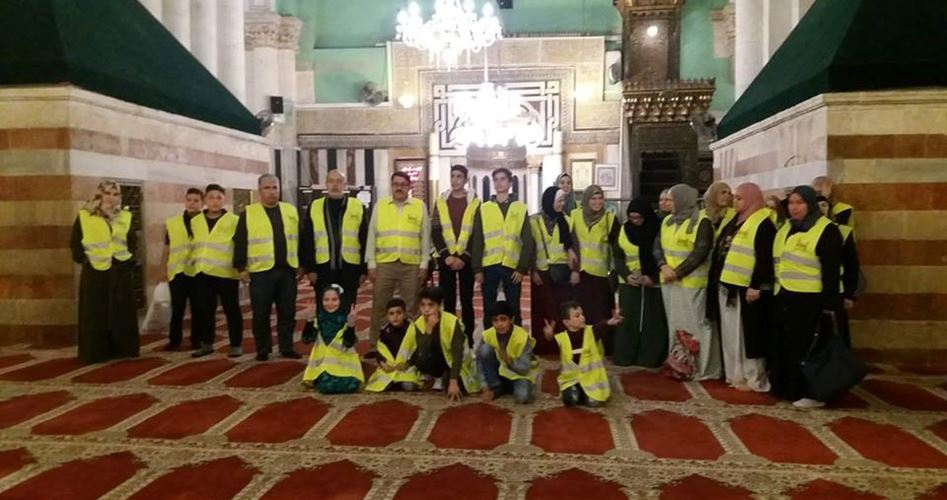
AL-KHALIL – A Palestinian youth group calling itself “Let’s Walk to the Haram” has launched an initiative in al-Khalil aimed at reviving its Old City and encouraging citizens to pray at the Ibrahimi Mosque.
Young men and women of different ages are participating in this initiative, and they organize tours to the Ibrahimi Mosque, pray collectively inside it and raise public awareness on the importance of visiting the holy site and protecting it against attempts to Judaize it by Jewish groups, settlers and their right-wing government.
The Palestinian group has urged the Palestinian citizens in al-Khalil and the West Bank to participate in the tours it organizes at the Mosque and not to fear any assaults and acts of bullying by Jewish settlers during their presence in the Old City and the Ibrahimi Mosque.
The Ibrahimi Mosque is being exposed to systematic Judaization and attempts by settlers to change its interior appearance in order to make it look like a synagogue and to gradually prevent Muslims from entering it.
Hamas calls on UN to support Palestinians’ right to bear arms against Israel

Head of the Political Bureau of Hamas Ismail Haniyeh makes a speech during a conference on 18 September, 2018 in Gaza City, Gaza [Ali Jadallah/Anadolu Agency]
MEMO | November 29, 2018
Hamas chief Ismail Haniyeh has called on the United Nations to recognise and support the Palestinian people’s right to bear arms against Israel in self-defence.
Haniyeh wrote to UN General Assembly (UNGA) President Maria Fernada Spinosa in advance of the organisation’s debate regarding Hamas rocket fire into Israel.
“We reiterate the right of our people to defend themselves and to resist the occupation, by all available means,” wrote Haniyeh, “including armed resistance, guaranteed by the international law.” He based the demand on international law drawn up and implemented by the UN, which gives states and peoples the right to defend themselves with arms if necessary, in the case of an external attack. “The General Assembly of the United Nations adopted dozens of resolutions that affirm the right of peoples to independence, self-determination and struggle by all available means, peaceful and non-peaceful, for that right. The UN singled out the Palestinian people for dozens of relevant resolutions, including 2621, 2649, 2787 and 3236,” he said.
After condemning the US for adopting Israel’s narrative of the conflict and justifying Israel’s aggression towards the Palestinians, Haniyeh insisted that “the last of these efforts is the attempt by the United States Ambassador to the United Nations… to submit a draft resolution condemning the Palestinian resistance and the right of our people to defend themselves against this racist and continuous occupation for more than seven decades.”
Israel’s Ambassador to the UN, Danny Danon, commented on Haniyeh’s letter, saying that Hamas “going to the UN for assistance is like a serial killer asking the police for assistance. Israel and the United States will continue to mobilize the countries of the world into a united front against the terrorism that Hamas engages in.”
The debate held in the UN today coincides with the International Day of Solidarity with the Palestinian People, which is held every year on 29 November. It comes two weeks after the latest Israeli assault on Gaza, which broke out after an undercover Israeli special forces operation in the strip was botched and compromised by Hamas. Days later, a ceasefire was declared, which was again broken by Israel the following morning when Israeli soldiers killed a Palestinian fisherman off the coast of Gaza.
READ: US lobbies for vote against Hamas at UN General Assembly
Featured Video

The Search for Truth: Charlie Kirk’s Assassination One Year Later
or go to
Aletho News Archives – Video-Images
From the Archives
The 9/11 “Double-Cross” Conspiracy Theory
BY LAURENT GUYÉNOT • UNZ REVIEW • SEPTEMBER 6, 2022
Is it true that “9/11 was an inside job”? Yes, insofar as Israel is “inside” the U.S. But for the 9/11 truthers who have identified Israel as the main perpetrators, “9/11 was an inside job” is at best a half-truth, and at worst an integral part of the Zionist operation, like a secondary flag sewn as a lining under the false flag of Islamism. Victor Thorn (1963-2017) wrote in his book 9/11 made in Israel: The Plot Against America (2011): “In essence, the ‘9-11 truth movement’ was created prior to Sept. 11, 2001 as a means of suppressing news relating to Israeli complicity. . . . The slogan ‘9-11 was an inside job’ was quite possibly the greatest example of Israeli propaganda ever devised.” In milder terms, it is “controlled opposition”.
A genuine truth movement would have pointed to Israel as the prime suspect from the start. From day one, it was obvious who would benefit. … continue
Blog Roll
 Aletho News
- Europe’s mounting social chaos… chickens coming home to roost for proxy war against Russia
- US-Russia Diesel Deal Becomes Massive Defeat for Ukraine
- Hormuz and the Looming Economic Catastrophe
- Dhubab offensive, media blitz and the rapid unraveling of Saudi-backed coalition’s new gambit
- Putin Conveys to Trump Iran’s Vision on Possible Conflict Resolution – Kremlin
- The Search for Truth: Charlie Kirk’s Assassination One Year Later
- ‘Harsh reality’: Iran says France seeks monopoly on power and intimidation, not peace for all
- When Will This White House Madness End?
- Huckabee aide goes to ‘unusual lengths’ to portray ‘Israel’ positively
- Trump Announces Diesel Supply Deal With Putin Following Phone Call
- If Americans Knew
- Israeli forces kill another child in Gaza – Daily Update
- Gaza ceasefire exists in name only, say more than 100 organizations
- Nearly 2 Million in Gaza Need Urgent Shelter Assistance as Winter Looms: IOM Chief Warns
- Suppressing Palestinian resistance: US charity under fire for AI monitoring of Gaza classrooms
- Thousands Are Held in Israeli Torture Camps. This Is What Happens Inside
- Israel puts Gaza’s sick, injured, newborn in peril – Daily Update
- Report claimed Mark Levin used by Israeli government to influence Trump
- Over 2,000 Gazans have died awaiting medical evacuation amid Israel’s continued siege
- How a U.S. Diplomat Suppressed and Altered Reports Critical of Israel
- 5 Palestinians Die from Israeli Strikes in Gaza as Relentless Attacks Continue
- No Tricks Zone
- New Study: 50 Years Of The Most Aggressive ‘Net Zero’ Policies Can Only Affect The Global Climate By 0.03°C
- US September “Heat” Was No Record…Many Records Set Decades Ago
- Latest European Green Energy Debacle; Portugal’s Largest Flagship Solar Park Insolvent!
- Green Energy Debacle: German Expert Professor Fritz Vahrenholt Warns Of Severe Economic And Social Consequences
- Two More Paleo Reconstructions Affirm Meters-Higher Sea Levels Across Ireland, Brazil 7000-6000 Years Ago
- New Study: Earth And Venus Surface Warmth Largely Explained By Convection And Lapse Rate, Not CO2 Or Radiation
- 2025 Nature Paper Claiming Worsening Global Drought Gets RETRACTED …Heavily Flawed
- New Study: ‘Global Drought Shows No Detectable Recent Acceleration Under Climate Warming’
- Economic Masterminds: German Socialists Suggest Taxing Productivity Gains Stemming From Using AI
- The South China Sea Has Not Been Cooperating With The Climate Change Narrative

