Blair directed PA to eliminate mention of ‘Palestine’ from textbooks, former UK envoy reveals
Press TV – September 2, 2026
Former UK Prime Minister Tony Blair has been tasked by a body set up by US President Donald Trump to approach the Palestinian Authority (PA) and propose removing the term “Palestine” from school textbooks, replacing it with the Jewish name “Samaria.”
Jeremy Greenstock, who served as Britain’s ambassador to the UN from 1998 to 2003, said on Wednesday that Blair sought to influence the Palestinian Authority.
He stated that if the PA wished to be recognized by the so-called Board of Peace as a legitimate partner capable of negotiating a resolution with Israel to conclude the genocidal war in Gaza, the term “Palestine” should be removed from educational materials.
Greenstock said in an extensive interview on the David Hearst Podcast that Palestinian Authority President Mahmoud Abbas rejected the request.
Greenstock further noted that his former superior was facing “challenges” in his new position managing the postwar administration of Gaza for the board.
“He recently, I understand, was asked by the Board of Peace to go to Ramallah and ask to remove from the Palestinian curriculum any mention of the word Palestine if they were to be treated by the Board of Peace as capable of coming to an agreement with Israel to end the current conflict that had stemmed from October 7 onwards,” Greenstock said, adding that the information was obtained from a source at the ministerial level.
“President Mahmoud Abbas said he would do no such thing,” he said.
“But the very fact that the Board of Peace could ask for that to be done in the Palestinian educational curriculum makes me wonder what principles the Board of Peace is working on, and what understanding they have of justice, of the sense of fairness, of the history of all of this,” Greenstock added.
A spokesperson for Blair refuted the claim that the former UK prime minister made such a request. “This is not true and a complete fabrication.”
Blair is known to have travelled to the Israeli-occupied territories in mid-August alongside Jared Kushner, Trump’s son-in-law, and Nickolay Mladenov, the high representative for the so-called Board of Peace.
The trio engaged in intense discussions with Israeli prime minister Benjamin Netanyahu, who has dismissed the proposed roadmap for Gaza. They then proceeded to Cairo, where they met with a Palestinian technocratic group expected to assume control of Gaza, along with representatives from the Hamas resistance movement.
During the interview, Greenstock was critical of Blair’s current role in the Board of Peace, saying he did not think Blair could engage with both sides with the same level of respect.
“Because of his record on Iraq and on Palestine since he left government, he will be seen as prejudiced. So I think he will have, and is having, difficulties.”
Greenstock, who left government service in March 2004, called the Board of Peace an “abstract and arbitrary committee” whose composition would not have any real effect on the ground with either Israel or the Arab side to the question of Palestine.
“I don’t think the Board of Peace is a strong enough construct to bear the weight of the difficult decisions that are going to have to be made about the future of the Palestinian territories.”
As part of an international campaign, Israel and its allies have been amplifying their endeavors to remove the word Palestine from educational materials and museums.
On Tuesday, Israeli authorities began imposing their curriculum on more than 45,000 Palestinian students in state-run schools in East al-Quds, as part of a wider crackdown on education in the occupied territory.
A revised curriculum is reported to be circulating privately for consultation in the occupied Palestinian territories.
Is Israel paving streets with Gaza rubble containing bodies – and is the Board of Peace funding it?
By Kathryn Shihadah | If Americans Knew | September 2, 2026
Muhammad Shehada (@muhammadshehad2) – the journalist at the center of this story – is an accomplished reporter and political analyst, a visiting fellow at the European Council on Foreign Relations and contributing writer to the London Review of Books, Newsweek, Al Jazeera English, Zeteo, The New Arab, Israeli media 972Mag and Ha’aretz, and others.
Shehada tweeted on August 26 and 27:
EU diplomats told me last week Israel has been quietly moving hundreds of thousands of tons of rubble mixed with dead bodies out of Gaza to bury evidence of its genocide.
When the EU asked Israel why or whether they filter human remains out of the rubble, no answer ever came!
I’ve been informed Trump’s Board of Peace is paying the expenses of the IDF’s covert transfer of rubble (mixed with dead bodies) out of Gaza. The money is taken from Gaza’s reconstruction funds!
The Board of Peace official X account replied on August 28:
This is categorically farcical and unfounded — total fake news. At a minimum, we would expect such an “intrepid” reporter to reach out to us for comment or clarification before recklessly spreading lies based on anonymous sources who have erroneously “informed” you.
Shehada responded the same day:
Dear Board of Peace,
1- I have a tender issued under your name on 20 May 2026 that includes “leveling & compacting” work in occupied Gaza, do you deny that document?
2- Is the Israeli company Terra Firma NOT doing “rubble clearance” in Gaza allegedly with machines that take rubble & spit out dust while the IDF is doing road-paving work (specifically near Erez)?
3- Are you NOT in any way paying, compensating, subsidizing or aiding Israeli companies, contractors, individuals, the Israeli army or government for rubble removal & road paving in Gaza?
4- If you are involved, can you explain whether any effort is being made to separate human remains from rubble or detect potential mass graves under the roads being paved? The Israeli government is silent on this.
5- I have satellite images that show clear & significant rubble removal work in East Gaza in the months of May & June. Do you deny any involvement in this?
6- Do you have anything to say on Israel killing over 1,200 Palestinians under your watch since your ceasefire started?
How about Israel restricting humanitarian aid and preventing prosthetic limbs from going to largest cohort of child amputees in modern history?
How about Israel preventing repairs of basic infrastructure (water, electricity, sewage, hospitals, bakeries), or releasing all children & women still in detention without trial or charges?
All of those unfulfilled commitments were part of phase one of President Trump’s 20-point plan!
Remarkable how none of Israel’s violations of your ceasefire ever caught your attention once in 323 days, but my sole tweet did in mere hours.
The Board of Peace account has yet to reply.
Excavation equipment for me, but not for thee
United Nations figures indicate that about 200,000 buildings – 82% of the structures in Gaza – are damaged or destroyed. Buried beneath these buildings, thousands of Palestinians await retrieval and dignified burial.
Israel has hundreds of pieces of heavy engineering machinery, and is spending a fortune demolishing what is left in the roughly 70% of Gaza under its control. Ha’aretz reports that a single piece of equipment may be rented for $1,500 a day; the operator may collect $400 a day. Nearly $1 million a day is spent on fuel.
But while part of Gaza is being demolished with massive quantities of equipment, at unprecedented speed and cost, the rest is moving slowly with primitive tools. Only a handful of excavators in Gaza are working at all – the rest were targeted by Israel, or in some cases simply wore out – Israel has blocked the entrance of spare parts. Fuel costs are prohibitive anyway.
Palestinians work long hours with shovels, wheelbarrows, and their hands to dig out the remains of their loved ones, or clear debris from what is left of the roads or their homes as legions of bulldozers demolish neighborhoods nearby.
(The IDF said, in response to the Ha’aretz report cited above, “According to army orders, property destruction is only carried out when there is an operational basis that requires it, and the IDF has never had a policy that allows for the deliberate destruction of civilian property.” It added, “The IDF is taking various measures to minimize damage to civilian structures as much as possible.” The reader can decide whether the IDF’s statement rings true.)
The Wall Street Journal placed the quantity of rubble in Gaza at 68 million tons, and the number of dead bodies buried beneath the rubble at 10,000.
EuroMed Human Rights Monitor estimates that Israeli civilian companies are operating “400 heavy pieces of excavation, demolition, crushing, and transport machinery” to demolish remaining structures, crush the rubble, and load the debris onto trucks.
The rubble is reportedly taken to “undisclosed sites” in Israel and the West Bank. Israeli authorities have neither revealed details nor permitted independent groups to observe the procedure. This lack of transparency does not imply innocence.
If the Israeli company Terra Firma is indeed doing “rubble clearance” in Gaza as Muhammad Shehada alleges, in the same areas where the IDF is paving roads, the similarity to accusations against the Nazis is eerie, to say the least.
If the Board of Peace is indeed bankrolling an effort to hide incriminating evidence about genocide, it would be no exaggeration to say Trump and the rest of the board are covering up a genocide.
What do we know about the Board of Peace?
The so-called Board of Peace is a pay-to-play group of wealthy and powerful Israel supporters, dictators, and authoritarians, as well as Israeli prime minister and war criminal Benjamin Netanyahu and two Israeli real estate tycoons – but no Palestinians. In fact, the organization’s charter makes no reference to Gaza.
The lower-tier technocratic committee, made up of Palestinians, will do the grunt work in Gaza – if and when Israel allows the group to enter the Strip.
BoP is problematic in multiple ways, not the least of which is its tendency to view the world through a real estate lens, rather than human rights, justice, or humanitarianism.
Trump Censorship Machine Loses Again in Court
By James Bovard | Mises Wire | August 31, 2026
The Trump administration’s crusade to crush campus criticism took another wallop on Friday in a California courtroom. Federal judge Noël Wise ruled that the Trump administration’s “ideological-deportation policy” brazenly violated the US Constitution.
The Stanford Daily—one of the best-known college student newspapers in the nation—sued the Trump administration for changing its “immigration policy and pattern of enforcement, namely by arresting, detaining, and deporting students with F-1 visas when those students use their freedom of speech to express opinions that the government does not like.” It asserted that the Trump administration’s “actions have specifically impacted Stanford Daily by decreasing the quantity and diversity of opinion pieces The Stanford Daily is able to publish on the conflict between Israel and Palestine.” Foreign students who had written on the issue requested that their previous articles be deleted, and other foreign students were no longer willing to comment on hot issues.
The Trump administration claims unlimited discretion to silence foreign students by deporting those whose opinions it disapproves of. Judge Wise wrote, “The language of the [First] Amendment makes clear that it is not the government that gives freedom of speech to the people. Instead, that freedom is imbued in the people. . . . It is not the government’s to take.” This is a notion that conservatives instinctively understand when it comes to the Second Amendment and the right of self-defense. But many people fail to recognize the same right for freedom of speech. Conor Fitzpatrick—the chief supervising attorney at the Foundation for Individual Rights and Expression (FIRE)—which represented the student newspaper, declared, “Today’s ruling proves that free speech isn’t a privilege, but the inalienable right of every man, woman, and child.” FIRE president Greg Lukianoff clarified the scope of the ruling:
This ruling does NOT say the government must admit anyone, issue anyone a visa, or grant anyone citizenship. It says that once a person is lawfully here, the government cannot deport them because they engaged in protected speech. The government cannot tell a legal immigrant: An American is free to say this, but if you say it, you’re out.
George Porteous—Editor in Chief of Stanford Daily—hailed the decision: “The reporters in our newsroom shouldn’t have to fear that writing a story will result in their deportation. Today’s victory means they won’t have to.” But it remains to be seen whether this latest judicial rebuff slows the Trump censorship juggernaut.
When former president Donald Trump was campaigning to get elected as president in 2024, he openly promised at a campaign event, “One thing I do is, any student that protests, I throw them out of the country. You know, there are a lot of foreign students. As soon as they hear that, they’re going to behave.” This was a linchpin of the promise on Trump’s campaign website to “make our college campuses safe and patriotic again.”
Trump presumed that non-citizens have zero right to free speech and his appointees have enforced that policy with an iron fist. On March 25, 2025, masked ICE agents seized Rumeysa Ozturk—a Turkish graduate student—off the streets outside Boston. Ozturk was locked up for 45 days and her student visa covertly canceled because she co-authored an op-ed criticizing Tufts University for failing to divest from Israel in response to the genocide in Gaza. Secretary of State Marco Rubio vilified her as a “lunatic” and implied that the feds had ample evidence of her crimes and abuses. Rubio later justified targeting Ozturk because she met the standard of “people that are supportive of movements that run counter to the foreign policy of the United States.” (Ironically, a large majority of Americans now oppose Trump’s foreign policy regarding his war on Iran). A leak to the Washington Post revealed that the feds had nothing on her—except that op-ed. Federal Judge William Sessions ordered Ozturk released because her arrest “potentially chills the speech of the millions and millions of people in this country who are not citizens.” But that was the whole point.
Last September, in a case similar to the Stanford Daily case, federal judge William Young ruled that the Trump’s administration’s implementation of the Executive Orders (on foreign students),
. . . was targeted intentionally at specific viewpoints in order to chill speech. The evidence presented at trial included the Public Officials’ many public statements suggesting that they wished to staunch public protest related to Israel’s treatment of Palestinians, including the President’s campaign promise that he would put an end to the student protests on this issue by kicking out protestors.
A Trump Executive Order interpreted “support” for terrorists “to be centered on core First Amendment speech and expressive conduct, such as attending public protests, leading such protests, or even publishing op-eds.” Judge Young declared that he “saw virtually no evidence that anyone along the way [any Trump official] seriously questioned whether pure political speech in support of Palestine or against Israel could be construed as support for terrorism.” Instead, that was the self-evident truth driving the crackdown.
The Stanford Daily case vivified how far the Trump administration will go to snuff dissent. A New York Times headline captured the essence of the case: “Judge Rules Trump Unlawfully Targeted Foreign Students Who Criticized Israel.” If a foreign student engaged in violence at a protest, that would be sufficient to deport them regardless of their opinions. But the Trump administration cast a far wider net, relying heavily on a list of 5,000 foreign students provided by the Canary Mission, which, according to Wikipedia, is “an Israel-based anonymously-run doxing website established in 2014 that publishes the personal information of students, professors, and organizations that it describes as anti-Israel or antisemitic.”
Judge Wise’s decision included stunning examples of how far the Trump administration stretched its definition of terrorist support or antisemitism to justify deporting aliens. John Armstrong—the chief of the Department of State’s Bureau of Consular Affairs—carried out Secretary Rubio’s crackdown on non-citizens. During legal proceedings, Armstrong was asked if a “statement calling for limiting military aid to Israel could be covered” (i.e., sufficient to deport). He answered, “[i]n my opinion, yes.” When did foreign aid become sacred?
Judge Wise concluded her 90-page ruling by declaring that the strength of American democracy,
. . . is diminished when members of our society—citizens and noncitizens alike—must self-censor and “behave” or suffer the government’s retaliation. In March 2025, that retaliation was directed at those engaged in pro-Palestine and anti-Israel speech. In September 2025, caught in the government’s net were people critical of Charlie Kirk. In May 2026, it potentially included “weighing in on a peace deal that’s being negotiated” in Iran regarding the Strait of Hormuz. Tomorrow, or perhaps even today, targets may include anyone in the United States who exercises their freedom of speech to simply express opinions the government does not like.
That warning reverberates as the Trump administration further decimates the privacy of Americans returning from abroad, claiming the right to seize and copy all the contents on their cell phones. The Trump administration proposed that foreign visitors will have to surrender their social media passwords before getting a visa to visit here. How long will it be until the same policy is imposed on American citizens?
Judge Wise declared, “Free speech, including the freedom to criticize the government and its leaders, is not a sign of our democracy’s fragility. It is evidence of its strength.” But is that “strength” increasingly a mirage in the United States? And how many other illegal actions has the Trump administration taken to suppress dissent that Americans have not yet heard about?
Final question: Is the Trump administration seeking to vindicate every leftist stereotype about conservatives and Republicans being intolerant authoritarians?
James Bovard is an American libertarian author and lecturer whose political commentary targets examples of waste, failures, corruption, cronyism and abuses of power in government. He is a USA Today columnist and is a frequent contributor to The Hill.
YouTube’s Account Enforcement Practices Face Possible FTC Lawsuit
By Dan Frieth | Reclaim The Net | August 31, 2026
The US Federal Trade Commission (FTC) is investigating YouTube’s (Google’s) controversial moderation and account-enforcement policies, a probe that is now in its final stages, according to a report from Bloomberg.
The agency is reportedly considering a potential lawsuit, but no decision has been made. YouTube has not been accused of wrongdoing, and the inquiry may end without enforcement action.
The FTC’s inquiry, which began in 2025, is said to be looking into whether the video giant’s suspension of accounts and removal of content, as well as the way it informs users about these decisions, violates consumer protection laws.
The agency is also reportedly examining whether YouTube broke its own rules when it took down content or reduced its visibility.
Another question the FTC is reportedly trying to answer is if YouTube’s publicly available community guidelines are in line with how content is actually treated on the platform.
In other words, the probe may be looking into the difference between what YouTube says it does, and what it actually does, regarding content policing and censorship.
If the FTC decides to sue Google, it would test whether YouTube’s published rules and its actual enforcement practices diverged in ways that violated consumer-protection law.
But even if the FTC were to find that YouTube had in fact violated consumer-protection laws, the case would not necessarily be about restoring content or accounts that were taken down or giving a particular group of users the right to remain on the platform.
Rather, it would be about making sure that YouTube’s public rules and the way it enforces those rules are in sync. But this could give the government leverage to influence how YouTube does its content policing.
YouTube already has complete control over who can publish on the platform, what content is allowed to stay up, what is made less visible and which creators are allowed to reach their audiences and earn money.
This would not necessarily be good news for free speech on YouTube, as the changes could go either way – the company could be forced to censor more, or less, or censor differently.
The reported YouTube probe is separate from a public inquiry the FTC launched in February 2025. That inquiry asked for information about how social media and video platforms engage in censorship.
This request for information sought public comment on how platforms deny or degrade access to content or users based on speech or affiliations, including through bans, shadow bans, and demonetization, as well as “opaque or unpredictable” procedures, limited notice, and weak appeals.
The public was also asked to comment on whether this type of conduct may violate platforms’ own policies or users’ reasonable expectations, and whether it may constitute unfair or deceptive acts or practices, unfair methods of competition, or other forms of consumer harm.
Why Israel Can Brag About Murdering Western Aid Workers
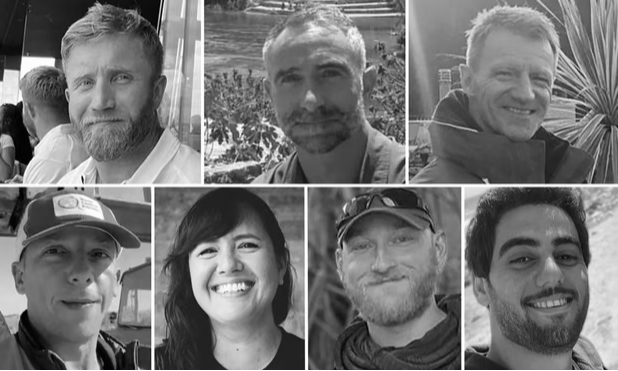
Killed aid workers (top): James Henderson, James Kirby and John Chapman; (bottom): Damian Sobol, Lalzawmi Zomi Frankcom, Jacob Flickinger and Saif Issam Abu Taha
By Nate Bear | ¡Do Not Panic! | August 28, 2026
The Israeli commander who gave the order to bomb the World Central Kitchen convoy in April 2024 which killed six aid workers – three Britons, an American-Canadian, a Pole, an Australian and a Palestinian – said yesterday he’s not sorry for ordering the strike and that the aid workers were “not innocent.”
Last week Israel (which originally lied and said the bombing was a mistake) said no one would be prosecuted for the murders.
The episode is astonishing.
Israel murdered the citizens of five of its supposed allies, using weapons and intelligence supplied by those countries, has refused to prosecute anyone, and the commander who ordered the bombing is now bragging about it.
This is Zionism.
This is what happens when you have swallowed the logic of an ethno-supremacist ideology that enables and forgives any action, no matter how heinous, because the action was undertaken by the most indulged and protected state in modern history. And obviously, this indulgence and protection flows directly from the fact that Israel is the so-called “Jewish state.” And Jewishness, objectively, is the most protected characteristic in the modern world. Grannies are prosecuted as terrorists not because they oppose genocide, but very specifically because they oppose the genocide committed by the Jewish state. Through cultural brainwashing, political infiltration, and using the shield of antisemitism to guard against all criticism, Israel can kill whoever it wants, whenever it wants, wherever it wants. And it can kill them in whatever quantities it desires. Because the killers are Jews, and we can’t criticise Jews because of antisemitism and the holocaust, which, through deep cultural programming has been instrumentalised to make Jews morally untouchable. Through this weaponisation of memory and elevation of unimpeachable Jewishness we end up with an inverted political morality: genocide is moral, anti-genocide is immoral.
Bring all this together and you get an ethno-supremacist apartheid state which commits genocide and kills westerners without consequence.
You get the mass murder of children for years on end. Murders which continue DAILY.
You get a state able to commit wanton acts of terror in Gaza and the West Bank without reproach.
You get Gaza and the West Bank, you get Israel, but you don’t get Palestine. You don’t get the state that the 1947 UN vote also authorised because the Jewish state was the only one that mattered to the “international community.”
You get Israel but not Palestine because the ability of Jews to commit ethnic cleansing and move to piece of land promised to them in a book matters more than the right of Palestinians to live in their ancestral homelands.
You get seventy-eight years of ethnic cleansing.
You get a state able to kill the citizens of its supposed allies, and the weapons and intelligence keep flowing, even when that intelligence kills your own citizens. The RAF has surveillance tape from a spy plane that was circling above Gaza on the day Israel bombed the aid convoy and killed three Brits, as it was almost every day during the genocide, but the British government has refused to publish or disclose what the tape shows.
It can feel like you’re going mad when analysing the role of Israel in the world, and its place within empire. You can sound like a conspiracy theorist. But then, sooner or later, the operatives of the Jewish state come out and in their own words confirm everything you know and everything you believe about Zionism.
To add to the fuckery of the World Central Kitchen murders, the boss of the organisation, Jose Andres, went on Israeli TV after the attack and repeated all the propaganda that enabled the murders in the first place, saying Israel has a right to defend itself. In the midst of a genocide, with the blood of his own employees barely dry, he tried to morally exculpate Israel by tearfully claiming the country is “better than this.” He simply couldn’t conceive that the murders were not an aberration but a perfect reflection of Israel. His organisation still cooks meals for the IDF because, like many, Andres has internalised the logic of Zionism which would mean that to not cook food for the Jewish murderers of his employees would be antisemitic.
It’s fucking disgusting, almost unbelievable.
This of course wasn’t the first time Israel has murdered citizens of western countries without consequence. It wasn’t the second, third or even the tenth time. In the last twenty-odd years Israel has killed scores of westerners in Palestine.
In November 2002, Iain Hook, a British UNRWA project manager, was shot and killed by Israeli forces in Jenin, in the West Bank. In March 2003 American Rachel Corrie was crushed to death by an Israeli military bulldozer in Rafah, Gaza, while protecting local families as IDF troops moved in to destroy their homes. Two months later, James Henry Miller, from Wales, was shot and killed by Israeli troops in Rafah while filming a documentary. In early 2004, British aid worker Tom Hurndall was shot in the head and killed by an Israeli sniper in Rafah while attempting to shield Palestinian children. In 2022, Al Jazeera journalist and US citizen Shireen Abu Akleh, was sniped in the head and killed on camera while reporting in the West Bank. In September 2024, a few months after the World Central Kitchen murders, Ayşenur Ezgi Eygi, a Turkish-American, was murdered by the IDF in the West Bank.
There were ZERO consequences for any of these murders. How many average western mainstream media consuming adults EVEN KNOW about these murders?
Palestinians, by contrast, have housed and homed westerners in Gaza and the West Bank. Hamas often welcomed western aid workers to Gaza with some, such as the Italian Vittorio Arrigoni, staying years, and after whom Hamas named a street in Gaza. The only people that kill westerners in Palestine are Jewish Israelis.
My depth of contempt for the Jewish state and for the system that sustains it knows no bounds and we should consider illegitimate any government that supports this colonial monstrosity.
Fuck Israel.
Free Palestine.
Israeli terrorism is getting worse because Western leaders are cowards, hypocrites
By Robert Inlakesh | Al Mayadeen | August 30, 2026
Israeli terrorism against civilians across the occupied West Bank has recently triggered condemnation from Western leadership – this shallow rhetoric is overshadowed by their actions, which are driven by a cowardly refusal to push back against the Zionist lobby.
Condemnations and statements of concern have been recently issued by US, UK, and EU officials alike, in what appears at first glance to be pushback against Israeli settler violence and expansionism in the occupied West Bank. In fact, what we are witnessing is the continuation of a decades-long tradition of hollow statements that act to save face by pretending as if the settlers themselves are somehow rogue elements that can be judged independent of the rest of the Zionist project.
In reality, settlement expansion is a regime project, as the violence of the settlers themselves is too. The Zionist armed forces are hand in glove with the settlers, to the point that military units such as the ‘Desert Frontier’ have been set up to integrate the settler militias into the occupation forces.
Even if the settlement movement was separate from the regime itself – as the EU, UK, and US leaderships like to pretend so that they can continue presenting themselves as capable of criticizing the Israelis – there has been a carte blanche granted to the authorities in “Tel Aviv”, instead of meaningful pushback that would coerce them into curtailing the aggressive project of the settlers.
The moves being made in Western capitals represent the exact opposite of genuine opposition to settler colonial violence and expansionism. US President Donald Trump has refused to impose consequences on the Zionist regime for the killings of 11 American citizens at the hands of settlers.
Instead, its latest move has been to proscribe Palestine Action as a terrorist organization. That means that both Washington and London have designated the activist group as such. This is not a group that engages in armed action; it does not go after targets that are integral to US or UK security, nor has it killed anyone. Palestine Action has been proscribed for the “crime” of organizing actions against weapons factories that supply the components for weapons used to commit genocide.
Interestingly, the news of Palestine Action being added to a US terror list came alongside a declaration from Washington that it was removing Syria from the State Sponsors of Terrorism List. Keep in mind that President Trump has actively acknowledged that the man – whom he claims to have put in power – was formerly affiliated with al-Qaeda. In fact, Hay’at Tahrir al-Sham (HTS), which is now the ruling Party in Damascus, is a rebrand of al-Qaeda’s Syrian wing, which was previously known as Jabhat al-Nussra. HTS is no longer considered a terrorist group by the US, as per its recent declaration.
This in itself demonstrates how unserious Western leadership takes the issue of terrorism. Simply put, terrorism is opposing the Zionist settler-colonial project. It can be guaranteed with a degree of certainty that if Syrian President Ahmad al-Sharaa were to suddenly begin taking measures against the Israelis in southern Syria, or supporting Palestinian Resistance factions, there would be immediate sanctions and proscriptions to follow. But because his administration has signed onto a “joint fusion mechanism” to coordinate with Israeli intelligence, the former face of al-Qaeda in Syria is welcomed across Europe, meets with British officials, and is welcomed with open arms into the White House.
The collective West’s political class is stupefyingly corrupt and has spent nearly three years performing puppet apologetics for a regime committing an active genocide against the people of Gaza. No meaningful action is ever taken. Even Western institutions like FIFA and Eurovision, alongside the International Olympic Committee (IOC), have proven too cowardly to boot out the Israelis, despite FIFA and IOC both taking measures to ban Russia over the war in Ukraine.
Consider the recent threats by Israeli Prime Minister Benjamin Netanyahu to launch precision strikes on targets in Gaza because it found kites near the separation barrier, forcing children to no longer enjoy a common hobby for Palestinian children in the besieged territory. Most people have considered this an utter outrage, mocking the mere premise of launching airstrikes over children’s kites being flown.
Yet the Israelis were taken seriously when, back in 2018, they began complaining of “terror balloons” and “terror kites” that young Gazans would attach burning objects to, as retaliation for the mass shootings carried out against unarmed protesters during the Great Return March. It may almost seem comical that the Israelis complained about this and that the words terror and balloon were combined in a serious sentence, yet Western leadership adopted the very same language.
Take, for example, the 2021 designation of the Hamas political wing as a ‘terrorist organization’ in the United Kingdom. In their justification as to why they decided to proscribe the political wing – because the Qassam Brigades had long been on their list – the most in-depth example they cited was the use of these balloons. Yes, balloons were used as the most important example as to why Hamas was designated a “terrorist group” in the United Kingdom.
The double standards are so stark that it beggars belief. At the end of the day, it is the utter cowardice that emboldens the Zionist regime to do whatever it chooses, whenever it likes. These Western governments and institutions have allowed the Israelis to erode the post-WW2 international order, destroyed the concepts of human rights and international law, and normalized genocide, even ignoring domestic law, endangering their own populations and undermining the fight against actual terrorism.
They render the international courts ineffective and take measures to punish them for doing their jobs; they stand by and praise the Zionist entity along with its allies in Washington as an alternative body to the United Nations taking over control of the Gaza Strip. International borders and national sovereignty no longer mean anything; embassies are no longer off limits for airstrikes; and journalists can be mass executed with no pushback.
A world that has been turned completely upside down, all so that a small settler colonial regime whose ethno-supremacist cult following of narcissistic psychopaths can have their way at every single turn. All of this, then they turn around and pretend as if their completely shallow statements about settler violence somehow mean anything. In many ways, it would be better if they just closed their mouths. None of the violence they pretend to condemn, without ever doing anything tangible to stop it, would be possible if they had taken action to stop it.
Federal GRANITE Act Targets Foreign Censorship Orders in US
Foreign censors have discovered that sending threatening emails to US platforms is cheap. Michael Rulli’s bill would make the next step considerably more expensive.
By Christina Maas | Reclaim The Net | August 29, 2026
It’s not every day that the US Congress is moved to act by the UK’s speech regulators – but there’s a first time for everything, and that time is now. And that regulator is Ofcom.
But Ofcom – or rather, its overreach – has managed to bring about the introduction of a new bill, the first of its kind at the federal level, even if not the first attempt to produce legislation that would deal with this problem.
The bill is called GRANITE, and the full name is even more interesting: Guaranteeing Rights Against Novel International Tyranny and Extortion Act. The man behind it is Republican Rep. Michael Rulli of Ohio, who introduced it on August 27, 2026, as H.R. 10174.
We obtained a copy of the bill for you here.
Rulli explained the effort as a way to stop “foreign bureaucrats” from deciding what Americans can and can’t say. “My bill makes clear that if a foreign government tries to punish an American for speech protected by the First Amendment, that judgment is dead on arrival in our courts,” Rulli is quoted as saying.
“The constitution protects our right to speak freely. It does not bend to Brussels or London,” he added. Rulli has the support of senior White House figures.
The background to all this is the UK’s Online Safety Act, and Ofcom’s attempts to use it to go after American online services. Ofcom, for some reason, believes its censorship powers extend to the US.
Preston Byrne, who represents 4chan and helped draft the GRANITE proposals, and supports Rulli’s bill, says that between February 2025 and April 2026, Ofcom sent at least 197 notices to US companies – and only four were publicly refused, all by his clients.
4chan sued Ofcom in a federal court in Washington, invoking the First, Fourth and Fifth Amendments – and Ofcom tried to get the case dismissed, citing the Foreign Sovereign Immunities Act.
But in doing that, Ofcom also invoked British law as applicable on US soil, while at the same time claiming immunity from the US lawsuit because it is a foreign state. And Ofcom’s demands arrived in emails marked CONFIDENTIAL and threatened fines and prison.
In the best of worlds, that would be that. But there’s a good chance the foreign order will be obeyed anyway, because big platforms and internet services are generally risk-averse and may not want to pick a fight with a foreign government. That’s where the law comes in.
First, the shield: Proposed section 4106(a) says: “Notwithstanding any other provision of Federal or State law, a domestic court shall not recognize or enforce a foreign judgment, or a fine, order, or demand issued by a foreign court or a foreign state, enforcing a foreign censorship law.” The shield reaches judgments, fines, orders and demands, not merely court judgments; that matters because regulators often act administratively without judicial supervision.
Now, the sword: Proposed section 4106(b) lets a United States person served or purportedly served with a covered measure seek declaratory relief in federal district court that it is unenforceable: “A United States person against whom a foreign judgment described in subsection (a) is entered, or upon whom a judgment, fine, order, or demand described in subsection (a) is served or purportedly served, may bring an action in an appropriate district court of the United States seeking declaratory relief that such judgment, fine, order, or demand is unenforceable under subsection (a).”
The remedy is declaratory only: the federal proposal does not award damages or authorize seizure of foreign assets.
Finally, the Foreign Sovereign Immunities Act amendment adds an exception for cases “under section 4106;” those are the entire three words of the new paragraph. This is intended to prevent a foreign regulator from ending the suit at the outset by claiming sovereign immunity.
Byrne, Wyoming Deputy Secretary of State Colin Crossman and Wyoming Rep. Daniel Singh developed Wyoming HB 70, introduced in early 2026. The bill passed the state House 46-12 on February 23 but stalled in the Senate during the short budget session; it did not become law.
Wyoming’s proposal combined a shield with a private right of action and proposed statutory damages equal to at least $1 million or the maximum threatened fine. It also proposed blocking state enforcement and cooperation, including assistance with investigations, extradition requests and data demands tied to First Amendment-protected speech.
West Virginia introduced a sword-and-shield version in its short 2026 session, but it did not advance. On July 24, 2026, ALEC adopted shield provisions as national model policy, and a New Hampshire proposal following that model is expected for the 2027 session. Byrne says that by August 28, at least five public versions of the GRANITE blueprint existed.
Rulli’s federal bill is narrower than Wyoming HB 70 because it offers declaratory relief but no damages; on the other hand, its federal authority lets it directly amend sovereign-immunity law.
But even without the proposed bill, the First Amendment already gives strong grounds against enforcement of a foreign censorship order, Preston Byrne writes. The rules, however, are “judge-made” – and a first-instance court could misapply them.
Congress enacted the SPEECH Act in 2010 to block enforcement of foreign defamation judgments that are inconsistent with American free speech standards. The proposed GRANITE language would sit beside it in chapter 181 of title 28.
But the threat works even before enforcement. A service can comply, restrict content globally, add age assurance and data collection, leave a market, or fund a fight. A large platform with staff, assets or infrastructure abroad still faces action there even if an American court refuses to help.
Byrne estimates that Ofcom spent about 2,800 staff-hours on the 4chan matter, and obtained zero compliance, one federal lawsuit, and four emails featuring hamsters from 4chan’s counsel.
“An e-mailed demand costs a foreign regulator nothing to send today and is frequently cloaked in secrecy,” he wrote. The bill would make a covered demand capable of triggering public, expensive litigation in America. It has only been introduced.
And so the email sent by a regulator abroad that was once essentially free to send, and was ignored, or replied to with pictures of hamsters – might in the future return to them in the form of a US court date.
US designates Palestinian refugee in Germany ‘terrorist’ over human rights activism

Zaid Abdulnasser, a Palestinian refugee and human rights activist stands in front of German police during a pro-Palestine demonstration in Berlin, October 2023.
Press TV -August 29, 2026
The US has designated Zaid Abdulnasser, a 30-year-old stateless Palestinian refugee based in Berlin, as a terrorist and imposed sanctions on him over his advocacy for Palestinians imprisoned by the Israeli regime, a report says.
The US Treasury Department placed Abdulnasser on its sanctions list on Wednesday, meaning financial institutions dealing with him could face pressure from Washington and potentially cut ties with his accounts, according to a report by Drop Site.
Because international payment networks rely heavily on US banks and dollar transactions, Abdulnasser said the measures could “completely paralyze” him financially.
“I was frightened. The authorities did not contact me beforehand; they just put me on the list,” Abdulnasser told Drop Site in an interview.
Abdulnasser, who has a six-month-old child, said he believes the move is part of a wider effort to restrict Palestinian human rights advocacy.
“On this list are Palestine Action, International Criminal Court judges, and Palestinian resistance factions,” he said, adding, “My listing is part of a broader attempt to crush the Palestinian liberation struggle and protect the Israeli occupation from prosecution.”
A Palestinian refugee born in Syria, Abdulnasser has lived in Berlin since 2017 and has worked on campaigns concerning Palestinian prisoners and Palestinian rights.
His lawyer, Alexander Gorski, said they are now carefully examining legal options to challenge the US measures.
“Mr. Abdulnasser has not committed a criminal offense. And nobody is accusing him of that … This is about legal political activity, mainly for Palestinian prisoners,” Gorski told Drop Site.
The sanctions come as Washington expands economic measures against people and organizations involved in pro-Palestinian activism, according to the report.
US Secretary of Treasury Scott Bessent said Washington would use its economic powers against groups it considers “security threats,” while Gorski described the action against his client as part of a broader US crackdown on Palestinian rights activism.
According to the Palestinian Prisoners’ Society, since October 7, 2023, when Israel launched its genocidal war on Gaza, the regime has abducted nearly 25,000 Palestinians from the occupied West Bank and the besieged enclave.
Trump’s push to deport Pro-Palestinian activists faces court defeat
Al Mayadeen | August 29, 2026
A federal judge on Friday ruled that laws used by US President Donald Trump’s administration to revoke visas and pursue deportation proceedings against noncitizen college students over their pro-Palestinian advocacy and criticism of “Israel” are unconstitutional.
US District Judge Noel Wise in San Jose, California, sharply criticized the US State Department and US Department of Homeland Security for using provisions of federal immigration law to pursue deportation against noncitizens for expressing views the government sought to suppress.
The State Department and DHS did not immediately respond to requests for comment, according to Reuters.
Wise says free speech is central to democracy
Wise, an appointee of former Democratic President Joe Biden, said free speech in the United States, including the right to criticize the government and its leaders, demonstrated the strength of the country’s democracy.
“That strength is diminished when members of our society – citizens and noncitizens alike – must self-censor and ‘behave’ or suffer the government’s retaliation,” she said.
Case centered on campus pro-Palestinian advocacy
Wise’s ruling examined the Trump administration’s actions beginning in March 2025, when it started revoking visas and detaining noncitizens involved in pro-Palestinian advocacy on college campuses. The effort began with the arrest of Columbia University graduate Mahmoud Khalil, who is fighting separately to avoid deportation.
The arrests prompted a lawsuit filed in August 2025 by Stanford University’s student newspaper, The Stanford Daily. The newspaper reported that some of its writers who held student visas had stopped covering pro-Palestinian student demonstrations and issues connected to the wars in West Asia because of the administration’s policies.
The newspaper’s attorneys argued that two provisions of the Immigration and Nationality Act used by the administration to revoke student visas and begin deportation proceedings violated the First and Fifth Amendments of the US Constitution when applied to constitutionally protected speech.
Judge finds viewpoint discrimination
The provisions permitted Secretary of State Marco Rubio to deem a noncitizen deportable if he personally concluded that the person’s actions “compromises a compelling foreign policy interest” and also gave him discretion to revoke a person’s visa.
Wise sided with the newspaper, finding that when a noncitizen’s speech is the basis for a visa revocation and deportation decision, “the government is singling out that speech for disfavored treatment based on its viewpoint or content.”
Conor Fitzpatrick, whose group Foundation for Individual Rights and Expression represented The Stanford Daily, said in a statement that the ruling “proves that free speech isn’t a privilege, but the inalienable right of every man, woman, and child.”
Ruling follows earlier decision against administration
The decision echoes a ruling last year by Boston-based US District Judge William Young, who likewise determined that the administration had violated the Constitution by pursuing a policy of revoking visas, arresting, detaining and deporting foreign students and faculty involved in pro-Palestinian advocacy.
Wise also warned that the administration appeared to be expanding its focus to people expressing other views it considered objectionable. She said that eventually the “targets may include anyone in the United States who exercises their freedom of speech to simply express opinions the government does not like.”
“This downward spiral is antithetical to our Constitution that recognizes our right to speak freely,” she wrote. “Here you can simultaneously hate the content of a person’s speech and love the country that cherishes the freedom to allow it.”
What do you need to know?
The ruling comes amid a sweeping Trump administration crackdown on pro-Palestinian advocacy and campus demonstrations at US universities, including threats to cut federal funding from institutions that permit what the administration termed “illegal protests,” investigations into dozens of universities over alleged failures to address antisemitism, and major funding withdrawals targeting schools such as Columbia University and Harvard.
The administration has also pursued international students and scholars involved in pro-Palestinian activism through visa revocations and deportation proceedings, including high-profile cases.
Up to 3,000 people forcibly disappeared in Gaza during Israeli war: Rights group
MEMO | August 29, 2026
Between 2,500 and 3,000 people are estimated to have been subjected to enforced disappearance in the Gaza Strip during Israel’s war, a Palestinian rights group said Saturday, on the eve of the International Day of the Victims of Enforced Disappearances, Anadolu reports.
The Palestinian Center for Missing and Forcibly Disappeared Persons issued the estimate based on an analytical study of a sample of 317 cases, saying the findings showed indicators warranting an investigation into the possibility of a broader pattern of enforced disappearances in Gaza.
The center said its study was based on reports submitted by families of missing people and cases documented in the field and did not represent all cases of missing or forcibly disappeared people in Gaza.
Of the 317 cases examined, 302, or 95.27%, were males and 15 were females. The sample included 41 children and 17 people aged 60 or older.
Gaza City recorded the largest number with 89 cases, followed by northern Gaza with 74, Khan Younis with 59, central Gaza with 37 and Rafah with 32.
Regarding the circumstances of the disappearances, 76 cases occurred during Israeli military raids on homes or sieges of neighborhoods, while 60 occurred as people attempted to return to their homes or retrieve necessities.
Another 42 cases were recorded during displacement or while passing through military checkpoints, and 39 while people were searching for food or waiting for aid.
The center also documented 22 cases linked to the siege or storming of medical facilities or the transfer of patients and 10 involving journalistic or field work.
Separately, the organization estimated that between 4,000 and 5,000 people are missing and believed to be under the rubble of destroyed buildings, stressing that these cases should not be conflated with suspected enforced disappearances.
In April, the Palestinian Justice Ministry said more than 11,200 Palestinians had been reported missing or forcibly disappeared since October 2023, including more than 4,700 women and children.
The UN defines enforced disappearance as the arrest, detention or abduction of a person by state authorities or actors operating with their authorization, support or acquiescence, followed by a refusal to acknowledge the deprivation of liberty or disclose the person’s fate or whereabouts.
The center called for the fate of all missing people to be disclosed, access for the International Committee of the Red Cross to detainees and the establishment of an independent international mechanism to investigate cases of enforced disappearance and hold those responsible accountable.
With US support, Israel launched its war on the Gaza Strip in October 2023, killing more than 73,000 Palestinians and injuring over 174,000, most of them women and children.
Coroner Contradicts Pennsylvania Health Officials, Says Measles Didn’t Cause Newborn’s Death
By Brenda Baletti, Ph.D. | The Defender | August 27, 2026
Pennsylvania Gov. Josh Shapiro stood in Lancaster County on Tuesday and announced two “measles-associated deaths” — the first the commonwealth has reported in 35 years — calling them “preventable” and urging residents to get vaccinated.
Within a day, the county’s own coroner publicly disputed the state’s characterization.
On Tuesday, a Pennsylvania Department of Health (DOH) press release reported two measles-associated deaths in unvaccinated Lancaster County residents. The department initially withheld the individuals’ ages, medical circumstances and immediate causes of death, citing privacy concerns.
On Wednesday, Lancaster County Commissioner Josh Parsons said on X that the Lancaster County Coroner’s Office had recorded zero deaths caused by measles — only one death of a person who tested positive for measles.
The coroner, Dr. Stephen Diamantoni, told the Philadelphia Inquirer that one of the deaths involved a newborn who died shortly after birth from a lacerated spleen. Measles antibodies were present in postmortem testing, but Diamantoni said the death was not caused by measles.
The World Health Organization (WHO) defines a “measles-related death” as a death in someone with a positive measles test that occurs within 30 days of a measles rash onset “and is not due to other unrelated causes” such as trauma. The WHO standard raises questions about how the Pennsylvania health authorities classified the infant’s death.
DOH spokesperson Neil Ruhland told The Defender that the department classifies a death “measles-associated” if “laboratory or epidemiologic evidence of measles is present,” even when the medical certifier or coroner doesn’t find measles was the immediate cause.
Pennsylvania Secretary of Health Debra Bogen said on X both individuals “tested positive for measles” and that DOH is not required to report deaths to coroners. The department has not disclosed any information about the second death.
U.S. Health Secretary Robert F. Kennedy Jr. and Shapiro sparred over the announcement. Shapiro blamed Kennedy and the Trump administration for circulating vaccine “misinformation.” He declined help from the federal government with the ongoing measles outbreak.
After the conflicting claims from DOH officials and the coroner’s office made headlines, Kennedy said on X that Shapiro’s announcement of two measles deaths on Tuesday appeared premature and may have been “altogether fabricated” by one of his staffers hoping to score a political win.
Kennedy called Shapiro’s Tuesday press conference “a replay of the Democrats’ COVID playbook: fearmongering, misinformation, finger-pointing, and the weaponization of infectious disease fears for political gain.”
Pennsylvania has deep financial ties to vaccine industry
At the podium on Tuesday, Shapiro didn’t disclose his administration’s extensive financial relationships with vaccine manufacturers specifically, and the pharmaceutical industry broadly.
Investigative journalist Sayer Ji documented roughly $5.5 billion in public and private investment in commonwealth-backed pharmaceutical and life-sciences companies under Shapiro, including about $300 million in direct support from Pennsylvania.
That total includes a $10.65 million grant Shapiro personally announced to flu vaccine manufacturer Sanofi Pasteur on June 26 — 60 days before the Lancaster press conference — and $21 million in commonwealth support for a GSK vaccine-manufacturing expansion in Lancaster County itself.
The GSK expansion project is just minutes from where the press conference was held. Ji reported that the project is “the largest Commonwealth-supported economic development project in Lancaster County history.”
Additional commonwealth-backed investment has gone to Eli Lilly, Johnson & Johnson/Janssen Biotech, Eurofins Lancaster Laboratories (also in Lancaster County), and Innovate in PA 2.0, a tax-credit program supporting startup capital and a statewide clinical trial network.
On Oct. 1, 2025, Shapiro signed an executive order stating that Pennsylvania “manufactures more than one-half of all vaccines administered in the United States.”
The order was intended to position the state to maintain its own vaccine guidance independent of federal recommendations, should the Centers for Disease Control and Prevention alter the childhood vaccine schedule.
DOH and governor work to expand health department powers
While the reports of measles deaths drew national attention, the Shapiro administration was separately advancing a proposed rewrite of the commonwealth’s communicable and non-communicable disease regulation.
The draft regulation was published Aug. 8, with public comment open through Sept. 21 — meaning the two unresolved measles deaths became national news 17 days after the regulation’s publication.
The proposed rule would significantly expand the DOH’s authority. The proposal includes expanding the list of reportable diseases from 52 to 125 and adding an open-ended “emerging disease” category.
It also calls for broadening immunization-reporting requirements and formalizing access to medical records, facilities and schools during investigations.
Provision 27.60 of the proposed regulation gives the DOH authority to order disease-control measures — like masking, social distancing and vaccine mandates — for disease “prevention, containment or mitigation.”
Researcher James Lyons-Weiler, Ph.D., noted in his Substack analysis that the preamble to the proposed rule specifically mentions a lawsuit that struck down school mask mandates.
Lyons-Weiler said the proposed rewrite appears specifically designed to give the state the legal authority that it lacked to implement such measures during the COVID-19 pandemic.
“In other words, the COVID-era legal defeat is not an incidental historical reference. It is part of the rationale for rewriting the rule,” he said.
‘Vaccines are on the ballot’
In a separate Substack post, Ji suggested that the political response to the Lancaster deaths didn’t emerge organically. He said that a well-resourced messaging apparatus was already positioned to convert the measles announcement into a national narrative.
Six days before Pennsylvania’s announcement, Protect Our Care — a Democratic Party health advocacy group staffed by former Democratic National Committee members, U.S. Department of Health and Human Services counselors and others — and 314 Action released results of polling designed to test vaccine-related messages for their power to damage Republicans electorally.
According to Ji, participants were presented with claims about measles returning, the Trump administration disregarding scientific evidence and Republicans weakening childhood vaccine recommendations.
The poll showed that 50%-54% of respondents said the messages lowered their opinion of GOP members of Congress.
Protect Our Care concluded that “vaccines are on the ballot” and that vaccine policy was the GOP’s greatest midterm weakness. In an Aug. 20 newsletter, the organization wrote: “needlessly putting kids in the hospital or morgue is a political loser.”
Ji reported that when Pennsylvania announced the deaths on Aug. 25, Protect Our Care immediately stated that Trump and Kennedy had fueled the crisis, “resulting in” the deaths. President Brad Woodhouse said, “Trump and RFK Jr. have blood on their hands … Mr. Kennedy, fucking resign already.”
Protect Our Care is not a charity; it is a lobbying group. Ji said that Shapiro’s office has worked closely with Protect Our Care since 2020, and noted the group’s own website describes its work as using a “campaign mentality” and running “tightly orchestrated, narrative-shaping initiatives.”
Ji was careful to frame this as raising questions rather than proving coordination. The timeline shows that the messaging infrastructure existed and was quickly activated, not that its timing or content were coordinated in advance with the state’s announcement, Ji said.
The information together — the coroner’s dispute over cause of death, the unmentioned funding to vaccine manufacturers, the regulation expanding the department’s own authority, and a political messaging operation that moved within hours — raises concerns about the deaths and Pennsylvania’s response.
Parsons continues to demand answers on X and to accuse the Pennsylvania health officials of “deception.”
This article was originally published by The Defender — Children’s Health Defense’s News & Views Website under Creative Commons license CC BY-NC-ND 4.0. Please consider subscribing to The Defender or donating to Children’s Health Defense.
Featured Video

Iran’s Next Strike May Not Explode. It Could Shut You Down
or go to
Aletho News Archives – Video-Images
From the Archive
Zionism’s Violent Legacy
By Donald Neff | Washington Report On Middle East Affairs | January 1996
On January 4, 1948, Jewish terrorists drove a truck loaded with explosives into the center of the all Arab city of Jaffa and detonated it, killing 26 and wounding around 100 Palestinian men, women and children.[1] The attack was the work of the Irgun Zvai Leumi – the “National Military Organization,” also known by the Hebrew letters Etzel – the largest Jewish terrorist group in Palestine. The Irgun was headed by Revisionist Zionist Menachem Begin and had been killing and maiming Arabs, Britons and even Jews for the previous ten years in its efforts to establish a Jewish state.
This terror campaign meant that at the core of Revisionist Zionism there existed a philosophical embrace of violence. … continue
Blog Roll
 Aletho News
- Trump’s Iran war is on an Israeli leash
- Saudi oil boss issues global supply warning
- Riyadh Says Its Oil System Is Intact. The Numbers Say Otherwise.
- Trump and Netanyahu Want to “Finish the Job” on Iran
- US ‘one-sided dictation’ not Iran’s beliefs makes rational talks impossible: Baghaei
- Iran’s Next Strike May Not Explode. It Could Shut You Down /Col Doug Macgregor
- Iran: US political targets legitimate if assassinations return
- Iraq shuts key border crossing with Iran under US pressure: Report
- Undersea Internet cables could be targeted in retaliation for attacks on Iran: IRGC deputy chief
- EU sending ‘biased’ observers to interfere in Serbian election – president
- If Americans Knew
- The Israel Lobby’s Changing Fortunes
- AIPAC has become such a political liability that it’s shifting to a more “nimble” approach to buying politicians
- At least 160 Israeli settler attacks in 2 weeks
- Will Gaza’s Ancient Christian Community Disappear Forever?
- Israel’s vision of regional security rests on keeping Arab states weak
- Heidi Levine recounts how Palestinian youths helped save her in settler attack
- DAILY UPDATE: Latest essential news on Palestine, Israel, & region
- Trump’s Intensifying Sabotage of the ICC, for Israel’s Sake
- Israeli military detain US and UK volunteers in West Bank including Democratic NY politician Brad Lander
- Americans at National Conservatism Conference held in Israel this year criticize Israel
- No Tricks Zone
- E-Cars Reduce CO2 Emissions By Only 41% Compared To Internal Combustion Engine Vehicles
- Predictions Made By Renowned Climate Professor Over Past Decades Have Been Proven To Be Poor
- New Study Suggests Large Regions Of The Pacific Ocean Have Been Cooling For The Last 80 Years
- Germany’s Green Energy Debacle: High Energy Costs Force Kahla Porzellan to Close After 182 Years!
- New Study: 50 Years Of The Most Aggressive ‘Net Zero’ Policies Can Only Affect The Global Climate By 0.03°C
- US September “Heat” Was No Record…Many Records Set Decades Ago
- Latest European Green Energy Debacle; Portugal’s Largest Flagship Solar Park Insolvent!
- Green Energy Debacle: German Expert Professor Fritz Vahrenholt Warns Of Severe Economic And Social Consequences
- Two More Paleo Reconstructions Affirm Meters-Higher Sea Levels Across Ireland, Brazil 7000-6000 Years Ago
- New Study: Earth And Venus Surface Warmth Largely Explained By Convection And Lapse Rate, Not CO2 Or Radiation

