In the American police state, police have a tendency to shoot first and ask questions later.
In fact, police don’t usually need much incentive to shoot and kill members of the public.
Police have shot and killed Americans of all ages—many of them unarmed—for standing a certain way, or moving a certain way, or holding something—anything—that police could misinterpret to be a gun, or igniting some trigger-centric fear in a police officer’s mind that has nothing to do with an actual threat to their safety.
So when police in Florida had to deal with a 19-year-old embarking on a shooting rampage inside Marjory Stoneman Douglas High School in Parkland, Fla., what did they do?
Nothing.
There were four armed police officers, including one cop who was assigned to the school as a resource officer, on campus during that shooting. All four cops stayed outside the school with their weapons drawn (three of them hid behind their police cars).
Not a single one of those cops, armed with deadly weapons and trained for exactly such a dangerous scenario, entered the school to confront the shooter.
Seventeen people, most of them teenagers, died while the cops opted not to intervene.
Let that sink in a moment.
Now before your outrage bubbles over, consider that the U.S. Supreme Court has repeatedly affirmed (most recently in 2005) that police have no constitutional duty to protect members of the public from harm.
Yes, you read that correctly.
According to the U.S. Supreme Court, police have no duty, moral or otherwise, to help those in trouble, protect individuals from danger, or risk their own lives to save “we the people.”
In other words, you can be outraged that cops in Florida did nothing to stop the school shooter, but technically, it wasn’t part of their job description.
This begs the question: if the police don’t have a duty to protect the public, what are we paying them for? And who exactly do they serve if not you and me?
Why do we have more than a million cops on the taxpayer-funded payroll in this country whose jobs do not entail protecting our safety, maintaining the peace in our communities, and upholding our liberties?
Why do we have more than a million cops who have been fitted out in the trappings of war, drilled in the deadly art of combat, and trained to look upon “every individual they interact with as an armed threat and every situation as a deadly force encounter in the making?
I’ll tell you why.
It’s the same reason why the Trump Administration has made a concerted effort to expand the police state’s power to search, strip, seize, raid, steal from, arrest and jail Americans for any infraction, no matter how insignificant.
This is no longer a government “of the people, by the people, for the people.”
It is fast becoming a government “of the rich, by the elite, for the corporations,” and its rise to power is predicated on shackling the American taxpayer to a life of indentured servitude.
Cops in America may get paid by the citizenry, but they don’t work for us.
They don’t answer to us. They’re not loyal to us.
And they certainly aren’t operating within the limits of the U.S. Constitution.
That “thin, blue line” of loyalty to one’s fellow cops has become a self-serving apparatus that sees nothing wrong with advancing the notion that the lives—and rights—of police should be valued more than citizens.
The myth of the hero cop really is a myth.
Cops are no more noble, no more self-sacrificing, no braver and certainly no more deserving of special attention or treatment than any other American citizen.
This misplaced patriotism about police and, by extension, the military—a dangerous re-shifting of the nation’s priorities that has been reinforced by President Trump with his unnerving knack for echoing past authoritarian tactics—paves the way for even more instability in the nation.
Welcome to the American police state, funded by Corporate America, policed by the military industrial complex, and empowered by politicians whose primary purpose is to remain in office.
It’s a short hop, skip and a jump from the police state we’re operating under right now to a full-blown totalitarian regime ruled with the iron fist of martial law.
The groundwork has already been laid.
The events of recent years have only served to desensitize the nation to violence, acclimate them to a militarized police presence in their communities, and persuade them that there is nothing they can do to alter the seemingly hopeless trajectory of the nation.
The sight of police clad in body armor and gas masks, wielding semiautomatic rifles and escorting an armored vehicle through a crowded street, a scene likened to “a military patrol through a hostile city,” no longer causes alarm among the general populace.
Few seem to care about the government’s endless wars abroad that leave communities shattered, families devastated and our national security at greater risk of blowback. Indeed, there were no protests in the streets after U.S. military forces carried out air strikes on a Syrian settlement, killing 25 people, more than half of which were women and children.
And then there’s President Trump’s plans for a military parade on Veterans Day (costing between $10 million and $30 million) to showcase the nation’s military might. Other countries that feel the need to flex their military muscles to its citizens and the rest of the world include France, China, Russia and North Korea.
The question is no longer whether the U.S. government will be preyed upon and taken over by the military industrial complex. That’s a done deal.
It’s astounding how convenient we’ve made it for the government to lock down the nation.
Mind you, by “government,” I’m not referring to the highly partisan, two-party bureaucracy of the Republicans and Democrats.
As I point out in my book Battlefield America: The War on the American People, I’m referring to “government” with a capital “G,” the entrenched Deep State that is unaffected by elections, unaltered by populist movements, and has set itself beyond the reach of the law.
I’m referring to the corporatized, militarized, entrenched bureaucracy that is fully operational and staffed by unelected officials who are, in essence, running the country and calling the shots in Washington DC, no matter who sits in the White House.
This is the hidden face of a government that has no respect for the freedom of its citizenry.
February 26, 2018
Posted by aletho |
Civil Liberties, Militarism, Timeless or most popular | Human rights, United States |
Leave a comment

Israeli hydraulic shovels demolishing a Palestinian building in the occupied West Bank
Israel has approved a bill to expand the jurisdiction of Israeli courts over Area C of the West Bank, paving the way for the annexation of the region.
The area is currently ruled by the military but an annexation would require Israeli law to be imposed and Palestinians living in the area to identify as Arab Israelis.
The ministerial committee for legislation on Sunday approved the measure introduced by justice minister Ayelet Shaked who is known for her extremist views regarding Palestinians.
Her office claimed in a statement that the bill aimed to minimize the caseload of the high court of justice which rules on property rights, building and construction, and restraining orders.
Under the new provision, such cases will be adjudicated by the district courts.
The legislation is also designed to treat Israeli settlers living in the West Bank like those living within the pre-1967 borders, or the so-called Green Line.
The bill must be rubber-stamped by the Israeli parliament or the Knesset but it has already drawn condemnation for being part of a drive to annex Area C and deprive Palestinians living there of their rights.
Yousef Jabarin, a member of the Joint List which represents Palestinian citizens of Israel at the Knesset, slammed the measure as another initiative by Israel to normalize the occupation and to advance “creeping annexation” over the West Bank.
“The High Court of Justice has never treated the Palestinians in the territories justly,” Jabarin said, noting that the legislation will complicate and prolong legal proceedings, leaving Palestinians with little legal recourse.
Under interim agreements signed in the 1990s with Israel, the West Bank is divided into three zones.
The Area C of the West Bank is the largest division in the occupied territory as it comprises 60 percent of the land, and is under full Israeli military control.
The Israeli military almost never grants Palestinians living in Area C building permits.
Palestinians want the West Bank as part of their future independent state, with East Jerusalem al-Quds as its capital.
The presence and continued expansion of illegal Israeli settlements in occupied Palestine, however, has created a major obstacle to the establishment of such a state.
More than half a million Israelis live in over 230 settlements built since the 1967 Israeli occupation of the Palestinian territories of the West Bank and East Jerusalem al-Quds.
The UN and most countries regard the Israeli settlements as illegal because they are built on territories captured by Israel in a war in 1967 and are hence subject to the Geneva Conventions, which forbid construction on occupied lands.
Nevertheless, the Israeli regime continues to build new settlements and expand existing ones.
US President Donald Trump on December 6 formally recognized Jerusalem al-Quds as the so-called capital of Israel and announced plans to move the American embassy to the occupied city.
February 26, 2018
Posted by aletho |
Ethnic Cleansing, Racism, Zionism, Illegal Occupation, War Crimes | Human rights, Israel, Palestine, West Bank, Zionism |
Leave a comment
The Center for American Progress (CAP), a Washington-based Democratic Party think tank funded by Wall Street, including private health insurers and their lobbying group, unveiled a new healthcare proposal designed to confuse supporters of Medicare for All and protect private health insurance profits. It is receiving widespread coverage in ‘progressive’ media outlets. We must be aware of what is happening so that we are not fooled into another ‘public option’ dead end.*
The fact that CAP is using Medicare for All language is both a blessing and a curse. It means Medicare for All is so popular that they feel a need to co-opt it, and it means that they are trying to co-opt it, which will give Democrats an opportunity to use it to confuse people.
This effort could be preparation for the possibility that Democrats win a majority in Congress in 2018 or 2020. It is normal for the pendulum to swing to the party opposite the President’s party during the first term in office. If Democrats win a majority, they will be expected to deliver on health care, but they face a dilemma of having to please their campaign donors, which includes the health insurance industry, or pleasing their voters, where 75% support single payer health care.
The public is aware that the Affordable Care Act (ACA) protects the profits of the medical-industrial complex (private health insurers, Big Pharma and for-profit providers) and not the healthcare needs of the public. “Fixing the ACA” is not popular. Last year during repeal attempts, people made it clear at town halls and rallies that they want a single payer healthcare system such as National Improved Medicare for All (NIMA). By offering a solution that sounds good to the uninformed, “Medicare Extra for All,” but continues to benefit their Wall Street donors, Democrats hope to fool people or buy enough support to undermine efforts for NIMA.
This is an expected development. If we look at the phases of stage six of successful social movements by Bill Moyer (see slide 8), we see that as a movement nears victory, the power holders appear to get in line with the public’s solution while actually attacking it. If the movement recognizes what is happening, that this is a false solution and not what the movement is demanding, then we have a chance to win NIMA. If the movement falls for the false solution, it loses.
Our tasks at this moment are to understand what the power holders are offering, recognize why it is a false solution and reject it.
“Medicare Extra for All” versus National Improved Medicare for All
The basic outline for the new proposal is that people would be able to buy a Medicare plan, a form of ‘public option,’ including the Medicare Advantage plans offered by private health insurers. People who choose to buy a Medicare plan would pay premiums and co-pays, as they do now for private health insurance. The new Medicare system would replace Medicaid for people with low incomes.
Private health insurance would still exist for employers, who currently cover the largest number of people, federal employees and the military. While workers would have the option to buy a Medicare plan, it is unclear how many would do so given that most employers who provide health insurance have their own plans and that private health insurers are experts at marketing their plans to the public.
NIMA, as embodied in HR 676: “The Expanded and Improved Medicare for All Act,” would create a single national healthcare system, paid for up front through taxes, that covers every person from birth to death and covers all medically-necessary care. NIMA relegates private insurance to the sidelines where it could potentially provide supplemental coverage for those who want extras, but it would no longer serve as a barrier for people who need care.
Here are the flaws in the CAP proposal:
- CAP’s plan will continue to leave people without health insurance. Instead of being a universal system of national coverage like NIMA, coverage under the CAP plan relies on people’s ability to afford health insurance. Only people with low incomes would not pay, as they do now under Medicaid. Just as it is today, those who do not qualify as low income, but still can’t afford health insurance premiums, would be left out. Almost 30 million are without coverage today. There is no guarantee that health insurance premiums will be affordable.
- CAPS’s plan will continue to leave people with inadequate coverage. Under NIMA, all people have the same comprehensive coverage without financial barriers to care. The CAP plan allows private health insurers to do what they do best – restrict where people can seek health care, shift the cost of care onto patients and deny payment for care. This is the business model of private health insurers because they are financial instruments designed to make profits for their investors. People with health insurance will face the same bureaucratic nightmare of our current system and out-of-pocket costs that force them to delay or avoid health care or risk bankruptcy when they have high health care needs.
- CAP’s plan will continue the high costs of health care. NIMA has been proven over and over to have the best cost efficiency because it is one plan with one set of rules. It is estimated that NIMA will save $500 billion each year on administrative costs and over $100 billion each year on reduced prices for pharmaceuticals. As a single purchaser of care, NIMA has powerful leverage to lower the costs of goods and services. The CAP plan maintains the complicated multi-payer system that we have today. At best, it will only achieve 16% of the administrative savings of a single payer system and it will have less power to reign in the high costs of care.
- CAP’s plan will allow private health insurers to continue to rip off the government. NIMA is a publicly-financed program without the requirement of creating profits for investors. With a low overhead, most of the dollars are used to pay for health care. The CAP plan maintains the same problems that exist with Medicare today. Private Medicare providers cherry pick the healthiest patients and those who have or develop healthcare needs wind up in the public Medicare plan. This places a financial burden on the public Medicare plan, which has to pay for the most care, while private health insurers rake in huge profits from covering the healthy with a guaranteed payor, the government.
- CAP’s plan will continue to perpetuate health disparities. NIMA provides a single standard of care to all people. Because all people, rich and poor (and lawmakers), are in the same system, there are strong incentives to make it a high quality program. CAP’s plan maintains the current tiered system in which some people have private health insurance, those with the greatest needs have public health insurance, some people will have inadequate coverage and others will have no coverage at all.
- CAP’s plan will continue to restrict patients’ choices. NIMA creates a nationwide network of coverage and consistent coverage from year-to-year so that patients choose where they seek care and have the freedom to stay with a health professional or leave if they are dissatisfied. CAP’s plan continues private health insurers and their restricted networks that dictate where patients can seek care. Private plans change from year-to-year and employers change the plans they offer, so patients will still face the risk of losing access to a health professional due to changes in their plan.
- CAP’s plan does not guarantee portability. NIMA creates a health system that covers everyone no matter where they are in the United States and its territories. CAP’s plan maintains the link between employment and health coverage. When people who have private health insurance lose their job or move, they risk losing their health insurance.
- CAP’s plan will perpetuate physician burn-out. NIMA creates a healthcare system that is simple for both patients and health professionals to use. Under the current system, which the CAP plan will perpetuate, health professionals spend more time on paperwork than they do with patients and physician offices spend hours fighting with health insurers for authorization for care and for payment for their services. This is driving high rates of physician burnout. Suicides among physicians and physicians-in-training are higher than the general population.
The new proposal is a ‘public option’ wrapped in a “Medicare for All” cloak. It is a far cry from National Improved Medicare for All. And, contrary to what CAP and its allies will tell you, the CAP plan will delay and prevent the achievement of NIMA.
Co-founders of Physicians for a National Health Program**, Drs. Steffie Woolhandler and David Himmelstein, explained why the public option would not work in the last health reform effort:
“The ‘public plan option’ won’t work to fix the health care system for two reasons.
“1. It forgoes at least 84 percent of the administrative savings available through single payer. The public plan option would do nothing to streamline the administrative tasks (and costs) of hospitals, physicians offices, and nursing homes, which would still contend with multiple payers, and hence still need the complex cost tracking and billing apparatus that drives administrative costs. These unnecessary provider administrative costs account for the vast majority of bureaucratic waste. Hence, even if 95 percent of Americans who are currently privately insured were to join the public plan (and it had overhead costs at current Medicare levels), the savings on insurance overhead would amount to only 16 percent of the roughly $400 billion annually achievable through single payer — not enough to make reform affordable.
“2. A quarter century of experience with public/private competition in the Medicare program demonstrates that the private plans will not allow a level playing field. Despite strict regulation, private insurers have successfully cherry picked healthier seniors, and have exploited regional health spending differences to their advantage. They have progressively undermined the public plan — which started as the single payer for seniors and has now become a funding mechanism for HMOs — and a place to dump the unprofitably ill. A public plan option does not lead toward single payer, but toward the segregation of patients, with profitable ones in private plans and unprofitable ones in the public plan.”
What we must do
The movement for National Improved Medicare for All experienced tremendous growth in the past few years. All of the flaws of the Affordable Care Act are becoming reality as people are forced to pay high health insurance premiums, face high out-of-pocket costs before they can receive care and have their access to health professionals or services denied. There is a strong demand for NIMA that has resulted in more than half of the Democrats in the House of Representatives signing on to HR 676 and a third of the Democratic Senators endorsing the Senate Medicare for All bill. Medicare for All is becoming a litmus test for the 2018 elections and 2020 Democratic presidential nomination.
Power holders are feeling threatened by support for NIMA. They are looking for ways to throw the movement off track and allow lawmakers who don’t support NIMA to support something that sounds like NIMA. This is why they invented “Medicare Extra for All.” It is common for the opposition to adopt our language when we have strong support.
This is the time when the movement for NIMA needs to remain focused on our goal of NIMA, resist compromising and escalate our pressure for NIMA. We are closer to winning, it’s time to increase our efforts to pass the finish line.
Here are our tasks:
- We need to expose the reasons for CAP’s proposal. It is designed to protect health insurance industry profits.
- We need to educate ourselves and others about the reasons why CAP’s proposal is flawed and deficient.
- We need to educate and challenge lawmakers and candidates who speak in favor of CAP’s proposal and push them to support NIMA.
- We need to be loud and vocal in our demand for nothing less than NIMA, as described in HR 676.
- We need to make support for HR 676 a litmus test in the upcoming elections.
We need to practice “ICU” – being independent of political party on this issue by not tying our agenda to the corporate agenda of major political parties, being clear about what will and what will not solve our healthcare crisis, and being uncompromising in our demand for National Improve Medicare for All.
With a concentrated effort for NIMA, we can overcome this distraction*** and win National Improved Medicare for All. This is the time for all supporters of single payer health care to focus on federal lawmakers from both parties. Movements never realize how close they are to winning and victory often feels far away when it is actually close at hand.
The fact that the Democrats are proposing something that sounds like NIMA means we are gaining power. Let’s use it to finally solve the healthcare crisis in the United States and join many other countries in providing health care for everyone. NIMA is the smallest step we can take to head down the path of saving lives and improving health in our country.
*The ‘public option’ dead end occurred during the health reform process of 2009-10. Faced with widespread public support for National Improved Medicare for All, and 80% support by Democratic Party voters, the power holders had to find a way to suppress that support. They created the idea of a ‘public option,’ a public health insurance for part of the population, and convinced progressives that this was more politically-feasible and a back door to a single payer healthcare system. Tens of millions of dollars were donated to create a new coalition, Health Care for America Now (similar in name to Healthcare-Now, a national single payer organization – this was intentional), that organized progressives to fight for this public option and suppress single payer supporters (they were openly hostile when we raised single payer). Many single payer supporters fell for it, and the movement was successfully divided and weakened. Kevin Zeese and I wrote about this in more detail in “Obamacare: The Biggest Health Insurance Scam in History.”
** Read more about this from Dr. Don McCanne of Physicians for a National Health Program in his Quote-of-the-Day.
*** Read more about intentional distractions through incremental approaches to prevent National Improved Medicare for All in this presentation.
February 25, 2018
Posted by aletho |
Corruption, Deception, Economics, Solidarity and Activism, Timeless or most popular | Democratic Party, Human rights, United States |
Leave a comment
Fads and scandals often follow a set trajectory. They grow big, bigger, and then, finally, too big, at which point they topple over and collapse under the weight of their own internal contradictions. This was the fate of the “Me too” campaign, which started out as an exposé of serial abuser Harvey Weinstein but then went too far when Babe.net published a story about one woman’s bad date with comedian Aziz Ansari. Suddenly, it became clear that different types of behavior were being lumped together in a dangerous way, and a once-explosive movement began to fizzle.
So, too, with Russiagate. After dominating the news for more than a year, the scandal may have at last reached a tipping point with last week’s indictment of thirteen Russian individuals and three Russian corporations on charges of illegal interference in the 2016 presidential campaign. But the indictment landed with a decided thud for three reasons:
— It failed to connect the Internet Research Agency (IRA), the alleged St. Petersburg troll factory accused of political meddling, with Vladimir Putin, the all-purpose evil-doer who the corporate media say is out to destroy American democracy.
— It similarly failed to establish a connection with the Trump campaign and indeed went out of its way to describe contacts with the Russians as “unwitting.”
— It described the meddling itself as even more inept and amateurish than many had suspected.
After nine months of labor, Special Prosecutor Robert Mueller thus brought forth a mouse. Even if all the charges are true – something we’ll probably never know since it’s unlikely that any of the accused will be brought to trial – the indictment tells us virtually nothing that’s new.
Yes, IRA staffers purchased $100,000 worth of Facebook ads, 56 percent of which ran after Election Day. Yes, they persuaded someone in Florida to dress up as Hillary Clinton in a prison uniform and stand inside a cage mounted on a flatbed truck. And, yes, they also got another “real U.S. person,” as the indictment terms it, to stand in front of the White House with a sign saying, “Happy 55th Birthday Dear Boss,” a tribute, apparently, to IRA founder Yevgeniy Prigozhin, the convicted robber turned caterer whose birthday was three days away. Instead of a super-sophisticated spying operation, the indictment depicts a bumbling freelance operation that is still giving Putin heartburn months after the fact.
Not that this has stopped the media from whipping itself into a frenzy. “Russia is at war with our democracy,” screamed a headline in the Washington Post. “Trump is ignoring the worst attack on America since 9/11,” blared another. “… Russia is engaged in a virtual war against the United States through 21st-century tools of disinformation and propaganda,” declared the New York Times, while Daily Beast columnist Jonathan Alter tweeted that the IRA’s activities amounted to nothing less than a “tech Pearl Harbor.”
All of which merely demonstrates, in proper backhanded fashion, how grievously Mueller has fallen short. Proof that the scandal had at last overstayed its welcome came five days later when the Guardian, a website that had previously flogged Russiagate even more vigorously than the Post, the Times, or CNN, published a news analysis by Cas Mudde, an associate professor at the University of Georgia, admitting that it was all a farce – and a particularly self-defeating one at that.
Mudde’s article made short work of hollow pieties about a neutral and objective investigation. Rather than an effort to get at the truth, Russiagate was a thinly-veiled effort at regime change. “[I]n the end,” he wrote, “the only question everyone really seems to care about is whether Donald Trump was involved – and can therefore be impeached for treason.
With last week’s indictment, the article went on, “Democratic party leaders once again reassured their followers that this was the next logical step in the inevitable downfall of Trump.” The more Democrats play the Russiagate card, in other words, the nearer they will come to their goal of riding the Orange-Haired One out of town on a rail.
This makes the Dems seem crass, unscrupulous, and none too democratic. But then Mudde gave the knife a twist. The real trouble with the strategy, he said, is that it isn’t working:
“While there is no doubt that the Trump camp was, and still is, filled with amoral and fraudulent people, and was very happy to take the Russians help during the elections, even encouraging it on the campaign, I do not think Mueller will be able to find conclusive evidence that Donald Trump himself colluded with Putin’s Russia to win the elections. And that is the only thing that will lead to his impeachment as the Republican party is not risking political suicide for anything less.”
Other Objectives of “Russiagate”
No collusion means no impeachment and hence no anti-Trump “color revolution” of the sort that was so effective in Georgia or the Ukraine. Moreover, while 53 percent of Americans believe that investigating Russiagate should be a top or at least an important priority according to a recent poll, figures for a half-dozen other issues ranging from Medicare and Social Security reform to tax policy, healthcare, infrastructure, and immigration are actually a good deal higher – 67 percent, 72 percent, or even more.
Summed up Mudde: “… the Russia-Trump collusion story might be the talk of the town in Washington, but this is not the case in much of the rest of the country.” Out in flyover country, rather, Americans can’t figure out why the political elite is more concerned with a nonexistent scandal than with things that really count, i.e. de-industrialization, infrastructure decay, the opioid epidemic, and school shootings. As society disintegrates, the only thing Democrats have accomplished with all their blathering about Russkis under the bed is to demonstrate just how cut off from the real world they are.
But Russiagate is not just about regime change, but other things as well. One is repression. Where once Democrats would have laughed off Russian trolls and the like, they’re now obsessed with making a mountain out of a molehill in order to enforce mainstream opinion and marginalize ideas and opinions suspected of being un-American and hence pro-Russian. If the RT (Russia Today) news network is now suspect – the Times described it not long ago as “the slickly produced heart of a broad, often covert disinformation campaign designed to sow doubt about democratic institutions and destabilize the West” – then why not the BBC or Agence France-Presse ? How long until foreign books are banned or foreign musicians?
“I’m actually surprised I haven’t been indicted,” tweets Bloomberg columnist Leonid Bershidsky. “I’m Russian, I was in the U.S. in 2016 and I published columns critical of both Clinton and Trump w/o registering as a foreign agent.” When the Times complains that Facebook “still sees itself as the bank that got robbed, rather than the architect who designed a bank with no safes, and no alarms or locks on the doors, and then acted surprised when burglars struck,” then it’s clear that the goal is to force Facebook to rein in its activities or stand by and watch as others do so instead.
Add to this the classic moral panic promoted by #MeToo – to believe charges of sexual harassment and assault without first demanding evidence “is to disbelieve, and deny due process to, the accused,” notes Judith Levine in the Boston Review – and it’s clear that a powerful wave of cultural conservatism is crashing down on the United States, much of it originating in a classic neoliberal-Hillaryite milieu. Formerly the liberal alternative, the Democratic Party is now passing the Republicans on the right.
But Russiagate is about something else as well: war. As National Security Adviser H.R. McMaster warns that the “time is now” to act against Iran, the New York Times slams Trump for not imposing sanctions on Moscow, and a spooky “Nuclear Posture Review” suggests that the US might someday respond to a cyber attack with atomic weapons, it’s plain that Washington is itching for a showdown that will somehow undo the mistakes of the previous administration. The more Trump drags his feet, the more Democrats conclude that a war drive is the best way to bring him to his knees.
Thus, low-grade political interference is elevated into a casus belli while Vladimir Putin is portrayed as a supernatural villain straight out of Harry Potter. But where does it stop? Libya has been set back decades, Syria, the subject of yet another US regime-change effort, has been all but destroyed, while Yemen – which America helps Saudi Arabia bomb virtually around the clock – is now a disaster area with some 9,000 people killed, 50,000 injured, a million-plus cholera cases, and more than half of all hospitals and clinics destroyed.
The more Democrats pound the war drums, the more death and destruction will ensue. The process is well underway in Syria, the victim of Israeli bombings and a US-Turkish invasion, and it will undoubtedly spread as Dems turn up the heat. If the pathetic pseudo-scandal known as Russiagate really is collapsing under its own weight, then it’s not a moment too soon.
Daniel Lazare is the author of several books including The Frozen Republic: How the Constitution Is Paralyzing Democracy (Harcourt Brace).
February 24, 2018
Posted by aletho |
Civil Liberties, Fake News, Full Spectrum Dominance, Mainstream Media, Warmongering, Militarism, Progressive Hypocrite, Russophobia, Timeless or most popular | Human rights, United States |
Leave a comment
This week, the International Rescue Committee issued a statement condemning Saudi Arabia’s Yemen Comprehensive Humanitarian Operations (YCHO), stating that the program is “neither comprehensive, nor reflective of clear, shared humanitarian priorities.”
Last month, the Coalition to Restore Legitimacy announced the launch of YCHO, a relief program that allegedly aims to improve the humanitarian situation in Yemen by committing billions of dollars in aid and support.
The three-year civil conflict In Yemen, which intensified when a Saudi-led, US-backed coalition launched massive airstrikes against the Houthi political opposition faction in 2015, has killed about 10,000 people and injured thousands more, placing more than 28 million Yemenis in dire need of humanitarian assistance. The number of suspected cholera cases in the war-torn country also hit 1 million by the end of December.
YHCO’s stated goals are to increase capacities of Yemeni ports so they can receive humanitarian and commercial imports, open an air bridge from Riyadh, Saudi Arabia, to Ma’rib in Yemen with daily cargo planes equipped with humanitarian aid, as well as establish 17 safe-passage corridors from six entry points in order secure safe transportation of aid to NGOs inside Yemen.
However, according to senior policy and advocacy director at the International Rescue Committee Amanda Catanzano, “The name [of YHCO] in itself is misleading: it is neither comprehensive, nor particularly humanitarian. The Saudi-led coalition is offering to fund a response to address the impact of a crisis it helped to create. The acute crisis in Yemen needs more than what appears to be a logistical operations plan, with token gestures of humanitarian aid.” In fact, the International Rescue Committee argues that the Saudi plan is more about gaining control over Yemen than about human rights.
In November, Saudi Arabia announced that it would temporarily close all ports in Yemen, the gateways through which some 70 percent of the country’s population receive food, medical aid and other supplies delivered.
According to the International Rescue Committee, the YHCO does not end the de-facto blockade. Given the severity of the Yemen humanitarian crisis, all ports should be permanently open, especially key ones like Hodeidah and Saleef. The YCHO only allows Hodeidah to remain open for 30 days, which will not make much difference on the ground, the International Rescue Committee claims in their statement. Although the development of more Yemeni ports could be helpful, it does not replace opening access to Red Sea northern ports like Hodeidah and Saleef, especially since the southern ports lack the necessary infrastructure and capacity. By controlling the flow of aid in the country, the Saudis are limiting aid to regions they control, particularly to “loyal” ports in the country’s south.
In addition, the YHCO does not address Yemen’s collapsed economy. Although the YCHO claims to aim to economically stabilize the country, it does not mention restoring basic public services including basic government services.
“A meaningful response to the world’s largest humanitarian crisis requires more access — not less. At best, this plan would shrink access and introduce new inefficiencies that would slow the response and keep aid from the neediest Yemenis, including the over 8 million on the brink of starvation,” said Catanzano. “At worst, it would dangerously politicize humanitarian aid by placing far too much control over the response in the hands of an active party to the conflict.”
February 24, 2018
Posted by aletho |
Illegal Occupation, Subjugation - Torture, War Crimes | Human rights, Saudi Arabia, Yemen |
Leave a comment

YouTube operates a three strikes and you are out policy. Content creators are told that if they violate community standards three times, their channel and all its content will be deleted. Two weeks ago The Richie Allen Show received a strike. Incredibly, I was informed that I had violated the bullying and harassment guidelines. The video in question was of an interview I conducted with Wolfgang Halbig over two years ago about The Sandy Hook school shooting. There was nothing harassing about it, there was certainly no bullying. I repeatedly challenged Wolfgang in the interview and pressed him for evidence to support his theory. Nevertheless that was strike one. YouTube said that as punishment, I couldn’t live stream for three months. I don’t live stream anyway. But of course I was worried. I had been warned repeatedly, by commercial presenters and producers and former colleagues of mine, that the show would be targeted.
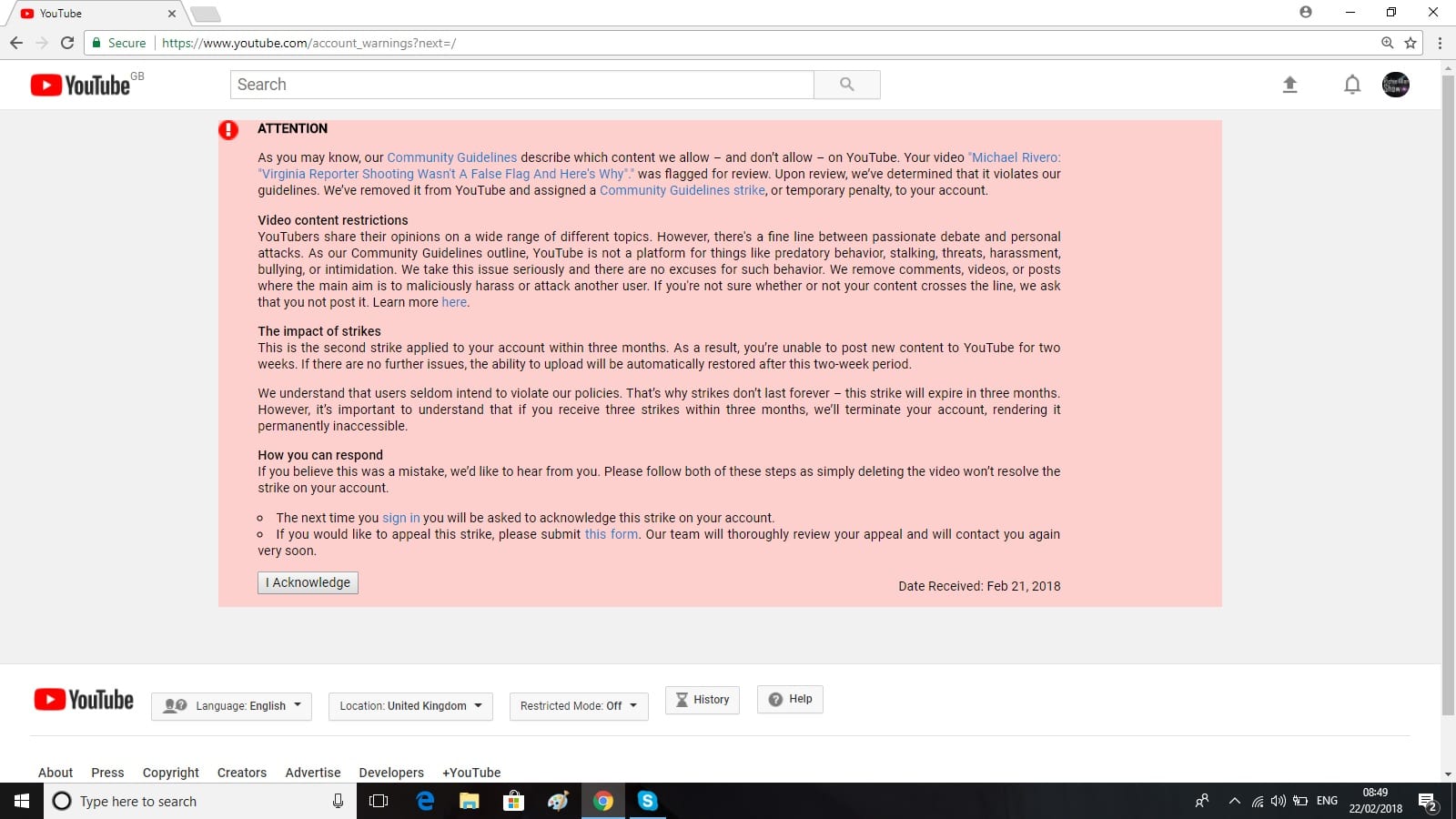
 Strike two came this morning. The offending video this time was an interview I did with Michael Rivero about the shooting of journalist Alison Parker and cameraman Adam Ward in Virginia in August 2015. Yes that’s right, YouTube has issued me with a community guideline strike for an interview I uploaded two and a half years ago. Get this, in the interview, Mike clearly states that he does not believe that the shooting was staged or a false flag. Mike talked about the background of the shooter Bryce Williams and what led him to murder the journalists. This morning, YouTube told me that the interview violated its guidelines on bullying and harassment. Again, there was no harassment or bullying. Mike went with the official story, as did I. Tough shit Paddy, that’s strike two. I was told today, that a third strike will see the channel deleted. A third strike is inevitable, as there are 1,400 interviews on the channel which was created in 2014. Oh and the punishment for strike two? We have been banned from uploading content to YouTube for the next three weeks.
This is fascism, this is tyranny, this is terrifying and we knew that this was coming didn’t we? Yes, there are other platforms but Google/YouTube is the only game in town. I could upload elsewhere, but those platforms don’t have the subscribers, it would be a waste of a lot of time for very little reward. The establishment knows this. This is why these monopolies were allowed to develop, so that they could come after shows like The Richie Allen Show when they felt like it. Over the last eighteen months, they have limited the reach of the channel by shadow banning it, in other words making it difficult for users to discover it. They even began demonetising the videos before they had even been published and then re-monetising them after they’d been watched over 5,000 times, meaning by the time the ads went on the vids, most people had watched them. I’ve talked about this and demonstrated it with photographic evidence. Now they’re about to delete the channel, the coup de grace.
 Now I mentioned that colleagues of mine in commercial TV/Radio had warned me that our channel would be specifically targeted. I’ve been warned time and again, but I knew it was coming anyway. Why The RA show specifically? The reason is simple. There is no other show like it in the independent media. We hold ourselves to the highest professional standards, our production values are second to none and uniquely, we put politicians, academics and other journalists on the air and ask them questions that they would never be asked on mainstream media. That has seen the show become the most listened to independent news show in Europe, the most downloaded podcast in news/politics on Podomatic and has seen us listed on Spotify and iheartradio.
Don’t call me arrogant. I am not now and never have been. I worked for and worked with the best producers and presenters in the world. I served my time and bring all that experience to bear on our show, it’s as simple as that. I am not important, the show is not and never has been about me. The information is the star, I’m just a gobby curmudgeonly Irishman, who learned his trade well. It’s always been about the amazing researchers who come on and share their discoveries and it is about getting their information to people who otherwise would be dismissive of conspiracy research. David Icke implicitly understood the importance of bringing mainstream production values to independent radio and the conspiracy research arena. We talked about it often and back in 2014, when he asked me to consider making my own show, produced edited and introduced by me and me alone, he said, “you can make alternative radio sound as good as or better than commercial radio.”
Of course beauty is in the eye of the beholder, ultimately the audience decides whether a show is any good or not, but there is overwhelming evidence here, that someone/something wants to make life very difficult for me, by removing our YouTube channel and deleting over 1,400 archived interviews. Google has served notice on The Richie Allen Show today, that there is no room for a professionally produced radio show, which asks uncomfortable questions and presents credible evidence that challenges the mainstream narrative.
February 23, 2018
Posted by aletho |
Civil Liberties, Full Spectrum Dominance | Human rights, YouTube |
Leave a comment
GAZA – Palestinian resistance group Hamas criticized Palestinian Authority (PA) chairman Mahmoud Abbas following his speech at the UN Security Council on Wednesday.
In a press release, Hamas underlined that the political plan presented by Abbas in his speech does not reflect the national position which calls for an end to the Oslo Accords and which opposes a resumption of negotiations with Israel.
“Abbas’s speech did not rise up to the desired level, nor did it reflect the national consensus, which wants to terminate the Oslo agreements and rejects negotiations with the occupiers,” Hamas said.
Abbas is working to create a new mechanism for the failed peace process despite Israel’s violations and crimes against Palestinian women and children and the dangerous bias of the United States in favor of Israel on Jerusalem and the refugees and the encouragement it gives Israel to commit crimes and liquidate the Palestinian cause, the statement reads.
In this context, Hamas demanded an end to Abbas’s unilateral decision-making, and instead of following the path of a political process, to accelerate the unification of the ranks within the Palestinian arena and reach an agreement on a national strategy that focuses on the path of resistance.
February 22, 2018
Posted by aletho |
Ethnic Cleansing, Racism, Zionism, Illegal Occupation | Hamas, Human rights, Israel, Palestine, Zionism |
Leave a comment
Canadians should prepare themselves for an onslaught of feel-good propaganda in the coming weeks as the world marks the 15th anniversary of one of the most horrific war crimes of the 21st century, the illegal invasion and occupation of Iraq by forces including the U.S., U.K., and Canada.
It will be disheartening to watch as liberal commentators from the Toronto Star and CBC engage in the most dishonest kind of smug, self-satisfied flag saluting, praising then-Liberal Prime Minister Jean Chretien for allegedly “declining” to sign on to the war. Yet the notion that Canada somehow decided not to be part of the Shock and Awe invasion of Iraq is a complete falsehood, and is well-documented elsewhere .
Lost within any of this self-congratulatory coverage will be the people of Iraq themselves, for whom 2018 marks 38 years of almost non-stop warfare and repression, during which they have endured hardships that are incomprehensible to most of us. The blood of the Iraqi people — millions of them killed, maimed, poisoned, irradiated, traumatized — is on the hands of many Canadian corporate, military, and political leaders who profited from weapons sales and political brinksmanship.
And while every Canadian government from Pierre Trudeau through to Justin Trudeau is in part responsible for this misery, no one has been held to account for aiding and abetting the crimes against humanity that have marked decades of aerial bombardment, the use of chemical and radioactive weapons (resulting in a massive spike in previously unseen birth defects), and an economic sanctions regime described by former UN inspectors as a “genocide.”
Was the price ‘worth it’?
Enforced throughout the 1990s in part with $1 billion in Canadian military muscle, those sanctions led to the monthly deaths of over 5,000 Iraqi children under the age of five, and provoked the high-profile resignations of UN humanitarian co-ordinators Denis Halliday and Hans Von Sponeck. When Halliday resigned in 1998, he stated: “I’ve been using the word ‘genocide’ because this is a deliberate policy to destroy the people of Iraq. I’m afraid I have no other view.”
What was one to make of a policy that deliberately targeted the importation of civilian goods that allegedly had “dual use,” from pencils and baby dolls to eyeglasses and shampoo? The equipment needed to fix electrical generating stations and water purification systems destroyed during the 1991 U.S. and Canadian bombing runs of Desert Storm was not permitted entry, so water-borne diseases ran rampant. The medicines needed to treat the spike in cancer (a result of tons of depleted uranium munitions dust that wound up in the Iraqi soil, air and water) didn’t get through either.
Bill Clinton’s secretary of state, Madeleine Albright, asked on the CBS program 60 Minutes if the sanctions-related deaths of a half million Iraqi children were worth it, famously replied, “We think the price is worth it.”
The people of Iraq were subjected to a Stalingrad-style siege, and while the general responsible for the Russian siege was charged as a war criminal at Nuremberg, Clinton now struts about the world stage as a self-styled “elder statesman” who runs a foundation where he paints himself as the second coming of Mother Theresa.
“In my life now, I am obsessed with only two things: I don’t want anybody to die before their time, and I don’t want to see good people spend their energies without making a difference,” Clinton crowed when the foundation began.
As Clinton continues to rake in obscene six-figure speaking fees for trotting out such tripe and basks in the “at least he wasn’t like Donald Trump” comparisons, New York oncologist Dr. Rafil Dhafir, who also believed no one should die before their time — especially in Iraq — remains behind the same prison walls that have marked his existence since his arrest 15 years ago this week for an alleged crime of compassion.
A crime of compassion
Dr. Dhafir was sentenced to 22 years for consciously violating the sanctions against the people of Iraq. Many individuals and groups who were not Muslim also violated the sanctions — fines were the worst punishment directed at a number of groups — yet Dhafir, as the driving force behind the Help the Needy Foundation, which provided millions in aid, was the only one to suffer such a fate. Needless to say, corporations that quietly went around the sanctions not for humanitarian goals, but to profit from their relationship with the Hussein dictatorship, did not face charges either.
Dhafir’s imprisonment began on the morning of February 26, 2003, when hundreds of federal agents swooped down on the community of Syracuse, New York. They knocked down his door, pointed a gun at his wife’s head, and ransacked his house, taking away any books related to Islam while leaving behind the Bible and tomes on American history.
Agents proceeded to terrorize patients at Dhafir’s clinic, and interrogated almost 150 primarily Muslim Help the Needy donors about how often they prayed, whether they had family in the Middle East, and whether they celebrated Christmas.
Cynically framed as a terrorism-related arrest as the U.S. prepared its invasion of Iraq, the first indictment of Dhafir contained 14 charges of violating sanctions. But when he refused a plea bargain, the government ratcheted up its already hyperbolic case, alleging an additional 45 alleged breaches of various financial laws related to the running of a charity as well as alleged Medicare fraud. The non-sanctions charges were speciously vague, and related to things like incorrectly filling out the complicated Medicare forms (many doctors refuse to treat Medicare patients as a result of their burdensome regulations, and even Medicare officials themselves appeared confused about them during the trial). Charges also arose from using another organization to issue Help the Needy’s tax receipts, a not uncommon practice. In any event, most such “white collar” cases, should they actually result in a trial, do not produce such serious consequences.
Refusing to be silent
As community members could testify, Dhafir was a hugely generous person, and opened his office not in Syracuse, where he could have made more money, but an hour away in Rome, New York, an under-served community. His reputation for providing interest-free loans, treating low-income patients, donating large chunks of money for schools and mosques, and assisting newcomers to the U.S. was legendary.
But Dhafir’s refusal to be silent in the face of genocide resulted in seven government agencies investigating Help the Needy and intercepting his mail, email, faxes and telephone calls, bugging his office and hotel rooms, combing through his trash, and also conducting physical surveillance. They were unable to find any evidence of terrorism links, yet the stench of such alleged associations infused the trial as a result of headline-grabbing outbursts from New York Governor George Pataki and Attorney General John Ashcroft.
After a six-week trial, Dhafir was convicted in February, 2005, though as the Syracuse New Standard pointed out, “The defense was forbidden during the trial to tell the jury that the government’s investigation of Dhafir had apparently begun as a terrorism hunt, nor was the defense allowed to argue that Dhafir had been selectively prosecuted for alleged crimes that are relatively common and do not usually result in criminal charges.”
Said former UN representative Denis Halliday: “I am stunned by the conviction of this humanitarian, especially as the US State Department breached its own sanctions to the tune of $10 billion. The policy of sanctions against Iraq undermined not only the UN’s own charter, but the Declaration of Human Rights and the Geneva Convention as well.”
During his time behind bars, Dhafir has developed a range of debilitating conditions, from an untreated hernia and diabetes, to chronic gout, significant back pain, and incipient cataracts. Even though he was originally sentenced to a medium-security prison within driving distance of his community, he was transferred to the notorious Communication Management Unit in Terre Haute, Indiana (a.k.a., “Little Guantanamo”), which was “home” to dozens of Muslims arrested as part of post-9/11 racial profiling paranoia. At the CMU, he could not have contact visits, his freedom to worship was severely limited, phone calls were rare, and he was harshly treated along with his fellow, isolated inmates.
When Barack Obama was getting ready to leave the White House, Dhafir, now aged 69, had the opportunity to apply for clemency, but declined to do so.
“How can an innocent person like me ask for this alleged commutation from a criminal, regardless of who she/he is?” he asked. While he is considering applying for non-medical compassionate release given his age and the fact that he has served so much time in prison, he watches as the world continues to treat the people of Iraq as a geopolitical punching bag and a $1 trillion economic opportunity. Indeed, Canadian companies are salivating at the chance to help “rebuild” the very infrastructure that they helped to destroy.
Dr. Dhafir, if forced to serve the remainder of his term, will not be released until he is 76 years of age. The lives of those he tried to save in Iraq — as well as the lives of patients who no longer had access to his compassionate and accessible medical services in New York State — are nameless victims to almost all of us, just some of the millions who have been sacrificed in the name of state security, war profiteers, and politicians addicted to militarism.
Further details of Dr. Dhafir’s case are available at www.dhafirtrial.net
February 22, 2018
Posted by aletho |
Civil Liberties, Subjugation - Torture, Timeless or most popular, War Crimes | Canada, Dr. Rafil Dhafir, Help the Needy, Human rights, United States |
Leave a comment
Another terrible school shooting took place in Parkland, Florida last week and unfortunately many politicians and pundits have used the tragedy – as they often do – to push their own agenda. Many will use the tragedy to argue that Americans should be prohibited from owning guns. As if anti-gun laws would dissuade a disturbed or violent individual intent on causing harm. Those intent on mass murder don’t obey gun laws.
It’s unfortunate that while many are quick to demand that guns be taken away from peaceful Americans, they don’t seem to have much to say about guns when they’re in the hands of government authorities shooting innocent people. If we need any gun control, it is to get control of the guns in the hands of thousands of government employees who use them against innocent people with impunity.
For example, why do those calling for more gun control remain silent when armed federal agents raid Amish farms to stop them from selling raw milk? This shows the hypocrisy of those who call for restrictions on private firearms ownership while supporting the use of government violence as a means of controlling our lives.
Unfortunately there are many key questions lost in the race to score political points from the shooting.
Why does it always seem that the shooter in these mass killings has been on some kind of psychotropic drugs? As the New American magazine pointed out this week, at least ten high profile mass shootings have been committed by individuals who “were either on — or just recently coming off of — psychiatric medications.” The young killer in Florida was no different. According to his aunt, he had been on these medications to treat mental problems.
Why is no one questioning these medications – all of which come with labels warning of horrific side effects? Perhaps one reason they are ignored is that the pharmaceutical industry spends billions of dollars lobbying Congress.
Also, how is it possible that the FBI once again missed so many obvious clues that a violent person intent on causing massive harm to others was about to strike? Is the FBI actually this incompetent, or perhaps its focus was in other areas — like meddling in our own elections by presenting “evidence” they knew was flawed to the FISA court to get permission to spy on the Trump campaign?
We’ve heard many stories of how alert FBI field agents tried to alert their bosses before 9/11 that foreigners were taking flight lessons but were not interested in learning how to land the planes.
Is giving the federal government more power to spy on us – as they demand – the answer to stop these terrible crimes? Hardly!
Those who think that giving federal authorities greater surveillance powers might prevent mass shootings should consider that the FBI has been alerted that the latest school shooter had made Facebook posts and YouTube comments talking about his intention to be, as he put it, “a professional school shooter.” But the Bureau failed to properly investigate the tips. If the FBI fails to stop someone who openly boasts about their intentions on social media why should we believe that giving them the power to snoop on every American would increase our safety?
We cannot stop tragedies like this by banning guns. We need to look seriously into the psychotropic drugs that more and more Americans are being prescribed. We need to demand that our elected Representatives demand a real day of reckoning at the FBI. We need to keep focused and ignore those who politicize such events.
February 20, 2018
Posted by aletho |
Civil Liberties | FBI, Human rights, United States |
Leave a comment
Israeli authorities in Jerusalem have begun construction of a new checkpoint on the edge of Al-Walaja, in what has been described as “the final step in blocking the village’s access to a national park built on land confiscated from its residents”.
According to Israeli NGO Ir Amim, the Jerusalem municipality initiated the construction on 14 February, some weeks after Mayor Nir Barkat and Minister of Jerusalem Affairs Ze’ev Elkin inaugurated the Emek Refaim National Park.
“The new checkpoint will replace the one now in operation between Al-Walaja and Gilo [settlement], bringing it directly to the edge of the village… in order to block resident’s access to 1,200 dunams of national park land between the village and the Green Line,” the NGO explains.
The park will thus “deepen the isolation of the village, already encircled by the Separation Barrier on its East Jerusalem side (half of the village lies beyond the municipal border, in the West Bank)”.
According to Ir Amim, these developments in Al-Walaja, “more than half of which is under threat of demolition, on its annexed side”, occur in “the context of a much larger campaign to consolidate the southern perimeter of East Jerusalem and fatally disrupt contiguity with the West Bank”.
To that end, Israel has “steadily promoted plans” in recent years including the expansion of Har Homa and Gilo settlements, and the approval of plans in Givat Hamatos, “which would supplant Har Homa as the newest settlement in East Jerusalem”.
The NGO also cites the “construction of the six-lane highway through residential Beit Safafa, which serves to further disrupt contiguity between East Jerusalem and the Bethlehem area while reinforcing the connection between settlements in the West Bank and Jerusalem”.
February 19, 2018
Posted by aletho |
Ethnic Cleansing, Racism, Zionism | Human rights, Israel, Israeli settlement, Palestine, Zionism |
Leave a comment
I have often asked myself, why there is an impression that some Western activists and pro-Palestinian organisations are working covertly, to divide and weaken the Palestinian cause. Before addressing the primary issue, a little has to be said about the Palestinian cause itself and how many prominent figures side-track real resolutions, with their own ideas as to how Palestinians should act in the face of their foreign occupier.
Whilst many choose to point out the progression of the Palestinian human rights cause in the West – with groups such as the BDS (Boycott Divestment Sanctions) movement and others seeing success – the movement at its most essential level, on the ground in Palestine, seems to be at its very weakest.
In order for the world to see a reality in which Palestinians are granted their full human rights, the most important place to see an emergence of change should surely be from within Palestine itself?
No amount of pro-Palestine advocacy from university students, nor rallies for human rights in the West, will result in direct evolution of the struggle on the ground for the Palestinians. It is the Palestinians themselves that will ultimately lead their own way to freedom. Whilst it is absolutely essential to have a strong solidarity movement overseas, this is not the Palestinian cause in its entirety.
The Israeli government have proceeded to massacre, destroy and dispossess the Palestinians for 70 years now and it is unrealistic to believe that they will simply stop what they are doing – suddenly growing a conscience – all because people in Western nations are mad at them.
The only way an apartheid regime such as Israel changes/falls, is when it is forced to do so. History has illustrated that there must be forceful measures executed in order to bring about change when confronted by Western Empire. From the expulsion of the French and the liberation of Algeria, to the struggle against Apartheid in South Africa, to the fight for Irish independence, the point has been illustrated that resistance is the key to freedom.
Palestinians are generally perceived by foreign onlookers as one of two things, victims or terrorists. The ‘Left’ love the idea of the defenseless civilian that must be saved and the ‘Right’ see Palestinians as violent extremists. Those looking in at the Palestinian struggle seem to have two ultra-polarized views, with little space for the idea that Palestinians are human beings in the struggle to liberate their homeland, thus the general consensus amongst the left is to reject the notion of Palestinians as being engaged in a potentially violent battle for their homeland and existence.
There is no simple solution to what is going on – although it is a conflict that is relatively easy to understand – this article is not claiming to provide all the answers, but certainly is of importance in order to understand a very sinister agenda that has been put into practice for some time now in Palestine.
The agenda to divide and conquer the Palestinian people and how this is being carried out.
Many steps have been taken by the Israeli government, in order to destroy the foundations of Palestinian society. Attempts to suppress the populations of the Gaza strip and West Bank pre-date the occupation/besiegement of these territories themselves and have varied in their approach to achieving this aim.
When Shimon Peres (former Israeli Prime Minister and President) established the first settlements in the West Bank and acted upon his plan to economically coerce the Palestinians of the occupied territories, he changed how the Israeli takeover of Palestine would manifest itself.
Instead of all out genocide, Israel began a process of quietly and sneakily conquering the land they sought to capture and hiding their true intentions through the notion of a ceasefire and what would be seen as “relative peace”.
Israel’s Infiltration of Palestinian Resistance is Exposed
After speaking to countless Palestinian activists in the West Bank, on the current state of the Palestinian cause, one theme remained constant, the lack of unity in Palestine today. Almost everyone I spoke to on this issue would reminisce back to the days of the second Intifada (or uprising) – which started in the year 2000 and lasted roughly five years – everyone spoke of how the people came together against the occupation and of the current erosion of that unity.
Intrigued as to how Palestinian unity had dissipated, as was described, I quickly came to the conclusion that the election of Mahmoud Abbas as president of the Palestinian Authority, was a primary factor, then I began to look deeper.
Although the Palestinian Authorities actions had made some impact, I discovered something else lurking behind the scenes. As I travelled from village to village, city to city, everywhere I went I saw division between grassroots organizations and feuds between activists, I saw this often hinder the results of organized demonsrations and campaigns.
After investigating the reasons behind these divisions, I found in every instance the involvement of Western activists and/or organizations.
Palestinians are often offered many things by international organizations/activists, such as celebrity status, money for their families or projects they are working on, the ability to travel to spread their message and much more, but this comes at a price.
These organizations and foreign activists, come with a particular view of how the cause has to be seen and seek to impose boundaries upon those that they promote.
If you would like money and to be highly regarded in the eyes of the many, you are forced to abide to the guidelines you are given, fearing demonization if you do not follow what they prefer you to talk about and focus your energies on.
Other Palestinian activists then often note the capitulation to the boundaries established for those aided by international organizations, this I found to be a primary instigator of infighting.
It is definitely conceivable that these organizations and activists truly believe that what they are doing, is for the good of the people they claim to advocate for. However I cannot simply believe the notion of coincidence without considering a much deeper involvement, one truly insidious in its nature.
If it was happening in one village or two, perhaps I could believe that these wealthy and well established groups were not compromised, but this was persistent throughout the West Bank, in almost every city and village I saw the same trend.
Other than causing feuds between activists and dividing grassroots organizations, the international groups are able to achieve the objective, of forcing those that they “help”, to speak only on very specific issues within occupied Palestine. When the attention is all surrounding one street, or one single instance of a human rights abuse, the wider picture is often fragmented, the wider picture being Israel’s intentions for all of Palestine.
Palestinians are never allowed to voice their opinions on a solution to what Israeli is/has been doing to them and their land, they always must assume the position of a victim, a victim that the West must step in to save. Of course when you depend upon the best friend of the occupier to save the occupied, this is a defeatist cycle.
By allowing these Western organizations – which approach the peaceful solution prospect from a Zionist point of view – to control the Palestinian grassroots organizations, it acts to muddy the water, destroying the foundations of the Palestinian movements.
I would proceed to name specific cases, activists and organizations, but I believe this would do a disservice to the purpose of this article. Rather than encouraging backlash against specific individuals, it is best that the points noted above be circulated in an effort to raise awareness.
Cliques of virtue signalers who seek to make themselves famous or wealthy off of the occupation.
As the Palestinian cause continues to gather support in the West, so does praise for those who choose to stand in solidarity with it. An alarming trend has been sparked recently, with virtue signaling activists who visit occupied Palestine, seeking to draw attention, a following and an income from their short-lived trips.
Insensitive videos have been circulated, by previously unknown activists, in which they feature with smiles on their faces, attempting a happy-go-lucky approach to reporting the horrific crimes committed against the Palestinians. With them, also come those that feel they are entitled to tell Palestinians how they should resist and deal with the occupation they face, otherwise known as the saviour complex.
To illustrate my point about these types of – so called – activists, I would like to share a personal account of my experiences whilst working for a short while with an international activist group.
During my recent visit to Palestine, spanning three months, I decided to get involved with a group called the ISM or International Solidarity Movement (in Hebron or al-Khalil). Whilst the ISM have in the past done some great work, this specific group of entitled university students I encountered, were nothing short of parasitic to the cause they claimed to stand for.
The group that I encountered at this time was five individuals who considered the Israeli firing of tear gas at Palestinian children to be an event to be joked about. This group of individuals brought with them preconceived ideals, feeling that they had a right to better comment on how Palestinians fight their externally imposed occupiers.
After my defending of a Palestinian man’s “legal and moral right” to expel the Israeli occupier with all means available, I was all but told to pack up my stuff and leave the accommodation we were staying in. Having been cast out for my differing views to my western room-mates, I was taken in by a Palestinian family who had none of the advantages of my previous companions but ten times the hospitality and respect for diverging views.
It is my position that Palestinians have every right to choose how they resist their foreign occupier, without the interference of those who claim to be in support of them. The dispute between this group and I took place at a rooftop cafe in the West Bank city of al-Khalil and consisted of them coming from a perspective that Palestinians were not as politically astute as they were.
I later discovered that this push back is a common occurrence when anyone goes against the grain of ISM’s diktat on how the Palestinian cause should be “managed”.
After speaking to many Palestinian friends – such as Iyad Burnat from the village of Bil’in and others – I got the sense that these types of activists were not all that uncommon.
I believe that talking about this issue, of activists who end up doing a great disservice to the Palestinian people, is key to making things better on the ground. One of the most powerful weapons that the Israelis can use against the Palestinians and their supporters – is division through misunderstanding, confusion and lack of education on what these organisations should be trying to achieve in solidarity with the Palestinian resistance – anything else, essentially controlled by the Zionist entity is nothing less than psychological warfare, designed to fragment support for the Palestinians.
It is imperative that we become aware of what division does to a cause that depends upon unity, therefore I wish for this article to be passed on, as a first hand experience. Palestinians often find it difficult making their voices heard, so this report comes from those that wish to communicate this point to the wider community of Palestinian human rights supporters.
Robert Inlakesh recently spent three months in various parts of the West Bank, occupied Palestine, living with Palestinian families and witnessing the crimes of the Zionist occupiers.
February 18, 2018
Posted by aletho |
Corruption, Ethnic Cleansing, Racism, Zionism, Solidarity and Activism, Timeless or most popular | Human rights, Israel, Palestine, Zionism |
Leave a comment
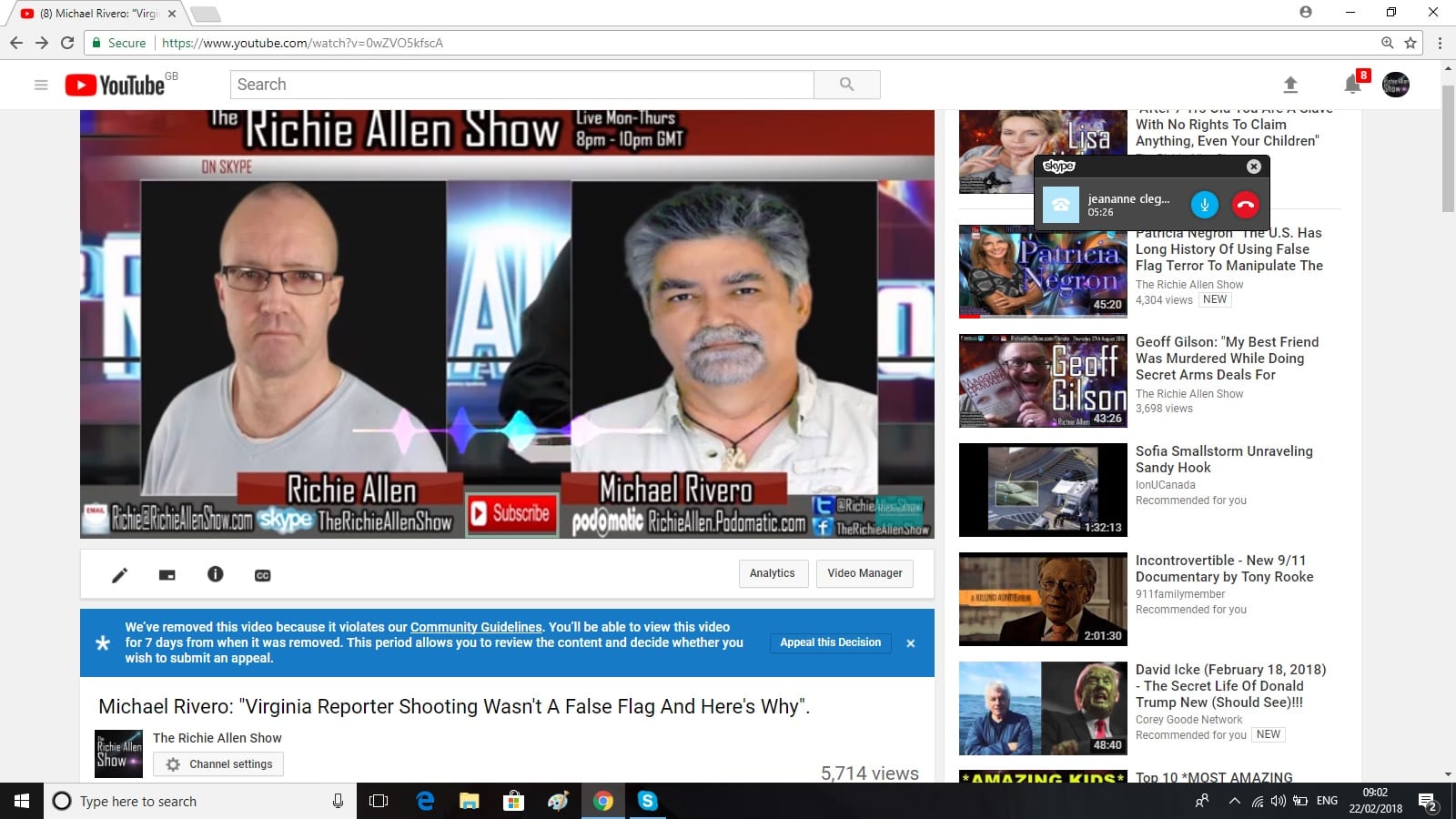 Strike two came this morning. The offending video this time was an interview I did with Michael Rivero about the shooting of journalist Alison Parker and cameraman Adam Ward in Virginia in August 2015. Yes that’s right, YouTube has issued me with a community guideline strike for an interview I uploaded two and a half years ago. Get this, in the interview, Mike clearly states that he does not believe that the shooting was staged or a false flag. Mike talked about the background of the shooter Bryce Williams and what led him to murder the journalists. This morning, YouTube told me that the interview violated its guidelines on bullying and harassment. Again, there was no harassment or bullying. Mike went with the official story, as did I. Tough shit Paddy, that’s strike two. I was told today, that a third strike will see the channel deleted. A third strike is inevitable, as there are 1,400 interviews on the channel which was created in 2014. Oh and the punishment for strike two? We have been banned from uploading content to YouTube for the next three weeks.
 Now I mentioned that colleagues of mine in commercial TV/Radio had warned me that our channel would be specifically targeted. I’ve been warned time and again, but I knew it was coming anyway. Why The RA show specifically? The reason is simple. There is no other show like it in the independent media. We hold ourselves to the highest professional standards, our production values are second to none and uniquely, we put politicians, academics and other journalists on the air and ask them questions that they would never be asked on mainstream media. That has seen the show become the most listened to independent news show in Europe, the most downloaded podcast in news/politics on Podomatic and has seen us listed on Spotify and iheartradio.
 Aletho News
